

Jainism: Theory of Reality; Saptabhaṅgīnaya; Bondage and Liberation.
Official Syllabus: Paper I, Section B, Unit 13
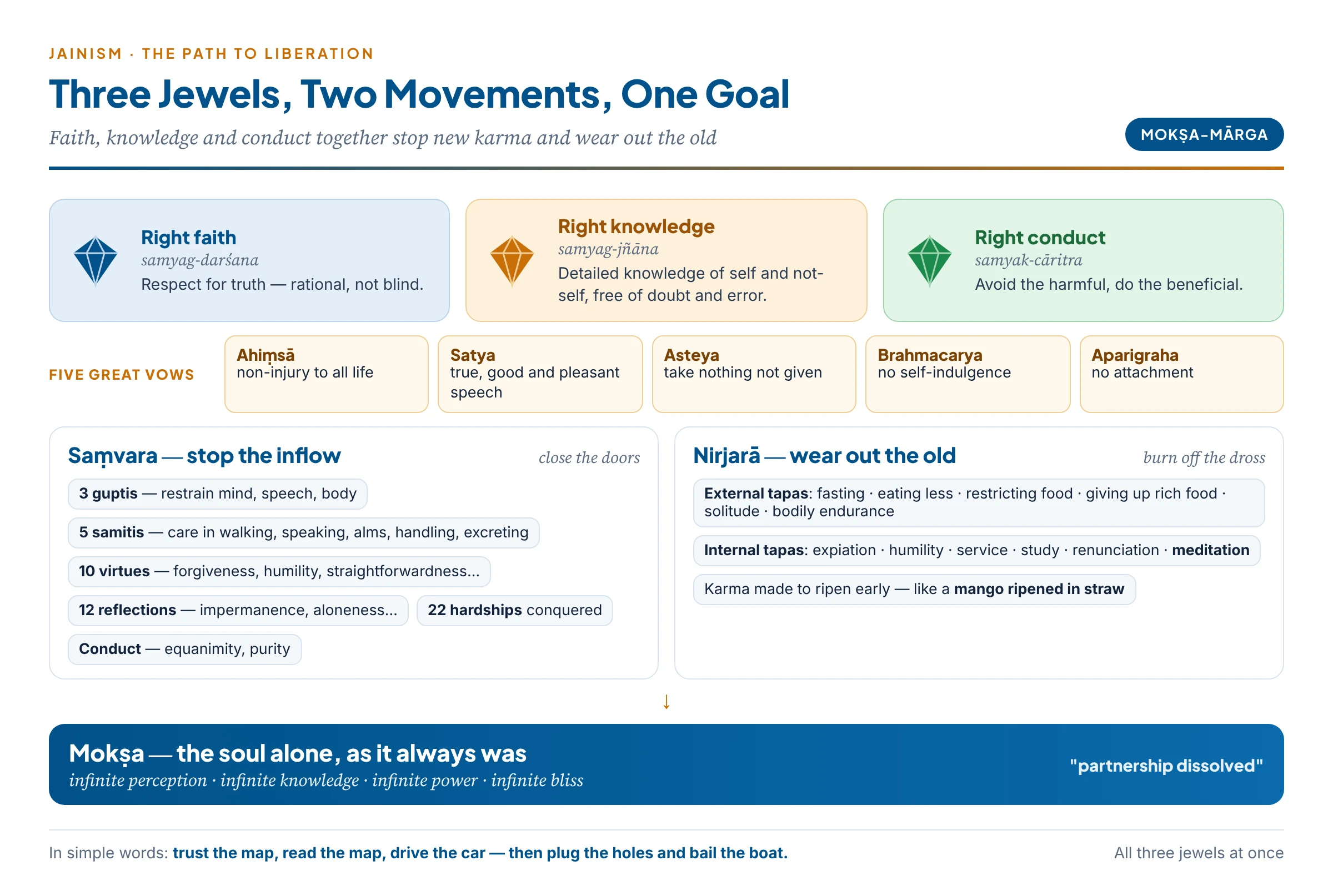
If bondage is the union of the soul with karmic matter, liberation (mokṣa) is their complete separation. The Jaina path to it has two movements: stop fresh karma from flowing in (saṃvara) and wear out the karma already bound (nirjarā). Both are achieved through the three jewels (triratna) — right faith, right knowledge and right conduct — practised together, with the five great vows (pañca-mahāvrata) at the heart of conduct. When the last particle of karma falls away, the soul regains its four infinities, rises to the summit of the universe (siddha-śilā) and dwells there for ever, omniscient and blissful, never to be born again. This article explains the path, the stages of spiritual ascent, the condition of the liberated soul, the comparison with Yoga’s kaivalya, and the main criticisms with the Jaina replies.
In simple words
A lamp inside a dirty glass chimney gives only a dim, smoky light. You do not need to buy a new lamp; you need to stop more soot settling (close the gap that lets smoke in) and clean off the soot already there. Then the flame shines as brightly as it always could. The Jaina soul is the flame, karma the soot, saṃvara the closing of the gap and nirjarā the cleaning. Mokṣa is the clear chimney.
Context & Problem
From Bondage to Liberation
- The logic. “If bondage means the union of soul with matter, then liberation means the separation of matter from soul.” This can be attained by stopping the influx of new matter and by completely eliminating the matter already mingled with the soul.
- Negative and positive. Liberation means negatively the removal of all bondage and positively the attainment of perfection — the soul’s own infinite knowledge, perception, power and bliss.
- The goal of Jaina philosophy. “To liberate the jīva from bondage is the final aim of Jaina philosophy.” Metaphysics and epistemology matter to the Jaina only in so far as they help right conduct; the most significant part of Jainism is its ethics.
- Proof that it is possible. The Tīrthaṅkaras (“ford-makers”) were once bound souls like us who freed themselves; their lives prove that liberation is possible and show the path. Hence the Jaina motto: “What man has done, man can do.“
- Synonyms. The texts speak of liberation as mokṣa, mukti, nirvāṇa, apavarga and, for the omniscient state, kaivalya.
Why Knowledge, Faith and Conduct?
- The chain of causes. Passions bind the soul; passions spring from ignorance of the real nature of the soul and the world; ignorance can be removed only by knowledge. So right knowledge is the cause of liberation.
- Faith before knowledge. Right knowledge comes from studying the teachings of the omniscient Tīrthaṅkaras; but one must first have some faith in them, based on a preliminary acquaintance, to begin that study. So right faith is needed.
- Conduct perfects knowledge. Knowledge that is not lived is useless: “theory without practice is empty, and practice without theory is blind.” So right conduct is needed. Right knowledge fully dawns only when the karmas are destroyed by right conduct.
- One path, three jewels. The first sūtra of Umāsvāti’s Tattvārtha Sūtra states the cardinal teaching: “Right faith, right knowledge and right conduct together are the path to liberation” (samyag-darśana-jñāna-cāritrāṇi mokṣa-mārgaḥ). Liberation is their joint effect.
Core Doctrine
1. The Three Jewels (Triratna)
Right faith (samyag-darśana):
- Definition. Umāsvāti defines right faith as an attitude of respect (śraddhā) towards truth — a correct and pure view of reality, free from delusion.
- Content. Faith in the eternal soul and its capacity for liberation; in the teaching of the twenty-four Tīrthaṅkaras; in the seven principles; and recognition of liberation as the goal.
- Inborn or acquired. In some it arises spontaneously; in others it is acquired by learning and culture. In either case it appears only when the karma that causes disbelief (a form of deluding karma) is calmed or worn away.
- Not blind. Jaina faith is rational, not dogmatic. A famous Jaina verse of Haribhadra, quoted by the commentator Maṇibhadra, puts it memorably: “I have no bias for Mahāvīra and none against Kapila and others. Reasonable words alone are acceptable to me, whoever’s they may be.“
- Why initial faith is reasonable.
- It is based on some initial acquaintance and is proportionate to it.
- Without it there would be no incentive to study further.
- Even a sceptic who studies rationally must have faith in the usefulness of his method.
- Faith grows with knowledge. Starting with partial faith and finding the teachings reasonable, the student’s faith increases; perfect knowledge brings perfect faith.
- The first step. Right faith is the first step of spiritual progress: without it one acts wrongly out of ignorance of the soul’s true nature.
Right knowledge (samyag-jñāna):
- Definition. “The detailed cognition of the real nature of the self and the not-self, free from doubt, error and uncertainty” (Dravyasaṅgraha).
- Content. Knowledge of jīva, ajīva and karma and of how karma binds and is removed; of the paths to liberation; and study of the scriptures such as the Tattvārtha Sūtra and the Āgamas.
- Its own obstacles. Knowledge too is hindered by karma (knowledge-obscuring karma); as these karmas are removed, knowledge grows until it reaches omniscience (kevala-jñāna).
- Its fruit. Right knowledge reveals the impermanence of material life and the true nature of the soul, and so leads to detachment.
Right conduct (samyak-cāritra):
- Definition. “Refraining from what is harmful and doing what is beneficial” (Dravyasaṅgraha) — whatever helps the self get rid of the karmas that bind it.
- Purpose. Through right conduct one controls the passions, senses, thought, speech and action in the light of right knowledge; this stops new karma and eradicates old karma.
- Daily disciplines. Repentance and self-examination (pratikramaṇa), austerity (tapas) and meditation purify action, speech and thought.
- Inseparable. The three jewels are inseparably bound up: the progress or decline of one reacts on the other two, and the perfection of one goes with the perfection of the others. They must be practised simultaneously.
In simple words
Think of a journey by car. Faith is trusting the map enough to set out; knowledge is reading the map correctly; conduct is actually driving — braking, steering, staying in lane. Trust without reading gets you lost; reading without driving gets you nowhere; driving without a map is a gamble. Only all three together bring you home.
2. The Five Great Vows (Pañca-mahāvrata)
The vows are known to the Upaniṣads, to the Buddhist five precepts (pañca-śīla) and, in substance, to the commandments of the Bible; but the Jainas practise them “with a rigour scarcely found elsewhere”. Some Jaina writers regard the five vows as sufficient for perfect conduct, the other disciplines only repeating their principles.
- Ahiṃsā — non-injury.
- Abstinence from injury to all life — not only to mobile beings but to the immobile ones in plants and in bodies of earth, water, fire and air.
- Jaina saints breathe through a cloth over the nose and mouth lest they destroy organisms in the air, and sweep the path before them.
- It covers thought, word and deed: one must not take life, nor think or speak of taking it, nor permit or encourage others to take it.
- It has a negative side (not harming) and a positive side (helping any suffering creature).
- Its basis is metaphysical: the potential equality of all souls, and the principle of reciprocity — do to others as you would be done by. It is not a relic of a primitive awe of life, as some critics thought. “Respect for life wherever found” becomes an irresistible duty.
- Satya — truthfulness.
- Speaking what is true, and also what is good and pleasant (sūnṛta); mere truth can sink into garrulity, vulgarity or insult.
- To keep it fully, one must conquer greed, fear and anger and even restrain the habit of jesting. A blunt truth is modulated by kindness.
- Asteya — non-stealing.
- Not taking what is not given.
- “Wealth is the outer life of man, and to rob wealth is to rob life“: the sanctity of property follows from the sanctity of life.
- Brahmacarya — abstinence from self-indulgence.
- Usually celibacy, but deeper: giving up self-indulgence of every form — in speech, in thought, in the hope of pleasures in heaven, and in asking or permitting others to indulge.
- It extends to indulgence external and internal, subtle and gross, worldly and other-worldly, direct and indirect.
- Aparigraha — non-attachment, non-possession.
- Giving up attachment to the objects of the five senses — pleasant sound, touch, colour, taste and smell.
- Attachment to the world is bondage to the world; its force causes rebirth; so liberation is impossible without withdrawing it.
- Great vows and small vows. The Jaina community (saṅgha) has monks, nuns, laymen and laywomen, organically related — the difference between monk and layman is one of degree, not kind (unlike early Buddhism, where the laity were less integrated). Monks and nuns keep the great vows (mahāvrata) strictly; lay people keep small vows (aṇuvrata), a milder form: brahmacarya becomes chastity (faithfulness in marriage), aparigraha becomes contentment (limiting possessions), and ahiṃsā begins with not injuring beings of two or more senses.
3. Saṃvara: Stopping the Inflow
Saṃvara closes the doors through which karma enters. The texts list its means:
- Gupti — restraints (three). Control of mind, speech and body.
- Samiti — carefulness (five).
- Īryā — care in walking, so as not to tread on any creature.
- Bhāṣā — care in speaking.
- Eṣaṇā — care in receiving alms and food, for the right purpose.
- Ādāna-nikṣepaṇa — care in picking up and putting down things.
- Utsarga — care in answering the calls of nature at a proper place.
- Dharma — the ten virtues. Forgiveness, humility (softness), straightforwardness (simplicity), truthfulness, purity (cleanliness, freedom from greed), self-control, austerity, renunciation (sacrifice, giving), non-attachment (disenchantment) and celibacy.
- Anuprekṣā — the twelve reflections. Meditation on the cardinal truths about the self and the world: impermanence, helplessness (no refuge but the dharma), the cycle of births, aloneness (each soul acts and suffers alone), the distinctness of soul from body, the impurity of the body, inflow, stoppage, wearing out, the structure of the universe, the rarity of enlightenment, and the true religion.
- Parīṣaha-jaya — conquest of hardships. Bearing with fortitude hunger, thirst, heat, cold, insect bites, insults and other pains (twenty-two are listed).
- Cāritra — conduct. Attaining equanimity, purity, absolute greedlessness and perfect conduct.
And the five great vows underlie all six.
In simple words
A boat with holes is filling with water. Bailing alone is useless while water keeps pouring in; plugging the holes alone leaves the boat half-sunk. You must plug the holes and bail out the water. The holes are the channels of āsrava, plugging them is saṃvara, bailing is nirjarā — and a dry boat that floats freely is mokṣa.
4. Nirjarā: Wearing Out the Karma Already Bound
- Two ways karma falls away.
- Natural (savipāka) — karma ripens in its own time, gives its fruit and drops off, like a mango ripening on the tree. This happens to every soul constantly — but new karma usually comes in as fast as old karma goes.
- Induced (avipāka) — karma is made to ripen and fall before its time by austerity, like a mango ripened early in a heap of straw. This is the nirjarā that leads to liberation.
- Austerity as fire. Austerity (tapas) is the “fire” that burns off karma; it serves both saṃvara and nirjarā.
- Six external austerities.
- Fasting (anaśana).
- Eating less than one’s fill (avamaudarya).
- Restricting the kinds of food accepted (vṛtti-parisaṅkhyāna).
- Giving up tasty food such as ghee, milk and sweets (rasa-parityāga).
- Living in a lonely place (vivikta-śayyāsana).
- Mortification of the body — enduring heat, cold and difficult postures (kāya-kleśa).
- Six internal austerities.
- Expiation of faults (prāyaścitta).
- Humility and reverence (vinaya).
- Service to others, especially the sick and elders (vaiyāvṛttya).
- Study of scripture (svādhyāya).
- Renunciation of attachment to the body (vyutsarga).
- Meditation (dhyāna) — the highest, culminating in “pure meditation” (śukla-dhyāna).
- Internal over external. The internal austerities matter more: fasting without humility and meditation only tortures the body. External austerity is valuable because it supports inner purification.
Common confusion
Do the Jainas think that suffering itself destroys karma? No. Pain endured with passion — resentment, self-pity, pride in one’s endurance — binds new karma even while old karma falls away. What destroys karma is austerity undertaken with right faith and knowledge, in equanimity. This is why the internal austerities — expiation, humility, service, study, renunciation and meditation — are ranked above the external ones, and why “pure meditation” is the highest austerity of all.
5. The Ladder of Spiritual Stages (Guṇasthāna)
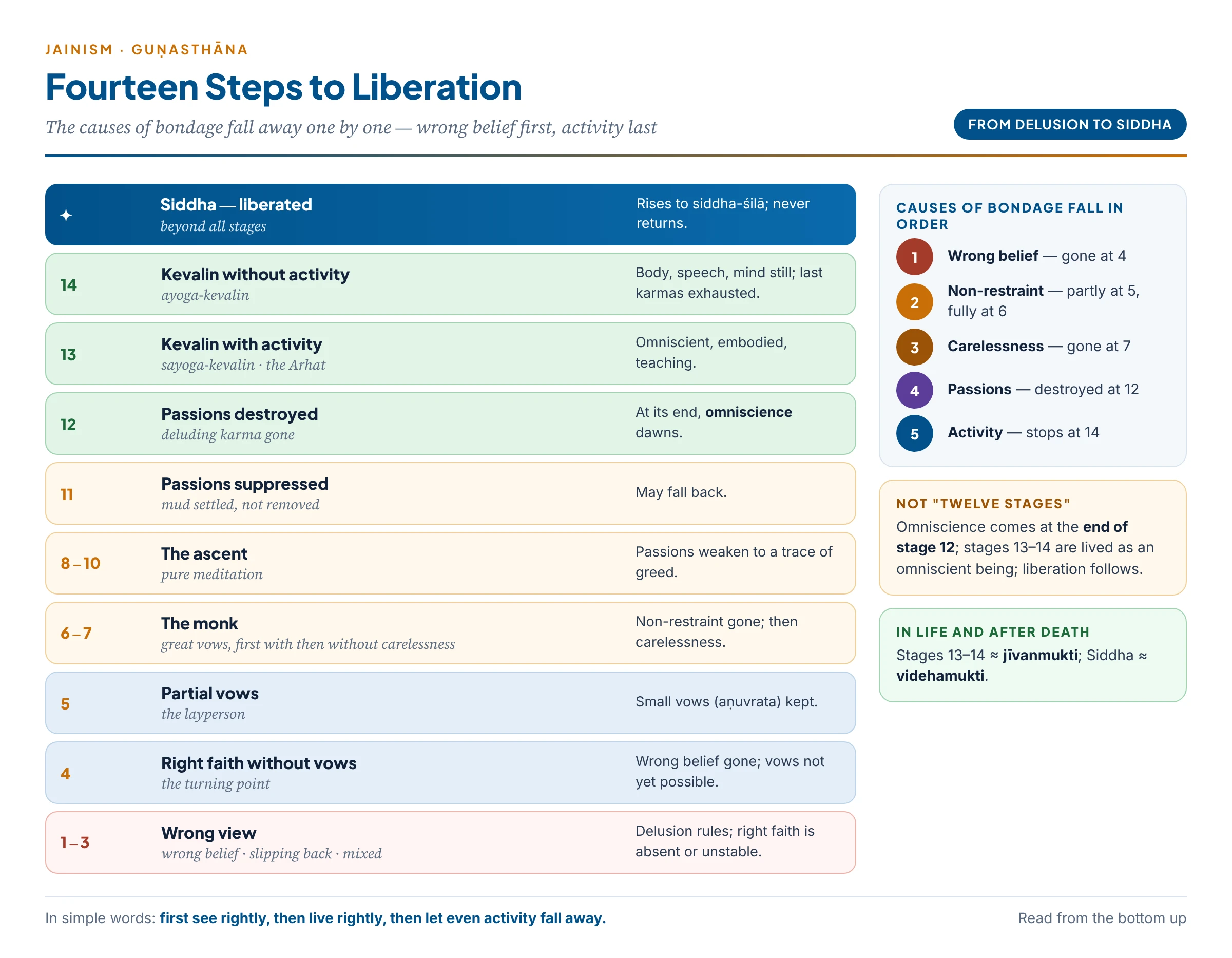
The causes of bondage disappear one by one, and the soul climbs fourteen stages of spiritual development (guṇasthāna):
- Stages 1–3 — wrong view. The soul is in wrong belief (stage 1), may taste right faith and slip back (stage 2), or waver in a mixed state (stage 3).
- Stage 4 — right faith without vows. The soul gains right faith (samyag-darśana) but cannot yet keep vows. This is the real turning point.
- Stage 5 — partial vows. The layperson who keeps the small vows.
- Stages 6–7 — the monk. Full vows, at first with some carelessness, then without it.
- Stages 8–10 — the ascent. Pure meditation weakens the passions to the subtlest trace of greed.
- Stage 11 — passions suppressed. The passions are only calmed, like mud settled at the bottom of water; the soul may fall back.
- Stage 12 — passions destroyed. Deluding karma is wholly destroyed; at the end of this stage the other harming karmas fall away and omniscience dawns.
- Stage 13 — the omniscient with activity (sayoga-kevalin). The soul is an Arhat: omniscient, still embodied, still speaking and moving. Its activity brings in only the momentary, non-binding inflow. The Tīrthaṅkaras preach at this stage.
- Stage 14 — the omniscient without activity (ayoga-kevalin). In the last moments of life all activity of body, speech and mind stops; the remaining non-harming karmas are exhausted.
- Beyond the stages — the Siddha. The soul leaves the body for ever and is liberated.
- Liberation in life and after death. Stages 13–14 are often compared with liberation while living (jīvanmukti) and the final stage with liberation after death (videhamukti); in Buddhism, with nirvāṇa with remainder and without remainder.
Common confusion
Are there twelve stages to omniscience, or fourteen stages to liberation? Some notes speak of “twelve stages” through which the soul attains omniscience. The standard Jaina scheme has fourteen guṇasthānas. The confusion arises because omniscience appears at the end of the twelfth stage, when deluding karma has been destroyed; the thirteenth and fourteenth stages are lived as an omniscient being, and final liberation comes after the fourteenth.
6. Kevala-jñāna and the Arhat
- Meaning. Kevala means “alone, pure, absolute“; kevala-jñāna is omniscience — knowledge of all substances in all their aspects, past, present and future, directly and simultaneously.
- Inherent, not acquired. It is the soul’s own nature, obscured by karma; every soul can attain it.
- When it arises. When the four harming karmas — knowledge-obscuring, perception-obscuring, deluding and obstructing — are destroyed. The soul is then a kevalin or Arhat (“worthy one”).
- The Tīrthaṅkara. Some kevalins, the Tīrthaṅkaras like Mahāvīra, not only attain omniscience but preach the path and found the fourfold community. They are revered as perfect beings and models.
- Prerequisite of mokṣa. Kevala-jñāna is the necessary condition of final liberation; when the kevalin’s body falls away, it becomes a Siddha.
7. The Condition of the Liberated Soul
- The moment of liberation. Liberation is the destruction of all eight kinds of karma (aṣṭa-karma-kṣaya). “When the last particle of karma has been exhausted, ‘the partnership between soul and matter is dissolved‘, and the soul shines in its intrinsic nature of infinite faith, knowledge, bliss and power.”
- The four infinities (ananta-catuṣṭaya): infinite perception (or faith), infinite knowledge, infinite power and infinite bliss — not newly produced, but uncovered.
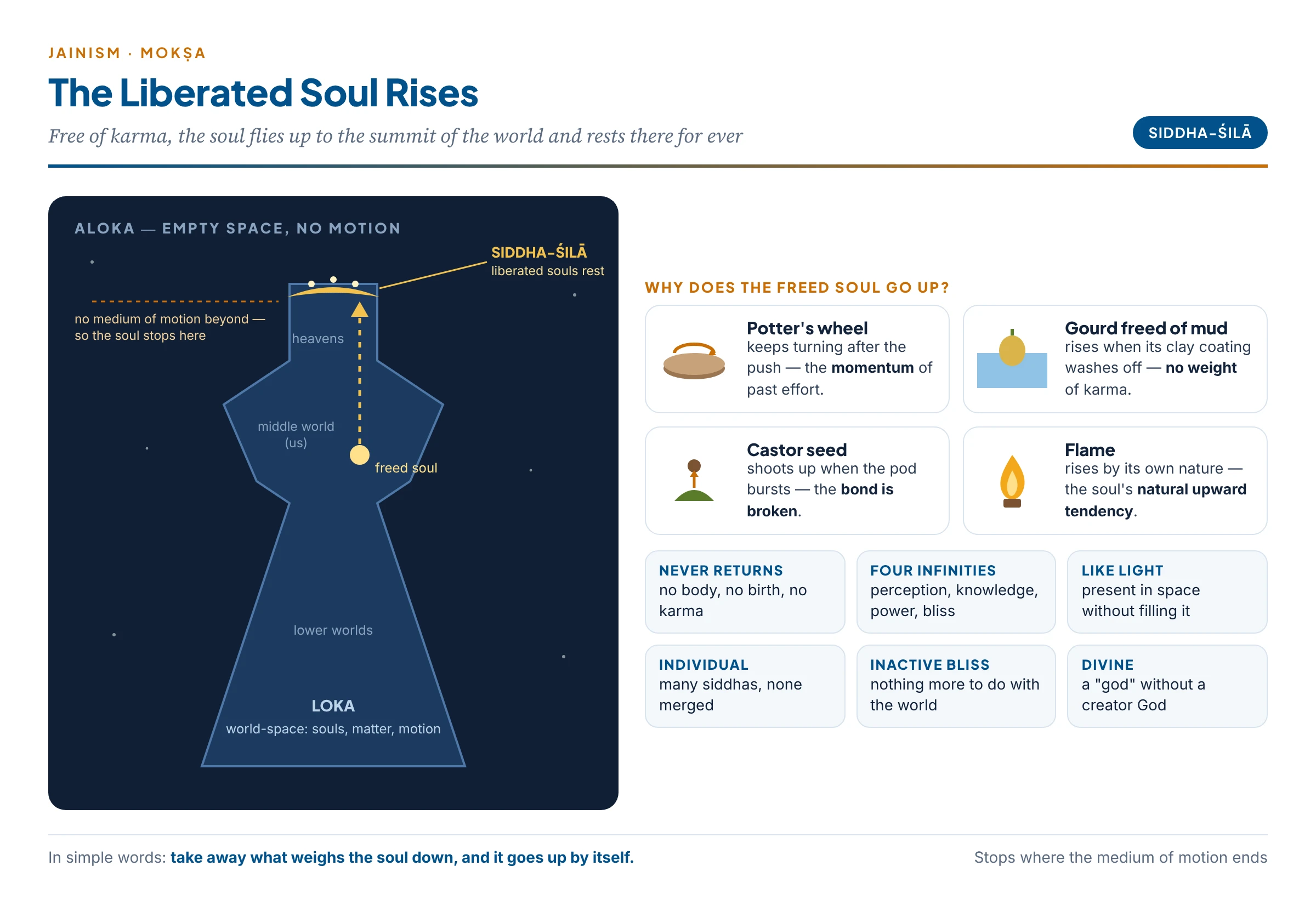
- Upward flight. Freed from matter, the soul rises at once to the top of the universe, above the highest heaven. The Jainas explain this upward motion with four examples:
- Like a potter’s wheel that goes on turning after the push — the momentum of past effort.
- Like a gourd coated with mud that sinks, but rises to the surface when the mud washes off — freedom from the weight of karma.
- Like a castor seed that shoots up when its pod bursts — the breaking of bonds.
- Like a flame, whose nature is to rise — the soul’s natural upward tendency.
- Why it stops at the summit. Above the world-space there is no medium of motion (dharma), so the soul comes to rest at siddha-śilā, the crescent-shaped abode at the very top of the universe.
- Its state.
- Never embodied again; never reborn; no return to the world.
- Absolute purity; free of every particle of karma.
- Inactive omniscient bliss “through all eternity” — it has nothing more to do with worldly affairs.
- It does not fill space like matter but is present in space like light; many siddhas can occupy the same place, as many lights fill one room.
- Each liberated soul remains individual — liberated souls are many, alike in nature but distinct; they do not merge into any absolute.
- Divine without God: every liberated soul is a god in the Jaina sense; the siddhas, with the other exalted souls, are worshipped not for favours but as ideals.
In simple words
Coat a dry gourd with layers of wet clay and drop it in a pond: it sinks to the bottom. As the water slowly washes the clay away, the gourd bobs up to the surface on its own — nobody needs to pull it. The Jaina soul is like that gourd: karma is the clay that keeps it down, and once the clay is gone it rises by its own nature.
8. Bound Soul and Liberated Soul Compared
| Bound soul | Liberated soul | |
|---|---|---|
| Relation to karma | Mixed with karmic matter “like milk with water” | Wholly free — “partnership dissolved” |
| Knowledge | Partial, through senses and mind; relative (syādvāda) | Omniscience (kevala-jñāna), direct and simultaneous |
| Four infinities | Covered, like the sun behind clouds | Fully shining |
| Body | Embodied in one of many forms; size of its body | Bodiless; present like light |
| Place | Moves through the world in birth after birth | At siddha-śilā, the summit of the universe |
| Activity | Acts with body, speech, mind; binds karma | Inactive bliss; no karma, no return |
| Individuality | One of innumerable souls | Still individual — liberation is not merger |
9. Sects and Liberation
- Two sects. The Digambaras (“sky-clad”) hold that a monk must renounce everything, even clothing; the Śvetāmbaras (“white-clad”) allow simple white robes.
- Who can be liberated? The Digambaras hold that women cannot attain liberation without first being reborn as men, and that the omniscient being needs no food; the Śvetāmbaras reject both views and count Mallinātha, the nineteenth Tīrthaṅkara, as a woman.
- Common ground. Both accept the same seven principles, three jewels, five vows and the same idea of liberation as the separation of soul from matter.
10. Jaina Liberation and Yoga Kaivalya
Both systems call the highest state kaivalya (“aloneness”, “isolation”), and both share the five vows — Yoga’s yamas (non-violence, truthfulness, non-stealing, celibacy, non-possession) are the same five, and Patañjali even calls them a “great vow” when kept universally. But the two ideas differ deeply.
| Feature | Jainism | Yoga (with Sāṃkhya) |
|---|---|---|
| What is freed | Jīva — a real knower, agent and enjoyer | Puruṣa — a passive witness, never really an agent |
| Was bondage real? | Yes — a real mixture with karmic matter | No — puruṣa only seems bound through identification with the mind (citta) |
| What is removed | Karmic matter clinging to the soul | The modifications of the mind and puruṣa’s identification with them |
| Content of liberation | Positive: infinite knowledge, perception, power and bliss | Isolation: pure consciousness resting in itself, beyond pleasure and pain; no knowledge of objects |
| Omniscience | The essence of liberation | A by-product power on the way, not the goal |
| Size and place | Bodiless, at siddha-śilā at the top of the universe | All-pervading; no place |
| Means | Three jewels, five vows, saṃvara, nirjarā, austerity | Eight limbs of Yoga, culminating in seedless samādhi |
| God | No God; the liberated are divine | Īśvara as a special puruṣa — an optional aid to meditation |
| Liberated while living | The kevalin (stages 13–14) | The yogin in cloud-of-virtue samādhi; the body falls later |
Indian Connect — Key takeaways
- In both systems liberation is “aloneness” of the spirit from matter, reached by ethical discipline and meditation; both reject a creator God as the cause of bondage or release.
- Jaina kaivalya is rich — omniscience and bliss; Yoga kaivalya is austere — pure consciousness without content. Jaina bondage is real, Yoga bondage is a mistaken identification.
- Advaita goes further than both: liberation is realising that the self is Brahman — no plurality of liberated souls remains. Buddhism denies any permanent self to be liberated at all; nirvāṇa is the blowing out of craving.
11. The Jaina Experience of Liberation and the Buddhist
Religious experience in Jainism and Buddhism shows how conflicting such experiences can be, even within the same culture.
- Jainism: the climax is kevala-jñāna — the experience of a permanent, individual, omniscient soul shining in its own bliss, reached through severe austerity.
- Buddhism: the climax is nirvāṇa — the experience of the cessation of craving and of no permanent self (anattā), reached by a middle path that rejects extreme austerity.
- The point. Two disciplined traditions, both non-theistic, report experiences that contradict each other on the very existence of a self. Religious experience seems to be shaped by prior doctrine — a key issue in the philosophy of religion.
Critical Evaluation
Objections
- Extreme asceticism. The Buddha, who had practised severe austerities, rejected them as useless self-torment and said he was happier without them; he chose the middle path. The Gītā too condemns those who “torture the body”.
- Impractical ahiṃsā. If there is life in earth, water, air and fire, every breath, step and meal destroys life; perfect non-injury is impossible, and the attempt leads to an anxious, life-denying ethic.
- Individualism. The liberated soul is inactive and has nothing more to do with the world; Jaina liberation seems self-centred, compared with the Mahāyāna bodhisattva, who postpones nirvāṇa out of compassion, or the Gītā’s ideal of action for the welfare of the world.
- A static perfection. An eternal, inactive omniscience at the top of the universe is hard to conceive; liberation becomes a frozen state.
- Plurality of the liberated. If all liberated souls are qualitatively identical, omniscient and blissful, their numerical difference is nominal — why not one absolute?
- The dilemma of bondage. If karma is beginningless and inseparable from the soul, liberation is impossible; if it is external, bondage is impossible (see the article on karma and bondage).
- Too high for most. The path of the monk is beyond ordinary people, and the Digambara view that women cannot be liberated as women is hard to defend.
- Vaiśeṣika objection. By its own anekānta, liberation would be true only “from one standpoint” — a soul liberated in one respect might be unliberated in another.
Jaina Replies
- Austerity is purification, not torture. The internal austerities rank higher; external hardship is valuable only as training for detachment, and only with equanimity.
- Graded ahiṃsā. The laity begin with beings of two or more senses; the monk aims higher. What counts is the intention and care (samiti): an unavoidable harm done with full care binds very little karma.
- Liberation is the highest service. The Tīrthaṅkaras preach the path before final liberation, and the kevalin’s compassion is shown in teaching. A liberated soul serves the world as a beacon, the way a lighthouse helps ships without sailing.
- Perfection is not idleness. The siddha’s “inactivity” means freedom from karma-producing activity, not a blank: it is infinite knowledge and bliss.
- Individuality preserved. Plurality of the liberated keeps the moral individuality that monism dissolves; each soul’s achievement is its own.
- Gold and ore. Beginningless union can end, as gold is freed from ore by fire.
- Standpoints and liberation. Anekānta does not make liberation partial: as substance, the soul was always pure; as mode, it was bound and is now freed. Both statements are true together.
Critics and Defenders
Criticism — Critics
- Buddha: austerities are useless self-torment; the middle path is better.
- Impractical ahiṃsā: life in air, water and earth makes non-injury impossible.
- Individualistic: inactive siddhas, unlike the compassionate bodhisattva.
- Static perfection: eternal inactive omniscience is hard to conceive.
- Nominal plurality of identical liberated souls.
- Exclusion: monk’s path too hard; Digambara view on women.
Defence — Defenders and strengths
- Internal austerity ranked above external; equanimity, not torture.
- Graded vows for monks and laity; care and intention count most.
- Tīrthaṅkaras teach before liberation — liberation as example and guide.
- Positive liberation: infinite knowledge and bliss, not annihilation.
- Individuality preserved; self-effort without grace.
- Rational faith: “reasonable words alone are acceptable to me”.
Cross-Tradition Comparison
| Jainism | Buddhism | Advaita Vedānta | Plato / Spinoza | |
|---|---|---|---|---|
| What is liberated | The individual jīva | No permanent self; the stream of craving ceases | The self realises it is Brahman | Plato: the soul freed from the body; Spinoza: the mind freed from passions |
| Cause of bondage | Karmic matter through passion | Craving and ignorance | Ignorance (avidyā) | Plato: attachment to the body; Spinoza: inadequate ideas and passions |
| Means | Three jewels, vows, austerity | Eightfold middle path | Knowledge of Brahman | Plato: philosophy as “practice of dying”; Spinoza: adequate knowledge |
| The liberated state | Omniscient, blissful, individual soul at siddha-śilā | Nirvāṇa — cessation, indescribable | Identity with Brahman; no plurality | Plato: contemplation of the Forms; Spinoza: “intellectual love of God”, blessedness |
| God’s role | None; the liberated are divine | None | Brahman (not a dispenser) | Plato: the Good; Spinoza: God = Nature |
Indian Connect — Key takeaways
- Jaina ahiṃsā — with anekānta (non-absolutism) and aparigraha (non-possession) — shaped Gandhi, through his Jaina friend and guide Raychandbhai; satyagraha is in part ahiṃsā applied to politics.
- The five vows are shared with Yoga’s yamas and the Buddhist pañca-śīla; Jainism is distinctive in the rigour with which it extends ahiṃsā to all forms of life.
- Like Spinoza, the Jaina sees bondage as bondage to the passions and freedom as a knowledge that masters them; unlike Spinoza, he makes the bond material and the freed soul individual and eternal.
Synthesis (Siddhānta)
- The path. Liberation is the separation of soul from matter, reached by saṃvara (restraints, carefulness, ten virtues, twelve reflections, conquest of hardships, conduct) and nirjarā (six external and six internal austerities). Its foundation is the three jewels — right faith, knowledge and conduct, practised together — and the five great vows, strict for monks and milder for the laity.
- The ascent. The soul climbs fourteen stages: right faith at the fourth, the destruction of deluding karma and the dawn of omniscience at the twelfth, the life of the kevalin at the thirteenth and fourteenth, and final liberation beyond.
- The goal. The liberated soul regains its four infinities, rises like a flame to siddha-śilā, and abides there individual, bodiless, omniscient and blissful, never to return.
- Balanced verdict. The Jaina doctrine of liberation is the most consistent expression of its realism: a real bondage requires a real cleansing, and no God can do it for us. Its moral seriousness, rational faith and universal non-violence are its glory; its extreme asceticism, the inactivity of the liberated and the practical impossibility of perfect ahiṃsā are its weak points.
- Contemporary relevance.
- Non-violence and animal ethics. The Constitution’s fundamental duty to have compassion for living creatures (Article 51A(g)) and India’s laws against cruelty to animals echo the Jaina respect for all life; vegetarian and vegan movements draw on the same ethic.
- Sustainability. Aparigraha — limiting possessions and desires — speaks directly to over-consumption and climate change; “enough” is a Jaina virtue.
- Self-reliance in ethics. A path to perfection by one’s own effort, without grace or intermediaries, appeals to a secular, rational age.
- Ethics of speech. Satya as speech that is true and wholesome and kind is a model for public discourse and social media.
“Right faith, right knowledge and right conduct together constitute the path to liberation.” — Umāsvāti, Tattvārtha Sūtra
Previous Year Questions
- 2022How does Jaina view of Karma bear upon their soteriology? Critically discuss.
- 2020Examine the concept of Karma according to Jainism. How does it bear upon their conception of Liberation?
- 2018How do the Jaina philosophers explain ‘bondage’? What, according to them, is the distinction between ‘liberated soul’ and ‘bound soul’? What do the Jainas think about the condition of the ‘liberated soul’? Discuss.
- 2016Differentiate the concept of ‘Kaivalya’ as discussed in Jaina and Yoga philosophies.
- 2015What do samvara and nirjara mean? Explain their significance in Jaina theory of liberation.
- 2014Discuss the conflicting nature of religious experience with special reference to Buddhism and Jainism.
- 2011What according to Jainism is Path to Liberation? Discuss.