

Organisations: Theories – systems, contingency; Structure and forms: Ministries and Departments, Corporations, Companies; Boards and Commissions; Ad hoc and advisory bodies; Headquarters and Field relationships; Regulatory Authorities; Public-Private Partnerships.
This article: Structure and its building blocks (hierarchy, bases of departmentalisation, coordination, control, formal and informal organisation); line, staff and auxiliary agencies; ministries and departments (Allocation and Transaction of Business Rules, 1961; attached and subordinate offices; recent restructuring); public corporations (Morrison’s model, autonomy versus accountability, RBI, LIC, FCI, Air India); government companies (Companies Act 2013, CPSEs, Ratna status, disinvestment) and the choice of form; boards and commissions (plural headship, independent regulatory commissions, Indian constitutional and statutory bodies); ad hoc and advisory bodies (Commissions of Inquiry Act 1952, task forces, councils); headquarters–field relationships (field systems, prefectoral and functional patterns, control, 2nd ARC); centralisation and decentralisation (deconcentration, delegation, devolution); newer structures (matrix, project and mission mode, SPVs, adhocracy, markets–hierarchies–networks).
Official Syllabus: Paper I · Unit 1-04 Organisations
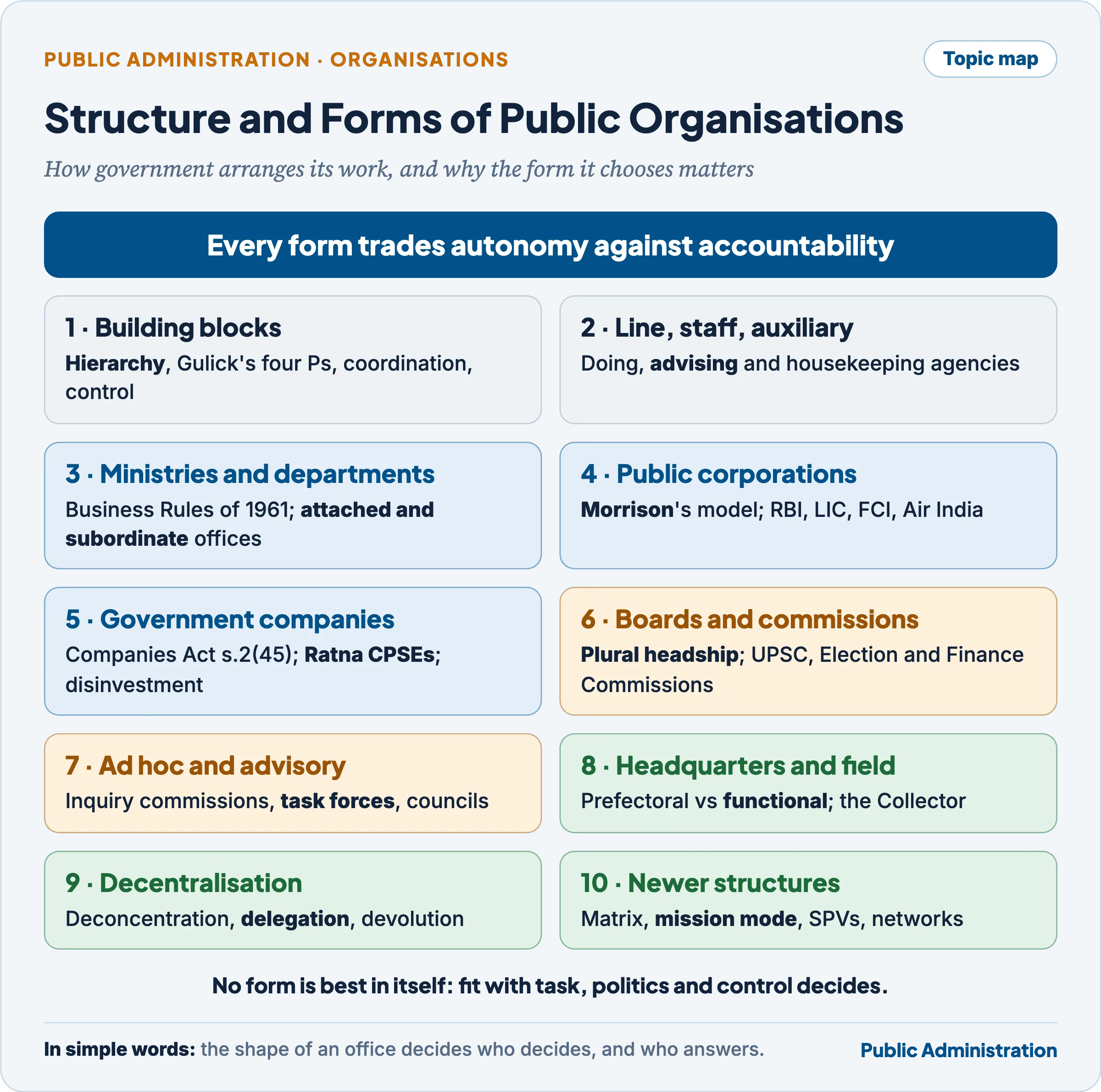
Every government has to answer the same practical question again and again: through what kind of body should this task be done? Collecting taxes, running trains, regulating telecom, conducting elections, inquiring into a riot and taking tap water to every village are all public tasks, yet India runs them through a department, a corporation, a company, a commission, an ad hoc body and a mission respectively. The form chosen decides how much freedom the body has, who controls it, and to whom it answers.
- The study of structure asks how work is divided and put back together: hierarchy, departments, line and staff, headquarters and field, centralisation and decentralisation.
- The study of forms asks which legal and institutional container suits which task. The systems and contingency theories (see the article on Systems and Contingency Theories) supply the underlying lesson: there is no one best form; the right form fits the task, the environment and the demands of democratic control.
In simple words
A family can run its kitchen itself, hire a cook on a monthly salary, order from a restaurant, or join a neighbourhood tiffin service. Each choice gives a different mix of control, cost and convenience. Government faces the same choice for every public task, only on a much larger scale and with Parliament watching.
1. Organisational Structure: Meaning and Elements
In simple words
Structure is the skeleton of an organisation: who does what, who reports to whom, and how the pieces are joined. The people and their informal ways of working are the flesh and blood that make the skeleton move.
1.1 What structure means
Structure is the relatively fixed pattern of relationships among the parts of an organisation. It emerges from four steps that every organisation takes, consciously or not:
- Differentiation of the task: the total work is broken into components (departments, divisions, sections). Division at the same level is horizontal differentiation (the Central Secretariat’s many departments); division by levels of authority is vertical differentiation (the hierarchy).
- Distribution of authority among levels and positions.
- Spatial placement of units, which raises the problem of headquarters and field and of centralisation versus decentralisation.
- Integration: the separated units are reconnected through hierarchy, coordination and control.
Mohit Bhattacharya, the Indian scholar of public administration, distinguishes the anatomy of structure (job definition, departments, size, span of control, levels) from its physiology (how authority is actually dispersed and how control works). The first is static; the second is dynamic. A sound analysis needs both.
Peter Self, the British scholar, adds the political dimension: any principle for allocating functions among departments has to be squared with the requirements of political management. Structure in government is never purely rational; it reflects coalition arithmetic, regional demands, history and the personalities of ministers.
1.2 Bureaucracy as structure, administration as function
The distinction between structure and function comes from structural-functional analysis (Talcott Parsons, Gabriel Almond, Fred Riggs). It helps to analyse government organisation clearly:
- Bureaucracy as structure: the arrangement of offices, ranks, rules, records and career service (Weber’s ideal type). It is the “who” and “where”.
- Administration as function: the activities performed through that structure, such as implementing law, delivering services, regulating and planning. It is the “what”.
- Why the distinction helps: the same function can be performed by different structures (welfare can be delivered by a department, a corporation, a panchayat or an NGO), and the same structure can perform several functions (the Collector’s office collects revenue, maintains order, coordinates development and manages disasters). Riggs showed that in prismatic societies formal structures often perform functions other than those they are designed for, so looking at structure alone misleads (see the article on Riggsian Models).
- Limit: structure and function are not separable in practice. Structure shapes how a function is performed, and a change of function (from law and order to development) forces a change of structure.
1.3 Formal and informal organisation
The formal organisation is the planned structure on the chart; the informal organisation is the network of personal relationships, cliques, norms and communication channels that grows spontaneously inside it. The Hawthorne studies and Chester Barnard (The Functions of the Executive, 1938) established that the informal organisation is not a nuisance but a condition of the formal one working at all.
Alvin Gouldner’s critique. Alvin Gouldner, the American sociologist whose study Patterns of Industrial Bureaucracy (1954) examined a gypsum plant, warned against treating the “informal organisation” as a residual category into which everything not on the chart is dumped. Such a concept becomes a catch-all with sprawling contents and explains little. His argument:
- Formal and informal elements are interdigitated: they interlock like the fingers of two clasped hands. Rules are bent, used, ignored or enforced selectively depending on informal understandings, and informal norms often grow around formal rules.
- His three patterns show this. Mock bureaucracy (rules imposed from outside and ignored by both managers and workers, such as a no-smoking rule), representative bureaucracy (rules both sides accept and support, such as safety rules) and punishment-centred bureaucracy (rules one side imposes on the other, producing tension).
- The lesson for administration: one cannot understand the working of a rule without understanding the informal relationships around it. A district office’s formal procedure for land records and its real practice (who actually moves the file, which informal fees are expected) must be studied together.
Learning by “dog law”. Jeremy Bentham ridiculed judge-made law as “dog law”: just as one teaches a dog by beating it after it misbehaves, citizens learn the law only when they are punished for breaking a rule they could not have known in advance. The phrase describes much organisational socialisation:
- Recruits learn a large part of what an organisation expects through unwritten norms: how much initiative is safe, which superior’s wishes override the manual, what may be put on file. They discover these mostly by being reprimanded after the fact.
- This is inefficient and unfair, since the newcomer is punished for breaking rules nobody told them, and it reproduces conformity and risk-aversion.
- Remedies lie in explicit induction and mentoring, codified manuals (the Central Secretariat Manual of Office Procedure), role clarity, and competency frameworks of the kind Mission Karmayogi promotes.
1.4 Why form matters
The choice of form is a choice about four variables at once:
- Autonomy: how far the body can decide without referring upward.
- Accountability: to whom and how it answers (minister, legislature, auditor, courts, citizens).
- Flexibility: freedom in finance, staffing and procedure.
- Expertise and representation: whether specialists or interests sit in the decision-making body.
No form maximises all four. The departmental form maximises accountability, the corporation and company forms autonomy and flexibility, boards and commissions impartiality and expertise, and ad hoc bodies speed and focus. This trade-off is the thread running through the rest of the article.
2. Hierarchy, Departmentalisation, Coordination and Control
In simple words
Divide the work, give each part to a team, put a boss over each team, and make sure the teams pull in the same direction. Hierarchy, departments, coordination and control are simply the names for these four steps.
2.1 Hierarchy: the universal technique
Hierarchy (the scalar principle) is the arrangement of positions in a graded series of superior–subordinate relationships, so that authority flows down and accountability flows up. James Mooney and Alan Reiley (Onward Industry!, 1931) made it a universal principle of organisation; Max Weber made it a defining feature of bureaucracy.
Why all administrative organisations rely on hierarchy. Hierarchy has been called a “many-splendoured” technique because it serves several purposes at once:
- Channel of command and communication: orders go down and reports come up through a known route.
- Instrument of coordination: every disagreement between two units can be settled at the level where their lines meet.
- Fixing of responsibility: each official knows to whom they answer, which is the foundation of ministerial responsibility in a parliamentary system.
- Delegation: authority can be passed down in defined amounts.
- Career structure: promotion through levels motivates and rewards experience.
- Order and predictability: citizens and officials know where a decision will be taken.
- Legitimacy: in a democracy hierarchy links the elected minister to the lowest official, so that administrative action rests on political authority.
Limits and critique.
- Delay and distortion: files pass through many levels; information is filtered and sanitised as it rises. The 2nd Administrative Reforms Commission (13th Report, 2009) recommended that a file should pass through no more than three levels, and later office manuals adopted delayering and the desk officer system.
- Victor Thompson (Modern Organization, 1961) argued that modern organisations suffer from a growing gap between the right to decide (hierarchical authority) and the ability to decide (specialist knowledge), producing anxiety and “bureaupathic” behaviour.
- Chris Argyris showed that tall hierarchies treat adults like children, frustrating the mature personality.
- Ethical problems: hierarchy encourages obedience over conscience. The official can say “I only followed orders”, responsibility is diffused across many hands (the “problem of many hands”), and whistle-blowers are punished as disloyal. In globalised administration, where decisions cross agencies, firms and countries, rigid hierarchy also makes it hard to know who is responsible at all.
- Rigidity in turbulent environments: contingency research (Burns and Stalker) found mechanistic hierarchies suited to stable conditions but not to change.
Hierarchy versus teamwork. Modern public work, from disaster response to the Aspirational Districts Programme, needs teams that cut across departments. A Collector running a flood response or a convergence programme achieves more by building cross-departmental teams than by issuing orders down separate departmental lines. Hierarchy remains the frame of accountability, but within it teams, task forces and matrix arrangements (Section 11) do much of the problem-solving.
2.2 Bases of departmentalisation: Gulick’s four Ps
Luther Gulick, in his “Notes on the Theory of Organization” in Papers on the Science of Administration (1937, edited with Lyndall Urwick), identified four bases on which work can be grouped. The details are in the article on Classical Theory; the summary below shows their use in government.
| Basis | Meaning | Indian example | Merit | Limitation |
|---|---|---|---|---|
| Purpose (function) | Major objective served | Ministry of Health, Ministry of Defence | Clear goal, easy to understand, avoids overlap | Neglects shared skills; departments become empires |
| Process | Skill or technique used | Ministry of Law, CPWD, accounts services | Uses expertise fully, economy | Loses sight of purpose; professional arrogance |
| Persons (clientele) | People or things dealt with | Ministry of Tribal Affairs, Ministry of Minority Affairs | Single window for a group | Duplication; capture by the clientele |
| Place (area) | Territory served | Ministry of Development of North Eastern Region; railway zones | Adapts to local needs | Uniformity suffers; local pressure |
- The Haldane Committee (Machinery of Government Committee, United Kingdom, 1918, chaired by Viscount Haldane) favoured distribution by service performed (function) and rejected distribution by persons, which would produce what it called “Lilliputian administration”: a separate hospital and school system for every class of client.
- India’s first Administrative Reforms Commission, in its report on the Machinery of the Government of India and its Procedures of Work (1968), also preferred grouping by function and affinity of subjects.
- In practice the bases overlap. The Ministry of Agriculture has a purpose (productivity), uses processes (extension, research), serves a clientele (farmers) and covers areas (agro-climatic zones). Departments are formed on one basis at the top and others lower down.
Why departmentalisation is “fraught with complexities”. The difficulty is partly technical and partly political:
- Technical: functions are interdependent (water for drinking, irrigation and industry), new tasks fit no existing box (climate change, cyber security, cooperatives), and any grouping cuts some linkages to create others.
- Political: the number of ministries depends on the size of the council of ministers (limited to 15 per cent of the Lok Sabha’s strength by the 91st Amendment, 2003), coalition bargaining, regional representation, symbolic recognition of a group (a separate ministry signals priority), and the personal weight of ministers. The 2nd ARC observed that India had about 55 ministries and recommended 20–25.
2.3 Coordination
Coordination is the orderly arrangement of group effort to secure unity of action. Mooney called it the “first principle” of organisation.
Managerial and functional aspects.
- Managerial (hierarchical) coordination is achieved vertically through authority: a superior reconciles the work of subordinates, and conflicts are referred upward. It is quick where lines meet low down, but overloads the top when they do not.
- Functional (horizontal) coordination is achieved laterally among units performing related functions, through consultation, committees, liaison officers and shared plans. Mary Parker Follett gave its principles: coordination by direct contact of the people concerned, in the early stages of policy, as reciprocal relating of all factors, and as a continuing process.
How coordination is achieved in government.
- Hierarchy and the chief executive (Cabinet, Chief Secretary, Collector).
- Staff agencies such as the Cabinet Secretariat and the Prime Minister’s Office.
- Committees and conferences: Cabinet committees, Committees of Secretaries, district review meetings.
- Planning and budgeting, which force departments to fit their work into one frame (NITI Aayog, the Union Budget).
- Standardisation of procedures and information systems (e-Office, dashboards, PM GatiShakti’s shared geospatial platform for infrastructure ministries).
- Informal relationships and a shared service culture.
James Fesler warned that “coordination in general” is an illusion: coordination is possible only around a specific common objective, with a limited number of participants meeting on equal terms.
2.4 Control: more than the chain of command
Hierarchic control (instructions passed down the line and compliance reported back) is the most visible form of control, but it is not the only dimension:
- Financial control: budgets, sanctions, the Finance Ministry’s scrutiny, internal financial advisers.
- Audit: the CAG’s regularity and performance audit.
- Legislative control: questions, committees (Public Accounts, Estimates, Public Undertakings), debates.
- Judicial control: writs, judicial review, tribunals.
- Professional control: norms of doctors, engineers and auditors that guide them from within.
- Peer and lateral control: committees and consultation.
- Citizen control: RTI, social audit, grievance portals, citizen’s charters.
- Self-control: internalised values and ethics, which Simon called the organisation’s “identification” and which Follett saw as control by the law of the situation rather than by persons.
The modern trend is from control by command to control by results, information and values, which matters greatly for the headquarters–field relationship (Section 9).
3. Line, Staff and Auxiliary Agencies
In simple words
In a hospital, doctors and nurses who treat patients are the line. The planning cell that studies disease trends and advises the superintendent is the staff. The office that buys medicines, pays salaries and repairs buildings is auxiliary. All three are needed, but only the first does what the hospital exists for.
3.1 Meaning and origin
The distinction comes from military administration: troops who fight are the “line”; the general staff who plan and advise the commander are the “staff”. Gulick and Urwick carried it into civil administration, and the Brownlow Committee (1937) built the American Executive Office of the President on the idea that “the President needs help”.
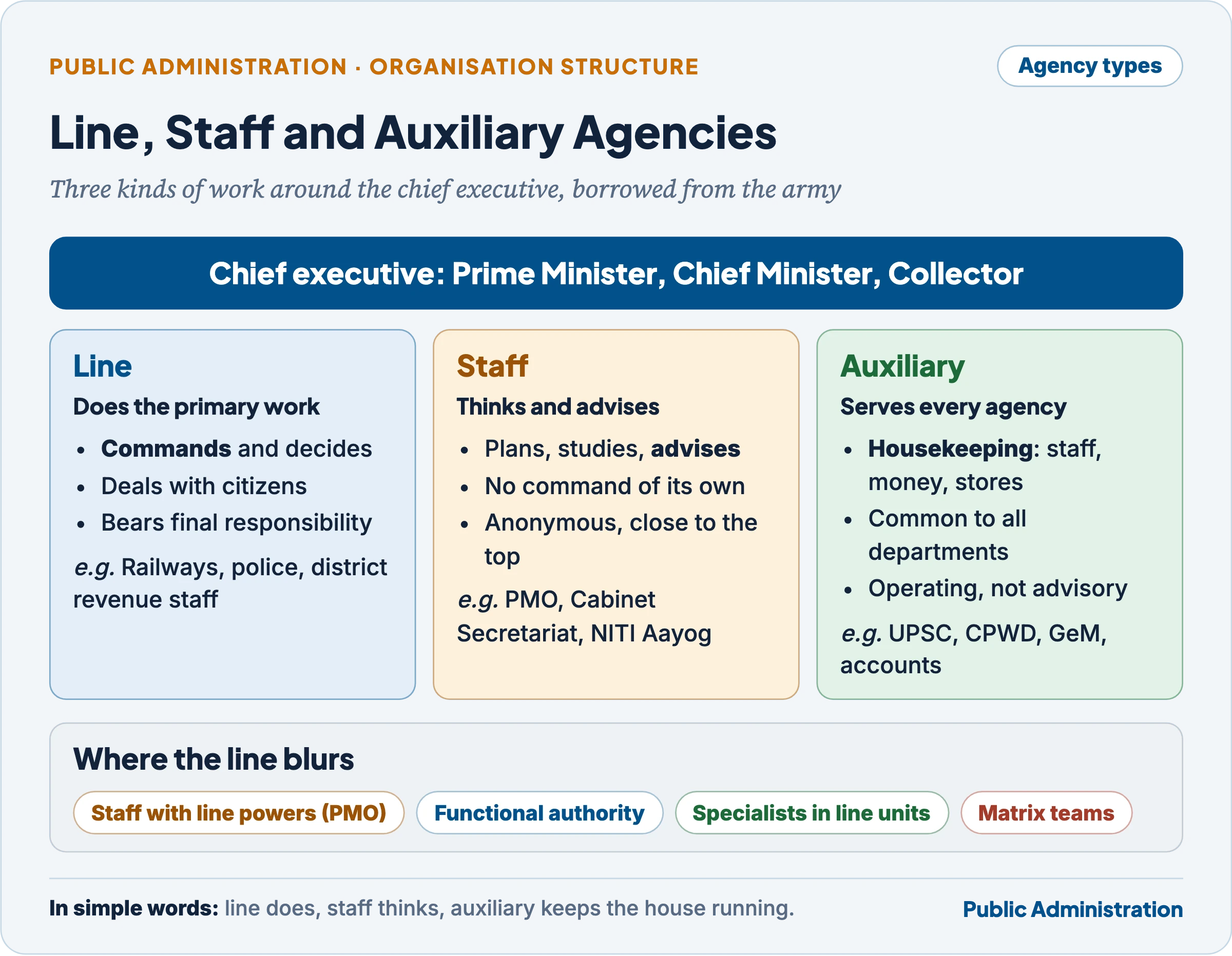
- Line agencies carry out the primary purposes of government. They make decisions, issue orders, deal directly with citizens and bear final responsibility. Departments, public corporations and many boards are line agencies.
- Staff agencies help the chief executive and the line by gathering information, planning, advising and coordinating. They have no command authority of their own; their influence comes from expertise and proximity to the top. Staff work is classically described as an extension of the chief executive’s personality: more eyes, ears and hands for a person who cannot see everything.
- Auxiliary agencies provide common housekeeping services to all other agencies: recruitment, purchase, accounts, buildings, printing, legal drafting. Leonard D. White stressed that auxiliary agencies are operating bodies concerned with maintaining the existing organisation, whereas staff is concerned with revision of policy and organisation.
3.2 Features compared
| Feature | Line | Staff | Auxiliary |
|---|---|---|---|
| Function | Primary, substantive | Advisory, planning | Common services |
| Authority | Command and decision | No command; persuasion | Operating authority within its service |
| Contact with citizens | Direct | Rare | Rare |
| Responsibility | Final, for results | For quality of advice | For efficiency of service |
| Anonymity | Visible | Anonymous | Mostly anonymous |
| Indian example | Ministry of Railways, police, revenue administration | PMO, Cabinet Secretariat, NITI Aayog | UPSC (recruitment), CPWD (works), GeM (procurement), Controller General of Accounts |
The table shows that the three differ in what they do and in the kind of authority they hold. The line acts on the world outside; staff and auxiliary agencies act on the organisation itself.
3.3 Types of staff
- General staff: generalist assistants who help the chief executive coordinate and plan (Cabinet Secretariat).
- Technical or special staff: specialists advising on a field (engineers, economists, legal advisers, the Chief Economic Adviser).
- Personal staff: private secretaries and aides who manage the executive’s time and correspondence.
- Donald Stone argued that accounting and legal services are closer to auxiliary services than to general staff, and others define general staff by the chief executive’s non-delegable functions. There is no settled boundary.
3.4 Line–staff conflict and its remedies
Conflict is common:
- Line complaints: staff interfere without responsibility, claim credit for success and blame the line for failure, give impractical advice from a distance, and use their nearness to the chief to “boss” the line.
- Staff complaints: the line resists new ideas, ignores expert advice, and uses staff as a scapegoat.
- Indian illustration: engineers in a works department often complain that a finance department “sat on” a sound project for months; the finance side replies that the project was poorly costed.
Remedies: define the limits of authority clearly; make consultation of staff compulsory on specified matters; rotate officers between line and staff posts (the Indian tenure system does this between field and secretariat); joint training; and form mixed teams that share responsibility for results.
3.5 Is the distinction real? “A distinction without a difference”
Many scholars argue that the line–staff distinction is relative rather than absolute:
- Staff acquire line powers. In India the PMO began as a staff agency to assist the Prime Minister but has at times issued directions, monitored ministries and driven policy, which critics see as a line role inconsistent with a secretariat system built on ministerial responsibility. Defenders reply that in a cabinet system the Prime Minister’s coordinating authority is real and the PMO merely transmits it.
- Functional authority: a staff unit is often given authority over the line in its own field (Finance over expenditure, Personnel over appointments). The Ministry of Finance is both a line ministry (taxation, banking) and a staff agency to all others.
- Expertise within the line: professional specialists (doctors, engineers) hold line posts, so line authority and professional expertise are mixed in the same office, contrary to the abstract model in which the line commands and staff knows.
- Context decides: the same unit is line in one relationship and staff in another. A department’s planning cell is staff to its Secretary, but NITI Aayog’s monitoring of ministries’ outcomes has a quasi-line edge.
- Changing technology and environment: the clean distinction belongs to an era of simple technology and stable environments; matrix and project structures (Section 11) replace it with dual reporting.
Assessment. It is difficult to state a single demarcating principle, and in that sense the distinction is “without a difference”. Yet it remains useful: it reminds administrators that advice and command should not be confused, that those who command must answer for results, and that experts should persuade rather than order. Its value is analytical, not absolute.
4. Ministries and Departments
In simple words
A ministry is the political charge a minister holds; a department is the administrative machine that does the work, headed by a Secretary. The two words are used loosely, but a ministry may contain several departments, and a few departments stand on their own.
4.1 Ministry, department and secretariat
| Term | Meaning | Example |
|---|---|---|
| Ministry | A political charge assigned to a minister, usually grouping related departments | Ministry of Finance (six departments) |
| Department | The basic administrative unit of the government, headed by a Secretary, responsible for policy and its execution in an allotted area | Department of Expenditure, Department of Posts |
| Secretariat | The policy-making headquarters formed by the ministries and departments together (the Central Secretariat), as distinct from executive agencies and field offices | Central Secretariat in New Delhi; State Secretariats |
- Constitutional basis: executive power vests in the President (Article 53), who acts on the advice of the Council of Ministers headed by the Prime Minister (Article 74). Under Article 77(3) the President makes rules for the more convenient transaction of government business and for its allocation among ministers. The same pattern exists in the States under Article 166(3).
- The Government of India (Allocation of Business) Rules, 1961 list in the First Schedule the ministries, departments, secretariats and offices, and in the Second Schedule the subjects allotted to each. The President allots departments to ministers on the Prime Minister’s advice. By July 2026 these Rules had been amended 386 times.
- The Government of India (Transaction of Business) Rules, 1961 define how business is disposed of: by or under the direction of the minister in charge; which cases need the Prime Minister’s, the Cabinet’s or a Cabinet committee’s approval; and when one department must consult another (for example, the Finance and Law ministries) before deciding.
- Number today: the First Schedule, as amended up to July 2026, lists 53 ministries, many divided into departments, plus the independent Departments of Atomic Energy and Space and five secretariats and offices: the Cabinet Secretariat, President’s Secretariat, Prime Minister’s Office, NITI Aayog and the National Security Council Secretariat.
4.2 Internal structure of a department
The commonly adopted pattern, laid down in the Central Secretariat Manual of Office Procedure, is:
- Secretary: administrative head of the department and principal adviser to the minister on policy and administration; responsibility is “complete and undivided”.
- Wing: under an Additional Secretary or Joint Secretary, with the maximum measure of independent functioning for business in the wing.
- Division: under a Director or Deputy Secretary.
- Branch: under an Under Secretary, who disposes of as many cases as possible at that level.
- Section: the lowest unit, under a Section Officer, where assistants (“dealing hands”) do the initial noting and drafting.
- Variations: the desk officer system, in which work at the lowest level is organised into functional desks handled by officers themselves with stenographic support; and the Integrated Headquarters of the Ministry of Defence, in which the service headquarters exercise delegated powers.
4.3 Attached and subordinate offices
Where execution of policy needs decentralised executive direction, a department has executive agencies under it.
- Attached offices provide executive direction for implementing the department’s policies, serve as repositories of technical information and advise on technical aspects. Examples: the Directorate General of Health Services (Ministry of Health), the Central Public Works Department (Ministry of Housing and Urban Affairs).
- Subordinate offices generally function as field establishments or agencies responsible for detailed execution, under the direction of an attached office or directly under the department. Examples: Regional Passport Offices of the Ministry of External Affairs.
- Other bodies linked to a department: constitutional bodies (created by the Constitution), statutory bodies (created by an Act of Parliament), autonomous bodies (set up by the government, usually as registered societies, funded by it but with their own memorandum of association) and public sector undertakings.
- The Cabinet Secretariat, too, has its own attached and subordinate units, such as the Special Protection Group and the National Authority for the Chemical Weapons Convention. They let a small coordinating secretariat carry out specialised executive tasks without burdening its policy core, which is the general logic of attached and subordinate offices everywhere.
Common confusion
Is an attached office the same as a subordinate office? No. An attached office sits close to the department and gives executive direction and technical advice for a whole programme (like a directorate at headquarters). A subordinate office works mainly in the field, carrying out the detailed execution, often under an attached office. The first directs implementation; the second does it.
4.4 The departmental form: features, merits and limits
Features.
- Oldest and most common form, directly under the chief executive.
- Headed politically by a minister and administratively by a Secretary: popular control combined with professional skill.
- Financed by annual appropriation from the Consolidated Fund; receipts go into that fund; unspent balances lapse; no re-appropriation beyond rules.
- Staffed by civil servants under government service rules.
- Subject to CAG audit and full parliamentary control through questions, debates and committees.
- No separate legal personality; it cannot be sued in its own name.
Merits.
- Maximum accountability: the minister answers for every detail; Parliament can question any act.
- Uniformity and integration with government policy.
- Suitable for sovereign, regulatory and welfare functions where public law values matter more than commercial results (defence, police, revenue, health).
Limits.
- Red tape and delay: rigid financial and procedural rules, multiple clearances.
- Lack of commercial flexibility: no freedom to borrow, price, invest or hire and fire quickly.
- Risk-aversion: audit and parliamentary scrutiny encourage playing safe.
- Political interference in operational decisions.
- Hence the long-standing criticism that the departmental pattern does not offer the autonomy, flexibility and entrepreneurship needed by business undertakings.
Departmental undertakings. Some commercial activities remain departmental: the Indian Railways (whose budget was merged with the Union Budget in 2017), the Department of Posts, and until 2021 the ordnance factories. They are placed under full control of government and Parliament because they are seen as strategic, monopolistic or public-service in character, but they suffer from the limits above. The corporatisation of the Ordnance Factory Board in 2021 (Section 6) shows the shift away from this form where commercial efficiency is sought.
4.5 Recent restructuring in India
Ministries and departments are created, merged and split by amending the Allocation of Business Rules, which shows how executive-made the departmental form is.
| Year | Change | Rationale |
|---|---|---|
| 2015 | Planning Commission replaced by NITI Aayog (1 January) | From allocative planning to a policy think tank and cooperative federalism |
| 2019 | Ministry of Jal Shakti formed (Water Resources and Drinking Water merged); Ministry of Fisheries, Animal Husbandry and Dairying carved out | Integrate water management; focus on allied sectors |
| 2019–20 | Department of Military Affairs in the Ministry of Defence, headed by the Chief of Defence Staff as Secretary (Rules amended 30 December 2019; functioning from 1 January 2020) | Jointness of the three services and military expertise inside the ministry |
| 2019 | Railway Board restructuring approved (24 December): eight Group A services unified into the Indian Railway Management Service; Board slimmed to a Chairman and CEO with four members | Remove departmentalism among cadres; functional board |
| 2020 | Ministry of Shipping renamed Ports, Shipping and Waterways; Ministry of HRD renamed Ministry of Education | Reflect mandate and policy shift (National Education Policy 2020) |
| 2021 | Ministry of Cooperation created (6 July); Department of Public Enterprises moved to the Ministry of Finance | Separate focus on cooperatives; bring CPSE policy and disinvestment under one ministry |
| 2026 | Ministry of Housing and Urban Affairs split into a Department of Capital Development (National Capital Region matters) and a Department of Urban Development (22 July) | Specialised attention to the capital region |
Indian Connect — Restructuring the machinery of government
- 2nd ARC, 13th Report, Organisational Structure of Government of India (2009): recommended that government focus on core functions and the principle of subsidiarity; that closely related subjects be grouped so as to reduce ministries from about 55 to 20–25; that a ministry be redefined as a group of related departments under a Coordinating (First) Minister; that the Allocation of Business Rules state each department’s mission and outcomes; and that policy be separated from implementation, with execution given to executive agencies headed by chief executives working under performance agreements.
- Practice since then shows partial movement: mergers such as Jal Shakti and the shift of DPE to Finance fit the “umbrella ministry” idea, but new ministries (Cooperation) and splits (Housing and Urban Affairs, 2026) show that political and administrative priorities still drive the number. The idea of executive agencies has been applied piecemeal through statutory authorities and mission directorates rather than as a general model.
5. Public Corporations
In simple words
When government runs a business such as insurance, food storage or an airline, it needs the speed of a company but must still answer to the public. A public corporation is a body set up by its own law to do exactly that: run like a business, owned and overseen by the public.
5.1 Concept and genesis
A public corporation is a body corporate created by a special Act of the legislature, with defined powers, functions and finances, wholly owned by the State, managed by a board, and enjoying a measure of autonomy from day-to-day ministerial control.
Genesis. As the State entered industry, banking, transport and utilities (through war, depression, welfare and planning), departments proved ill-suited: their budgeting, procurement and personnel rules were designed for regularity, not enterprise. The answer was to import the business form (the joint-stock corporation) into public administration while keeping public ownership.
- United States: government corporations multiplied in the world wars and the Depression; the Tennessee Valley Authority (1933) became the model of a regional development corporation.
- Britain: the London Passenger Transport Board (1933) and the BBC (1927), and after 1945 the great nationalised industries (National Coal Board, British Transport Commission).
- India: the Reserve Bank of India (1935) was the only one before Independence. After 1947 came the Damodar Valley Corporation (1948, modelled on TVA), the Industrial Finance Corporation (1948), the Employees’ State Insurance Corporation (1948), the Air Corporations (1953), the Life Insurance Corporation (1956), the Food Corporation of India (1965) and others; States set up road transport corporations under the Road Transport Corporations Act, 1950 and financial corporations under the State Financial Corporations Act, 1951.
Morrison’s concept. Herbert Morrison, the British Labour minister who created the London Passenger Transport Board, set out the model in Socialisation and Transport (1933). A public corporation is a combination of public ownership, public accountability and business management for public ends:
- Public ownership: capital provided by the State; no private shareholders with control; no profit motive for its own sake.
- Public accountability: to a minister for broad policy and to Parliament through reports and debates, but not for day-to-day management.
- Business management: a board of competent persons, chosen for ability rather than as representatives of interests, running the undertaking on commercial lines with financial self-sufficiency.
- Public ends: the corporation is an instrument of public policy (cheap, reliable transport or power), not an end in itself.
W.A. Robson, the British scholar of nationalised industry (Nationalized Industry and Public Ownership, 1960), described the public corporation as a body with separate legal personality, independent finances and freedom from civil service rules, meant to combine public ownership with commercial freedom.
5.2 Features
- Created by a special statute that defines objects, powers, board composition and relations with government; can be changed only by amending the Act.
- Separate legal entity: can own property, contract, sue and be sued; perpetual succession and common seal.
- Wholly owned by the State.
- Financial autonomy: initial capital from the State, thereafter its own revenues, reserves and borrowing (often with government guarantee); not dependent on annual appropriations; judged by results over a period rather than year by year.
- Own personnel system: employees are not civil servants; recruitment, pay and promotion are set by the corporation.
- Exempt from many procedural rules that bind departments (tendering, re-appropriation, lapse of funds).
- Board management: a board of directors appointed by government, with a chief executive (chairman, managing director, governor).
- Limited ministerial control: appointment and removal of directors, directions on matters of general policy, approval of capital programmes and borrowing, and the right to call for information and reports.
- Accountability to the legislature through annual reports and accounts laid before it, committee scrutiny and debates.
Corporation versus department. The corporation differs not in its internal hierarchy (it too has divisions and sections) but in its external relations (limited ministerial and parliamentary control) and its procedures (financial, personnel and contractual flexibility modelled on business). Leonard D. White doubted that the difference was fundamental, noting that in the United States legislative control was steadily pulling corporations towards the departmental pattern; some American writers even called them “corporations only by courtesy”.
Corporation versus private company. The public corporation is a custodian of the public interest: it is expected to pay its way over good and bad years, not to maximise profit; it has no private shareholders entitled to control management; and its “owners” are represented by the minister and the legislature. This financial disinterestedness distinguishes it from a joint-stock company.
5.3 Autonomy versus accountability: the central dilemma
A public corporation tries to combine two things that pull apart. If accountability is pushed to its limit, the corporation becomes indistinguishable from a department; if autonomy is pushed to its limit, it becomes a state within the State, spending public money without answering for it. The practical questions are:
- How much power should the minister have over the board?
- Can members of the legislature ask questions about details of management?
- What other channels of information and debate should exist?
- Should the legislature vote its estimates?
- Should the CAG and the Public Accounts Committee examine its accounts as they do departmental accounts?
Comparative experience.
- United States: after decades of piecemeal tightening, the Government Corporation Control Act, 1945 required wholly owned corporations to submit business-type budgets through the President to Congress, subjected them to commercial audit by the Comptroller General on their own premises, and allowed new corporations only by Act of Congress. Many had already been brought under civil service rules (Ramspeck Act, 1940). Yet they kept freedom from annual appropriations and from legality-type audit: the aim was to inform Congress, not to turn them into departments.
- Britain: the minister appoints and can remove board members, issues general directions, approves capital investment and borrowing, appoints auditors and lays reports before Parliament. Ministers refuse to answer questions on day-to-day management; a House of Commons select committee (Assheton, 1952) confirmed that a minister answers only for matters within their powers. Parliament later created a Select Committee on Nationalised Industries (1956) to fill the gap.
Indian practice.
- Ministerial powers: appointment and removal of board members; policy directions (the DVC must follow policy instructions, and the government decides what counts as policy; the Air Corporations had to obey directions on the exercise of their functions); approval of capital programmes and borrowing; power to call for information; in some cases power to supersede the board.
- Parliamentary control: annual reports and accounts laid before Parliament; questions limited to matters within ministerial control; debates on demands of the parent ministry and on amending Bills; scrutiny by the Estimates and Public Accounts Committees and, from 1 May 1964, by the Committee on Public Undertakings (COPU), set up after the Congress party’s Krishna Menon Committee (1958) recommended a dedicated committee. COPU now has 22 members (15 from the Lok Sabha and 7 from the Rajya Sabha) and excludes matters of major government policy and day-to-day administration.
- Morrison’s advice remains apt: ministerial control should be well-informed but limited, supported by a small, capable branch in the ministry that studies the boards’ work and helps the minister set priorities without “bossing” the boards; and the minister should not become an automatic apologist for the board in Parliament.
What actually happened in India. The record shows the dilemma in both directions:
- Too much interference: A.D. Gorwala’s Report on the Efficient Conduct of State Enterprises (1951) found that the DVC had to spend its energies defending its autonomy against attempts to reduce it to a department subordinate to the secretariat. The Chagla Commission (1958) on the Mundhra affair found that the Finance Ministry treated the LIC as its own wing and that LIC’s purchase of Mundhra company shares was a “dictated transaction”.
- Too little accountability: members of Parliament complained in the 1950s that hundreds of crores invested in corporations had become impervious to public opinion, that the CAG had limited power over them and that committee scrutiny was only after the event.
- Corporations, in turn, complained of restrictions on capital expenditure, delays in sanctions and lack of technical personnel.
Are public corporations an end in themselves? No. Morrison’s model makes them extensions of government activity designed to promote public welfare: they exist because a public purpose (cheap credit, food security, insurance for all, regional development) is better served by a business-like body than by a department. Their autonomy is instrumental: justified only so long as it serves that purpose and is matched by accountability for results. When corporations become loss-making, overstaffed and politically managed, critics describe them as exhausted Leviathans: huge bodies that have lost both their entrepreneurial energy and their public purpose.
5.4 Indian examples
| Corporation | Act and year | What it does | Points for analysis |
|---|---|---|---|
| Reserve Bank of India | RBI Act, 1934 (operations from 1 April 1935; nationalised 1949) | Central bank, monetary authority, regulator | The government may give directions under Section 7 after consultation; the 2018 consultations under Section 7 showed the tension between autonomy and ministerial control |
| Life Insurance Corporation | LIC Act, 1956 | Life insurance; nationalised over 240 insurers | Mundhra affair (1958); listed in May 2022 after a 3.5 per cent share sale, yet remains a statutory corporation |
| Food Corporation of India | Food Corporations Act, 1964 (set up January 1965) | Procurement, storage and distribution of foodgrains for PDS and price support | Carries the costs of food policy; the Shanta Kumar High Level Committee (2015) recommended restructuring its role |
| Damodar Valley Corporation | DVC Act, 1948 | Multi-purpose river valley development across two States | Regional authority on TVA model; tensions over autonomy (Gorwala) |
| Employees’ State Insurance Corporation | ESI Act, 1948 | Social security for workers | Tripartite board; interest representation |
| State Bank of India | SBI Act, 1955 | Commercial banking | Listed statutory bank |
| National Highways Authority of India | NHAI Act, 1988 | Highway development, including PPP projects | Statutory authority used as an executive agency |
Indian Connect — Air India: the journey of a form
- 1932–53: Tata Airlines, later Air India Ltd, a private company.
- 1953: the Air Corporations Act nationalised civil aviation into two statutory corporations, Air India International and Indian Airlines, subject to ministerial directions and parliamentary scrutiny.
- 1994: the Air Corporations (Transfer of Undertakings and Repeal) Act converted both into government companies to give them commercial flexibility after the end of the State’s monopoly in civil aviation.
- 2007: the two were merged into a single government company (later Air India Ltd), which accumulated heavy losses and debt.
- 27 January 2022: after a strategic sale, Air India was handed over to Talace, a Tata Sons subsidiary, ending 69 years of government ownership; Vistara was merged into it on 12 November 2024.
- Lesson: one undertaking passed through all three forms, showing that the choice of form follows the State’s changing view of its role, from commanding heights to market participant to exit.
Common confusion
Is every body called a “Corporation” a statutory public corporation? No. The Food Corporation of India, LIC and the Damodar Valley Corporation are statutory corporations created by their own Acts. But the Oil and Natural Gas Corporation Ltd, NTPC Ltd and the State Trading Corporation of India Ltd are government companies registered under the Companies Act; “Corporation” is only part of their name. The test is the legal basis (a special Act or the Companies Act), not the word in the title. Many notes also say that States cannot create corporations at all; in fact the Constitution gives Parliament power over trading corporations (List I, Entry 43), but States can incorporate other corporations confined to the State (List II, Entry 32), and they create trading ones under Union enabling Acts such as the Road Transport Corporations Act, 1950.
6. Government Companies and Central Public Sector Enterprises
In simple words
A government company is an ordinary company, like any registered firm, except that the government owns most of its shares. It can be set up quickly, can bring in private partners, and runs under company law rather than a special Act.
6.1 Definition and features
Section 2(45) of the Companies Act, 2013 (formerly Section 617 of the 1956 Act) defines a government company as a company in which not less than 51 per cent of the paid-up share capital is held by the Central Government, by any State Government or Governments, or partly by the Centre and partly by one or more States, and it includes a subsidiary of such a company.
Features.
- Created by executive decision and registration under the Companies Act; no special statute is needed.
- Separate legal entity, governed by its Memorandum and Articles of Association, drawn up and revisable by the government.
- Wholly or partly owned: where private shareholders hold part of the capital it is a mixed-ownership company.
- Board of directors, most of whom are appointed by the government in proportion to its holding; the President of India (through the ministry) is the shareholder.
- Own employees, not civil servants.
- Exempt from departmental budgeting, accounting and audit rules; funds come from equity, borrowing and sales.
- Audit: under Section 139(5) the CAG appoints the statutory auditor, and under Section 143 the CAG may conduct a supplementary audit and test audit.
- Reporting: the annual report, with the auditor’s and CAG’s comments, is laid before Parliament or the State legislature (Sections 394–395).
- The Central Government can, by notification, exempt government companies from specified provisions of the Act or apply them with modifications.
Merits.
- Easy and quick to form, change and wind up; objects can be amended without legislation.
- Flexibility in finance, personnel and contracts close to that of private business.
- Partnership: the only form that readily allows private (domestic or foreign) capital and expertise alongside public control.
- Holding-company and subsidiary structures for expansion and diversification.
- Discipline of company law keeps management alert; performance can be compared with private firms.
Demerits.
- Erosion of parliamentary accountability: created without Parliament’s consent, not audited exactly like departments; a former Comptroller and Auditor-General, giving evidence to the Public Accounts Committee in the early 1950s, called the device “a fraud on the Companies Act and also on the Constitution” because public money was taken out of parliamentary control.
- “A fraud on the Companies Act”: with the government as the sole or dominant shareholder, provisions about annual general meetings and shareholder control become meaningless; the company is a proprietary concern of the ministry.
- Autonomy on paper only: the Estimates Committee of the Lok Sabha observed that government companies were “more or less extensions of departments”, run on the same pattern; boards packed with serving officials who are frequently transferred give little continuity.
- Diffuse accountability: neither fully commercial nor fully public.
When the company form is preferred. Indian committees (the Estimates Committee and the first ARC) and practice suggest it suits cases where:
- the government launches an enterprise with private partners (joint ventures);
- the undertaking is predominantly trading (State Trading Corporation of India);
- the government must take over a private company in difficulty to protect workers and the public;
- the government intends to transfer the enterprise to private management later;
- the undertaking is small or experimental.
Despite the criticism, the company is the most popular form in India because it gives governments speed and flexibility, while statutory corporations are reserved for strategic, regulatory or social-insurance functions.
6.2 CPSEs, MoUs and the Ratna system
Central Public Sector Enterprises (CPSEs) are the companies (and some statutory corporations) in which the Centre holds the majority stake. Their policy is handled by the Department of Public Enterprises, part of the Ministry of Finance since July 2021.
- Memorandum of Understanding (MoU) system: following the Arjun Sengupta Committee (1984), annual performance agreements between each CPSE and its ministry set targets, rate performance and link incentives to results. It applies the principle of “autonomy in exchange for accountability for results”.
- Ratna status gives boards enhanced financial and operational powers:
| Status | Main criteria (summary) | Key power of the board |
|---|---|---|
| Maharatna (scheme from 2009–10) | Navratna, listed, large average turnover, net worth and profit, global presence | Invest up to ₹5,000 crore (or 15 per cent of net worth) in a project without government approval |
| Navratna (from 1997) | Miniratna Category I with excellent MoU ratings and a high composite score | Invest up to ₹1,000 crore or 15 per cent of net worth in a project; joint ventures and subsidiaries |
| Miniratna Category I / II (from 1997) | Continuous profits and positive net worth | Capital expenditure up to ₹500 crore (I) or ₹300 crore (II) within net-worth limits |
- Numbers: the Department of Public Enterprises reported in June 2025 that Maharatnas had risen from 7 in 2014 to 14 and Navratnas from 10 to 26; upgrades continue (Garden Reach Shipbuilders became a Navratna in June 2026, and Munitions India Ltd, one of the former ordnance factories, received Miniratna Category I status in February 2026).
- Assessment: the Ratna scheme shows that delegated autonomy, more than legal form, drives performance: the best performers are companies whose boards were given freedom and held to MoU targets. Critics note that boards remain dependent on ministries for appointments and that autonomy can be withdrawn informally through directions, dividend demands and pressure to fund government priorities.
6.3 Disinvestment and privatisation, briefly
- Phases: minority stake sales from 1991–92; strategic sales with transfer of management around 2000–2004; a renewed push after the Department of Disinvestment became the Department of Investment and Public Asset Management (DIPAM) in 2016.
- New Public Sector Enterprise Policy (2021): a bare minimum presence in four broad strategic sectors (atomic energy, space and defence; transport and telecommunications; power, petroleum, coal and minerals; banking, insurance and financial services); CPSEs in non-strategic sectors to be privatised or closed.
- Recent milestones: strategic sale of Air India (January 2022); LIC’s listing (May 2022); corporatisation of the Ordnance Factory Board into seven defence PSUs from 1 October 2021 (41 factories converted from a departmental undertaking into companies such as Munitions India Ltd and Armoured Vehicles Nigam Ltd); and in October 2026 the selection of Fairfax Financial Holdings to acquire 60.72 per cent of IDBI Bank (30.48 per cent from the government and 30.24 per cent from LIC), with completion expected by March 2027 after regulatory approvals.
- Administrative significance: privatisation does not end the State’s role; it shifts it from owner-manager to regulator and contract manager. Its tools include user fees (charging beneficiaries directly, which raises equity questions), outsourcing (contracting out services, which needs strong contract management) and public–private partnerships (see the article on Regulatory Authorities and PPPs).
6.4 Choosing the form: department, corporation, company or board
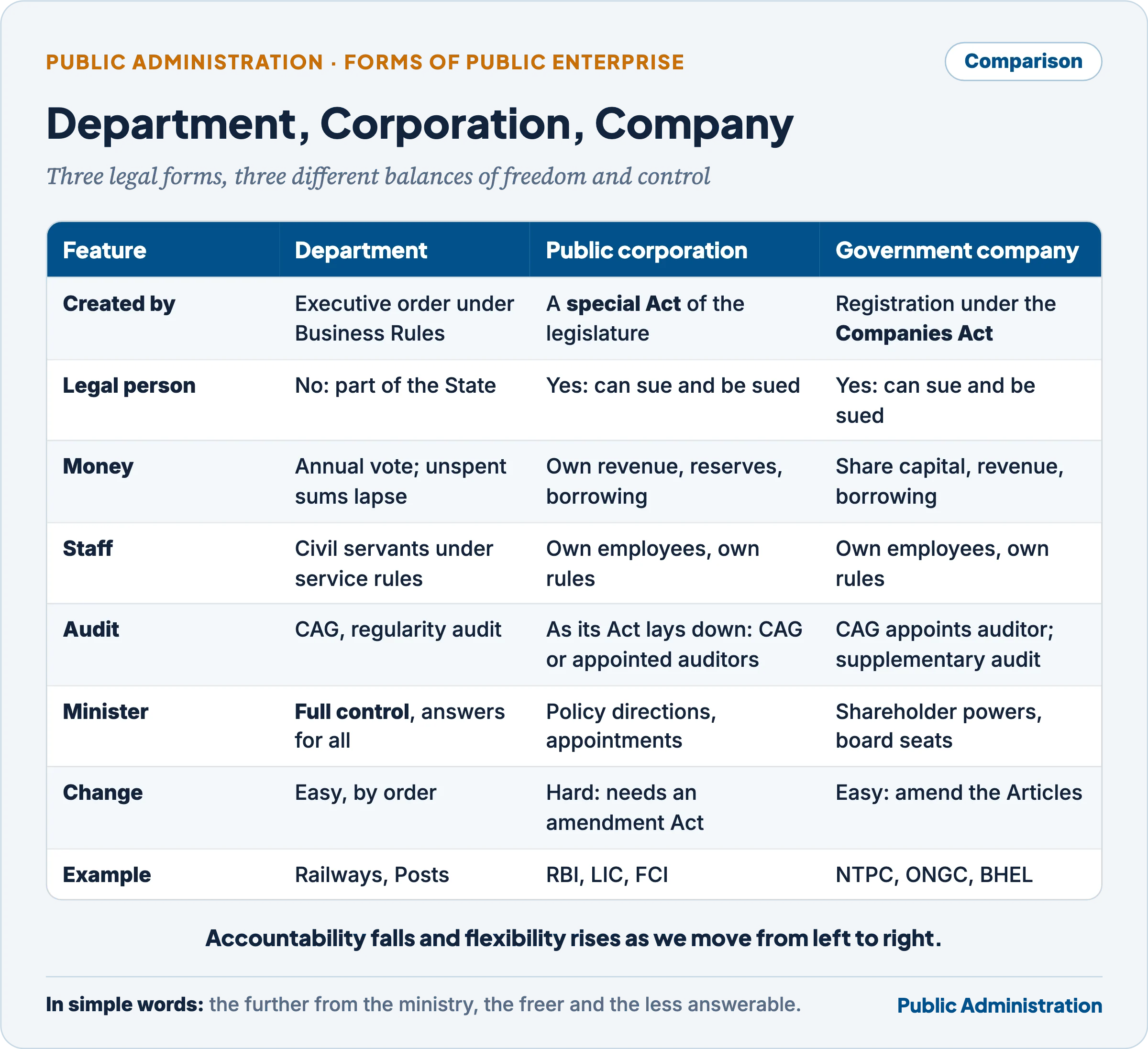
| Feature | Department | Public corporation | Government company | Board |
|---|---|---|---|---|
| Created by | Executive order (Business Rules) | Special Act | Registration under Companies Act | Act or executive resolution |
| Legal personality | No | Yes | Yes | Usually no (unless statutory) |
| Finance | Annual appropriation | Own revenue and borrowing | Equity, revenue, borrowing | Mostly budgetary |
| Personnel | Civil servants | Own staff | Own staff | Civil servants or experts |
| Ministerial control | Complete | Policy directions, appointments | Shareholder control | Varies; often collegial and semi-independent |
| Parliamentary control | Full | Through reports, COPU | Through reports, COPU, CAG comments | Through ministry or reports |
| Best suited to | Sovereign and regulatory functions | Monopoly utilities, finance, social insurance | Commercial and joint ventures | Collegial expert or representative decisions |
The table shows that accountability falls and flexibility rises as we move from the department to the company, while the board form trades single-headed speed for collective judgement.
Why the choice has always been problematic.
- Mixed objectives: a public enterprise must be both commercial and social; each form favours one side.
- Practice converges: corporations and companies have often been run like departments (the Estimates Committee’s point), while departments such as the Railways have acquired commercial practices. Legal form therefore predicts less than one expects.
- Political preference: governments prefer the company form because it is quick and controllable; Parliament prefers forms that keep it informed.
- Time changes the answer: Air India and the ordnance factories show forms changing as policy changes.
The better test. To claim that a company or corporation is always more effective is an outdated view. The real test of a sound structure is its capacity to balance decisional autonomy and operational flexibility with optimal accountability. That balance depends on:
- a clear mandate and separation of the government’s roles as owner, policy-maker and regulator;
- arm’s-length relations through MoUs and performance contracts;
- professional boards with independent directors and stable tenure;
- accountability for results rather than for procedure;
- transparency (RTI, published reports, CAG comments).
Criticism — The case against autonomous forms (corporations, companies, boards)
- They dilute ministerial responsibility: the minister answers only for “policy”, and Parliament cannot question day-to-day failures that hurt citizens.
- Autonomy becomes a shield: boards captured by insiders, sinecures for retired officials, losses socialised through budget support.
- Audit and committee scrutiny are partial and after the event (the 1950s parliamentary complaints, the early CAG remark).
- Indian experience shows autonomy is often illusory anyway: ministries interfere through appointments and informal directions (DVC, Mundhra), so the form adds confusion without real freedom.
- Fragmentation: a multiplication of semi-independent bodies weakens coordination and creates a “headless” government.
Defence — The case for autonomous forms
- Commercial and technical tasks cannot be run efficiently under departmental budgeting and personnel rules; the corporation and company were invented for that reason.
- Autonomy with accountability for results (MoUs, Ratna status, independent directors) has produced globally competitive enterprises.
- Boards and commissions bring expertise, collective judgement and impartiality, insulating decisions such as recruitment, elections or tariffs from partisan pressure.
- Parliamentary control can be redesigned rather than abandoned: COPU, CAG comments, RTI, published performance data and independent regulators supplement ministerial answerability.
- The real problem is misuse of autonomy, not autonomy itself; the remedy is better governance of public bodies, as the 2nd ARC argued.
7. Boards and Commissions
In simple words
Some decisions are too important or too sensitive to leave to one person, such as choosing civil servants, conducting elections or dividing tax money between the Centre and the States. For these, government uses a board or commission: a group that decides together, usually with some protection from political pressure.
7.1 Single versus plural headship
A department is usually headed by one person (the bureau type). A board or commission vests headship in a group, presided over by a chairperson.
| Single head (bureau) | Plural head (board or commission) |
|---|---|
| Quick decisions, unity of command | Slower, deliberative decisions |
| Responsibility easily fixed | Responsibility shared and diffused |
| Risk of arbitrariness and favouritism | Collective wisdom; one member checks another |
| Suits execution and emergencies | Suits quasi-legislative, quasi-judicial, policy and representative work |
| Overload at the top | Burden shared, continuity of membership |
The plural form is preferred where policies and techniques must be put on a sound footing, where conflicting interests must be reconciled, and where discretion needs a check. Max Weber saw collegiality as one of the few ways to limit the power of bureaucratic expertise.
Types of boards and commissions: administrative boards (running a service, such as the Railway Board), regulatory commissions (quasi-legislative and quasi-judicial control of an economic activity), permanent advisory boards, boards tied into the hierarchy (under a minister), and bipartisan boards (with members from different parties or interests).
7.2 The American model: independent regulatory commissions
The United States created independent regulatory commissions to regulate private economic activity outside the direct control of the President: the Interstate Commerce Commission (1887) was the first, followed by the Federal Trade Commission (1914), the Securities and Exchange Commission (1934) and others.
- Features: collegial, bipartisan membership; fixed, staggered terms; removal only for cause (upheld for the FTC in Humphrey’s Executor v. United States, 1935); a combination of administrative, quasi-legislative and quasi-judicial functions.
- “Headless fourth branch”: the Brownlow Committee (President’s Committee on Administrative Management, 1937), in a study by Robert Cushman, described them as a “headless fourth branch” of government: a set of irresponsible agencies and uncoordinated powers outside the three constitutional branches, which obstructed the President’s coordination and mixed judicial and executive functions.
- Why the board form was said to inject politics into administration: bipartisan and interest-representative boards bring party and group bargaining into decisions that, under the politics–administration dichotomy, were supposed to be neutral execution. In this sense board administration violates the distinction between politics and administration. Defenders reply that regulation inevitably involves value choices, and that a bipartisan collegial body is a more honest way of handling them than a single official pretending to be neutral.
- India’s regulatory authorities (SEBI, TRAI, CERC, CCI) borrow features of this model; they are treated in the article on Regulatory Authorities and PPPs.
7.3 Indian boards and commissions
Indian bodies can be classified by legal status and by the nature of their authority.
By legal status.
| Category | Basis | Examples |
|---|---|---|
| Constitutional | Created by the Constitution | Union Public Service Commission (Art. 315), Election Commission (Art. 324), Finance Commission (Art. 280), National Commission for Scheduled Castes (Art. 338), for Scheduled Tribes (Art. 338A, separated by the 89th Amendment, 2003), for Backward Classes (Art. 338B, 102nd Amendment, 2018) |
| Statutory | Created by an Act | Central Vigilance Commission (set up by resolution in 1964 on the Santhanam Committee’s advice; statutory under the CVC Act, 2003), National Human Rights Commission (1993), University Grants Commission (1956), Central Board of Direct Taxes and Central Board of Indirect Taxes and Customs (Central Boards of Revenue Act, 1963; the latter renamed in 2018) |
| Executive | Created by resolution or order | Railway Board (1905), Atomic Energy Commission, Space Commission, Staff Selection Commission, Law Commission, formerly the Planning Commission (1950) |
By nature of authority.
- Purely advisory: boards that advise a ministry (various development and commodity boards in their advisory roles).
- Policy plus direction: bodies that frame policy and guide administration (the former Planning Commission).
- Policy, direction and execution: bodies that also run a service, substituting for a department (the Railway Board, the Atomic Energy Commission). These are often called administrative boards or commissions.
Why the commission form was chosen for planning. The Planning Commission (1950) was deliberately set up as a commission by executive resolution, chaired by the Prime Minister with full-time expert members. The reasons were to bring expertise into economic planning, to give the plan a national rather than departmental view, to allow collegial deliberation across sectors, and to keep the body flexible and close to the political executive without making it a ministry. Its critics (including the first ARC) argued that it became a “super-cabinet” and an extra-constitutional centre of power over States. NITI Aayog (2015), also created by resolution, retains the commission form but as a think tank, with a Governing Council of the Prime Minister, Chief Ministers and Lieutenant Governors for cooperative federalism.
7.4 Departments, boards and commissions: different accountability
| Aspect | Department | Board | Commission (constitutional or statutory) |
|---|---|---|---|
| Who answers | Minister, individually | Board collectively, through the minister | The commission, through reports and the courts |
| Line of control | Direct hierarchy | Partly hierarchical, partly collegial | Insulated by fixed tenure and protected removal |
| Parliament | Full questioning | Through the ministry | Through annual reports (UPSC, Art. 323) or reports laid with action taken (Finance Commission, Art. 281) |
| Responsibility for decisions | Clear | Shared and diffused | Shared, but protected by independence |
| Justification | Democratic control | Expertise and representation | Impartiality, constitutional trust |
The comparison shows why the three forms are dissimilar in accountability and responsibility: the department maximises political answerability, the board shares responsibility among members, and the commission trades direct answerability for independence, which is itself a form of accountability to the Constitution rather than to the government of the day.
Contemporary debate on independence. In Anoop Baranwal v. Union of India (2 March 2023), the Supreme Court held that, until Parliament legislated, Election Commissioners should be appointed on the advice of a committee of the Prime Minister, the Leader of the Opposition and the Chief Justice of India. Parliament then passed the Chief Election Commissioner and Other Election Commissioners (Appointment, Conditions of Service and Term of Office) Act, 2023, replacing the Chief Justice with a Union minister nominated by the Prime Minister on the selection committee. The episode shows how the appointment process decides a commission’s real independence.
8. Ad hoc and Advisory Bodies
In simple words
When a new problem appears, government often does not create a permanent office. It forms a committee, a commission or a task force for a limited time to study the problem, advise, or get a specific job done, and then winds it up.
8.1 Meaning and types
Ad hoc bodies are created for a specific, temporary purpose and dissolved when it is achieved; advisory bodies give advice without executive power, and may be temporary or standing.
| Type | What it does | Indian examples |
|---|---|---|
| Committees | Study a problem and recommend | Gorwala Committee (1951), Santhanam Committee (1962–64), Shanta Kumar Committee (2015) |
| Administrative reforms commissions | Review the whole machinery of government | First ARC (1966), Second ARC (2005–09, Veerappa Moily, later V. Ramachandran) |
| Commissions of inquiry | Fact-finding into matters of public importance, with legal powers | Shah Commission (1977) on Emergency excesses; Liberhan Commission (appointed 1992, reported 2009); the Manipur violence commission (2023) |
| Task forces and working groups | Deliver a specific output in a fixed time | Task forces on infrastructure, digital public goods |
| Groups of Ministers | Resolve inter-ministerial issues | Used widely until 2014, when standing GoMs and Empowered GoMs were wound up |
| Councils and advisory boards | Standing forums for advice or federal consultation | NITI Aayog Governing Council, Inter-State Council (Art. 263, set up 1990), Zonal Councils (1956), Economic Advisory Council to the Prime Minister |
| Law Commission | Legal reform | A non-statutory body reconstituted every three years; the 23rd Law Commission (2024–27) |
| Relief and emergency bodies | Temporary operations | Flood and cyclone relief camps and control rooms |
8.2 Commissions of inquiry
The Commissions of Inquiry Act, 1952 governs formal inquiries.
- Section 3: the appropriate government may appoint a commission to inquire into a definite matter of public importance, and must do so if each House of Parliament (or the State legislature) passes a resolution to that effect.
- Powers: a commission has the powers of a civil court to summon witnesses, require documents and receive evidence on affidavit, and can be given further powers to search and seize.
- Reporting: the government must lay the report before the legislature, with a memorandum of the action taken, within six months of receiving it.
- Nature: the findings are recommendatory; they are not binding judgments.
- Recent example: on 4 June 2023 the Union government appointed a three-member commission headed by Justice Ajai Lamba, former Chief Justice of the Gauhati High Court, under the 1952 Act to inquire into the violence in Manipur from May 2023; its tenure has been extended more than once.
8.3 NITI Aayog’s Governing Council
The Governing Council is a standing deliberative forum of cooperative federalism: the Prime Minister (chair), all Chief Ministers, the Lieutenant Governors of Union Territories, and the Aayog’s ex-officio and special members. It has no executive power; its value lies in agenda-setting and consensus-building. The 11th meeting (11 June 2026) took up the theme of inclusive human development for Viksit Bharat@2047, including youth skills, investment, One District One Product and women-led development.
8.4 Uses and misuse
Uses.
- Expertise and fresh perspective from outside the bureaucracy.
- Speed and focus on a single problem without disturbing permanent structures.
- Consultation and legitimacy: bringing in States, experts, interests and the public builds consensus before decisions.
- Fact-finding and catharsis after disasters or riots, restoring public trust.
- Experimentation: a task force can pilot an approach before it is institutionalised.
Misuse.
- Delay and burial: appointing a committee to defuse public anger and then shelving its report (the Liberhan Commission took 17 years).
- Legitimising a decision already taken, with hand-picked members.
- Sinecures for retired officials and judges.
- Non-implementation: reports not tabled on time, or tabled without action.
- Proliferation: too many bodies with overlapping mandates confuse responsibility.
- Extra-constitutional power centres: advisory councils that steer policy without accountability (the criticism made of the Planning Commission in its later years and of the National Advisory Council of 2004–14).
Remedies: clear terms of reference and time limits; transparent selection of members; mandatory tabling with an action-taken report; and periodic review to wind up bodies that have outlived their purpose.
9. Headquarters–Field Relationships
In simple words
No government can serve a whole country from its capital. It must post people in districts, blocks and villages. Headquarters makes policy and keeps control; the field does the work and meets the citizen. How the two talk to and trust each other largely decides whether programmes succeed.
9.1 Meaning
- Headquarters is the central place of an area where its highest authorities are located and from which direction and control fan out; the rest of the area is the field. In Indian administrative language these are the sadar and the mofussil. Both terms are relative: a district headquarters is “field” for the State capital but “headquarters” for the blocks.
- Field services are the personnel stationed away from headquarters to carry the agency’s work within easy reach of the people. They are usually far larger than the headquarters staff; in the United States about nine-tenths of federal employees have been estimated to work in the field.
- Governmental and administrative areas: a governmental area (State, district with a zila parishad, municipality, panchayat) has an elected body, a corporate existence and power to tax; a purely administrative area (postal circle, railway zone, military command, income tax range) is a unit of convenience for one service and can be changed easily.
- Why field offices grow: to bring services to the citizen’s doorstep; to adapt national policy to local conditions; and because technology both revealed the national dimensions of once-local functions (public health, transport) and made constant contact between headquarters and field possible.
- Field offices are neutral instruments: they can serve centralisation (tightening control over local bodies through agents on the spot) or decentralisation (letting local offices adapt and decide).
9.2 Patterns of field organisation
W.F. Willoughby (Principles of Public Administration, 1927) distinguished two types:
- Unitary (territorial) type: functional units at headquarters deal with their field counterparts through a regional chief administrator under whom all field services in the area are placed. It integrates services in the field but makes communication indirect and slower.
- Multiple (functional) type: each functional unit at headquarters deals directly with its own field units; coordination happens higher up at headquarters. It is quick and technically expert but fragments the field.
Luther Gulick described three patterns using a metaphor of arms (regional offices) and fingers (lines to the lowest units):
- All fingers: headquarters deals with every field unit directly, with no regional tier.
- Short arms, long fingers: regional divisions exist but sit at headquarters (the territorial divisions inside the Ministry of External Affairs that supervise missions abroad).
- Long arms, short fingers: regional offices sit in the field (the Superintendent of Police at the district, between the police stations and the State police headquarters; railway zones and divisions).
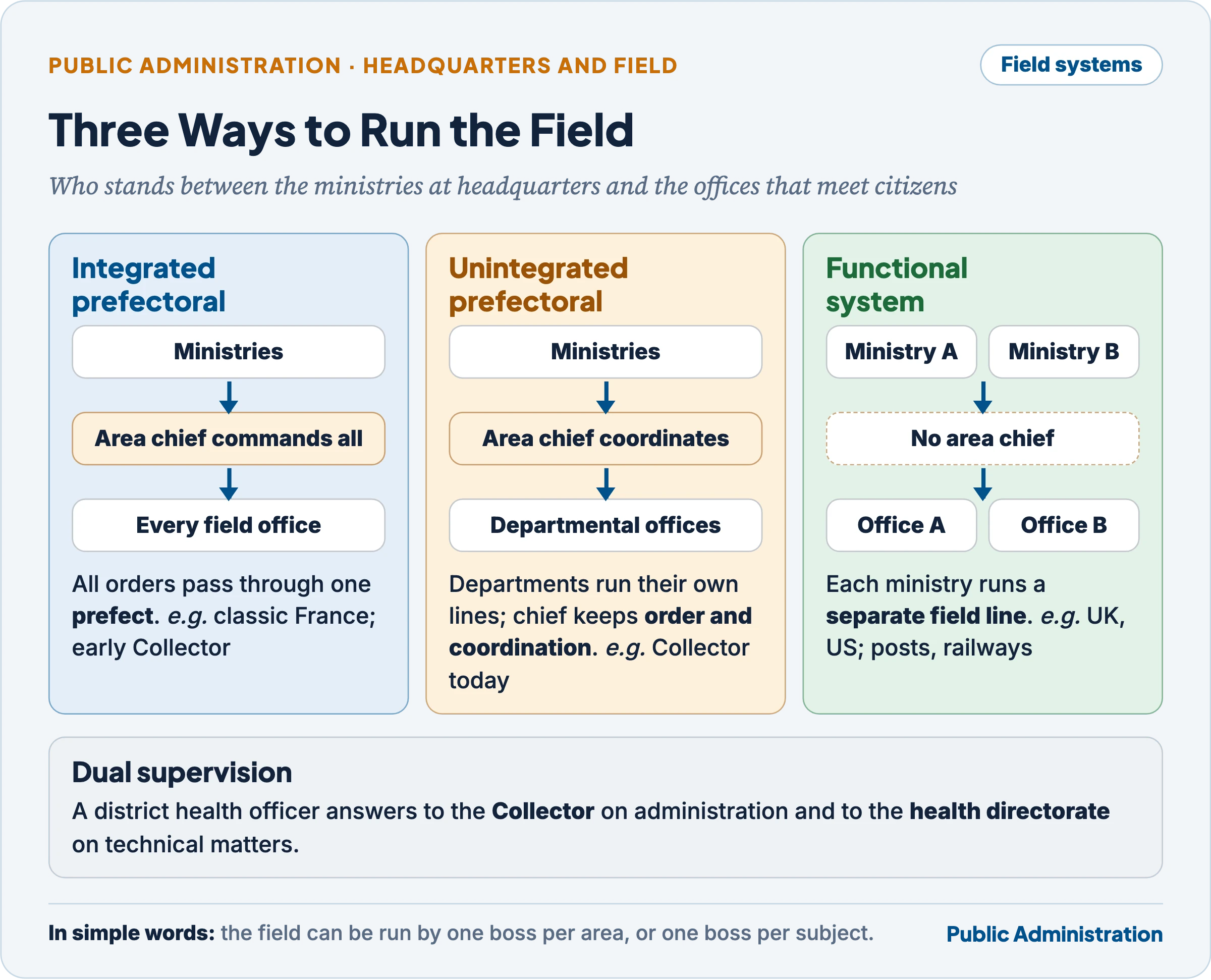
Prefectoral and functional systems. James Fesler (Area and Administration, 1949) and later Brian C. Smith (Field Administration, 1967) classified field systems by the role of a general area representative:
| System | Area chief’s role | Example | Strength | Weakness |
|---|---|---|---|---|
| Integrated prefectoral | A prefect represents the whole government in the area; all field services are subordinate to him and all communication passes through him | Classic French prefect; the Collector in early British India | Unity of command and coordination at the point of delivery | Overload; specialists subordinated to a generalist |
| Unintegrated prefectoral | An area chief keeps law and order and coordinates, but functional departments run their own lines to their headquarters | The Collector in India today | Coordination without destroying specialist lines | Dual supervision and confusion |
| Functional | No general area representative; each ministry runs a separate field hierarchy | Britain, the United States; posts, railways, income tax in India | Technical expertise, uniform standards | Fragmentation; citizens face many separate offices |
Area versus function. The field faces a permanent tension between the area principle (one coordinator for all services in a territory) and the function principle (one chain for each subject from headquarters to the village). Dual supervision is the usual compromise: a district health officer or district agriculture officer answers to the Collector on administrative and coordination matters and to the State directorate on technical matters. It secures both coordination and expertise, but can produce delays, conflicting orders and the old generalist–specialist rivalry.
9.3 What decides whether field agencies are centralised or decentralised
Fesler identified four sets of factors:
- Responsibility: headquarters answers to the legislature for failures in the field, so it hesitates to delegate unless the law limits its responsibility (as with corporations).
- Administrative factors: an older agency with settled policies and an experienced, trusted field staff can decentralise; a new agency still groping for policies tends to centralise. Pressure for speed and economy favours decentralisation.
- Functional factors: single-function agencies (defence, posts, police) need uniformity; multi-functional and development agencies (agriculture, water, rural development) must adapt to local conditions.
- External factors: programmes that depend on the cooperation of people, local bodies and voluntary groups require field officers with enough discretion to accommodate them (“grass-roots administration”).
Signs of a truly decentralised field agency: it decides most matters locally; its authority is defined broadly rather than by minute rules; its decisions are usually final rather than routinely reversed on appeal; and it is decentralised internally too, down to its own sub-offices.
9.4 Methods of headquarters control
- Reports, returns and statistics from the field, on which headquarters can issue directions.
- Manuals and codes of procedure that set the limits of discretion.
- Budget: allotments within which the field must work; deviations need approval.
- Inspection: traditionally a “policing” device to detect irregularity; the modern view treats it as education, advice and help as well as correction.
- Investigation of specific malpractice.
- Uniform plan of organisation across field offices, which simplifies control.
- Interchange of personnel: India’s tenure system, under which field officers serve in the secretariat for fixed terms and return, gives headquarters field experience and the field an understanding of headquarters.
9.5 Problems in the relationship
- Ivory-tower policy: headquarters designs uniform schemes detached from field realities; the field complains of not being consulted, and headquarters blames tardy implementation.
- Over-centralisation: minor financial and personnel matters referred upward; field officers lack discretion.
- Communication distortion: information is filtered and sanitised as it rises; instructions are unclear as they descend.
- Generalist–specialist friction: secretariat generalists over field specialists (doctors, engineers, agronomists).
- Multiple masters: district officials receive orders from many State departments and centrally sponsored schemes at once.
- Intermediate levels as bottlenecks: if headquarters bypasses intermediate levels to reach the “firing line”, those levels lose authority; if it does not, it loses touch with reality. India’s practice is a workable blend: the Inspector-General supervises through the Superintendent of Police, who himself stays in direct touch with police stations.
- Frequent transfers that break continuity.
Why no general theory works. The degree of decentralisation, the mode of coordination, the method of control and the number of intermediate levels all vary with the agency’s function, age, staff and environment. This is why the relationship is often said to be a practitioner’s domain: the workable pattern is evolved through practice for each agency and level. This is the contingency view applied to the field.
9.6 Remedies: communication, MIS and trust
- Effective two-way communication is the core of a healthy relationship: clear and detailed instructions downward; honest, timely feedback upward; involvement of field officers in policy design; regular conferences and field visits by headquarters staff.
- Management Information Systems (MIS) turn reports into usable data: real-time dashboards, geo-tagging and transaction-based data let headquarters monitor outcomes without micro-managing processes. Examples include PRAGATI (from 2015), the Prime Minister’s ICT-based review platform with Chief Secretaries; the Aspirational Districts Programme (2018) dashboard ranking districts on indicators; and programme MIS such as NREGASoft. But MIS is necessary, not sufficient: data can be gamed, may centralise decision-making, and cannot replace trust and discretion. An MIS that only reports upward without empowering the field reproduces centralisation in digital form.
- Delegation of financial and administrative powers within budget ceilings.
- Training and capacity-building of field officers (Mission Karmayogi’s role-based competencies).
- Stable tenure for field officers.
- Fesler’s humanistic criterion: the ultimate test of field organisation is its total impact on the citizen at the point where all agencies converge. If the citizen finds it confusing, harassing and inconvenient, the system stands condemned however neat it looks on the chart.
2nd ARC on headquarters and field.
- 13th Report (2009): separate policy (ministries) from implementation (executive agencies, attached and subordinate offices, autonomous bodies and field formations); delegate and delayer; apply subsidiarity.
- 15th Report, State and District Administration (2009): the same separation of policy and implementation at the State level, with executive agencies for implementation, more delegation to heads of departments, and a district administration in which the Collector coordinates while elected local governments gain functions.
Indian Connect — Field organisations and policy implementation
- Rural employment guarantee: under the MGNREGA (2005), a District Programme Coordinator (usually the Collector or the zila parishad’s chief executive) and a Programme Officer at the block supervised works, while gram panchayats executed at least half the works; an MIS recorded every job card, muster roll and payment, and social audits by gram sabhas checked the field. The Viksit Bharat–G RAM G Act, 2025 has since replaced MGNREGA with a 125-day guarantee, rolled out through State schemes from 2026, again relying on panchayat and block-level field machinery.
- Swachh Bharat Mission (Grameen): district sanitation committees under the Collector, block coordinators and village-level motivators (swachhagrahis), with geo-tagged verification of toilets, show how field organisation plus MIS can drive behaviour change at scale.
- Lesson: field organisations convert national schemes into local results when they combine delegated discretion, local participation and real-time information; they fail when targets are imposed from above and verified only on paper.
10. Centralisation and Decentralisation
In simple words
Centralisation means that the big decisions, and many small ones, are taken at the top. Decentralisation means that power to decide is passed down or out, to field officers, to separate agencies or to elected local bodies. The question is not which is good, but how much of each, for what purpose.
10.1 Meaning
- Leonard D. White: the transfer of administrative authority from a lower to a higher level of government is centralisation; the converse is decentralisation.
- Henri Fayol: “everything which goes to increase the importance of the subordinate’s role is decentralisation; everything which goes to reduce it is centralisation”. The right degree is a question of proportion.
- Centripetal and centrifugal tendencies: centralisation draws authority upward and inward; decentralisation pushes it downward and outward.
- A matter of degree: no organisation is wholly centralised or decentralised; both coexist. Paul Appleby observed that nothing can be decentralised until it has first been centralised: headquarters must define policy before it can safely leave its application to others.
How power can move. Dennis Rondinelli and his colleagues (World Bank, 1983–84) distinguished forms of decentralisation by how much power moves and to whom:
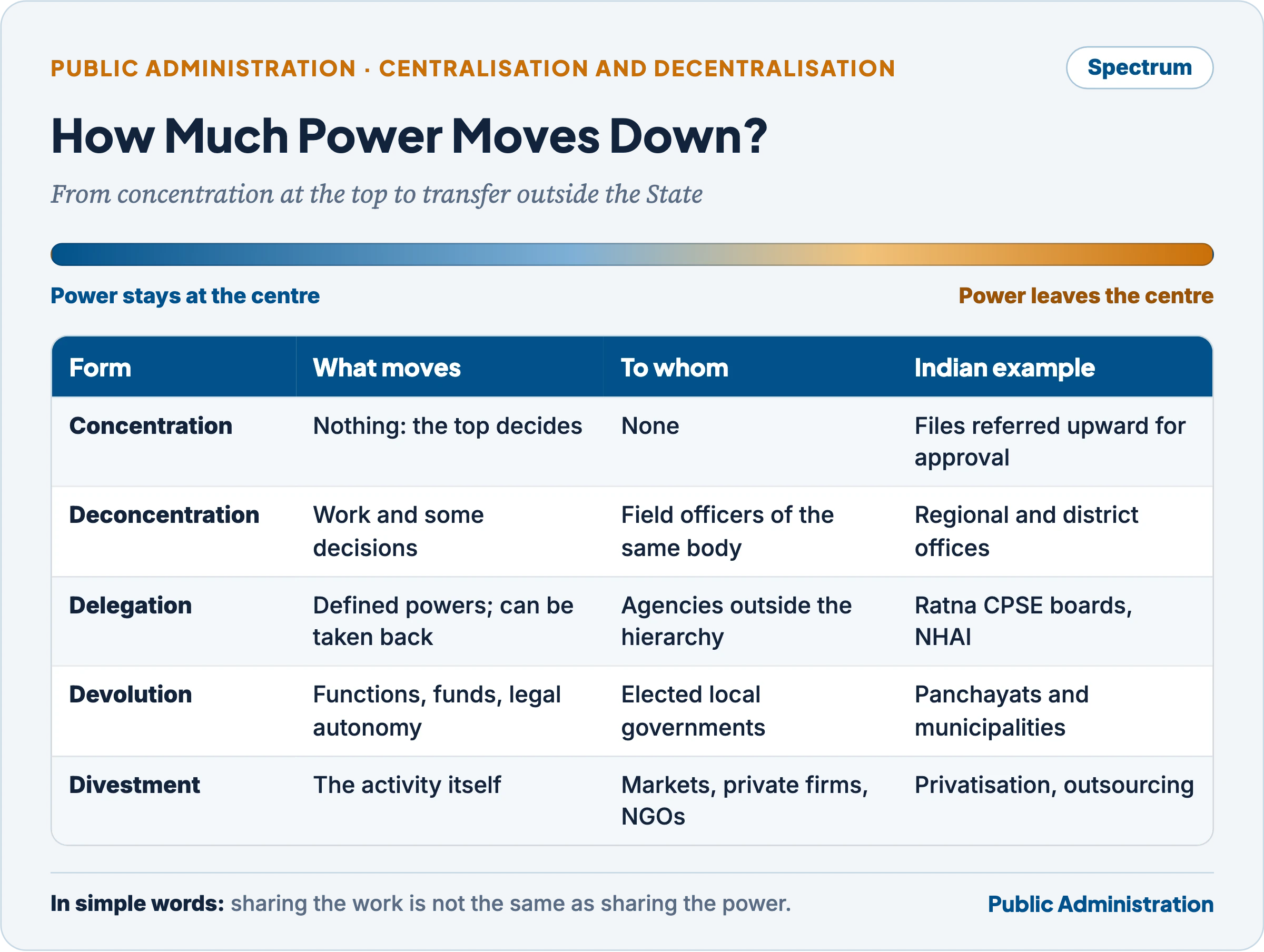
| Form | What happens | Indian example |
|---|---|---|
| Concentration | Authority retained at the top; field merely executes | Files referred upward for approval |
| Deconcentration | Work and some decision-making shifted to field units of the same organisation; the centre keeps control | District and regional offices of a department |
| Delegation | Defined powers given to semi-autonomous agencies outside the regular hierarchy, which remain ultimately answerable and whose powers can be withdrawn | Ratna CPSE boards, NHAI, development authorities |
| Devolution | Functions, funds and legal autonomy transferred to elected, autonomous local governments that the centre cannot easily override | Panchayats and municipalities under the 73rd and 74th Amendments |
| Divestment (privatisation) | The activity itself transferred to markets, firms or voluntary bodies | Privatisation, outsourcing, PPPs |
Delegation in organisational sense. Within an organisation, delegation means entrusting part of one’s authority to a subordinate. Its essence is to confer discretion on others, letting them use their judgement on specific problems within the framework of their duties. Its features:
- The superior assigns duties, grants matching authority and creates an obligation.
- Responsibility cannot be delegated: the delegator remains answerable for the result.
- Authority delegated can be withdrawn.
- It needs trust and clear limits; without trust, delegation remains a paper plan.
- It develops subordinates’ skills and relieves overload at the top.
Common confusion
Is delegation the same as decentralisation? No. Delegation passes authority to a subordinate or agency that acts on behalf of the delegator, who retains overall responsibility and can revoke or revise it. Decentralisation in its full sense (devolution) means the centre divests itself of powers in favour of bodies with their own legal and political standing, which act in their own right. Delegation is a technique of management; devolution is a redistribution of power. Deconcentration, in turn, is decentralisation of work without real decentralisation of power.
10.2 Types
- Political decentralisation: creating autonomous governments with their own powers (federalism; local self-government).
- Administrative decentralisation: dispersing authority within an administrative system, either territorial (to area units such as districts and divisions) or functional (to specialised bodies such as the UGC or professional councils).
- Fiscal decentralisation: assigning revenues and spending powers to lower levels (Finance Commissions, State Finance Commissions).
- Measuring the degree: decentralisation is greater when more decisions, and more important decisions, are made at lower levels; when those decisions affect more functions (finance and personnel, not just operations); and when less checking is required (no consultation before or report after).
- Mervin Kohn’s matrix combines dispersal of facilities with dispersal of authority, showing that an organisation may have dispersed offices but centralised decisions (many transport undertakings) or concentrated facilities with delegated decisions.
10.3 Factors that favour each
| Favour centralisation | Favour decentralisation |
|---|---|
| Responsibility of headquarters to the legislature | An old agency with settled policies |
| A new agency without settled procedures | Competent, trusted field personnel |
| Need for uniform national policy (defence, currency, planning) | Need to adapt policy to diverse local conditions |
| Crises and emergencies | Pressure for speed and economy |
| Fear of corruption or parochialism locally | Demand for popular participation |
| Information technology that lets the top see everything | Complex, technical, multi-functional tasks |
| Weak local capacity | Democratic commitment to local self-government |
10.4 Merits and demerits
| Centralisation | Decentralisation | |
|---|---|---|
| Merits | Uniform policy and standards; coordination; economy through avoiding duplication; control over abuse of authority; quick decisions in emergencies; prestige and clear leadership at the top | Decisions close to the problem and the citizen; quicker local action; adaptation to diversity; participation and democratic training; relief to the top; leadership development in the field; room for experiment; less paperwork |
| Demerits | Congestion at the top and weakness at the extremities (a nineteenth-century French critic called it apoplexy at the centre and anaemia at the extremities); delay; ignorance of local needs; rigidity and autocracy; no participation | Problems of coordination and control; duplication and cost; parochialism and inequality between regions; capture by local elites; uneven capacity |
10.5 The growing tendency towards centralisation in the modern state
Despite the praise for decentralisation, modern states tend to centralise. The reasons:
- Welfare and planning: national standards in health, education and income support; centrally sponsored schemes with central funds and conditions.
- Economic integration: a single market, national infrastructure and macroeconomic management (GST, a single tax and its Council).
- Security and crises: wars, terrorism, pandemics and disasters (the Disaster Management Act, 2005, and the Epidemic Diseases Act were used for nationally coordinated responses in 2020).
- Technology: communication and data systems remove the old obstacles of distance and let headquarters monitor and decide directly; digital platforms can re-centralise decision-making while appearing to decentralise service delivery.
- Party politics and leadership: dominant parties and strong executives (the growing role of the Prime Minister’s Office).
- Fiscal power: the centre’s superior revenue base and the conditions attached to transfers.
10.6 More than efficiency: why decentralisation matters
Decentralisation is never just a technical exercise confined to economy and efficiency; it is about power, participation and values.
- Fesler’s four approaches (1965): the doctrinal (decentralisation idealised as an article of faith, as in romantic views of the self-governing village); the political (decentralisation depends on political commitment, and without it devolution remains on paper, which he called “illusory decentralisation”); the administrative (decentralisation as a means to efficiency, producing field units and the area–function duality); and the dual-role (field administration torn between maintaining order and promoting change and development).
- Pfiffner and Sherwood observed that decentralisation has become almost a “gospel” of management, with ethical roots in democracy, and is difficult because it runs counter to old habits of command.
- Kochen and Deutsch treated decentralisation as a problem of logistics and information: it is rational when moving messages, people and materials to the point of action improves task performance. Their functional view is useful, but it misses decentralisation’s ethical and political value.
- Democratic justification: decentralisation brings government closer to people, allows self-determination, trains citizens in self-government, protects against concentrated power and accommodates diversity. In this sense, centralisation inclines towards power and domination (uniform control from one point), while decentralisation inclines towards competition and self-determination (many centres that can experiment, compete and choose for themselves).
- Polycentric governance: Vincent and Elinor Ostrom argued that many overlapping centres of decision-making can supply public goods better than a single hierarchy (Section 11.4).
India: decentralisation in brief. The 73rd and 74th Constitutional Amendment Acts (1992) gave panchayats and municipalities constitutional status, regular elections, reservation, State Finance Commissions and lists of functions (the Eleventh and Twelfth Schedules). Implementation remains uneven: transfer of funds, functions and functionaries depends on State governments, many local bodies lack staff and own revenue, and parallel bodies (district-level committees run by officials) often bypass them. This is Fesler’s “illusory decentralisation” in Indian form (see the articles on Panchayati Raj and Urban Local Government).
11. Newer Structures: Matrix, Mission, SPV and Networks
In simple words
The pyramid with one boss on top works well for routine jobs. For new, urgent or cross-cutting problems, governments now also use teams drawn from many departments, time-bound missions, separate companies for projects, and partnerships with private and voluntary bodies.
11.1 Why hierarchy is questioned
Hierarchical structures do not align well with environments that are turbulent, technology-driven and cross-cutting: climate change, digital services, urban infrastructure, pandemics. Problems cut across departments; knowledge lies with specialists and partners outside the chain of command; and speed matters more than procedure. Contingency theory explains why: organic structures suit uncertainty, mechanistic ones suit stability (see the article on Systems and Contingency Theories).
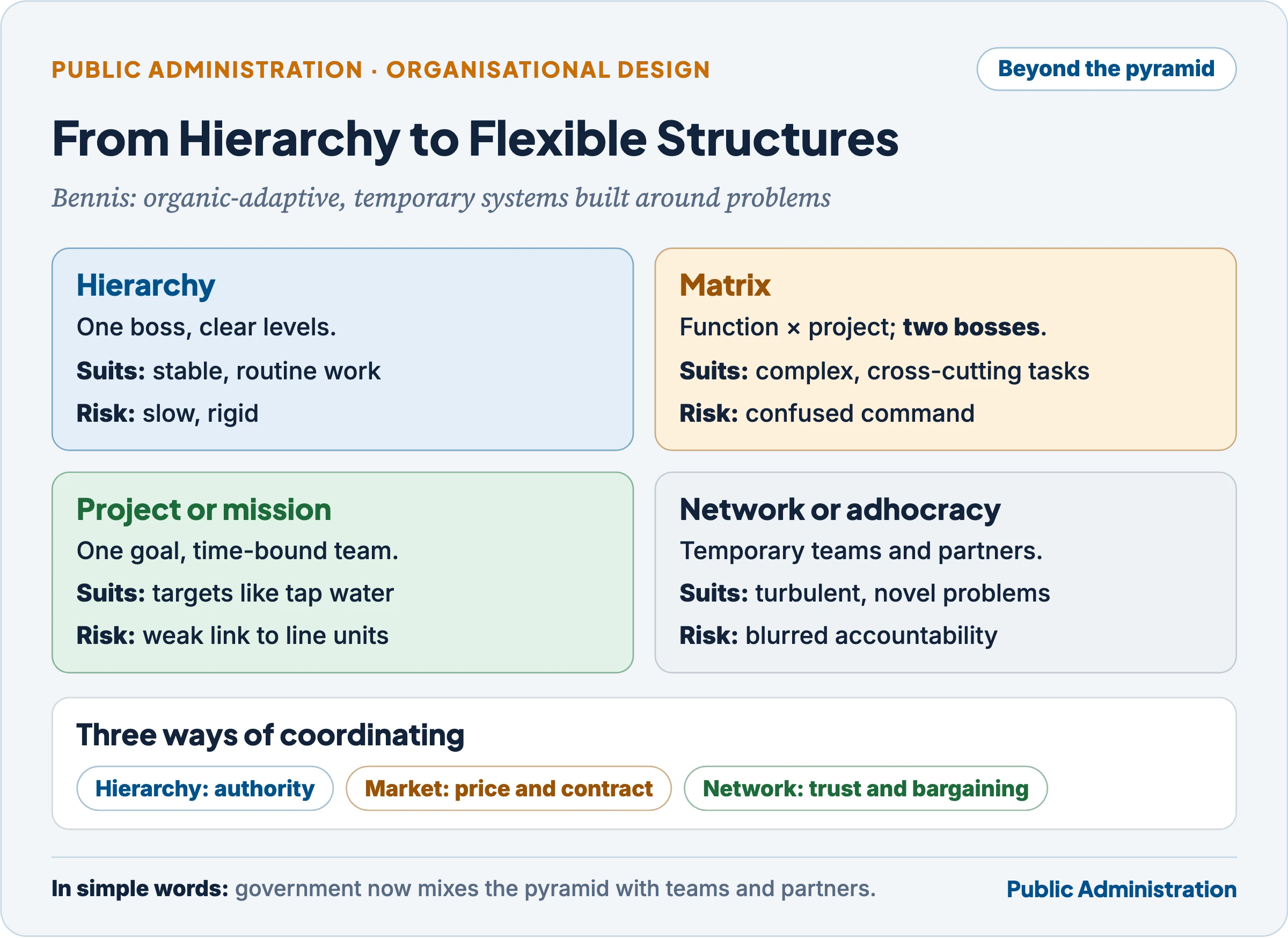
11.2 Forms of structuring modern organisations
- Functional (traditional) structure: grouping by function under a single hierarchy; efficient for routine work.
- Divisional structure: semi-autonomous divisions by product, region or client, each with its own functions (railway zones; CPSE subsidiaries).
- Matrix structure: employees report both to a functional head (engineering, finance) and to a project or programme head. It focuses resources on outcomes while keeping specialist depth. India’s old block administration was an early example: an extension officer was administratively responsible to the Block Development Officer and technically to the functional chief at the next level. Its risk is two bosses, conflict and blurred accountability.
- Project organisation and task forces: a team assembled for a defined goal and dissolved afterwards.
- Mission mode: a time-bound programme with its own directorate, targets, funding stream and monitoring, cutting across the usual departmental lines. Example: the Jal Jeevan Mission (launched 15 August 2019) to give every rural household a tap connection, run through a National Jal Jeevan Mission in the Ministry of Jal Shakti, State and district water and sanitation missions and village water committees; in March 2026 the Union Cabinet approved its extension to December 2028 with an enhanced outlay and restructuring.
- Special Purpose Vehicles (SPVs): a separate company created for one project, which ring-fences finances, attracts partners and gives managerial freedom. Example: the Smart Cities Mission (2015) required an SPV under the Companies Act, 2013 in each of the 100 cities; after the mission formally ended on 31 March 2025, the Ministry of Housing and Urban Affairs advised States to repurpose these SPVs and their command and control centres as long-term urban institutions. SPVs are also the standard vehicle for PPP projects.
- Network and virtual organisations: a small core coordinating many partners (firms, NGOs, other governments) through contracts and agreements.
- Flat, team-based and digital platforms: delayered structures in which data platforms coordinate many actors (PM GatiShakti for infrastructure planning).
11.3 Bennis: organic-adaptive structures and temporary systems
Warren Bennis, the American organisation theorist, predicted the end of bureaucracy in essays of the mid-1960s and in The Temporary Society (1968, with Philip Slater). He argued that bureaucracy, designed for stable, routine environments, cannot cope with rapid change, the growth of science and the rise of professionals. Organisations of the future would be:
- Temporary systems: adaptive, rapidly changing project groups organised around problems to be solved, made up of relative strangers with diverse professional skills, and dissolved when the problem is solved.
- Organic rather than mechanical: coordinated by linking persons who mediate between groups, not by a fixed chain of command; people are differentiated by skill and training rather than rank.
- Adaptive: able to change structure as tasks change; authority based on competence, not position.
- Human consequences: more commitment to the task and professional growth, but also less job security, weaker group loyalty and higher personal stress in moving from team to team.
Related ideas: Alvin Toffler (Future Shock, 1970) popularised the word “adhocracy”; Henry Mintzberg (The Structuring of Organizations, 1979) made adhocracy one of his basic configurations, suited to complex innovation. Organisation Development (OD), which Bennis also championed, is the planned, behavioural-science-based effort to improve an organisation’s capacity to change through team-building, feedback and participative problem-solving. Modern civilisation’s rapid change creates an unprecedented need for such deliberate renewal, because structures and attitudes otherwise lag behind tasks.
Critique: bureaucracy has not disappeared. Public organisations need stability, due process and accountability, which temporary systems weaken. In practice governments combine a permanent hierarchical core with temporary teams, missions and partnerships around it.
11.4 Markets, hierarchies and networks
Modern governing structures can be understood as three modes of coordination:
| Mode | Coordinating mechanism | Relationship | Strength | Weakness | Example |
|---|---|---|---|---|---|
| Hierarchy | Authority and rules | Superior–subordinate | Control, accountability, equity | Rigidity, slowness | Departments, districts |
| Market | Price, competition, contract | Buyer–seller | Efficiency, choice, innovation | Inequity, under-supply of public goods | User fees, contracting out, vouchers |
| Network | Trust, reciprocity, negotiation | Partners, interdependent | Pooled knowledge and resources, flexibility | Diffuse accountability, slow consensus | PPPs, inter-agency task forces, government–NGO partnerships |
- Oliver Williamson (Markets and Hierarchies, 1975) explained when organisations choose hierarchy over market contracting (to economise on transaction costs).
- Walter Powell (“Neither Market nor Hierarchy”, 1990) identified networks as a distinct third form based on trust and reciprocity.
- The volume Markets, Hierarchies and Networks: The Coordination of Social Life (1991) presented the three as alternative ways of coordinating social life; R.A.W. Rhodes later described the shift from government (hierarchy) to governance (self-organising networks).
- Implication: New Public Management pushed markets into government; New Public Governance stresses networks. Real governments mix all three, and the administrative skill lies in choosing and combining them (see the article on NPM and After).
The Ostroms’ theory of institutional arrangements. Vincent Ostrom and Elinor Ostrom (“Public Choice: A Different Approach to the Study of Public Administration”, 1971) argued that a variety of different organisational arrangements can be used to provide different public goods and services. The theory underlying the claim:
- Public goods differ in scale, excludability and jointness of consumption; no single bureaucratic hierarchy suits them all.
- Provision (deciding what to supply and how to finance it) can be separated from production (actually delivering it): a municipality can provide water but contract a firm, a cooperative or another government to produce it.
- Polycentric systems of overlapping jurisdictions allow matching of scale to good, citizen choice and competition among producers; Vincent Ostrom’s The Intellectual Crisis in American Public Administration (1973) called this “democratic administration”.
- Potential contribution: a theoretical basis for decentralisation, contracting, PPPs, user associations and community management (Elinor Ostrom’s later Nobel-winning work on common-pool resources showed communities managing forests and irrigation successfully). Limits: fragmentation, inequality between jurisdictions and difficulty in coordinating externalities.
11.5 Privatisation and its tools
The shift from hierarchy to market and network has three common instruments, each with administrative consequences:
- User fees: charging beneficiaries directly (tolls, water charges, hospital fees). They improve efficiency and signal demand but raise equity concerns and need exemption systems for the poor.
- Outsourcing (contracting out): government buys services from private or voluntary providers. It needs contract design, monitoring and enforcement capacity; without effective accountability mechanisms it can be counter-productive.
- Public–private partnerships: long-term contracts sharing risks and returns, usually through SPVs, treated fully in the article on Regulatory Authorities and PPPs.
The common lesson is that privatisation changes the role of public administration rather than shrinking it: from producer to enabler, regulator and contract manager.
Key Terms
| Term | Meaning in simple words |
|---|---|
| Structure | The relatively fixed pattern of relationships among the parts of an organisation |
| Hierarchy (scalar principle) | Graded levels of authority, with orders flowing down and accountability up |
| Departmentalisation | Grouping work into units by purpose, process, persons or place |
| Lilliputian administration | Haldane Committee’s term for tiny client-based departments duplicating services |
| Coordination | Arranging group effort to secure unity of action |
| Line agency | Agency that performs the primary work and commands |
| Staff agency | Agency that advises, plans and coordinates without command |
| Auxiliary agency | Agency that provides common housekeeping services to all others |
| Allocation of Business Rules | 1961 rules listing ministries and departments and the subjects given to each |
| Transaction of Business Rules | 1961 rules on how government business is disposed of and who must be consulted |
| Attached office | Executive agency giving direction and technical advice for a department’s policies |
| Subordinate office | Field establishment doing the detailed execution of policy |
| Public corporation | Body corporate created by a special Act, State-owned, with operational autonomy |
| Government company | Company in which governments hold at least 51 per cent of paid-up capital (Companies Act 2013, s.2(45)) |
| CPSE | Central Public Sector Enterprise, majority-owned by the Union government |
| Ratna status | Maharatna, Navratna and Miniratna categories giving CPSE boards wider financial powers |
| Disinvestment | Sale of government shares in public enterprises; strategic sale transfers control |
| Plural headship | Leadership vested in a board or commission rather than one person |
| Headless fourth branch | Brownlow Committee’s description of independent regulatory commissions |
| Commission of inquiry | Fact-finding body with civil court powers under the 1952 Act |
| Sadar and mofussil | Indian terms for headquarters and field |
| Prefectoral system | Field system with a general area representative (prefect, Collector) |
| Functional system | Field system in which each ministry runs its own field line |
| Dual supervision | A field officer answering to an area chief administratively and to a department technically |
| Deconcentration | Shifting work and some decisions to field units of the same body |
| Delegation | Entrusting authority to a subordinate or agency who acts on the delegator’s behalf |
| Devolution | Transferring functions, funds and autonomy to elected local governments |
| Illusory decentralisation | Fesler’s term for decentralisation on paper without real transfer of power |
| Matrix structure | Dual reporting to a functional head and a project head |
| Mission mode | Time-bound programme with its own directorate, targets and funds |
| Special Purpose Vehicle | Separate company created to execute one project |
| Adhocracy | Flexible, temporary, team-based structure organised around problems |
| Polycentricity | Many overlapping centres of decision-making supplying public goods |
Commissions, Committees and Judgments
| Body / case | Year | Key point |
|---|---|---|
| Haldane Committee (UK, Machinery of Government) | 1918 | Departments by function (service performed); rejected client basis as “Lilliputian administration” |
| Brownlow Committee (US) | 1937 | “The President needs help”; regulatory commissions a “headless fourth branch” |
| Government Corporation Control Act (US) | 1945 | Business-type budgets, commercial audit, creation only by Congress |
| Gorwala Report, Efficient Conduct of State Enterprises | 1951 | Excessive interference in the Damodar Valley Corporation; case for flexible forms |
| Chagla Commission (Mundhra affair) | 1958 | Finance Ministry treated LIC as its wing; “dictated transaction” |
| Krishna Menon Committee | 1958–59 | Recommended a parliamentary committee on public undertakings |
| Committee on Public Undertakings | 1964 | Parliamentary scrutiny of PSUs; now 22 members (15 LS, 7 RS) |
| First ARC, Machinery of Government of India | 1968 | Grouping of subjects by function and affinity |
| Arjun Sengupta Committee | 1984 | MoU system for public enterprises |
| Commissions of Inquiry Act | 1952 | Civil court powers; report with action-taken memorandum within six months |
| 2nd ARC, 13th Report (Organisational Structure of GoI) | 2009 | 20–25 ministries, coordinating ministers, executive agencies, delayering |
| 2nd ARC, 15th Report (State and District Administration) | 2009 | Separation of policy and implementation; executive agencies; delegation |
| Shanta Kumar High Level Committee (FCI) | 2015 | Restructuring the Food Corporation of India’s role |
| Humphrey’s Executor v. United States | 1935 | Removal protection for independent commissioners upheld |
| Anoop Baranwal v. Union of India | 2023 | Independent selection process for Election Commissioners pending a law |
Contemporary Developments
- 22 July 2026: the 386th amendment to the Allocation of Business Rules split the Ministry of Housing and Urban Affairs into a Department of Capital Development (National Capital Region) and a Department of Urban Development, a fresh example of departmentalisation by place and purpose.
- 11 June 2026: the 11th Governing Council meeting of NITI Aayog, chaired by the Prime Minister with Chief Ministers and Lieutenant Governors, took up inclusive human development for Viksit Bharat@2047, showing the council form as a forum of cooperative federalism.
- 10 March 2026: the Union Cabinet approved the extension and restructuring of the Jal Jeevan Mission till December 2028 with an enhanced outlay, continuing the mission-mode structure.
- February and June 2026: Munitions India Ltd, one of the seven companies carved out of the Ordnance Factory Board, received Miniratna Category I status, and Garden Reach Shipbuilders and Engineers was upgraded to Navratna, extending delegated autonomy in defence CPSEs.
- October 2026: the government selected Fairfax Financial Holdings to acquire 60.72 per cent of IDBI Bank, the largest strategic sale since Air India, with completion expected by March 2027.
- February 2026: the report of the Sixteenth Finance Commission (chair Arvind Panagariya), submitted on 17 November 2025, was tabled in Parliament for the award period 2026–31, an example of a constitutional commission shaping fiscal federalism.
- 2025: after the Smart Cities Mission ended on 31 March 2025, the Ministry of Housing and Urban Affairs issued an advisory to repurpose the 100 city SPVs as permanent urban institutions; in December 2025 Parliament passed the Viksit Bharat–G RAM G Act, 2025, replacing MGNREGA with a 125-day rural employment guarantee implemented through State schemes and local field machinery.
- June 2025: the Department of Public Enterprises reported 14 Maharatna and 26 Navratna CPSEs, up from 7 and 10 in 2014.
Revision Grid
| Thinker / body | Work or report (year) | Key idea |
|---|---|---|
| Luther Gulick | Papers on the Science of Administration (1937) | Four Ps of departmentalisation; arms-and-fingers field patterns |
| Haldane Committee | Machinery of Government (1918) | Departments by function; against “Lilliputian administration” |
| Mooney and Reiley | Onward Industry! (1931) | Coordination as first principle; scalar principle |
| Mary Parker Follett | Collected papers (1920s–30s) | Four principles of coordination |
| Leonard D. White | Introduction to the Study of Public Administration (1926) | Staff vs auxiliary; definition of centralisation |
| W.F. Willoughby | Principles of Public Administration (1927) | Unitary and multiple field organisation |
| James Fesler | Area and Administration (1949); approaches to decentralisation (1965) | Prefectoral vs functional; factors of decentralisation; illusory decentralisation; citizen criterion |
| Brian C. Smith | Field Administration (1967) | Integrated and unintegrated prefectoral systems |
| Herbert Morrison | Socialisation and Transport (1933) | Public corporation: public ownership, accountability, business management for public ends |
| W.A. Robson | Nationalized Industry and Public Ownership (1960) | Corporate autonomy with public ownership |
| Robert Cushman / Brownlow Committee | 1937 | Independent commissions as a “headless fourth branch” |
| Alvin Gouldner | Patterns of Industrial Bureaucracy (1954) | Mock, representative, punishment-centred bureaucracy; formal and informal interdigitated |
| Victor Thompson | Modern Organization (1961) | Gap between authority and expertise in hierarchy |
| Warren Bennis | The Temporary Society (1968) | Organic-adaptive, temporary systems |
| Henry Mintzberg | The Structuring of Organizations (1979) | Adhocracy as a configuration |
| Oliver Williamson | Markets and Hierarchies (1975) | Transaction costs explain hierarchy vs market |
| Walter Powell | Neither Market nor Hierarchy (1990) | Networks as a third form |
| Vincent and Elinor Ostrom | Public Choice: A Different Approach (1971) | Variety of institutional arrangements; polycentricity |
| Dennis Rondinelli | Decentralization studies (1983–84) | Deconcentration, delegation, devolution, privatisation |
| A.D. Gorwala | Efficient Conduct of State Enterprises (1951) | Autonomy of public enterprises; DVC interference |
| 2nd ARC | 13th and 15th Reports (2009) | Fewer ministries, executive agencies, separation of policy and implementation |
Previous Year Questions
- 2026Hierarchical structures do not align with the modern business world. Discuss the different forms of structuring modern organisations.
- 2024Healthy Headquarters and Field Agencies relationship thrives on effective communication. Comment.
- 2020“Organizations of the future will be organic-adaptive structures but temporary systems.” Discuss how Warren Bennis characterises the new form of organization.
- 2020“Markets, hierarchies and networks represent Modern governing structures in government.” Explain.
- 2020Departments, Boards and Commissions as forms of organization are dissimilar in the context of accountability and responsibility.” Analyse.
- 2018“Form of an organisation influences the success of a public enterprise, but the choice of a form has always remained problematic.” Discuss the statement in the context of the comparative merits and limitations of departments, corporations, companies and boards. Give illustrations.
- 2018“An effective Management Information System (MIS) is the key to successful headquarter-field relationships.” Comment.
- 2016“The autonomy of Public Corporations raised a great debate about their internal working and external relation with the Ministers and the Parliament.” Discuss.
- 2014“The notion of informal organisation is a residual or cafeteria concept of diverse and sprawling contents.” How does Gouldner established the need for understanding the interdigitations between the formal and informal organisation?
- 2013“A variety of different organizational arrangements can be used to provide different public goods and services.” Explain the theory underlying this proposition and its potential contribution.
- 2013“In the globalized public administration, hierarchy creates more ethical problems than it solves ….” Comment.
- 2010Explain the impact of privatisation on public administration with special reference to The issue of user fees. Public- private partnership. Outsourcing technique.
- 2009“There is no doubt the departmentalisation is fraught with complexities. These are in part technical, in part political.” Discuss.
- 2008“To claim that a company or a corporation form is always more effective than an outdated view. The real test of a sound structure is its capacity to balance decisional autonomy and operational flexibility with optimal accountability.” Critically examine this statement.
- 2007“The distinction between line and staff is relative rather than absolute.” Discuss.
- 2002“Public corporations are not an end in thems-elves but an extension of the government activities designed to promote public welfare.” – Substantiate.
- 2001A fairly adequate analysis of the Administrative Organization in Government is possible when we treat ‘bureaucracy’ as a ‘structure’ and ‘administration’ as a ‘function’. Discuss.
- 2001Why do all administrative organizations consider ‘hierarchy’ as the many splendoured technique? Discuss.
- 1999“The Commission form of organisation would tend to be a ‘headless fourth branch’ of government.” Comment.
- 1998Differentiate between managerial and functional aspects of co-ordination. How is co-ordination achieved?
- 1998“Headquarter and Field relationships determine the tendor of implementation of programmes.” Comment.
- 1997“Theoretically the Board administration violates the distinction between government and politics because through it politics is injected in the administration.” Comment.
- 1997“Centralization inclines toward power and domination. Decentralization, on the other hand, inclines toward competition and self-determination.” Discuss.
- 1995Hierarchic control, whereby instructions are passed down the line is not the only dimension of control. Comment.
- 1995“Much of what the recruit learns in an organisation is communicated after the fashion of Bentham’s ‘dog law’.” Discuss.
- 1994“The distinction between line authority and professional expertness is also less clear-cut in reality than the abstract concepts of line and staff make it appear.” Discuss.
- 1993“Decentralization is never just a technical exercise, with intentions and effects neatly confined to questions of economy and efficiency.” Comment.
- 1992‘It is difficult to state any demarcating principle to differentiate between Line and Staff functions of agencies.’ Discuss.
- 1992‘The Departmental pattern of undertaking does not offer the necessary, autonomy, flexibility and entrepreneurship to Management’. Examine.
- 1992‘Decentralization has a more important justification than more administrative efficiency.’ Comment.
- 1991‘A Public Corporation is a combination of Public ownership, public accountability and business managements for public ends. Comment.
- 1991Account for the growing tendency of central-ization in the modern state.
- 1991‘The essence of delegation is to confer discretion upon others, to use their judgement in meeting specific problems within the framework of their duties.’ Comment.
- 1987‘And therefore, Modern Civilization has an unprecedented need of Organisation Development (OD). Comment.
- 1987‘The distinction between line and staff is distinction without a difference.’ Comment.
- 2026Government of India has done Corporatisation of Ordnance Factory Boards. Discuss the rationale in the light of Disinvestment Policy of the government.
- 2025Examine the significance of field organizations in enhancing policy implementation of projects like MGNREGA and Swachh Bharat Mission.
- 2025In contemporary times, the District Collector should prioritize teamwork over hierarchical structures. Comment.
- 2024“Autonomy to Public Undertakings is a myth.” Analyse.
- 2018“The attached offices and subordinate offices are integral to the functioning of the Cabinet Secretariat.” Discuss.
- 2016Evaluate the performance and efficacy of the Maharatna, Navratna and Miniratna type of Public Sector Undertakings in the context of Liberalization, Privatization and Globalization (LPG).
- 2015Explain fully how a balance can be struck between autonomy and accountability of India’s public enterprises.
- 2013“Autonomy to public sector undertakings is a myth.” Analyse in the context of the use of government expenditures by politicians who control governments at different levels.
- 1999“The Public Corporations in India are like exhausted Leviathans.” Comment.
- 1997“For national planning, the commission type of organisation was deliberately preferred.” Examine the statement.
- 1995“The departmental public undertakings have necessarily been placed under the full control of the Government and Parliament.” Comment.
- 1993“The Prime Minister’s Office is a staff agency. Its line functions are inconsistent with the Secretariat Systems of administration.” Comment.
- 1993“The British colonial administration superimposed the prefectorial system on the historically inherited district administration in India, in the absence of rural local governments at the district level.” Comment.
- 1991‘The company form of organization in public sector is said to be a fraud on the principle of parliamentary accountability. Yet it is the most popular enterprise in the field of public sector organization in India.’ Comment.