

Administrative Thought: Scientific Management and Scientific Management movement; Classical Theory; Weber’s bureaucratic model – its critique and post-Weberian Developments; Dynamic Administration (Mary Parker Follett); Human Relations School (Elton Mayo and others); Functions of the Executive (C.I. Barnard); Simon’s decision-making theory; Participative Management (R. Likert, C. Argyris, D. McGregor).
This article: Scientific Management (F.W. Taylor) and the Scientific Management movement, its critics, its place in public administration and its present relevance (NPM, work study, the gig economy).
Official Syllabus: Paper I · Unit 1-02 Administrative Thought
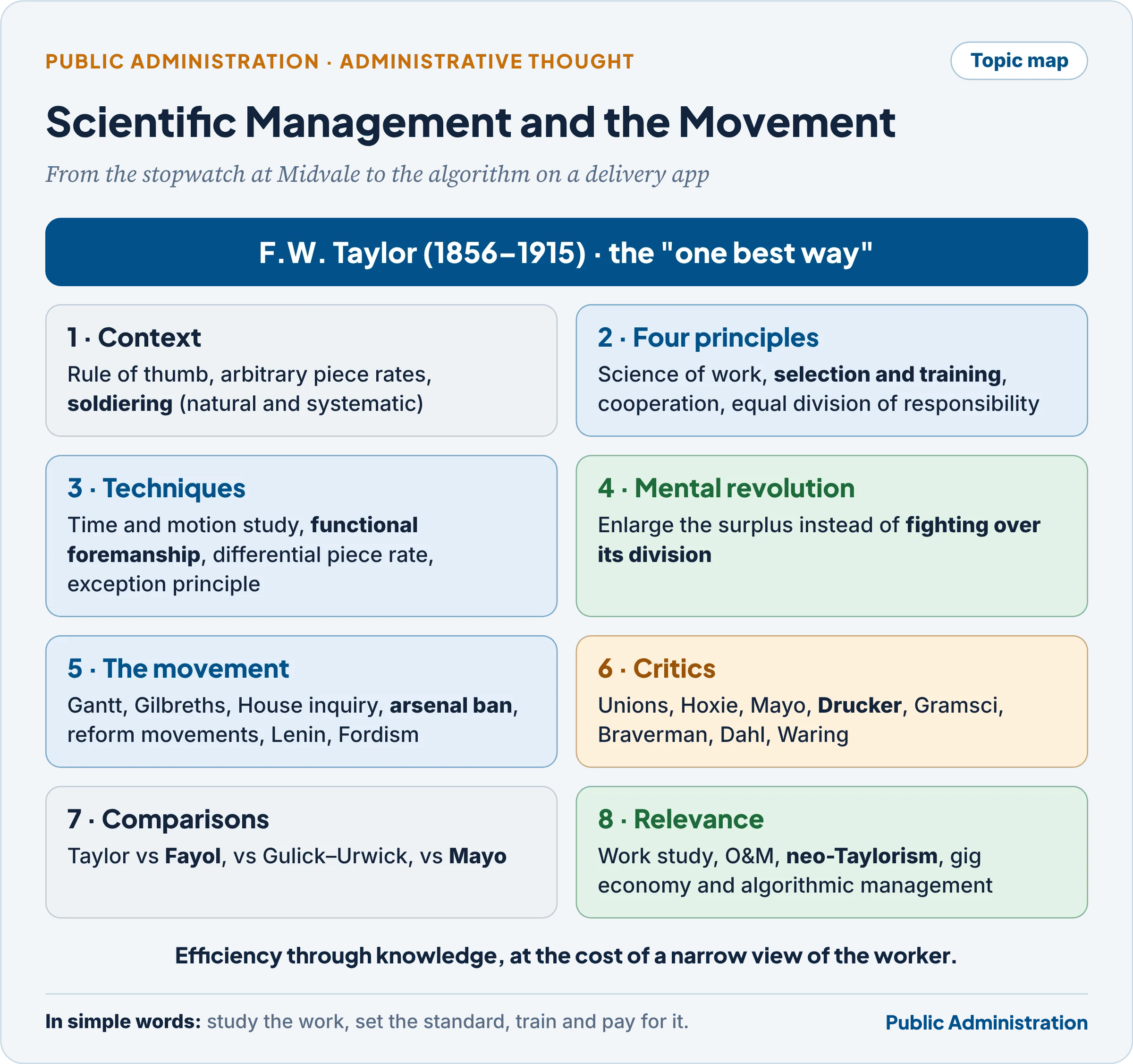
Scientific management is the first coherent theory of organisation. At the start of the twentieth century, the American engineer Frederick Winslow Taylor argued that work could be studied like a physical process: observed, measured, timed and redesigned until the “one best way” of doing each task was found. Management, not the worker’s habit, would then decide how work is done.
- Its core claim was that efficiency is a matter of knowledge, not of driving workers harder.
- Its core promise was a “mental revolution”: if employer and worker stopped quarrelling over how to divide the surplus and worked together to enlarge it, both could become richer.
- Its core weakness, exposed within twenty years, was its picture of the worker as an isolated “economic man” moved only by money.
Taylor’s ideas grew into a movement that reached factories, armies, city halls, the federal government, the Soviet Union and, later, India’s work-study and O&M units. A century later they reappear in New Public Management, call-centre targets and the algorithmic management of gig workers.
In simple words
Think of a busy railway ticket counter. One clerk handles a passenger in two minutes, another takes six. A Taylorist would film both, find which steps the fast clerk skips or does in a better order, write that down as the standard method, train every clerk in it, set a target of so many tickets an hour, and pay a bonus to those who meet it. That is scientific management in one picture.
1. The Context: Why Scientific Management Arose
In simple words
In the late 1800s, American factories had grown huge but were run by habit. Foremen hired, fired and bullied; workers decided their own methods and quietly held output down so that piece rates would not be cut. Taylor thought the waste came from ignorance on both sides and that science could end it.
1.1 The industrial setting
- Rapid industrialisation in the United States after the Civil War produced large factories, railways and steel mills, but management practice lagged behind the technology.
- Rule of thumb: work methods, tools and speeds were decided by individual workers and foremen through tradition. There were no standards of what a fair day’s work was.
- The foreman’s empire: the foreman, often hired on contract, controlled hiring, pay, discipline and methods with little direction from the owners.
- Arbitrary piece rates: when workers produced more, employers often cut the rate per piece, so workers learned that extra effort was punished.
- Labour–capital conflict: strikes and distrust were common; trade unions were growing.
- The engineers’ movement: members of the American Society of Mechanical Engineers (ASME) wanted to apply engineering logic to management. Henry R. Towne‘s paper “The Engineer as an Economist” (1886) called management a field for engineers. Charles Babbage, Henry Metcalfe and Frederick Halsey (premium wage plan) had already written on systematic management, so Taylor was the most complete, not the first, thinker of the approach.
1.2 Soldiering: the problem Taylor set out to solve
Soldiering (deliberately working below capacity) was, for Taylor, the central evil of industry. He distinguished two kinds:
| Type | Cause | Example |
|---|---|---|
| Natural soldiering | The ordinary human tendency to take it easy | A worker slows down when the foreman is not watching |
| Systematic soldiering | Deliberate, group-organised restriction of output, because workers fear that higher output will lead to rate cuts or job losses | A gang agrees that nobody will produce more than a fixed quota |
Taylor traced systematic soldiering to three causes:
- the workers’ belief that more output per man means fewer jobs;
- defective wage systems that cut rates when output rose, so it was rational to hide one’s real capacity;
- inefficient rule-of-thumb methods that wasted effort even when workers tried hard.
His conclusion was that the fault lay mainly with management, which had never studied the work it supervised. He listed the defects he saw at Midvale: no clear division of responsibility between management and workers, no effective standards, decisions by hunch and past experience, poor job design, wrong incentives, and placement of workers without regard to aptitude.
1.3 Taylor’s life and works
Frederick Winslow Taylor (1856–1915) was born in Germantown, Philadelphia. Poor eyesight kept him from Harvard; he became an apprentice pattern-maker and machinist, joined Midvale Steel Company as a labourer in 1878, and rose to chief engineer, earning a degree in mechanical engineering from the Stevens Institute of Technology through evening study. He later worked as a consultant, most famously at Bethlehem Steel (1898–1901), where he co-developed high-speed tool steel. He was president of ASME (1906).
| Work | Year | Main idea |
|---|---|---|
| “A Piece-Rate System” | 1895 | Time study to set standards; the differential piece rate; “paying men and not positions” |
| Shop Management | 1903 | Detailed shop organisation, the planning department, functional foremanship; the philosophy of high wages with low unit cost |
| “On the Art of Cutting Metals” | 1906 | ASME presidential address, based on tens of thousands of metal-cutting experiments over about 26 years |
| The Principles of Scientific Management | 1911 | The four principles and the mental revolution, written for a general audience |
| Testimony before the Special House Committee | 1912 | Taylor’s own definition of scientific management as a “complete mental revolution” |
- The term itself was popularised not by Taylor but by the lawyer Louis Brandeis during the Eastern Rate Case before the Interstate Commerce Commission (1910–11), where he argued that railways could save “a million dollars a day” by scientific management. Taylor first disliked the phrase as too academic but then adopted it.
- Famous experiments at Bethlehem: the pig-iron study (Taylor claimed a selected labourer’s daily loading rose from about 12.5 to 47.5 tons with rest pauses and a bonus) and the shovelling study (scientifically designed shovels for each material allowed the yard gang to be cut from roughly 400–600 men to about 140 while wages per man rose). Later historians have shown that Taylor dramatised these stories, but they made his name.
2. Taylor’s Concept of Management and the Four Principles
In simple words
Taylor said management had been lazy: it left all the thinking to the worker and kept only the shouting for itself. He wanted managers to take over the thinking (studying, planning, training) so that workers could concentrate on doing, and both would earn more.
2.1 What management is for
- “The best management is a true science, resting upon clearly defined laws, rules, and principles, as a foundation.” Taylor claimed these principles apply “with equal force to all social activities”: to homes, farms, businesses, churches, philanthropic institutions, universities and government departments. This universalism is why public administration claims him.
- The object of management: “to secure the maximum prosperity for the employer, coupled with the maximum prosperity for each employee.” Maximum prosperity meant not only higher wages and dividends but developing each worker to the highest grade of work his abilities allowed.
- No inherent conflict: Taylor believed the true interests of employers, workers and consumers coincide. Higher productivity gives higher wages to workers, higher profits to owners and lower prices to consumers.
- The system before the man: “In the past the man has been first; in the future the system must be first.” Organisation, not the individual genius, would secure efficiency.
2.2 The four principles
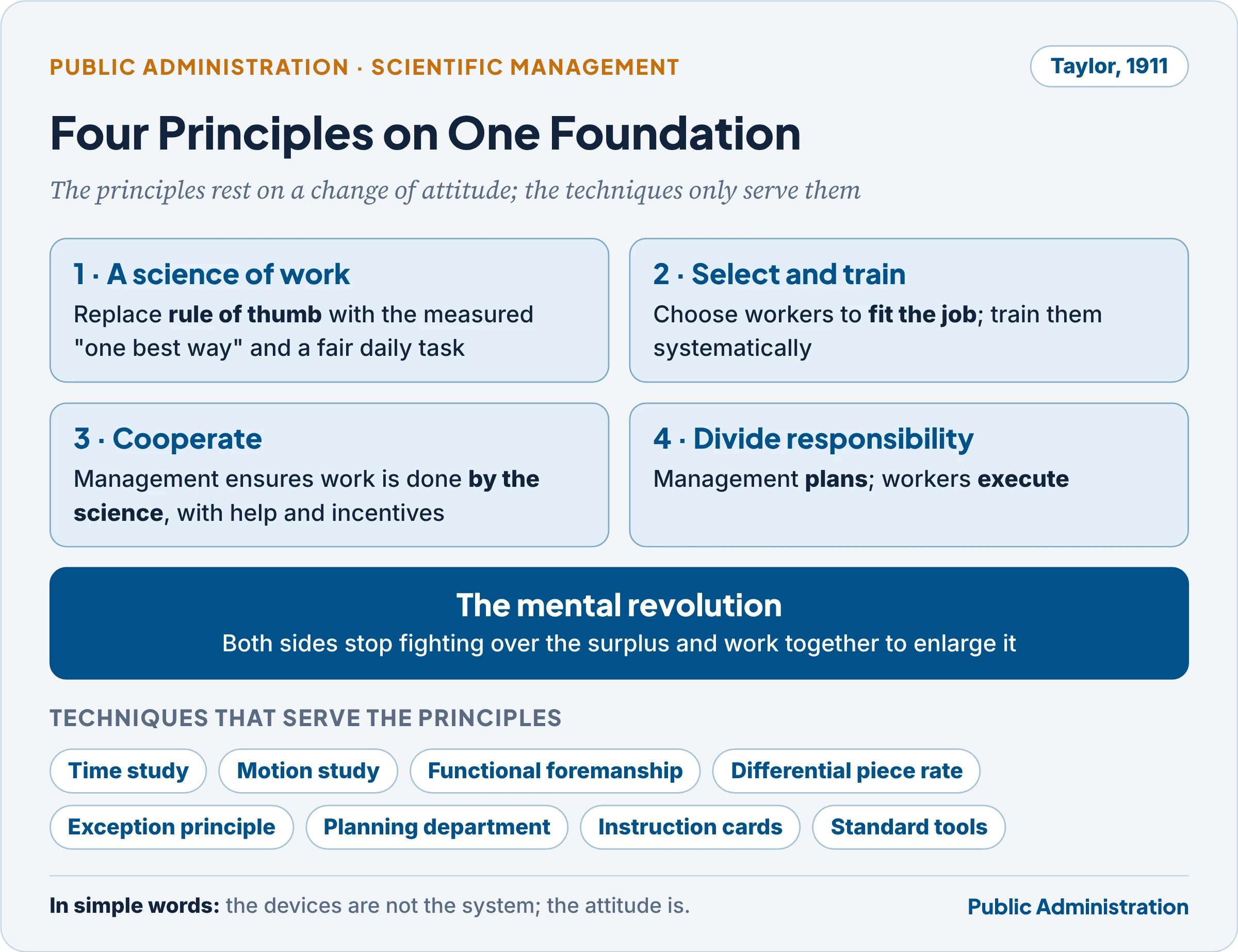
Taylor stated four “great underlying principles of management” in The Principles of Scientific Management (1911):
| Principle | What it means | Example |
|---|---|---|
| 1. Develop a science for each element of work | Replace rule of thumb with measured, tested methods: the “one best way” and a fair “large daily task” | Time each movement of bricklaying and remove the wasted ones |
| 2. Scientific selection, training and development of workers | Choose workers whose abilities fit the job; train them systematically instead of letting each learn by himself | Select loaders by physique; teach them the right shovel and rhythm |
| 3. Cooperation to bring science and the trained worker together | Management must actively ensure the work is done by the scientific method, with incentives and help | Instruction cards, functional foremen and a bonus for meeting the task |
| 4. Equal division of work and responsibility | Management takes over planning and organising, for which it is better fitted; workers do the work | A planning department prepares each job; the worker executes it |
The philosophy in five phrases (Taylor’s own summary):
- science, not rule of thumb;
- harmony, not discord;
- cooperation, not individualism;
- maximum output, in place of restricted output;
- the development of each man to his greatest efficiency and prosperity.
- Dwight Waldo reduced the principles to four in the same spirit: the development of a true science, the scientific selection of workmen, their scientific education and development, and intimate, friendly cooperation between management and men.
- No principle alone is scientific management; Taylor insisted it is the combination that counts.
2.3 Three principles of organisation implied by Taylorism
Read as a theory of organisation, Taylorism rested on three structural ideas:
- Great division of labour: break each production process into simple tasks, ideally one task per worker. Specialisation raises efficiency and allows cheaper, less-skilled labour (the deskilling later attacked by critics).
- Full managerial control of the workplace: planning, organising, hiring and coordination move from the shop floor to management, which now coordinates the work that division of labour has fragmented.
- Cost accounting based on time-and-motion study: systematic data give managers the information they need to control the workplace.
2.4 Taylor’s assumptions about people
- Economic man: the worker is motivated mainly by money and wants two things, high wages and a chance of advancement.
- The isolated individual: each worker is treated as a separate unit; the work group plays no positive role (it is the source of soldiering).
- Passive executor: a good worker does not initiate action but follows instructions worked out by management.
- Organisational functions can be improved by science: there is one best method waiting to be discovered.
These assumptions explain both the strength of the approach (clarity, measurability) and the attack that followed from the Human Relations school.
3. The Techniques of Scientific Management
In simple words
The principles told managers what to aim for; the techniques were the tools. A stopwatch to time work, a better shovel, a planning office, eight specialised supervisors, written instruction cards and a pay system that rewards those who reach the target.
3.1 Time study and motion study
- Motion study observes every movement in a job and removes wasted ones, to find the best sequence of motions with the best tools and layout. It was developed most fully by Frank and Lillian Gilbreth, who broke work into basic motions they called “therbligs” (their name spelled almost backwards) and studied bricklaying, surgery and later the work of disabled people.
- Time study uses a stopwatch to fix the standard time for each element of a job, so that a fair “large daily task” can be set. Motion study comes first (find the best method); time study follows (time it).
3.2 Functional foremanship
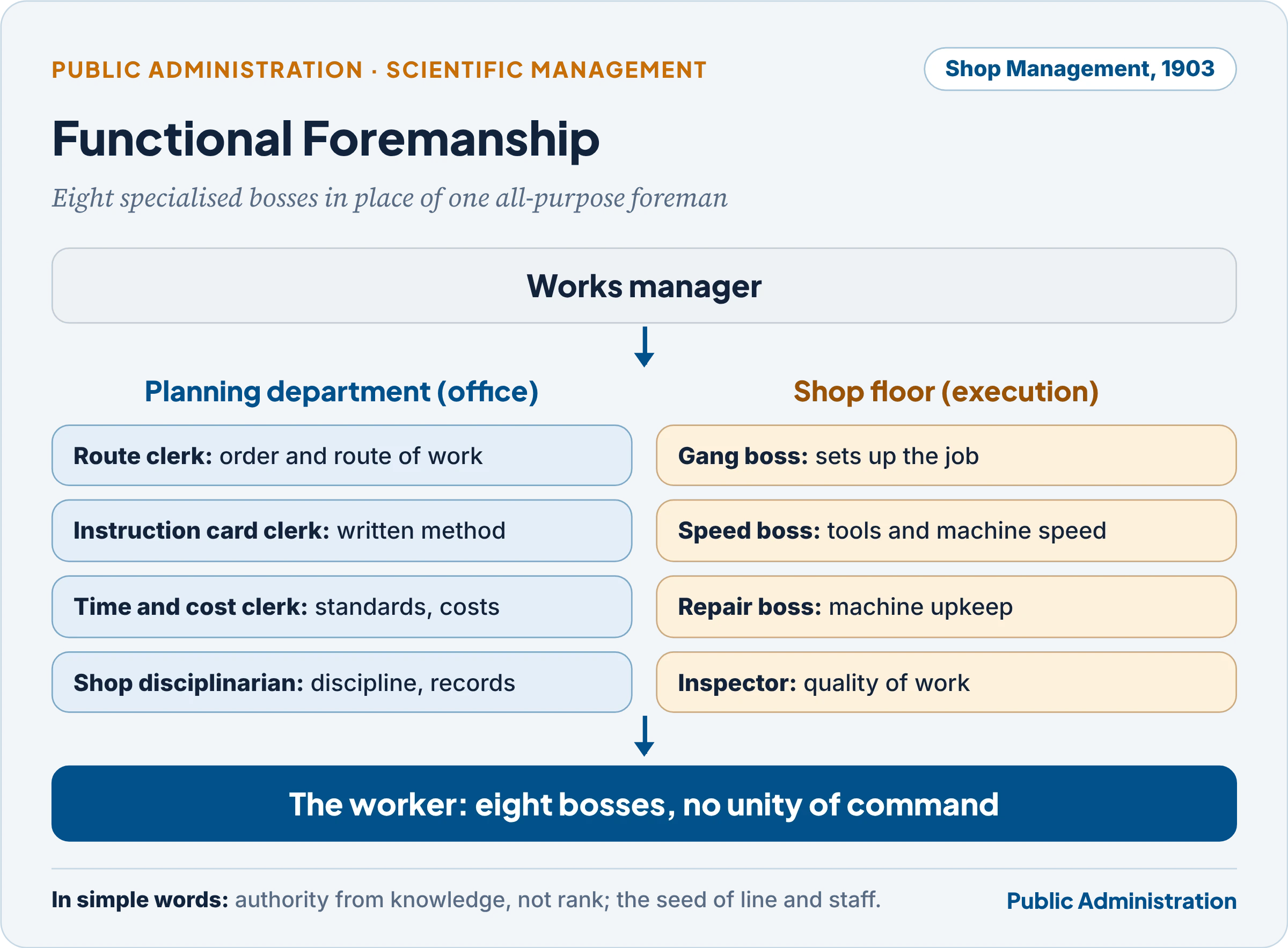
Taylor rejected the “military” or line type of organisation, in which one foreman did everything, because no single person could have all the knowledge needed. He divided supervision into eight functional foremen, four in a planning department (the office) and four on the shop floor:
| Planning department (office) | Shop floor (execution) |
|---|---|
| Order-of-work and route clerk: sequence and route of jobs | Gang boss: sets up work and materials at the machine |
| Instruction card clerk: written instructions for each job | Speed boss: right tools, feeds and machine speeds |
| Time and cost clerk: time standards and cost records | Repair boss: maintenance of machines and belts |
| Shop disciplinarian: discipline, hiring and dismissal records | Inspector: quality of work |
- Significance: authority rests on knowledge, not position. Planning experts were to be relatively free from bureaucratic control from above, and top executives were to handle only what the planning department could not.
- The cost: each worker had eight bosses, a direct breach of unity of command. The scheme was rarely adopted in full; what survived was the separation of planning from doing and the staff specialist, the root of the later line and staff concept.
- Taylor also listed nine qualities of a good foreman: education, special or technical knowledge, manual dexterity and strength, tact, energy, grit, honesty, judgement and good health. No one person has all nine, which was his argument for dividing the job.
Common confusion
Did Taylor “abandon Fayol’s unity of command”? Many notes say so, but the chronology is the other way round. Taylor described functional foremanship in Shop Management in 1903; Fayol’s Administration industrielle et générale appeared in 1916 (English translation 1929, widely read only from 1949). Taylor was breaking with the traditional military or line organisation of the factory. Fayol later defended unity of command, partly in reaction to functional foremanship, and the clash between the two became a standard example of contradictory “principles”.
3.3 The differential piece-rate system
- Pay is fixed per piece on the basis of standards set by time and motion study.
- A worker who meets or exceeds the standard is paid a higher rate on every piece; one who falls short gets a lower rate on every piece. In variants such as Gantt’s task-and-bonus plan, a guaranteed day wage is paid below standard and a large bonus at the standard.
- Taylor preferred this direct, quick reward to profit-sharing, which he thought too remote to motivate.
- A worker who, after selection and training, could not or would not reach the standard was to be moved or removed.
- “Paying men and not positions“: pay should reflect each person’s output, not the title of the post.
3.4 Other mechanisms
Taylor listed these as “mechanisms” of scientific management:
- standardisation of tools, implements and working conditions, and of workers’ motions for each class of work;
- a separate planning room or department;
- the exception principle: managers should receive condensed reports and concentrate only on exceptions, items far above or below standard, rather than on routine;
- instruction cards for workers;
- the task idea, with a large bonus for completing the task;
- slide rules and similar time-saving devices (Carl Barth developed slide rules for machine speeds);
- mnemonic systems for classifying products and implements;
- a routing system;
- a modern cost system.
Taylor himself warned that these devices are not scientific management: “it is not an efficiency device … not a new system of figuring costs … not a new scheme of paying men … not time study … not motion study … not divided foremanship.” They are aids; the essence is a change of attitude.
4. The Mental Revolution
In simple words
Taylor believed workers and owners fought because they argued over how to slice a small cake. If they cooperated to bake a much bigger cake, the quarrel would disappear because both slices would be larger.
- The definition (1912 testimony): “In its essence, scientific management involves a complete mental revolution on the part of the working man … as to their duties toward their work, toward their fellow men, and toward their employers. And it involves the equally complete mental revolution on the part of those on the management’s side.”
- Two conditions without which scientific management does not exist:
- both sides must take their eyes off the division of the surplus and turn them to increasing its size, until it is so large that quarrelling over shares becomes unnecessary;
- both sides must accept exact scientific investigation and knowledge in place of individual judgement or opinion on all matters of work.
- Peace for war: Taylor described the change as “the substitution of peace for war; the substitution of hearty brotherly cooperation for contention and strife.”
- Who decides? Cooperation was not equality. For Taylor, management was the senior partner, deriving authority from superior knowledge; disputes would be settled by “the laws of science”, not by bargaining. This is why he saw trade unions as unnecessary: if pay and pace are set scientifically, there is nothing to bargain over. Reinhard Bendix (Work and Authority in Industry, 1956) summed up the logic: by maximising each worker’s productive efficiency, scientific management would maximise the earnings of both workers and employers, so all conflict between capital and labour would be resolved by the findings of science.
- The tragedy of the idea: in practice, employers adopted the techniques (stopwatch, bonus, speed-up) without the mental revolution. Taylor’s intention was obscured, and Taylorism came to mean “speed-up”. Taylor himself admitted that his methods “may be used more or less as a club to drive workmen into doing a larger day’s work for approximately the same pay.”
5. The Scientific Management Movement
In simple words
Taylor’s ideas did not stay in one steel mill. Disciples spread them, a society was formed to promote them, Congress investigated them, the army banned the stopwatch, cities used them to fight waste, Lenin praised them and Soviet factories copied them. That spread is what the syllabus calls the “movement”.
5.1 Taylor’s disciples and their contributions
| Disciple | Contribution |
|---|---|
| Henry L. Gantt | The Gantt chart for scheduling and progress control; the task-and-bonus plan with a guaranteed minimum wage; stressed the human side of incentives |
| Frank B. and Lillian M. Gilbreth | Motion study, therbligs, micro-motion films; Lillian Gilbreth pioneered the psychology of management (1914) and later ergonomic design |
| Harrington Emerson | The Twelve Principles of Efficiency (1912); efficiency engineering on the Santa Fe railway; line-and-staff thinking |
| Carl G. Barth | Slide rules for calculating machine speeds and feeds |
| Morris L. Cooke | Applied Taylorism to universities (Academic and Industrial Efficiency, 1910) and to city government as Director of Public Works, Philadelphia (1911–15) |
| H.K. Hathaway, Sanford E. Thompson | Installation of the system in firms; time-study methods |
5.2 Institutions, controversy and investigation
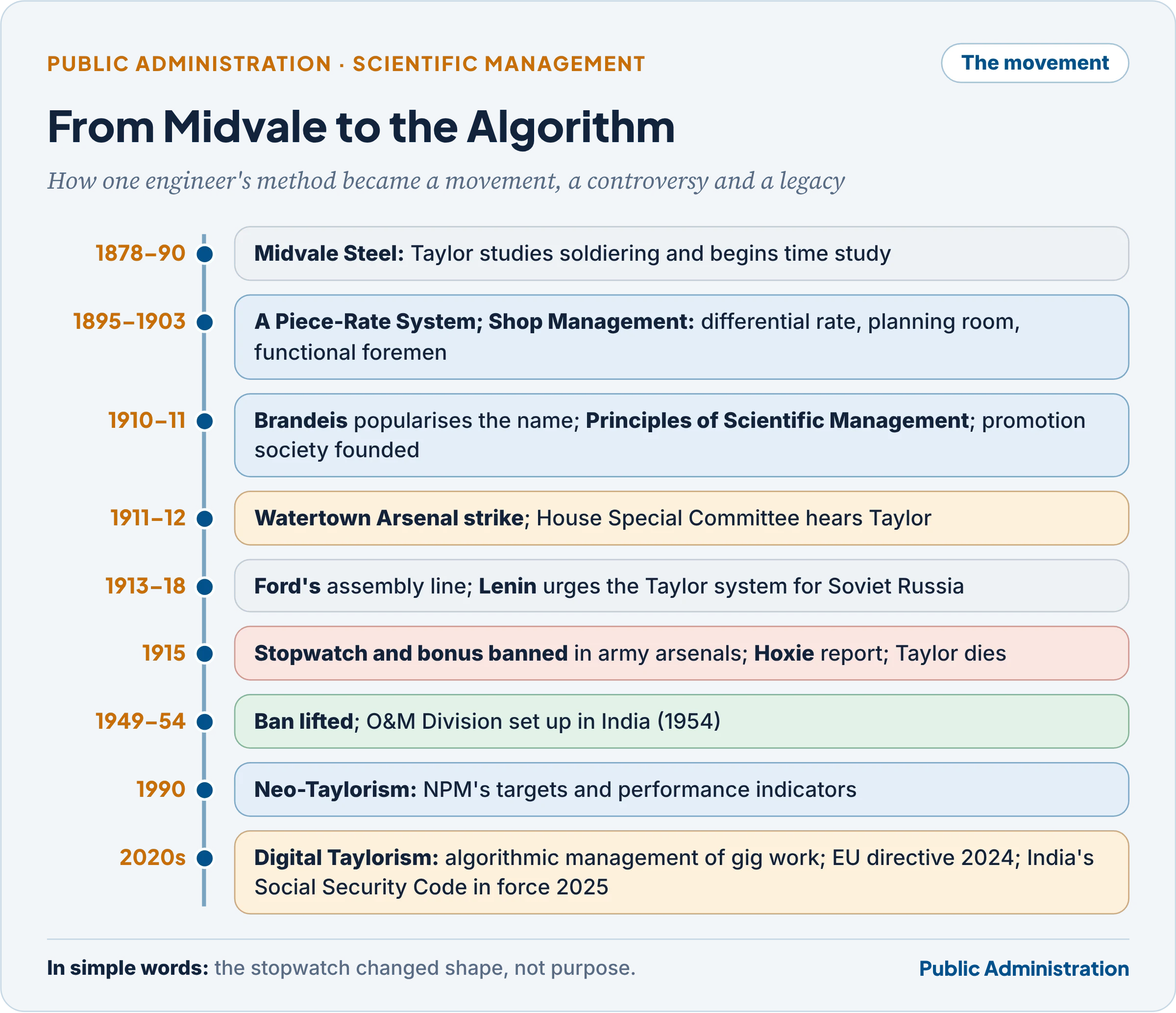
- 1910–11: the Eastern Rate Case made “scientific management” a national phrase.
- 1911: the Society to Promote the Science of Management was founded; it was renamed the Taylor Society after Taylor’s death.
- 1908–11: Taylor’s methods were installed in the army’s Watertown Arsenal (Massachusetts), which the War Department treated as an experiment station for the system. In August 1911 moulders at Watertown struck against a stopwatch time study.
- 1911–12: a Special Committee of the House of Representatives (under House Resolution 90) investigated “the Taylor and other systems of shop management”. Taylor’s testimony, sometimes before hostile questioning, is the classic statement of the mental revolution. The committee’s report favoured neither side but found no need for legislation.
- 1915: organised labour secured a rider to the Army Appropriation Act banning the use of stopwatches and premium or bonus payments in army arsenals; the ban lasted until 1949.
- 1915: Robert F. Hoxie‘s report Scientific Management and Labor, for the US Commission on Industrial Relations, concluded that scientific management neglected the human side of production and that its ideals and those of trade unionism were incompatible.
- 1915: Taylor died; the movement continued through the Taylor Society and the growth of industrial engineering.
5.3 The movement in public administration
Scientific management reached government through the American reform movement of the Progressive era:
- The New York Bureau of Municipal Research (founded 1906–07) applied efficiency methods, cost accounting and budgeting to city government; its training school produced many early public administrators.
- President Taft’s Commission on Economy and Efficiency (1910–13) studied federal organisation and recommended an executive budget, leading eventually to the Budget and Accounting Act, 1921.
- Morris Cooke in Philadelphia showed that municipal departments could be run on scientific management lines.
- The intellectual link: Woodrow Wilson’s call (1887) for a science of administration, the politics–administration dichotomy, and the efficiency value of early public administration all drew strength from Taylorism. Dwight Waldo observed that scientific management and public administration were related parts of a common movement to extend the methods and spirit of science to ever wider areas of human concern. Bertram Gross wrote that scientific management “had a major influence on the growing reform and economy movements in public administration.”
- The administrative management school (Gulick, Urwick, POSDCORB, the Brownlow Committee of 1937) carried the same faith in principles and efficiency from the shop floor to the top of government (see the article on Classical Theory).
5.4 The movement abroad
- Europe: The Principles of Scientific Management was translated into several languages, including French, German, Dutch, Swedish, Russian, Italian, Spanish and Japanese. In France, Henry Le Chatelier promoted it; in Germany it fed the “rationalisation” movement of the 1920s; in Britain, Urwick and Sheldon adapted it.
- The Soviet Union: in “The Immediate Tasks of the Soviet Government” (1918) Lenin called the Taylor system “a combination of the refined brutality of bourgeois exploitation and a number of the greatest scientific achievements”, and urged that Russia study, teach and adopt it. Soviet “scientific organisation of labour” followed, and the Stakhanovite movement (after the miner Aleksei Stakhanov’s record in 1935) celebrated output norms, though it relied more on emulation than on Taylor’s methods.
- Fordism: Henry Ford‘s moving assembly line (Highland Park, 1913) took Taylor’s division of labour to its limit: standardised products, fixed work stations, machine-paced work and high wages ($5 a day, 1914). “Fordism” became the name for the whole system of mass production that followed.
- Japan used Taylor’s methods widely in its post-war growth, later combining them with quality circles and continuous improvement.
Indian Connect — Scientific management in Indian administration
- O&M and work study: an Organisation and Methods (O&M) Division was set up in the Cabinet Secretariat in 1954 (its functions now rest with the Department of Administrative Reforms and Public Grievances), and O&M units were created in ministries; the Staff Inspection Unit (1964) of the Ministry of Finance carried out work measurement to fix staff strength. These are Taylor’s time study applied to the files and desks of government.
- Standard procedure: the Central Secretariat Manual of Office Procedure prescribes the stages, time limits and levels of disposal for files, a Taylorist “one best way” for paperwork; the e-Office system records each movement of a file and makes delay measurable.
- Measuring and clearing pendency: under Special Campaign 5.0 (October 2025), led by DARPG, ministries weeded or closed 29.52 lakh files, freed 233.75 lakh square feet of office space and earned ₹833.92 crore from scrap; across Special Campaigns 1.0 to 5.0 (2021–25), 167.38 lakh files were closed or weeded. Targets, timed drives and dashboards are a modern exception-and-standards approach.
- Performance standards: time-bound service delivery under state Right to Public Services Acts and outcome dashboards for schemes set standard times and outputs for public tasks, much as Taylor set standard times for machine work.
- Taylorism’s limits in India: frontline workers (police constables, ASHA and anganwadi workers) are often judged by numerical targets that encourage gaming, the old “speed-up” problem in a new setting.
6. Criticisms of Scientific Management
In simple words
Workers said Taylorism treated them like machines. Managers disliked being told they did not know their jobs. Social scientists showed that people work for belonging and respect, not only money. Marxists said it was a weapon to take skill and control away from workers. Each criticism hit a different weak point.
6.1 From labour and trade unions
- Speed-up and exhaustion: unions called it a system to drive workers to the limit of their strength for little extra pay.
- Anti-union: individual piece rates and “scientific” standards left nothing to collective bargaining; the Hoxie report found the two ideals incompatible.
- Unemployment: more output per worker meant fewer workers.
- Dehumanisation and monotony: minute tasks removed skill, variety and initiative; stopwatch studies provoked strikes (Watertown, 1911).
6.2 From managers
- Managers who had risen without education resented Taylor’s claim that they were unqualified without trained experts, and his contempt for rule of thumb.
- Standardisation reduced managers’ discretion; functional foremanship divided their authority.
- Taylor himself left both Midvale and Bethlehem after friction with company managers.
6.3 From the human relations school and behavioural scientists
- Mechanistic view of man: the worker as a cog in the machine, to be made as efficient as the machine itself. Scientific management has been called a mechanistic theory of organisation.
- Monistic theory of motivation: it explained motivation by money alone. The Hawthorne studies (1924–32) showed that social and psychological factors (recognition, group norms, supervision) matter as much as pay. Oliver Sheldon, Mary Parker Follett, Elton Mayo, Chester Barnard, Peter Drucker and Chris Argyris all criticised Taylor on these lines.
- Ignored the informal group: for Taylor the group was only a source of soldiering; Mayo showed it could be the key to cooperation.
- “Physiological organisation theory”: James March and Herbert Simon (Organizations, 1958) called it this because it dealt only with that range of behaviour connected with the body (speed, fatigue, motions) and treated the worker as an instrument.
- Argyris: extreme specialisation and close control keep adults in a state of dependence and psychological immaturity, breeding frustration and apathy.
- Work is not a burden by nature: the psychologist J.A.C. Brown argued that work gives people status and binds them to society; when they dislike it, the fault lies in the social and psychological conditions of the job, not in the worker.
6.4 From the critics of its logic: Drucker’s two blind spots
Peter Drucker admired Taylor but identified two “blind spots” in The Practice of Management (1954):
- It confuses the principle of analysis with the principle of action. Because work is best analysed by breaking it into its smallest motions, Taylor assumed it is best organised in the same way, as a series of separate motions each done by a different person. But a job that is easy to analyse into parts may be done better as an integrated whole; human beings do not work well as a chain of fragments.
- It divorces planning from doing. Planning and doing are two parts of the same job; separating them completely (planners in the office, doers on the floor) destroys responsibility, initiative and team spirit.
- The law of diminishing returns also applies: beyond a point, further sub-division of work lowers efficiency through monotony, fatigue and coordination costs.
6.5 From Marxist critics: Gramsci and Braverman
- Antonio Gramsci, in his prison notes on “Americanism and Fordism” (written in the early 1930s), treated Taylorism as more than a technique. It was an attempt to create a new type of worker and a new type of man:
- Taylor expressed “the purpose of American society”: to develop in the worker “automatic and mechanical attitudes” and break the old psycho-physical link of skilled work, which demanded intelligence, imagination and initiative. Taylor’s own remark that an “intelligent gorilla” could be trained to handle pig iron better than a man, which Gramsci recalled as the “trained gorilla“, captured this aim.
- The new industrial regime reached beyond the factory into the worker’s private life: American employers’ interest in workers’ drinking (Prohibition), sexual life and family stability served the need for a disciplined, regular, sober workforce.
- Yet Gramsci also argued that purely mechanical labour does not exist: even the most degraded work keeps a minimum of intellectual activity, and the worker’s mind, freed from craft, may turn to critical thought. Taylorism therefore produced not only submission but the possibility of resistance and a new consciousness.
- The socio-psychological lesson: Taylorism is a project of hegemony (consent manufactured through high wages and new habits), not only of coercion.
- Harry Braverman, Labor and Monopoly Capital (1974), made Taylorism the centre of his theory of deskilling:
- scientific management separates conception from execution, takes craft knowledge out of the worker’s head and stores it in management’s system;
- it uses that monopoly of knowledge to control each step of the labour process;
- the result is the degradation of work in factories and, later, offices.
- Industrial democracy critics argued that Taylorism resolves the contradiction between democratic politics and undemocratic, appointed authority in industry by giving managerial control the respectability of “science”.
6.6 Dahl: a primitive tool for industrial polyarchies
- Robert Dahl (with Charles Lindblom, Politics, Economics and Welfare, 1953) used polyarchy for systems in which control is dispersed among many centres that bargain with one another, as in democracies and in large, pluralist industrial societies.
- Judged against such systems, scientific management is a primitive instrument of control: it knows only hierarchy (orders from experts at the top) and price (piece rates), and ignores bargaining, consent and participation, through which control is actually exercised in complex organisations with unions, professionals and many centres of power.
- Dahl’s wider point (in “The Science of Public Administration: Three Problems“, 1947) was that a science of administration cannot ignore values, human behaviour and social setting; scientific management, built on a narrow model of the worker and on efficiency as the only value, fails all three tests.
6.7 Waring: controversial despite its popularity
Stephen P. Waring (Taylorism Transformed: Scientific Management Theory since 1945, 1991) explains why Taylorism remains both popular and controversial:
- Popular, because its core (hierarchy, central direction, specialised tasks, measurement) still structures most organisations, and because later “new” theories such as operations research, systems analysis and parts of Simon’s decision science are, in his reading, “post-Taylor” refinements of the same project of making organisations more machine-like.
- Controversial, because it concentrates power in management and treats workers as instruments; it promises harmony through science while actually settling conflicts in favour of those who control the knowledge.
- Waring reads management theories as political theories: Taylor’s is a “bureaucratic” theory of control; Mayo’s human relations is a “corporatist” alternative that seeks integration rather than command. Both, he argues, leave the hierarchy itself unquestioned.
Criticism — The case against scientific management
- Treats the worker as an economic, isolated, passive instrument; ignores social and psychological needs.
- Deskills work and separates thinking from doing (Braverman, Drucker).
- Concentrates control in management under the cover of science; hostile to unions and collective bargaining (Hoxie, Gramsci).
- Its principles are micro, shop-floor rules that say little about the organisation as a whole.
- Its efficiency ignores equity, democracy and human dignity, values central to public administration (Dahl, Waldo).
Defence — The case for scientific management
- It replaced guesswork with evidence and made management a subject of systematic study.
- It linked higher wages to higher productivity and aimed at cooperation, not exploitation; Taylor attacked arbitrary rate-cutting.
- It created planning, standards, cost control, training and selection, now normal parts of management and personnel administration.
- Its techniques (work study, O&M, operations research, quality control, project scheduling) remain in daily use.
- Its demand that administration be measured underlies today’s performance management and outcome budgeting.
7. Assessing Taylor: Rival Interpretations
In simple words
Was Taylor a tyrant with a stopwatch or an early humanist? Scholars still disagree. Reading him carefully shows both sides: he wanted workers to earn more and develop, but he also wanted experts, not workers, to decide how they work.
7.1 A set of operating procedures rather than general principles
- One line of interpretation holds that Taylor’s real contribution was not a set of general principles for organising work efficiently but a set of operating procedures: a method (observe, measure, experiment, standardise, train) to be applied afresh in each concrete situation.
- Why this reading is persuasive:
- Taylor’s “principles” are thin and general; what spread was the method of investigation: controlled experiment holding all variables constant except one, as in his metal-cutting studies.
- The “one best way” is situation-specific: the best shovel for coal differs from the best shovel for iron ore. There is no universal rule, only a universal procedure for finding the local rule.
- This is exactly what later work study, industrial engineering and operations research inherited: techniques, not doctrines.
- The contrast with the classical theorists: Fayol, Gulick and Urwick offered general principles of organisation (unity of command, span of control, POSDCORB) applicable everywhere; Taylor offered procedures for improving particular tasks.
7.2 Scientific management or classical organisation theory?
Taylor is usually grouped with the classical school, but his theory differs from the classical organisation theory of Gulick and Urwick in important respects:
| Basis | Taylor’s scientific management | Classical organisation theory (Gulick, Urwick) |
|---|---|---|
| Level | Micro: the task, the worker, the shop floor | Macro: the whole organisation, departments, top management |
| Direction | Bottom-up: from the job to the organisation | Top-down: from the chief executive to the units |
| Central question | How should each task be done, and how should the worker be motivated to do it? | How should work be divided and coordinated among units? |
| Core concepts | Time and motion study, one best way, differential piece rate, functional foremanship | Division of work, 4Ps of departmentalisation, POSDCORB, span of control, unity of command |
| Motivation | An explicit (economic) theory of motivation: pay tied to output | Little explicit theory of motivation; assumes authority and structure secure compliance |
| Authority | Based on knowledge (functional experts) | Based on position in the hierarchy (unity of command) |
| Field of origin | Engineering, factory | Public administration, business, military |
- This is why Taylor’s scheme is sometimes called “classical motivational theory” while Gulick and Urwick’s is “classical organisational (structural) theory“. Both share the faith in efficiency, rationality and universal principles, and both neglect the informal organisation.
7.3 Taylor and Fayol: different perspectives, same goal
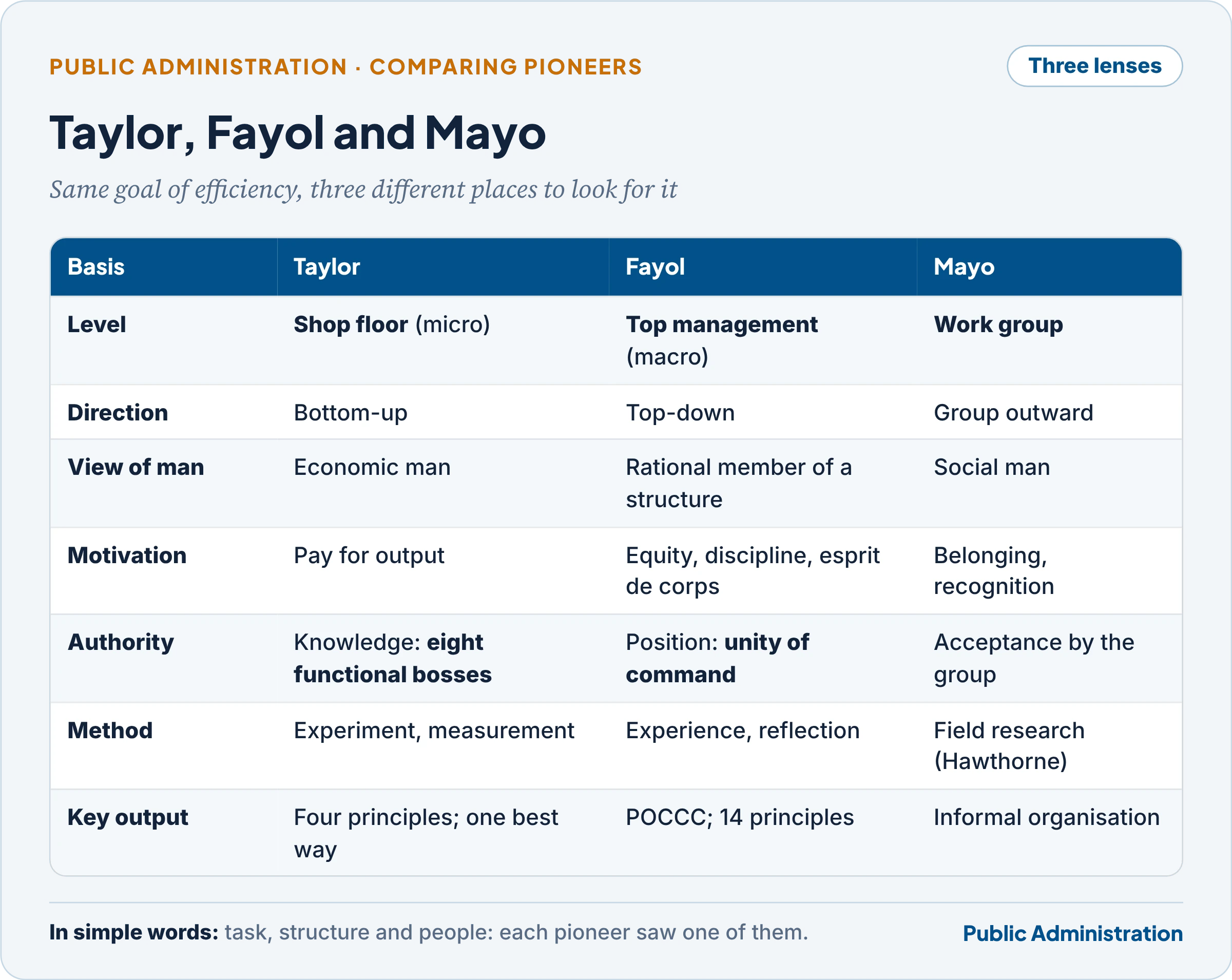
| Basis | Taylor | Fayol |
|---|---|---|
| Background | American engineer; scientist and experimenter | French mining engineer; managing director; practitioner |
| Focus | Shop floor, the operative worker | Top management, the whole enterprise |
| Approach | Bottom-up, micro | Top-down, macro |
| Method | Observation, experiment and measurement | Personal experience and reflection |
| Main concern | Productivity of labour, elimination of waste | A general theory of administration applicable to all organisations |
| Command | Functional foremanship (many bosses) | Unity of command (one boss) |
| Contribution | A science of industrial management | A theory of management functions (POCCC) and 14 principles |
| Applicability | Mainly production activities | All functional areas, including government |
- What they shared: both wanted efficiency; both applied a rational, systematic approach; both believed management could be taught; both stressed cooperation between management and workers; both claimed universality for their principles. Fayol himself said (1925) that his work and Taylor’s were complementary, not rival.
- Why they differ: Taylor looked up from the machine; Fayol looked down from the board room. Together they cover the two ends of the classical view of organisation.
7.4 Was Taylor already a humanist?
- The revisionist case (associated with Hindy Lauer Schachter, Frederick Taylor and the Public Administration Community: A Reevaluation, 1989): read in the original, Taylor offered a motivational theory with participatory elements that the human relations school did not much improve on.
- He insisted on cooperation and mutual prosperity, attacked arbitrary rate-cutting, and wanted each worker developed to the highest grade of work he could do.
- He used non-economic motivators: a sense of mission, recognition, individual attention, two-way communication between planning staff and workers, and opportunities for advancement.
- He welcomed suggestions from workers: an improvement proposed by a worker was to be tested and, if better, adopted as the new standard, with credit (and sometimes a cash reward) to the worker.
- He attacked managers, not only workers, demanding that they learn and plan.
- The counter-argument: these elements were subordinate to control. Workers could suggest, but management decided; there was no collective voice; the group was suspect; and the “development” offered was development to fit the system. Mayo’s discovery of the informal group and the social needs of workers was a real advance, not a repetition.
- A balanced view: Taylor was more humane in intention than his caricature, but his system, as practised, was mechanistic. The truth lies in the gap between Taylor’s philosophy (mental revolution) and Taylorism in practice (speed-up).
8. Scientific Management Compared with Human Relations
In simple words
Scientific management asks, “What is the best way to do this job, and how much should we pay for it?” Human relations asks, “How do people feel about this job, their group and their boss?” Both want more output; they look for it in different places.
| Basis | Scientific management (Taylor) | Human relations (Mayo) |
|---|---|---|
| View of man | Economic man, isolated individual | Social man, member of a group |
| Motivation | Money (monistic) | Recognition, belonging, security, morale (socio-economic) |
| Focus | Tasks, tools, methods, physical conditions | People, groups, sentiments, social conditions |
| Unit of analysis | The individual worker | The informal work group |
| Organisation | Formal structure, standards, rules | Informal organisation alongside the formal |
| Management style | Directive; experts decide | Participative; supervisors listen and involve |
| Source of efficiency | The one best method plus incentive pay | Cooperation, morale and supportive supervision |
| Research base | Time and motion experiments | Hawthorne studies (1924–32) |
| Skills stressed | Technical | Social |
| View of the group | Source of soldiering; hostile to management | Potential ally of management if its norms are aligned |
- Distinct approaches: they rest on opposite assumptions about human nature and look for efficiency in opposite places, structure versus sentiment.
- But complementary: both accept efficiency and productivity as the goal and both take the managerial point of view; human relations did not abolish standards, planning or incentives but added the social dimension. Later behavioural theory (Barnard, Simon, Likert) combined the two. From “Taylorism to Mayoism”, organisation theory travelled from the body of the worker to his mind and his group, but always in search of organisational effectiveness.
9. Contribution and Present Relevance
In simple words
Taylor’s stopwatch is gone, but his questions are everywhere: How long should this take? How do we measure it? What is the best method? Who should plan and who should execute? Delivery apps, call centres, hospital protocols and government dashboards all answer these questions, often in Taylor’s way.
9.1 Lasting contributions
- Pioneer of the study of work: the first systematic, quantitative study of human beings at work; work study, method study, ergonomics and industrial engineering descend from him.
- Management as a discipline: the idea that management is a body of knowledge that can be taught and learned, and that managers must plan, organise and control, not merely supervise.
- Personnel administration: scientific selection, training, job analysis and performance standards.
- Planning and staff: the planning department and functional experts anticipated line and staff organisation.
- Management by exception, cost accounting, standard costing and production control.
- Public administration: the efficiency and economy movements, budgeting reform, O&M and work study in government, and the faith in a “science of administration”.
- Drucker’s verdict: Drucker ranked scientific management among the most powerful and lasting contributions America made to Western thought, and argued that developing countries in particular needed Taylor’s message of productivity through knowledge applied to work.
9.2 Neo-Taylorism: New Public Management
- Christopher Pollitt (Managerialism and the Public Services, 1990) described the managerialism of the 1980s as neo-Taylorism: a revival of Taylor’s faith in measurement, targets, standards, incentives and managerial control, now applied to the public services.
- Taylorist features of NPM: performance indicators and league tables; output targets; performance-related pay; separation of policy (planning) from delivery (doing) through executive agencies; contracts specifying standards; management by results.
- Limits of the comparison: NPM also borrowed from public choice and market theory (competition, customer choice, contracting out), which Taylor did not consider, and it decentralised managerial freedom rather than centralising it in a planning office (see the article on New Public Management and After).
9.3 Taylor in the post-industrial and gig economy
Why Taylor’s ideas still fit:
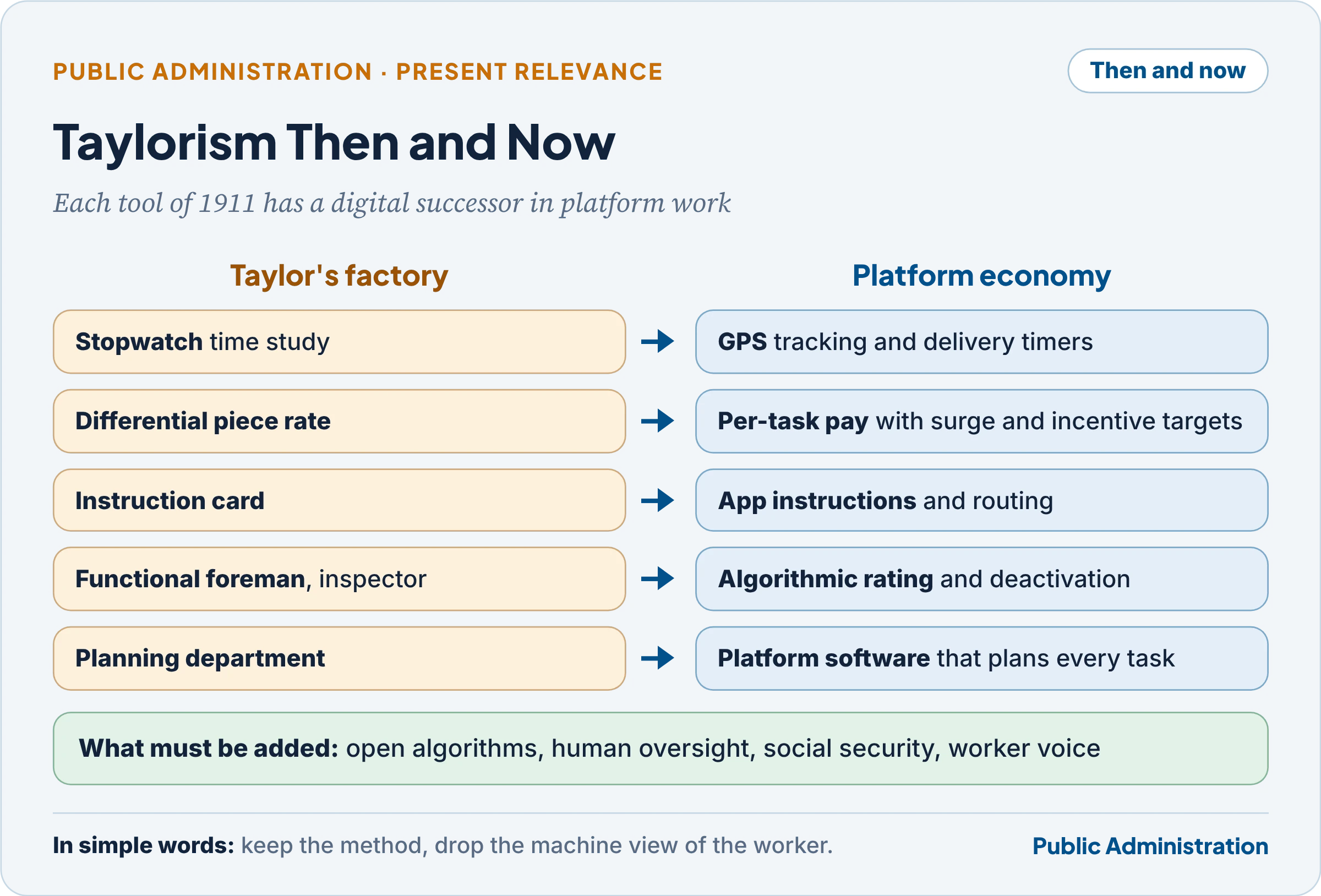
- Platform work is Taylorism by algorithm. Food delivery and ride-hailing apps break work into small standard tasks, set standard times (delivery windows), monitor every movement by GPS, rate each worker, and pay per task with incentives for meeting targets: time study, differential piece rate and the exception principle, run by software. Scholars call this digital Taylorism or algorithmic management.
- Knowledge work is being standardised: call centres follow scripts and handling-time targets; warehouses track “time off task”; even professional work (claims processing, coding, some medical work) is split into measured, standard units. Phillip Brown, Hugh Lauder and David Ashton (The Global Auction, 2011) described the extension of Taylorism to white-collar and knowledge work as “digital Taylorism“.
- Public services: time-bound service guarantees, file-movement tracking in e-Office, dashboards and target-driven campaigns apply Taylor’s logic to government.
- Lean and quality management: Toyota’s production system, Six Sigma and process re-engineering refine Taylor’s search for waste-free methods, though with more worker involvement.
Why Taylor’s ideas need modification:
- Knowledge, not muscle: in post-industrial economies, value comes from creativity, problem-solving and judgement, which cannot be timed with a stopwatch; separating thinking from doing destroys exactly what the organisation needs.
- Educated, mobile workforces expect autonomy, voice and meaningful work; rigid control raises attrition and disengagement.
- Teams, networks and flexibility have replaced the single standard method; there is rarely one best way in rapidly changing environments.
- Human costs: algorithmic control raises problems of stress, safety (pressure to deliver fast), opacity (workers do not know why they are penalised) and lack of social security, because platform workers are often treated as independent contractors.
- Regulation is catching up: the European Union’s Platform Work Directive (Directive (EU) 2024/2831, adopted 23 October 2024) requires transparency, human oversight of automated decisions and limits on algorithmic monitoring; in India, the Code on Social Security, 2020 (in force from 21 November 2025) defines gig and platform workers for the first time and provides for social security schemes, a Social Security Fund and a National Social Security Board; Rajasthan (2023) and Karnataka (Act No. 72 of 2025) have passed laws for platform workers, Karnataka’s including transparency in automated monitoring and decision-making systems.
- The modification needed: keep Taylor’s measurement, method improvement and planning, but add the human relations and participative insights (worker voice, team autonomy, fair and transparent rules, social protection). In short, scientific methods without a mechanical view of man.
Indian Connect — The gig economy: Taylor’s ideas in Indian conditions
- Scale: the NITI Aayog report India’s Booming Gig and Platform Economy (June 2022) estimated 77 lakh gig workers in 2020–21 (1.5 per cent of the workforce), projected to reach 2.35 crore by 2029–30.
- Algorithmic management: delivery and ride-hailing platforms assign tasks, set times, rate workers and adjust incentives by algorithm, a direct descendant of time study and the differential piece rate.
- Social protection: the Union Budget 2025–26 announced identity cards and e-Shram registration for gig workers and health cover under PM Jan Arogya Yojana, expected to help nearly 1 crore workers; about 5.12 lakh platform workers were registered on e-Shram by 1 December 2025.
- State laws: Karnataka’s Act (assented 11 September 2025, deemed in force from 30 May 2025) sets up a welfare board and fund financed by a welfare fee on aggregators’ payouts, and requires aggregators to disclose how automated systems affect workers.
- The administrative lesson: efficiency gains from Taylorist platforms are real (fast service, low cost), but the state must supply what Taylor left out: security, dignity and voice for the worker.
Key Terms
| Term | Meaning in simple words |
|---|---|
| Scientific management | Taylor’s approach of studying work scientifically to find the best method and set standards |
| Taylorism | Scientific management as a system of control, often used critically |
| Soldiering | Deliberately working below capacity |
| Natural soldiering | The ordinary tendency to take it easy |
| Systematic soldiering | Group-organised restriction of output for fear of rate cuts or job loss |
| One best way | The single most efficient method of doing a task, found by study |
| Rule of thumb | Methods based on habit and tradition rather than measurement |
| Time study | Using a stopwatch to fix the standard time for each part of a job |
| Motion study | Analysing body movements to remove wasted ones |
| Therblig | The Gilbreths’ name for a basic unit of motion |
| Differential piece rate | Higher rate per piece for those who meet the standard, lower for those who do not |
| Functional foremanship | Supervision divided among eight specialised foremen |
| Exception principle | Managers deal only with results far from the standard |
| Mental revolution | Taylor’s demand that both sides stop fighting over the surplus and cooperate to enlarge it |
| Economic man | The assumption that people work mainly for money |
| Deskilling | Removing skill and judgement from jobs by splitting them into simple tasks |
| Physiological organisation theory | March and Simon’s label for Taylorism’s focus on the body and its motions |
| Fordism | Mass production on the moving assembly line with standard products and high wages |
| Stakhanovism | Soviet movement that celebrated workers who exceeded output norms |
| Neo-Taylorism | The revival of measurement, targets and managerial control in New Public Management |
| Digital Taylorism | Standardisation and monitoring of work, including knowledge work, through software |
| Algorithmic management | Assigning, monitoring and evaluating work by automated systems |
| Work study | Systematic investigation, measurement and improvement of work methods |
| O&M | Organisation and Methods: units that study and improve administrative procedures |
Contemporary Developments
- 23 October 2024: the European Union adopted the Platform Work Directive (2024/2831), the first supranational law to regulate algorithmic management, requiring human oversight and transparency; member states must apply it by December 2026.
- 1 February 2025: the Union Budget 2025–26 promised identity cards, e-Shram registration and PM-JAY health cover for gig workers, likely to assist nearly 1 crore workers.
- 11 September 2025: Karnataka enacted the Platform Based Gig Workers (Social Security and Welfare) Act, 2025, with a welfare fee on aggregators and transparency duties for automated decision-making.
- October 2025: Special Campaign 5.0 closed or weeded 29.52 lakh government files and freed 233.75 lakh sq ft of office space, the latest round of a measured, target-driven drive against pendency.
- 21 November 2025: the four Labour Codes came into force; the Code on Social Security, 2020 now legally defines gig and platform workers and provides for their social security.
Revision Grid
| Thinker / body | Work or report (year) | Key idea |
|---|---|---|
| F.W. Taylor | A Piece-Rate System (1895), Shop Management (1903), The Principles of Scientific Management (1911) | One best way; four principles; mental revolution |
| Henry Towne | “The Engineer as an Economist” (1886) | Management as an engineering field |
| Louis Brandeis | Eastern Rate Case (1910–11) | Popularised “scientific management” |
| Frank and Lillian Gilbreth | Motion study (1911); The Psychology of Management (1914) | Therbligs; human side of efficiency |
| Henry Gantt | Gantt chart; task-and-bonus plan | Scheduling; guaranteed minimum wage |
| Harrington Emerson | The Twelve Principles of Efficiency (1912) | Efficiency engineering |
| Morris Cooke | Academic and Industrial Efficiency (1910) | Taylorism in universities and city government |
| Robert Hoxie | Scientific Management and Labor (1915) | Incompatible with trade unionism |
| House Special Committee | 1911–12 | Investigated the Taylor system; Taylor’s testimony |
| Lenin | “The Immediate Tasks of the Soviet Government” (1918) | Adopt the Taylor system under socialism |
| Antonio Gramsci | “Americanism and Fordism” (1929–34) | Taylorism creates a new psycho-physical type of worker; hegemony |
| Robert Dahl | “The Science of Public Administration: Three Problems” (1947) | Values, behaviour and social setting limit a science of administration |
| Peter Drucker | The Practice of Management (1954) | Two blind spots: analysis vs action; planning vs doing |
| March and Simon | Organizations (1958) | “Physiological organisation theory” |
| Harry Braverman | Labor and Monopoly Capital (1974) | Deskilling; separation of conception and execution |
| Hindy Lauer Schachter | Frederick Taylor and the Public Administration Community (1989) | Taylor as a participatory, humane thinker |
| Christopher Pollitt | Managerialism and the Public Services (1990) | NPM as neo-Taylorism |
| Stephen Waring | Taylorism Transformed (1991) | Taylorism as a political theory of control; post-Taylor and post-Mayo |
| Brown, Lauder and Ashton | The Global Auction (2011) | Digital Taylorism of knowledge work |
| NITI Aayog | India’s Booming Gig and Platform Economy (2022) | 77 lakh gig workers (2020–21), 2.35 crore by 2029–30 |
Previous Year Questions
- 2026The ideas of Frederick Taylor remain highly relevant in today’s business world, in both the public and private sectors, including the ‘gig economy’. Comment.
- 2024Scientific Management and Human Relations theory are two distinct approaches for improving efficiency and production. Explain.
- 2021Fayol and Taylor had different management perspectives, while having similar goal of organizational efficiency. Comment.
- 2020Principles of analysis and principles of action were not differentiated in Taylor’s scientific management. Comment
- 2017New Public Management has been branded by certain scholars as ‘Neo-Taylorism’. Is it a justified comparison? What factors have led to the decline of NPM so soon after its birth?
- 2017“What is distinctive about the Classical and Human Relations Schools of administration is their complementarity to each other “. Analyse
- 2016“Taylorism is considered very controversial despite its popularity.” (Stephen P. Waring) Comment.
- 2014“Taylor’s ideas need modification in the context of post-industrial economies in contemporary era.” Justify with reasons.
- 2012In what respects is Taylor’s ‘Scientific Management’ or classical motivational theory different from the classical organizational theory expounded by Gulick, Urwick etc?
- 2012What light does Antonio Gramsci’s critique of Taylorism throw on its socio-psychological underpinnings?
- 2009“Taylor’s contribution was not a set of general principles for organising work efficiency, but a set of operating procedures that could be employed in each concrete situation to secure their application.”
- 2007“Taylor’s scientific management ignored social and psychological factors.” Comment.
- 2006Discuss the main approaches to increase the efficiency of government and public administration.
- 1994“Taylor’s Scientific Management already offered a ‘humanistic’ theory of motivation, with its democratic and participatory emphases, that was hardly improved on by Elton Mayo and others.” Comment.
- 1992‘Taylor’s Scientific Management had a major influence on the growing reform and economy movements in Public Administration.’ Comment.
- 1989“From Taylorism to Mayoism the organisation theory has travelled a long road in quest of Organisational Effectiveness.” Comment.
- 1987‘Scientific Management is a primitive tool for industrial polyarchies.’ (Dahl). Explain.