

Accountability and Control: Concepts of accountability and control; Legislative, Executive and Judicial control over administration; Citizen and Administration; Role of media, interest groups, voluntary organizations; Civil society; Citizen’s Charters; Right to Information; Social audit.
This article: The social accountability triad (transparency, accountability, participation); Citizen’s Charters (UK origin, John Major 1991, six principles, Charter Mark, Service First 1998, People’s Charter to Precariat Charter, global spread, India from 1997, DARPG, Sevottam and its three modules, the 2nd ARC 12th Report’s seven-step model, problems, the 2011 Grievance Redress Bill, state right to services laws); Right to Information (rationale, constitutional basis, MKSS and the RTI movement, Freedom of Information Act 2002, RTI Act 2005 section by section, Information Commissions, the 2019 amendment, the DPDP Act 2023 amendment of s.8(1)(j) and its litigation, key judgments, political parties, pendency and vacancies, whistleblowers and attacks on RTI users, impact); Social audit (concept, origin, MKSS jan sunwais, MGNREGA s.17 and the 2011 Audit of Schemes Rules, social audit units, the 2016 Auditing Standards, the VB–G RAM G Act 2025, the Meghalaya Act 2017, the Andhra–Telangana model, social audit vs CAG and performance audit, effectiveness and limits).
Official Syllabus: Paper I · Unit 1-05 Accountability and Control
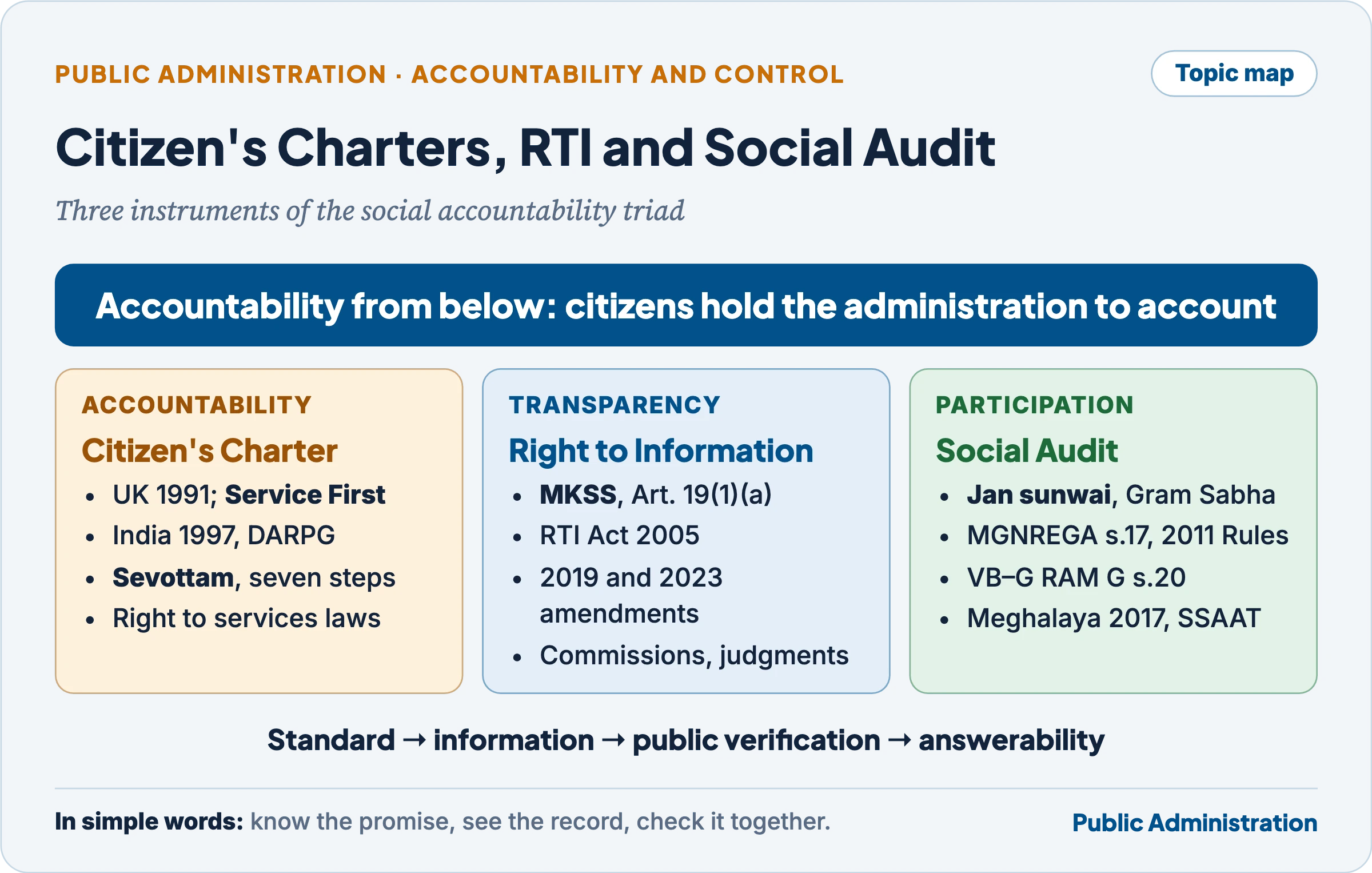
The three instruments in this article answer one practical question: how can an ordinary citizen, and not only Parliament, a minister or a court, hold the administration to account? A Citizen’s Charter tells people what service they can expect and how to complain. The Right to Information lets them see the files behind a decision. A social audit lets a whole community check, in public, whether the money spent on their village actually reached them. Together they shift accountability from the top of the hierarchy to the point where the state meets the citizen.
- The classical controls (legislative, executive and judicial) work from above and after the event. They are discussed in the article on Accountability and Control: Concepts and Legislative, Executive and Judicial Control.
- The instruments here work from below and close to the event. They give citizens a standard to measure the service against (charter), evidence to test it (RTI) and a forum to demand answers (social audit).
- They grew out of two different streams that met in the 1990s: the managerial stream of New Public Management, which saw the citizen as a customer, and the democratic stream of Indian grassroots movements, which saw the citizen as the owner of public money.
In simple words
Think of a ration shop. A board on the wall saying “rice at Rs 3 a kilo, shop open 9 to 5, complain to the block officer” is a charter. Your right to see the shop’s stock register is RTI. The whole village sitting together, reading out the register and asking the dealer why their names show rice they never got, is a social audit.
1. The Social Accountability Triad
In simple words
Accountability needs three things. People must be able to see what the government does (transparency), someone must be answerable and face consequences (accountability), and people must be able to take part in checking and deciding (participation). Take away any one and the other two become weak.
1.1 From supply-side to demand-side accountability
Conventional accountability mechanisms work inside the state: Parliament questions ministers, ministers direct secretaries, auditors check accounts and courts review legality. These are supply-side (government-side) mechanisms. From the 1990s, scholars and development agencies argued that they were not enough, especially for the poor.
- Social accountability was defined by the World Bank as an approach to building accountability that relies on civic engagement, in which ordinary citizens or civil society organisations take part, directly or indirectly, in exacting accountability (Carmen Malena, Reiner Forster and Janmejay Singh, World Bank paper, 2004). John Ackerman‘s conceptual paper for the World Bank (2005) became the standard reference for the idea.
- The World Development Report 2004, Making Services Work for Poor People, contrasted two routes. In the long route, citizens elect politicians, who make policy, which instructs providers; the chain is long and often breaks. In the short route, citizens act directly on providers as clients. Charters, RTI and social audit strengthen the short route.
- Guillermo O’Donnell, the Argentine political scientist, distinguished vertical accountability (citizens over rulers through elections and the press) from horizontal accountability (state agencies checking one another, such as audit bodies and courts) in his essay on new democracies (1998).
- Anne Marie Goetz and Rob Jenkins described a third, hybrid or diagonal accountability: citizens entering the state’s own oversight processes, as when villagers in Rajasthan examined official muster rolls in public hearings (Public Management Review, 2001). Social audit is the clearest example.
- Albert Hirschman, in Exit, Voice, and Loyalty (1970), showed that dissatisfied users either exit (switch provider) or use voice (complain). Public monopolies offer little exit, so voice must be strengthened. Charters build a channel for voice and, under NPM, sometimes a substitute for exit; RTI and social audit give voice an evidence base.
1.2 Why secrecy is the enemy of accountability
- Max Weber, the German sociologist of bureaucracy, observed in Economy and Society that every bureaucracy tries to increase its power by keeping its knowledge and intentions secret, and that the “official secret” is bureaucracy’s own invention. Secrecy turns expertise into power over the public.
- Joseph Stiglitz, the Nobel economist, argued in his Oxford Amnesty Lecture (1999) that secrecy creates information asymmetry between rulers and ruled, which allows rent-seeking and weakens public debate. In principal–agent terms, citizens are the principals and officials the agents; agents who hold all the information can shirk or steal without detection.
- Information is therefore the precondition for every other form of accountability: a legislator cannot question, a court cannot review and a voter cannot judge what nobody can see.
1.3 How the three instruments fit together
The table below sets the three instruments side by side. Each one supplies a different link in the chain of accountability.
| Element of the triad | Main instrument | What it gives the citizen | Accountability question it answers |
|---|---|---|---|
| Accountability (standards and answerability) | Citizen’s Charter, Sevottam, right to services laws | A promise of service quality, time limits and redress | “What was I entitled to, and who answers if it is not delivered?” |
| Transparency | Right to Information Act, 2005 | Access to records, reasons and decisions | “What did the government actually decide and spend?” |
| Participation | Social audit, jan sunwai, Gram Sabha | A public forum to verify and demand action | “Did the benefit reach us, and what will be done about the gap?” |
- The instruments depend on one another. A charter without information cannot be checked; information without a forum often produces no action; a social audit without records (which RTI secures) becomes a meeting of complaints without proof.
- The same logic runs through the 2nd ARC’s reports: the 1st Report (2006) called RTI the “master key to good governance”, and the 12th Report (2009) put the citizen at the “heart of governance” through charters, grievance redress and social audit.
- The wider relationship between citizens and the administration, and the roles of the media, interest groups, voluntary organisations and civil society that use these tools, are covered in the article on Citizen and Administration: Media, Interest Groups, Voluntary Organisations and Civil Society.
2. Citizen’s Charters
In simple words
A Citizen’s Charter is a public promise made by a government office: these are our services, this is how long each will take, this is how you will be treated, and this is whom you complain to if we fail. It turns a vague hope of good service into a written standard against which the office can be judged.
2.1 Meaning and rationale
A Citizen’s Charter is a written, voluntary declaration by a public organisation of its standards of service, the information it will give, the choices and consultation it offers, the courtesy citizens can expect and the grievance redress available when standards are not met. India’s Department of Administrative Reforms and Public Grievances (DARPG) describes it as a document that represents a systematic effort to focus on the commitment of an organisation towards its citizens.
- Rationale: public services are paid for by citizens, directly or through taxes, so they are entitled to services of known quality, delivered efficiently and at reasonable cost.
- A social contract, not a new law: a charter usually does not create new legal rights. It states existing entitlements in plain language and sets out good practice that the government thinks should become the norm.
- Who is the “citizen”? In DARPG’s usage the term covers all stakeholders: citizens, customers, clients, beneficiaries, and even other ministries or state governments that use a service. Where an office serves mainly other government bodies, it issues a Client’s Charter instead.
- Two-way document: Indian charters add a component the UK model lacked, the expectations from citizens (for example, filling forms correctly or paying dues on time).
- Mindset change: a charter is meant to move the official from someone with power over the public to someone with a duty towards the public.
2.2 Origin in the United Kingdom
John Major, the Conservative Prime Minister, presented the White Paper The Citizen’s Charter: Raising the Standard (Cm 1599) to Parliament on 22 July 1991. It was a national programme to raise standards across all public services and the privatised utilities.
- Background: a series of Thatcher-era reforms prepared the ground: the Efficiency Scrutinies (from 1979), the Financial Management Initiative (1982) and the Next Steps executive agencies (1988). The charter added the user’s point of view to this managerial reform.
- Four themes: quality, choice, standards and value.
- Six principles of public service (as elaborated in the programme):
- Standards: setting, monitoring and publishing explicit standards, and actual performance against them;
- Information and openness: full, accurate, plain-language information about how services are run and who is in charge;
- Choice and consultation: choice wherever practicable and regular consultation with users;
- Courtesy and helpfulness: staff who identify themselves by name and serve all entitled users equally;
- Putting things right: an apology, an explanation and a swift remedy, with well-publicised complaint procedures and independent review;
- Value for money: efficient and economical delivery, with independent validation of performance.
- Charter Mark (1992): an award for public bodies that met the charter standard, announced by Major in January 1992 to reward excellence and create competition between offices.
- Service First (1998): the Labour government of Tony Blair relaunched the programme in 1998 as Service First, with nine principles of public service delivery: set standards of service; be open and provide full information; consult and involve; encourage access and promote choice; treat all fairly; put things right when they go wrong; use resources effectively; innovate and improve; and work with other providers.
DARPG summarises the original movement’s principles in a slightly different list: quality, choice, standards, value, accountability and transparency. Both lists describe the same idea; the first is the White Paper’s working version, the second a compressed summary.
2.3 From the People’s Charter to the Precariat Charter
The word “charter” has a long history in the struggle for rights, and the citizen’s charter is one stage in it.
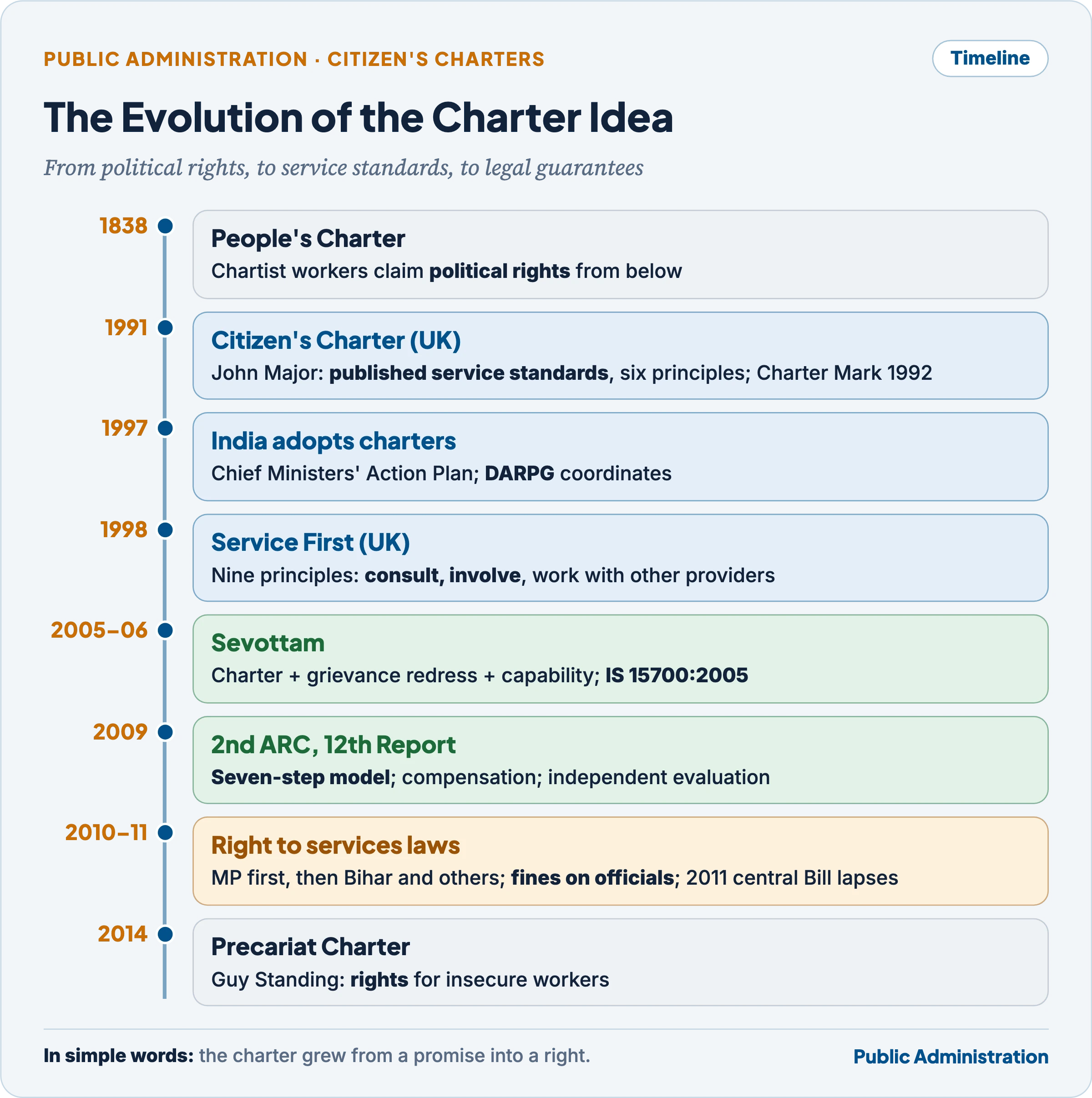
- People’s Charter (1838): the Chartist movement of British workers demanded political rights such as manhood suffrage and the secret ballot. It was a charter of political rights claimed from below.
- Citizen’s Charter (1991): a charter of service standards granted from above, rooted in NPM’s customer orientation.
- Service First (1998) and similar programmes: a broader, more participatory version stressing consultation and partnership.
- Precariat Charter (2014): Guy Standing, the British economist, in A Precariat Charter: From Denizens to Citizens (2014), proposed rights for the precariat, the growing class of workers in insecure, short-term and platform jobs who lack occupational identity and social protection. It returns the charter idea to rights of citizenship, not just quality of service.
- Rights-based service laws: in India the charter evolved into enforceable right to services laws (section 2.8). The arc therefore runs from political rights, to consumer standards, back to legal entitlements.
2.4 Spread across the world
The UK model attracted wide interest. Some countries copied it closely; others joined it to Total Quality Management (TQM), which shares its focus on the customer, standards, stakeholder involvement and continuous improvement.
| Country | Initiative | Year |
|---|---|---|
| France | Public Service Charter | 1992 |
| Belgium | Public Service Users’ Charter | 1992 |
| Spain | Quality Observatory | 1992 |
| Malaysia | Client’s Charter (agency-wide and unit charters, a “service recovery” idea) | 1993 |
| Portugal | Quality Charter in Public Services | 1993 |
| Jamaica | Citizen’s Charter | 1994 |
| Canada | Service Standards Initiative | 1995 |
| India | Citizen’s Charter | 1997 |
| Australia | Service Charter (later one-stop Centrelink) | 1997 |
- Malaysia introduced a Best Client’s Charter Award and the idea of service recovery: proactively restoring a client’s trust when service fails.
- Canada took its cue from the UK but widened the scope to friendly service, faster response, longer office hours and one-stop shopping, while also cutting the deficit.
2.5 Citizen’s Charters in India
India adopted charters in response to rising literacy, awareness and dissatisfaction with an unresponsive bureaucracy.
- Chief Secretaries’ Conference (November 1996): called to develop “an agenda for an effective and responsive administration”. It recommended that accountability be read in terms of public satisfaction, and that charters be introduced in phases, with consumer groups involved and performance independently scrutinised.
- Conference of Chief Ministers (24 May 1997): adopted an Action Plan for Effective and Responsive Government with three themes: an accountable and citizen-friendly administration, transparency and the right to information, and cleansing and motivating the civil services. Charters were to begin with sectors of large public interface such as railways, telecom, posts and the public distribution system.
- DARPG became the nodal agency for formulating, coordinating and evaluating charters at the Centre and helping the states.
- Civil society role: the Consumer Coordination Council and its associate Common Cause, led by H.D. Shourie, pushed the concept forward with the Cabinet Secretariat.
Components of an Indian charter (DARPG guidelines):
- vision and mission statement;
- details of business transacted by the organisation;
- details of clients;
- details of services provided to each client group, with standards and time limits;
- details of the grievance redress mechanism and how to access it;
- expectations from the clients.
Road map for formulating a charter (DARPG): form a task force with users, senior management and cutting-edge staff; identify stakeholders and major services; consult clients and frontline staff; prepare a draft; circulate it and revise it; have it reviewed by a core group; obtain the minister’s approval; send a copy to DARPG; release it publicly and on the website; send copies to people’s representatives; and appoint a nodal officer to see it through. Charters were to be reviewed periodically.
Early implementation measures:
- Hand-holding in banks (2000): three national banks (Punjab National Bank, Punjab and Sind Bank, Oriental Bank of Commerce) were chosen to show exemplary implementation; staff were trained and charters were revised on a model charter of the Indian Banks’ Association.
- Information and Facilitation Counters (IFCs): physical help desks giving information on schemes and the status of applications, and acting as a nodal point for grievances. An IFC is the physical face of the charter.
- Awareness and training: a compendium of central charters, regional seminars and capacity-building workshops at training institutes.
- Good practice examples: Regional Transport Offices in Hyderabad publishing service-wise fees and same-day time limits; Jan Sewa Kendras in Ahmedabad and Vadodara reorganising district services around a single counter and standard forms; water boards in Chennai and Hyderabad setting time limits for connections, the Hyderabad charter even promising a token compensation for delay.
2.6 Sevottam: making charters measurable
Charters on paper changed little, so DARPG built an assessment-and-improvement framework around them. Sevottam (from seva, service, and uttam, excellent) was developed by DARPG in 2005–06 after studying models such as the UK Charter Mark and the US Malcolm Baldrige quality award.
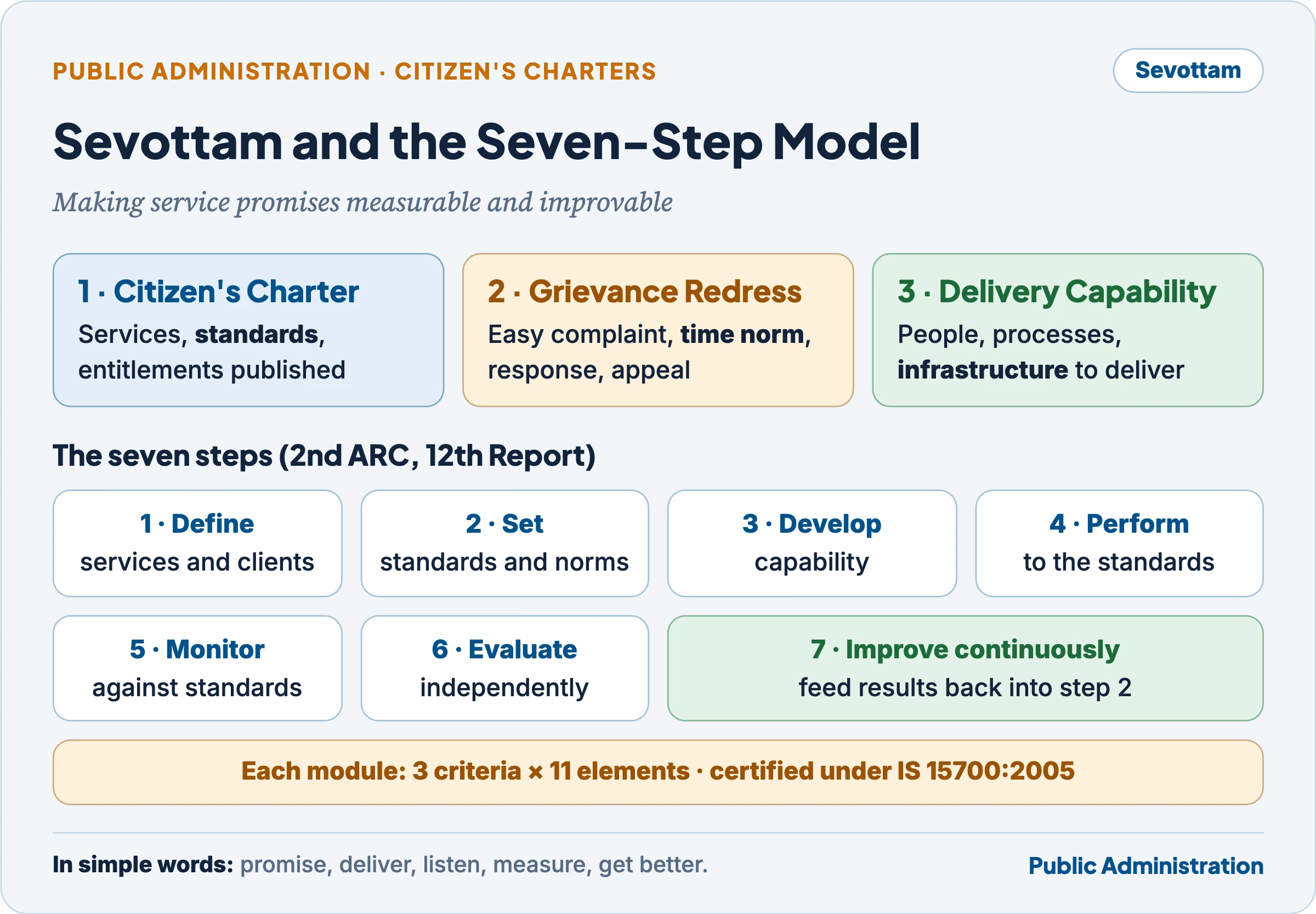
- Three modules, each with three criteria and eleven elements (nine criteria and 33 elements in all):
- Citizen’s Charter: the organisation declares its services, standards and entitlements, opening a channel for citizens’ inputs into how services are designed;
- Public Grievance Redress: a good complaint system that leaves the citizen satisfied with how the organisation responds, whatever the final decision;
- Service Delivery Capability: the organisation manages the ingredients of good delivery (people, processes, infrastructure) and builds its capacity to improve continuously.
- IS 15700:2005: at DARPG’s request, the Bureau of Indian Standards issued a quality management standard for public service organisations, based on the ISO 9000 series but with citizen-centric additions such as a charter, grievance redress and the nomination of an ombudsman. Offices meeting it can be certified.
- Pilots: Sevottam was piloted in ten central departments with large public interface (including Posts, Railways, the Passport Office, income tax and customs, the EPFO and Kendriya Vidyalayas) in 2009–10, and in states such as Himachal Pradesh, Karnataka, Madhya Pradesh and Odisha.
- Link to performance management: under the Performance Monitoring and Evaluation System approved in 2009, each department prepared a Results-Framework Document (RFD), and a Sevottam-compliant charter and grievance mechanism became mandatory success indicators. The RFD system fell into disuse after 2014.
- CPGRAMS (2007): the Centralised Public Grievance Redress and Monitoring System, an online portal for lodging and tracking grievances against central ministries, gave the second module a digital backbone.
2.7 The 2nd ARC’s seven-step model
The Second Administrative Reforms Commission (chaired by M. Veerappa Moily), in its 12th Report, Citizen Centric Administration: The Heart of Governance (February 2009), studied Sevottam, found it a step in the right direction and recommended that the Union and state governments make a seven-step model mandatory for all organisations with public interface:
- Define all services the organisation provides and identify its clients.
- Set standards and norms for each service.
- Develop the capability to meet the standards.
- Perform to achieve the standards.
- Monitor performance against the standards.
- Evaluate the impact through an independent mechanism.
- Improve continuously on the basis of monitoring and evaluation.
The Commission’s other recommendations on charters:
- One size does not fit all: each charter should be drawn up separately, down to the level of field units, not copied from the ministry above.
- Wide consultation with citizens and frontline staff before drafting.
- Firm commitments, quantified in time and quality, rather than vague assurances.
- Redress for default: the charter must say what the organisation will do if it fails, including compensation where possible.
- Periodic evaluation, preferably by an external agency, and accountability of officers for non-performance.
- A similar seven-step model for grievance redress (receipt, acknowledgement, time norm, communication of action taken, appeal, analysis of grievance-prone areas and systemic change).
2.8 Why charters disappointed in India
Evaluations by DARPG and the 2nd ARC found a long list of weaknesses.
- Not consultative: most charters were drafted by senior officers without consulting users or cutting-edge staff, many simply because “there was a direction from above”.
- Poor awareness: frontline staff did not know the philosophy or content of their own charter; citizens knew even less. Publicity brochures were sometimes mistaken for charters.
- Unrealistic standards: time norms were either too lax (meaningless) or too tight (unachievable), damaging credibility.
- No funds or training: no budget was earmarked for awareness or staff orientation; frequent transfers of the officers responsible disrupted implementation.
- Uniform templates: charters copied a ministry-wide format and ignored local conditions.
- No enforceability and no compensation: citizens had no remedy when promises were broken; grievance officers were often non-functional.
- Supply-driven culture: charters declared what agencies chose to offer, not what users needed; services were still seen as a favour, not a right.
- Weak monitoring: reviews were irregular and rarely independent.
Common confusion
Is a Citizen’s Charter legally enforceable? No. DARPG’s own guidelines state that a charter is not legally enforceable and therefore non-justiciable; it is a tool for facilitating delivery, a promise the organisation makes to itself and to the user. A citizen cannot sue merely because a charter’s time limit was missed. Enforceability comes only when a statute gives the promise legal force: the state right to services laws (for example, Madhya Pradesh 2010 and Bihar 2011) make notified services a legal entitlement with appeals and penalties, and the lapsed 2011 central Bill would have made charters themselves mandatory and enforceable. Many notes treat charters and right to services laws as the same thing; the charter is the promise, the law is the guarantee.
2.9 From charter to statute: grievance redress and right to services laws
The 2011 central Bill. The Right of Citizens for Time Bound Delivery of Goods and Services and Redressal of their Grievances Bill, 2011 (often called the Citizens’ Charter or Grievance Redress Bill) was introduced in the Lok Sabha on 20 December 2011 and examined by a standing committee (report August 2012).
- Every public authority would have had to publish a citizen’s charter within six months, listing goods and services and their time limits.
- Citizens could complain about any failure in the charter, in the functioning of a public authority, or in the implementation of a law, policy or scheme.
- Every authority would appoint Grievance Redress Officers; grievances were to be redressed within 30 working days, with appeals to a designated authority and to Central and State Public Grievance Redressal Commissions.
- A penalty of up to Rs 50,000 could be imposed on the responsible official, with compensation to the complainant.
- The Bill lapsed on the dissolution of the 15th Lok Sabha in 2014 and has not been reintroduced.
State right to services laws. The states moved faster.
- Madhya Pradesh passed the first such law, the Lok Sewaon Ke Pradan Ki Guarantee Adhiniyam, 2010 (assent August 2010). Notified services must be delivered by a designated officer within a fixed time; the citizen can go to a first appeal officer and then a second appeal authority, which can fine the defaulting official (in the original Act, Rs 500 to 5,000) and compensate the applicant.
- In 2011 at least eight more states and UTs followed, among them Bihar (Right to Public Services Act), Delhi, Himachal Pradesh, Punjab, Rajasthan, Uttar Pradesh, Uttarakhand and Jammu and Kashmir; Karnataka’s Sakala law came the same year. By 2024 about two dozen states had such laws.
- Some states (for example Maharashtra in 2015 and Haryana in 2014) created a Right to Service Commission to supervise implementation, a stronger model than appeals within the same department.
| Feature | Citizen’s Charter | Right to services law |
|---|---|---|
| Legal status | Voluntary declaration | Statute passed by a legislature |
| Enforceability | Not justiciable | Enforceable through appeals |
| Sanction for failure | None, or an apology | Fine on the official, compensation |
| Coverage | All services the office chooses to list | Only notified services |
| Philosophy | Customer service (NPM) | Rights-based entitlement |
- Right to services laws are thus best read as an extension and hardening of the charter: they borrow its core idea (time-bound, published standards) and add what it lacked (legal force, appeals, penalties).
- Limits remain: only a fraction of services are notified, penalties are rarely imposed, the appellate officers are themselves officials of the same administration, awareness is low and digital portals record “deemed delivery” while real delivery lags.
Indian Connect — Charters that bite: the shift to guarantees
- Madhya Pradesh’s 2010 law turned the charter’s promise into a legal duty of a named officer, with a time limit and a fine for delay. Its design (designated officer, two appeals, personal penalty) was copied by most later state laws.
- The 2nd ARC’s 12th Report (2009) had already asked for compensation for default and independent evaluation; the state laws implemented the first, while the second remains weak.
- CPGRAMS, the central grievance portal, carries the second Sevottam module online, but it routes complaints back to the department complained against; a Paper II question (2025) asked whether it addresses local-level issues at all.
2.10 Assessment: customers or citizens?
Charters are often called the most important innovation for customer orientation in administration, and they did bring explicit standards, publicity, name badges and complaint procedures into offices that had never published anything.
- Strengths: they make performance measurable, give staff clear targets, educate citizens about entitlements, and provide the standards that both grievance redress and social audit need.
- Critique from citizenship: treating the citizen as a customer narrows the relationship to consumption of services. Janet and Robert Denhardt‘s New Public Service argued that public servants should serve citizens, not customers, because citizens are also owners and co-producers of public value, and the poor may lack the market power that “customer” implies. Exit (choice) is often unavailable in public monopolies.
- Critique from practice: without enforceability, consultation and funding, charters became wall posters. The lesson drawn in India was that voice needs teeth: hence Sevottam, right to services laws and the link to RTI and social audit.
The concept therefore keeps evolving: from consumer standards towards legal rights, from top-down declarations towards co-produced charters negotiated with users, and from service quality towards the social rights of insecure workers.
3. Right to Information
In simple words
The Right to Information means you can ask any government office for a copy of a file, a record or the reasons for a decision, and it must reply within 30 days unless the law gives a clear reason to refuse. It turns the government’s files from the government’s property into the people’s property.
3.1 Meaning and why it matters
Right to information is the freedom of people to have access to information held by public authorities: files, documents, decisions and the reasons for them. It is the opposite of administrative secrecy.
- James Madison, the fourth US President, wrote in 1822 that a popular government without popular information, or the means of acquiring it, is but a prologue to a farce or a tragedy, or both.
- Woodrow Wilson argued that government ought to be “all outside and not inside”, since corruption thrives in secret places.
- India inherited a culture of secrecy from colonial rule: the Official Secrets Act, 1923, the evidence law’s privilege for unpublished official records relating to affairs of state (ss.123–124 of the Indian Evidence Act, now ss.129–130 of the Bharatiya Sakshya Adhiniyam, 2023), and the conduct rules that forbid officials to share information.
Why the right is needed:
- makes administration accountable and responsive to people;
- reduces the gap between administration and people and makes them aware of how decisions are made;
- improves delivery of services and allows intelligent, constructive criticism;
- reduces corruption and arbitrariness by exposing decisions to scrutiny;
- deepens participation, turning citizens into co-sharers in policy, as J.S. Mill saw in the educative effect of open local government;
- strengthens economic life, since a free flow of official information improves policy and investment;
- builds trust: a government that hides more than its functions require loses public confidence (the UK Franks Committee on the Official Secrets Act, 1972, made this point).
3.2 The international context
Access to information has been recognised as a human right since the founding of the UN. The UN General Assembly called freedom of information a fundamental human right and the touchstone of all freedoms (Resolution 59(I), 1946), and Article 19 of the Universal Declaration of Human Rights (1948) includes the freedom to seek, receive and impart information.
| Country | Law | Year | Note |
|---|---|---|---|
| Sweden | Freedom of the Press Act | 1766 | First access law; now part of the constitution |
| Finland | Access law | 1951 | Second in the world |
| United States | Freedom of Information Act | 1966 | Nine exempted categories; tightened after 2001 |
| Australia, New Zealand, Canada | Access laws | 1982–83 | Canada’s Access to Information Act 1982 |
| South Africa | Constitution plus access law | 1996, 2000 | Right extends partly to private bodies |
| Japan | Information disclosure law | effective 2001 | Administrative documents |
| United Kingdom | Freedom of Information Act | 2000 | An Information Commissioner, but ministers can override |
| India | Right to Information Act | 2005 | One of the most user-friendly laws |
Common features of these laws are: a definition of the scope of access, defined exemptions (security, foreign relations, privacy, law enforcement), procedures and time limits, and an independent appeal body.
3.3 The constitutional basis in India
The Constitution has no express right to information. The Supreme Court read it into Article 19(1)(a) (freedom of speech and expression) and Article 21 (life and personal liberty).
- State of U.P. v. Raj Narain (1975): the people have a right to know every public act done in a public way by their public functionaries; the right flows from Article 19(1)(a). Secrecy can be claimed only where disclosure would truly harm the public interest.
- S.P. Gupta v. Union of India (1981) (the Judges’ Transfer case): open government is the new democratic culture; exposure to public gaze and scrutiny is one of the surest means of a clean and healthy administration, and disclosure should be the rule and secrecy the exception.
- Reliance Petrochemicals v. Indian Express (1988): the right to know is also part of Article 21.
- Secretary, Ministry of I&B v. Cricket Association of Bengal (1995): the right to receive information is part of free speech.
- Union of India v. Association for Democratic Reforms (2002) and PUCL v. Union of India (2003): voters have a right to know the criminal, financial and educational background of candidates.
- Association for Democratic Reforms v. Union of India (15 February 2024): a five-judge Constitution Bench struck down the Electoral Bond Scheme, holding that the voter’s right to information under Article 19(1)(a) extends to information about political funding.
The RTI Act therefore does not create the right; it operationalises a fundamental right by giving it procedures, time limits and penalties.
3.4 The movement that made the law
India’s law came from a grassroots movement, not from a government reform agenda alone.
- Mazdoor Kisan Shakti Sangathan (MKSS): formed on 1 May 1990 in central Rajasthan by Aruna Roy (a former IAS officer), Nikhil Dey and Shankar Singh, working among labourers who were not being paid minimum wages on government works.
- Jan sunwais (public hearings): the first was held at Kot Kirana in Pali district on 2 December 1994. Muster rolls and bills of local works, obtained with difficulty, were read aloud; villagers testified that they never worked on sites shown in their names, that dead people were on the rolls and that works paid for did not exist. The slogan became hamara paisa, hamara hisaab (our money, our accounts).
- Beawar dharna (April–May 1996): a 40-day sit-in in Beawar for the right to photocopy local records; it led to the formation of the National Campaign for People’s Right to Information (NCPRI) in 1996, which drafted a model law with the Press Council of India.
- State laws: Tamil Nadu and Goa (1997), Rajasthan and Karnataka (2000), Delhi (2001), Maharashtra and Assam (2002), Madhya Pradesh (2003) and Jammu and Kashmir (2004) passed their own laws. Maharashtra’s and Delhi’s were the most used.
- Official momentum: the 1997 Chief Ministers’ conference listed transparency and the right to information as an action point; a Working Group under H.D. Shourie (1997) drafted a bill on the principle that disclosure should be the rule and secrecy the exception; the Fifth Central Pay Commission also argued for openness and the repeal of the Official Secrets Act.
- Freedom of Information Act, 2002: passed by Parliament (assented to in January 2003) but never brought into force. It was criticised for wide exemptions (including requests that would “disproportionately divert” resources), no ceiling on fees, no penalties and no independent appeal body.
- RTI Act, 2005: the National Common Minimum Programme of the UPA government (2004) promised a more progressive law; a draft prepared with the National Advisory Council was introduced in December 2004, amended heavily, passed in May 2005 and given assent on 15 June 2005. It came fully into force on 12 October 2005, and the 2002 Act was repealed.
Indian Connect — From Kot Kirana to Parliament
- The MKSS hearings showed that information was a livelihood issue, not an elite concern: a labourer denied wages needed the muster roll to prove it.
- The jan sunwai combined three things at once: access to records (transparency), public verification (participation) and demands for recovery and action (accountability). It is the common ancestor of both the RTI Act and the social audit of MGNREGA.
- The same organisations (MKSS, NCPRI) later shaped Section 17 of MGNREGA (2005), which made social audit by the Gram Sabha a legal requirement.
3.5 The RTI Act, 2005: key provisions
The Preamble states that democracy requires an informed citizenry and transparency of information, which are vital to its functioning and to contain corruption and hold governments accountable to the governed. The Act applies to all citizens; an applicant need not give reasons.
| Section | Provision | What it means in practice |
|---|---|---|
| 2(f) | Information | Any material in any form: records, documents, memos, e-mails, opinions, advices, press releases, circulars, orders, logbooks, contracts, reports, samples, models, electronic data, and information about a private body that a public authority can access under any law |
| 2(h) | Public authority | Any body established by the Constitution, by a central or state law, or by government notification, including bodies owned, controlled or substantially financed by government and NGOs substantially financed, directly or indirectly, by government funds |
| 2(j) | Right to information | To inspect works, documents and records; take notes, extracts or certified copies; take certified samples of material; obtain information in electronic form |
| 4 | Proactive disclosure | Every authority must maintain and computerise its records and publish, on its own, 17 categories of information (s.4(1)(b): functions, powers, norms, budgets, subsidies, directory of officers, salaries and others); publish relevant facts while formulating policy and give reasons for administrative decisions to affected persons |
| 5 | PIOs and APIOs | Every authority designates Public Information Officers; Assistant PIOs at sub-district level receive applications (5 extra days) |
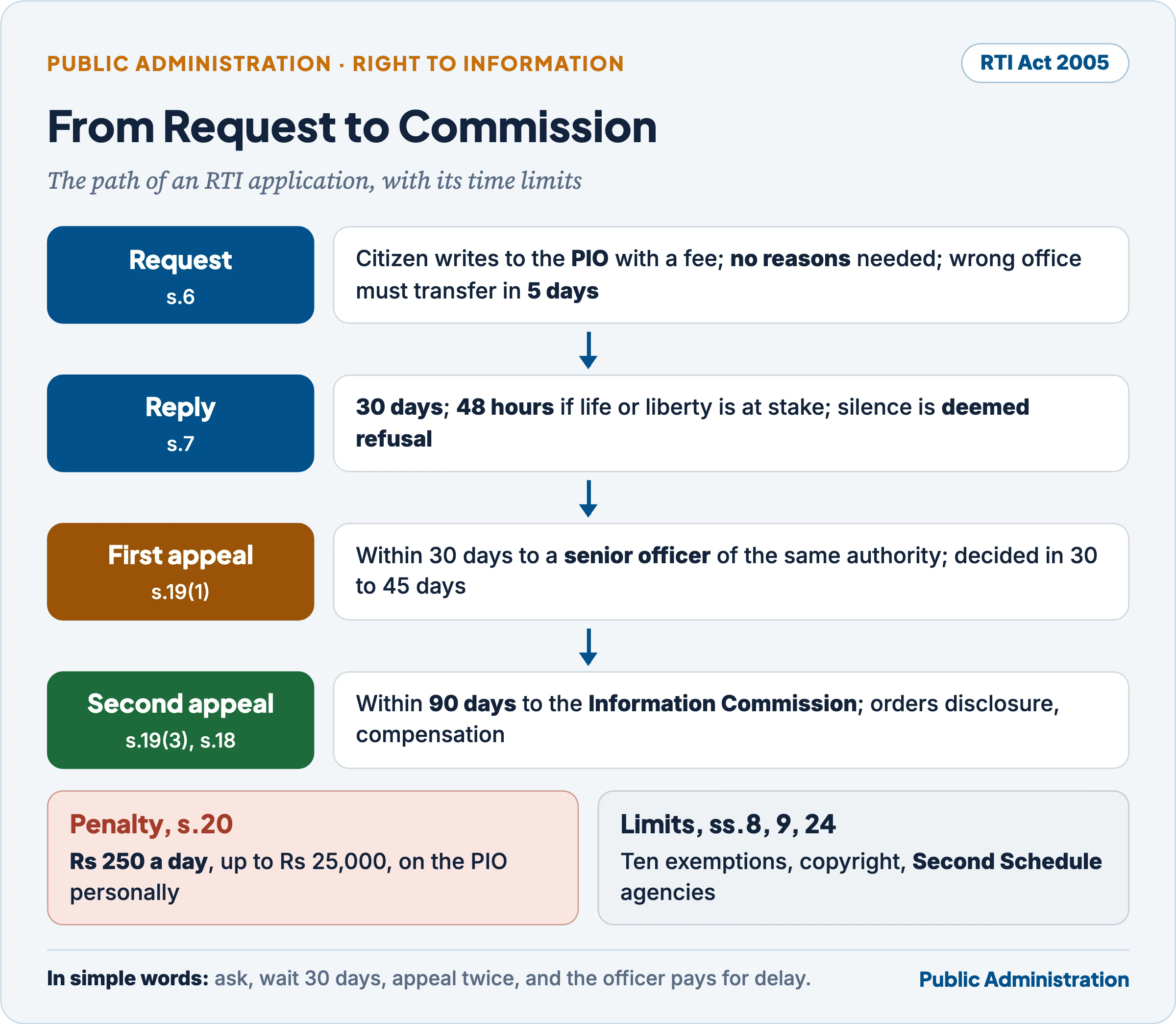
| 6 | Request | Application in writing or electronically with a fee (Rs 10 for central authorities); no reasons required (s.6(2)); a request for another authority’s information must be transferred within 5 days (s.6(3)) |
| 7 | Time limits | Reply within 30 days; within 48 hours if it concerns the life or liberty of a person; no fee for BPL applicants; information free of charge if the deadline is missed; silence counts as deemed refusal |
| 8(1) | Exemptions (a)–(j) | Sovereignty, security, strategic, scientific or economic interests and foreign relations; information forbidden by courts; breach of legislative privilege; commercial confidence and trade secrets; fiduciary relationships; information from foreign governments; danger to life or identification of sources; information that would impede investigation; Cabinet papers (until the decision is taken and the matter is complete); personal information (clause (j), amended in 2023) |
| 8(2) | Public interest override | Notwithstanding the Official Secrets Act or the exemptions, access may be allowed if the public interest in disclosure outweighs the harm |
| 8(3) | Twenty-year rule | Information about events 20 years old must be disclosed, except under clauses (a), (c) and (i) |
| 9 | Copyright | Refusal where disclosure would infringe copyright held by a person other than the State |
| 10 | Severability | The non-exempt part of a record must be given |
| 11 | Third-party information | The third party gets notice and a chance to object; a decision within 40 days |
| 12–17 | Information Commissions | Central and State Commissions: constitution, tenure, removal, powers |
| 18 | Complaints | Direct complaints to Commissions, which have civil court powers of inquiry |
| 19 | Appeals | First appeal within 30 days to a senior officer in the same authority, to be decided in 30 (up to 45) days; second appeal within 90 days to the Commission, which can order disclosure and compensation |
| 20 | Penalties | Rs 250 per day of delay, up to Rs 25,000, on the PIO personally; the burden of proving reasonable conduct is on the PIO; the Commission can recommend disciplinary action |
| 22 | Overriding effect | Prevails over the Official Secrets Act and other inconsistent laws |
| 24 | Excluded organisations | Intelligence and security organisations listed in the Second Schedule (for example IB, R&AW, the central armed police forces, and later additions such as the CBI and CERT-In) are outside the Act, except for information on corruption and human rights violations (the latter only with the Commission’s approval, within 45 days) |
| 25–26 | Monitoring and education | Commissions report annually; governments must run awareness programmes, especially for disadvantaged groups |
- The Act is unusual in three ways: no reasons need be given; the burden of proof in appeals lies on the official who refused; and the penalty falls on the officer personally, not the department.
- Partial or deemed refusal, delay or excessive fees can all be challenged before the Commission.
3.6 Information Commissions and the 2019 amendment
Structure. The Central Information Commission (CIC) consists of a Chief Information Commissioner and up to ten Information Commissioners, appointed by the President on the recommendation of a committee of the Prime Minister, the Leader of the Opposition in the Lok Sabha and a Union Cabinet Minister nominated by the Prime Minister. State Information Commissions are similar, with the Chief Minister, the Leader of the Opposition and a minister. Commissioners must be persons of eminence in public life with knowledge of law, science and technology, social service, management, journalism, mass media or administration and governance.
The original design (2005) protected independence through the statute itself:
- a fixed term of five years (or until age 65);
- status and salary equal to the Chief Election Commissioner (for the Chief Information Commissioner) and to an Election Commissioner (for Information Commissioners); State Chief Information Commissioners equal to an Election Commissioner;
- removal only by the President after a Supreme Court inquiry (for misbehaviour or incapacity).
The RTI (Amendment) Act, 2019 changed sections 13, 16 and 27:
- the term, salaries, allowances and conditions of service of all Commissioners, central and state, are now “as prescribed by the Central Government”;
- the RTI Rules, 2019 fixed a term of three years and a fixed pay of Rs 2.5 lakh a month for the Chief Information Commissioner and Rs 2.25 lakh for Information Commissioners.
The debate:
- Government’s case: the Election Commission is a constitutional body under Article 324, while Information Commissions are statutory; equating them was an anomaly, and the change only “rationalises” service conditions.
- Critics’ case: independence comes from security of tenure and status, not from constitutional status alone. When the Centre can set and change the term and pay of commissioners who decide appeals against the Centre, the Commission’s autonomy is weakened; the change also lets the Centre decide service conditions of state commissioners, which raises a federal objection. The 2nd ARC had earlier warned against Commissions dominated by retired civil servants and recommended diverse membership.
- Judicial guidance: in Anjali Bhardwaj v. Union of India (2019) the Supreme Court directed governments to fill vacancies in time, advertise posts, disclose selection criteria and shortlists, and appoint people from diverse fields, warning that vacancies defeat the right itself. In Kishan Chand Jain v. Union of India (2023) it asked Commissions to monitor compliance with Section 4 continuously.
3.7 The DPDP Act, 2023 and the personal information exemption
The Digital Personal Data Protection Act, 2023 (DPDP Act) is India’s general data protection law. Section 44(3) of that Act substituted clause (j) of Section 8(1) of the RTI Act. This amendment was brought into force with the DPDP Rules, 2025, notified on 13–14 November 2025.
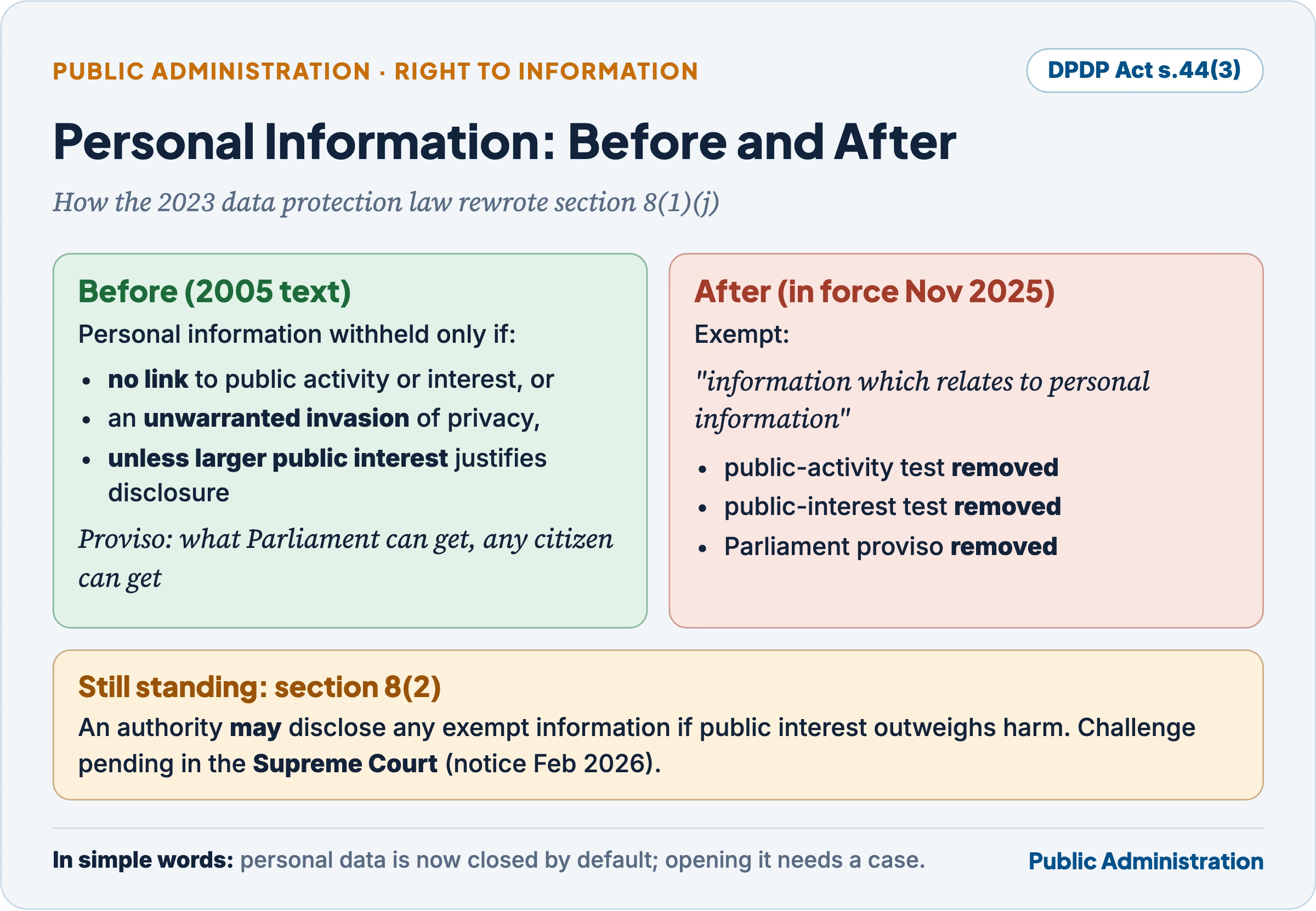
- Before: personal information could be withheld only if its disclosure had no relationship to any public activity or interest, or would cause an unwarranted invasion of privacy, unless the PIO was satisfied that the larger public interest justified disclosure. A proviso added that information which cannot be denied to Parliament or a state legislature shall not be denied to any person.
- After: the clause now exempts simply “information which relates to personal information”. The public-activity test, the larger public interest test and the Parliament proviso have gone from clause (j).
- What remains: Section 8(2) (the general public interest override) was not amended, so a public authority may still disclose exempt information where public interest outweighs harm.
The debate:
- Government’s view: the amendment harmonises the RTI Act with the right to privacy recognised in K.S. Puttaswamy v. Union of India (2017); personal data of individuals, including officials, should not be released routinely; Section 8(2) still allows disclosure in genuine public interest.
- Critics’ view (NCPRI, transparency activists and journalists’ groups): a calibrated exemption has become a blanket bar. “Personal information” can cover officials’ names, attendance, assets, qualifications, ration and MGNREGA beneficiary lists, so the change can block exactly the social audit and anti-corruption uses that made RTI powerful. Section 8(2) is discretionary (“may”), while the old clause (j) required the PIO to weigh public interest. Privacy is not a ground of restriction listed in Article 19(2), and the Supreme Court had already struck the balance in Subhash Chandra Agrawal (2019). The amendment also reaches non-digital records, beyond the DPDP Act’s own subject.
- Litigation: on 16 February 2026 the Supreme Court issued notice on petitions (the lead one by RTI researcher Venkatesh Nayak, with petitions by NCPRI and journalists’ groups), declined to stay the law, and noted that the balance between privacy and the right to information raises questions fit for a larger Bench. A Bench led by Chief Justice Surya Kant heard the matter further in August 2026; the Union’s reply was awaited. Clause (j) was already the most invoked exemption before the amendment: central public authorities cited it 15,753 times in 2023–24.
Common confusion
Did the DPDP amendment end all disclosure of personal information in the public interest? Not entirely, but it changed the default. Section 44(3) of the DPDP Act rewrote only clause (j) of Section 8(1); Section 8(2), which lets a public authority disclose any exempt information when the public interest outweighs the harm, still stands. The difference is that the old clause (j) obliged the PIO to apply the public-activity and larger-public-interest tests before refusing, while Section 8(2) only permits disclosure. Personal information is now exempt by default, and the citizen must persuade the authority (or the Commission) to use its discretion. Whether this is constitutional is pending before the Supreme Court.
3.8 How the courts have shaped the Act
The Supreme Court has both widened the Act (who must answer) and narrowed it (what can be refused). The leading cases are below.
| Case (year) | Question | Holding |
|---|---|---|
| CBSE v. Aditya Bandopadhyay (2011) | Can a student see his evaluated answer sheet? | Yes. An evaluated answer book is information; an examining body does not hold it in a fiduciary capacity towards the student. The Court also warned that indiscriminate and impractical demands could clog administration, and that Section 4 disclosure should be strengthened |
| Girish Ramchandra Deshpande v. CIC (2012) | Can an official’s service record, show-cause notices and asset returns be disclosed? | Generally no: these are personal information under s.8(1)(j), unless the authority is satisfied that larger public interest justifies disclosure |
| Thalappalam Service Co-operative Bank v. State of Kerala (2013) | Are co-operative societies “public authorities”? | Not merely because the state regulates them. A body is “substantially financed” only if government funding is so substantial that the body could not survive without it; mere supervision or small grants are not enough. The ruling also guides when NGOs fall under s.2(h) |
| Namit Sharma v. Union of India (2012, review 2013) | Must Commissions have judicial members? | The 2012 direction requiring judicial members was recalled on review in 2013; the Court asked for persons from diverse fields and a transparent process |
| RBI v. Jayantilal N. Mistry (2015) | Can the RBI withhold bank inspection reports as fiduciary? | No: the RBI is not in a fiduciary relationship with banks; the public interest in their soundness prevails |
| CPIO, Supreme Court v. Subhash Chandra Agrawal (13 November 2019) | Is the office of the Chief Justice of India a public authority? | Yes (five-judge Bench). Judicial independence is not secured by secrecy; information such as judges’ assets can be disclosed, but collegium deliberations and personal data need case-by-case balancing of privacy against public interest, applying proportionality |
| Anjali Bhardwaj v. Union of India (2019) | Can vacancies in Commissions be left unfilled? | No: governments must fill vacancies in time through a transparent selection process |
| Kishan Chand Jain v. Union of India (2023) | Who checks proactive disclosure? | Commissions must continuously monitor Section 4 compliance |
- The thread running through the cases: disclosure is the rule, exemptions are construed narrowly, but privacy and efficiency are legitimate limits that require balancing, not blanket refusal.
3.9 Political parties and the RTI Act
- On 3 June 2013 a full bench of the CIC held six national parties (INC, BJP, CPI(M), CPI, NCP and BSP) to be public authorities under s.2(h): they were substantially financed indirectly (cheap land and buildings, tax exemptions, free airtime on public broadcasters) and perform public functions central to democracy.
- The parties ignored the order; in March 2015 the CIC admitted it had no tools to enforce compliance.
- Petitions by the Association for Democratic Reforms (filed 2015) and others asking the Supreme Court to enforce the CIC’s ruling are still pending; a final hearing listed in 2025 was deferred.
- Arguments for coverage: public funding and public functions; parties choose candidates who exercise public power; opaque funding breeds corruption (the 2024 electoral bonds judgment strengthened this).
- Arguments against: parties are voluntary associations, not state bodies; disclosure of internal strategy could help rivals; they already file accounts with the Election Commission and the income-tax department.
3.10 Problems in working the Act
1. Vacancies and pendency in Information Commissions. The civil society group Satark Nagrik Sangathan (SNS) publishes an annual report card based on RTI replies from all 29 Commissions.
- 2024–25 report (October 2025): over 4.1 lakh appeals and complaints pending on 30 June 2025; six Commissions defunct for some part of the year (Jharkhand and Himachal Pradesh still defunct); the CIC headless from 13 September 2025; penalties not imposed in about 98% of cases where they could have been.
- The CIC’s vacancies were filled on 15 December 2025, when Raj Kumar Goyal was sworn in as Chief Information Commissioner and eight new Information Commissioners took oath.
- 2025–26 report (October 2026): 3,85,716 appeals and complaints pending on 30 June 2026 in 28 Commissions; 14 Commissions would take a year or more to decide a new appeal (Tripura about 19 years and 8 months); the CIC’s own backlog rose to 39,121 (from 24,102 a year earlier) and it returned 14,603 appeals without orders, often on technical defects of format.
2. Weak proactive disclosure. Section 4 was meant to make most requests unnecessary, but websites are often incomplete or outdated, which pushes citizens into filing requests and appeals.
3. Poor record management. Files are lost, not indexed or destroyed. The Act’s power depends on records existing.
4. Penalties rarely imposed. Commissions treat penalties as exceptional, so the deterrent in Section 20 is weak.
5. Bureaucratic resistance. Vague replies (“information not available”, “voluminous”), misuse of exemptions (especially s.8(1)(j) and s.8(1)(e)), high photocopy charges and transfers between offices.
6. Dilution by law. The 2019 amendment (tenure and pay) and the 2023 amendment of s.8(1)(j) (personal information) have narrowed the regime from within.
7. Misuse and burden. Some requests are frivolous, vexatious or used for private disputes and blackmail; the Supreme Court in Aditya Bandopadhyay cautioned against requests that consume most of an office’s time. The answer, most observers agree, is better Section 4 disclosure, not restrictions on applicants.
8. Attacks on RTI users. The Commonwealth Human Rights Initiative (CHRI) compiled media reports of more than 300 attacks on RTI users between October 2005 and October 2016, including at least 51 alleged murders and 5 suicides, with Maharashtra and Gujarat reporting the most; killings have continued since. Most victims were local users exposing land grabs, illegal construction or scheme fraud.
9. No working whistleblower law. The Whistle Blowers Protection Act, 2014 (assent May 2014) provides for complaints of corruption to the CVC and protection of complainants, but it has never been brought into force. A 2015 amending Bill, which would have barred disclosures touching sovereignty, security and several RTI-type exemptions, passed the Lok Sabha and lapsed in 2019.
Remedies proposed for the protection of RTI users:
- treat attacks on RTI users as attacks on human rights defenders; fast-track investigation;
- disclose proactively, on the authority’s website, the information sought by a user who is attacked, so that silencing the user is pointless (a practice some Commissions have ordered);
- protect the identity of applicants where there is a threat;
- operationalise the Whistle Blowers Act and extend protection explicitly to RTI users;
- the 2nd ARC’s 1st Report, Right to Information: Master Key to Good Governance (June 2006), had also recommended repealing the Official Secrets Act and placing official-secrets provisions in a chapter of the National Security Act, replacing the ministers’ oath of secrecy with an oath of transparency, building record management and designating PIOs at every level.
3.11 Records, declassification and the limits of the right
Openness depends on records being kept and eventually released. Governments sometimes destroy records to defeat inquiry, so a right to information without records management is hollow.
- Section 8(3) opens most records after 20 years, and the Public Records Act, 1993 governs retention and transfer to the National Archives.
- A demand for complete declassification and “de-archivisation” of all records goes further than the Act allows. Some information (genuine security matters, privacy of individuals, ongoing investigations) must stay closed for a period. The democratic answer is a time-bound, reviewable classification system, not permanent secrecy or total exposure.
- Practical steps: record retention schedules, digitisation, penalties for unlawful destruction, periodic review and declassification of old files (as the 2nd ARC suggested), and making Section 4 disclosure the default.
3.12 Impact assessment
Scale and use. Central public authorities alone received about 17.5 lakh RTI requests in 2023–24; the share rejected fell from about 7% in 2013–14 to 3.26% in 2024–25. Estimates including state authorities run into several million requests a year.
What RTI has achieved:
- Exposure of corruption: RTI applications have been central to uncovering scams in housing allotments, ration distribution, scholarship schemes and public works; the Adarsh Housing Society case in Mumbai is the best-known example of activists using RTI to piece together a land and housing scam.
- Everyday entitlements: the commonest use is personal: pensions, ration cards, passports, land records, exam results. The mere filing of an RTI often speeds up a stuck file.
- A new form of accountability: accountability used to mean the official answering to his superior and, through the minister, to Parliament. RTI makes him answerable to any single citizen, in writing, within 30 days, with a personal penalty for default. It redefines accountability from internal answerability to direct, individual and enforceable answerability to the public.
- Support for other tools: RTI is the evidence base for social audits, PILs, media investigations and parliamentary questions.
- Behavioural change: officials know that file notings can be read, which encourages reasoned decisions.
Limits:
- benefits skewed towards the literate and urban; the rural poor depend on intermediaries;
- time and pendency defeat the purpose (an answer after two years has little value);
- information does not automatically produce action; without a forum (court, media, social audit), disclosure may change nothing;
- legal dilution and attacks on users raise the cost of asking.
Is it feasible in a developing country? The objections are cost, poor records, low literacy and the risk of paralysing a thin administration. India’s experience suggests that the right is most valuable precisely where the state is distant and corrupt, and that it works when backed by social movements, simple procedures and proactive disclosure. Its legal implications (an enforceable right, penalties, overriding effect on secrecy laws) and political implications (shift of power towards citizens, resistance from those who gain from opacity) go together: the law survives only as long as citizens use and defend it.
Indian Connect — RTI at work in a village
- A labourer who has not been paid can ask for the muster roll and the payment register of the work; the gap between the roll and reality becomes visible.
- A ration-card holder can ask for the stock and sale register of the fair price shop; diversion shows up as sales against names that never bought.
- These are exactly the documents a social audit reads aloud. RTI gives the individual the record; social audit gives the community the stage.
4. Social Audit
In simple words
A social audit is a public check by the people for whom a programme was meant. Officials put all the records on the table, resource persons visit the work sites and the homes of workers, and then the whole village meets to compare what the records say with what actually happened, and to demand action on every gap found.
4.1 Concept
Social audit is a process through which the intended beneficiaries and stakeholders of a programme examine its records and outcomes, verify them against ground reality, and hold the implementing agency to account in a public forum.
- The word audit comes from the Latin audire, to hear: originally, auditors were sent by rulers to listen to the people. Social audit returns the audit to this root.
- It measures an organisation’s social performance, its success in meeting social objectives, not only the legality of its spending. It asks whether the programme reached the right people, with the right quality, at the right time.
- It is a process, not an event: it covers the whole programme cycle (planning, beneficiary selection, implementation, payment and follow-up).
- Stakeholders (workers, beneficiaries, elected members, officials, contractors) are at its centre; it gives special voice to marginalised groups whose voice is rarely heard.
- Its purposes are to assess gaps between needs, resources and results; create awareness of entitlements; improve the effectiveness of programmes; scrutinise decisions from the standpoint of the poor; and estimate the cost to people of not getting timely services.
4.2 Origin
- Corporate origin: the idea began in the corporate world. In the early 1970s the British consumer activist Charles Medawar used “social audit” for assessing the social responsibility of companies and public bodies. In the mid-1970s, trade unions and local councils in the UK used it to evaluate the social consequences of closing or relocating enterprises. Tata Iron and Steel Company (TISCO) at Jamshedpur conducted India’s first corporate social audit in 1979.
- Development and local government: after the 73rd Amendment (1992), the Gram Sabha became the natural forum, and the approach paper to the Ninth Five Year Plan (1997–2002) emphasised social audit for Panchayati Raj institutions. Kerala’s People’s Plan Campaign (1996) also used public scrutiny of local plans.
- MKSS jan sunwais (from 1994): the decisive Indian form. The jan sunwai turned audit from a technical exercise by experts into a public, oral, evidence-based hearing by the people themselves. Hearings in Rajasthan (and later Delhi and other states) exposed fake muster rolls, inflated bills and non-existent works, and led to recoveries and returns of money by officials in public.
4.3 Principles and prerequisites
Good social auditing practice rests on eight principles:
- Multi-perspective (polyvocal): reflects the voices of all stakeholders;
- Comprehensive: eventually covers all aspects of the organisation’s work;
- Participatory: encourages stakeholders to take part and share their values;
- Multidirectional: stakeholders share and give feedback on many aspects;
- Regular: produces social accounts periodically, so that the practice becomes part of the organisation’s culture;
- Comparative: compares performance over time and against benchmarks;
- Verified: checked by a person or agency with no vested interest;
- Disclosed: findings are made public in the interest of accountability.
Prerequisites: a state that has faith in participatory democracy; an active and empowered civil society; access to records (RTI and proactive disclosure); an independent facilitating agency; protection for people who speak out; and a follow-up mechanism with power to act on findings.
4.4 Social audit under MGNREGA
The Mahatma Gandhi National Rural Employment Guarantee Act, 2005 (MGNREGA) was the first Indian law to make social audit mandatory.
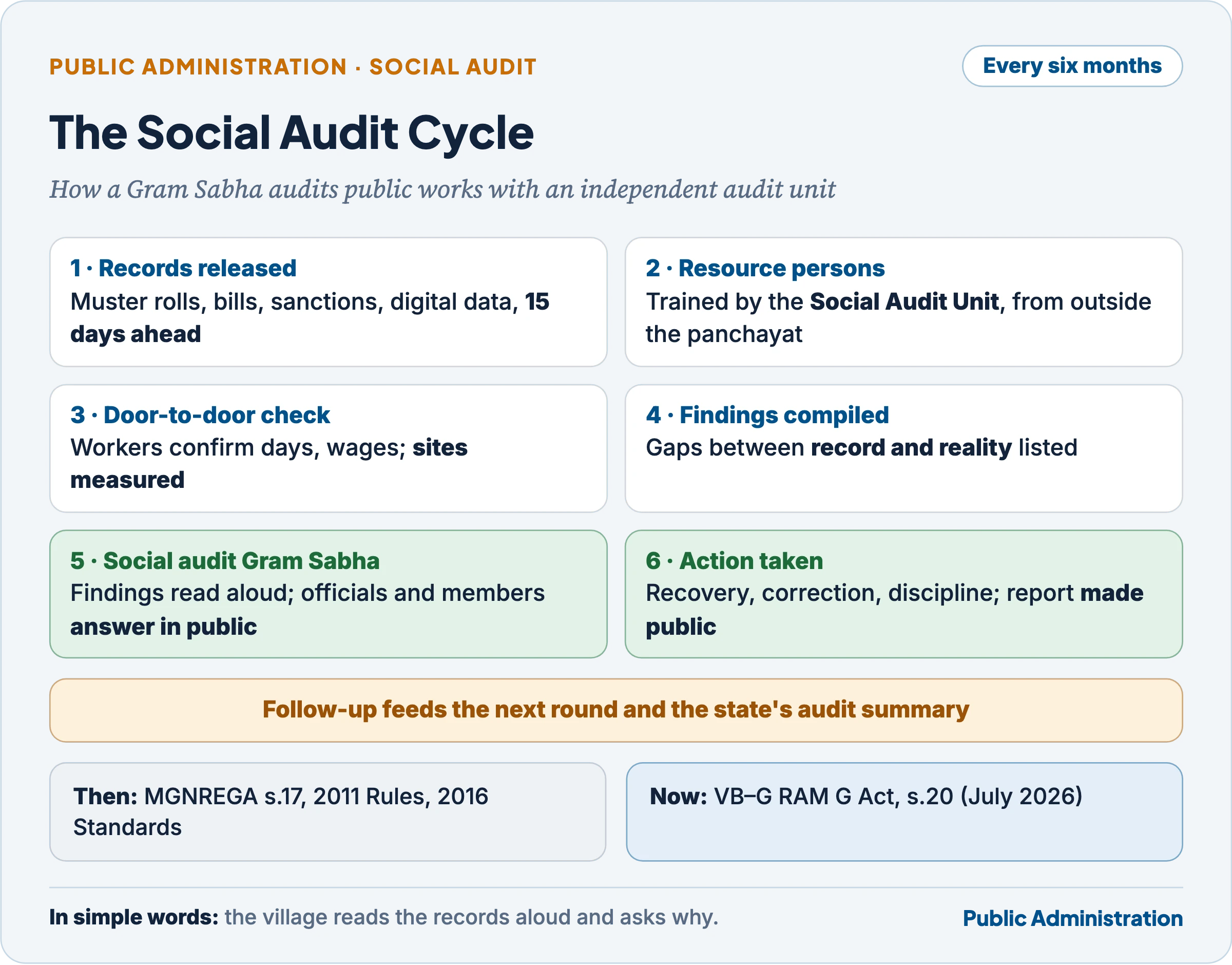
- Section 17: the Gram Sabha shall monitor the execution of works in the Gram Panchayat (s.17(1)); it shall conduct regular social audits of all projects under the scheme in the Gram Panchayat (s.17(2)); and the Gram Panchayat shall make available to the Gram Sabha all relevant documents, including muster rolls, bills, vouchers, measurement books and copies of sanction orders (s.17(3)).
- Audit of Schemes Rules, 2011 (notified 30 June 2011, framed by the Centre in consultation with the CAG):
- the state must facilitate a social audit of works in every Gram Panchayat at least once in six months, and send a summary of findings to the CAG;
- every state must identify or set up an independent Social Audit Unit (SAU) to build the capacity of Gram Sabhas, train village resource persons, prepare formats, create awareness and host reports publicly;
- the social audit must be independent of the implementing agency, which may not interfere but must hand over records at least 15 days in advance;
- resource persons may not belong to the same panchayat they audit;
- resource persons and workers verify muster rolls by contacting wage-seekers, inspect work sites, check the cash book and bank statements, and examine bills for materials;
- a social audit Gram Sabha reads out the findings; all officials and elected members must attend and answer; an action taken report follows.
- Auditing Standards for Social Audit (19 December 2016): a Joint Task Force of the Ministry of Rural Development and the CAG (set up in June 2015) produced standards that the Ministry issued to all states. They define the independence of SAUs (own bank account, autonomy in staffing, governing body), the process of verification, the conduct of the Gram Sabha, follow-up and reporting, and funding of SAUs at 0.5% of the previous year’s scheme expenditure.
- Extension to other schemes: social audit was later required or encouraged for the public distribution system (s.28 of the National Food Security Act, 2013), mid-day meals, rural housing, pensions under the National Social Assistance Programme and several social sector schemes, with the same SAUs often doing the work.
4.5 Current position: the VB–G RAM G Act, 2025
The Viksit Bharat – Guarantee for Rozgar and Ajeevika Mission (Gramin) Act, 2025 (VB–G RAM G Act) received assent in December 2025 and came into force on 1 July 2026, repealing MGNREGA from that date. It raises the statutory employment guarantee to 125 days a year.
- Section 20 keeps social audit as a Gram Sabha function: the Gram Sabha shall monitor and review the execution of works and conduct regular social audits of all works taken up under the scheme, in the manner prescribed by the Central Government, and the Gram Panchayat must make available all records, including muster rolls, bills, vouchers, measurement books, sanction orders, digital records and geo-tagged photographs.
- The Act’s Schedule requires that all works, expenditures and guarantees be subject to social audit at least once every six months.
- Sections 23 and 24 add technology-enabled transparency: biometric authentication, geo-tagging and real-time dashboards.
- What it means: the legal base of social audit has moved from s.17 of MGNREGA to s.20 of the new Act, and the digital record is now explicitly part of what citizens can examine. Whether central rule-making on the manner of social audit preserves the independence of state SAUs, built up under the 2011 Rules and 2016 Standards, is the question to watch.
4.6 The Meghalaya Act, 2017: social audit as a general law
Meghalaya passed the Meghalaya Community Participation and Public Services Social Audit Act, 2017 on 4 April 2017 and launched it in December 2017, the first state law to make social audit a regular part of government practice across departments rather than for one scheme.
- It initially covered 11 departments and 21 schemes, later more.
- It provides for social audit of works, services and programmes, citizen participation in planning, beneficiary selection and concurrent monitoring, and grievance redress.
- It creates a State Social Audit Council and district and village structures; the Meghalaya Society for Social Audit and Transparency facilitates audits.
- Its significance is that social audit becomes a right of the community across sectors, not a condition attached to a centrally sponsored scheme.
4.7 The Andhra Pradesh–Telangana model
Undivided Andhra Pradesh is regarded as the most successful state in institutionalising social audit.
- Social audits of the employment guarantee began in 2006, with the state’s Rural Development Department working with civil society groups that had learnt from MKSS.
- In 2009 the state set up the Society for Social Audit, Accountability and Transparency (SSAAT), the country’s first independent Social Audit Unit; after 2014 both Andhra Pradesh and Telangana retained SSAAT bodies.
- Features: trained village social auditors drawn from wage-seeker families; door-to-door verification; mandal-level public hearings attended by officials with power to act; findings entered in a database; and departmental follow-up with recovery of misappropriated money and disciplinary action.
- Why it worked: strong political and bureaucratic backing at the top, independence of the audit society from the implementing department, regularity (every panchayat in a cycle), and follow-up that made findings costly for wrongdoers.
- Limits: recoveries were often a small share of amounts flagged; powerful local actors sometimes escaped; and the model depended heavily on committed leadership.
Indian Connect — The SSAAT lesson
- Andhra’s audits showed that social audit works best when it is state-supported but independent of the implementer: the government funds and protects the process, but those audited do not control it.
- The 2011 Rules and the 2016 Auditing Standards generalised this design to all states: an independent SAU, outside resource persons, records in advance, a public hearing and mandatory follow-up.
- Where states kept SAUs inside the implementing department, under-staffed or unfunded, audits became rituals: held late, poorly attended and without action.
4.8 Social audit, CAG audit and performance audit
A statutory audit is required by law and done by a professional auditor. In India the Comptroller and Auditor General (CAG) conducts financial, compliance and performance audits of government. Social audit differs from all three in who audits, how and for whom.
| Basis | CAG financial/compliance audit | CAG performance audit | Social audit |
|---|---|---|---|
| Who audits | Professional auditors of the CAG | Professional auditors, sometimes with surveys | Beneficiaries and community, facilitated by an SAU |
| Focus | Legality, regularity, accuracy of accounts | Economy, efficiency, effectiveness of programmes | Whether benefits reached the people, quality on the ground, social impact |
| Evidence | Documents, accounts, vouchers | Documents, data, sample checks, beneficiary surveys | Oral testimony and physical verification checked against records |
| Coverage | Sample-based, periodic | Selected programmes | Every panchayat, every six months (in principle) |
| Forum | Report to Parliament or legislature, PAC | Same | Gram Sabha, public hearing |
| Timing | Usually after the year closes | After or during implementation | Concurrent, close to the event |
| Remedy | Legislative scrutiny, departmental action | Same | Immediate public answerability, recovery, action taken report |
- Two sides of one coin? They share the goal of accountability for public money and the method of comparing records with reality. Each covers the other’s blind spot: CAG audit is rigorous but distant, sample-based and slow; social audit is direct and universal but informal and localised.
- Separate coins? They differ in authority (constitutional mandate vs participatory practice), standards of evidence (documentary vs oral), audience (legislature vs community) and purpose (financial regularity vs social justice and empowerment).
- The CAG’s own position: a Task Group on Social Audit constituted by the CAG in May 2009 concluded that social audit should not be treated as a separate type of audit but as a technique to broaden and deepen the CAG’s performance and compliance audits. The CAG found social audit evidence the strongest direct evidence of outputs, but noted its limits: it is localised, sporadic, informally documented and cannot be generalised unless representative.
- Facilitation: social audits of flagship programmes give the CAG ground-level evidence it cannot collect with its own staff (no auditor can visit every road or every household); the Audit of Schemes Rules require summaries of social audit findings to be sent to the CAG, and CAG performance audits of programmes such as MGNREGA have used beneficiary surveys and social audit reports.
- The best view is therefore complementarity: statutory audit gives rigour and legislative accountability; social audit gives coverage, immediacy and people’s voice.
4.9 Effectiveness and limits
What social audit achieves beyond saving money:
- Deterrence and recovery: the fear of public exposure reduces fake muster rolls and inflated bills; money is recovered on the spot.
- Empowerment: labourers learn their entitlements (wage rates, work on demand, unemployment allowance), and the poor speak in a public forum, often for the first time.
- Inclusive governance: women, Dalits, Adivasis and landless workers, usually absent from decision-making, become auditors of the state. Social audit converts beneficiaries into citizens.
- Better programme design: findings reveal systemic problems (delayed payments, poor technical estimates, missing worksite facilities) that feed back into policy.
- Legitimacy and trust: visible answerability strengthens trust between the state and the community and builds social capital.
- Deepening democracy: it activates the Gram Sabha, the constitutional forum of direct democracy that often exists only on paper.
Why social audits have often been ineffective:
- No punitive teeth: findings are recommendations; disciplinary action, recovery and prosecution depend on the very departments being audited. The absence of a legal provision for punitive action is the most cited weakness.
- Lack of independence: SAUs placed under implementing departments, starved of funds or staff.
- Delayed or ritual audits: irregular calendars, poor publicity, Gram Sabhas without quorum, findings not recorded.
- Elite capture and intimidation: sarpanches, contractors and officials pressure resource persons and witnesses; social auditors have been threatened and attacked.
- Information barriers: records not supplied in advance; digital records unintelligible to villagers; now also the risk that the amended s.8(1)(j) is used to withhold names of beneficiaries.
- Weak follow-up: action taken reports pending, recoveries a small fraction of amounts flagged.
Strengthening social audit for inclusive government:
- give findings legal consequences: time-bound action by designated authorities, recovery as arrears of land revenue, and disciplinary proceedings triggered automatically;
- guarantee independence and funding of SAUs as the 2016 Standards require, and extend the Meghalaya model of a general social audit law;
- protect social auditors and witnesses;
- integrate social audit findings into CAG audits, legislative committees and the grievance system;
- use digital tools (public dashboards, geo-tagged photos) to support, not replace, the public hearing;
- extend social audit to urban local bodies, health and education services, and to the outputs promised in charters and right to services laws.
5. Bringing the Three Instruments Together
In simple words
Each tool on its own is easy to dodge. An office can ignore its charter, delay an RTI reply or skip a social audit. Used together, they close each other’s gaps: the charter sets the standard, RTI produces the proof, and the social audit puts the proof before the people with power to demand answers.
5.1 How the instruments reinforce one another
| Instrument | Main strength | Main weakness | Which other instrument fills the gap |
|---|---|---|---|
| Citizen’s Charter | Clear standards and time limits | Not enforceable; top-down | Right to services laws add legal force; social audit checks delivery against standards |
| RTI | Legally enforceable access to records | Individual and slow; information may not lead to action | Social audit turns records into collective action; charters say what to ask for |
| Social audit | Collective verification, immediate answerability | No punitive teeth; depends on records | RTI secures records; statutory audit and courts add sanctions |
- The transparency–accountability–participation triad is therefore a cycle: standards (what was promised) feed information (what was done), which feeds participation (public verification), which produces answerability and corrective action, which should improve the standards.
- This is the Indian version of the shift from government to governance: accountability is no longer a closed loop inside the state but a network that includes citizens, civil society, the media and independent bodies.
- The chain also shows the Paper I–Paper II bridge: the same instruments appear in Paper II as RTI and citizen–administration interface, grievance redress in the civil services, social audit in financial management and rural development, and Sevottam in administrative reforms.
Criticism — Do citizen-centric tools really make administration accountable?
- Accountability without sanctions: charters are unenforceable, social audits lack punitive power and Information Commissions rarely impose penalties, so officials can absorb criticism without consequence.
- Capture and resistance: bureaucracies dilute the tools from within (vague replies, ritual audits, template charters) and governments dilute them by law (the 2019 and 2023 amendments, the unimplemented Whistle Blowers Act).
- Unequal use: the literate, urban and organised benefit most; the poorest depend on intermediaries and face intimidation.
- Information overload, little action: disclosure without a forum or follow-up produces cynicism; pendency of years empties the right.
- Customer, not citizen: charters reduce the citizen to a consumer of services and leave out questions of rights, equity and policy.
Defence — The case for the triad
- Power has shifted: any citizen can now demand a written answer within 30 days with a personal penalty on the official; this did not exist before 2005.
- Corruption exposed: RTI and jan sunwais have uncovered fraud from village works to big-city housing scams; the fear of exposure itself changes behaviour.
- Movement-backed and resilient: the tools came from social movements, and civil society keeps defending them through report cards, litigation and campaigns.
- Steady institutionalisation: charters led to Sevottam and right to services laws; jan sunwais led to statutory social audit, independent SAUs, auditing standards and the Meghalaya law; social audit survives in the 2025 employment law.
- Complementary, not stand-alone: used together and linked with courts, the CAG, legislatures and the media, they make accountability continuous rather than once in five years.
The balanced conclusion is that these instruments have changed the terms of the relationship between citizen and state: from favour to right, from secrecy to disclosure, from audit by experts to audit by the people. Their effectiveness depends on three conditions that recur through every section above: independent institutions, enforceable consequences and organised citizens willing to use them.
Key Terms
The terms below recur across the three instruments. Each is explained in the section where it is first taught.
| Term | Meaning in simple words |
|---|---|
| Social accountability | Accountability built through civic engagement, where citizens or civil society directly take part in holding officials to account |
| Demand-side accountability | Pressure for accountability that comes from citizens, as opposed to supply-side checks inside government |
| Hybrid (diagonal) accountability | Citizens entering the state’s own oversight processes, as in a public audit of official records |
| Citizen’s Charter | A voluntary public statement by an office of its service standards, time limits and grievance redress |
| Client’s Charter | A charter for an office whose users are mainly other government bodies |
| Charter Mark | UK award (from 1992) for public bodies meeting the charter standard |
| Service First | The 1998 relaunch of the UK charter programme with nine principles of service delivery |
| Precariat Charter | Guy Standing’s 2014 proposal of rights for workers in insecure, short-term jobs |
| Sevottam | DARPG’s framework for excellence in service delivery: charter, grievance redress, service capability |
| IS 15700:2005 | The Bureau of Indian Standards’ quality standard for public service organisations, based on Sevottam |
| CPGRAMS | The central online portal for lodging and tracking public grievances (2007) |
| Right to services law | A state statute making notified services a legal entitlement within a time limit, with appeals and penalties |
| Public authority | Any body covered by the RTI Act under s.2(h), including bodies substantially financed by government |
| Proactive (suo motu) disclosure | Information that public authorities must publish on their own under Section 4 |
| PIO / APIO | Public Information Officer who answers requests; Assistant PIO who receives them at sub-district level |
| Deemed refusal | Failure to reply within the time limit, treated as a refusal that can be appealed |
| Fiduciary relationship | A relationship of trust in which information is held for another’s benefit; an RTI exemption under s.8(1)(e) |
| Public interest override | The power to disclose exempt information when public interest outweighs the harm (s.8(2)) |
| Second Schedule | List of intelligence and security organisations excluded from the RTI Act, except for corruption and human rights information |
| Jan sunwai | A public hearing where official records are read out and checked by villagers |
| Social Audit Unit (SAU) | An independent state body that facilitates social audits by Gram Sabhas |
| Village resource person | A trained local person, from outside the audited panchayat, who verifies records door to door |
| Action taken report (ATR) | The official record of what was done on each social audit finding |
| Performance audit | An audit of the economy, efficiency and effectiveness of a programme, as distinct from financial or compliance audit |
| Whistleblower | A person who discloses wrongdoing in an organisation in the public interest |
Commissions, Committees and Judgments
The bodies, reports and cases below supply the Indian anchors used throughout the article.
| Body / case | Year | Key point |
|---|---|---|
| State of U.P. v. Raj Narain | 1975 | Right to know flows from Article 19(1)(a) |
| S.P. Gupta v. Union of India | 1981 | Open government; disclosure the rule, secrecy the exception |
| Chief Secretaries’ Conference | 1996 | Phased introduction of charters; accountability as public satisfaction |
| Conference of Chief Ministers | 1997 | Action Plan: charters, right to information, cleansing the services |
| H.D. Shourie Working Group | 1997 | Draft freedom of information bill |
| Union of India v. ADR | 2002 | Voters’ right to know candidates’ background |
| 2nd ARC, 1st Report (Right to Information: Master Key to Good Governance) | 2006 | Repeal OSA; oath of transparency; records management |
| 2nd ARC, 12th Report (Citizen Centric Administration) | 2009 | Seven-step model; enforceable charters; grievance redress; social audit |
| CAG Task Group on Social Audit | 2009 | Social audit as a technique to strengthen CAG audits |
| MGNREGA Audit of Schemes Rules | 2011 | Six-monthly social audit; independent SAUs |
| CBSE v. Aditya Bandopadhyay | 2011 | Answer sheets are information; no fiduciary bar |
| Girish Ramchandra Deshpande v. CIC | 2012 | Service records and asset returns are personal information |
| CIC full bench on political parties | 2013 | Six national parties are public authorities |
| Thalappalam Service Co-op Bank v. State of Kerala | 2013 | Meaning of “substantially financed”; co-operatives not covered merely by regulation |
| MoRD–CAG Auditing Standards for Social Audit | 2016 | Independence, process and funding of SAUs |
| CPIO, Supreme Court v. Subhash Chandra Agrawal | 2019 | Office of the CJI is a public authority; privacy–transparency balancing |
| Anjali Bhardwaj v. Union of India | 2019 | Timely, transparent appointments to Information Commissions |
| Kishan Chand Jain v. Union of India | 2023 | Commissions to monitor Section 4 compliance |
| ADR v. Union of India (electoral bonds) | 2024 | Right to information on political funding |
Contemporary Developments
- 15 February 2024: the Constitution Bench in the electoral bonds case extended the voter’s right to information under Article 19(1)(a) to political funding, strengthening the case for transparency of political parties, whose own RTI case remained pending in the Supreme Court in 2025.
- 13–14 November 2025: the DPDP Rules, 2025 were notified and Section 44(3) of the DPDP Act came into force, reducing RTI s.8(1)(j) to “information which relates to personal information”.
- 15 December 2025: Raj Kumar Goyal was sworn in as Chief Information Commissioner and eight new Information Commissioners took oath, ending a three-month period in which the CIC had no chief.
- December 2025 and 1 July 2026: the VB–G RAM G Act, 2025 received assent and came into force, repealing MGNREGA; its Section 20 retains Gram Sabha social audits, and its Schedule requires a social audit at least every six months.
- February 2026: government data placed before Parliament showed the rejection rate of RTI requests to central public authorities at 3.26% in 2024–25, down from 7.21% in 2013–14.
- 16 February 2026 and August 2026: the Supreme Court issued notice on challenges to the s.8(1)(j) amendment, refused an interim stay, indicated that the privacy–information balance may need a larger Bench, and heard the batch further in August 2026.
- 12 October 2026: the SNS Report Card 2025–26 recorded 3,85,716 pending appeals and complaints in 28 Information Commissions on 30 June 2026, a CIC backlog of 39,121 and 14,603 appeals returned by the CIC without orders.
Revision Grid
| Thinker / body | Work or report (year) | Key idea |
|---|---|---|
| John Major | The Citizen’s Charter: Raising the Standard (1991) | Published service standards, information, choice, courtesy, redress, value |
| Tony Blair government | Service First (1998) | Nine principles; consultation and partnership |
| Guy Standing | A Precariat Charter (2014) | Charter of rights for insecure workers |
| Albert Hirschman | Exit, Voice, and Loyalty (1970) | Where exit is impossible, voice must be strengthened |
| Max Weber | Economy and Society | The official secret as bureaucracy’s instrument of power |
| Guillermo O’Donnell | Horizontal accountability (1998) | Vertical (citizens) vs horizontal (state agencies) accountability |
| Goetz and Jenkins | Hybrid accountability (2001) | Citizens inside state oversight, as in jan sunwais |
| World Bank | World Development Report 2004; Malena, Forster and Singh (2004) | Short route of accountability; social accountability |
| Janet and Robert Denhardt | New Public Service | Serve citizens, not customers |
| MKSS (Aruna Roy, Nikhil Dey, Shankar Singh) | Jan sunwais from 1994 | “Our money, our accounts”; birth of RTI and social audit |
| DARPG | Sevottam (2005–06), IS 15700:2005 | Charter, grievance redress, service capability |
| 2nd ARC | 1st Report (2006), 12th Report (2009) | RTI as master key; seven-step citizen-centric model |
| Charles Medawar | Social audit (1970s) | Social responsibility of organisations |
| CAG | Task Group on Social Audit (2009); Auditing Standards with MoRD (2016) | Social audit as a technique within public audit |
| Satark Nagrik Sangathan | Report Cards on Information Commissions | Pendency, vacancies, penalties not imposed |
Previous Year Questions
- 2026Have governments under governance become more transparent and accountable? Elucidate.
- 2024Strengthening social audit through appropriate ways will promote inclusive government. Comment.
- 2023“Citizen Charter’s focus is on empowering citizens concerning public service delivery.” Analyze.
- 2023“The backlash against Right to information (RTI) by the State hampered the citizen’s right to know.” Examine and point out the need to amend the RTI Act to provide protection to RTI activists.
- 2022Social auditing is not just saving the money, it creates positive impact on governance. Comment.
- 2017Can we say that statutory audit and social audit are two sides of the same coin? Or are they two separate coins with varying values?
- 2016“In spite of certain advantages, Social Audit arrangements have mostly been ineffective because there is no legal provision for punitive action.” Comment.
- 2015“Right from the days of the ‘peoples’ Charter’ to the new concept of ‘Precariat Charter’, the concept of Citizen’s Charter and its scope is constantly evolving.” Comment.
- 2014“The right to information is not all about citizens empowerment, it essentially redefines the concept of accountability.” Discuss.
- 2012‘Open access to government records is … the hallmark of a democratic government’, but ‘governments are not hesitant about destroying records – very deliberately – in order to prevent investigations, as well as to generally weaken accountability’. Do you think that in this situation right to information can go to the extent of demanding complete declassification and ‘be-archivization’ of government records? Argue.
- 2010Explain the basic principles underlying Citizen’s Charter with special reference to Its administrative philosophy. Promoting public accountability. Ensuring standards of public service.
- 2007“Right to information promotes transparency and accountability in the working of every public authority.” Explain.
- 2004Discuss the legal and political implications of Right to information. Is it a feasible concept in the developing countries?
- 2003“’Citizens’ charter’ is the most important innovation in the context of promotion of customer-orientation of administration.” Discuss.
- 2022Citizens charters in India have not succeeded in their objectives in making administrative system citizen centric. Do you agree? Give reasons.
- 2019‘Sevottam Scheme’ had great potential to reform service delivery, but opportunity is frittered away. Comment.
- 2019“The RTI has started its journey, but is far from its destination.” In the view of the statement, examine the present status of the RTI movement.
- 2018“Social audit has lent a critical edge to the implementation of programmes such as MGNREGA.” Comment.
- 2017Do you think that the Public Service Guarantee Acts passed by various State Governments are an extension of the Citizen Charters? Give reasons.
- 2017“The Right to Information (RTI) has started its journey but is far from its destination.” Comment.
- 2016“The Right to Information Act is a path-breaking legislation which signals the march from darkness of secrecy to dawn of transparency.” What hurdles do the citizens face in obtaining information from the government? Explain how the reluctance of the government to part with information under R.T.I. can be addressed.
- 2014“Social auditing of flagship programmes of the Central government facilitates the performance of the Comptroller and Auditor-General.” Elaborate the statement with appropriate examples.
- 2013“The concept of social audit is more comprehensive that of traditional audit.” Comment.
- 2009Do you agree with the view that Citizens’ Charters in India have not succeeded in their objective of making the administrative system citizen-centric? Analyze and give your suggestions in this regard.
- 2008‘Right to Information Act has led to greater transparency and accountability of administration.’ Comment.
- 2007“If information is power, nothing can perhaps empower a citizen more that the secret and developmental informations held by various public authorities.” Analyse the merits and demerits of RTI Act, 2005 in the light of this statement.