

Accountability and Control: Concepts of accountability and control; Legislative, Executive and Judicial control over administration; Citizen and Administration; Role of media, interest groups, voluntary organizations; Civil society; Citizen’s Charters; Right to Information; Social audit.
This article: Concepts of accountability, responsibility, responsiveness, answerability and control (internal and external, formal and informal); the Friedrich–Finer debate; typologies of accountability (Dwivedi and Jabbra, Romzek and Dubnick, Bovens, Schedler, Behn); vertical, horizontal and diagonal accountability (O’Donnell); outcome and process accountability; the accountability–autonomy dilemma; NPM shifts; legislative control (questions, motions, budget, committees, CAG, limits and data); executive control (political direction, Finance Ministry, rule-making, personnel and Article 311, staff agencies, performance monitoring, CVC, Lokpal and Lokayuktas); judicial control (grounds of review, writs, PIL, activism and overreach, landmark judgments, limits); comparison of the three controls; UK, US and France; 2nd ARC and other reform recommendations.
Official Syllabus: Paper I · Unit 1-05 Accountability and Control
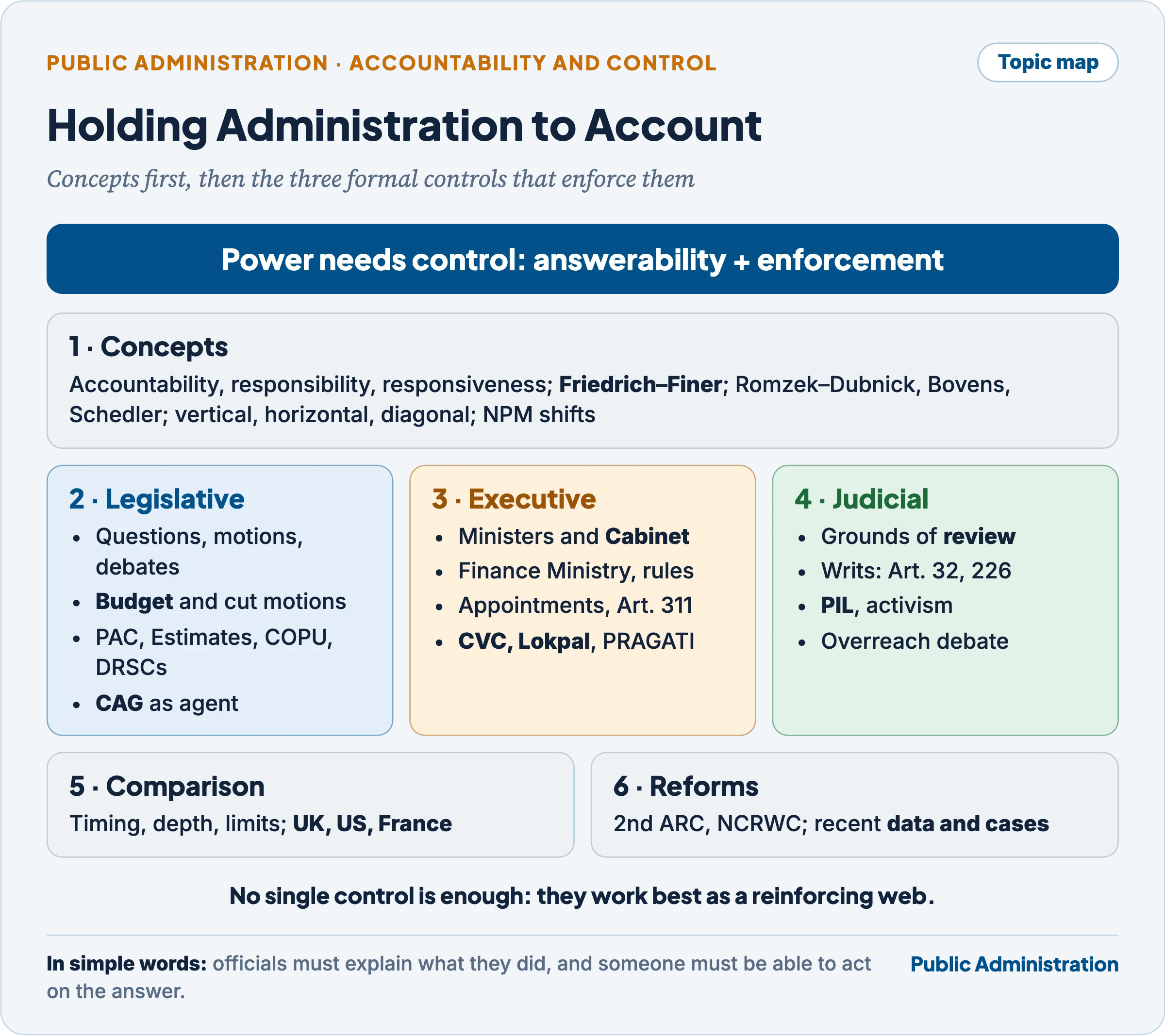
Accountability is what separates public administration in a democracy from administration under an autocrat. A modern state taxes, licenses, regulates, polices, builds and distributes on a vast scale, and almost all of this is done by unelected officials using discretion. The question every democracy must answer is how to give officials enough power to act without letting that power turn into arbitrariness, waste or corruption.
- The answer lies in a web of controls: the legislature watches policy and money, the political executive directs and supervises day to day, and the courts test legality and protect rights. Around these formal controls sit citizens, media and civil society, which the companion articles on citizen and administration and on Citizen’s Charters, RTI and social audit cover.
- None of these controls works alone. Each catches a different kind of failure at a different moment, and each has blind spots the others must cover.
In simple words
Think of a school bus driver. The school gives him rules and checks his log book every week (internal control). The traffic police can stop him if he speeds (external, legal control). Parents complain if the bus is late (citizen control). And a good driver also drives carefully because he cares about the children (inner responsibility). Public officials are held to account in all these ways at once.
1. Concepts of Accountability and Control
In simple words
Accountability means you must explain what you did with the power and money given to you, and face consequences if you misused them. Control means the checks placed on you while you work, so that mistakes are prevented or corrected early.
1.1 Why administration must be controlled
- Power invites abuse. Lord Acton, the British historian, wrote in an 1887 letter that power tends to corrupt and absolute power corrupts absolutely. Officials are not more wicked than others, but unchecked discretion creates opportunities and temptations.
- The historic dilemma. L.D. White, the American author of the first textbook of the discipline, Introduction to the Study of Public Administration (1926), put the problem in a famous sentence: power in a democracy requires control, and the greater the power the greater the need for control; the hard part is to vest enough power for the purpose while keeping adequate controls without crippling authority.
- The administrative state has grown. Planning, welfare, regulation and now digital governance have multiplied the points of contact between citizen and state. Officials now make policy, not only execute it: they draft Bills, frame rules (delegated legislation, laws made by the executive under powers given by Parliament) and decide disputes (quasi-judicial functions). Accountability must therefore cover policy formulation, execution and adjudication, not only the honest spending of money.
- Indian experience. The Emergency of 1975–77 showed what happens when Parliament, courts and the press are silenced together: administration ran according to the will of those in power, with mass detentions and forced sterilisations. Every later reform of accountability in India was shaped by that memory.
1.2 Accountability, responsibility, responsiveness and answerability
The word accountable entered English around 1583, meaning “liable to be called to account”. The four related terms below are often used loosely, but they are not the same.
| Term | Meaning | Source of the obligation | Example |
|---|---|---|---|
| Accountability | Formal obligation to give an account and face sanctions | External, legal and hierarchical | A Secretary deposing before the PAC on a CAG para |
| Responsibility | Inner sense of duty; also the duties attached to a post | Internal, moral and professional | A doctor refusing to sign a false death certificate |
| Responsiveness | Readiness to respond to citizens’ needs and wishes | Political and social | A municipal body fixing drains before the monsoon after ward complaints |
| Answerability | Duty to inform and justify, without necessarily facing a penalty | Informational | A minister answering a starred question |
- John Pfiffner, the American scholar, separated the first two: accountability is the formal and specific location of responsibility, enforced by methods and procedures from outside, while responsibility has a personal, moral quality that works from within and is not tied to formal status.
- Herbert Spiro, in Responsibility in Government (1969), showed that “responsibility” has three senses: accountability (answering to someone), cause (being the agent of an outcome) and obligation (a moral duty). Confusing them produces muddled debates, for instance blaming a minister who caused nothing.
- L.D. White defined administrative responsibility as the sum total of constitutional, statutory, administrative and judicial rules and precedents and established practices by which officials may be held to account. In this broad usage the two words overlap.
- The relationship. In a democracy responsibility cannot be left to the official’s conscience alone; it must be given a formal legal and procedural basis. That basis is accountability. Responsibility is the inside of good conduct; accountability is the outside frame that enforces it.
1.3 Accountability and control
- Control operates alongside or before action: it steers, limits and corrects administrative behaviour while it happens (a sanction order, an inspection, a stay by a court).
- Accountability comes after action: the official is called on to render an account of what was done (an audit report, a parliamentary question, a disciplinary inquiry).
- The two are means and end: controls are the instruments through which accountability is enforced. Political control by Parliament, for example, is the device that makes ministers accountable.
Common confusion
Are accountability and control the same thing? No. Control works while an action is under way and is about steering; accountability works after the action and is about explaining and answering. A Finance Ministry sanction is control; the CAG’s audit of that spending a year later is accountability. Both are needed because control without accountability hides mistakes, and accountability without control discovers them too late.
1.4 Kinds of control: internal and external, formal and informal
Charles Gilbert, in “The Framework of Administrative Responsibility” (Journal of Politics, 1959), arranged controls on two axes: whether they come from inside or outside the administration, and whether they are formal (legal) or informal.
| Formal | Informal | |
|---|---|---|
| Internal | Hierarchy, budget and financial rules, personnel rules, inspection, internal audit, vigilance wings | Professional ethics, organisational culture, peer pressure, leadership |
| External | Legislature and its committees, CAG, courts, ombudsman (Lokpal), election commission, information commissions | Media, interest groups, civil society, public opinion, citizens’ complaints |
- Internal controls are built into the machinery and work automatically, spontaneously and continuously as the machinery moves. The standard list is: the budgetary system, personnel management, efficiency surveys (organisation and methods studies), professional standards, administrative leadership, the hierarchical order, enquiries and investigations, and performance appraisal (in India the Annual Performance Appraisal Report, which replaced the Annual Confidential Report).
- External controls are laid down mainly by the Constitution and operate from outside: legislature, executive (political), judiciary and citizens.
- The two are complementary. As administration grows too large and technical for politicians to supervise closely, external control must be supplemented by internal controls working from within.
1.5 The Friedrich–Finer debate
The most famous argument about accountability took place in the United States between two German-born political scientists, just before the Second World War.
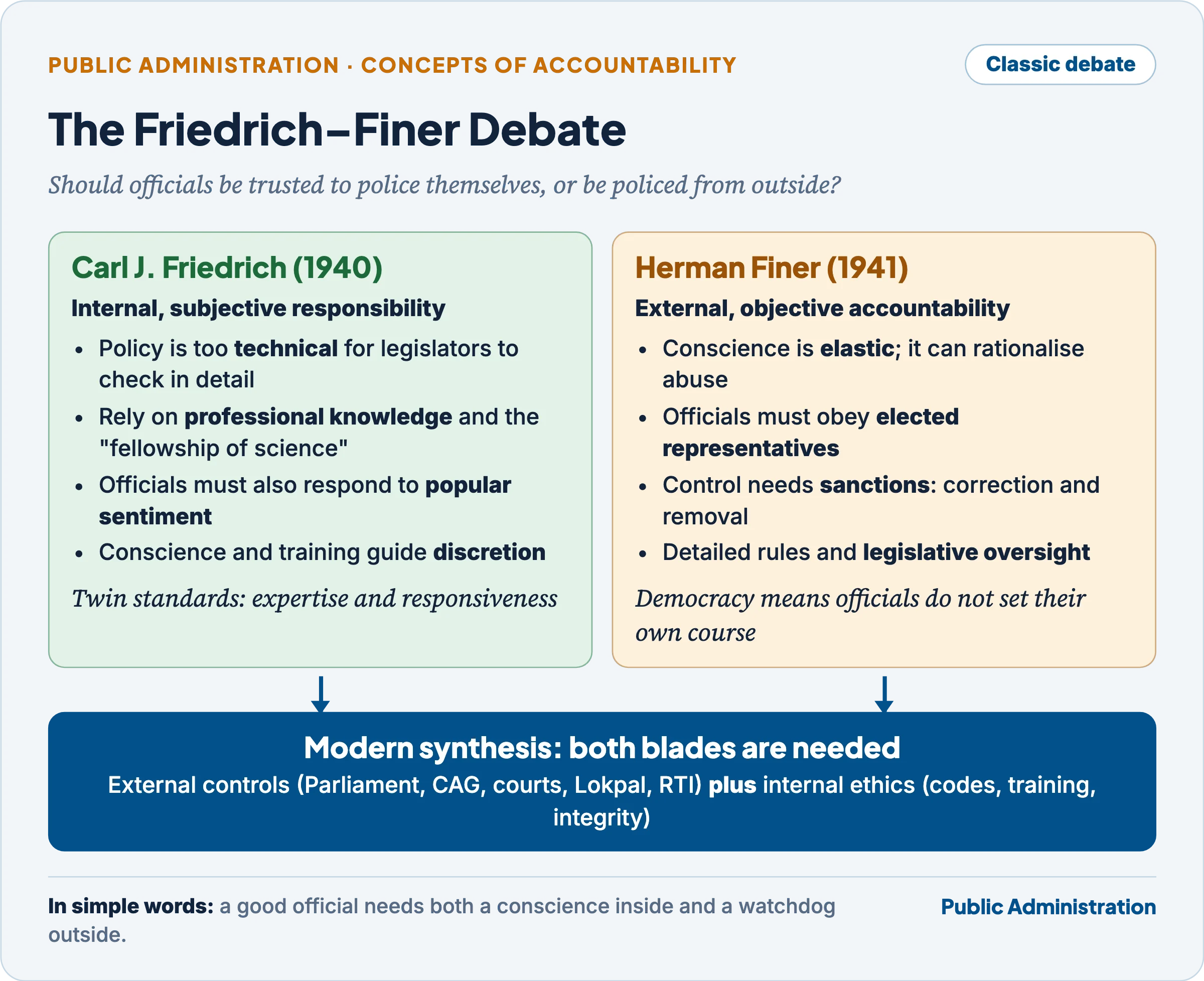
Carl J. Friedrich, the Harvard theorist of constitutional government, argued in “Public Policy and the Nature of Administrative Responsibility” (1940) for internal, subjective responsibility.
- Modern policy is so technical that legislators cannot supervise it in detail; external controls reach only the surface.
- The responsible official is guided by two standards: technical knowledge (the judgement of his professional peers, the “fellowship of science“) and popular sentiment (what citizens need and feel).
- Officials are policy-makers in practice; their discretion is unavoidable, so the best safeguard is a professionally trained, ethically socialised civil service.
Herman Finer, the London-based scholar of comparative government, replied in “Administrative Responsibility in Democratic Government” (Public Administration Review, 1941) for external, objective accountability.
- Conscience is elastic: an official’s “inner check” can rationalise almost anything, and history is full of zealous officials who did harm in good faith.
- In a democracy the people’s elected representatives decide what is in the public interest; officials are servants, not judges, of the public good.
- Accountability requires external agents with power to correct and punish: legislatures, courts and political executives, with detailed rules and real sanctions.
Assessment and modern synthesis.
- Finer is right that self-regulation alone is dangerous in a society where officials are powerful and citizens weak; India’s experience of corruption and colonial-style aloofness supports him.
- Friedrich is right that rules cannot anticipate everything. Parliament cannot audit a vaccine trial or a monetary policy decision in real time; professional integrity has to fill the gap. Indian cases where whistle-blowers exposed wrongdoing despite pressure show the value of inner responsibility.
- The modern view treats them as two blades of one pair of scissors. India’s design reflects both: external controls (Parliament, CAG, courts, CVC, Lokpal, RTI) and internal ones (conduct rules, codes of ethics, Mission Karmayogi’s emphasis on values, professional services).
1.6 Typologies of accountability
Dwivedi and Jabbra: five kinds
O.P. Dwivedi and Joseph Jabbra, in Public Service Accountability (1988), defined accountability as the methods by which a public agency or official fulfils its duties and the process by which it is required to account for them. They listed five kinds.
- Organisational or administrative: answering to superiors within the hierarchy, the classical Weberian line of command.
- Legal: answering to laws, legislative intent and the courts, enforced through judicial review.
- Political: recognising the authority of elected leaders to set priorities, redistribute resources and demand compliance.
- Professional: following the codes of doctors, engineers or scientists, balanced against the wider public interest.
- Moral: acting with integrity beyond what any law or code requires; demand for it grows as corruption spreads.
Romzek and Dubnick: four accountability systems
Barbara Romzek and Melvin Dubnick, in “Accountability in the Public Sector: Lessons from the Challenger Tragedy” (Public Administration Review, 1987), studied the 1986 space-shuttle disaster. NASA’s engineers had warned about faulty seals, but the agency answered mainly to political and hierarchical pressure to launch on schedule. They classified accountability by two questions: is the source of control internal or external, and is the degree of control high or low?
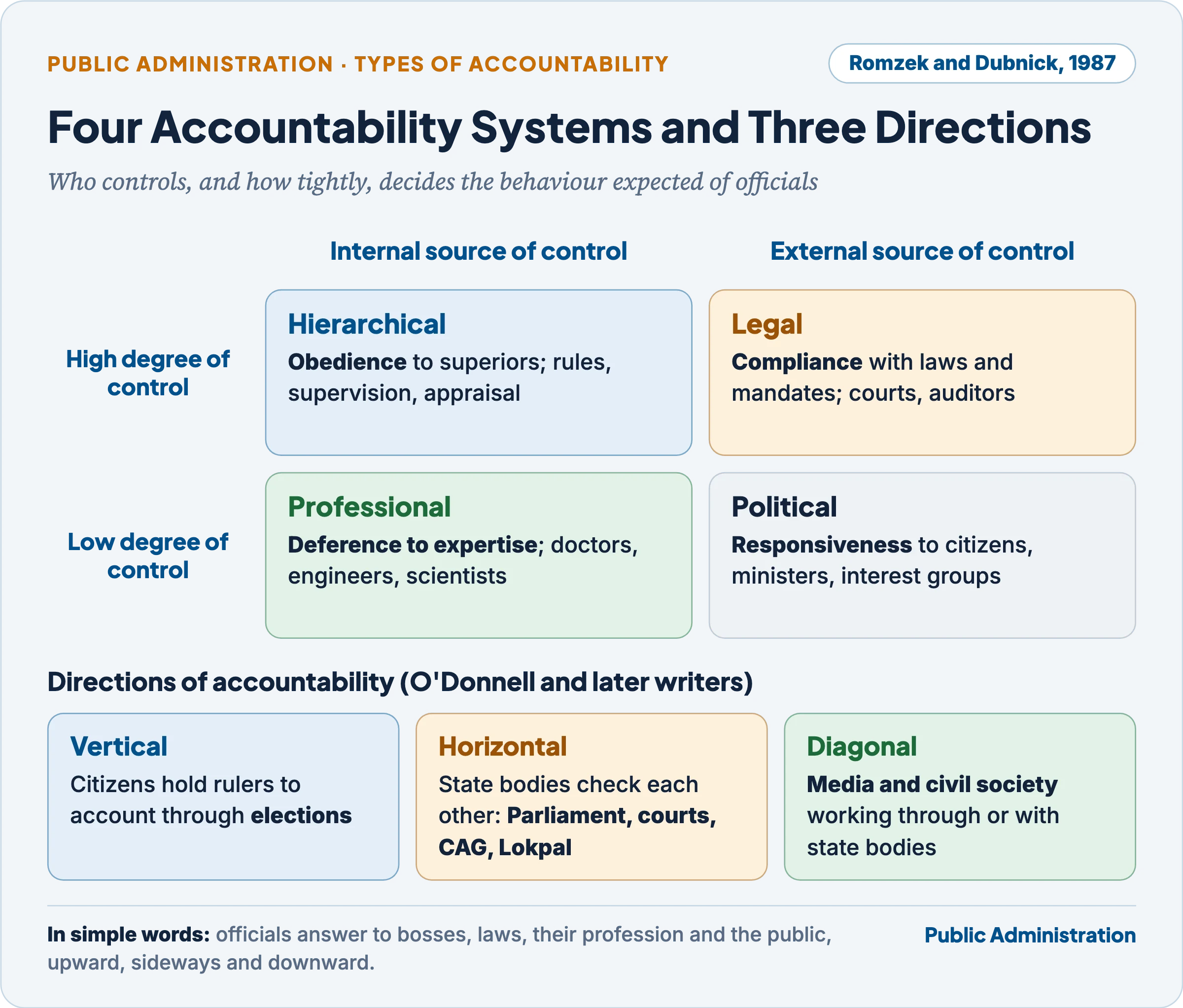
| System | Source and degree | Behaviour expected | Indian example |
|---|---|---|---|
| Hierarchical | Internal, high | Obedience to superiors | A tehsildar following the Collector’s written orders |
| Legal | External, high | Compliance with laws and mandates | A department complying with a High Court order |
| Professional | Internal, low | Deference to expertise | An ICMR scientist deciding trial protocols |
| Political | External, low | Responsiveness to key stakeholders | A municipal commissioner responding to councillors and residents |
- Public officials face multiple, competing accountabilities at the same time. The Challenger lesson is that when an agency lets the wrong system dominate (here, political and hierarchical over professional), disaster follows.
- Romzek later called for “accountability alignment”: performance criteria should match the behaviour the organisation actually wants.
Bovens: accountability as an account-giving relationship
Mark Bovens, the Dutch scholar, gave the most widely used narrow definition in “Analysing and Assessing Accountability: A Conceptual Framework” (European Law Journal, 2007).
- Accountability is a relationship between an actor and a forum, in which the actor is obliged to explain and justify conduct, the forum can ask questions and pass judgement, and the actor may face consequences.
- It has three phases: information (the actor reports), debate (the forum questions), consequences (praise, censure, sanction).
- Bovens also asks to whom (political, legal, administrative, professional, social forums), who (the organisation, its head, or each official, which raises the “problem of many hands“, a term of Dennis Thompson, 1980, for the difficulty of pinning blame when many people contribute to a decision), about what (finances, procedures, results) and why (the obligation may be vertical, diagonal or horizontal).
Schedler: answerability plus enforcement
Andreas Schedler, in “Conceptualizing Accountability” (in The Self-Restraining State, 1999), reduced accountability to two components.
- Answerability: the duty of power-holders to inform (what they did) and justify (why). It has an informational and an argumentative side; accountability is a dialogue, opposed to mute, unilateral power.
- Enforcement: the capacity of accounting agencies to impose sanctions on those who violated their duties.
- Bodies with answerability but no enforcement (an information commission whose orders are ignored, a committee whose reports are advisory) produce “diminished” accountability.
Behn and the content of accountability
Robert Behn, in Rethinking Democratic Accountability (2001), asked accountability for what? and gave three answers: finances (money spent as authorised), fairness (equal and lawful treatment) and performance (results achieved). He warned of the accountability dilemma: the rules that guarantee financial and procedural accountability often stifle the initiative needed for performance.
Indian textbooks often state the same idea as fiscal, process and programme accountability: fiscal checks the legality of spending, process checks procedures (tenders, contracts), and programme accountability asks whether the scheme achieved its purpose (was the right beneficiary chosen, did living standards improve).
1.7 Directions of accountability: vertical, horizontal and diagonal
Guillermo O’Donnell, the Argentine political scientist, in “Horizontal Accountability in New Democracies” (Journal of Democracy, 1998), distinguished two directions.
- Vertical accountability runs from citizens to rulers: periodic elections, plus a free press and associations that criticise governments. It is periodic and blunt; a voter cannot punish one bad decision without changing the whole government.
- Horizontal accountability is exercised by state agencies legally empowered to oversee, sanction or impeach other state agencies: legislatures, courts, audit offices, election commissions, ombudsmen, anti-corruption bodies. O’Donnell argued that many new democracies have elections but weak horizontal accountability, producing “delegative democracy” in which an elected leader governs as he sees fit between elections.
- Diagonal accountability, a term developed by later writers (for example the Varieties of Democracy project, Lührmann and colleagues, 2020), describes media and civil society acting on government directly or through horizontal institutions: a PIL that triggers a court order, a social audit that feeds a Gram Sabha, an RTI request that becomes a CAG audit.
- India’s design is strong on paper on all three: universal franchise (vertical); Parliament, CAG, Supreme Court, Election Commission, CVC, Lokpal (horizontal); RTI, PIL, social audit and a large press (diagonal). The real question is how well each works.
Other directional terms appear in the literature: upward accountability (to superiors and funders), downward accountability (to service users and communities) and outward accountability (to peers and professional bodies). Albert Hirschman’s Exit, Voice, and Loyalty (1970) gave two citizen tools, exit (switching providers) and voice (complaint and participation), which the World Bank’s 1992 report Governance and Development used to distinguish micro-accountability (service level) from macro-accountability (financial accountability and accountability for economic performance).
1.8 Process versus outcome accountability, and the autonomy dilemma
| Aspect | Process (input) accountability | Outcome (performance) accountability |
|---|---|---|
| Question asked | Were rules and procedures followed? | Were results achieved? |
| Typical tool | Audit of vouchers, financial rules, file noting | Outcome budget, performance contracts, dashboards |
| Strength | Prevents fraud, ensures equality | Focuses on citizens’ benefit |
| Risk | Rule-bound timidity, “red tape” | Gaming of targets, neglect of fairness |
| Era | Weberian bureaucracy | NPM and results-based management |
The accountability–autonomy dilemma. Organisations need autonomy to perform (a public enterprise must take commercial decisions quickly), but the more autonomy they get, the harder they are to hold to account.
- Public enterprises are the classic case. The Krishna Menon Committee (1959) argued that Parliament should not interfere in day-to-day management but should review overall performance; this led to the Committee on Public Undertakings (1964). Later devices tried to square the circle: Memorandums of Understanding between ministries and enterprises (from the late 1980s), the Maharatna/Navratna scheme of graded autonomy, and audit by the CAG.
- Over-control produces what the 1992 question below describes: officials who procrastinate, refuse to decide or move files in circles because every decision may later be questioned by audit, vigilance, investigating agencies or courts. In India this is often called policy paralysis, and was much discussed after the 2G and coal allocation controversies of 2010–12. Parliament responded by adding Section 17A to the Prevention of Corruption Act in 2018, requiring prior approval before investigating a public servant for decisions taken in official functions, and by distinguishing honest error from corrupt intent.
- Under-control produces capture and corruption. The balance is struck by ex-ante clarity (clear goals and delegations), ex-post scrutiny of results, and protection for bona fide decisions.
Corruption and liberty: Gibbon’s paradox. Edward Gibbon, in The History of the Decline and Fall of the Roman Empire, called corruption “the most infallible symptom of constitutional liberty”.
- Read literally it sounds cynical; its deeper point is that free societies make corruption visible. Under despotism, abuse is hidden; under liberty, a free press, audit and opposition expose it, so it appears more widespread.
- Liberty also creates interest-driven politics, elections that need money and bargaining that can shade into bribery.
- India illustrates both sides: the large scams of recent decades came to light because of the CAG, courts, RTI and media. But visibility is not the same as remedy; exposure without enforcement (Schedler’s “diminished accountability”) breeds public cynicism.
1.9 How New Public Management changed accountability (bridge)
The detailed treatment of NPM is in the article on New Public Management and after; here only the accountability shifts matter.
- From process to results: performance targets, outcome budgets and contracts replaced rule-compliance as the main test.
- From hierarchy to contract: autonomous agencies, contracting out and public–private partnerships put services at arm’s length from ministers, reducing the reach of ministerial responsibility and legislative scrutiny.
- From citizen to customer: charters, choice and user satisfaction became accountability tools (covered in the article on Citizen’s Charters, RTI and social audit).
- From internal to external accountability: the 2013 question below captures this. In the neo-liberal era, internal hierarchical controls weaken as tasks are devolved, while external accountability grows: regulators, auditors, courts, rating and ranking systems, RTI and social audits.
- Critique. M. Shamsul Haque (2000) argued that NPM changed the standards of accountability (efficiency over equity), the agents (customers over citizens) and the means (results over legislative and ministerial control), and that accountability for profit does not guarantee accountability for welfare and justice. Post-NPM reforms (joined-up government, New Public Governance, digital-era governance) tried to restore coordination and public values.
Indian Connect — Accountability in Indian governance
- Constitutional design: collective responsibility of the Council of Ministers to the Lok Sabha (Article 75(3)), a constitutional auditor (Articles 148–151), judicial review (Articles 13, 32, 226) and service safeguards (Articles 309–311).
- Good governance link: the 2nd Administrative Reforms Commission (2005–09) treated responsibility and accountability as twin goals; its fourth report, Ethics in Governance (2007), opened by calling corruption a systemic failure of accountability.
- Contemporary pressure points: fewer parliamentary sittings, ordinances, Article 142 orders, and the debate over vigilance “chilling” honest decisions, all discussed below.
2. Legislative Control over Administration
In simple words
Parliament gives the government its powers and its money. In return it asks questions, debates, examines accounts and can even remove the government. Officials do not face Parliament directly; their minister answers for them.
2.1 Basis: ministerial responsibility
- In a parliamentary system (India, UK) the legislature is the supreme organ because it represents the people. The Council of Ministers is collectively responsible to the Lok Sabha (Article 75(3)), and each minister is individually responsible for his department.
- Control is indirect. Civil servants cannot be summoned to the floor of the House. The minister answers for every act of his department, and officials remain anonymous. Committees are the main exception: officials appear before them as witnesses.
- Ministerial responsibility has limits. If applied rigidly, every file would go to the minister and administration would stop. In practice ministers rarely resign for officials’ mistakes if they have party backing; the doctrine is a convention and a matter of conscience more than a legal rule. Critics therefore say that bureaucracy thrives under the cloak of ministerial responsibility: officials escape public blame because the minister shields them, while the minister escapes real blame because the majority protects him.
- In a presidential system (USA), the executive neither sits in nor is responsible to Congress, so control works through legislation, appropriations, investigations and Senate confirmation (section 2.8).
2.2 Law-making and delegated legislation
- Parliament creates, structures and funds departments by law and lays down policy. But it legislates in skeleton form, leaving details to rules, regulations and bye-laws framed by the executive.
- This delegated legislation is unavoidable (Parliament lacks time and technical expertise) but it shifts real law-making to officials. Parliament keeps a check through:
- laying of rules before both Houses, with power to modify or annul them;
- the Committees on Subordinate Legislation (Lok Sabha 1953; Rajya Sabha 1964), which ask whether a rule is within the parent Act, imposes a tax, bars the courts, has retrospective effect without authority, or was unduly delayed in publication.
- The tension: delegated legislation brings speed and expertise but weakens the rule of law and accountability when rules are vague, sweeping or never scrutinised. In practice very few rules are discussed on the floor, and committee reports are rarely debated. The full treatment of delegated legislation is in the article on administrative law.
2.3 Questions, Zero Hour and discussions
The first hour of every sitting is normally the Question Hour, followed by the informal Zero Hour.
| Device | What it is | Notes |
|---|---|---|
| Starred question | Oral answer, supplementaries allowed | Marked with an asterisk |
| Unstarred question | Written answer, no supplementaries | Large volume of data for oversight |
| Short notice question | Urgent matter, less than ten days’ notice | Answered orally |
| Zero Hour | Matters raised without notice after Question Hour | Indian innovation, from about 1962; not in the rules |
| Half-an-hour discussion | Elucidation of an answer on a matter of public importance | No formal motion or vote |
| Short duration discussion | Up to two hours on an urgent matter | In use since 1953; no vote |
| Calling attention | Draws a minister’s attention to an urgent matter; minister makes a statement | Indian innovation, 1954; in the rules |
- Why questions matter. They force ministers to master their departments, put information on record and keep the civil service on its toes. A saying attributed to Clement Attlee called question time one of the finest examples of real democracy. Hugh Gaitskell, the British Labour leader, observed that fear of parliamentary questions makes civil servants cautious and careful to keep records, which is both a strength (traceability) and a weakness (timidity).
- Questions as financial control. Questions expose wasteful spending, delays and leakages, and an embarrassing answer often forces a department to act before audit catches up.
- A classic case. In December 1957 Feroze Gandhi raised the LIC–Mundhra deal in the Lok Sabha; the resulting Chagla Commission inquiry led Finance Minister T.T. Krishnamachari to resign in February 1958. It remains the best illustration of how floor scrutiny can bring down a minister for a decision taken by his officials.
2.4 Motions and debates
- Motion of Thanks on the President’s Address, debates on Bills and resolutions allow MPs to criticise the whole range of administration.
- Adjournment motion: interrupts normal business to discuss a definite, factual, urgent matter of recent occurrence; needs 50 members to be admitted; involves an element of censure, so it is not available in the Rajya Sabha. Not a single adjournment motion was taken up in the 16th or 17th Lok Sabha (PRS).
- No-confidence motion: follows from Article 75(3); needs 50 members to be admitted; if passed the Council of Ministers must resign. The first was moved in 1963; the latest was debated in August 2023 (20 hours) and defeated.
- Censure motion versus no-confidence motion:
| Censure motion | No-confidence motion |
|---|---|
| Must state reasons | Need not state reasons |
| Can be against a minister, a group or the whole Council | Only against the whole Council of Ministers |
| Censures specific policies or actions | Tests whether the House still has confidence |
| Government need not resign if passed | Government must resign if passed |
2.5 Financial control: the budget
The principle is old: no taxation without representation and no expenditure without appropriation. Under Articles 112–117, the executive presents the Annual Financial Statement, but no money can be withdrawn from the Consolidated Fund without an Appropriation Act and no tax collected without a Finance Act.
- Opportunities for scrutiny:
- the general discussion on the budget as a whole;
- voting on Demands for Grants ministry by ministry, where cut motions focus debate:
- policy cut (reduce the demand to Re 1) disapproves the underlying policy;
- economy cut (reduce by a specified amount) seeks savings;
- token cut (reduce by Rs 100) ventilates a specific grievance;
- the Finance Bill debate, on which, by convention, any grievance can be raised, on the principle that citizens should not be asked to pay without being heard;
- supplementary, excess and additional grants, and votes on account (Article 116).
- Cut motions are rarely carried, because the government has a majority, and a defeat would amount to a vote of no confidence. Their value lies in forcing a debate on a ministry’s working and putting the opposition’s case on record.
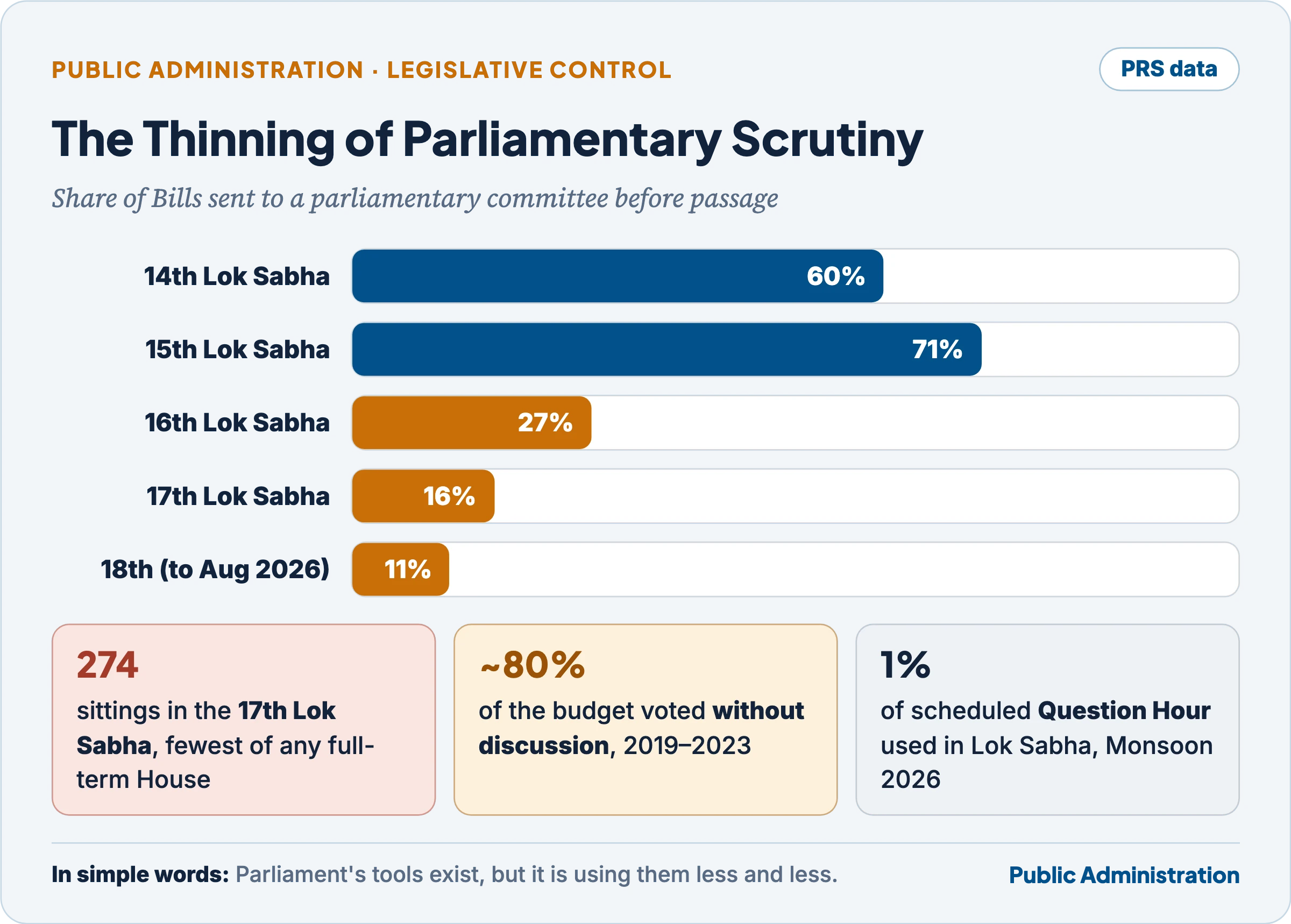
- The guillotine: when time runs out, all remaining demands are put to vote together without discussion. PRS data show that between 2019 and 2023 about 80% of the budget was voted without discussion, and in 2023 the entire budget was passed without discussion (as also in 2018 and 2013). The 17th Lok Sabha discussed the annual budget for only about 35 hours on average.
- Charged expenditure (salaries of judges, the CAG, interest on debt) is not even voted, though it may be discussed.
Why financial control is weak. Parliament can only reduce or refuse a demand, not increase it; the budget is technical; party discipline ensures passage; and the main financial scrutiny (PAC, CAG) is after the money is spent.
2.6 Parliamentary committees
Committees are the workshop of Parliament: small, cross-party, able to call officials and experts, and free from the theatre of the floor. They are where detailed, continuous control actually happens.
| Committee | Origin and size | What it does | Main limits |
|---|---|---|---|
| Public Accounts Committee (PAC) | 1921 under the Government of India Act 1919; 22 members (15 Lok Sabha, 7 Rajya Sabha); chair from the Opposition by convention since 1967 | Examines CAG audit reports and appropriation and finance accounts; checks that money was legally available, spent as authorised and re-appropriated under rules; also looks at waste, extravagance and propriety | Post-mortem; cannot question policy; advisory; depends on the CAG |
| Estimates Committee | 1950 (suggested by Finance Minister John Mathai); 30 members, all Lok Sabha | Suggests economies, efficiency and administrative reform consistent with policy; may suggest alternative policies; called a “continuous economy committee“ | Examines estimates after they are voted; covers a few ministries a year; no expert aid; advisory |
| Committee on Public Undertakings (COPU) | 1964, recommended by the Krishna Menon Committee; 22 members (15+7) since 1974 | Examines reports, accounts and CAG audit of public enterprises, their autonomy and commercial efficiency | Takes up few enterprises a year; avoids day-to-day matters and major policy; post-mortem |
| Departmentally Related Standing Committees (DRSCs) | 17 set up in 1993; 24 since 2004; 31 members each (21 Lok Sabha, 10 Rajya Sabha) | Examine Demands for Grants before voting, Bills referred, annual reports and long-term policy documents | Advisory; no cut motions; time-bound during budget recess; Bills referred only at the Speaker’s or Chairman’s discretion |
| Committee on Subordinate Legislation | Lok Sabha 1953, Rajya Sabha 1964; 15 members | Scrutinises delegated legislation | Huge volume; reports rarely debated |
| Committee on Government Assurances | Lok Sabha 1953, Rajya Sabha 1972; 15 members | Tracks whether promises made by ministers on the floor are kept, and within the minimum time | Assurances can be dropped on request; slow follow-up |
| Joint Parliamentary Committees | Ad hoc | Inquiries into scams (Bofors 1987, securities scam 1992, 2G 2011) and complex Bills | Often split on party lines |
The PAC in practice. The CAG acts as its “friend, philosopher and guide“, briefing it on audit findings. Ministries must submit Action Taken Notes, and the PAC reports on them. Asok Chanda, who served as CAG in the 1950s and later wrote on Indian administration, judged that the PAC had grown into a powerful force for control of public expenditure. Its weakness is timing: it examines accounts two or three years old, so it deters more than it corrects.
The DRSC system: merits and record.
- Merits: proceedings are relatively non-partisan; procedure is flexible; scrutiny becomes continuous and in-depth; ministries draft demands more carefully; experts and stakeholders can testify; the opposition and the Rajya Sabha gain a role in financial control.
- Record: PRS found that in the 17th Lok Sabha the 24 DRSCs presented about 1,100 reports, nearly half of them Action Taken Reports; but between 2020 and 2023 only 32% of reports on proposed expenditure were presented before the budget was passed, which defeats the purpose of pre-voting scrutiny.
- The 2007 and 2012 questions below ask whether DRSCs have analysed demands for grants effectively; the honest answer is “in depth but too late and too rarely heeded”.
2.7 The CAG: the legislature’s agent
- Status: the Comptroller and Auditor General (Articles 148–151) is appointed by the President, holds office for six years or until 65, can be removed only like a Supreme Court judge, and is ineligible for further office under government. Duties and powers are set by the CAG (Duties, Powers and Conditions of Service) Act, 1971. Since 1976 accounts have been separated from audit at the Union level.
- Role: the CAG audits all receipts and expenditure of the Union and States and of bodies substantially financed by them. Reports go to the President or Governor, who lays them before the legislature, where the PAC (and COPU for enterprises) examines them. The CAG is thus the eyes and ears of Parliament over the executive.
- Kinds of audit:
- compliance (regularity) audit: was money spent according to law, rules and sanctions?
- propriety audit: was it spent with prudence, as a careful person would spend his own money?
- performance audit: were economy, efficiency and effectiveness achieved?
- financial audit of accounts.
- Performance audit methods: since the late 2000s the CAG’s performance audits of flagship schemes (rural employment guarantee, rural health mission, school education, mid-day meals, rural roads) use beneficiary surveys, physical inspection, statistical sampling and audio-visual evidence, and engage the executive at planning, execution and reporting stages. In 2009 the CAG set up a Task Group on Social Audit to link its own findings with community audits (covered in the article on Citizen’s Charters, RTI and social audit).
- New accountability concerns: after the 73rd and 74th Amendments and the Eleventh Finance Commission, large sums began to flow directly from the Union to panchayats, municipalities and registered societies running schemes, with only a facilitating role for State governments. Such money falls outside the State legislature’s accountability loop, while local accountability structures are often weak, so audit has to follow the money to new levels.
- Impact: CAG reports on the 2G spectrum allocation (2010, estimating a presumptive loss of about ₹1.76 lakh crore) and coal block allocation (2012, about ₹1.86 lakh crore) triggered JPC inquiries, Supreme Court cancellations of licences and allocations, and a national debate on discretion in allocating natural resources.
- Lacunae:
- appointment by the executive alone, without a transparent selection process;
- growing spending through PPPs, special purpose vehicles and private entities that lie partly outside audit;
- delays in tabling and in PAC examination, and a large backlog of unanswered audit paras;
- no power of enforcement: audit points out, the executive and legislature must act;
- weak audit of local bodies, and criticism (going back to Paul Appleby) that excessive audit makes officials timid.
- Reforms suggested: a collegium for appointment, statutory backing for performance audit, audit of all public money wherever it flows, time limits for action on audit paras, and stronger internal audit within ministries so the CAG is not the first line of defence.
2.8 Legislative control in a presidential system
Because of the separation of powers, the US Congress cannot question or dismiss the executive, but it has other powerful tools.
- It creates departments, agencies and independent regulatory commissions and defines their powers by law.
- It controls the purse: appropriations are detailed, and its committees revise the President’s budget heavily; the Congressional Budget Office (1974) gives it independent analysis.
- Legislative oversight: standing committees and subcommittees hold hearings, subpoena officials and investigate.
- The Senate confirms senior appointments and treaties; Congress can impeach the President and officers.
- The Government Accountability Office (created as the General Accounting Office in 1921, renamed 2004) audits and evaluates programmes for Congress.
- Members do casework for constituents with agencies; F.A. Nigro described the close involvement of committees in agency decisions as “co-directorship“.
The irony is that the presidential legislature, which cannot remove the executive, often controls administration more closely than a parliamentary legislature dominated by its own government.
2.9 Limits: why legislative control is weaker than it ought to be
Structural reasons (found everywhere).
- Executive dominance: the government initiates nearly all Bills and the budget; legislative leadership rests with the Cabinet. The government is safe behind its majority, and party discipline (reinforced in India by the Tenth Schedule’s anti-defection law, 1985) turns MPs into reliable votes.
- Lack of time and expertise: administration has grown in volume and complexity; MPs are generalists with little research support.
- Size: a large House cannot exercise detailed control; committees can, but they are advisory.
- Post-mortem financial control: PAC and COPU examine spending after it has occurred.
- Delegated legislation: most binding rules are made by officials and barely scrutinised.
- Political motive: most criticism aims at dislodging the government, not improving administration; control is sporadic, general and partisan.
- John Pfiffner summed it up: legislatures have neither the staff nor the expertise for effective control in the most meaningful areas; they act decisively only in isolated cases of notorious conduct.
Paul Appleby’s critique (1956). The American administrator Paul Appleby, invited by the Government of India, wrote two reports, Public Administration in India: Report of a Survey (1953) and Re-examination of India’s Administrative System (1956). In the second he argued that the Indian Parliament’s control was misdirected rather than weak:
- MPs exaggerated the importance of the CAG and paid too much attention to audit reports, making officials timid and unwilling to take responsibility, so decisions were made by a slow process of reference and conference in which everybody shared dimly;
- Parliament harboured a vague fear that its responsibilities were not being preserved, and was reluctant to delegate, which in turn discouraged ministers and secretaries from delegating;
- it showed an anomalous reliance on businessmen’s judgement and too ready concessions to small business lobbies.
Indian reasons (current data).
- Fewer sittings: the 17th Lok Sabha (2019–24) held 274 sittings, the fewest of any full-term Lok Sabha; 11 of its 15 sessions were adjourned early. The National Commission to Review the Working of the Constitution (2002) had recommended at least 120 days a year for the Lok Sabha and 100 for the Rajya Sabha.
- Less committee scrutiny: the share of Bills referred to committees fell from 60% (14th Lok Sabha) and 71% (15th) to about a quarter (16th) and 16% (17th). An analysis of PRS data in August 2026 put the 18th Lok Sabha’s figure so far at about 11%, with 53% of Bills passed in the same session in which they were introduced.
- Hurried law-making: 35% of Bills in the 17th Lok Sabha were passed with less than an hour of discussion; in the Monsoon Session 2026, nine Bills were cleared without any MP other than the minister speaking.
- Disruption: in the Monsoon Session 2026 the Lok Sabha functioned for 15% of scheduled time and Question Hour for 1%; in the 17th Lok Sabha Question Hour worked for 60% of scheduled time and only about a quarter of listed oral questions were answered.
- Ordinances: Article 123 lets the executive legislate when Parliament is not in session. In D.C. Wadhwa v State of Bihar (1986) the Supreme Court condemned Bihar’s routine re-promulgation of hundreds of ordinances; in Krishna Kumar Singh v State of Bihar (2017) a seven-judge bench held that re-promulgation without placing ordinances before the legislature is a fraud on the Constitution and that ordinances are subject to judicial review.
- Money Bills: certifying ordinary Bills as Money Bills (Article 110) bypasses the Rajya Sabha. The Aadhaar Act, 2016 was upheld as a Money Bill in K.S. Puttaswamy (Aadhaar) (2018), but in Rojer Mathew (2019) a bench doubted that reasoning and referred the question to a larger bench, where it is pending.
- No Deputy Speaker for the whole 17th Lok Sabha, and none elected in the 18th so far: a constitutional office (Article 93) left vacant.
- Weak opposition in some Houses, frequent suspensions of MPs (146 in the Winter Session 2023) and declining suo motu statements by ministers.
2.10 Making legislative control effective
The 2024 question asks for a comprehensive approach. The measures fall into five groups.
- Time: a statutory or conventional minimum number of sittings, a parliamentary calendar, and protection of Question Hour from disruption (for example, a rule that a lost Question Hour is made up).
- Committees: mandatory referral of Bills (except Money Bills and emergencies) to DRSCs; DRSC reports on Demands for Grants before voting and time for their debate; publication of committee evidence; longer terms so members build expertise.
- Capacity: a Parliamentary Budget Office on the lines of the US CBO, research staff for committees and MPs, and use of PRS-style analysis.
- Finance: discussion of a minimum share of demands before the guillotine; scrutiny of outcome budgets and CAG performance audits; follow-up on Action Taken Reports with deadlines.
- Institutions and norms: limits on ordinances and Money Bill certification, an elected Deputy Speaker, a stronger role for the opposition (shadow committees, opposition days), codes of conduct to reduce disruption, and e-Parliament tools that publish data on questions, assurances and action taken.
Indian Connect — Parliament and administrative accountability in India
- PAC and the 2G and coal reports show legislative control at its sharpest: the CAG found, the PAC and a JPC examined, and courts finally acted.
- DISHA committees (2016), chaired by MPs, review central schemes in each district, bringing legislators into executive monitoring at the field level.
- Downward trend: fewer sittings, fewer referrals and more guillotined budgets mean that the formal machinery is intact but used less. Legislative control in India is, in the words of a 1997 question, of greater theoretical than practical efficiency, though committees, audit and questions still deter and expose.
3. Executive Control over Administration
In simple words
The Prime Minister, ministers and senior offices direct officials every day: they set policy, give money, frame rules, post and transfer staff, and check performance. Because this control is continuous and close, it is often the most real control, but it is also the one most open to misuse.
3.1 Nature of executive control
- Executive control means control by the political executive (Cabinet and ministers in India and Britain; the President and his secretaries in the USA) over the permanent executive (the civil service).
- Unlike legislative control, which is general, periodic, informational and reportive, executive control is fuller, constant, continuous, stimulative, corrective and directive. Felix Nigro saw its importance in the positive enforcement of standards and safeguards in the actual working of departments.
- This is why the 1998 question says executive control is “much more real“: the minister and the hierarchy act before and during administrative action, while Parliament and courts act mostly after.
3.2 Political direction and the business rules
- The Cabinet formulates policy and coordinates its implementation; each minister lays down departmental policy, issues directions, can call for any file, reserve decisions for himself and supervise working.
- Under Article 77(3) the President makes the Government of India (Allocation of Business) Rules, 1961 and the (Transaction of Business) Rules, 1961, which distribute work among ministries and lay down what must go to the minister, the Cabinet or the Prime Minister. States have equivalent rules under Article 166.
- The real extent of control depends on the minister’s political strength (standing with the Prime Minister and party) and his grasp of the subject. A strong minister can direct; a weak one is directed by his secretary. Max Weber had warned that the political master always stands as a “dilettante” before the trained expert official.
- Bureaucracy and policy: officials are not docile executors; they initiate and formulate policy and supply expertise. Executive control is therefore a two-way relationship of direction and advice, with the risk of a minister–secretary nexus in which both escape accountability.
3.3 Budgetary and financial control
- The executive prepares the budget, gets it enacted and allocates funds; no department may exceed its grant.
- The Ministry of Finance controls administration by:
- approving schemes in principle and accepting provision in the budget;
- sanctioning expenditure beyond delegated powers (Expenditure Finance Committee and similar appraisal bodies);
- placing Integrated Financial Advisers in ministries, who advise and also restrain;
- controlling re-appropriation of funds between heads;
- prescribing the General Financial Rules and delegation of financial powers;
- internal audit and real-time tracking through the Public Financial Management System.
- Controlling officers in each ministry ensure that grants are not exceeded and spending is not improper, wasteful or extravagant.
- The 2nd ARC’s report on Strengthening Financial Management Systems (2009) urged a shift from input-based, line-item control to outcome-oriented management, with stronger internal financial advisers and audit so that reliance on the CAG’s after-the-event audit falls.
3.4 Rule-making and ordinances
- Delegated legislation is an important instrument of executive control: the executive makes rules, regulations and bye-laws which officials must follow, and which define their powers and procedures.
- Ordinances (Articles 123 and 213) allow the executive to legislate when the legislature is not in session; they have the force of law. The 38th Amendment (1975) made the President’s satisfaction non-justiciable; the 44th Amendment (1978) removed that bar, and courts now review ordinances (A.K. Roy, 1982; Krishna Kumar Singh, 2017).
- Executive orders and guidelines fill gaps where no statute exists, and are binding within government.
3.5 Personnel control: appointment, transfer and removal
Control over careers is the most effective means of executive control.
- Recruitment to the higher services is insulated through the UPSC (Article 315 onwards), but the executive frames recruitment rules (Article 309), decides qualifications and has a free hand in senior postings: ministers have a say in choosing secretaries and heads of departments, and the Appointments Committee of the Cabinet clears top posts.
- Doctrine of pleasure (Article 310): civil servants hold office during the pleasure of the President or Governor.
- Safeguards (Article 311):
- no dismissal or removal by an authority subordinate to the appointing authority (Article 311(1));
- no dismissal, removal or reduction in rank without an inquiry in which the employee is informed of the charges and given a reasonable opportunity of being heard (Article 311(2)); the 42nd Amendment (1976) removed the second opportunity at the penalty stage;
- the second proviso dispenses with inquiry where the person is convicted on a criminal charge, where an inquiry is not reasonably practicable, or in the interest of the security of the State; Union of India v Tulsiram Patel (1985) upheld these exceptions.
- The 2nd ARC (2007, 2008) argued that Article 311 as interpreted makes it too hard to remove corrupt officials and recommended revisiting it so that honest officers stay protected while dishonest ones can be removed quickly.
- Conduct and discipline rules: the All India Services (Conduct) Rules, 1968, the Central Civil Services (Conduct) Rules, 1964 and the Railway Services (Conduct) Rules, 1966 govern loyalty, political neutrality, gifts, investments, private trade and post-retirement employment; disciplinary procedure is in the CCS (Classification, Control and Appeal) Rules, 1965 and the AIS (Discipline and Appeal) Rules, 1969.
- Performance appraisal (APAR), empanelment, training and capacity building under Mission Karmayogi (2020) are softer instruments of the same control.
- Transfers are the most used, and most abused, tool. In T.S.R. Subramanian v Union of India (2013) the Supreme Court directed Civil Services Boards to advise on transfers, minimum tenure for officers, and that officials act on written rather than oral instructions.
Common confusion
Does Article 311 make a civil servant irremovable? No. Article 311 gives procedural protection, not tenure for life. A civil servant can be dismissed after a fair inquiry, and even without one when convicted, when an inquiry is not reasonably practicable, or in the interest of State security. Many notes say Article 311 “protects corrupt officials”; the real problem is slow and poorly conducted inquiries, not the Article itself.
3.6 Staff agencies
James Mooney, the American organisation theorist, called a staff agency “an expansion of the personality of the executive“: more eyes, more ears and more hands to help the chief executive form and carry out plans. Staff agencies exercise indirect control by coordinating, advising, monitoring and setting standards.
| Agency | Control function |
|---|---|
| Cabinet Secretariat | Secretariat to the Cabinet and its committees; inter-ministerial coordination; monitoring implementation of Cabinet decisions; the Cabinet Secretary heads the civil service and chairs the Committee of Secretaries |
| Prime Minister’s Office (PMO) | Advises the PM, tracks priority programmes, handles appointments files and public grievances to the PM; very influential in centralised governments |
| Department of Personnel and Training (DoPT) | Central personnel agency: cadre management, conduct and discipline rules, training, vigilance policy |
| Department of Administrative Reforms and Public Grievances (DARPG) | Administrative reform, CPGRAMS grievance system, good governance index, awards for excellence |
| Ministry of Finance | Financial control (above) |
| NITI Aayog and its Development Monitoring and Evaluation Office | Replaced the Planning Commission on 1 January 2015; evaluation of schemes and output–outcome monitoring |
| UPSC | Independent constitutional body; advises on recruitment, promotion and disciplinary matters |
The PMO and accountability. The 2006 question asks whether the Prime Minister is accountable to Parliament in the context of extra-constitutional power. The PMO is not mentioned in the Constitution, but it wields great influence over ministries. The PM is accountable through collective responsibility, Question Hour (the PM answers questions on his own portfolios), debates and the Lok Sabha’s confidence; but the PMO’s officials are not directly answerable to Parliament. Critics see a concentration of power that bypasses ministerial responsibility; defenders see coordination in a fragmented government.
3.7 Internal control instruments and performance monitoring
- Hierarchy, inspection and reporting: inspections by superior officers (the Collector’s inspection of tehsils, a director’s inspection of schools), periodic reports and returns, and annual administration reports.
- Performance monitoring:
- Results-Framework Documents (RFDs) were introduced in 2009 under a Performance Monitoring and Evaluation System run by the Performance Management Division of the Cabinet Secretariat, following the 2nd ARC. An RFD was a record of understanding between a minister (the people’s mandate) and his secretary (responsible for delivery), meant to shift departments from process to results. It listed objectives with weights, actions, success indicators and targets on a five-point scale, and requirements from other departments; at year-end achievements were converted into a composite score. By 2010–11 it covered about 62 ministries and departments and made a Sevottam-compliant Citizen’s Charter and grievance mechanism mandatory indicators. The system fell into disuse after 2014, largely because targets were self-set and scores carried no consequences.
- PRAGATI (Pro-Active Governance And Timely Implementation), launched on 25 March 2015, is a video-conferencing platform through which the Prime Minister personally reviews stalled infrastructure projects, schemes and grievances with Union secretaries and state chief secretaries. By its 50th meeting at the end of 2025, 377 projects had been reviewed and the government credited the ecosystem with accelerating projects worth over ₹85 lakh crore.
- Project monitoring systems of the Ministry of Statistics and Programme Implementation and line ministries, PM Gati Shakti (2021) for infrastructure, and dashboards for flagship schemes.
- Assessment: such tools bring real-time, top-down accountability and break inter-departmental logjams. Critics say they centralise decision-making in the PMO, measure outputs more than outcomes, and substitute personal review for institutional accountability.
3.8 Vigilance and anti-corruption machinery
The Santhanam Committee and the CVC
- The Committee on Prevention of Corruption (1962–64), chaired by the parliamentarian K. Santhanam, held that the discretionary powers of civil servants produced harassment and corruption. Its main recommendations were:
- an independent Central Vigilance Commission;
- a code of conduct for ministers;
- simplification of laws and procedures to cut opportunities for corruption;
- restrictions on post-retirement private employment;
- stronger vigilance units in ministries.
- The Central Bureau of Investigation was set up by a Home Ministry resolution on 1 April 1963, drawing its legal powers from the Delhi Special Police Establishment Act, 1946.
- The CVC was created by executive resolution in 1964. After Vineet Narain v Union of India (1997), in which the Supreme Court directed statutory status and CVC supervision of the CBI’s anti-corruption work, Parliament passed the CVC Act, 2003.
- Structure and functions: a Central Vigilance Commissioner and up to two Vigilance Commissioners, appointed on the recommendation of a committee of the Prime Minister, the Home Minister and the Leader of the Opposition in the Lok Sabha, for four years or until 65; removal only after a Supreme Court inquiry. It superintends the CBI’s investigations under the Prevention of Corruption Act, reviews prosecution sanctions, advises ministries on vigilance cases and supervises Chief Vigilance Officers in every ministry and public enterprise.
- Limits: the CVC is advisory: ministries may reject its advice by recording reasons; it depends on the CBI, which remains under the government’s administrative control; and prior-approval requirements (struck down for the DSPE Act’s Section 6A in Subramanian Swamy v Director, CBI, 2014, but reintroduced in a different form as Section 17A of the Prevention of Corruption Act in 2018) slow investigations.
Lokpal and Lokayuktas
- Origins: the first Administrative Reforms Commission (chaired by Morarji Desai), in its interim report on the Problems of Redressal of Citizens’ Grievances (1966), recommended a Lokpal for ministers and secretaries and Lokayuktas for other senior officials, modelled on the Scandinavian ombudsman (Sweden, 1809). Lokpal Bills were introduced eight times between 1968 and 2001 and lapsed.
- States moved first: Odisha passed a Lokayukta law in 1970 and Maharashtra set up the first working Lokayukta in 1972; Karnataka’s Lokayukta, with its own police wing and jurisdiction over the Chief Minister, became the most active. Many state bodies were weak: the 2nd ARC noted that some were abolished by ordinance and others saw their reports ignored.
- The 2nd ARC (2007) recommended a constitutional Rashtriya Lokayukta with a serving or retired Supreme Court judge as chair, an eminent jurist and the CVC as ex officio member, covering Union ministers, Chief Ministers and MPs but excluding the Prime Minister.
- The Lokpal and Lokayuktas Act, 2013 (assent 1 January 2014, in force 16 January 2014), passed after the anti-corruption movement of 2011, provides:
- a chairperson and up to eight members, half judicial, and at least half from SC, ST, OBC, minorities and women;
- selection by a committee of the Prime Minister, Speaker, Leader of the Opposition, Chief Justice of India (or a nominated judge) and an eminent jurist;
- jurisdiction over the Prime Minister (with exclusions for international relations, security, public order, atomic energy and space, and only with approval of a full bench by a two-thirds majority, in camera), ministers, MPs, and Group A to D officials of the Union;
- its own inquiry and prosecution wings, power of superintendence over the CBI in cases it refers, and time limits for inquiry and investigation;
- a duty on States to set up Lokayuktas within a year (Section 63).
- Implementation: the first Lokpal, Justice Pinaki Chandra Ghose, was appointed only in March 2019, after the Supreme Court held in Common Cause v Union of India (2017) that the absence of a recognised Leader of the Opposition could not stall appointments. Justice A.M. Khanwilkar has chaired it since March 2024.
- Recent record: in January 2025 the Lokpal held that it could entertain complaints against High Court judges; the Supreme Court took suo motu cognisance and stayed that order on 20 February 2025. In 2026 a full bench refused to accept a CBI closure report against a former senior bureaucrat and ordered a fresh probe, showing a more assertive posture. The Lokpal has also reported a steady rise in complaints.
- Critique: a large share of complaints are dismissed for being in the wrong format or outside jurisdiction; investigation still depends largely on the CBI and CVC; the selection committee is weighted towards the government; and the “minimal accountability” culture of politics (the 2019 question) limits what any ombudsman can do. Defenders reply that its existence deters, that it has begun to assert independence, and that institution-building takes time.
Indian Connect — The vigilance web in India
- Agencies: CVC (1964; statutory 2003), CBI (1963), Lokpal (2013 Act; working since 2019), state Lokayuktas and anti-corruption bureaus, Chief Vigilance Officers in ministries and PSUs.
- Laws: Prevention of Corruption Act, 1988 (amended 2018 to make bribe-giving an offence and add Section 17A), Benami Transactions Act (amended 2016), Lokpal Act, Whistle Blowers Protection Act, 2014 (its 2015 amendment Bill lapsed).
- The balance problem: strong vigilance deters corruption but can also deter decisions; sanction requirements for prosecuting public servants now sit in Section 218 of the Bharatiya Nagarik Suraksha Sanhita, which replaced the CrPC from 1 July 2024.
3.9 Appeal to public opinion and the limits of executive control
- Appeal to public opinion: bureaucracies are status-quo oriented; Pfiffner and Presthus noted that agencies build alliances with legislators and pressure groups to protect their programmes and routines. A determined executive can go over their heads to the public through campaigns, to push through reforms the bureaucracy resists.
- Limits:
- expertise gap: generalist ministers depend on expert officials;
- politicisation: transfers and postings used as reward and punishment, “committed bureaucracy” in the 1970s sense, and pressure on neutrality;
- self-policing: executive control is the government checking itself; it is weakest where the government itself is the problem;
- scale: no minister can supervise lakhs of employees; control dissolves into paperwork;
- risk aversion: heavy internal control breeds file-pushing and fear of the “four Cs” (CBI, CVC, CAG, courts).
4. Judicial Control over Administration
In simple words
When an official harms you by acting beyond the law or unfairly, you can go to a court. The court does not run the department; it checks whether the action was legal, fair and reasonable, and if not, it cancels it, orders the right action or awards compensation.
4.1 Meaning and basis
- Judicial control is the power of courts to examine the legality of administrative acts and to protect citizens’ rights; it also includes the citizen’s right to sue the government or its officials. L.D. White contrasted the two great external controls: legislative supervision controls policy and expenditure, while judicial control ensures legality and protects citizens against unlawful trespass on their rights.
- M.P. Sharma, the first professor of public administration in India, observed that what officials see as judicial control, citizens see as judicial remedies: official liability and citizens’ remedies are two faces of the same coin.
- Basis: the rule of law. A.V. Dicey, in Introduction to the Study of the Law of the Constitution (1885), gave three elements: absence of arbitrary power (no punishment except for a breach of law established before ordinary courts), equality before the law (every official, from the Prime Minister to a constable, is under the same responsibility for acts without legal justification), and the primacy of individual rights as declared by courts.
- Constitutional basis in India: Article 13 (laws inconsistent with fundamental rights are void), Article 32 (Supreme Court; itself a fundamental right), Article 226 (High Courts; wider, covering “any other purpose”), Article 136 (special leave), Article 227 (superintendence over tribunals) and Article 142 (complete justice).
- Judicial review is part of the basic structure: Kesavananda Bharati v State of Kerala (24 April 1973) held that Parliament cannot amend the basic structure; Minerva Mills (1980) struck down attempts to exclude review; L. Chandra Kumar (1997) held the High Courts’ review of tribunal decisions inviolable; I.R. Coelho (2007) brought even Ninth Schedule laws within review.
- Scope across countries: judicial review is widest in the USA, narrower in Britain (parliamentary sovereignty), and India falls in between because of constitutional and statutory limits.
4.2 Grounds of judicial review
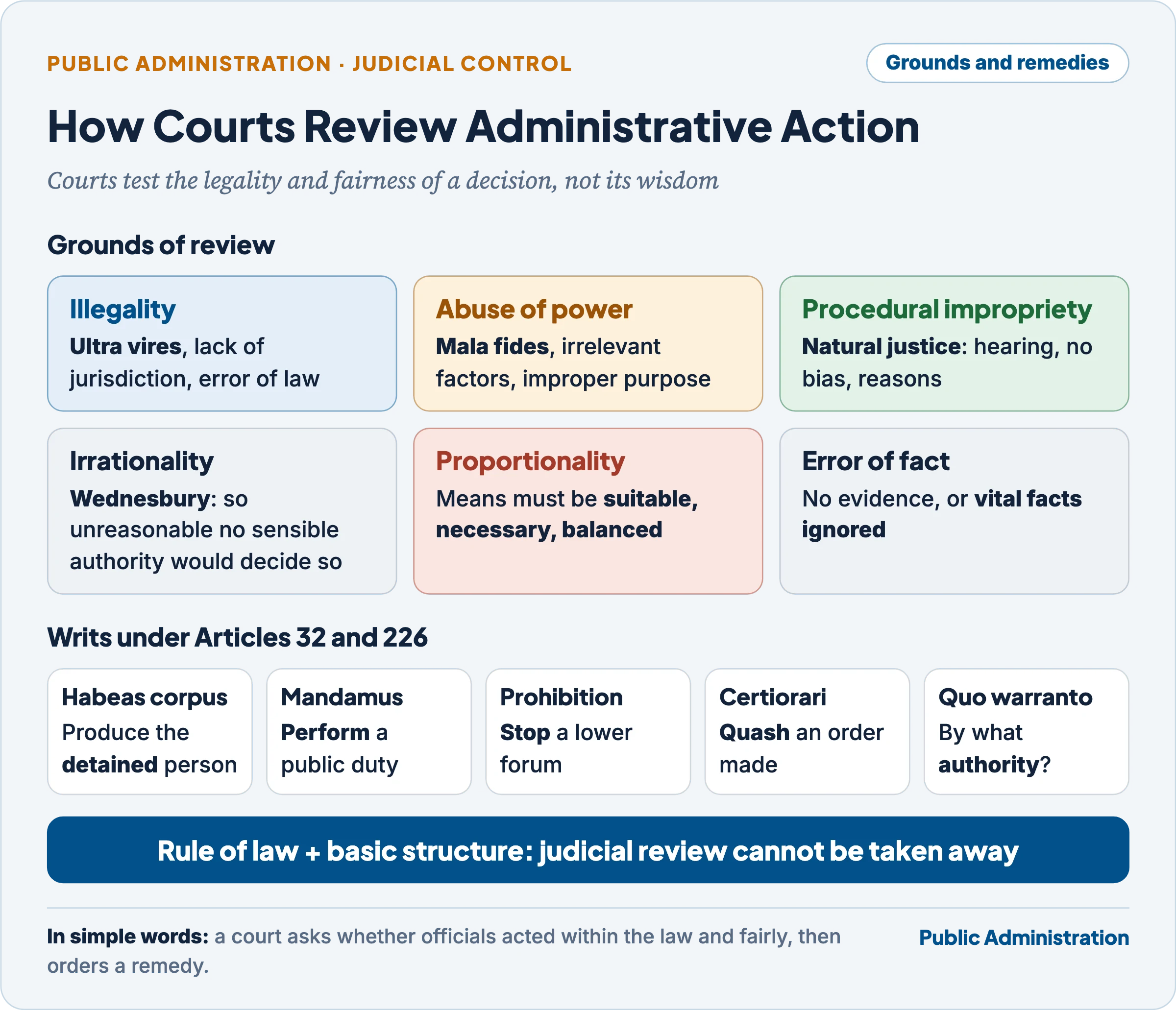
Courts review the decision-making process, not the merits; they ask whether the authority acted within its powers, fairly and rationally. In the GCHQ case (Council of Civil Service Unions v Minister for the Civil Service, 1985), Lord Diplock grouped the grounds under illegality, irrationality and procedural impropriety, and foresaw proportionality as a fourth.
- Lack of jurisdiction / ultra vires (illegality): acting without authority, beyond it, or outside the territorial limits of power (sometimes called overfeasance). An order of dismissal by an authority lower than the appointing authority violates Article 311(1) and is void.
- Error of law: misinterpreting the law and imposing obligations it does not require (sometimes called misfeasance); an error apparent on the face of the record can be corrected by certiorari.
- Error of fact: acting on no evidence, ignoring vital facts or relying on wrong presumptions.
- Abuse of power (malfeasance): mala fides (personal malice or corrupt motive), using power for an improper purpose, taking irrelevant considerations into account or ignoring relevant ones, acting under dictation, or fettering discretion by rigid policy.
- Procedural impropriety: breach of statutory procedure or of natural justice (section 4.3).
- Irrationality (Wednesbury unreasonableness): from Associated Provincial Picture Houses v Wednesbury Corporation (England, 1948): a decision so unreasonable that no reasonable authority could have reached it.
- Proportionality: the action must pursue a legitimate aim by suitable and necessary means, with a balance between harm and benefit. In Om Kumar v Union of India (2001) the Supreme Court applied proportionality to fundamental-rights cases and Wednesbury to others; Modern Dental College (2016), K.S. Puttaswamy (privacy, 2017) and Anuradha Bhasin (internet shutdown, 2020) built a four-part test. Disproportionate penalties in service cases are routinely corrected.
- Legitimate expectation: where the government’s promise or past practice creates a reasonable expectation, it must not be defeated arbitrarily without a hearing (an aspect of Article 14’s bar on arbitrariness).
4.3 Natural justice and its exceptions
- Two classic rules: audi alteram partem (hear the other side: notice, disclosure, opportunity to respond) and nemo judex in causa sua (no one should judge his own cause: rule against bias). A third, the duty to give reasoned decisions, is now generally added.
- Indian development: A.K. Kraipak v Union of India (1969) held that the line between administrative and quasi-judicial functions is thin and natural justice applies to administrative decisions with civil consequences; Maneka Gandhi v Union of India (25 January 1978) held that procedure under Article 21 must be fair, just and reasonable and read natural justice into it, accepting a post-decisional hearing where prior hearing was impractical.
- Exceptions (the 2015 question):
- Legislative action: making law or rules of general application (price fixation, for instance) does not require individual hearings (Union of India v Cynamide India, 1987).
- Statutory or constitutional exclusion: the second proviso to Article 311(2) is an express example.
- Urgency and emergency: where prompt action is needed to protect public health or safety, a hearing may be postponed (post-decisional hearing).
- National security and confidentiality: disclosure itself may harm the State.
- Necessity: if the only competent authority is biased, it must still decide rather than leave the matter undecided.
- Academic and purely administrative matters (evaluation of answer scripts, interim suspensions, preliminary inquiries) involving no final civil consequence.
- Impracticability: where the number of affected persons makes individual hearing impossible.
- No prejudice: courts increasingly ask whether the breach actually prejudiced the person before quashing (State Bank of Patiala v S.K. Sharma, 1996), though a hearing is never a “useless formality” where facts are disputed (S.L. Kapoor v Jagmohan, 1980).
4.4 Methods of judicial control
- Judicial review of administrative acts and of delegated legislation.
- Statutory appeals to courts or tribunals where a statute provides them.
- Suits against the government (Article 300):
- in contract, the State is liable like a private person, provided Article 299’s formalities are met;
- in tort, older law exempted sovereign functions (Kasturi Lal v State of UP, 1965), but later cases narrowed the immunity (N. Nagendra Rao, 1994) and courts now award public-law compensation for violation of fundamental rights through writs (Rudul Sah, 1983; Nilabati Behera, 1993).
- Suits against officials: civil and criminal proceedings are possible, with sanction requirements for prosecution of public servants and a two-month notice for civil suits for official acts. The President and Governors are personally immune during office (Article 361); ministers have no such immunity; judicial officers are protected for judicial acts.
- Extraordinary remedies: the writs. The Supreme Court (Article 32) and High Courts (Article 226) can issue directions, orders and writs, including the five named below; injunctions, though not named, are also issued.
| Writ | Literal meaning | Against whom | Purpose |
|---|---|---|---|
| Habeas corpus | “Have the body” | Any person or authority detaining another | Release from illegal detention |
| Mandamus | “We command” | Public officials, bodies, government (not President or Governor, not private persons) | Compel performance of a public legal duty |
| Prohibition | “To forbid” | Judicial and quasi-judicial bodies | Prevent a lower forum from exceeding jurisdiction (before the decision) |
| Certiorari | “To be certified” | Judicial, quasi-judicial and (in India) administrative bodies affecting rights | Quash an order already made without jurisdiction, in breach of natural justice or with error apparent on the record |
| Quo warranto | “By what authority” | Holder of a substantive public office created by statute or Constitution | Oust an unlawful occupant |
- Prohibition and certiorari are on similar grounds; prohibition is preventive and comes during the proceedings, certiorari is curative and comes after the order.
- Mandatory injunction resembles mandamus but can run against private parties; preventive injunction resembles prohibition but is directed to the parties, not the court.
- The 1987 statement that judicial control “operates through a system of writs” is true but incomplete: writs are the sharpest instruments, but judicial control also works through suits, appeals, compensation, PIL guidelines and continuing supervision.
4.5 Public Interest Litigation
- Origins: in the late 1970s and early 1980s, judges such as P.N. Bhagwati and V.R. Krishna Iyer relaxed locus standi (who may sue). Hussainara Khatoon v State of Bihar (1979) exposed thousands of undertrials in jail for years; S.P. Gupta v Union of India (1981) held that any public-spirited person may approach the court for those unable to do so; Bandhua Mukti Morcha (1984) dealt with bonded labour. Letters and even postcards were treated as petitions (epistolary jurisdiction).
- New tools: court-appointed commissions and amici curiae, continuing mandamus (keeping a case open and issuing directions over years, as in Vineet Narain, 1997, and T.N. Godavarman Thirumulpad, the forest case from 1996), and guidelines that operate as law until the legislature acts (Vishaka, 1997, on sexual harassment at work; D.K. Basu, 1996, on arrest and custody; Prakash Singh, 2006, on police reform).
- Achievements: PIL turned the Supreme Court into a forum for the voiceless: undertrials, bonded labourers, pavement dwellers, forest communities; it improved accountability of police, prisons, environment regulators and anti-corruption agencies.
- Changes since the 1980s (the 2010 question): PIL shifted from rights of the poor to governance and environment (CNG buses in Delhi, coal and spectrum allocations, river cleaning), and also attracted publicity, political and private-interest petitions. In State of Uttaranchal v Balwant Singh Chaufal (2010) the Court laid down guidelines to filter frivolous PILs, and costs are now imposed for abuse.
4.6 Landmark judgments shaping administrative accountability
| Case | Year | Holding relevant to accountability |
|---|---|---|
| Kesavananda Bharati v State of Kerala | 1973 | Basic structure; judicial review and rule of law cannot be amended away |
| Maneka Gandhi v Union of India | 1978 | Procedure must be fair, just and reasonable; natural justice part of Article 21 |
| Common Cause v Union of India (petrol-pump allotments) | 1996 | Exemplary damages against a minister for arbitrary discretionary allotments; the damages were set aside on review in 1999, but the case marked a turn against discretionary patronage |
| Vineet Narain v Union of India | 1997 | Struck down the “single directive” shielding senior officers from CBI inquiry; directed statutory CVC to supervise CBI; fixed tenure for CBI Director; continuing mandamus |
| T.N. Godavarman Thirumulpad v Union of India | from 1996 | Court-supervised forest governance through continuing orders; criticised as the Court becoming a forest administrator |
| Prakash Singh v Union of India | 2006 | Seven directives for police reform: State Security Commission, fixed tenure for DGP and SPs, separation of investigation from law and order, Police Establishment Board, Police Complaints Authority; implementation remains patchy |
| T.S.R. Subramanian v Union of India | 2013 | Civil Services Boards, fixed tenure, written instructions to officials |
| Common Cause v Union of India (Lokpal) | 2017 | Lokpal appointments cannot wait for an amendment on the Leader of the Opposition |
| Krishna Kumar Singh v State of Bihar | 2017 | Ordinance re-promulgation a fraud on the Constitution; ordinances reviewable |
| Anoop Baranwal v Union of India | 2 March 2023 | Election Commissioners to be appointed on advice of PM, Leader of the Opposition and CJI until Parliament legislates; Parliament’s 2023 Act replaced the CJI with a Union minister; in September 2026 a two-judge bench gave a split view and sent the challenge to the CJI for a larger bench |
| Government of NCT of Delhi v Union of India | May 2023 | Elected Delhi government controls services (the “triple chain” of accountability: officials to ministers, ministers to legislature, legislature to voters); Parliament then legislated to restore Union control |
| Association for Democratic Reforms v Union of India (electoral bonds) | 15 February 2024 | Struck down the electoral bond scheme for violating voters’ right to information under Article 19(1)(a); ordered disclosure of donor data |
| State of Tamil Nadu v Governor of Tamil Nadu and the Presidential Reference | 8 April 2025; 20 November 2025 | The two-judge bench set timelines for assent to Bills and declared “deemed assent”; on a reference under Article 143, a five-judge bench held that courts cannot fix timelines or declare deemed assent, as that substitutes the judiciary for the executive, though indefinite inaction remains open to limited review |
4.7 Judicial activism, judicial control and judicial overreach
- Judicial restraint: courts defer to the legislature and executive on policy, intervening only for clear illegality.
- Judicial control: courts police the legality of administrative action on recognised grounds (section 4.2).
- Judicial activism: courts use their powers creatively to protect rights and fill governance vacuums: relaxing standing, issuing guidelines, monitoring implementation. The 2023 statement that the judiciary now mandates government action, not merely limits it, describes this stage.
- Judicial overreach: courts substitute their own judgement for that of the executive or legislature in matters of policy, budgets or administration: framing detailed policy, running institutions, or using Article 142 to create outcomes the Constitution does not provide.
Examples on each side.
- Activism widely accepted: Vishaka, D.K. Basu, Vineet Narain, the cancellation of 2G licences (2012), electoral bonds (2024): each filled a real accountability gap.
- Contested as overreach: the nationwide ban on liquor sale within 500 metres of highways (State of Tamil Nadu v K. Balu, December 2016, later diluted); the Godavarman court acting as a forest regulator; the “deemed assent” device of April 2025, which the Court itself later rejected in the Presidential Reference; and orders fixing fees, school curricula or building norms.
- Warnings from the bench: in Aravali Golf Club v Chander Hass (2007), the Supreme Court cautioned that judges must not run the government and that judicial overreach violates the separation of powers. In April 2025 the then Vice-President publicly attacked the use of Article 142, showing the political cost of perceived overreach.
Why activism arises. The 2018 question links overreach to an ineffective executive: when police reform, pollution control or anti-corruption action stall for decades, citizens turn to courts, and courts respond. Activism is thus partly a symptom of failures of legislative and executive control, and partly a product of judicial ambition.
The fine line. The line between control and overreach depends on judicial prudence:
- the remedy should enforce existing constitutional or statutory duties, not invent new policy;
- courts should prefer declaring the law and remitting the decision to the authority over substituting their own decision;
- interventions should be time-bound and evidence-based, with deference to expertise;
- where courts issue guidelines, they should be interim, inviting legislation.
4.8 Limits of judicial control
- No suo motu power in principle: courts act only when approached (PIL and suo motu cognisance have softened this, as in the 2025 Lokpal case).
- Post-mortem: courts intervene after the damage is done; interim relief is uncertain.
- Delay and cost: over five crore cases are pending across Indian courts (National Judicial Data Grid); litigation is expensive and favours the resourceful; justice delayed is often justice denied.
- Not all acts are reviewable: statutes may exclude review (subject to the basic structure), and courts practise a self-denying ordinance in political questions, economic policy and expert matters.
- Technical complexity: judges are legal experts and may not grasp technical administration; hence the growth of administrative tribunals (covered in the article on administrative law).
- Executive override: the government can change the law or rules to undo a judgment (as after the 2023 Delhi services judgment).
- Implementation gap: compliance with directions (Prakash Singh is the classic case) depends on the executive.
- L.D. White’s dilemma remains the guide: too much judicial control paralyses administration; too little invites bureaucratic tyranny.
Criticism — The case against judicial activism as a mode of control
- Separation of powers: courts are unelected and not accountable to voters; when they make policy, democratic accountability is diluted.
- Institutional capacity: judges lack expertise, data and implementation machinery; orders like the highway liquor ban had heavy unintended costs.
- Selective and personalised: outcomes depend on which bench hears a case and on public mood.
- Executive abdication: governments learn to pass hard decisions to courts, weakening their own responsibility.
- Who guards the guardians: the judiciary’s own accountability (appointments, pendency, transparency) is limited, so its activism faces few checks.
Defence — The case for activism as necessary control
- Rights of the voiceless: without relaxed standing and PIL, undertrials, bonded labourers and forest dwellers would have no forum.
- Filling vacuums: Vishaka, D.K. Basu and Vineet Narain addressed gaps that legislatures left open for years; many were later converted into law.
- Horizontal accountability: in O’Donnell’s terms, courts are the strongest horizontal check in India when Parliament is dominated by the executive.
- Self-correction exists: the Presidential Reference of November 2025 shows the Court itself pulling back from overreach, and PIL filters since 2010 curb abuse.
- Synthesis: activism is legitimate when it enforces the Constitution and existing law, and turns into overreach when it substitutes judicial preference for policy.
Indian Connect — Judicial control in India today
- Constitutional strength: Articles 32 and 226 make India’s higher judiciary one of the most powerful in the world, with review protected as basic structure.
- Recent landmarks: Anoop Baranwal (2023) on Election Commission appointments, electoral bonds (2024) on political finance transparency, the Tamil Nadu Governor case and the Presidential Reference (2025) on the limits of judicial timelines.
- Weaknesses: crushing pendency, uneven implementation and episodes of overreach mean judicial control is powerful but slow and selective.
5. Comparing the Controls, Other Countries and Reform
In simple words
Each control is like a different doctor. Parliament is the general physician who asks questions once in a while; the executive is the family member who watches you every day; the court is the surgeon you go to when something has gone badly wrong. Good health needs all three.
5.1 The three controls compared
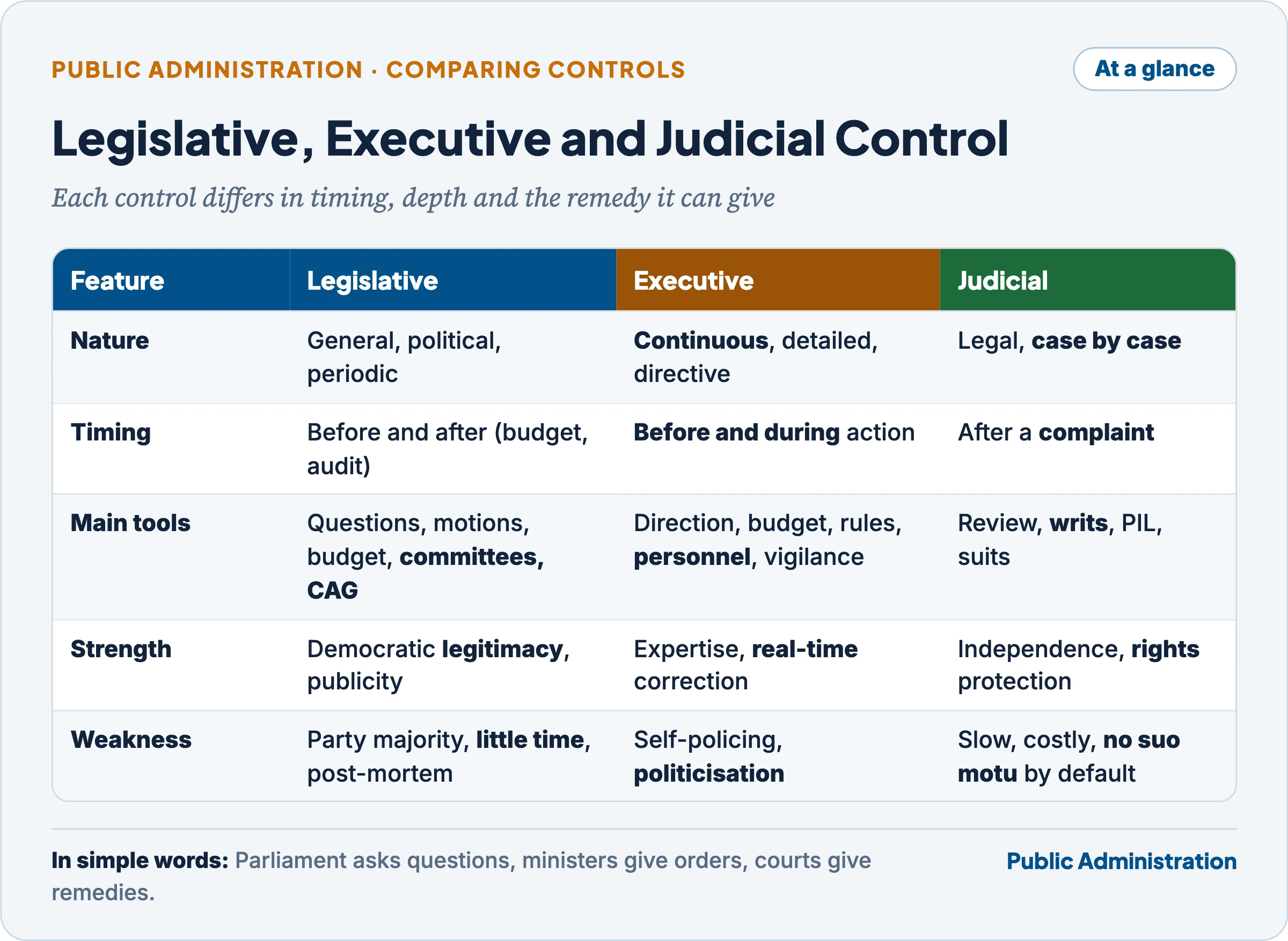
| Feature | Legislative | Executive | Judicial |
|---|---|---|---|
| Nature | General, political, periodic | Continuous, detailed, directive | Legal, case by case |
| Timing | Before (budget, law) and after (audit) | Before and during action | After a grievance |
| Main instruments | Questions, motions, budget, committees, CAG | Direction, budget, rules, personnel, vigilance, monitoring | Review, writs, PIL, suits, compensation |
| Who initiates | MPs, opposition | Ministers, superiors | Aggrieved citizen or public-spirited person |
| Strength | Democratic legitimacy, publicity | Expertise, speed, correction in real time | Independence, protection of rights, binding orders |
| Weakness | Party majority, little time, post-mortem | Self-policing, politicisation | Slow, costly, limited to legality |
| Indian status | Machinery intact, use declining | Strong and centralising | Powerful, activist, overloaded |
- Is executive control “much more real”? Yes in its continuity and depth: it reaches every file and every posting. But it is control by the government over itself; it cannot catch misconduct by the political executive itself, which is why external controls exist.
- Is legislative control “of greater theoretical than practical efficiency”? Largely, as the data in section 2.9 show; yet its deterrent and publicity effect (questions, CAG reports, committee hearings) remains real.
- Parliamentary versus judicial control: they are supplementary, not substitutes. Parliament controls policy and expenditure and enforces political accountability; courts enforce legality and individual rights. Parliament cannot quash an illegal detention; a court cannot hold a minister politically responsible for a bad but legal policy.
5.2 Comparative notes: UK, US and France
| Aspect | United Kingdom | United States | France |
|---|---|---|---|
| Legislative control | Ministerial responsibility; Public Accounts Committee (1861) and National Audit Office (1983); departmental select committees (1979); Liaison Committee questions the Prime Minister | Separation of powers; detailed appropriations; committee oversight; Senate confirmation; GAO (1921) and CBO (1974); impeachment | Parliament weaker than the executive in the Fifth Republic; Cour des comptes (1807) audits and reports to Parliament |
| Executive control | Cabinet, Treasury, agency framework documents since the Next Steps reforms (1988) | President, Office of Management and Budget, Inspectors General (1978) | Strong prefectoral system and grands corps |
| Judicial control | Ordinary courts; grounds from Wednesbury and GCHQ; Human Rights Act 1998 brought proportionality; Crown Proceedings Act 1947 made the State liable in tort | Wide review under the Constitution and the Administrative Procedure Act (1946); in Loper Bright v Raimondo (2024) the Supreme Court ended Chevron deference, so courts now decide statutory meaning themselves rather than deferring to agencies | Separate administrative courts headed by the Conseil d’État (1799); droit administratif; the Blanco decision (1873) founded State liability under public law |
| Ombudsman | Parliamentary Commissioner for Administration (1967) | Many state-level ombudsmen; Inspectors General | Médiateur (1973), now Défenseur des droits (2011) |
- Lesson for India: India combines the British pattern (ministerial responsibility, PAC, common-law review) with an American-style written constitution and strong judicial review, but not the French separate administrative courts; its tribunals are a partial substitute.
- The Conseil d’État shows that specialised administrative judges can control administration expertly and cheaply; Dicey saw droit administratif as a threat to equality before law, but later scholars found it often protected citizens better than common-law courts.
5.3 Reform recommendations
| Body | Year | Key recommendations on control and accountability |
|---|---|---|
| Paul Appleby reports | 1953, 1956 | Less audit-driven timidity; more delegation; Parliament to focus on broad policy |
| Santhanam Committee | 1964 | CVC; code of conduct for ministers; simpler procedures; vigilance units |
| First ARC (Morarji Desai) | 1966 interim report | Lokpal and Lokayuktas |
| National Commission to Review the Working of the Constitution (M.N. Venkatachaliah) | 2002 | Minimum 120 sittings (Lok Sabha) and 100 (Rajya Sabha); stronger committees; checks on ordinances |
| 2nd ARC, 4th report: Ethics in Governance | 2007 | Constitutional Rashtriya Lokayukta (PM excluded); revisit Article 311; ethics codes for ministers, legislators and civil servants; confiscation of corruptly acquired property; protection of honest decisions |
| 2nd ARC, 10th report: Refurbishing of Personnel Administration | 2008 | Performance management, intermediate reviews of careers, a Civil Services Law, fixed tenure |
| 2nd ARC, 13th report: Organisational Structure of Government of India | 2009 | Separate policy from execution through executive agencies held accountable by performance agreements |
| 2nd ARC, 14th report: Strengthening Financial Management Systems | 2009 | Outcome-based budgeting, stronger internal audit and financial advisers, accrual accounting |
| 2nd ARC, 12th report: Citizen Centric Administration | 2009 | Citizen’s Charters, grievance redress, social audit (see the article on Citizen’s Charters, RTI and social audit) |
5.4 Beyond the three formal controls (bridges)
- Citizens, media, interest groups, voluntary organisations and civil society supply vertical and diagonal accountability: they expose wrongdoing, mobilise opinion and use institutional channels. These are treated in the companion article on Citizen and Administration.
- Citizen’s Charters, the Right to Information Act, 2005 and social audit turn accountability into citizen rights and community scrutiny. These are treated in the companion article on Citizen’s Charters, RTI and Social Audit.
- Together with the formal controls they form a web: an RTI reply becomes a PIL, a PIL leads to a court order, a court order is monitored by a parliamentary committee and reported by the media.
Key Terms
| Term | Meaning in simple words |
|---|---|
| Accountability | Duty to explain one’s actions and face consequences, enforced from outside |
| Responsibility | Inner sense of duty; also the duties attached to a post |
| Responsiveness | Readiness to meet citizens’ needs and wishes |
| Answerability | Duty to inform and justify, without necessarily facing a penalty |
| Internal control | Checks built into administration: hierarchy, budget, personnel rules, inspection |
| External control | Checks from outside: legislature, courts, citizens, media |
| Horizontal accountability | State agencies checking each other (Parliament, courts, CAG, Lokpal) |
| Vertical accountability | Citizens holding rulers to account, mainly through elections |
| Diagonal accountability | Media and civil society acting through or alongside state bodies |
| Problem of many hands | Difficulty of fixing blame when many officials share a decision |
| Ministerial responsibility | Minister answers to Parliament for all acts of his department |
| Cut motion | Motion to reduce a demand for grant: policy, economy or token cut |
| Guillotine | Putting all remaining demands to vote together without discussion |
| DRSC | Departmentally Related Standing Committee examining ministries’ budgets and Bills |
| Delegated legislation | Rules made by the executive under powers given by an Act |
| Ordinance | Temporary law made by the executive when the legislature is not in session |
| Doctrine of pleasure | Civil servants hold office during the pleasure of the President or Governor (Article 310) |
| Staff agency | Body that advises and coordinates for the chief executive without line command |
| Ombudsman | Independent officer who investigates complaints against officials (Lokpal, Lokayukta) |
| Ultra vires | Beyond legal power |
| Natural justice | Fair hearing and absence of bias in decisions |
| Wednesbury unreasonableness | Decision so unreasonable no sensible authority could make it |
| Proportionality | Means must be suitable, necessary and balanced against harm |
| Writ | Formal court order such as habeas corpus or mandamus |
| Public Interest Litigation | Case filed by any public-spirited person for a public cause |
| Continuing mandamus | Court keeps a case open and issues directions over time |
| Judicial overreach | Courts substituting their judgement for the legislature’s or executive’s in policy |
Commissions, Committees and Judgments
| Body or case | Year | Key point |
|---|---|---|
| Public Accounts Committee | 1921 | Examines CAG reports; opposition chair since 1967 |
| Estimates Committee | 1950 | “Continuous economy committee”; 30 Lok Sabha members |
| Paul Appleby reports | 1953, 1956 | Parliament over-relies on audit; breeds timidity |
| Krishna Menon Committee | 1959 | Led to Committee on Public Undertakings (1964) |
| Santhanam Committee | 1962–64 | CVC (1964), code for ministers, CBI support |
| First ARC interim report | 1966 | Lokpal and Lokayuktas |
| DRSCs | 1993 | 17 committees; 24 since 2004 |
| Vineet Narain v Union of India | 1997 | CVC supervision of CBI; continuing mandamus |
| NCRWC | 2002 | Minimum sittings; stronger committees |
| CVC Act | 2003 | Statutory CVC |
| Prakash Singh v Union of India | 2006 | Seven police-reform directives |
| 2nd ARC, Ethics in Governance | 2007 | Rashtriya Lokayukta; Article 311 review |
| Lokpal and Lokayuktas Act | 2013 | Lokpal; Lokayuktas in states; first Lokpal 2019 |
| T.S.R. Subramanian v Union of India | 2013 | Civil Services Boards, fixed tenure |
| Krishna Kumar Singh v State of Bihar | 2017 | Ordinance re-promulgation a fraud on the Constitution |
| Anoop Baranwal v Union of India | 2023 | Independent selection of Election Commissioners |
| ADR v Union of India (electoral bonds) | 2024 | Scheme struck down for opacity |
| Presidential Reference on assent to Bills | 2025 | No judicial timelines or deemed assent |
Contemporary Developments
- February 2024: the Supreme Court struck down the electoral bond scheme in ADR v Union of India, treating voters’ right to know who funds parties as part of Article 19(1)(a), a major ruling on diagonal and horizontal accountability.
- February 2025: the Supreme Court, acting suo motu, stayed the Lokpal’s order claiming jurisdiction over High Court judges, setting limits to the ombudsman’s reach.
- April and November 2025: in State of Tamil Nadu v Governor of Tamil Nadu the Court set timelines for assent to Bills; on a Presidential Reference the five-judge bench held that courts cannot impose timelines or deemed assent, a judicial self-correction in the activism–overreach debate.
- End of 2025: the 50th PRAGATI review; 377 projects reviewed since 2015, illustrating the centralised, technology-driven style of executive control.
- 2026: the Lokpal under Justice A.M. Khanwilkar rejected a CBI closure report against a former senior bureaucrat and ordered a fresh probe, a sign of a more assertive anti-corruption ombudsman.
- August 2026: PRS data showed only about 11% of Bills in the 18th Lok Sabha referred to committees and, in the Monsoon Session 2026, the Lok Sabha functioning for 15% of scheduled time with Question Hour at 1%.
- September 2026: a split two-judge bench sent the challenge to the Election Commissioners’ appointment law, 2023 to the Chief Justice for a larger bench, keeping alive the question raised by Anoop Baranwal.
- Comparative, June 2024: the US Supreme Court’s Loper Bright decision ended Chevron deference, strengthening judicial control over federal agencies’ interpretation of statutes.
Revision Grid
| Thinker / body | Work or report (year) | Key idea |
|---|---|---|
| L.D. White | Introduction to the Study of Public Administration (1926) | Power needs control without crippling authority; legislative vs judicial control |
| Carl J. Friedrich | “Public Policy and the Nature of Administrative Responsibility” (1940) | Inner responsibility: expertise plus popular sentiment |
| Herman Finer | “Administrative Responsibility in Democratic Government” (1941) | External control by elected representatives with sanctions |
| Charles Gilbert | “The Framework of Administrative Responsibility” (1959) | Internal/external × formal/informal controls |
| Herbert Spiro | Responsibility in Government (1969) | Responsibility as accountability, cause and obligation |
| Albert Hirschman | Exit, Voice, and Loyalty (1970) | Exit and voice as citizen tools |
| Dennis Thompson | Problem of many hands (1980) | Diffused responsibility in organisations |
| Romzek and Dubnick | Challenger article (1987) | Hierarchical, legal, professional, political accountability |
| Dwivedi and Jabbra | Public Service Accountability (1988) | Organisational, legal, political, professional, moral |
| O’Donnell | “Horizontal Accountability in New Democracies” (1998) | Vertical vs horizontal accountability |
| Schedler | “Conceptualizing Accountability” (1999) | Answerability plus enforcement |
| Haque | Accountability under new governance (2000) | NPM changes standards, agents and means |
| Behn | Rethinking Democratic Accountability (2001) | Finances, fairness, performance; accountability dilemma |
| Bovens | European Law Journal (2007) | Actor–forum relationship: information, debate, consequences |
| Paul Appleby | Reports (1953, 1956) | Misdirected parliamentary control; audit-induced timidity |
| A.V. Dicey | Law of the Constitution (1885) | Rule of law as basis of judicial control |
| Lord Diplock | GCHQ case (1985) | Illegality, irrationality, procedural impropriety |
Previous Year Questions
- 2026Have governments under governance become more transparent and accountable? Elucidate.
- 2026The fine demarcation between judicial control and judicial overreach disappears when judicial prudence is replaced by activism. Critically examine.
- 2026Examine the tension between the functional efficiency of delegated legislation and the risks it poses to accountability and the rule of law.
- 2026Financial integrity, compliance with laws and performance standards, and efficient, economical and effective service delivery performance are mandatory for every government. Discuss the existing practices in ensuring public financial accountability and also give suggestions to improve it.
- 2024Ineffectiveness of legislative control over administration can stem from various factors, hence in ensuring effectiveness, a comprehensive approach is the need of the hour. Discuss.
- 2023“The judiciary is playing a more positive role in policy formulation, not just in limiting government actions, but also in mandating them.” Comment.
- 2020“Accountability under New Public Management has undergone a radical change, although the focus has continued to remain on management.” Comment
- 2018Edward Gibbon, the author of Decline and Fall of the Roman Empire remarked: “Corruption, the most infallible symptom of Constitutional liberty.” Critically examine this statement.
- 2016“The legislative control over administration is not as effective as it ought to be.” Comment.
- 2015“Legislative action is not subject to the rules of natural justice.” Explain the exceptions to the rule of natural justice.
- 2014“New public management and post new public management reforms initiatives ever affected the balance between managerial, political, administrative, legal, professional and social accountability.” Analyse.
- 2013How did traditional public administration “resolve a fundamentally irresolvable problem- creating an administration strong enough to be effective but not so strong enough to endanger accountability”?
- 2013Public administration in the neo-liberal era is governed less by instruments of internal accountability and more by those of external accountability. Elaborate.
- 2006“Autonomy and accountability in Public Enterprises cannot walk together”. Explain.
- 2005What is judicial activism? How far has it been successful in exercising a check over administration?
- 2003“Legislative controls over finances are inadequate and incomplete.” Comment.
- 2002Examine the government budget as an instrument of public policy and a tool of legislative control.
- 2000“The weakest aspect of Indian Administrative System is utter disregard of accountability.” Examine the current mechanism for enforcing accountability. What steps are necessary to make it more effective?
- 2000Write short note on Judicial control over administration in India and concept of judicial activism.
- 1999“Public Interest Litigation is an effective innovation in realizing social justice.” Comment.
- 1998“Executive control over administration is much more real.” Comment.
- 1997“The controls exercised over administration by legislature are, in sum, of greater theoretical than practical efficiency. Comment.
- 1996At one extreme, the vigour of judicial control may paralyse effective administration, at the other the result may be offensive bureaucratic tyranny, exactly where the balance may be best struck is a major problem of judicial administration relationship. Comment.
- 1995Describe the methods by which the Public Accounts Committee and the Estimates Committee control administration.
- 1994“The basic issue of administrative accountability relates to that part of Public Administration which has something concrete to contribute towards not only policy execution but also policy formulation and policy adjudication.” Comment.
- 1993How has the interest of judiciary in administrative decisions grown over the years? Has it extended the frontiers of administrative law?
- 1992It would be fatal for administration if the public functionaries indulge in procrastination, betray inaction, or more in circles simply because the demand for accountability has overawed and benumbed them.’ Comment.
- 1992‘Bureaucracy thrives under the cloak of ministerial responsibility in a parliamentary democracy; Comment.
- 1991Examine the nature of parliamentary control over the National Finances in India.
- 1990‘Professional standards, ethics, philosophy, attitudes and ideology of public service are the means to promote accountability of Public Administration.’ Explain how career and no-Career Public Service is accountable to judiciary.
- 1989“Administrative Law has the obligation to observe the principles of natural justice and fairness.” Elaborate.
- 1987‘The Judicial Control over administration operates through a system of writs.’ Comment.
- 2026Though seldom enacted, Cut Motions remain vital instruments of parliamentary accountability. Comment.
- 2024“Parliamentary control over public expenditure is declining.” Comment.
- 2023Accountability of the Executive to the Parliament in the domain of financial administration is secured through CAG reports. Discuss.
- 2022Parliamentary control over administration is no substitute for judicial control. Comment.
- 2022Examine the role of Lokpal in ensuring transparency and accountability in Indian administration.
- 2021Responsibility and accountability are two major goals of Good Governance. Discuss the statement in the context of Indian administration.
- 2020Parliamentary committees are at the deliberative core of parliamentary work which is crucial for refining legislations. Elucidate.
- 2020The office of the Comptroller and Auditor General of India stands on the pillar of autonomy. Discuss the major lacunae in the functioning of this constitutional body and also suggest measures for its strengthening.
- 2020“There are adequate legal mechanisms to address corruption and malpractices in administration, but they have failed to curb the menace to any noticeable degree.” In the light of this statement, discuss the efficacy of the institution of Lokayukta in Indian States.
- 2019Minimal accountability being the dominant norm in the political system, the Lokpal can only be an ideal institution with limited effectiveness. Explain.
- 2018“Judicial overreach to a large extent is a consequence of ineffective executive.” Examine.
- 2015“Ordinance-making power of the Executive needs to be suitably restrained.” Examine it critically.
- 2015Explain fully how a balance can be struck between autonomy and accountability of India’s public enterprises.
- 2014Parliamentary committees bring about accountability and public expenditure. Discuss.
- 2012‘Parliamentary Departmental Committees have played their role effectively in analysing the demands for grants.’ Evaluate.
- 2012‘Questions represent a powerful technique of parliamentary control over expenditure.’ Explain.
- 2010“Public Interest Litigation (OIL) has undergone several changes since its inception in 1980.” Comment.
- 2007“Parliamentary Departmental Committees have played their role effectively in analysing the demands for grants.” Evaluate.
- 2006Indian prime Minister should not only be accountable to the Indian Parliament but should appear to be so.” Comment on the accountability of the Prime Minister to the Indian Parliament in the context of extra-constitutional power.
- 2006“Audit, like the judiciary, the executive and the legislature is one of the important ingredients of democracy.” Comment.
- 2005“Public Accounts Committee conducts a post-mortem examination of Public Accounts.” Comment.
- 2005“The Lokayuktas in States have not succeeded in tackling mal-administration, while the Bill on Lokpal still faces stiff opposition on the floor of the Parliament.” Comment.
- 2004“The Estimates Committee is – ‘a continuous economy committee’.” Comment.
- 2003“Questions represent a powerful technique of parliamentary control over expenditure.” Comment.
- 2001“Control over public expenditure is an essential feature of accountable and responsible financial administration.” In the light of this statement discuss various methods of control over public expenditure which are exercised by the Indian Parliament.
- 1999“The Public Accounts Committee is probably the best medium through the eyes of which the tax-payer sees what has been done with his money.” Comment.
- 1997“The main function of the Public Accounts Committee is to ascertain that the money granted by Parliament has been spent by the government within the scope of the demand.” Comment.
- 1997Trace the origin of the Lokayukta plan and comment on its working.
- 1996“CAG is the friend, philosopher and guide of the Public Accounts Committee.” Comment.
- 1995“The Estimates Committee merely gives a big list of advices.” Comment.
- 1993“The Comptroller and Auditor General’s audit of Public Undertakings is an effective instrument of parliamentary control, but the form, content and the approach of this audit have affected the efficiency and profitability of the Public Undertakings in India.” Comment.
- 1992‘Public Accounts Committee of Parliament is the real watch dog of financer of Union Govt.’ Comment.
- 1991‘The company form of organization in public sector is said to be a fraud on the principle of parliamentary accountability. Yet it is the most popular enterprise in the field of public sector organization in India.’ Comment.
- 1991‘The office of the Comptroller and Auditor General of India is a Constitutional device to ensure parliamentary accountability, federal supervision and expert administrative control over expenditure in the Financial administration of the nation.’ Comment.
- 1991‘The institution of Lokpal is still-born while that of Lokayuktas in states are ineffective. But strengthening of these institutions is a sure way of the development of democracy with integrity.’ Comment.
- 1989‘The Parliamentary Control over administration is a misnomer……… It is like the blade at the top of the Guillotine, which need not fall to be Parliament gets improved, the desire to control by its members will abate.’ Comment.
- 1988“The judicial control over administration is no substitute for parliamentary control. Infact, they are supplementary but serve two different kinds of purposes.” Discuss.
- 1988“The institution of ‘Lokpal’ in India is likely to confront a different set of problems as compered to the set of problems experienced by the ‘Lokayuktas’ in the past.” Comment.
- 1987What have you to suggest to make legislative control over public administration healthy and purposeful?