

Administrative Thought: Scientific Management and Scientific Management movement; Classical Theory; Weber’s bureaucratic model – its critique and post-Weberian Developments; Dynamic Administration (Mary Parker Follett); Human Relations School (Elton Mayo and others); Functions of the Executive (C.I. Barnard); Simon’s decision-making theory; Participative Management (R. Likert, C. Argyris, D. McGregor).
This article: Classical (administrative management) theory: Fayol, Mooney and Reiley, Gulick and Urwick, span of control and Graicunas, the “principles” debate (Simon, Waldo, Dahl), related laws (Peter, Parkinson) and the theory’s present standing.
Official Syllabus: Paper I · Unit 1-02 Administrative Thought
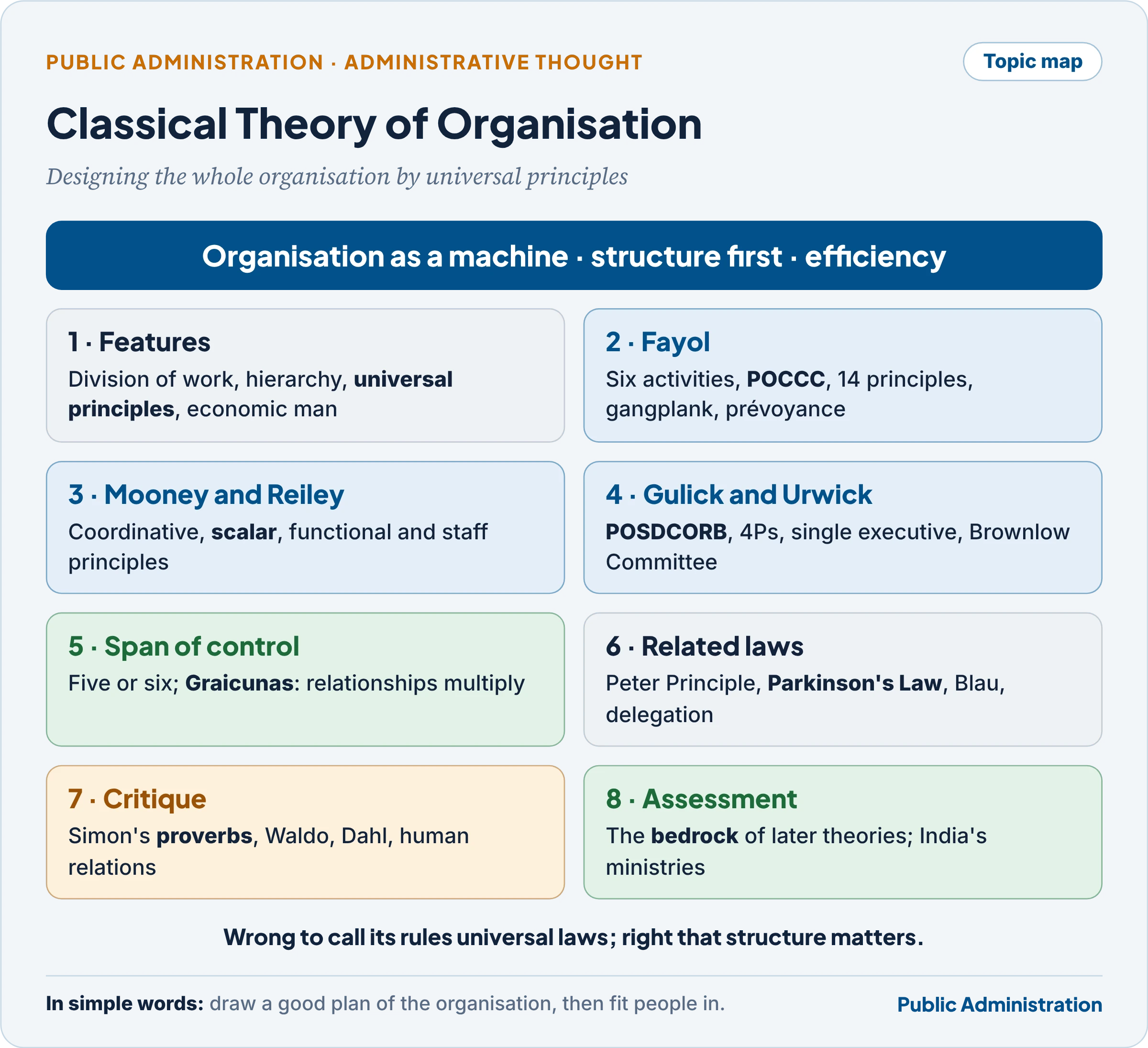
Classical theory is the first general theory of how to design and run a whole organisation. Where Taylor looked at the single task on the shop floor, the classical writers looked at the organisation from the top down: what the manager does, how work should be divided into departments, how many people one boss can supervise, and how authority should flow. Their great hope was that a small set of universal principles, like the laws of engineering, would let anyone build an efficient organisation, whether a factory, an army, a church or a government department.
- Its builders were practitioners: Henri Fayol (a French mining executive), James Mooney and Alan Reiley (General Motors executives), Luther Gulick (an American public administrator) and Lyndall Urwick (a British army officer and management consultant).
- Its high point was 1937, when Gulick and Urwick edited Papers on the Science of Administration and Gulick sat on the Brownlow Committee that redesigned the American presidency.
- Its fall came quickly: in 1946–48 Herbert Simon called its principles “proverbs“, Dwight Waldo exposed its political assumptions and Robert Dahl doubted that any universal science of administration was possible.
Yet hierarchy, unity of command, span of control, line and staff, departmentalisation and the functions of the executive remain the skeleton of almost every public organisation, including India’s ministries and districts.
In simple words
Think of designing a new district hospital. Who is the head? Which departments should there be: by disease (cardiology), by skill (radiology), by patient (children’s ward) or by place (rural outreach)? How many doctors can one senior doctor supervise? Should a nurse take orders from both the ward doctor and the matron? Classical theory is the first systematic attempt to answer exactly these design questions.
1. Meaning, Strands and Common Features
In simple words
“Classical” here means “the first, formal, structure-centred theory”. Its authors believed an organisation is like a machine or a building: draw a good plan, put the right parts in the right places, and it will run efficiently whoever the people inside are.
1.1 Names and strands
Classical theory is also called the traditional theory, the formal organisation theory, the structural theory, the mechanistic or machine theory, the management process school and, in March and Simon‘s phrase, administrative management theory. It had three strands:
| Strand | Main thinkers | Focus |
|---|---|---|
| Scientific management | Taylor and disciples | The task and the worker (see the article on Scientific Management) |
| Administrative management (classical organisation theory) | Fayol, Mooney and Reiley, Gulick, Urwick, Sheldon | The structure and functions of management as a whole |
| Bureaucratic theory | Max Weber | Rational-legal authority and the ideal-type bureaucracy (see the article on Weber) |
- Most classical writers except Weber were practitioners, motivated by the problems of managing the large, complex organisations produced by the Industrial Revolution and by the growth of government.
- Weber is sometimes placed outside the group because he was a sociologist, not a reformer, and his model was descriptive-analytical rather than prescriptive; but his emphasis on hierarchy, rules and impersonality puts him in the same family.
1.2 Common features
- Organisation as a machine: an organisation can be designed in advance, like a building from an architect’s plan, and people are fitted into the positions. Urwick held that structure must be studied “isolated from other considerations“, however artificial the isolation, and that lack of design is “illogical, cruel, wasteful and inefficient“.
- Division of work is the central tenet; coordination through hierarchy puts the divided parts back together.
- Universal principles: administration is administration everywhere; principles discovered in one setting apply to all. Gulick and Urwick stated that there are principles “which can be arrived at inductively from the study of human organisation which should govern arrangements for human association of any kind”, irrespective of “the purpose of the enterprise, the personnel comprising it, or any constitutional, political or social theory underlying its creation”. Mohit Bhattacharya calls this “an assertion of positivism and universalism“.
- Efficiency and economy as the supreme values.
- Formal structure: hierarchy, unity of command, span of control, line and staff, delegation, specialisation.
- Economic man: people are rational and respond to formal authority and pay; the informal organisation is ignored.
- Top-down approach: analysis begins with the chief executive and moves downwards.
- A science of administration: administration, hitherto an art, can become a science, answering Woodrow Wilson’s call (1887).
1.3 The philosophical character of classical theory
Critics have summed up its assumptions as six “philosophical characteristics”:
- Atomistic: sees the individual in isolation from fellow workers;
- Mechanistic: cannot explain the dynamics of behaviour;
- Static: treats the organisation as fixed, not changing;
- Voluntaristic: assumes individuals are free of control by groups and social factors;
- Rationalistic: assumes behaviour follows the logically designed plan;
- Narrowly economic: ignores non-economic incentives.
1.4 Waldo’s five characteristics of the classical approach in public administration
Dwight Waldo identified the features that dominated American public administration until about 1940:
- acceptance of the politics–administration dichotomy;
- a generic management orientation (business techniques fit government);
- the search for principles of administration through scientific analysis;
- emphasis on centralisation and a strong chief executive (“the dogmas of centralisation” and “the canons of integration”);
- a commitment to democracy, but defined substantively (efficient service) rather than procedurally (participation).
2. Henri Fayol: The Father of Management Process Theory
In simple words
Fayol ran a large French mining company for thirty years and turned it from near-bankruptcy to success. He believed his success came not from his personality but from a method that could be taught: the manager plans, organises, commands, coordinates and controls, guided by a set of flexible principles.
2.1 Life and works
- Henri Fayol (1841–1925) was born in Constantinople, trained as a mining engineer at Saint-Étienne, joined the mining company Commentry-Fourchambault-Decazeville in 1860 and was its managing director from 1888 to 1918. Urwick called his rescue of the company “one of the romances of French industrial history”.
- Administration industrielle et générale appeared in 1916. It reached English readers through J.A. Coubrough’s translation (1930) and, decisively, Constance Storrs‘s General and Industrial Management (1949).
- After retirement he founded a Centre for Administrative Studies, advised the French government, studied the posts and telegraphs and the tobacco monopoly, and presented “The Administrative Theory in the State” to the Second International Congress of Administrative Sciences, Brussels (1923), later reprinted in Gulick and Urwick’s Papers (1937).
Common confusion
Did Fayol write about “management” or “administration”? Fayol wrote administration. Storrs translated it as “management“, which led English readers to think Fayol was only a business writer. Urwick protested in his foreword. Fayol himself insisted on one science for all organisations: “We are no longer confronted with several administrative sciences, but with one which can be applied equally well to public and to private affairs.” He is therefore a thinker of public administration as much as of business management.
2.2 The six activities of an undertaking
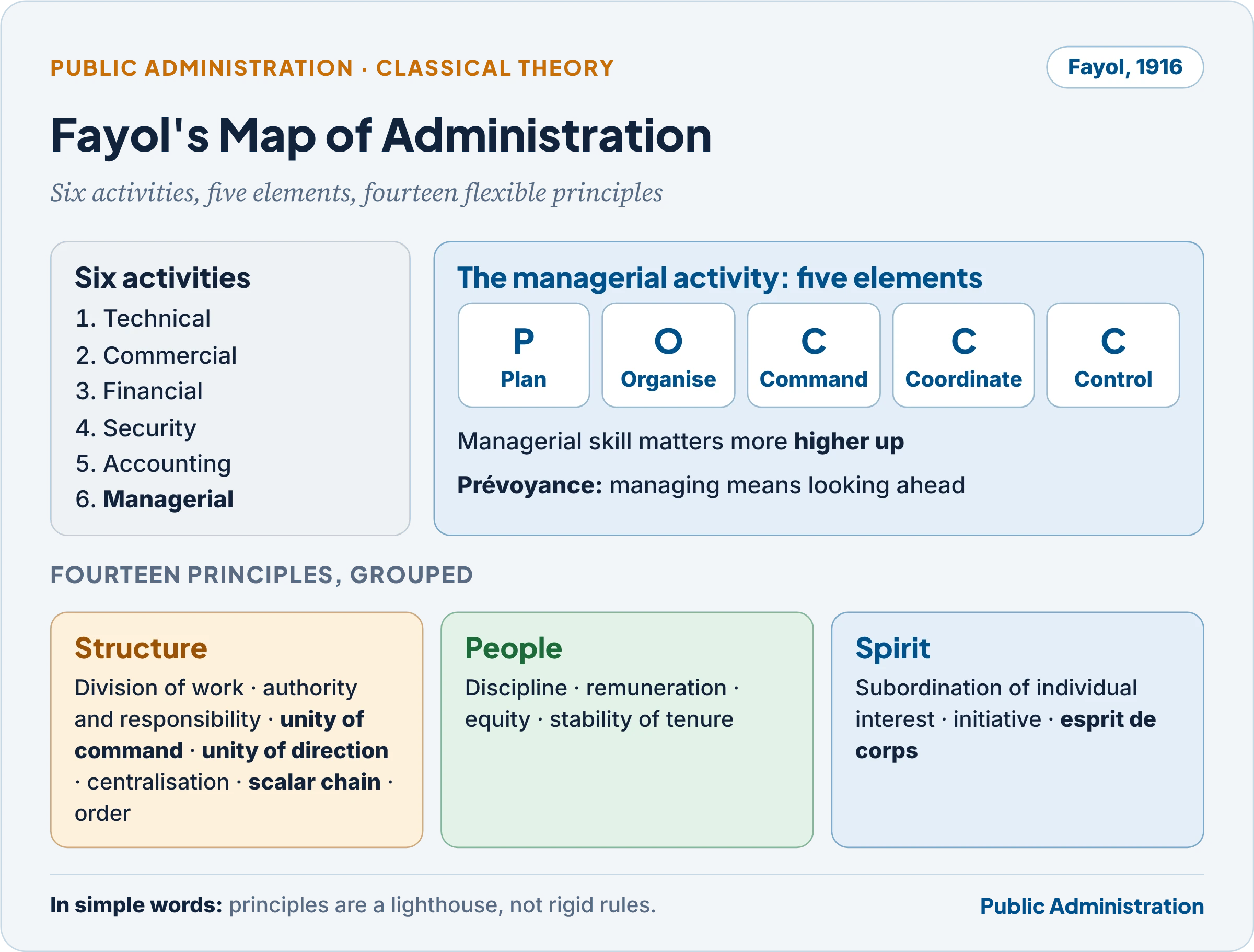
Fayol divided all the activities of an industrial enterprise into six groups:
| Activity | Content |
|---|---|
| Technical | Production, manufacture, adaptation |
| Commercial | Buying, selling, exchange |
| Financial | Search for and optimum use of capital |
| Security | Protection of property and persons |
| Accounting | Stocktaking, balance sheets, costs, statistics |
| Managerial (administrative) | Planning, organising, commanding, coordinating, controlling |
- The first five were well understood; the sixth was neglected because there was no theory of it. Fayol’s book was an attempt to supply that theory.
- Managerial ability rises with rank: “technical ability predominates lower down the ladder and managerial ability higher up.” A worker needs mostly technical skill; a chief executive mostly administrative skill. Hence Fayol was the first to plead for teaching administration, in schools, universities and on the job (“every superior is a teacher to his subordinates”).
- Administration is distinct from government: “to govern” is to conduct the whole undertaking towards its objective using all six functions; “to administer” is only one of the six.
2.3 The five elements of management (POCCC)
“To administer is to forecast and plan, to organise, to command, to co-ordinate and to control.“
- Planning (prévoyance): “to foresee and provide”, examining the future and drawing up a plan of action. A good plan has unity, continuity, flexibility and precision. Fayol treated foresight as the essence of management: managing means looking ahead.
- Organising: building up the dual structure, material and human, of the undertaking. Fayol listed sixteen managerial duties of organisation, from ensuring the plan is carried out to “preventing excess of regulations, red tape and paper control”.
- Commanding: maintaining activity among the personnel; the manager should know his staff, eliminate the incompetent, set a good example, hold conferences of chief assistants, not get lost in detail, and foster unity, energy, initiative and loyalty.
- Coordinating: binding together, unifying and harmonising all activity and effort.
- Controlling: seeing that everything occurs in conformity with the plan, instructions and principles, correcting errors promptly.
Prévoyance as the central business activity. For Fayol, planning was the chief manifestation of administration: without foresight, the enterprise drifts from crisis to crisis. Experience is an asset in planning, and plans should be made for the long run (ten-year forecasts in his company) and reviewed every year. Modern strategic planning, budgeting and outcome frameworks all descend from this idea.
2.4 The qualities of a manager
Fayol listed six attributes: physical (health, vigour), mental (ability to understand and learn, judgement, adaptability), moral (firmness, willingness to accept responsibility, loyalty), general education, special knowledge of the function, and experience.
2.5 The fourteen principles of administration
Fayol called them “principles” while “dissociating it from any suggestion of rigidity, for there is nothing rigid or absolute in management affairs; it is all a question of proportion.” The principle is “the lighthouse fixing the bearings”, but it serves only those who already know the way into port.
| Principle | Meaning |
|---|---|
| 1. Division of work | Specialisation produces more and better work with the same effort; it has limits |
| 2. Authority and responsibility | Authority is “the right to give orders and the power to exact obedience”; responsibility must match it. Authority is official (from the office) and personal (from intelligence, experience, moral worth) |
| 3. Discipline | Obedience and respect for agreements; depends on good superiors, clear agreements and judicious sanctions |
| 4. Unity of command | “For any action whatsoever, an employee should receive orders from one superior only“; if violated, “authority is undermined, discipline is in jeopardy, order disturbed and stability threatened” |
| 5. Unity of direction | “One head and one plan for a group of activities having the same objective” |
| 6. Subordination of individual interest to general interest | Group and personal interests must not prevail over the organisation’s |
| 7. Remuneration | Fair pay that satisfies both employee and employer; modes include time rates, piece rates, bonuses, profit-sharing and non-financial rewards |
| 8. Centralisation | “Everything which goes to increase the importance of the subordinate’s role is decentralisation; everything which goes to reduce it is centralisation”; the right degree is “a question of proportion” |
| 9. Scalar chain | The chain of superiors from the ultimate authority to the lowest ranks, the route for communication |
| 10. Order | “A place for everything and everything in its place” (material order); “a place for everyone and everyone in his place” (social order) |
| 11. Equity | Kindliness combined with justice |
| 12. Stability of tenure | Instability of personnel is both cause and effect of bad management |
| 13. Initiative | The power of thinking out and executing a plan, encouraged at all levels within the limits of authority |
| 14. Esprit de corps | “Union is strength”: harmony, avoidance of divide-and-rule, preference for verbal over written communication |
- Not an exhaustive list: “There is no limit to the number of principles of administration. Every administrative rule or device which strengthens the human part of an organisation or facilitates its working takes its place among the principles for so long as experience proves it to be worthy.”
- Unity of command vs unity of direction: unity of direction (one plan for one objective) comes from sound organisation; unity of command (one boss for one person) concerns the functioning of personnel. “Unity of command cannot exist without unity of direction, but does not flow from it.”
2.6 The gangplank
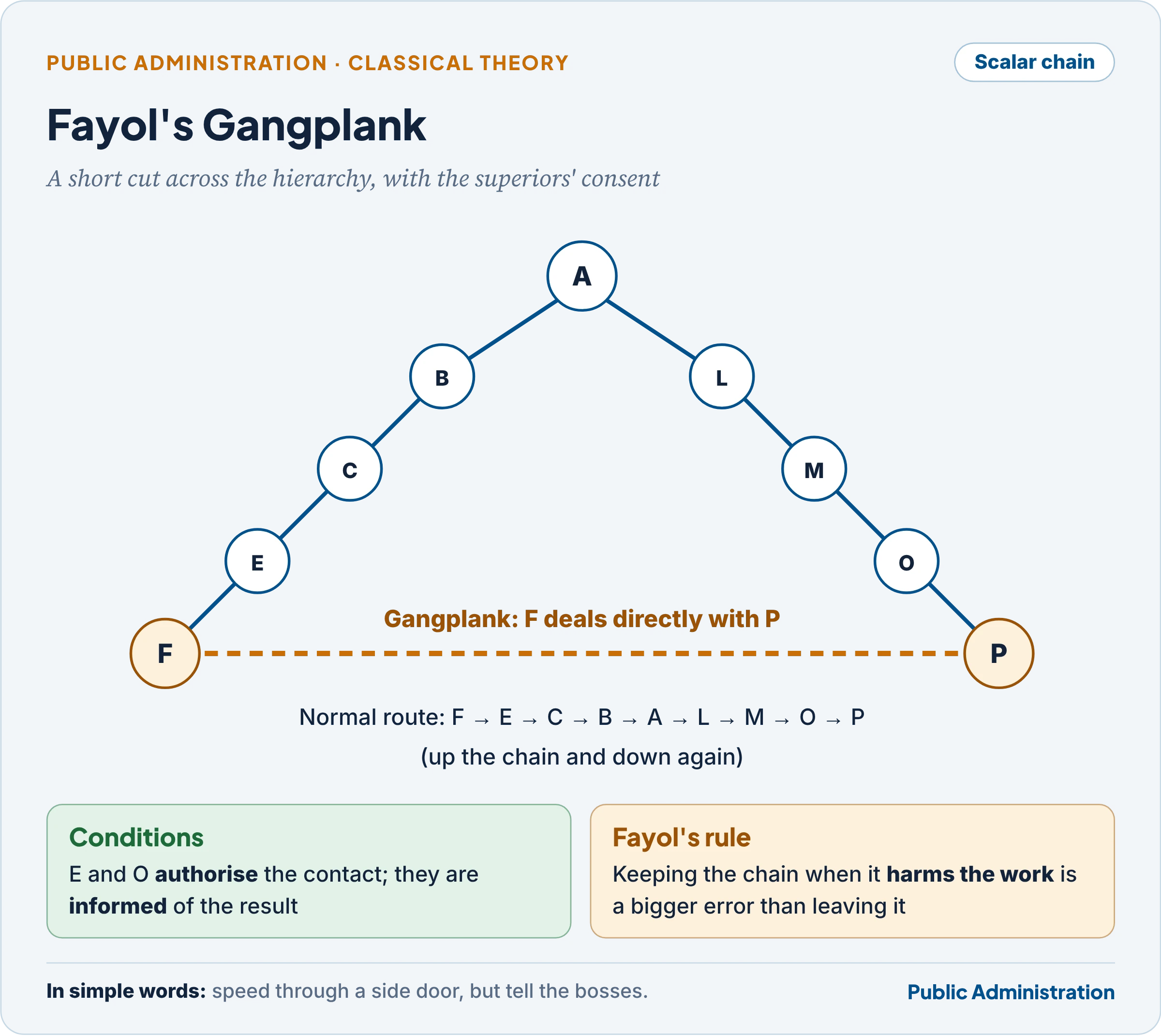
- The scalar chain can be slow: a message from F to P in a parallel chain would climb up to the common superior and come down again through every level.
- Fayol allowed a gangplank (passerelle): F and P may deal directly, provided (a) their immediate superiors have authorised the contact and (b) the superiors are informed of what was agreed. Any disagreement goes back up the chain.
- “It is an error to depart needlessly from the line of authority, but it is an even greater one to keep to it when detriment to the business ensues.” Fayol thought the gangplank especially needed in government, where adherence to the chain was most rigid.
Indian Connect — Fayol’s principles in Indian administration
- Unity of command and dual control: a district-level technical officer (a district health or agriculture officer) answers to the Collector on administrative and coordination matters and to the state directorate on technical matters. This “dual control” is the everyday violation of unity of command that Simon used to attack the principle.
- Scalar chain and delayering: the Central Secretariat Manual of Office Procedure (first issued in 1955) fixes levels of disposal and channels of submission. The 2nd Administrative Reforms Commission (13th Report, Organisational Structure of Government of India, 2009) recommended that no file pass through more than three levels, and CSMOP 2022 (16th edition) adopted a four-pronged approach of delayering, delegation, the desk officer system and e-Office 7.0.
- Gangplank today: e-Office allows files to be marked across divisions; the PRAGATI platform (2015) lets the Prime Minister review projects directly with Union Secretaries and state Chief Secretaries by video conference, a planned “level-jump” with superiors informed.
- Unity of direction: single-ministry ownership of missions (for example, the Ministry of Jal Shakti, formed in 2019 by merging the water resources and drinking water ministries) reflects “one head and one plan” for one objective.
3. Mooney and Reiley: The Principles of Organisation
In simple words
Two General Motors executives looked at armies, churches, governments and companies across history and asked: what is common to all of them? Their answer: every organisation coordinates effort, does so through a hierarchy, divides duties by function, and gives the leader advisers.
- James D. Mooney and Alan C. Reiley published Onward Industry! (1931), republished as The Principles of Organization (1939). They were the first in the USA to state classical theory systematically and popularised organisation charts and manuals.
- Logical framework: each principle has its own principle, process and effect.
| Principle | Meaning | Process / effect |
|---|---|---|
| Coordinative principle | “The orderly arrangement of group effort, to provide unity of action in the pursuit of a common purpose.” Coordination is “the first principle”, containing all others; even two men lifting a stone need it | Achieved through authority and doctrine (shared understanding of purpose) |
| Scalar principle | Hierarchy: grading of duties by degrees of authority and responsibility | Process: leadership, delegation, functional definition |
| Functional principle | Differentiation between kinds of duties: the difference between an infantry and an artillery officer is functional; between a general and a colonel, scalar | Three basic functions: determinative (setting objectives, law-making), applicative (executing) and interpretative (deciding disputes, judicial) |
| Staff principle | Line authority is supported by staff that advises and informs | Staff is “an expansion of the personality of the executive”: “more eyes, more ears and more hands” |
4. Gulick and Urwick: POSDCORB and the Science of Administration
In simple words
Gulick and Urwick gathered all the classical ideas into one book and turned them into a checklist for top executives: plan, organise, staff, direct, coordinate, report, budget. Their aim was practical: to help the American President and big organisations run better.
4.1 The authors and the landmark volume
- Luther Gulick (1892–1993), born in Osaka, Japan, directed New York’s Institute of Public Administration (the successor to the Bureau of Municipal Research) for four decades, was a member of President Franklin Roosevelt’s Committee on Administrative Management (the Brownlow Committee, 1936–37, with Louis Brownlow and Charles Merriam) and later City Administrator of New York (1954–56).
- Lyndall Urwick (1891–1983), British army officer and management consultant, wrote The Elements of Administration (1943) and The Making of Scientific Management.
- Papers on the Science of Administration (1937), prepared for the Brownlow Committee, collected essays by Gulick, Urwick, Fayol, Mooney, Follett, Graicunas, Henderson, Mayo and others. Gulick’s essay “Notes on the Theory of Organization” is the classic statement of administrative management.
- The Brownlow Committee reported in 1937 that “the President needs help” and recommended a stronger executive with staff assistance. Its ideas led to the Reorganization Act of 1939 and the Executive Office of the President, the clearest application of classical principles (single executive, staff, coordination through hierarchy) to government.
4.2 Gulick’s theory of organisation
- Division of work is the foundation: “Work division is the foundation of organisation; indeed, the reason for organisation.” “Division of work and integration are the bootstraps by which mankind lifts itself in the process of civilisation.”
- Limits to division: the volume of work, technology and custom, and the physical and organic limits of tasks (a task cannot be divided below a one-person job, or across places where it must be done at once).
- Coordination puts the parts together in two ways:
- by organisation: placing the subdivided work in a structure of authority so that it is coordinated by orders from superiors to subordinates, from top to bottom;
- by the dominance of an idea: developing “intelligent singleness of purpose” in the minds of those working together, so that each fits his task into the whole of his own accord. (This anticipates later writing on organisational culture and leadership.)
- Gulick’s ten principles: division of work or specialisation; bases of departmental organisation; coordination through hierarchy; deliberate coordination; coordination through committees; decentralisation; unity of command; staff and line; delegation; span of control.
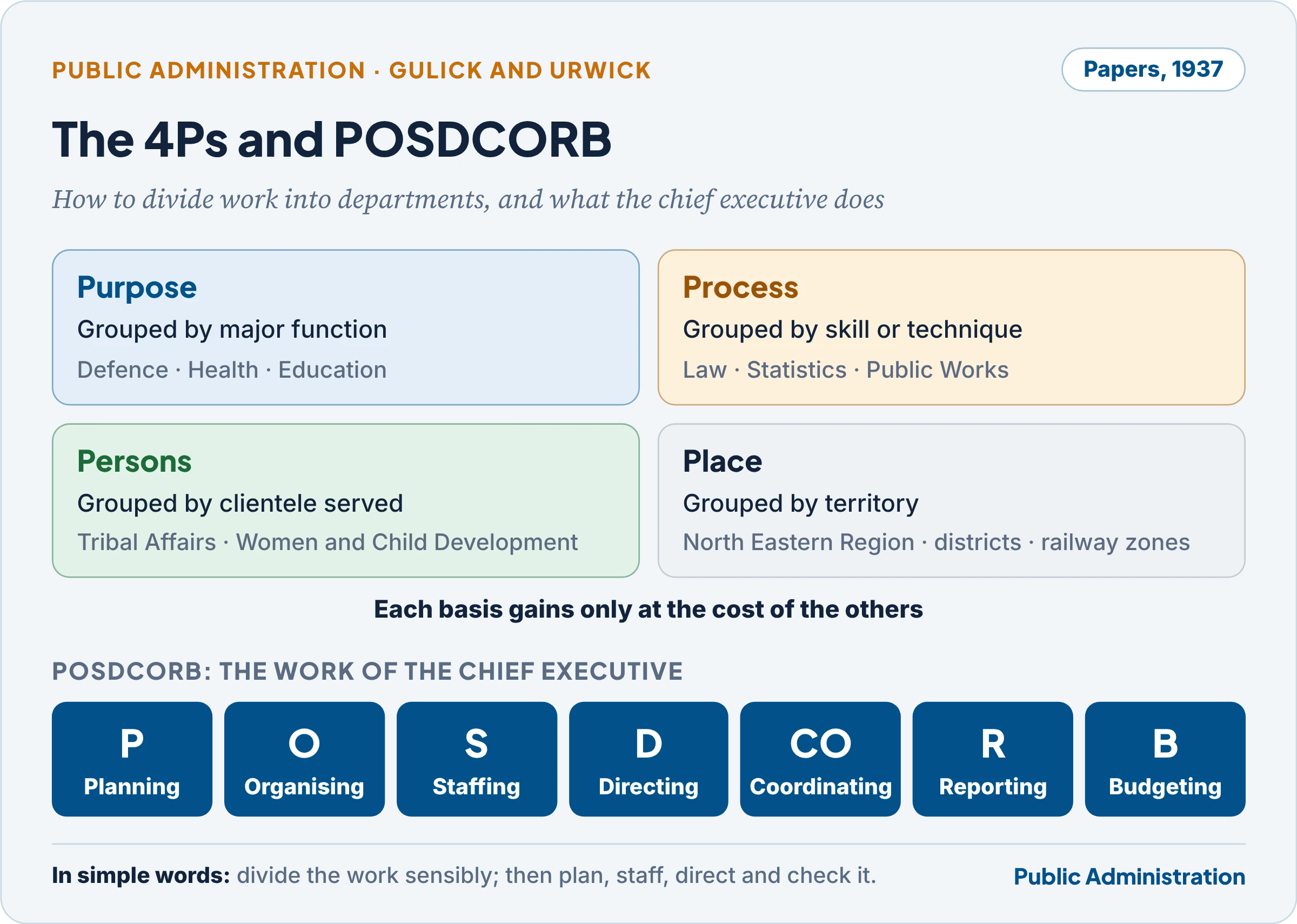
4.3 The 4Ps: bases of departmentalisation
Work can be grouped into departments by any of four bases. Gulick’s key point was that each basis has advantages that are bought at the cost of the others; no basis is right in general.
| Basis | Example (Government of India) | Advantages | Disadvantages |
|---|---|---|---|
| Purpose (major function) | Defence, Health, Education | Self-contained; the whole job under one head; clear to the public; easier coordination of a programme | May not use specialists fully; duplication of common services; departments become empire-like |
| Process (skill or technique) | Law and Justice (legal advice), Statistics, Public Works | Best use of specialised skill and equipment; economies of scale; professional standards | Process becomes an end in itself; poor coordination for any one purpose; experts dominate |
| Persons (clientele) | Tribal Affairs, Minority Affairs, Women and Child Development, Ex-Servicemen Welfare | Single point of contact; better understanding of the group’s needs | Overlap with purpose departments; clientele capture; hard to apply to everyone |
| Place (territory) | Development of North Eastern Region; railway zones; district administration; field offices | Coordinated development of an area; local knowledge; area specialists | Local pressures; uneven standards; duplication across areas |
- In practice all four bases coexist inside one ministry: Defence (purpose) has commands by region (place), a welfare wing for ex-servicemen (persons) and an accounts organisation (process).
- Critics call the bases vague and overlapping; Simon showed that “purpose” and “process” depend on the level of analysis (a typing pool is a process unit, but from inside it typing is its purpose).
4.4 POSDCORB: the functions of the chief executive
Gulick asked “What is the work of the chief executive?” and answered with the acronym POSDCORB, adapted from Fayol’s elements:
| Letter | Function | Meaning |
|---|---|---|
| P | Planning | Working out in broad outline what needs to be done and the methods for doing it |
| O | Organising | Establishing the formal structure of authority through which work is arranged, defined and coordinated |
| S | Staffing | The whole personnel function: recruiting, training and maintaining favourable conditions of work |
| D | Directing | Making decisions and embodying them in orders; serving as leader |
| CO | Coordinating | Interrelating the various parts of the work |
| R | Reporting | Keeping those to whom the executive is responsible informed, through records, research and inspection |
| B | Budgeting | Fiscal planning, accounting and control |
- Significance: it defined the core of public administration as management techniques common to all agencies, shaping courses and textbooks for decades (the “principles” phase of the discipline).
- Criticism: it is technique-centred and value-free; it ignores the substance of programmes (what the agency does: health, defence, education), policy-making, politics, public relations and the human side of leadership. Lewis Meriam and others argued that knowledge of the subject matter matters as much as POSDCORB. Later writers added elements (POSDCORB + E for evaluation, or communication and leadership).
- The chief executive in one sentence: Marshall Dimock summed up these functions by saying the chief executive is “a trouble shooter, a supervisor and a promoter of the future programme“: he resolves crises and conflicts (troubleshooting), oversees and coordinates current operations (supervision), and plans and builds support for what the organisation must do next (promotion). The phrase shows that executive work is not only routine POSDCORB but also political leadership and foresight.
4.5 Unity of command, staff and the single executive
- Unity of command: Gulick admitted that Taylor’s functional foremanship showed the efficiency of specialised supervision, but argued that the confusion, inefficiency and irresponsibility that follow multiple command outweigh the gains.
- Staff: special staff (experts) advise and inform without command, working by “the authority of ideas“; general staff help the chief in command, control and coordination.
- Single executive: Urwick distrusted boards and committees, which “encourage irresponsibility” and are like a corporation without “a soul to be damned or a body to be kicked”. The Brownlow report added that for purposes of management “boards and commissions have turned out to be failures”, and that well-managed units are “almost without exception headed by single administrators”.
- Delegation: executives must delegate but remain answerable; authority and responsibility must be coterminous, coequal and defined (Urwick’s principle of correspondence).
4.6 Urwick’s principles
- Eight principles (in Papers, 1937): objective (every organisation must express a purpose); correspondence (authority and responsibility coequal); responsibility (superiors are absolutely responsible for subordinates’ work); scalar (a pyramid of authority); span of control (no superior should directly supervise more than five or six subordinates whose work interlocks); specialisation (one function per person as far as possible); coordination; definition (each duty, authority and relationship clearly written).
- Twenty-nine principles (The Elements of Administration, 1943) synthesised Taylor, Fayol, Mooney and Reiley, Follett and Graicunas into one framework: investigation, forecasting, planning, appropriateness, organisation, coordination, order, command, control, the coordinative principle, authority, scalar process, assignment of functions, leadership, delegation, functional definition, determinative, applicative, interpretative, general interest, centralisation, staffing, spirit, selection and placement, rewards and sanctions, initiative, equity, discipline and stability.
- Urwick presented these as “a framework of thought”, not proven laws.
4.7 Gulick’s later reflections: humans and time
- In later life Gulick admitted the limits of the 1937 approach. Governments “are constituted of human beings, are run by human beings and have as their main job helping, controlling and serving human beings.”
- He criticised the military design of the state (line and staff, field commanders, “manpower”) and urged decentralisation, compassion and attention to human welfare.
- He made time a central variable: time as an input, an output, a flow of events, a gap between events, and timing as a policy instrument. Principles appropriate at one stage may not suit the next.
5. Span of Control and Graicunas
In simple words
A teacher can easily watch five students; with forty, she cannot track what each is doing or how they affect one another. Span of control asks how many people one boss can effectively supervise. Graicunas showed that the problem grows much faster than the number of people, because the boss must also manage their relations with one another.
5.1 The principle
- Span of control is the number of subordinates a superior can effectively supervise directly.
- Urwick: no more than five, or at most six, subordinates “whose work interlocks“. Sir Ian Hamilton, from military experience, had earlier suggested three to six.
- Gulick refused to fix a number and named the factors that determine the span:
- the supervisor: knowledge, energy and personality;
- the work: routine, repetitive, measurable and homogeneous work allows a wide span; diverse, qualitative work a narrow one;
- time and stability: old, stable organisations with settled procedures allow wider spans than new ones;
- space: scattered subordinates are harder to supervise.
- Later writers added: competence of subordinates, quality of communication and information systems, delegation, staff assistance, and standardisation of methods.
5.2 Graicunas’ theory of relationships
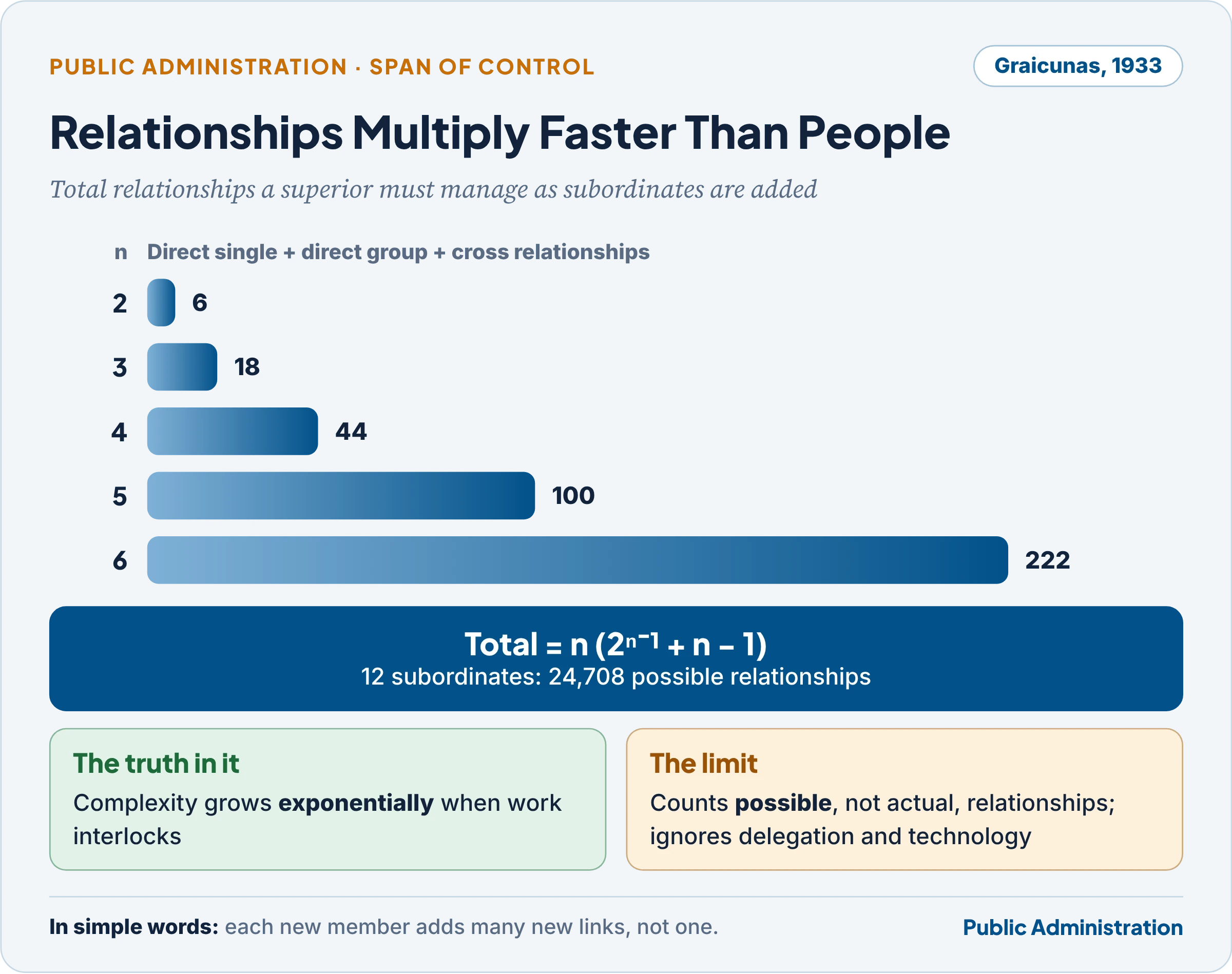
V.A. Graicunas, a Lithuanian management consultant, in “Relationship in Organization” (1933), argued that when a superior adds subordinates, the relationships he must manage multiply far faster than the number of subordinates. He distinguished three kinds:
| Type | What it is | Formula (n = subordinates) |
|---|---|---|
| Direct single | Superior with each subordinate individually | n |
| Direct group | Superior with each possible group of subordinates | n(2ⁿ⁻¹ − 1) |
| Cross | Subordinates with one another (counting each direction) | n(n − 1) |
| Total | All relationships | n(2ⁿ⁻¹ + n − 1) |
| Subordinates (n) | Direct single | Direct group | Cross | Total |
|---|---|---|---|---|
| 2 | 2 | 2 | 2 | 6 |
| 3 | 3 | 9 | 6 | 18 |
| 4 | 4 | 28 | 12 | 44 |
| 5 | 5 | 75 | 20 | 100 |
| 6 | 6 | 186 | 30 | 222 |
| 12 | 12 | 24,564 | 132 | 24,708 |
- Adding a fifth subordinate raises the possible relationships from 44 to 100; a sixth, to 222. Graicunas concluded that five or six is the practical limit where work interlocks, which supported Urwick’s rule.
5.3 How far is Graicunas right?
Why his theory is crude:
- It counts potential relationships, not actual ones; most possible groupings never need the superior’s attention.
- It treats all relationships as equally frequent and important, which they are not.
- It ignores the nature of work (independent field staff need little coordination), competence of subordinates, delegation, staff support and communication technology.
- It assumes direct, personal supervision; modern organisations coordinate through rules, standards, teams and information systems.
- Empirically, successful organisations often have spans of 10 to 20 or more (Joan Woodward found spans varied with technology; flat organisations like Sears in the 1940s had very wide spans).
Why it is still useful as a reference:
- It captures a real truth: complexity rises exponentially, not arithmetically, as interdependent subordinates are added.
- It gives a benchmark against which actual spans within and between organisations can be compared and explained (Why does this department need more supervisors than that one? Because its work interlocks more).
- It draws attention to cross and group relations, the lateral coordination that classical theory otherwise neglected.
- So it states a partial truth: valid where work is highly interdependent and supervision personal; misleading where work is independent, standardised or digitally coordinated.
5.4 The span–levels dilemma
- A narrow span means more supervisors and therefore more levels (a tall hierarchy): close control, but slow communication, distortion of information and higher cost.
- A wide span means fewer levels (a flat structure): faster communication, more delegation and autonomy, but weaker personal supervision.
- Simon used exactly this conflict to show that the “principles” contradict each other (see Section 7).
Indian Connect — Span of control in Indian government
- The Council of Ministers: the 91st Amendment (2003) capped the Union Council of Ministers at 15 per cent of the Lok Sabha (Article 75(1A)) and of state assemblies (Article 164(1A), minimum 12). The Council sworn in on 9 June 2024 had 72 members (30 Cabinet Ministers, 5 Ministers of State with independent charge and 36 Ministers of State), within the cap of about 81. The Prime Minister’s span is the classic span problem at the top of government.
- Grouping to widen the span: the 2nd ARC (13th Report, 2009) recommended grouping some 55 ministries into about 20–25 groups under coordinating ministers, keeping the Council’s size but narrowing the PM’s effective span. In practice, one minister often holds related portfolios.
- The Collector: a Collector supervises dozens of line departments, revenue officers and local bodies; the span works only because of delegation, standard procedures, review meetings and dashboards, not because of Graicunas’ five or six.
6. Related “Laws” of Hierarchy and Organisation
In simple words
Not every “principle” about organisations is serious engineering. Some are satire that became famous because people recognised them in their own offices: the boss promoted beyond his ability, the department that grows whether or not work grows.
6.1 The Peter Principle
- Laurence J. Peter and Raymond Hull, The Peter Principle (1969): “In a hierarchy every employee tends to rise to his level of incompetence.“
- The logic: promotion rewards good performance in the present job. A good clerk becomes a supervisor; if good, a manager; and so on, until he reaches a job he does badly, where he stays because there is no further promotion. In time, “every post tends to be occupied by an employee who is incompetent to carry out its duties”, and the work is done by those who have not yet reached their level of incompetence.
- Implications for promotion policy:
- promotion should be based on ability to do the next job, not only performance in the present one (potential appraisal, assessment centres);
- training before promotion; probation in the higher post with the option to revert;
- dual career ladders, so that good specialists (teachers, doctors, engineers) can earn more without becoming managers;
- lateral movement and rewards other than promotion.
- Relevance to India: promotion largely by seniority in the civil services can move people into posts that need different skills; Mission Karmayogi’s competency frameworks and the debate on lateral entry respond partly to this problem.
- Limits: it is half-serious; organisations also demote, retire and redesign jobs, and many people grow into higher posts.
6.2 Parkinson’s Law
C. Northcote Parkinson (essay in The Economist, 1955; book 1957): “Work expands so as to fill the time available for its completion.” He added satirical corollaries: officials multiply subordinates, not rivals; officials make work for each other; committees grow until they become ineffective; time spent on an item is in inverse proportion to its cost (the “law of triviality”). Parkinson’s Law captures the bureaucratic tendency to grow regardless of work, which public choice later explained through budget-maximising officials.
6.3 Size and its opposite effects (Blau)
- Peter Blau‘s formal theory of differentiation (1970) showed that increasing size produces opposing (dialectical) effects:
- size increases differentiation (more departments, levels and specialised units), at a decreasing rate;
- differentiation raises the need for coordination, increasing the administrative component (managers, staff);
- but size also gives economies of scale in administration, reducing the proportion of managers per worker.
- So growth both adds and saves administrative overhead; which effect dominates depends on the stage of growth. Large organisations also become more formalised and decentralised at the same time (rules allow delegation). The lesson for classical theory: there is no single correct structure for all sizes.
6.4 The consequences of delegation
Delegation of authority, praised by the classical writers, has institutional and organisational consequences beyond those they foresaw:
- Intended consequences: specialised competence, faster decisions, relief for the top executive, development of subordinates, adaptation to local conditions.
- Unintended consequences (from Philip Selznick‘s study of the Tennessee Valley Authority, as modelled by March and Simon):
- delegation leads to specialisation and departmentalisation;
- sub-units develop their own goals and interests (“bifurcation of interests”);
- members internalise sub-goals, and decisions are increasingly made in terms of the sub-unit, not the whole;
- conflict between sub-units increases, leading to more delegation to resolve it: a self-reinforcing cycle.
- Institutional consequences: delegated bodies may be co-opted by local interests (Selznick) and accountability becomes harder to trace (see the article on Weber and post-Weberian developments).
6.5 Brownlow: the administrator’s catholic curiosity
- Louis Brownlow, chair of the Brownlow Committee, said in a 1936 talk (“What Is an Administrator?”) that the one quality common to successful administrators, from Presidents to the foreman of a garbage gang, is this: “to be a successful administrator one must have a catholic curiosity“, that is, a wide-ranging curiosity about everything and everybody.
- His example: a refuse department head in Washington who studied what was in the city’s garbage cans, re-planned collection routes and found that garbage could be turned into a saleable product.
- Meaning: principles and techniques are not enough; the good administrator asks questions, learns how the work and the people actually function, and avoids narrow specialisation. Brownlow even recommended the ability to “loaf” with people, informal mixing to learn what they think.
- Significance: from inside the classical camp, it anticipates the behavioural emphasis on informal knowledge, communication and leadership, and the generalist ideal of the civil servant.
7. The Critique of Classical Theory
In simple words
Classical theory promised a science but delivered common-sense rules that contradicted each other, ignored people and politics, and were never tested. Simon, Waldo, Dahl and the human relations writers each attacked a different weakness, and by 1950 the “principles” era was over.
7.1 Simon: the proverbs of administration
Herbert Simon, “The Proverbs of Administration” (Public Administration Review, 1946), reprinted in Administrative Behavior (1947):
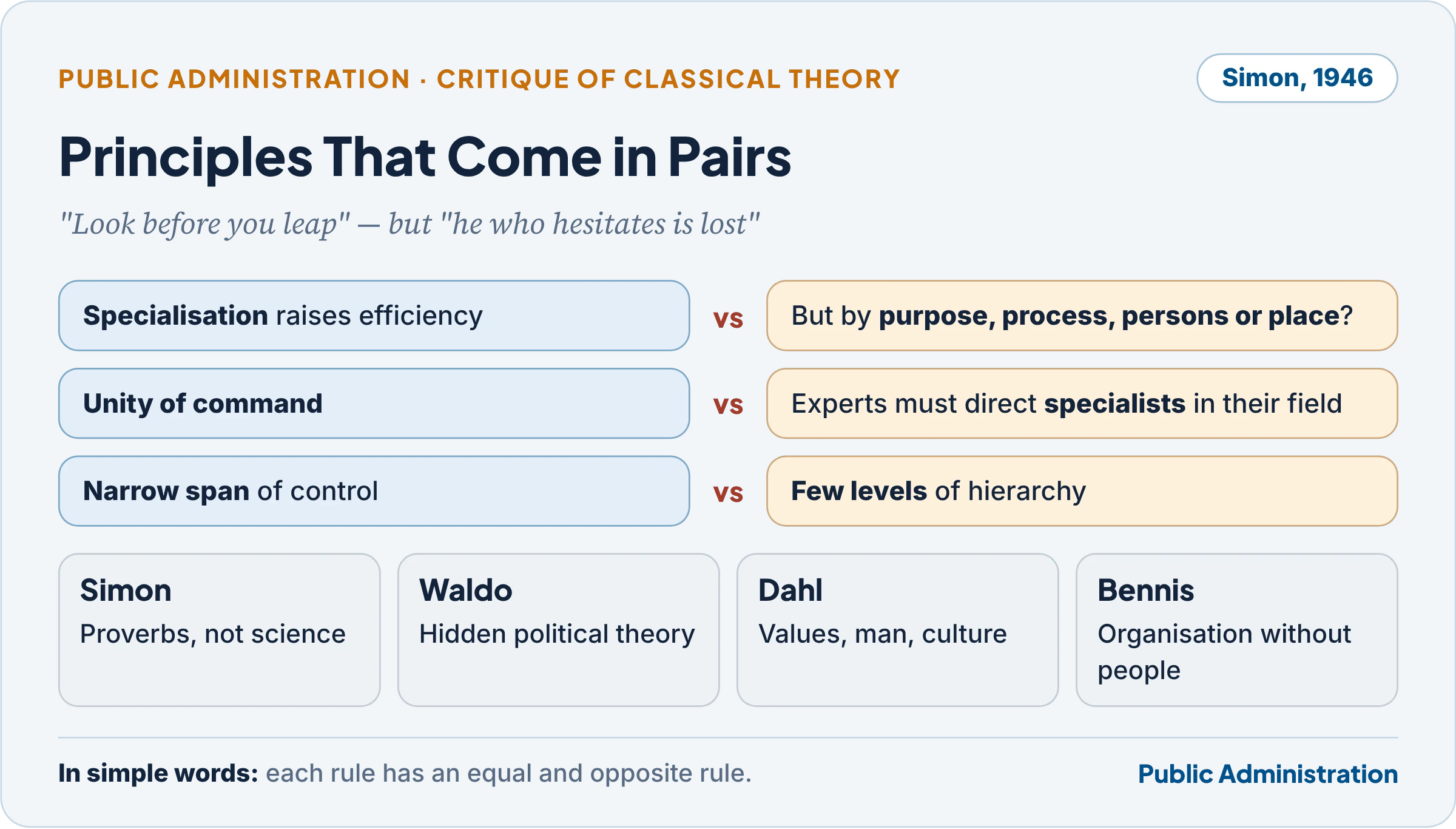
- “It is a fatal defect of the current principles of administration that, like proverbs, they occur in pairs. For almost every principle one can find an equally plausible and acceptable contradictory principle. Although the two principles of the pair will lead to exactly opposite organisational recommendations, there is nothing in the theory to indicate which is the proper one to apply.” (“Look before you leap” / “He who hesitates is lost”.)
| Principle | Its contradictory twin | Simon’s point |
|---|---|---|
| Specialisation increases efficiency | Specialisation by purpose or by process or by place? | The principle does not say which kind of specialisation; each choice sacrifices the others |
| Unity of command | Specialisation requires experts to direct specialists in their field | An accountant in a school department must take technical orders from the finance department; real organisations put specialisation first |
| Narrow span of control | Few levels of hierarchy, so that matters pass through few hands | A narrow span multiplies levels; a flat structure widens spans. The two cannot both be satisfied |
| Organisation by purpose, process, clientele, place | The same four bases compete | Purpose and process are relative to the level of analysis; the bases conflict and the theory gives no rule for choosing |
- Simon’s diagnosis: the principles are “at best criteria for describing and diagnosing administrative situations”; they rest on “superficiality, oversimplification and lack of realism”, and on inadequate definition of terms and no empirical testing.
- Simon’s remedy: study decision-making, the actual behaviour of people in organisations, with a value-free, empirical method (see the article on Simon). He suggested a narrower, defensible version of unity of command: when two authoritative commands conflict, there should be a single determinate person whom the subordinate is expected to obey.
- Is Simon justified? Largely yes: the principles were untested, ambiguous and contradictory when stated as universal rules. But:
- Simon himself admitted that the principles are useful diagnostic criteria, and he could not discard them; he devoted much space to them.
- Thomas Hammond (“In Defence of Luther Gulick’s ‘Notes on the Theory of Organization'”, 1990) argued that Simon misread Gulick, who presented the bases of departmentalisation as trade-offs to be weighed, not as rules, which is close to Simon’s own view.
- Classical writers (Fayol, Gulick, Urwick) repeatedly said their principles were flexible, a “question of proportion”.
- Later research (for example, Meier and Bohte‘s work on span of control in public organisations, 2003) shows that classical variables like span and levels do affect performance; the problem is universalism, not the variables.
7.2 Waldo: The Administrative State (1948)
Dwight Waldo‘s The Administrative State: A Study of the Political Theory of American Public Administration (1948) showed that the “science” of administration was really a political theory in disguise:
- Roots in political theory: the classical writers had unacknowledged answers to the great questions of political theory: the good life (efficient material abundance), the criteria of action (efficiency), who should rule (experts and a strong executive), separation of powers (to be overcome by executive integration) and centralisation versus decentralisation (centralise).
- Business ideology: public administration borrowed both business methods and business values, using them to argue for a strong chief executive and hierarchical control.
- Efficiency is not a value in itself: it is meaningful only within a framework of consciously held values; “efficient for what?” must be asked.
- Principles ignore specificity: organisations should be designed for their purposes and situations, not by general rules.
- Science and values: administration deals with thinking, valuing human beings; techniques of natural science are inappropriate; classical “science” was “little more than an extension of common sense”.
- The dichotomy was false: administration inevitably makes policy; the politics–administration separation was neither an accurate description nor a sound prescription.
- The challenge to orthodoxy: the book attacked the orthodox premises (the dichotomy, the science of principles, efficiency as the supreme value, the business model, centralisation). It made Waldo, in his own words, something of a “pariah” in the field, but it began the shift towards seeing public administration as politics.
- Critical examination of Waldo’s contention:
- Strengths: it exposed hidden values; anticipated New Public Administration’s call for value-consciousness; and is supported by later evidence that administrators shape policy.
- Weaknesses: it is stronger in criticism than in construction; Simon (1952) accused Waldo of loose, unscientific reasoning; Waldo himself later conceded some continuing value in the dichotomy, and the field still needs technical, management knowledge alongside political theory.
7.3 Dahl: three problems for a science of administration
Robert Dahl, “The Science of Public Administration: Three Problems” (Public Administration Review, 1947), argued that no science of public administration is possible unless:
- the place of normative values is made clear: administrative choices involve values (efficiency versus responsiveness, equity, liberty) that science cannot settle;
- the nature of man in administration is better understood and his conduct more predictable: the classical “rational, economic man” ignores the complexity of human behaviour;
- there is a body of comparative studies from which principles transcending national boundaries and peculiar historical experiences can be discovered: principles derived from American (or French) experience cannot be assumed to hold in different social and cultural settings.
Dahl’s critique laid the foundation for both behavioural studies (the second problem) and comparative public administration (the third).
7.4 Other criticisms
- Unscientific and untested: classical theory failed to “confront theory with evidence“: its principles were drawn from personal experience and logic, never tested under controlled or comparative conditions, so when examined they “tend to dissolve”. It was, in effect, normative (what ought to be) rather than descriptive (what is).
- Neglect of the human factor: the human relations school showed that social and psychological factors shape behaviour; Warren Bennis called classical theory a theory of “organisations without people“; March and Simon called it the “machine model“.
- Neglect of the informal organisation: Barnard and Simon showed that actual behaviour departs widely from the formal plan.
- Closed and static: it ignored the environment and change; the systems and contingency approaches later corrected this.
- Argyris: formal structure (specialisation, chain of command, unity of direction, span of control) keeps adults dependent and passive, in conflict with the needs of a mature personality.
- March and Simon‘s list of limitations (Organizations, 1958): motivational assumptions are incorrect; little appreciation of intra-organisational conflict; little attention to the human being as a limited information processor; neglect of cognition in identifying and classifying tasks; and neglect of programme elaboration and evaluation.
- V. Subramaniam (“The Classical Organisation Theory and its Critics”, 1966): its propositions lack sophistication and do not interest researchers; and it shows a pro-management bias, dealing with problems of the top only.
- Drucker on Fayol: imposing a mechanistic “ideal” structure on a living business caused some of the worst mistakes of organisation-building; Fayol’s functional structure suits small manufacturing firms but not large, complex or innovative ones.
- Neglect of politics and power: structure was treated as a technical matter, ignoring that departmental boundaries and spans reflect politics and interest groups.
- Narrow empirical base: Fayol generalised from a mining company, Mooney and Reiley from General Motors and the army.
8. Assessment: The Bedrock of Modern Organisation Theory
In simple words
Classical theory was wrong to claim that its rules were universal laws, but right that structure matters. Every later theory either built on it or defined itself against it, and every real organisation still has a hierarchy, departments, spans and staff.
8.1 Contributions
- First general theory of management and organisation; made administration a subject of study and teaching.
- A vocabulary that every later theory uses: hierarchy, unity of command, span of control, line and staff, delegation, centralisation, departmentalisation, coordination.
- Practical design tools that remain in daily use: organisation charts, manuals, job descriptions, delegation schedules, levels of disposal.
- Influence on government reform: the Brownlow Committee (1937), the First and Second Hoover Commissions (1949, 1955) in the USA; in India, the Appleby reports (1953, 1956), the creation of O&M units, and the structural recommendations of the first and second Administrative Reforms Commissions.
- Universal concern for efficiency, economy and effectiveness, which survives in performance management and outcome budgeting.
- Stimulus to its critics: the human relations, behavioural, systems and contingency theories all grew from its limits.
8.2 Classical theory as the bedrock of modern theories
| Modern theory | What it takes from classical theory | What it changes |
|---|---|---|
| Weberian bureaucracy | Hierarchy, rules, specialisation, career officials | Adds legitimacy and sociology of authority |
| Human relations | Accepts efficiency and formal structure as given | Adds the informal group and social needs |
| Behavioural (Barnard, Simon) | Studies authority, communication, decisions within formal organisations | Replaces principles with empirical study of behaviour |
| Systems theory | Organisation as interrelated parts (Mooney’s coordination) | Opens the system to the environment |
| Contingency theory | Keeps the classical variables (span, centralisation, formalisation) | Says the right value depends on technology, size and environment |
| New Public Management | Single executive accountability, span and delegation, performance control | Adds markets and managerial freedom |
| Matrix and network forms | Still need unity of direction, coordination and clear roles | Accept dual command and lateral links |
- “Structural theory is grounded in classical principles of efficiency, effectiveness and productivity”: the structural tradition (Fayol, Gulick, Urwick, Weber, and later Blau, Woodward and the contingency theorists) assumes that the right structure (division of work, hierarchy, coordination) produces efficiency (least cost), effectiveness (goal achievement) and productivity (output per input). Even critics who reject universal principles still ask structural questions in the same efficiency-oriented terms.
8.3 Classical theory and the systems approach compared
| Basis | Classical theory | Systems approach |
|---|---|---|
| View of organisation | Machine; closed system | Organism; open system interacting with its environment |
| Focus | Formal structure | Interrelation of parts and environment: inputs, processes, outputs, feedback |
| Change | Static | Dynamic, adaptive (equilibrium, feedback) |
| Principles | Universal | Depends on environment (equifinality: many routes to the same result) |
| People | Economic, rational | Social and technical subsystems |
| Merit | Clear, simple, practical design rules; strong on accountability | Realistic, integrative, explains adaptation and survival |
| Weakness | Rigid, ignores environment and people | Abstract, hard to operationalise; risks repeating classical faith in a grand universal model |
8.4 From anatomy to social behaviour
- The classical approach held that “the design of the physical structure, the anatomy of the organisation, came first, and was indeed the principal consideration“. Organisation was an anatomy of positions and lines of authority.
- The behavioural approach, from Barnard onwards, defined organisation as “a system of interrelated social behaviours of participants“, a living pattern of cooperation, communication, motivation and decision.
- Their contributions are complementary: the classical approach gave the framework of roles and authority without which cooperation has no shape; the behavioural approach explained how people actually behave inside that framework and why the formal plan is never followed exactly. Modern organisation theory combines both: structure and behaviour, anatomy and physiology.
8.5 Approaches to increasing the efficiency of government
The search for efficiency has gone through several approaches, each with classical theory as its starting point:
- Scientific management and work study: better methods, standards and measurement (Taylor, O&M).
- Administrative management: better structure, POSDCORB, the strong chief executive (Fayol, Gulick, Brownlow).
- Bureaucratic rationality: merit, rules, hierarchy, professional civil service (Weber).
- Human relations and behavioural approaches: morale, motivation, participation and better decisions (Mayo, Barnard, Simon, Likert).
- Management techniques: PPBS, MBO, zero-based budgeting, operations research, PERT and CPM.
- New Public Management: markets, performance targets, agencies, contracting out.
- Digital and governance approaches: e-government, process re-engineering, data-driven monitoring and collaboration with citizens and partners.
Criticism — The case against classical theory
- Its “principles” are proverbs: ambiguous, contradictory and untested (Simon).
- It hides political values under the language of science (Waldo) and ignores values, human nature and culture (Dahl).
- It treats the organisation as a machine without people, ignoring informal groups and motivation (Mayo, Bennis, Argyris).
- It is static and closed, blind to the environment and change.
- It has a pro-management, top-down bias.
Defence — The case for classical theory
- It created the vocabulary and tools of organisation design that every later theory still uses.
- Its writers called their principles flexible guides, “a question of proportion”, not rigid laws (Fayol, Urwick, Gulick).
- Structure does matter: span, levels, unity of command and delegation measurably affect performance and accountability.
- It gave public administration its first identity and shaped real reforms (Brownlow, Hoover, Appleby, the ARCs).
- Modern theories refine rather than replace it: contingency theory keeps its variables and adds context.
Key Terms
| Term | Meaning in simple words |
|---|---|
| Classical theory | The first theory of designing whole organisations by universal principles |
| Administrative management | March and Simon’s name for the Fayol–Gulick–Urwick school |
| POCCC | Fayol’s five elements: planning, organising, commanding, coordinating, controlling |
| Prévoyance | Fayol’s term for foresight and planning |
| Unity of command | Each person receives orders from only one superior |
| Unity of direction | One head and one plan for activities with the same objective |
| Scalar chain | The line of authority from top to bottom |
| Gangplank | Fayol’s direct contact between equals in different chains, with superiors’ consent |
| Esprit de corps | Team spirit; “union is strength” |
| Coordinative principle | Mooney and Reiley’s first principle: orderly arrangement of group effort |
| Determinative, applicative, interpretative | Mooney and Reiley’s three functions: setting goals, executing, judging |
| POSDCORB | Gulick’s seven functions of the chief executive |
| 4Ps | Gulick’s bases of departmentalisation: purpose, process, persons, place |
| Line and staff | Line commands; staff advises and supports |
| Span of control | Number of subordinates one superior can supervise effectively |
| Graicunas’ formula | n(2ⁿ⁻¹ + n − 1): total relationships with n subordinates |
| Delegation | Passing authority to subordinates while remaining answerable |
| Proverbs of administration | Simon’s label for contradictory classical principles |
| Peter Principle | People rise to their level of incompetence in a hierarchy |
| Parkinson’s Law | Work expands to fill the time available |
| Machine model | March and Simon’s description of classical theory |
| Catholic curiosity | Brownlow’s wide-ranging curiosity as the mark of a good administrator |
Commissions, Committees and Judgments
| Body / report | Year | Key point |
|---|---|---|
| President’s Committee on Administrative Management (Brownlow Committee) | 1937 | “The President needs help”: strong single executive, staff agencies; led to the Executive Office of the President (1939) |
| First Hoover Commission | 1949 | Reorganisation of the US executive on classical lines: grouping by purpose, clear lines of authority |
| Appleby Reports (India) | 1953, 1956 | Led to the O&M Division (1954) and the Indian Institute of Public Administration |
| 91st Constitutional Amendment | 2003 | Council of Ministers capped at 15 per cent of the lower house (Articles 75(1A), 164(1A)) |
| 2nd ARC, 13th Report Organisational Structure of Government of India | 2009 | Group ministries into 20–25 under coordinating ministers; no more than three levels of decision-making; executive agencies for delivery |
| Central Secretariat Manual of Office Procedure (16th edition) | 2022 | Delayering, delegation, desk officer system, e-Office 7.0 |
Contemporary Developments
- 5 August 2022: CSMOP 2022 (16th edition) adopted delayering, delegation, the desk officer system, digitised central registry units and e-Office 7.0 to speed decisions, a direct revision of the scalar chain.
- 9 June 2024: a 72-member Union Council of Ministers was sworn in (30 Cabinet, 5 MoS independent charge, 36 MoS), several Cabinet Ministers holding two or three related ministries, a practical form of grouping departments under one head.
- October 2025: under Special Campaign 5.0, ministries simplified 470 rules and processes, continuing the effort to cut procedural layers inherited from classical design.
- 6 July 2021: a new Ministry of Cooperation was carved out of the Ministry of Agriculture to give one head and one plan to the cooperative sector, a fresh use of the “purpose” basis and of unity of direction.
- Continuing: contingency and digital-era research keeps classical variables (span, levels, centralisation) at the centre of organisation design while rejecting fixed universal values.
Revision Grid
| Thinker / body | Work or report (year) | Key idea |
|---|---|---|
| Henri Fayol | Administration industrielle et générale (1916; English 1930, 1949) | Six activities; POCCC; 14 principles; gangplank; teaching administration |
| Fayol | “The Administrative Theory in the State” (1923) | One administrative science for public and private affairs |
| Mooney and Reiley | Onward Industry! (1931); The Principles of Organization (1939) | Coordinative, scalar, functional and staff principles |
| Luther Gulick | “Notes on the Theory of Organization” in Papers on the Science of Administration (1937) | POSDCORB; 4Ps; ten principles; coordination by structure and idea |
| Lyndall Urwick | Papers (1937); The Elements of Administration (1943) | Eight and 29 principles; span of five or six |
| V.A. Graicunas | “Relationship in Organization” (1933) | n(2ⁿ⁻¹ + n − 1) relationships |
| Brownlow Committee | Report (1937) | “The President needs help”; single executive and staff |
| Louis Brownlow | “What Is an Administrator?” (1936) | Catholic curiosity |
| Marshall Dimock | Writings on the executive | Trouble shooter, supervisor, promoter of the future programme |
| Herbert Simon | “The Proverbs of Administration” (1946); Administrative Behavior (1947) | Principles occur in contradictory pairs |
| Dwight Waldo | The Administrative State (1948) | Classical theory as hidden political theory |
| Robert Dahl | “The Science of Public Administration: Three Problems” (1947) | Values, human behaviour, comparative studies |
| March and Simon | Organizations (1958) | Machine model; five limitations |
| V. Subramaniam | “The Classical Organisation Theory and its Critics” (1966) | Lack of sophistication; pro-management bias |
| Peter and Hull | The Peter Principle (1969) | Rise to the level of incompetence |
| C.N. Parkinson | Parkinson’s Law (1955, 1957) | Work expands to fill the time available |
| Peter Blau | Formal theory of differentiation (1970) | Size has opposite effects on administrative overhead |
| Thomas Hammond | “In Defence of Luther Gulick’s Notes” (1990) | Simon misread Gulick’s trade-offs |
| 2nd ARC | 13th Report (2009) | 20–25 ministry groups; three levels |
Previous Year Questions
- 2025Is Herbert Simon justified in criticizing some principles of administration as proverbs? Analyse.
- 2022Classical Organisation Theory formed the bedrock for the modern organisation theories. Analyse.
- 2018Dwight Waldo in his book, The Administrative State emphatically mentions that the roots of administrative theory lie in political theory. Critically examine Waldo’s contention.
- 2017“What is distinctive about the Classical and Human Relations Schools of administration is their complementarity to each other “. Analyse
- 2015Waldo’s ‘The Administrative State’ provides a fundamental challenge to some of the orthodox premises. Explain.
- 2013“The design of the physical structure, the anatomy of the organization came first, and was indeed the principal consideration.” “An organisation is a system of inter-related social behaviours of participants,” Analyse these statements and evaluate the contributions of the respective approaches to administration theory.
- 2013Structural theory is, by and large, grounded in classical principles of efficiency, effectiveness and productivity. Explain.
- 2012In what respects is Taylor’s ‘Scientific Management’ or classical motivational theory different from the classical organizational theory expounded by Gulick, Urwick etc?
- 2010Explain the ‘Peter Principle’ in respect of promotion policy in a hierarchical organisation.
- 2006Critically examine the Classical Science of Administration with special reference to its criticism by Dwight Waldo and Robert Dahl.
- 2006Discuss the main approaches to increase the efficiency of government and public administration.
- 2005“The failure of classical science of administration lies in its capacity to confront theory with evidence.” Discuss.
- 1997“That is, to be successful administrator one must have a catholic curiosity.” Comment.
- 1996In a hierarchy every employee tends to rise to his level of incompetence. Comment.
- 1996Although the theory of V.A. Graicunas is admittedly crude, it is useful as reference against which variations between organisations as well as within organisation can be examined. Comment.
- 1996Examine the view that systems theory, despite its promises to the contrary, followed similar patterns that characterised the structural classical theories.
- 1994“Most of the propositions that make up the body of administrative theory today share, unfortunately, this defect of proverbs.” Comment.
- 1991‘The Chief Executive is a trouble shooter, a supervisor, and a promoter of the future programme; Comment.
- 1990Compare the relative merits of the classical theory of organisation and the systems approach.
- 1989Elucidate whether increasing organizational size gives rise to dialectical forces having opposite organization effects.
- 1988“Managing means looking ahead, which makes the process of prevoyance a central business activity.” (Henry Fayol). Comment.
- 1987Describe the institutional and organisational consequences of delegation of authority.
- 1987‘The law of Graicunas about the span of relationships in an organisation states a partial truth; Comment.