

Organisations: Theories – systems, contingency; Structure and forms: Ministries and Departments, Corporations, Companies; Boards and Commissions; Ad hoc and advisory bodies; Headquarters and Field relationships; Regulatory Authorities; Public-Private Partnerships.
This article: Meaning of regulation and the rise of the regulatory state (Majone, Levi-Faur, regulatory capitalism, the “arbitrator state”, diffusion by emulation); rationale for independent regulators; theories of regulation (public interest, capture, principal–agent, responsive and smart regulation); design of regulators (independence, accountability, appointment, tenure, funding, overlap, quasi-judicial powers, appellate tribunals, the super-regulator debate); Indian regulators and recent laws; 2nd ARC, FSLRC, the draft Regulatory Reform Bill, parliamentary oversight and leading judgments; public-private partnerships: meaning, rationale, PPP and privatisation, perspectives and stakeholders, models (BOT to HAM, TOT, InvIT, Swiss challenge), risk allocation, value for money, viability gap funding, institutional framework (PPPAC, NIP, NMP 2.0), the Kelkar Committee, problems, sector experience, the end of the UK’s PFI, and the theory lens of NPM and governance networks.
Official Syllabus: Paper I · Unit 1-04 Organisations
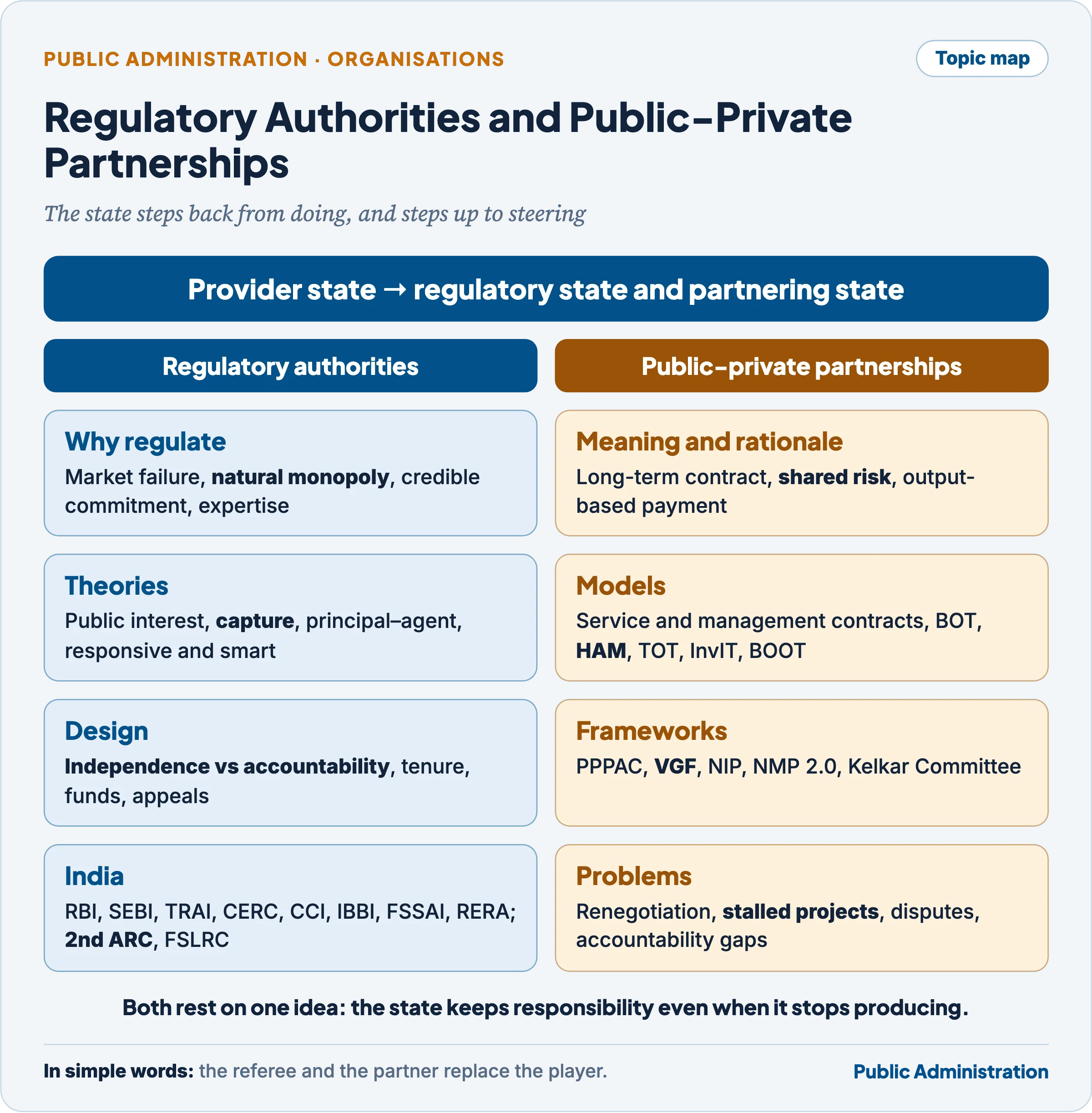
From the 1980s the state in most countries, and in India after 1991, changed its job description. It stopped trying to produce everything itself (electricity, telephones, airlines, roads) and began to set rules for private producers and to contract with them.
Two organisational forms carry this change. The regulatory authority is a specialised public body, usually independent of the ministry, that writes and enforces rules for a sector. The public-private partnership (PPP) is a long-term contract under which a private firm finances, builds or runs a public asset or service while the government keeps final responsibility. Both shift the administrator’s role from doer to designer, referee and contract manager, and both raise the same question: how can a state that no longer runs things directly still answer to citizens for what happens?
In simple words
Think of a cricket match. In the old days the government was both the team and the umpire: it owned the airline, the phone company and the power plant. Today private teams play the match, the regulator is the umpire, and the PPP is a long contract under which a private team builds and runs the stadium for the government. The umpire must be neutral and the contract must be fair, or the spectators (citizens) lose.
These notes are the third of three on organisations. The first, on systems and contingency theories, explains why organisations must adapt to their environment; the second, on structure and forms, covers departments, corporations, companies, boards and commissions. Regulators and PPPs are best read as the newest forms in that family.
1. Meaning of Regulation and the Rise of the Regulatory State
In simple words
To regulate is to steer the behaviour of others by rules, without doing the work yourself. A traffic policeman does not drive the cars; he makes sure the drivers follow the rules. The regulatory state is a government that mostly works like that traffic policeman.
1.1 What regulation means
- Narrow meaning: regulation is the sustained and focused control exercised by a public agency over activities valued by a community, the definition of the American sociologist Philip Selznick (1985). The key words are sustained (continuous, not one-off), focused (on a sector) and valued (the activity is legitimate, unlike crime, so it is steered rather than banned).
- Economic meaning: Barry Mitnick, The Political Economy of Regulation (1980), defined it as the intentional restriction of choice by a party not directly involved in the regulated activity. A tariff order of an electricity commission restricts the choices of both the power company and the consumer.
- Broad meaning: all government action that shapes individual and group conduct: law and order, market operation, health, education, consumer and environmental protection, employment, prices and profits.
- Regulatory administration is the part of public administration that makes, applies and adjudicates such rules. It combines three processes that are normally separated: policy-making (setting standards), policy execution (licensing, inspection) and adjudication (deciding disputes and penalties). For that reason it needs a systems approach in which the three are linked rather than handled by different bodies that never talk to one another.
Three aspects of regulation in a developing mixed economy (an Indian framing):
| Aspect | What it does | Indian example |
|---|---|---|
| Positive (promotional) | Induces and helps private actors to contribute to development | Incentives for private investment in infrastructure; standards that open new markets |
| Negative (restrictive) | Prevents activities against the public interest | Bans on adulterated food and narcotics; anti-monopoly action |
| Creative | Creates competitive conditions, including for public enterprises | Ending PSU monopolies in telecom and airlines so that they must compete |
- Regulatory objectives follow from the Directive Principles: Article 39(c) asks the state to ensure that the operation of the economic system does not result in the concentration of wealth and means of production to the common detriment. Hence regulation aims to set standards, protect consumers, prevent concentration, prohibit monopolistic, restrictive and unfair trade practices, ensure product safety, protect the environment and labour.
- Law and order is part of regulation, and therefore part of development: development cannot happen without a sound foundation of order and the rule of law. Treating policing as a “non-development” function is a mistake.
- Regulation has been called the most important yet least developed field of development administration, because Indian administration grew up as a producer and a licensor rather than as a rule-based umpire.
1.2 From provider state to regulatory state
Giandomenico Majone, the Italian political scientist of European regulation, gave the best-known account of the change in The Rise of the Regulatory State in Europe (1994) and From the Positive to the Regulatory State (1997).
| Feature | Positive (interventionist) state | Regulatory state |
|---|---|---|
| Main functions | Redistribution, macroeconomic stabilisation, public ownership | Correcting market failure through rules |
| Main instrument | Taxing and spending; running enterprises | Rule-making, licensing, monitoring |
| Key institutions | Ministries, nationalised corporations, planning bodies | Independent regulatory agencies, courts, tribunals |
| Policy style | Discretionary, political bargaining | Technical, legalistic, adversarial |
| Accountability | Through ministers to Parliament | Through transparency, reasons, expertise and judicial review |
| Indian parallel | Planning Commission era, PSU monopolies | Post-1991 SEBI, TRAI, CERC, CCI |
- Why the shift: fiscal crisis of the welfare state in the 1970s–80s; poor performance of state enterprises; technological change that broke “natural” monopolies (mobile telephony); globalisation and pressure from international lenders; and the European single market, which required neutral national regulators.
- Non-majoritarian institutions: Majone’s term for bodies such as central banks and regulators that are deliberately not run by elected politicians. Their legitimacy rests on expertise, procedural fairness and results, not on votes.
- Freer markets, more rules: Steven Vogel‘s book title (1996) captures a paradox. Liberalisation did not reduce rules; it multiplied them, because private markets in electricity or telecom need detailed rules on access, tariffs and quality that a state monopoly never needed.
- Regulatory capitalism: David Levi-Faur and John Braithwaite (Regulatory Capitalism, 2008) argue that the modern order is one in which the state steers and business rows: privatisation and regulation expanded together, and regulation is now done by states, by business itself and by civil society.
- Michael Moran, The British Regulatory State (2003), described how Britain’s old informal “club” self-regulation was replaced by codified, audited, statutory regulation.
- Regulatory state of the South: Navroz Dubash and Bronwen Morgan (2012–13) showed that in countries like India regulators were often transplanted under donor pressure into states with weak capacity and strong political control of prices, so they work differently: regulators become arenas of political bargaining, not neutral technocrats.
1.3 Diffusion by emulation
The 2014 question quotes the idea that delegation to independent agencies spread through an interdependent process driven by emulation. This is the argument of Fabrizio Gilardi, Delegation in the Regulatory State (2008).
- Countries did not each invent independent regulators after studying their own needs. The model diffused internationally: once a few countries created telecom or electricity regulators, others copied them because the form had become legitimate and taken for granted.
- Gilardi drew on DiMaggio and Powell’s institutional isomorphism (1983): coercive (lenders such as the World Bank required regulators as a condition of reform), mimetic (copying successful peers under uncertainty) and normative (professional networks of economists and lawyers spreading “best practice”).
- Independent telecom and electricity regulators spread to dozens of countries between the late 1970s and 1999; OECD agendas made them appear the “appropriate” institution.
- Implication for India: TRAI (1997) and the electricity regulatory commissions (1998) were partly shaped by such international templates. Emulation explains form; it does not guarantee function. A copied regulator placed in a system of ministerial tariff control and populist pricing may become a “regulator in name”.
1.4 The “arbitrator state” and regulatory regimes
The 2019 question asks whether regulatory regimes signal the demise of the arbitrator state.
- The arbitrator state can be understood in two ways: (a) the state as a neutral arbiter standing above competing interests and settling their disputes case by case through ministers and courts; (b) the interventionist state that itself allocated resources, licences and prices, arbitrating between producers and consumers through administrative discretion.
- Regulatory regimes replace both with standing, rule-based, specialised institutions: rules announced in advance, consultations, reasoned orders and appeals. Arbitration becomes institutionalised rather than disappearing.
- The thesis is only partly true. Regulators themselves arbitrate (TDSAT or APTEL settle disputes; CERC settles tariff disputes), and governments retain policy directions, so arbitration has been relocated and proceduralised, not ended. The state remains the final arbiter when crises strike: the 2008 financial crisis and the COVID-19 pandemic brought governments back as rescuers, guarantors and price-setters.
Common confusion
Does the regulatory state mean a smaller state? No. The regulatory state may own and spend less, but it makes more rules, builds more specialised agencies and needs more skilled staff. Liberalisation in India after 1991 shrank licensing but created a dense web of regulators, appellate tribunals and compliance requirements. What changes is the mode of intervention (rules instead of ownership), not its overall reach.
2. Why Independent Regulators? The Rationale
In simple words
Some markets cannot police themselves. One company may own the only power lines in a city, buyers may not know whether food is safe, or a factory may dump waste in a river. Someone neutral and expert must set and enforce rules, and must be shielded from day-to-day political pressure so that investors and consumers can trust its word.
2.1 Economic rationale: market failure
- Natural monopoly: where one network serves a market most cheaply (power transmission, water pipes, railway tracks, airports), competition is impossible or wasteful. A regulator fixes tariffs, ensures non-discriminatory access for competitors and sets quality standards. The Indian electricity regulatory commissions and the Airports Economic Regulatory Authority exist for this reason.
- Externalities: costs imposed on third parties (pollution, systemic risk in finance) are not priced by markets.
- Information asymmetry: consumers cannot judge the safety of medicines, food or insurance contracts; investors cannot see inside companies. Hence FSSAI, IRDAI and SEBI’s disclosure rules.
- Abuse of market power: cartels and dominant firms raise prices or exclude rivals; competition authorities (CCI) act against them.
- Public goods and universal service: markets under-provide rural telephony or rural electricity; regulators design obligations or funds to serve them.
- Joseph Stiglitz (World Bank, 1998) stressed that financial markets, the “brain” of the economy, promote growth only with strong regulation and enforcement; Paul Joskow, studying infrastructure reform, concluded that privatisation succeeds only where regulators are guided by independence, transparency and expertise, protect consumers from exploitation and prevent cross-subsidy and discrimination among competitors.
2.2 Political and institutional rationale
- Credible commitment: an investor building a 25-year power plant fears that a future government will cut tariffs before an election. Economists Finn Kydland and Edward Prescott (1977) called this time inconsistency: governments have incentives to break today’s promises tomorrow. Delegating tariff-setting to an independent body ties the government’s hands and makes its promises credible (Majone’s central argument).
- Technical expertise: legislatures lack time and technical staff; courts lack specialised knowledge and are bound by procedure. A regulator can accumulate expertise and act continuously.
- Flexibility: rigid statutes cannot foresee every situation; regulators can revise rules quickly.
- Insulation from electoral cycles: decisions such as electricity tariffs or interest rates can be based on economic viability rather than populism.
- Level playing field: where public sector firms (BSNL, Air India, state electricity boards) compete with private ones, a ministry that owns the PSU cannot be a neutral umpire. An independent regulator separates ownership from regulation.
- Blame-shifting and decision costs: critics add a less flattering reason: politicians delegate unpopular decisions so that the regulator takes the blame (Fiorina’s argument).
- Separation of quasi-judicial functions: specialised adjudication is faster and cheaper than ordinary courts and relieves the judiciary.
2.3 Features of independent regulatory commissions
Drawing on the American model and Indian practice, an independent regulator typically has the following features.
- Statutory creation with a defined mandate.
- Collegial (multi-member) form: decisions are taken collectively, giving continuity and resistance to outside pressure; members are appointed for staggered fixed terms.
- Mixed functions: quasi-legislative (regulations), executive (licensing, inspection) and quasi-judicial (adjudication, penalties).
- Expert membership and often financial autonomy through fees.
- Security of tenure: removal only on specified grounds, so the executive cannot dismiss members for unwelcome decisions.
- Decisions final as far as the executive is concerned, subject only to appeal and judicial review.
- Hence the labels “islands of autonomy” and, in the USA, “arms of the legislature”, since they exercise powers delegated by the legislature and stand outside the President’s hierarchy.
Advantages commonly claimed:
- They allow policy experimentation in one sector before wider adoption.
- They separate determinative (quasi-judicial) powers from the executive and give speedier, cheaper remedies.
- They protect consumers and small firms against large corporations and multinationals.
- Their technical expertise helps government frame rules for new problems.
Criticisms commonly made:
- They fragment government and hinder coordination between organs.
- Their independence reduces the constitutional authority of the chief executive, who answers to the people but cannot direct them.
- They combine legislative, executive and judicial powers, breaching separation of powers.
- Large corporations may influence them (capture).
- Being independent, they are answerable to no elected authority in the ordinary way.
2.4 The American origins and the Indian classification
- USA: the Interstate Commerce Commission (1887), created to regulate railway rates, was the first federal independent regulatory commission. Others followed: Federal Reserve (1913), Federal Trade Commission (1914), Federal Communications Commission (1934), Securities and Exchange Commission (1934), National Labor Relations Board (1935).
- The first Hoover Commission task force (1949) defended the commission form: several members with secure tenure resist partisan pressure, accumulate experience and act in public view.
- India has a wider family of commissions, classified by origin; the second article of these notes treats boards and commissions as a structural form.
| Type | Basis | Autonomy | Examples |
|---|---|---|---|
| Constitutional commissions | Created by the Constitution | Highest; protected by the Constitution | Finance Commission (Art. 280), UPSC (Art. 315), Election Commission (Art. 324), commissions under Arts. 340 and 344 |
| Statutory regulators | Acts of Parliament | Substantial; tenure and removal fixed by law | RBI, SEBI, TRAI, CERC, CCI, IRDAI, FSSAI |
| Executive bodies | Government resolution or order | Low; attached to a ministry, can be abolished by order | Commission for Agricultural Costs and Prices; the former Bureau of Industrial Costs and Prices |
- The executive bodies advise on prices (minimum support prices on the recommendation of the Commission for Agricultural Costs and Prices; administered prices for cement, fertiliser, steel in the past) but cannot bind the government.
- Before 1991 most regulation was departmental: licensing under the Industries (Development and Regulation) Act, 1951, the MRTP Commission under the Monopolies and Restrictive Trade Practices Act, 1969, and a long list of consumer and commodity laws (Essential Commodities Act 1955, Prevention of Food Adulteration Act 1954, Drugs and Cosmetics Act 1940). Apart from the MRTP Act, these were mainly punitive and preventive, not market-shaping.
3. Theories of Regulation
In simple words
Different theories ask one simple question: whom does the regulator really work for? Some say the public, some say the industry it is supposed to control, some say it drifts and pleases itself. A newer school asks a practical question instead: how should a regulator act so that firms actually obey?
3.1 Public interest theory
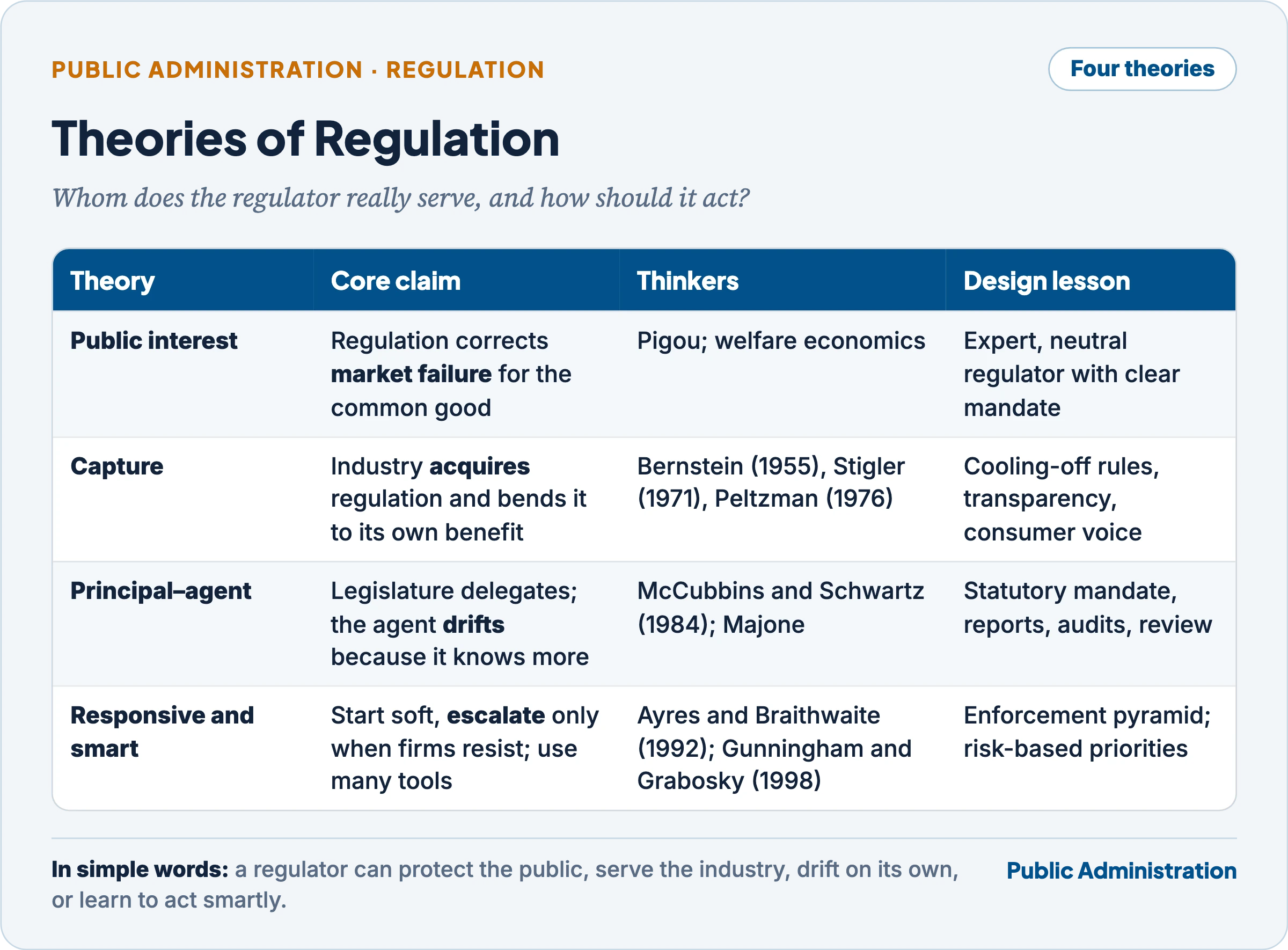
- Claim: regulation arises to correct market failures and is carried out by expert, disinterested officials in the general interest. It draws on welfare economics (A.C. Pigou) and the Progressive and New Deal faith in expert administration.
- Strength: it explains why regulators exist in exactly those sectors where markets fail (utilities, finance, food safety).
- Critique: it is normative rather than explanatory: it says what regulators should do, not what they do. It assumes regulators are benevolent and well-informed. Many regulations protect incumbents (licensing that blocks entry), which public interest theory cannot explain.
3.2 Capture theory
Capture means that the regulator comes to serve the interests of the industry it regulates rather than the public.
- Marver Bernstein, Regulating Business by Independent Commission (1955), proposed a life cycle of commissions: gestation (public outrage creates the agency), youth (crusading zeal), maturity (routine, cosy relations with the industry as public attention fades) and old age (debility, protection of the industry’s status quo).
- George Stigler, the Chicago economist, in The Theory of Economic Regulation (1971), turned capture into an economic theory: regulation is a product supplied by the state and demanded by interest groups. Small, concentrated, well-organised industries gain a lot per member and lobby hard; consumers are many, dispersed and lose little each, so they do not organise. Hence “as a rule, regulation is acquired by the industry and is designed and operated primarily for its benefit”. Typical benefits: subsidies, entry barriers, price fixing and control over substitutes.
- Sam Peltzman, Toward a More General Theory of Regulation (1976), refined this: the regulator is a vote- and support-maximiser who balances producer and consumer interests; it will not hand the industry everything, but will set prices between the competitive and the monopoly level. This explains why regulators sometimes cross-subsidise politically important groups (cheap power for farmers).
- Gary Becker (1983) added competition among pressure groups: outcomes reflect the relative pressure of organised groups.
- Forms of capture:
- Industry capture: through information dominance, lobbying and the revolving door (regulators taking jobs with regulated firms, or industry experts joining regulators).
- Political or executive capture: ministers pack regulators with loyal retired officials or dictate decisions informally.
- Cognitive capture: regulators come to see the world through the industry’s eyes because they depend on its data and experts.
- Critique of capture theory: it is often unfalsifiable (any outcome can be read as capture); it cannot explain deregulation that hurt incumbents (US airlines in 1978, Indian telecom liberalisation that ended incumbent dominance) or aggressive action against powerful firms (competition authorities fining global technology companies).
- Design lessons: cooling-off periods, conflict-of-interest disclosures, transparency of meetings and consultations, consumer representation, collegial boards and rotation of staff.
Indian Connect — Capture and conflict of interest in Indian regulation
- Indian regulators are frequently headed by retired civil servants of the parent ministry, which risks executive capture: the ministry’s preferences continue to shape decisions.
- The draft Regulatory Reform Bill (2013) proposed that an official who had dealt with a sector should not head its regulator until one year after leaving office, a cooling-off rule against both executive and industry capture.
- After allegations about conflicts of interest at the top of SEBI, a High-Level Committee on Conflict of Interest, Disclosures and related matters chaired by Pratyush Sinha submitted its report to SEBI on 10 November 2025, proposing stronger disclosure and recusal norms for SEBI’s own members and officials. Regulators, too, need regulating.
3.3 Principal–agent theory
- Logic: the legislature (principal) delegates power to a regulator (agent). The agent has more information than the principal and its own preferences, so it may drift from the principal’s intentions (agency drift or bureaucratic drift). The problem is the same as in public choice accounts of bureaucracy.
- Tools of control:
- Ex ante: precise statutory mandates, procedures, appointment rules, sunset clauses.
- Ex post: reports, audits, budget scrutiny, appeals, removal powers.
- Police patrols and fire alarms: Mathew McCubbins and Thomas Schwartz (1984) showed that legislators rarely patrol agencies directly; they rely on “fire alarms”: procedures that let affected citizens and firms complain (consultation, appeals, courts). Indian examples: mandatory public consultation by TRAI, appeals to TDSAT and APTEL, consumer complaints.
- Multiple principals: an Indian regulator answers to Parliament, the parent ministry, courts and appellate tribunals, and sometimes state governments, each with different goals, which blurs accountability.
- Paradox for design: the more independence is granted to obtain credibility (Majone), the greater the risk of drift. The answer is not less independence but better accountability: clear mandates, transparency and reasons.
3.4 Responsive regulation: the enforcement pyramid
Ian Ayres and John Braithwaite, Responsive Regulation: Transcending the Deregulation Debate (1992), rejected the stale choice between heavy-handed command-and-control and deregulation.
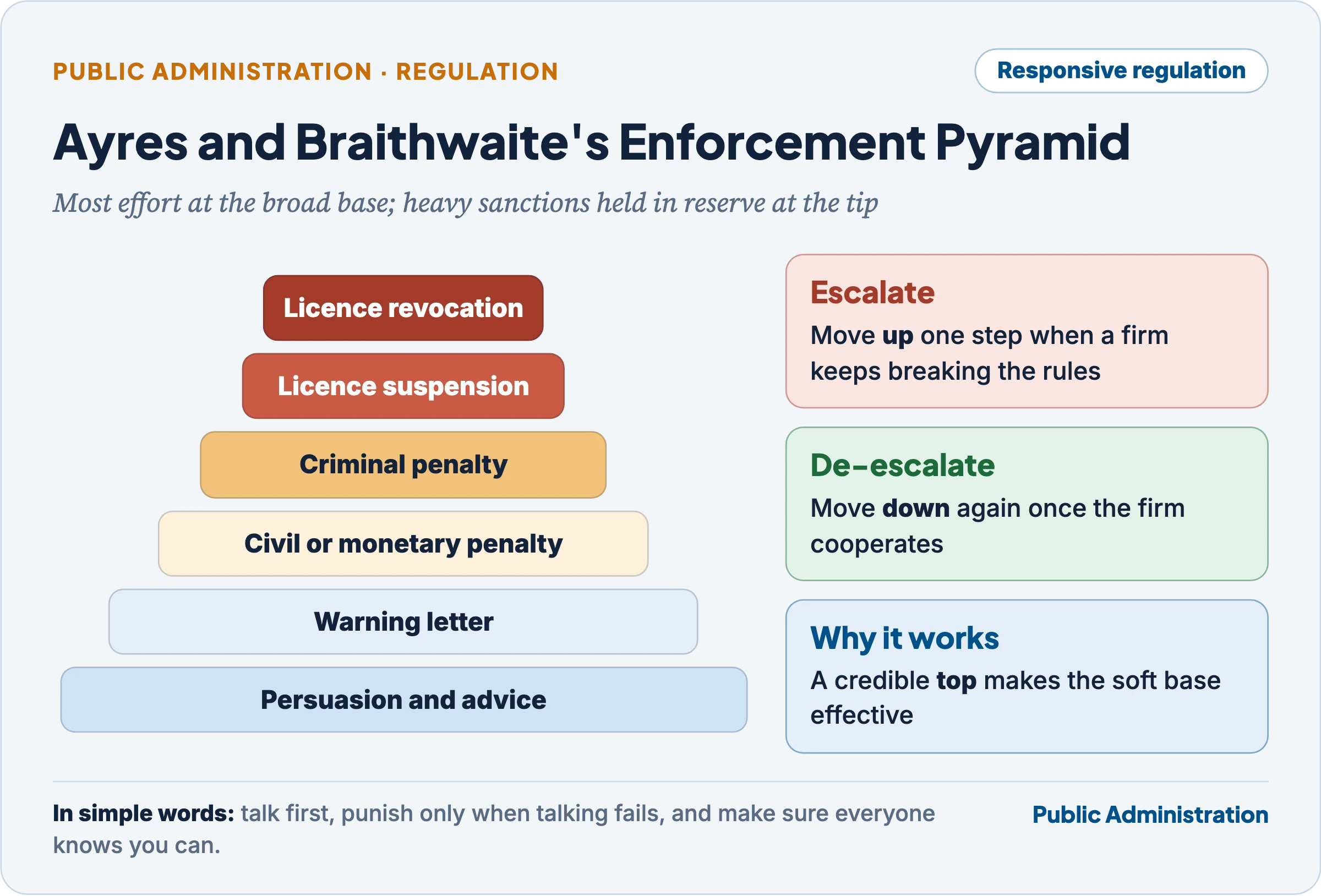
- The pyramid: most regulatory activity takes place at the broad base through persuasion and advice; if a firm does not comply, the regulator escalates step by step: warning letter, civil penalty, criminal penalty, licence suspension and finally licence revocation.
- Tit-for-tat: the regulator begins by assuming good faith and cooperates; it escalates only in response to non-compliance and de-escalates once the firm cooperates again.
- Benign big gun: the soft base works only because firms know the regulator can reach the tip. A regulator without credible heavy sanctions will be ignored; one that uses them first will provoke resistance.
- Enforced self-regulation and tripartism: firms write their own compliance rules under the regulator’s supervision; public interest groups are given a formal role to counter capture.
- Critique: escalation is slow against firms that cause one-off catastrophic harm; regulators may not be able to judge motives; small firms may be treated differently from large ones. Robert Baldwin and Julia Black (2008) proposed “really responsive regulation”, which responds also to the firm’s culture, the institutional setting, the regulator’s own performance and change over time.
3.5 Smart and risk-based regulation
- Smart regulation: Neil Gunningham and Peter Grabosky (Smart Regulation, 1998) argued for a mix of instruments and actors: not only state rules but market incentives, self-regulation, third parties (insurers, auditors, NGOs, consumers) and information disclosure, chosen to fit the problem.
- Risk-based regulation: inspection and enforcement resources are concentrated on firms and activities posing the highest risk, assessed through data. Examples: risk-based supervision of banks by the RBI; risk-based inspection by food safety authorities; risk categorisation of factories for inspection.
- Regulatory impact assessment (RIA): a cost–benefit test before making new rules, now standard in the OECD; the 2nd ARC asked that every statute creating a regulator provide for periodic external impact assessment.
- Trust-based regulation and decriminalisation: the Jan Vishwas (Amendment of Provisions) Act, 2023 decriminalised minor offences across many central laws, and the High-Level Committee for Regulatory Reforms (constituted on 19 August 2025, led by NITI Aayog member Rajiv Gauba) reviews non-financial regulations, licences and inspections. These follow the smart-regulation idea that heavy sanctions should be reserved for serious harm.
- Critique: risk models can miss new risks; data may be poor in developing countries; light-touch regimes can turn into neglect, as the 2008 global financial crisis showed.
Common confusion
Is “light-touch” regulation the same as responsive or smart regulation? No. Light-touch regulation means low intensity everywhere. Responsive regulation means starting soft but escalating quickly and credibly; smart regulation means using the right mix of tools, which may include very strict ones. Both require a strong regulator with real teeth; light-touch regimes often lack them.
4. Designing Regulators: Independence and Accountability
In simple words
A referee must not be afraid of the team owners, or he will favour them. But a referee who answers to nobody can also misuse the whistle. Good design gives the regulator a secure job and its own money, and then makes it explain every decision in public, before Parliament and before the courts.
4.1 The Cushman dilemma
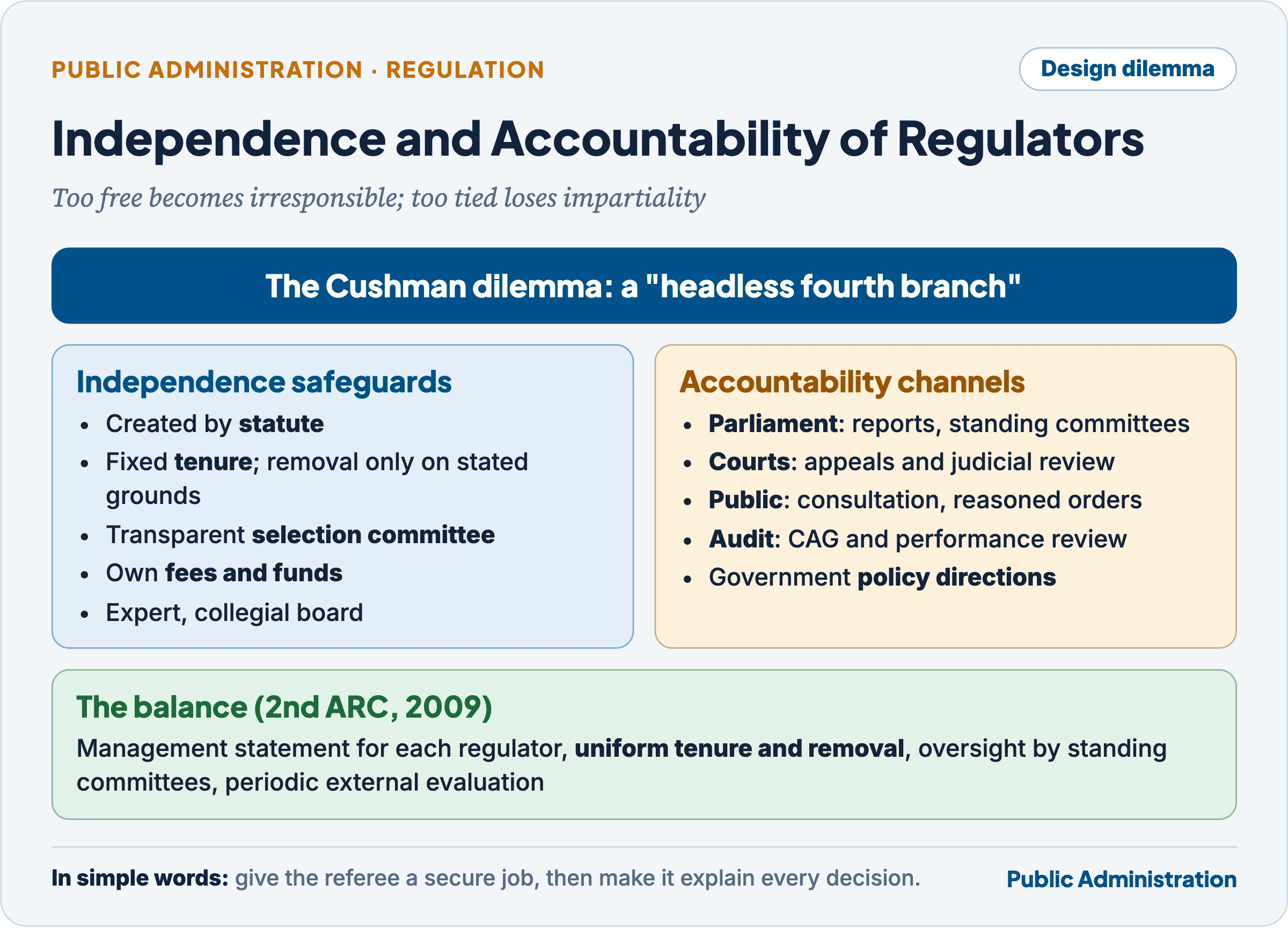
- In 1937 the President’s Committee on Administrative Management (the Brownlow Committee) called the American independent regulatory commissions a “headless fourth branch of government”: a dozen powerful agencies outside the executive, legislative and judicial hierarchy. The study on these commissions was prepared by the American political scientist Robert E. Cushman, who later wrote The Independent Regulatory Commissions (1941).
- The dilemma (the 2016 question): if commissions are wholly independent, they make important policy and administrative decisions while being responsible to no one; if they are robbed of independence, their quasi-judicial work (deciding cases between parties) loses its impartiality.
- Cushman’s way out: separate the two kinds of work. Policy and administrative functions should be brought under the responsible executive; the adjudicating part should remain independent and judicial in character. India’s practice of giving government power to issue policy directions while protecting quasi-judicial decisions and providing appellate tribunals follows this logic in a looser form.
4.2 Dimensions of independence
| Dimension | Meaning | Indian practice and problems |
|---|---|---|
| Legal | Created by statute with a clear mandate | Most major regulators are statutory; some bodies began by executive order (SEBI 1988, PFRDA 2003) |
| Appointment | Transparent selection committee | Committees exist but are often dominated by officials of the parent ministry |
| Tenure and removal | Fixed term; removal only on stated grounds after inquiry | Terms vary (3 to 5 years, age caps); post-retirement appointments common |
| Financial | Own fee income, not dependent on ministry grants | Mixed: SEBI and IRDAI rely on fees; others need budget support and ministry approvals |
| Operational | Freedom to hire experts and set procedures | Staff often on deputation from ministries; pay scales tied to government |
| Policy | Government gives directions only on policy | Laws such as the TRAI Act (Section 25) and the Electricity Act (Section 107) let the Union give binding policy directions, and the government decides what counts as “policy” |
4.3 Accountability mechanisms
- To Parliament: annual reports laid before Parliament; questions; scrutiny by Departmentally Related Standing Committees; audit by the CAG where public funds are involved.
- To the executive: policy directions, appointment and removal powers, approval of budgets and rules, and in extreme cases supersession under the statute.
- To courts: judicial review under Articles 32, 226 and 136, and statutory appeals to specialised tribunals.
- To the public: consultation papers, open hearings, reasoned orders, RTI, publication of agendas and minutes.
- Answerability by results: periodic performance evaluation and regulatory impact assessment.
- The 2nd ARC stressed that independence and accountability are mutually reinforcing, not a trade-off: the greater the autonomy, the more credible the accountability mechanisms must be.
4.4 Appellate tribunals
- Appeals from Indian regulators go to specialised tribunals: TDSAT (telecom, airports tariff and data-related disputes), APTEL (electricity), SAT (securities, insurance, pensions), NCLAT (competition and insolvency matters; the Competition Appellate Tribunal was merged into it in 2017), the Real Estate Appellate Tribunals of the States.
- Purpose: expert and quick review of regulatory decisions, sparing High Courts.
- Problems: vacancies, executive control over appointments and tenure, and dilution of judicial character. The Supreme Court repeatedly struck down executive-dominated arrangements, most recently in Madras Bar Association v. Union of India (19 November 2025), which invalidated key provisions of the Tribunals Reforms Act, 2021 as a re-enactment of rules already struck down, and directed the creation of a National Tribunals Commission.
- Parliament responded with the Tribunals Reforms Act, 2026 (assented to on 13 August 2026), which provides for a National Tribunals Commission to oversee selection and administration of tribunal members.
4.5 Overlap and the super-regulator debate
The 2010 question asks whether overlapping jurisdictions require a super-regulator or unified regulator.
- Overlaps in India: CCI and sector regulators (TRAI, CERC, RBI) both claim jurisdiction over anti-competitive conduct in their sectors; financial conglomerates are supervised by RBI, SEBI, IRDAI and PFRDA; digital platforms are touched by MeitY, the Data Protection Board, CCI and TRAI.
- In Competition Commission of India v. Bharti Airtel (2018), the Supreme Court held that where a sector regulator exists, TRAI must first decide the sector-specific questions (interconnection obligations) before CCI could examine anti-competitive behaviour: an attempt to sequence rather than merge.
| Arguments for a unified or super-regulator | Arguments against |
|---|---|
| Ends jurisdictional conflict and regulatory arbitrage (firms choosing the softest regulator) | Sector expertise is lost; a generalist body cannot master telecom and electricity alike |
| Uniform standards, procedures and appointments | Concentration of power; single point of capture |
| Economies of scale in staff and data | Converging sectors (finance) differ from network sectors (power, telecom) |
| Better oversight of conglomerates and converging technologies | Coordination can be achieved through councils and MoUs |
- Middle path in India: the Financial Stability and Development Council (FSDC, 2010) coordinates financial regulators; the Forward Markets Commission was merged into SEBI in 2015, a partial unification recommended by FSLRC. The 2nd ARC (2009) rejected a separate Department of Regulatory Affairs, saying a generic department could never acquire deep sectoral expertise, and preferred uniformity through the Committee of Secretaries and the Secretary (Coordination) in the Cabinet Secretariat.
4.6 Quasi-judicial and quasi-legislative powers
- Regulations made by regulators are subordinate (delegated) legislation. They must stay within the parent Act and are open to judicial review for arbitrariness (Article 14) and unreasonable restrictions (Article 19(1)(g)).
- In PTC India Ltd v. CERC (2010), a Constitution Bench held that regulations under Section 178 of the Electricity Act are subordinate legislation that cannot be challenged before the appellate tribunal; their validity can be tested only in judicial review.
- Combining rule-making, enforcement and adjudication in one body risks bias. Good practice separates the investigating and adjudicating wings internally (CCI’s Director General investigates; the Commission decides), follows natural justice and gives reasons. The article on administrative law explains delegated legislation and natural justice in detail.
5. Regulatory Authorities in India
In simple words
Before 1991 the government regulated the economy mostly by owning companies and issuing licences. After 1991, as private companies entered banking, stock markets, telecom, power and insurance, Parliament created specialised umpires for each field: SEBI for stock markets, TRAI for telecom, CERC for electricity, and so on.
5.1 The main regulators
| Sector | Regulator | Law and year | Core functions |
|---|---|---|---|
| Money and banking | RBI | RBI Act, 1934 (began 1935); Banking Regulation Act, 1949 | Monetary policy (with the Monetary Policy Committee since 2016), regulation of banks and NBFCs, payments |
| Securities | SEBI | Set up in 1988; statutory under SEBI Act, 1992 | Protect investors, regulate and develop securities markets, intermediaries and disclosures |
| Insurance | IRDAI | IRDA Act, 1999 | Licensing and solvency of insurers, policyholder protection |
| Pensions | PFRDA | Set up in 2003; statutory under PFRDA Act, 2013 | Regulates the National Pension System and pension funds |
| Telecom | TRAI, with TDSAT | TRAI Act, 1997; amended 2000 | Recommendations on licensing and spectrum, tariffs, interconnection, quality of service |
| Electricity | CERC and SERCs, with APTEL | Electricity Regulatory Commissions Act, 1998; Electricity Act, 2003 | Tariffs, licensing of transmission and trading, grid code, open access |
| Airports | AERA | AERA Act, 2008 (set up 2009) | Tariffs for aeronautical services at major airports |
| Petroleum and gas | PNGRB | PNGRB Act, 2006 | Downstream pipelines and city gas distribution |
| Competition | CCI | Competition Act, 2002 (fully operational 2009; MRTP Commission wound up) | Anti-competitive agreements, abuse of dominance, merger control |
| Insolvency | IBBI | Insolvency and Bankruptcy Code, 2016 | Regulates insolvency professionals and processes |
| Food | FSSAI | Food Safety and Standards Act, 2006 (set up 2008) | Food standards, licensing, safety |
| Real estate | RERAs (State) | Real Estate (Regulation and Development) Act, 2016 | Project registration, escrow of buyers’ money, complaint redressal |
| Consumers | Central Consumer Protection Authority | Consumer Protection Act, 2019 (set up 2020) | Class action against unfair trade practices and misleading advertisements |
| Accounting and audit | NFRA | Companies Act, 2013 (constituted 2018) | Oversight of auditors of listed and large companies |
After the table, three features stand out.
- Sectoral logic: India chose sector-specific regulators rather than a single utility regulator, mirroring the UK and US.
- Federal layering: electricity and real estate have State regulators (SERCs, State RERAs), so regulatory quality varies by State; tariffs in particular remain politically sensitive at State level.
- Uneven independence: RBI and SEBI are powerful and fee-funded; newer bodies depend on ministries for staff and money.
Indian Connect — TRAI and consumer protection
- Tariff orders and transparency: TRAI publishes consultation papers, holds open house discussions and issues reasoned tariff and quality-of-service regulations.
- Net neutrality: the Prohibition of Discriminatory Tariffs for Data Services Regulations (2016) barred differential pricing of data by content, ending zero-rating schemes.
- Unsolicited calls and spam: the Telecom Commercial Communications Customer Preference Regulations (2018) created do-not-disturb registers and blockchain-based consent records.
- Choice and quality: mobile number portability, publication of call-drop and speed data, and consumer complaint portals.
- Limits: in Cellular Operators Association of India v. TRAI (2016) the Supreme Court struck down TRAI’s call-drop compensation regulation as arbitrary and unreasonable and faulted its lack of transparency and reasons, holding that TRAI’s regulations are subordinate legislation open to judicial review. Consumer protection by regulation must still be evidence-based and procedurally fair.
- Telecommunications Act, 2023, which replaced the Indian Telegraph Act, 1885 and related colonial laws, reorganised licensing as authorisation, provided for administrative allocation of satellite spectrum and widened the field from which TRAI’s chairperson and members can be drawn; TRAI’s recommendatory role on spectrum and authorisations continues.
5.2 Recent laws and bills reshaping regulation
- Competition (Amendment) Act, 2023: introduced a deal-value threshold for merger notification (brought into force in September 2024), settlement and commitment procedures, and penalties based on global turnover, aimed at digital markets.
- Digital Competition Bill: a draft bill for ex ante rules on large digital platforms was released in March 2024, following a parliamentary committee report; in August 2025 the government withdrew the draft in its existing form and commissioned a market study before any redrafting.
- Digital Personal Data Protection Act, 2023 and the DPDP Rules, 2025 (notified in November 2025): created the Data Protection Board of India, an adjudicatory body for data breaches, with the provisions on the Board brought into force first and other obligations phased in.
- Securities Markets Code, 2025: introduced in the Lok Sabha on 18 December 2025 to consolidate the SEBI Act, the Securities Contracts (Regulation) Act and the Depositories Act; referred to the Standing Committee on Finance.
- Sabka Bima Sabki Raksha (Amendment of Insurance Laws) Act, 2025: passed in December 2025; raised the FDI limit in insurers to 100 per cent and gave IRDAI wider powers (to supersede an insurer’s board, regulate agents’ commission and inspect intermediaries).
- Tribunals Reforms Act, 2026: a National Tribunals Commission for the selection and oversight of tribunal members, after the 2025 judgment.
5.3 Problems of the Indian regulatory system
- “Too much control and too little regulation”: ministries keep tariff, licensing and appointment levers, so many regulators implement government preferences rather than independent rules.
- Post-retirement appointments: regulators become destinations for retired officials of the very ministry they deal with, weakening expertise and independence.
- Vacancies and delays in appointments to regulators and tribunals.
- Capacity gaps: few economists, engineers and data scientists; reliance on deputation.
- Overlapping jurisdiction and turf wars (CCI and sector regulators; RBI and SEBI over hybrid products).
- Political pricing: State governments direct SERCs to keep farm and domestic tariffs low, accumulating distribution company losses.
- Weak parliamentary scrutiny (see section 6.4) and heavy reliance on courts, leading to long litigation.
- Regulatory unpredictability: retrospective changes and abrupt policy shifts deter investment, the reverse of the credible-commitment logic.
6. Reviews and Reform of Regulators
In simple words
Over the last two decades, commissions and committees have studied Indian regulators and asked for the same things again and again: choose regulators fairly, give them fixed terms and money of their own, and then make them report regularly to Parliament and the public.
6.1 Second Administrative Reforms Commission: 13th Report (2009)
The 2nd ARC’s thirteenth report, Organisational Structure of Government of India (April 2009), has a chapter on creating an effective regulatory framework. Its recommendations:
- Regulator only where justified: setting up a regulator should be preceded by a review of whether a regulator would deliver the department’s policy objectives better than the department itself.
- Management statement: in addition to the statute, each ministry should evolve a management statement (on the UK Treasury model) setting out the regulator’s objectives, its role and the rules governing its interaction with government.
- Uniform appointment, tenure and removal: appointment of chairpersons and members on the recommendation of a selection committee whose composition is defined in each Act, broadly on the pattern of the electricity regulators; a uniform tenure (preferably three years or age 65, whichever earlier); removal only on specified grounds, as in Section 6 of the IRDA Act, with an inquiry and UPSC consultation before removal for abuse of power.
- Parliamentary oversight through the respective Departmentally Related Standing Committees, rather than a separate exclusive committee for regulators.
- Periodic evaluation: a body of reputed outside experts should frame guidelines; regulators’ annual reports should report performance against them and be discussed by the parliamentary committee.
- Impact assessment and sunset: each statute creating a regulator should provide for periodic external impact assessment; once a level playing field is achieved, regulatory intervention could be reduced, leading to abolition or convergence with other regulators.
- No Department of Regulatory Affairs; uniformity through the Committee of Secretaries and the Secretary (Coordination).
- The Commission also argued that independence and accountability are mutually reinforcing, and cited UK good practices: open meetings, corporate plans, affordable appeals, consultation, regulatory impact assessment.
6.2 Financial Sector Legislative Reforms Commission (2013)
- Chair: Justice B.N. Srikrishna; constituted in 2011, report in March 2013.
- Draft Indian Financial Code to replace dozens of financial laws with a principles-based code.
- Regulatory architecture: RBI to regulate banking and payments; a Unified Financial Agency to absorb SEBI, the Forward Markets Commission, IRDA and PFRDA; a Financial Sector Appellate Tribunal (an expanded SAT); a Resolution Corporation for failing firms; a Financial Redress Agency for consumer complaints; a Public Debt Management Agency; and a statutory FSDC.
- Regulatory governance principles: clear objectives, board composition with independent members, cost–benefit analysis of regulations, public consultation, reasoned orders, separation of rule-making and adjudication, and accountability through reporting to Parliament.
- Follow-up: the FMC–SEBI merger (2015), the Monetary Policy Committee (2016) and the insolvency framework partly reflect its thinking; the Unified Financial Agency and the full Code were not adopted.
6.3 The draft Regulatory Reform Bill
- Released by the Planning Commission in 2013 as an overarching law for infrastructure regulators, revisited in a 2015 consultation; it was never enacted.
- Key provisions: a common selection committee (including a UPSC member) to recommend panels; a four-year term with no reappointment; at least one member each with finance, technical and legal or public administration expertise; a one-year cooling-off bar for officials who dealt with the sector; asset disclosure; power to merge regulators and appellate tribunals; and answerability to Parliament through annual reports and a parliamentary committee.
- The Commission on Review of Administrative Laws (chaired by P.C. Jain, 1998) had earlier recommended repeal of over 1,300 obsolete central laws and harmonised regulatory frameworks for thirteen sectors, an early attempt at regulatory clean-up.
6.4 Parliamentary oversight gaps
- Laying is not scrutiny: annual reports of regulators are laid before Parliament but rarely debated.
- Standing committees are overloaded: each Departmentally Related Standing Committee covers ministries with large budgets and has little time for regulators.
- No regulatory budget review or regular hearings of regulators’ chairpersons, unlike the UK’s select committee practice.
- Information asymmetry: MPs lack technical staff to assess tariff orders or prudential rules.
- Remedy proposals: a dedicated sub-committee or regular hearings within standing committees; performance reports against published objectives (2nd ARC); a parliamentary budget and research office.
6.5 Courts and regulators
Judicial review has become a major channel of regulatory accountability in India.
- Cellular Operators Association of India v. TRAI (2016): regulations are subordinate legislation; transparency under Section 11(4) of the TRAI Act and reasoned decision-making are mandatory; the call-drop compensation rule fell as arbitrary.
- PTC India v. CERC (2010): regulations under the Electricity Act bind as subordinate legislation and can be challenged only through judicial review.
- Sahara India Real Estate Corporation v. SEBI (2012): upheld SEBI’s jurisdiction over large public issues of hybrid securities and ordered refunds to investors, strengthening the regulator.
- CCI v. Bharti Airtel (2018): sector regulator first, competition authority after, on sector-specific questions.
- Madras Bar Association v. Union of India (2025): independence of tribunals that hear regulatory appeals.
Indian Connect — Regulatory reform agenda in India
- Appointment reform: transparent selection committees with independent members; fixed non-renewable terms; cooling-off periods.
- Financial autonomy: fee-based funding with parliamentary audit.
- Accountability: management statements, published performance reports, parliamentary hearings.
- Coordination: FSDC-type councils for other sectors, memoranda of understanding between CCI and sector regulators.
- Quality of rules: regulatory impact assessment and decriminalisation (Jan Vishwas, 2023; the Gauba committee, 2025).
- Capacity: lateral recruitment of domain experts and in-house research.
7. Public-Private Partnerships: Meaning and Rationale
In simple words
Suppose a city needs a new water treatment plant but has no money and little engineering talent. It signs a 20-year contract with a company: the company builds the plant with its own loans, runs it to agreed standards, and is paid either by water charges or by the city. At the end, the plant belongs to the city. That is a public-private partnership: the public keeps the goal, the private partner brings money and skill, and both share the risks.
7.1 Definitions
There is no single accepted definition; each country defines PPP in the light of its own law.
- E.S. Savas, Privatization and Public-Private Partnerships (2000): any arrangement in which activities that are partly or traditionally public are performed by the private sector.
- Government of India (draft National PPP Policy, 2011): an arrangement between a government or statutory entity and a private sector entity for the provision of public assets or public services, through investment or management by the private entity for a specified period, with a well-defined allocation of risk and performance-linked payments that conform to pre-determined, measurable standards.
- South Africa defines PPP in law as a contract in which a private party performs an institutional function or uses state property and substantial project risk passes to it.
- Darrin Grimsey and Mervyn Lewis (2004) stress PPPs as long-term arrangements for infrastructure provision and project finance.
- Some writers stress a triangular relationship: state, market and civil society together, as in “government by network” (Stephen Goldsmith and William Eggers, Governing by Network, 2004).
7.2 Essential features
- Long-term contract (typically 15–30 years), not a one-off purchase.
- Public asset or public service that the state has traditionally provided.
- Private investment and/or management in design, construction, finance, operation or maintenance.
- Risk sharing: each risk is allocated to the party best able to manage it; mere outsourcing with no risk transfer is not a PPP.
- Output specification: the contract specifies outputs and service levels, not technical inputs, leaving room for innovation.
- Performance-linked payment: through user charges (tolls, tariffs) or government payments (annuities, availability payments) tied to service standards, with penalties and incentives.
- Finite duration: assets usually revert to the public authority at the end; arrangements in perpetuity are excluded.
- Special Purpose Vehicle (SPV): a consortium of a construction company, an operator and lenders forms a project company that signs the concession; where the government invests, it may hold equity in the SPV.
- Government remains accountable: it stays responsible for service quality, price certainty and value for money. Its role is redefined as facilitator, enabler and regulator, while the private partner acts as financier, builder and operator.
Indian guidance also lists desirable conditions: the project must be a high government priority that the government would want regardless of financing; outputs must be clearly definable; there must be avenues for non-government revenue; and the private sector must have the capacity to deliver.
7.3 Rationale
- Infrastructure gap and fiscal constraint: the scale of investment needed in roads, power, ports, urban services and health cannot be met from budgets alone; PPPs leverage private capital.
- Efficiency and innovation: private management, technology and incentives for timely completion; the developer bears cost overruns in a well-designed contract.
- Whole-of-life costing: because the same party builds and maintains, it has an incentive to build well to reduce maintenance costs.
- Risk transfer to those best placed to manage construction and operation risks.
- Value for money (VfM) rather than mere off-budget financing.
- Speed and capacity: faster implementation, transfer of skills to government, and a push for public sector reform.
- Origins: the pressure arose from public debt in the 1970s–80s. The UK’s Private Finance Initiative (PFI), launched in 1992 under John Major, first aimed at reducing the Public Sector Borrowing Requirement; the Blair government (from 1997) kept PFI but shifted its justification to value for money through risk allocation. The early belief that private finance provides infrastructure “at no cost to the public” was later abandoned, since users or taxpayers ultimately pay.
7.4 PPP, privatisation and outsourcing
| Basis | PPP | Privatisation (divestiture) | Outsourcing / service contract |
|---|---|---|---|
| Ownership | Usually stays public, or reverts after the term | Passes permanently to private owners | Public |
| Duration | Long (15–30 years) | Permanent | Short (1–5 years) |
| Risk transfer | Substantial, contractually shared | Total (owner bears all) | Minimal |
| Government role | Partner, regulator, monitor of performance | Regulator only | Purchaser |
| Accountability for service | Government remains answerable | Market and regulator | Government |
| Example | Delhi and Mumbai airports, highway concessions | Sale of a PSU’s majority stake (UK under Thatcher; Indian strategic sales) | Catering on trains, hospital housekeeping |
- Forms of privatisation include deregulation (allowing private entry alongside public firms), delicensing, divestiture (sale of state assets) and complete privatisation. PPP is a middle path: the state retains ownership and responsibility but brings in private finance and management.
- De-monopolisation often accompanies PPP: State Electricity Boards that held a monopoly over generation, transmission and distribution were unbundled; Delhi privatised distribution, and Odisha privatised distribution earlier.
- In the words often attributed to the Planning Commission, PPPs should be seen as public projects with private participation, not private projects with public support.
Common confusion
Is every contract with a private firm a PPP? No. The Government of India’s definition excludes simple service contracts, EPC (engineering, procurement and construction) contracts and divestiture of assets. A road built by a contractor and paid for entirely by NHAI on completion (EPC) is public procurement. It becomes a PPP only when the private partner finances at least part of it, maintains it for years and is paid according to performance.
7.5 Perspectives on PPP
The 2018 question asks for the public sector-centred and market-centred perspectives and their comparison.
| Basis | Public sector-centred perspective | Market-centred perspective |
|---|---|---|
| Purpose | Achieve public goals (access, equity, quality); PPP is a tool of the state | Efficiency, profitability, mobilising private capital; PPP is a market opportunity |
| View of the state | Steering, regulating, protecting the public interest | Facilitator that removes constraints and guarantees returns |
| Key value | Publicness: accountability, transparency, citizen rights | Value for money, innovation, risk transfer |
| Risk | Government must not offload responsibility; social risks remain public | Transfer as much commercial risk as possible, priced into returns |
| Success test | Service outcomes for citizens, especially the poor | Financial closure, timely completion, investor returns |
| Theoretical roots | Public interest theory, New Public Service, governance | NPM, public choice, contract theory |
- Comparison: the market-centred view drove the first wave of Indian PPPs (aggressive bids, focus on financing); the Kelkar Committee pulled India back towards a public sector-centred view by insisting that service delivery to citizens, not fiscal convenience, should be the aim, and that PPPs must not be used to evade the government’s responsibility.
- Stephen Linder (1999) showed that “PPP” carries multiple meanings: management reform, problem conversion (turning public problems into market opportunities), moral regeneration (making officials more entrepreneurial), risk shifting, restructuring public service, and power sharing. The same label can cover very different political projects.
- Graeme Hodge and Carsten Greve (2007) found the evidence on PPP performance mixed, often weaker than the rhetoric.
7.6 Stakeholders and their conflicting aims
The 2015 question quotes the view that PPPs serve too many parties and too many interests to be focused.
| Party | Main aim | Typical conflict |
|---|---|---|
| Government / sponsoring authority | Asset delivered quickly, off-budget; political credit | Wants low tariffs and fast delivery yet high risk transfer |
| Private developer / SPV | Return on equity, early exit | Seeks guarantees, higher tariffs, renegotiation |
| Lenders | Safe repayment | Prefer government guarantees and termination payments |
| Construction contractor | Construction profit | May cut corners if not also responsible for maintenance |
| Users / citizens | Affordable, reliable service | Oppose tolls, user charges and exclusion |
| Workers | Job security | Fear lay-offs after transfer |
| Regulator | Fair tariffs and quality | Squeezed between investor returns and consumer pressure |
| Auditors and investigating agencies | Probity | Officials fear post-facto charges, slowing decisions |
| Civil society and media | Transparency, equity | Distrust of “crony” deals |
- Implication: because so many interests are stitched into one contract, PPPs need clear objectives, transparent procurement, an independent regulator and a dispute-resolution mechanism; otherwise the partnership is pulled in different directions.
8. PPP Models
In simple words
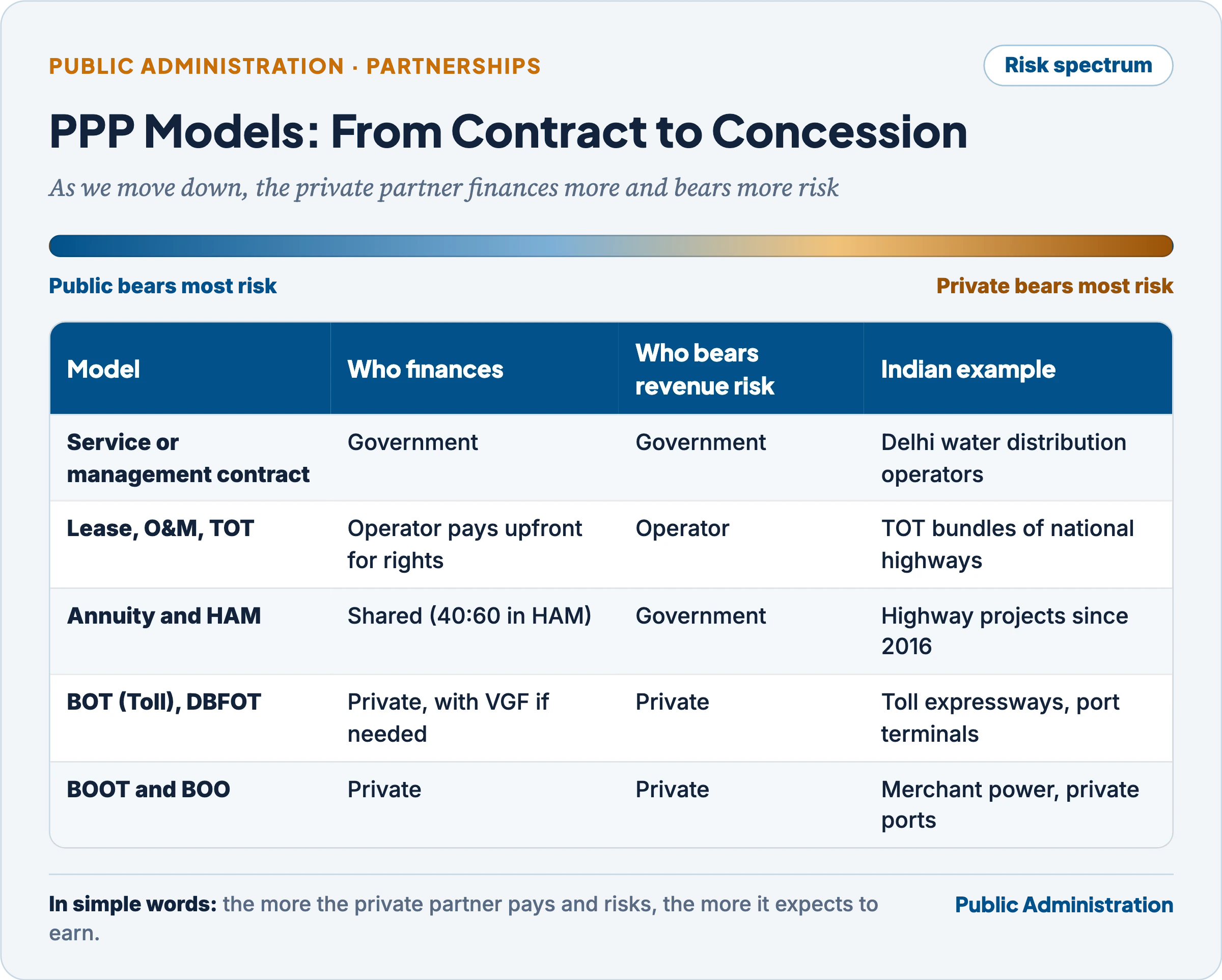
PPPs come in many shapes. In some, the company is only hired to run something the government owns. In others, it borrows money, builds a road, collects tolls for 20 years and then hands it back. The more money the company puts in and the more risk it takes, the more it expects to earn.
8.1 The main contractual forms
- Service contract: the public authority contracts out specific services (cleaning, catering, billing, ticketing) for a fee; the government keeps all assets and commercial risk.
- Management contract: a private operator runs and maintains a system for 3–5 years for a fee, takes day-to-day decisions, but bears no capital risk. The Delhi Jal Board water projects are of this hybrid type (section 12).
- Lease (affermage): the private firm pays rent and operates the facility, keeping user revenue and bearing operational risk.
- Build-Operate-Transfer (BOT): the private party finances and builds an asset, operates it for a concession period recovering cost and return, then transfers it. Variants:
- BOT (Toll): the concessionaire collects tolls and bears traffic risk; budgetary support is limited to an upfront grant (VGF) decided through competitive bidding.
- BOT (Annuity): the government pays fixed annual sums out of budget; it bears traffic risk.
- Build-Own-Operate-Transfer (BOOT): like BOT, but the private entity owns the asset during the concession.
- Build-Own-Operate (BOO): the private party owns the asset permanently; the draft Indian policy treated BOO as not a preferred form because of finite government resources and difficulty in enforcing performance.
- Design-Build-Finance-Operate-Transfer (DBFOT): the most complete form of concession used in Indian model agreements for highways and ports.
- Build-Lease-Transfer (BLT) and Operate-Maintain-Transfer (OMT): OMT contracts are used for maintaining completed highways with toll collection.
- Toll-Operate-Transfer (TOT): approved in 2016; the government bundles completed, revenue-earning highways and auctions the right to collect tolls for about 30 years against an upfront lump sum, which it reinvests in new roads. The first bundle was awarded in 2018.
- Hybrid Annuity Model (HAM): see 8.2.
- Infrastructure Investment Trusts (InvITs): not a contract form but a monetisation vehicle under SEBI regulations (2014): completed, revenue-generating assets are placed in a trust whose units are sold to investors; NHAI, PowerGrid and others have used InvITs.
- Municipal bonds and franchising: cities raise market finance (Ahmedabad’s municipal bond of 1998 was a pioneer) and franchise services such as waste collection or city buses.
- Social PPPs: variants such as public-social-private partnerships, and global product development partnerships for drugs against neglected diseases (the Medicines for Malaria Venture).
8.2 The Hybrid Annuity Model (HAM)
- Approved by the Cabinet Committee on Economic Affairs on 27 January 2016 for national highways.
- Structure: the government pays 40 per cent of the project cost during construction; the developer arranges the remaining 60 per cent (equity and debt) and recovers it, with interest, through annuity payments over the operation period, plus operation and maintenance payments. NHAI collects tolls itself.
- Risk allocation: the private partner bears construction and maintenance risk; financing risk is shared; traffic and inflation risks stay with the government, since they are beyond the developer’s control.
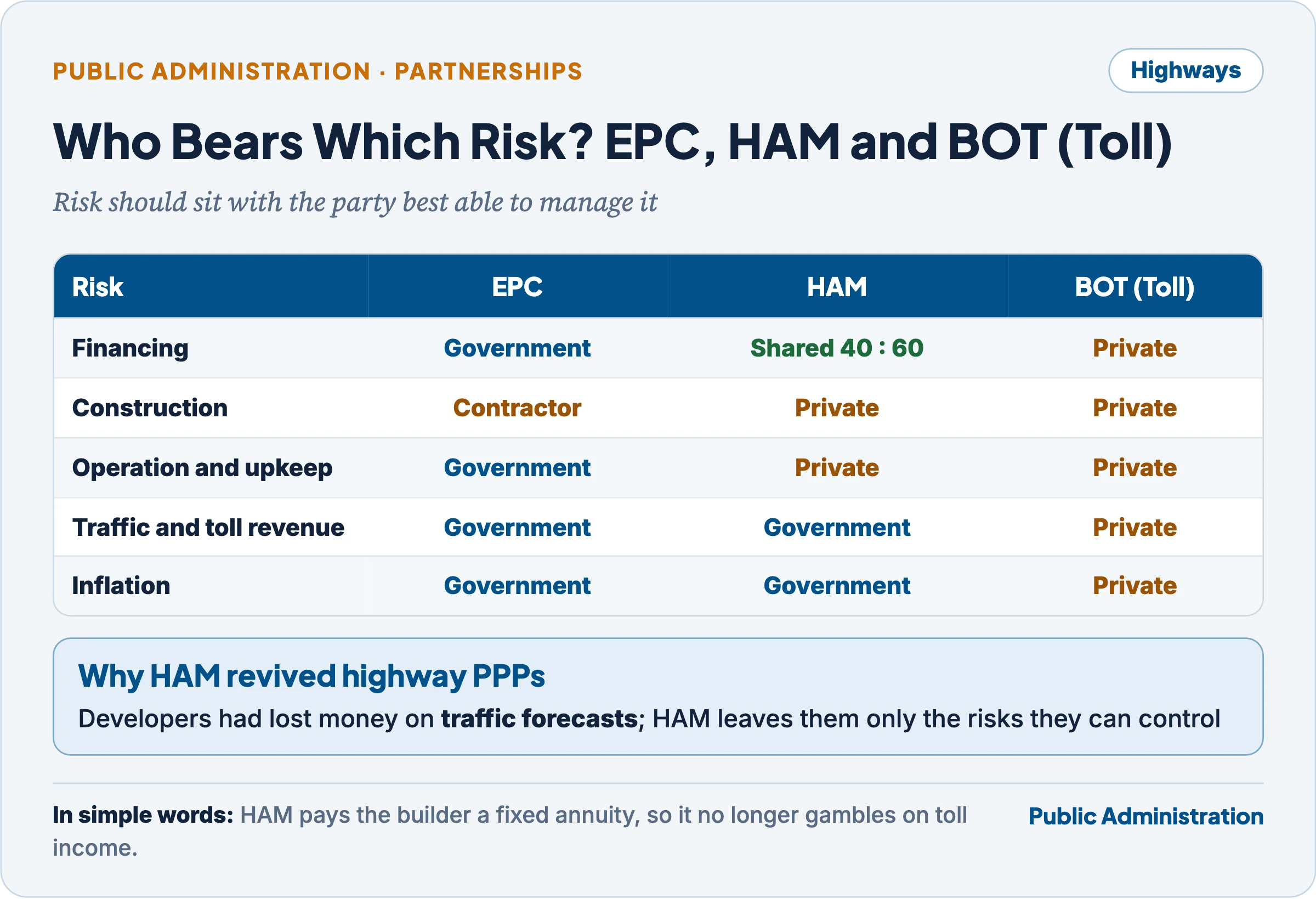
- Why it was needed: after 2011–12, BOT (Toll) projects collapsed because traffic forecasts proved optimistic, land acquisition stalled and banks stopped lending; the government had to fall back on EPC, which strained its budget. HAM sits between the two and revived private interest.
- Critique: HAM puts long annuity liabilities on the government’s books (contingent fiscal commitments) and returns traffic risk to the state; in recent years the government has sought to revive BOT (Toll) for viable corridors so that the private partner again shares demand risk.
8.3 The Swiss challenge
- Mechanism: a private party submits an unsolicited (suo motu) proposal for a project; the government publishes it and invites counter-proposals; if a better counter-bid comes in, the original proponent gets the right to match it.
- Merits: taps private ideas and innovation, especially where government lacks project-development capacity.
- Criticism: information asymmetry (the original proponent knows the project best), weak competition, scope for favouritism.
- Indian position: the draft National PPP Policy (2011) proposed not to allow it; the Kelkar Committee asked that it be actively discouraged; it has nevertheless been used selectively (for example, some railway station redevelopment offers in 2016) and in some States.
9. Risk Allocation, Value for Money and Viability Gap Funding
In simple words
A PPP is basically a deal about who pays if something goes wrong. If traffic is low, if costs rise, if land is not handed over, or if the law changes, someone must bear the loss. A good PPP gives each risk to whoever can best control it, and checks that the whole deal is cheaper for the public than doing it the old way.
9.1 Risk allocation
| Risk | Usually best borne by | Reason |
|---|---|---|
| Land acquisition, clearances, right of way | Government | Only the state can acquire land and grant clearances |
| Construction (cost and time overrun) | Private | It controls design, contractors and schedules |
| Operation and maintenance | Private | It controls quality and efficiency |
| Demand or traffic | Depends on the sector and model | Private where it can influence demand (airports, ports); government where it cannot (rural roads, HAM) |
| Financing and interest rate | Private, sometimes shared | Lenders and sponsors manage capital structure |
| Change in law, policy and regulation | Government | It controls these decisions |
| Force majeure | Shared | Neither party controls it |
| Social, environmental and political risk | Government | Requires public authority and citizens’ consent |
- Principle: allocate risk to the party best able to manage it at least cost. Over-transferring risk (for example, traffic risk on new rural highways) makes bidders either inflate prices or bid aggressively and later default.
- The Kelkar Committee called inefficient and inequitable risk allocation a major cause of PPP failure and asked for a generic risk monitoring and evaluation framework over the project life cycle.
9.2 Value for money (VfM)
- Meaning: the PPP option should deliver the required service at lower whole-of-life cost (adjusted for risk) than traditional public procurement, or better quality for the same cost.
- Public Sector Comparator (PSC): a hypothetical cost of the project if done by government, adjusted for risks retained; the PPP should beat it.
- Pitfalls: private borrowing costs more than government borrowing; transaction costs (advisers, lawyers) are high, so small projects rarely give VfM; optimistic PSC assumptions can bias the choice. The OECD’s principles say there should be no institutional, procedural or accounting bias for or against PPPs: VfM alone should decide.
- Affordability and fiscal transparency: PPP payments and contingent liabilities (guarantees, termination payments) must be disclosed in budget documents; otherwise PPPs become a way to hide public debt.
9.3 Viability Gap Funding (VGF)
- Problem it solves: many projects are economically justified (they benefit society) but not financially viable (user charges alone cannot repay investment).
- Scheme for Financial Support to PPPs in Infrastructure (VGF Scheme): administered by the Department of Economic Affairs, Ministry of Finance. It gives a capital grant, normally at the construction stage, to PPP projects whose private sponsors are selected through open competitive bidding; the grant amount is itself usually the bid parameter (the bidder seeking the least VGF wins).
- Original ceilings: up to 20 per cent of total project cost from the Centre, plus up to a further 20 per cent from the sponsoring government or authority.
- Revamp (2020): the Union Cabinet extended a revamped scheme up to 2024-25 with an outlay of Rs 8,100 crore, raising support for social infrastructure (health, education, water supply, waste water, solid waste management) to up to 60 per cent of project cost (up to 30 per cent each from the Centre and the State), keeping 40 per cent (20 + 20) for other sectors, with a sub-scheme for pilot social-sector projects.
- Complementary instruments:
- India Infrastructure Project Development Fund (IIPDF): meets part of the cost of project preparation (feasibility studies, transaction advisers), recovered from the successful bidder.
- India Infrastructure Finance Company Ltd (IIFCL, 2006) and NaBFID (the National Bank for Financing Infrastructure and Development, 2021) for long-tenor debt.
- Infrastructure Risk Guarantee Fund: announced in the Union Budget 2026-27 to give partial credit guarantees to lenders during development and construction.
10. Institutional Framework for PPPs in India
In simple words
India has built a support system for PPPs: a committee that approves big central projects, a cell in the Finance Ministry that advises and funds, model contracts that make bidding uniform, and national lists (pipelines) of projects to be built or handed over to private operators.
- Public Private Partnership Appraisal Committee (PPPAC): set up after a decision of the Cabinet Committee on Economic Affairs in October 2005; chaired by the Secretary, Department of Economic Affairs, with the Secretaries of Expenditure, Legal Affairs, the Planning Commission (now NITI Aayog) and the sponsoring department. It appraises large central PPP projects before approval; smaller ones go through the Standing Finance Committee or delegated routes.
- PPP Cell in the DEA: policy, guidelines, VGF and IIPDF administration, capacity building, and an online database of projects; State PPP cells and nodal agencies in most States, several of which have PPP or infrastructure development laws (Gujarat’s Infrastructure Development Act of 1999 was an early example; Andhra Pradesh, Punjab and others followed).
- Model Concession Agreements (MCAs): first developed by the Planning Commission for highways in 2006, later for ports, airports, urban transport and annuity projects; they standardise risk allocation, termination and dispute clauses.
- Draft National PPP Policy (2011): set out definitions, principles (VfM, optimal risk allocation, competitive bidding, transparency, public oversight) and life-cycle governance; it was never formally adopted.
- National Infrastructure Pipeline (NIP): launched on 31 December 2019; the task force’s final report (2020) projected investment of about Rs 111 lakh crore over 2020–25 across Centre, States and private sector, with private participation expected in many projects.
- National Monetisation Pipeline (NMP):
- NMP 1.0 (August 2021, prepared by NITI Aayog) aimed to monetise brownfield central assets worth Rs 6 lakh crore over four years (FY 2022–25) through TOT, OMT, InvITs and leases; ownership stays public and assets revert. About 90 per cent of the target was achieved.
- NMP 2.0, launched on 23 February 2026 under the “Asset Monetisation Plan 2025-30” announced in the Union Budget 2025-26, estimates a monetisation potential of Rs 16.72 lakh crore over FY 2026–30, including about Rs 5.8 lakh crore of private investment, across roads, railways, power, petroleum, civil aviation, ports, telecom, mining, coal and urban sectors. An empowered Core Group of Secretaries on Asset Monetisation oversees it.
- Union Budget 2025-26: asked each infrastructure ministry to prepare a three-year pipeline of PPP projects, with States encouraged to do the same and seek IIPDF support.
Indian Connect — Asset monetisation as “brownfield PPP”
- Monetisation leases existing, operating public assets (highway stretches, transmission lines, gas pipelines, stadiums) to private operators for a fixed term in exchange for upfront or periodic payments.
- It recycles capital: money locked in completed assets is released for new projects without selling ownership.
- Concerns: under-valuation of public assets, concentration in a few large bidders, higher user charges, and weak monitoring capacity once operations are handed over.
11. The Kelkar Committee (2015)
In simple words
By 2015 many PPP projects in India were stuck, banks were holding bad loans and private firms had stopped bidding. The government asked a committee led by the economist Vijay Kelkar to find out what went wrong and how to fix the PPP model.
- Name and chair: Committee on Revisiting and Revitalising the PPP Model of Infrastructure, chaired by Dr Vijay Kelkar; set up after the Budget speech of 2015-16; report submitted to the Finance Ministry on 19 November 2015.
- Terms of reference: review PPP experience and contract variations; analyse sectoral risks and their sharing; propose contract design changes; and build government capacity.
Main recommendations:
- Purpose: PPP contracts should focus on service delivery to citizens, not fiscal benefits; PPPs must not be used by government to evade its responsibility; PPP should be chosen only after checking viability in terms of cost and risk; it is unsuitable for very small projects.
- Who may bid: public sector undertakings should not bid for PPP projects, since PPP is meant to bring in private finance and efficiency.
- Risk: optimal allocation to the party best suited to manage it; a generic risk monitoring framework.
- Policy and law: a national PPP policy endorsed by Parliament; a PPP law if feasible; amend the Prevention of Corruption Act, 1988 to distinguish genuine errors of judgement from corruption, so that honest officials are not deterred.
- Institutions:
- an Infrastructure PPP Project Review Committee to evaluate stressed projects and renegotiation;
- an Infrastructure PPP Adjudication Tribunal for quick, enforceable dispute resolution;
- independent sector regulators where PPPs are being used;
- a national institute of excellence in PPP (the “3P India” idea) for capacity building and research.
- Contracts: allow renegotiation in a structured way for long contracts hit by unforeseen changes, based on full disclosure of costs, risks and benefits and comparison with the government’s position at signing and just before renegotiation.
- Audit and governance: guidelines for auditing PPPs; SPVs to follow corporate governance and disclosure norms under the Companies Act, 2013.
- Finance: limit the number of banks in a consortium; develop long-term finance (it suggested instruments such as zero coupon bonds); encourage monetisation of operational assets.
- Swiss challenge to be actively discouraged.
Follow-up: the Prevention of Corruption (Amendment) Act, 2018 narrowed the definition of criminal misconduct and introduced prior approval before inquiry into decisions taken in official functions (Section 17A), partly addressing the “fear of the 3Cs” (CBI, CVC, CAG) that the committee identified; HAM and TOT, the Vivad se Vishwas II (Contractual Disputes) scheme of 2023 for settling government contract disputes, and the revamped VGF all reflect its spirit. A PPP law, a dedicated adjudication tribunal and the PPP institute have not materialised.
12. Problems of PPPs in India
In simple words
Many Indian PPPs ran into trouble because firms bid too low to win, land was not handed over on time, traffic was lower than forecast, disputes took years, and banks that lent too much were left with bad loans. Then honest officials became afraid to renegotiate any contract.
- Aggressive bidding and the winner’s curse: in the 2008–12 boom, firms bid unrealistically (offering large premiums to NHAI) on optimistic traffic forecasts; when growth slowed they could not service debt.
- Stalled projects: delays in land acquisition, forest and environmental clearances, and utility shifting held up hundreds of projects.
- Twin balance sheet problem: the Economic Survey 2016-17 described over-leveraged infrastructure companies and banks burdened with their bad loans, each weakening the other; much stress originated in power, roads and steel.
- Renegotiation: long contracts face changed circumstances; without a transparent framework renegotiation is either refused (projects stall) or done opaquely (favouritism). International studies of concessions in Latin America (by J. Luis Guasch) found renegotiation to be common and often initiated by operators soon after award.
- Dispute resolution: arbitration proceedings drag on for years. The Delhi Airport Metro Express case is the best-known example: the Reliance Infrastructure-led concessionaire (DAMEPL) terminated its contract in 2013 alleging defects; an arbitral award of about Rs 8,000 crore in its favour was upheld by the Supreme Court in 2021, but on 10 April 2024 the Court, in an unusual curative judgment, set the award aside, holding that it suffered from patent illegality.
- Contingent liabilities and fiscal risk: guarantees, termination payments and annuities create hidden obligations.
- Accountability gaps: private SPVs are generally outside RTI; CAG audit of concessionaires is contested; contracts are not always published. The Kelkar Committee recommended audit guidelines and disclosure.
- Equity concerns: tolls and user charges may exclude the poor; private hospitals or schools under PPP may skim profitable patients.
- Crony capitalism concerns: the Prime Minister warned in 2011 that PPP awards must be fair and transparent to remove any suspicion of favouritism; “efficiency, economy, competition and transparency” were to be the touchstones.
- Capacity gaps: weak project preparation and detailed project reports; short bid times (45–60 days against international norms of several months); lack of contract management skills in government.
- Privatisation of profits and socialisation of losses: developers keep gains in good times and walk away in bad times, leaving public banks and the exchequer with losses.
13. Sector Experience
In simple words
PPPs have worked best where revenues are steady and risks are clear, as in airports and ports, and have struggled where revenues are uncertain or the service is social, as in rural roads, water and health.
- Airports: Delhi (DIAL, GMR-led consortium) and Mumbai (MIAL, first GVK-led, controlled by the Adani group since 2021) were leased under PPP in 2006 for modernisation; greenfield airports at Bengaluru and Hyderabad followed. Between 2019 and 2021 the Airports Authority leased six airports (Ahmedabad, Lucknow, Mangaluru, Jaipur, Guwahati, Thiruvananthapuram) to a single private group. Gains: world-class terminals; concerns: high user charges, AERA’s tariff disputes, concentration of ownership, and a CAG audit criticising the generosity of land terms at Delhi.
- Highways: the National Highways Development Programme used BOT (Toll) and BOT (Annuity) extensively; after the 2012–15 slowdown, EPC took over, then HAM (2016), TOT (2016) and the NHAI InvIT (2021) revived private participation.
- Ports: major port terminals (for example at Jawaharlal Nehru Port) and private minor ports have been among the more successful PPPs.
- Urban water: Delhi Jal Board: from 2013, DJB awarded PPP contracts to improve water distribution in Malviya Nagar (12 years, operator contributing 30 per cent of capital cost), Nangloi (15 years, operator contributing 30 per cent) and Mehrauli–Vasant Vihar (DJB funding 100 per cent), with payments linked to service benchmarks such as reducing non-revenue water and 24×7 supply; DJB staff were deputed to the operators. Results were mixed: 24×7 supply reached some localities but bulk water supply shortfalls from DJB limited coverage, showing that a PPP cannot succeed if the public partner fails its own obligations.
- Health: Gujarat’s Chiranjeevi Yojana (2005) contracted private obstetricians for deliveries of poor women; the Pradhan Mantri National Dialysis Programme (2016) runs dialysis centres in district hospitals under PPP; NITI Aayog proposed (2020) PPP guidelines for linking new medical colleges with district hospitals. Concerns include monitoring quality, cream-skimming and staff shortages.
- Smart Cities Mission (2015–2025): each of the 100 cities created an SPV under the Companies Act, 2013, owned 50:50 by the State and the urban local body, to plan and execute projects; about 8,000 projects worth about Rs 1.64 lakh crore were taken up, with PPP as one funding source. The Mission closed financially on 31 March 2025; a 2025 advisory asked SPVs to continue running Integrated Command and Control Centres. Critics noted that SPVs bypassed elected municipal councils, raising the issue of accountability under the 74th Amendment (the 2011 Paper II question on “multiple partnerships” in municipal governance).
- Urban services: waste-to-energy plants, city bus franchising and street lighting contracts are common municipal PPPs; the 2nd ARC’s report on Local Governance (2007) insisted that all service providers within a city, including private ones, should be accountable to the urban local body, and that municipalities need the capacity to frame and monitor such contracts.
14. Global Experience: The Rise and End of the UK’s PFI
In simple words
Britain was the pioneer of PPPs. For 26 years it built hospitals, schools and prisons through private finance. In 2018 it stopped, because the deals had turned out costlier and less flexible than expected.
- Launch (1992): the Private Finance Initiative began under the Conservative government of John Major to keep investment off the public balance sheet.
- Expansion (1997–2010): the Labour government used PFI widely for hospitals and schools, justifying it by value for money through risk transfer.
- Reform (2012): PF2 introduced public equity stakes and more transparency.
- Abolition (2018): in the October 2018 Budget, the Chancellor (Philip Hammond) announced that the government would no longer use PFI or PF2 for new projects. The decision followed a National Audit Office report (January 2018) that found PFI projects often cost more than public borrowing, with inflexible contracts and unclear benefits, and the collapse of Carillion (January 2018), a major PFI contractor.
- Lessons for India: private finance is not free; inflexible long contracts can lock governments into poor deals; transparency and VfM tests must be real; and when a contractor fails the state must still deliver the service. Other countries (Canada, Australia, Chile) continue to use PPPs, but with stronger central PPP units and fiscal disclosure.
15. Theory Lens: NPM, Governance Networks, Systems and Accountability
In simple words
Theories of public administration explain why PPPs and regulators became popular, and what dangers they carry. Some see them as smart management; others as networks in which nobody is fully in charge; still others as a way to make profits from public needs.
15.1 New Public Management and public choice
- NPM (Christopher Hood, 1991; Osborne and Gaebler, Reinventing Government, 1992) asked government to “steer rather than row”: separate policy from delivery, use contracts and competition, measure outputs. Regulators (separating rule-making from ownership) and PPPs (contracting delivery) are classic NPM instruments. The article on NPM gives the full doctrine.
- Public choice explains capture (Stigler) and argues that private operators, disciplined by profit and contract, will be more efficient than budget-maximising bureaucracies.
- The 2025 question links PPP under NPM to the entropy of closed and open models of organisation. In systems theory, a closed system tends towards entropy (decay and disorder) because it does not exchange energy with its environment; an open system imports resources and information to achieve negative entropy (renewal). A traditional department producing services alone behaves like a closed system: it runs down through red tape, under-investment and poor maintenance. A PPP opens the boundary: it imports private capital, skills and market feedback, and the contract’s performance standards act as a feedback loop. But it also imports new disorder: conflicting goals of many partners, renegotiation, disputes. PPP therefore challenges the entropy of the closed bureaucratic model only if the public partner manages the boundary well through regulation and contract monitoring. The first article of these notes explains open systems, entropy and negentropy in detail.
15.2 Governance networks and New Public Governance
- Governance theorists (R.A.W. Rhodes; Erik-Hans Klijn and Geert Teisman on PPP networks; Stephen Osborne‘s New Public Governance, 2006–2010) see PPPs not as simple contracts but as inter-organisational networks of governments, firms, lenders, regulators and citizens. Outcomes depend on trust, negotiation and relational management, not only on contract clauses.
- The 2021 question (PPP as a governance scheme): PPP has moved from a financing technique to a mode of governance: it brings in shared decision-making, long-term relationships, network management and new accountability arrangements. Its capacity to meet future challenges (climate-resilient infrastructure, urbanisation, digital public infrastructure, health systems) depends on public capacity to plan, regulate and renegotiate fairly, on transparency, and on citizen participation.
- The 2013 question (regulatory framework as governance): a PPP needs a regulatory framework whose elements are: a legal basis and policy; transparent procurement; tariff and quality regulation; performance monitoring and information disclosure; dispute resolution and renegotiation rules; consumer grievance redress; termination and step-in rights; and audit. Designing and running these is itself governance: the steering of a network of actors towards public goals.
15.3 Accountability concerns
- Blurring of public and private: when a private SPV runs a public service, citizens do not know whom to hold responsible; the government can blame the operator and vice versa.
- Multiple accountabilities: to shareholders, lenders, the contracting authority, the regulator and the public; these can conflict.
- Commercial confidentiality limits transparency; RTI coverage of SPVs is disputed.
- Democratic deficit: long contracts bind future governments; SPVs may bypass elected local bodies.
- Remedies: publish contracts and performance data, bring PPP-delivered public services within RTI to the extent of public functions, CAG audit of the public side and performance audit of service delivery, independent regulators, citizen charters and user committees.
Criticism — The case against PPPs as a mode of public service
- PPPs are often justified by shifting arguments (debt reduction, then efficiency, then value for money, then “governance”) that mask privatisation of public services for private profit, the concern in the 2023 question.
- Profits are privatised and losses socialised: developers exit in downturns; banks and taxpayers absorb losses (the twin balance sheet).
- Private finance costs more than government borrowing, and transaction costs are high; the UK abandoned PFI in 2018 for this reason.
- Equity suffers: tolls and user charges exclude the poor; private partners avoid unprofitable areas and patients.
- Accountability weakens: confidentiality, opaque renegotiation and limited RTI coverage.
- Capture and cronyism: concentrated awards to a few groups; Swiss challenge and negotiated deals invite favouritism.
Defence — The case for PPPs as a mode of public service
- The state keeps ownership and responsibility: assets revert and government sets service standards; PPP is not sale of public assets.
- Infrastructure needs exceed budgets: private capital and asset recycling (NMP) expand investment.
- Efficiency and quality: whole-of-life incentives, faster completion and modern management, as in airports and ports.
- Learning from failure: HAM, TOT, revamped VGF, model concessions and the Kelkar reforms corrected early mistakes.
- Social PPPs work when designed well: dialysis centres, maternal health contracts and water distribution with service-level payments show that equity goals can be written into contracts.
- The real issue is governance, not the model: strong regulators, transparent bidding and fair risk allocation make PPPs serve the public interest.
The weight of evidence suggests that PPP is neither a cure nor a conspiracy. It works when the public partner is strong (able to prepare projects, allocate risk, regulate and renegotiate) and fails when government uses it to escape fiscal limits or responsibility. The same is true of regulators: independence produces good outcomes only when matched by expertise, transparency and accountability.
Indian Connect — The partnering and regulatory state in India: a balance sheet
- Achievements: competitive telecom market with among the world’s lowest data tariffs; modern airports; a deep securities market regulated by SEBI; an insolvency framework; HAM and TOT reviving highway investment; NMP recycling capital.
- Shortfalls: politicised electricity tariffs and distribution losses; stalled PPP projects and bank stress in the 2010s; executive dominance over regulators; weak parliamentary scrutiny; limited social-sector PPP success.
- Direction: independent but accountable regulators; PPPs chosen on value for money with transparent contracts; the public partner’s capacity built through institutions such as the PPP cell, IIPDF and a dedicated dispute-resolution system.
Key Terms
| Term | Meaning in simple words |
|---|---|
| Regulation | Sustained control by a public agency over valued activities through rules |
| Regulatory state | A state that governs mainly by making and enforcing rules rather than by owning and spending |
| Positive state | The interventionist state of public ownership, redistribution and planning |
| Non-majoritarian institution | A body (central bank, regulator) deliberately not run by elected politicians |
| Regulatory capitalism | An order in which the state steers and business rows; regulation grows with markets |
| Natural monopoly | A market where one network serves everyone most cheaply (power lines, pipes) |
| Credible commitment | Binding the government’s future hands so that investors trust today’s promises |
| Time inconsistency | The temptation of governments to break earlier promises later |
| Capture | The regulator ends up serving the regulated industry |
| Revolving door | Movement of people between regulators and regulated firms |
| Agency drift | A regulator moving away from the legislature’s intentions |
| Fire-alarm oversight | Control through complaints and appeals by affected parties rather than direct patrol |
| Enforcement pyramid | Escalating sanctions from persuasion to licence revocation |
| Risk-based regulation | Concentrating inspection and enforcement on the riskiest activities |
| Regulatory impact assessment | Cost–benefit test of a proposed rule |
| Headless fourth branch | Brownlow Committee’s label for independent commissions outside the three branches |
| Management statement | A document fixing a regulator’s objectives and its relations with the ministry |
| Public-private partnership | Long-term contract in which a private partner finances, builds or runs a public asset or service, sharing risk |
| Special Purpose Vehicle (SPV) | A project company created only to implement one contract |
| Concession | The right granted to a private party to build or run an asset and collect revenue for a period |
| BOT / BOOT / BOO | Build-operate-transfer; build-own-operate-transfer; build-own-operate |
| Hybrid Annuity Model | Government pays 40 per cent during construction; developer’s 60 per cent repaid through annuities |
| TOT | Toll-operate-transfer: upfront payment for the right to collect tolls on completed roads |
| InvIT | A trust that pools operating infrastructure assets and sells units to investors |
| Swiss challenge | Unsolicited proposal opened to counter-bids, with the original proponent allowed to match |
| Value for money | Best combination of whole-of-life cost and quality compared with public delivery |
| Viability Gap Funding | Government grant that makes an economically useful but financially unviable PPP bankable |
| Asset monetisation | Leasing operating public assets to private operators to release capital, without selling them |
| Twin balance sheet problem | Stressed infrastructure firms and stressed banks dragging each other down |
Commissions, Committees and Judgments
| Body or case | Year | Key point |
|---|---|---|
| Interstate Commerce Commission (USA) | 1887 | First US federal independent regulatory commission |
| Brownlow Committee (USA) | 1937 | Called independent commissions a “headless fourth branch” |
| First Hoover Commission (USA) | 1949 | Defended collegial commissions for continuity and resistance to pressure |
| Commission on Review of Administrative Laws (P.C. Jain) | 1998 | Repeal of over 1,300 obsolete laws; harmonised regulatory frameworks |
| PPP Appraisal Committee | 2005 | Appraisal of large central PPP projects, chaired by Secretary (DEA) |
| 2nd ARC, Local Governance (6th Report) | 2007 | Service providers in cities accountable to urban local bodies |
| 2nd ARC, Organisational Structure (13th Report) | 2009 | Management statement, uniform tenure and removal, DRSC oversight, periodic evaluation; no Department of Regulatory Affairs |
| PTC India v. CERC | 2010 | Regulations are subordinate legislation; challenge only by judicial review |
| Sahara v. SEBI | 2012 | SEBI’s jurisdiction over large hybrid public issues upheld |
| FSLRC (Justice B.N. Srikrishna) | 2013 | Indian Financial Code, Unified Financial Agency, regulatory governance principles |
| Draft Regulatory Reform Bill (Planning Commission) | 2013 | Common selection, four-year term, cooling-off, accountability to Parliament |
| Kelkar Committee on PPP | 2015 | Service focus, risk allocation, PPP review committee and tribunal, PC Act amendment, discourage Swiss challenge |
| Cellular Operators Association v. TRAI | 2016 | Call-drop compensation regulation struck down; transparency and reasons required |
| CCI v. Bharti Airtel | 2018 | Sector regulator decides sector questions before CCI acts |
| DMRC v. DAMEPL (curative) | 2024 | Rs 8,000 crore arbitral award against DMRC set aside |
| Madras Bar Association v. Union of India | 2025 | Tribunals Reforms Act 2021 provisions struck down; National Tribunals Commission directed |
| SEBI committee on conflict of interest (Pratyush Sinha) | 2025 | Disclosure and recusal norms for SEBI’s own members |
| High-Level Committee for Regulatory Reforms (Rajiv Gauba) | 2025 | Review of non-financial regulations, licences and inspections |
Contemporary Developments
- August 2025: the government withdrew the draft Digital Competition Bill (released in March 2024) and commissioned a market study, pausing ex ante regulation of large digital platforms.
- 19 August 2025: a High-Level Committee for Regulatory Reforms, led by NITI Aayog member Rajiv Gauba, was constituted to review non-financial sector regulations, as announced in the Union Budget 2025-26.
- November 2025: the DPDP Rules, 2025 were notified and the Data Protection Board of India provisions brought into force; on 10 November 2025 SEBI’s committee on conflict of interest submitted its report; on 19 November 2025 the Supreme Court struck down provisions of the Tribunals Reforms Act, 2021.
- December 2025: the Securities Markets Code, 2025 was introduced in the Lok Sabha (18 December) and referred to the Standing Committee on Finance; the Sabka Bima Sabki Raksha (Amendment of Insurance Laws) Act, 2025 allowed 100 per cent FDI in insurers and widened IRDAI’s powers.
- February 2026: the Union Budget 2026-27 announced an Infrastructure Risk Guarantee Fund for partial credit guarantees to lenders; on 23 February 2026 the Finance Minister launched NMP 2.0 with a monetisation potential of Rs 16.72 lakh crore for FY 2026–30.
- 13 August 2026: the Tribunals Reforms Act, 2026 received assent, providing for a National Tribunals Commission.
- 31 March 2025: the Smart Cities Mission closed financially; SPVs were asked to continue managing command and control centres and to complete residual projects.
Revision Grid
| Thinker / body | Work or report (year) | Key idea |
|---|---|---|
| Philip Selznick | Regulation as sustained, focused control (1985) | Narrow definition of regulation |
| Barry Mitnick | The Political Economy of Regulation (1980) | Regulation as intentional restriction of choice |
| Giandomenico Majone | The Rise of the Regulatory State in Europe (1994); From the Positive to the Regulatory State (1997) | Rule-making replaces spending; credibility through non-majoritarian bodies |
| Steven Vogel | Freer Markets, More Rules (1996) | Liberalisation multiplies rules |
| Levi-Faur; Braithwaite | Regulatory Capitalism (2005; 2008) | State steers, business rows |
| Michael Moran | The British Regulatory State (2003) | From club self-regulation to statutory regulation |
| Dubash and Morgan | Regulatory state of the South (2012–13) | Transplanted regulators work politically in developing states |
| Fabrizio Gilardi | Delegation in the Regulatory State (2008) | Independent agencies diffused through emulation |
| Kydland and Prescott | Rules rather than discretion (1977) | Time inconsistency; case for delegation |
| Marver Bernstein | Regulating Business by Independent Commission (1955) | Life cycle ending in capture |
| George Stigler | The Theory of Economic Regulation (1971) | Regulation acquired by industry for its benefit |
| Sam Peltzman | Toward a More General Theory of Regulation (1976) | Regulator balances producer and consumer support |
| McCubbins and Schwartz | Police patrols versus fire alarms (1984) | Oversight through complaints and appeals |
| Ayres and Braithwaite | Responsive Regulation (1992) | Enforcement pyramid; tit-for-tat |
| Gunningham and Grabosky | Smart Regulation (1998) | Mix of instruments and third parties |
| Baldwin and Black | “Really responsive regulation” (2008) | Respond to culture, setting and performance too |
| Robert Cushman | The Independent Regulatory Commissions (1941) | Independence versus responsibility dilemma |
| Brownlow Committee | Report (1937) | “Headless fourth branch” |
| E.S. Savas | Privatization and Public-Private Partnerships (2000) | PPP as private performance of public activities |
| Stephen Linder | Multiple meanings of PPP (1999) | PPP as management reform, risk shifting, power sharing |
| Hodge and Greve | International performance review (2007) | Evidence on PPP performance is mixed |
| Osborne and Gaebler | Reinventing Government (1992) | Steer, not row |
| Goldsmith and Eggers | Governing by Network (2004) | Public value through networks of partners |
| 2nd ARC | 13th Report (2009) | Uniform, accountable regulators |
| FSLRC | Report (2013) | Indian Financial Code and unified financial agency |
| Kelkar Committee | Report (2015) | Revitalise PPP with fair risk sharing and dispute resolution |
Previous Year Questions
- 2025Under the New Public Management framework ‘Public Private Partnership’ challenges the entropy of closed and open models of organization. Analyse.
- 2024Regulatory authorities are independent and effective for controlling service delivery activities but are subjected to extraneous factors. Do you agree? Give reasons.
- 2023“Public- Private Partnerships (PPPs) have been justified in various ways over time that seek to privatise public services for the profit of private entities.” Do you agree?
- 2022Regulatory governance frameworks have become essential building blocks of world society. Discuss their potential and impact in fulfilling the hopes and demands.
- 2021Regulation is an old but increasingly necessary mode of social coordination and political intervention into societal processes. Examine it in the context of globalization.
- 2021Public-private partnership phenomenon has been transformed into a type of governance scheme or mechanism. Discuss its capacity to overcome future challenges.
- 2019“The advent of the regulatory regimes indicates the demise of the arbitrator state.” Comment.
- 2018Discuss the essential characteristics of public sector-centred and market-centred perspectives in Public Private Partnerships and also compare the two.
- 2016“If the Regulatory Commissions … are wholly independent, they are completely irresponsible for the doing of very important policy determining and administrative work …. on the other hand, to rob the commissions of their independence is seriously to menace the impartial performance of their judicial work.” (Cushman) Examine.
- 2015“PPPs serve too many parties and too many interests … to be focussed.” Identify in the context of the statement, the parties involved in Public-Private Partnerships and their conflicting aims.
- 2014“Delegation to independent agencies has taken place in an interdependent progress driven by emulation.” Discuss in the context of independent regulatory agencies in the modern regulatory State.
- 2013“To talk about the regulatory framework is to talk about governance.” Analyse the statement in the context of public- private partnerships and identify the elements of regulation.
- 2010Explain the impact of privatisation on public administration with special reference to The issue of user fees. Public- private partnership. Outsourcing technique.
- 2024Examine the role of Telecom Regulatory Authority of India (TRAI) in protecting the interests of the consumers.
- 2023In the context of the Second Administrative Reforms Commission recommendations, evaluate Public-Private Partnership (PPP) as a preferred mode of implementing infrastructural projects.
- 2019Accountability of regulatory bodies would address the problem of over-regulation and help make them truly facilitators. Analyze the present status of regulators and suggest measures to induce accountability in the mechanism.
- 2017Discuss, with suitable examples, the emerging challenges faced by the Regulatory Commissions as the arbitrating agents between the State and the market forces.
- 2011Examine the institutional vulnerability of municipal governance in the midst of an emerging spectre of multiple partnerships.
- 2010With the creation of new regulatory agencies in the wake of a liberalisation, overlapping jurisdictions and conflicts became the new trend. Is there need for the creation of a super-regulator or unified regulator?