

Organisations: Theories – systems, contingency; Structure and forms: Ministries and Departments, Corporations, Companies; Boards and Commissions; Ad hoc and advisory bodies; Headquarters and Field relationships; Regulatory Authorities; Public-Private Partnerships.
This article: Meaning of organisation, formal and informal organisation, the families of organisation theory (classical, neo-classical, modern) and why organisation theory gives “different answers to different situations”; the systems approach (general systems theory, open and closed systems, inputs, throughput, outputs, feedback, entropy and negative entropy, steady state, equifinality, subsystems); Katz and Kahn’s open-system theory; Barnard’s cooperative system, Easton’s political system applied to administration, the Tavistock socio-technical school, Simon and March, Churchman, Selznick; critique of the systems approach; the contingency approach (Burns and Stalker, Woodward, Lawrence and Lorsch, Thompson, Perrow, Chandler, the Aston studies, Fiedler, strategic contingencies theory, Bennis’s organic-adaptive structures); critique; systems and contingency compared and their reply to the classical school; closed and open models; later developments (population ecology, institutional theory and isomorphism, networks, the learning organisation, complexity, post-structuralism); Indian anchors (ministries as open systems, CPGRAMS, form fitted to task, the 2nd ARC’s 13th Report).
Official Syllabus: Paper I · Unit 1-04 Organisations
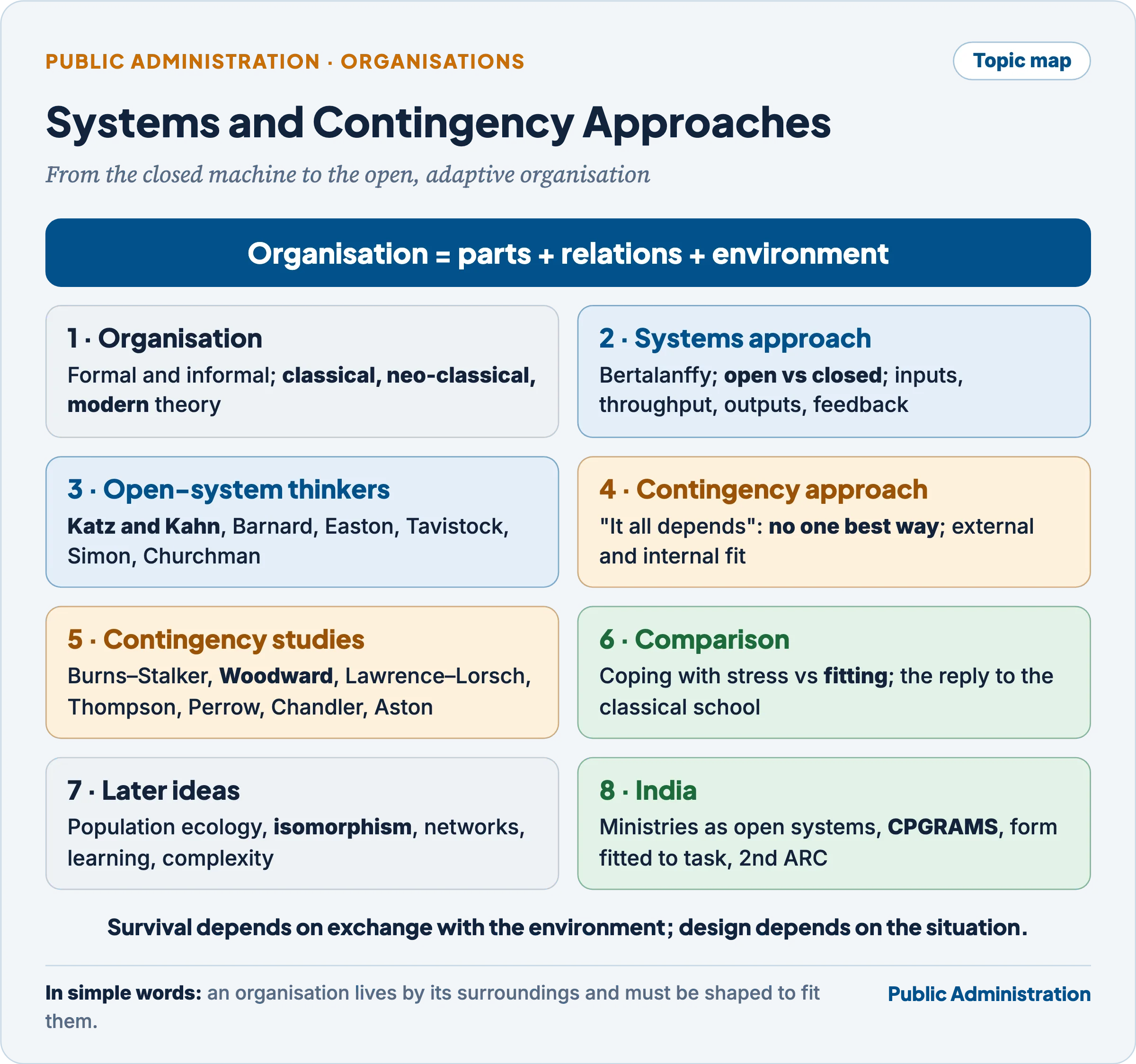
Organisation theory asks a simple question with no simple answer: why are organisations shaped the way they are, and what shape works best? The classical writers answered with universal principles: one best way, valid everywhere. The systems approach replied that an organisation is a living whole that survives only by exchanging energy and information with its environment. The contingency approach turned that insight into design advice: the right structure depends on the situation, chiefly the environment, technology, size and strategy.
- For public administration these two approaches explain why a ministry, a public corporation, a regulator and a mission are built differently, why grievance systems, audits and elections are feedback loops without which government decays, and why reform must fit the task and environment instead of copying a model.
- They are the bridge between the classical and human relations schools of the past and the network, learning and complexity ideas of today.
In simple words
Think of a district hospital. It takes in patients, doctors, medicines and money (inputs), treats people (throughput) and discharges healthier patients (outputs). Complaints and death audits tell it what is going wrong (feedback). Its emergency ward works like a flexible team, while its billing counter follows fixed rules. Systems thinking explains the first part; contingency thinking explains why two wards of the same hospital are run differently.
1. Organisation and the Families of Organisation Theory
In simple words
An organisation is a group of people deliberately arranged to achieve goals that none of them could achieve alone. Theories of organisation are different ways of looking at the same thing: as a machine, as a group of human beings, or as a living system inside a larger world.
1.1 Meaning of organisation
There is no single definition, because each school defines the organisation in its own image. The definitions below move from structure to people to systems.
| Thinker | Definition (paraphrased unless quoted) | What it stresses |
|---|---|---|
| Max Weber | A corporate group with a continuous, purposive activity under an administrative staff | Authority and continuity |
| Chester Barnard, The Functions of the Executive (1938) | “a system of consciously coordinated activities or forces of two or more persons” | Cooperation as a system |
| Herbert Simon, Administrative Behavior (1947) | The complex pattern of communications and relationships in a group that supplies members with information, assumptions and goals for decisions | Decision-making |
| Amitai Etzioni, Modern Organizations (1964) | Social units deliberately constructed and reconstructed to seek specific goals | Goals and redesign |
| Katz and Kahn (1966) | An open system of roles, held together by norms and values, importing energy from its environment | Openness and roles |
| W. Richard Scott, Organizations: Rational, Natural and Open Systems (1981) | A coalition of interest groups in exchange with its environment | Environment |
- Most definitions share four elements: people, purpose, structure (division of work and authority) and coordination. Systems writers add a fifth: an environment on which the organisation depends.
- Public organisations add further features: a legal mandate, political direction, public accountability and goals that are often multiple and hard to measure (welfare, justice, security).
1.2 Formal and informal organisation
Formal organisation is the deliberately designed structure: posts, rules, hierarchy, channels of communication, the organisation chart. Informal organisation is the network of personal relations, groups, norms and leaders that grows up spontaneously among people who work together.
| Point | Formal organisation | Informal organisation |
|---|---|---|
| Origin | Designed by law, rules or management | Grows spontaneously from interaction |
| Basis | Positions and authority | Persons, sentiments, shared interests |
| Communication | Official channels, the file | The grapevine, personal contacts |
| Leadership | Appointed head | Accepted informal leader |
| Stability | Relatively stable | Fluid, changes with people |
| Example | A Collectorate’s sections and their duties | The clerk everyone consults on rules; a group of officers from the same batch |
- Barnard was the first major theorist to treat the informal organisation as essential, not deviant: informal relations precede the formal organisation, create conditions for it, carry communication the formal channels cannot, maintain cohesion and protect the personal integrity of members.
- The Hawthorne studies (1924–1932) under Elton Mayo showed that informal group norms set output levels (the bank wiring room). Philip Selznick, in TVA and the Grass Roots (1949), showed how informal coalitions reshape formal goals.
- The systems approach treats formal and informal organisation as two interacting subsystems; William G. Scott (1961) made the informal organisation one of the five “parts” of the system (see section 2.6).
1.3 The three families of organisation theory
Organisation theory is usually grouped into three families. They differ in what they see as the essence of an organisation and in whether they look beyond its boundary.
| Family | Period | View of organisation | Main thinkers | Closed or open |
|---|---|---|---|---|
| Classical | c. 1900–1940 | A machine to be designed on rational, universal principles | Taylor, Fayol, Gulick, Urwick, Mooney, Weber | Closed |
| Neo-classical (human relations, behavioural) | c. 1930–1960 | A social system of people, groups and feelings | Mayo, Follett, Barnard, Simon, Maslow, McGregor, Argyris | Mostly closed, inward-looking |
| Modern | From the 1950s | An open, adaptive system dependent on its environment | Bertalanffy, Katz and Kahn, Tavistock, Burns and Stalker, Woodward, Lawrence and Lorsch, Thompson | Open |
- The classical school gave the vocabulary of structure: division of work, hierarchy, span of control, unity of command, line and staff, POSDCORB. (See the articles on Scientific Management, Classical Theory and Weber.)
- The neo-classical school accepted the formal structure but added the human being: motivation, groups, informal organisation, participation, decision-making.
- Modern theory integrates both and adds the environment. Its distinctive features are: the organisation as an open system; dynamic interaction among parts; a multilevel and multidimensional view (micro and macro); multiple interrelated variables rather than single causes; and an adaptive rather than a fixed design.
1.4 “Different answers to different situations”: why organisation theory is plural
Organisation theory is not one theory but a loosely knit family of approaches, each catching one side of a complex reality.
- Gareth Morgan, in Images of Organization (1986), showed that every theory rests on a metaphor: the organisation as machine (classical), organism (systems and contingency), brain (cybernetics, learning), culture, political system, psychic prison, flux and transformation (complexity) and instrument of domination (radical critiques). Each metaphor reveals something and hides something.
- W. Richard Scott grouped theories into rational systems (organisations as tools for specific goals), natural systems (organisations as collectivities that seek to survive) and open systems (organisations as coalitions shaped by their environments).
- The contingency approach turned this plurality into a principle: since organisations face different tasks and environments, different theories and designs fit different situations. A theory of the organisation is therefore a set of if–then propositions, not a single prescription.
- The price of plurality is eclecticism: critics say the field has many partial theories and no unifying one, which is why the systems approach was welcomed as a possible synthesis.
1.5 Classical theory as the bedrock of modern theory
Modern theories reacted against classical theory, but they built on it rather than discarding it.
- Concepts retained: structure, specialisation, hierarchy, coordination, span of control, formalisation and rationality remain the basic variables of every modern theory; contingency theory measures exactly these (the Aston studies measured specialisation, standardisation, formalisation and centralisation).
- Rationality retained: Simon kept the classical concern with efficiency but replaced “principles” with bounded rationality; James D. Thompson described organisations as open systems that still strive for “norms of rationality”.
- Bureaucracy re-validated: Woodward found classical principles worked well in mass-production firms; Burns and Stalker found mechanistic (classical) systems effective in stable environments. Contingency theory limits classical theory to its proper situation instead of rejecting it.
- Method retained: the search for general laws of organisation, begun by Fayol and Gulick, continues in contingency theory’s search for tested generalisations.
- What changed: universality gave way to situational validity; the closed system to the open system; the machine model to the organism model.
Common confusion
Did the systems and contingency approaches reject classical theory? No. They rejected its claim to be universal, not its content. Contingency research shows that hierarchy, rules and specialisation are often the right answer, in stable environments, routine technologies and large organisations. Classical theory became one special case within a wider, situational theory.
2. The Systems Approach: Origins and Core Ideas
In simple words
A system is a whole made of parts that depend on one another. Change one part and others change too. A living body, a family, a car and a government department are all systems; the difference is that living and social systems must keep exchanging things with their surroundings to stay alive.
2.1 What is a system?
- Webster’s dictionary defines a system as “a set or arrangement of things so related or connected as to form a unity or organic whole”. The Oxford English Dictionary speaks of a complex unity formed of many parts in orderly arrangement.
- Fremont Kast and James Rosenzweig, Organization and Management: A Systems Approach (1970), defined a system as an organised, unitary whole composed of two or more interdependent parts, components or subsystems, delineated by identifiable boundaries from its environmental suprasystem.
- A system therefore has three properties:
- a set of interactions within itself, so that a change in one activity produces changes elsewhere;
- a boundary that separates it from other systems;
- an environment (the suprasystem) with which it interacts.
- Features of the systems view:
- The system is made of interrelated, identifiable parts arranged in an orderly manner.
- Communication links the parts and allows interaction.
- The interaction is directed to a common goal.
- The whole has properties the parts lack: the whole is more than the sum of its parts (holism or emergence).
- Systems are hierarchical: every system is a subsystem of a larger one (a section within a department, a department within a ministry, a ministry within the government, the government within society).
2.2 General systems theory: Ludwig von Bertalanffy
Ludwig von Bertalanffy (1901–1972), the Austrian biologist, founded general systems theory (GST). He developed the idea from the 1930s, set it out in “An Outline of General System Theory” (1950) and collected it in General System Theory (1968).
- The problem: science had split into narrow specialisms, each studying parts in isolation. Bertalanffy noticed that similar principles (wholeness, organisation, dynamic interaction) were being discovered independently in biology, physics, psychology and sociology.
- The aim: a “unity of science” built on principles common to all systems, whether physical, biological or social. GST was meant to be trans-disciplinary and integrative.
- The key idea: living organisms are open systems that maintain themselves through continuous exchange of matter and energy with their environment, unlike the closed systems of classical physics.
- Equifinality was Bertalanffy’s concept: an open system can reach the same final state from different initial conditions and by different paths.
- Allied developments:
- Norbert Wiener, Cybernetics (1948): the science of control and communication in animals and machines through feedback; social systems are self-steering. (See the article on Communication for Karl Deutsch’s The Nerves of Government (1963).)
- Kenneth Boulding, “General Systems Theory: The Skeleton of Science” (1956): a ladder of nine levels of systems, from static frameworks and clockworks through cells, plants, animals and human beings to social organisations and transcendental systems; social systems are among the most complex.
- Talcott Parsons, The Social System (1951): structural-functionalism; every social system must perform four functions (adaptation, goal attainment, integration, latency or pattern maintenance, the AGIL scheme).
- Robert Merton: manifest and latent functions, dysfunctions; Gabriel Almond: functional analysis of political systems.
- These ideas reached organisation theory in the 1950s and 1960s and became known as modern organisation theory.
2.3 Closed and open systems
| Point | Closed system | Open system |
|---|---|---|
| Relation to environment | Self-contained; little or no exchange | Constant exchange of energy, materials and information |
| Examples | Physical and mechanical systems (a sealed machine) | Biological and social systems (a cell, a firm, a ministry) |
| Boundary | Rigid, easily identified | Permeable, defined by activities and functions |
| Tendency | Towards entropy: run-down, disorder, death | Towards negative entropy: growth, elaboration, higher order |
| End state | Determined by initial conditions | Equifinality: same end by different paths |
| Organisation theory | Classical theory (Taylor, Fayol, Weber) | Modern theory (Katz and Kahn, Tavistock, contingency) |
- Entropy, a concept from thermodynamics, is the natural tendency of a closed system to run down into disorder. An organisation that stops importing new resources, ideas and feedback decays: its rules ossify, its staff ages, its outputs lose relevance.
- Negative entropy (negentropy) is the capacity of an open system to import more energy than it spends and store the surplus, so it can survive, grow and become more complex.
- Boundaries of social organisations are not physical. They must be understood from activities and functions: a regulator’s boundary includes the firms it regulates in some respects; a police station’s boundary includes the community it serves.
- Total closure is fatal to an organisation, but total openness is also impossible: every organisation must filter its inputs. Real organisations lie between the two extremes.
2.4 The properties of an open system
The open-system model rests on a small set of linked properties. Each has a direct administrative meaning.
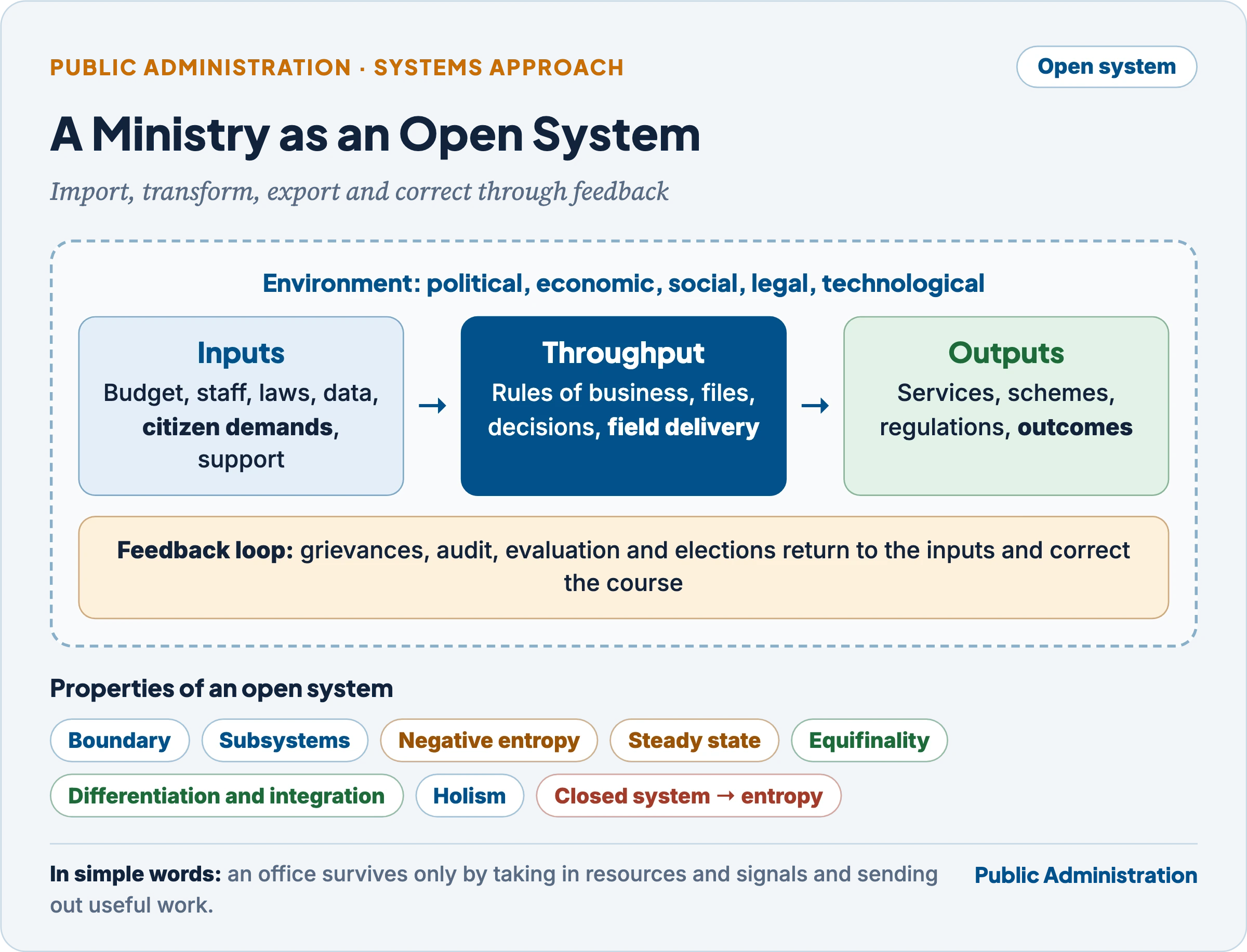
- Inputs: the energy, materials, people, money and information the system imports. For a ministry: budget, staff, laws, data, demands from citizens and Parliament, and support (legitimacy, compliance).
- Throughput (conversion or transformation): the internal processes that turn inputs into outputs: rules of business, file work, decisions, field operations.
- Outputs: what the system exports: services, schemes, regulations, decisions. Outcomes are the effects of outputs on society.
- Feedback: information about outputs and their effects that returns as new input.
- Negative feedback signals a deviation from the goal and triggers correction (a fall in immunisation coverage triggers a drive).
- Positive feedback amplifies a change (success attracts more funding, which brings more success; or panic feeds panic).
- Boundary and boundary-spanning: units that manage exchanges with the environment, such as public relations, procurement, legislative liaison or a grievance cell.
- Subsystems: interdependent parts, each a system in itself (section 2.5).
- Entropy and negative entropy: decay unless renewed (section 2.3).
- Steady state and homeostasis: an open system maintains a dynamic equilibrium, a constant ratio of energy exchanges and relations between parts, while energy flows through it. It is not motionless; like body temperature, it is kept steady by constant adjustment.
- Equifinality: the same goal can be reached by different routes, so there is no single best way. Two States may achieve universal school enrolment through very different combinations of incentives, infrastructure and community mobilisation.
- Differentiation and integration: as open systems grow they specialise (more roles and units), and must then integrate them through coordination.
- Holism (non-summativity): the performance of the whole depends on the relations among parts, not only on the quality of each part. A strong police force and a weak prosecution produce a weak criminal justice system.
- Requisite variety: W. Ross Ashby, An Introduction to Cybernetics (1956), argued that a regulator must have as much variety (range of possible responses) as the disturbances it faces. A rigid, single-response bureaucracy cannot cope with a varied environment.
- Cycles of events: the pattern of input–throughput–output–feedback is a repeating cycle; outputs earn new inputs (taxes, legitimacy, votes).
2.5 Subsystems of an organisation
Different writers divide the organisation into subsystems differently, but all agree that no subsystem can be understood alone.
| Scheme | Subsystems | Use |
|---|---|---|
| Kast and Rosenzweig (1970) | Goals and values; technical (knowledge, techniques, equipment); psychosocial (people, motivation, groups); structural (tasks, authority, workflow); managerial (spans and coordinates the rest) | The most widely used analytical scheme |
| Talcott Parsons | Technical level (actual work), managerial level (coordination, resources), institutional level (links with society, legitimacy) | Explains levels of government: field, secretariat, cabinet |
| Katz and Kahn (1966) | Production, supportive, maintenance, adaptive, managerial | See section 3.3 |
| Tavistock | Social and technical subsystems, to be jointly optimised | See section 4.3 |
- In the Kast–Rosenzweig scheme the structural subsystem formalises relations between the technical and psychosocial subsystems through jobs, authority and workflow; the managerial subsystem relates the whole organisation to its environment.
- Parsons’s three levels were later used by Thompson to explain why organisations seal off their technical core from environmental disturbance while the institutional level deals with uncertainty.
2.6 The parts and linking processes: William G. Scott
William G. Scott, in “Organization Theory: An Overview and an Appraisal” (1961), set out the questions modern theory asks: What are the strategic parts of the system? What is the nature of their interdependence? What are the linking processes? What are the goals of the system?
- Five parts:
- the individual and the personality, motives and expectations he brings;
- the formal organisation, the designed arrangement of functions; writers saw a basic conflict between its demands and the individual’s needs (Argyris);
- the informal organisation, with mutual modification of expectations between group and individual;
- status and role patterns arising from both formal and informal demands; the fusion process (a term of E. Wight Bakke) welds these divergent elements into an integrated whole;
- the physical setting, where man–machine systems must be designed to fit people’s psychological and physiological properties, not the reverse.
- Three linking processes:
- Communication, formal and informal, vertical and horizontal, which links decision centres into a pattern (studied as cybernetics);
- Balance, the equilibrating mechanism that keeps parts in a harmonious relationship;
- Decision-making, which keeps the parts energised and involved.
- The environment (culture, technology, education, politics, natural and human resources, the economy) surrounds all five parts. The administrator’s task is to integrate these variables, which means he must be an analyst: there is no one best way to manage in all situations.
Common confusion
Is “systems theory” the same as “systems analysis”? No. The systems approach is a way of thinking about organisations as wholes in an environment. Systems analysis is a technique of operations research and management science for choosing among alternatives (cost-benefit analysis, PPBS, network analysis such as PERT and CPM). The technique borrows the systems view, but a ministry can use systems thinking without any quantitative systems analysis. (See the article on Techniques of Administrative Improvement.)
3. Katz and Kahn: Organisations as Open Systems
In simple words
Katz and Kahn treated an organisation like a living creature that must eat, work and grow. It takes in energy from outside, does work with it, sends out a product and uses what it earns to start the cycle again. If it stops taking in energy, it dies.
3.1 The work and its approach
Daniel Katz and Robert L. Kahn, social psychologists at the University of Michigan, wrote The Social Psychology of Organizations (1966; second edition 1978). It is the classic application of open-system theory to organisations.
- Why they wrote it: earlier organisational psychology was tied to Taylor’s scientific management or Weber’s bureaucracy, which treated existing structures as given and could not explain restructuring or social change.
- Their definition: an organisation is an open system of roles. It is a contrived system: unlike a biological organism it has no physical structure; it is a structure of acts and events held together by roles, norms and values.
- Two lines of attack: the problems of an organisation are explained by its structure (its position and pattern), and by its interdependence with the environment, since it relies on energy and information inputs to produce what society needs.
- The test of an organisation is therefore not whether it obeys principles but whether it can secure inputs and export outputs that its environment will pay for.
3.2 The common characteristics of open systems
Katz and Kahn listed nine characteristics in 1966 and added a tenth (integration and coordination) in the 1978 edition.
| No. | Characteristic | Meaning | Public administration example |
|---|---|---|---|
| 1 | Importation of energy | No social system is self-sufficient; it draws people, materials and money from outside | Tax revenue, recruitment through the UPSC, data |
| 2 | Throughput | Energy is transformed; work is done | Processing applications, building roads |
| 3 | Output | A product is exported to the environment | Pensions paid, licences issued, schools run |
| 4 | Systems as cycles of events | The product exported furnishes the energy for repeating the cycle | Good service earns legitimacy, compliance and budgets |
| 5 | Negative entropy | To survive, the system must import more energy than it spends and store some | Reserves, training, institutional memory, reform |
| 6 | Information input, negative feedback and coding | Information on performance corrects deviations; coding selects which signals are received | Grievance systems, audit, MIS dashboards; filtering of what reaches the Secretary |
| 7 | Steady state and dynamic homeostasis | A stable ratio of exchanges is preserved; growth is used to protect the system’s character | A department expanding its mandate to secure its future |
| 8 | Differentiation | Movement towards elaboration and specialised roles | New wings for cyber security, data, vigilance |
| 9 | Equifinality | The same final state can be reached from different starting points by different paths | Different State models of public health reaching similar outcomes |
| 10 | Integration and coordination (1978) | Unification through coordinating mechanisms counters differentiation | Cabinet committees, empowered groups of secretaries |
- Coding deserves attention: every organisation has a selective filter that admits some signals and ignores others. A department that codes complaints only as “disposed” or “pending” may miss the message in them. This is why the systems approach stresses the quality of feedback, not only its quantity.
- Dynamic homeostasis explains administrative behaviour that looks like empire-building: organisations incorporate external resources (new schemes, new subjects) to preserve their character and survive.
3.3 The five subsystems
| Subsystem | Function | Example in a ministry |
|---|---|---|
| Production (technical) | Does the work that transforms inputs into outputs | Divisions implementing schemes; field offices |
| Supportive | Procures inputs, disposes of outputs, maintains institutional relations with the environment (boundary-spanning) | Procurement, budget, parliamentary and media cells |
| Maintenance | Keeps people tied to their roles: recruitment, socialisation, rewards, sanctions | Establishment and training divisions |
| Adaptive | Senses change in the environment and recommends adjustment | Policy, research, statistics and evaluation units |
| Managerial | Directs, coordinates and controls the other subsystems; resolves conflict | Secretary, Additional and Joint Secretaries |
- The supportive and adaptive subsystems are what distinguish an open-system view from the classical view, which saw only production, maintenance and management.
3.4 Types of organisations by their function in society
Katz and Kahn classified organisations by the genotypic (first-order) function they perform for the larger society.
- Productive or economic organisations create wealth and goods: factories, public sector undertakings.
- Maintenance organisations socialise people for roles in other organisations: schools, religious bodies, health and welfare agencies.
- Adaptive organisations create knowledge and new solutions: universities, research laboratories.
- Managerial or political organisations adjudicate, coordinate and control resources, people and subsystems: the state, government agencies, trade unions, pressure groups.
- Most public agencies are managerial-political organisations, which means they must balance conflicting demands, not just produce efficiently.
3.5 Assessment
- Strengths: the first comprehensive and testable open-system theory of organisations; links individual roles to the whole organisation and the environment; explains survival, growth and change; directs attention to boundary-spanning and adaptive functions.
- Limits: the energy metaphor borrowed from biology fits social systems loosely; the theory says little about power, conflict and politics inside organisations; its categories are broad and hard to operationalise for design.
Indian Connect — A Union Ministry as an open system
- Inputs: the subjects allotted under the Government of India (Allocation of Business) Rules, 1961, the budget voted by Parliament, staff from the central services, statutes, and demands expressed through parliamentary questions, RTI applications, PILs, the media and pressure groups.
- Throughput: the Government of India (Transaction of Business) Rules, 1961 (made under Article 77(3)), the Central Secretariat Manual of Office Procedure and the e-Office system convert inputs into decisions.
- Outputs and outcomes: schemes, rules, licences, payments; the Outcome Budget (introduced in 2005) tries to measure outcomes, not just outlays.
- Feedback: departmentally related standing committees of Parliament, CAG audit (Article 148), social audit of MGNREGA works, evaluation studies, elections, and the Centralised Public Grievance Redress and Monitoring System (CPGRAMS), the government’s main formal grievance feedback loop.
- Entropy risk: a ministry that does not read its feedback keeps producing outputs nobody needs; the closing of the Planning Commission and its replacement by NITI Aayog on 1 January 2015 is an example of a system restructuring itself when its old role lost fit with the environment.
4. Systems Thinkers in Administration
In simple words
Many writers used systems ideas long before the term became popular. Barnard saw an organisation as people cooperating; Easton saw politics as demands going in and decisions coming out; the Tavistock researchers saw that machines and people must be designed together.
4.1 Chester Barnard: the organisation as a cooperative system
Chester I. Barnard (1886–1961), President of the New Jersey Bell Telephone Company, wrote The Functions of the Executive (1938) from long practical experience. It is often called the first systems treatment of organisation. (See the article on Barnard for his full theory.)
- Starting point: the individual has limited power of choice and limited capacity, so people cooperate to achieve purposes they cannot achieve alone. Organisation is the system through which cooperation happens.
- Cooperative system: a complex of physical, biological, personal and social components in a systematic relationship because two or more persons cooperate for at least one definite end. The formal organisation is its core: “a system of consciously coordinated activities or forces of two or more persons”.
- Three elements of formal organisation: willingness to cooperate, a common purpose, and communication.
- Effectiveness and efficiency:
- Effectiveness is the accomplishment of the cooperative purpose: the organisation’s external equilibrium with its environment.
- Efficiency is the satisfaction of individual motives of participants: the internal equilibrium. An action may be effective but inefficient (the goal is met but members are dissatisfied), or efficient but ineffective.
- Barnard’s well-known idea is that the survival of the organisation depends on maintaining both equilibria.
- Contribution–satisfaction equilibrium: the organisation survives only if the inducements it offers are at least equal to the contributions it demands. Barnard listed specific inducements (material rewards, personal non-material opportunities, desirable physical conditions, ideal benefactions) and general incentives (associational attractiveness, customary conditions, participation, communion).
- Informal organisation is necessary to the formal; authority rests on acceptance by subordinates (the zone of indifference).
- Executive functions: to maintain organisational communication, to secure essential services from individuals, and to formulate purpose and objectives. The executive’s highest function is moral: creating faith in the common purpose.
- Two angles on the individual: from inside the organisation people are functional participants whose efforts are depersonalised; from outside they are unique persons. Both aspects are always present, and organisation must reconcile them through incentives and persuasion.
Ecological elements in Barnard’s thought. Barnard is often grouped with human relations writers, but his theory has a strong ecological, open-system side.
- The organisation is a subsystem of a wider social system; its boundary is drawn widely enough to include customers, suppliers and investors whose contributions it needs.
- Survival is the central problem, and it depends on adjusting to a changing physical, biological and social environment, the language of ecology.
- The strategic factor, the limiting factor the executive must identify and control, is often located in the environment.
- Contemporary organisational ecology (Hannan and Freeman, section 10.1) moves the unit of analysis to populations and emphasises selection by the environment rather than adaptation by executives. It is therefore further from Barnard’s executive-centred, moral theory than from his ecological insight that organisations live or die by their fit with the environment.
4.2 David Easton: the political system and administration
David Easton (1917–2014), the Canadian-American political scientist, introduced systems theory to political science in The Political System (1953) and developed it in A Framework for Political Analysis and A Systems Analysis of Political Life (both 1965). He defined politics as “the authoritative allocation of values for a society”.
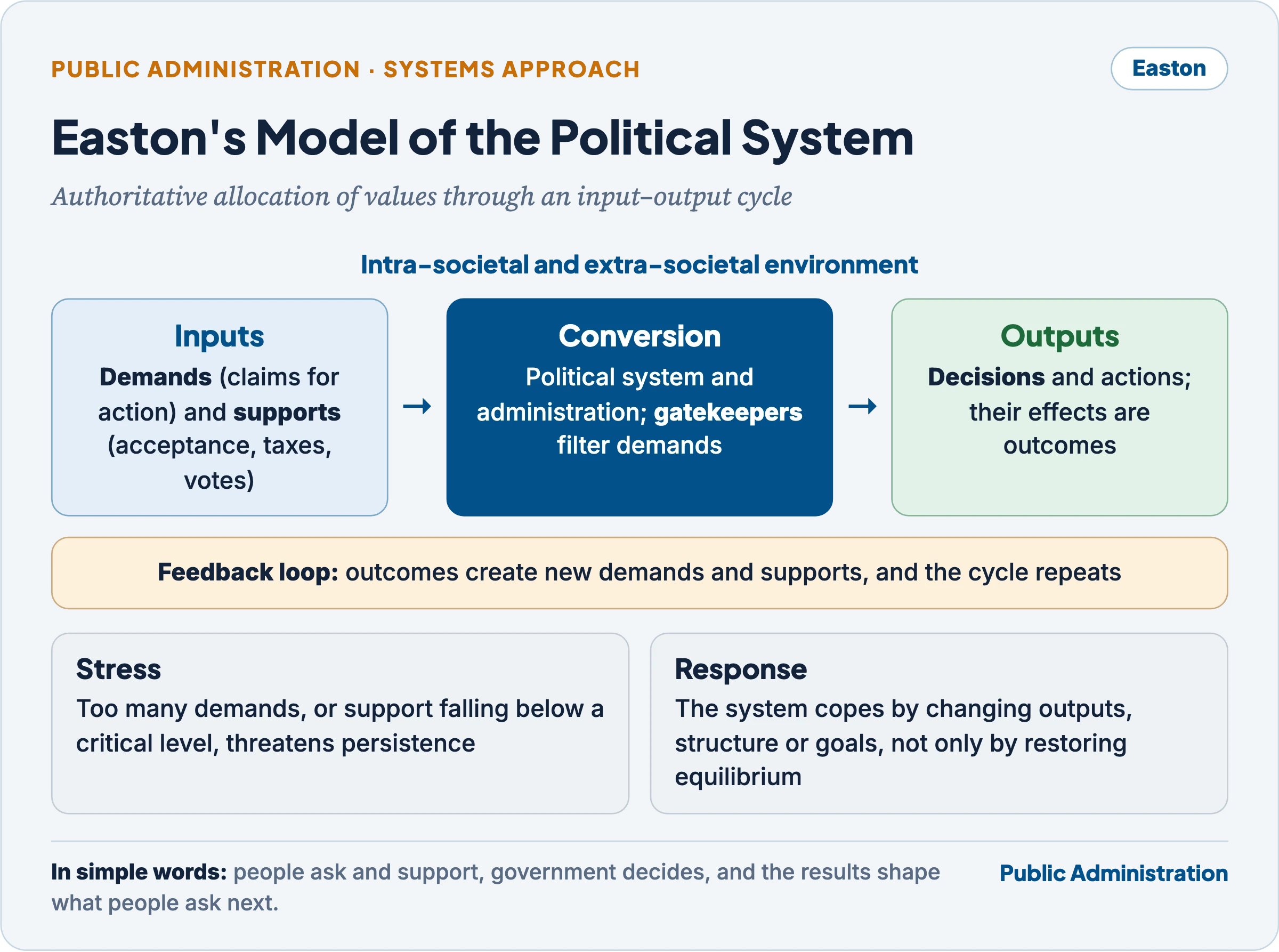
- Environment: the political system is bounded but open to the intra-societal (economy, culture, social structure) and extra-societal (international) environment.
- Inputs:
- Demands: claims for authoritative action (a new law, a subsidy, a dam).
- Supports: attitudes and actions that sustain the system (paying taxes, obeying laws, voting, patriotism). Specific support depends on satisfaction with outputs; diffuse support is a reservoir of goodwill towards the regime itself.
- Withinputs: demands that arise inside the system (from bureaucrats or legislators).
- Gatekeepers (parties, interest groups, the media, officials) regulate the flow of demands, preventing overload.
- Conversion: the political authorities and the administration convert demands into outputs: binding decisions, policies and actions. Outcomes are their consequences in society.
- Feedback loop: outputs and outcomes generate new demands and supports; the cycle never ends.
- Stress: the system is threatened by demand overload (too many or too complex demands) or by support falling below a critical level.
- Persistence, not equilibrium: Easton rejected the idea that political systems simply return to equilibrium. His question was how systems persist under stress, by changing outputs, structures or even goals.
- Application to administration: Ira Sharkansky, in Public Administration: Policy-Making in Government Agencies (1970), used the same model for public agencies: environment, inputs, conversion within the agency, outputs and feedback. Administration is thus the main conversion machinery of the political system and also one of its most important gatekeepers.
How Barnard and Easton used the systems approach.
| Point | Barnard | Easton |
|---|---|---|
| Field | Organisation (a firm or agency) | The whole political system |
| Unit | Cooperative system of persons | Interactions that allocate values authoritatively |
| Key exchange | Contributions for inducements | Demands and supports for outputs |
| Survival condition | External effectiveness and internal efficiency | Persistence under demand and support stress |
| Regulator | The executive | Gatekeepers and authorities |
| Feedback | Communication; acceptance of authority | Feedback loop from outcomes to new inputs |
| Limit | Executive-centred, managerial | Abstract; conversion process a black box |
- Critique of Easton: the model is highly abstract; the conversion process is treated as a black box, so it says little about how bureaucracies actually decide; it has a conservative bias towards system maintenance; and it struggles to explain revolutionary change. Its strength is that it can subsume group theory and elite theory within one framework.
Indian Connect — Feedback and stress in Indian policy
- Feedback and correction: the three farm laws of 2020 met sustained protest; the government announced their withdrawal in November 2021 and Parliament passed the Farm Laws Repeal Act, 2021. In Easton’s terms, a sharp fall in specific support from a key constituency forced a change in outputs to protect diffuse support.
- Gatekeeping: the Department of Administrative Reforms and Public Grievances sorts and routes millions of grievances; standing committees of Parliament filter and aggregate demands on each ministry.
- Overload: courts, police stations and Collectorates facing far more demands than their capacity show the stress Easton described; the response is often to create new subsystems (fast-track courts, single-window portals) rather than to restore an old equilibrium.
4.3 The Tavistock school: socio-technical systems
The Tavistock Institute of Human Relations, London (founded 1947), developed the idea that every work organisation is a socio-technical system with a social subsystem (people, groups, roles) and a technical subsystem (tools, techniques, layout).
- Eric Trist and Ken Bamforth, “Some Social and Psychological Consequences of the Longwall Method of Coal-Getting” (1951): when British coal mines replaced small, self-regulating teams with the mechanised longwall method, organised on mass-production lines with narrow, fragmented jobs, productivity did not rise as expected; absenteeism, stress and conflict grew. Mines that kept composite, self-regulating work groups with the new technology did better.
- Joint optimisation: the best result comes not from maximising technical efficiency and fitting people to it, but from designing the social and technical subsystems together. The same technology permits organisational choice.
- A.K. Rice, Productivity and Social Organization: The Ahmedabad Experiment (1958): from 1953 the Tavistock Institute worked with the Ahmedabad Manufacturing and Calico Printing Company (Calico Mills). Reorganising weavers in automatic and non-automatic loom sheds into small internally led groups responsible for a whole group of looms raised productivity and reduced damage. It is one of the earliest socio-technical experiments, and it took place in India.
- E.J. Miller and A.K. Rice, Systems of Organization (1967): every enterprise is an open system that imports materials, transforms them, consumes some for its own maintenance and exports the rest; these import-conversion-export processes are the work it must do to live. Each enterprise has a primary task, the task it must perform to survive.
- Fred Emery and Eric Trist, “The Causal Texture of Organizational Environments” (1965): environments range from placid-randomised and placid-clustered through disturbed-reactive to turbulent fields, where change arises from the environment itself. Turbulent environments need collaboration across organisations, a forerunner of network governance.
- Relevance: e-governance projects that digitise a process without redesigning work and roles often fail for the reason Trist identified: technology was changed, the social system was not.
4.4 Herbert Simon and March–Simon
Herbert Simon, in Administrative Behavior (1947), treated the organisation as a system of decisions. (See the articles on Simon and on Decision-Making.)
- He took Barnard’s inducements–contributions balance as the condition of organisational equilibrium.
- The organisation supplies members with premises for decisions (goals, information, rules), so individual decisions are integrated into an organisational system.
- James March and Herbert Simon, Organizations (1958), developed this into a theory of organisations as adaptive systems with bounded rationality: members satisfice, use performance programmes (routines), and organisations practise uncertainty absorption as information is summarised on its way up.
- Richard Cyert and James March, A Behavioral Theory of the Firm (1963), saw the organisation as a coalition with goals bargained among members, adapting through organisational learning.
- Simon’s decision scheme follows the systems approach: decisions are outputs of one subsystem and inputs (premises) for others, linked by communication and feedback.
4.5 C. West Churchman and the systems approach to management
C. West Churchman, The Systems Approach (1968), drew attention to five basic considerations in thinking about any system:
- the total objectives of the system and the measures of performance;
- the system’s environment, which acts as a set of constraints;
- the system’s resources used in performance;
- the system’s components, with their goals and activities (subsystems);
- the management of the system, its regulating and decision-making aspect.
- Churchman’s point is that improving a part can harm the whole (sub-optimisation). A tax department that maximises collection by harassing taxpayers may reduce compliance and investment, lowering revenue for the whole government.
4.6 Selznick and the institutional view
Philip Selznick, in TVA and the Grass Roots (1949), studied the Tennessee Valley Authority as an adaptive system.
- He described cooperative systems as individuals interacting as wholes in relation to a formal system of coordination; the real structure results from the reciprocal influence of formal and informal aspects, and is itself an adaptive organism reacting to its environment.
- Co-optation: to survive, the TVA absorbed local elites into its policy-making, which secured support but changed its goals. Environment reshapes organisations, sometimes against their stated purpose.
- In Leadership in Administration (1957), Selznick distinguished an organisation (a technical instrument) from an institution (an organisation infused with value), the starting point of later institutional theory.
4.7 Systems thinking in public administration
- John Gaus urged an ecological study of administration in Reflections on Public Administration (1947), and Fred Riggs built his ecological and structural-functional models of developing societies on systems ideas. (See the articles on Comparative Public Administration.)
- Systems analysis techniques such as PPBS (adopted across the US federal government in 1965) brought systems thinking into budgeting.
- Indian administrative reform has used systems language from the Sevottam model of service delivery to “whole of government” approaches in grievance redress and infrastructure planning.
5. Assessment of the Systems Approach
In simple words
Systems thinking is like a good map of a city: it shows every road and how they connect. But a map does not tell you which road to take to reach your destination today. That is both its value and its limit.
5.1 Contributions
- Holism: it made administrators look at the whole organisation and its relations, ending the partial views of the structural (classical) and the human (human relations) schools.
- Environment: it put the environment at the centre of analysis, which matters most in public administration, where organisations are created, funded and judged by their environment.
- Interdependence: it explains why reforms in one part fail when connected parts are not changed.
- Feedback and learning: it made feedback (grievances, evaluation, audit) a condition of survival, not an optional extra.
- Integration of knowledge: it gave a common language to economics, sociology, psychology and political science, and a framework for comparative study.
- Bridge to practice: it led directly to the contingency approach, which made its insights usable for design.
5.2 Critique
- Too abstract: it says that parts are interrelated and that the relationship is dynamic, but not which economic forces trigger which social, technical and psychological changes. It gives no action framework for managers.
- No universal applicability: many of its tools (cybernetic control, elaborate information systems, structural designs) suit large organisations and not small ones; a theory should specify relations among variables that hold across organisations.
- “Nothing new”: some argue that capable managers always saw their problems as networks of interrelated elements; the systems approach only gave the habit a vocabulary.
- Conservative and equilibrium bias: it emphasises stability, integration and survival; conflict is treated as a malfunction. David Silverman, The Theory of Organisations (1970), argued that it reifies the organisation, treating it as a thing with its own needs and goals, when only people have goals; he proposed an action frame of reference based on actors’ meanings.
- Neglect of power: radical and political critics say it hides who benefits from the system’s “survival” and treats domination as function.
- Functionalist teleology: explaining a structure by the function it serves for the whole risks circular reasoning: whatever exists must be functional.
- Boundary problem: the boundaries of social systems are hard to fix, so analyses differ depending on where the observer draws them.
- Analogy problem: organisations are not organisms; they can change their own goals and structures deliberately, merge, split or be abolished, which no biological organism does.
5.3 An approach, not a theory
Systems “theory” is better described as an approach or framework than as a theory in the strict sense.
- A theory states specific, testable relationships among defined variables (if X, then Y). The systems approach states general properties (interdependence, feedback, equifinality) that hold for all systems and therefore predict little about any particular one.
- It is a way of looking: a set of concepts and questions (What are the parts? How are they linked? What are the goals? What is the environment?) that help analysis and diagnosis.
- Kast and Rosenzweig themselves described general systems theory as providing a macro paradigm for the study of organisations, at a very high level of generalisation; actual explanations must come from middle-range theories such as contingency theory.
- This is a strength as well as a limitation: an approach can organise many theories, including classical and behavioural ones, without replacing them.
5.4 Did systems theory repeat the classical pattern?
Some critics argue that systems theory, despite promising a radical break, followed similar patterns to the structural classical theories.
- Search for a universal model: like Fayol’s principles, systems theory claimed to apply to all organisations.
- Managerial perspective: both look at the organisation from the top, as something to be designed and controlled by management; the “managerial subsystem” replaces the classical executive.
- Order and equilibrium: both value stability, integration and efficiency, and treat conflict as dysfunctional.
- Structure over people: contingency research, the practical offspring of systems theory, measured mostly structural variables (span, levels, formalisation), much as Gulick and Urwick did.
- Rationality: organisations are still seen as instruments that rationally adapt; politics and irrationality are pushed aside.
- But the differences are real: the classical theory was closed and prescriptive; systems theory is open, multi-causal and descriptive, and it explicitly admits equifinality (many paths to the same end), which classical theory denied.
5.5 Functional and dysfunctional characteristics of bureaucracy
The systems approach provides tools to separate the functional from the dysfunctional features of a public bureaucracy.
- Functional analysis asks what each structure contributes to the survival and goals of the whole: rules give predictability and equal treatment; hierarchy gives coordination and accountability; specialisation gives expertise.
- Dysfunctions are consequences that lessen the system’s adaptation. Robert Merton showed how rules become ends in themselves (goal displacement) and produce trained incapacity; feedback failures let these persist. (See the article on Weber and Bureaucracy.)
- Systems diagnosis: dysfunctions appear as blocked inputs (citizens unable to reach the office), distorted throughput (red tape, delay), irrelevant outputs (schemes nobody uses), broken feedback (complaints filed but ignored), and entropy (an ageing, inward-looking organisation).
- Functional for whom? A structure may be functional for one subsystem (security for staff) and dysfunctional for another (delay for citizens). Systems analysis forces this question to be asked.
5.6 Change and crisis in systems
Change is necessary for an open system’s survival, yet the process of change may itself create crises.
- Disturbing the steady state: change upsets established balances among subsystems, roles and informal groups; people resist because change threatens security, status and routines.
- Easton’s stress: rapid change multiplies demands and may erode support faster than the system can respond.
- Kurt Lewin described change as unfreezing, moving and refreezing (1947): crises occur when the old pattern is unfrozen before a new one is in place.
- Larry Greiner, “Evolution and Revolution as Organizations Grow” (1972), showed that each phase of growth ends in a characteristic crisis: creativity ends in a crisis of leadership, direction in a crisis of autonomy, delegation in a crisis of control, coordination in a crisis of red tape. Each crisis is resolved only by moving to a new structure.
- Riggs showed that in transitional (prismatic) societies, imported structures coexist with old practices, producing formalism and tension.
- Crisis as opportunity: a crisis forces double-loop learning (changing the goals and assumptions, not only the actions). Well-managed change uses feedback, participation and phased implementation to keep the crisis within bounds.
6. The Contingency Approach: “It All Depends”
In simple words
A doctor does not give every patient the same medicine; the treatment depends on the illness, age and condition of the patient. The contingency approach says the same about organisations: the right structure and management style depend on the situation.
6.1 Meaning and origins
The contingency approach holds that there is no one best way to organise, to lead or to decide. The best course of action is contingent (dependent) on the internal and external situation.
- Origin: several studies in the late 1950s and 1960s found that successful organisations had different structures depending on their technology and environment. Paul Lawrence and Jay Lorsch gave the approach its name in Organization and Environment (1967).
- Reaction against universalism: contingency theorists argued that Weber’s bureaucracy and Taylor’s scientific management had failed as universal models because they ignored how environment, technology and task shape management style and structure.
- Not a rejection of earlier ideas: the situational view does not dismiss classical or bureaucratic design. It says only that no single model is good in every situation; to be effective, a design must fit the situation.
- W. Richard Scott‘s summary: the best way to organise depends on the nature of the environment to which the organisation must relate.
- Gareth Morgan summed up the main ideas:
- organisations are open systems that must satisfy internal needs and adapt to the environment;
- there is no one best way of organising; the right form depends on the task or environment;
- management must achieve alignment and good fit;
- different types of organisation are needed in different types of environment.
6.2 The contingency factors
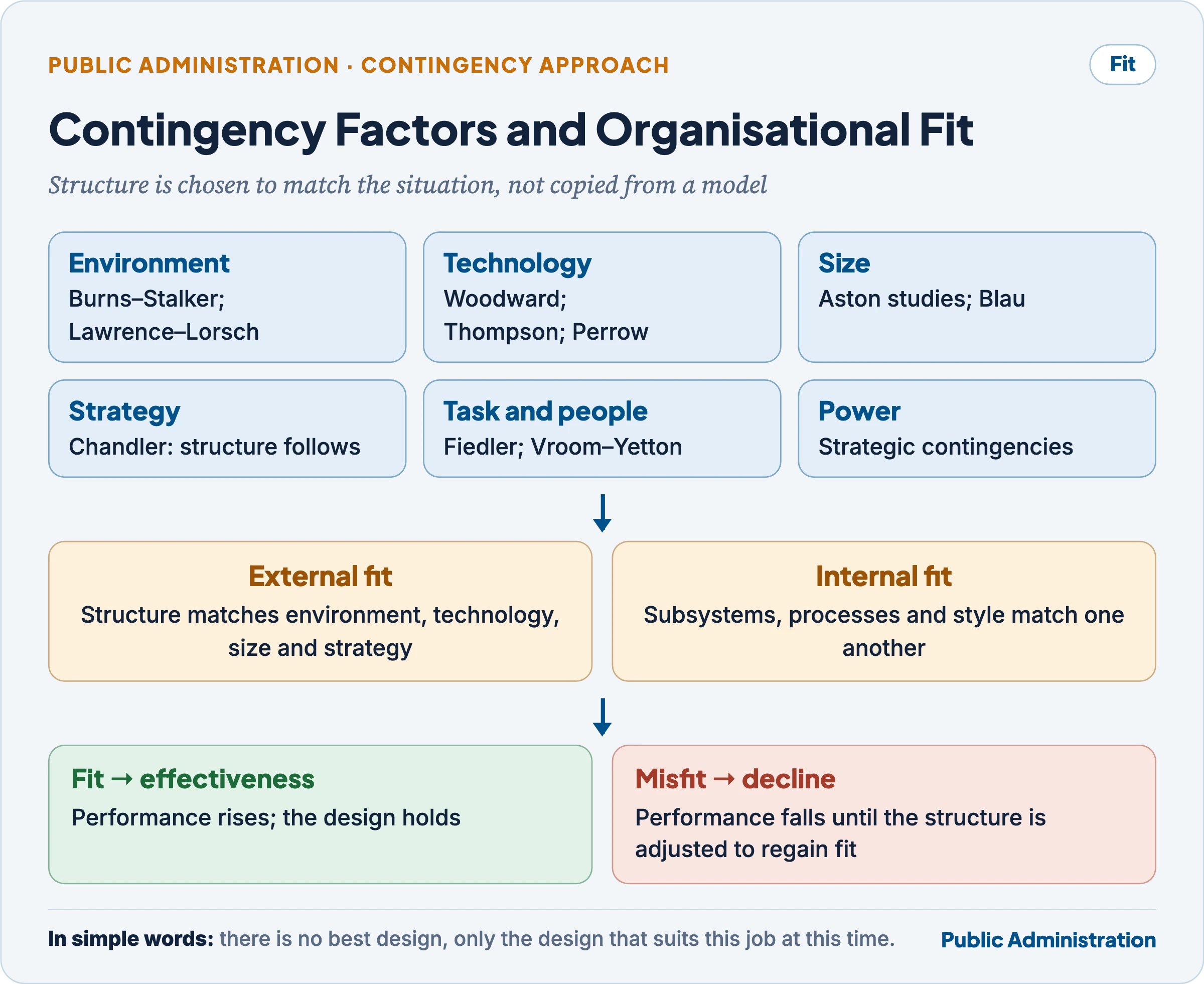
| Contingency factor | Key studies | Main proposition |
|---|---|---|
| Environment (stability, complexity, uncertainty) | Burns and Stalker (1961); Lawrence and Lorsch (1967); Emery and Trist (1965) | Stable environments suit mechanistic structures; uncertain ones need organic structures and stronger integration |
| Technology | Woodward (1965); Thompson (1967); Perrow (1967) | Production system and task routineness shape structure |
| Size | Aston studies (1960s); Blau (1970) | Larger organisations are more specialised, standardised and formalised |
| Strategy | Chandler (1962) | Structure follows strategy |
| Task, people and leadership | Fiedler (1967); Vroom and Yetton (1973) | Leadership and decision style must fit the situation |
| Power and dependence | Hickson et al. (1971) | Sub-units that cope with critical uncertainty gain power |
- These factors are often interrelated: large organisations tend to use mass technologies and operate in stable markets, which makes isolating each effect difficult.
6.3 External fit and internal fit
Contingency theory is founded on the idea of fit, and fit has two dimensions.
| Point | External fit | Internal fit |
|---|---|---|
| Meaning | Match between the organisation’s design and its contingencies | Consistency among the organisation’s own subsystems |
| Question asked | Does our structure suit our environment, technology, size and strategy? | Do our structure, processes, people, rewards and leadership style reinforce one another? |
| Source | Burns and Stalker, Woodward, Lawrence and Lorsch | Lawrence and Lorsch (differentiation with integration); Mintzberg’s configurations |
| Failure | A rule-bound department facing a fast-changing problem | A flat, team-based unit judged by a rigid hierarchical appraisal system |
| Indian example | A regulator needing technical expertise and independence | A mission staffed on deputation with no authority over line departments |
- Both are necessary. External fit without internal fit gives a well-chosen design that does not hang together; internal fit without external fit gives a coherent organisation in the wrong shape for its environment.
- Lawrence and Lorsch showed this directly: high-performing firms matched the differentiation their environment required (external fit) and achieved the integration that this differentiation demanded (internal fit).
- Lex Donaldson, The Contingency Theory of Organizations (2001), described the dynamic as SARFIT (structural adaptation to regain fit): growth changes contingencies, creating misfit; performance falls; management then adapts the structure to regain fit.
- Strategy links the two: an organisation chooses its domain (external), then aligns its internal design to deliver it; Raymond Miles and Charles Snow (1978) showed that internally consistent “prospector”, “defender” and “analyser” organisations outperform inconsistent “reactors”.
Common confusion
Is Fiedler’s “contingency model” the same as contingency theory of organisation? It is a part of the wider approach, not the whole. Fred Fiedler‘s model (A Theory of Leadership Effectiveness, 1967) applies the contingency idea to leadership: whether a task-oriented or relationship-oriented leader is effective depends on leader–member relations, task structure and position power. The organisational contingency theory of Burns and Stalker, Woodward and Lawrence and Lorsch deals with structure. Both share the premise that effectiveness depends on fit with the situation. (See the article on Leadership.)
7. The Major Contingency Studies
In simple words
Researchers went into factories and offices and compared successful and unsuccessful ones. They found that the winners were not those that followed textbook rules, but those whose structure matched the kind of work they did and the kind of world they faced.
7.1 Burns and Stalker: mechanistic and organic systems
Tom Burns and G.M. Stalker, The Management of Innovation (1961), studied about twenty firms in Scotland and England, many of them firms entering the fast-changing electronics industry. They asked how management practice related to the rate of change in technology and markets.
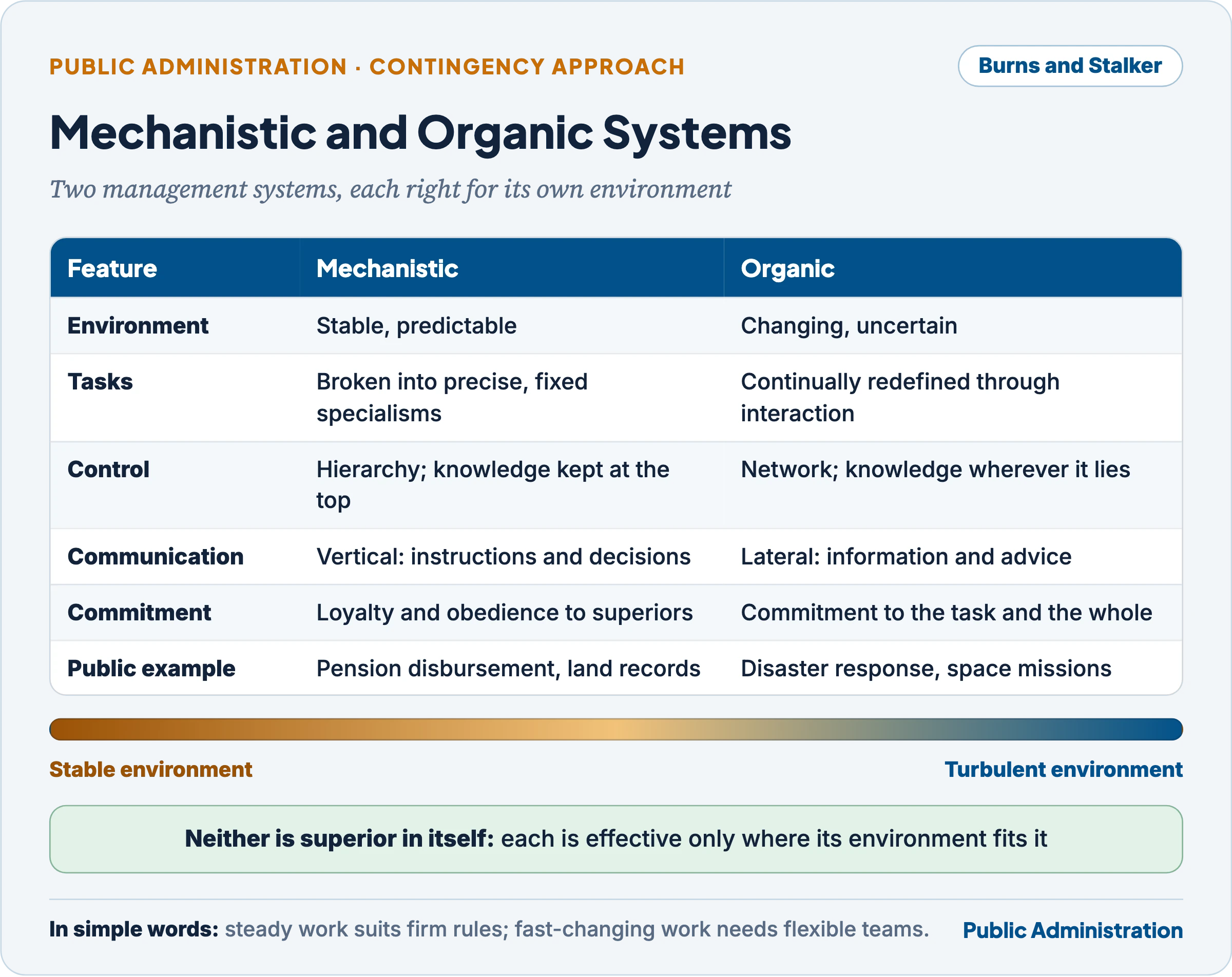
- Mechanistic system (suited to stable conditions):
- tasks broken into specialisms, each pursued as if distinct from the concern as a whole;
- methods, duties and powers precisely defined;
- hierarchical control, authority and communication; knowledge assumed to lie at the top;
- vertical interaction; instructions and decisions flow down, information is filtered on the way up;
- loyalty and obedience valued.
- Organic system (suited to changing conditions):
- problems cannot be broken down and distributed among fixed roles; individuals perform their tasks in light of the whole;
- jobs lose formal definition and are continually redefined through interaction;
- network structure of control and communication; knowledge may lie anywhere;
- lateral communication resembling consultation rather than command;
- commitment to the task and progress of the firm valued over loyalty.
- Neither is superior in itself. Burns and Stalker stressed that nothing justified the belief that mechanistic systems should be replaced by organic ones in conditions of stability. Each is appropriate to its own conditions.
- Pathological responses: mechanistic firms that met rapid change without becoming organic developed distorted forms:
- the ambiguous figure system, in which everyone bypasses the hierarchy to the chief;
- the mechanistic jungle, which multiplies new posts and departments;
- the super-personal or committee system, which piles on committees.
- Public relevance: a pension disbursement office or land records registry faces stable, repetitive work and can be mechanistic; a disaster response force, a pandemic task force or a space mission needs organic working. Indian administration often has the pathologies Burns and Stalker described: issues pushed up to the Secretary or Chief Minister, new cells created for every new problem, and committees for coordination.
7.2 Warren Bennis: organic-adaptive structures and temporary systems
Warren Bennis, in “The Coming Death of Bureaucracy” and Changing Organizations (both 1966) and The Temporary Society (with Philip Slater, 1968), predicted that bureaucracy would be replaced by organic-adaptive structures.
- Why bureaucracy would decline: rapid and unexpected change, growth in size, the complexity of modern technology demanding diverse specialists, and changing values of employees who want participation rather than obedience.
- Characteristics of the new form:
- organisations will be adaptive, rapidly changing temporary systems;
- organised around problems to be solved by groups of relative strangers with diverse professional skills;
- groups will be arranged on an organic rather than a mechanical model, evolving in response to problems rather than programmed role expectations;
- coordinating executives (linking pins) will relate the many project groups;
- people will be differentiated by skill and professional training, not by rank or role;
- executives will need skills in collaboration, change management and integration.
- Costs: temporary systems create stress, insecurity and weak commitment; people must learn to form intense working relations quickly and then let them go.
- Assessment: the prediction was premature; bureaucracy persisted and adapted. But Bennis anticipated project and matrix organisations, adhocracy (a term popularised by Alvin Toffler in Future Shock, 1970, and developed by Henry Mintzberg), and today’s task forces and mission teams. In India, empowered groups of officers set up in March 2020 for the COVID-19 response, empowered groups of secretaries and mission directorates are such temporary systems working inside a permanent bureaucracy.
7.3 Joan Woodward: technology and structure
Joan Woodward, a British industrial sociologist, studied 100 manufacturing firms in South Essex in the 1950s (Management and Technology, 1958; Industrial Organization: Theory and Practice, 1965).
- First finding: structural features were not related to size or to classical principles in any consistent way.
- Second step: she grouped firms by technical complexity of production:
- unit and small-batch production (custom-made items, prototypes);
- large-batch and mass production (assembly lines);
- continuous process production (oil refineries, chemicals).
- Findings:
| Feature | Unit / small batch | Large batch / mass | Continuous process |
|---|---|---|---|
| Levels of authority | Fewest | More | Most |
| Ratio of managers to total staff | Low | Higher | Highest |
| Span of control of first-line supervisor | Medium | Widest | Narrow |
| Rules, controls, written communication | Few | Many | Few |
| Character | Organic | Mechanistic | Organic |
- The key result: the successful firms in each category clustered around the median structure for their technology; less successful firms had spans that were too wide or too narrow. One particular form of organisation was most appropriate to each system of production.
- Classical principles held only in the middle: successful mass-production firms used tight controls and precise duties, close to the bureaucratic type; at the top and bottom of the technical scale flexibility worked better.
- Technology defined broadly: the techniques used to transform inputs into outputs; this applies to service organisations too (handling requests, files and cases).
- Is technology destiny? Critics warned against technological determinism: technology itself is chosen and can be changed. Saying that technology matters does not mean it cannot be altered.
- Public relevance: issuing standard certificates is a “mass” technology suited to standardised procedures; designing a metro rail system is “unit” production needing project teams; a power grid or a payments network is “process” technology needing highly trained staff and real-time control.
7.4 Lawrence and Lorsch: differentiation and integration
Paul Lawrence and Jay Lorsch of Harvard, Organization and Environment: Managing Differentiation and Integration (1967), studied first six firms in the plastics industry (a highly uncertain environment) and then compared them with firms in packaged foods (moderate) and standardised containers (stable).
- Sub-environments: each organisation faces several sub-environments, mainly the market (sales), the technical-economic (production) and the scientific (research and development). They differ in rate of change, certainty of information and time span of feedback.
- Differentiation: “the state of segmentation of the organisational system into subsystems, each of which tends to develop particular attributes in relation to the requirements posed by its relevant external environment”. Departments differ in:
- goal orientation (sales seek customers; R&D seeks knowledge);
- time orientation (short for production, long for research);
- interpersonal orientation (task or relationship focus);
- formality of structure (high in production, low in research).
- Integration: “the process of achieving unity of effort among the various subsystems in the accomplishment of the organisation’s task”. Means range from hierarchy, rules and plans to liaison roles, task forces, integrating roles and integrating departments.
- Findings:
- the more uncertain and diverse the environment, the more differentiation is needed;
- the more differentiation, the harder and more necessary integration becomes;
- high performers in every industry achieved both the differentiation and the integration their environment required;
- stable-industry firms integrated mainly through hierarchy; uncertain-industry firms needed special integrating units and conflict resolution by open confrontation of issues.
- Conclusion: there is no one best way; internal structure, integrating devices and conflict-resolution methods must be adjusted to the state of the environment, with management acting as the integrating node.
- Public relevance: a government faces highly differentiated sub-environments (finance, defence, welfare, science, regulation). As ministries multiply, integration becomes the central problem: hence Cabinet committees, the Cabinet Secretariat, empowered groups, NITI Aayog and platforms such as PRAGATI and PM GatiShakti (section 11.2).
7.5 James D. Thompson: technologies and interdependence
James D. Thompson, Organizations in Action (1967), combined the closed-system logic of rationality with the open-system logic of uncertainty: organisations are open systems that seek determinateness and try to reduce uncertainty.
- Three technologies:
- Long-linked: sequential steps (an assembly line; the issue of a driving licence through test, approval and printing);
- Mediating: linking clients who want to be interdependent (banks, insurance, employment exchanges, a grievance portal linking citizens and departments);
- Intensive: a variety of techniques applied to a particular case as feedback dictates (a hospital, a disaster response, an investigation).
- Three types of interdependence and their coordination:
| Interdependence | Meaning | Coordination by | Example |
|---|---|---|---|
| Pooled | Units contribute separately to the whole | Standardisation (rules) | District passport offices under common rules |
| Sequential | Output of one is input of another | Plans and schedules | The budget cycle from estimates to Parliament |
| Reciprocal | Outputs flow back and forth | Mutual adjustment | Police, health, revenue and NDRF in a flood |
- Buffering the technical core: organisations protect their core work from disturbance through buffering (stocks, reserves), smoothing (managing demand), forecasting and rationing, and use boundary-spanning units to manage the environment.
- Grouping rule: reciprocal interdependence is the costliest, so units with reciprocal ties should be grouped together first, then sequential, then pooled.
7.6 Charles Perrow: task routineness
Charles Perrow, “A Framework for the Comparative Analysis of Organizations” (1967), classified technology by two dimensions: task variability (number of exceptions) and problem analysability (whether there are known procedures for solving problems).
| Technology | Exceptions | Analysable? | Structure | Public example |
|---|---|---|---|---|
| Routine | Few | Yes | Formal, centralised | Issue of ration cards, birth certificates |
| Engineering | Many | Yes | Formal but flexible, expert-based | Tax assessment, road design |
| Craft | Few | No (needs experience) | Decentralised to skilled workers | Agricultural extension, teaching |
| Non-routine | Many | No | Flexible, organic, collegial | Policy design, intelligence, research |
- The lesson for government is that one ministry contains several technologies; uniform procedures across all its units create misfit.
7.7 Alfred Chandler: structure follows strategy
Alfred D. Chandler, Strategy and Structure (1962), studied the history of DuPont, General Motors, Standard Oil (New Jersey) and Sears, Roebuck.
- As these firms diversified into new products and regions, their old centralised, functional structures broke down under administrative overload; they developed the multidivisional (M-form) structure with semi-autonomous divisions and a general office for strategy.
- Thesis: structure follows strategy; a new strategy creates administrative problems that are solved only by a new structure, though structure often lags behind.
- Public relevance: when a government changes its strategy, its structure follows: the Ministry of Jal Shakti (2019) merged water departments to pursue an integrated water strategy; the Ministry of Cooperation (2021) was carved out to give a new policy focus; the Department of Disinvestment became the Department of Investment and Public Asset Management (2016) as asset policy widened.
- Critique: structure can also shape strategy (a ministry’s existing divisions limit what it imagines); John Child (1972) stressed that leaders choose both.
7.8 The Aston studies: size
A research group at the University of Aston, Birmingham, led by Derek Pugh, David Hickson and Bob Hinings (1960s), measured the structures of dozens of organisations on dimensions such as specialisation, standardisation, formalisation, centralisation and configuration.
- Size was the best single predictor of the structuring of activities: larger organisations were more specialised, standardised and formalised.
- Dependence on other organisations (for example, being a branch of a larger body) predicted centralisation.
- Peter Blau (1970) found that size increases differentiation, but at a decreasing rate, and that differentiation increases the administrative component needed for coordination.
- Public relevance: a large department like Railways or Posts inevitably develops elaborate rules and manuals; a small expert body can work informally.
7.9 Strategic contingencies theory of power
David Hickson, Bob Hinings, Charles Lee, Rodney Schneck and Johannes Pennings, “A Strategic Contingencies’ Theory of Intraorganizational Power” (1971), applied contingency thinking to power among sub-units.
- Core idea: a sub-unit gains power when it controls contingencies on which other units depend. Three conditions matter:
- Coping with uncertainty: the unit reduces uncertainty for others (by prevention, information or absorption);
- Non-substitutability: no other unit can do what it does;
- Centrality: its work is pervasive (linked to many units’ workflows) and immediate (its stoppage quickly halts final outputs).
- Problems arising from centrality and non-substitutability: concentration of power, dependence of the organisation on one unit, bargaining and resistance to change, bottlenecks, and distorted priorities (the unit protects its monopoly rather than serving the whole).
- How the theory deals with these problems:
- Reduce non-substitutability: develop alternative sources (in-house capacity, multiple vendors, outsourcing), codify and routinise the unit’s expertise, cross-train staff, rotate personnel;
- Reduce centrality: decouple workflows, build buffers and redundancy, decentralise the function to several units;
- Reduce uncertainty itself: better planning and information systems shift power as uncertainty falls;
- Institutionalise the power: where a unit must be central (finance, law), subject it to rules, review and accountability so its power serves the whole.
- Public relevance: a single IT vendor or a central technical agency on which all e-governance depends; the finance department, whose concurrence every scheme needs; generalist coordinating posts that control the flow of files. Reformers deal with such dependence by delegating financial powers, developing in-house technical cadres and avoiding vendor lock-in.
Indian Connect — Fitting the form to the task: PSUs, regulators and missions
- Department: routine, sovereign and politically sensitive work under full ministerial accountability (revenue administration, police policy). Mechanistic form fits a stable, rule-governed task.
- Public corporation and government company: commercial work in competitive markets needs autonomy, speed and business methods: statutory corporations such as LIC (1956) and government companies such as NTPC under the Companies Act. Their autonomy is graded (Maharatna, Navratna) as their environment demands.
- Regulator: technical, conflict-laden markets with powerful firms and a government that may itself be a player need independence, expertise and quasi-judicial procedures: SEBI (statutory since 1992), TRAI (1997), the electricity regulatory commissions.
- Strategic science bodies: long-horizon, non-routine, high-uncertainty work led to commission forms reporting to the Prime Minister: the Atomic Energy Commission and the Space Commission with the Department of Space (1972); space-sector reform added IN-SPACe (2020) as an autonomous promotion and authorisation agency.
- Missions and special purpose vehicles: time-bound, cross-sector goals use organic, project-type forms: the Jal Jeevan Mission (2019), Swachh Bharat Mission (2014) and city-level SPVs under the Smart Cities Mission (2015).
- Disaster management: turbulent, unpredictable events required the NDMA and NDRF under the Disaster Management Act, 2005, with command structures able to shift between routine and emergency modes.
- The 2nd Administrative Reforms Commission, in its 13th Report, Organisational Structure of Government of India (2009), made the same contingency argument: the form of an executive agency should suit the job, a company for business-like work, a society for social sector work, and statutory bodies for strategic areas such as atomic energy. (See the articles on Structure and Forms of Organisation and on Regulatory Authorities and PPPs.)
8. Assessment of the Contingency Approach
In simple words
“It all depends” is wise advice, but only if someone can tell you what it depends on and how. The contingency approach has given many partial answers, but critics say it has not produced a complete rulebook.
8.1 Contributions
- Realism: it matches what administrators see: no single structure works everywhere.
- Bridge from theory to practice: it made the abstract systems approach operational by naming specific variables and testing their relationships.
- Empirical method: it rests on comparative field research across many organisations, not on armchair principles.
- Diagnostic value: it trains managers to analyse their situation before choosing a design; it stresses the analytical and diagnostic ability of managers.
- Wide application: organisational design, leadership, decision-making, information systems, strategy, motivation and change management.
- Synthesis: it reconciles classical and human relations theory by assigning each its proper situation.
8.2 Critique
- Inadequate theory: Kast and Rosenzweig noted that once we understand “what is”, we can begin to make normative propositions about “what ought to be”; the approach still lacks a full set of if–then prescriptions.
- Determinism: it implies that organisations are shaped by contingencies. John Child‘s strategic choice argument (1972) showed that managers choose and influence their environments, technologies and sizes.
- Ambiguity of key terms: “environment”, “technology”, “uncertainty”, “fit” and “effectiveness” are defined differently in different studies, so findings are hard to compare.
- Measuring fit and effectiveness: in public organisations effectiveness is multiple and contested (efficiency, equity, legitimacy); fit cannot be measured against profit.
- Static view: most studies are cross-sectional; they show correlations at one moment, not how organisations move from misfit to fit.
- Reverse causality: successful firms may choose stable environments, rather than stable environments producing successful structures.
- Equifinality: if many structures can reach the same result, a tight one-to-one fit cannot be required; there is room for choice.
- Neglect of politics and power: design decisions reflect interests and bargaining, not only technical fit; this is especially true in government, where structure is fixed by law, budgets and politics.
- Managerial bias: like the systems approach, it looks at the organisation from the top, treating people as role-holders; its model of the person is thin.
- Eclecticism: critics call “it all depends” a non-theory that can explain anything after the event.
8.3 The reply of contingency theorists
- Lex Donaldson argued that contingency theory is a coherent, cumulative research programme with consistent findings on size, strategy and structure.
- Strategic choice operates within limits: managers may delay adaptation, but persistent misfit lowers performance until structure is adjusted (SARFIT).
- Configuration theory (Henry Mintzberg, The Structuring of Organizations, 1979, with five configurations from simple structure and machine bureaucracy to adhocracy; Miles and Snow) answers the “too many variables” charge by showing that a few internally consistent types recur.
9. Systems and Contingency Compared, and the Reply to the Classical School
In simple words
The systems approach is the wide-angle lens: it shows the whole organisation in its surroundings. The contingency approach is the zoom lens: it focuses on one organisation in one situation and asks what design will work there.
9.1 How the two are related
- Contingency emerged from systems: it accepts the systems premises of interdependence, the open, adaptive character of organisations and the need for flexibility, but finds the systems approach too abstract to apply. It translates the systems framework into an operational one.
- William Scott and Terence Mitchell compared the relationship to that between neo-classical and classical theory: just as neo-classical writers accepted classical premises and modified them with behavioural insights, contingency writers accept systems premises and modify them with empirical, situational findings.
- Kast and Rosenzweig described the contingency view as one that sees the organisation as a system of subsystems bounded from its environmental suprasystem, which seeks patterns of relationships or configurations of variables and tries to understand how organisations operate under varying conditions in specific circumstances.
- Equifinality connects them: the systems approach recognises that different adaptive strategies can solve the same problem; contingency theory specifies which strategy suits which situation.
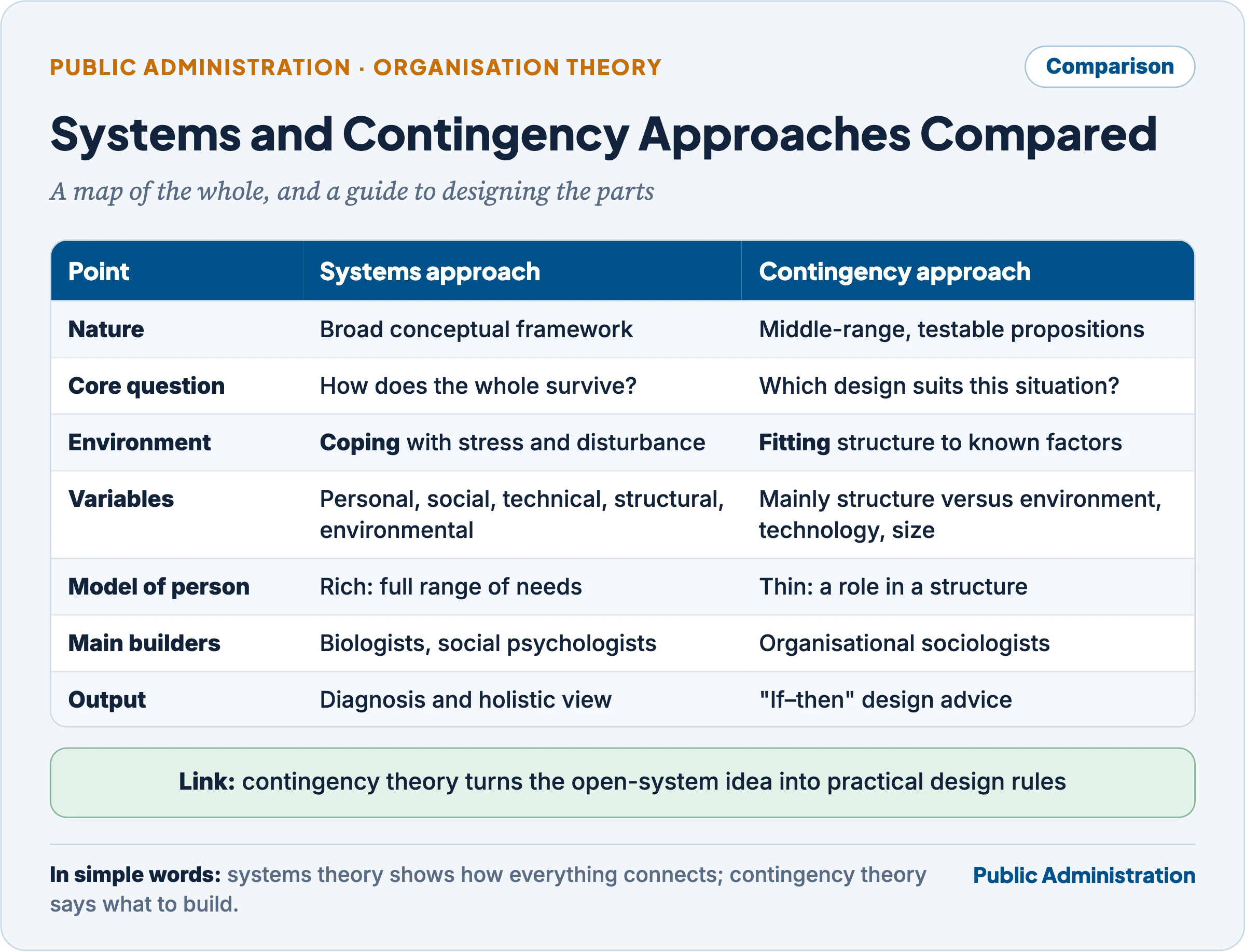
9.2 Differences
| Point | Systems approach | Contingency approach |
|---|---|---|
| Nature | Broad conceptual framework, macro paradigm | Middle-range, testable propositions |
| Variables | All-encompassing: personal, social, technical, structural, environmental | Concentrates on structural adaptation to environment, technology, size, strategy |
| Model of the person | Rich: full range of human needs and motivation | Thinner: people as role-holders in a structure |
| Main contributors | Biologists and social psychologists | Organisational sociologists |
| Relation to environment | Coping with stress and disturbance to survive | Fitting structure to identified contingencies |
| Purpose | Understanding and diagnosis | Design and prescription |
| Level of generality | Universal, applies to all systems | Situational, applies to defined types of situation |
- Evolution: the two may merge: the systems approach can specify situations under which a concept applies, and the contingency approach can supply the process by which an organisation adapts.
9.3 “Fitting” versus “coping with stress”
This contrast captures the essential difference between the two.
- Coping (systems): the environment is a source of disturbance and stress. The system survives by homeostatic and adaptive responses: importing energy, using feedback, changing outputs, elaborating new subsystems. The emphasis is on process, survival and persistence (Easton’s stress, Katz and Kahn’s negative entropy). The environment is treated as largely given and turbulent.
- Fitting (contingency): the environment is described by measurable contingencies (stability, complexity, technology, size). Effectiveness comes from matching structural characteristics to them. The emphasis is on structure, design and performance. The environment is treated as knowable and classifiable.
- Where they differ essentially:
- coping is reactive and continuous; fitting is a deliberate design choice made in advance;
- coping concerns the whole system’s survival; fitting concerns the effectiveness of a particular structure;
- coping admits many paths (equifinality); fitting points to an appropriate structure for each situation;
- coping can involve changing goals (Easton’s persistence through transformation); fitting usually takes goals as given.
- Where they meet: misfit is itself a form of stress; regaining fit (SARFIT) is a coping response.
9.4 How they answer the classical school
| Classical claim | Systems answer | Contingency answer |
|---|---|---|
| The organisation is a closed machine | It is an open system dependent on its environment | Its design must fit its environment |
| There is one best way | Many paths lead to the same end (equifinality) | The best way depends on the situation |
| Universal principles (span, unity of command) | Principles are partial views of a whole | Principles hold only in certain situations (stable, mass, large) |
| Efficiency through structure alone | Effectiveness depends on all subsystems together | Structure must match technology, size and strategy |
| People as inputs to be engineered | People form a psychosocial subsystem | People are one contingency among others |
| Order is imposed from the top | Order is dynamic equilibrium maintained by feedback | Degree of order depends on environmental uncertainty |
9.5 Closed and open models, and their synthesis
Nicholas Henry, in Public Administration and Public Affairs, contrasted the closed model (bureaucratic, hierarchical, Weberian) with the open model (organic, collegial, adaptive) along five axes.
| Axis | Closed model | Open model |
|---|---|---|
| Social role | A wall between organisation and society; the bureaucrat inside, the client outside; society to be manipulated by the “rational” organisation | Society as an interlocking system of organisations; bureaucrat and citizen are the same; the organisation shares society’s purposes |
| View of man | Work-avoiding, dependent, needs strict supervision (McGregor’s Theory X) | Self-actualising, self-controlling, creative (Theory Y); manipulation curbs initiative |
| Structure | Rigid hierarchy, heavy formalism, ordered communication | Participative, flexible, free flow of communication |
| Organisational order | Imposed from the top; supervised atmosphere | Grows from spontaneous human behaviour; people need it “as they need air and water” |
| Environment | Shut off in search of stability; assumes a stable environment | Environment is the soil in which the organisation is planted; reorders itself in response to change |
- Both are ideal constructs: real organisations lie between them; total closure is fatal, and total openness impossible.
- Model synthesis: Henry described a school that starts from the open model (organisations as spontaneous collectivities with their own goals, in an uncertain environment) but explains behaviour as a drive to routinise and rationalise internal work and environmental relations wherever possible, a Darwinian notion. Its three assumptions are that organisations and environments change, that organisations act to survive, and that they learn from mistakes. In short, organisations try to reduce uncertainty, which is Thompson’s thesis.
Entropy, closed and open models, and partnerships. In closed models, entropy grows as the organisation seals itself off; in open models, entropy is countered by importing resources, skills and information. Public-private partnerships under the New Public Management are one way of crossing the boundary: they import private capital, managerial skill and risk-bearing into public service delivery, but also import new uncertainties (contract renegotiation, accountability gaps). (See the article on Regulatory Authorities and Public-Private Partnerships.)
Criticism — The case against systems and contingency thinking in public administration
- Abstraction: the systems approach describes everything and prescribes little; it is a vocabulary, not a theory.
- Determinism: contingency theory treats structure as a response to forces, hiding the choices and interests behind design.
- Equilibrium bias: both value stability, survival and integration, and treat conflict and protest as malfunctions.
- Managerialism: both view organisations from the top, as instruments to be tuned, with people reduced to roles.
- Public sector misfit: much of their evidence comes from manufacturing firms; public agencies are bound by law, politics and multiple goals that “fit” cannot capture.
- Eclecticism: “it all depends” can justify any arrangement after the event.
Defence — The case for systems and contingency thinking in public administration
- Holism: government is a web of interdependent agencies; reforms that ignore linkages fail, as systems theory predicts.
- Environment: public agencies are created, funded and judged by their environment; an open-system view is simply realistic.
- Feedback: grievance systems, audit, evaluation and elections are the feedback loops without which government decays into entropy.
- Design wisdom: contingency theory explains why ministries, corporations, regulators and missions are built differently, and warns against copying one model everywhere.
- Evidence: decades of comparative research support links between structure and environment, technology, size and strategy.
- Openness to synthesis: both approaches absorb later ideas on institutions, networks, learning and complexity.
10. Later Developments
In simple words
After the 1970s, scholars asked new questions. Do organisations really adapt, or does the environment simply weed out the unfit? Do they copy one another to look respectable? Can they learn? Are they too complex to be designed at all?
10.1 Population ecology
Michael Hannan and John Freeman, “The Population Ecology of Organizations” (1977), shifted attention from single organisations to populations of similar organisations.
- Selection, not adaptation: organisations have structural inertia (sunk costs, routines, internal politics, legal constraints), so they change slowly. Change in the population of organisations occurs mainly through birth and death: the environment selects forms that fit and eliminates others.
- Process: variation (new forms appear), selection (environment favours some), retention (successful forms are reproduced).
- Niches: specialists thrive in stable niches, generalists in variable ones; new organisations suffer a liability of newness.
- Contrast with contingency theory: contingency theory assumes managers adapt structures to regain fit; population ecology doubts they can, and stresses environmental selection.
- Public relevance: public organisations are protected from selection by law and budgets, which is why weak bodies survive; yet replacement happens: the Planning Commission gave way to NITI Aayog (2015), loss-making public enterprises have been closed or sold (Air India‘s strategic sale was completed in January 2022).
10.2 Institutional theory and isomorphism
Institutional theory asks why organisations in the same field come to look alike, even when this does not improve efficiency.
- John Meyer and Brian Rowan, “Institutionalized Organizations: Formal Structure as Myth and Ceremony” (1977): organisations adopt structures because they are socially legitimate, not because they are efficient; formal structures are often decoupled from actual practice.
- Paul DiMaggio and Walter Powell, “The Iron Cage Revisited” (1983): organisations become similar through institutional isomorphism:
- Coercive isomorphism: pressure from laws, regulators and funders (States creating bodies required by central law, such as State real estate regulators under RERA, 2016, or Lokayuktas required by the Lokpal and Lokayuktas Act, 2013);
- Mimetic isomorphism: copying successful or prestigious models under uncertainty (India’s Citizen’s Charters of 1997 borrowed from the UK’s 1991 Citizen’s Charter);
- Normative isomorphism: spread of professional norms through training and networks (common training at national academies; global consultancy templates).
- W. Richard Scott: institutions rest on three pillars: regulative, normative and cultural-cognitive.
- Relevance: institutional theory explains ceremonial reform: charters displayed but not honoured, committees formed but not convened, dashboards built but not used.
10.3 Networks and network governance
- Walter Powell (1990) described network forms of organisation as “neither market nor hierarchy”, based on trust, reciprocity and long-term relations.
- Governance increasingly works through networks of ministries, States, local bodies, private firms and civil society; R.A.W. Rhodes described “governing without government”.
- Implication: the systems boundary blurs; the unit of analysis becomes the inter-organisational network, and the main skill becomes integration across organisations (Lawrence and Lorsch’s problem at a larger scale). Platforms such as PRAGATI and PM GatiShakti are network-integration devices.
10.4 The learning organisation
- Peter Senge, The Fifth Discipline (1990): a learning organisation continually expands its capacity to create its future through five disciplines: personal mastery, mental models, shared vision, team learning and systems thinking, the “fifth discipline” that integrates the others.
- Chris Argyris and Donald Schön, Organizational Learning (1978): single-loop learning corrects actions within existing goals; double-loop learning questions the goals and assumptions themselves.
- Link with systems: learning is the organisation’s use of feedback; single-loop learning is negative feedback, double-loop learning is re-design.
- India: Mission Karmayogi (National Programme for Civil Services Capacity Building, approved in September 2020) aims at role-based, continuous learning through the iGOT Karmayogi platform; NITI Aayog’s Development Monitoring and Evaluation Office feeds evaluation back into policy.
10.5 Complexity theory
- Complex adaptive systems consist of many interacting agents following local rules; their behaviour is non-linear, emergent and self-organising; small causes can have large effects, and outcomes cannot be predicted in detail.
- Karl Weick (1976) described organisations as loosely coupled systems in which parts respond to one another weakly, allowing local adaptation but making central control difficult.
- Implications: control gives way to sense-making, experimentation and rapid feedback; plans become adaptive; leaders set direction and boundaries and let solutions emerge.
- Contrast with contingency theory: contingency theory assumes environments can be classified and matched; complexity theory doubts that fit can be designed in advance.
- India: the response to the COVID-19 pandemic in 2020 needed rapid, decentralised experimentation (district-level containment strategies, State variations) alongside central coordination.
10.6 The post-structuralist perspective
Post-structuralism (Michel Foucault, Jacques Derrida) and the wider postmodern turn challenged the systems and contingency approaches at the level of knowledge itself.
- Epistemological position: there is no neutral, objective knowledge of organisations; knowledge is produced within language and discourse and is bound up with power (Foucault’s power/knowledge). Grand theories such as systems theory are meta-narratives that claim universality they cannot have.
- Deconstruction (Derrida) exposes the hidden hierarchies in binary oppositions on which administrative theory rests: politics/administration, fact/value, public/private, rational/irrational, expert/citizen.
- In public administration:
- David Farmer, The Language of Public Administration (1995), proposed reflexive interpretation through imaginization, deconstruction, deterritorialisation (breaking disciplinary boundaries) and alterity (moral concern for the “other”);
- Charles Fox and Hugh Miller, Postmodern Public Administration (1995), proposed discourse theory: legitimacy through authentic, open public dialogue rather than through hierarchy or markets.
- Implications for discrete aspects:
- Organisation: hierarchy and rationality are constructions, not natural facts; multiple voices inside organisations deserve recognition;
- Decision-making: rationality is bounded and constructed; policy problems are framed by dominant discourses;
- Accountability: shifts from hierarchical control to dialogue with citizens;
- Ethics: responsibility towards the other, the marginalised and the unheard;
- Comparative administration: suspicion of universal models exported from the West;
- Expertise: the authority of the expert is questioned; citizen knowledge gains standing.
- Critique: it is better at criticism than construction; it can slide into relativism; its language is obscure; and administration still needs rules and expertise.
11. Indian Administration through the Systems and Contingency Lens
In simple words
Indian government is a huge system of ministries, departments, States and local bodies. It works well only when signals from citizens reach decision-makers, when its many parts are joined up, and when each organisation is built for the job it actually has to do.
11.1 Feedback: CPGRAMS and grievance redress
The Centralised Public Grievance Redress and Monitoring System (CPGRAMS), run by the Department of Administrative Reforms and Public Grievances (DARPG), is the main online channel through which citizens’ complaints against central ministries and, increasingly, States reach the government.
- As feedback: each grievance is information that an output has failed. Aggregated, grievances show systemic defects (a pension rule, a portal fault) that call for root-cause correction, not only case-by-case disposal.
- As a subsystem: CPGRAMS has its own inputs (grievances from the portal, mobile app and Common Service Centres), throughput (routing to over one lakh grievance redressal officers), outputs (action taken reports) and a second-order feedback loop (citizen feedback and appeals).
- Limits seen through systems theory:
- Coding problems: grievances closed as “not pertaining” or disposed with formulaic replies are feedback lost;
- Distance: a central portal is weakly connected to local problems that belong to districts and local bodies;
- Single-loop bias: speedy disposal does not by itself change the rules that cause grievances.
Indian Connect — CPGRAMS: the government’s feedback loop
- Comprehensive Guidelines for Handling Public Grievances were issued by DARPG through an Office Memorandum dated 23 August 2024, reducing the maximum redressal time from 30 days to 21 days (with interim replies where longer is needed), requiring nodal officers and dedicated grievance cells, an appellate layer, a whole-of-government approach (no closure as “does not pertain to this Ministry”), feedback through a call centre with a right of appeal, AI-based analytical dashboards and a monthly Grievance Redressal Assessment and Index.
- Performance: for central ministries and departments, receipts were about 17.4 lakh in 2023-24, 16.7 lakh in 2024-25 and 18.3 lakh in 2025-26, with the average disposal time falling from 16 days to 15 and then 14 days, as reported to the Lok Sabha.
- The State gap: across States and UTs the average disposal time was 119 days in 2023-24 and 64 days in 2024-25, showing weaker feedback loops at the level closest to citizens.
- Systems reading: shorter disposal time improves the speed of feedback; the guidelines’ stress on root-cause analysis is an attempt at double-loop learning.
11.2 Differentiation and integration in the Union Government
- Differentiation: the Union Government has more than fifty ministries and many more departments, each with its own sub-environment, clientele and professional culture. This is the differentiation Lawrence and Lorsch described, at national scale.
- Classic integrating devices: the Cabinet and its committees, the Cabinet Secretariat, Groups of Ministers, committees of secretaries, and NITI Aayog as a coordinating think-tank.
- New integrating platforms:
- PRAGATI (Pro-Active Governance and Timely Implementation, 2015): monthly multi-level reviews chaired by the Prime Minister with Union Secretaries and State Chief Secretaries; a reciprocal-interdependence device that forces mutual adjustment among central ministries and States;
- PM GatiShakti National Master Plan (launched 13 October 2021): a common geospatial platform with an Empowered Group of Secretaries chaired by the Cabinet Secretary, a Network Planning Group of the planning heads of infrastructure ministries and a Technical Support Unit: an integrating department in Lawrence and Lorsch’s sense.
- Reading through contingency theory: where interdependence is reciprocal (infrastructure needing land, forest, railway and power clearances at once), hierarchy and rules are not enough; lateral integrating units are needed.
11.3 The 2nd ARC’s 13th Report: structure through a systems and contingency lens
The Second Administrative Reforms Commission (set up in 2005, chaired by M. Veerappa Moily until March 2009 and then by V. Ramachandran as acting chairman) devoted its 13th Report, Organisational Structure of Government of India (2009), to the shape of the Union Government.
- Diagnosis: a structure built for command and control now has to develop, promote and facilitate; proliferating ministries cause coordination failure; too many levels delay decisions; ministers and secretaries are absorbed in routine operations, leaving little time for policy.
- Main recommendations:
- the Union should concentrate on core functions and leave the rest to States and local governments (subsidiarity);
- group related ministries into about 20–25 groups, each under a coordinating minister, to integrate differentiated units;
- the Allocation of Business Rules should state each department’s mission, not only a list of subjects;
- separate policy from implementation: ministries keep policy, budgets, monitoring and evaluation; executive agencies with autonomy and performance agreements deliver services;
- fit the form to the job: company, society or statutory form depending on the nature of the task;
- no file should pass through more than three levels before a decision;
- common rules on appointment, tenure, removal and review for independent regulators;
- periodic policy evaluation by every department.
- Theory lens: grouping ministries is an integration device (Lawrence and Lorsch); executive agencies apply contingency design; policy evaluation strengthens feedback (systems theory); fewer levels reduce filtering and delay in the communication system (Burns and Stalker’s mechanistic pathology).
- Status: the full clustering has not been adopted, but related ideas recur in practice: mergers such as the Ministry of Jal Shakti (2019), delegation of decision levels, mission-mode agencies and integrated platforms. (See the article on Structure and Forms of Organisation.)
Key Terms
| Term | Meaning in simple words |
|---|---|
| System | A whole made of interdependent parts, with a boundary and an environment |
| General systems theory | Bertalanffy’s search for principles common to all systems |
| Open system | A system in constant exchange with its environment |
| Closed system | A self-contained system with little exchange, tending to run down |
| Input | Energy, resources and information taken in from the environment |
| Throughput | The process that transforms inputs into outputs |
| Output | What the system sends back to its environment |
| Feedback | Information on results that returns to correct or amplify behaviour |
| Entropy | Natural tendency of a system to decay into disorder |
| Negative entropy | Importing more energy than is spent, so the system can survive and grow |
| Homeostasis (steady state) | Dynamic balance maintained by constant adjustment |
| Equifinality | Reaching the same end from different starting points by different paths |
| Subsystem | A part of a system that is itself a system |
| Requisite variety | A controller needs as many possible responses as the disturbances it faces (Ashby) |
| Socio-technical system | Organisation seen as social and technical subsystems to be designed together |
| Cooperative system | Barnard’s view of organisation as consciously coordinated cooperation |
| Demands and supports | Easton’s inputs: claims for action and backing for the system |
| Gatekeepers | Actors who filter demands entering the political system |
| Contingency approach | The view that the best design depends on the situation |
| External fit | Match between structure and environment, technology, size, strategy |
| Internal fit | Consistency among an organisation’s own parts and processes |
| Mechanistic system | Rigid, hierarchical structure suited to stable conditions |
| Organic system | Flexible, networked structure suited to changing conditions |
| Differentiation | Division into units with different orientations to their sub-environments |
| Integration | Achieving unity of effort among differentiated units |
| Pooled, sequential, reciprocal interdependence | Thompson’s three ways units depend on one another |
| Strategic contingencies | Sources of sub-unit power: coping with uncertainty, non-substitutability, centrality |
| Isomorphism | Organisations becoming alike through coercion, imitation or professional norms |
| Learning organisation | An organisation that continuously improves through feedback and systems thinking |
| Double-loop learning | Questioning goals and assumptions, not only correcting actions |
Commissions, Committees and Judgments
| Body / instrument | Year | Key point |
|---|---|---|
| Government of India (Allocation of Business) Rules and (Transaction of Business) Rules | 1961 | Define the inputs (subjects) and conversion procedures of each ministry, under Article 77(3) |
| 2nd ARC, 12th Report: Citizen Centric Administration | 2009 | Grievance redress and service standards (Sevottam) as feedback for citizen-centred government |
| 2nd ARC, 13th Report: Organisational Structure of Government of India | 2009 | 20–25 groups under coordinating ministers; policy separated from implementation; executive agencies; form fitted to task; no more than three levels |
| PM GatiShakti institutional framework (EGoS, NPG, TSU) | 2021 | Integrating mechanism across infrastructure ministries |
| DARPG Comprehensive Guidelines for Handling Public Grievances | 2024 | 21-day timeline, nodal officers, appellate layer, feedback, root-cause analysis, monthly index |
Contemporary Developments
- 23 August 2024: DARPG issued Comprehensive Guidelines for Handling Public Grievances, cutting the CPGRAMS redressal timeline from 30 to 21 days and adding appellate authorities, feedback-based appeals, AI dashboards and a monthly Grievance Redressal Assessment and Index.
- 2 December 2024: a case study by the Saïd Business School, University of Oxford, with the Gates Foundation, credited PRAGATI with accelerating 340 projects worth about USD 205 billion, many of them three to twenty years overdue, through Centre–State integration at the highest level.
- 5 August 2025: the government reported that the PM GatiShakti Network Planning Group had evaluated 293 infrastructure projects worth ₹13.59 lakh crore, with 57 central ministries and departments and all 36 States and UTs on board and about 1,700 data layers integrated.
- August 2025: DARPG’s monthly CPGRAMS report recorded the 38th consecutive month in which central disposals crossed one lakh grievances, with most pending cases under 21 days old.
- October 2025: four years of PM GatiShakti: the Network Planning Group had evaluated over 300 major projects, every State and UT had a State Master Plan portal, and a District Master Plan portal was extended to 28 aspirational districts.
- 2026: the government told the Lok Sabha that central CPGRAMS receipts rose to 18.3 lakh in 2025-26 while the average disposal time fell to 14 days, and listed new feedback tools such as Bhashini translation and the AI chatbot Samadhan Didi.
Revision Grid
| Thinker / body | Work or report (year) | Key idea |
|---|---|---|
| Chester Barnard | The Functions of the Executive (1938) | Cooperative system; effectiveness and efficiency |
| Ludwig von Bertalanffy | “An Outline of General System Theory” (1950); General System Theory (1968) | Open systems, equifinality |
| Philip Selznick | TVA and the Grass Roots (1949) | Co-optation; organisation as adaptive organism |
| Talcott Parsons | The Social System (1951) | AGIL; technical, managerial, institutional levels |
| Trist and Bamforth | Longwall study (1951) | Socio-technical systems; joint optimisation |
| David Easton | The Political System (1953); A Systems Analysis of Political Life (1965) | Demands, supports, outputs, feedback |
| A.K. Rice | Productivity and Social Organization: The Ahmedabad Experiment (1958) | Socio-technical groups in Indian textile mills |
| March and Simon | Organizations (1958) | Bounded rationality, programmes, uncertainty absorption |
| Burns and Stalker | The Management of Innovation (1961) | Mechanistic and organic systems |
| William G. Scott | “Organization Theory: An Overview and an Appraisal” (1961) | Parts and linking processes |
| Alfred Chandler | Strategy and Structure (1962) | Structure follows strategy |
| Joan Woodward | Industrial Organization: Theory and Practice (1965) | Technology and structure |
| Katz and Kahn | The Social Psychology of Organizations (1966; 1978) | Characteristics and subsystems of open systems |
| Warren Bennis | Changing Organizations (1966); The Temporary Society (1968) | Organic-adaptive temporary systems |
| Lawrence and Lorsch | Organization and Environment (1967) | Differentiation and integration; named contingency theory |
| James D. Thompson | Organizations in Action (1967) | Technologies; pooled, sequential, reciprocal interdependence |
| Charles Perrow | Comparative framework (1967) | Routine, engineering, craft, non-routine |
| C. West Churchman | The Systems Approach (1968) | Five considerations of a system |
| Aston group (Pugh, Hickson, Hinings) | Studies of the 1960s | Size and structuring |
| Kast and Rosenzweig | Organization and Management: A Systems Approach (1970) | Five subsystems; contingency as operational systems theory |
| Ira Sharkansky | Public Administration: Policy-Making in Government Agencies (1970) | Systems model of public agencies |
| David Silverman | The Theory of Organisations (1970) | Critique of reification; action frame |
| Hickson et al. | Strategic contingencies theory (1971) | Uncertainty, non-substitutability, centrality |
| John Child | Strategic choice (1972) | Managers choose, not only adapt |
| Hannan and Freeman | “The Population Ecology of Organizations” (1977) | Environmental selection; inertia |
| Meyer and Rowan | “Institutionalized Organizations” (1977) | Myth, ceremony, decoupling |
| DiMaggio and Powell | “The Iron Cage Revisited” (1983) | Coercive, mimetic, normative isomorphism |
| Gareth Morgan | Images of Organization (1986) | Metaphors of organisation |
| Peter Senge | The Fifth Discipline (1990) | Learning organisation; systems thinking |
| Farmer; Fox and Miller | (1995) | Postmodern public administration |
| Lex Donaldson | The Contingency Theory of Organizations (2001) | SARFIT; defence of contingency theory |
| 2nd ARC | 13th Report (2009) | Restructuring the Government of India |
Previous Year Questions
- 2026There is no single best way to manage an organisation. Instead, it is about the optimal structure and strategic fit between the organisation’s internal sub-systems and its dynamic external environment. Elucidate.
- 2025Under the New Public Management framework ‘Public Private Partnership’ challenges the entropy of closed and open models of organization. Analyse.
- 2023“Organization theory is not a single theory with a loosely knit of many approaches to organizational analysis, and it provides different answers to different situations.” Comment.
- 2022Classical Organisation Theory formed the bedrock for the modern organisation theories. Analyse.
- 2020“Organizations of the future will be organic-adaptive structures but temporary systems.” Discuss how Warren Bennis characterises the new form of organization.
- 2019Contingency theory of organization is founded on the interplay of ‘external fit’ and ‘internal fit’. Discuss.
- 2017“Systems Theory” in essence is not a theory, but an approach to the study of administrative phenomena.” Comment.
- 2015“Contemporary Organisational theory seems further afield of Chester Barnard’s Functions of the Executive than of organisational ecology.” Examine the statement in the light of ecological elements in Barnard’s thought.
- 2014What are the implications of the post-structuralist perspective on the discrete aspects of Public Administration, coming from its epistemological positions?
- 2014How does the Strategic Contingencies Theory of organizational design deal with problems arising from sub-unit centrality and non-substitutability?
- 2012(i) ‘The essence of the contingency theory paradigm is that organizational effectiveness results from fitting characteristics of the organization, such as its structure, to contingencies that reflect the situation of the organization.’ Give your reactions to this statement. (ii) In the light of your discussion on 3(b) (i) above, also show where and hiw this ‘fitting’ differs essentially from the ‘coping’ with ‘stress’ from the environment emphasized by the systems theory of organization.
- 2011The Systems Approach is relevant even today for organisational analysis. Discuss how Chester Barnard and David Easton adopted this approach in their respective areas of study.
- 1999“The process of change may create crises in the system.” Comment.
- 1996Examine the view that systems theory, despite its promises to the contrary, followed similar patterns that characterised the structural classical theories.
- 1990Compare the relative merits of the classical theory of organisation and the systems approach.
- 1988How does systems Theory help to delineate functional and dysfunctional characteristics of a public bureaucracy?