

6 Anthropological theories: (d) Structuralism (Lévi-Strauss and E. Leach).
Official Syllabus: Paper I, Unit 6 (structuralism)
1. What Structuralism Is
In simple words
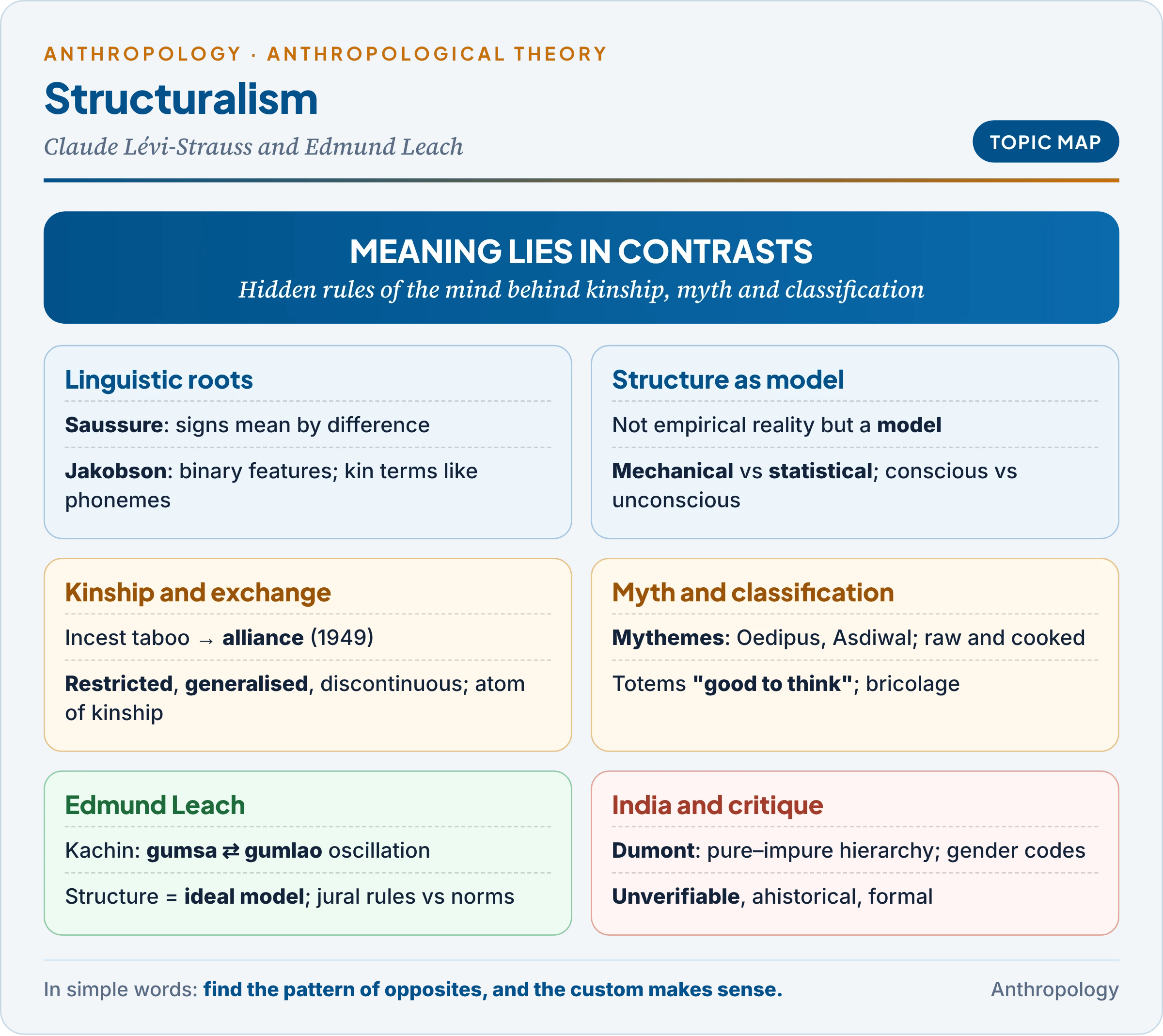
Structuralism holds that the meaning of anything in a culture comes from its place in a system of contrasts, not from the thing itself. Behind the variety of customs, myths and marriage rules lies a small set of mental rules that sort the world into opposites. The anthropologist’s job is to find those hidden rules.
Example first. At a traffic light red means stop and green means go, yet nothing in redness means “stop”: the meaning comes from the contrast, and amber means something only because it stands between them (the British anthropologist Edmund Leach‘s example in Culture and Communication, 1976). In much of India the right hand is for eating and giving and the left for cleaning the body; neither is pure by nature, each is defined against the other. Structuralism extends this insight to all of culture.
1.1 The core ideas
- Structure (a set of relations that stays the same when the elements change) matters more than the elements: chess is the same game with wooden or plastic pieces.
- Surface and depth. The surface structure is what we observe (a myth, a marriage rule, a menu); the deep structure is the unconscious pattern beneath it. Different surfaces can share one deep structure, as many sentences share one grammar.
- Binary opposition (a pair of contrasting terms, such as nature/culture or raw/cooked) is the mind’s basic tool of classification. The mind turns differences of degree into differences of kind: day shades into night, but culture treats them as opposites.
- Mediation and transformation. Cultures invent middle terms (amber, a trickster) that bridge oppositions, and a structure yields transformations (inverted or reversed versions), so two unlike myths may be versions of one.
- Psychic unity. Claude Lévi-Strauss argued that the “savage” and the “civilized” mind have the same structure: no people is pre-logical.
1.2 Claude Lévi-Strauss (1908–2009)
Claude Lévi-Strauss, the French founder of structural anthropology, was born in Brussels and trained in law and philosophy. From 1935 he taught at São Paulo and studied the Bororo and Nambikwara of Brazil (Tristes Tropiques, 1955). In wartime New York he met the linguist Roman Jakobson, from whom he took structural linguistics. He held the chair of social anthropology at the Collège de France (1959–1982). His aim was to find truths about the human mind, not about one society.
1.3 Social structure as a model
Lévi-Strauss’s best-known statement on method appears in his essay “Social Structure” (1953, reprinted in Structural Anthropology, 1958):
“The term ‘social structure’ has nothing to do with empirical reality but with models which are built up after it.”
- Social relations (who marries whom, who works with whom) are the raw material; the structure is the model the analyst builds from them.
- A model is a structure only if it is a system (change one element and the others change), belongs to a group of transformations, lets us predict its reactions, and accounts for all observed facts.
- Mechanical and statistical models. A mechanical model has elements on the same scale as the phenomena: a rule “marry your mother’s brother’s daughter” describes each marriage directly. A statistical model has elements on a different scale: marriage choices in modern society, shaped by chance, class and mobility, can only be described as averages and tendencies. Lévi-Strauss held that anthropology mainly builds mechanical models, sociology and history mainly statistical ones.
- Conscious and unconscious models. The people’s own account (a conscious, “home-made” model) may hide as much as it reveals; the analyst seeks the unconscious model.
The contrast with British social anthropology is sharpest here. For A.R. Radcliffe-Brown, the British founder of structural-functionalism (Unit 6e), structure was the actual network of social relations, observed in the field. For Lévi-Strauss it was a model in the mind. The table sets the two side by side.
| Basis | Structural-functionalism (Radcliffe-Brown) | Structuralism (Lévi-Strauss) |
|---|---|---|
| What “structure” is | Real network of observable relations | Model built by the analyst |
| Where it exists | In society | In the human mind (unconscious) |
| Question asked | How does an institution maintain society? | What mental rules generate this pattern? |
| Kinship seen as | Descent groups and their rights | Alliance: exchange between groups |
| Method | Comparison of observed societies; induction | Model-building; deduction and transformation |
| Model of science | Biology (organism) | Linguistics (language) |
| Time | Synchronic | Synchronic; history largely set aside |
Both study societies at one moment, but they disagree on where structure lives. Radcliffe-Brown could see a structure by watching people; Lévi-Strauss held that watching never reveals it, because it is a logical order followed unawares. Hence their different readings of kinship (§3).
2. The Linguistic Roots
In simple words
Structuralism borrowed its method from the study of language. Linguists had shown that sounds and words mean something only through their differences from other sounds and words. Lévi-Strauss reasoned that kinship terms, myths and food rules might work the same way.
In brief (from Unit 1.3). Ferdinand de Saussure, the Swiss linguist (Course in General Linguistics, published 1916), held that a sign means through its differences from other signs, that langue (the shared system) differs from parole (individual speech), and that a language can be studied synchronically (as a system at one time). The Prague school of N.S. Trubetzkoy and Roman Jakobson showed that phonemes (the smallest units of sound that change meaning, as /p/ and /b/ in “pin” and “bin”) are bundles of binary distinctive features, such as voiced against voiceless. A French root also mattered: Durkheim and Mauss‘s Primitive Classification (1903) had argued that classification of nature copies the divisions of society. Unit 1.3 compares the two fields; the points below show what Lévi-Strauss took from them.
2.1 What Lévi-Strauss borrowed
In “Structural Analysis in Linguistics and in Anthropology” (1945), Lévi-Strauss followed Trubetzkoy‘s four steps of structural phonology:
- Move from conscious phenomena to their unconscious infrastructure: speakers do not know their phonology, nor members their kinship rules.
- Treat relations between terms as the units: “father” means something only against “son” or “mother’s brother”.
- Study the terms as a system.
- Seek general laws.
The analogy. Kinship terms are like phonemes: they acquire meaning only within systems built by the mind unconsciously. Society is communication on three levels: kinship circulates women, economics circulates goods and services, and language circulates messages. In each, exchange creates relations between groups.
2.2 How far the analogy holds
- It works where culture is a code: kin terms, myths, totems and food rules are systems of contrasts used without stated rules.
- It strains elsewhere. Linguists knew language’s function but not its system; anthropologists since Morgan knew kin terms form systems but not their function. And women are persons with interests, not signs (§7.3).
3. The Elementary Structures of Kinship
In simple words
Lévi-Strauss argued that the ban on marrying close relatives forces families to marry out, so they must exchange daughters and sisters with other families. Marriage is therefore an alliance between groups. Different marriage rules create different patterns of exchange, from simple swaps between two groups to long one-way circles linking many.
Example first. Among the Kachin of highland Burma, a lineage takes its wives from a fixed set of lineages called mayu (wife-givers) and gives its daughters to another set called dama (wife-takers). A man should marry a woman of the category that includes his mother’s brother’s daughter. Brides move one way; bride-wealth (cattle, gongs, cloth) moves the other way; and wife-givers rank above wife-takers. Among the Dravidian-speaking castes of Tamil Nadu, by contrast, two families often give brides to each other across generations, and cross cousins are called by terms that mark them as marriageable. Lévi-Strauss showed that such rules are not curiosities: they are different solutions to one problem.
3.1 The argument of The Elementary Structures of Kinship (1949)
- The incest taboo (summarised from Unit 2.3): the one rule that is both universal (like nature) and a rule (like culture), it marks the passage from nature to culture. Its real content is positive: if I give up my sister, I gain a claim on someone else’s.
- Reciprocity. Following Marcel Mauss, the French sociologist whose The Gift (1925) showed that gifts oblige a return, Lévi-Strauss treated marriage as the supreme gift: exchanging women creates alliance (lasting ties between groups), and alliance creates society.
- The unit of kinship is the relation between exchanging groups, not the nuclear family: hence alliance theory, against the descent theory of Radcliffe-Brown and Fortes (Unit 2.5b).
3.2 Elementary, complex and semi-complex structures
- Elementary structures prescribe whom one must marry, usually a category of cross cousin. The kinship terminology itself sorts kin into marriageable and non-marriageable. Lévi-Strauss called this a closed system.
- Complex structures only forbid certain kin and leave the choice of spouse to other mechanisms: wealth, love, class, chance. Modern industrial societies are complex; this is an open system.
- Semi-complex structures (Crow-Omaha systems, which he discussed in his Huxley Lecture of 1965) forbid marriage into many lineages but prescribe none.
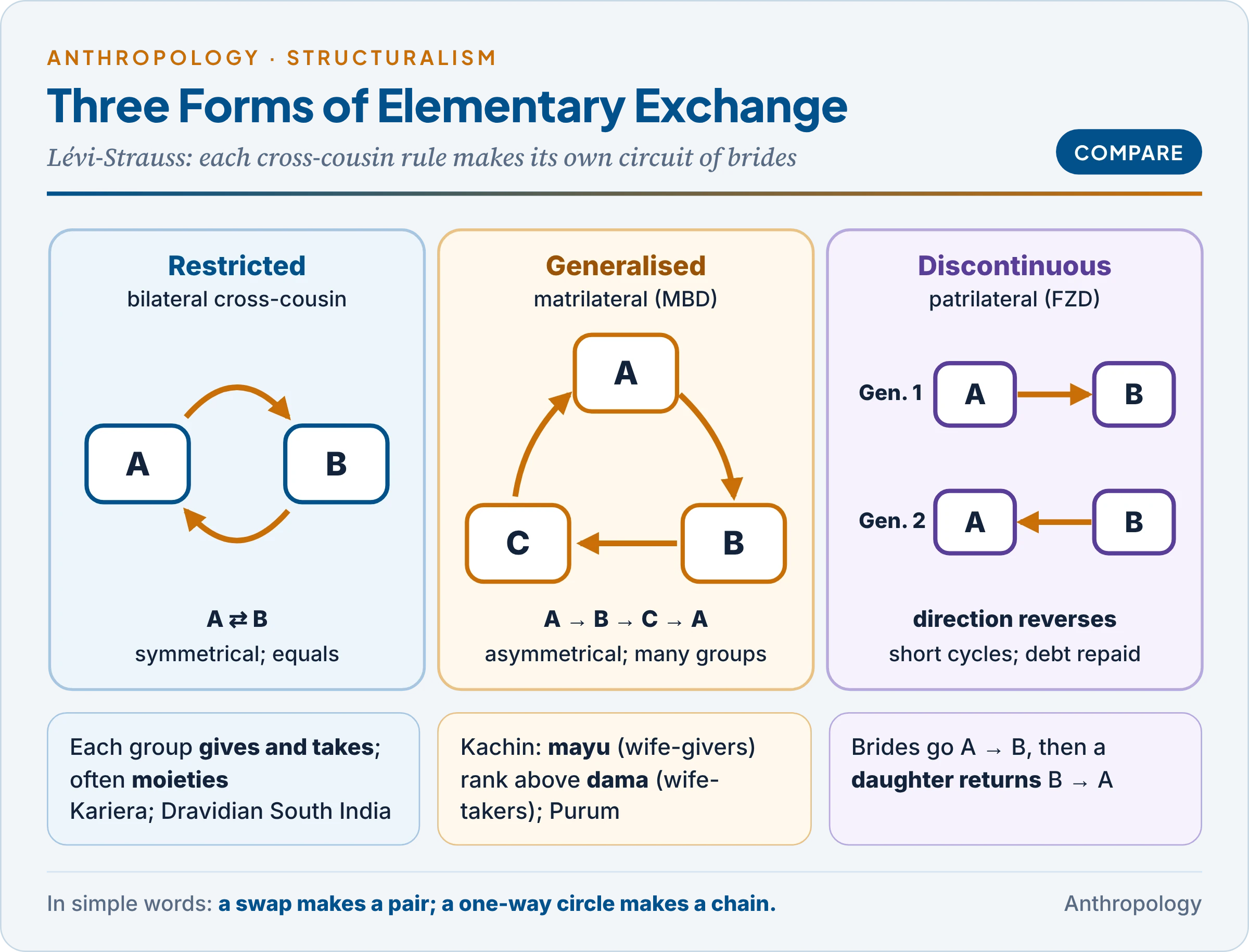
3.3 Three forms of elementary exchange
Lévi-Strauss derived three patterns from the three kinds of cross-cousin marriage. The table shows each rule, the exchange it produces and its social result.
| Marriage rule | Exchange produced | Pattern | Social result | Cases |
|---|---|---|---|---|
| Bilateral cross-cousin (MBD who is also FZD) | Restricted exchange | A ⇄ B; symmetrical | Closed pairs; equality; often moieties (two halves) | Kariera (Australia); Dravidian South India |
| Matrilateral (MBD only) | Generalised exchange; continuous | A → B → C → A; asymmetrical | Long chain linking many groups; tends to rank givers and takers | Kachin (Burma); Purum (Manipur) |
| Patrilateral (FZD only) | Discontinuous (delayed) exchange | Direction reverses each generation | Short cycles that close quickly | Rare as a strict rule |
- Restricted exchange is symmetrical because each group is both wife-giver and wife-taker to the other, so neither ranks higher; the terms need only separate cross from parallel cousins.
- Generalised exchange links many groups because A cannot receive from B, to whom it gives; the circle closes only when the last group gives back to A, tying a whole society together. This integrative power (his “solidarity” explanation), Lévi-Strauss argued, is why MBD marriage is commoner than FZD. Because A must trust that the circle will close, the system carries risk and pushes towards hierarchy.
- FZD exchange is discontinuous because a woman goes from A to B and her daughter returns to A in the next generation: the debt is repaid quickly and no long chain forms.
Debate on the MBD preference. The Americans George Homans and David Schneider (Marriage, Authority and Final Causes, 1955) gave a sentiment explanation: in patrilineal societies the father has authority and the mother’s brother is affectionate, so a man is drawn to the MBD. The British anthropologist Rodney Needham (Structure and Sentiment, 1962) replied that Lévi-Strauss explained prescriptive categories, not feelings. A demographic explanation adds that husbands are usually older than wives, so a man’s MBD is more often of a suitable age than his FZD. This debate and the Purum case of Manipur are treated in Unit 2.5b.
3.4 The atom of kinship
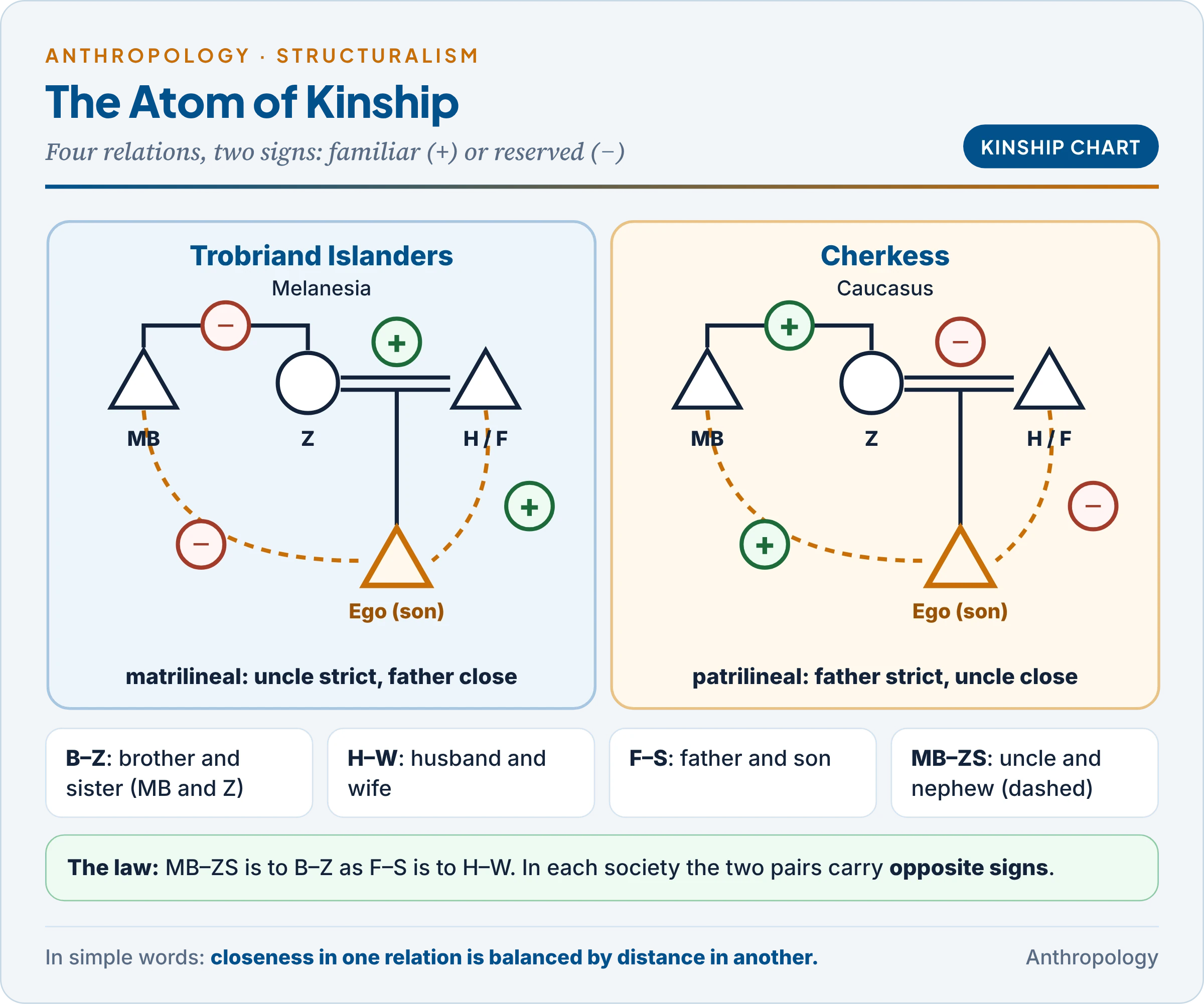
The atom of kinship (the smallest unit of a kinship structure) is Lévi-Strauss’s answer to the old problem of the avunculate (the special relation between a boy and his mother’s brother). Radcliffe-Brown had linked it to two relations only: where father and son are familiar, the mother’s brother is strict, and the reverse. Lévi-Strauss (1945) argued that four relations form one structure:
- brother–sister
- husband–wife
- father–son
- mother’s brother–sister’s son
The mother’s brother is part of the atom because the incest taboo makes a man give his sister to another man; the elementary unit of kinship therefore always contains a wife-giver. Each relation is marked positive (+) (familiar, affectionate) or negative (−) (reserved, hostile). The law:
The relation between maternal uncle and nephew is to the relation between brother and sister as the relation between father and son is to that between husband and wife.
| Society | Descent | Father–son | MB–ZS | Husband–wife | Brother–sister |
|---|---|---|---|---|---|
| Trobriand (Melanesia) | Matrilineal | + | − | + | − |
| Cherkess (Caucasus) | Patrilineal | − | + | − | + |
Reading the table. Descent alone does not predict the attitudes, as Radcliffe-Brown thought; what holds is a balance: if father and son are close, uncle and nephew are distant, and if husband and wife are close, brother and sister are distant. Lévi-Strauss tested the law on Tonga, the Siuai of Bougainville and Lake Kutubu (New Guinea). Attitudes are positions in a system, not separate customs.
Common confusion
Is Lévi-Strauss’s “structure” the same as Radcliffe-Brown’s “social structure”? No. For Radcliffe-Brown, social structure is the actual network of relations between persons, which the fieldworker can observe and describe. For Lévi-Strauss, structure is an unconscious model, a set of logical relations that generates the observed patterns but is never directly seen. The same Kachin data are, for the first, a set of descent groups with rights; for the second, a system of exchange produced by a rule of the mind.
4. The Structural Study of Myth
In simple words
Myths look like fanciful stories, but Lévi-Strauss read them as a kind of logic. Each myth sets up a problem people cannot solve, such as how life and death fit together, and works on it through pairs of opposites. To understand a myth one must read all its versions together and look for the pattern they share.
Example first. In many North American Indian myths the trickster is Coyote or Raven. Why these animals? Lévi-Strauss pointed out that they eat carrion: like hunters they eat meat, like plant-eaters they do not kill what they eat. They stand between the herbivore and the beast of prey, and so between life and death. The trickster’s in-between nature is what fits him to mediate the opposition that the myths struggle with. The meaning lies in the position, not in the animal.
4.1 Myth as language
In “The Structural Study of Myth” (1955), Lévi-Strauss argued that myth is language working at a level where meaning detaches from the words, which is why a myth survives translation.
- Mythemes are the units of myth: short relations (“Oedipus kills his father”) rather than single words. Like phonemes, they mean something only in bundles and in contrast with other bundles.
- All versions count: a myth is the sum of its variants, Freud’s version of Oedipus included. Variants are transformations: as the tale passes between neighbouring peoples, Cinderella becomes Ash-Boy when the hero’s sex is reversed.
- The purpose of myth is to provide a logical model capable of overcoming a contradiction; because the contradiction is real, myths keep producing new versions.
4.2 The Oedipus myth
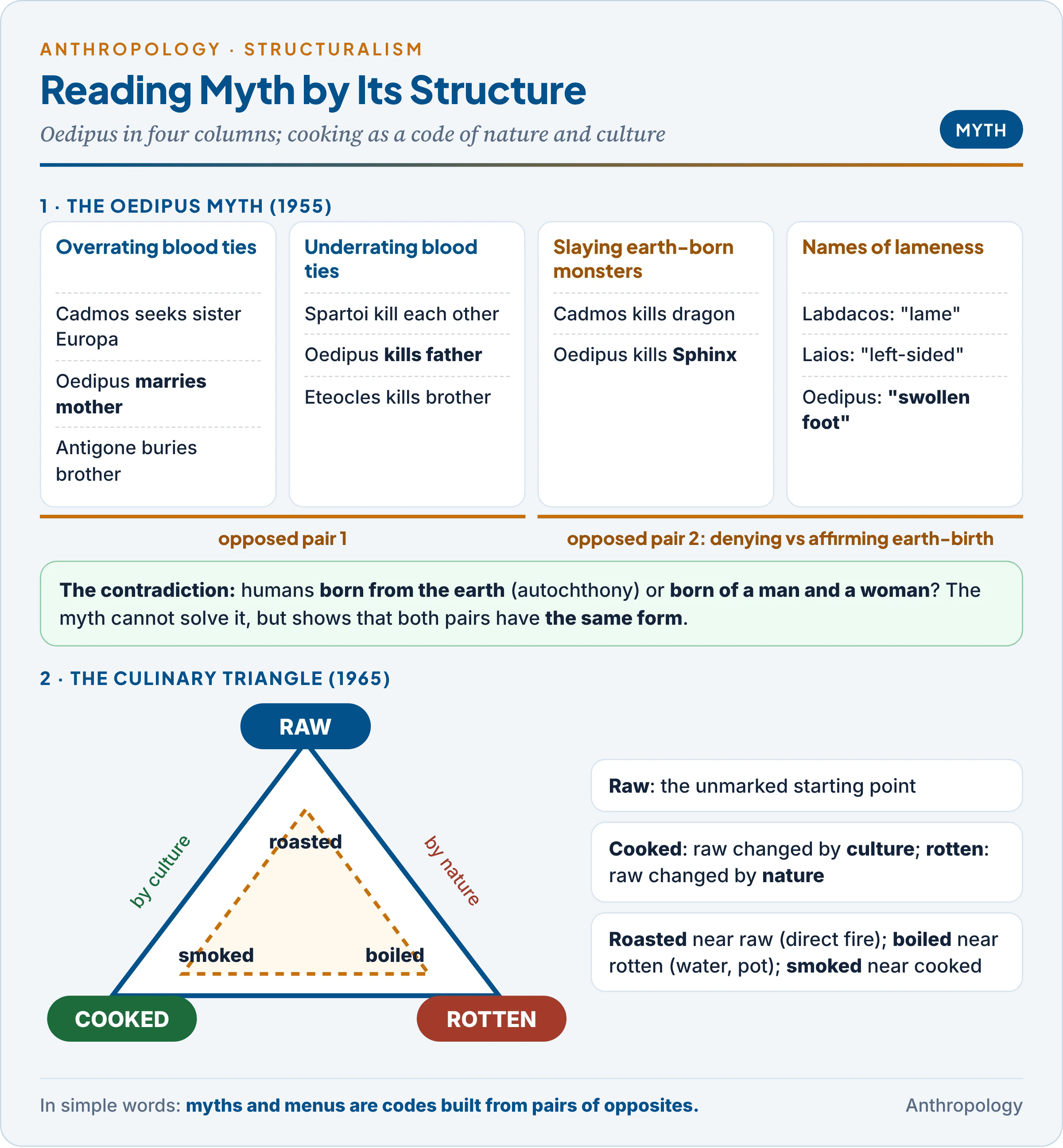
Lévi-Strauss laid out the Greek myths of the Theban line (Cadmos to Oedipus and his children) as an orchestra score, with mythemes arranged in four columns:
| Column 1 | Column 2 | Column 3 | Column 4 |
|---|---|---|---|
| Overrating of blood relations | Underrating of blood relations | Slaying of monsters | Names suggesting difficulty in walking straight |
| Cadmos seeks his sister Europa; Oedipus marries his mother Jocasta; Antigone buries her brother against the law | The Spartoi kill each other; Oedipus kills his father Laios; Eteocles kills his brother Polynices | Cadmos kills the dragon; Oedipus kills the Sphinx | Labdacos (“lame”), Laios (“left-sided”), Oedipus (“swollen foot”) |
Reading the table. Columns 1 and 2 are opposites (kin ties overvalued, then undervalued); so are 3 and 4. The monsters are earth-born, so killing them denies autochthony (the belief that humans were born from the soil); lameness, a mark of earth-born beings in myth, affirms it. The myth sets birth from the earth against birth from a man and a woman. It cannot resolve this, but shows that the two contradictions have the same form, and the mind finds relief in the parallel.
4.3 The story of Asdiwal (1958)
“The Story of Asdiwal” analyses a myth of the Tsimshian of the Skeena and Nass rivers (British Columbia), recorded by Franz Boas. The hero, born after his mother and grandmother meet halfway along the frozen Skeena in a famine, moves between sky and earth, mountain and sea, upstream and downstream, and his wives’ homes and his own.
- Four levels run through the myth: geographic (real places), techno-economic (winter famine, fishing and hunting), sociological (marriage and residence) and cosmological (sky, earth and underworld).
- The key opposition is social. Tsimshian descent was matrilineal and a wife lived at her husband’s place, which pulled men between their own maternal kin and their wives’ kin. In the myth Asdiwal tries matrilocal marriage (living with his wife’s people) again and again, and each attempt fails.
- What it shows: by showing the alternatives unworkable, the myth makes the real rules look necessary. Myth does not mirror social life; it inverts and tests it.
4.4 Mythologiques and the raw and the cooked
- Mythologiques (four volumes, 1964–1971) traces the transformations of hundreds of myths across South and North America. The first volume, The Raw and the Cooked (1964), starts from a Bororo myth of a bird-nester and analyses 187 South American myths.
- Cooking is the central code. Raw food is nature; cooked food is nature transformed by culture. Myths about the origin of fire and cooking are therefore myths about the origin of culture itself.
- The culinary triangle (1965): raw is the unmarked pole; cooked is raw transformed by culture; rotten is raw transformed by nature. Within cooking, roasting (direct fire) stands near the raw, boiling (through water and a pot, a doubly cultural process) near the rotten, and smoking (slow, without a vessel) near the fully cooked.
- Indian parallel. The Hindu contrast of kachcha food (cooked in water) and pakka food (fried in ghee), which governs who may accept food from whom, was analysed as a code of purity by R.S. Khare (The Hindu Hearth and Home, 1976): the manner of cooking carries social meaning.
4.5 Assessment
- Strength: it explains why distant myths resemble each other without diffusion or a primitive mentality, treating myth-makers as thinkers.
- Weakness: the columns depend on the analyst’s choice, and it ignores performance and context, which Malinowski stressed in calling myth a charter (Unit 5a).
5. Totemism and the Savage Mind
In simple words
Lévi-Strauss argued that tribal peoples are not confused thinkers but classifiers. When a clan takes an animal as its emblem, it is using the differences between animals to express the differences between groups of people. The logic is the same as ours; only the materials differ.
Example first. Oraon clans of Jharkhand bear animal and plant names such as Ekka (tortoise) and Lakra (tiger). The old question was why a clan feels kinship with a tortoise. Lévi-Strauss turned it round: the difference between tortoise and tiger stands for the difference between two clans. Natural species are a ready-made system of differences for thinking about society.
5.1 Totemism (1962)
- Totemism is not a single institution or a stage of religion; it is a mode of classification. Lévi-Strauss called it an “illusion” created by lumping together different practices.
- Four combinations of nature and culture: species–group (Australian clans); species–individual (North American guardian spirits); particular animal–individual (the Mota of the Banks Islands, where a child incarnates a creature found by the mother in pregnancy); particular animal–group (Polynesia, Africa).
- The formula: species are chosen not because they are “good to eat” (Malinowski) but because they are “good to think”, building on Radcliffe-Brown’s 1951 point that paired species express opposed moieties. Totemism as religion is in Unit 5b.
5.2 The Savage Mind (1962)
- The science of the concrete. So-called primitive peoples classify plants and animals with great precision, often for no practical gain, out of a desire for order. Their thought is logical, but it works with concrete, sensible things rather than abstract concepts.
- Bricolage (French for do-it-yourself tinkering): mythical thought builds new structures from leftover pieces of old ones, as a handyman makes something new from odds and ends. The engineer, by contrast, designs tools for a project.
- Hot and cold societies. Cold societies try to neutralise history; hot ones make change the engine of development: a contrast of attitudes to time, not a ranking.
- Totem and caste. Lévi-Strauss compared Australian totemic groups with Indian castes. Totemic groups are exogamous: they borrow differences from nature (species) and exchange women. Castes are endogamous: they borrow differences from culture (occupations) and exchange goods and services. The two are an inverted symmetry. Castes treat their women as if they were different natural species that cannot be exchanged, while totemic groups treat natural species as if they were cultural groups.
6. Edmund Leach: Structure, Politics and Change
In simple words
Edmund Leach was a British anthropologist who first followed Malinowski and later adopted parts of Lévi-Strauss’s method. He showed that real societies are never in perfect balance: people move between rival ideal models of how society should be, and use myth and ritual to argue their case. Social structure, for him, is a set of ideas people use, not a fixed thing.
Example first. In the Kachin hills of north-east Burma, Leach found neighbouring villages organised in opposite ways: some had hereditary chiefs and ranked lineages, others no chiefs and equal lineages, and a village could change from one form to the other over generations. What, then, is “the” Kachin social structure?
6.1 Edmund Leach (1910–1989)
Sir Edmund Leach, a British social anthropologist, trained as an engineer at Cambridge and then under Malinowski at the LSE. He began Kachin fieldwork at Hpalang in 1939, served in the Burma Army in the war, and later worked in Sri Lanka. He moved from functionalism to process and then to a critical structuralism, becoming Lévi-Strauss’s chief interpreter in English.
6.2 Political Systems of Highland Burma (1954)
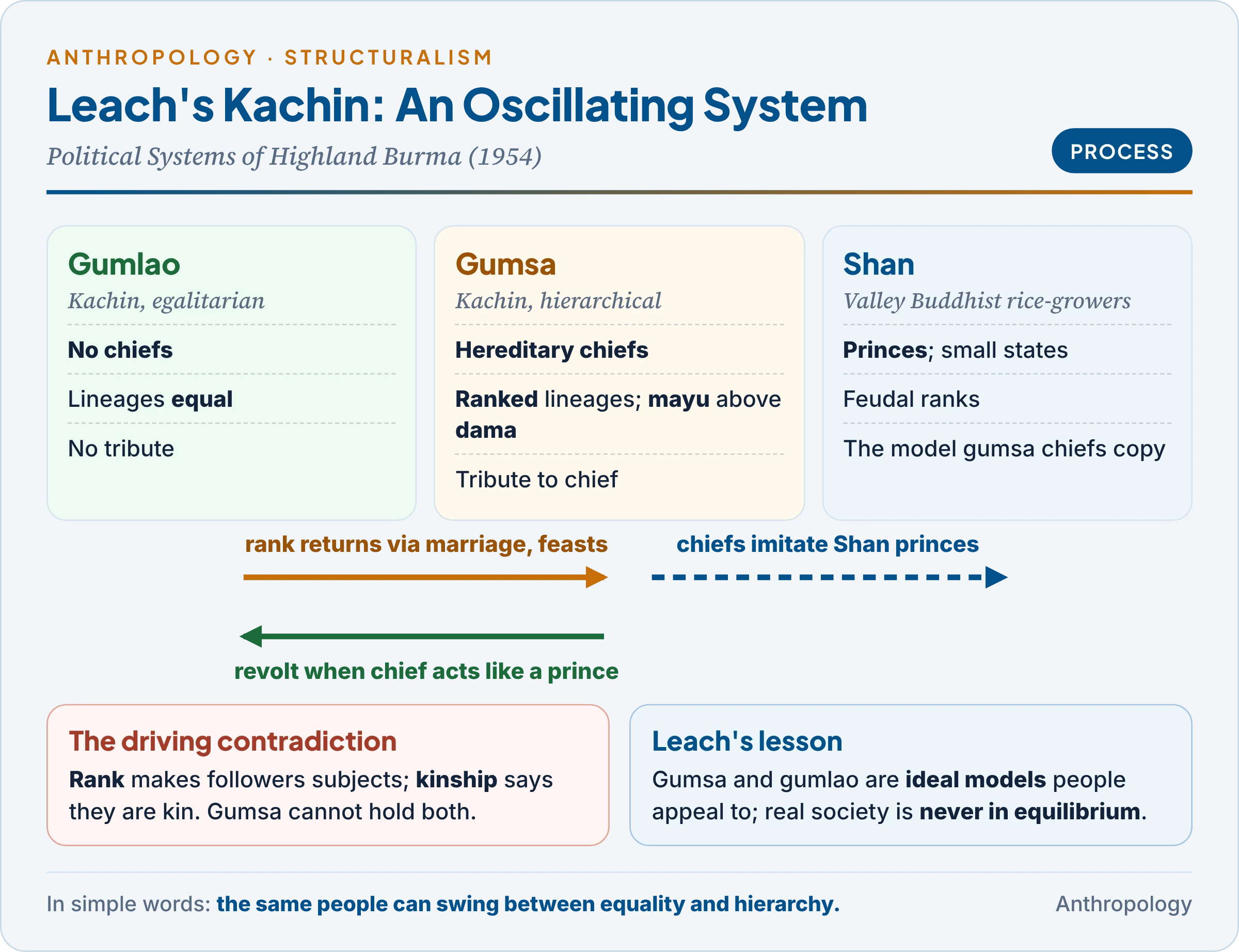
- Three models. The Kachin Hills Area held three sub-systems:
- Shan: the valley-dwelling Buddhist rice-growers, organised as small feudal states under princes.
- Gumsa: Kachin communities with hereditary chiefs, ranked lineages and tribute, imitating the Shan.
- Gumlao: Kachin communities that rejected chiefs and treated all lineages as equal.
- Oscillating equilibrium. Gumsa is unstable. When a chief behaves like a Shan prince and treats his wife-taking kin as subjects, his followers revolt and set up a gumlao order. But gumlao communities, through marriage and feasting, gradually develop rank again and drift back towards gumsa. Over the generations the system oscillates between the two poles.
- Why gumsa contains the seed of change: the mayu–dama rule (§3) makes wife-givers superior to wife-takers. A chief can accumulate prestige through this asymmetry, but kinship also tells his dependants that they are kin, not subjects. Rank and kinship pull in opposite directions; that internal contradiction drives the oscillation.
6.3 Social structure as a model
Leach drew a radical conclusion about method:
- Ideal and real. Structure is an ideal model, a set of ideas about the distribution of power, describing society as if in equilibrium. Real societies are never in equilibrium.
- Models are used by the people. Gumsa and gumlao are ideal orders Kachin actors appeal to, choosing between them to pursue power.
- Myth and ritual as argument. Kachin myths exist in contradictory versions, each backing a lineage’s claim to rank. Myth is not a tidy charter (against Malinowski) but a language of argument; ritual is a symbolic statement of status.
- Jural rules and statistical norms. In Pul Eliya: A Village in Ceylon (1961), Leach separated jural rules (stated rules backed by sanctions) from statistical norms (average behaviour). In Pul Eliya kinship was largely a way of talking about land, so the statistical pattern, not the stated rule, revealed the structure: his version of mechanical and statistical models.
- Parallel move. Raymond Firth, Malinowski’s successor at the LSE, separated social structure (the continuing framework) from social organisation (the choices people make within it) in Elements of Social Organization (1951), also opening British anthropology to choice and change.
6.4 Leach against Radcliffe-Brown, and against Lévi-Strauss
- Against Radcliffe-Brown. In Rethinking Anthropology (1961) Leach mocked typing societies as “butterfly collecting” (sorting without explaining) and proposed seeking patterns of relations shared by unlike societies, as a mathematician finds one form in different figures.
- Against Lévi-Strauss on the Kachin. In “The Structural Implications of Matrilateral Cross-Cousin Marriage” (1951), Leach argued that Lévi-Strauss’s Kachin ethnography was faulty and that alliance was tied to bride-wealth, rank and politics: empirical and political, not just a mental rule.
- Against universalism. Leach accepted the method of binary analysis but doubted a universal mind. He applied it to the Bible (“Lévi-Strauss in the Garden of Eden”, 1961; Genesis as Myth, 1969). British structuralism (Leach, Needham, Mary Douglas) was more empirical than the French.
The table brings the two scholars together.
| Basis | Lévi-Strauss | Leach |
|---|---|---|
| Structure is | Unconscious model in the human mind | Ideal model that actors and analysts use |
| Aim | Universal laws of the mind | Explaining particular societies and change |
| Equilibrium | Assumed for analysis | Rejected: societies are always in flux |
| Individual | Largely absent | Chooses between models for power |
| Myth | Logical mediation of contradiction | Also a political argument between rivals |
| Evidence | Comparison of many cultures, often from texts | Long fieldwork (Kachin, Pul Eliya) |
| Kinship | Exchange of women | Exchange tied to bride-wealth and rank |
Leach kept structuralism’s insight that meaning lies in contrasts, but put history and agency back into it. That makes his work a bridge between structuralism and later symbolic and processual anthropology (Unit 6h onwards).
Common confusion
Was Leach a structuralist or a critic of structuralism? Both. He adopted Lévi-Strauss’s method (reading myth, ritual and kinship as systems of binary contrasts) and introduced it to British anthropology. But he rejected Lévi-Strauss’s claim to discover a universal mind and his neglect of change. Political Systems of Highland Burma (1954) was written before Leach’s structuralist phase; its key idea, that structures are ideal models which real people manipulate, already set him apart from both Radcliffe-Brown and Lévi-Strauss.
7. Structuralism and Indian Society
In simple words
Structural ideas have been used to study caste, Indian kinship and gender in India. Caste has been read as a system built on one master contrast, between pure and impure. Gender has been read through contrasts such as nature and culture, or seed and field.
7.1 Dumont: caste as hierarchy
Louis Dumont, a French anthropologist of India trained by Mauss, wrote Homo Hierarchicus: The Caste System and Its Implications (1966; English 1970), the most influential structural account of caste.
- One master opposition. Caste rests on the opposition of pure and impure. Purity is relative: each caste is pure in relation to those below and impure in relation to those above.
- Three features (taken from the French sociologist Célestin Bouglé): separation (rules on marriage and contact), division of labour (hereditary occupations) and hierarchy (ranking). All three follow from the single pure–impure opposition.
- Hierarchy as “encompassing of the contrary”. The higher term includes the lower while being opposed to it, as “man” can include “woman” in older usage. The Brahmin (status) ranks above the king (power), yet the king’s power is encompassed by, and depends on, the priest’s status. Status and power are separated, which Dumont saw as unique to India.
- Holism versus individualism. India values the whole (homo hierarchicus); the modern West values the individual (homo aequalis). Caste is a total system of ideas, not just a form of inequality.
- Criticism. Gerald Berreman and others said Dumont took the Brahmin’s view for the whole and underplayed power and dominant castes; Nicholas Dirks (Castes of Mind, 2001) traced the purity picture partly to colonial knowledge. As a structure in Lévi-Strauss’s sense, the model is open to the charge of being ahistorical.
7.2 Indian kinship
- Dravidian terminology. Dumont (“The Dravidian Kinship Terminology as an Expression of Marriage”, 1953) showed that South Indian kin terms divide relatives by a binary contrast of cross and parallel, so that the terms themselves express marriage alliance, repeated across generations. His study of the Pramalai Kallar of Tamil Nadu (1957) applied this in the field. Details are in Unit 2.5b.
- Purum (Manipur): Needham’s structural reading of T.C. Das’s data as generalised exchange, and its statistical critique, are treated in Unit 2.5b.
- Texts and ritual. Veena Das, in Structure and Cognition: Aspects of Hindu Caste and Ritual (1977), applied structural analysis to Sanskrit ritual texts and a Gujarati caste origin text, bringing out oppositions such as auspicious and inauspicious and gods and ancestors.
7.3 Gender
- Women as exchanged. In Lévi-Strauss’s model men exchange women. Gayle Rubin, an American anthropologist, in “The Traffic in Women” (1975), took this as a description of male control over women’s sexuality and labour, not a neutral law of the mind.
- Nature and culture. Sherry Ortner, in “Is Female to Male as Nature Is to Culture?” (1974), argued that many cultures place women closer to nature (through childbirth and childcare) and men closer to culture, explaining women’s widespread lower valuation. Critics replied that many societies do not divide nature and culture this way.
- Seed and earth. Leela Dube, the Indian anthropologist, in “Seed and Earth” (1986), analysed the north Indian metaphor that the man supplies the seed and the woman is the field. The opposition gives the child to the father’s lineage and denies women rights over their children and land. A binary cultural symbol thus supports patriliny.
8. Critique and Legacy
In simple words
Critics said that structuralism could never be tested, that it ignored history and the individual, and that it turned living cultures into abstract diagrams. Yet it changed how anthropologists read kinship, myth and symbols, and later schools grew out of the argument with it.
Criticism — Main criticisms
- Unverifiable. Structures are models in the analyst’s mind; two analysts can find different oppositions in one myth, with no test to decide between them.
- Ahistorical. Structuralism is synchronic: it explains how a system holds together, not how it changes. Leach’s Kachin study showed that structures are constantly revised.
- Formalism. It reduces culture to form and logic and neglects content, emotion and material conditions. Clifford Geertz called Lévi-Strauss’s thinker the “cerebral savage” (1967); Marvin Harris (1968) attacked it as idealism that ignores ecology and economy.
- No room for the individual. People appear as carriers of rules, not as agents. Pierre Bourdieu‘s theory of practice (Outline of a Theory of Practice, 1972; English 1977) put the strategies of actors back into the picture.
- Weak ethnography and universalism. Lévi-Strauss often used others’ data (Leach found Kachin errors), and a single human mind can flatten cultural difference.
Defence — Replies and lasting value
- Structuralism sought intelligibility, not prediction; a model is judged by how much it makes coherent that was obscure.
- It showed that “primitive” thought is logical, a powerful answer to theories of pre-logical mentality.
- It transformed kinship (alliance theory), myth and symbolism, and gave a method for comparing cultures without ranking them.
- It shaped symbolic anthropology (Douglas, Turner), cognitive anthropology, and, through its critics (Derrida, Foucault, Bourdieu), post-structuralism and post-modernism (Unit 6k).
- Post-structuralism. Jacques Derrida (“Structure, Sign and Play”, 1966) argued that a structure has no fixed centre, so meaning is never closed; Michel Foucault turned to power and discourse. They kept meaning-through-relations but rejected a stable, universal structure. Others in French thought, such as the literary critic Roland Barthes and the psychoanalyst Jacques Lacan, applied structural ideas to texts and the unconscious while refusing the label.
- Overall. Structuralism is best seen as a method for decoding cultural systems; its weak points (history, agency, testing) set the questions later schools answered.
Key Concepts
| Concept | Scholar | Meaning |
|---|---|---|
| Structure | Lévi-Strauss | Model of relations that stays constant under transformation |
| Mechanical / statistical model | Lévi-Strauss | Elements on the same / a different scale as the phenomena |
| Binary opposition | Lévi-Strauss | Paired contrasts through which the mind classifies |
| Restricted / generalised exchange | Lévi-Strauss | Direct swap / one-way circle of women |
| Atom of kinship | Lévi-Strauss | Four linked relations including the mother’s brother |
| Mytheme | Lévi-Strauss | Smallest unit of myth, a relation |
| Oscillating equilibrium | Leach | Movement between gumsa and gumlao |
| Jural rules / statistical norms | Leach | Stated rules / average behaviour |
| Encompassing of the contrary | Dumont | The higher term includes the lower |
Major Works
| Scholar | Work | Year | Significance |
|---|---|---|---|
| Lévi-Strauss | “Structural Analysis in Linguistics and in Anthropology” | 1945 | Kin terms like phonemes; atom of kinship |
| Lévi-Strauss | The Elementary Structures of Kinship | 1949 | Alliance theory; three exchanges |
| Leach | “The Structural Implications of Matrilateral Cross-Cousin Marriage” | 1951 | Kachin alliance tied to rank |
| Leach | Political Systems of Highland Burma | 1954 | Gumsa–gumlao oscillation |
| Lévi-Strauss | “The Structural Study of Myth” | 1955 | Mythemes; Oedipus |
| Lévi-Strauss | “The Story of Asdiwal” | 1958 | Tsimshian myth on four levels |
| Leach | Rethinking Anthropology; Pul Eliya | 1961 | Against butterfly collecting; jural vs statistical |
| Lévi-Strauss | Totemism; The Savage Mind | 1962 | “Good to think”; science of the concrete |
| Lévi-Strauss | The Raw and the Cooked | 1964 | Cooking as nature–culture code |
| Dumont | Homo Hierarchicus | 1966 | Caste as pure–impure hierarchy |
Key Terms
| Term | Meaning in simple words |
|---|---|
| Structuralism | Study of the hidden patterns of contrast behind cultural forms |
| Deep structure | The unseen rule-set that produces what we observe |
| Binary opposition | A pair of opposites, such as raw and cooked |
| Synchronic | Looking at a system at one point in time |
| Alliance | A tie between groups created by marriage |
| Elementary structure | A kinship system that prescribes whom to marry |
| Avunculate | Special relation between a boy and his mother’s brother |
| Mytheme | A basic unit of a myth, like “son kills father” |
| Autochthony | Belief that humans were born from the earth |
| Gumsa / gumlao | Kachin hierarchical / egalitarian political orders |
| Mayu / dama | Kachin wife-giving / wife-taking lineages |
| Hierarchy (Dumont) | Ranking in which the higher includes the lower |
Contemporary Developments
- Death and centenary: Lévi-Strauss died on 30 October 2009, aged 100; a selection of his works had entered the French Pléiade library of classics in 2008, a rare honour for a living author.
- A new translation (2021): La Pensée sauvage was retranslated into English as Wild Thought (University of Chicago Press), restoring the pun in the original title (pensée means both “thought” and the pansy flower) and the book’s argument that “wild” thought is thought in its untamed state, not the thought of “savages”.
- Nature and culture rethought: Philippe Descola, Lévi-Strauss’s successor at the Collège de France, in Beyond Nature and Culture (2005; English 2013), used structural method to classify four ways of relating humans and non-humans (animism, totemism, analogism and naturalism), questioning the nature–culture opposition itself.
- Amerindian perspectivism: the Brazilian anthropologist Eduardo Viveiros de Castro (from 1998; Cannibal Metaphysics, 2009) reworked structural analysis of Amazonian myth into a theory of how different beings see the world, a leading strand of the “ontological turn”.
Diagrams to Master
- Topic map of the article.
- Three forms of exchange (§3.3): draw A ⇄ B, the circle A → B → C → A, and the reversing FZD arrows; label symmetrical, asymmetrical, mayu–dama.
- Atom of kinship (§3.4): four relations with + and − for Trobriand and Cherkess; write the law beneath.
- Oedipus columns and culinary triangle (§4): four column headings; raw, cooked, rotten with roasted, boiled, smoked.
- Leach’s Kachin model (§6.2): Shan, gumsa, gumlao, with the oscillation arrows and the rank–kinship contradiction.
Revision Grid
| Scholar | Work (year) | Key idea |
|---|---|---|
| Saussure | Course in General Linguistics (1916) | Langue and parole; meaning by difference |
| Lévi-Strauss | Elementary Structures (1949) | Incest taboo, exchange, alliance |
| Lévi-Strauss | “Social Structure” (1953) | Mechanical and statistical models |
| Lévi-Strauss | “Structural Study of Myth” (1955); “Asdiwal” (1958) | Mythemes; mediation |
| Lévi-Strauss | Totemism; The Savage Mind (1962) | Good to think; bricolage; totem and caste |
| Leach | Political Systems of Highland Burma (1954) | Oscillation; structure as ideal model |
| Leach | Rethinking Anthropology; Pul Eliya (1961) | Butterfly collecting; jural rules and statistical norms |
| Dumont | Homo Hierarchicus (1966) | Pure–impure; encompassing of the contrary |
| Leela Dube | “Seed and Earth” (1986) | Seed–field symbolism supports patriliny |
Previous Year Questions
Unit 6: Structuralism (Lévi-Strauss and E. Leach)
- 2026How is the theory of structuralism helpful in understanding the concepts of caste and gender?
- 2024How does Lévi-Strauss look at the Tsimshian myth of Asdiwal? Critically discuss Lévi-Strauss’ theory of structuralism in the light of his study of mythologies.
- 2021Explain the structural analysis of kinship as proposed by Levi – Strauss.
- 2016How do the concepts of binary opposites and exchange figure in Levi-Strauss’ structural analysis of kinship?
- 2009What are the major criticisms of the theory of ‘Structuralism’ as propounded by Claude Levi-Strauss ?
- 1996Analyze how Raymond Firth’s concepts of structure, function, organization and process accommodate the study of both static and dynamic aspects of the social structure.
- 1994Write a note on Structuralist approach to the study of myth.
- 1993Write a note on Edmund R Leach.
- 1991Discuss how Edmund Leach views social structure as a model.
- 1989Examine critically the concept of Model and myth in Levi-Strauss Anthropology.
- 1988Discuss how Edmund Leach viewed ‘Social Structure’ as a model.
- 1986Critically examine the contribution of Levi-Strauss in providing a theoretical ‘ frame for the structural analysis in society.
- 1985Discuss in brief model and myth in Levi- Strauss anthropology.
- 1984Discuss how structuralism derived from modern linguistics ?
- 1982Discuss the structural study of myth by Levi-Strauss.
- 1981Discuss how social structure is conceived as models, following Levi-Strauss and Leach.
Related questions from other units
- 2026Unit 6: Compare Edmund Leach’s structuralism with interpretive anthropology of Clifford Geertz.
- 2026Unit 2.3: Discuss ‘incest taboo’ as the basis of development of kinship systems in human societies.
- 2026Unit 5: Write notes on: Myth as oral literature.
- 2025Unit 2.5: Write notes on: Theoretical significance of Purum kinship-system.
- 2021Unit 2.3: Write notes on: Marriage Regulations and Alliance Theory.
- 2019Unit 6: How did Radcliffe-Brown and Levi-Strauss study kinship in terms of social structure?
- 2016Unit 2.5: Describe the cardinal points of descent and alliance theories.
- 2001Unit 2.5: Explain the salient features of Descent and Alliance theories. Discuss the relevance to the analysis and understanding of Social Structure.
- 1985Unit 1.3: What are the common aspects of structural anthropology and linguistics?
- 1983Unit 1.3: Does structuralism in social anthropology coincide with that in linguistics ? Critically assess their analogy.