

6 Anthropological theories: (c) Functionalism (Malinowski); Structural-functionalism (Radcliffe-Brown).
Official Syllabus: Paper I, Unit 6 (structural-functionalism)
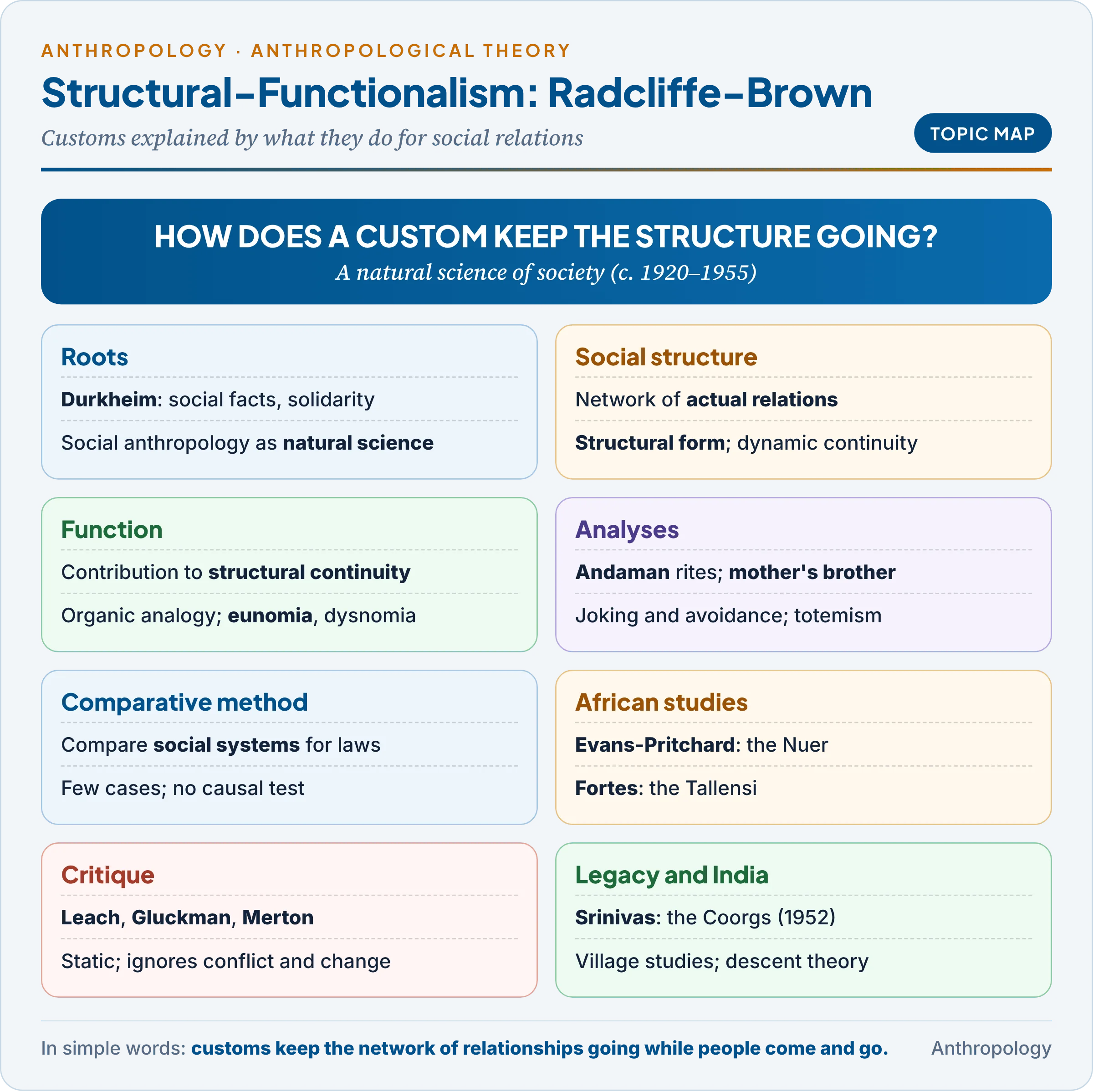
1. From Durkheim to a Natural Science of Society
In simple words
Structural-functionalism looks at a society as a set of relationships between people, such as father and son or chief and subject. It asks how each custom helps to keep those relationships going, so that the society holds together even though individuals are born and die.
Example first. Among the Andaman Islanders (Bay of Bengal, India), friends or relatives meeting after a long absence sat down, embraced and wept together; so did former enemies at a peace-making, mourners at the end of mourning, and kin at a marriage or initiation. The British anthropologist A.R. Radcliffe-Brown, who studied the islanders in 1906–08, observed that the weeping was not a spontaneous outburst but a rite required by custom: anyone who failed to weep would be condemned. Its purpose, he argued, was “to affirm the existence of a social bond” between the people concerned. He asked not what the weepers felt but what the custom did for social relationships: the question of structural-functionalism.
1.1 Radcliffe-Brown in brief
- Alfred Reginald Brown (1881–1955) was born in Birmingham and studied moral sciences at Trinity College, Cambridge, where he was the first student of W.H.R. Rivers and A.C. Haddon. His interest in the anarchist Peter Kropotkin, who saw society as self-regulating, earned him the nickname “Anarchy Brown“. He added “Radcliffe” to his name in 1926.
- Fieldwork: the Andaman Islands (1906–08) and Western Australia (1910–12).
- A travelling founder: he set up social anthropology teaching in Cape Town (1921–25), Sydney (1926–31), Chicago (1931–37) and Oxford (1937–46), where he held the first chair of social anthropology.
1.2 The Durkheimian inheritance
Radcliffe-Brown took his central ideas from the French sociologist Émile Durkheim and the French sociological school of the 1890s.
- Society is a reality of its own (sui generis). Social phenomena form an order of reality distinct from biology and psychology, so they must be explained by other social phenomena, not by individual needs, drives or feelings.
- Solidarity is the central problem: how do customs contribute to cohesion?
- Function. Durkheim had defined the function of an institution as its correspondence with the needs of the social organism (Rules of Sociological Method, 1895). Radcliffe-Brown accepted this but, “to avoid possible ambiguity and in particular the possibility of a teleological interpretation”, replaced “needs” with “necessary conditions of existence“. A society does not “want” anything; it simply cannot persist without certain conditions.
- Religion as society. In The Elementary Forms of the Religious Life (1912), built on Arunta totemism, Durkheim argued that the sacred totem is the clan’s emblem, so worship of the sacred is worship of society itself (Unit 5a).
- Laws through comparison. Like natural systems, societies are governed by laws that can be found by systematic comparison.
1.3 A natural science of society
Radcliffe-Brown called social anthropology “the theoretical natural science of human society“, to be studied “by methods essentially similar to those used in the physical and biological sciences”, and was willing to call it comparative sociology. He separated ethnology (historical reconstruction, conjectural for peoples without records) from social anthropology (the comparative, law-seeking study of social structures). He also rejected the label “functionalist”. In 1940 he declared that the “Functional School does not really exist; it is a myth invented by Professor Malinowski”, and in 1949 he called Malinowski’s needs-based functionalism “useless and worse” (Unit 6d, §7.3). His own key word was structure; function was defined through it.
2. Social Structure and Structural Form
In simple words
Social structure is the pattern of relationships between people in a society. The particular people change all the time, as some are born and others die, but the pattern of relationships, such as how a son should treat his father, lasts much longer. The anthropologist studies that lasting pattern.
2.1 Social structure: the network of actual relations
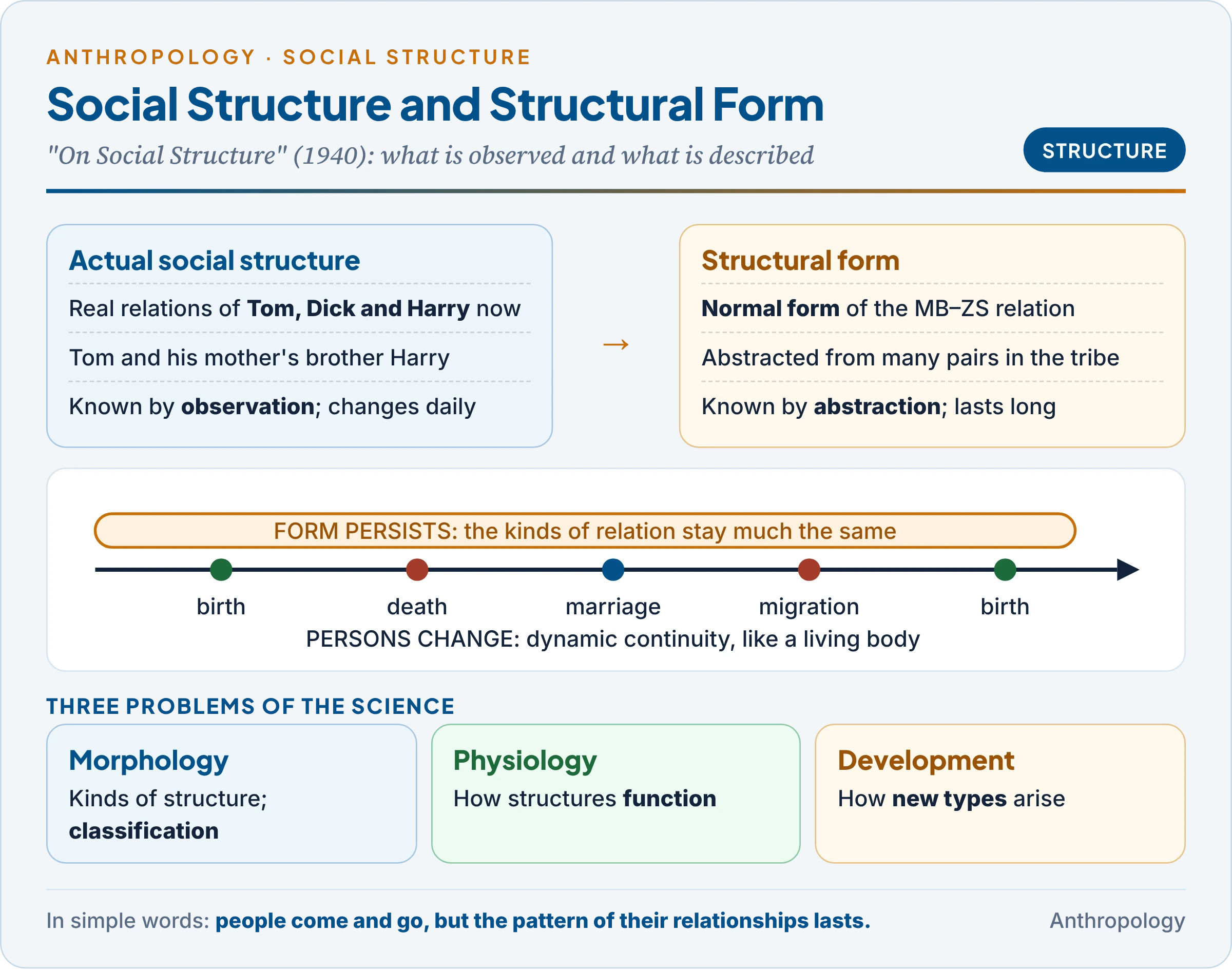
In his presidential address to the Royal Anthropological Institute, “On Social Structure” (1940), Radcliffe-Brown argued that the anthropologist cannot observe a “culture”, which is “a vague abstraction”. What can be observed is that human beings “are connected by a complex network of social relations”. He continued: “I use the term ‘social structure’ to denote this network of actually existing relations.”
- Its units are persons occupying positions (father, chief, buyer); it includes all person-to-person relations and the differentiation of individuals and classes by social role (men and women, chiefs and commoners, castes).
- He also defined it as “the continuing arrangement of persons in relationships defined or controlled by institutions“.
2.2 Structural form: what the anthropologist describes
Radcliffe-Brown then drew his most important distinction. The observed reality is “the set of actually existing relations, at a given moment of time, which link together certain human beings”. But science “is not concerned with the particular, the unique, but only with the general”. So “the actual relations of Tom, Dick and Harry” go into the notebook, while what the anthropologist needs is “an account of the form of the structure“.
His own example: in an Australian tribe he observed many pairs of mother’s brother and sister’s son, in order “to record as precisely as possible the general or normal form of this relationship, abstracted from the variations of particular instances”. The table sets the two levels side by side.
| Basis | Actual social structure | Structural form |
|---|---|---|
| What it is | Real relations between named persons now | General pattern of a kind of relation |
| Example | Tom’s dealings with his mother’s brother Harry | The normal form of the MB–ZS relation in the tribe |
| How known | Direct observation | Abstraction from many cases |
| Change | Changes daily: births, deaths, quarrels | Relatively constant over long periods |
| Studied by | Field notebook, biography, history | Social anthropology as a science |
The distinction lets the anthropologist generalise while real people vary: the people change, the form persists.
2.3 Dynamic continuity
Social structure has continuity, but “not static like that of a building“: it is “a dynamic continuity, like that of the organic structure of a living body”. Members are born, die, marry and quarrel, yet a stable community revisited after ten years shows “the kinds of relations” little changed.
- The matter and the form: the “matter” of the structure is the individuals, who come and go; the “form” is supplied by the institutions, which last.
- Change does happen: structural form may change “sometimes gradually, sometimes with relative suddenness, as in revolutions and military conquests”, but “even in the most revolutionary changes some continuity of structure is maintained”.
2.4 Structural features of social life
Radcliffe-Brown listed what a description of social structure must include:
- Social groups that persist (families, lineages, clans, villages, tribes) and the relations between them;
- the internal structure of each group (the family as relations of father, mother and children);
- the arrangement of persons into social classes and categories (castes in India, economic classes in the West, age-sets);
- social distinctions of role and status between persons and classes, by sex, age, rank or wealth;
- dyadic relations, person to person (master and servant, teacher and pupil, MB and ZS);
- the interaction of persons and groups in cooperation, competition and conflict.
2.5 Status, role and institution
- Status (position): each person in the structure occupies positions (father, chief, sister’s son), which locate him in the network.
- Role: the expected behaviour attached to each position.
- Institution: an established, socially recognised system of norms governing a kind of relationship. The institution of the family, for example, lays down how father and son, husband and wife should behave towards each other. Institutions connect the structure to behaviour: they say what each status-holder owes to others.
In short, the structure arranges persons, institutions set the norms of their relations, and roles are those norms in action. The fuller treatment of status and role (Linton, Merton’s role-set, Goffman) is in Unit 2.2, §3.
2.6 Three problems and three kinds of adaptation
The science has three problems, borrowed from biology: social morphology (classifying kinds of structure), social physiology (how structures function) and social development (how new types arise).
Every social system is adapted in three ways: ecological (to the environment), institutional (the social structure itself) and cultural (individuals acquiring fitting habits). He gave priority to the second.
3. Function and the Organic Analogy
In simple words
Radcliffe-Brown compared a society to a living body. The body stays the same body although its cells are constantly replaced, because each organ does its work. In the same way, a society stays the same society although people come and go, because each custom does its part in keeping the relationships going.
3.1 The definition of function
In “On the Concept of Function in Social Science” (1935), Radcliffe-Brown built his definition on the analogy with an organism.
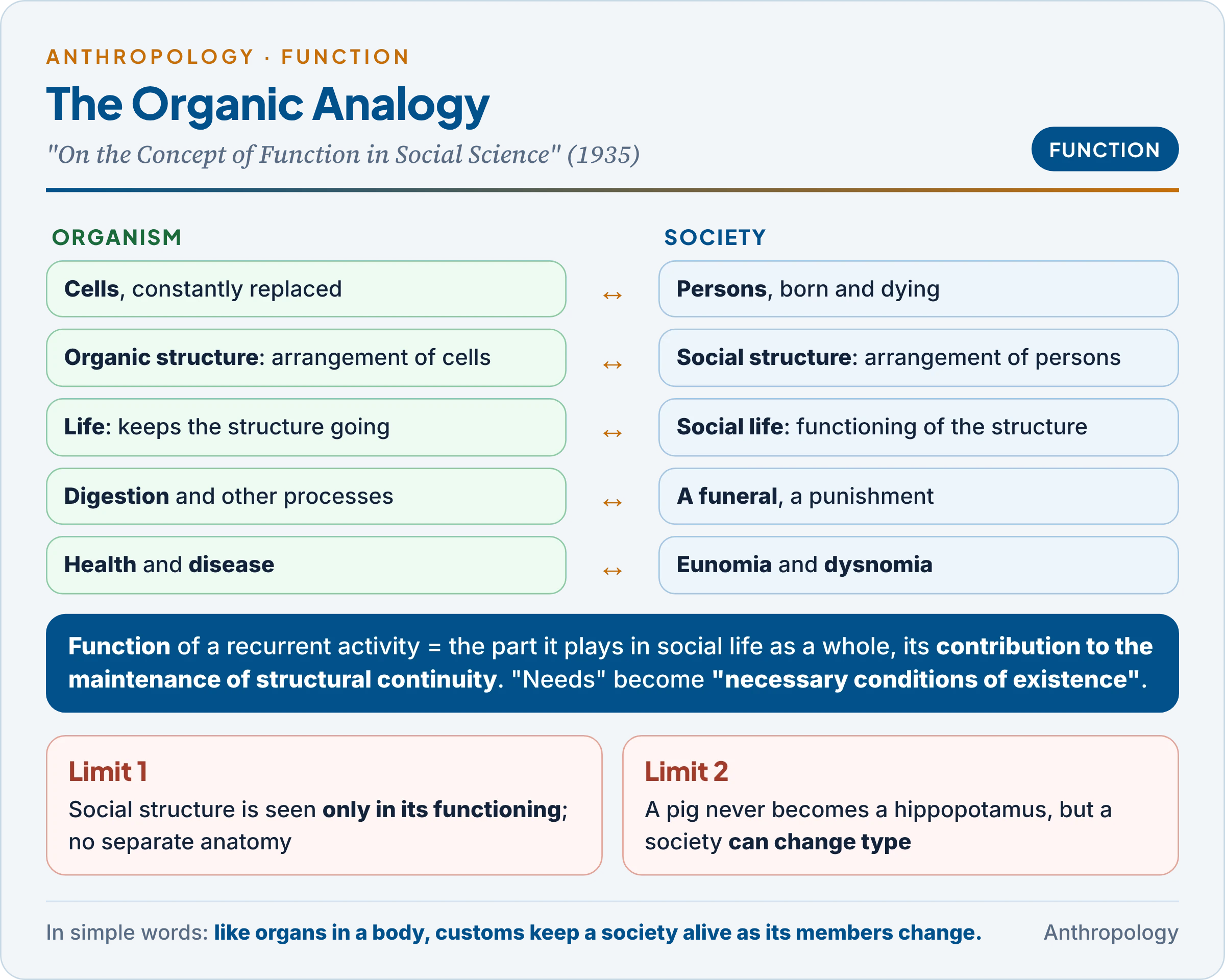
- In the organism: cells are replaced but their arrangement (structure) stays similar; life keeps it going, and the function of a process such as digestion is its contribution to “the life of the organism as a whole”.
- In society: “the continuity of the social structure, like that of an organic structure, is not destroyed by changes in the units”. Social life is “the functioning of the social structure”.
- The definition: “The function of any recurrent activity, such as the punishment of a crime, or a funeral ceremony, is the part it plays in the social life as a whole and therefore the contribution it makes to the maintenance of the structural continuity.”
- Short form: function is “the contribution which a partial activity makes to the total activity of which it is a part”.
The table maps the analogy term by term.
| Organism | Society |
|---|---|
| Cells | Persons |
| Organic structure (arrangement of cells) | Social structure (arrangement of persons) |
| Life (process maintaining the structure) | Social life (functioning of the structure) |
| Physiological process (digestion) | Recurrent activity (a funeral, a punishment) |
| Function: contribution to the organism’s life | Function: contribution to structural continuity |
| Health and disease | Eunomia and dysnomia |
Two ideas follow: function is always relative to a structure, and the explanation is social (a funeral is explained by what it does for the bereaved group’s relations, not by individual grief).
3.2 Functional unity, eunomia and dysnomia
- Functional unity. A social system has “a condition in which all parts of the social system work together with a sufficient degree of harmony or internal consistency, i.e., without producing persistent conflicts which can neither be resolved nor regulated”. He stressed that this was a hypothesis to be tested, not a dogma.
- Conflict is allowed. In a footnote he added that “opposition, i.e., organized and regulated antagonism, is, of course, an essential feature of every social system”. What threatens a system is conflict that cannot be regulated.
- Eunomia and dysnomia. Greek terms for good order (social health) and disorder (social ill-health); he preferred dysnomia to Durkheim’s anomie. The community’s matching moods are euphoria and dysphoria (Unit 4b).
3.3 Where the analogy breaks down
Radcliffe-Brown himself named two limits:
- Structure cannot be seen apart from functioning. An animal’s anatomy can be studied on a dissecting table, separately from its physiology. Most social relations (father and son, buyer and seller, ruler and subject) “cannot be observed except in the social activities in which the relations are functioning“.
- Societies change type; organisms do not. “A pig does not become a hippopotamus”, but a society “can and does change its structural type without any breach of continuity”.
Many later critics attacked the analogy as if he had never qualified it (§7).
Common confusion
Is “function” here the same as “purpose”? No. Purpose is what people intend; function in Radcliffe-Brown’s sense is the effect a custom has on the continuity of the social structure, whether or not anyone intends it. Andaman mourners weep because custom requires it, not in order to “maintain solidarity”. This is why he replaced Durkheim’s “needs” with “necessary conditions of existence“: to avoid suggesting that society has goals.
4. Structural-Functional Analyses
In simple words
Radcliffe-Brown tested his ideas on puzzling customs: why people weep together at meetings, why a boy may take liberties with his mother’s brother but must respect his father’s sister, why some relatives must joke while others must avoid each other, and why clans are named after animals. Each custom, he showed, expresses and protects a social relationship.
4.1 The Andaman Islanders (1922)
- The fieldwork. Funded by Cambridge’s Anthony Wilkin Studentship, he worked in 1906–08. After three months among the Little Andamanese (Onge) he gave up on their language and concentrated on the Great Andamanese of the North Andaman, working first in Hindustani and later through an Akar-Bale interpreter. The interpretive chapters, written about 1910, appeared in 1922, the year of Argonauts.
- The theory of sentiments. “A society depends for its existence on the presence in the minds of its members of a certain system of sentiments by which the conduct of the individual is regulated.” Ceremonial customs keep these sentiments alive: their function is “to maintain and to transmit from one generation to another the emotional dispositions on which the society (as it is constituted) depends for its existence”.
- Social value: anything affecting society’s well-being (food, fire, disease, the dead) becomes an object of ritual attitude.
- The cases. The weeping rite affirms a social bond; the peace-making dance, which ends with an exchange of weapons, turns enmity into friendship and “restore[s] the condition of solidarity between two local groups”; burial and mourning are “means by which the society acts upon its members, compelling them to feel emotions appropriate to the occasion”.
- Why it mattered: it inverted the usual order: the custom produces the feeling, not the feeling the custom.
- Limits: the Great Andamanese were already depopulated and gathered around the penal settlement of Port Blair, their tribal customs merging; he worked partly through a contact language.
- Indian relevance today. The Great Andamanese, about 1,300 in 1911, fell to 19 by 1969 and were resettled on Strait Island; they now number about 70 (2024 counts) and are a Particularly Vulnerable Tribal Group (PVTG). Most of the languages he recorded are extinct, so his monograph is one of the few records of their social life.
4.2 The mother’s brother in South Africa (1924)
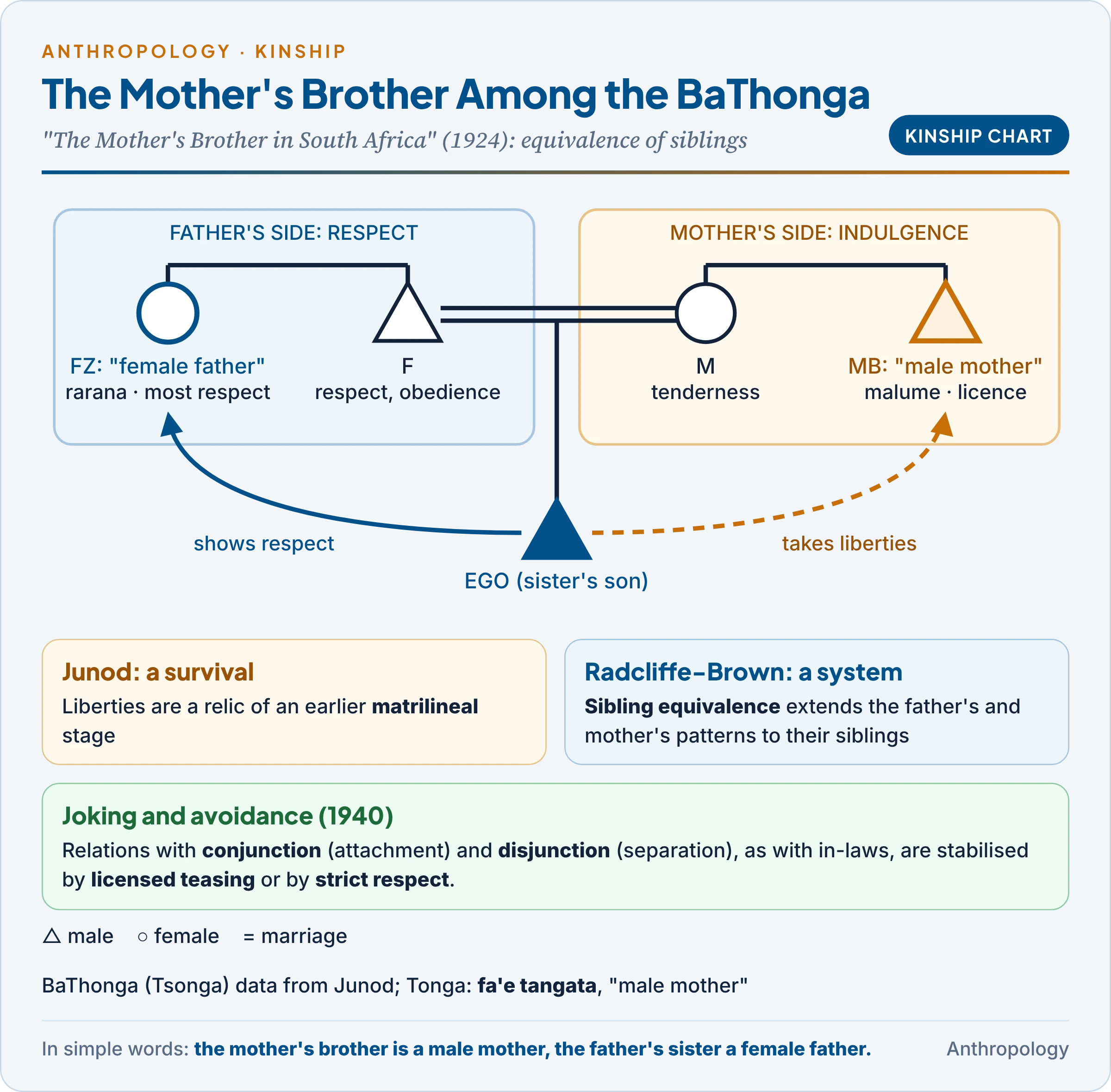
The puzzle. Among the patrilineal BaThonga (Tsonga) of south-eastern Africa, described by the Swiss missionary Henri Junod, a sister’s son may take great liberties with his mother’s brother, even seizing the offering at a sacrifice to the maternal ancestors. Junod explained this as a survival of an earlier matrilineal stage.
Radcliffe-Brown’s explanation rejected conjectural history and looked at the whole system of kinship behaviour.
- Correlation: wherever the mother’s brother is indulgent, the father’s sister (FZ) is a figure of special respect and obedience. Any explanation must cover both.
- Principle of the equivalence of siblings: in many kinship systems a person treats a brother or sister as standing in the same kind of relation to him as the sibling’s own parent or child. So the father’s brother is a kind of father and the mother’s sister a kind of mother.
- Extension of sentiments: in a strongly patriarchal society the father must be respected and obeyed, while the mother gives tenderness and indulgence. Extended by the sibling principle, the mother’s brother becomes a “male mother” (indulgent) and the father’s sister a “female father” (to be respected). Because familiarity is easier between persons of the same sex, the father’s sister gets even more respect than the father, the mother’s brother more licence than the mother.
- Linguistic evidence: in South Africa the mother’s brother is malume, from ma (mother) and a suffix meaning male; among the BaThonga the father’s sister is rarana, “female father”. In Tonga (Polynesia) the mother’s brother may be called fa’e tangata, literally “male mother”. Since the Bantu and Polynesian languages are unrelated, the parallel cannot be diffusion; it points to a general principle.
Why it matters. It is the classic demonstration of the method: a custom is explained by its place in a system of relations existing now, tested by comparison across unrelated societies. The French structuralist Claude Lévi-Strauss built his “atom of kinship” (1945) on this problem, treating the mother’s brother as the wife-giver (Unit 6f). The Indian parallel, the north Indian mama‘s gifts at his sister’s children’s weddings, is in Unit 2.5b.
4.3 Joking and avoidance relationships (1940)
A joking relationship is “a relation between two persons in which one is by custom permitted, and in some instances required, to tease or make fun of the other, who in turn is required to take no offence”. It may be symmetrical (both tease) or asymmetrical (one teases, the other accepts).
- The structural problem: joking appears in relations that combine social conjunction (attachment, shared interests) with social disjunction (separation, divergent interests). The clearest case is marriage: a man is brought into a close relation with his wife’s family, to which he remains an outsider.
- Two solutions to one problem: such a relation could be stabilised either by extreme mutual respect and avoidance (as between a man and his wife’s mother) or by licensed disrespect, joking in which hostility is shown but never taken seriously. Both keep a potentially explosive relation stable.
- Other cases: allied clans or tribes, and grandparents and grandchildren.
- Indian examples: joking between a man and his wife’s younger sister (sali) or between a woman and her husband’s younger brother (devar), and avoidance between a woman and her husband’s elder brother (jeth) or a man and his mother-in-law.
The critique of the theory as circular and static, and Mary Douglas’s reading of the joke as an “anti-rite”, are in Unit 2.5b, §4.
4.4 Totemism
- First theory (1929), “The Sociological Theory of Totemism”: any natural species important to a society’s well-being, such as a food animal, becomes an object of ritual attitude; totemism is a special case in which such species are linked to clans, so that each group’s identity is marked by a sacred emblem.
- Second theory (1951), in the Huxley Memorial Lecture: why are the Australian moieties of the Darling River named after Eaglehawk and Crow? Because the two birds are alike (both meat-eaters) yet opposed (hunter and scavenger). Nature is used to think about social relations of opposition and union: the moieties are both rivals and partners.
- Why it matters: Lévi-Strauss praised the second theory as a move from asking what species are chosen to how differences between species express differences between groups (Unit 5b).
4.5 Other analyses
- Australian social organisation (1930–31): Aboriginal kinship systems classified into Kariera and Aranda types.
- Social sanction (1934): diffuse and organised sanctions; law as organised political force (Unit 4b).
5. The Comparative Method
In simple words
Radcliffe-Brown believed that laws of society could be found by comparing many societies, as a naturalist compares species. His critics answered that he compared too few cases, chose them to fit his ideas and never proved what caused what.
In “The Comparative Method in Social Anthropology” (1951) Radcliffe-Brown distinguished the conjectural comparisons of the evolutionists from sociological comparison: compare social systems as wholes, classify them into types, and look for general principles (such as the equivalence of siblings or the opposition of moieties) that appear in unrelated societies. Comparison is the substitute for the experiment of the natural sciences.
Limitations of the method as he used it:
- Few and selected cases. The mother’s brother paper rests on three societies (BaThonga, Nama, Tonga). Cases are chosen to illustrate a principle, not sampled to test it.
- Typology over explanation. Classifying societies into types (Kariera, Aranda) describes but does not explain; Edmund Leach called it “butterfly collecting” (Rethinking Anthropology, 1961).
- No causal test. Showing that a custom fits a structure is not showing that the structure causes it; the method yields correlations and “principles”, not causes.
- Units not comparable: what counts as “a society” is unclear, as he admitted in 1940.
- History and meaning left out.
His Chicago student Fred Eggan proposed controlled comparison within one region of known history (1954); Isaac Schapera (1953) urged regional comparison; George Murdock used statistical cross-cultural samples. The table contrasts Radcliffe-Brown with Evans-Pritchard.
| Basis | Radcliffe-Brown | Evans-Pritchard |
|---|---|---|
| View of the discipline | Natural science of society | Humanities, a kind of history |
| Aim of comparison | Discover general laws | Find patterns; interpret |
| Unit compared | Social systems and types | Particular societies, in depth |
| Attitude to history | Conjectural history rejected | History essential |
| Verdict on results | Laws can be found | Comparison has yielded few results (“The Comparative Method in Social Anthropology”, 1963) |
The split ran through British anthropology itself: Radcliffe-Brown wanted explanation by laws; his successor concluded that anthropology interprets, like history.
6. Evans-Pritchard, Fortes and African Political Systems
In simple words
Radcliffe-Brown’s students took his ideas to Africa. They showed how societies without chiefs or governments keep order through kinship groups that balance each other, and how kinship ties link each person to both parents’ families.
6.1 African Political Systems (1940)
Edited by Meyer Fortes and E.E. Evans-Pritchard, with a preface by Radcliffe-Brown, the volume divided African societies into two groups:
- Group A, centralised states: with central authority, administration and courts (Zulu, Ngwato, Bemba, Banyankole, Kede).
- Group B, stateless societies: without centralised authority, where order rests on segmentary lineage systems (Logoli, Tallensi, Nuer).
It showed that kinship and descent could do the work of the state (Unit 4a).
6.2 Evans-Pritchard and the Nuer
E.E. Evans-Pritchard (1902–1973), the British anthropologist who succeeded Radcliffe-Brown at Oxford, studied the cattle-herding Nuer of South Sudan (The Nuer, 1940; Nuer Religion, 1956).
- Segmentary lineage system: maximal, major, minor and minimal lineages match tribal sections and villages; segments that feud at one level unite against outsiders at the next (complementary opposition). Order is kept by balanced opposition of equal segments, not by a ruler. (The full model is in Unit 2.5a, §5.)
- The leopard-skin chief (kuaar muon) cannot command; he mediates feuds and shelters a killer, a ritual office.
- Oecological and structural time: time is reckoned by seasons and cattle camps, and by distances in the lineage structure, so even time reflects social structure.
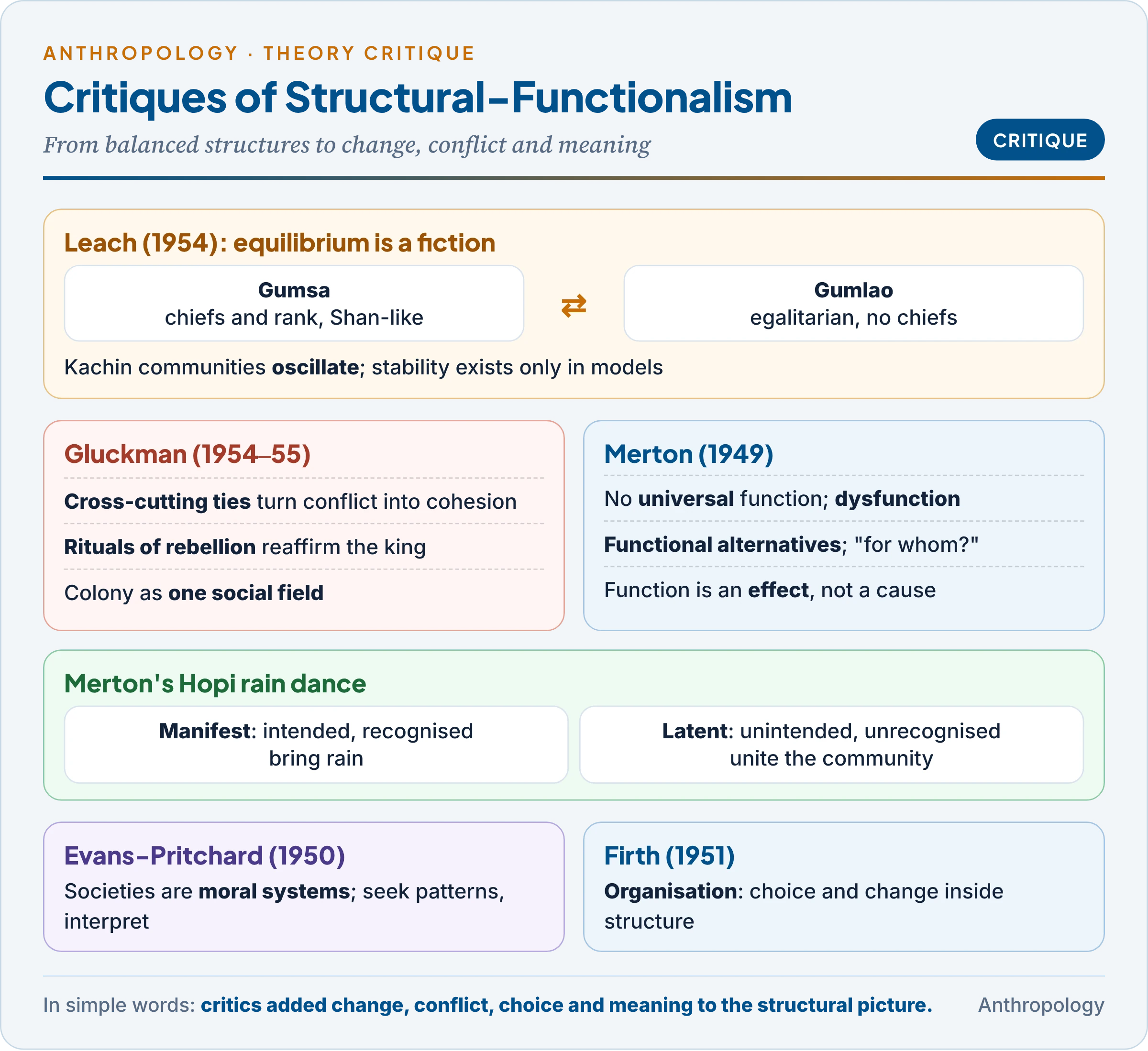
- The break with Radcliffe-Brown. His Witchcraft, Oracles and Magic among the Azande (1937) showed that Zande witchcraft beliefs form a coherent logic within their own premises. In his Marett Lecture (1950) he declared that social anthropology “studies societies as moral systems and not as natural systems, … is interested in design rather than in process, and … therefore seeks patterns and not scientific laws, and interprets rather than explains”. This was a direct rejection of the natural-science programme.
6.3 Meyer Fortes and the Tallensi
Meyer Fortes (1906–1983), a South African-born anthropologist trained first in psychology, studied the Tallensi of northern Ghana (The Dynamics of Clanship, 1945; The Web of Kinship, 1949).
- Corporate descent groups: in “The Structure of Unilineal Descent Groups” (1953) he described lineages as corporate groups (holding land, offices and ancestor shrines as a single legal person) that frame politics and law in stateless societies.
- Complementary filiation: each person belongs to the father’s lineage by descent but keeps recognised ties with the mother’s kin, especially the mother’s brother, linking lineages (Unit 2.5b, §5).
- The axiom of amity (1969): kinship obliges prescriptive altruism, sharing without reckoning.
- The developmental cycle (1958): domestic groups expand, disperse and are replaced, bringing time into structure.
6.4 Raymond Firth: structure and organisation
Raymond Firth (1901–2002), the New Zealand-born anthropologist and Malinowski’s successor at the LSE, studied Tikopia in the Solomon Islands. In Elements of Social Organization (1951) he distinguished:
- Social structure: the enduring form of relations, the framework of expectations;
- Social organisation: the choices and decisions individuals make within that framework, the working arrangements of everyday life.
This brought choice and change inside a structural account.
7. Critique of Structural-Functionalism
In simple words
Critics said structural-functionalism pictured societies as always balanced and unchanging, ignored conflict and power, treated every custom as useful, confused what a custom does with why it exists, and suited colonial rule. They did not throw it away but changed it, adding change, conflict and meaning.
7.1 Static: no account of change
- The charge: a theory that explains each custom by its contribution to the continuity of the structure has no room for change, except as a disturbance (dysnomia) to be corrected. History, migration and colonial conquest appear only at the edges.
- Why it holds: functional unity is assumed, not shown, and a year or two of fieldwork cannot see long-term processes. Radcliffe-Brown listed “social development” as a problem but did little work on it.
7.2 Edmund Leach: equilibrium is a fiction
Edmund Leach studied the Kachin of highland Burma (Political Systems of Highland Burma, 1954).
- The finding: Kachin communities oscillate over generations between two models: gumsa, hierarchical, with hereditary chiefs and aristocratic lineages like the neighbouring Shan states, and gumlao, egalitarian and anti-chief.
- The argument: a real society is never in equilibrium. Equilibrium exists only in the models people and anthropologists use to describe it; the anthropologist must treat it “as if” stable while studying how people manipulate rules for power.
- Why it matters: it replaced the balanced structure with an open, unstable system shaped by ambition and history.
7.3 Max Gluckman: conflict within equilibrium
Max Gluckman, the South African-born head of the Manchester school, kept the idea of equilibrium but put conflict at its centre (Custom and Conflict in Africa, 1955; Rituals of Rebellion in South-East Africa, 1954).
- Conflict can maintain order: cross-cutting loyalties (to kin, neighbours, cattle partners) check a quarrel in one set of relations by obligations in another, “the peace in the feud”.
- Rituals of rebellion: in Zulu and Swazi first-fruits ceremonies, subjects openly insult the king and women ritually defy men. Expressing conflict in licensed form reaffirms the order it seems to attack.
- Repetitive and changing equilibrium: a tribal system may be in repetitive equilibrium, where conflicts are resolved without changing the pattern, while colonial South Africa was one social field of Africans and Europeans bound by conflict (Unit 6d, §7.2).
- Method: the extended case method, following real disputes over time.
7.4 Robert Merton: dysfunction and latent functions
The American sociologist Robert Merton (Social Theory and Social Structure, 1949) rejected three postulates of anthropological functionalism:
- Functional unity: that every item is functional for the whole system.
- Universal functionalism: that every item has a positive function. Some are dysfunctional (they lessen the adaptation of the system) and some are non-functional.
- Indispensability: that each item is necessary. There are functional alternatives (equivalents) that can do the same job.
He added two distinctions that became standard:
- Manifest functions are consequences intended and recognised by participants; latent functions are neither intended nor recognised. The Hopi rain dance is meant to bring rain (manifest); whatever the weather, it brings the scattered community together and reaffirms its identity (latent).
- Net balance: an item may have both functions and dysfunctions, so the analyst must weigh them, asking “functional for whom?“
This also meets the charge that structural-functional studies do not explain causal relationships: a statement of function describes an effect, not a cause. To explain why a custom exists one must show how its effect feeds back to maintain it and why no alternative arose instead.
7.5 Other criticisms
- Teleology and circularity: customs are explained by a structure inferred from the customs; “necessary conditions of existence” reduced but did not remove the problem.
- The organic analogy imports harmony where there is often domination; Marxist critics called the theory conservative, a defence of the status quo, and interactionist critics said it ignored how actors create meanings in interaction.
- Agency and meaning: persons became mere occupants of positions, a gap later filled by Evans-Pritchard’s humanism, Firth’s organisation and interpretive anthropology.
- The colonial context: administrators read African Political Systems for indirect rule; Talal Asad (1973) argued that balanced, timeless tribes left out colonial power.
The table gathers the critiques with the revision each one produced.
| Critique | Critic | Revision it produced |
|---|---|---|
| Equilibrium is a fiction; societies oscillate | Leach (1954) | Process and transactional analysis |
| Conflict is part of the system | Gluckman (1954; 1955) | Extended case method; cross-cutting ties |
| Not every item is functional; dysfunctions; alternatives | Merton (1949) | Manifest and latent functions; net balance |
| Anthropology interprets, not explains | Evans-Pritchard (1950) | Humanist, historical anthropology |
| Structure leaves out choice | Firth (1951) | Social organisation |
| Colonial bias | Asad (1973) | Anthropology of colonialism and power |
Most critics amended rather than abandoned the approach, adding conflict, process, choice and history to the structural framework.
8. Malinowski and Radcliffe-Brown Compared
In simple words
Malinowski and Radcliffe-Brown both asked what customs do for a society, and both relied on fieldwork. But Malinowski explained customs by the needs of individual people, while Radcliffe-Brown explained them by the needs of the network of relationships.
The table sets the two founders side by side: the first row shows what they shared, the rest where they parted.
| Basis | Malinowski (functionalism) | Radcliffe-Brown (structural-functionalism) |
|---|---|---|
| Shared ground | Synchronic; against conjectural history; intensive fieldwork; small islands (Trobriands) | Synchronic; against conjectural history; fieldwork; small islands (Andamans) |
| Key concept | Culture | Social structure |
| Unit of analysis | The institution | The social relationship and the structure |
| Function means | Satisfaction of a need | Contribution to structural continuity |
| Whose needs | Individuals: biological, derived, integrative | Society: “necessary conditions of existence” |
| Intellectual roots | Biology, psychology, pragmatism | Durkheim, Spencer, natural science |
| Role of the individual | Central | Occupant of a position; replaceable |
| Laws | General theory of culture; little interest in laws | Laws through comparison |
| Method | Participant observation; the native’s view | Comparison of structural types |
| On religion | Relieves individual anxiety | Expresses social dependence; creates sentiments |
| Key works | Argonauts (1922); A Scientific Theory of Culture (1944) | The Andaman Islanders (1922); Structure and Function (1952) |
| Main heirs | Firth, Richards, Mair; applied anthropology | Evans-Pritchard, Fortes, Eggan, Srinivas |
The decisive difference is in the direction of explanation. Malinowski reasoned upward from the human body to culture; Radcliffe-Brown reasoned across, from one social relation to the structure of which it is part.
Common confusion
Is structural-functionalism the same as structuralism? No. Radcliffe-Brown’s structure is the observable network of social relations between persons, studied for its function. Lévi-Strauss’s structuralism (Unit 6f) seeks unconscious structures of the mind, patterns of binary opposition that lie beneath kinship, myth and cuisine. Lévi-Strauss argued (1953) that social structure is a model built by the anthropologist; Radcliffe-Brown replied, in a letter, that he meant the observable relations themselves.
9. Legacy and Indian Relevance
In simple words
Structural-functionalism shaped how anthropologists studied kinship, politics and religion for decades, and it shaped Indian sociology through M.N. Srinivas, who learned it from Radcliffe-Brown and used it to study Indian villages and castes.
9.1 What survives
- Descent theory: the study of lineages, corporate groups and segmentary systems (Fortes, Evans-Pritchard, Goody) grew directly from Radcliffe-Brown’s programme (Unit 2.5a).
- Sociology: Talcott Parsons built structural-functionalism into a general theory of social systems (adaptation, goal attainment, integration, latency), dominant in 1950s American sociology.
- The vocabulary of status, role, institution, structure and function remains basic.
9.2 Structural-functionalism and India
- M.N. Srinivas (1916–1999) took his Oxford doctorate (1945–47) under Radcliffe-Brown and then Evans-Pritchard. Radcliffe-Brown told him to re-read his Coorg material “through functionalist eyes”, and Srinivas used The Andaman Islanders to analyse the Coorg wedding. Religion and Society among the Coorgs of South India (1952), with Radcliffe-Brown’s foreword, showed how rituals of the okka (patrilineal joint family), village and caste maintain the solidarity of the structural system; Sanskritisation first emerged from it. Srinivas described himself as having become “a structural-functionalist, albeit a somewhat skeptical one”.
- Village studies: Srinivas’s “field view” of Indian society against the scriptural “book view”, his work on Rampura and the dominant caste (1955), and S.C. Dube‘s Indian Village (1955, Shamirpet near Hyderabad) treated the village as a functioning system of castes, families and factions.
- The Manchester turn: F.G. Bailey, a student of Gluckman, studied Bisipara in Odisha (Caste and the Economic Frontier, 1957), showing how new economic opportunities set caste and kinship into conflict and change, the Manchester correction applied to India.
- The Andamanese: the islanders he made famous are among India’s smallest PVTGs, and protecting the Jarawa, Onge and Great Andamanese remains a live policy question.
Key Concepts
| Concept | Meaning in Radcliffe-Brown |
|---|---|
| Social structure | Network of actually existing relations between persons |
| Structural form | General, normal form of a relation, abstracted from cases |
| Structural continuity | Persistence of the form while persons change |
| Function | Contribution of a recurrent activity to structural continuity |
| Functional unity | Parts work together without unregulated conflict |
| Eunomia / dysnomia | Social health / social ill-health |
| Institution | Socially recognised system of norms for a relationship |
| Equivalence of siblings | Siblings are treated as standing in the same relation |
| Conjunction and disjunction | Attachment and separation combined in a relation |
Major Works
| Work | Year | Significance |
|---|---|---|
| The Andaman Islanders | 1922 | Ceremonial and sentiments |
| “The Mother’s Brother in South Africa” | 1924 | Equivalence of siblings |
| “The Social Organization of Australian Tribes” | 1930–31 | Kariera and Aranda types |
| “On the Concept of Function in Social Science” | 1935 | Definition of function |
| “On Social Structure” | 1940 | Structure and structural form |
| “On Joking Relationships” | 1940 | Conjunction and disjunction |
| “Functionalism: A Protest” | 1949 | Rejects Malinowski’s needs |
| “The Comparative Method in Social Anthropology” | 1951 | Eaglehawk and Crow |
| Structure and Function in Primitive Society | 1952 | Collected essays |
Key Terms
| Term | Meaning in simple words |
|---|---|
| Structural-functionalism | Explaining customs by how they keep social relations going |
| Social structure | The pattern of relationships between people |
| Structural form | The general shape of a relationship, beyond individual cases |
| Eunomia | A society in good order |
| Dysnomia | A society in disorder |
| Sentiment | A shared, learned feeling on which society depends |
| Joking relationship | Licensed teasing between certain relatives |
| Avoidance relationship | Required distance and respect between certain relatives |
| Segmentary lineage | Nested lineages that unite or oppose by level |
| Dysfunction | An effect that weakens a system |
| Latent function | An unintended, unrecognised effect |
| Functional alternative | Another item that can do the same job |
Contemporary Developments
- Centenary of The Andaman Islanders (2022). A Royal Anthropological Institute symposium on 24 November 2022 marked the centenary of both The Andaman Islanders and Argonauts, reassessing the two founding monographs.
- The Great Andamanese today. The community has grown from about 35 before the 2004 tsunami to about 70–74 (2024); Anthropological Survey of India researchers report marriages outside the group and a fading youngest-daughter inheritance rule.
- New kinship studies since Janet Carsten’s Cultures of Relatedness (2000) treat kinship as relatedness made through feeding and care, beyond fixed structural positions.
- Conflict and process in Indian ethnography. Studies of caste, panchayats and development now routinely combine structural description with Manchester-style case and process analysis.
Diagrams to Master
- Topic map of the article.
- Structure and structural form (§2): Tom, Dick and Harry against the normal MB–ZS form; dynamic continuity; morphology, physiology, development.
- Organic analogy (§3): cells to persons; the 1935 definition; eunomia and dysnomia; two limits.
- Mother’s brother (§4): BaThonga chart with F, M, MB (malume), FZ (rarana), Ego; respect and licence; joking and avoidance.
- Critique (§7): Leach’s gumsa and gumlao, Gluckman’s conflict, Merton’s manifest and latent functions.
Revision Grid
| Scholar | Work (year) | Key idea |
|---|---|---|
| Radcliffe-Brown | The Andaman Islanders (1922) | Ceremonies maintain sentiments |
| Radcliffe-Brown | “The Mother’s Brother” (1924) | Equivalence of siblings |
| Radcliffe-Brown | “On the Concept of Function” (1935) | Contribution to structural continuity |
| Radcliffe-Brown | “On Social Structure” (1940) | Actual structure and structural form |
| Fortes and Evans-Pritchard | African Political Systems (1940) | Centralised and stateless societies |
| Evans-Pritchard | The Nuer (1940); Marett Lecture (1950) | Segmentary lineage; moral systems |
| Merton | Social Theory and Social Structure (1949) | Dysfunction; manifest and latent |
| Srinivas | Religion and Society among the Coorgs (1952) | Structural-functional study of Indian religion |
| Leach | Political Systems of Highland Burma (1954) | Gumsa and gumlao oscillation |
| Gluckman | Custom and Conflict in Africa (1955) | Conflict and cohesion |
Previous Year Questions
Unit 6: Structural-functionalism (Radcliffe-Brown)
- 2022Write notes on: Radcliffe-Brown’s ideas on status, role and institution.
- 2019How did Radcliffe-Brown and Levi-Strauss study kinship in terms of social structure?
- 2017Write a note in 150 words on Basic tenets of structural-functionalism.
- 2013In what ways is Functionalism different from Structural Functionalism? (350words).
- 2008Write a note on Structural functionalism.
- 2003Describe structural features of social life as suggested by Radcliffe-Brown in his theory of social structure.
- 2001Discuss the approaches of RadcliffeBrown and Evans-Pritchard to Methods Comparative in Anthropological Research.
- 1998“To Radcliffe-Brown ‘function’ was the contribution an institution makes to the maintenance of social structure.” Elucidate in the light of RadcliffeBrown’s contributions to structural functionalism theory.
- 1995Give the names of two prominent British functionalists in social anthropology. Describe the functional theory attributed to any one of them.
- 1994Write a note on A.R. Radcliffe-Brown.
- 1989Re-examine the view of Radcliffe-Brown in connection with structure and function in Anthropology.
- 1986Write an essay on ‘structure-function theory of Radcliffe-Brown.’
- 1984Evaluate the contribution of Radcliffe Brown for the development of structural method.
- 1982Discuss contributions of Malinowski. Radcliffe Brown and Firth to the concept of Function.
- 1981Specify limitations of Radcliffe-Brown’s method of comparison as actually used by him. (200 words).
- 1981“Structure-functional studies do not explain casual relationships.” Discuss the view.
Related questions from other units
- 2024Unit 2.5: Write notes on: Critical perspective on avoidance and joking relationship.
- 2015Unit 5: How do you relate the concepts of ‘Sacred’ and ‘Profane’ in Durkheim’s theory of religion with a focus on the role of totem ?
- 2010Unit 2.5: Write a note in 150 words on. Segmentary lineage and territoriality.
- 2001Unit 2.5: Explain the salient features of Descent and Alliance theories. Discuss the relevance to the analysis and understanding of Social Structure.
- 1999Unit 2.2: Write a note on Social structure.
- 1996Unit 6: Analyze how Raymond Firth’s concepts of structure, function, organization and process accommodate the study of both static and dynamic aspects of the social structure.
- 1994Unit 5: Describe the role of totemism in primitive religion, according to Durkheim.
- 1993Unit 2.2: Write a note on Social institution.
- 1991Unit 2.5: What is kinship system? Discuss its relevance in understanding the social structure of society.
- 1981Unit 2.5: “Unilineal kinship is more characteristic of segmentary society than bilateral kinship.” Discuss.