

6 Anthropological theories: (c) Functionalism (Malinowski); Structural-functionalism (Radcliffe-Brown).
Official Syllabus: Paper I, Unit 6 (functionalism)
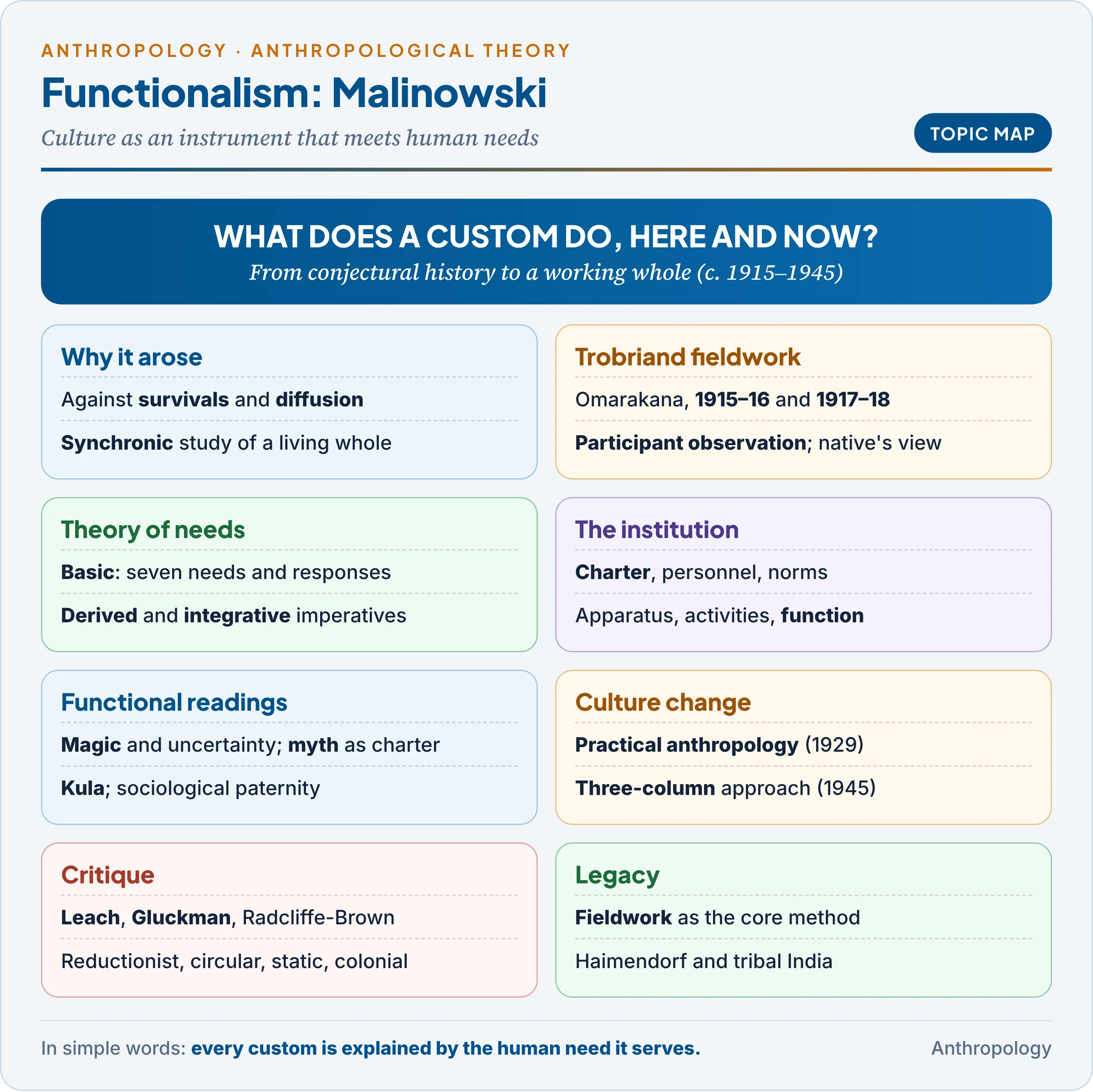
1. Why Functionalism Arose
In simple words
Functionalism asks a simple question about any custom: what does it do, here and now, for the people who practise it? Instead of guessing where a custom came from long ago, the functionalist lives with the people and shows how the custom fits with everything else in their life.
Example first. In the Trobriand Islands (off eastern Papua New Guinea), a man spends much of the year growing his finest yams, not for his own household but for his sister’s husband. This harvest gift, carried with ceremony to his sister’s village, is called urigubu. A nineteenth-century evolutionist would have asked which “stage” of family life the custom revealed. Bronislaw Malinowski, the Polish-born British anthropologist who lived among the Trobrianders, asked a different question: what does the gift do? Descent is matrilineal (traced through women), so a man’s heirs are his sister’s sons; the yams feed them. The gift binds two lineages, displays a man’s gardening skill, and the yams sent to the chief, who has many wives, give him the wealth to hold feasts and rule. One custom turned out to support kinship, marriage, economy and politics at once. That way of seeing is functionalism.
1.1 The reaction against speculative history
Functionalism grew in Britain between about 1910 and 1930 as a revolt against the two earlier schools:
- Classical evolutionism (Tylor, Morgan, Frazer; Unit 6a) ranked societies on one ladder of stages and treated odd customs as survivals, relics of an earlier stage that had lost their use. Malinowski rejected survivals outright: if a custom persists, it must be doing something now.
- Diffusionism (Elliot Smith, Graebner, Wissler; Unit 6c) traced traits back to centres of origin and treated culture as a heap of borrowed bits, the “thing of shreds and patches” of the American anthropologist Robert Lowie (1920). Malinowski rejected that picture of a “patchwork”. For him a borrowed item matters only once it is fitted into a working whole, and fitting it in changes its meaning.
- Both schools were diachronic (they studied change over long periods) and both relied on conjectural history, reconstructions of an unrecorded past. Functionalism is synchronic: it studies a society as it works at one period, from direct observation.
The shift is from “where did this custom come from?” to “what does it do now, and how does it fit?”
1.2 Two functionalisms
Two British scholars founded the approach, and they disagreed sharply.
- Malinowski’s functionalism (often called bio-cultural or psychological functionalism) explains culture by the needs of individuals, starting with biological needs.
- A.R. Radcliffe-Brown’s structural-functionalism (Unit 6e) explains customs by their contribution to the social structure, the network of relations between persons, and keeps individual needs out of the explanation.
Both drew on the French sociologist Émile Durkheim, who in The Rules of Sociological Method (1895) had defined the function of an institution by the needs of the social organism. Radcliffe-Brown followed Durkheim closely; Malinowski moved the “needs” from society to the human body and mind. This difference runs through everything below.
Malinowski in brief. Born in Kraków (1884), he took a doctorate there in 1908 in philosophy, with physics and mathematics, studied in Leipzig with Wilhelm Wundt, and while convalescing read Frazer’s The Golden Bough, which turned him to anthropology. In 1910 he joined the London School of Economics (LSE), where he studied with C.G. Seligman and Edward Westermarck. He became the LSE’s first professor of anthropology (1927) trained Firth, Evans-Pritchard, Fortes, Leach, Mair and Richards, and died at Yale in 1942.
2. Trobriand Fieldwork and Participant Observation
In simple words
Before Malinowski, many scholars wrote about distant peoples from reports sent by travellers and missionaries. Malinowski showed that the way to understand a people is to live among them for a long time, learn their language, join in their daily life and record what they actually do, not only what they say.
2.1 How the fieldwork happened
- Mailu (1914–15). Malinowski reached Australia with the British Association meeting of 1914 just as the First World War began. As a subject of Austria-Hungary he was technically an enemy alien, but the Australian authorities let him work in Papua. He spent about six months, much of it among the Mailu of the south coast.
- Trobriands (two expeditions). He worked in the Trobriands from mid-1915 to May 1916 and again from October 1917 to October 1918, about two years in all. He pitched his tent in Omarakana, the village of the paramount chief To’uluwa, on Kiriwina island, and within months worked in the local language, Kilivila, without an interpreter.
- The result was a shelf of monographs: Argonauts of the Western Pacific (1922), Crime and Custom in Savage Society (1926), Sex and Repression in Savage Society (1927), The Sexual Life of Savages (1929) and Coral Gardens and Their Magic (1935).
The wartime accident forced an unusually long stay in one community, which let him see connections a visitor would miss.
2.2 The method set out in Argonauts
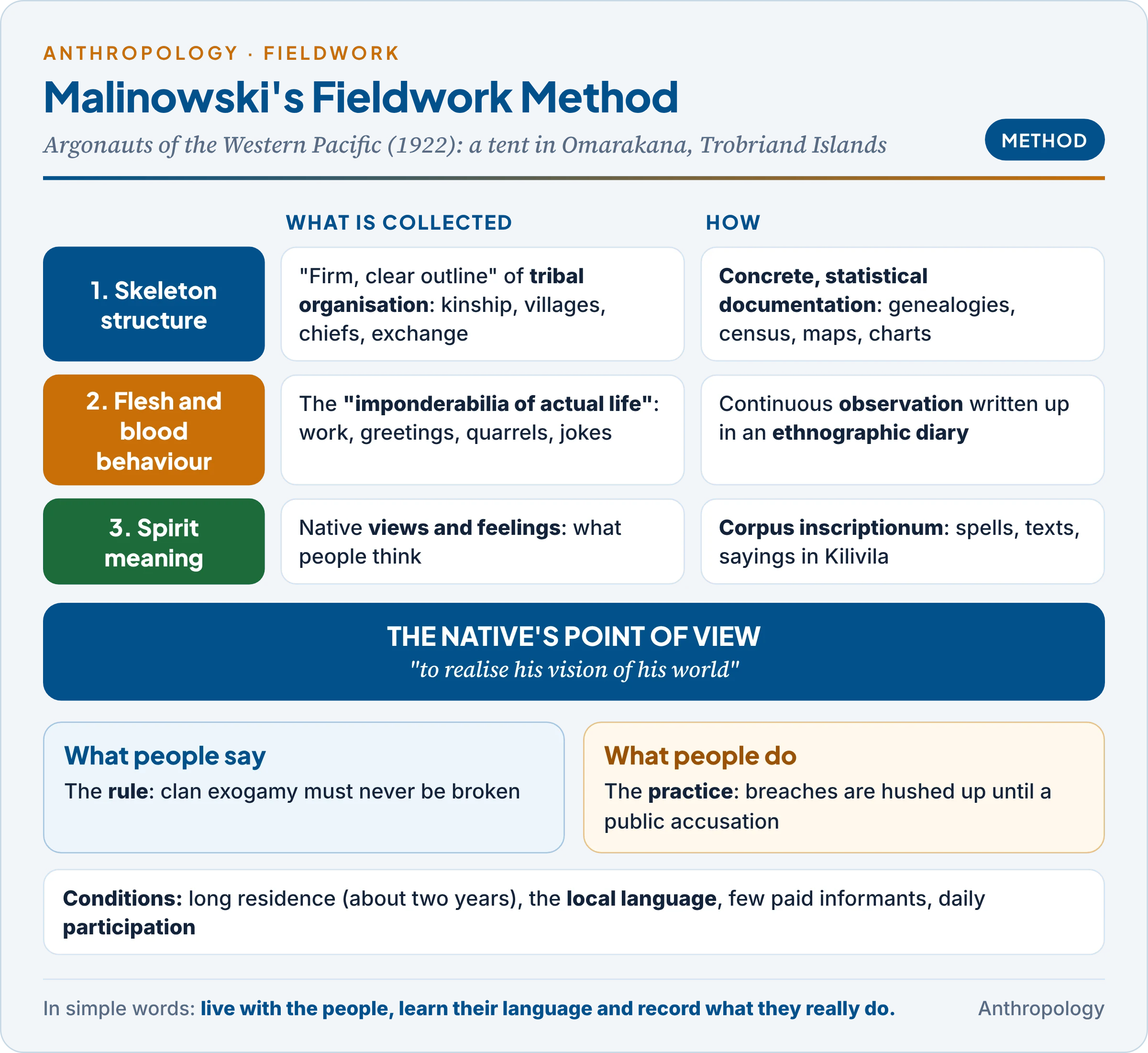
The introduction to Argonauts became the charter of modern fieldwork. Its aim is “to grasp the native’s point of view, his relation to life, to realise his vision of his world”. Malinowski named three kinds of material the ethnographer must collect.
| Aim | What it means | How it is collected |
|---|---|---|
| 1. The skeleton | The “firm, clear outline” of tribal organisation: kinship, villages, chieftainship, exchange | Method of concrete, statistical documentation: genealogies, census, maps, synoptic charts |
| 2. The flesh and blood | The “imponderabilia of actual life”: routine work, how people greet, quarrel, joke, care for the sick | Close, continuous observation, written up in an ethnographic diary |
| 3. The spirit | Native views, opinions and utterances: what people think and feel | A corpus inscriptionum: texts, spells, narratives and typical sayings in the native language |
The three aims move from structure to behaviour to meaning. Only someone living in the village can collect all three. That is participant observation: the researcher is a resident who takes part in ordinary life, so that people stop performing for him.
Two further rules followed from the method:
- Norm and practice differ. Malinowski insisted on recording both what people say they do (the rule) and what they actually do (behaviour). In Crime and Custom he showed Trobrianders breaking clan exogamy and then managing the breach quietly, until a public accusation forced a crisis (Unit 4b).
- Everything connects. He assumed that the whole field of observed facts must fit together, so the fieldworker must follow each custom into economy, kinship, magic and politics.
Edmund Leach later summed up the method as a curtailed use of the paid informant plus the assumption that the field data “must somehow fit together and make sense” (1957). That assumption is where theory and fieldwork meet.
2.3 Boas and Malinowski: two fieldwork traditions
Franz Boas, the German-American founder of American anthropology (Unit 6b), also demanded first-hand data, but used fieldwork for a different end. The table compares the two.
| Basis | Boas (American) | Malinowski (British) |
|---|---|---|
| Aim of fieldwork | Reconstruct the history of each culture | Show how a culture works now |
| Time frame | Diachronic, historical | Synchronic, functional |
| Main technique | Texts dictated by key informants, often in short visits | Long residence and participant observation |
| Focus | Culture traits, language, myths as historical records | Institutions in action; the individual in society |
| Generalisation | Distrusted laws; each culture unique | Sought a general theory of culture (needs) |
Radcliffe-Brown described the contrast in 1929 as two “opposing tendencies”: the American multiplied hypothetical reconstructions of the past; the British treated each culture as a functionally interrelated system.
2.4 The diary and the fieldwork controversies
In 1967 Malinowski’s private Polish diary from Mailu and the Trobriands was published as A Diary in the Strict Sense of the Term. It shocked the profession.
- What it revealed: loneliness, depression and frequent contemptuous and racist remarks about his hosts. Clifford Geertz reviewed it as “Under the Mosquito Net” (1967).
- Why it mattered: it broke the myth of the calm, empathetic insider. If the master of rapport privately despised his hosts, how objective was participant observation?
- The other side: in Coral Gardens (1935) Malinowski had already confessed “Ignorance and Failure”, admitting a pull towards the dramatic over the everyday; his published ethnography is largely confirmed by restudies.
- The Mead parallel: in 1983 the New Zealand anthropologist Derek Freeman attacked Margaret Mead’s Coming of Age in Samoa (1928), arguing that her short fieldwork, limited language and reliance on teenage informants produced a false picture of carefree Samoan adolescence (Unit 6g). Both cases ask: how long, in what language, with which informants, and with what bias?
Common confusion
Did Malinowski invent participant observation? Not entirely. Earlier ethnographers, including Boas among the Inuit and the Kwakiutl, Frank Cushing among the Zuni, and many missionaries, had lived with the people they studied. Malinowski’s contribution was to make long residence, the local language and daily participation an explicit, teachable standard, and to tie it to a theory that told the fieldworker why every detail mattered.
3. The Theory of Needs
In simple words
Malinowski believed that people create culture to meet their needs. First come the needs of the body, such as food, shelter and safety. Meeting them in groups creates new needs, for rules, training and leadership. Finally, people need beliefs and arts that give them confidence and hold the group together.
3.1 Culture as an instrument
Malinowski set out his general theory late in life, in A Scientific Theory of Culture and Other Essays (published after his death, 1944), building on an article in the American Journal of Sociology, “The Group and the Individual in Functional Analysis” (1939).
- Culture defined. Culture “obviously is the integral whole consisting of implements and consumers’ goods, of constitutional charters for the various social groupings, of human ideas and crafts, beliefs and customs”.
- Culture as instrument. Culture is an instrumental apparatus: a set of means by which human beings, an animal species, meet the conditions of survival. Each element exists as a means to an end.
- Function defined. “Function can not be defined in any other way than the satisfaction of a need by an activity in which human beings cooperate, use artifacts, and consume goods.”
- The functional view of culture, in his article “Anthropology” for the Encyclopaedia Britannica (1926), “insists therefore upon the principle that in every type of civilization, every custom, material object, idea and belief fulfils some vital function, has some task to accomplish, represents an indispensable part within a working whole”.
The last statement is the most famous and the most criticised sentence in functionalism. It says that nothing in a culture is functionless, which is exactly what his critics would deny (§7).
3.2 Basic needs and cultural responses
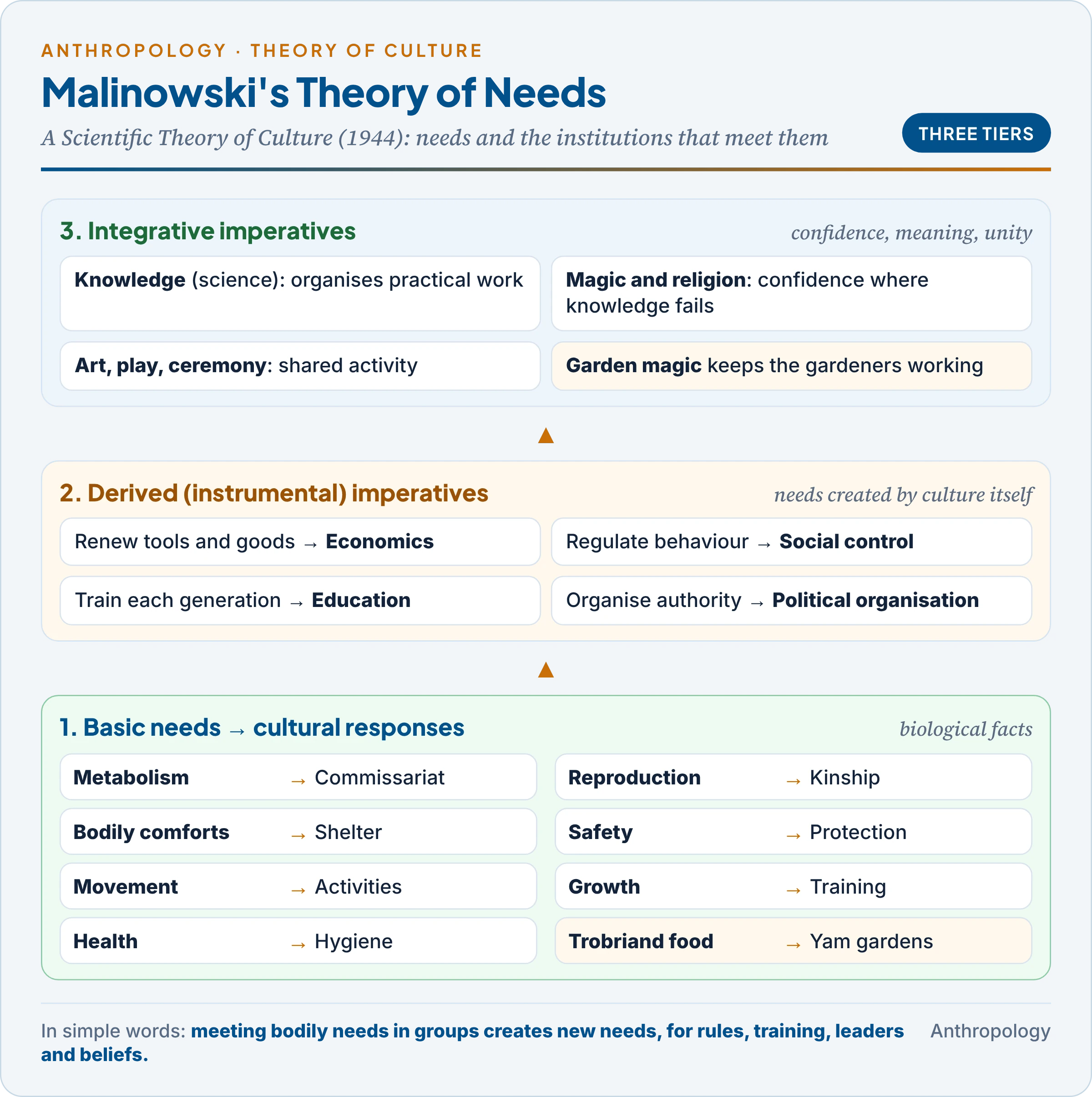
The starting point is biology. Every human group must feed, reproduce, keep warm and stay safe, or it dies out. Human beings never meet these needs directly, as an animal grazes; they meet them through organised, learned, collective arrangements. Malinowski called each such arrangement a cultural response. His 1944 list pairs seven basic needs with seven responses.
| Basic (biological) need | Cultural response | Trobriand example |
|---|---|---|
| Metabolism (food and its digestion) | Commissariat (food supply) | Yam gardens, fishing, food exchange |
| Reproduction | Kinship (marriage and family) | Matrilineal clans, marriage |
| Bodily comforts | Shelter | Houses, dress |
| Safety | Protection | Defence, warfare, sorcery against enemies |
| Movement | Activities | Organised work, canoe voyages |
| Growth | Training | Learning from kin, apprenticeship |
| Health | Hygiene | Healing, rules of cleanliness |
Each row pairs a biological fact with a cultural institution. Culture is not “just biology”: hunger is universal, but what, when and with whom one eats is cultural.
Two versions. The 1939 list ran nutrition, reproduction, bodily comforts, safety, relaxation, movement and growth; the 1944 book replaced relaxation with health. Textbooks listing “relaxation” follow the earlier version.
3.3 Derived and integrative needs
Meeting basic needs through culture creates a “secondary environment” of tools, groups and rules, and this environment must itself be kept going. That produces a second order of needs.
- Derived (instrumental) imperatives arise from cultural life itself, each answered by a type of institution:
- renewal of the cultural apparatus (tools, goods) → economics;
- regulation of behaviour → social control (custom, law, sanctions);
- renewal of personnel (each generation must be trained) → education;
- organisation of authority and force → political organisation.
- Integrative (synthetic) imperatives answer the need for confidence, meaning and unity:
- knowledge (science), which organises practical action;
- magic and religion, which give confidence where knowledge fails and sanctify social life;
- art, play and ceremony, which satisfy the senses and bind people in shared activity.
How the derivation works. Take food. Hunger (basic) is met by gardening (commissariat). Gardening needs digging sticks and seed yams that must be made and replaced (economics), rules about whose plot is whose (social control), young people who know how to plant (education) and someone to decide when the gardens are cut (political organisation, the chief and the garden magician). Because no gardener can control the weather or pests, garden magic gives the confidence to keep working (integrative). One biological need produces a whole chain of institutions. Functionalism is thus the theory of how organic needs are transformed into derived cultural needs.
3.4 Merits of the theory of needs
- It explains universals: every society has economy, family, law, education, politics, religion and art because all face the same needs, a basis for comparison without a ladder of stages.
- It links individual and group: needs are felt by individuals but met only by organised groups.
- It guides fieldwork: the needs work as a checklist for any society.
- It refutes the “irrational savage”: magic, myth and exchange serve definite purposes.
4. The Institution: Malinowski’s Unit of Analysis
In simple words
For Malinowski the real building block of culture is the institution: a group of people organised for a purpose, with rules, tools and regular activities. A family, a fishing crew, a garden team and a chiefdom are all institutions. To study a culture is to study its institutions and how they work together.
4.1 The anatomy of an institution
A culture trait (a single tool or custom) means nothing on its own; it lives inside an institution. Every institution, in any culture, has the same six parts.
- Charter: the purpose and system of values for which people come together, often expressed in a myth or tradition. It justifies the institution and says what it is for.
- Personnel: the people who belong, organised by authority and division of labour (leader, members, dependants).
- Norms: the rules of conduct, technical skills and customs the personnel must follow.
- Material apparatus: the tools, goods, land and objects the institution uses.
- Activities: what the people actually do, which may follow the norms or deviate from them.
- Function: the need that the whole institution satisfies, its contribution to the culture.
The charter and norms are ideal (what should happen); the activities are real (what does happen); function is the result.
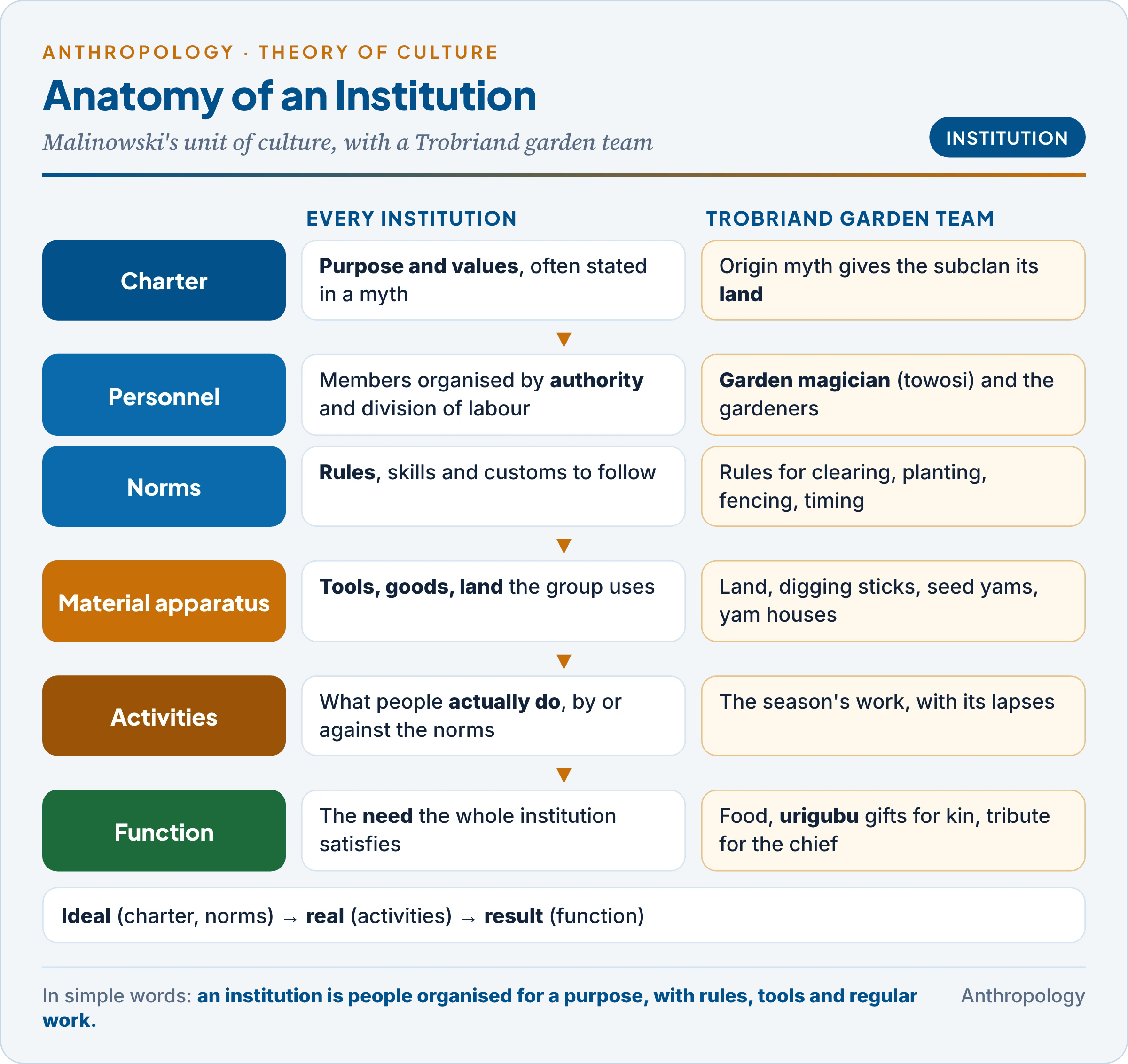
Worked example: the Trobriand garden team.
- Charter: origin myths give each subclan its land; garden magic and tradition say how gardens should be made.
- Personnel: the village garden magician (towosi), who opens each stage of work with rites, and the gardeners, organised by household and kin.
- Norms: rules on clearing, planting, fencing and the timing of each stage.
- Material apparatus: land, digging sticks, seed yams, fences, the yam houses where the harvest is displayed.
- Activities: the season’s work, with its lapses.
- Function: food for the household, urigubu gifts for kin, tribute for the chief.
Principles of integration. Institutions everywhere are organised on seven universal principles: reproduction (family, clan), territory (village), physiology (sex and age groups), voluntary association, occupation, rank and status, and the comprehensive principle (the tribe as a whole). They allowed comparison without ranking.
4.2 Basic premises of Malinowski’s functionalism
Drawing the threads together, the core tenets are:
- Culture is an integrated whole, not a collection of separate traits.
- The institution is the unit of that whole; traits matter only inside institutions.
- Every institution has a function: it satisfies a basic, derived or integrative need.
- Institutions are interdependent: a change in one affects the others.
- The individual remains at the heart of every institution. Needs are felt by individuals, so explanation always returns to human beings.
- Analysis is synchronic and empirical: a culture is understood from its present working, observed in the field.
5. Functionalism at Work: Magic, Myth, Kula and Kinship
In simple words
Malinowski tested his approach on the customs that looked strangest to Europeans: magic, myths, a ring of exchange in which shell ornaments travel endlessly between islands, and a people who said that fathers play no part in making a child. In each case he showed that the custom made sense once you saw what it did for the people.
5.1 Magic: confidence where knowledge ends
In Magic, Science and Religion (1925) Malinowski reported that Trobriand fishermen used no magic in the calm inner lagoon, where fishing by poison was safe and sure, but performed elaborate magic before fishing in the open sea, where catches were uncertain and lives were at risk.
- The functional reading: magic is used where technique cannot guarantee success. It relieves anxiety, gives confidence and organises work. Trobrianders have sound empirical knowledge; magic, science and religion coexist rather than form Frazer’s three stages (Unit 5b; Radcliffe-Brown’s reply that ritual may create anxiety: Unit 5a).
5.2 Myth as charter
In Myth in Primitive Psychology (1926) Malinowski argued that myth is not primitive science or idle story. It is “a pragmatic charter of primitive faith and moral wisdom”.
- Trobriand case: each subclan traces its first ancestors, a sister and her brother, to a “hole” in the ground from which they emerged; the myth names the spot and so proves the subclan’s right to that land. Rank was settled at the hole of Obukula near Laba’i, from which the animals of four clans emerged. The Dog of the Lukuba clan, then the highest, ate the unclean noku fruit, and the Pig of the Malasi clan said: “Thou eatest noku, thou eatest dirt; thou art a low-bred, a commoner; the chief, the guya’u, shall be I.” Ever since, the Tabalu subclan of the Malasi have been the chiefs. The myth is cited whenever clan rank or food taboos are disputed.
- The functional reading: myths are charters that validate present land rights, rank and magic by tying them to a sacred past. A myth “works” when a right is challenged, so it must be read in use (compared with Lévi-Strauss: Unit 5a).
5.3 The kula
The kula is a ring of ceremonial exchange among the islands of the Massim, off eastern New Guinea. Red shell necklaces (soulava) travel clockwise and white shell armbands (mwali) anticlockwise between lifelong partners, with ordinary barter (gimwali) carried on alongside. A valuable is never kept for good; it is held for a time and passed on, gaining fame from its history.
- The functional reading: the kula is not trade. It builds alliances among islands with no common government, displays rank and renown, carries magic and myth, and makes peaceful barter possible. It refuted “primitive economic man” and inspired Marcel Mauss’s The Gift (1925); its interpretations by Uberoi and Weiner are in Unit 3b.
5.4 Kinship, paternity and the “matrilineal complex”
- Sociological paternity. Trobrianders told Malinowski that a child is formed when a spirit child (baloma) enters a woman; the father (tama) is the mother’s husband, a loving outsider to the child’s matrilineage, while authority lies with the mother’s brother. Malinowski called this sociological paternity: fatherhood as a social role, not a biological claim (The Father in Primitive Psychology, 1927).
- Against a universal Oedipus complex. Sigmund Freud’s Oedipus complex assumed that a boy’s love for his mother and rivalry with his father is universal. In Sex and Repression in Savage Society (1927) Malinowski argued that in the Trobriands the boy’s tension is with the mother’s brother, who holds authority, while the father is a friend; the forbidden woman is the sister. The “complex” follows the social structure of the family, not a fixed human nature. The British psychoanalyst Ernest Jones defended Freud, and the debate opened the culture-and-personality question (Unit 6g).
5.5 Law and reciprocity
In Crime and Custom in Savage Society (1926) Malinowski explained why Trobrianders keep rules without courts: reciprocity and publicity. Coastal villages give fish, inland villages give yams, and anyone who fails loses the return gift and his good name (Unit 4b).
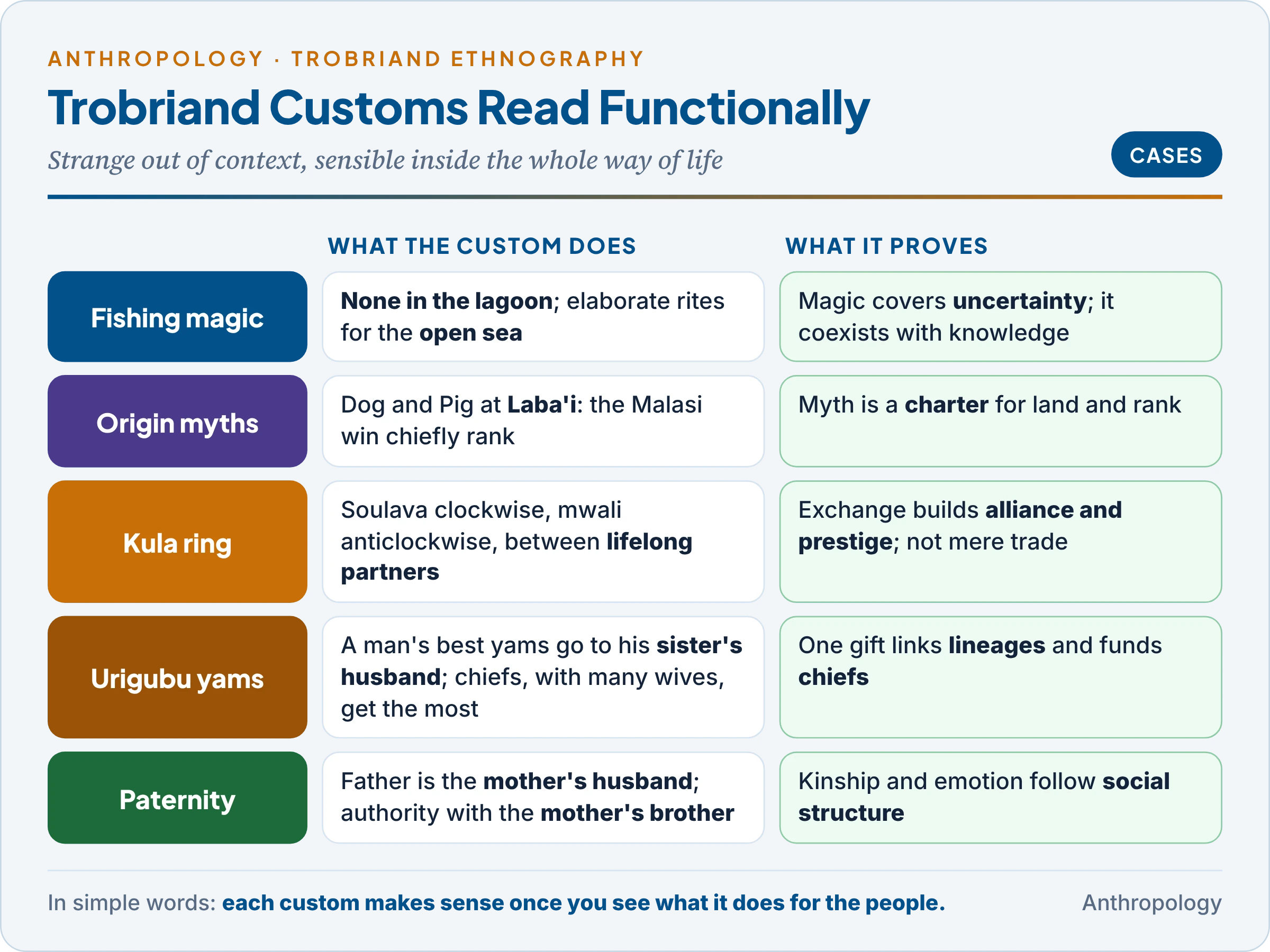
5.6 What the cases show
The table gathers the functional readings, each with what it proves against the earlier schools.
| Case | Older reading | Malinowski’s functional reading | What it proves |
|---|---|---|---|
| Lagoon and sea fishing | Magic is failed science (Frazer) | Magic covers uncertainty; gives confidence | Magic and knowledge coexist |
| Origin myths | Myth is primitive explanation | Myth is a charter for land and rank | Myth must be read in use |
| Kula | Primitive trade | Exchange builds alliance and prestige | Economy is embedded in society |
| Urigubu yams | Irrational waste of labour | Gift links lineages and supports chiefs | One custom serves many needs |
| Sociological paternity | Proof of a primeval matriarchy | Fatherhood as a social role in a matrilineal system | Kinship is social, not only biological |
| Mother’s brother’s authority | Freud’s universal Oedipus complex | Tension follows family structure | Psychology varies with social organisation |
Each custom looked irrational when lifted out of context and made sense when placed back in the whole way of life. That is the strongest argument for functionalism, and it rests on long fieldwork.
6. Culture Change and Practical Anthropology
In simple words
Late in life Malinowski turned from small, self-contained islands to colonial Africa, where African and European ways were meeting and clashing. He argued that anthropologists should study this change directly and advise governments, so that change would cause less harm.
- Practical anthropology. In “Practical Anthropology” (Africa, 1929) Malinowski argued that anthropology should serve administrators and educators; with International African Institute and Rockefeller funds he sent many students to Africa in the 1930s.
- The Dynamics of Culture Change (published after his death, 1945, edited by Phyllis Kaberry) treated culture contact not as a “mixture” of traits but as the interaction of two institutional systems: European agencies with their own aims, and African institutions with theirs.
- The three-column approach. To study a contact situation he proposed three columns:
- Column A: European influences, interests and intentions (administration, missions, mines, settlers);
- Column B: processes of culture contact and change, the new institutions that arise where the two meet;
- Column C: surviving forms of tradition.
- later columns for the reconstructed past as people remember it, and for new forces of African reaction, such as independent churches.
- The weakness: by keeping European and African institutions in separate columns, the scheme treated them as two cultures in contact rather than parts of one social system with a single structure of power. This is the core of Max Gluckman’s critique (§7.2).
7. Critique of Malinowski’s Functionalism
In simple words
Critics agreed that Malinowski was a great fieldworker but doubted his theory. They said that explaining everything by biological needs tells us little about why societies differ, that claiming every custom is useful ignores harmful and useless ones, that the theory could not explain change, and that it served colonial rule.
7.1 Edmund Leach: great ethnographer, dead theory
Edmund Leach, a British anthropologist who had studied with Malinowski and later turned to structuralism, gave the most quoted verdict in 1957: “the abstract theoretical writings of Malinowski are not merely dated, they are dead”. Malinowski was “an imaginative genius of a high order”, but his bias against abstract theory made him “a fanatical theoretical empiricist”.
- The objection: the theory of needs is too general to explain anything particular. All societies must eat, so hunger cannot explain why Trobrianders grow yams for their sisters’ husbands. The variety of culture is what the theory cannot reach; the lasting contribution is the ethnography.
7.2 Max Gluckman: needs cannot explain society or change
Max Gluckman, the South African-born British anthropologist who led the Manchester school, reviewed Malinowski’s theories in An Analysis of the Sociological Theories of Bronislaw Malinowski (Rhodes-Livingstone Papers, 1949).
- Retreat into biology: because Malinowski explained institutions by individual needs, he could not formulate comparative problems at the social level, such as why one society is centralised and another is not.
- The three columns divide what is one: in his “Analysis of a Social Situation in Modern Zululand” (1940) Gluckman described a bridge opening attended by Zulu, officials, missionaries and chiefs. Africans and Europeans, he argued, form one social field with shared institutions and a single structure of conflict and power. Treating them as separate “cultures in contact” hides the colonial relationship that links them.
7.3 Radcliffe-Brown’s objection
- In his presidential address “On Social Structure” (1940) he said: “This Functional School does not really exist; it is a myth invented by Professor Malinowski.”
- In “Functionalism: A Protest” (1949) he defined Malinowski’s functionalism as the doctrine “that every feature of culture of any people past or present is to be explained by reference to seven biological needs of individual human beings”, and wrote: “I reject it entirely, regarding it as useless and worse. As a consistent opponent of Malinowski’s functionalism, I may be called an antifunctionalist.”
- The substance of the objection: following Durkheim, Radcliffe-Brown held that social facts must be explained by other social facts. Explaining a custom by biological or psychological needs is reductionism: it reduces society to the individual organism. The function of a custom should be its contribution to the social structure, not to the stomach or the nerves (Unit 6e).
7.4 Circularity, teleology and universal functionalism
- Circularity. Needs are inferred from the institutions that exist, and the institutions are then explained by the needs; he also used “needs” and “imperatives” interchangeably without saying why. The argument goes round in a circle: a custom exists because it meets a need, and we know the need exists because the custom does.
- Teleology (explaining a thing by the purpose or end it serves). To say an institution exists because of its useful effects confuses consequence with cause. The usefulness of urigubu does not tell us how it arose. The American philosopher Carl Hempel (“The Logic of Functional Analysis”, 1959) showed that functional statements explain why a thing persists only if one also shows that no functional alternative could do the same job.
- Universal functionalism. Malinowski’s claim that every custom is “indispensable” leaves no room for customs that are useless, harmful or kept by inertia. The American sociologist Robert Merton (Social Theory and Social Structure, 1949) rejected this postulate, along with the postulates of functional unity and indispensability, and introduced dysfunction and functional alternatives (treated fully in Unit 6e, §7).
7.5 Static, ahistorical and unable to explain change
- Static: a culture whose parts all fit should never change; the theory describes a balanced, timeless whole.
- Ahistorical: in dismissing conjectural history, functionalists also ignored documented history. The Trobriands of 1915 had missions, a government station and pearl traders, which appear only at the edges of the monographs.
7.6 The colonial context
- Funding and purpose: the “practical anthropology” of the 1930s was financed by bodies linked to colonial administration and advertised as useful for indirect rule, the British policy of ruling through native institutions.
- Anthropology and the Colonial Encounter (1973), edited by the Saudi-born anthropologist Talal Asad, argued that the picture of stable, bounded tribes suited colonial rule by leaving out the power that governed them.
- Balance: Malinowski also criticised settler land policies; functionalism was shaped by and useful to colonial rule without being simply its tool.
7.7 Gaps in the ethnography: women’s exchange
The American anthropologist Annette Weiner restudied the Trobriands (Women of Value, Men of Renown, 1976) and found that women’s wealth, banana-leaf bundles and fibre skirts distributed at mortuary ceremonies (sagali), was central to renewing the matrilineages. Malinowski, working mostly with men, had almost missed it: “seeing the whole” depends on whose activities the fieldworker sees.
7.8 The critique in summary
The table sets each objection beside its critic and its target.
| Objection | Critic | What it targets |
|---|---|---|
| Theory “dead”; too general to explain variety | Leach (1957) | Theory of needs |
| Cannot frame social comparison; colonial society is one field | Gluckman (1949; 1940) | Needs; three-column approach |
| Reductionism: social facts explained by biology | Radcliffe-Brown (1940; 1949) | Individual needs |
| Circular and teleological | Hempel (1959); many | Logic of functional explanation |
| Not every item is useful; dysfunctions exist | Merton (1949) | Universal functionalism |
| Static; ignores history, conflict and actors | Marxist and interactionist critics | Model of balanced whole |
| Served colonial rule | Asad (1973) | Practical anthropology |
| Male-centred ethnography | Weiner (1976) | Fieldwork data |
The first four objections attack the theory; the last four attack the picture of society it produced. Almost no critic attacked the method of long, intensive fieldwork, which is why that method survived the theory.
Common confusion
Is Malinowski’s functionalism the same as Radcliffe-Brown’s structural-functionalism? No. Both ask what a custom contributes to a working whole, but Malinowski’s “whole” is culture serving individual needs, starting from biology, while Radcliffe-Brown’s is the social structure, and he excluded individual needs from explanation. Radcliffe-Brown himself called Malinowski’s version “useless and worse”. The full side-by-side comparison is in Unit 6e.
8. Legacy and Indian Relevance
In simple words
Malinowski’s theory faded, but his way of working became the basic method of anthropology everywhere. His ideas about exchange, myth, law and the gap between rules and behaviour are still used, and his students carried his approach to India.
8.1 What survives
- Fieldwork as the core method: long residence, the local language and participant observation became every anthropologist’s rite of passage, and spread to sociology and design research.
- Holism in practice: tracing a custom into economy, kinship, religion and politics remains the anthropologist’s habit, whatever the theory.
- Lasting concepts: reciprocity in economic and legal anthropology; myth as charter; magic and uncertainty; sociological paternity; the gap between norm and practice; and phatic communion (“The Problem of Meaning in Primitive Languages”, 1923), talk whose function is to create social contact rather than to pass on information.
- Raymond Firth, Malinowski’s New Zealand-born successor at the LSE, kept the functional approach alive in his studies of Tikopia and modified it by distinguishing social structure (the enduring form) from social organisation (the choices and decisions of individuals), which brought change back in (Elements of Social Organization, 1951; Unit 6e).
8.2 Functionalism and India
- Christoph von Fürer-Haimendorf, the Austrian anthropologist trained in the Vienna diffusionist school, attended Malinowski’s LSE seminars in 1935 before his first Indian fieldwork among the Konyak Nagas (1936–37). Inspired by Malinowski but “not uncritical” of functionalism, he went on to long fieldwork among the Chenchus, Reddis and Raj Gonds of Hyderabad and the Apatanis of Arunachal Pradesh. His monographs, such as The Chenchus (1943) and The Raj Gonds of Adilabad (1948), show the Malinowskian method of residence and the local language applied in India.
- Functional ethnographies of Indian tribes: from the 1930s Indian anthropologists described tribes as integrated wholes that careless change could damage, as in D.N. Majumdar‘s study of the Ho, A Tribe in Transition (1937).
- Youth dormitories compared. The Trobriand bukumatula (the bachelors’ house) is often compared with the ghotul of the Muria (Chhattisgarh), described by Verrier Elwin in The Muria and Their Ghotul (1947): both train the young for adult roles (Unit 2.2).
- Policy relevance. The warning that institutions are interdependent, so that removing one (a dormitory, a customary council) disturbs others, runs through Indian tribal policy from Nehru’s tribal Panchsheel (late 1950s) to the respect for customary institutions in PESA (1996).
Key Concepts
| Concept | Meaning in Malinowski |
|---|---|
| Function | Satisfaction of a need by an organised, cooperative activity |
| Culture | Instrumental apparatus for meeting needs; an integrated whole |
| Basic needs and responses | Seven biological needs, each met by a cultural response |
| Derived imperatives | Economics, social control, education, political organisation |
| Integrative imperatives | Knowledge, magic, religion, art and play |
| Institution | Charter, personnel, norms, material apparatus, activities, function |
| Participant observation | Long residence to grasp the native’s point of view |
| Myth as charter | Myth validates present rights and rules |
| Sociological paternity | Fatherhood as a social role, apart from biology |
| Three-column approach | European influences, contact processes, surviving tradition |
Major Works
| Work | Year | Significance |
|---|---|---|
| Argonauts of the Western Pacific | 1922 | The kula; fieldwork method |
| Magic, Science and Religion | 1925 | Magic and uncertainty |
| Crime and Custom in Savage Society | 1926 | Law as reciprocity |
| Myth in Primitive Psychology | 1926 | Myth as charter |
| Sex and Repression in Savage Society | 1927 | Matrilineal complex against Freud |
| Coral Gardens and Their Magic | 1935 | Garden economy, magic, language |
| A Scientific Theory of Culture | 1944 | Needs and institutions |
| The Dynamics of Culture Change | 1945 | Culture contact; three columns |
| A Diary in the Strict Sense of the Term | 1967 | Fieldwork controversy |
Key Terms
| Term | Meaning in simple words |
|---|---|
| Functionalism | Explaining a custom by what it does for a working whole |
| Synchronic | Studying a society at one period, as it works |
| Diachronic | Studying change over long periods |
| Conjectural history | Guessed reconstruction of an unrecorded past |
| Survival | A custom thought to be a useless relic |
| Imponderabilia | Everyday behaviour seen only by continuous observation |
| Basic need | A biological requirement of survival |
| Derived need | A need created by cultural life itself |
| Integrative need | Need for confidence, meaning and group unity |
| Urigubu | Harvest gift of yams from a man to his sister’s husband |
| Reductionism | Explaining social facts by biology or psychology |
| Teleology | Explaining a thing by the purpose it serves |
Contemporary Developments
- Centenary of Argonauts (2022). Conferences at the LSE (July 2022), Kraków’s Jagiellonian University (September 2022) and a Royal Anthropological Institute symposium (November 2022) marking the centenary of both Argonauts and The Andaman Islanders reassessed Malinowski’s fieldwork, his colonial position and his economic anthropology.
- Ethnographers Before Malinowski (2022), edited by Frederico Rosa and Han Vermeulen, documents intensive fieldwork from 1870 to 1922, qualifying the claim that Malinowski invented it.
- The kula today. Expeditions in 2016 and 2018 by Susanne Kuehling and Gina Knapp with Milne Bay islanders documented over 1,200 kula valuables and helped draft a community “kula constitution”, responding to the sale of shells outside the ring.
- Decolonising fieldwork: debates on ethics and the fieldworker’s power, sharpened by the diary, now shape fieldwork training (Unit 8a).
Diagrams to Master
- Topic map of the article.
- Fieldwork method (§2): tent in Omarakana; skeleton, imponderabilia, corpus inscriptionum; native’s point of view; say against do.
- Theory of needs (§3): three tiers; the seven pairs of needs and responses; the four derived imperatives; integrative imperatives; the garden chain.
- Institution (§4): charter, personnel, norms, material apparatus, activities, function, with the garden team.
- Trobriand cases (§5): magic, myth, kula, urigubu, paternity; what each proves.
Revision Grid
| Scholar | Work (year) | Key idea |
|---|---|---|
| Malinowski | Argonauts (1922) | Participant observation; kula |
| Malinowski | Myth in Primitive Psychology (1926) | Myth as charter |
| Malinowski | A Scientific Theory of Culture (1944) | Needs; institution |
| Malinowski | Dynamics of Culture Change (1945) | Three columns |
| Radcliffe-Brown | “Functionalism: A Protest” (1949) | Needs “useless and worse” |
| Gluckman | Sociological Theories of Malinowski (1949) | One social field |
| Merton | Social Theory and Social Structure (1949) | Dysfunction |
| Leach | “Epistemological Background” (1957) | Theory “dead” |
| Asad | Anthropology and the Colonial Encounter (1973) | Colonial context |
| Weiner | Women of Value, Men of Renown (1976) | Women’s wealth |
Previous Year Questions
Unit 6: Functionalism (Malinowski)
- 2023Critically discuss the controversies related to fieldwork of Bronislaw Malinowski and Margaret Mead.
- 2016Write a note in 150 words on Functionalism.
- 2014What is functionalism? Discuss the functional approach to the understanding of Religion.
- 2013In what ways is Functionalism different from Structural Functionalism? (350words).
- 1999What is meant by functionalism? Discuss the basic tenets of Malinowski’s functionalism.
- 1995Give the names of two prominent British functionalists in social anthropology. Describe the functional theory attributed to any one of them.
- 1992Define social function. Critically evaluate the concepts as postulated by Malinowski.
- 1990Discuss Malinowski’s contributions to functionalism in social anthropology.
- 1987Evaluate Malinowski’s contribution to functionalism.
- 1986Examine Malinowski’s theory of needs and state its merits.
- 1984Distinguish between : Note Malinowski’s contribution to functionalism in social anthropology.
- 1983Functionalism is not confined to Anthropology among social sciences. Elaborate.
- 1982Discuss contributions of Malinowski. Radcliffe Brown and Firth to the concept of Function.
Related questions from other units
- 2026Unit 5: Write notes on: Myth as oral literature.
- 2024Unit 3: Write notes on: Cultural relevance of the Kula.
- 2022Unit 3: Critically examine various anthropological interpretations about the Kula Ring.
- 2022Unit 8: Write the historical development of fieldwork tradition in anthropology till recent times.
- 2019Unit 8: Evaluate participant observation in producing anthropological knowledge.
- 2012Unit 5: Distinguish between Religion, Magic and Science.
- 2003Unit 3: Write a note on Kula Ring.
- 1996Unit 5: Why have religion and magic become stable features of a society ? What role do the religious functionaries play in simple and non-literate societies ?
- 1996Unit 8: Examine the importance of observation as a fieldwork technique in Anthropology. Differentiate between participant and non-participant observation and analyze the problem of objectivity in participant observation.
- 1989Unit 8: Write a note on Participant Observation in Anthropological Field Work.