

6 Anthropological theories: (e) Culture and personality (Benedict, Mead, Linton, Kardiner and Cora-du Bois).
Official Syllabus: Paper I, Unit 6 (culture and personality)
1. The Culture and Personality School
In simple words
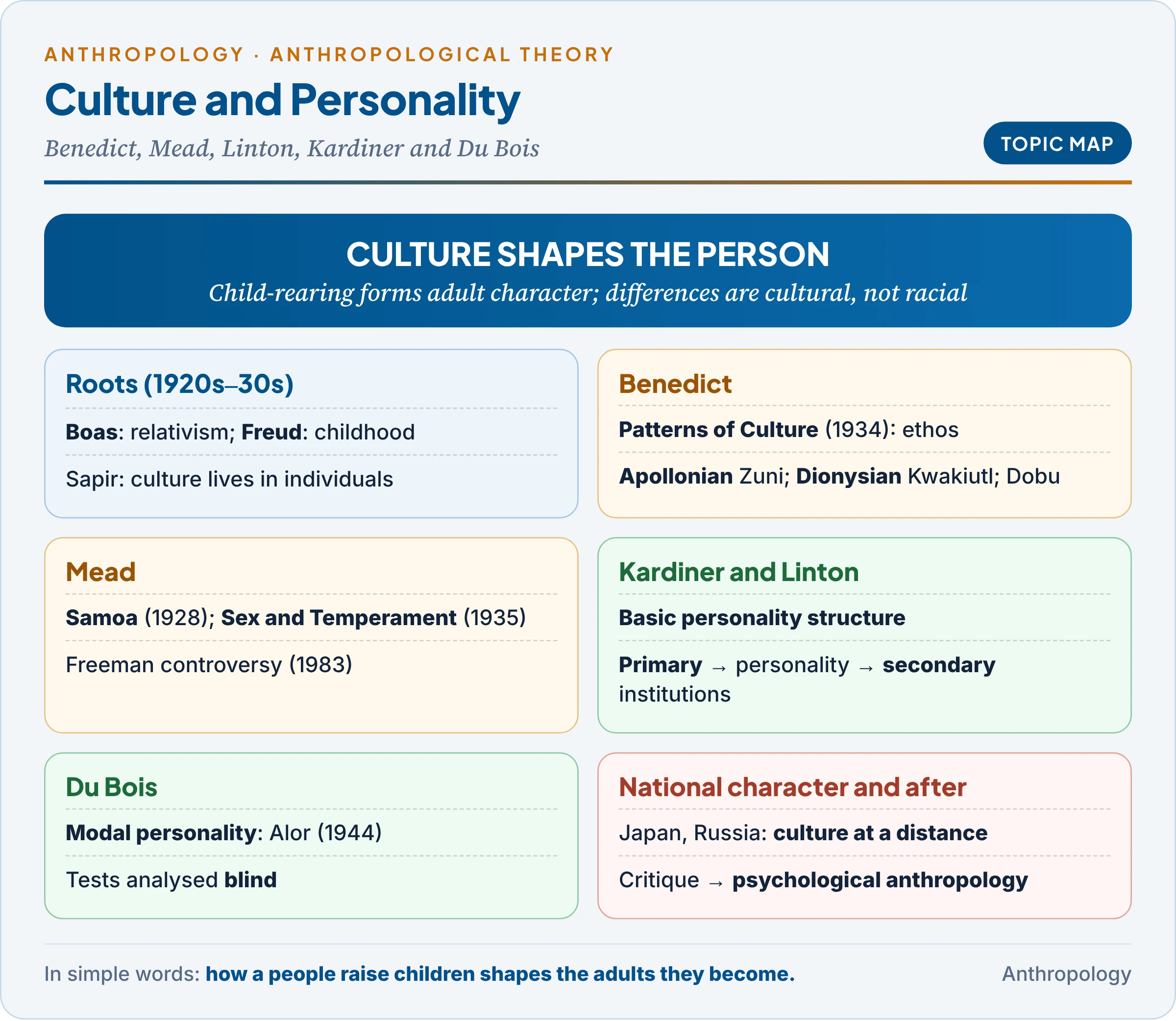
This school asked how a people’s culture shapes the kind of persons they become. Its members believed that the way children are raised, fed, disciplined and taught leaves a lasting stamp on adult character. They used this to argue that differences between peoples come from culture, not race.
Example first. In many Indian joint families an infant is fed whenever it cries, carried by many relatives and sleeps beside its mother for years. In much of mid-twentieth-century middle-class America, an infant was fed on a schedule and put to sleep alone in its own room. Does such a difference produce different kinds of adults, one more dependent on the group, the other more self-reliant? This is the question the culture and personality school set out to answer, and its members thought the answer was yes.
1.1 Origins
- Boas’s relativism. The school grew among the students of Franz Boas, the German-born founder of American anthropology (Unit 6b). Boas had shown that differences between peoples are cultural, not racial. His students asked the next question: how does culture get into the individual?
- Freud’s psychoanalysis. Sigmund Freud, the Austrian founder of psychoanalysis, held that early childhood experiences shape adult personality and that adults carry unconscious conflicts from infancy. Applied to whole societies, this suggested that shared child-rearing produces shared personality. Freud’s own anthropological book, Totem and Taboo (1913), was speculative, but his model of personality became the school’s main tool.
- Edward Sapir, the American linguist and anthropologist, argued from the 1920s that culture exists only in individuals and their interactions, and urged anthropologists to study the person.
- The anti-racist motive. In an age of racial theories of character, the school offered a cultural explanation of why peoples differ. This was its most important public achievement.
In brief (from Unit 1.2). Psychology studies the individual mind; anthropology tests whether psychological claims hold across cultures. The best-known case is Mead’s Samoa study, which challenged the idea that adolescence is everywhere a time of “storm and stress”. Unit 1.2 treats the wider relation between the two disciplines; this unit treats the school itself.
1.2 Basic premises and methods
- Culture and personality are two sides of one coin: culture is shared outside individuals; personality is culture as it lives inside each individual.
- Childhood is decisive: the socialisation (the process by which a child learns its culture) of the early years forms a personality that adult life builds on.
- Different cultures produce different typical personalities, and the typical personality in turn shapes institutions such as religion and folklore.
- Methods: participant observation, life histories (an individual’s account of his or her own life), dream analysis, and projective tests (tests in which a person interprets ambiguous material, such as the Rorschach inkblots or the Thematic Apperception Test pictures, and so “projects” inner attitudes).
1.3 Four approaches
The school is usually divided into four approaches. The table shows how each links culture and personality.
| Approach | Scholars | Key idea | Key case |
|---|---|---|---|
| Configurational | Benedict, early Mead | Each culture is an integrated pattern with a dominant ethos, which selects a type of personality | Zuni, Kwakiutl, Dobu |
| Basic personality structure | Kardiner, Linton | Primary institutions (child-rearing) form a shared personality, which creates secondary institutions (religion, folklore) | Marquesas, Tanala |
| Modal personality | Cora Du Bois | The most frequent personality type, measured by tests on individuals | Alor |
| National character | Mead, Benedict, Gorer | Typical personality of a modern nation, studied often “at a distance” | Japan, Russia, USA |
The four approaches move from intuition to measurement. Benedict read a culture as a whole, like a work of art; Kardiner reasoned from institutions to personality like a clinician; Du Bois tested individuals and counted results. National character studies then carried these tools, sometimes uncritically, to entire nations.
2. Ruth Benedict: Patterns of Culture
In simple words
Ruth Benedict argued that every culture picks out a few human tendencies from the many possible ones and builds its whole way of life around them. A culture therefore has a kind of character, as a person does. People who fit that character are seen as normal; those who do not are seen as odd, even though they might be admired elsewhere.
Example first. At a potlatch (a ceremonial feast of the North-West Coast of America), a Kwakiutl chief gave away or destroyed blankets, canoes and copper plates in front of his rivals, boasting and shaming them; the aim was to humiliate rivals and win rank. Among the Zuni of New Mexico, a man who won the foot races too often was expected to stop competing, and a person who sought office too eagerly was distrusted. The same human urge, to be recognised, is magnified in one culture and suppressed in the other. Benedict asked why.
2.1 Ruth Benedict (1887–1948)
Ruth Fulton Benedict, an American anthropologist and poet, trained under Boas at Columbia University and became his chief colleague there. She did fieldwork among the Zuni and other Pueblo peoples in the 1920s; for the Kwakiutl she drew on Boas’s data, and for the Dobu on the work of the New Zealand anthropologist Reo Fortune (Sorcerers of Dobu, 1932). Her Patterns of Culture (1934) became one of the most widely read books in anthropology.
2.2 Configuration and ethos
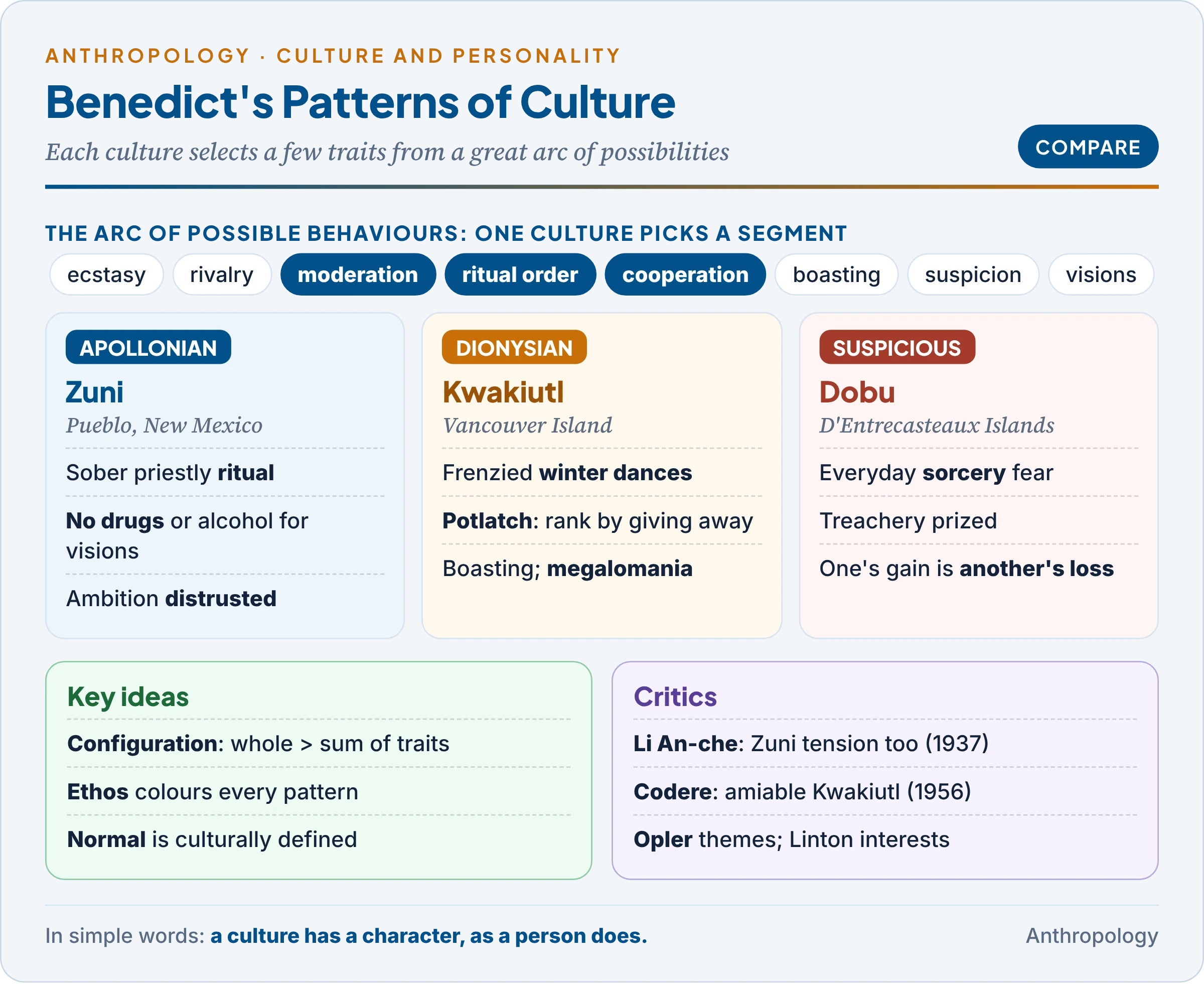
- The arc of possibilities. Human cultures draw on a great arc of possible interests and behaviours, from those of different ages and sexes to forms of ritual and economy. No culture can use them all; each selects a segment, as each language selects a few of the possible sounds.
- Configuration. A culture is more than the sum of its traits. Its parts are arranged around a dominant drive, so that marriage, religion and economy all express the same spirit. Benedict likened culture to an individual: “a more or less consistent pattern of thought and action”. The view was later summed up in the phrase “culture is personality writ large”.
- Ethos. The dominant emotional and moral tone of a culture is its ethos (or “genius”). It colours every subordinate pattern.
- Normal and abnormal. In “Anthropology and the Abnormal” (1934), Benedict argued that normality is culturally defined. A trance that marks a shaman as gifted in one culture may be called madness in another. A person whose temperament fits the culture’s configuration is “normal”; a misfit is a deviant, not because he is sick but because his culture has not selected his type.
2.3 Apollonian and Dionysian
Benedict took the terms from the German philosopher Friedrich Nietzsche‘s study of Greek tragedy (The Birth of Tragedy, 1872). She first applied them in “Psychological Types in the Cultures of the Southwest” (1928), contrasting the Pueblo peoples of the American South-West with the surrounding Native American peoples.
- Apollonian (after Apollo, god of order): restraint, moderation, sobriety, ritual order, distrust of excess and of individual display.
- Dionysian (after Dionysus, god of wine and ecstasy): the pursuit of excess, ecstasy, frenzy and visions, breaking through the ordinary limits of the senses.
The table summarises her three main cases.
| Culture | Region | Dominant pattern | Expressions |
|---|---|---|---|
| Zuni (Pueblo) | New Mexico, USA | Apollonian | Sober ritual by priests; no drugs or alcohol for visions; suspicion of personal ambition; authority avoided; cooperation |
| Kwakiutl | Vancouver Island, British Columbia | Dionysian, with megalomania (an exaggerated drive for greatness) | Frenzied winter dances; potlatch rivalry; boasting; shaming of rivals |
| Dobu | D’Entrecasteaux Islands, off New Guinea | Paranoid-like suspicion | Fear of sorcery; treachery prized; every gain seen as another’s loss |
Reading the table. The Plains peoples, with their vision quests through fasting and self-torture, were Benedict’s other Dionysian example; the Pueblo stood out against them as Apollonian. The Dobu do not fit either label: Benedict described their culture by its pervasive suspicion and sorcery, not by the Apollonian–Dionysian pair. The contrast was meant to show that each culture is a coherent choice, and that within it apparently strange behaviour is rational: a Dobuan’s distrust is sensible in a world where everyone is believed to practise sorcery.
2.4 Other ideas
- “Continuities and Discontinuities in Cultural Conditioning” (1938): American culture trains children to be submissive and asexual but expects adults to be dominant and sexual, so growing up involves a painful break. Many tribal societies make the transition gradual, through graded responsibilities, or mark it with clear rites.
- Race: Science and Politics (1940) and the pamphlet The Races of Mankind (1943, with Gene Weltfish) argued against racism for a wide public.
2.5 Criticism of Benedict
- Overgeneralisation. A whole culture is reduced to one adjective. The Chinese anthropologist Li An-che, who worked at Zuni, showed (1937) that Zuni life also held tension, gossip and rivalry. Helen Codere described “The Amiable Side of Kwakiutl Life” (1956), showing that the potlatch was only one side of Kwakiutl life.
- Ignores individual variation within a culture, which later tests confirmed (§5).
- Ignores history and change. The Kwakiutl potlatch she described was inflated by colonial conditions: a fall in population left more titles than claimants, and wage-earning brought new wealth to give away.
- One theme or many? Morris Opler argued that cultures are organised by several themes that check each other, not by a single ethos; Ralph Linton proposed a hierarchy of interests, ranked differently in each culture.
- Method. The approach is impressionistic, closer to literary portraiture than to testable science.
3. Margaret Mead: Culture Shapes Temperament
In simple words
Margaret Mead studied young people in Samoa and three peoples of New Guinea to test whether behaviour that Americans thought natural, such as teenage rebellion or male aggression, was really fixed by biology. She concluded that culture, not nature, decides most of it. Her work was later fiercely attacked and just as fiercely defended.
Example first. In the 1920s many American psychologists, following G. Stanley Hall, taught that adolescence is everywhere a time of “storm and stress” caused by the biology of puberty. If that were true, teenage turmoil should appear in every culture. Mead went to Samoa to look for a society where it did not. Finding one, she argued, would be enough to show that the turmoil was cultural: a single negative case can disprove a universal claim.
3.1 Margaret Mead (1901–1978)
Margaret Mead, an American anthropologist, was a student of Boas and was closely guided by Benedict. She did fieldwork in Samoa (1925–26), among the Manus of the Admiralty Islands (1928–29), among three peoples of the Sepik region of New Guinea (1931–33, with Reo Fortune), and in Bali (with Gregory Bateson). She became the best-known anthropologist of her time and a public voice on child-rearing, gender and education.
3.2 Her main studies
| Work | Year | People | Finding |
|---|---|---|---|
| Coming of Age in Samoa | 1928 | Girls of Ta’u island, American Samoa | Adolescence was calm: few strong attachments, relaxed attitudes to sex, little conflict between generations; turmoil is cultural |
| Growing Up in New Guinea | 1930 | Manus, Admiralty Islands | Manus children were practical and unimaginative, not “animistic”; imagination depends on adult cultivation, not childhood nature |
| Sex and Temperament in Three Primitive Societies | 1935 | Arapesh, Mundugumor, Tchambuli (Sepik) | Temperament is not tied to sex; each culture assigns it differently |
| Balinese Character (with Bateson) | 1942 | Bali | Pioneered photographic analysis of behaviour (some 25,000 photographs were taken) |
| And Keep Your Powder Dry | 1942 | United States | An anthropologist’s view of American character in wartime |
| Male and Female | 1949 | Seven Pacific cultures and the USA | How cultures build on, and sometimes against, sex differences |
Reading the table. Each study tested a claim of biological universality by finding a culture that broke it. This negative case method gave Mead’s conclusions their force, and it also made them vulnerable: if the case was wrongly described, the conclusion fell with it.
3.3 Sex and Temperament
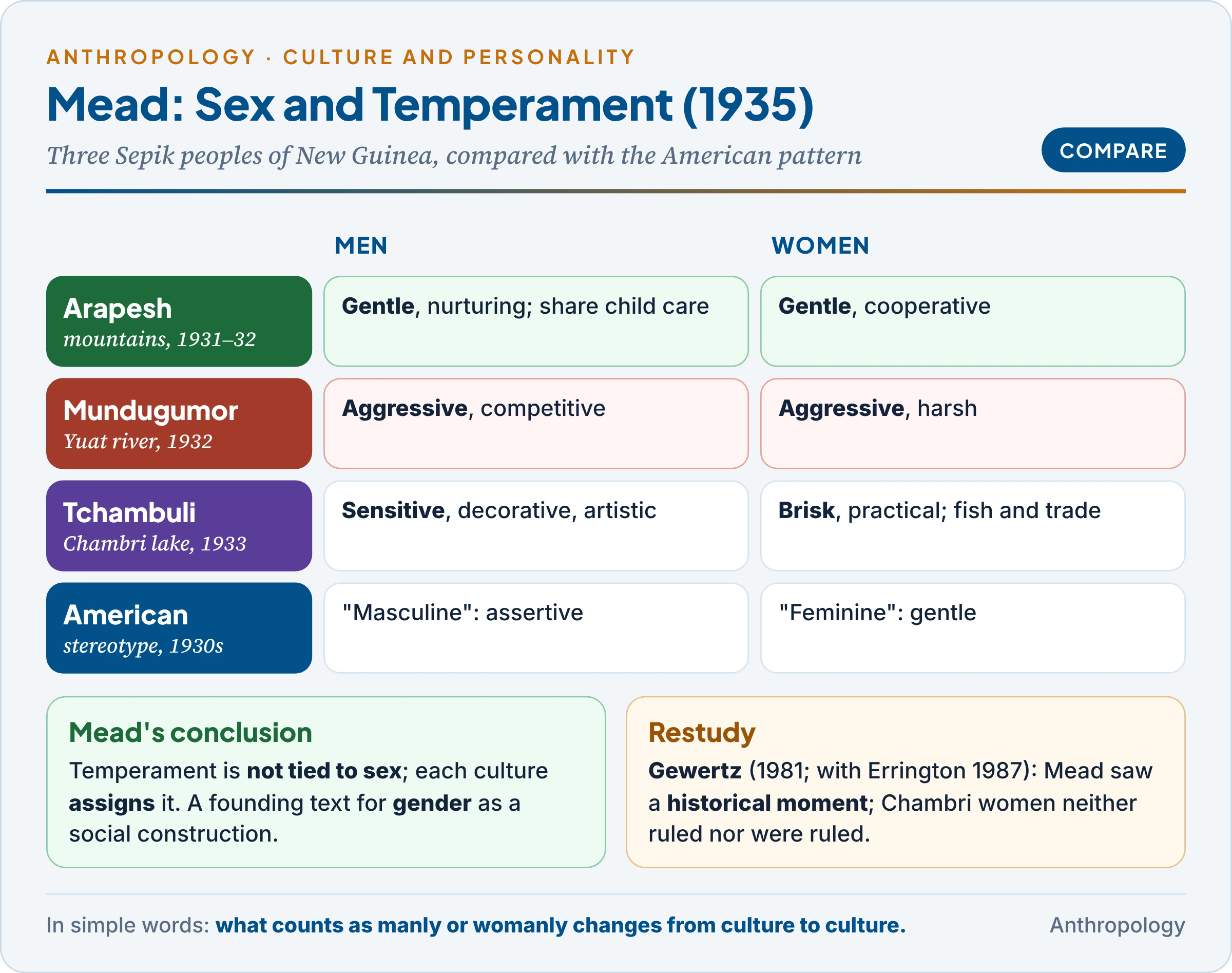
- Mountain Arapesh (village of Alitoa, 1931–32): both men and women were gentle, cooperative and nurturing, a temperament Americans thought “feminine”. Fathers were said to “bear” children too, sharing in their care.
- Mundugumor (Yuat river, 1932): both sexes were aggressive, competitive and harsh, a temperament Americans thought “masculine”. Marriage by exchange of sisters set fathers against sons over daughters to exchange.
- Tchambuli (now Chambri, 1933): the reverse of the American pattern: women were brisk, practical and economically dominant through fishing and trade; men were decorative, sensitive and absorbed in art and ceremony.
- Conclusion: “masculine” and “feminine” temperaments are culturally standardised, not given by sex. The book became a founding text for the idea of gender as a social construction.
- Restudy. Deborah Gewertz, who worked among the Chambri from the 1970s, argued (1981; with Frederick Errington, 1987) that Mead saw a historical moment, when war and labour migration had disrupted men’s position, and that Chambri women neither dominated nor were dominated by men in any lasting way.
3.4 The Freeman controversy
- The attack. In Margaret Mead and Samoa: The Making and Unmaking of an Anthropological Myth (1983), the New Zealand-born anthropologist Derek Freeman, who had worked in Western Samoa from the 1940s, argued that Samoan society was competitive, authoritarian and often violent, with a cult of female virginity, high rates of rape and adolescent delinquency. Mead’s calm Samoa, he said, was a myth produced by her commitment to cultural determinism (the view that culture alone shapes behaviour).
- The hoax claim. In The Fateful Hoaxing of Margaret Mead (1999), Freeman relied on interviews (1987 onwards) with Fa’apua’a Fa’amū, who said that she and a friend had joked with Mead about their night-time activities in 1926, and that Mead had taken the jokes as fact.
- The replies. Critics noted that Mead worked in American Samoa in the 1920s, Freeman mainly in Western Samoa decades later; that both sexual freedom and the virginity ideal existed in Samoa, for different social ranks and contexts; and that Freeman’s own view leaned to biological determinism. The American anthropologist Paul Shankman (The Trashing of Margaret Mead, 2009; Current Anthropology, 2013) showed from the interview transcripts and Mead’s field notes that Fa’apua’a was not an informant on adolescent sex, that she said Mead had not asked her about it, and that Freeman had omitted crucial passages.
- Lessons. The controversy showed the danger of building a universal conclusion on one case, the value of restudies, and how a debate over fieldwork becomes a proxy war over nature against nurture.
Common confusion
Did the Freeman controversy prove that culture does not shape behaviour? No. At most it showed that Mead’s picture of Samoan adolescence was one-sided in some respects, a point Shankman’s work weakened further. The wider claim, that cultures differ greatly in how they shape adolescence and gender, rests on many studies, not on Samoa alone. The debate is better read as a lesson in ethnographic method: restudies, attention to rank and context, and caution about single cases.
4. Linton and Kardiner: Basic Personality Structure
In simple words
Kardiner and Linton argued that every society raises its children in broadly similar ways, so its members share a core of common personality. That shared core then shows itself in the society’s religion, myths and art. Change the way children are raised and, in time, the religion and myths change too.
Example first. In the Marquesas Islands of Polynesia, there were far more men than women, so a woman often had several husbands, and food was frequently scarce because of droughts. Mothers gave infants little care and nursing was brief. Marquesan folklore was full of ogresses (vehini-hai) who seduce men or steal and eat children, and of tales about food. Kardiner read this as a chain: scarce women and food and maternal neglect in childhood produced adults who feared women and starvation, and these fears reappeared in their myths and food taboos.
4.1 Ralph Linton (1893–1953)
Ralph Linton, an American anthropologist, began as an archaeologist, worked in the Marquesas (1920–22) and in Madagascar among the Tanala (1925–27), and later taught at Wisconsin, Columbia and Yale.
- Status and role. In The Study of Man (1936) he defined status as a position with a set of rights and duties, and role as the dynamic aspect of status, the putting of those rights and duties into action. Statuses are ascribed (given by birth, sex or age) or achieved (won by effort).
- Basic and status personality. In The Cultural Background of Personality (1945) he distinguished the basic personality type (traits shared by most members of a society through common early experience) from status personality (traits shared by those in the same status, such as men, priests or nobles), on top of which each person has individual traits.
- Personality defined. Personality is the organised aggregate of psychological processes and states pertaining to the individual; it is learned through enculturation and shaped also by heredity and unique experience.
- Hierarchy of interests. Against Benedict’s single ethos, Linton argued that each culture ranks many interests, and only study can show which dominates (§2.5).
4.2 Abram Kardiner (1891–1981)
Abram Kardiner, an American psychoanalyst who had himself been analysed by Freud in Vienna, ran a seminar at the New York Psychoanalytic Institute and at Columbia from the mid-1930s in which anthropologists presented their field data and he interpreted them. With Linton he wrote The Individual and His Society (1939: Marquesas and Tanala) and The Psychological Frontiers of Society (1945: the Comanche, Alor and “Plainville”, a small US town).
The model. Basic personality structure is the constellation of personality characteristics common to members of a society as a result of the early experiences they have in common.
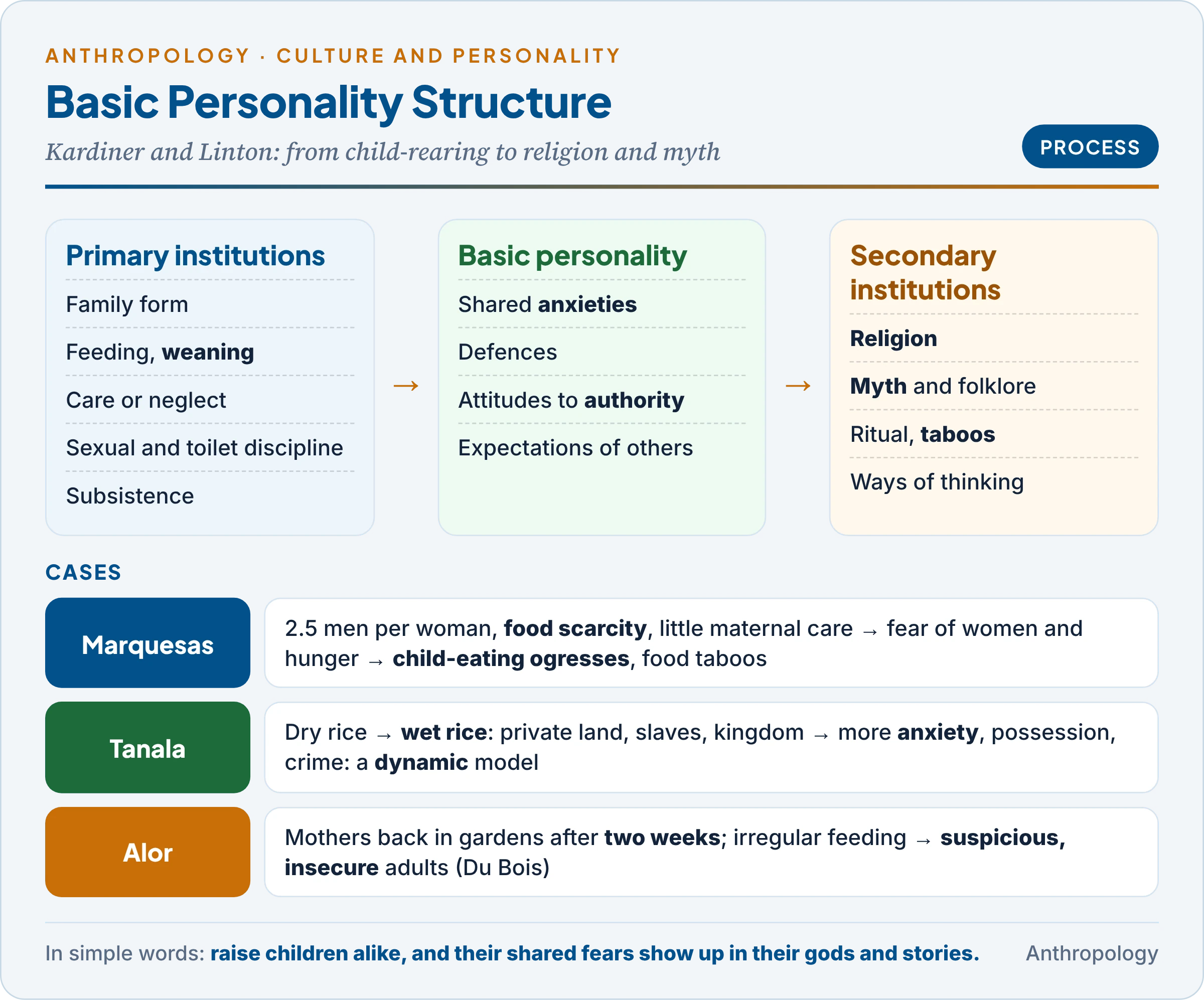
- Primary institutions shape the child: family organisation, feeding and weaning, care or neglect, toilet training, sexual disciplines, and the subsistence techniques that set the conditions of childhood.
- They produce the basic personality structure: shared anxieties, defences, attitudes to authority and expectations of others.
- The basic personality projects itself into secondary (projective) institutions: religion, myth and folklore, ritual, taboo systems and modes of thought. These satisfy or express the needs and tensions that childhood created.
4.3 Cases
- Marquesas (Linton’s data). Primary: about 2.5 men to every woman, polyandrous households, frequent food shortage, little maternal care. Basic personality: anxiety about food, hostility to women, male jealousy kept in check for the sake of household cooperation. Secondary: cannibal ogresses in folklore, food taboos, fear of being eaten.
- Tanala (Madagascar). When the Tanala shifted from dry (swidden) rice to irrigated wet rice, land became private and inheritable, slavery and a kingdom grew, and the old joint family under the father’s authority weakened. Kardiner noted a rise in anxiety, spirit-possession and crime: a change in primary institutions produced a change in personality and then in secondary institutions. This made the model dynamic, able to explain culture change, unlike Benedict’s static configurations.
4.4 Methods of studying basic personality
Basic personality was studied through:
- Ethnographic description of child-rearing and adult institutions, interpreted by a psychoanalyst (deduction from institutions to personality).
- Life histories and autobiographies, read for recurring anxieties and defences.
- Projective tests (Rorschach, Thematic Apperception Test, children’s drawings), analysed blind by specialists who had not seen the people.
- Dreams and folklore, treated as windows on shared unconscious concerns.
The strength of the approach is its explicit causal chain; its weakness is circularity: personality is inferred from institutions and then used to explain those same institutions.
5. Cora Du Bois: Modal Personality in Alor
In simple words
Cora Du Bois tested the idea of a shared personality by giving psychological tests to many individuals on the island of Alor and having experts analyse them separately. She found a common pattern, but not one shared by everybody: it was the most frequent type, not a universal one. She called it the modal personality.
Example first. On Alor, an island in eastern Indonesia, mothers returned to work in their gardens about two weeks after giving birth, leaving infants all day with older siblings or grandparents. Feeding was irregular, children were teased and promised things that never came, and they often fell into temper tantrums. Adult Alorese, Du Bois found, tended to be suspicious, insecure and distrustful, with shallow emotional ties. She asked whether the second followed from the first, and set out to test it.
5.1 The Alor study
- Cora Du Bois (1903–1991), an American anthropologist trained under Kroeber and Lowie at Berkeley, worked in Kardiner’s seminar and lived in Atimelang village on Alor from 1938 to 1939. Her The People of Alor (1944) carried analyses by Kardiner and the Rorschach specialist Emil Oberholzer.
- Data: detailed records of child-rearing; eight autobiographies, with dreams; Rorschach tests, children’s drawings, word-association and Porteus maze tests.
- Blind analysis. Each body of data went to a different expert who had never been to Alor: Kardiner read the autobiographies, Oberholzer the Rorschachs, a third specialist the drawings. Their independent portraits of the Alorese agreed in large part with each other and with Du Bois’s ethnography. This was the first serious attempt to control bias in culture and personality research.
- Economy and childhood: women did the food-growing; men were absorbed in competitive financial exchanges of pigs, gongs and moko (bronze drums used as wealth). The economic role of women set the conditions of maternal absence.
5.2 Modal personality
- Definition: the modal personality is the personality type that occurs most frequently in a society (the statistical mode), not one that every member shares.
- Why it mattered: it allowed for variation within a culture, rested on tests of individuals rather than inference from institutions, and could be checked by others.
- Du Bois’s own caution. In a later edition she described modal personality as a static and descriptive concept, not an explanation.
- How common is the mode? The American anthropologist Anthony F.C. Wallace found among the Tuscarora (1952) that the modal type, measured by Rorschach tests, was shared by only about a third of the sample. A culture holds many personality types.
Basic and modal personality are often confused. The table separates them.
| Basis | Basic personality structure | Modal personality |
|---|---|---|
| Scholars | Kardiner, Linton | Du Bois (later Wallace, Inkeles) |
| Meaning | Core shared by all members | Type that is most frequent |
| Source | Deduced from primary institutions | Measured from individuals |
| Method | Psychoanalytic interpretation of ethnography | Projective tests, life histories, statistics |
| Variation | Little room for it | Allows variation |
| Explains change | Yes: change in primary institutions | Mainly descriptive |
| Case | Marquesas, Tanala | Alor |
Basic personality is a theory of how culture forms personality; modal personality is a measurement of what personalities a society actually contains. Du Bois’s work tested Kardiner’s theory and showed its core to be partly right, but only as a tendency, never a uniform type.
5.3 Du Bois in India
From 1961 to 1973, as a professor at Harvard (the first woman appointed to a tenured professorship in its anthropology department), Du Bois led the Harvard–Bhubaneswar project in Odisha, comparing the old temple town with the new state capital. Its Indian and American researchers found continuity between tradition and modernity, rather than a clean break, a finding that questioned the modernisation theories of the time.
6. National Character Studies
In simple words
During the Second World War, the United States government asked anthropologists to explain the behaviour of enemy and allied nations. They tried to describe the typical character of a whole nation, often without visiting it. The studies produced some insights but also many stereotypes.
Example first. In 1944 the US Office of War Information asked Ruth Benedict why Japanese soldiers rarely surrendered, yet, once captured, often cooperated readily with their captors. Benedict could not go to Japan, so she interviewed Japanese Americans, read novels and wartime propaganda, and watched Japanese films. The result was The Chrysanthemum and the Sword (1946).
6.1 Meaning and assumptions
- National character is the set of personality traits and behaviour patterns held to be typical of the members of a nation. Mead described the aim as to describe, analyse and interpret the characteristic behaviour patterns of nations.
- Assumptions: members of a nation share common institutions and child-rearing, so they share psychological regularities; these are learned, not racial; and a sub-group properly understood can stand for the national pattern.
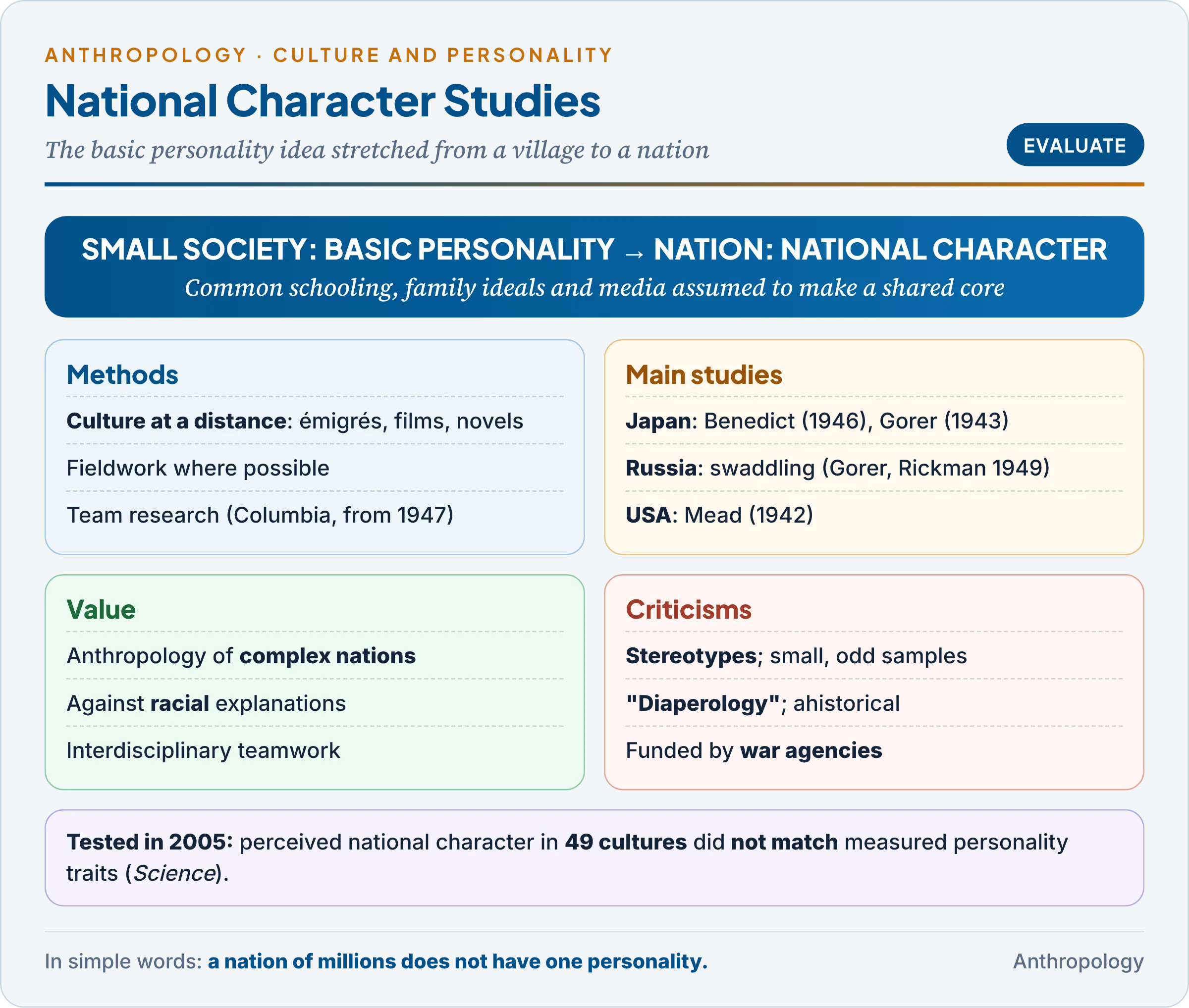
- From basic personality to national character. National character studies scaled up the basic personality idea: if shared child-rearing produces a shared core in a tribe, a nation’s common schooling, family ideals and media might produce a national core. The weak link is that a modern nation has many regions, classes and religions, so the “common experience” is far thinner than in a small society.
6.2 Main studies
| Study | Scholar | Year | Claim |
|---|---|---|---|
| The Chrysanthemum and the Sword | Benedict | 1946 | Japan as a hierarchical society bound by obligations: on (debts received), gimu (unlimited duties to the emperor and parents), giri (debts to be repaid exactly); a “shame culture” governed by others’ judgement, against the American “guilt culture” of inner conscience |
| “Themes in Japanese Culture” | Geoffrey Gorer | 1943 | Japanese compulsiveness traced to strict early toilet training |
| The People of Great Russia | Gorer and John Rickman | 1949 | The swaddling hypothesis: tightly bound infants alternate between restraint and release, which was linked to Russian swings between submission and outbursts |
| And Keep Your Powder Dry | Mead | 1942 | American character: achievement, mobility, success measured against others |
| The Study of Culture at a Distance | Mead and Rhoda Métraux | 1953 | Manual of methods for studying cultures that cannot be visited |
6.3 Methods
- Culture at a distance: interviews with émigrés and immigrants, study of novels, films, newspapers, propaganda and child-care manuals, used when fieldwork was impossible.
- Fieldwork where possible, and Mead’s three steps: identify approved and disapproved behaviour; find how conformity is rewarded and deviance punished; and relate the results to personality data.
- Team research: Columbia University’s Research in Contemporary Cultures project (from 1947), begun by Benedict and continued by Mead, studied several European and Asian cultures through interdisciplinary teams.
6.4 Value and limitations
Value:
- They brought anthropology to complex nations, encouraged interdisciplinary teamwork, and offered an alternative to racial explanations of national behaviour.
- Some insights lasted: Benedict’s account of hierarchy and obligation in Japan was widely read and debated in Japan itself.
Limitations:
- Samples were small and unrepresentative: émigrés, prisoners of war and immigrants stood in for whole nations.
- Childhood determinism: tracing national politics to swaddling or toilet training was mocked as “diaperology”.
- Stereotyping and homogenisation: a nation of millions, with regions, classes and religions, was given one character.
- Ahistorical: national behaviour was explained by personality, not by history, institutions and circumstance (for example, Japanese soldiers’ refusal to surrender was also a matter of military training and fear of punishment).
- Political aspects. The studies were funded by war agencies (the Office of War Information; later the Office of Naval Research during the Cold War) and aimed to understand enemies and allies. This raised the question of whether anthropology should serve the state, and whether describing “enemy character” could feed new forms of racism.
7. Critique and the Move to Psychological Anthropology
In simple words
By the 1950s critics had shown that whole cultures do not share one personality, that childhood does not fix everything, and that the school’s methods were often loose. The field did not die; it became psychological anthropology, which studies variation between individuals and uses more careful, comparative methods.
7.1 General criticisms
- Homogenisation. Treating a culture as one personality ignores individual variation, which Wallace’s tests and later studies showed to be large.
- Childhood determinism. Adult behaviour is shaped by adult situations too: economy, politics, war and age. Not everything is laid down by weaning and toilet training.
- Freudian bias. Psychoanalytic concepts developed among middle-class Viennese patients were applied to every culture, often without testing.
- Circularity. Personality was inferred from culture and then used to explain culture.
- Static and ahistorical. Most studies (Kardiner’s Tanala apart) ignored history and change.
- Unreliable methods. Projective tests were designed in the West and may not carry the same meaning elsewhere; ethnographic portraits were impressionistic.
7.2 Indian studies
- G. Morris Carstairs, a British psychiatrist, in The Twice-Born (1957), studied high-caste Hindus in a Rajasthan town and linked an indulgent mother and distant father to adult ambivalence about authority and anxiety about the loss of vital strength.
- The Six Cultures study (directed by John and Beatrice Whiting, 1954 onwards) compared child-rearing in six communities with a common field guide; its Indian site was the Rajputs of Khalapur in Uttar Pradesh (Leigh Minturn and John Hitchcock, 1963; book 1966), where purdah and the joint family spread child care among many women.
- Sudhir Kakar, the Indian psychoanalyst, in The Inner World (1978), argued that a prolonged, intense bond with the mother and a late, abrupt entry into the world of men shape Hindu identity, read through the joint family and Hindu myth.
7.3 Psychological anthropology
- A new name. The Chinese-American anthropologist Francis L.K. Hsu proposed in Psychological Anthropology (1961) to rename the field, freeing it from the narrow “culture and personality” formula.
- Replication of uniformity or organisation of diversity? Wallace (Culture and Personality, 1961) contrasted the old view that culture replicates uniform personalities with the view that culture organises diverse personalities so that they can interlock in social life. The second view became dominant.
- Comparative testing. John Whiting and Irvin Child (Child Training and Personality, 1953) used the Human Relations Area Files to test hypotheses about child-rearing statistically across many cultures.
- Later directions: cognitive anthropology (how people classify and reason); the study of emotion, self and person (Melford Spiro, Robert LeVine); and cultural psychology, which studies how culture and mind make each other up.
Overall. The school’s lasting achievements were its anti-racist argument, its insistence that personality is partly cultural, and its methods for linking childhood and culture. Its failures, overgeneralisation and stereotyping, taught the field to respect variation and history.
Common confusion
Is national character the same as basic personality? No. Basic personality (Kardiner and Linton) is a theoretical core of traits, derived from the primary institutions of a small, fairly uniform society and studied through fieldwork. National character is a claimed typical personality of a large, internally varied nation, often studied at a distance. National character studies borrowed the basic personality idea, but stretching it from a village to a nation of millions is exactly where it became a stereotype.
Key Concepts
| Concept | Scholar | Meaning |
|---|---|---|
| Configuration | Benedict | Integration of a culture around a dominant pattern |
| Ethos | Benedict | The dominant emotional tone of a culture |
| Apollonian / Dionysian | Benedict | Restraint and order / excess and ecstasy |
| Negative case | Mead | One exception disproving a biological universal |
| Status and role | Linton | Position with rights and duties / their performance |
| Status personality | Linton | Traits shared by people in one status |
| Basic personality structure | Kardiner, Linton | Core personality from shared early experience |
| Primary / secondary institutions | Kardiner | Child-rearing institutions / projective ones such as religion |
| Modal personality | Du Bois | The most frequent personality type |
| National character | Mead, Benedict, Gorer | Typical personality of a nation |
| Culture at a distance | Mead, Métraux | Studying a culture from émigrés and texts |
Major Works
| Scholar | Work | Year | Significance |
|---|---|---|---|
| Mead | Coming of Age in Samoa | 1928 | Adolescence shaped by culture |
| Benedict | Patterns of Culture | 1934 | Configurations; Apollonian and Dionysian |
| Mead | Sex and Temperament in Three Primitive Societies | 1935 | Temperament not tied to sex |
| Linton | The Study of Man | 1936 | Status and role |
| Kardiner (with Linton) | The Individual and His Society | 1939 | Basic personality structure |
| Du Bois | The People of Alor | 1944 | Modal personality; blind test analysis |
| Linton | The Cultural Background of Personality | 1945 | Basic and status personality |
| Benedict | The Chrysanthemum and the Sword | 1946 | Japanese national character |
| Gorer and Rickman | The People of Great Russia | 1949 | Swaddling hypothesis |
| Mead and Métraux | The Study of Culture at a Distance | 1953 | Methods of national character study |
| Hsu | Psychological Anthropology | 1961 | Renaming and widening the field |
Key Terms
| Term | Meaning in simple words |
|---|---|
| Personality | A person’s lasting pattern of thinking, feeling and acting |
| Socialisation / enculturation | How a child learns the ways of its society |
| Configuration | The overall design of a culture |
| Ethos | The emotional “feel” of a culture |
| Apollonian | Calm, moderate and orderly |
| Dionysian | Seeking excitement, excess and ecstasy |
| Potlatch | Feast where wealth is given away or destroyed for rank |
| Projective test | A test in which people read meaning into vague pictures |
| Primary institution | Child-rearing practices that form personality |
| Secondary institution | Beliefs and customs that express personality, such as myth |
| Basic personality | The personality core shared by a society’s members |
| Modal personality | The most common personality type in a group |
| National character | The supposed typical personality of a nation |
| Shame and guilt culture | Control by others’ judgement / by inner conscience |
| Cultural determinism | The view that culture alone shapes behaviour |
Contemporary Developments
- National stereotypes tested (2005): a study in Science by Antonio Terracciano, Robert McCrae and colleagues collected ratings of the “typical” member of 49 cultures from nearly 4,000 people and compared them with measured personality traits; the two did not match (median correlation about 0.04). Perceived national character appears to be a social construction that sustains national identity.
- The Mead controversy settled in her favour (2009, 2013): Paul Shankman’s re-examination of Freeman’s interviews and Mead’s field materials found no compelling evidence that Mead was hoaxed.
- WEIRD psychology (2010): Joseph Henrich and colleagues showed that most psychological findings come from Western, Educated, Industrialised, Rich and Democratic samples that are often unusual by world standards, reviving the school’s founding claim that human nature must be tested across cultures.
- Cultural psychology: research on the independent self (typical of the West) and the interdependent self (typical of East and South Asia), following Hazel Markus and Shinobu Kitayama (1991), continues the culture and personality question with experimental methods.
Diagrams to Master
- Topic map of the article.
- Benedict’s patterns (§2): the arc; Zuni, Kwakiutl, Dobu with their traits; the critics.
- Mead’s three societies (§3): a 2 × 3 grid of men and women in Arapesh, Mundugumor, Tchambuli against the American pattern.
- Kardiner’s model (§4): primary institutions → basic personality → secondary institutions, with the Marquesas example.
- National character (§6): methods, main studies, value and criticisms.
Revision Grid
| Scholar | Work (year) | Key idea |
|---|---|---|
| Mead | Coming of Age in Samoa (1928) | Calm adolescence; negative case |
| Benedict | Patterns of Culture (1934) | Apollonian, Dionysian; ethos |
| Mead | Sex and Temperament (1935) | Temperament culturally assigned |
| Linton | Study of Man (1936); Cultural Background (1945) | Status, role; status personality |
| Kardiner | Individual and His Society (1939) | Primary and secondary institutions |
| Du Bois | The People of Alor (1944) | Modal personality |
| Benedict | Chrysanthemum and the Sword (1946) | Shame culture; on, giri, gimu |
| Gorer | People of Great Russia (1949) | Swaddling hypothesis |
| Wallace | Tuscarora (1952); Culture and Personality (1961) | Organisation of diversity |
| Carstairs | The Twice-Born (1957) | Hindu personality in Rajasthan |
| Freeman | Margaret Mead and Samoa (1983) | Attack on Mead |
| Shankman | The Trashing of Margaret Mead (2009) | Defence of Mead |
Previous Year Questions
Unit 6: Culture and personality (Benedict, Mead, Linton, Kardiner and Cora-du Bois)
- 2026Discuss, with appropriate examples, how basic personality types may lead towards building up of national character.
- 2024Critically discuss the characteristics of the psychological types in the cultures of the American South-West as observed by Ruth Benedict.
- 2023Discuss political and methodological aspects of national character studies. Elucidate the contemporary relevance of such studies.
- 2020Discuss various anthropological approaches to the study of personality and culture.
- 2018What do you understand by the National Character Study ? Illustrate the concept.
- 2017Explain Ruth Benedict’s patterns of culture.
- 2008Discuss the relationship between culture and personality.
- 2004Critically discuss the contribution of Ruth Benedict to the study of culture,.
- 2001Discuss the contributions of Margaret Mead and Ralph Linton to the analysis of the relationship between culture and personality.
- 1999Discuss the contributions of Ralph Linton, Core-Du-Bois and Abraham Kardiner in the study of personality.
- 1996Write a note on Culture and personality •.
- 1994Discuss critically anthropological approaches in national character studies.
- 1994Examine the relationship between culture and personality. Give suitable examples to illustrate your answer.
- 1992Write a note on Model Personality.
- 1992Define basic personality and discuss the different methods employed in the study of its structure.
- 1988Define basic personality and discuss the different methods employed in the study of its structure.
- 1986Write a note on Basic personality structure and model personality.
- 1984Distinguish between : Basic personality and model personality.
- 1982Discuss the limitations of basic personality constructs and model personality in the study of culture and personality.
- 1981Discuss the value and limitations of national character studies in Anthropology.
Related questions from other units
- 2023Unit 6: Critically discuss the controversies related to fieldwork of Bronislaw Malinowski and Margaret Mead.
- 1999Unit 1.2: Discuss the relationship of anthropology with psychology and medicine.
- 1991Unit 1.1: Discuss the relevance of anthropological approach to national character studies.
- 1990Unit 1.3: Write a note on Recent trends in psychological anthropology.
- 1988Unit 1.2: Write a note on Psychological anthropology.
- 1987Unit 1.1: Discuss the relevance of anthropological approach in national character studies.