

Rationalism (Descartes, Spinoza, Leibniz): Cartesian Method and Certain Knowledge; Substance; God; Mind-Body Dualism; Determinism and Freedom.
Official Syllabus: Paper I, Section A, Unit 2
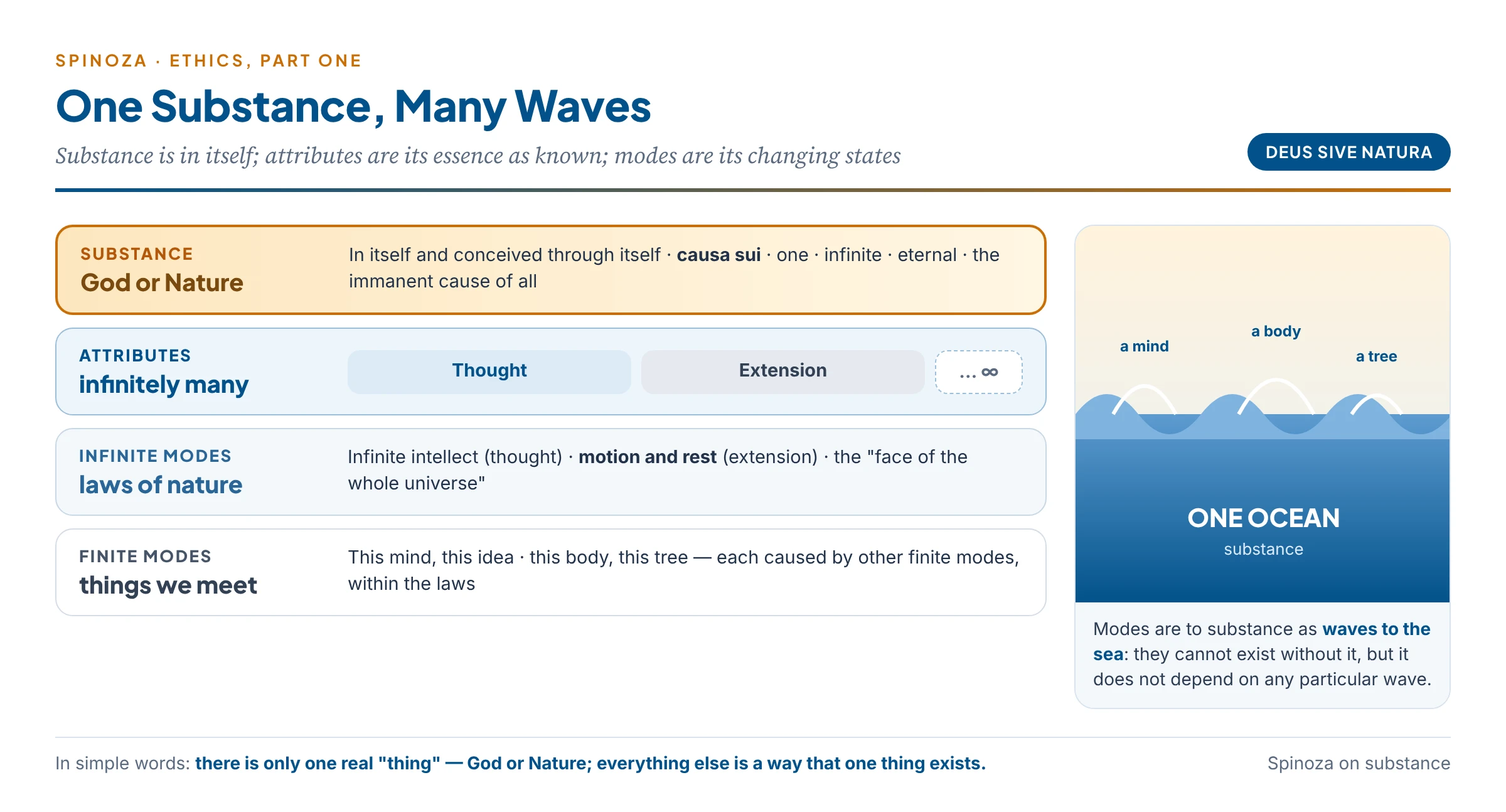
Baruch (Benedict) de Spinoza (1632–1677) pushed rationalism to its most radical conclusion. Descartes had defined substance as what needs nothing else in order to exist — and then, inconsistently, called mind and body substances though they need God. Spinoza took the definition at its word: if substance is what is in itself and conceived through itself, there can be only one substance — infinite, eternal, self-caused — and he calls it God or Nature (Deus sive Natura). Everything else — every mind, body, thought and event — is a mode (a modification) of this one substance, expressed through its attributes, of which we know two: thought and extension. The result is the most uncompromising monism in Western philosophy, often compared with Advaita Vedānta.
In simple words
Think of the ocean and its waves. Waves come and go, each with its own shape, but none of them is a separate thing — each is the ocean “waving” in a certain way. For Spinoza, God-or-Nature is the ocean; you, I, this table and this thought are waves.
Context & Problem
Spinoza’s Life and Sources
- The most radical of the post-Cartesians. Born into the Portuguese-Jewish community of Amsterdam, he was excommunicated in 1656 for his views, earned his living partly by grinding optical lenses, and refused a professorship to keep his freedom of thought.
- Influences: Cartesian metaphysics and method, Stoicism, Jewish rationalism, Hobbes and Machiavelli, and the heterodox religious thinkers of his day.
- Works: the Theologico-Political Treatise (published in his lifetime) and the Ethics, which contains his whole system in its most rigorous form and was published only after his death in 1677; plus important letters.
- His aim is ethical. The metaphysics serves a practical goal: to show human beings their place in Nature so that they can be free and blessed — liberation through knowledge of necessity.
From Descartes to Spinoza: The Problem of Unity
- Descartes’ gap. The cogito gave Descartes a clear and distinct idea, but such an idea only affirms the existence of something; it does not show its connection with other ideas. Without necessary connections between ideas there can be no real, rational system. Descartes had to call on God to connect and conserve his system from outside.
- Spinoza’s different starting point. He begins not with the doubting self but with the unity of all that exists. A thing is real only as it follows from the whole; an object taken apart from its connections is an abstraction. So he starts with the innate idea of God or Substance and deduces everything else from it.
- Algebra vs geometry. A common contrast: Descartes, with his algebraic approach, looks for axioms and deductive chains; Spinoza, with his geometrical approach, looks for the unity of all things — a reality where everything is “where it should be” and could not be elsewhere, like points in a figure.
- Reality is rational. Like a true rationalist, Spinoza holds that we can know reality through reason because reality itself is rational.
Core Doctrine
1. The Geometrical Method
The Ethics is written “in geometrical order,” on the model of Euclid: definitions → axioms → propositions → demonstrations → corollaries → scholia (explanatory notes).
- Human beings as geometry. Spinoza treats human actions and passions “just as if it were a question of lines, planes and bodies.”
- Why this method?
- Vision of unity — if everything follows from one reality, the right method shows everything following in order from one self-evident starting point.
- Impersonality — mathematics does not let personal feelings, hopes or fears distort the truth; it is exact and disinterested.
- Clear and distinct ideas are not enough — knowledge needs the connections between ideas, which a deductive system supplies.
- Method mirrors reality — things follow from God as theorems follow from axioms, so a deductive book is an imitation of the structure of being (necessitarianism).
- Three kinds of knowledge — the method trains the mind to rise through them:
- Imagination (opinion) — from the senses, images, hearsay and chance experience; confused and inadequate.
- Reason (ratio) — knowledge of common notions and universal laws; adequate ideas of things as necessarily determined.
- Intuitive knowledge (scientia intuitiva) — the highest; grasping things from the essence of God, seeing them “under the aspect of eternity” (sub specie aeternitatis).
- Descartes vs Spinoza on method: Descartes begins with doubt to find a secure foundation; Spinoza thinks doubt is only a form of ignorance and cannot be a foundation. Descartes’ method is sceptical purification; Spinoza’s is rational construction — more architectonic (building a whole) than foundational. Doubt disappears not through subjective assurance but through logical inevitability.
What the method brings with it:
- Pantheism — geometry rests on one presupposition (space); Spinoza’s world rests on one reality (God), of which all things are modifications.
- A static world — there is no movement in geometry; cast in geometrical form, the world becomes fixed and necessary.
- No free will — what follows from definitions cannot be otherwise.
- An impersonal God — a geometrical principle has no personality.
Criticisms of the method:
- Abstraction — philosophy must explain the varied concrete experience of life; a priori geometry cannot disclose empirical truth.
- Man as pure intellect — Spinoza treats the human being as if he had no feelings.
- Part for whole — the abstract is mistaken for the concrete.
- Human interests ignored — even in choosing axioms we cannot ignore the “moving and pulsating” interests of human beings.
In simple words
In geometry, once you define a triangle, every property — “angles add up to 180°” — follows automatically and could not be otherwise. Spinoza writes philosophy the same way: define God correctly, and the whole world follows like the properties of a triangle.
2. The Definition of Substance
“By substance I understand what is in itself and is conceived through itself, that is, that whose concept does not require the concept of another thing, from which it must be formed.” — Spinoza, Ethics
This is a real definition (of what substance truly is), not merely a nominal one. It has two parts:
- “In itself” — ontological independence. Substance is the ultimate subject; it does not exist in anything else as a property or state. Other things may exist as features of a substance; substance is not a feature of anything.
- “Conceived through itself” — conceptual independence. To think of substance you need no idea of anything else.
Contrast with modes: a mode is “in another, through which it is also conceived” — dependent both in being and in being understood.
More radical than Descartes. Descartes called mind and body substances though they depend on God for their preservation. For Spinoza, that dependence disqualifies them: anything that relies on another is not a substance.
Self-caused (causa sui). “By cause of itself I understand that whose essence involves existence, or that whose nature cannot be conceived except as existing.” So:
- A contingent substance is impossible — it is impossible for substance not to exist.
- Substance cannot begin or cease to exist.
- There can be no external cause of substance.
3. From the Definition to Monism
From this one definition, Spinoza deduces the nature of reality step by step:
- Substance is prior to its modes — a mode depends on the substance it is in.
- Two substances cannot share the same attribute. Substances are distinguished either by their attributes or by their modes. Not by modes, because substance is prior to its modes. Not by attributes, if they share them. So two substances with the same attribute would be indistinguishable — i.e. one.
- One substance cannot produce another — things with nothing in common cannot cause one another, and a substance that was caused would depend on another.
- Every substance is infinite — if it were finite, it would be limited by another substance of the same nature, which step 2 rules out.
- God necessarily exists. God is defined as “a being absolutely infinite, that is, a substance consisting of infinite attributes, each of which expresses eternal and infinite essence.” Since a substance’s essence involves existence, God exists necessarily. (Spinoza gives several proofs here — a version of the ontological argument from the definition of an absolutely infinite substance, which differs from Anselm’s in moving deductively from a definition rather than from “that than which nothing greater can be conceived.”)
- Except God, no substance can be or be conceived. God has all attributes; any other substance would have to share an attribute with God — impossible by step 2. So God is the only substance.
- “Whatever is, is in God, and nothing can be or be conceived without God.” Everything that exists is either God (substance) or in God (a mode).
Character of the one substance:
- One — two would limit each other.
- Infinite and unlimited.
- Uniquely individual — self-determined, conceivable only through itself; to impose any quality would limit it.
- Self-determined and self-contained — nothing outside can affect or modify it.
- Causa sui — reality is self-explanatory, self-caused, all-inclusive and interrelated; everything flows from it as the properties of a triangle flow from its definition.
- Eternal — it follows from its very essence that it exists.
Common confusion
Does “causa sui” mean God created Himself at some moment? No. “Self-caused” is not a temporal event in which God brings Himself into being. It means God’s essence involves existence — His existence is explained by His own nature, not by anything outside. Just as the three angles of a triangle follow from its concept without any act in time, God’s existence follows from what God is.
4. “Every Determination Is Negation”
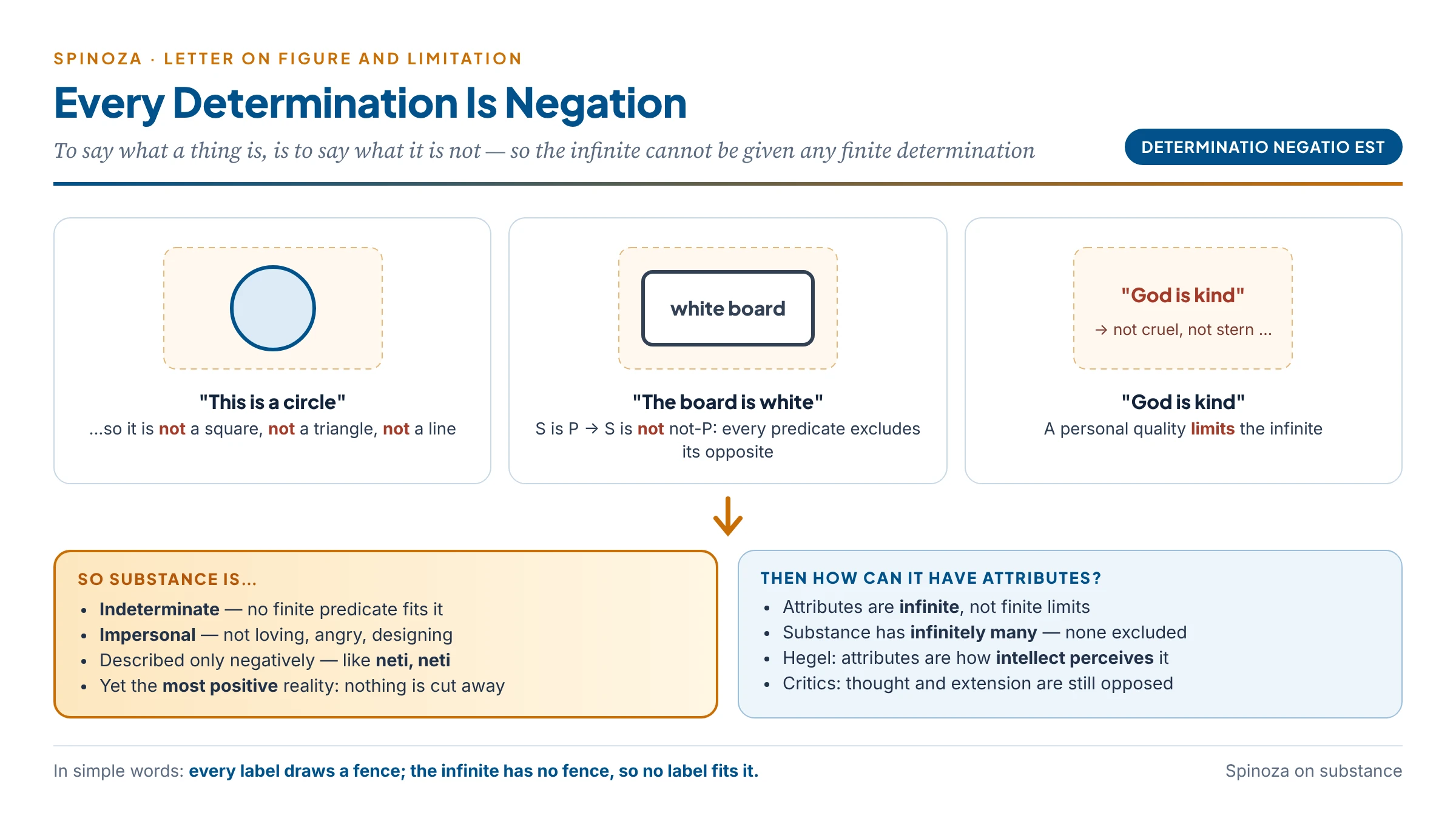
In a letter, Spinoza remarks that figure (shape) is nothing but limitation, and “determination is negation” (determinatio negatio est). Hegel later made the phrase famous in the form omnis determinatio est negatio.
What it means:
- To determine is to limit. To say what a thing is — to define it — is to mark its boundary, to say what it is not. “This is a circle” denies that it is a square, a triangle or a line.
- Subject–predicate form. Ordinarily we know a thing by comparing it with others: “the board is white” places it among white things and excludes the non-white. If we qualify substance as S is P, we make it devoid of not-P — a limitation.
- So the infinite cannot be determined. Substance is infinite; it lacks nothing. Any finite determination — “God is angry,” “God is a designer,” “God is merciful” — would negate some part of its fullness.
- No personal God. The God of religion has personal qualities — love, kindness, will. “If we say God is kind, then He cannot be cruel” — every such quality limits. So Spinoza’s God is impersonal, not an object of devotion — like Śaṅkara’s Parabrahman.
- Negative description. Substance can be described only negatively — “not this, not this” — as the Upaniṣads describe Brahman (neti, neti). Yet it is not empty: by removing every limitation, it becomes the most positive reality, without any limit.
In simple words
A sculptor makes a statue by removing stone. Every cut that gives the statue a definite shape also takes something away. To give something a definite shape is to cut away everything it is not. God, being infinite, has nothing cut away — so no definite shape can be given to Him.
Indian Connect — Neti, neti and Spinoza’s Substance
The Bṛhadāraṇyaka Upaniṣad says of the Self–Brahman: “neti, neti” — not this, not this. Every finite description is denied, not because Brahman is nothing but because it exceeds every limit. Śaṅkara distinguishes nirguṇa Brahman (beyond all qualities) from saguṇa Brahman (Brahman with qualities, Īśvara, as conceived for worship). Spinoza’s Substance is like nirguṇa Brahman; the personal God of popular religion corresponds to saguṇa Brahman — a limited, human picture of the infinite.
The problem it creates — how can Substance have attributes? If every determination is a negation, and substance is utterly indeterminate, how can Spinoza say that it has attributes such as thought and extension? Three answers are given:
- Attributes are not limitations. An attribute is not a finite quality but an infinite way of being. Each attribute is “infinite in its own kind”; thought does not limit extension, and neither limits substance. Determination applies to finite things (modes), not to infinite attributes.
- Infinite attributes. Substance has infinitely many attributes; so it is not confined to thought or extension. Ascribing all attributes is the opposite of limiting.
- The subjective reading (Hegel). Stress the words “what the intellect perceives“: attributes are the ways a finite intellect views the one substance, not divisions within it — rather as Śaṅkara treats māyā as not an essential attribute of Brahman. Against this, Spinoza’s own text suggests the realist reading: attributes really belong to substance and really constitute its essence.
5. Attributes
“By attribute I understand what the intellect perceives of a substance, as constituting its essence.” — Spinoza, Ethics
- No substance without attributes. An attribute is not just any property — it is the substance’s essence as grasped by intellect. So close is the relation that Spinoza denies any real distinction between substance and its attributes.
- Infinitely many attributes, each expressing the infinite essence of substance in its own way.
- We know only two — thought and extension — because we are embodied minds: a mind (mode of thought) that is the idea of a body (mode of extension).
- Independent and parallel. Attributes do not limit or act on one another; each is infinite in its own kind. God is infinitely extended and infinitely thinking.
- Languages of reality. The attributes are like two languages in which the same reality can be spoken about — the language of bodies and the language of ideas.
- What follows from each: from extension follow the truths of geometry and the laws of motion and rest (physics); from thought follow the laws of thinking (logic and psychology).
- Inseparable aspects of one reality, like the convex and concave sides of one curve, the two sides of a coin, the circumference and area of one circle.
Two readings of “attribute”:
| Point | Subjective reading | Realist (objective) reading |
|---|---|---|
| Key phrase stressed | “what the intellect perceives” | “as constituting its essence” |
| Attributes are | Our ways of viewing the one substance | Real essences of the one substance |
| Main defender | Hegel | Spinoza’s own text; most later readers |
| Advantage | Saves “every determination is negation” | Keeps the attributes real and makes parallelism meaningful |
| Indian parallel | Śaṅkara: māyā is not an essential attribute of Brahman | Rāmānuja: Brahman really has attributes (viśeṣaṇa) |
Criticisms of the doctrine of attributes:
- Why only two? If there are infinite attributes, why can we apprehend only two? The infinite attributes are inaccessible to human thought and add nothing.
- Why any at all? No reason is given why an indeterminate substance should have attributes; the doctrine looks highly a priori.
- Contradiction. Spinoza rejects a personal God because opposed qualities cannot coexist in substance — yet he lets opposed attributes, thought and extension, coexist in it.
- An aggregate, not an organic whole. Substance seems to be just a collection of attributes, not a living unity; parallelism merely names the attributes without linking them organically to substance.
- Extended and unextended at once? Substance cannot be both.
- Thought oversteps. The mind, a mode of thought, knows extension — so thought reaches beyond its boundary while extension never knows thought. This quietly gives primacy to thought (an idealist tendency), against the claimed equality of attributes. And if thought can know extension, why can it not know the other attributes?
6. Modes
“By mode I understand the affections of a substance, or that which is in another through which it is also conceived.” — Spinoza, Ethics
- Modes are the things of experience — particular minds, bodies, ideas, events: “shoes and ships and cabbages and kings” are all modes.
- Like waves to the sea. Modes can never exist without substance, though substance can exist without any particular mode.
- Vocabulary from Descartes. “Substance,” “attribute” and “mode” are Descartes’ categories; Spinoza keeps the terms but changes the map: particular things become properties (modes) of the one substance.
- Modes of thought — ideas, intellect, imagination, memory; every finite mind is a complex mode of thought.
- Modes of extension — bodies, their motion and rest; every finite body is a modification of extension.
Infinite and finite modes:
| Kind | Follows from | Under extension | Under thought |
|---|---|---|---|
| Immediate infinite modes | Directly from an attribute | Motion and rest | Infinite intellect (God’s idea of everything) |
| Mediate infinite modes | From an immediate infinite mode | The “face of the whole universe” — the total pattern of nature that stays the same while its parts change | The total system of ideas |
| Finite modes | From God as modified by other finite modes | Particular bodies — this tree, my body | Particular ideas and minds — my mind, this thought |
- The bridge. If only finite modes existed, the world would look fragmented; if only substance existed, it would explain no finite things. Infinite modes — the eternal laws and structures of nature — mediate between the eternal substance and the temporary things.
- Laws of nature are divine. Since infinite modes follow from God’s essence, the laws of nature are not contingent but eternal modes of God.
- Double determination of finite things. A finite mode is determined (a) by the general laws that follow from God’s nature and (b) by other finite things acting on it — a moving ball obeys the laws of motion and is pushed by the bodies around it.
- Real or illusory? Spinoza sometimes treats modes as real affections in God and sometimes almost as illusions. A mode is real insofar as it participates in God’s nature, and unreal though actual insofar as it seems determined only by the endless multitude of other finite things. The tension recalls the Advaitic difficulty of explaining the world’s status.
In simple words
Think of the laws of chess (fixed, always the same — like infinite modes), the chessboard (the one space of the game — like substance) and the moves in a particular game (changing, each caused by previous moves within the rules — like finite modes).
7. Natura Naturans and Natura Naturata
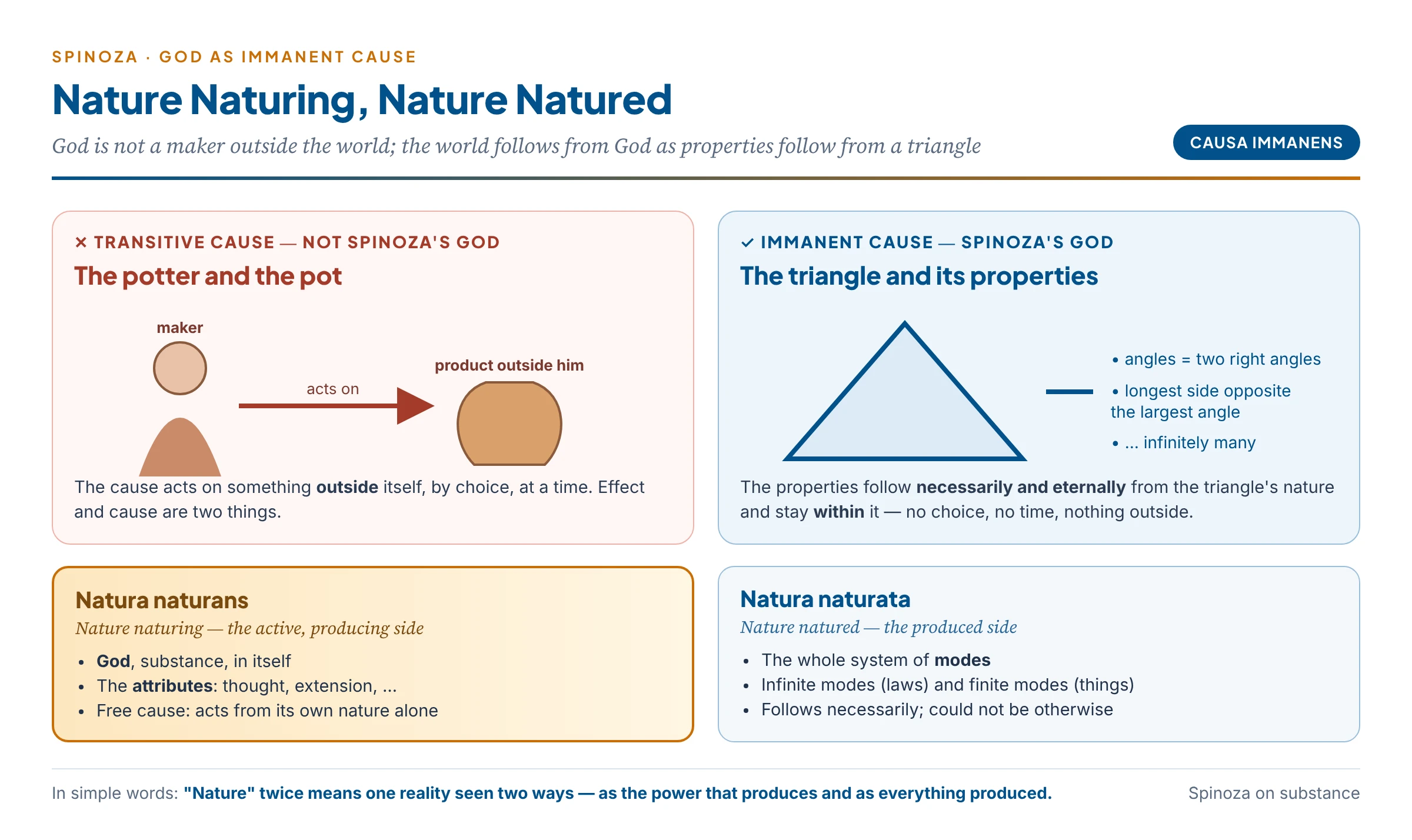
Spinoza distinguishes two aspects of the one Nature:
- Natura naturans (“Nature naturing“) — Nature in its active, productive aspect: God, substance and its attributes.
- Natura naturata (“Nature natured“) — Nature in its produced aspect: the whole system of modes, infinite and finite.
Why the double formula matters:
- Unity — using the word “Nature” twice shows that God and the system of modes are one reality; every mode is a modification of nothing other than God.
- Causation — the active naturans and passive naturata show that God is not merely the subject of modes but an active power producing and sustaining them.
Immanent, not transitive, causation. God is “the immanent, not the transitive, cause of all things.” A transitive cause acts on something outside itself (a potter shaping clay). An immanent cause produces effects that remain within it. God’s causality never passes outside the divine substance; the world is not a product “out there” but God’s own self-expression.
8. “From the Necessity of the Divine Nature …”
“From the necessity of the divine nature there must follow infinitely many things in infinitely many modes, that is, everything that can fall under an infinite intellect.” — Spinoza, Ethics
- Everything that can exist, does. God’s power is infinite, so all that is possible follows — infinitely many things in infinitely many ways.
- As a triangle’s properties. From God’s supreme power “all things have necessarily flowed … by the same necessity and in the same way as from the nature of a triangle it follows, from eternity and to eternity, that its three angles are equal to two right angles.”
- The world is necessary. It is impossible that God should exist and the world not.
- No arbitrary creation. God does not create by a free choice that could have gone otherwise. “Things could have been produced by God in no other way, and in no other order, than they have been produced.” In nature “there is nothing contingent.”
- Yet God is free. God is the only free cause, because He acts from the laws of His own nature alone, compelled by no one outside Him. Freedom means self-determination, not choice between alternatives.
- No purposes in God. Since everything follows by necessity, final causes (purposes) are human fictions; to explain events by God’s purposes is to take refuge in “the asylum of ignorance.” There is no purpose in mathematics, and none in God.
Criticisms of this statement:
- Fatalism — if nothing could have been otherwise, human effort, choice and responsibility seem pointless.
- Evil — if everything follows necessarily from God, cruelty and suffering follow from God too.
- Too much follows — if everything possible exists, the world should contain every possible thing; why this world and no other?
- How does the finite follow from the infinite? Spinoza never explains how finite, changing things “follow” from an eternal, infinite, unchanging nature — the infinite modes only push the question one step back.
- No novelty — like geometry, the system leaves no room for real becoming, creativity or history.
9. God or Nature: Pantheism
The identification. Substance is one, infinite, self-caused, self-explanatory, eternal, and the source of everything. In theology, these are the marks of God. So Spinoza calls substance God — but not the God of Western theology.
What Spinoza’s God is not:
- Not a creator of the world out of nothing. Creation implies will, intellect and feeling — personal traits. If God made the world out of some material, that material would be co-eternal with God, breaking monism. And creation presupposes a time when there was no world, but substance is eternal and timeless.
- Not a person with will, purposes or emotions; He does not love or hate, reward or punish as humans do.
- Not transcendent — not outside the world ruling it by providence. God is Nature itself, an infinite, necessary, fully determined system of which humans are a part.
What He is: “God or Nature” — the one infinite reality, which appears under extension as the physical universe and under thought as the realm of ideas. He is “the indwelling, not the transient cause of all things.” Nature is fully intelligible by itself; there is no need to appeal to a transcendent God.
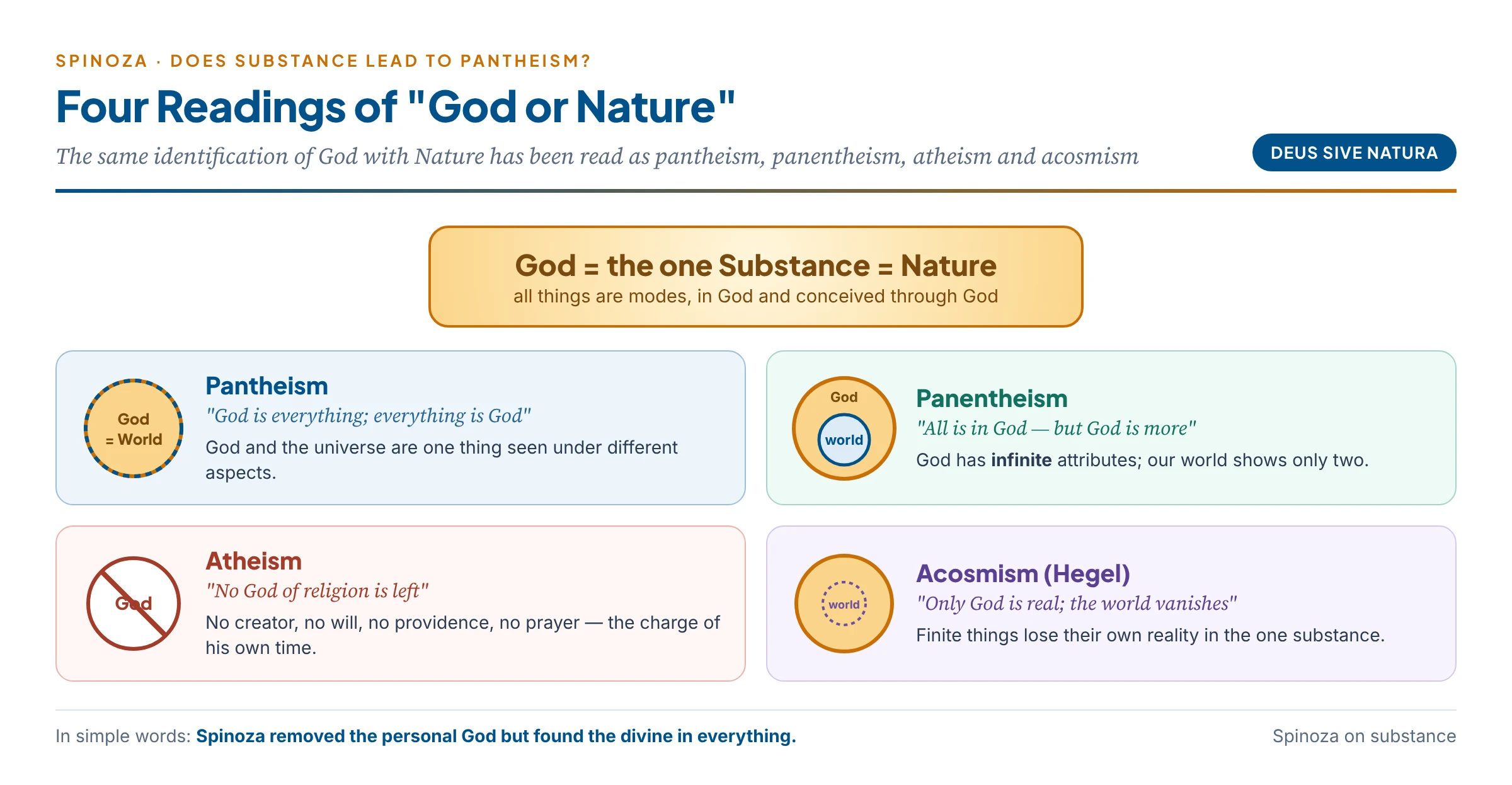
Does Spinoza’s view lead to pantheism? Four verdicts:
| Verdict | Claim | Reason |
|---|---|---|
| Pantheism | God is everything and everything is God | God = Nature; all things are modes of God |
| Panentheism | All things are in God, but God is more than the world | God has infinite attributes; the physical and mental world we know expresses only two |
| Atheism | There is no God in the religious sense | No personal, creating, providential God; theologians of his time branded Spinoza a hideous atheist |
| Acosmism (Hegel) | Only God is real; the world vanishes | Finite things are mere modes, swallowed up in substance — the world loses its own reality |
- Two sides of the dispute: to the orthodox he was an atheist; to the Romantic poet Novalis he was “a God-intoxicated man.” Both see something true: Spinoza abolishes the personal God but finds the divine in everything.
- A spiritual pantheism. It is not a “worship of nature” but an intellectual and ethical vision: understanding the necessity of Nature becomes the intellectual love of God (amor Dei intellectualis) — the topic of the next article.
10. “Whatever Is, Is in God”: Why God Alone Is Absolutely Real
Spinoza establishes that God alone is absolutely real through a chain:
- Absolute reality = independence. What is absolutely real must exist in itself and be conceived through itself — that is, be substance.
- Only one substance exists, and it is God (the proofs above).
- Everything else is in God. Minds, bodies, events, laws are modes — they exist in God and are conceived through God. “Whatever is, is in God, and nothing can be or be conceived without God.”
- Modes have only dependent reality. A wave has reality only as the ocean’s waving. Finite things are real insofar as they express God, not in their own right.
- So God alone is absolutely real; everything else is real relatively, as God’s modification.
Critical points:
- Hegel’s acosmism — this view absorbs the world and human individuality into a static divine abyss; it is the world, not God, that disappears.
- Individuality lost — Leibniz objected that if individuals are mere modes, there are no genuine individual substances, no real persons who act and are responsible.
- Moral responsibility — if all actions flow necessarily from God, sin and virtue seem to lose meaning. (Spinoza’s answer: freedom is understanding necessity — see the next article.)
- The finite is not explained — calling things “modes” names their dependence but does not show why and how the infinite substance should appear as many finite, changing things.
- Substance cannot stand alone — Hegel’s deeper objection: reality must be grasped not only as substance but also as subject — as living, self-developing spirit, not a fixed geometrical system.
Common confusion
Did Spinoza deny that the world is real? Not exactly. Spinoza does not say the world is an illusion; he says it is not a separate substance. Tables, bodies and minds are real modes of God. Hegel’s charge of “acosmism” is a criticism — that the logic of Spinoza’s system leaves no independent reality to finite things — not Spinoza’s own claim.
11. Descartes and Spinoza on Substance
| Point | Descartes | Spinoza |
|---|---|---|
| Definition | That which needs no other thing to exist — but created substances need God’s concurrence | That which is in itself and conceived through itself; causa sui |
| Number | Three — God, mind, body (pluralist) | One — God or Nature (monist) |
| Attributes | Thought and extension belong to different substances | Thought and extension are two attributes of one substance |
| Mind and body | Two substances that interact | Two expressions of one reality — parallelism |
| God and world | Transcendent Creator; transitive causation | Immanent cause; the world is in God |
| Finite things | Finite substances (minds, bodies) | Mere modes of the one substance |
| Freedom | Free will; absence of compulsion | Understanding necessity; freedom through adequate ideas |
| Knowledge | Clear and distinct ideas reveal distinct substances | Adequate knowledge reveals the unity of substance |
The continuity: Spinoza’s monism is Descartes’ own definition of substance followed consistently. The Cartesian successful negation — doubting away all that is not clear — reaches its peak in Spinoza’s “every determination is negation.”
12. Mathematical Mysticism
Spinoza’s philosophy is often called mathematical mysticism: he used the mathematical method to reach a mystical vision.
- The secret of the universe is treated and solved like a geometrical problem; the nature of the universe is deduced from the nature of God.
- He makes no final distinction between the real and the intellectual — thought and being are identified.
- God is pictured almost as a mathematician who “writes” the universe as a treatise follows from its axioms.
- Yet the goal is union: the mind that understands Nature sees all things in God and loves God intellectually.
- Faith in reason — nothing in the universe is in principle beyond the grasp of the mind.
Critical Evaluation
Major Objections
- Ignores the concrete individual. Substance is the only true reality; persons become modes. Existentialists object that the concrete existing individual — choosing, suffering, hoping — is lost.
- Determinism and morality. A necessary world seems to leave no room for freedom, praise and blame.
- The problem of the many. A perfectly unified, infinite substance does not explain why there is a plurality of finite things at all.
- Attributes and determination. The doctrine of attributes sits uneasily with “every determination is negation.”
- Static universe. Geometry has no time; Spinoza’s world has no real history or development — Hegel’s dialectic was partly a reply to this.
- The religious objection. A God without will, love or purpose is not the God of religion; prayer, worship and providence lose their sense.
- The empiricist objection. The whole system is deduced from definitions; nothing in it is tested by experience.
Critics and Defenders
Criticism — Critics
- Leibniz: Spinoza denies individuality and contingency; real individual substances (monads) must exist.
- Kant: reason cannot know substance-in-itself; Spinoza’s dogmatic metaphysics goes beyond possible experience.
- Hegel: Spinozism is acosmism — substance swallows the world; reality must be grasped as subject, not only substance.
- Theologians of his time: atheism, denial of providence, miracles and personal immortality.
- Existentialists: the free, concrete individual disappears in a geometrical whole.
Defence — Defenders and lasting value
- Consistency: Spinoza is the rationalist who followed the definition of substance to its logical end; Hegel said that one must either be a Spinozist or not a philosopher at all.
- Naturalism: a law-governed, purpose-free Nature anticipates the scientific worldview; Einstein said he believed in “Spinoza’s God, who reveals himself in the lawful harmony of all that exists.”
- Ecology: the unity of humans and nature has inspired deep ecology (Arne Naess).
- Religious tolerance: his critique of revealed religion and defence of free thought shaped the Enlightenment and liberal secularism.
- Influence on Idealism: Goethe, Schelling and Hegel all built on Spinoza’s monism.
Cross-Tradition Comparison
Spinoza’s Substance and Brahman
| Point | Spinoza | Advaita (Śaṅkara) | Viśiṣṭādvaita (Rāmānuja) |
|---|---|---|---|
| Ultimate reality | One substance, God or Nature | One Brahman, without a second | One Brahman qualified by souls and matter |
| Description | “Every determination is negation” | Neti, neti; nirguṇa (without qualities) | Saguṇa — Brahman has real auspicious qualities |
| Attributes | Infinite; we know thought and extension | Sat–cit–ānanda — not qualities but Brahman’s very nature | Real attributes (viśeṣaṇa); souls and matter are Brahman’s “body” |
| The world | Modes of God — real but dependent | Appearance (vivarta) through māyā; empirically real only | Real modification (pariṇāma) of Brahman |
| Causation | Immanent cause; world follows necessarily | Brahman is the material cause by appearance | Brahman is both material and efficient cause |
| Personal God | Rejected | Īśvara is real only at the empirical level | Personal God (Viṣṇu–Nārāyaṇa) is ultimate |
| Path to the goal | Intellectual love of God (knowledge) | Jñāna — knowledge of identity | Bhakti — devotion |
Indian Connect — Key takeaways
- Closest to Advaita in spirit: one reality, described negatively, impersonal, known through knowledge rather than devotion. Spinoza’s “intellectual love of God” parallels jñāna-mārga — liberation through knowledge.
- But the world is treated differently. For Śaṅkara the world is appearance (vivarta), sublated by knowledge; for Spinoza it is the real (though dependent) expression of God. In this respect Spinoza is closer to Rāmānuja’s real modification, or to Sāṃkhya’s satkāryavāda (the effect pre-exists in the cause).
- The relation of substance and attributes troubles both Spinoza and Rāmānuja: how can one reality have real, distinct attributes without becoming many?
- Advaita’s tool, adhyāsa, offers an answer Spinoza lacked: the many are a superimposition on the one — which is close to Hegel’s subjective reading of the attributes.
Synthesis (Siddhānta)
Spinoza’s theory of substance is the logical climax of Cartesian rationalism. From one definition — substance is what is in itself and conceived through itself — follow monism, the identity of God and Nature, infinite attributes, a world of modes, immanent causation and strict necessity. “Every determination is negation” keeps the infinite free of finite limits, at the cost of making God impersonal. The system’s weaknesses are real: it struggles to explain the many, the attributes, and the individual, and Hegel could fairly accuse it of dissolving the world. Yet its grandeur is also real: a universe that is one, rational and lawful, in which human beings are not strangers to God or Nature but parts of it.
- Science and naturalism: Nature as a self-sufficient, law-governed whole is the presupposition of modern science.
- Religion beyond anthropomorphism: Spinoza’s God appeals to those who see the divine in the order of the cosmos rather than in a personal ruler — a bridge between science and spirituality.
- Environmental ethics: if humans are modes of one Nature, damage to nature is damage to the whole of which we are part.
For Spinoza, God is not the maker of the world but the world’s very being — and to understand Nature is already to know God.
Previous Year Questions
- 2025“All determination is negation.” Comment with reference to Spinoza.
- 2024How does Spinoza establish that God alone is absolutely real with his statement – “Whatever is, is in God”? Critically discuss.
- 2024How is the notion of God in Spinoza’s philosophy embedded in his metaphysics of substance and attributes? Critically discuss.
- 2022Discuss the concept of substance according to Spinoza. Does his discussion on substance lead to pantheism? Substantiate your view.
- 2022Write an essay on Spinoza’s notion of God and His attributes.
- 2020“From the necessity of the divine nature there must follow infinitely many things in infinitely many ways.” Explain this statement by Spinoza along with some possible criticisms.
- 2012If ‘every determination is negation’ then how can Substance have attributes? Explain.
- 2010Why does Spinoza think that God alone is absolutely real? Explain.
- 2006Explain Spinoza’s theory of Substance.
- 2005Spinoza’s conception of the Ultimate Substance. Short notes.
- 2002State and critically examine Spinoza’s doctrine of the identity of the Substance, God and nature.
- 1997Explain the nature of substance and its relation to attributes according to Spinoza.