

Rationalism (Descartes, Spinoza, Leibniz): Cartesian Method and Certain Knowledge; Substance; God; Mind-Body Dualism; Determinism and Freedom.
Official Syllabus: Paper I, Section A, Unit 2
Cartesian dualism is the theory that reality contains two utterly different kinds of created substance — mind (res cogitans), whose whole nature is thinking, and body (res extensa), whose whole nature is extension (taking up space) — both depending on God, the only substance in the strict sense. A human being is a union of the two, and they interact: the body causes sensations in the mind, and the mind’s will moves the body, through a meeting point Descartes placed in the brain, the pineal gland. This theory gave modern philosophy its most famous puzzle — the mind–body problem: how can two things with nothing in common act on each other?
In simple words
Think of a television. The screen and its circuits are physical — they have size, weight and wires. The story you watch has meaning, feelings and ideas, but no size or weight. Descartes says a person is like that: a physical body plus a mind that thinks. The puzzle is how the “story” can push the “circuits” — how a thought can move an arm.
Context & Problem
Where Dualism Comes From
- Everyday experience shows two kinds of things: material objects — stones, rivers, tables — which have size, shape and weight but no feelings; and conscious beings, who desire, will, know and feel. Physical objects do not have consciousness, desire, will, knowledge or motive; living, thinking beings do.
- The same split appears in ourselves. Mental activity is not limited by space in the way the body is; the mind is subtle, the body gross; the mind is not visible, the body is. Man appears to be a conglomerate of two diametrically opposed though complementary elements.
- Dualism is the theory built on this experience: it accepts as fundamental the distinction between mind and body, the conscious and the unconscious.
- Old and new. Dualism in one form or another goes back to Plato and Aristotle, but Descartes is the first dualist of the modern era — and the first to give it a sharp, scientific form.
Why Descartes Needs Two Substances
- The cogito showed a thinking self that can be known without knowing whether any body exists.
- The new physics needed a world of matter in motion, fully explained by geometry and mechanical laws — with no souls, purposes or hidden qualities inside it.
- Dualism serves both aims at once: it protects the soul (free, immortal, rational) from mechanism, and it frees science to explain all of nature mechanically. By marking the boundary between the material and the mental, Descartes freed science from religion and spiritualism.
Core Doctrine
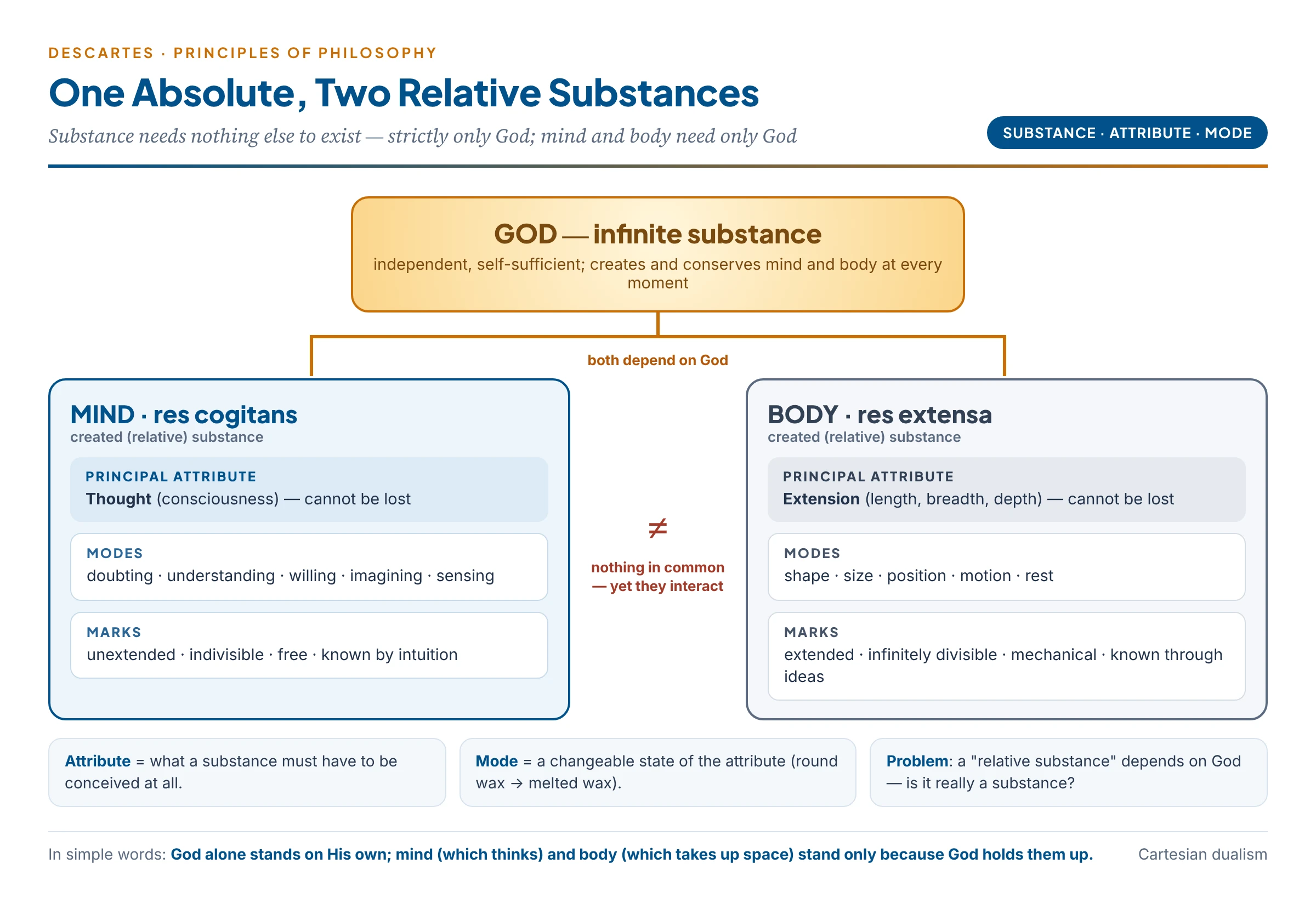
1. Substance, Attribute and Mode
Substance — “a thing which exists in such a way that it needs no other thing in order to exist.”
- Strictly, only God fits this definition — only God is completely self-sufficient. Everything else depends on God for its existence at every moment.
- Created substances — mind and body — are substances in a derived or relative sense: they need nothing except God to exist. Mind does not need body, and body does not need mind.
- So Descartes recognises one absolute substance (God) and two relative substances (mind and body). Mind and body are independent of each other but dependent on God.
Attribute — the essential property of a substance, without which it cannot be conceived to exist.
- Each substance has one principal attribute that makes it what it is: mind → thought (consciousness); body → extension (length, breadth and depth).
- A substance cannot change its principal attribute; a body cannot stop being extended, a mind cannot stop thinking. The attribute expresses what the substance essentially is.
Mode — a particular way in which the attribute shows itself; a modification or state of the substance.
- Modes of mind: particular thoughts — doubting, understanding, willing, imagining, sensing, desiring.
- Modes of body: particular shapes, sizes, positions and motions — “figure or motion is a mode of extension.”
- Modes depend on the substance and its attribute; a substance can change its modes while keeping its attribute (wax can change from cube to puddle but remains extended).
Common confusion
Can a substance exist without its attribute but not without its modes? Some notes state this backwards. The correct order: a substance cannot exist or be conceived without its principal attribute (body without extension is impossible), but it can exist without any particular mode (a body need not be round or square — it can change shape). Modes, on the other hand, cannot exist without the substance and its attribute.
2. Body as Extension: The Mechanical World
- Body is extension — nothing more. To find a substance’s attribute, look for the quality that is clear, obvious and unique to it. In bodies this is only extension; colour, sound, taste, smell, heat and cold are not clearly part of body. So body and extension are identical.
- No empty space. Wherever there is space there is extension, and wherever there is extension there is body — so there is no vacuum. The material world is an infinite, continuous extension.
- No atoms. Extension can always be divided further, so matter is infinitely divisible — there are no indivisible atoms.
- Change is motion. All variety in nature comes from division and combination of extended matter brought about by motion — the movement of bodies from one place to another. Bodies differ (gas, liquid, solid) only through the size, shape and motion of their parts.
- Motion comes from God. Matter is passive — it cannot move itself. At creation God gave the world a fixed quantity of motion, which He keeps constant. (This resembles Aristotle’s prime mover and anticipates the modern conservation principles.) Nature then runs by the laws of motion God laid down.
- A vast machine. The whole universe — including plants, animals and the human body — is explained mechanically. Here Descartes anticipates nineteenth-century materialism, and his account of the reflex anticipates behaviourism.
- Animals are automata. Animals have no soul; their behaviour is the working of a bodily machine. They lack genuine language and reason — a parrot can utter words but not reply meaningfully to what is said.
Primary and secondary qualities.
- Primary qualities — extension, figure, motion, rest, solidity, number — really exist in bodies and give clear ideas.
- Secondary qualities — colour, taste, smell, heat, cold — are confused ideas; they are subjective, depending on the mind, and represent nothing objective in the body.
In simple words
Descartes sees nature as a giant clockwork. Every gear (piece of matter) moves only because another gear pushes it; nothing inside the clock “wants” anything. Animals and even the human body are parts of the clock. Only the human mind stands outside the clockwork.
3. Mind as Thinking Substance
- Essence = thought. “I am a thing whose whole essence or nature is only to think.” Thought includes doubting, understanding, affirming, denying, willing, refusing, imagining and sensing — so far as these are conscious.
- Unextended and indivisible. The mind has no shape, size or location and cannot be split into parts.
- Always thinking. Since thought is its essence, the mind is never without some thought.
- Known by introspection — directly and with certainty, unlike bodies, which are known through ideas.
- Immortal (by implication). Since the mind is distinct from the body and indivisible, the death of the body does not entail the end of the mind.
Mind and body compared:
| Point | Mind (res cogitans) | Body (res extensa) |
|---|---|---|
| Principal attribute | Thought (consciousness) | Extension |
| Modes | Thinking, willing, imagining, sensing | Shape, size, position, motion |
| Space | Unextended — no location | Extended — occupies space |
| Divisibility | Indivisible | Divisible without limit |
| Perceptibility | Not visible; known by introspection | Visible, perceived in space and time |
| Character | Subtle, active | Gross, passive |
| Governed by | Reason and free will (purpose) | Mechanical laws |
| How known | Intuitively, with certainty | Through ideas, guaranteed by God |
4. The Six Senses of Cartesian Dualism
“Cartesian dualism” covers more than mind vs body. Descartes’ system is dualistic at several levels:
- Metaphysical dualism — absolute vs dependent substance: God (independent) vs mind and body (dependent).
- Qualitative dualism — of attributes: thought vs extension, independent and diametrically opposite.
- Epistemological dualism: the self is known intuitively (the cogito), the world only through ideas that represent it — a split between knower and known later criticised by Berkeley.
- Dualism of qualities: primary qualities (objective, in things) vs secondary qualities (subjective, in the mind).
- Dualism within the mind: intellect (finite) vs will (infinite) — the source of error.
- Mind–body dualism proper: the insentient body (a machine) vs the conscious soul — and their relation, interactionism.
On the cosmic scale this also becomes a dualism of living and non-living, man and nature, God and world.
5. Arguments for Mind–Body Dualism
Descartes’ own philosophical arguments:
- The doubt argument. I can doubt that my body exists, but I cannot doubt that I (my mind) exist. Things with different properties — one doubtable, one not — cannot be identical. So mind ≠ body.
- The clear-and-distinct (conceivability) argument. I have a clear and distinct idea of myself as a thinking, unextended thing, and of body as an extended, unthinking thing. Whatever I clearly and distinctly conceive as separate, God can make exist separately. So mind can exist without body — they are really distinct substances.
- The divisibility argument. Body is divisible — I can lose a foot or an arm without losing any part of my mind. The mind is indivisible — I cannot find half a will or a third of a thought. Different essential properties, different substances.
- The attribute argument. A substance is identified by its principal attribute; thought and extension are completely different attributes; so they belong to two substances.
- Mechanism vs reason. The body works like a machine under physical laws; the mind has reason, language and creativity that no machine can match. This functional difference suggests two kinds of being.
- Freedom of the will. The mind chooses freely; bodily motion follows deterministic laws. Free will points to a non-material principle.
Supporting arguments often added:
- Common language. We never describe mental states with words of extension: it is absurd to say “love is many square yards,” “hope weighs so much,” “thought is so many inches long,” or “mountains have hope.” We use such words for rivers, stones and atoms — unconscious things.
- Common experience. Mental activity bears no resemblance to physical activity. Things behave in imagination in ways impossible in the physical world (I can imagine a golden mountain flying); memory and thinking have no physical counterpart.
- Mind and matter do not change into each other. Thinkers have long tried to explain mind through matter or matter through mind, and failed.
- Common sense. We see daily that the world has two elements — extended, divisible, unconscious objects, and unextended, indivisible consciousness.
6. Interactionism: How Mind and Body Meet
Descartes insists that mind and body really interact — the union is not accidental but intimate, needed for sensation, emotion and voluntary action.
- Examples: when I desire something and reach for it, the mind moves the body; when I see a snake, a bodily process produces fear and shivering in me.
- “Not like a pilot in a ship.” Descartes says I am not merely lodged in my body as a pilot in a ship: a pilot sees damage to his ship; I feel pain when my body is hurt. Hunger, thirst and pain show that mind and body form a true union — a single human being.
The mechanism — pineal gland and animal spirits:
- An external stimulus acts on a sense organ.
- The motion travels through the nerves as a flow of “animal spirits” — very fine, fast-moving particles of blood.
- The spirits move the pineal gland (conarion), a small organ near the centre of the brain.
- This movement is the occasion for a sensation to arise in the mind.
- In voluntary action, the mind moves the pineal gland, which directs the animal spirits into the nerves and muscles, producing bodily movement.
- Why the pineal gland? Most brain organs come in pairs; the pineal gland is single and central, so it seemed a fitting place where the double images from two eyes and two ears could be unified for the one mind.
- Body acts on mind through sensation; mind acts on body through volition.
- God guarantees the union. Though we cannot fully understand how the interaction happens, experience shows that it does, and God, creator of both substances, ensures it works.
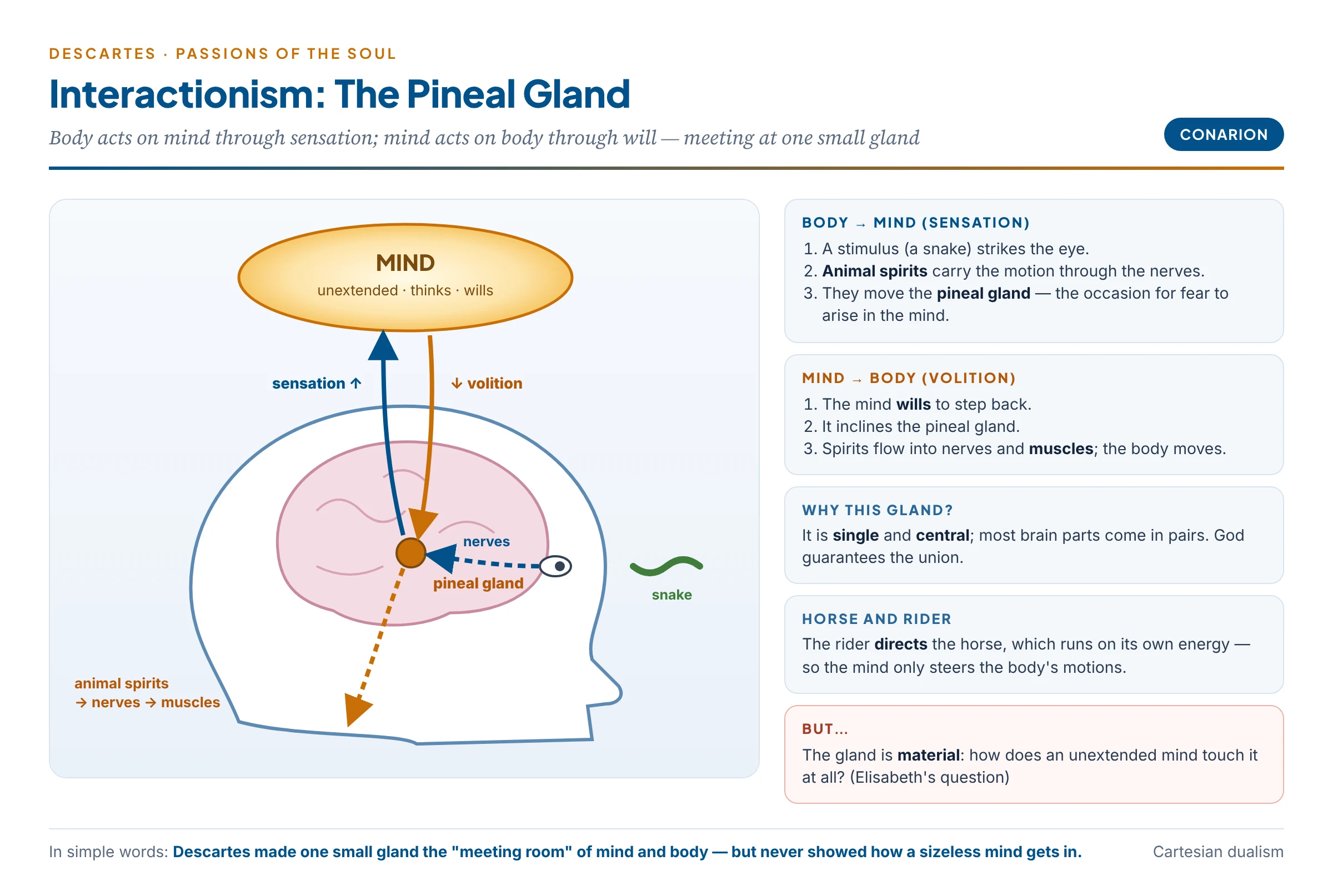
The horse and rider. Descartes tries to soften direct interaction with an analogy: as a rider spurs a horse to run faster without giving it his own energy — the horse runs with its own energy — so the mind only excites or directs bodily movement without putting its own energy into the material series. (The magnet that moves iron is used in a similar way.)
In simple words
A rider does not carry the horse; he only signals it, and the horse’s own muscles do the running. Descartes hoped the mind works like that — it does not push the body with force, it just “steers” the body’s own motions.
7. Princess Elisabeth’s Challenge
In 1643 Princess Elisabeth of Bohemia put the problem to Descartes in its sharpest form:
- Mind → body: bodies are moved only by contact — pushing, impact, shape and surface. The mind has no extension, no surface, no contact. How can an immaterial soul set the animal spirits in motion?
- Body → mind: how can physical particles (light striking the eye) produce a conscious experience in a non-spatial soul?
- Descartes’ reply: the union of mind and body is a “primitive notion” — known not by pure intellect (which grasps mind and body separately) but by ordinary life and the senses. We should not try to understand interaction on the model of one body pushing another.
- Elisabeth’s response: she found it easier to grant matter and extension to the soul than to grant that an immaterial thing could move a body — an early hint that dualism pushes towards materialism.
Indian Connect — Nyāya’s manas and Sāṃkhya’s lame and blind
- Nyāya-Vaiśeṣika faces a similar problem: the all-pervading self (ātman) knows objects only through the atomic internal organ (manas), which links it with the senses and allows only one cognition at a time. Manas plays a role strikingly like Descartes’ pineal gland — a small connecting organ between self and body.
- Sāṃkhya holds a strict dualism of puruṣa (pure consciousness, inactive) and prakṛti (matter, active but unconscious). It explains their cooperation by proximity (sannidhi) — like iron moving near a magnet — and by the image of the lame man (puruṣa) riding on the shoulders of the blind man (prakṛti): one sees, the other walks. Like Descartes’ horse and rider, the analogy describes the union without explaining how two opposite principles connect.
8. Freedom of the Mind, Determinism of the Body
- Body is fully determined by mechanical laws — no purposes, no choice.
- Mind is free. The will is infinite in scope; it can always affirm, deny or suspend judgment. Freedom of the will is “known without proof” — we experience it directly.
- Two grades of freedom:
- Indifference — being able to go either way when reasons are evenly balanced. This is the lowest grade of freedom, a sign of ignorance.
- Spontaneity — the will’s free assent to what the intellect sees clearly (a clear truth, a clearly good act). The more clearly I see, the more freely I choose — freedom and rational necessity coincide.
- Why infinite will? A limited will would have made man a machine rather than a free spirit; the gift of free will is needed for spiritual growth — and we, not God, are responsible for its misuse.
- The tension: if the body is a deterministic machine, how can a free mind change its motions without breaking the laws of physics? Descartes holds that both determinism (in matter) and free will (in mind) are true, but he never shows how they fit — part of his unsuccessful attempt to synthesise science and religion, determinism and free will.
Critical Evaluation
Objections to Dualism and Interactionism
The interaction problem:
- Two contradictory elements cannot be related. Dualism makes mind and matter mutually exclusive; no philosopher has explained how such opposites cooperate.
- The pineal gland does not help.
- If the mind is unextended, how can it be located in the pineal gland? Why is a gland needed at all?
- The gland and the animal spirits are material — the problem of how the immaterial touches the material simply reappears at the gland.
- The pineal gland’s role was a figment of Descartes’ imagination; modern biology gives it a quite different job.
- How does the mind “know” that a physiological change calls for a mental reaction?
- Many bodily processes produce no mental effect — the flow of blood, digestion — so interaction is not as thorough as the theory implies.
- Why not many minds in one body, or one mind in many bodies? If mind and body are independent, nothing in the theory ties this mind to this body.
- Animals have pineal glands too. If the gland is the seat of the soul, do animals have souls? If not, how do their bodies carry out all their complex functions — and what then makes human beings different?
- The analogies fail. In horse and rider, both are conscious and extended beings; in magnet and iron, both are unconscious bodies. Neither pictures a relation between a purely spiritual and a purely material substance.
Scientific objections:
- Conservation of energy. Sometimes the smallest bodily change produces great mental change, and the smallest mental change great bodily change — as if mental energy turned into physical energy and back. But the physical world conserves its energy; if the mind adds energy, the law is broken. (Leibniz made a related point: even if the mind only changed the direction of motion, it would violate the conservation of momentum.)
- Causal closure. Modern physics treats every physical event as having a sufficient physical cause; there is no gap for an immaterial mind to fill.
Epistemological and metaphysical objections:
- The copy theory collapses. Descartes holds that ideas represent objects, yet mind and matter are completely unlike. How can a mental idea copy or resemble an extended thing?
- A relation becomes a third thing. Any relation between mind and matter must be either mental or physical — and then it belongs to one side, and the two are not really independent; or it is a third reality, and the dualism breaks down. Unless one element is held to have two forms, no relation can be established.
- Which came first? Did mind or matter exist first? Were they self-caused or caused by something else? If by one cause, that cause is a deeper unity; if by two, the problem doubles.
- “Relative substance” is a contradiction. A substance by definition depends on nothing else; a substance that depends on God is not a substance at all.
- God as go-between. By making God the guarantor of the union, Descartes slides towards occasionalism — God doing the real work at every interaction — and if God created both elements, his dualism becomes farcical and turns into non-dualism: mind and matter are identified in God.
- Ethical and humane difficulties. The mechanical view of living things fed materialism and behaviourism, and the doctrine that animals are machines was used to excuse cruelty to animals (vivisection without concern for pain).
Later Philosophers on Cartesian Dualism
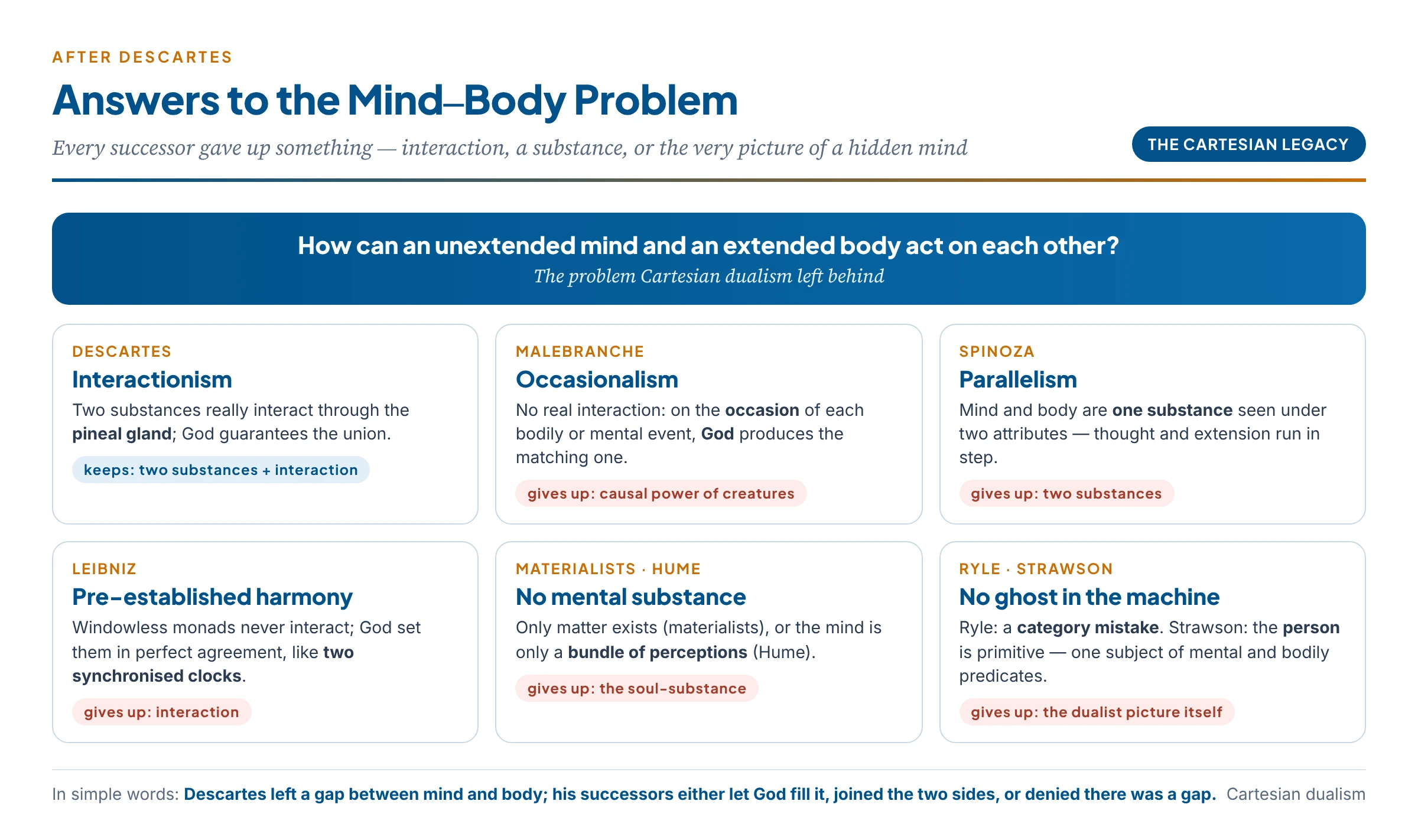
- Spinoza: only one substance — God or Nature — is possible. Thought and extension are two attributes of one substance; mind and body are one thing seen in two ways (parallelism). No interaction is needed because there is nothing to bridge.
- Malebranche (occasionalism): neither mind nor body acts on the other; on the occasion of a bodily event, God produces the sensation, and on the occasion of a volition, God moves the body.
- Leibniz (pre-established harmony): mind and body never interact; God set them going in perfect agreement from the start, like two perfectly synchronised clocks.
- French materialists: deny the soul altogether — only matter exists. Every successor has shed at least one of the three substances Descartes believed real — God, mind or body.
- Hume: there is no mental substance to be one side of the dualism — the mind is a bundle of perceptions.
- Kant: we cannot know the soul as a substance at all; the “I think” is a formal condition of experience, and the claims of rational psychology are paralogisms.
- Husserl: consciousness is always intentional — directed at the world. Mind is not a private container sealed off from body and world.
- Gilbert Ryle (The Concept of Mind): Cartesian dualism is “the dogma of the ghost in the machine.” It rests on a category mistake — treating the mind as a thing of the same logical type as the body, only invisible. A visitor shown Oxford’s colleges, libraries and laboratories who then asks “But where is the University?” makes the same mistake: the university is not one more building but the way the buildings and people are organised. Mental words describe dispositions and ways of behaving, not events in a hidden inner theatre.
- Wittgenstein and his followers: the private inner object Descartes assumed cannot give meaning to our mental words (the private language argument); interactionism is a “pseudo-solution to a pseudo-problem.”
- Pragmatists: the problems of solipsism and scepticism in both rationalism and empiricism grow from the Cartesian essentialist reduction of the self to a thinking substance.
- Modern identity theory and functionalism: mental states are brain states, or are defined by their functional roles — positions that try to keep the reality of mind without a second substance.
Strawson’s Response: The Primitive Concept of a Person
P. F. Strawson (Individuals) attacks dualism by asking two questions:
- Why are states of consciousness ascribed to anything at all?
- Why are they ascribed to the very same thing to which we also ascribe physical characteristics — height, weight, position?
Two answers he rejects:
- The Cartesian view: states of consciousness belong to one subject (a pure ego or mind) and physical properties to another (a body). But then we could never identify or count Cartesian egos — an ego with no body has no criteria by which I could pick out yours from mine; and dualism cannot explain why we ascribe both kinds of predicate to one thing.
- The “no-ownership” view: experiences are not really owned by any subject, only causally dependent on a particular body. But this view cannot even be stated without speaking of “my” experiences — it is incoherent.
Strawson’s answer:
- The concept of a person is primitive — “a type of entity such that both predicates ascribing states of consciousness and predicates ascribing corporeal characteristics are equally applicable to a single individual of that single type.”
- Two kinds of predicate: M-predicates apply also to material bodies (“weighs 60 kg,” “is in the drawing room”); P-predicates apply only to persons (“is smiling,” “is going for a walk,” “is in pain,” “believes in God”).
- Self-ascription needs other-ascription. “It is a necessary condition of one’s ascribing states of consciousness to oneself that one should also ascribe them, or be prepared to ascribe them, to others.” And to ascribe them to others, I must be able to identify others — which I can do only through their bodies. So states of consciousness belong to embodied persons.
- P-predicates have two uses with one meaning: I ascribe “is depressed” to myself without observing my behaviour, and to others on the basis of their behaviour — yet the word means the same in both cases.
- The pure ego is secondary. The idea of a mind or “pure consciousness” is derived from the concept of a person, not prior to it; a disembodied person is at best a logically secondary idea.
So, against Descartes, the basic unit is neither a mind nor a body but the person — one thing that both thinks and weighs.
In simple words
We say “Ravi is 1.7 metres tall” and “Ravi is worried” about the same Ravi. Descartes would split this into “Ravi’s body is tall” and “Ravi’s mind is worried.” Strawson says the split is backwards: we start with one person, Ravi, who can be both tall and worried; “mind” and “body” are abstractions from him.
Critics and Defenders
Criticism — Critics
- Elisabeth of Bohemia: an immaterial thing cannot move a body that is moved only by contact.
- Spinoza and Leibniz: two substances with nothing in common cannot interact; deny interaction.
- Physicalists: interaction violates the conservation of energy and the causal closure of physics.
- Ryle: dualism is a category mistake — “the ghost in the machine.”
- Strawson: the person, not the mind, is the primitive subject of both mental and physical predicates.
Defence — Defenders and lasting value
- Experience of union: Descartes himself treated the union as a primitive fact known through sensation — like gravity in later physics, a relation we observe without a mechanical picture.
- The hard problem: philosophers such as David Chalmers argue that conscious experience (what pain feels like) is not explained by any physical description — a modern case for at least property dualism.
- Conceivability arguments (zombies, inverted experience) revive Descartes’ reasoning that mind is not simply identical to body.
- Interactionist dualism was defended in the twentieth century by Karl Popper and John Eccles (The Self and Its Brain).
- Moral and legal personhood: the idea that a person is more than a mechanism underlies dignity, free will and responsibility.
Cross-Tradition Comparison
Cartesian Dualism and Indian Theories of Self and Matter
| Point | Descartes | Sāṃkhya | Nyāya-Vaiśeṣika | Advaita (Śaṅkara) |
|---|---|---|---|---|
| Basic realities | Mind and body (+ God) | Puruṣa and prakṛti | Self (ātman) and matter, among nine substances (dravya) | Brahman alone is real |
| Nature of self | Thinking substance; thought is its essence | Pure consciousness, inactive witness; thinking belongs to prakṛti (buddhi) | Substance in which consciousness arises as a quality | Witness-consciousness (sākṣī), identical with Brahman |
| Nature of matter | Extension, mechanical | Three guṇas, active, evolving | Atoms (paramāṇu) combining | Appearance (māyā) |
| How they connect | Pineal gland, animal spirits | Proximity (sannidhi); lame and blind | Manas (atomic inner organ) | Mutual superimposition (adhyāsa) — not a real link |
| Main weakness | Interaction unexplained | Relation of puruṣa and prakṛti unexplained | Self unconscious in liberation | Status of māyā |
Indian Connect — Key takeaways
- Descartes and Sāṃkhya are the closest parallel: two independent, opposite principles, and the same unsolved problem of how they cooperate. But for Sāṃkhya, thinking (buddhi, manas) belongs to matter, and the self is pure, inactive witness — while for Descartes thinking is the very essence of the self.
- Nyāya’s manas is an Indian counterpart of the pineal gland — a minute connecting organ between self and senses.
- Advaita’s solution is the one many critics of Descartes point to: Śaṅkara begins his commentary on the Brahma Sūtra by saying that the self and the not-self are as opposed as light and darkness — exactly Descartes’ starting point — but concludes that their apparent union is a superimposition (adhyāsa), not a real interaction. Dualism is resolved by non-dualism.
- Hence the common verdict: any dualism — Cartesian or Sāṃkhya — “cannot be resolved without establishing monism in duality,” or turning to non-dualism, as in Spinoza’s pantheism or Śaṅkara’s Advaita.
Synthesis (Siddhānta)
Descartes’ theory of substance gave a clean division of labour: matter for physics, mind for philosophy and theology. Its arguments — from doubt, clear and distinct ideas, divisibility, language and freedom — capture a real difference between what it is like to think and what it is to take up space. But it left an unbridgeable gap. Descartes wavers between interactionism, which he seems to suggest, and parallelism, which follows logically from his absolute dualism. As Berkeley said of such puzzles, “we have first raised a dust and then complain we cannot see”: the dualism itself creates the problem it cannot solve.
- A permanent agenda: every later philosopher — rationalist, empiricist, idealist, materialist — had to answer Descartes, usually by giving up one of his three substances.
- The modern mind–body debate — identity theory, functionalism, the hard problem of consciousness, the question whether artificial intelligence could have a mind — is still the Cartesian question in new language.
- Balance: philosophical satisfaction seems to need what neither pure monism nor pure dualism gives alone — unity that does not erase difference: a monism that explains duality, and a duality grounded in a deeper unity.
Descartes split the world into thinking and extension so cleanly that he could never put the human being back together.
Previous Year Questions
- 2026Why are states of consciousness ascribed to anything at all and why are they ascribed to the same things to which we also ascribe physical properties? How does Strawson answer these questions in his work Individuals?
- 2014Explain the doctrine of Cartesian Dualism and examine critically arguments in favour of it.
- 2009Descartes’ mind-body dualism and Strawson’s response to it.
- 2009Interactionism in the philosophical context. Short notes.
- 2006Discuss Descartes’ Dualism.
- 2005Mind and Body as two interacting substances.
- 1998Interactionism. Notes.