

Rationalism (Descartes, Spinoza, Leibniz): Cartesian Method and Certain Knowledge; Substance; God; Mind-Body Dualism; Determinism and Freedom.
Official Syllabus: Paper I, Section A, Unit 2
After the cogito, Descartes is certain of only one thing: he exists as a thinking being. Everything outside his own mind — mathematics, other people, his body, the world — is still in doubt, because a deceiving demon might be at work. To climb out of this solitary certainty he needs a bridge, and that bridge is God. If a perfect God exists, He cannot be a deceiver; then whatever we perceive clearly and distinctly must be true, the demon is defeated, and the material world can be won back. So God is not an afterthought in Descartes’ system — He is the guarantor of all knowledge beyond the cogito.
In simple words
Imagine you wake up in a strange room and cannot trust your eyes. You can be sure you exist, but not that the room is real. Then you find a reliable friend who built the room and never lies. Once you know the friend is honest, you can trust what you see clearly in the room. For Descartes, God is that honest builder.
Context & Problem
Why Descartes Needs God
- The cogito is certain but isolated. It shows “I exist” only while I think it. It says nothing about anything beyond my mind.
- Clear and distinct ideas are certain only in the moment. While I attend to “2 + 3 = 5” I cannot doubt it, but once I turn away, the demon hypothesis returns: perhaps my nature is made to go wrong even in what seems most evident.
- A finite mind cannot guarantee itself. Human knowledge is fallible; its reliability must be anchored in a perfect source outside it.
- So the proof of God is the crucial epistemic step: it removes the demon, secures clear and distinct ideas over time, restores mathematics and grounds the existence of bodies.
Ideas, Their Reality and Their Causes
To prove God from within his own mind, Descartes examines his ideas:
- Three kinds of ideas (by origin): adventitious (from outside, via the senses), factitious (made up by imagination) and innate (born with the mind). The idea of God — an infinite, eternal, all-knowing, all-powerful, perfect being — is innate.
- Two ways of looking at an idea:
- As a mental act — every idea is equally just a thought, a mode of my mind (its formal reality, the reality it has as a thing).
- As representing something — here ideas differ greatly. The idea of a substance represents more than the idea of a quality, and the idea of an infinite substance represents more than that of a finite one. This representational content is the idea’s objective reality.
- Degrees of reality: modes (qualities, states) < finite substances (minds, bodies) < infinite substance (God).
In simple words
A photograph of a palace and a photograph of a hut are both just paper and ink (equal “formal reality”). But what they show differs: one shows something far grander (more “objective reality”). Descartes asks: what could have produced a “photograph” in my mind that shows an infinite, perfect being?
Core Doctrine
1. The Causal (Trademark) Argument
This is Descartes’ first and main proof, in the third Meditation.
- I have an idea of God — an infinite and perfect being.
- Every idea has a cause.
- Causal adequacy principle: “There must be at least as much reality in the efficient and total cause as in the effect.” Something cannot come from nothing, and nothing gives what it does not have (nemo dat quod non habet).
- This applies to the objective reality of ideas: the idea of the sun must come from something containing at least the reality of the sun.
- I am finite and imperfect — I doubt, I desire, I lack knowledge. Such a being cannot produce an idea containing infinite perfection.
- Therefore the cause of my idea of God must be a being that actually has all the perfections the idea represents — God. God exists.
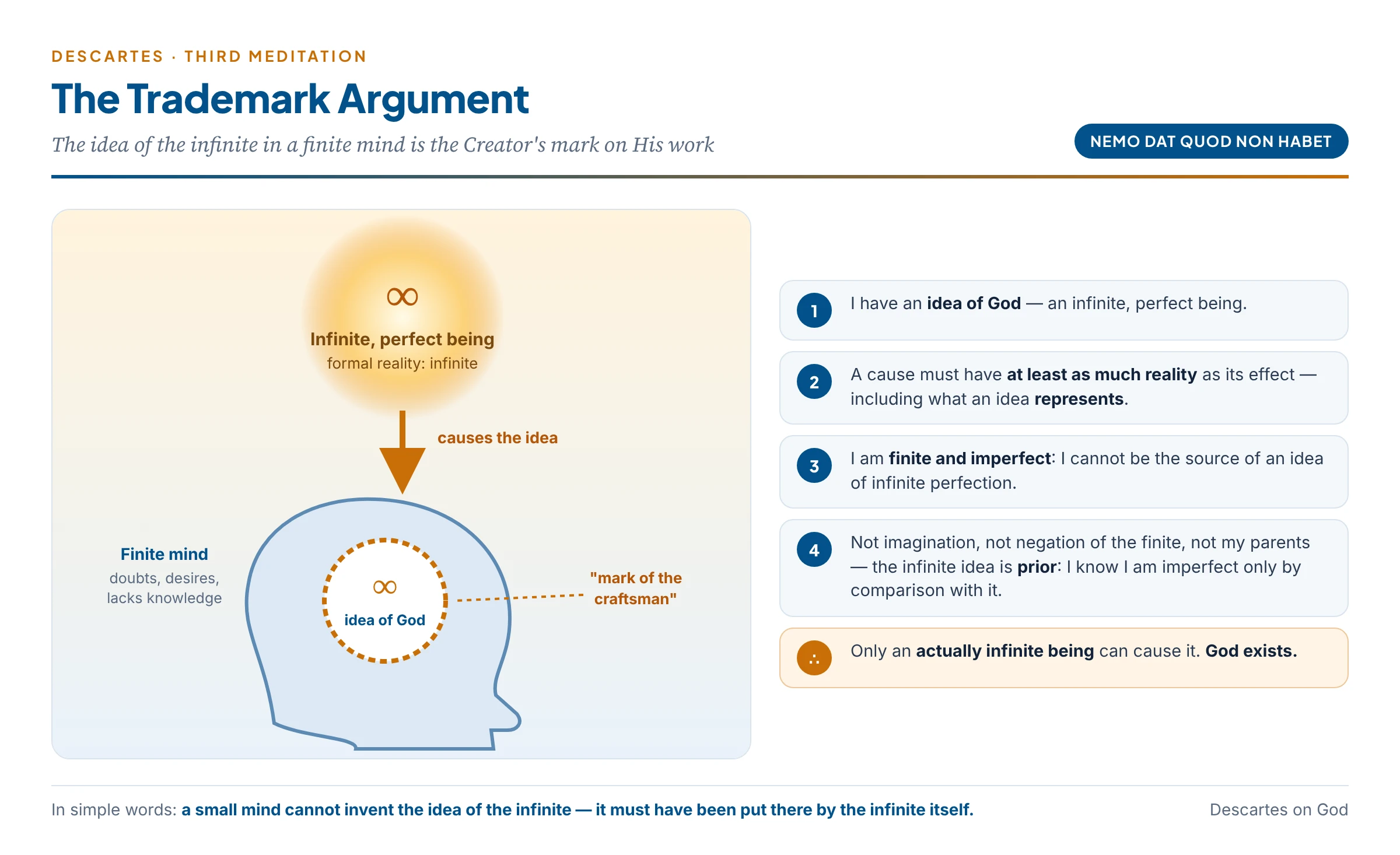
- The trademark image. God placed the idea of Himself in me “like the mark of the craftsman stamped on his work.” The idea is God’s signature in the human mind.
- Why “my parents” or “my imagination” won’t do:
- Not factitious — I cannot add to or subtract from it; it is not a combination of finite ideas.
- Not by negation — the infinite is not just “the finite with limits removed.” Descartes argues the reverse: the idea of the infinite is prior. I know I am imperfect only by comparing myself with an idea of perfection.
- Not from potential perfections in me — even if my knowledge grows forever, it will always be only potentially infinite; the idea is of an actually infinite being.
- How it differs from Anselm. The causal argument does not start from the essence or definition of God; it starts from the actual idea of God existing in my mind as a fact, and asks for its cause. God’s existence follows from the existence of the idea, not from the content of a definition. So it is called causal, not ontological.
Common confusion
Isn’t Descartes’ “trademark argument” just Anselm’s ontological argument? No. The ontological argument reasons from the concept of God (what “God” means) to His existence. The trademark argument reasons from the fact that I have this idea to its cause. It is a causal, a posteriori-style argument whose “effect” happens to be an idea inside the mind. Descartes gives the ontological argument separately, in the fifth Meditation.
2. The Argument from My Own Existence (Cosmological Form)
Descartes strengthens the causal proof by asking: what causes me — a being who has this idea?
- Not myself. If I had made myself, I would have given myself every perfection I can conceive — I would be God. Besides, to create myself I would have to exist before my own existence, a contradiction.
- Not my parents. At most they produced my body; they do not sustain my thinking self. And if they were the cause, we would ask what caused them — an endless regress of finite causes that never explains the idea of the infinite.
- Not some lesser being or several causes together. The unity and simplicity of God’s perfections in my idea could not come from many partial causes.
- Conservation needs a cause at every moment. Time is made of independent moments: from the fact that I existed a moment ago it does not follow that I exist now. To preserve a thing needs the same power as to create it. I find no such power in myself.
- Therefore I depend on a being that exists by itself, contains all perfections, and creates and conserves me at every moment — God.
- Not Aquinas’s cosmological argument. Aquinas reasons from motion and causes in the world. Descartes cannot — at this stage he still doubts the world exists. His starting point is the thinking self and its idea of God.
3. The Argument from the Clarity of the Idea of God
- By the criterion of truth, whatever is clear and distinct is true. The idea of God passes this test better than any other idea — it is the clearest and most distinct of all, since it contains more reality than any other.
- God creates this idea in us, and we cannot change it at will. Since God is perfect, He would not plant a defective or illusory idea of a permanent, unchanging, all-knowing, infinite being. So such a being exists.
4. The Ontological Argument
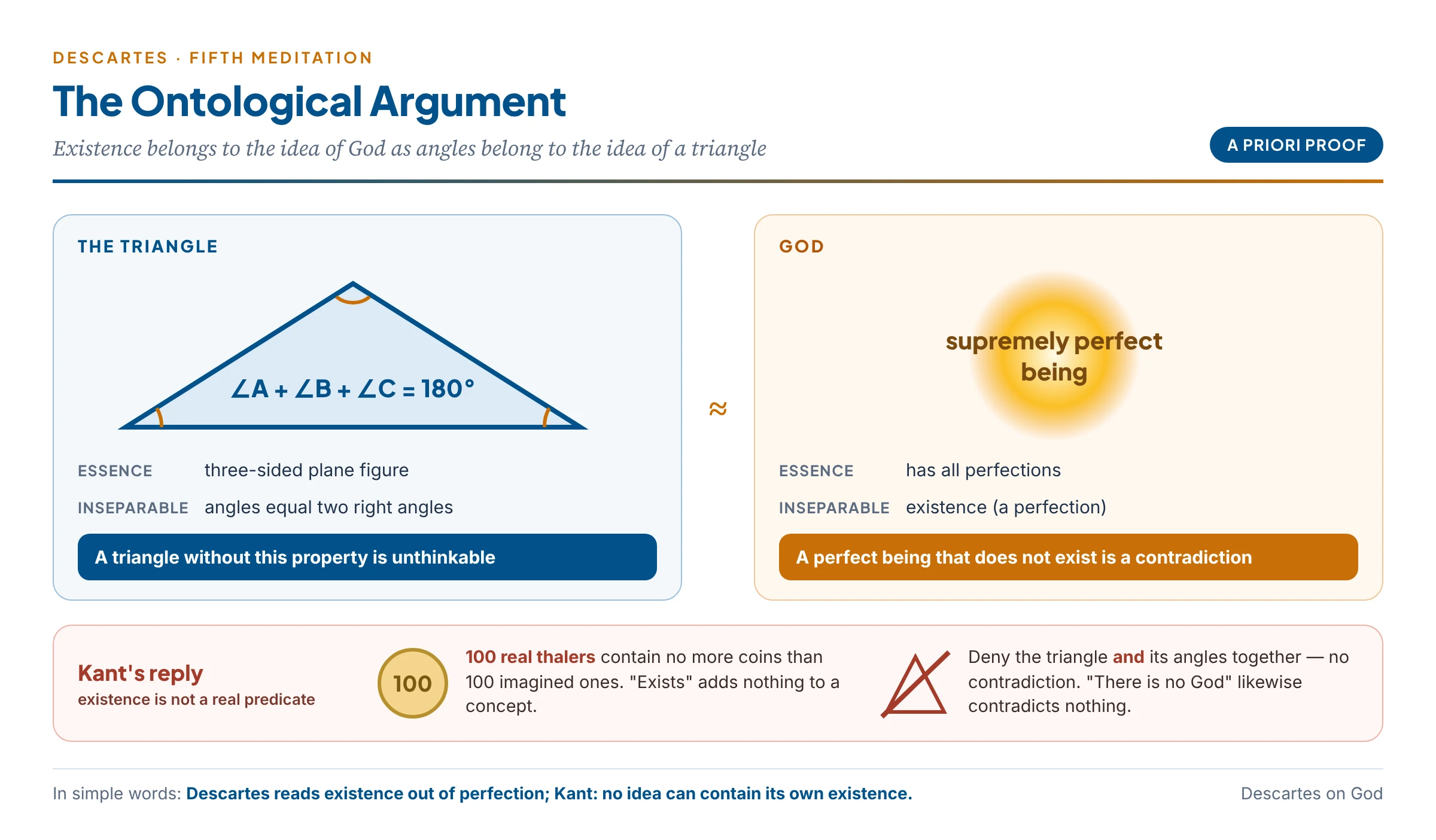
In the fifth Meditation, Descartes gives a “geometrical” proof directly from the essence of God.
- I find in myself the idea of God as a supremely perfect being — having all perfections in the highest degree.
- Existence is a perfection — it is better to exist than not to exist.
- A supremely perfect being that lacked existence would lack a perfection — it would not be supremely perfect. That is a contradiction.
- So existence belongs to God’s essence as inseparably as “angles equal to two right angles” belongs to the essence of a triangle, or as a valley belongs to a mountain.
- Therefore God necessarily exists.
- “Mountain without a valley.” We can no more think of God without existence than think of an uphill slope without a downhill. (Descartes adds: this does not mean a mountain exists, only that mountain and valley go together; but in God’s case, what is inseparable from the essence is existence itself.)
- Only God has this feature. In every other thing, essence and existence are separable — I can think of a winged horse that does not exist. God alone is the being whose essence includes existence.
- True and immutable natures. Descartes insists the idea of God is not an invention he can alter at will; like the idea of a triangle, it has a fixed nature he discovers, not makes.
- Roots. The argument was first given by St Anselm; Descartes is the first to bring it into modern philosophy. It also echoes St Augustine: in God, idea and fact are not separate.
In simple words
“A bachelor is unmarried” is true just from the meaning of “bachelor.” Descartes thinks “a supremely perfect being exists” is true just from the meaning of “supremely perfect being” — because a being missing existence would be missing something, and so would not be supremely perfect.
5. God Is No Deceiver
- Deception is an imperfection. The will to deceive is “undoubtedly evidence of malice or weakness.” A being with all perfections and no imperfection cannot have it — to conceive of a deceiving God would be like conceiving a mountain without a valley.
- So clear and distinct ideas are true. God made my mind; I cannot help assenting to what I perceive clearly and distinctly. If such an idea were false, God would be the deceiver. Therefore all clear and distinct ideas are true — “on pain of contradiction.”
- The demon is dismissed. An omnipotent and benevolent God would not let me be systematically deceived; the evil-demon hypothesis loses its force.
- Mathematics restored. The truths of arithmetic and geometry, doubted under the demon hypothesis, are now certain — even when I am not attending to their proofs.
- A rational universe. God’s veracity means that the world is intelligible through and through: the mathematical laws we discover reflect the rationality of the Creator who made both our minds and nature. Science can search “without fear of being baffled or deceived.”
- Consequences. Knowledge of God is required for any perfectly certain knowledge; an atheist geometer can be convinced of a proof while attending to it, but cannot be certain it is true once he looks away.
- Error is still possible — not from God but from misuse of the will (judging beyond what is clearly perceived), as explained in the article on the Cartesian method.
The veracity of God is the ontological assumption of the methodological criterion — the rule of clear and distinct ideas stands on a truthful God.
6. Why Descartes Does Not (Finally) Doubt God
Descartes does doubt God at the start — the demon hypothesis even raises the possibility of a deceiving God. But once the cogito is secured, God becomes beyond doubt, for five reasons:
- The idea of God is innate and clear and distinct — the clearest of all ideas, carrying the highest objective reality.
- Doubt itself presupposes God. To know that I doubt is to know that I am imperfect; and I can know my imperfection only by comparison with the idea of a perfect being. The doubter carries the idea of God within him.
- The causal principle shows that only an actually infinite being can be the cause of that idea.
- Necessary existence belongs to the essence of a perfect being (ontological argument) — to doubt that God exists would be to think a contradiction.
- The system needs it: without a truthful God, no knowledge beyond the present moment of the cogito would be secure. Doubting God would undo the whole rebuilding of knowledge.
So the method of doubt, by uncovering the finite, doubting self, leads to God rather than away from Him — Descartes’ answer to whether doubt can justify belief in God.
7. The Cartesian Circle
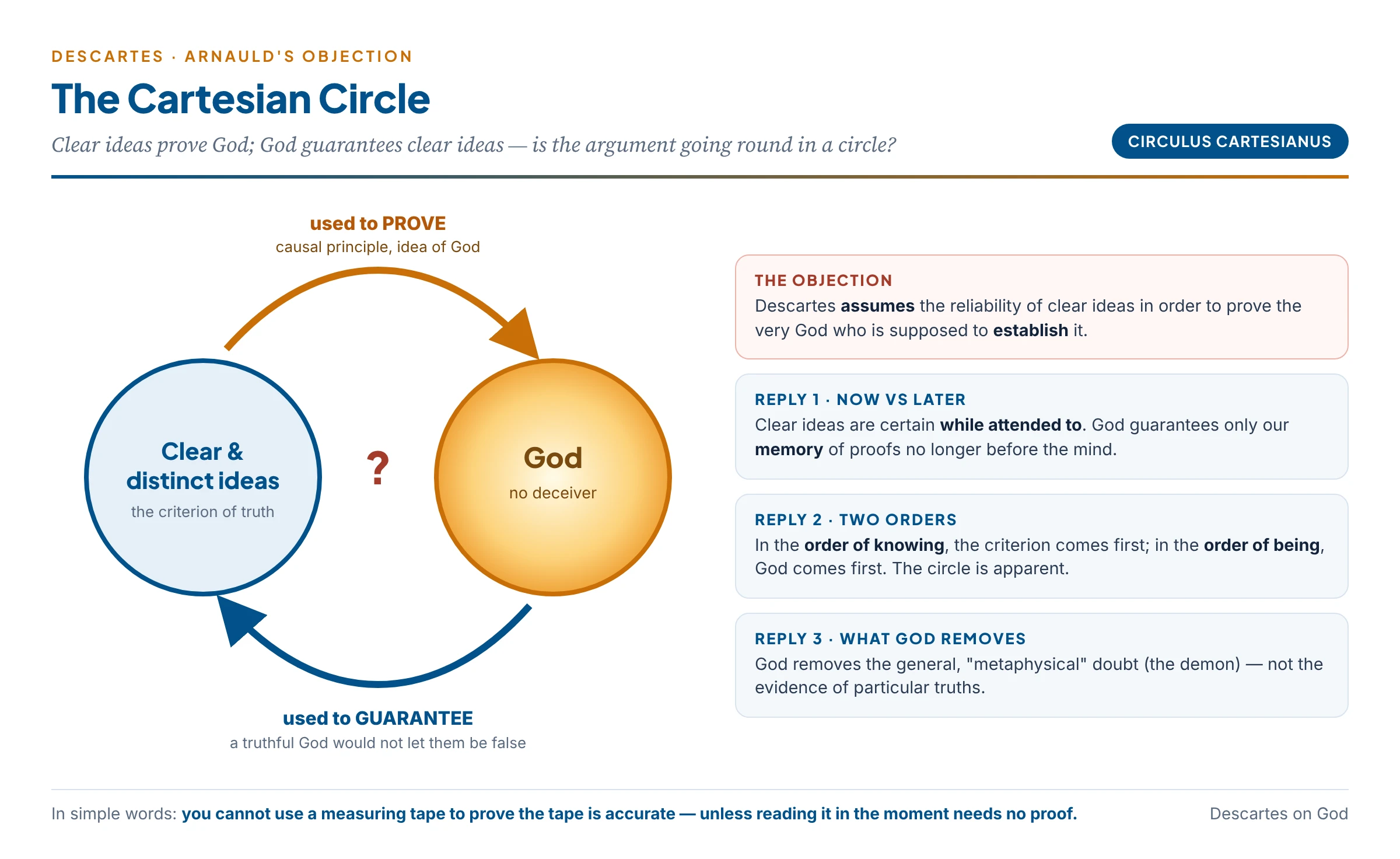
The objection (first raised by the theologian Antoine Arnauld):
- To prove God exists, Descartes relies on clear and distinct perceptions (the causal principle, the idea of God).
- To trust clear and distinct perceptions, he must already know that a non-deceiving God exists.
- So he assumes what he wants to prove — he argues in a circle.
Replies:
- Present intuition vs memory. Clear and distinct perceptions have intrinsic, self-evident certainty while they are being grasped — they need no divine guarantee at that moment. God is needed only to guarantee our memory of past demonstrations, when the proof is no longer before the mind. The proofs of God can be held in one present intuition, so there is no circle.
- Order of knowing vs order of being. In the order of knowledge, the criterion of clear and distinct ideas comes first; in the order of existence, God comes first. The two orders run in opposite directions — so the circle is apparent, not real.
- What God removes is doubt, not evidence. God’s existence removes the general, “metaphysical” doubt (the demon hypothesis) that might hang over our faculties; it does not supply the evidence of particular truths, which is intrinsic to them.
Assessment. Many critics, including Hume and later Kant, found these replies insufficient: if the demon can corrupt even what seems most evident, he can corrupt the proofs of God too. If he cannot, God is not needed. Either way the circle shows the limits of a system that rests all certainty on the inner clarity of ideas.
In simple words
It is like a witness who says, “You can trust me because my friend vouches for me,” while his friend says, “You can trust me because he vouches for me.” Descartes replies that he does not need the friend while he is actually looking at the evidence — only to trust his memory of it later.
8. Criticisms of Descartes’ Proofs of God
Against the causal (trademark) argument:
- Empiricists (Locke, Hume): there is no innate idea of God. All ideas come from experience; the idea of infinity is formed by extending and negating the limits we meet in finite things — not by a divine imprint.
- Hume: the causal principle — that a cause must contain at least as much “reality” as its effect — cannot be proved by reason. Causes need not resemble their effects; we learn about causes only from experience of constant conjunction.
- Kant: the category of causality applies only within the world of phenomena (possible experience); it cannot be used to reach God, who lies beyond experience (the noumenal).
- Russell: one cannot arbitrarily stop a regress of causes by bringing in God; and the scholastic maxim that an effect cannot have more perfection than its cause escapes critical scrutiny.
- Bad metaphysics: an a priori line of reasoning can at best show that a concept of God exists in the mind; it cannot reach an actual state of affairs outside it.
Against the ontological argument:
- Gaunilo (against Anselm): by the same reasoning we could prove a perfect island exists.
- Caterus (in Descartes’ own day): even if “existence” is part of the concept of a supreme being, it follows only that the concept includes existence — not that anything exists in reality.
- Kant’s critique:
- Existence is not a real predicate. “Being” adds nothing to the concept of a thing; it only posits the thing with all its predicates. A hundred real thalers contain no more coins than a hundred possible thalers — though they make a difference to my finances.
- No contradiction in rejecting both. If you keep the subject (a triangle) and deny the predicate (three angles), you contradict yourself. But if you reject the subject together with all its predicates — “there is no God” — no contradiction remains. “God does not exist” denies nothing within the concept.
- The dilemma: “God exists” is either analytic (then it says nothing about reality — it only repeats the concept) or synthetic (then it can be denied without contradiction and needs experience to confirm it).
- “Necessary being” is empty. Necessity belongs to judgments, not to things; the idea of a being whose non-existence is self-contradictory is a fiction of reason.
- In popular words: “If wishes were horses, beggars would ride” — no amount of thinking can produce an actual thing.
- Hume: “Whatever we conceive as existent, we can also conceive as non-existent.” No being’s non-existence implies a contradiction.
- Leibniz (a partial supporter): the argument is valid only if we first prove that the concept of a supremely perfect being is possible — free of contradiction. Descartes skipped this step. Leibniz tried to supply it: perfections are simple positive qualities and so cannot conflict.
- Russell and modern logic: “exists” is not a property of individuals but of concepts (it says a concept has instances). So existence cannot be one perfection among others.
Against Descartes’ God as a whole:
- Spinoza rejects a personal, willing God separate from the world: God is identical with Nature, not a separate substance who guarantees truth from outside.
- Two Gods in one. Descartes’ God is partly the Absolute of metaphysics on which everything depends, and partly the personal Creator of Christian theology — and the two do not sit easily together. “Modern rationalism is introduced by Descartes by the circuitous route of scholasticism.”
Indian Connect — Nyāya’s God and Descartes’ God
Udayana (Nyāyakusumāñjali) gives a series of proofs for Īśvara. Several have Cartesian echoes:
- Kāryāt — the world is an effect and needs an intelligent cause (compare Descartes’ “what caused me?”).
- Dhṛtyādeḥ — the world is supported and finally dissolved by God’s will (compare Descartes’ God who conserves the world at every moment).
- Pratyayataḥ — the validity of the Vedas requires a trustworthy, omniscient author (compare Descartes’ God who guarantees the truth of clear and distinct ideas).
But Nyāya never uses an ontological argument from the concept of God; its proofs are inferential (anumāna) from the world. And Mīmāṃsā, Buddhists and Jains reject a creator-God, much as Hume and Kant reject Descartes’ proofs.
9. The Existence of the External World
With God proved, Descartes can at last ask: do bodies exist? (sixth Meditation).
A first hint — imagination. When I imagine a triangle, I seem to “look at” a shape — an effort not needed when I simply understand it (I can understand a thousand-sided figure clearly but cannot imagine it distinctly). This suggests that imagination works by turning towards a body joined to the mind. But this makes bodies only probable.
The proof:
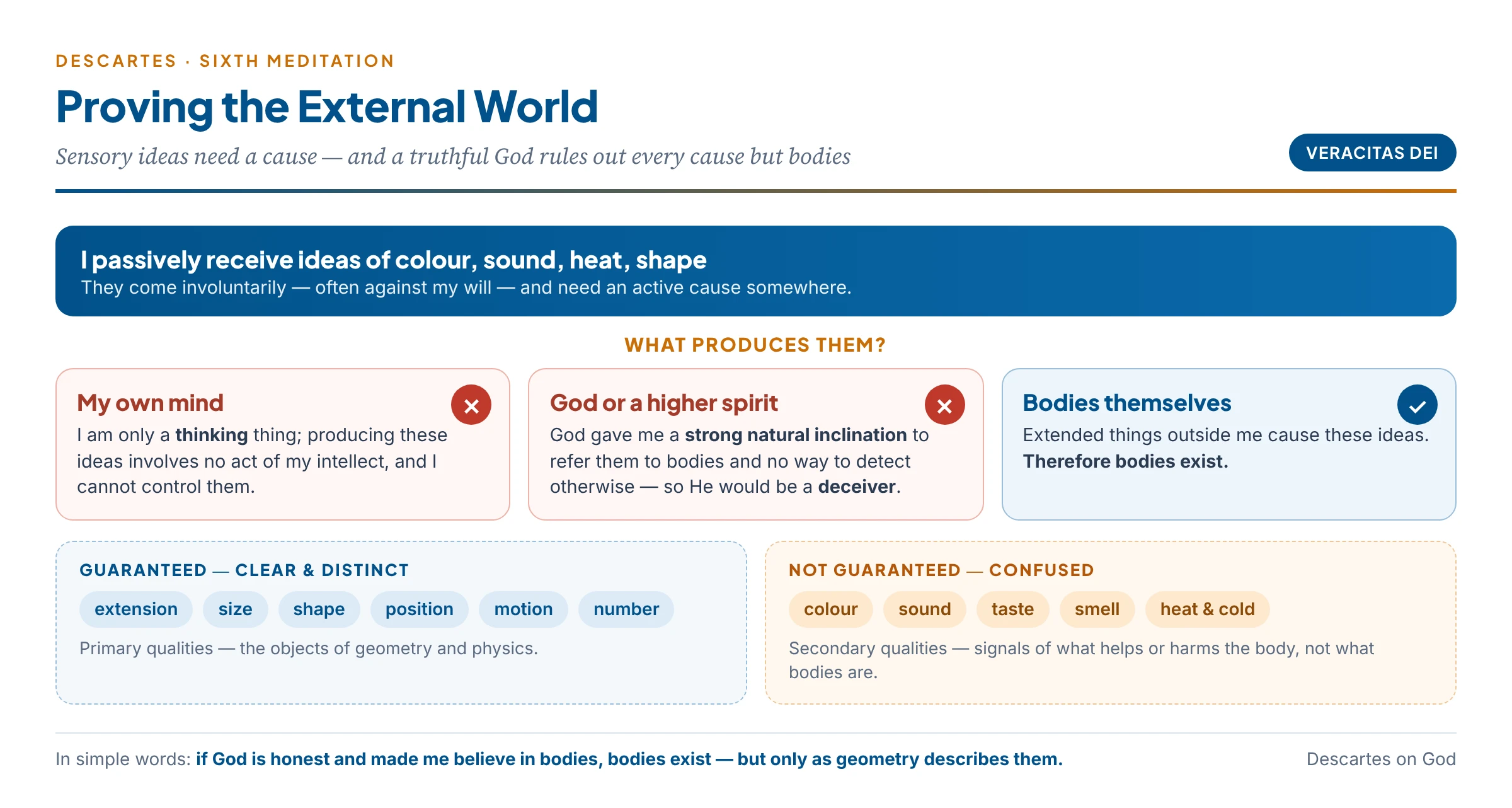
- I have a passive faculty of sensation — I receive ideas of colours, sounds, heat, shapes.
- A passive faculty needs an active faculty somewhere that produces these ideas.
- It is not in me. These ideas come involuntarily — often against my will — and their production involves no act of my intellect. As a thinking thing, I am not their cause.
- So it is in some other substance, which must contain (at least as much as) the reality the ideas represent: either bodies themselves, or God, or some creature nobler than bodies.
- God has given me no faculty to tell that the ideas come from God or a higher creature; on the contrary, He has given me a great natural inclination to believe they come from bodies.
- If they did not, God would be a deceiver — which He is not.
- Therefore bodies exist.
Supporting points often listed:
- Natural inclination — we irresistibly believe sensory ideas come from external bodies; so strong an inclination cannot, given a truthful God, lead us systematically astray.
- Involuntariness — I cannot produce or stop sensations at will.
- Vividness — sensory ideas are more forceful, vivid and detailed than those of imagination, suggesting an outside cause.
- Causal adequacy — ideas that represent extended things need a cause with at least that reality.
- The mind–body distinction — I understand myself as a non-extended thinking thing and bodies as extended, so bodies cannot simply be my own states.
- Clear and distinct mathematics of matter — extension, shape, motion are known clearly; since God guarantees these, a material world answering to them exists.
But bodies may not be exactly as they appear. God guarantees only what I perceive clearly and distinctly in bodies: extension, size, shape, position, motion — the objects of geometry (primary qualities). Colours, sounds, tastes, smells, heat and cold (secondary qualities) are confused ideas; they tell me what is useful or harmful to my body, not what bodies are in themselves.
Why the senses still mislead. If God is good, why do we have illusions? God has given the senses for practical guidance (to preserve the union of mind and body), and has also given us an intellect with which to correct them. We go wrong when we treat sense impressions as clear and distinct knowledge of the nature of things. God leads; He does not mislead — the fault lies in our hasty judgments. Sources of sensory error include ordinary illusion, dreams (whose objects are not in the world) and our tendency to believe what “nature” urges before the mind examines it.
How we perceive the world — the representative picture. Objects make impressions on the sense organs → motions pass through the nerves and animal spirits to the brain and the pineal gland → the mind has ideas → God’s veracity guarantees the correspondence between the (clear and distinct parts of the) ideas and the objects. This is representative realism: we know bodies through ideas that represent them.
Other minds and animals.
- Other selves are known by analogy: just as my conscious states have their seat in my soul, the speech and adaptable behaviour of other human beings show that they too have minds.
- Animals have no souls, Descartes holds; their behaviour is the working of a bodily machine — they lack genuine language and reason.
10. Does the Clear-and-Distinct Account Prove Material Objects?
What it does show:
- The essence of body: a clear and distinct idea of extension tells us what a body would be — something with length, breadth, depth, shape and motion.
- Once God is proved, the truth of that idea is guaranteed: if bodies exist, they have these properties.
What it does not show on its own:
- Existence. A clear idea of a triangle does not prove any triangle exists; likewise the clear idea of extension does not prove that bodies exist.
- The existence proof uses something else: the involuntariness of sensations and our natural inclination to refer them to bodies — and these are not clear and distinct perceptions but “teachings of nature.” They become reliable only through God’s veracity.
So the answer is: only indirectly. The clear-and-distinct account supplies the content of our knowledge of bodies (geometry); God’s truthfulness supplies the existence. If the proofs of God fail, the proof of the world fails with them.
Critical estimate:
- It all rests on God. The external world is proved solely through the veracity of a personal God; since the proofs of God are themselves disputed, the proof of the world loses its ground. Hume: “To have recourse to the veracity of the supreme Being, in order to prove the veracity of our senses, is surely making a very unexpected circuit.”
- The primary/secondary split can be challenged — just as Berkeley challenged Locke’s: we never perceive extension without colour; if colour is in the mind, so is extension. And an idea can resemble nothing but an idea.
- The analogy for other minds depends on mind–body dualism, which Ryle and others reject.
- The theodicy of error — that God gave us a finite, fallible intellect because that is better for us — is a vestige of medieval faith, not a conclusion of reason.
- A different route: Kant’s Refutation of Idealism and, later, G. E. Moore’s commonsense proof (“here is one hand”) treat the external world not as something to be inferred from inner ideas but as part of the very conditions of experience or of plain knowledge.
Common confusion
Does God guarantee that the world is exactly as I sense it? No. God guarantees only what is clear and distinct — the geometrical properties of bodies. Descartes explicitly says bodies “may not exist in a way that exactly corresponds to my sensory grasp of them.” Colours, smells and tastes as we feel them are not in the objects. The senses are reliable as guides for survival, not as sources of scientific truth.
Critical Evaluation
Internal Difficulties
- The circle — the deepest problem: the guarantor of clear ideas is proved by clear ideas.
- The demon’s reach — if the demon could distort my sense of what is evident, he could distort the very proofs of God.
- Scholastic premises — “nothing gives what it does not have,” degrees of reality, formal vs objective reality — are assumed, not proved; they are exactly the kind of inherited opinion the method of doubt was meant to clear away.
- Idea of the infinite — empiricists argue it is a negative idea built from finite experience, which undercuts the trademark argument.
- Existence as a perfection — the ontological argument stands or falls with treating existence as a property; most later philosophers deny this.
- A God of convenience — critics complain that God appears just when Descartes needs to get from the self to the world, and then retires.
- Two different Gods — the impersonal ground of truth and the personal Creator are fused without explanation.
Critics and Defenders
Criticism — Critics
- Arnauld: the Cartesian circle.
- Gassendi and the empiricists: no innate idea of God; the “infinite” is the finite with its limits denied.
- Hume: causes need not resemble effects; no being exists necessarily; proving the senses through God is an “unexpected circuit.”
- Kant: existence is not a predicate; causality cannot go beyond experience; the three classical proofs collapse into the ontological, which fails.
- Berkeley: if ideas are all we perceive, matter “behind” them is an empty supposition.
Defence — Defenders and lasting value
- Descartes’ replies: the proofs rest on present intuitions; God secures memory and removes general doubt.
- Leibniz: completed the ontological argument by arguing that a supremely perfect being is possible.
- Modern modal versions (Malcolm, Plantinga) restate the ontological argument as “necessary existence,” which is not open to the “existence is not a predicate” reply in the same way.
- The rational universe: the belief that nature is mathematically intelligible because it is rationally ordered inspired the scientific revolution.
- Epistemic humility: the insight that our faculties need an external warrant anticipates modern reliabilist views — knowledge needs faculties that are in fact reliable, not just felt to be.
Cross-Tradition Comparison
God as the Guarantor of Knowledge: Descartes and Indian Thought
| Point | Descartes | Nyāya (Udayana) | Advaita (Śaṅkara) | Mīmāṃsā |
|---|---|---|---|---|
| Can God be proved? | Yes — causal, cosmological and ontological proofs | Yes — inference from the world (kāryāt etc.) | Brahman is not an object of reasoning; known through śruti; reason only supports | No creator-God is needed |
| Kind of proof | A priori (ontological) and causal from an innate idea | A posteriori inference (anumāna) | Self-evident consciousness, revealed by scripture | Rejects Nyāya’s proofs |
| God guarantees | Truth of clear and distinct ideas | Validity of the Vedas (pratyayataḥ) | Brahman is truth itself (satyaṃ jñānam anantam) | Vedas are authorless (apauruṣeya) and self-valid |
| God and world | Creator and conserver, separate from the world | Efficient cause shaping eternal atoms | Brahman is the ground; the world is appearance (vivarta) | The world is beginningless; no creation |
| Status of the world | Real, known through ideas; only geometric properties certain | Real and directly perceived (direct realism) | Empirically real (vyāvahārika), not ultimately real | Real |
Indian Connect — Key takeaways
- Truth needs a trustworthy source in both Descartes and Nyāya: Descartes’ God guarantees clear ideas; Nyāya’s Īśvara, as the omniscient author, guarantees the Vedas.
- Mīmāṃsā is the anti-Cartesian: knowledge is self-valid (svataḥ-prāmāṇya) and the Vedas need no author — no divine guarantor is required.
- Advaita reverses the direction: Descartes uses reason to reach God; Śaṅkara holds that Brahman, as pure consciousness, is the self-evident ground of all reasoning and cannot be reached as a conclusion.
- On the world, Nyāya is a direct realist (we perceive things themselves), while Descartes is an indirect realist (we know things through ideas) — closer to the Buddhist Sautrāntika, who infer outer objects from the forms in consciousness.
Synthesis (Siddhānta)
Descartes’ God is the hinge of his whole philosophy. The trademark and cosmological arguments move from the finite, doubting self to an infinite cause; the ontological argument finds existence in God’s very essence; and God’s veracity turns momentary certainty into lasting knowledge, restores mathematics and wins back a world of extended bodies — though only in its geometrical features. The system is elegant, but it is only as strong as its weakest link: if the proofs of God fail — and Hume and Kant gave powerful reasons to think they do — the bridge from the self to the world falls with them.
- The legacy is double. Descartes made God the foundation of science’s confidence that nature is rationally ordered; but by making the world depend on a proof, he also created the modern “problem of the external world,” which Berkeley, Hume, Kant and Moore each answered in a different way.
- Ontological debate today — modal logic, the nature of existence and “perfect being” theology still begin from Descartes’ fifth Meditation and Kant’s reply.
- Trust in faculties — the question “what guarantees that our senses and reasoning are reliable?” remains alive in debates on scientific realism, simulated worlds and artificial perception.
For Descartes, the honesty of God is the price of knowing the world: no truthful God, no certain science.
Previous Year Questions
- 2024Critically examine Kant’s objections against the ontological argument for the existence of God.
- 2024Present an exposition of ontological proof for the existence of God along with its criticism.
- 2021Explain how Cartesian formulation of ontological argument is criticised by Kant.
- 2019How does Descartes prove the existence of things other than himself and God? Discuss.
- 2018Does the concept of God entail the existence of God? Examine from the perspective of ontological argument.
- 2017What according to Descartes is a clear and distinct idea? What is the epistemological status of clear and distinct ideas? Does this account help Descartes prove that material objects exist? Explain.
- 2014Discuss the ontological argument for the existence of God, and show its merits and demerits.
- 2013Explain Descartes’s method of doubt. Can this method be used to justify his belief in the existence of God? Argue your case.
- 2011Why does Descartes not doubt the existence of God? Explain.
- 2009Comment on Kant’s objections against the ontological argument for the existence of God.
- 2008Different versions of ontological arguments and Kant’s critique of these arguments. Critical note.
- 1997The idea of an all-perfect, omnipotent being implies also that it or He exists. Notes.