

Rationalism (Descartes, Spinoza, Leibniz): Cartesian Method and Certain Knowledge; Substance; God; Mind-Body Dualism; Determinism and Freedom.
Official Syllabus: Paper I, Section A, Unit 2
Rationalism is the theory of knowledge which holds that reason (intellect), not sense experience, is the main source of knowledge that is certain, necessary and universal. In the seventeenth century this old idea of Socrates and Plato became a full system in the hands of René Descartes (1596–1650), Baruch Spinoza and G. W. Leibniz. Descartes began it. Disturbed that philosophy, after centuries of the best minds, still had “not a single proposition” beyond dispute, he looked for a method that would give philosophy the certainty of geometry. His answer was the method of doubt, which ends in the one truth that cannot be doubted — Cogito, ergo sum (“I think, therefore I am”) — and from there rebuilds knowledge through clear and distinct ideas, innate ideas and God.
In simple words
Think of an architect who finds an old building full of cracks. Instead of patching walls one by one, he pulls everything down to the bare rock, tests the rock, and builds again only on what holds. Descartes does this with beliefs: he “pulls down” every belief that can be doubted, finds one rock that cannot be doubted — “I am thinking, so I exist” — and builds the rest of knowledge on it.
Context & Problem
What Rationalism Claims
Rationalism is also called the a priori theory of knowledge, because it holds that the most important knowledge is prior to and independent of experience.
- Reason is the source of real knowledge. The senses give only confused, changing, probable information; reason grasps what is necessary — what cannot be otherwise.
- Rationalists differ on experience. Some treat sense experience as wholly misleading; others give it a lower, “confused” value. All agree that reason alone gives certain and perfect knowledge.
- Earliest rationalists: Socrates and Plato — true knowledge comes from reason, not the senses. The tradition became articulate in Descartes, was developed by Spinoza and reached its zenith in Leibniz.
Four core tenets of continental rationalism:
- Primacy of reason — reason alone grasps necessary truth; sense experience gives opinion.
- Innate ideas (ideae innatae) — the mind is born with some basic ideas (God, self, number, cause) that are not drawn from experience.
- The mathematical (deductive) ideal — philosophy should copy geometry: start from self-evident axioms and deduce everything else.
- Clarity and coherence as the mark of truth — a truth is known by its clarity, distinctness and logical consistency, not by matching sense reports.
Rationalism vs Empiricism
| Point | Rationalism | Empiricism |
|---|---|---|
| Source of valid knowledge | Reason (largely rejects knowledge from the senses) | Experience (largely rejects knowledge from pure reason) |
| Method | Deductive — mathematically derived | Inductive — generalised from experience |
| Character of knowledge | Necessarily true (2 + 2 = 4) | Probable, not necessary |
| Newness | No new content — the conclusion only makes explicit what is implicit | New content — a generalisation goes beyond the cases |
| Supporters | Descartes, Spinoza, Leibniz | Locke, Berkeley, Hume |
Deduction and induction — the two kinds of reasoning behind the two schools:
| Deductive reasoning | Inductive reasoning |
|---|---|
| Universal → universal, or universal → particular | Particular → universal |
| “All men are mortal; Ram is a man; so Ram is mortal” | “Man 1 is mortal, man 2 is mortal … so all men are mortal” |
| The premise contains the conclusion (premise ≥ conclusion) | The conclusion goes beyond the premises (a leap) |
| Gives formal truths; valid or invalid | Gives material truths; only more or less probable |
Descartes: The Man and His Worry
- Mathematician first, natural scientist second, metaphysician third. He created analytic (algebraic) geometry, co-framed the sine law of refraction, gave an important account of the rainbow, and proposed a natural account of how the earth and planets formed (a forerunner of the nebular hypothesis).
- A new picture of nature: a world of matter with a few basic properties, obeying a few universal mechanical laws — replacing the Aristotelian-scholastic explanation by final causes (purposes). Inside this world he placed an immaterial mind linked to the brain, and so gave the modern form of the mind–body problem.
- The problem: philosophy had been cultivated for centuries by the best minds, yet every proposition in it was still disputed. Mathematics, by contrast, commanded agreement. Descartes wanted the certitude of arithmetic and geometry in philosophy — and so he needed a “method of philosophising”.
- Philosophy is practical, not mental gymnastics. “Philosophy is a perfect knowledge of all that man can know, as well for the conduct of his life as for the preservation of his health and the discovery of all the arts.” Its aim is not only knowledge but wisdom — a higher realisation in the person himself.
- Father (and “legislator”) of modern philosophy. He rid philosophy of reliance on authority and faith, accepted reason as the final criterion, and showed the three marks of modern thought: naturalism, scientific orientation and freedom of thought.
Tendencies Descartes started, which later thinkers completed:
- Rationalism — begun by Descartes, developed by Spinoza, at its height in Leibniz.
- Mathematical method — became Spinoza’s geometrical method; Leibniz refined it scientifically.
- Scientific approach — by marking the boundary between the material and the mental, he freed science from religion and spiritualism.
- Practicability — philosophy as a guide to life; the same attitude appears in Spinoza and Leibniz.
- Agenda-setting problems — the relation of mind and body, the nature of matter, the place of God — became the agenda of all later philosophy, rationalist and empiricist alike.
Core Doctrine
1. The Cartesian Method: Four Rules
Descartes noticed that mathematics works by two mental operations:
- Intuition — the direct, undoubting grasp of a self-evident truth by an attentive mind (“a triangle has three sides”).
- Deduction — a necessary inference from intuited truths, link by link.
Experimental inference cannot give errorless results; deduction alone yields certainty — but deduction needs self-evident first truths. So philosophy must first find its axioms. In the Discourse on the Method he laid down four rules:
- Rule of evidence — never accept anything as true unless it is known clearly and distinctly to be true; avoid haste and prejudice. (Most errors in philosophy come from preconceived notions, hasty judgments and poorly understood experiences.)
- Rule of analysis — divide each difficulty into as many parts as possible.
- Rule of synthesis (order) — start with the simplest objects and rise step by step to the more complex, so that each step follows naturally from the last.
- Rule of enumeration — make reviews so complete that nothing is left out (no hasty, illicit generalisation).
In simple words
These are the rules a good student uses for a hard maths problem: accept nothing you are not sure of; break the problem into small pieces; solve the easiest piece first and build up; then check that you have not skipped any step.
Character of the method:
- Analytic, then synthetic. First the mind analyses — digs down to the first certain truth; then it synthesises — builds the rest from it.
- “Inductive and deductive.” Many notes say the method is inductive until it reaches the cogito (it discovers the first truth by examining beliefs) and deductive afterwards (everything else follows from it). In Descartes’ words, “passing little by little from one truth to another, we acquire in time a perfect knowledge of the whole of philosophy.”
- Three working assumptions: (a) some knowledge about the world is certain; (b) whatever is clear and distinct is true; (c) deduction can be as certain as intuition.
- Epistemology first. Descartes reaches metaphysics (“what is“) through epistemology (“what can be known“). After him, the theory of knowledge comes before the theory of being — a lasting shift in Western philosophy.
2. The Method of Doubt (Methodological Scepticism)
To find a truth that is beyond all doubt, Descartes deliberately doubts everything that can possibly be doubted — de omnibus dubitandum. His working rule: treat as false any belief that falls prey to even the slightest doubt. Pushed to its farthest limit, doubt will either destroy everything or reveal something that resists it.
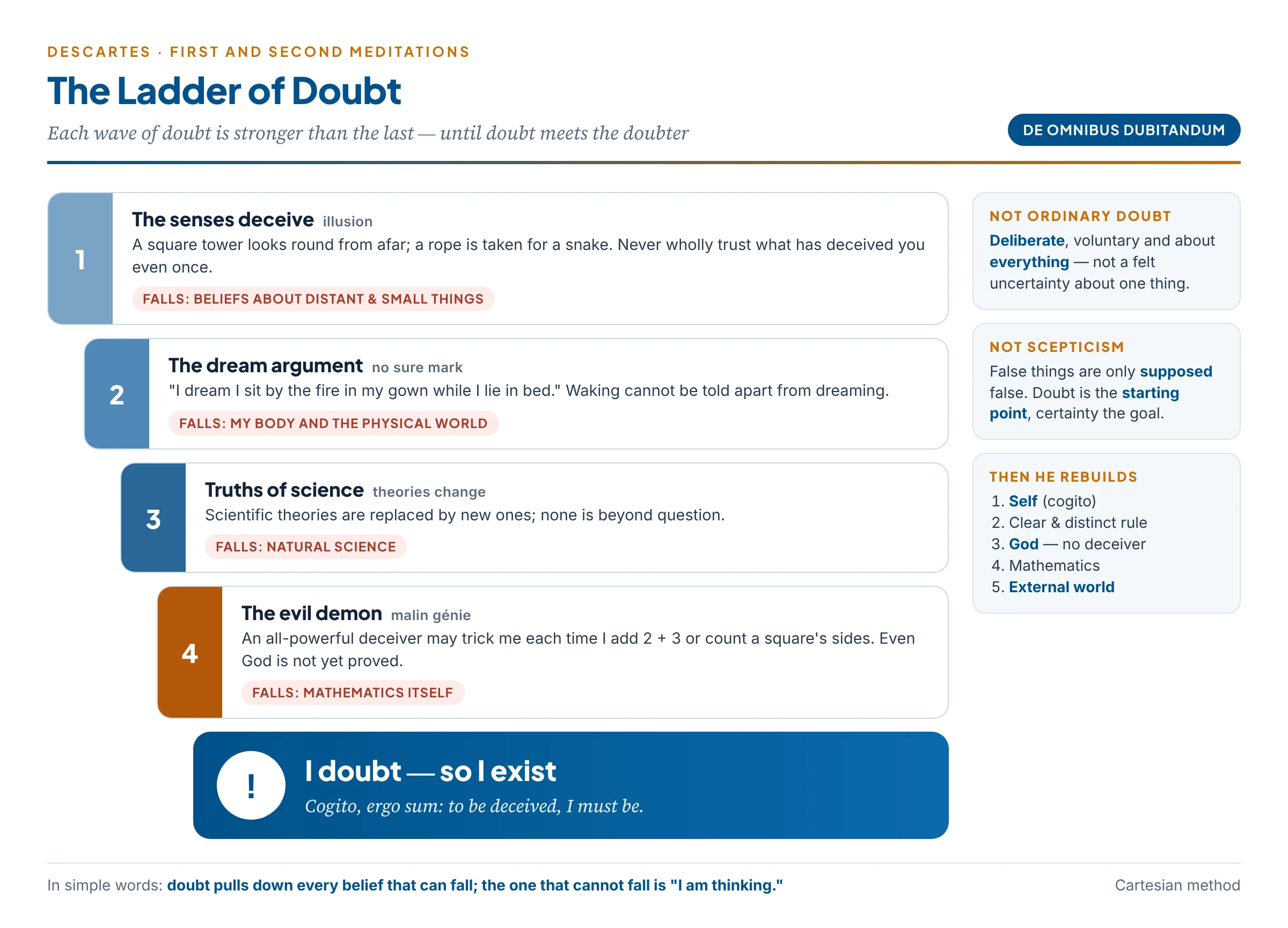
The waves of doubt:
- The senses deceive. A tower that looks round at a distance is square near by; a stick looks bent in water; a rope is taken for a snake. Prudence says: never wholly trust what has deceived you even once. Sense beliefs feel convincing while they last, but not one of them is certain.
- The dream argument. “I often dream that I am sitting by the fire in my dressing gown, when in fact I am lying undressed in bed.” There is no sure mark to tell waking from dreaming, so even “I am sitting here” — and the existence of my body and the physical world — can be doubted.
- The truths of science. Scientific theories are replaced by new theories; none is beyond question.
- The evil demon (malin génie). Even in dreams, 2 + 3 = 5 seems certain. But suppose an all-powerful, malicious demon deceives me every time I add two and three or count the sides of a square. Then even mathematics can be doubted. (Some notes use 2 + 2 = 4 / 2 + 2 = 5 as the example — the point is the same.)
- Even God — whose existence is not yet proved — can be doubted at this stage.
In simple words
The three waves get stronger, like three filters: the first removes beliefs about distant or small things, the second removes the whole physical world, the third removes even sums and geometry. Descartes keeps filtering until only something that passes every filter is left.
Cartesian doubt is not ordinary (psychological) doubt:
| Descartes’ doubt | Psychological doubt |
|---|---|
| A deliberate, dispassionate attitude towards human experience as a whole | Directly felt — “is that a snake or a rope?” |
| Not determined by the object; chosen for the sake of method | Caused by the object about which we are unsure |
| Logical and voluntary — depends on the will | Involuntary — continues however hard we try |
| Concerns total or ultimate things (self, world, God) | Concerns particular things of daily life |
Cartesian doubt is not scepticism:
- Supposing, not asserting. Descartes does not assert that whatever can be doubted is false; he only supposes it false for the sake of the method. He does not really believe he is dreaming or deceived by a demon — the doubt is hyperbolic (deliberately exaggerated).
- Starting point, not conclusion. Scepticism is a finished conclusion — no certain knowledge is possible. Cartesian doubt is a starting point to find what cannot be doubted further.
- Six differences in purpose:
- Methodological purpose — doubt is a means to certainty; the aim is constructive, not destructive.
- Provisional — beliefs are suspended to test them, not because truth is unattainable.
- A search for foundations — the sceptic stops at doubt; Descartes looks for a truth that survives it.
- Doubt cannot touch the doubter — the act of doubting proves the doubter exists, a positive discovery that breaks with scepticism.
- Reconstruction — after the cogito, knowledge is rebuilt through clear and distinct ideas.
- Commitment to science — the method aims to secure mathematics and physics, which scepticism undermines.
- That is why the method is called methodological scepticism or metaphysical doubt: sceptical in its procedure, anti-sceptical in its goal.
Indian Connect — Nyāya also begins with doubt
In Nyāya, doubt (saṃśaya) is one of the sixteen categories (padārtha) and the starting point of every inquiry (nyāya): we investigate only what we are unsure of. Like Descartes, Nyāya treats doubt as a tool for reaching valid knowledge (pramā), not as an end. The radical Cārvāka sceptic Jayarāśi, who denied that any means of knowledge (pramāṇa) is valid, is the true sceptic — the position Descartes wants to defeat.
3. Cogito, Ergo Sum
The discovery. Everything can be doubted — except that I am doubting. “I may doubt anything, but I cannot doubt that I am doubting.” When doubt has done its worst, it meets a fact of complete certainty:
- Doubting is a kind of thinking. A doubt about whether thought exists would itself be a thought.
- Thinking needs a thinker. Just as running is impossible without a runner, thinking is impossible without someone who thinks.
- Even the demon proves it. “Let the demon deceive me as much as he can — he can never make me be nothing while I think I am something.” To be deceived, I must exist.
- So: I doubt, therefore I exist — in general form, “I think, therefore I am” (Je pense, donc je suis in the French Discourse; Cogito, ergo sum in Latin). In the Meditations: “I am, I exist, is necessarily true each time it is expressed by me or conceived in my mind.”
“I think, therefore I am.” — René Descartes
Seven features of the cogito:
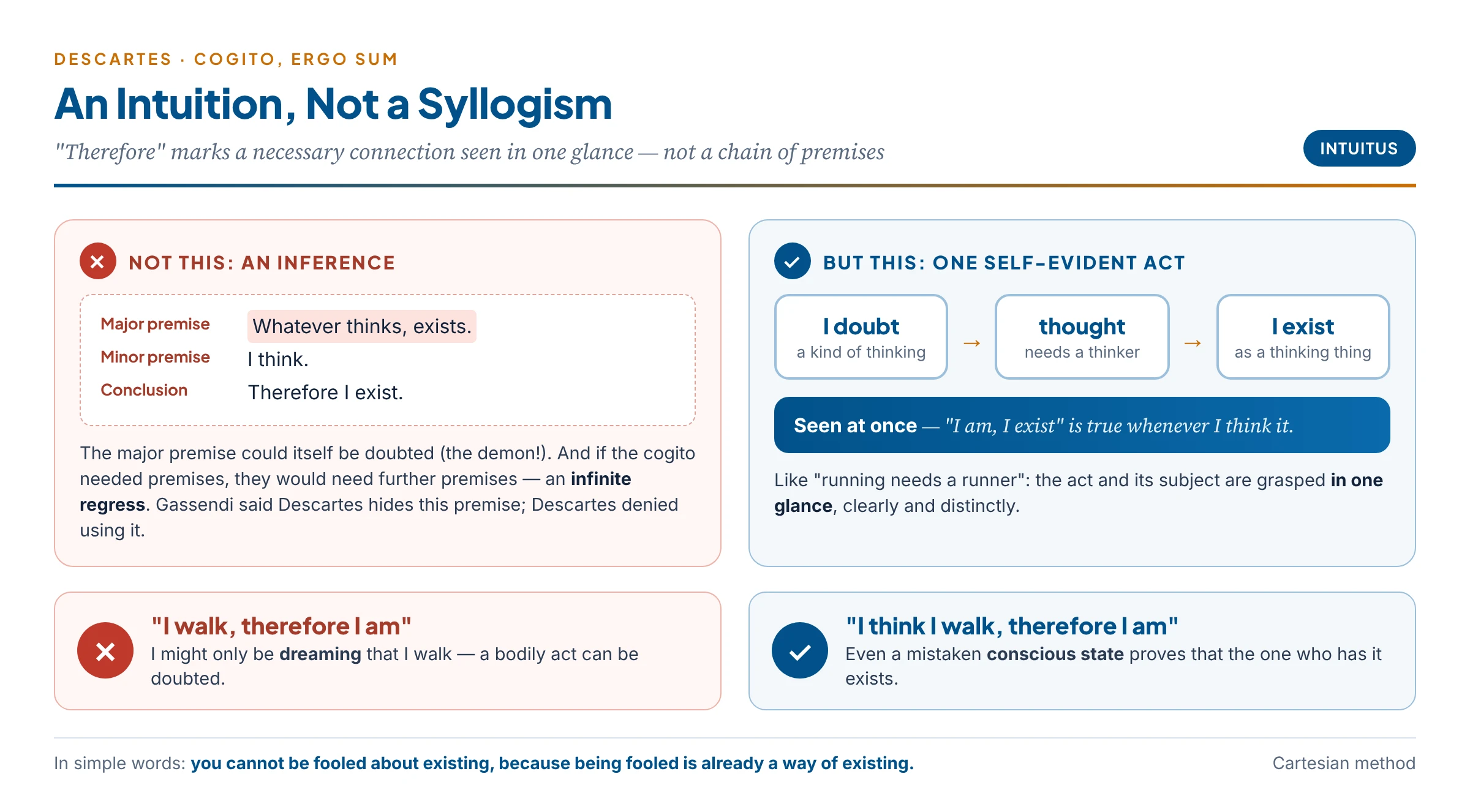
- Not an inference but an intuition. It is not the syllogism “Whatever thinks exists; I think; therefore I exist.” The major premise (“whatever thinks exists”) could itself be doubted, and if the cogito depended on premises, those premises would need further premises — an infinite regress. The cogito is a self-evident axiom, grasped in one act of mind. “Therefore” (ergo) marks a necessary connection, not a step of reasoning.
- Clear and distinct. Nothing else is perceived with the same certainty — so it becomes the model of all certain knowledge.
- Consciousness reveals existence. It is my consciousness that carries with it the existence of myself; thought and thinker are inseparable.
- Only a conscious act will do. “I walk, therefore I am” fails: I may be dreaming that I walk, and walking can happen without awareness. But “I seem to walk” or “I think I walk” — a conscious state — does prove that I exist.
- “I know that I am, but not what I am.” At this stage only my existence is certain; my nature — whether my body is part of me — is not yet known.
- That which thinks is a substance. “Thinking cannot exist without a thing that thinks; no act or accident can exist without a substance.” The cogito gives the thinking substance (res cogitans).
- The first existential proposition. It is the first truth both logically (it comes first in the order of knowing) and psychologically (it is the first thing I find when I look within).
Common confusion
Does Descartes say “I know I am the soul but not the body”? Some notes write the line as “I know I am, but I do not know I am” and read it as soul vs body. Descartes’ point is simpler: in the cogito I know that I am (my existence), but not yet what I am (my essence). Only later does he argue that his essence is thinking and that the mind is distinct from the body.
What am I? A thinking thing.
- A mind is “a thing that doubts, understands, affirms, denies, wills, refuses, and also imagines and senses.” All these are ways of thinking — conscious states.
- Intellect and will. The mind’s two main faculties are understanding (intellect), which perceives ideas, and will, which affirms or denies.
- Imagination and sensation belong to the mind as united with a body — they need bodily organs; pure understanding and will belong to the mind alone.
- Unextended. Extension (taking up space) is the nature of body; the mind is not extended, so it is an immaterial thinking substance.
- Ideas are modes of mind. A substance needs nothing else to exist; an idea is a mode (a way of thinking) and needs a mind to exist in.
Why the cogito is the cornerstone:
- Strategic position — every other element is deduced from it: God exists (from the idea of God found in the thinking self), the external world exists (because God is no deceiver), and mind–body dualism follows (because thinking is found to be the mind’s essence).
- An answer to agnosticism — at least one certain truth exists.
- The marker for dualism — it fixes consciousness as the distinguishing quality of mind.
- Epistemology to metaphysics — from what can be known with certainty, Descartes reaches what exists.
Indian Connect — Śaṅkara on the self-evident “I”
Śaṅkara argues that the existence of the self cannot be doubted or denied: everyone is aware “I am,” and no one thinks “I am not.” The very person who denies the self is the self — the denier presupposes what he denies. The self is self-established (svataḥ-siddha) and self-luminous (svayaṃprakāśa): it needs no proof because it is the ground of every proof. Sāṃkhya likewise treats puruṣa as self-luminous consciousness. But note the difference: Descartes’ “I” is an individual thinking substance full of changing thoughts; for Śaṅkara that “I” (the ego, ahaṃkāra) is itself a superimposition (adhyāsa), and the real self is the pure witness-consciousness (sākṣī) behind all thinking.
4. Clear and Distinct Ideas: The Criterion of Truth
Why is the cogito certain? Because it is perceived clearly and distinctly. So Descartes lays down a general rule: “whatever I perceive very clearly and very distinctly is true.”
- Clear (clara) — an idea that is present and manifest to an attentive mind. For an idea to be clear, it must be before the mind and the mind must attend to it.
- Distinct (distincta) — an idea so precisely determined and separated from all others that it contains nothing but what is clear — only its essential features, with nothing confused mixed in.
- An idea can be clear without being distinct, but not distinct without being clear. A sharp pain is clear (vividly present), but our idea of it is often not distinct: we confuse the feeling with a judgment that something in the foot “resembles” the pain.
- Which ideas pass the test? (a) the cogito (the self); (b) the innate idea of God; (c) the ideas of mathematics; (d) the idea of body as extension (size, shape, motion) — but not colours, sounds, tastes, which remain confused.
- Epistemological status. Clear and distinct ideas are self-evident while attended to; the mind cannot help assenting to them. But their lasting reliability rests on a further guarantee — a non-deceiving God (taken up in the next article on God and the external world).
In simple words
A clear idea is like a face seen in good light; a distinct idea is that face seen so sharply that you cannot mistake it for anyone else’s. Descartes trusts only ideas that are both well-lit and sharp.
Criticisms of the criterion:
- No logical test. As N. K. Smith pointed out, Descartes never gives a logical criterion for telling when an idea is really clear and distinct.
- Subjective. Leibniz objected that “clear and distinct” is a psychological feeling — people feel certain of false things. He wanted logical tests: an idea is true if it is free of contradiction.
- Circularity. The criterion needs God; God is proved by the criterion — the Cartesian circle (see the God article). “The veracity of God is the ontological assumption of the methodological criterion.”
5. Innate Ideas
Descartes classifies all ideas by their origin:
| Type | Origin | Examples | Clear & distinct? |
|---|---|---|---|
| Adventitious | Come from outside, through the senses | The heat of a fire, the sound of a bell, the sun as I see it | No — they can deceive |
| Factitious (fictitious) | Made up by the imagination by combining ideas | A mermaid, a golden mountain, a hippogriff | No |
| Innate | Born with us; come from the nature of reason itself | God, the self, number, figure, the truths of mathematics, “nothing comes from nothing” | Yes |
- The senses do not reveal the natures of things. To grasp the basic truths of metaphysics we must “withdraw the mind from the senses” and turn to our innate ideas of essences.
- Not ready-made pictures. Innate ideas are “inborn dispositions of thought” — capacities the mind finds in itself when it reflects carefully. They come to light when the mind thinks properly.
- Key examples: (a) the idea of God as infinite and perfect — which, Descartes argues, a finite mind could never have produced; (b) mathematical truths — number, equality, geometrical figures; (c) the ideas of mind (thought) and body (extension).
- Why they matter: they are universal among rational beings and do not depend on chance sense input; they give certainty where sense experience fails; they ground mathematics, metaphysics and the idea of God.
- The mind is active, not merely receptive. It supplies formative principles of knowledge — here Descartes is a forerunner of Kant, whose categories of understanding are concepts without which sense data would be “blind.”
- An inconsistency. Descartes sometimes stretches innateness to sense ideas — even ideas of colour, sound and taste, which he says are “not in the objects” and so cannot be simply copied from them. This blurs his own neat division.
Locke’s refutation of innate ideas. John Locke (Essay Concerning Human Understanding) attacked the doctrine on these grounds:
- No universal consent. Defenders say everyone agrees to certain principles, so they must be innate. But there is no such universal agreement — children and “idiots” have no thought of principles like “whatever is, is” or “it is impossible for the same thing to be and not to be.”
- Even universal consent would not prove innateness, if the agreement can be explained in another way (by experience and reasoning).
- An idea in the mind that the mind is not aware of is a contradiction. “To imprint anything on the mind without the mind’s perceiving it seems to me hardly intelligible.”
- The “capacity” version is trivial. If “innate” means only that the mind has the capacity to come to know a truth, then every truth we ever learn would be innate — the doctrine says nothing.
- “Known when reason is used”? If the principles are known only when we come to the use of reason, then reason discovers them — they are not innate.
- The idea of God is not universal. Whole nations have been found without any idea of God, and people’s ideas of God differ widely.
- Positive alternative — the blank slate. The mind at birth is “white paper, void of all characters” (tabula rasa); all ideas come from sensation and reflection.
Descartes’ reply (made in 1648 against a critic of his own day, before Locke wrote): by “innate” he never meant ideas actually present in a baby’s mind. Ideas are innate “in the same sense as we say that generosity is innate in certain families, or that diseases such as gout are innate in others” — not that babies suffer from gout in the womb, but that they are born with a disposition to develop it. Innate ideas are dispositions that unfold when the mind reflects.
In simple words
A seed does not contain a tiny visible tree, yet it is not true that the tree comes “from outside.” The tree is in the seed as a capacity. Descartes says innate ideas are in the mind in this way — as seeds, not as finished pictures.
Later answer — Leibniz. In his New Essays, Leibniz compares the mind to a block of veined marble: the veins already mark out the figure of Hercules, though work is needed to bring it out. He accepts the empiricist slogan “nothing is in the intellect that was not first in the senses” but adds “except the intellect itself.”
| Point | Descartes | Locke | Leibniz |
|---|---|---|---|
| Mind at birth | Has innate ideas (God, self, mathematics) | Blank slate | Veined marble |
| Meaning of “innate” | A disposition that unfolds on reflection | Would have to mean actually perceived | Virtual knowledge, needing experience to awaken |
| Source of necessary truths | Reason | Comparison of ideas from experience | Reason; experience only occasions them |
Indian Connect — Saṃskāras and intrinsic validity
- Latent impressions. Indian schools explain inborn tendencies through saṃskāras / vāsanās — latent impressions carried from past births (the infant’s instinctive fear and its first suckling are cited by Nyāya as evidence of past experience). Like Descartes’ “dispositions,” they are potential, becoming active when conditions arise.
- Validity of knowledge. Mīmāṃsā’s svataḥ-prāmāṇyavāda holds that knowledge is valid by itself unless defeated; Nyāya’s parataḥ-prāmāṇyavāda holds that validity is established by an outside test (successful action). Descartes stands in between: clear and distinct ideas are self-evident in the moment, but their lasting truth is guaranteed from outside — by God.
6. The Wax Argument: Bodies Are Known by the Mind
In the second Meditation, Descartes shows that even physical objects are known by the intellect, not by the senses or imagination.
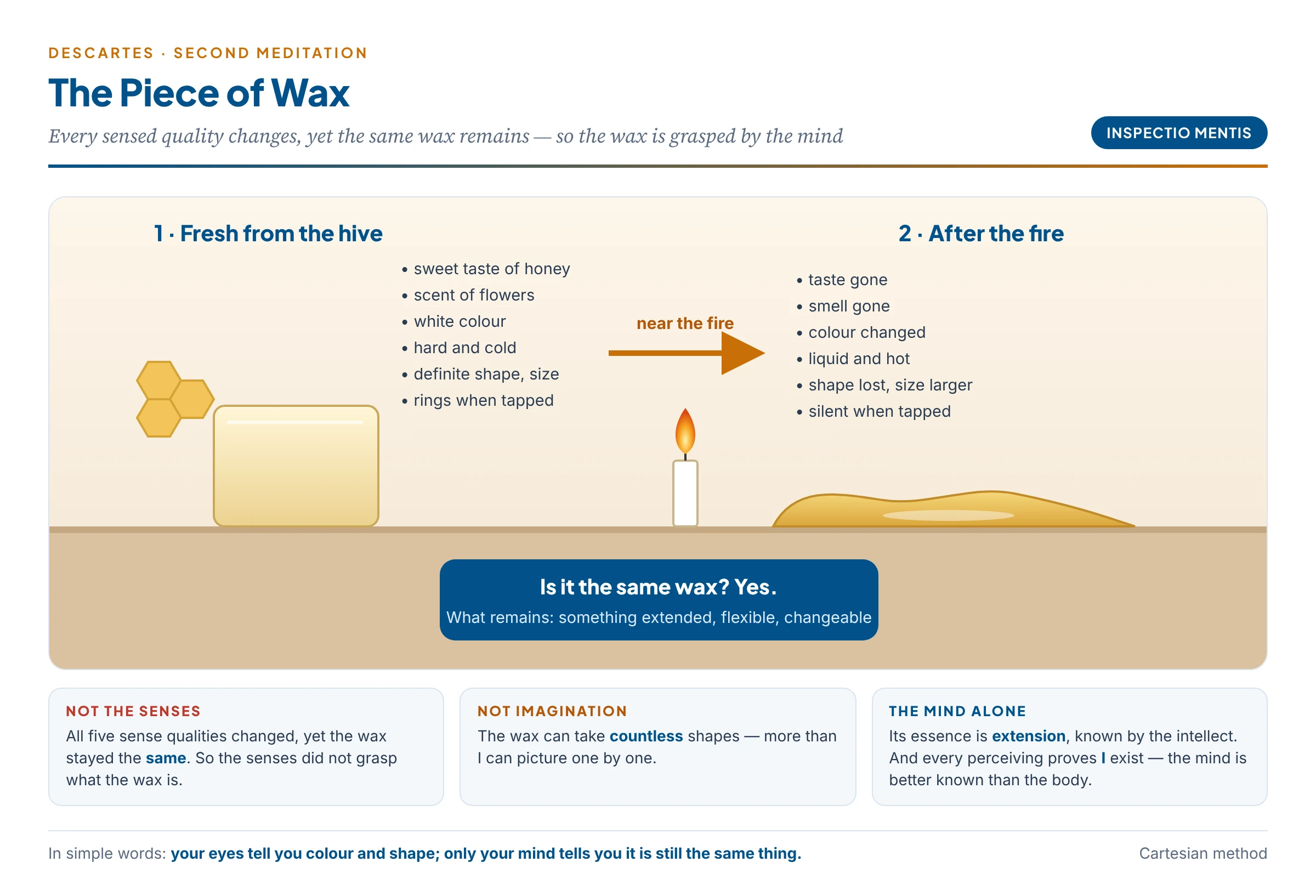
- Fresh wax from the honeycomb: it has the taste of honey, the scent of flowers; it is hard, cold, white; it has a shape and size; it makes a sound when struck.
- Put it near the fire: the taste and smell vanish, the colour changes, the shape is lost, the size increases, it becomes liquid and hot, and makes no sound.
- Is it the same wax? Everyone agrees that it is.
- So what was known in the wax was none of the sense qualities — all of them changed, yet the wax remained.
- Not imagination either. What remains is “something extended, flexible and changeable.” But the wax can take countless shapes — more than I could ever imagine one by one. So I grasp it not by imagination but by an “inspection of the mind alone.”
Lessons of the wax:
- Primary vs secondary qualities. What belongs to the body itself is extension (with shape, size, motion); colour, smell, taste, sound are secondary — confused ideas in us.
- Sense knowledge is not clear and distinct; intellectual knowledge is. This supports rationalism.
- The mind is better known than the body. Every act of perceiving the wax — even mistaken — proves with more certainty that I exist.
- Judgment is hidden in seeing. “I see men crossing the square” — but what I actually see are hats and coats which might cover machines; I judge they are men. Perception involves the intellect.
7. Error: Finite Intellect and Infinite Will
If God is no deceiver, why do we make mistakes?
- Error lies in judgment, not in ideas. An idea by itself is neither true nor false; truth and falsity arise when we affirm or deny.
- Judgment needs two faculties: the intellect, which presents ideas (passive), and the will, which affirms or denies (active).
- The imbalance. The intellect is finite — it cannot have clear and distinct ideas of everything. The will is practically infinite — free to assent even to confused ideas. Error arises when the will goes beyond what the intellect clearly perceives.
- The remedy. Suspend judgment wherever clarity is lacking; assent only to what is clear and distinct. True freedom is the will aligned with clear perception.
- Positive causes of error: haste (judging before the evidence is adequate), prejudice (early opinions never tested), and over-reliance on memory (which should be checked by fresh perception).
- Why did God not make us infallible? (a) A created intellect must be finite — only God’s is infinite. (b) For the harmony of the whole universe, it is better to have fallible creatures in it. (c) A limited will would have made man a machine rather than a free spirit; the gift of free will is needed for spiritual growth, and its misuse is our fault, not God’s.
- Consequence. Since lasting certainty depends on knowing God, Descartes concludes that an atheist cannot have perfectly certain knowledge even of geometry.
In simple words
The intellect is like the light of a torch, which shows only a small area. The will is like your feet, which can walk anywhere — even into the dark. You trip (make errors) when you walk beyond where the torch shines.
8. Certainty of the Self vs Knowledge of the World
Descartes’ theory gives two very different kinds of knowledge:
| Point | Knowledge of the self | Knowledge of the world |
|---|---|---|
| How known | Intuition — direct, immediate, from the inside | Through ideas that represent bodies — indirect |
| Degree of certainty | Indubitable even under the demon hypothesis | Doubted until God is proved; then certain only for clear and distinct features |
| What is known | That I exist, and that I am a thinking thing | Only the primary qualities (extension, shape, motion); colours, sounds are confused |
| Dependence | Needs nothing else — self-certifying | Needs God’s veracity as guarantee |
| Access | Private — only I have this access | Public objects, reached through private ideas |
- The self is better known than the body (the lesson of the wax) — a reversal of common sense, which takes tables and chairs as most certain.
- Problems this creates: (a) a gap between ideas and things (“representative” knowledge), later attacked by Berkeley; (b) the problem of other minds and the threat of solipsism (only I am certain); (c) the “problem of the external world,” which haunted philosophy until Kant’s Refutation of Idealism argued that inner experience itself presupposes outer things, and later Moore, Wittgenstein, Strawson and Heidegger rejected the private, worldless starting point.
9. The Cogito and Essentialism
Essentialism is the view that things have an essence — a set of properties a thing must have to be what it is.
- Descartes is an essentialist about mind and body. The essence of the mind is thought — “I am a thing whose whole essence or nature is only to think.” The essence of body is extension (the wax).
- Does the cogito alone entail this? Strictly, the cogito gives only existence (“I know that I am”). The step to essence (“what I am — a thinking thing whose whole nature is thought”) comes from a further argument: I can clearly and distinctly conceive myself as thinking without conceiving myself as extended, and God can make real whatever I clearly conceive — so thought alone is my essence.
- Objections:
- Arnauld: I may clearly understand a right-angled triangle without knowing that the square on its hypotenuse equals the squares on the other sides — yet that property belongs to it. So being able to conceive the mind without the body does not show it is without body.
- Pragmatists: problems like solipsism and scepticism, in rationalism and empiricism alike, grow from this Cartesian essentialist reduction of the self to a “thinking thing.”
- Existentialists: Sartre reverses the picture — for human beings “existence precedes essence“; there is no fixed essence given in advance.
- Ryle: the “thinking substance” is a “ghost in the machine” (taken up in the article on dualism).
10. How the Cogito Shaped Hume and Kant
Hume took up Descartes’ inward look but found no self in it: “When I enter most intimately into what I call myself, I always stumble on some particular perception or other, of heat or cold, light or shade, love or hatred, pain or pleasure. I never can catch myself at any time without a perception.” The self is a “bundle of perceptions” — the Cartesian thinking substance dissolves.
Kant kept the “I think” but changed its status:
- “The ‘I think’ must be able to accompany all my representations.” The transcendental unity of apperception — the unity of self-consciousness — is the formal condition of all experience. This is the true heir of the cogito.
- But it is not knowledge of a substance. In the Paralogisms, Kant argues that “rational psychology” (Descartes’ kind) commits fallacies when it infers from “I think” that the soul is a substance, simple, identical over time, and separable from the body. The self is the knower and cannot be known as an object; if it were known, it would become a mere object among other objects, not the subject that knows them.
- Against Cartesian doubt about the world. Kant’s Refutation of Idealism argues that I am conscious of my existence in time only through something permanent outside me — so Descartes’ order (self certain, world doubtful) is reversed.
So Descartes gave both Hume’s scepticism about the self and Kant’s transcendental philosophy their starting point: the turn to the subject.
Common confusion
Is Descartes a “naïve realist”? Some notes call him a naïve realist. A naïve realist thinks we see objects directly, exactly as they are. Descartes holds that we perceive the world through ideas, that colours and tastes are not in the objects, and that only extension and its modes are real properties of bodies. That is representative (indirect) realism — the very position Berkeley later attacked.
Critical Evaluation
Objections to the Cogito
- A hidden premise (Gassendi). The cogito seems to rest on “all thinking things exist” — itself a premise that the method of doubt should have doubted.
- Tautology (Kierkegaard). “I think, therefore I am” assumes the “I am” in “I think” — if I am thinking, it is no wonder that I am. Heidegger too treated it as circular.
- “It thinks” (Lichtenberg, Nietzsche, Russell). Experience shows only that thinking is taking place. “We should say it thinks, as we say it lightens.” To assume an “I” that does the thinking is to go beyond the evidence; Nietzsche: the right conclusion is “something thinks, therefore something exists.”
- The leap to substance. “I think” shows “I exist”; it does not show “I am a substance.” Descartes uses the scholastic rule that every act needs a substance, without proving it.
- Kant — the paralogism. The self as knower cannot become an object of knowledge; nothing about a soul-substance follows from “I think.”
- Hume — no impression of a self. Inner experience shows only a stream of perceptions; “if there is any self, it is this changing thought.”
- Husserl — a confusion. Descartes mistook the transcendental consciousness he had uncovered for an empirical “piece of the world” — a thinking thing alongside other things.
- Existentialists — the order reversed. “I exist, therefore I think”: existence comes before reflection.
- Linguistic analysis (Ayer, Carnap). “I am” used without a predicate is a misuse of language — we say “I am tall,” “I am a poet.” Following Kant’s point that existence is not a predicate, the cogito is logically ill-formed.
- The quest for certainty (Peirce, Dewey). No inquiry starts from zero; even methodic doubt presupposes that certain knowledge is possible. Peirce: we cannot doubt at will what we do not really doubt — “paper doubt.”
- Universal doubt undermines itself. We doubt only because we believe something else is right. To say “the world may be a dream” presupposes the contrast with a real waking world.
Was Descartes a Consistent Rationalist?
| His rationalist claims | Where he departs from them |
|---|---|
| Innate ideas are clear and distinct (God, mathematics) | He extends innateness to sense ideas like colour and taste, which are not in things |
| Knowledge of self is intuitive | Paralogism: the self is the knower, not a knowable object |
| From “I think” → “I exist” → “I am a substance” | A leap: the cogito shows only a thinking process (Hume) |
| Mind and body explained by reason | No rational account of how two opposite substances interact |
| God proved by rational arguments | Kant’s critique of the proofs removes their rational force |
- “Modern rationalism is introduced by Descartes by the circuitous route of scholasticism.” He freed reason from authority, yet his proofs lean on scholastic maxims — “an effect cannot have more reality than its cause,” “every accident needs a substance.”
- Russell’s verdict: “The constructive part of Descartes’ theory of knowledge is much less interesting than the earlier destructive part.”
Descartes and Husserl
| Point | Descartes | Husserl |
|---|---|---|
| Starting point | Radical doubt, seeking certainty | Epoché (bracketing), seeking a presuppositionless start |
| Treatment of the world | Doubts it, then proves it through God | Does not deny it; suspends the natural attitude to study how things appear |
| What is reached | A thinking substance (res cogitans) | Transcendental subjectivity, always intentional — “I think something” (ego–cogito–cogitatum) |
| Character of method | Metaphysical and deductive | Descriptive (phenomenological) |
| Key fault (Husserl’s view) | Took a leap from “I think” to a substance; reached God by scholastic routes | — |
- Shared aims: both were troubled that every proposition in philosophy was disputed; both sought a “first philosophy” grounded in consciousness; both used a method of elimination — doubt for Descartes, the epoché and reduction for Husserl.
Critics and Defenders
Criticism — Critics
- Empiricists (Locke, Hume): no innate ideas; no impression of a substantial self; knowledge begins in experience.
- Kant: the “I think” is only a formal condition; inferring a soul-substance is a paralogism.
- Lichtenberg, Nietzsche, Russell: the cogito proves only “thinking occurs,” not an “I.”
- Peirce and the pragmatists: total doubt is “paper doubt”; inquiry always starts amid beliefs.
- Wittgenstein, Ryle, Heidegger: the private, worldless thinking subject is a philosophical illusion; we are first in a world and in a shared language.
Defence — Defenders and lasting value
- First-person certainty survives: even critics accept that “thinking is going on” cannot be doubted while it is going on.
- Descartes’ own reply: the cogito is an intuition, not a syllogism, so it needs no prior premise.
- Husserl and phenomenology rebuilt philosophy on consciousness — the Cartesian Meditations is named after him.
- Innate structures returned in Chomsky’s theory of an inborn language faculty and in cognitive science.
- Methodical doubt became the spirit of critical inquiry and science: accept nothing on authority; test before you trust.
Cross-Tradition Comparison
Doubt, Self-Certainty and Knowledge: Descartes and Indian Thought
| Point | Descartes | Advaita (Śaṅkara) | Nyāya | Buddhism |
|---|---|---|---|---|
| Starting point | Methodic doubt | Inquiry into the self (ātma-jijñāsā) | Doubt (saṃśaya) begins inquiry | Suffering and its causes |
| Is the self certain? | Yes — the cogito | Yes — self-luminous (svayaṃprakāśa); its denier presupposes it | Yes, but inferred as the substratum of cognition | No enduring self (anātmavāda) — only a stream of states |
| Nature of self | Thinking substance; thought is its essence | Pure witness-consciousness (sākṣī), beyond thinking | Substance (dravya) in which cognition is a passing quality | Five aggregates (skandhas) |
| Dream argument | Waking and dreaming cannot be told apart | Three levels of reality: illusory, empirical, absolute — waking is “dream” from the highest level (Gauḍapāda) | Dream objects are memory traces | Waking world is like a dream (Yogācāra) |
| Guarantee of truth | God’s veracity | Self-evidence of consciousness; śruti | Successful action (parataḥ-prāmāṇya) | Causal efficiency (arthakriyā) |
Indian Connect — Key takeaways
- Closest parallel — Śaṅkara: both find the self beyond doubt, because any doubt or denial presupposes the doubter. But Śaṅkara’s self is impersonal consciousness, not Descartes’ individual thinker; Descartes’ “thinking thing” corresponds rather to the Advaitic jīva or ego.
- Buddhism and Lichtenberg: the Buddhist “thoughts without a thinker” is the Indian form of the objection “it thinks” — the cogito proves thinking, not a permanent thinker.
- Nyāya’s self is closer to Descartes’ “thinking substance,” but for Nyāya consciousness is an accidental quality (absent in deep sleep and liberation), whereas for Descartes thought is the very essence of mind — so the Cartesian mind always thinks.
- Dream argument: Descartes uses dreams to make doubt possible; Advaita uses them to show grades of reality — both deny that vivid experience alone guarantees truth.
Synthesis (Siddhānta)
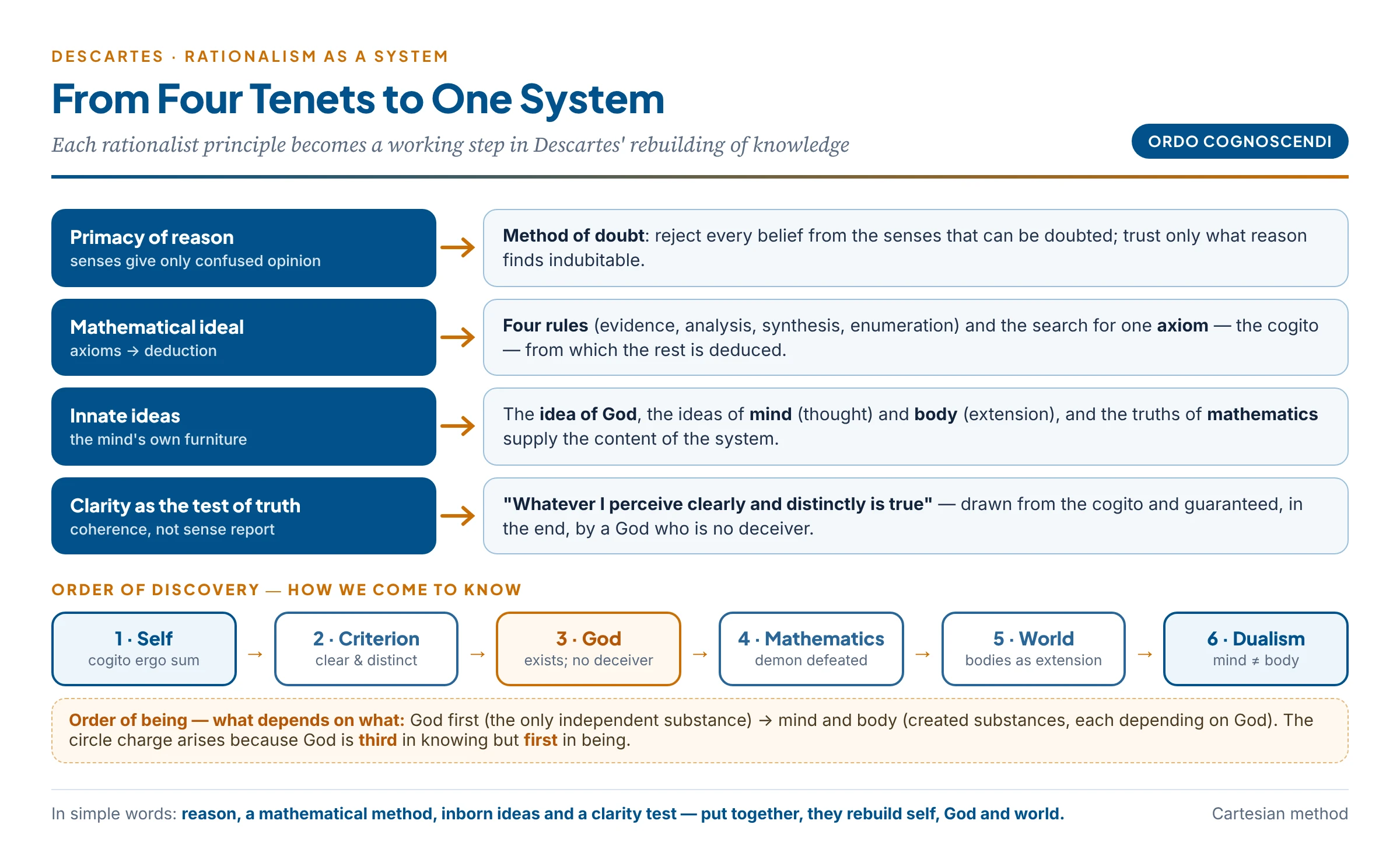
Descartes’ method takes the four tenets of rationalism and turns them into a system. Primacy of reason becomes the rule of evidence and the method of doubt; the mathematical ideal becomes the search for one axiom — the cogito — from which everything is deduced; innate ideas supply the content (God, mind, extension); and clarity and distinctness become the test of truth. The order of discovery runs self → God → mathematics → external world → mind–body dualism, while the order of being runs God → mind and body.
The foundation is weaker than it looks. The cogito proves that thinking occurs but not, without further assumptions, a thinking substance; the criterion of clear and distinct ideas needs God, and God needs the criterion. Yet the destructive part of Descartes’ work changed philosophy for good: after him, philosophy asks first how we know before asking what there is, and the first-person standpoint became a permanent part of the Western mind.
- Science and critical thinking: accept nothing on authority; break problems into parts; test before you trust.
- Philosophy of mind: the question “what is a mind?” and the asymmetry between inner certainty and outer knowledge still drive debates on consciousness and artificial intelligence.
- Media literacy: the evil-demon hypothesis lives on in “brain in a vat” thought experiments and in today’s worry about deepfakes and simulated realities — how do we know what is real?
Descartes doubted everything in order to doubt nothing — and found that the one thing doubt cannot reach is the doubter.
Previous Year Questions
- 2025What are the basic tenets of Rationalism? How does Descartes build a system of Philosophy in consonance with them? Discuss.
- 2025How is Husserl’s account of “I think” different from that of Descartes? Critically discuss.
- 2023Discuss Descartes’ theory of innate ideas and the grounds on which Locke refutes it.
- 2022How does Rene Descartes explain the notion of certainty with reference to knowledge of the self? Critically discuss the way it differs from the knowledge of the world.
- 2017What according to Descartes is a clear and distinct idea? What is the epistemological status of clear and distinct ideas? Does this account help Descartes prove that material objects exist? Explain.
- 2016Examine Kant’s criticism on Descartes’ view of Self.
- 2015Does Descartes cogito principle entail that he is an essentialist? Discuss.
- 2013Explain Descartes’s method of doubt. Can this method be used to justify his belief in the existence of God? Argue your case.
- 2012How does Descartes’ ‘cogito ergo sum’ affect Hume and Kant’s transcendental philosophy? Explain.
- 2004“I think, therefore I am.” Short notes.
- 2001Descartes’ method of philosophy.
- 1997“I think, therefore I am.” Notes.
- 1996“I think, therefore I am.” Notes.
- 1990Descartes’ method of doubt. Notes.