

Plato and Aristotle: Ideas; Substance; Form and Matter; Causation; Actuality and Potentiality.
Official Syllabus: Paper I, Section A, Unit 1
Aristotle’s doctrine of the four causes (aitia) holds that to know a thing scientifically is to know why it is as it is, and that “why?” has four distinct answers: what it is made of (material cause), what it is (formal cause), what produced it (efficient cause), and what it is for (final cause). The doctrine gathers up his whole metaphysics — matter and form, potentiality and actuality, nature as goal-directed — into one theory of explanation. Its most distinctive and most disputed feature is teleology: the claim that nature, like art, acts for the sake of an end.
In simple words
Ask “why is there a chair here?” and you can get four honest answers — because there was wood, because it has a chair’s design, because a carpenter made it, and because someone needed something to sit on. Modern science usually keeps only the third; Aristotle insists all four are needed for full understanding.
Context & Problem
Earlier Explanations Were Partial
- The Ionian physicists (Thales: water; Anaximenes: air) looked only for the material cause.
- Empedocles (Love and Strife) and Anaxagoras (Mind) added a moving cause, but used it inconsistently.
- Plato stressed the formal cause (the Forms) and, in the Timaeus, the Good as an end — but his Forms could not move anything.
- The atomists explained everything by matter in motion and necessity — no room for purpose.
- Aristotle’s claim: each predecessor glimpsed one of the causes; a complete explanation needs all four.
What Aitia Means
Common confusion
Is Aristotle’s “cause” the same as our “cause”? Not quite. Today a cause usually means an earlier event that makes a later one happen. Aristotle’s word aitia is wider: it means a reason, a because — anything that correctly answers “why?” That is why “what it is made of” and “what it is for” can both count as causes.
- Knowledge requires causes: “men do not think they know a thing till they have grasped the ‘why’ of it (which is to grasp its primary cause)”. The popular form: “We think we know a thing when we can explain its cause.“
- Science and wisdom: science is the knowledge of causes, pursued for its own sake — the highest achievement of a civilisation. Metaphysics goes further: it is wisdom, the knowledge of the first and most universal causes, and above all of the final cause of all things. So Aristotle’s view of causation is metaphysical: he seeks the first and final cause of the universe, not just the cause of this or that event.
Why He Starts from the Craftsman
- Aristotle reads the four causes off human production — the making of a chair, a table or a statue — because he assumes that human and cosmic (natural) production are of the same nature. What is true of the carpenter is true, in an unconscious way, of the growing plant.
Core Doctrine
1. The Four Causes
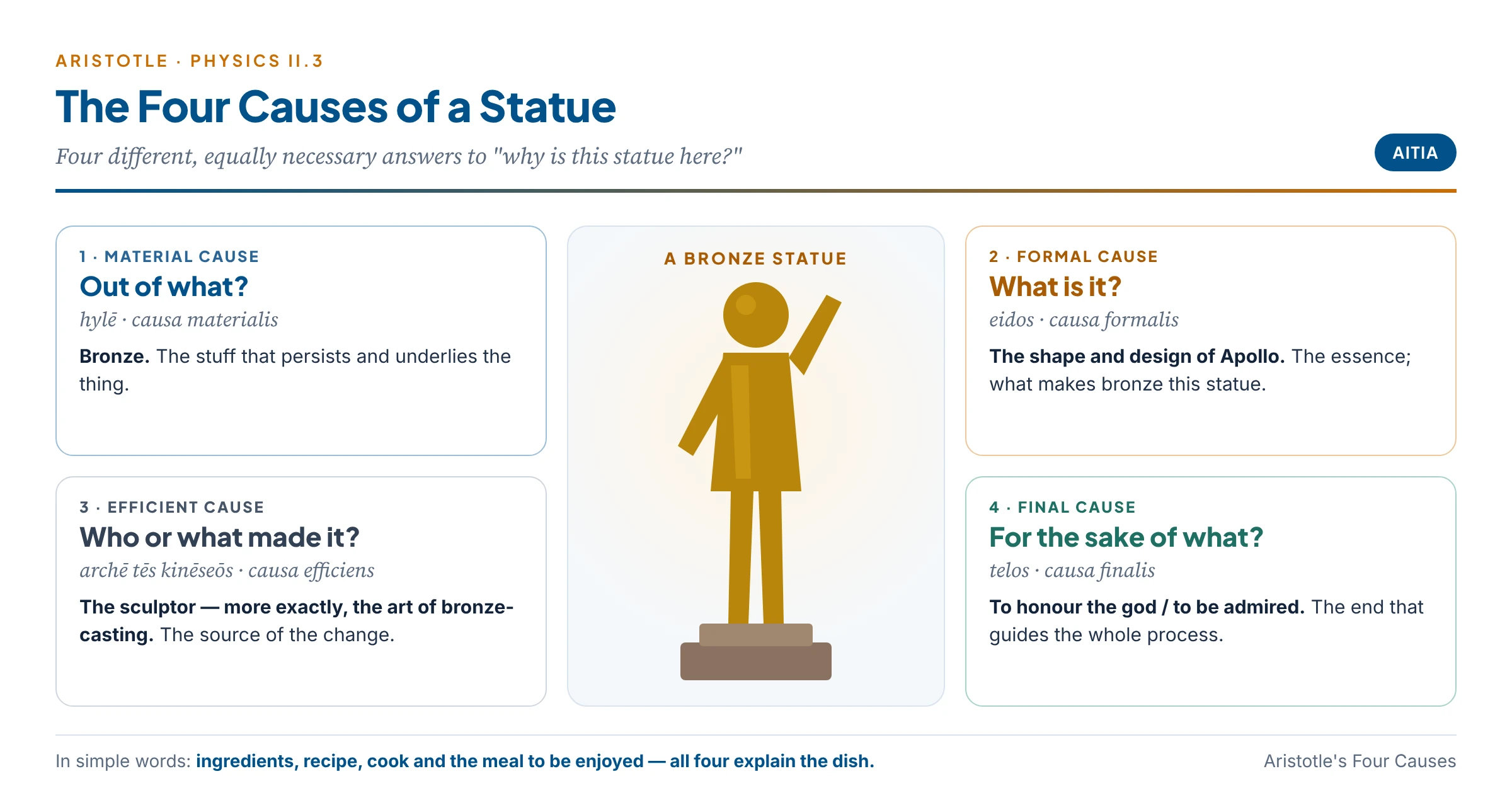
| Cause | Question it answers | Statue | Oak tree | Human being |
|---|---|---|---|---|
| Material (hylē, causa materialis) | Out of what? | Bronze | Wood, sap, the elements | Flesh, bones (from the mother) |
| Formal (eidos, causa formalis) | What is it? | The shape / design of Apollo | The form “oak” | Rational animal (the soul) |
| Efficient (causa efficiens) | From where did change begin? | The sculptor, the art of casting | The parent oak | The father (Aristotle’s biology) |
| Final (telos, causa finalis) | For the sake of what? | To honour the god | Being a mature, flourishing oak | Living well (eudaimonia) |
- Material cause: the stuff that persists and underlies the thing — the bronze of the statue, the letters of a syllable, the premises of a conclusion.
- Formal cause: the essence, the account (logos) of what the thing is — the ratio 2:1 of the octave, the design of the house.
- Efficient cause: the source of change or rest — the adviser of an action, the father of a child, the art of building rather than merely the builder (the art is the more precise cause).
- Final cause: the end, “that for the sake of which” — health is the end of walking, slimming, drugs and surgical instruments.
In simple words
Material = ingredients; formal = recipe; efficient = cook; final = meal to be enjoyed.
The classroom examples
| Cause | Chair | Curd | Marble statue | House |
|---|---|---|---|---|
| Material | Wood | Milk | Chunk of marble | Bricks, timber |
| Formal | Shape, size, design — the idea of the chair in the carpenter’s mind | The form of curd | The form of the statue in the artist’s mind | The blueprint |
| Efficient | Carpenter, his skill, tools and motion | The souring of milk | The sculptor’s chipping | The builder building |
| Final | An office chair, a resting chair, a chair for the living room | Food | To beautify the place | Shelter for people and goods |
- All four are present together: in Aristotle all four causes are simultaneously present and work together; in modern science causes are taken one by one, as a chain of antecedents.
- Four questions to ask of anything: What is it made of? What is it? Who or what made it? For what end?
Four kinds of change brought about by the efficient cause
- Substantial — a thing comes into being or passes away.
- Qualitative — one quality changes into another (alteration).
- Quantitative — increase or decrease (growth and diminution).
- Locomotion — change of place.
2. Kinds and Levels of Cause
- Proper and coincidental: the sculptor is the proper cause of the statue; “Polyclitus” or “a pale man” is the cause only coincidentally (it happens that the sculptor is Polyclitus).
- General and particular: “a doctor” heals generally; “this doctor” healed this patient.
- Potential and actual: a builder is the cause of the house potentially; a builder building is the cause actually.
- Simultaneity of actual causes: actual causes exist and cease together with their effects — this builder building is cause of this house being built exactly while it happens.
- Mutual causes: exercise is the efficient cause of health, health the final cause of exercise.
3. The Reduction: Four Causes to Two
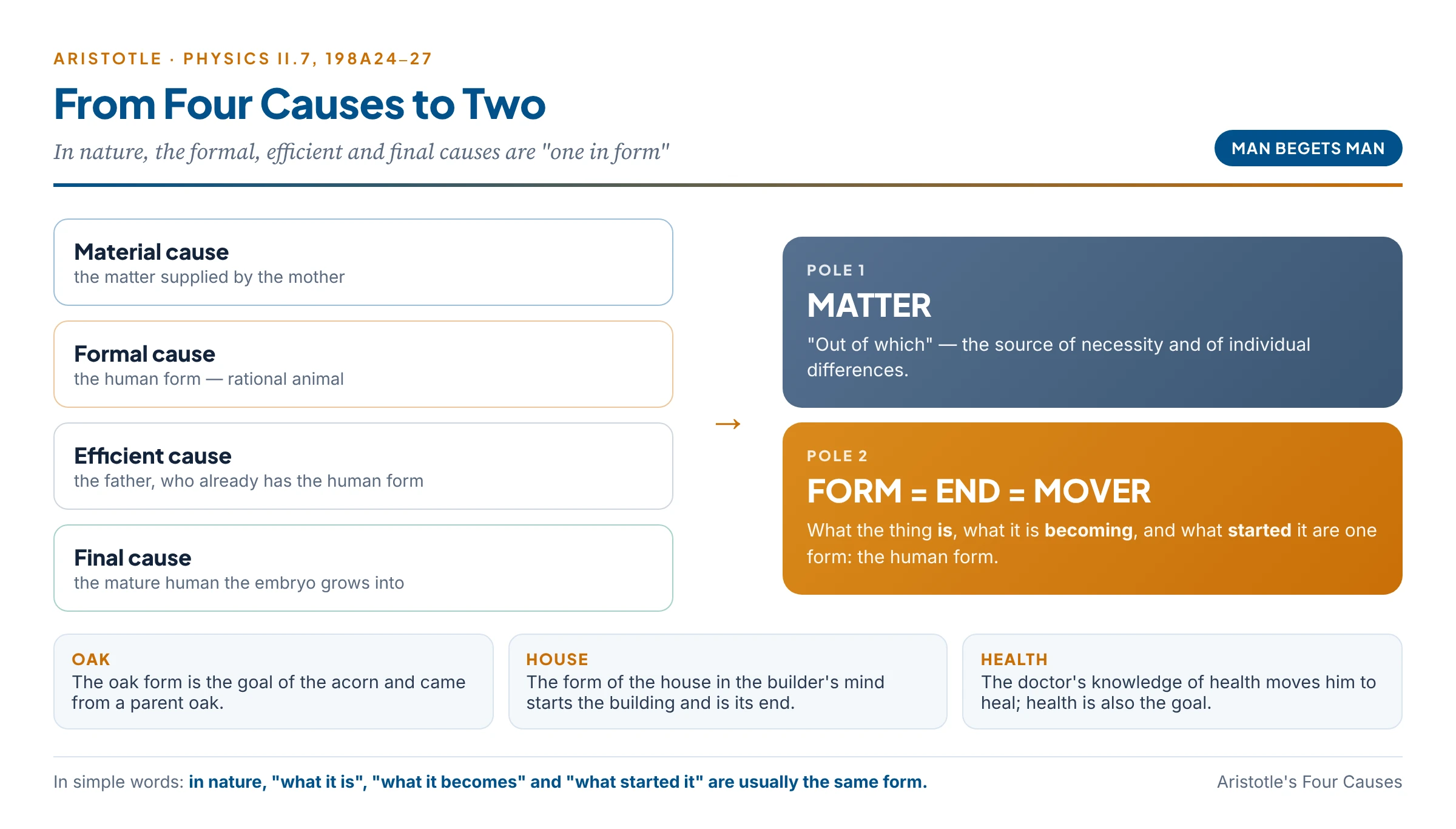
- In natural things, three of the four causes often coincide: the formal, efficient and final cause are “one in form”.
- “Man begets man”: the form a child will reach (a mature human) is also the goal of its development, and the source of the process is a mature human (the father) who has that same form.
- So causes reduce to two: matter on one side; form (which is also end and mover) on the other — the doctrine of form and matter applied to explanation.
- Formal = final: the formal cause is what the thing is going to be; the final cause is that same form as the end reached. “The end is the real beginning.“
- Final = efficient: the wood is cut and shaped so that a chair may be made — the end guides and regulates the efficient cause. The final cause is the drive behind the efficient cause.
Common confusion
Do the causes reduce to “material and final” or “material and formal”? Notes give both versions. They say the same thing: matter on one side, and form-as-end on the other — because in nature the form a thing reaches is also its end and its moving source.
- In living things the formal, efficient and final causes meet in the soul (psychē): the soul is the form of the organism, the source of its motion and the goal of its growth.
In simple words
In nature, “what a thing is,” “what it is becoming,” and “what started it” are often the same thing — the oak’s form is the goal of the acorn and also came from a parent oak.
- Significance of form and matter in causation: hylomorphism supplies the two poles of explanation — matter as the “out of which” and the source of necessity, form as the “what,” the “for which” and, in nature, the “by which.”
- Aristotle and his predecessors: the Ionians saw only the material cause; Plato made the Idea the formal and final cause; Aristotle keeps both matter and form-as-end.
Significance of the doctrine
- It explains being and becoming — what persists and what is gained in change.
- It reconciles matter and form, Democritus and Plato.
- It gives a logical explanation of change through potentiality and actuality.
- It gives a teleological explanation of the world as a whole.
- Russell’s verdict: “This doctrine is optimistic and teleological: the universe and everything in it is developing towards something continually better than what was before.”
4. Teleology: Nature Acts for an End
- The thesis: natural processes, like crafts, occur for the sake of something — teeth grow sharp in front for biting and broad at the back for chewing.
Against Empedocles’ “survival by chance”: Empedocles suggested that animal parts formed by chance and only those that happened to fit survived. Aristotle replies:
- Chance results are rare; natural outcomes happen always or for the most part.
- What happens always or for the most part is not by chance.
- So natural regularities that benefit the organism are for the sake of that benefit.
Common confusion
Does Aristotle say rain falls in order to make crops grow? No. Rain falls by material necessity — warm air rises, cools and turns to water. That it helps (or spoils) the crops is coincidental. Aristotle’s teleology is mainly about living things and their parts, not a plan for the whole cosmos.
- No conscious design needed: “it is absurd to suppose that purpose is not present because we do not observe the agent deliberating” — art does not deliberate either; a skilled shipbuilder does not stop to think. If the art of shipbuilding were in the wood, it would produce ships by nature.
- Hypothetical necessity: matter is necessary for the end, not the end for the matter — if there is to be a saw that cuts, then it must be of iron. Necessity lies in the matter; the reason lies in the end.
5. Chance and Spontaneity
- Chance (tychē): a man goes to the market to buy food and by chance meets his debtor and collects the money. The outcome could have been an end (had he gone for that purpose), but it was not aimed at.
- Spontaneity (to automaton): the wider class, including non-rational beings — a falling stone happens to strike someone; a horse wanders and happens to reach safety.
- Chance presupposes purpose: chance is a coincidental cause among things that could be for an end. So chance cannot be prior to purpose; nature and intelligence are prior to chance and spontaneity.
6. Causes as Processes and the Identity of Substance
- Causation happens in a single process: the activity of the agent and the change in the patient are one and the same motion, described from two sides — teaching is in the learner; the road from Thebes to Athens is the same road as from Athens to Thebes.
- Causes are activities, not events in a chain: the cause is the builder building, simultaneous with the house being built — not a prior event followed by a later one.
- Identity through change: what remains the same across a process is the substance’s form/essence (Socrates stays a man while growing, learning and ageing) and its matter as substratum; what changes are its accidents.
Are they in consonance? Largely yes:
- Processes are of an enduring subject and toward its form; identity is the condition of causal processes, and processes are the realisation of identity (the acorn becomes more fully an oak).
- Tension: if a substance is constantly being actualised, is its identity fixed or developing? Aristotle answers that the form is fixed while its realisation grows — the identity is that of a kind unfolding in an individual.
7. Aristotle and the Modern Notion of Causation
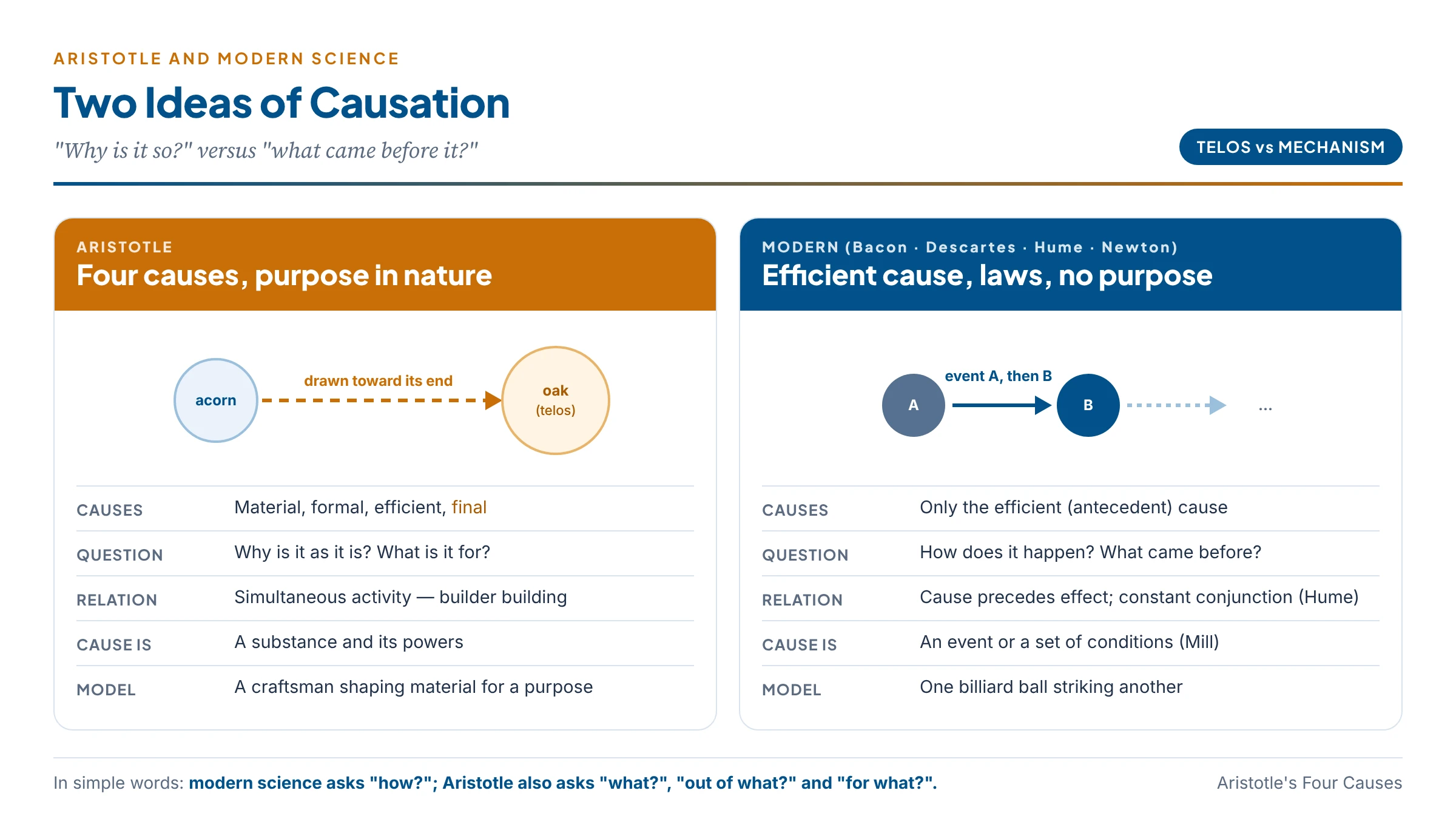
| Point | Aristotle | Modern (Bacon, Descartes, Hume, science) |
|---|---|---|
| Number of causes | Four — material, formal, efficient, final | Essentially one — the efficient (antecedent) cause |
| Question | Why is it as it is? | How does it happen? What precedes it? |
| Purpose in nature | Yes — final causes in living things | No — final causes banished from physics |
| Cause–effect relation | Simultaneous activity (builder building) | Cause precedes effect in time |
| What a cause is | A substance or its powers | An event or set of conditions |
| Necessity | Rooted in natures and essences | Hume: only constant conjunction + habit of mind |
| Form of explanation | Qualitative, by kinds and ends | Quantitative, by mathematical laws |
| Scope | The world as a whole — the perennial problem of being and becoming | Particular types of events only |
| Meaning of “matter” | Not physical matter; used relatively and non-uniformly | Physical matter obeying the laws of science |
| Nature seen as | Organic — living, purposive | Mechanical |
| Ultimate cause | The Unmoved Mover, cause of all motion | No prime mover |
| Testability | Largely beyond verification | Must meet empirical verification (the logical positivists’ demand) |
| Model case | A craftsman making a statue | A billiard ball striking another |
- In one line: Aristotle’s causation is metaphysical and teleological, science’s is empirical and mechanical; Aristotle asks why, science asks how.
- Bacon: inquiry into final causes is “like a virgin consecrated to God — it bears nothing.”
- Descartes and Spinoza: final causes are hidden in God’s will or are human projections; physics needs only extension and motion.
- Hume: we never observe necessary connection — only priority, contiguity and constant conjunction; causation is a habit of expectation.
- J. S. Mill: the cause is the sum of conditions, positive and negative, given which the effect invariably follows.
- Russell: the law of causality is “a relic of a bygone age, surviving, like the monarchy, only because it is erroneously supposed to do no harm”; mature physics uses functional equations, not causes.
8. What Survives of Aristotle’s Causes
- Formal cause as structure: chemistry and molecular biology explain properties by arrangement (DNA sequence, crystal lattice) — a form-like explanation.
- Final cause as function: biology still asks “what is it for?” — the heart is for pumping blood; evolutionary biology reinterprets this as teleonomy (goal-directedness produced by natural selection, without conscious purpose).
- Material cause: still essential — explanation in materials science and medicine starts from composition.
- Causal powers: contemporary metaphysics of dispositions treats causes as the exercise of powers of things — closer to Aristotle than to Hume.
- In short: modern science keeps the efficient cause in full, reads the material cause as composition and the formal cause as structure, and keeps the final cause only as function in biology and systems theory (goal, adaptation, feedback). Examples Aristotle would recognise: the eye is for seeing; the acorn’s end is the oak.
Critical Evaluation
Critics and Defenders
Criticism — Weaknesses
- Anthropomorphism: attributing ends to non-conscious nature projects human purposes onto stones and seeds.
- Explanatory emptiness: “the acorn grows into an oak because it has the form of an oak” can sound circular — Molière’s “dormitive virtue.”
- Physical science: the move from qualitative ends to quantitative laws (Galileo, Newton) made modern physics possible precisely by dropping final causes.
- Unmoved Mover: as the final cause of the whole cosmos, it explains motion only by a metaphor of love and desire.
- Rejected by modern science: Aristotle claimed a scientific method, yet science explains by mechanism, not ends; final causes now look anthropomorphic or redundant.
- One-directional: the scheme runs only from cause to effect towards an end; it does not account for negative instances — failures, deformities, processes that miss their end.
- Hard to apply: because form and matter are fluid, relative terms, it is often unclear what counts as the material or formal cause at a given level.
- From other quarters: Platonists object that form confined to particulars loses its universality; empiricists reject innate essences and prefer sensory experience and mechanical causation; modern science dismisses final causes and keeps only efficient causation.
Defence — Strengths and replies
- Comprehensive: it distinguishes kinds of explanation that later thought often confuses.
- Fits biology: organisms really do have parts for functions; Darwin himself admired Aristotle as a naturalist.
- Fits human action: intentions and goals are genuine causes of what people do; the social sciences still explain by purposes.
- Reply to the critics: much of the criticism targets cosmic teleology or conscious design, which Aristotle did not claim; his teleology is immanent (within organisms) and non-intentional.
Cross-Tradition Comparison
Aristotle and the Sāṃkhya Theory of Causation
| Point | Aristotle | Sāṃkhya |
|---|---|---|
| Theory | Four causes; change = potential → actual | Satkāryavāda — the effect pre-exists in the cause |
| Is the effect new? | The actuality is new; it pre-exists only potentially | No — only manifestation (āvirbhāva) of what was latent |
| Material cause | Matter (hylē) | Prakṛti — the one material cause of the world |
| Efficient cause | Agent / art / parent | Disturbance of the guṇas by the proximity of puruṣa |
| Final cause | Form as end; the Unmoved Mover | The world exists for the sake of puruṣa — for its experience (bhoga) and liberation (apavarga) |
| Teleology | Immanent, non-conscious (nature like art) | Unconscious prakṛti acts for puruṣa, like milk flowing for the calf |
| Arguments | Regularity of nature; man begets man | Five arguments of the Sāṃkhya Kārikā: asadakaraṇāt (the non-existent cannot be produced), upādānagrahaṇāt (a definite material is needed), sarvasambhavābhāvāt (not everything comes from everything), śaktasya śakyakaraṇāt (a cause produces only what it can), kāraṇabhāvāt (the effect is of the nature of the cause) |
Indian Connect
- Striking parallel: both hold an unconscious teleology — Aristotle’s nature acting like an art that does not deliberate; Sāṃkhya’s prakṛti acting for puruṣa like milk flowing to nourish the calf.
- Key difference: Sāṃkhya makes the effect already existent in the cause; Aristotle makes it potentially existent — which allows him to call the result genuinely new.
Aristotle and Other Indian Theories
| Point | Aristotle | Nyāya-Vaiśeṣika | Buddhism | Advaita Vedānta |
|---|---|---|---|---|
| Effect | New actuality | New creation (asatkāryavāda, ārambhavāda) | Momentary, dependent arising (pratītyasamutpāda) | Appearance (vivartavāda) |
| Causes | Material, formal, efficient, final | Samavāyi (inherent), asamavāyi (non-inherent), nimitta (efficient) | Conditions (pratyaya), no enduring agent | Brahman as both material (upādāna) and efficient (nimitta) cause |
| Purpose | Form as end | Īśvara’s design (efficient cause) | None in nature | Līlā (play), not need |
Indian Connect
- Nyāya’s three causes map closely onto three of Aristotle’s: threads (inherent / material), their conjunction (non-inherent, akin to form-as-arrangement), the weaver (efficient). Nyāya has no formal cause as essence and places purpose in Īśvara, not in nature.
- Advaita: Brahman is both the material and efficient cause of the world (abhinna-nimittopādāna-kāraṇa) — like Aristotle’s coinciding causes, but with the world as appearance.
Synthesis (Siddhānta)
The four causes are not four rival theories but four kinds of question, each with a legitimate answer. Aristotle’s reduction of the causes to matter and form, and his immanent, non-conscious teleology, make the doctrine a theory of how natures explain things. Modern science narrowed causation to the efficient cause and gained mathematical power; but the other three keep returning — as composition in chemistry, as structure and information in biology, as function in physiology and as purpose in the explanation of human action.
- Environmental thought: seeing organisms and ecosystems as having their own ends grounds arguments for respecting nature beyond human use.
- Design and technology: engineers routinely reason with all four causes — materials, design, manufacture, purpose.
- Ethics: Aristotle’s ethics rests on the final cause of human life — flourishing (eudaimonia) as the activity of reason.
Science asks how; Aristotle insists we also ask what, out of what, and for what — and only all four together tell us why.
Previous Year Questions
- 2022Is Aristotle’s view of nature of identity in consonance with his metaphysical view of causes as processes? Discuss giving suitable examples.
- 2014Explain the significance of Aristotle’s doctrine of form & matter in his theory of causation.
- 2010How does Aristotle’s notion of causation differ from the modern notion of causation?
- 2009Compare Aristotle’s view regarding causation with that of the Sāṃkhya school’s view of causation.
- 2008Write short notes on: Aristotle’s teleological conception of causation.