

Plato and Aristotle: Ideas; Substance; Form and Matter; Causation; Actuality and Potentiality.
Official Syllabus: Paper I, Section A, Unit 1
Actuality (energeia, entelecheia) and potentiality (dynamis) are Aristotle’s tools for explaining becoming. Something that changes was already, in a definite way, able to be what it becomes: the acorn is potentially an oak, the oak is actually an oak. Change is neither creation from nothing (which Parmenides rightly denied) nor mere illusion (as Parmenides wrongly concluded); it is the actualisation of a potentiality. The pair also orders the whole universe — from bare potential matter at the bottom to the Unmoved Mover, pure actuality, at the top.
In simple words
A sleeping mathematician still knows mathematics — the knowledge is there, but not in use. When she wakes and solves a problem, the same knowledge becomes active. “Potential” is real ability not yet exercised; “actual” is that ability at work or fulfilled.
Context & Problem
The Problem of Being and Becoming
- Parmenides: what is, is; what is not, is not. Becoming would mean what-is-not turning into what-is — impossible. So change is illusion.
- Heraclitus: everything flows; there is only becoming, nothing stable to know.
- Plato: assigns being to the Forms and becoming to the sensible world — but leaves becoming unexplained.
- Aristotle: there is a third status between full being and sheer non-being — being potentially. What becomes an oak was not nothing before; it was an acorn — potentially an oak. Being and becoming are reconciled. Form-and-matter tells us what changes; potentiality-and-actuality tells us why and how it changes.
Four Jobs the Doctrine Does
- Bridges Plato’s dualism of Form and matter — they become two stages (potential and actual) of one thing.
- Explains becoming, which Plato neglected.
- Gives a theory of nature — a graded, developing order of beings.
- Establishes God — the series of actualisations must end in a pure actuality.
The Megarian Challenge
- The Megarians held that a thing has a capacity only when it is exercising it: the builder who is not building cannot build.
- If they were right, there would be no unexercised abilities, no unrealised potentials — and therefore no way to describe change as the realising of potentials. Aristotle’s doctrine is built partly as an answer to them.
Core Doctrine
1. The Vocabulary
Dynamis has two senses:
- Capacity / power — the ability to produce or undergo change (the builder’s skill; wood’s ability to be cut).
- Potentiality-for-being — the way bronze is potentially a statue, or a child is potentially an adult.
- Energeia — literally “being-at-work”: the exercise of a capacity or the realised state.
- Entelecheia — a word Aristotle coined, roughly “having-its-end-within”: the completed state in which a thing has reached its end (telos). The two terms are often used interchangeably; entelecheia stresses completion, energeia stresses activity.
In simple words
dynamis is “can,” energeia is “is doing,” entelecheia is “has arrived.”
Simple definitions
- Potentiality = possibility and uncertainty — what a thing is capable of doing or undergoing, if conditions are right and nothing prevents it. The seed in the soil is potentially a plant and, unless something prevents it, will become one. Matter by itself is formless and purposeless, but it is not non-being: it can become anything through the generating principle of form.
- Actuality = purpose, action, energy — the fulfilment of the end at which the potentiality aims. A plant is actual when it does what plants do.
- The clay and the potter: clay by itself is “nothing,” yet it can become a brick, a box or a cooking pot — that capacity is its potentiality. The potter, with the idea of a brick in mind and skill in his hands, shapes the indeterminate clay into actual bricks. So form is the principle of actualisation: “matter is the potentiality, and form is the actualisation of this potentiality.”
2. Why Potentiality Cannot Be Defined
- Aristotle says actuality and potentiality cannot be defined — they are too basic; there is nothing more fundamental to define them by. They must be grasped by analogy across cases.
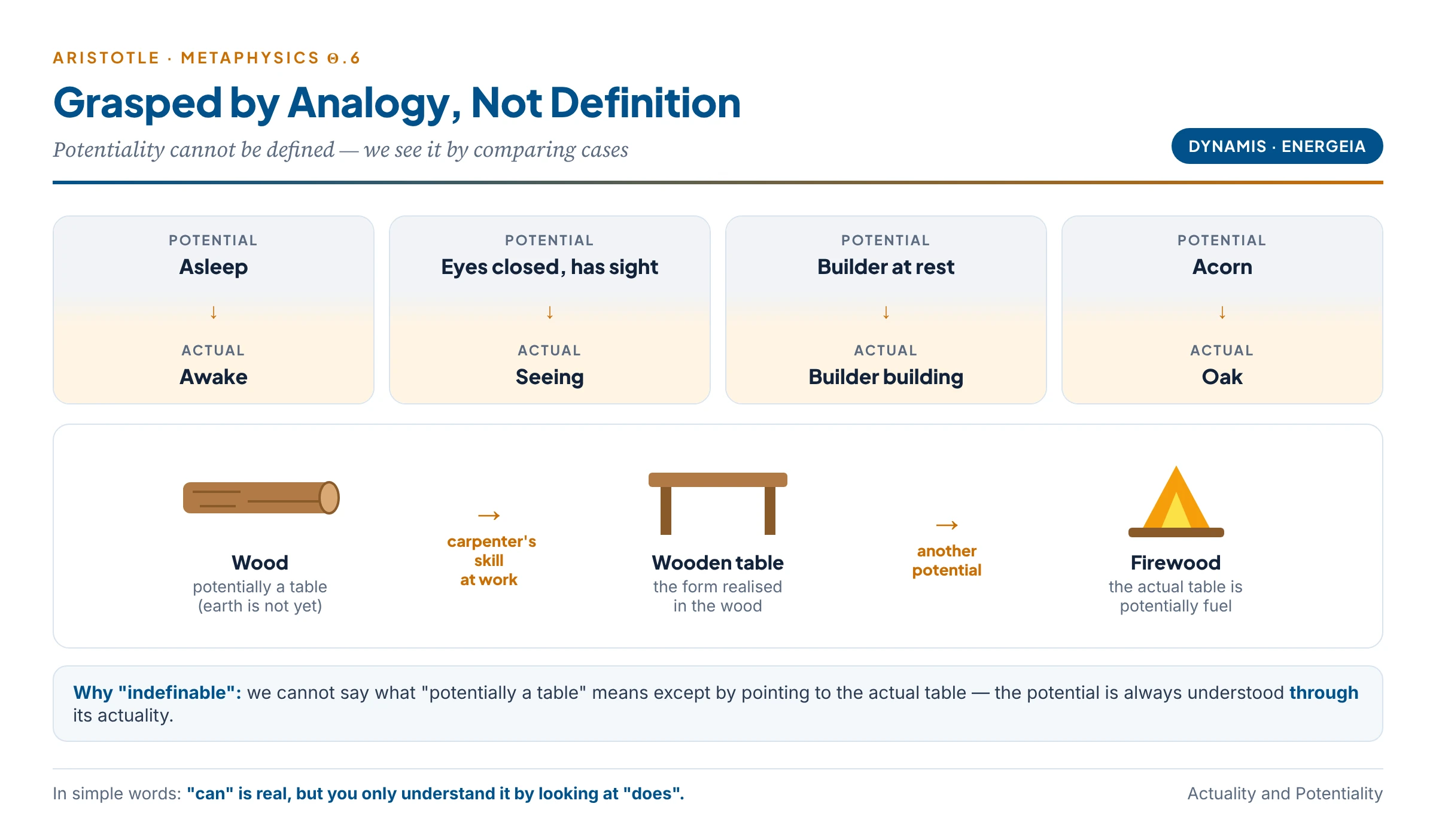
| Potential | Actual |
|---|---|
| Asleep | Awake |
| Eyes closed (but has sight) | Seeing |
| Builder not building | Builder building |
| The unworked wood | The wooden table |
| The acorn | The oak |
The wooden table:
- The wood is potentially a table — it can take the table’s form; stone or water cannot in the same way.
- The carpenter’s skill is an active potentiality; it becomes actual in making.
- The finished table is the actuality — the form realised in the wood.
- The table is itself potentially firewood or a bench — actuality at one level is potentiality at another.
- We cannot say what “potentially a table” means except by pointing to the actual table — which is exactly why potentiality is understood only through its actuality.
Common confusion
Is “potentially X” the same as “possibly X”? No. It is logically possible for earth to become a table, but earth is not yet potentially a table. Something is potentially X only when nothing more is needed except the normal agent or conditions — the seed in the soil is potentially a plant; the earth is not.
3. Against the Megarians
If a capacity existed only while exercised:
- A builder would stop being a builder every time he put down his tools — and would have to relearn his art each time he began.
- A person with eyes closed would be blind, and would become blind and sighted many times a day.
- Nothing would be hot or sweet unless someone was perceiving it.
- Motion and coming-to-be would be impossible: what is standing could never walk, since it lacks the capacity to walk until it is walking.
- Conclusion: capacities are real and persisting even when idle; potentiality is a genuine way of being.
4. Kinds of Potentiality
- Active and passive: the power to act (fire’s power to heat) and the power to be acted on (wood’s power to burn).
- Non-rational (one-way): fire can only heat; it cannot choose to cool.
- Rational (two-way): the doctor’s art can heal or harm — which one is realised depends on desire and choice. This is the root of Aristotle’s account of human responsibility.
- Innate and acquired: senses are innate; skills and virtues are acquired by practice — we become builders by building, just by doing just acts.
5. First and Second Actuality
Aristotle distinguishes levels:
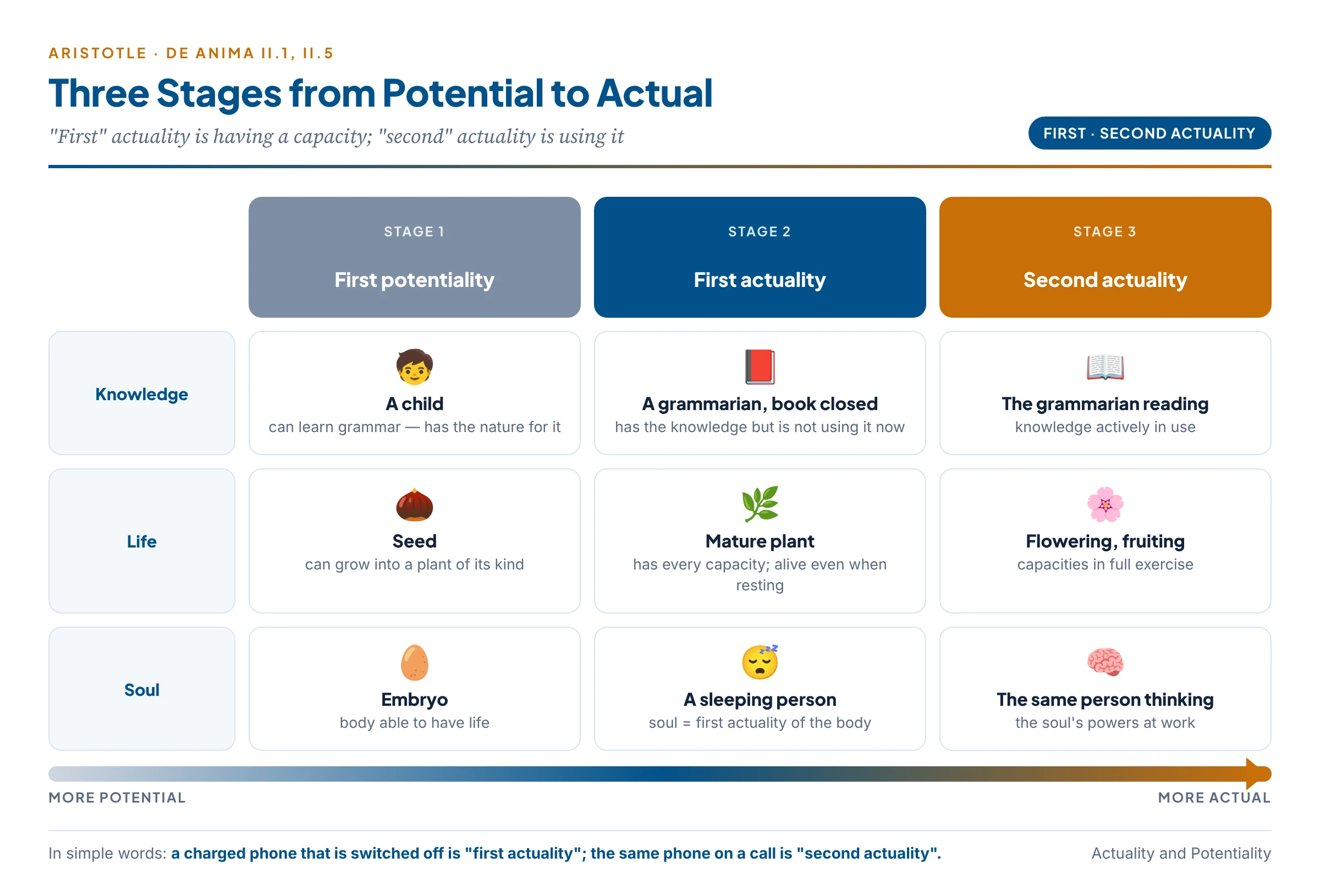
- First potentiality — a child can learn grammar (has the nature for it).
- First actuality (= second potentiality) — the grammarian has the knowledge but is not using it now.
- Second actuality — the grammarian is actually reading, using the knowledge.
- Why it matters: the soul is the first actuality of the body — a sleeping person is still alive and still has a soul, though not every capacity is in use.
In simple words
A phone that is switched off but charged is “first actuality”; a phone making a call is “second actuality”; a phone still in parts at the factory is mere potentiality.
6. Motion versus Activity (Kinēsis and Energeia)
- Motion defined: “the actuality of what is potentially, as such” — the building of a house is the actuality of the bricks as buildable; when the house is built, the motion is over.
Incomplete vs complete:
- A kinēsis (process) is incomplete at every moment; it aims at an end outside itself and stops when it reaches it — building, walking to the market, learning.
- An energeia (activity) is complete at every moment; its end is in itself — seeing, thinking, living well.
- The tense test: one is seeing and has seen at the same time, is thinking and has thought — but one cannot be building and have built the same house at the same time.
- Ethical consequence: happiness (eudaimonia) is an energeia — an activity of the soul in accordance with virtue, complete in itself, not a process aimed at something beyond it.
| Kinēsis (motion / process) | Energeia (activity) | |
|---|---|---|
| Completeness | Incomplete until it ends | Complete at every moment |
| End | Outside itself (the product) | Within itself |
| Tense test | “Is building” ≠ “has built” | “Is seeing” = “has seen” |
| Examples | Building, learning, walking | Seeing, contemplating, living well |
| Highest case | — | God’s thought thinking itself |
7. Entelechy — Aristotle and Leibniz
The 2026 paper asked candidates to compare and contrast the notion of entelechy in Aristotle and Leibniz. The word links this unit to Leibniz’s monadology (Paper I, Unit 2).
Entelechy in Aristotle
- The word: entelecheia — from en (in), telos (end) and echein (to have): “having one’s end within.” It names the state of completion in which a potentiality has reached its end.
- Form as entelechy: the form of a natural thing is its entelechy — the inner end that directs its growth (the oak in the acorn) and the completed state when growth is done.
- Soul as entelechy: the soul is “the first entelechy of a natural organic body” — the organised, living actuality of the body, present even in sleep.
- Framework: entelechy lives inside hylomorphism — it is always the actuality of matter; matter is the potential, entelechy the realised form. At the top is God, pure actuality with no potentiality.
Entelechy in Leibniz
- Revival of “substantial forms”: against Descartes’ view that body is mere extension, Leibniz set out to “rehabilitate substantial forms” — something besides extension must explain activity and unity.
- Monads as entelechies: “All simple substances or created monads might be called entelechies, for they have in them a certain perfection; there is a self-sufficiency in them which makes them the sources of their own internal actions — incorporeal automata, so to speak” (Monadology).
- Entelechy as force: in his dynamics, the entelechy is the primitive active force of a substance (the passive force is “primary matter”). It shows itself as appetition — each monad’s inner urge to pass from one perception to the next, from obscure to clear.
- Dominant entelechy: every living body has a dominant monad, its soul, which is the entelechy of that organism.
| Point | Aristotle | Leibniz |
|---|---|---|
| What entelechy is | The completed actuality of a potentiality; form realised in matter | An inner force or striving (appetition) that produces all of a monad’s states |
| Emphasis | The end achieved | The source of action — the present “pregnant with the future” |
| Relation to matter | Always the form of matter (hylomorphism) | Monads are immaterial, spiritual units; matter is only their appearance (phenomenon) |
| Where found | In each natural substance; the soul as entelechy of the body | In every simple substance — infinitely many entelechies, even in what looks inorganic |
| Nature | Biological and metaphysical | Metaphysical, psychological (perception) and dynamical (force) |
| Causal relations | Things act on one another (efficient causes) | Monads are “windowless“; no real interaction — pre-established harmony |
| Highest principle | Unmoved Mover — pure actuality, final cause, not creator | God — the monad of monads, creator and harmoniser |
| Change | Potential → actual under the pull of the end | Self-unfolding of the monad’s own programme from within |
- Similarities: both make entelechy an internal principle of activity and end-directedness; both reject mechanism as the whole truth and defend teleology; both treat the soul as the entelechy of the living body; both see nature as a graded continuum (Aristotle’s scale of nature; Leibniz’s law of continuity). Aristotle’s dynamic view of nature is often said to have inspired Leibniz’s monadology, and Leibniz’s appetition (each monad’s inner urge to develop) is compared to Aristotle’s ladder of increasing actuality.
- Key difference in one line: Aristotle’s entelechy is the fulfilment a thing reaches; Leibniz’s entelechy is the force a thing always is.
- Later echo: the biologist Hans Driesch (vitalism, early 20th century) used “entelechy” for a non-mechanical life-principle guiding development.
8. How the Doctrine Solves Being and Becoming
- Becoming is not from sheer non-being: a statue comes from bronze that is potentially a statue — something that already is (bronze) and is not yet a statue.
- Becoming is not illusion: potentiality and actuality are both real ways of being; the passage between them is real change.
- Continuity and novelty: the same thing persists (the acorn grows into the oak — one organism), yet something new is realised (the mature form).
- Knowability: since change runs from a definite potentiality to a definite actuality, it has a structure that science can grasp — answering Heraclitus.
9. Developmental Change in Substance
Why does a living thing grow and develop?
- Potentiality in matter — the seed or embryo has the capacity to become a mature organism of its kind.
- Form as the end — the mature form is the goal that directs the process; development is teleological (goal-directed), not random.
- Nature as an inner principle — physis is an internal source of motion and rest; unlike a bed, an oak grows itself.
- A prior actuality — an actual oak produced the acorn; “man begets man.” Development is always triggered by something already actual.
- Conditions and hindrances — soil, warmth and nourishment are needed; deformity and failure come from matter resisting form.
- Scale of nature: the whole cosmos is ordered from pure potentiality (formless matter) through elements, plants, animals and humans up to pure actuality.
The Doctrine of Unfoldment
- All things are caught up in development from the less developed to the more developed. It is the form that leads the unfoldment.
- The fertilised egg: the end of becoming a chick lies in the fertilised egg. The egg has the potentiality of becoming a chick, but it is actualised only when the form of the chick actualises itself in the egg — matter is being shaped into an actual chick. In an organism, matter and form, potentiality and actuality, work together inseparably.
- Two supports: Aristotle backs the doctrine by the presence of form in organisms (the embryo carries the form of its species) and by human production (artistic or ordinary making).
- More form, more actuality: the higher a thing stands, the more form and the less unrealised potential it has.
- Wholly teleological: unfoldment is directed to an end, not driven by chance. Aristotle’s picture invites comparison with Sāṃkhya’s prakṛti (which evolves what is latent in it), with satkāryavāda (the effect pre-exists in the cause), and with Sri Aurobindo’s Saccidānanda (involution and evolution). It also anticipates Hegel and Marx, for whom change is always a qualitative advance.
Conscious and unconscious teleology
- Conscious teleology — in human production: the potter changes clay into a pot with the purpose of holding water; the sculptor chisels marble deliberately.
- Unconscious teleology — in nature: the seed sown in soil grows into a tree without any plan in its mind. Aristotle compares divine (natural) production with human production and extends teleology to the whole of nature — but as unconscious teleology, not under the control of any mind.
The hierarchy of beings
- Individual men fall under the species man; the species under the class animal; that under living creature. In this graded order, each class is matter relative to the higher class, which is its form — the species “man” is form for individual men but matter for “animal.”
- The ladder: formless matter → nature (the elements) → plants → animals → human beings → higher beings → matterless form (actus purus). At the base there is potentiality without actuality; at the top actuality without potentiality.
- An eternal, moving ladder: the universe is eternal; every rung has its own form and every rung is in motion. The motion is not random but teleological — towards the Unmoved Mover. Pure potentiality, under the influence of the Prime Mover, is progressively actualised from lower to higher.
- Purpose of the universe: for Plato, the soul’s release from bondage; for Aristotle, the perfection (self-realisation) of each thing.
Aristotle’s “evolution” and modern evolution
| Point | Aristotle | Modern evolution (Darwin) |
|---|---|---|
| Species | Fixed and eternal | Arise, change and go extinct |
| Scope | Within a species (embryo → man, egg → chick) | Between species (common ancestry of apes and humans) |
| Explanation | Purely teleological; no mechanism | Mechanism: variation, natural selection, genetics |
| Ranking | By degree of rationality (arbitrary criterion) | By careful study of organs, locomotion, environment |
| Ultimate cause | An impersonal God at the top | No transcendent entity |
10. The Priority of Actuality over Potentiality
Actuality is prior in three senses:
- In definition (logos) — “able to build” can be defined only by reference to building; “visible” means “able to be seen.” The actual is needed to explain the potential.
- In time (with a qualification) — in one individual the potential comes first (acorn before oak); but in the species, an actual oak always comes before the acorn. There is always an actual being that makes the potential one actual: only an actual musician can train a pupil who was at first only potentially a musician; only an actual human begets a human; the potter first imagines the form, then shapes the clay. (Strictly, this prior form is not a free-floating “pure form” but the form already actual in another being.)
- In substance (ousia):
- The end is the reason for which the potentiality exists — animals do not see in order to have sight; they have sight in order to see.
- What is potential may or may not be; what is eternal cannot fail to be, so eternal things must be actual. Eternal things are prior in being to perishable things.
- The materials for a building are potentially a building; both the activity of building and the form of the finished building are actualities — and the finished form is the final cause that explains the whole process. “Everything that comes to be moves towards a principle, the end; and the end is actuality.”
In simple words
You cannot explain what a seed is without mentioning the tree; the seed exists for the sake of the tree, and some tree came first to produce it.
11. The Unmoved Mover: Pure Actuality
Aristotle’s metaphysics culminates in theology, which he calls the highest science because it studies the highest substance, being as such, and the universal cause of things.
The argument from motion (regress):
- If A is moved by B, B by C, C by D, and so on, the search for the cause of motion becomes an infinite regress (regressus ad infinitum), and nothing would ever explain the motion. So there must be a first mover that is not itself moved — an uncaused cause.
The argument from eternal motion:
- Motion is eternal (time has no beginning; there is no “before time”). The universe exists because there is never-ending activity in it.
- Eternal motion needs an eternal cause — and “eternal” means “that which by its own nature cannot fail to be.”
- If that cause had any potentiality, it might not act — and motion might stop.
- So the first cause must be a substance whose essence is actuality — without matter, without potentiality.
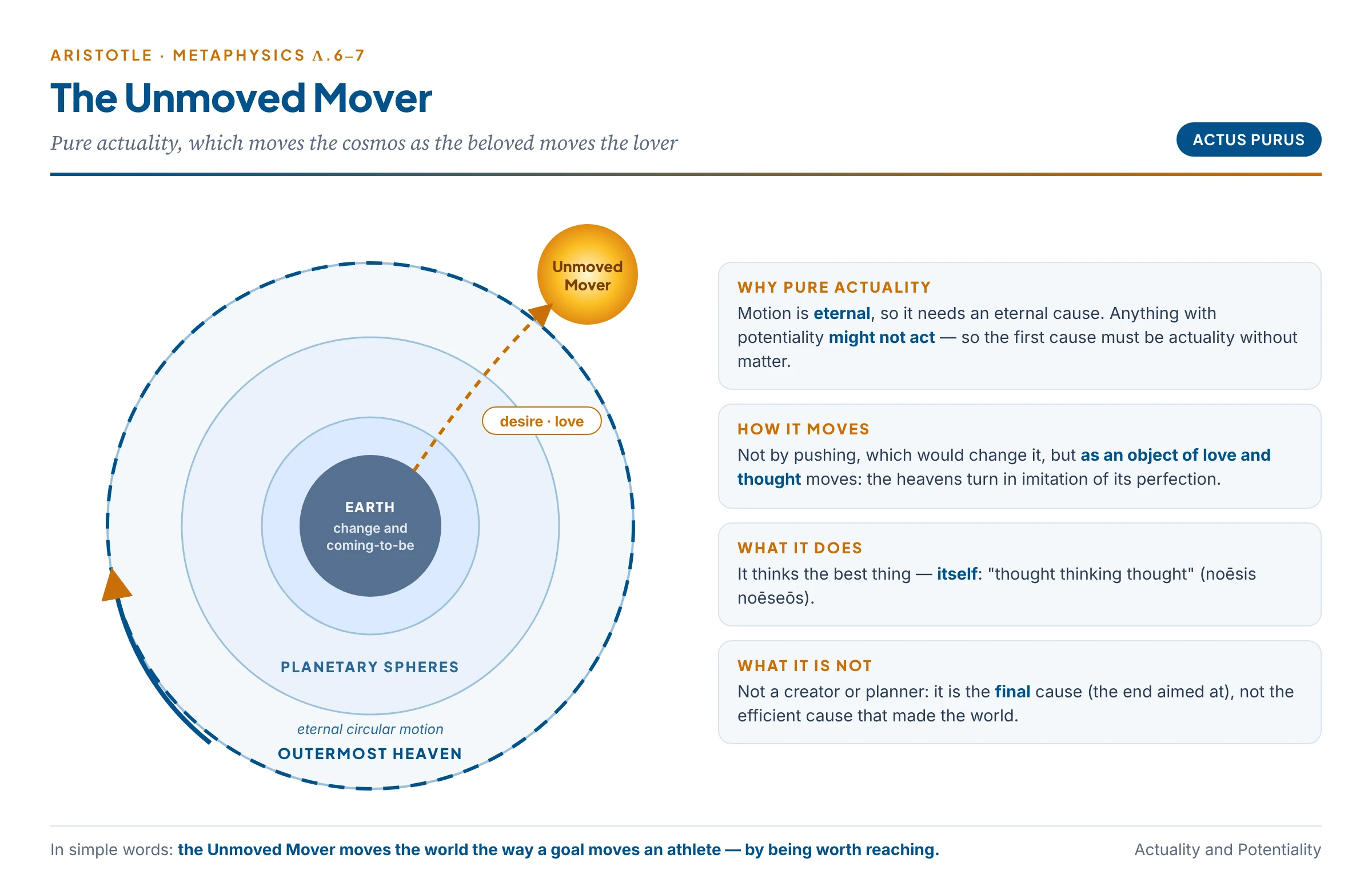
- How it moves: not by pushing (that would change the mover), but as an object of love and thought moves — “it moves by being loved” (kinei hōs erōmenon). The outermost heaven moves in eternal circular motion in imitation of its perfection.
- What it does: its activity is thinking, and since it must think the best thing, it thinks itself — “thought thinking thought” (noēsis noēseōs).
- Final, not efficient, cause: the Unmoved Mover is the end toward which the cosmos strives, not a craftsman who made it; it does not create, plan or attend to the world.
Features of Aristotle’s God
- Pure form, Form of forms, “Idea of Ideas” — unmixed with matter; complete actuality; substance par excellence. Its thought is intuitive and reflective: “it must be itself that thought thinks, and its thinking is a thinking on thinking.”
- Perfect and self-sufficient — it has nothing left to realise and no desire; it enjoys perfect blessedness; it is its own end.
- Apex of the world process — the world is an evolution in which lower forms give way to higher ones; God stands at the pinnacle. The variety of things comes from their different ratios of form and matter.
- Not a person — pure form lacks the particularity a person needs; to be a person God would have to admit matter. Aristotle’s God does not answer prayers; absorbed in its own thought, it is not the God of religion.
- Like Plato’s Good — immovable, unchangeable, the final cause of all things; “Actus Purus” is, in effect, Plato’s Idea of the Good rethought.
- One God — the idea gave the Western world a philosophical spiritual monotheism.
- Transcendent or immanent? The texts do not settle it. W. D. Ross reads Aristotle’s God as immanent; many others see it as transcendent, outside the heavens.
Common confusion
Is Aristotle’s God the efficient cause of the world? Many notes say God is the world’s efficient cause (giving matter its “initial push”), its formal cause (Form of all forms) and its final cause (the end of evolution). Aristotle’s own view is narrower: God is the final cause only. It moves the world “as the object of love,” without acting on it or changing. “Formal cause” fits only loosely, as the supreme form all things imitate. It is the Christian God of Aquinas, not Aristotle’s God, that creates the world.
How can an unmoved mover move?
- The lover analogy: just as a lover is moved by the sight of the beloved, all things move towards God. But this God is impersonal and unconcerned with its lovers — the world loves God without being loved back.
Indian Connect
In Sāṃkhya, prakṛti evolves in the mere presence of the inactive puruṣa, as iron moves near a magnet — a similar idea of moving without acting.
Proofs and influence
- Aristotle’s reasoning yields a cosmological argument (from motion to a first mover) and a teleological one (from order and purpose in nature).
- It shaped Thomas Aquinas (the first and second of his Five Ways), and the medieval and early modern theistic tradition (Anselm, Descartes) drew on the same ideal of a perfect, necessary being.
Critical Evaluation
Internal Difficulties
- Circularity: if potentiality is understood only through actuality, and actuality only by analogy, are the concepts doing explanatory work or just renaming the facts?
- Prime matter as pure potentiality: something that is only potential and in no way actual seems unintelligible — a potentiality must be the potentiality of something.
- The Unmoved Mover’s isolation: a God who thinks only of itself does not know or care for the world; it is hard to see how it can be the cause of the world’s order (later Aquinas fused it with a personal, creating God).
- Teleology: the claim that natural processes aim at ends sounds anthropomorphic — attributing purposes to seeds and stones.
- “Unconscious teleology” is a contradiction: purpose belongs only to conscious beings; an aim that no one aims at is hard to make sense of.
- Contradicts his own philosophy: substance is defined as inseparable form-in-matter, yet the ladder needs formless matter at the bottom and matterless form at the top — neither of which can exist on that definition. The two ends are at best logical limits, not realities.
- Cannot consistently attack Plato: if Actus Purus is so like the Idea of the Good, Aristotle’s criticism of Plato’s separate Form rebounds on his own God.
- Conflict of metaphysics and theology: God is brought in as an ontological stop-gap to end the regress, but the “temporary solution becomes a permanent problem” — how does a God that does nothing explain anything?
- Back to metaphor: Aristotle criticised Plato’s myths and metaphors, yet explains God’s causation through the analogy of the lover — poetic and mystical rather than precise.
- Religiously unsatisfying: a God that contemplates only itself cannot be worshipped, cannot love, and cannot answer prayer.
- Plurality and imperfection unexplained: a single perfect actuality does not explain why there are many things, nor why so much in nature falls short of its form.
- Transcendent or immanent? Aristotle never makes clear whether pure form (and pure matter) are beyond the world or within it.
Critics and Defenders
Criticism — Modern critics
- Mechanists (Descartes, Hobbes, Galileo): nature is matter in motion; explanation by “potencies” is empty — the target of Molière’s joke that opium puts people to sleep because it has a “dormitive virtue.”
- Hume: we never observe powers or necessary connections, only one event following another; “potentiality” is projected by the mind.
- Darwinian biology: apparent goal-directedness in organisms is explained by natural selection, not by forms pulling development toward an end.
Defence — Revival today
- Metaphysics of powers: contemporary philosophers defend dispositions as real, irreducible features of things — a return to Aristotle against Hume.
- Physics: the physicist Werner Heisenberg compared the quantum probability wave to Aristotle’s potentia — a real tendency between mere possibility and actuality, realised in measurement.
- Biology: development from genome to organism is often described as the realisation of a programme — a modern echo of potentiality guided by form; teleonomy recognises goal-directedness without conscious purpose.
- Ethics and policy: the capabilities approach of Amartya Sen and Martha Nussbaum (Nussbaum explicitly following Aristotle) judges societies by whether people can actualise their capabilities — health, education, practical reason — not just by income.
Cross-Tradition Comparison
Potentiality, Actuality and Indian Theories of Causation
| Point | Aristotle | Sāṃkhya | Nyāya-Vaiśeṣika | Buddhism | Sri Aurobindo |
|---|---|---|---|---|---|
| Does the effect exist before it appears? | Potentially, yes | Yes — latent in the cause (satkāryavāda) | No — a new creation (asatkāryavāda, ārambhavāda) | Neither: dependent arising (pratītyasamutpāda) | Yes — evolution unfolds what was involved |
| Change is | Potential → actual | Unmanifest (avyakta) → manifest (vyakta) | Parts combine into a new whole | Succession of momentary events (kṣaṇikavāda) | Spirit emerging from matter |
| Key image | Acorn → oak | Oil latent in sesame; curd in milk | Threads → new cloth | Flame-series | Involution → evolution |
| Highest principle | Pure actuality (Unmoved Mover) | Puruṣa (inactive witness) | Īśvara (efficient cause) | Nirvāṇa (no first cause) | Saccidānanda (Supermind) |
Indian Connect
- Closest parallel — Sāṃkhya: both deny that something comes from nothing; Sāṃkhya’s arguments for satkāryavāda (oil comes only from sesame; a cause produces only what it is capable of) mirror Aristotle’s claim that a thing becomes only what it is potentially (an acorn becomes an oak, never a horse).
- Key difference: for Sāṃkhya the effect is already real in the cause and only becomes manifest; for Aristotle what pre-exists is a potentiality, and the actuality is genuinely new.
- Nyāya contrast: Nyāya’s asatkāryavāda (the effect is a new creation) stresses novelty, as Aristotle does — but it lacks the notion of a directed potential toward a specific end.
- Buddhist contrast: Buddhism rejects enduring substances with hidden potencies; a thing is real only through its causal efficiency (arthakriyākāritva) at a moment — close to Hume’s critique of powers.
- Aurobindo parallel: Aurobindo’s evolution of consciousness out of matter presupposes a prior involution of Spirit into matter — the higher is prior to the lower, as Aristotle’s actuality is prior to potentiality.
Synthesis (Siddhānta)
The doctrine of actuality and potentiality is Aristotle’s most powerful explanatory device. It makes change intelligible as the realisation of real but unexercised capacities, defeats the Megarian and Parmenidean denials of becoming, grounds teleology in nature, and culminates in a God who is pure actuality. Its weaknesses — the threat of circularity, the obscurity of pure potentiality and an aloof Unmoved Mover — are serious. Yet the revival of powers in metaphysics, potentia in quantum theory and capabilities in ethics shows that the distinction between what a thing can be and what it is remains indispensable.
- Education: teaching is helping a learner’s potential become actual knowledge — Aristotle’s alternative to Plato’s recollection.
- Ethics: virtue is a capacity actualised through habit; character is formed by repeated acts.
- Public policy: human development is measured by what people are actually able to do and be.
What a thing can become is real; what it has become is more real — and the most real of all is what is always fully what it is.
Previous Year Questions
- 2026Compare and contrast the notion of entelechy as presented in Aristotle’s and Leibniz’s philosophy.
- 2023Present an exposition of Aristotle’s distinction between actuality and potentiality. Does it provide a solution to the problem of being and becoming as presented in ancient Greek philosophy? Discuss with suitable examples.
- 2021“Potentiality is indefinable” according to Aristotle. Explain the relationship between potentiality and actuality with reference to the above philosophical position by taking the example of a “wooden table”.
- 2020How does Aristotle argue for the priority of Form over Matter and Actuality over Potentiality? Critically discuss.
- 2019What are the reasons for developmental changes in substance according to Aristotle? Discuss.
- 2015Write short notes on: Aristotle’s distinction between ‘actuality’ and ‘potentiality’.