

Rationalism (Descartes, Spinoza, Leibniz): Cartesian Method and Certain Knowledge; Substance; God; Mind-Body Dualism; Determinism and Freedom.
Official Syllabus: Paper I, Section A, Unit 2
Spinoza’s answers to the mind–body problem and the problem of freedom both follow from his monism. Since there is only one substance, mind and body cannot be two things that interact; they are one and the same thing expressed in two attributes, thought and extension — “the order and connection of ideas is the same as the order and connection of things.” And since everything follows from the necessity of God’s nature, there is no free will in the ordinary sense. Yet Spinoza calls his main work the Ethics and its last part “On Human Freedom.” Freedom, for him, is not uncaused choice but self-determination through understanding: we are in bondage when driven by passions we do not understand, and free when we act from reason and see things “under the aspect of eternity” — culminating in the intellectual love of God.
In simple words
Look at a curved line. From one side it is convex (bulging out); from the other it is concave (curving in). It is one curve, not two — yet “convex” and “concave” describe it in two different ways. Spinoza says mind and body are like that: one reality, described once as thinking and once as extended.
Context & Problem
Two Problems Spinoza Inherits from Descartes
- The mind–body problem. Descartes made mind and body two substances with nothing in common, and then had them interact through the pineal gland. His successors found this unintelligible. Spinoza’s monism removes the problem at its root: there are not two substances to connect.
- The freedom problem. Descartes defended an infinite free will in a world of mechanical bodies, but never explained how a free mind can change the motions of a determined body. Spinoza accepts the full consequence of rationalism: if everything follows by necessity, so do our thoughts and choices.
- His ethical aim. Spinoza does not stop at determinism. His question is practical: how can a finite being, determined like everything else, become free and blessed? His answer joins metaphysics, psychology and ethics into one system.
Core Doctrine
1. Psychophysical Parallelism
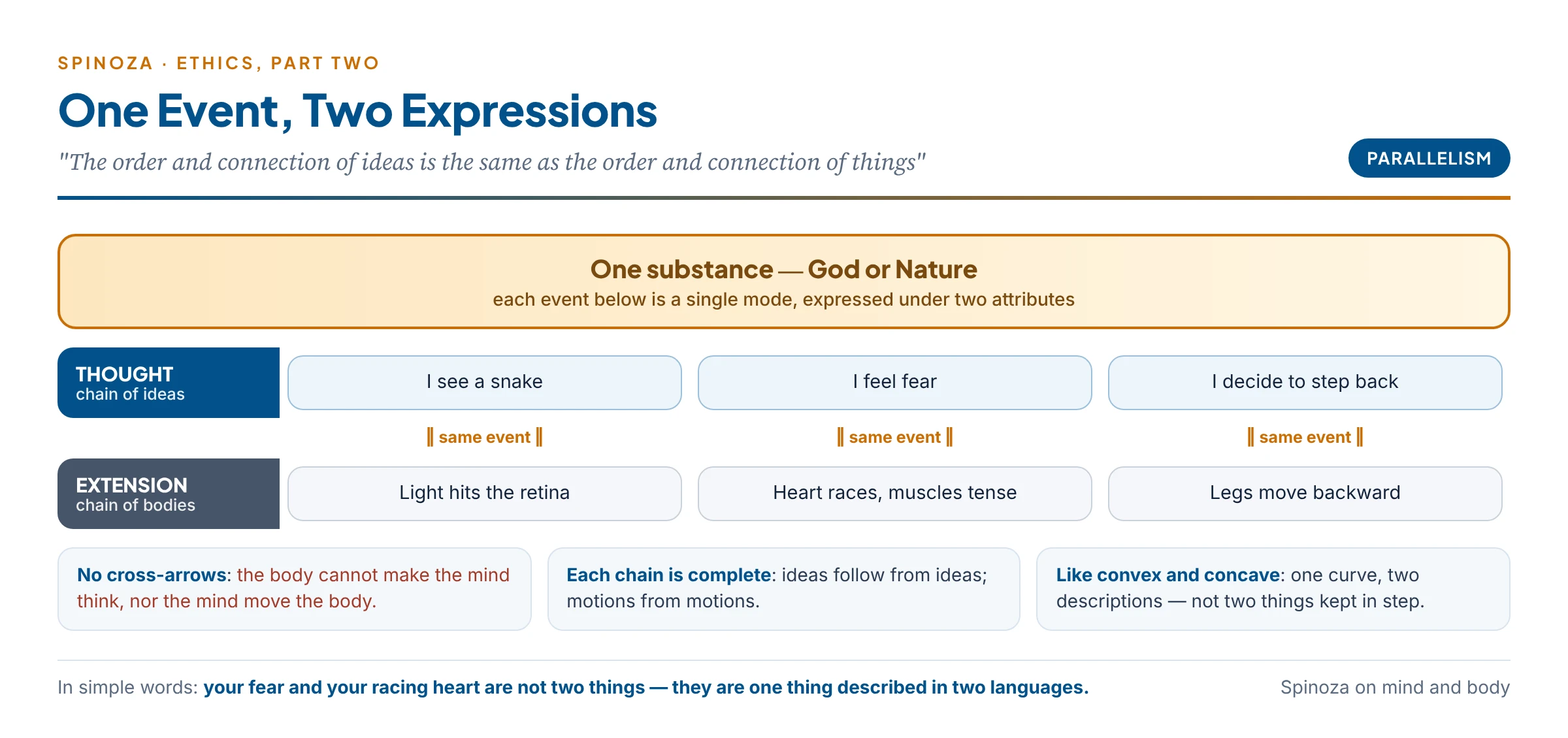
“The order and connection of ideas is the same as the order and connection of things.” — Spinoza, Ethics
The basic claim. Thought and extension are two attributes of the one substance. Every mode of extension (a body, a bodily event) has a corresponding mode of thought (an idea of it), and the two series run in exactly the same order. “A mode of extension and the idea of that mode are one and the same thing, but expressed in two ways.”
- No interaction. “The body cannot determine the mind to think, nor can the mind determine the body to motion or rest.” A bodily event is explained only by other bodily events; an idea only by other ideas. Each attribute is a complete causal order in its own terms.
- No gap to bridge. Since mind and body are not two things, there is no pineal gland, no animal spirits, no miracle — and no need for occasionalism, in which God links them at each moment. Spinoza rejects occasionalism along with interactionism.
- Perfect correlation. Because they are the same event in two descriptions, mental and bodily changes always correspond. When I decide to raise my arm, the decision (thought) and the neural-muscular process (extension) are one event seen two ways.
Analogies used to explain parallelism:
- The convex and concave sides of one curve.
- The two sides of one coin.
- The circumference and area of a circle: when you understand a circle through its circumference, its area is already given with it.
- Two spokes of one wheel, two rays of one sun.
- A sentence spoken in two languages: two expressions, one meaning.
2. The Mind Is the Idea of the Body
- The object of the human mind is the body. “The object of the idea constituting the human mind is the body … and nothing else.” Your mind is God’s idea of your body, as your body is a mode of God’s extension.
- Complexity matches complexity. The more complex and capable a body is — the more ways it can act and be acted on — the more capable its mind is of perceiving many things at once. Human minds surpass others because human bodies do.
- We know the world through the body. The mind perceives external things only as they affect the body, not as they are in themselves. When I see the sun as “a few hundred feet away,” my idea expresses more about the state of my body than about the sun. This is why sense knowledge (imagination) is confused.
- The mind knows itself through the body. The mind knows itself only by perceiving the ideas of the affections (changes) of its body.
- Everything is “animate” in degrees. Since every body has a corresponding idea in God, Spinoza says that all things are animate (animata), “albeit in different degrees.” A stone’s “mind” is as simple as its body; a human mind as complex as a human body.
Common confusion
Does Spinoza say minds and bodies are two parallel things running side by side? Not quite. “Parallelism” can suggest two separate tracks kept in step — which is closer to Leibniz’s pre-established harmony. Spinoza’s view is stronger: mind and body are one and the same thing grasped under two attributes. That is why his view is also called double-aspect theory or identity theory of mind and body. The parallel is between two descriptions, not two substances.
3. How Spinoza Explains States of Mind and Bodily Processes
The 2026 question asked exactly this. Spinoza’s account works at three levels:
- Every mental state has a bodily counterpart, and vice versa. A feeling of fear is the idea of a bodily process (racing heart, tense muscles); the bodily process is the extended side of the fear. Neither causes the other — they are one event.
- Emotions (affects) are defined on both sides at once. An affect is “an affection of the body by which the body’s power of acting is increased or diminished … and at the same time the idea of these affections.”
- Joy (laetitia) — a passage to greater power (perfection), in body and mind together.
- Sadness (tristitia) — a passage to lesser power.
- Desire (cupiditas) — the very essence of a being, its striving, as we are conscious of it.
- The striving (conatus). “Each thing, as far as it can by its own power, strives to persevere in its being.” In the body this is the drive of life and self-preservation; in the mind it is will; in both together, appetite; and appetite with consciousness is desire.
Examples Spinoza gives to show the body acts by its own laws:
- Sleepwalkers do things in sleep they would never do awake — the body can do much without any decision of the mind.
- “No one has yet determined what the body can do” from the laws of nature alone; the mind’s supposed command over it is assumed, not observed.
- People think they act from “free decisions” of the mind, but “the decisions of the mind are nothing but the appetites themselves,” which vary with the condition of the body.
In simple words
When you blush with embarrassment, there is the feeling of embarrassment and the reddening of your cheeks. Common sense says the feeling causes the blush. Spinoza says they are one event: the blush is what embarrassment looks like as body; the feeling is what the blush is like as mind.
4. Strengths and Criticisms of Parallelism
Strengths:
- Solves the interaction problem by denying there are two substances to interact.
- Excludes both materialism and idealism — matter does not explain mind, nor mind matter; both express one reality.
- Respects science — every bodily event has a bodily cause; physics is complete in its own domain.
- Anticipates modern views — the identity theory of mind and brain and dual-aspect theories in neuroscience; the neuroscientist Antonio Damasio titled a book Looking for Spinoza.
Criticisms:
- Not a solution but a deduction. Parallelism follows from Spinoza’s monism; it evades rather than explains the felt relation of mind and body.
- Sudden interruptions. When a sudden noise breaks my concentration, a physical event seems to cause a mental change. Parallelism seems unable to describe this as genuine influence.
- The mind’s biological role. In evolution the mind appears to matter more and more for survival; if the mind never affects the body, it can have no biological use.
- Panpsychism. If every physical event has a mental counterpart, then mind exists in everything — stones and atoms included. Critics take this as a reduction to absurdity.
- Why exactly two? If substance has infinite attributes, each mode should have infinitely many “sides”; why do minds perceive only thought and extension?
- Determinism. Parallelism leaves no room for the mind freely to direct the body (see below).
Common confusion
Is panpsychism a refutation of Spinoza? Many notes list panpsychism as an objection — “there is mind in everything, which is not a fact.” But Spinoza accepts this consequence: he explicitly says all individuals are animate “in different degrees.” So it is not a contradiction in his system; the real question is whether it is plausible. (Some contemporary philosophers of mind do defend forms of panpsychism.)
5. Necessity: “What Is Cannot Be Other Than It Is”
- Everything is necessary. “In nature there is nothing contingent, but all things have been determined from the necessity of the divine nature to exist and produce an effect in a certain way.” “Things could have been produced by God in no other way, and in no other order.”
- Necessitarianism is the view that whatever exists or happens does so with absolute necessity and could not have been otherwise — denying contingency, alternative possibilities and indeterminacy.
- Two sources of a thing’s necessity:
- From its essence — a triangle’s angles necessarily equal two right angles.
- From its cause — a particular event must happen given the chain of causes behind it.
- Contingency is ignorance. We call a thing “contingent” or “possible” only because we do not know its causes. A fuller understanding would show it necessary.
- The infinite chain of finite causes. Each finite thing is determined to exist and act by another finite thing, and that by another, to infinity — all within the laws that follow from God’s nature.
- What it means for us. Our thoughts, feelings and actions are links in this chain. “What is, cannot be other than what it is”: given the whole order of Nature, this event — my choosing tea over coffee — could not have been different.
6. No Free Will: The Illusion of Choice
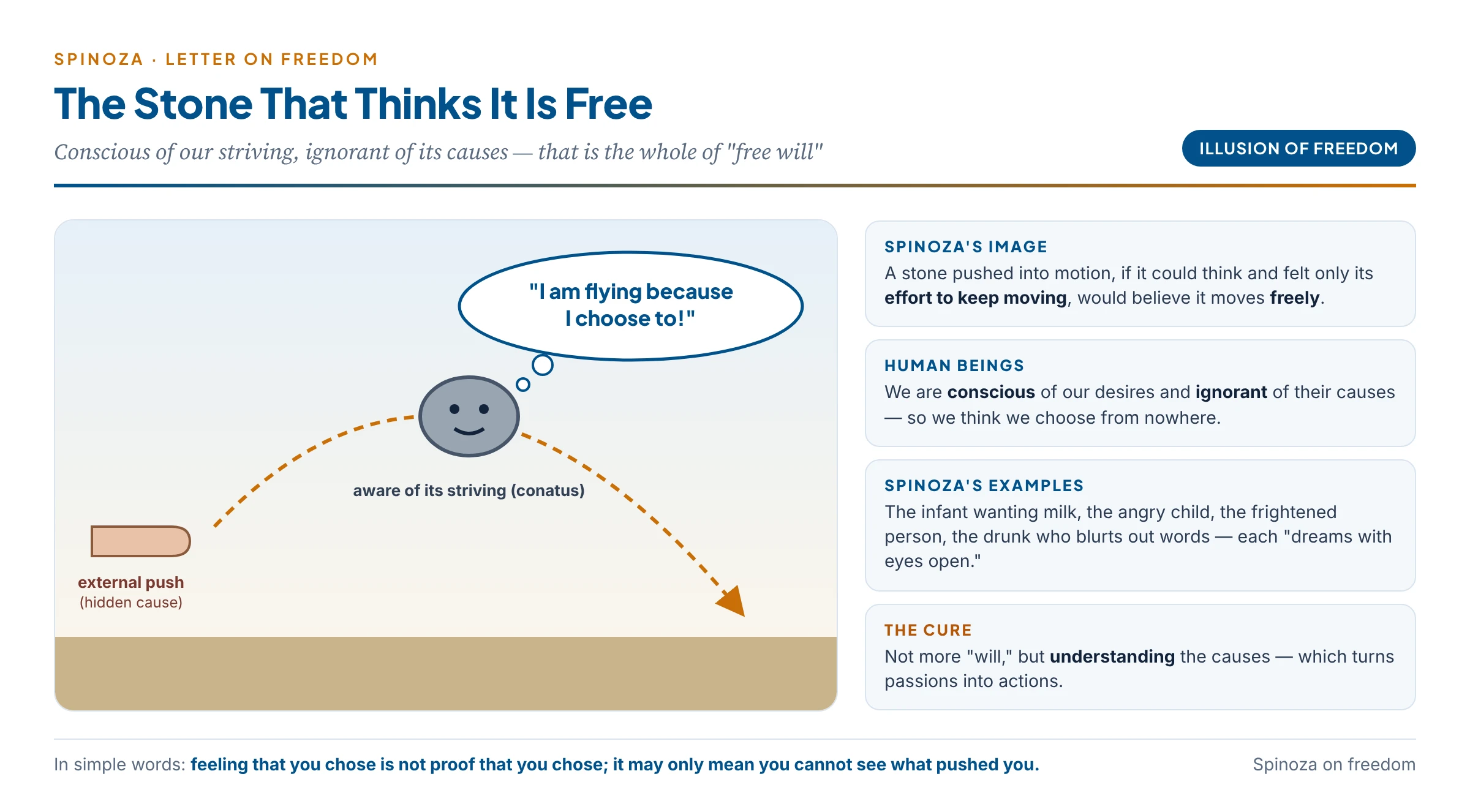
“Men are deceived in thinking themselves free, an opinion which consists only in this, that they are conscious of their actions and ignorant of the causes by which they are determined.” — Spinoza, Ethics
- The will is not free. “In the mind there is no absolute, or free, will; but the mind is determined to will this or that by a cause which is also determined by another, and this again by another, and so to infinity.”
- Will is not a faculty apart from ideas. There is no separate “will” choosing among ideas; a volition is simply an idea’s own affirmation. To understand a triangle is already to affirm that its angles equal two right angles.
- Where the illusion comes from. We are aware of our desires and actions but unaware of their causes. So we imagine our choices come from nowhere — from a “free decree” of the mind.
- Spinoza’s examples: the infant believes it freely wants the milk; the angry child believes it freely wants revenge; the timid person freely wants to run; the drunk believes he speaks from a free decision words he later wishes unsaid; the chatterbox cannot hold his tongue. “Those who believe they speak or keep silent by a free decree of the mind dream with their eyes open.”
- The falling stone. In a letter, Spinoza imagines a stone set in motion by an external push. If the stone could think and were aware only of its striving to keep moving, it would believe it moves freely, by its own choice. “This is that human freedom which all boast of possessing.”
- No final causes. The same ignorance makes us think Nature acts for purposes — that the eyes were made for seeing, the sun for warmth. “The infant’s impulse to drink milk is as necessary as the motion of the sun.” Purposes are human projections; teleology is anthropomorphism.
In simple words
Imagine a puppet who can feel the urge to raise its arm but cannot see the strings. Every time the string pulls, it feels “I want to raise my arm” — and thinks it chose. Spinoza says we are like that puppet, except that the “strings” are the countless causes inside and outside us.
7. Freedom Redefined: Self-Determination
“That thing is said to be free which exists solely from the necessity of its own nature, and is determined to action by itself alone. That thing is said to be necessary, or rather compelled, which is determined by another to exist and to act in a fixed and determinate way.” — Spinoza, Ethics
Freedom is opposed to compulsion, not to necessity.
| Contrast | Free | Compelled |
|---|---|---|
| Source of action | One’s own nature alone | Something external |
| Kind of necessity | Inner necessity (self-determination) | Outer necessity (being pushed) |
| Example | God; a person acting from reason | A stone pushed by another body; a person driven by passion |
- Only God is wholly free. God alone exists by the necessity of His own nature and acts from its laws alone, compelled by nothing outside. God is free not because He could have done otherwise but because nothing external determines Him.
- Humans are partly free. As finite modes we are always acted on by other things, so we can never be totally free. But we can be more or less free, depending on how far our actions follow from our own nature — and our nature is reason.
- “The action of a man is free when it follows from the very nature of his being.” Since reason is our essence, acting from reason is acting freely.
- Freedom and necessity coincide. Free action is self-determined, not undetermined. A rational person who sees that 2 + 2 = 4 cannot think otherwise — yet is perfectly free, because the thought follows from his own understanding, not from outside pressure.
So the answer to whether freedom is consistent with determinism in Spinoza is yes — once freedom is understood as self-determination rather than uncaused choice. This view is called compatibilism.
In simple words
A musician who has mastered her instrument plays exactly the right notes — she “cannot” play wrongly, yet she is at her freest. A beginner pressing keys at random has more “options” but is not free; he is pushed about by clumsiness. For Spinoza, freedom is like mastery: acting from your own understanding, not having random options.
8. Bondage: Life under the Passions
Spinoza titles the fourth part of the Ethics “Of Human Bondage, or the Strength of the Affects.”
- Passions and actions. When we are the adequate (full) cause of what happens in us, it is an action; when we are only a partial cause and outside things push us, it is a passion.
- Inadequate ideas. Passions arise from inadequate (confused) ideas — partial knowledge of causes, mostly from imagination and sense experience.
- Swept by currents. Most people, most of the time, are “driven about by external causes like waves of the sea driven by contrary winds,” swept on currents of pleasure and pain, feeling powerless before life’s challenges.
- Bondage is this condition: being moved like puppets by passions — hope and fear, love and hatred, ambition and envy — which separate our vision from the unity of things.
- Emotions are natural. Spinoza does not condemn the passions as sins; he studies them “as if they were lines, planes and bodies,” as natural events with natural causes. To understand them is the first step to mastering them.
9. The Road to Freedom: Reason, Knowledge and the Emotions
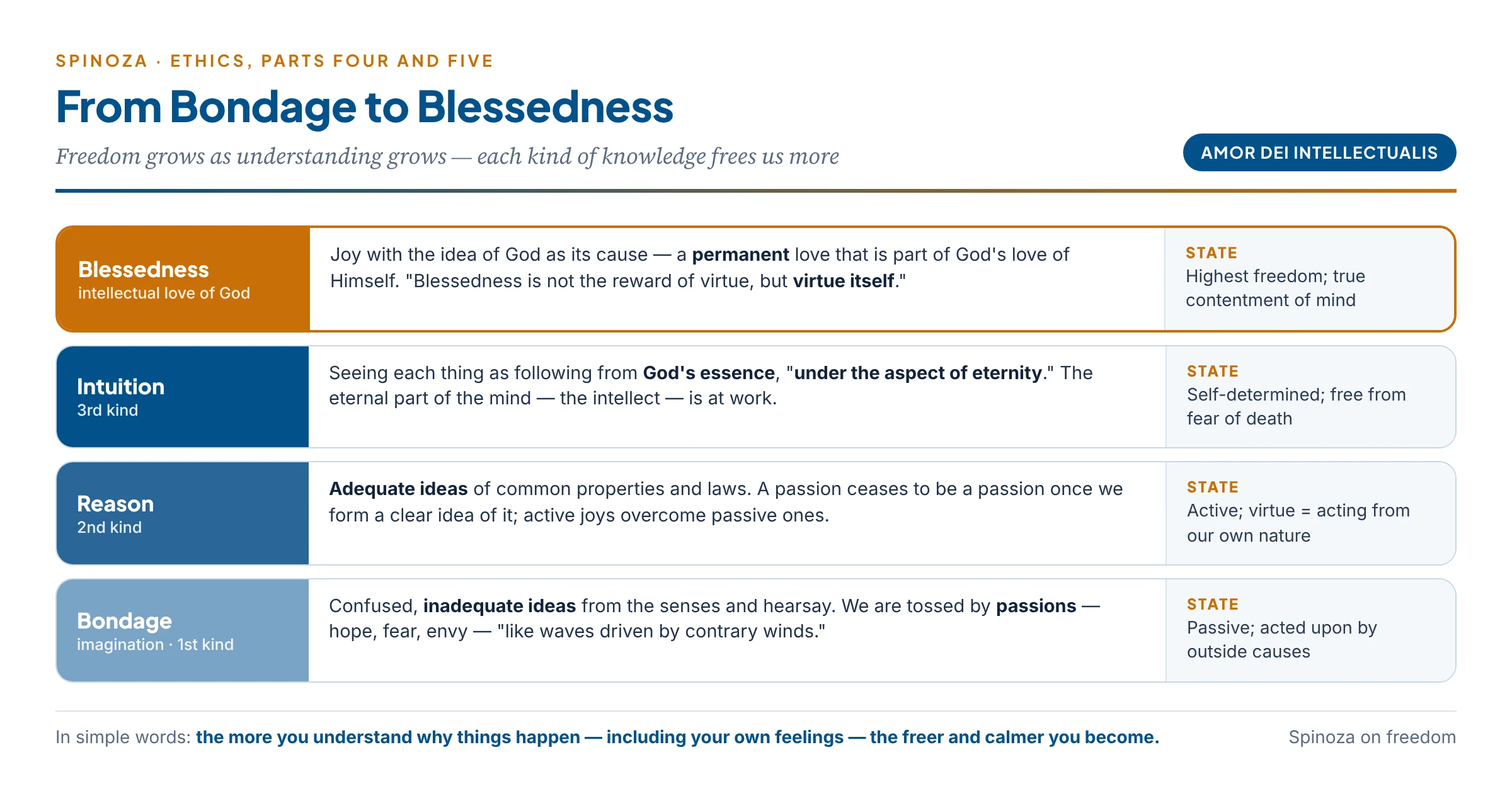
- Understanding transforms passions. “An affect which is a passion ceases to be a passion as soon as we form a clear and distinct idea of it.” When I understand why I am angry, the anger loses its grip; error loses its power over the mind once we know it as error.
- Emotion is overcome by emotion. Bare reason cannot defeat a passion; “an affect cannot be restrained or removed except by an opposite and stronger affect.” Reason works by generating active emotions — joy in understanding — that are stronger than passive ones.
- Adequate ideas come from adequate causes — causes that follow from our own nature, not from outside circumstances. Reason “demands nothing contrary to Nature”; it shows what truly agrees with our nature.
- Virtue = power = acting by reason. Virtue is not obedience to commands but the power to act from our own nature; virtue and acting according to reason are the same.
- The three kinds of knowledge:
- Imagination — confused, the source of passions and bondage.
- Reason — adequate knowledge of universal laws; frees us progressively from the passions.
- Intuitive knowledge — seeing particular things as following from God’s essence, under the aspect of eternity; the source of the highest freedom.
- The free man. Spinoza sketches the ideal: the free man “thinks of nothing less than of death, and his wisdom is a meditation not on death but on life“; he repays hatred with love; he never acts deceitfully; a wise person never hates, envies or is angry with others.
10. The Intellectual Love of God and Blessedness
- Arises from intuitive knowledge. Seeing all things as following necessarily from God gives a joy accompanied by the idea of God as its cause — that is, love of God. Because it comes from intellect, it is intellectual love (amor Dei intellectualis).
- Love of the eternal. This love rests not on picturing God as present but on understanding Him as eternal. It is therefore permanent, without beginning, and complete; any other love is unstable.
- God loves Himself — and us. God loves Himself with an infinite intellectual love; “the mind’s intellectual love of God is the very love of God by which God loves Himself,” insofar as God is expressed through the human mind. In loving God, the mind shares in God’s own love; God’s love for human beings and their intellectual love of God are one and the same.
- Not a bargain. “He who loves God cannot strive that God should love him in return” — this love seeks no reward.
- Peace and freedom from fear of death. It brings the greatest contentment of mind (acquiescentia) and frees us from fear of death; the more we understand things by the second and third kinds of knowledge, the less we fear death.
- The eternal part of the mind. “The human mind cannot be absolutely destroyed with the body, but something of it remains which is eternal.” The part that perishes is the imagination; the part that is eternal is the intellect, through which alone we act.
- Blessedness is virtue itself. “Blessedness is not the reward of virtue, but virtue itself; we do not enjoy it because we restrain our lusts, but because we enjoy it we are able to restrain them.”
- Rare and difficult. “If the way I have shown … seems very hard, still it can be found … all things excellent are as difficult as they are rare.”
Common confusion
Does Spinoza accept rebirth or personal immortality? Some notes say that Spinoza “accepts rebirth and determinism.” He accepts determinism, but not rebirth. The “eternal part of the mind” is the intellect insofar as it understands things under the aspect of eternity — it is not a person who continues in time with memories, and it does not pass into another body. Memory and imagination perish with the body; what is eternal is the mind’s adequate knowledge, which is part of God’s infinite intellect.
How can a determined, finite being be free? A helpful way to see Spinoza’s answer is to notice a twofold nature in the human mind:
- As a finite mode in time, I am one link in the endless chain of causes, constantly acted on by other things — unfree.
- As expressing God’s eternal essence, the intellect in me is part of God’s infinite intellect; when I understand adequately, the action follows from my own nature, which is an expression of God’s nature — free.
- Free action is not a break in necessity. It is necessity flowing from within. My free acts are themselves part of the necessary order of Nature — self-determined, not undetermined.
Indian Connect — Knowledge as liberation
- Bhagavad Gītā: “All actions are performed by the guṇas of prakṛti; but he whose mind is deluded by egoism thinks, ‘I am the doer.'” This is strikingly close to Spinoza’s diagnosis of free will as an illusion born of ignorance of causes.
- Sāṃkhya: bondage is due to non-discrimination (aviveka) between puruṣa and prakṛti; liberation (kaivalya) comes through discriminative knowledge (viveka-jñāna), not through effort of will.
- Advaita: jñāna-mārga — liberation through knowledge — parallels Spinoza’s freedom through intuitive knowledge; the liberated person (jīvanmukta) is free from fear and desire, like Spinoza’s “free man.”
- Buddhism: dependent origination (pratītyasamutpāda) denies an uncaused self; freedom (nirvāṇa) comes by insight into causes and the cessation of craving — as Spinoza’s freedom comes by understanding the causes of our passions.
11. Is Spinoza’s Freedom Consistent with His Determinism?
For consistency:
- Spinoza’s freedom is self-determination, not freedom from all causes. A determined world can contain self-determined action — action caused by one’s own nature and understanding.
- God is both wholly necessary and wholly free — proof that the two are compatible in Spinoza’s sense.
- Freedom comes in degrees: the more adequate our ideas, the more our actions flow from within.
- Ethics remains possible: the Ethics is a guide to becoming free, and a person who understands will in fact act better — reason “makes” us moral.
Against consistency:
- The meaning of “free” is changed. Ordinary freedom means could have done otherwise; Spinoza simply redefines the word. His “freedom” is a name for a certain kind of necessity.
- Responsibility. If no one could act otherwise, praise, blame and punishment seem unjust. (Spinoza replies that we restrain the dangerous as we restrain a mad dog — not because it chose to be dangerous but because it is.)
- Who chooses to follow reason? If whether I become rational is itself determined, then my “liberation” is as fixed as my bondage; the Ethics cannot really invite anyone to change.
- The individual disappears. Freedom is located in the eternal intellect, which is God’s; it is not clear that “I,” the particular person, am free.
- Existentialist objection. From the standpoint “existence precedes essence,” Spinoza’s freedom is pure determinism: it assumes a fixed human essence (reason) and ignores the concrete individual who creates himself through choice.
12. Spinoza and Sartre on Freedom
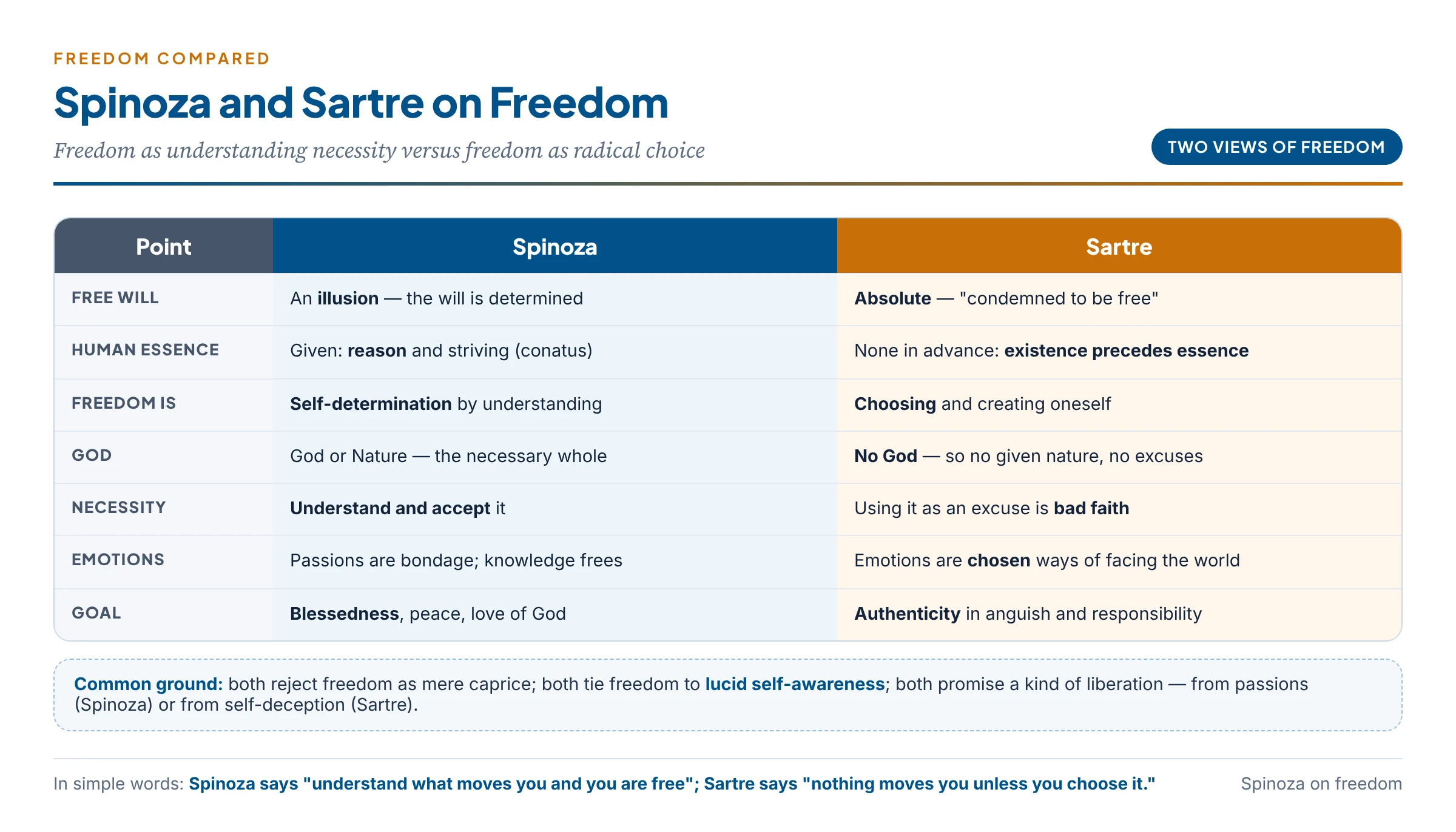
| Point | Spinoza | Sartre |
|---|---|---|
| Free will | Illusion; the will is determined | Absolute; “man is condemned to be free” |
| Human essence | Fixed — reason, striving (conatus) | None in advance — “existence precedes essence” |
| Meaning of freedom | Self-determination by understanding necessity | Choosing oneself; creating one’s essence through acts |
| Role of God | God-or-Nature is the necessary whole of which we are modes | No God; hence no given nature, no excuses |
| Emotions | Passions are bondage; understanding them frees us | Emotions are themselves chosen ways of meeting the world |
| Attitude to necessity | Accept and understand it — freedom is in seeing it | Refuse it as an excuse — appeal to necessity is bad faith |
| Goal | Blessedness, peace, intellectual love of God | Authentic existence in anguish and responsibility |
| Common ground | Both reject freedom as caprice; both tie freedom to lucid self-awareness and to taking one’s life into one’s own understanding; both find a kind of liberation from fear | — |
Critical Evaluation
Critics and Defenders
Criticism — Critics
- Libertarians and Kant: without the ability to do otherwise there is no moral responsibility; Spinoza’s “freedom” is only a comfortable name for necessity.
- Leibniz: Spinoza’s necessitarianism leaves no contingency and no choice even for God; Leibniz’s distinction between moral and metaphysical necessity was meant to avoid it.
- Existentialists (Sartre): Spinoza dissolves the concrete individual into a geometrical system; freedom is choice, not acceptance.
- Critics of parallelism: it cannot explain interruptions, the evolutionary role of mind, or why only two attributes; it implies panpsychism.
- Religious critics: no providence, no grace, no personal immortality, no God who answers prayer.
Defence — Defenders and lasting value
- Compatibilism: modern philosophers (Hobbes, Hume, and many today) agree that freedom is acting from one’s own desires and reasons, not acting without causes.
- Psychology and therapy: the idea that understanding an emotion weakens its hold anticipates psychoanalysis and cognitive behavioural therapy.
- Neuroscience: identity and dual-aspect theories of mind and brain echo Spinoza; experiments on the timing of decisions revive the question whether “free decisions” are what we think.
- Ethics of understanding: replacing blame with understanding has humane consequences in criminal justice (rehabilitation rather than revenge) and in personal life (less hatred, more compassion).
- Spiritual freedom: Spinoza offers a path to peace that needs no supernatural reward — freedom as clarity, serenity and love of the whole.
Cross-Tradition Comparison
Determinism and Freedom: Spinoza and Indian Thought
| Point | Spinoza | Sāṃkhya–Yoga | Advaita Vedānta | Buddhism |
|---|---|---|---|---|
| Is the world determined? | Yes — necessary order of Nature | Yes — evolution of prakṛti by its guṇas | Empirical world governed by karma and causality | Yes — dependent origination |
| Source of bondage | Inadequate ideas; passions | Non-discrimination (aviveka) | Ignorance (avidyā), false identification | Ignorance and craving (tṛṣṇā) |
| Doer of actions | Not a free will; ideas and appetites follow causes | Prakṛti acts; puruṣa only seems to act | The ego (ahaṃkāra), not the Self | No permanent doer; only processes |
| Path to freedom | Reason and intuitive knowledge | Discriminative knowledge; yogic discipline | Jñāna — knowledge of identity with Brahman | Insight (prajñā) and the Eightfold Path |
| State of freedom | Blessedness, intellectual love of God | Kaivalya — isolation of puruṣa | Mokṣa — realisation of Brahman | Nirvāṇa — extinction of craving |
| Mind–body | One reality, two attributes | Mind (buddhi, manas) belongs to matter; consciousness to puruṣa | Body–mind complex is superimposed on the Self | Five aggregates; no soul |
Indian Connect — Key takeaways
- Knowledge, not will, liberates — in Spinoza and in Sāṃkhya, Advaita and Buddhism alike. Freedom comes from seeing truly, not from an act of choice.
- “I am the doer” is the root illusion in the Gītā, just as “I act by free decree” is in Spinoza.
- Difference: Indian schools usually locate the true self beyond the determined mind–body (puruṣa, ātman), while Spinoza places freedom within Nature, in the mind’s understanding of Nature — there is no self outside God-or-Nature.
- Mind–body: Sāṃkhya, like Spinoza, refuses to make the thinking mind a separate spiritual substance — for Sāṃkhya, buddhi is a product of matter; for Spinoza, the mind is the idea of the body.
Synthesis (Siddhānta)
Spinoza’s two doctrines stand or fall together. Parallelism dissolves the Cartesian interaction problem by making mind and body one reality under two attributes; necessitarianism follows from the same monism; and freedom is rebuilt not as uncaused choice but as self-determination through understanding — from bondage under passions, through reason, to intuitive knowledge and the intellectual love of God. Critics are right that he redefines freedom and leaves hard questions about responsibility and the individual. But his view is coherent on its own terms, and it captures a deep truth found also in Indian thought: we become free not by escaping causality but by understanding it.
- Mental health: understanding the causes of our emotions weakens their tyranny — the principle behind modern therapy.
- Law and punishment: if behaviour has causes, justice should aim at prevention and reform more than revenge.
- Mind and brain: whether consciousness is “the same event” as brain activity seen from inside is still the central question in philosophy of mind and AI.
For Spinoza, the free person is not one who escapes the order of Nature but one who understands it — and in understanding, loves it.
Previous Year Questions
- 2026How does Spinoza explain the relationship between states of mind and bodily processes?
- 2023“That thing is said to be free which exists solely from the necessity of its own nature, and is determined to action by itself alone.” Discuss Spinoza’s views on freedom and determinism in the light of the above statement.
- 2019What do you understand by Spinoza’s statement that what is, cannot be other than what it is? Explain.
- 2013Write a short critical essay on Spinoza’s conception of freedom of an individual.
- 2011Is the concept of freedom consistent with the theory of determinism of Spinoza? Support your answer with arguments.
- 2009Compare the views of Spinoza and Sartre on Freedom.