

Rationalism (Descartes, Spinoza, Leibniz): Cartesian Method and Certain Knowledge; Substance; God; Mind-Body Dualism; Determinism and Freedom.
Official Syllabus: Paper I, Section A, Unit 2
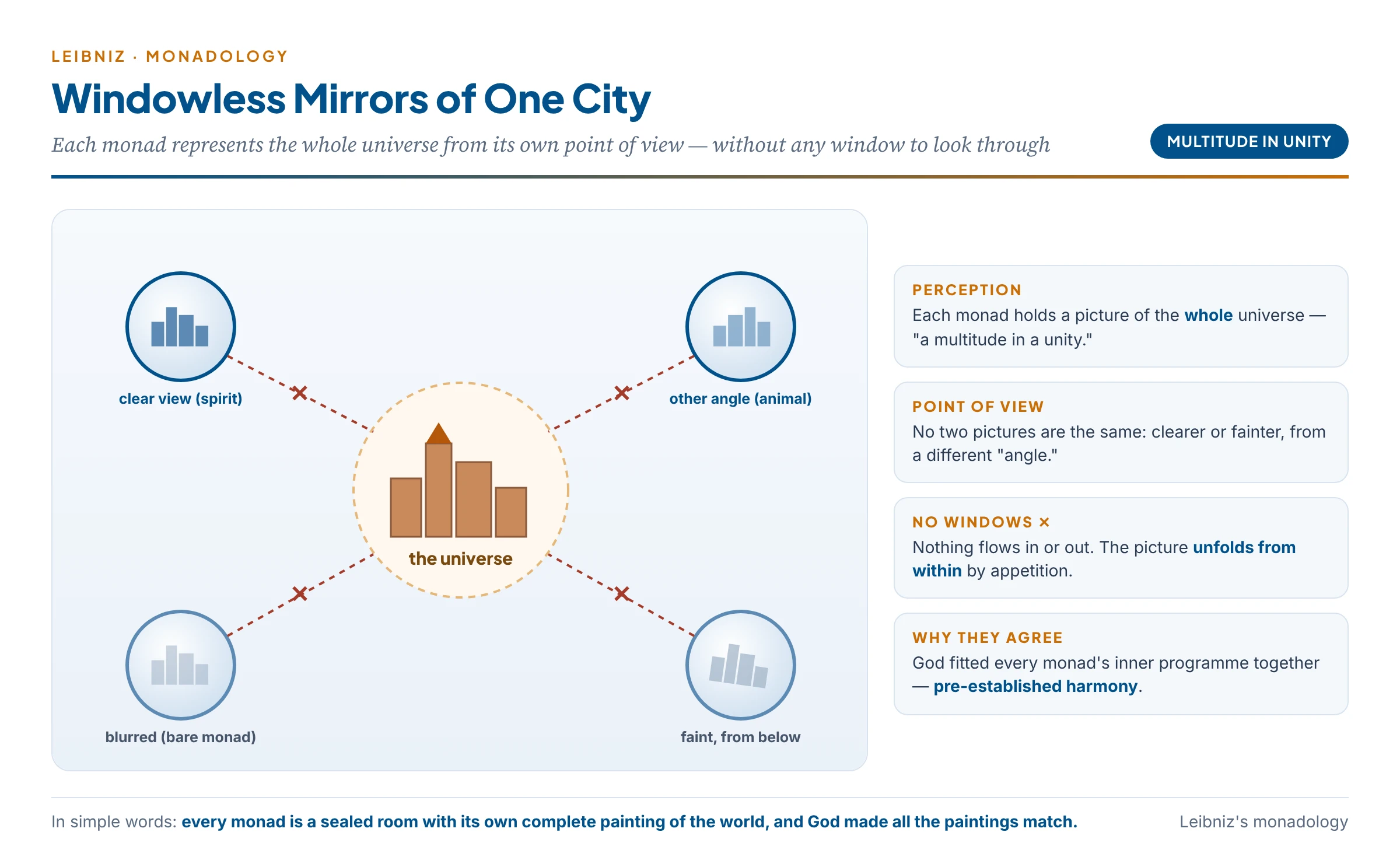
Gottfried Wilhelm Leibniz (1646–1716) completes the rationalist trio by taking the road neither Descartes nor Spinoza took. Descartes had three substances and could not connect them; Spinoza had one substance and lost the individual. Leibniz answers with infinitely many substances — monads — each a simple, unextended, spiritual centre of force that mirrors the whole universe from its own point of view. Monads have “no windows” through which anything can enter or leave; all their changes come from within. Matter is only the appearance of aggregates of monads. The whole system rests on a few great principles of reason — contradiction, sufficient reason, the identity of indiscernibles and continuity — and is held together by God’s pre-established harmony (taken up in the next article).
In simple words
Imagine a city seen from a thousand different windows. Each window shows the whole city, but from a different angle — some views are blurred, some sharp. Leibniz says the universe is like that city, and every monad is one “point of view” on it. No monad looks out of a real window; each carries its own picture of the whole inside it.
Context & Problem
Leibniz the Reconciler
- A polymath. Born in Leipzig (Germany); philosopher, mathematician, logician, lawyer, diplomat and engineer. He co-invented the calculus (and the notation still used), developed binary arithmetic (the basis of modern computing) and dreamed of a universal symbolic language and a “calculus of reasoning” — anticipating modern formal logic.
- A man of courts, not solitude. Unlike Descartes’ retreat or Spinoza’s withdrawn life, Leibniz worked within courts and academies, travelled widely and kept up an enormous correspondence with scientists and theologians. His temperament was optimistic, courteous and driven by the wish to reconcile opposing views.
- No single masterpiece. His ideas lie scattered in letters and short works: the Discourse on Metaphysics (1686); the New Essays on Human Understanding (a detailed reply to Locke); the Theodicy (1710, the only major work published in his lifetime); and the Monadology (1714), a compact statement of his mature system.
- A philosophy of compromise. “I have tried to … reconcile Plato with Democritus, Aristotle with Descartes, the scholastics with the moderns, theology and morality with reason.” He sought to harmonise mechanism and teleology, induction and deduction, reason and faith.
What Leibniz Rejects
The atoms of Democritus:
- Any physical atom, however small, is extended — and whatever is extended can be divided, so it is not truly simple.
- The atomists’ “hardness” is a relative, subjective quality — what is hard to one is not hard to another.
- Atoms are dead particles; they cannot explain life and spirit.
- Atoms differ only in size, shape and mass — quantitative differences that cannot explain the qualitative variety of the world.
- So the true elements of things must be spiritual, not material.
Descartes’ extended substance:
- Extension is divisible without end; it can never yield a true unity, so it cannot be substance.
- Extension is passive, but the world is dynamic — bodies in motion, bodies resisting motion (inertia). Motion and inertia presuppose force, the capacity to act. So force, not extension, is the essence of the real.
- If God gave matter its first motion, rest and inertia remain unexplained.
- Accepting extension as a separate substance brings an abrupt break between mind and matter — against the law of continuity.
- Conservation: Descartes held that the total quantity of motion is conserved; Leibniz showed that what is conserved is living force (vis viva) — an anticipation of the modern principle of conservation of energy.
- Mind is wider than consciousness. Descartes made consciousness the essence of mind, yet in dreamless sleep or a faint the mind does not cease to exist. Below the threshold of clear consciousness lies a background of obscure and unconscious perceptions. Widening the concept of mind lets Leibniz bridge the animate and the inanimate.
- Leibniz therefore rejects Descartes’ matter and keeps his mind — but a mind made active and graded.
Spinoza’s one substance:
- Spinoza gives “the whole, or the blank universal, from which the parts have disappeared”; he cannot explain the plurality, change and individuality of things.
- His system is static and deterministic, like geometry, leaving no room for individual action.
- His attributes are self-contradictory — opposed attributes (thought and extension) ascribed to one substance.
- Leibniz begins from the opposite end: the reality of the parts, the extreme multiplicity of experience. It is as if Spinoza’s substance were broken into infinitely many pieces, each as real and individual as the whole.
Core Doctrine
1. What a Substance Is
- The ultimate subject. “When several predicates are attributed to a single subject, and this subject is attributed to no other, it is called an individual substance.”
- A true unity — simple and without parts. Whatever is composite is an aggregate, not a substance.
- Active. A substance is the ultimate created source of its own actions. “Every substance has a perfect spontaneity … everything that happens to it is a consequence of its idea or of its being, and nothing determines it except God alone.”
- Causally isolated. There is intra-substantial causation (a substance produces its own states) but no inter-substantial causation (no substance acts on another).
- No extended substances. Nothing extended is a unity; so the ultimate created substances are more like Cartesian minds than bodies — Leibniz calls them “souls” or “monads.” Reality is spiritual; and because individuality is real, it is not one spirit (like Brahman) but infinitely many spiritual individuals.
- Spirit is more certain than matter. Leibniz notes that the existence of the external world cannot be proved with full certainty, but the existence of spirit is more certain than that of sensible objects.
2. The Monads
“The monad … is nothing but a simple substance which enters into composites; simple, that is to say, without parts.” — Leibniz, Monadology
- The true atoms of nature. Because there are composites, there must be simples; these are “the true atoms of nature and, in a word, the elements of things.”
- No parts, no shape, no extension. Monads cannot be divided, shaped or located in space.
- Begin by creation, end by annihilation. A composite comes into being and perishes part by part; a monad can begin only by creation and end only by annihilation — all at once, by God.
- Centres of force. Substance is force; space, matter and motion are only phenomena. (Leibniz argued, against Newton, that space and time are relative — a view often seen as anticipating relativity.)
- Infinitely many, infinitely small, each unique.
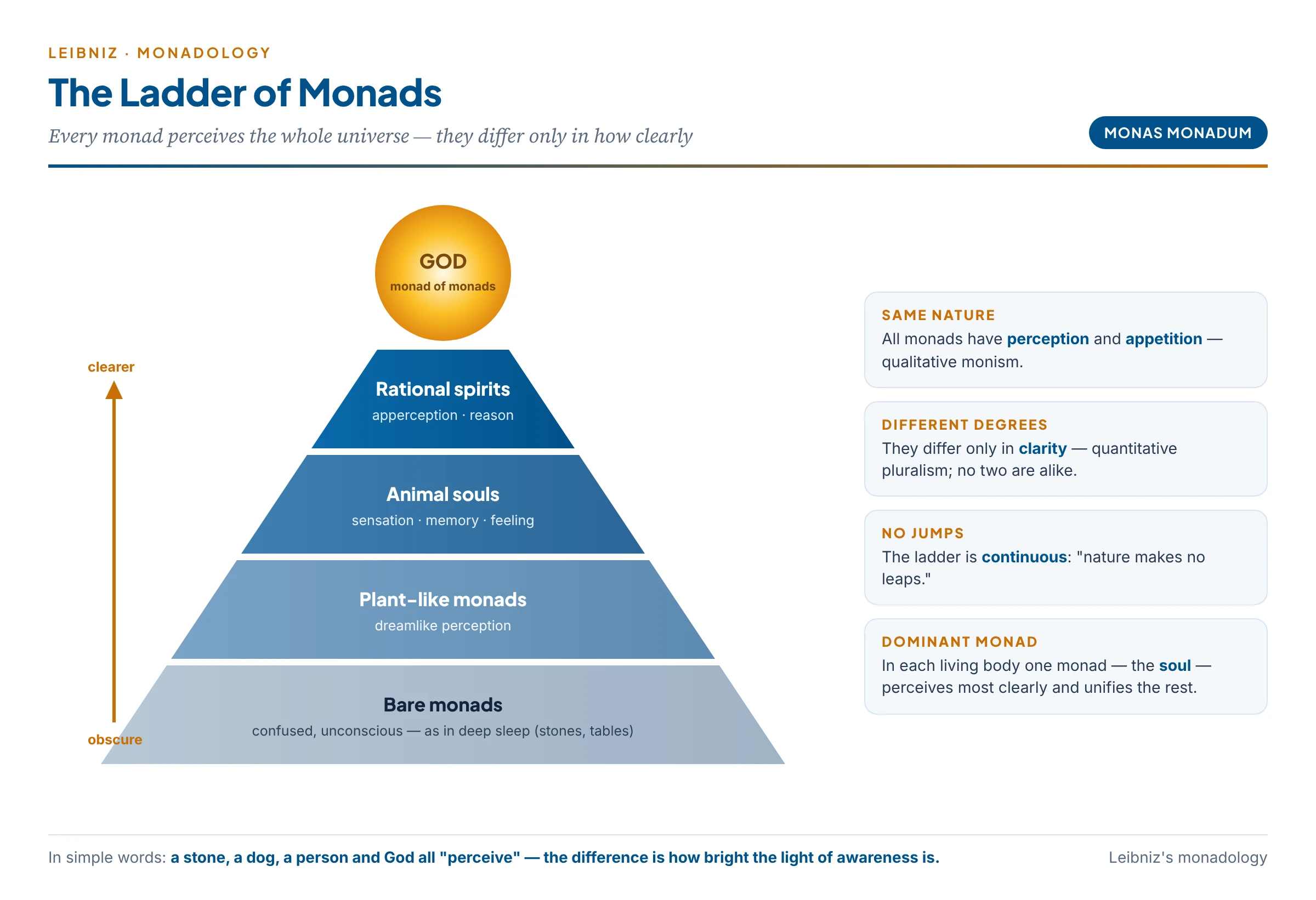
- Qualitatively alike, quantitatively different. All monads share the same basic nature — perception and appetition — and differ only in degree (the clarity of their perceptions). This is “quantitative pluralism, qualitative monism.” (Compare the jīvas of Jainism, the puruṣas of Sāṃkhya and the selves of Rāmānuja.)
- Windowless. “Monads have no windows through which anything could come in or go out.” Nothing external can act on them; whatever changes takes place within.
- A world in miniature. Each monad contains the whole universe potentially — “macrocosm in microcosm.” It is a “perpetual living mirror of the universe,” reflecting every event, vaguely or clearly.
- Charged with the past, big with the future. Since nothing enters a monad and nothing in it is lost, all its stages — past, present, future — are contained in it; “the present is big with the future.”
Common confusion
Are monads eternal and self-created? Some notes say monads are “self-created, self-existent and eternal,” even causa sui. That is not Leibniz’s view. Monads are created by God and can end only by God’s annihilation; they are “eternal” only in the weaker sense that no natural process can make or unmake them (they have no parts to come together or fall apart). Only God, the necessary being, is self-existent. (Critics do point to a real tension in Leibniz’s language here — see the criticisms below.)
3. Perception and Appetition
Every monad has two activities:
- Perception — “the passing state which involves and represents a multitude in a unity.” Each monad represents the entire universe, but from its own point of view — like a city viewed from different places. No two monads represent it in the same way.
- Appetition — the inner tendency or striving by which a monad passes from one perception to the next, from obscure to clear perception.
- Action from obscure perception is impulse; action from clear perception is will.
- The difference between impulse and will is one of degree, not kind.
Three kinds of appetition are often distinguished:
| Kind | Found in | What it involves |
|---|---|---|
| Unconscious appetition | Bare monads | Tendencies they are not aware of |
| Conscious appetition | Animals and humans | Awareness of desire (food, pleasure) |
| Rational appetition | Rational minds | The intellect judging the best course; grasp of necessary truths |
Minute perceptions (petites perceptions). We hear the roar of the sea as one sound, but it is made of countless tiny sounds of individual waves, each too faint to notice alone. Such unconscious perceptions are everywhere; apperception is perception that has become conscious and reflective.
In simple words
Think of the volume knob on a radio. In some monads the “volume” of awareness is nearly zero (a stone); in animals it is turned up (feeling, memory); in humans it is high enough to reflect on itself; in God it is infinite. It is the same kind of signal everywhere — only the clarity differs.
4. The Hierarchy of Monads
Monads differ in the clarity and distinctness of their perceptions, forming a continuous ladder:
- Bare monads — the lowest; confused, unconscious perception, as in deep sleep. Their aggregates make up apparently lifeless things — stones, tables, chairs.
- Plant-like monads — perception in a dreamlike state (some lists treat these with bare monads).
- Animal souls (sentient monads) — sensation, memory, feeling of pleasure and pain; they can attend to things but cannot reason about necessary truths.
- Rational souls (spirits) — human minds; apperception (reflective self-consciousness), knowledge of necessary and eternal truths, reason; they can know God and enter into a moral community with Him.
- The supreme monad — God, the monad of monads (monas monadum): perfect perception, omniscient and omnipotent, creator of all other monads.
The dominant monad. In every living body there is a dominant (or “queen”) monad — its soul — which perceives more clearly than the monads composing the body and gives the organism its unity. As God is to the universe, so the soul is to the body’s monads.
5. Matter and Bodies
- Bodies are aggregates. A stone or a tree appears as one thing, but it is really an aggregate of countless simple, unextended substances.
- Well-founded phenomena (phenomena bene fundata). Matter is not an illusion (as Berkeley would say) but a derivative reality — the way aggregates of monads appear to a perceiving mind, grounded in real monads.
- Organic and inorganic. An aggregate with a dominant monad is an organic body (a corporeal substance); an aggregate without one is a mere mass.
- Life everywhere. “Every portion of matter may be conceived as a garden full of plants and a pond full of fishes. But every branch of the plant, every member of the animal, every drop of its liquid is also such a garden or such a pond.” There is nothing dead in nature — Leibniz’s view is a form of panpsychism.
- Primary and secondary matter:
- Primary matter (materia prima) — the principle of passivity and limitation in every created monad: its confused perceptions. God alone has none; if a monad lost it, it would be God (pure act).
- Secondary matter (materia secunda) — the mass or aggregate of monads that appears as a material body.
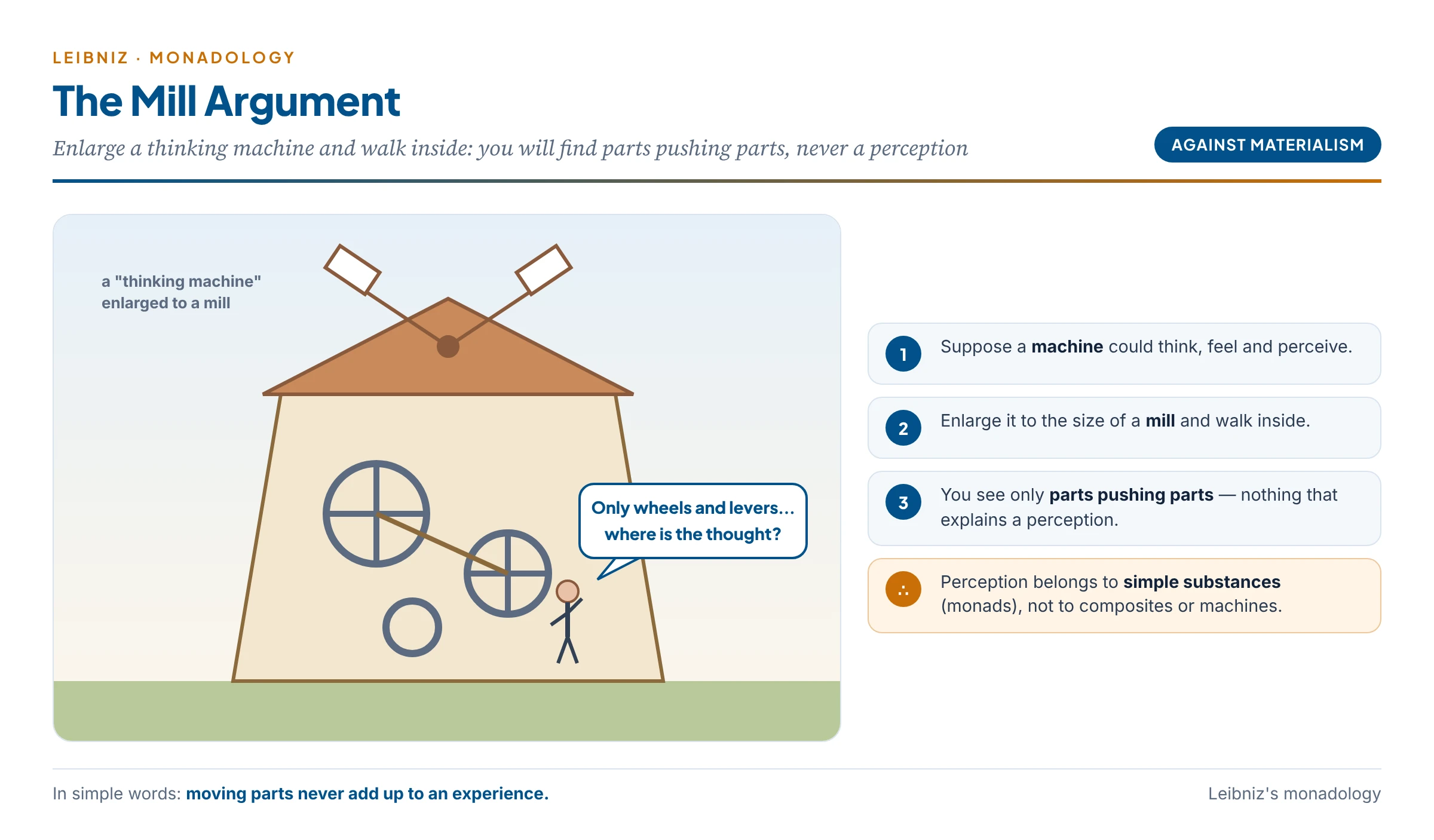
6. Leibniz’s Mill Argument
Why can’t perception be explained mechanically?
- Suppose there were a machine whose structure produced thought, feeling and perception.
- Imagine it enlarged to the size of a mill, so that we could walk inside it.
- Inside we would find only parts pushing one another — wheels, levers, gears — and never anything that explains a perception.
- So perception must be sought in a simple substance, not in a composite or a machine.
This is one of the earliest and most famous arguments against materialism about the mind — an ancestor of today’s “hard problem of consciousness.”
7. The Principles of Reason
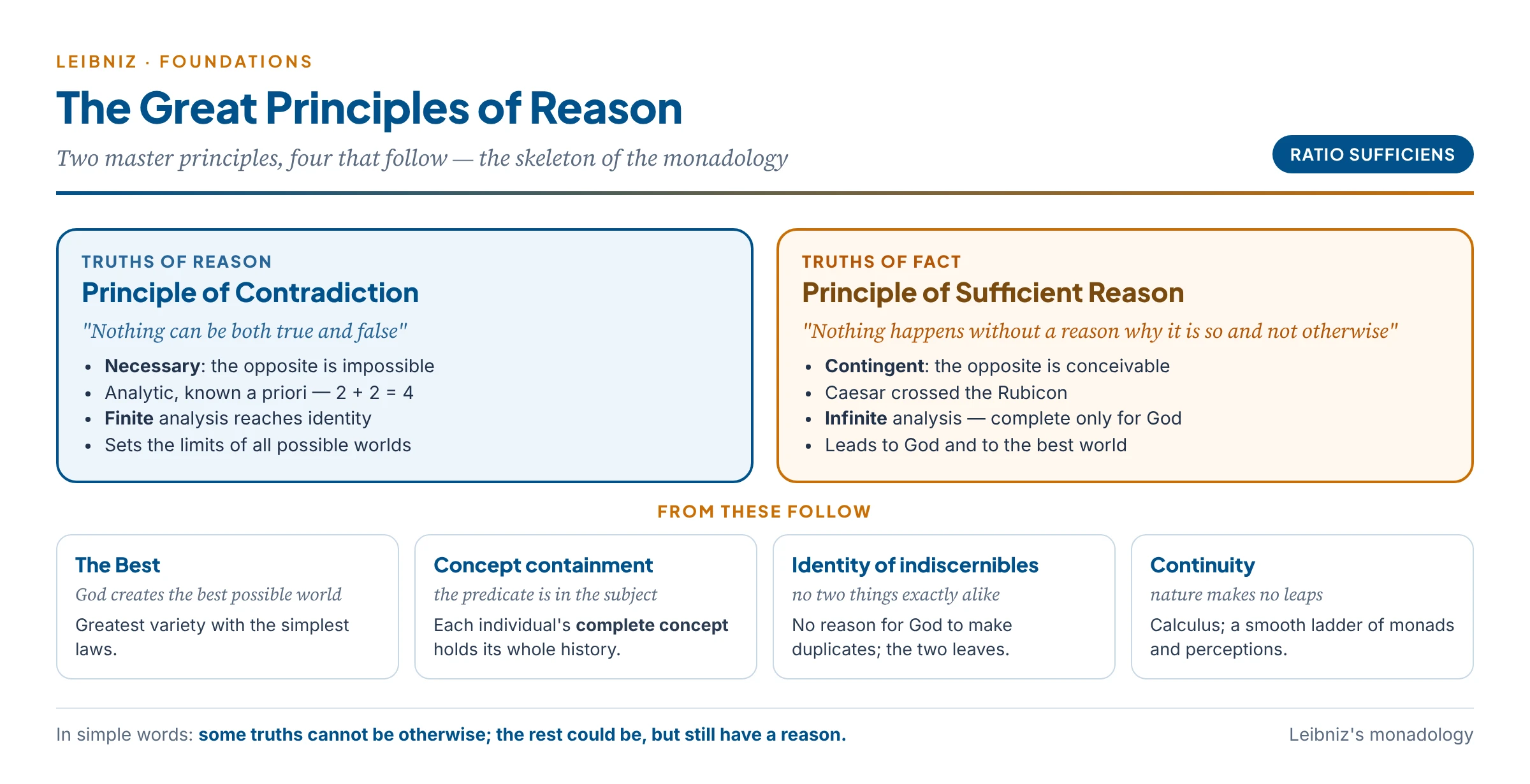
Leibniz’s whole system rests on a small number of great principles.
(a) The Principle of Contradiction
- “A proposition cannot be true and false at the same time and in the same sense.” Nothing of the form “P and not-P” can be true.
- It governs truths of reason — necessary truths whose denial is self-contradictory: “2 + 2 = 4,” “a bachelor is unmarried.”
- These truths are analytic (the predicate is contained in the subject) and known a priori.
- It is not just a rule of thought but a law of reality: even God cannot make a contradiction true, since contradictions are impossible — nothing. It sets the boundary of the possible worlds.
(b) The Principle of Sufficient Reason (PSR)
- “Nothing happens without a sufficient reason why it is so and not otherwise.”
- It governs truths of fact — contingent truths whose denial is not self-contradictory but which still need an explanation: “Caesar crossed the Rubicon.”
- No brute facts: every fact, event and existence has a rational ground — ultimately in God’s intellect and will.
- It underlies Leibniz’s cosmological argument, his optimism (God’s choice of the best world) and his rejection of both occasionalism and Spinoza’s necessity: even human choices have reasons, though reasons that incline rather than necessitate.
In simple words
Why did the cricket ball break the window? “Because it was hit hard in that direction.” Why was it hit that way? “Because the batsman chose that shot.” Leibniz insists the questions never meet a blank wall: every fact has a reason. The principle of sufficient reason is simply the rule that “it just happened” is never a final answer.
Truths of reason and truths of fact:
| Point | Truths of reason | Truths of fact |
|---|---|---|
| Example | “The angles of a triangle equal two right angles” | “Caesar crossed the Rubicon” |
| Status | Necessary — opposite impossible | Contingent — opposite conceivable |
| Governing principle | Contradiction | Sufficient reason |
| How known | A priori, by analysis | Through experience (finite minds); by God a priori |
| Analysis | Finite — reduced to identities in a finite number of steps | Infinite — only God sees the full containment |
(c) The Principle of the Best
- God, perfectly wise and good, chooses the best of all possible worlds — the one with the greatest variety and richness of phenomena combined with the greatest simplicity of laws. (Developed in the next article.)
(d) The Predicate-in-Notion Principle (concept containment)
- A proposition is true if and only if the predicate is contained in the complete concept of the subject (praedicatum inest subiecto).
- In necessary truths the containment is explicit and can be shown by analysis (“a triangle has three angles”).
- In contingent truths the containment is implicit: an individual’s complete concept contains everything that ever has been or will be true of it. “This cup is blue” is not necessary — the cup might have been red in another possible world — but “blue” belongs to this cup’s complete concept in the actual world.
- Consequences: each substance’s whole history unfolds from its own concept (supporting windowless monads and pre-established harmony), and God, who comprehends every complete concept, foreknows everything.
(e) The Identity of Indiscernibles (PII)
- No two distinct substances are exactly alike in all their properties. If two things share every property, they are not two but one — “indiscernibility implies identity.”
- Arguments for it:
- From complete concepts — each substance has a complete concept; two substances with the same complete concept would be the same substance.
- From sufficient reason — God would have no reason to create one of two perfect duplicates rather than the other, or to place them one way round rather than the other.
- From perspective — no two things can exist at the same place, at the same time, with the same point of view.
- The two leaves. Leibniz told a courtier that he would never find two leaves exactly alike; the courtier searched the palace garden and failed. However similar, they differ in texture, history or relations.
- Monads and minute perceptions — since each monad mirrors the universe from a different viewpoint, every monad differs from every other, if only in infinitesimal perceptions.
- Against absolute space — if space were an absolute container, the whole universe shifted a few metres would be a different but indiscernible universe; PII rules this out, so space must be relational.
- Distinguish from its converse: the indiscernibility of identicals (if A and B are one thing, they share all properties) — the uncontroversial principle often called Leibniz’s Law in logic.
In simple words
Two photocopies of the same page look identical — yet one has a tiny smudge, or sits on the left of the desk and the other on the right. Leibniz says there is always some difference like this. If you could find two things with no difference at all, you would really be looking at one thing twice.
(f) The Principle of Continuity
- “Nature makes no leaps” (natura non facit saltus). All change is gradual, through infinitely small steps.
- In mathematics it inspired the calculus — curves and motions change by infinitesimal increments; points generate lines, lines surfaces, surfaces solids.
- In nature — no sharp boundaries between species; a continuous scale of forms.
- In minds — perception rises gradually from minute unconscious perceptions to clear apperception.
- In the monadology — monads form a continuous series from the lowest to God, as numbers form a continuous series. The principle bridges the gap between monads, reconciles the animate and inanimate, and even empiricism and rationalism (confused sense knowledge and clear rational knowledge differ only in degree).
Laws behind the monadology (a common summary):
| Law | Claim |
|---|---|
| Individuality | There are infinitely many real, individual substances (against Spinoza) |
| Similarity | All monads share the same basic nature — perception and appetition |
| Dissimilarity (identity of indiscernibles) | No two monads are exactly alike; they differ in degree |
| Continuity | Monads form an unbroken series without jumps |
| Harmony | A principle of unity is needed to reconcile individuality with continuity — pre-established harmony |
| Conservation of force | What is conserved is force (vis viva), not quantity of motion |
8. Innate Ideas and Knowledge
- All ideas are innate in a sense: since monads are windowless, nothing can enter the mind from outside; all knowledge is self-development — the unfolding of what is already virtually present.
- Against Locke (New Essays): the mind is not a blank tablet but a block of veined marble, whose veins already mark out the figure to be sculpted. “Nothing is in the intellect that was not first in the senses — except the intellect itself.”
- Virtual innateness: necessary truths are in us as dispositions, which experience awakens but does not create.
- Reason is governed by the principles of contradiction and sufficient reason; by them Leibniz concludes that the first reason of all things is God.
9. Entelechy: Aristotle and Leibniz
The 2026 paper asked for a comparison of entelechy in Aristotle and Leibniz.
- Aristotle: entelecheia — “having its end within” — the completed actuality of a potentiality; form realised in matter. The soul is “the first entelechy of a natural organic body.”
- Leibniz: wanting to “rehabilitate substantial forms” against Descartes’ bare extension, he called monads entelechies: “All simple substances or created monads might be called entelechies, for they have in them a certain perfection; there is a self-sufficiency in them which makes them the sources of their own internal actions — incorporeal automata, so to speak.”
- In his dynamics, entelechy is the primitive active force of a substance, showing itself as appetition.
| Point | Aristotle | Leibniz |
|---|---|---|
| Entelechy is | The fulfilment reached — form actualised in matter | The inner force that produces all a monad’s states |
| Emphasis | The end achieved | The source of action — the present “big with the future” |
| Relation to matter | Always the form of matter (hylomorphism) | Monads are immaterial; matter is their appearance |
| Where found | In each natural substance; the soul of a living body | In every simple substance — infinitely many entelechies |
| Interaction | Things act on one another | Windowless; no interaction — pre-established harmony |
| Highest principle | Unmoved Mover — pure actuality, final cause, not creator | God — monad of monads, creator and harmoniser |
- Similarities: both make entelechy an internal principle of activity and purpose; both reject mechanism as the whole truth; both treat the soul as the entelechy of the living body; both see nature as a graded continuum.
- In one line: Aristotle’s entelechy is the fulfilment a thing reaches; Leibniz’s entelechy is the force a thing always is.
10. Space and Time: Leibniz and Kant
- Leibniz — relational space and time. Against Newton’s absolute space and time (a container existing independently of things), Leibniz holds that space is the order of coexisting things and time the order of successive things. They are not substances or containers but relations — ideal orders grounded in the relations among monads, which we perceive confusedly as extended and successive.
- Arguments: if space were absolute, God would have no sufficient reason to place the universe here rather than a few metres away; and the two arrangements would be indiscernible — violating PII.
- Kant — forms of intuition. Kant agreed space and time are not things in themselves, but held they are neither concepts nor relations among things: they are a priori forms of sensible intuition — the subjective conditions under which anything can appear to us at all.
| Point | Leibniz | Kant |
|---|---|---|
| Status | Relations (orders) among things | A priori forms of intuition in the subject |
| Known by | Intellect — confused perception of relations | Sensibility — pure intuition |
| Prior to things? | No — derivative from the relations of substances | Yes — prior to all experience as its condition |
| Concept or intuition? | Close to concepts of relations | Intuitions, not concepts |
| Kant’s charge | Leibniz “intellectualised appearances,” treating sensibility as merely confused thinking | — |
11. Leibniz and Hume on Substance
| Point | Leibniz | Hume |
|---|---|---|
| Is there substance? | Yes — infinitely many monads | No idea of substance beyond a bundle of qualities |
| Nature | Simple, active, spiritual centres of force | “Nothing but a collection of simple ideas” united by imagination and given a name |
| Self | A rational monad, a true unity | A “bundle of perceptions” with no impression of a self |
| How known | By reason (principles of contradiction and sufficient reason) | Only through impressions — and there is no impression of substance |
| Method | Rationalist, a priori | Empiricist, sceptical |
| Unity of things | Real unity of the monad; harmony from God | Unity is a fiction of the imagination, from resemblance and contiguity |
- Common ground: both deny Descartes’ and Locke’s extended material substance as an underlying “something I know not what”; Hume dissolves it, Leibniz spiritualises it.
12. Is a Monad a Basic Particular in Strawson’s Sense?
- Strawson’s basic particulars (Individuals): the particulars on which our whole scheme of identifying things depends are material bodies (and persons). They are basic because they can be identified and re-identified in a single, public spatio-temporal framework — we can point to them, locate them and find them again.
- Monads fail this test: they are unextended, non-spatial, unobservable and windowless. We cannot pick out “this monad” by pointing or by locating it in space and time.
- Identification by description alone: Leibniz individuates monads by their complete concepts — purely general descriptions. Strawson argues that description alone cannot secure reference to a unique particular; identification needs a link to the speaker’s own spatio-temporal position.
- Revisionary vs descriptive metaphysics: Strawson called Leibniz’s metaphysics revisionary — it tries to replace our actual conceptual scheme — while his own is descriptive, laying bare the scheme we actually use.
- Verdict: a monad cannot be a basic particular in Strawson’s sense; at best it is a theoretical entity derived from the scheme in which material bodies and persons are basic.
Critical Evaluation
Objections to the Monadology
- Windows and mirrors. If monads are windowless and nothing passes between them, how can a monad perceive or mirror others? The idea of “living mirrors” is vague.
- How does a monad know there are other monads? If each knows only its own states, the system leads to solipsism — one has access only to one’s own mental states.
- Relative knowledge. If A mirrors B, and B mirrors C, then A’s perception includes B’s perception of C, and so on — an endless series, making all knowledge relative.
- Eternal yet created. Leibniz calls monads indestructible, yet says God creates and can annihilate them, and sometimes speaks of them as “fulgurations” (flashes) of God — which would make them almost like Spinoza’s modes.
- God as a monad. If God is a monad, it is odd for one monad to create all the others; if God is not a monad, the monadology is not the whole story.
- Sameness vs difference. All monads have the same nature, yet by the identity of indiscernibles all are different — and it is hard to see how consciousness can differ in degree even between two animals of the same species.
- Independence vs hierarchy. Perfectly independent monads are hard to reconcile with a continuous, ordered hierarchy governed by one plan.
- Origin of extended things. How purely spiritual force appears as extended, solid bodies is never clearly explained.
- Unverifiable. No monad can go beyond its own states to observe others; the theory cannot be checked by experience — empiricists see it as dogmatic speculation.
- The identity of indiscernibles.
- Max Black’s two spheres: a universe containing only two qualitatively identical iron spheres seems conceivable — two things, no discernible difference.
- Kant: two drops of water can be identical in all inner qualities and still be two, because they occupy different places.
- Physics: quantum particles of the same kind (electrons, photons) seem to be strictly indiscernible yet many.
- Defence: if relational properties (being here, being this distance from that) count, PII is saved — but critics say it then becomes trivial.
Critics and Defenders
Criticism — Critics
- Kant: monads are things in themselves, unknowable; Leibniz confused sensibility with confused thought.
- Hegel: monads are “windowless atoms” incapable of real unity or relation.
- Empiricists: no observational basis for monads; the system is a priori speculation.
- Strawson: monads cannot be identified; the monadology is revisionary metaphysics.
- Russell: the monadology is a fantastic system resting on the logic of subject and predicate; relations are treated as unreal.
Defence — Defenders and lasting value
- Force and energy: Leibniz’s dynamics (vis viva) anticipated conservation of energy; his relational space anticipated relativity.
- Information and computing: monads as self-contained “programmes” unfolding from within, binary arithmetic and the dream of a logical calculus look forward to computation.
- The unconscious: minute perceptions anticipate the psychology of the unconscious (Freud).
- Philosophy of mind: the mill argument remains a classic statement of why consciousness resists mechanical explanation.
- Logic and metaphysics: possible worlds, identity of indiscernibles and concept containment shaped modern modal logic.
Cross-Tradition Comparison
Monads and Indian Pluralism
| Point | Leibniz (monads) | Jainism (jīvas) | Sāṃkhya (puruṣas) | Nyāya-Vaiśeṣika (atoms and selves) |
|---|---|---|---|---|
| Plurality | Infinitely many monads | Infinitely many jīvas | Many puruṣas | Many selves; eternal atoms (paramāṇu) |
| Nature | Spiritual centres of perception and force | Souls with infinite knowledge obscured by karma | Pure consciousness, inactive | Selves are substances with consciousness as a quality; atoms are material |
| Degrees | Monads differ in clarity of perception | Jīvas differ in degree of karmic obscuration (one-sensed to five-sensed) | Puruṣas do not differ in nature | — |
| Matter | Only phenomenon of aggregates of monads | Real (pudgala) | Real (prakṛti) | Real (atoms) |
| Interaction | None — windowless; harmony from God | Real interaction of soul and karmic matter | Puruṣa only seems bound; proximity | Real combination of atoms guided by adṛṣṭa and Īśvara |
| God | Monad of monads, creator | No creator God | No God (classical Sāṃkhya) | Īśvara as efficient cause |
Indian Connect — Key takeaways
- Closest parallel — Jainism: an infinite plurality of conscious souls, each in principle capable of omniscience, differing only in the degree to which their knowledge is clouded — very like monads differing in clarity of perception. But Jainism keeps matter real and lets it bind the soul; Leibniz reduces matter to appearance.
- Sāṃkhya’s argument for many puruṣas (different births, deaths and experiences show many selves) parallels Leibniz’s law of individuality against Spinoza’s one substance.
- Nyāya-Vaiśeṣika atoms are the material counterpart of monads: partless, indivisible, eternal elements — but Leibniz would object, as he did to Democritus, that anything with size and position cannot be truly simple.
- Rāmānuja: many real selves, all within one Brahman — close to Leibniz’s many monads within the one divine plan.
Synthesis (Siddhānta)
Leibniz’s monadology is the most ingenious answer to the rationalist problem of the one and the many. Against Descartes it makes force, not extension, the essence of the real and turns matter into well-founded appearance; against Spinoza it restores individual substances — infinitely many, each unique, each mirroring the whole. Its principles — contradiction, sufficient reason, the identity of indiscernibles and continuity — are among the most influential ideas in philosophy. Its costs are equally clear: windowless monads that still “perceive,” created substances that are called eternal, and a unity that can only be supplied from outside, by God’s harmony.
- Science: relational space and time, conservation of energy, the calculus — Leibniz’s metaphysics and science grew from the same principles.
- Logic and computing: concept containment, possible worlds and binary arithmetic underlie modern logic and computer science.
- Mind: the mill argument and minute perceptions still frame debates about consciousness and the unconscious.
For Leibniz, the universe is not one thing broken into parts but infinitely many points of view on one harmony.
Previous Year Questions
- 2026Compare and contrast the notion of entelechy as presented in Aristotle’s and Leibniz’s philosophy.
- 2015Explain Leibnitz’s principle of ‘identity of indiscernible’.
- 2013Give a critical account of Leibnitz’s principle of the identity of indiscernible.
- 2012Does Monadology sufficiently explain the nature of Substance? Are monads independent of each other? Explain.
- 2010What is the basic difference between Leibniz and Kant on the concept of space and time?
- 2009Compare the views of Leibnitz and Hume on the concept of substance.
- 2008Explain Leibnitz’s notion of monad. Can monad be regarded as a basic particular in the Strawsonian sense?
- 2000Monadology of Leibnitz.
- 1990Explain the views of Leibniz concerning substances, called monads.