

Rationalism (Descartes, Spinoza, Leibniz): Cartesian Method and Certain Knowledge; Substance; God; Mind-Body Dualism; Determinism and Freedom.
Official Syllabus: Paper I, Section A, Unit 2
Leibniz’s monads are windowless: no monad can act on any other. Yet the world plainly looks like a web of interaction — I will to raise my arm and it rises; light strikes my eye and I see. Leibniz’s answer is the pre-established harmony: at creation, God so arranged the inner development of every monad that each one’s states correspond perfectly with every other’s, like countless clocks made so accurately that they always strike together. This harmony also solves the mind–body problem, unites mechanism with teleology, shows God’s wisdom in choosing the best of all possible worlds, and raises the hardest question of the system: if everything is pre-arranged, is there any room for freedom?
In simple words
Imagine an orchestra in which the musicians cannot see or hear one another. Each simply plays his own written part from start to finish. Because the composer wrote the parts to fit, the whole performance sounds perfectly coordinated — as if the players were listening to each other. Leibniz’s monads are the players, God is the composer, and the “score” is each monad’s own nature.
Context & Problem
The Problem Harmony Must Solve
- Windowless monads. Each monad is self-contained; its states follow only from its own previous states. Interaction between substances would require something — parts, force, properties — to pass from one to another; but monads are simple and have no parts to transmit.
- A harmonious world. Yet the world is a cosmos — ordered and coordinated. Perceptions in different monads agree; minds and bodies correspond.
- The mind–body problem inherited from Descartes. Descartes said mind and body interact (pineal gland) — unintelligible to Leibniz. The occasionalists (Malebranche) said God links them at every occasion — a “perpetual miracle.” Spinoza made them two attributes of one substance — but at the cost of individuality.
- The need for unity. Leibniz’s law of individuality (many independent monads) and law of continuity (one ordered series) need a principle of unity to reconcile them: the principle of harmony.
Core Doctrine
1. Pre-established Harmony
- The doctrine. “There is a pre-established harmony between the changes in one monad and those in another.” Every monad mirrors the universe not because the universe affects it, but because God gave it a nature which spontaneously produces this result.
- Arranged at creation. God created and ordered the monads in their hierarchy so that a change in one is always preceded and followed by corresponding changes in others. To an observer, it seems that a change in A causes a change in B; in reality, each unfolds by its own inner law, and the two are concomitant.
- One master plan. Each monad works according to its own inner urge (appetition), but this inner plan coincides with the master plan in the mind of the Creator. Because every monad realises its part of the same plan, harmony results.
- As if interaction were real. “Although no substance can act on another, everything in the universe takes place as if natural interaction were real.” Substances form a system not of physical relations but of harmony or natural compatibility.
- Russell’s summary: “Leibniz had an infinite number of clocks, all arranged by the Creator to strike at the same instant, not because they affect each other, but because each is a perfectly accurate mechanism.”
Examples:
- The button and the fan. When I press a switch and the fan turns, there is no real causal flow from the “button monads” to the “fan monads”; each changes by its own preceding states, and God’s harmony makes the changes coincide.
- The orchestra. Players who cannot see or hear one another each follow their own notes; the listener hears perfect harmony, as if they were connected.
2. The Two Clocks: Four Theories of Mind and Body
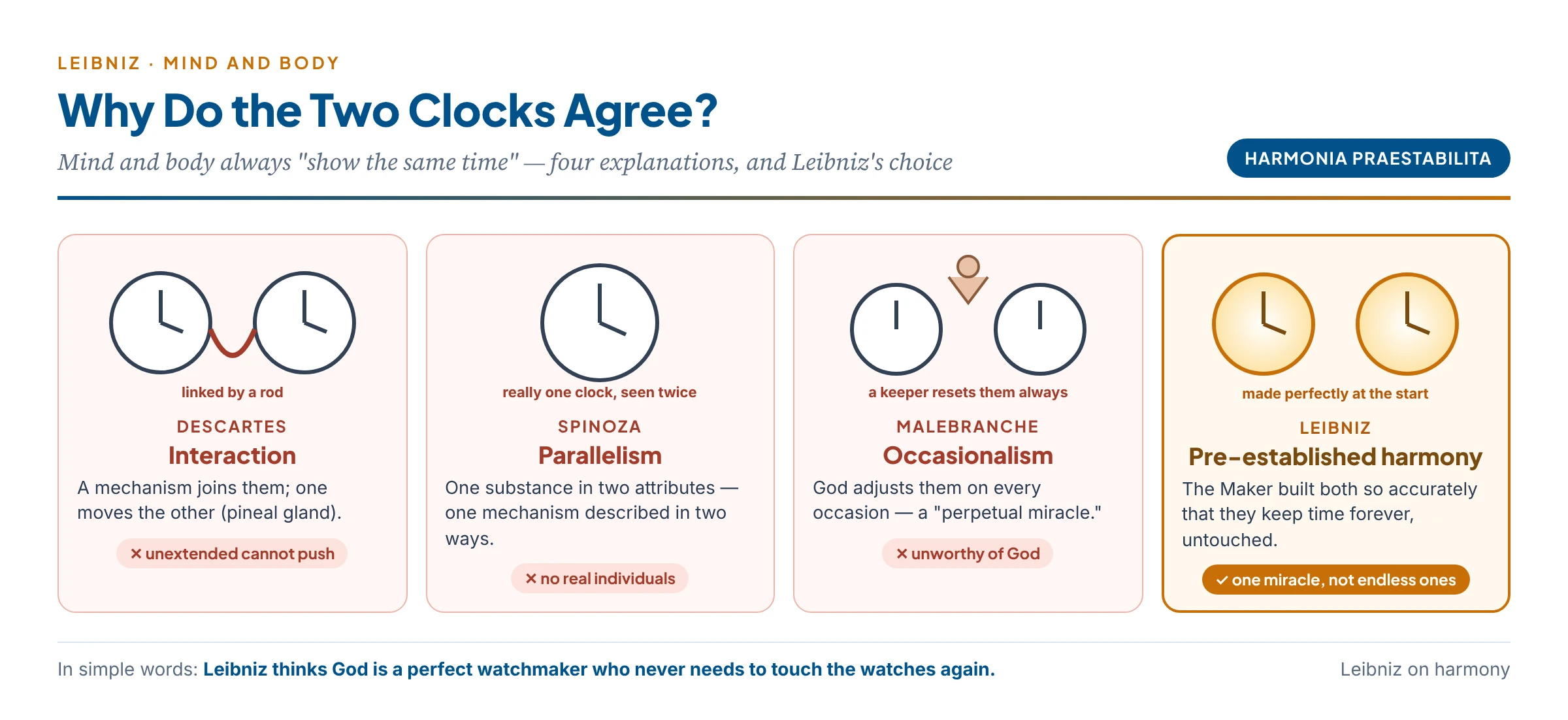
Leibniz illustrates the options with two clocks that always show the same time — mind and body.
| Theory | How the clocks agree | Leibniz’s verdict |
|---|---|---|
| Interactionism (Descartes) | They are joined by a mechanism, so the motion of one passes to the other | Impossible — windowless substances cannot transmit anything; how could the unextended act on the extended? |
| Parallelism (Spinoza) | They are really one mechanism seen in two ways — two attributes of one substance | Rejected — sacrifices real individual substances |
| Occasionalism (Malebranche) | A clockmaker constantly adjusts them to keep them together — God intervenes on every occasion | A “perpetual miracle”; constant interference is unworthy of God’s wisdom and limits His power |
| Pre-established harmony (Leibniz) | The clockmaker built them so perfectly at the start that they keep time forever without any further adjustment | One miracle (creation) instead of endless miracles — the most worthy of God |
In simple words
Two watches show exactly the same time. Either a wire connects them (Descartes), or they are really one watch seen twice (Spinoza), or someone keeps resetting them (the occasionalists) — or a master watchmaker built both so perfectly that they never drift apart (Leibniz).
3. Mind and Body
- The body is an aggregate of monads with a lower degree of perception; in strict sense there is no “dead” matter, since every part of the body is a living force.
- The soul is the dominant monad — the “queen monad” — which perceives more clearly than the others and represents the whole body, and through it the universe.
- No interaction. No mental state has as its real cause a state of a body, and no bodily state has as its real cause a mental state. Minds and bodies are programmed at creation so that their states correspond.
- Two sets of laws. “Souls act according to the laws of final causes, through appetitions, ends and means. Bodies act according to the laws of efficient causes or of motions. And the two realms … are in harmony with one another.”
- “As if.” “Bodies act as if there were no souls, and souls act as if there were no bodies, and both act as if each influenced the other.”
- We may still speak of causes. Leibniz allows that “one is quite right to say that my will is the cause of this movement of my arm” — in the sense that the soul’s state is the one that explains and expresses the bodily change most distinctly. When my arm moves, the purpose served is in the dominant monad: the bodily changes happen for the sake of the soul.
- Why no interaction? Causal interaction requires the transmission of parts from one thing to another; simple, unextended substances have no parts; so no substance can influence another.
Common confusion
Is pre-established harmony just Spinoza’s parallelism? Many notes call it “an extension of Spinoza’s parallelism,” and there is a likeness: both deny mind–body interaction and both explain correspondence without causal flow. But the differences are basic. For Spinoza, mind and body are one and the same thing in two attributes of one substance; correspondence is necessary and needs no plan. For Leibniz, mind and body are distinct substances (or aggregates of substances), and their correspondence is a harmony freely chosen by a wise God for the best world. Leibniz also extends harmony to the relations of all monads, not just mind and body.
4. Mechanism and Teleology Combined
The problem. Modern science explains nature mechanically — by efficient causes and laws of motion. Religion and ethics explain by purposes — final causes. Descartes and Spinoza banished purposes from nature. Can the two views be reconciled?
Leibniz’s answer — mechanism grounded in teleology:
- Mechanism is valid. Every bodily event can be explained by efficient causes and the laws of motion; the arrangement of monads gives rise to the appearance of mechanical causation, and science should pursue such explanations.
- But mechanism is not ultimate. The laws of motion themselves cannot be derived from extension and geometry alone; they rest on force and on the principle of the best — on God’s wise choice. So the source of mechanism is metaphysical and purposive.
- Two kingdoms in harmony. The kingdom of efficient causes (bodies) and the kingdom of final causes (souls) run side by side, perfectly harmonised. A “kingdom of nature” and a “kingdom of grace” (the moral community of spirits under God) agree.
- Machines serve ends. As a car or bicycle is a mechanism that serves human purposes, so the mechanical order of nature serves the ends of the Creator. Even inorganic nature, mechanical in appearance, is arranged for an end.
- Machines of nature. Living bodies are “divine machines,” which remain machines down to their smallest parts — unlike human machines — showing infinite design.
Does he succeed? Leibniz shows how mechanism and teleology can be combined in principle: everything has an efficient-causal explanation and a purposive one. Critics reply that the “harmony” between the two kingdoms is simply asserted — supplied by God rather than shown — and that once mechanics is complete, final causes seem to do no explanatory work.
5. God in Leibniz’s System
God’s place. God is the necessary, perfect and rational being who grounds all reality — the monad of monads, creator of all other monads, author of the harmony, source of the principle of sufficient reason, and guarantor of the moral order. He has created the universe so precisely that He need not interfere in it again; each monad proceeds along its pre-determined path. Laws of nature, of physics and of morality are all in harmony, grounded in divine reason.
Leibniz’s proofs for God’s existence:
- From sufficient reason (contingency). Every contingent thing lacks the reason for its existence in itself. Even an infinite chain of contingent things would still need a reason why that chain exists rather than another or none. So the ultimate reason must lie in a necessary being whose existence is self-explanatory — God. (Leibniz’s image: a book of geometry copied from an earlier copy, and that from another, without end — we would still ask why the book has the content it has.)
- The cosmological argument — the universe exists, but not necessarily; even if eternal, it needs an explanation outside itself, which must be a necessary being.
- The ontological argument, completed. Leibniz accepts Descartes’ proof — a most perfect being must exist — but adds the missing step: one must first show that such a being is possible (free of contradiction). Since perfections are simple, positive qualities, they cannot conflict; so the most perfect being is possible, and a possible necessary being must exist.
- From eternal truths. Necessary truths (of logic and mathematics) must exist somewhere; they exist in an eternal mind — God’s understanding, the “region of eternal truths.”
- From pre-established harmony (design). The perfect correspondence of countless windowless substances can be explained only by an infinitely intelligent designer who arranged them.
- From the best world. The order, simplicity and mathematical beauty of the world point to its deliberate choice by a perfect being.
God as mathematician. Leibniz’s universe is so exactly coordinated — infinitely many substances “timed” to agree for all eternity, nature obeying the simplest laws — that its author must be like a supreme mathematician who calculates the best combination. Leibniz put it in a famous line: “As God calculates and thinks things through, the world is made” (cum Deus calculat … fit mundus). The perfect timing and harmony of the universe is, for him, evidence of a calculating, wise Creator, not a blind necessity. (Spinoza, too, pictured the world as following from God like a geometrical system — but for him without choice or purpose.)
In simple words
If you find a geometry book, you ask who wrote it. If someone says, “It was copied from an older copy, and that from an older one, forever,” you still have not been told why it says what it says. Leibniz argues the same of the world: an endless chain of causes still needs a reason outside the chain — God.
6. The Best of All Possible Worlds
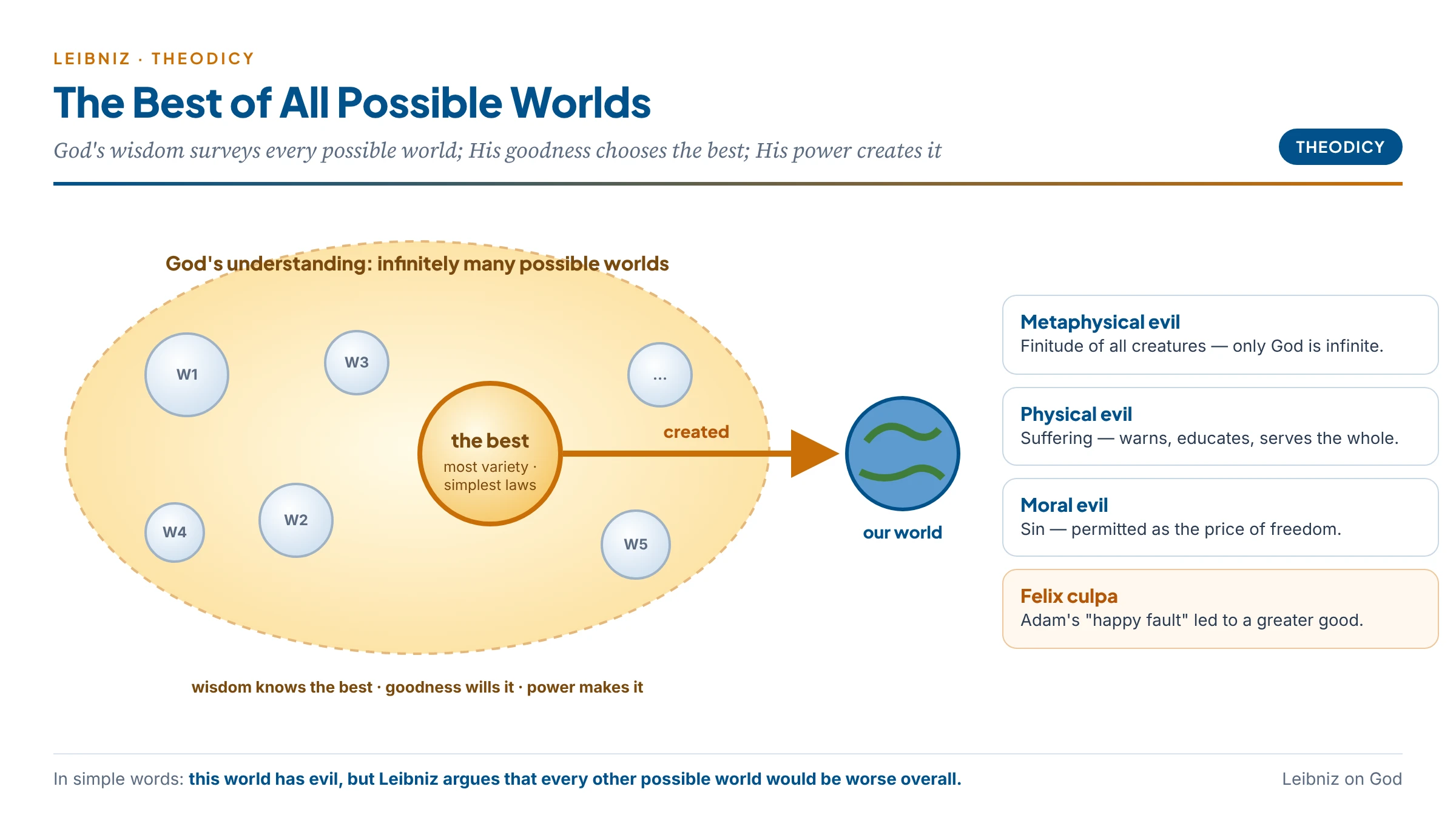
God’s choice. In God’s intellect there are infinitely many possible worlds — every consistent combination of things. God’s power could create any of them; His goodness wills the best; His wisdom knows which it is. By the principle of sufficient reason, God must have a reason for choosing this world — and the only adequate reason is that it is the best.
What “best” means:
- Not a world without evil, but the world with the greatest total perfection: the greatest variety and richness of phenomena combined with the greatest simplicity of laws — “as much variety as possible, but with the greatest order possible.”
- Parts and whole. Imperfections in the parts can serve the perfection of the whole. A world with no evil at all might be poorer overall.
- Analogies: a dissonance in music, rightly placed, makes the harmony richer; the dark background of a painting brings out its light; a general accepts a small wound to win a great victory.
Three kinds of evil:
| Kind | What it is | Explanation |
|---|---|---|
| Metaphysical evil | The imperfection of every created thing — its finitude | Unavoidable: anything created must be finite, since only God is infinite; its source is the limited nature of creatures (materia prima), not God |
| Physical evil | Suffering and pain | Often a means to greater good — it warns, educates, punishes, or contributes to the harmony of the whole |
| Moral evil | Sin | The price of creaturely freedom; God does not will sin but permits it, because a world with free beings is better than one without |
- God permits, does not will, evil. God wills the good absolutely; He permits evil as a condition of the best whole.
- Felix culpa — the “happy fault.” Leibniz cites the old Christian theme that Adam’s fall was a “happy fault,” since it brought about the incarnation and redemption — a greater good than if there had been no fall. God permitted evil in order to bring about a greater good.
- Theodicy. Leibniz coined the word theodicy (theos + dikē, “the justice of God”) for this defence of God’s goodness in the face of evil.
Criticisms of the optimism:
- Voltaire’s satire. After the Lisbon earthquake of 1755, which killed tens of thousands, Voltaire ridiculed Leibnizian optimism in Candide through Dr Pangloss, who insists amid every disaster that “all is for the best in the best of all possible worlds.”
- The amount of evil. Even if some evil is necessary, the quantity and intensity of suffering (children’s suffering, natural disasters) seem far beyond what any greater good requires.
- Is there a “best” world? For any world, a better one might be conceivable — just as there is no greatest number; then God could not choose “the best.”
- God’s freedom. If God must choose the best, did He create freely?
- Ends justify means? The felix culpa reasoning seems to make sin good in the end, and to treat individuals’ suffering as a mere means to the beauty of the whole.
7. Freedom in a Pre-established World
The problem:
- Each monad’s whole history is contained in its complete concept from the start (“charged with the past, big with the future”).
- Its states unfold by its own inner law, pre-arranged by God to harmonise with all others.
- God foreknows everything.
So it seems that everything I do was settled before I was born. Leibniz criticised Spinoza for leaving no room for freedom — has he done any better?
Leibniz’s answer — compatibilism:
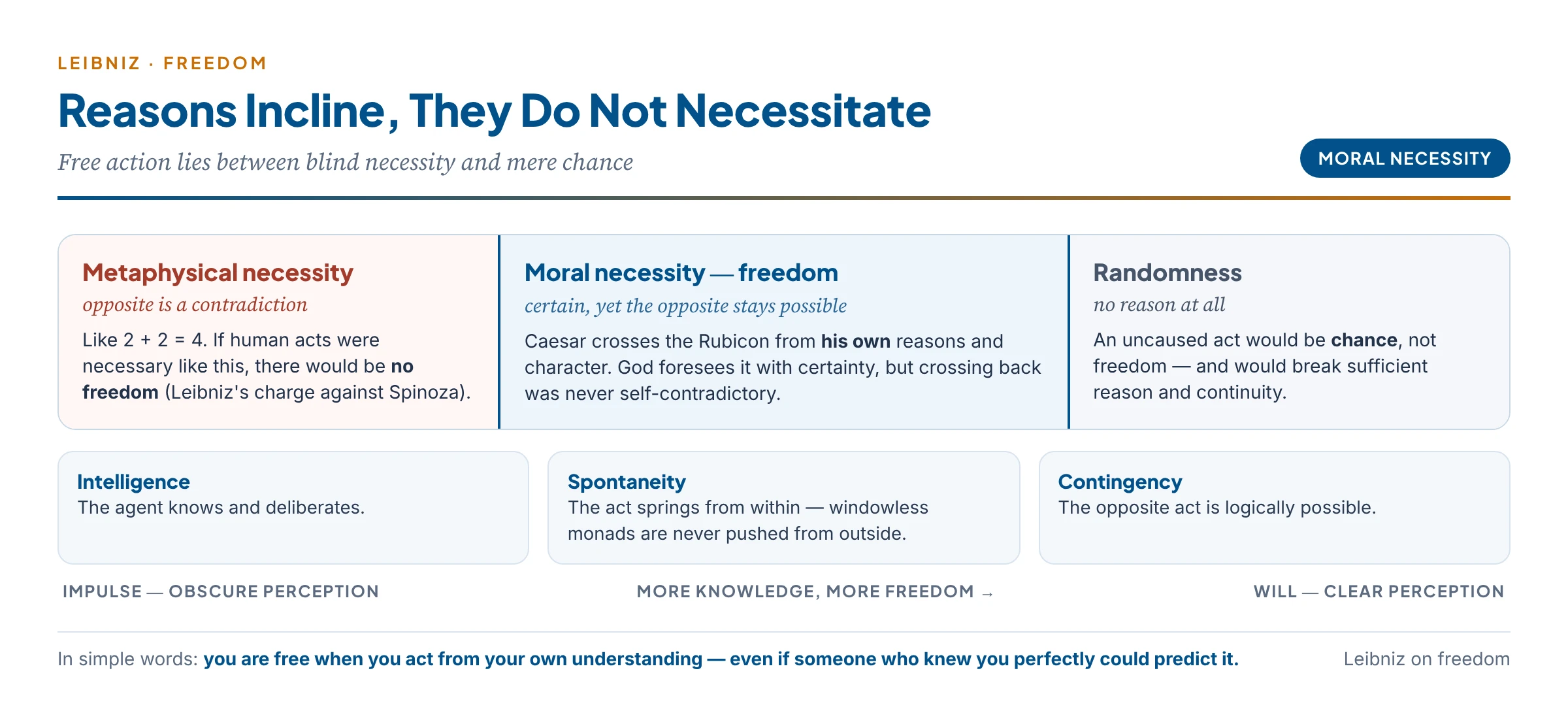
- Freedom is not randomness. Ordinary people think of freedom as unpredictability — the opposite of the predictability of a washing machine or a sum. But an uncaused, random act would not be free; it would be mere chance. “Nothing happens de novo“: a purely undetermined action would be an abrupt break, violating the law of continuity and the principle of sufficient reason.
- Freedom is self-determination. A free act is one whose source is the agent itself. Caesar crossing the Rubicon is free because the act flows from Caesar’s own nature and reasons, not from anything outside him. Why complain that Caesar’s concept determines what Caesar does — isn’t Caesar free if he is the source of his action? A sluggard and a Caesar will lead very different lives, each from his own character.
- Three conditions of freedom:
- Intelligence — the agent knows what it is doing and deliberates.
- Spontaneity — the action comes from within the agent (as all monadic action does — no external compulsion).
- Contingency — the opposite of the action is not self-contradictory; it remains logically possible.
- Metaphysical vs moral necessity.
- Metaphysical (absolute) necessity — the opposite is a contradiction (like 2 + 2 = 5). Free acts are not necessary in this sense.
- Moral (hypothetical) necessity — given the agent’s reasons and character, the act will certainly follow, but its opposite remains possible. “Reasons incline without necessitating.”
- Certainty is not necessity. God’s foreknowledge makes my action certain but does not make it necessary; God foresees what I will freely do. Caesar’s crossing is contained in his concept, but only through an infinite analysis that no finite mind could complete — so it remains a contingent truth, not a necessary one.
- Degrees of freedom. The more we act from clear and distinct perceptions — from reason rather than confused passion — the freer we are. Action from obscure perception is impulse; from clear perception, will. Freedom grows with knowledge.
- God is the most free — not because He acts at random, but because every act of His is determined by infinite wisdom. Freedom consists neither in strict necessity nor in mere spontaneity, but in spontaneous action guided by clear understanding.
In simple words
Your closest friend knows you so well that she can predict you will refuse a bribe. Her knowing does not force you; you refuse because of who you are. Leibniz says God’s foreknowledge is like that, only perfect: your act is certain because it flows from your character and reasons — not forced, and its opposite was never impossible.
8. Does Pre-established Harmony Lead to Determinism?
Why it seems so:
- Every state of every monad is fixed in advance by its complete concept and by God’s harmony.
- Nothing can enter a monad from outside to change its course.
- God chose this world, with every event in it, before creation.
- So human beings seem to act like pre-set automata — Leibniz himself calls monads “incorporeal automata.”
Leibniz’s defence:
- Spontaneity is guaranteed. Since monads are windowless, nothing external compels them; all action is the monad’s own. This is a stronger spontaneity than any interactionist can offer.
- Contingency is preserved. The opposite of every free act is logically possible; only moral, not metaphysical, necessity rules.
- God’s choice is free and wise, not a blind necessity like Spinoza’s.
- Harmony is not compulsion. God did not force my choice; He chose to create the possible world in which I, by my own nature, choose as I do.
Verdict:
- Determinism — yes, in a sense. The future is certain and, in principle, fully determined by prior states and God’s plan.
- Fatalism or compulsion — no. Actions flow from agents’ own natures and reasons; they could have been otherwise without contradiction.
- Critics’ view. Many hold that Leibniz’s system is as deterministic as Spinoza’s: “contingency” through infinite analysis and “moral necessity” look like verbal distinctions. If my complete concept contains all my acts, and God chose that concept, my “freedom” is the freedom of a clock that runs by its own spring. Arnauld objected along these lines when Leibniz first presented the complete-concept doctrine.
Indian Connect — Harmony, karma and freedom in Indian thought
- Nyāya’s Īśvara and adṛṣṭa. In Nyāya-Vaiśeṣika, the unseen moral force adṛṣṭa (the accumulated merit and demerit of souls) guides the combination of atoms, under the direction of Īśvara, so that each soul receives experiences matching its karma — a cosmic coordination of souls and matter rather like a harmony arranged by God.
- Karma and freedom. Indian schools generally hold that present conditions are shaped by past karma, yet the agent remains free and responsible in present action — a compatibilism close to Leibniz’s “reasons incline without necessitating.”
- Karma as theodicy. Where Leibniz explains evil by the best whole, Indian thought typically explains suffering by the souls’ own past actions; God (in Nyāya or Vedānta) is like rain that helps every seed grow according to its own nature — not responsible for the differences.
- Līlā. Vedānta’s idea of creation as God’s līlā (spontaneous play), done not from need, offers another answer to why a perfect being creates — where Leibniz answers “to realise the greatest good.”
Critical Evaluation
Objections to the Harmony
- Freedom vs harmony. How can monads be free if pre-established harmony determines everything? The system seems as deterministic as Spinoza’s.
- Ad hoc. The harmony does not follow from the nature of monads themselves; it is brought in from outside to fill a gap the theory created.
- God as micromanager. God must arrange the states of infinitely many monads for all time; critics find this a strange picture of creation.
- Unverifiable. The theory can be neither confirmed nor refuted by any experience; to some it looks like mere imagination.
- Theology vs monadology. If monads are truly self-sufficient, why bring in God? If God governs everything by a plan, the “independent activity” of monads is illusory.
- Whose harmony? Is God outside the harmony (as its author) or part of it (as the supreme monad)? The relation is unclear.
- Optimism. The claim that this is the best possible world seems contradicted by the scale of suffering.
Critics and Defenders
Criticism — Critics
- Voltaire: “best of all possible worlds” is a cruel joke in the face of real disasters.
- Arnauld: the complete-concept doctrine makes every act of a person fated.
- Kant and Hegel: the harmony is imposed from outside; monads without real relations cannot form a true world.
- Empiricists: an untestable metaphysical hypothesis.
- Libertarians: “moral necessity” is still necessity; there is no real alternative open to the agent.
Defence — Defenders and lasting value
- A coherent compatibilism: freedom as rational self-determination, not chance, is widely defended today.
- Science and purpose: Leibniz’s two-kingdom view lets science explain everything mechanically while leaving room for meaning and value.
- Theodicy as a field: his framing of the problem of evil — possible worlds, greater goods, free will — still structures debates in philosophy of religion.
- Possible worlds: his idea of God choosing among possible worlds underlies modern modal logic and the analysis of necessity and contingency.
- Systems thinking: a world of autonomous units coordinated by one design anticipates ideas in computing and systems theory.
Cross-Tradition Comparison
Coordination of Self and World: Leibniz and Indian Thought
| Point | Leibniz | Nyāya-Vaiśeṣika | Sāṃkhya | Advaita |
|---|---|---|---|---|
| Problem | How do windowless monads agree? | How do atoms and souls come together rightly? | How do puruṣa and prakṛti cooperate? | How does one Brahman appear as self and world? |
| Answer | Pre-established harmony by God | Adṛṣṭa guided by Īśvara | Proximity (sannidhi); prakṛti works “for the sake of” puruṣa | Māyā / superimposition — the many are appearance |
| Teleology | The world is chosen as best; mechanism serves ends | Creation serves souls’ experience and liberation | Prakṛti’s evolution is for puruṣa’s experience and liberation | Creation is līlā, play |
| Evil | Metaphysical, physical, moral; best whole | Due to souls’ karma | Due to non-discrimination | Belongs to the empirical level only |
| Freedom | Self-determination; reasons incline, do not necessitate | Agent free within karma | Puruṣa never really acts | Liberation by knowledge |
Indian Connect — Key takeaways
- Sāṃkhya’s teleology is strikingly close to Leibniz’s: unconscious prakṛti evolves for the sake of conscious puruṣa, as milk flows for the calf — mechanism serving an end without either side acting on the other.
- Nyāya’s adṛṣṭa plays the part of Leibniz’s harmony in coordinating souls and matter, but under a God who regulates rather than pre-programmes.
- The theodicies differ: Leibniz justifies evil by the perfection of the whole; Indian thought justifies it by the individual’s own karma — the injustice charge falls on the world-order in one, on the individual’s past in the other.
Synthesis (Siddhānta)
Pre-established harmony is Leibniz’s bold solution to the problems his monadology created. It explains how windowless substances form one world, dissolves Descartes’ mind–body problem without Spinoza’s monism, joins the mechanical and the teleological, and expresses God’s wisdom in choosing the best of all possible worlds. His compatibilist account of freedom — intelligence, spontaneity and contingency, with reasons that incline without necessitating — is subtle and still influential. Yet the harmony is supplied by God rather than explained, the optimism strains against the reality of suffering, and many readers find his freedom only a refined determinism. Leibniz’s lasting gift is less the details of his system than its questions and tools: possible worlds, sufficient reason, the problem of evil, and the relation of freedom to reason.
- Science and meaning: harmony between the efficient-causal explanations of science and the purposive language of ethics remains a live ideal.
- Theodicy: every modern discussion of the problem of evil — natural disasters, the free-will defence — engages Leibniz.
- Free will today: compatibilism — freedom as acting from one’s own reasons — is the dominant view among philosophers.
For Leibniz, the world is a vast orchestra in which no instrument hears another, yet all play one symphony — because they were all written by one Composer.
Previous Year Questions
- 2020How does Leibniz’s conception of monads bear upon his views on determinism and freedom? Discuss with your own comments.
- 2018Is there any place for freedom in Leibniz’s philosophy, when he speaks of ‘pre-established harmony’? Discuss.
- 2014Does Leibnitz’s theory of pre-established harmony necessarily lead to determinism? Discuss.
- 2012Does Leibnitz succeed in combining the mechanical with the teleological view of the world? Explain his theory of Pre-Established Harmony.
- 2007“God permitted evil to exist in order to bring about greater good, Adam’s fall was felix culpa (happy sin).” – Leibnitz. Critical notes.
- 1992Everything in the universe is so perfectly timed and so harmonious: God must be a mathematician. Notes.