

Rationalism (Descartes, Spinoza, Leibniz): Cartesian Method and Certain Knowledge; Substance; God; Mind-Body Dualism; Determinism and Freedom.
Official Syllabus: Paper I, Section A, Unit 2
Descartes, Spinoza and Leibniz shared one faith: that reason, working from innate ideas by deduction, can reveal the structure of reality. Yet the same method produced three opposite pictures of the world — three substances for Descartes, one for Spinoza, infinitely many for Leibniz. Their views of God, the mind–body relation and human freedom differ just as sharply. Seeing the three side by side is the best way to understand each, and UPSC repeatedly asks for exactly this comparison: why rationalists disagree on substance, whose mind–body theory leaves room for freedom, and how rationalists and empiricists differ on God.
In simple words
Think of three architects given the same tools — ruler, compass and the rules of geometry — and asked to design “the world.” The first builds a house with three separate wings (God, mind, matter) and struggles to connect them. The second says separate wings make no sense and builds one single hall in which everything is a corner or a pillar of the same building. The third finds the single hall lifeless and builds a city of countless self-contained rooms, each perfectly synchronised with every other by the original plan. Same tools, three buildings — because each architect began with a different idea of what a “building block” must be.
Context & Problem
What the Three Share
- Reason over the senses. True knowledge is universal and necessary; the senses give only particular and doubtful information. Reason alone gives certainty.
- Innate ideas. The mind is not a blank slate. Ideas such as God, substance, cause and the axioms of logic and mathematics are inborn — present in the mind as potential, drawn out by reflection.
- The mathematical model. Mathematics is the model of knowledge: start from self-evident truths and deduce everything else. Descartes used algebra and analytic geometry, Spinoza the geometrical method of Euclid, Leibniz the logic of the calculus and a planned universal symbolic language.
- A metaphysics of substance. All three ask: what is substance — the ultimate, independent reality? Their answers shape everything else.
- God at the centre. In all three, God is the keystone: the guarantor of truth (Descartes), the one reality (Spinoza), the creator and harmoniser (Leibniz).
- The principle of sufficient reason. Everything has a reason why it is so and not otherwise — explicit in Leibniz, implicit in Spinoza’s “everything follows necessarily” and in Descartes’ “there must be at least as much reality in the cause as in the effect.”
- System-building. Each builds a complete, deductive system covering knowledge, reality, God, mind, ethics.
The Common Problem: the One and the Many
- Unity and diversity. Experience shows both unity (one ordered world) and diversity (many distinct things, persons, minds). A satisfactory philosophy must explain both and show how they fit together.
- Freedom and interaction. We also experience mutual exchange (things affect each other) and freedom (we choose). Without accounting for these, moral and religious values cannot be explained.
- Three answers. Descartes keeps diversity but cannot explain unity — his three substances limit and exclude one another. Spinoza secures unity but loses diversity — finite things become passing modes. Leibniz tries to hold both: many monads, unified by pre-established harmony.
- The rationalist dialectic. The sequence is often read as a dialectic: Descartes’ dualism (thesis) → Spinoza’s monism (antithesis, removing dualism’s contradictions) → Leibniz’s pluralism (synthesis, restoring individuality while keeping one harmonious order).
Core Doctrine
1. Knowledge and Method Compared
| Point | Descartes | Spinoza | Leibniz |
|---|---|---|---|
| Starting point | Methodical doubt → Cogito ergo sum | The idea of God / Substance — begins where Descartes ends | Principles of contradiction and sufficient reason |
| Method | Analytic–synthetic; four rules (evidence, analysis, synthesis, enumeration) | Geometrical method: definitions, axioms, propositions, demonstrations | Logical analysis; truths of reason vs truths of fact |
| Criterion of truth | Clear and distinct perception, guaranteed by God | Adequate ideas — truth is its own standard (verum index sui) | Non-contradiction (reason); sufficient reason (fact) |
| Innate ideas | Some ideas innate (God, self, mathematics); others adventitious or invented | All true knowledge rational; senses give confused “imagination” | All ideas innate — monads have no windows; knowledge is self-unfolding |
| Grades of knowledge | Intuition and deduction | Imagination → reason → intuitive knowledge | Obscure → confused → clear → distinct → adequate |
| Role of experience | Senses confused; useful for practical life | Source of inadequate ideas and passions | Truths of fact are contingent; still grounded in reason (PSR) |
- Descartes doubts, Spinoza constructs. Descartes’ method is foundational — purify the mind by doubt and rebuild from one certainty. Spinoza’s is architectonic — start with the highest truth and deduce the whole system from it. For Spinoza, doubt is simply a sign of ignorance.
- Leibniz softens the divide. By separating truths of reason (necessary, analytic) from truths of fact (contingent, grounded in sufficient reason), Leibniz leaves room for experience — a step toward Kant.
2. Substance: One Concept, Three Answers
The definitions:
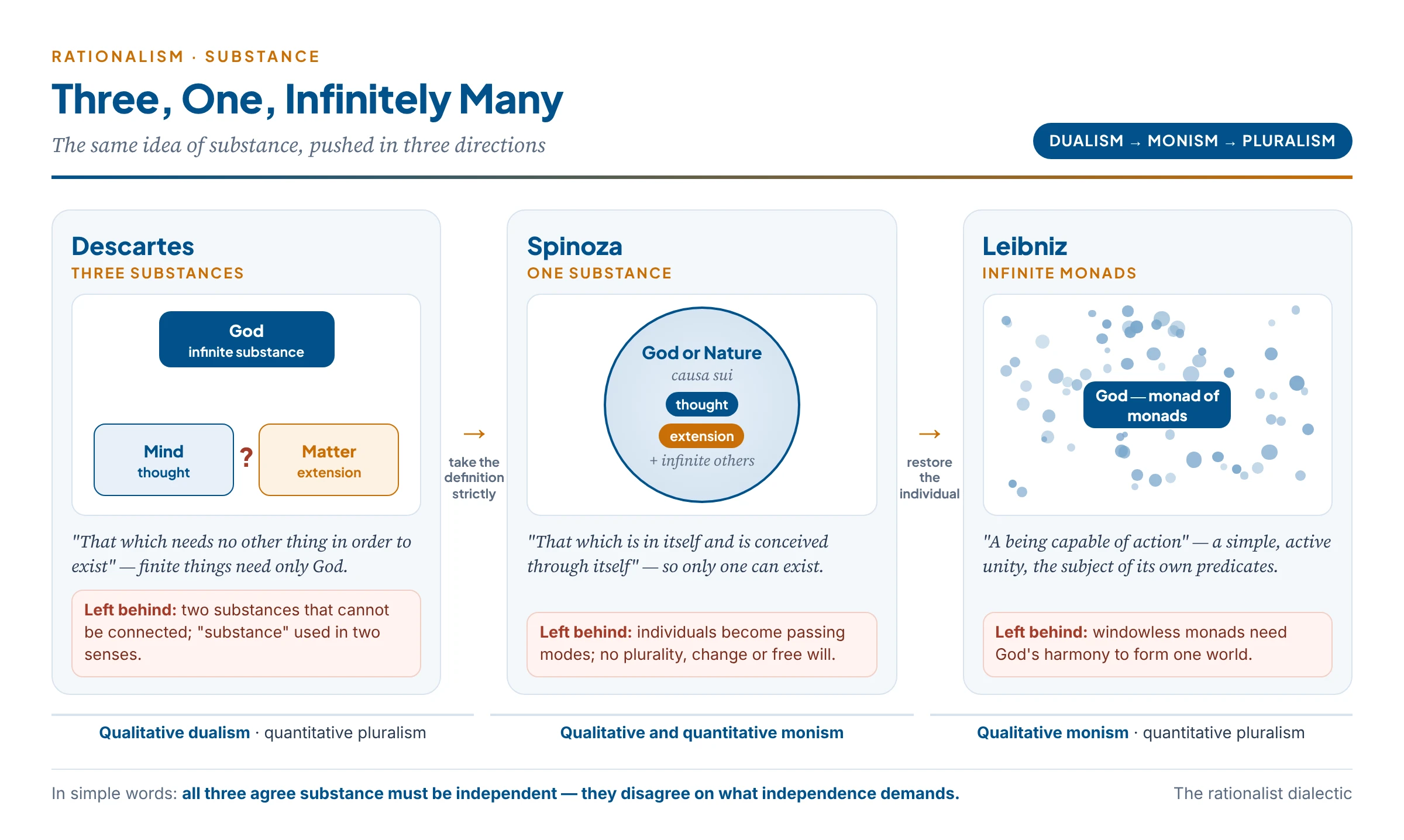
- Descartes. “A substance is that which exists in such a way that it needs no other thing in order to exist.” Strictly only God fits; mind and matter are substances in a secondary sense, needing only God’s concurrence.
- Spinoza. “By substance I understand that which is in itself and is conceived through itself” — whose concept does not need the concept of anything else. This makes substance self-caused (causa sui), infinite and unique.
- Leibniz. Substance is a being capable of action — an active, simple unity; “when several predicates are attributed to a single subject and this subject is attributed to no other, it is called an individual substance.”
The classifications:
| Point | Descartes | Spinoza | Leibniz |
|---|---|---|---|
| Definition stresses | Independence (relative for finite things) | Ontological and conceptual independence; self-causation | Activity (force), unity, being the ultimate subject |
| Number | Three: one infinite (God) + two finite (mind, matter) | One: God or Nature (Deus sive Natura) | Infinite: monads |
| Kinds | Qualitative dualism (thought vs extension) | Qualitative and quantitative monism | Qualitative monism (all spiritual), quantitative pluralism |
| Essence / attributes | Mind = thought; matter = extension; one principal attribute each | Infinite attributes; we know two — thought and extension — of the same substance | Perception and appetition; extension is mere appearance |
| Finite things | Finite substances, created and conserved by God | Modes — affections of the one substance | Monads — created substances, each a living mirror of the universe |
| Matter | Real, extended, passive, infinitely divisible | An attribute of God | Phenomenon of aggregates of monads; real only as “well-founded” appearance |
| Causation | Transitive — God creates; mind and body interact | Immanent — God is in his effects; no interaction | No interaction among created substances; harmony |
| Resulting ontology | Dualism / pluralism | Monism / pantheism | Spiritual pluralism / monadism |
3. Why the Same School Defines Substance Differently
Though all three are rationalists, their definitions differ for several reasons — the core of the 2018 question.
- Different emphasis within the same idea. All agree substance is what is independent. Descartes takes independence loosely (finite things depend only on God), Spinoza strictly (nothing dependent can be substance), and Leibniz shifts the stress to activity and unity (what acts from itself and has no parts).
- Each corrects his predecessor. Spinoza saw that Descartes’ definition, taken strictly, allows only God — so calling mind and matter “substances” is inconsistent. Leibniz saw that Spinoza’s one substance cannot explain plurality, individuality, change and freedom, and that Descartes’ three substances “limit one another” and cannot be related.
- Different starting points. Descartes starts from the self (the Cogito) and reaches God and the world afterwards; he already has a finite substance before he has the infinite one. Spinoza starts from God, so finite things can only be modes of the infinite. Leibniz starts from the logic of subject and predicate and the dynamics of force.
- Different scientific models. Descartes’ mechanics needs a real, extended, passive matter moved by impact. Spinoza’s geometry suggests one space with figures as its modifications — an impersonal, timeless unity. Leibniz’s calculus and dynamics treat reality as infinitely divisible into points of force (vis viva) and continuous change.
- Different problems to solve. Descartes wanted a secure foundation for science and the immortality of the soul — hence two distinct substances. Spinoza wanted to remove the mind–body puzzle and reach ethical blessedness — hence one substance. Leibniz wanted to reconcile mechanism and teleology, science and religion, unity and individuality — hence many substances in harmony.
- The nature of extension. Extension divides Descartes’ world into two; for Spinoza it is an attribute of God; for Leibniz it cannot be substantial at all, since what is extended is divisible and so a mere aggregate.
- Different religious and ethical aims. Descartes, a Catholic, kept a transcendent personal Creator; Spinoza, excommunicated and seeking intellectual love of God, made God immanent and impersonal; Leibniz, a diplomat seeking to reunite churches, sought a God who is both creator and rational architect.
In short, the rationalists agree that substance must be independent, but disagree about what independence demands — and each later thinker reshapes the definition to remove the difficulties of the earlier one.
Common confusion
Is Leibniz simply “the opposite” of Spinoza? He is a pluralist where Spinoza is a monist, but only quantitatively. Qualitatively, Leibniz is also a monist: every monad is the same kind of thing — a spiritual centre of perception and appetition — differing only in degree of clarity. And Leibniz brings unity back through pre-established harmony under one God, so critics say his pluralism finally turns into a kind of monism. Remember the formula: Descartes — qualitative dualism; Spinoza — qualitative and quantitative monism; Leibniz — qualitative monism with quantitative pluralism.
4. God Compared
| Point | Descartes | Spinoza | Leibniz |
|---|---|---|---|
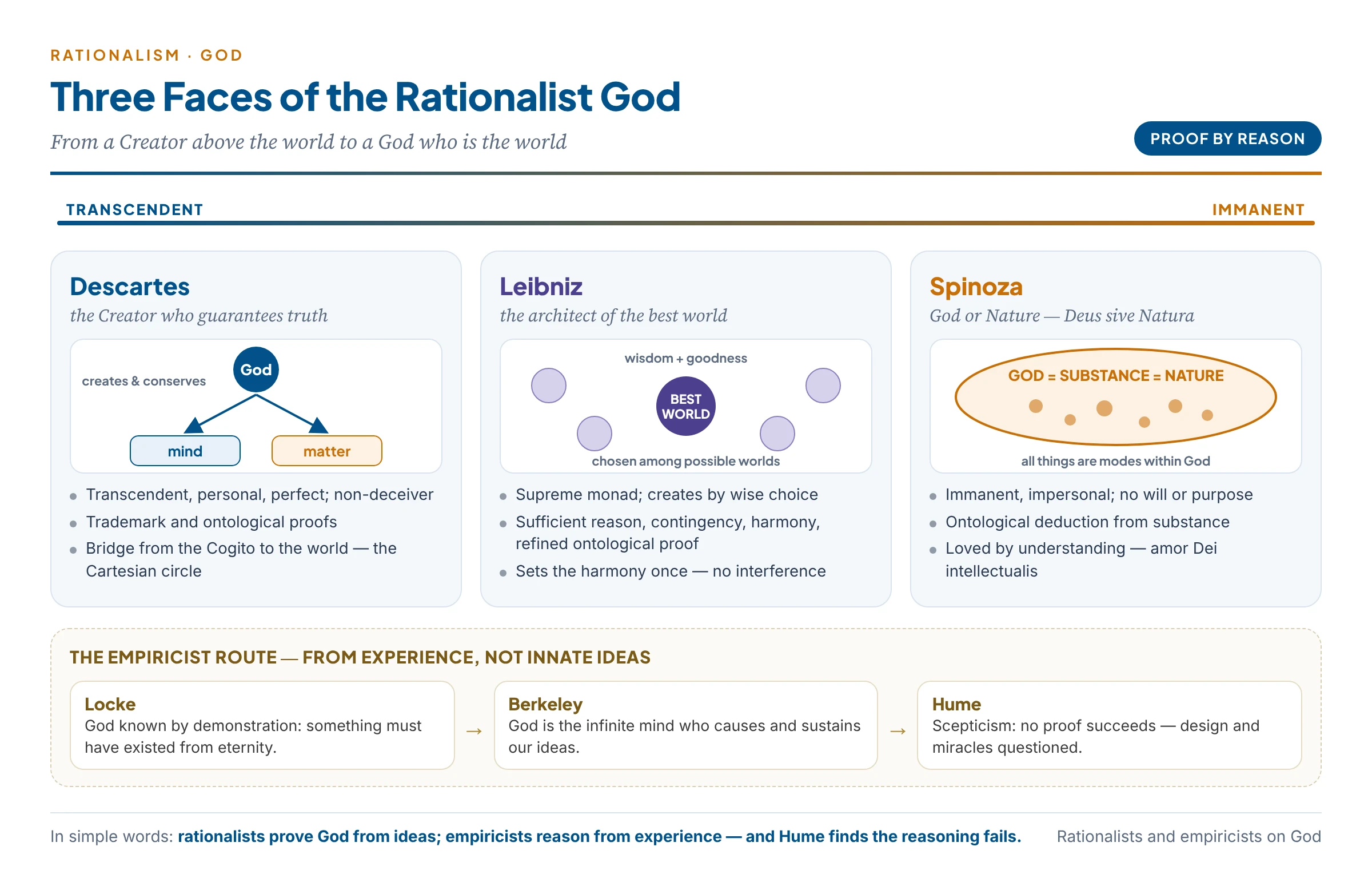
| Nature | Transcendent, personal, infinite substance; creator and conserver | Immanent, impersonal; God = Substance = Nature | Supreme monad (monas monadum); creator of monads; perfect, rational, good |
| Relation to world | Creates mind and matter and keeps them in being by continuous creation | Natura naturans (God as active cause) and natura naturata (God’s modes) — no separate creation | Chooses and creates the best of all possible worlds; then does not interfere |
| Will and purpose | Free will; eternal truths depend on God’s will | No will or purpose; everything follows from necessity of God’s nature | Will guided by wisdom; acts for the best (principle of the best) |
| Proofs | Trademark (causal), ontological, from my existence | Ontological (substance with infinite attributes necessarily exists) | Ontological (refined: God is possible), cosmological/contingency (PSR), eternal truths, pre-established harmony |
| Epistemic role | Guarantor of clear and distinct ideas; removes the evil demon | The object of the highest knowledge (amor Dei intellectualis) | Source of the eternal truths and of the harmony that makes knowledge possible |
| Charge against it | Deus ex machina; Cartesian circle | “Atheism” (Hegel: rather acosmism); “God-intoxicated” (Novalis) | Optimism; God as micromanager of every monad |
- Descartes’ God makes knowledge possible. Without a non-deceiving God, the bridge from the Cogito to the world collapses. God is outside the world, its free creator.
- Spinoza’s God is the world seen rightly. There is no creation by choice: “whatever is, is in God.” God has no purposes, emotions or personality; to love God is to understand the necessary order of nature.
- Leibniz’s God is the supreme rational architect. God surveys infinitely many possible worlds and, by wisdom and goodness, chooses the best — the one with the greatest variety under the simplest laws.
5. Rationalists and Empiricists on God
For the 2016 question, compare the rationalist trio with the empiricists.
| Thinker | Stance on God | Main basis |
|---|---|---|
| Descartes | God exists necessarily; a perfect, non-deceiving creator | Innate idea of the infinite (trademark); ontological argument |
| Spinoza | God is the one substance, identical with Nature | Definition of substance; ontological deduction |
| Leibniz | God is the necessary being, creator of the best world | Sufficient reason; harmony; ontological argument made complete |
| Locke | God’s existence is known by demonstration | Cosmological reasoning from my own existence: something has existed from eternity, a most powerful and knowing being; no innate idea of God |
| Berkeley | God is the infinite spirit who causes and sustains our ideas | Ideas of sense are not produced by my will, so another mind produces them; things continue to exist when unperceived because God perceives them |
| Hume | Sceptical: no rational proof is possible | Existence can’t be proved a priori (whatever we conceive as existing we can conceive as not existing); critique of the design argument (weak analogy, many causes possible) and of miracles; religion’s origin in fear and hope |
- The pattern. Rationalists deduce God from ideas and definitions, and God holds their systems together. Empiricists begin from experience: Locke and Berkeley still reach God by inference from experience, but Hume shows the inferences fail — God becomes a matter of faith, not knowledge.
- Rationalists proved, empiricists questioned. The ontological argument is the rationalists’ favourite; the empiricist line ends in Hume’s scepticism, which Kant then uses to deny that God can be known by theoretical reason at all.
In simple words
Picture God’s relation to the world as an author and a book. For Descartes, God is an author who writes the book and must keep holding it, or it would vanish. For Leibniz, God is an author who chose the best of all possible books, wrote every page in advance, and then let it read itself. For Spinoza, there is no author standing outside — God is the book, and every character and sentence is a part of Him.
6. Mind and Body Compared
| Point | Descartes | Spinoza | Leibniz |
|---|---|---|---|
| What are mind and body? | Two distinct substances: thinking and extended | Two attributes (modes of two attributes) of the one substance — one thing seen two ways | Mind = dominant monad; body = aggregate of lesser monads; all spiritual |
| Relation | Interactionism: mind and body act on each other through the pineal gland | Parallelism / double aspect: “the order and connection of ideas is the same as the order and connection of things”; no interaction | Pre-established harmony: no interaction; God has synchronised their states from creation |
| Two-clock analogy | Clocks linked by a mechanism | Not two clocks but one, seen from two sides | Two perfect clocks set by the master clockmaker at the start |
| Main difficulty | How can the unextended move the extended? Breaks conservation of motion | Mind’s apparent influence (fear making the heart race) unexplained; panpsychism; individuality lost | Interaction only “apparent”; harmony ad hoc; freedom threatened |
| Whose problem it is | Creates the problem | Dissolves it by monism | Dissolves it by harmony and monadism |
- Between Descartes and Leibniz stands occasionalism. Malebranche held that God produces the bodily movement on the occasion of my willing, and the sensation on the occasion of the bodily change — a “perpetual miracle,” which Leibniz replaced by one miracle at creation.
- Spinoza’s view is a deduction, not a solution. Parallelism follows from his idea of substance; it explains correspondence by identity — mind is the “idea of the body.” Leibniz explains correspondence by design between distinct substances.
In simple words
Imagine a film with its soundtrack. Descartes says sound and picture are two separate machines connected by a cable — but no one can find the cable. Spinoza says there is only one recording, which you can either watch or listen to: picture and sound agree because they are the same film. Leibniz says sound and picture are two separate reels that never touch, but the editor synchronised them so perfectly at the start that they always match.
7. Traditional European Theories of Mind and Body
For the 1997 question on “theories in traditional European philosophy,” place the rationalists within the wider map.
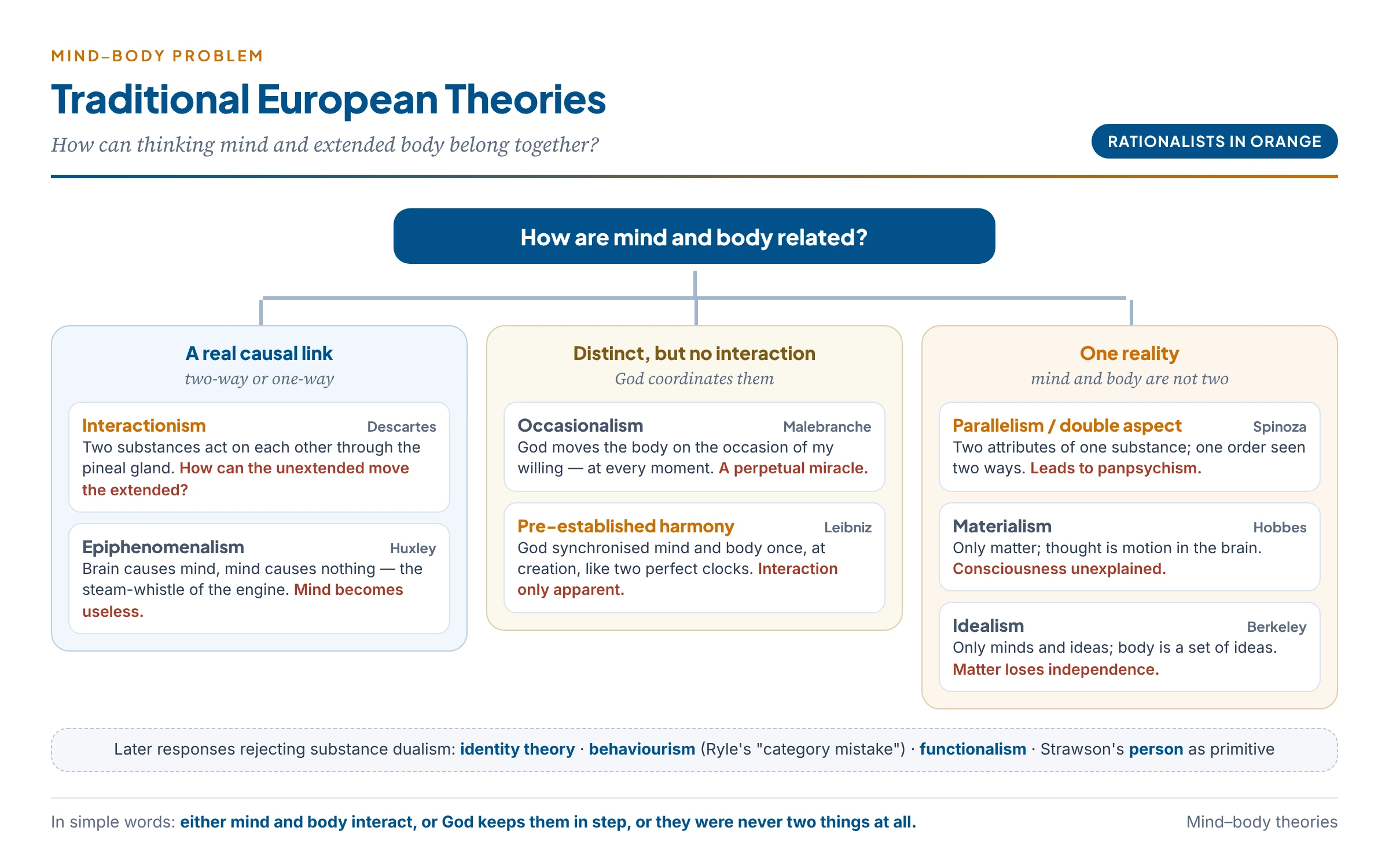
- Interactionism (Descartes). Two substances act causally on each other. Objection: unintelligible causal link; pineal gland is still physical.
- Occasionalism (Malebranche, Geulincx). No real interaction; God is the only true cause and coordinates mind and body on each occasion. Objection: constant miracle; God becomes the cause of everything, even sin.
- Parallelism / double-aspect theory (Spinoza). Mind and body are two aspects of one reality; their series run in parallel without causal crossing. Objection: unclear what the underlying reality is; leads to panpsychism.
- Pre-established harmony (Leibniz). Distinct substances synchronised by God at creation. Objection: no real relations; freedom compromised.
- Materialism (Hobbes, La Mettrie). Only matter exists; thought is motion in the brain; “man a machine.” Objection: cannot explain consciousness and meaning.
- Idealism (Berkeley). Only minds and their ideas exist; body is a collection of ideas. Objection: denies the independence of the material world.
- Epiphenomenalism (T. H. Huxley). Brain events cause mental events, but the mental causes nothing — like the steam-whistle of an engine. Objection: makes mind useless; contradicts evolution of consciousness.
- Modern responses. Identity theory (mental states are brain states), behaviourism (Ryle: the “ghost in the machine” is a category mistake), functionalism, and Strawson’s concept of person as primitive — all reject Cartesian substance dualism.
Common confusion
Is Spinoza a “parallelist” in the same sense as Leibniz? Both deny interaction, and textbooks often group them as “parallelists,” but their reasons are opposite. Spinoza’s mind and body are one and the same thing expressed in two attributes, so their agreement is a matter of identity and is logically necessary. Leibniz’s mind and body are different substances (or aggregates of substances) whose agreement is a matter of harmony chosen by God. One is monism, the other pluralism coordinated by design.
8. Determinism and Freedom Compared
| Point | Descartes | Spinoza | Leibniz |
|---|---|---|---|
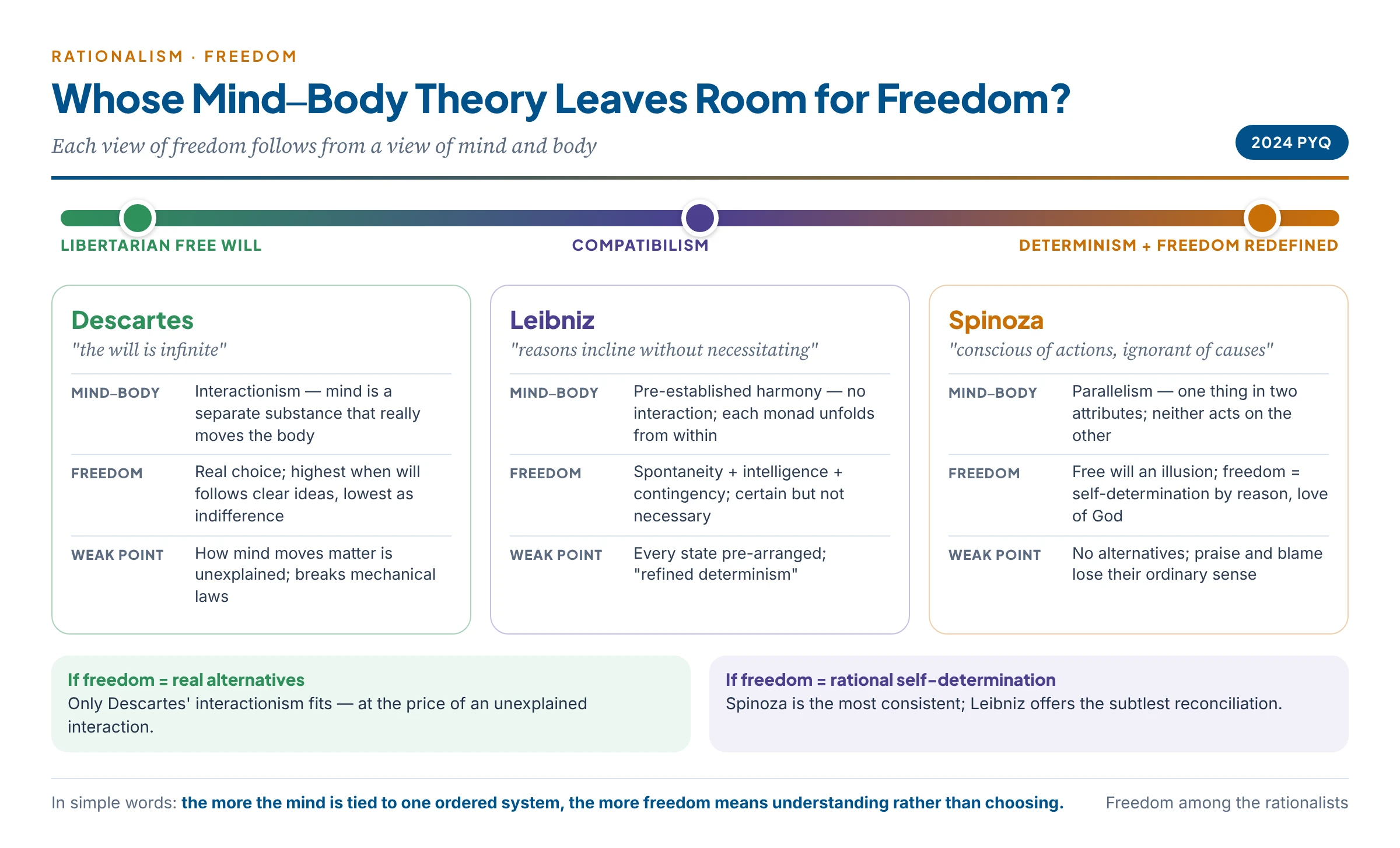
| Position | Libertarian free will in man (body is mechanically determined) | Hard determinism about events; freedom redefined as self-determination | Compatibilism: freedom within a determined but contingent order |
| Nature of will | The will is infinite — the faculty in which man most resembles God | No separate faculty of will; will and intellect are the same; “volitions” are ideas | Will follows the strongest reason, but reasons incline without necessitating |
| Grades of freedom | The lowest grade is indifference (no reason either way); highest = assent to what the intellect sees clearly | Bondage to passions → freedom through reason → blessedness in intuitive knowledge | Clearer perception = greater freedom; God most free |
| Free will illusion? | No — we experience freedom directly and it is self-evident | Yes — “men think themselves free because they are conscious of their actions but ignorant of their causes” (the falling stone) | Partly — freedom is real but not uncaused; no “liberty of indifference” |
| Source of error / evil | Will outruns intellect — judging beyond what is clearly perceived | Inadequate ideas and passions | Finite nature (metaphysical evil); moral evil from creaturely limits |
| God’s freedom | God free even over eternal truths | God alone is “free” — acts from necessity of his own nature alone | God chooses the best freely; “morally,” not metaphysically, necessary |
| Key formula | Freedom = choice guided by clear knowledge | Freedom = understood necessity (amor Dei intellectualis) | Freedom = spontaneity + intelligence + contingency |
- Spinoza’s freedom as self-control. Freedom does not mean absence of control but self-control. Even God is free only because he acts by the laws of his own nature, which he does not violate. If man is governed by the laws of God, and God is the very substance of man, then man in following them follows his own deepest nature. Read this way, divine determinism does not destroy human freedom — it defines it.
- Leibniz’s middle path. Every act has a sufficient reason, so nothing happens by chance; but the opposite of any act is not self-contradictory, so it is not metaphysically necessary. Caesar crossing the Rubicon was certain but contingent.
- Descartes’ tension. He insists on libertarian free will while holding that God foreordains everything; he admits the two cannot be fully reconciled by our finite minds but that both are clearly known.
9. Whose Mind–Body Theory Leaves Room for Freedom?
This is the 2024 question. Assess each in turn.
- Descartes — most compatible with free will in the ordinary (libertarian) sense. The mind is a separate substance not governed by mechanical laws, and through interaction it can really move the body. Freedom is both real and effective in the world. Problem: the interaction is unintelligible, and if the physical world is a closed mechanism, the mind’s influence would break the laws of motion.
- Spinoza — compatible only with freedom redefined. Mind cannot act on body (III P2); every idea and every bodily motion is determined. Free will is an illusion. Yet freedom as rational self-determination — acting from adequate ideas, freedom from passions — is fully available. Problem: no alternative possibilities; moral responsibility and praise and blame lose their ordinary meaning.
- Leibniz — compatibilist freedom within harmony. Each monad acts spontaneously from its own nature; no external force compels it. A rational soul acts on the reasons it perceives, and its choices are contingent. Problem: God pre-arranged every state; “inclining reasons” and the “complete concept” make the future certain, so critics call it a refined determinism.
Verdict:
- If free will means real alternative possibilities and the mind’s power to initiate bodily action, only Descartes’ interactionism is compatible with it — at the cost of an unexplained interaction.
- If freedom means self-determination by reason, Spinoza’s parallelism gives the most consistent account, and Leibniz offers the subtlest compatibilism, keeping contingency while denying chance.
- Most evaluators prefer to present Leibniz as the most serious attempt to reconcile freedom with a lawful universe, Descartes as the defender of libertarian freedom, and Spinoza as the thinker who redefines freedom most radically.
In simple words
Think of three kinds of train journey. Descartes’ passenger can pull the chain and stop the train anywhere — but no one can explain how the chain is connected to the engine. Leibniz’s passenger has a ticket booked by a wise travel agent who knew every choice she would make; she travels freely, by her own reasons, yet her route was always certain. Spinoza’s passenger knows the train runs on fixed rails; freedom is not changing the rails but understanding the route so well that she wants nothing else.
10. Common Merits and Shared Weaknesses
Merits:
- Confidence in reason. They showed how far pure reasoning can go and made the demand for clarity, rigour and system central to philosophy.
- Foundations of modern science. Descartes’ mechanism, Spinoza’s universal law and Leibniz’s dynamics and calculus shaped the scientific picture of nature.
- The mind–body problem. Their theories map nearly every possible position on this problem; contemporary philosophy of mind still argues within this map.
- Ethics through knowledge. All three tie freedom and the good life to understanding.
Weaknesses:
- Same method, opposite results. If pure reason leads equally to three, one and infinitely many substances, the method itself is suspect — Kant called this dogmatism: reason going beyond experience falls into conflict with itself.
- Innate ideas questioned. Locke and the empiricists argued there are no innate ideas — children and “idiots” do not know them; ideas come from sensation and reflection.
- Gap between logic and existence. Deductions from definitions show what must be thought, not what exists — the weakness of the ontological argument and of Spinoza’s geometrical system.
- God as deus ex machina. In all three, God is brought in to close the gaps the system creates: to guarantee truth, to make substance one, or to harmonise monads.
- The problem of the one and the many remains unsolved. Even later systems, Hegel’s included, did not finally reconcile unity and diversity.
Critical Evaluation
Rationalism on Trial
Criticism — Critics
- Empiricists (Locke, Berkeley, Hume): no innate ideas; substance is “something, I know not what” (Locke) or a bundle (Hume); metaphysics beyond experience is empty.
- Kant: rationalist metaphysics is dogmatic; reason applied beyond possible experience produces antinomies — like the clash between Spinoza’s one substance and Leibniz’s many simple monads.
- Hegel: Descartes leaves an unbridgeable dualism, Spinoza an abstract unity without real differences (acosmism), Leibniz “windowless” atoms tied together only externally by God.
- Logical positivists: claims about substance and God are neither analytic nor verifiable — meaningless.
- Ryle and later philosophy of mind: the Cartesian “ghost in the machine” is a category mistake; mind is not a substance at all.
Defence — Defenders and lasting value
- Necessary truths exist: mathematics and logic still look like knowledge not derived from the senses — the rationalists’ central insight.
- Innateness revived: Chomsky’s innate grammar and modern cognitive science give new life to the idea of inborn mental structure.
- Kant’s synthesis: Kant himself kept the rationalist demand for a priori principles, combining it with empiricist experience.
- Unity of science: Spinoza’s one lawful nature and Leibniz’s sufficient reason express the ideal behind modern physics.
- Live options in philosophy of mind: dualism, dual-aspect monism and panpsychism — all descended from this trio — are seriously defended today.
Cross-Tradition Comparison
The Rationalist Triad and Indian Philosophy
| Point | Descartes | Spinoza | Leibniz |
|---|---|---|---|
| Indian parallel on substance | Sāṃkhya dualism of puruṣa and prakṛti (but no God and no interaction) | Advaita Vedānta: one Brahman; also Viśiṣṭādvaita, where world and selves are real “attributes” of Brahman | Jaina plurality of jīvas; Sāṃkhya’s many puruṣas; Rāmānuja’s many selves |
| God | Nyāya’s Īśvara — efficient cause, proved by inference | Nirguṇa Brahman of Advaita — impersonal, beyond determinations (neti neti) | Nyāya’s Īśvara who arranges atoms by adṛṣṭa; Rāmānuja’s personal Lord |
| Mind–body | Interaction problem resembles Sāṃkhya’s puzzle of how puruṣa and prakṛti come together | Mind and body as aspects of one reality — like Brahman manifesting as subject and object | Coordination by divine plan — like adṛṣṭa directing atoms for souls |
| Freedom | Agent’s real choice — Nyāya and Mīmāṃsā’s free agent bound by karma | Liberation through knowledge (jñāna-mārga), seeing reality as it is | Karma shapes conditions, agent still responsible — Gītā’s action without attachment |
Indian Connect — Key takeaways
- Spinoza and Advaita: both arrive at one infinite reality beyond all determinations, and both see liberation as knowledge. But Spinoza’s world of modes is real, while Śaṅkara’s world is appearance (vivarta, māyā); Spinoza’s God includes extension, Brahman is pure consciousness.
- Spinoza’s attributes and Rāmānuja: thought and extension as real expressions of one substance recall Rāmānuja’s selves (cit) and matter (acit) as the body of Brahman — a unity that keeps real differences.
- Descartes and Sāṃkhya: both are dualists, but Sāṃkhya’s puruṣa is a passive witness while Descartes’ mind actively thinks and wills; Sāṃkhya has no Creator to bridge the two.
- Leibniz and the Jainas: many souls, alike in nature, differing in degree of knowledge — the Jaina jīvas covered by karma differ as Leibniz’s monads differ in clarity of perception.
- God: Nyāya’s inferential proof of Īśvara as the maker of the world is closest to Descartes’ and Leibniz’s causal arguments; Advaita’s impersonal Brahman is closest to Spinoza.
Synthesis (Siddhānta)
The three rationalists began with the same conviction — that reason can grasp reality — and the same question: what is substance? Descartes, defining substance as what needs nothing else, admitted three, but split the world into thought and extension and could not connect them. Spinoza, taking the definition strictly, found only one substance — God or Nature — removing the mind–body puzzle and grounding a noble ethics of understood necessity, but at the cost of individuality and ordinary free will. Leibniz, defining substance as active unity, restored many individual substances and joined them by pre-established harmony, offering the subtlest reconciliation of mechanism and purpose, necessity and freedom — though the harmony is supplied by God rather than explained. Their disagreement exposed the limits of pure reason and prepared the ground for Kant, while their questions — about the nature of mind, the existence of God and the possibility of freedom in a lawful universe — remain at the heart of philosophy.
- Philosophy of mind: substance dualism, dual-aspect monism and panpsychism continue the debate the trio began.
- Free will: the libertarian (Descartes), hard-determinist (Spinoza) and compatibilist (Leibniz) options remain the three main positions today.
- Science and religion: the ideal of one rational, law-governed world created or expressed by God still frames the dialogue between them.
Descartes divided reality, Spinoza unified it, and Leibniz tried to multiply it without losing its unity — three answers to one question that philosophy is still asking.
Previous Year Questions
- 2024Among the rationalists, whose account of mind-body problem is compatible with the notion of human freedom and free will? Critically discuss.
- 2018What is the reason for the difference in the definitions and classifications of substances made by Descartes, Spinoza and Leibnitz in spite of the fact that they all belonged to the rationalist school of thought? Discuss.
- 2016Discuss the various stances on God taken by Rationalists and Empiricists.
- 1997State, explain and discuss the various theories in traditional European philosophy regarding the relationship of body and mind.