

Empiricism (Locke, Berkeley, Hume): Theory of Knowledge; Substance and Qualities; Self and God; Scepticism.
Official Syllabus: Paper I, Section A, Unit 3
Empiricism is the theory of knowledge which holds that all our ideas and all our knowledge come from experience. Its first full statement is John Locke’s An Essay Concerning Human Understanding (1689). The rationalists said the mind is born with innate ideas (ideas present from birth) such as God, self and the laws of logic. Locke denied this. He argued that the mind starts as “white paper” (tabula rasa), gets every idea from sensation and reflection, and builds all knowledge by joining, comparing and abstracting these ideas. He then asked how far such knowledge reaches. His answer: we have intuitive certainty of our own self, demonstrative certainty of God and mathematics, and only sensitive knowledge of the outside world. Beyond experience, knowledge stops.
In simple words
Think of a newborn’s mind as a new phone with no apps and no photos, but with a camera and a microphone. Nothing is stored at the start. Everything inside it later — photos, songs, notes — came in through the camera and microphone (sensation) or was made by the phone working on what it had already stored (reflection, combining, editing). Locke says the human mind is like this: built-in capacities, but no built-in content.
Context & Problem
What Empiricism Claims
Empiricism (from Greek empeiria, “experience”) holds that sense experience is the source and the test of knowledge.
- A posteriori theory of knowledge. Knowledge comes after (posterior to) experience and depends on it. Rationalism is called the a priori theory, because it says the most important knowledge is prior to experience.
- The old maxim. “There is nothing in the intellect which was not first in the senses” (Nihil est in intellectu quod non prius fuerit in sensu). The line goes back to the Aristotelian schoolmen; Locke made it the motto of modern empiricism.
- Knowledge is inductive. It starts with particular facts of experience and rises to generalisations. It does not start from self-evident innate principles and deduce the rest, as Descartes and Spinoza did.
- A more modest agenda. The rationalists wanted certain foundations for all knowledge. The empiricists ask humbler questions: where does our information actually come from, and how reliable is it? They accept that most conclusions will be probable, not certain.
Why empiricism arose. Modern philosophy began with rationalism. Descartes held that some ideas are innate; Leibniz went further and made all ideas innate, unfolding from within the mind. On that view nothing truly new can enter the mind from outside. Empiricism was a reaction against this dogmatism: it wanted knowledge that adds something new and is tested against the world.
Rationalism vs Empiricism
| Point | Rationalism | Empiricism |
|---|---|---|
| Source of knowledge | Reason (understanding) | Sense experience (sensation and reflection) |
| Innate ideas | Accepted (Descartes: some; Leibniz: all) | Rejected — mind is a blank slate |
| Ideal of knowledge | Universal and necessary, like geometry | New and informative, about the actual world |
| Method | Deductive — from axioms to conclusions | Inductive — from particular facts to generalisations |
| Main interest | Mathematics, axioms, the structure of reality | Epistemology — how knowledge is acquired and how far it reaches |
| Thinkers | Descartes, Spinoza, Leibniz | Locke, Berkeley, Hume |
Locke: The Man and His Project
- Life. John Locke (1632–1704) studied at Oxford, practised medicine and was deeply involved in politics. His Essay Concerning Human Understanding appeared in December 1689 (dated 1690).
- Titles. He is called the father of empiricism, the father of the critique of knowledge, and, for his political writings, the father of liberalism. He made psychology an empirical science and introduced a “historical, plain method” into philosophy — tracing each idea back to its origin in experience.
- Influence. Voltaire, Rousseau, the Scottish Enlightenment and the American revolutionaries drew on him; Berkeley and Hume built on his foundations; Kant borrowed heavily from him; twentieth-century empiricists such as Carnap, Moore and Quine acknowledged their debt.
- Spirit. He worked like a scientist: a claim must be open to testing, and nothing is exempt from correction. He was ready to throw any of his own writings into the fire the moment he found them untrue.
“It is ambition enough to be employed as an under-labourer in clearing the ground a little, and removing some of the rubbish that lies in the way to knowledge.” — John Locke
Locke’s problem. Philosophers had argued for centuries without agreement. Locke thought the trouble lay in not first asking what the human mind is fit to know. So the Essay inquires into the origin, certainty and extent of human knowledge. In his own words, his aim was to describe “what it is they do, when they perform that action which they call knowing.”
- Knowledge must be certain. “With me, to know and to be certain is the same thing.” What falls short of certainty is opinion or belief, not knowledge.
- Knowledge must be instructive. It should tell us something, not merely repeat what we already said.
- Knowledge must be real. It must refer to, and hold good of, the actual state of affairs. Locke never doubted that there is an independent world of tables, houses and mountains.
- So Locke faces three problems: (a) certainty as against the mere probability of opinion; (b) the reality (validity) of knowledge; (c) its instructiveness.
- Process before product. Locke studies the process by which we come to know rather than the finished body of knowledge. His approach is more psychological than strictly logical — a point his critics later used against him.
The plan of the Essay: Book I attacks innate notions; Book II traces all ideas to experience; Book III studies words and their meanings; Book IV examines knowledge and opinion — their kinds, degrees and limits.
Core Doctrine
1. The Attack on Innate Ideas
Nativism is the view that the mind contains innate ideas — ideas that were neither received through experience nor built by the mind out of ideas it received. In its most popular form, God planted certain ideas and principles in every mind at the moment of its creation. Plato (knowledge as recollection) and Descartes (innate ideas of God, self and mathematics) are the classic nativists.
Locke was not attacking one particular author. He wanted to clear the ground for his own view by contrast, and to remove a doctrine that, he thought, blocked free inquiry by appealing to an incomprehensible source instead of to reason.
What the defenders of innate ideas claimed:
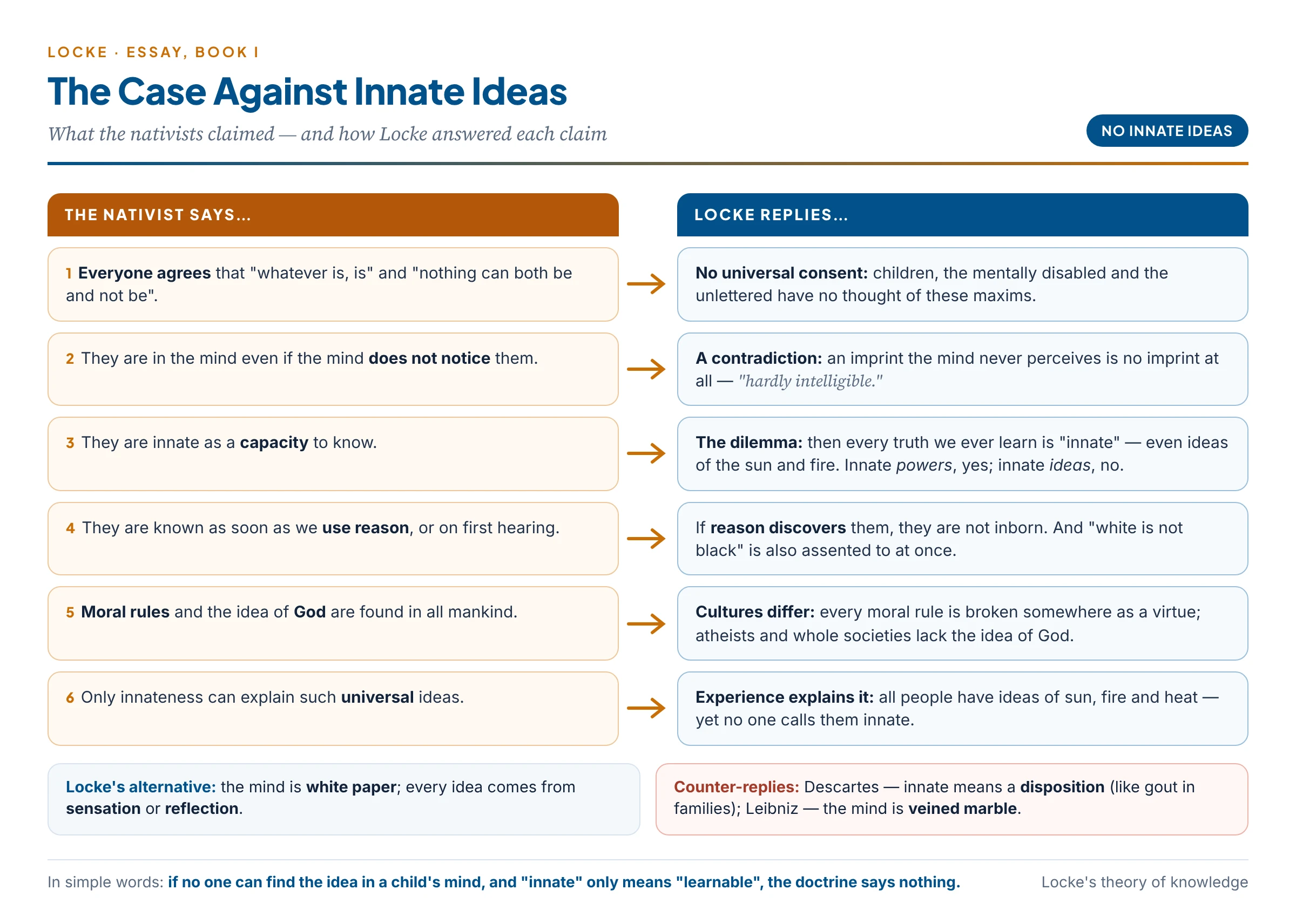
- Universal consent — some principles are accepted by all people everywhere, so they must be inborn. The favourite examples were the laws of logic: “Whatever is, is” (identity) and “It is impossible for the same thing to be and not to be” (non-contradiction).
- The idea of God is found in all people.
- Moral and religious principles are common to all mankind.
- Innate ideas are needed as the basis of axioms, which cannot come from experience.
- Some innate knowledge may lie hidden in the mind and become expressed only in the course of time.
Locke’s arguments against them:
- There is no universal consent. Children, “idiots” (the mentally disabled) and illiterate people have not the faintest thought of “whatever is, is” or of the law of contradiction. If these principles were stamped on the soul from birth, those whose minds are least influenced by custom and learning should show them most clearly. Instead, such principles are the last fruit of a trained intellect, not the first.
- An idea in the mind that the mind does not know is a contradiction. To say a truth is “imprinted” on the soul and yet the soul has never perceived it is to make the imprint nothing. For Locke, being in the mind means being perceived by the mind: “to imprint anything on the mind without the mind’s perceiving it, seems to me hardly intelligible.”
- The “capacity” version is empty — Locke’s dilemma. Defenders may say innate ideas are only implicitly present, as a capacity to know them. But then every truth we ever learn would be innate, since we have the capacity to learn it — even ideas of the sun, fire and heat. So either innate ideas are actually present from birth (which is false), or the doctrine means only that we have a general capacity to know (which is true but makes innate ideas nothing special). Locke: he spoke of innate ideas, not innate powers.
- “Known when we come to the use of reason”? Some say innate principles are known as soon as people begin to use reason. But if reason discovers them, they are not innate — reason is needed only because they are not already known. Besides, children know many things (“sweet is not bitter”) long before they grasp abstract maxims.
- “Assented to on first hearing”? If ready assent on first hearing proves innateness, then “white is not black,” “two and two make four” and countless other propositions would all be innate — absurd.
- Even universal consent would not prove innateness. Agreement can be explained another way, by common experience. Everybody has ideas of the sun, fire and heat, yet nobody calls them innate.
- No moral principle is universally accepted. There is hardly a single moral rule that all nations accept, and hardly one whose contrary has not somewhere been practised as a virtue. Locke’s reports include whole nations that exposed infants to die; the notes often add the Spartan training of boys in theft, and the honour of head-hunters. Even among civilised people, “robberies, murders, rapes are the sports of men set at liberty from punishment and censure.” Moral rules also need proof — we can always ask why we must keep a promise — which a self-evident innate truth would not need.
- The idea of God is not universal. Individual atheists exist, and travellers reported whole societies without any idea of God. Where the idea exists, it differs widely from people to people.
- The laws of logic come from experience too. Their universal validity does not require them to be innate.
- Supposed innate ideas come late. If they were innate, they would come before acquired knowledge; in fact they appear only after considerable knowledge has been gained.
- Religious and moral ideas vary with time and place — a sign that they are learned in a culture, not inborn.
- The doctrine encourages laziness and authority. Calling a principle “innate” saves people the trouble of searching for its causes. And because an innate principle cannot be questioned or analysed, it lets some people dominate others by putting their doctrines beyond question.
Locke’s positive point: human beings can reach all the knowledge they have by using their natural faculties on experience. Rejecting innate ideas does not mean rejecting the truths of science, morals or religion; Locke wanted to give them a sounder basis than a mysterious inborn origin.
In simple words
Suppose someone says, “Every child is born knowing the rules of cricket — they just don’t know that they know it.” You would reply: if a child cannot tell you a single rule, in what sense is the rule “in” the child? And if “born knowing” only means “able to learn,” then children are also born knowing chess, Sanskrit and calculus. Locke’s argument has exactly this shape.
2. Tabula Rasa: The Mind as White Paper
Having removed innate ideas, Locke gives his positive account.
“Let us then suppose the mind to be, as we say, white paper, void of all characters, without any ideas: how comes it to be furnished? … To this I answer, in one word, from experience.” — John Locke
- Blank slate, white paper, empty cabinet. At birth the mind holds no ideas and no principles. The material of knowledge comes from outside the mind.
- Capacities, not content. Locke grants that we are born with powers — to perceive, remember, compare, will. What we lack at birth is knowledge.
- Not inert. Tabula rasa does not mean the mind is dead or idle. It processes what experience supplies — receiving, retaining, comparing, combining and abstracting.
- A limit on metaphysics. Since every idea must come from experience, speculation about things that no experience could supply is cut down to size. This is the root of Locke’s doctrine of the limits of knowledge.
“No man’s knowledge here can go beyond his experience.” — John Locke
3. Two Windows of Experience: Sensation and Reflection
Experience works through two sources, which together exhaust the origin of all our ideas.
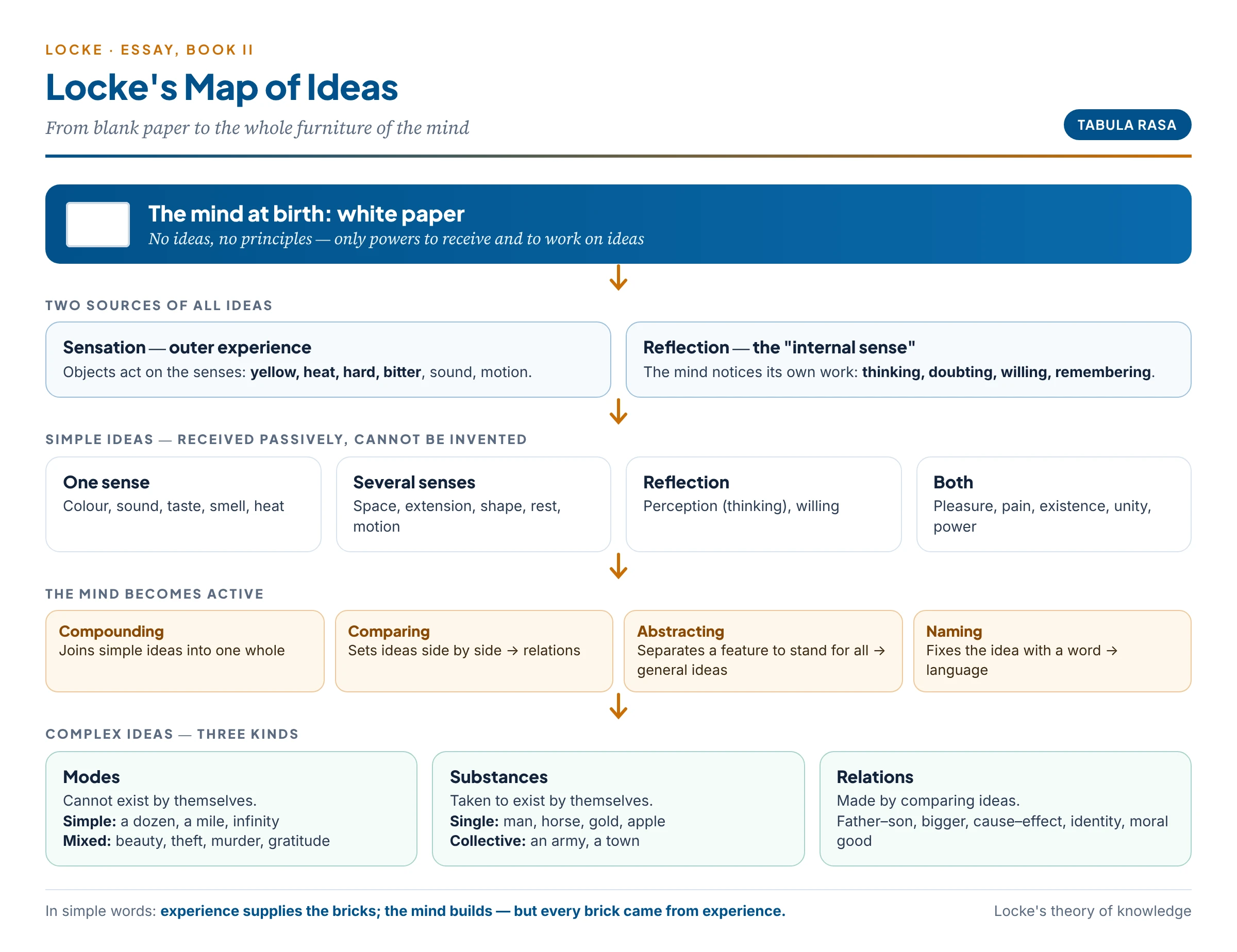
- Sensation (outer experience) — external objects act on the sense organs and produce ideas of their qualities: yellow, white, heat, cold, soft, hard, bitter, sweet, solidity, extension, motion, colour, sound. Sensation gives the raw material of all further thinking.
- Reflection (inner experience) — the mind’s awareness of its own operations. It gives ideas of perceiving, thinking, doubting, believing, reasoning, knowing, willing, remembering. Locke calls it an “internal sense.”
- Reflection depends on sensation. The mind can reflect only after it has begun to work on ideas received through sensation. A mind that had never sensed anything would have nothing to operate on, and so nothing to reflect upon.
- Two differences between them.
- In sensation an idea represents something outside the mind; in reflection the mind is present to itself directly.
- Reflection needs more attention than sensation. Children notice the outside world long before they notice their own thinking.
In simple words
Sensation is a window that looks out on the street; reflection is a mirror that shows the room inside. Through the window come colours, sounds and tastes. In the mirror you see yourself doubting, remembering or deciding. Locke says every idea you will ever have came in through one of these two.
4. Simple Ideas: The Alphabet of Knowledge
An idea, for Locke, is “whatever is the object of the understanding when a man thinks.” Ideas are the immediate objects of the mind in perceiving, thinking and knowing. They are of two kinds — simple and complex.
A simple idea is “uncompounded” — it contains “nothing but one uniform appearance” and cannot be broken into different ideas. The cold of ice or the whiteness of a lily is simple.
Marks of simple ideas:
- Received passively. The mind cannot refuse them when they come, and cannot invent or destroy them. No one can frame the idea of a taste he has never tasted. Locke’s example: nobody gets the taste of a pineapple until he goes where pineapples grow and tastes one.
- Partless and separate. They are the atoms of thought — unanalysable and distinct from one another.
- Received one by one. The qualities of an apple — colour, smell, taste, softness — exist together in the apple, but their ideas enter the mind separately, through different senses.
- The building blocks of knowledge. Just as all literature is made of the letters of the alphabet, all knowledge is built from simple ideas. They are the window through which the light of knowledge enters the dark room of the mind.
Four kinds of simple ideas (by their source):
| Kind | Source | Examples |
|---|---|---|
| From one sense | Only sight, only hearing, etc. | Colours (sight), sounds (hearing), tastes, smells, heat and cold |
| From more than one sense | Both sight and touch | Space, extension, figure (shape), rest, motion |
| From reflection alone | The mind observing its own operations | Perception (thinking), willing (volition), remembering, doubting |
| From both sensation and reflection | Accompany almost every idea | Pleasure and pain, existence, unity, power, succession |
Molyneux’s problem. Locke’s friend William Molyneux asked: if a man born blind, who has learnt to tell a cube from a sphere by touch, suddenly gains his sight, could he tell which is which by sight alone, before touching them? Locke answered no: ideas of sight and ideas of touch are different, and their link must be learned by experience. Modern research has tested this. In India, Project Prakash gave sight to children born with cataracts, and the newly sighted children could not at first match the shapes they saw with the shapes they had felt — though they learned quickly. The empiricist answer fared well.
5. Complex Ideas: The Mind at Work
Once it has simple ideas, the mind becomes active and builds complex ideas out of them. Here the mind is like a builder; in simple ideas it was like a receiver.
The mind’s operations:
- Compounding (combining) — putting several simple ideas together into one whole, as white, sweet, cold and hard into the idea of a lump of ice-cream. Even here the mind adds something sensation did not give: the unity of the complex idea.
- Decompounding (separating) — breaking a complex idea back into its simple parts. Compounding presupposes this.
- Comparing — setting two ideas side by side “so as to take a view of them at once, without uniting them into one.” This gives ideas of relation — bigger, older, similar, cause.
- Abstracting — separating some feature from the particular circumstances in which it was found, so as to form a general idea. Abstraction has two steps:
- Consider the content apart from its original setting — three-sidedness apart from the size and colour of this triangle.
- Let it stand for all particulars of that kind — the abstract idea now represents every triangle.
- Naming — fixing the general idea with a word. With abstraction and naming, language begins; Locke thought this is what separates human beings from animals, who do not abstract.
The full sequence runs: perception → retention (memory) → discernment → comparison → composition → abstraction. All scientific knowledge rests on general ideas gained by abstraction, though the objects of experience are always concrete and particular.
Three kinds of complex ideas:
- Modes — complex ideas that cannot subsist by themselves; they are dependencies on, or affections of, substances.
- Simple modes — variations of one simple idea repeated: a dozen, a gross or a score (repeating the unit), a mile (repeating a unit of length), space, duration. The idea of infinity is a simple mode reached by endlessly adding units — a negative idea of “no limit.”
- Mixed modes — several different simple ideas combined and fixed by a name: beauty (a certain composition of colour and figure causing delight), theft, murder, obligation, a lie, gratitude, running, fighting. Mixed modes are usually made by the mind first and then applied to the world.
- Substances — combinations of simple ideas taken to represent things that exist by themselves: a man, a horse, gold, an apple, a table, a mountain. There are also collective substances: many buildings make a town, many soldiers an army. (Locke’s account of substance is the subject of the next article.)
- Relations — ideas formed by comparing one idea with another: father, son, bigger, cause, effect, similar.
In simple words
Simple ideas are like Lego bricks of single colours. The bricks come in a box (experience); you cannot make a new colour of brick yourself. But with the bricks you can build a house (compounding), put two models side by side to see which is taller (comparing), and pick out “being red” as the thing all red bricks share (abstracting). Every complex idea is a Lego model; every brick came from the box.
Is knowledge only a heap of ideas? No. All complex ideas, however sublime, are reducible to simple ideas — but knowledge is something more: it is the mind’s perception of how ideas relate.
“All those sublime thoughts which tower above the clouds, and reach as high as heaven itself, take their rise and footing here.” — John Locke
6. What Knowledge Is
“Knowledge then seems to me to be nothing but the perception of the connexion of and agreement, or disagreement and repugnancy of any of our ideas.” — John Locke
- Knowledge is relational. It is not having an idea but seeing a link — of agreement or disagreement — between ideas. Where we cannot perceive such a link, we may have belief, but not knowledge.
- Ideas are the direct objects of knowledge. We know the external world only indirectly, through ideas that represent it. This is representative realism, examined in the next article.
- Truth as correspondence. Knowledge is true when our ideas agree with the reality they refer to.
- Real knowledge. “A centaur is not an elephant” is certain, but it is not real knowledge, since no centaur exists. Our simple ideas are real because we cannot make them up — they are the regular effects of things acting on us. Mathematics and ethics give real knowledge even about figures and actions no one has met, because their ideas are of possible existents: what is proved of a triangle “in idea” will hold of any real triangle.
- Trifling vs instructive propositions. “Substance is substance” or “lead is a metal” (where “metal” is part of what we mean by “lead”) are certain but trifling — they add nothing. An instructive proposition affirms something not contained in the subject. Kant later made this the famous distinction between analytic and synthetic judgments.
7. Four Sorts of Agreement
Since knowledge is the perception of agreement or disagreement among ideas, Locke asks what kinds of agreement there are. He finds four:
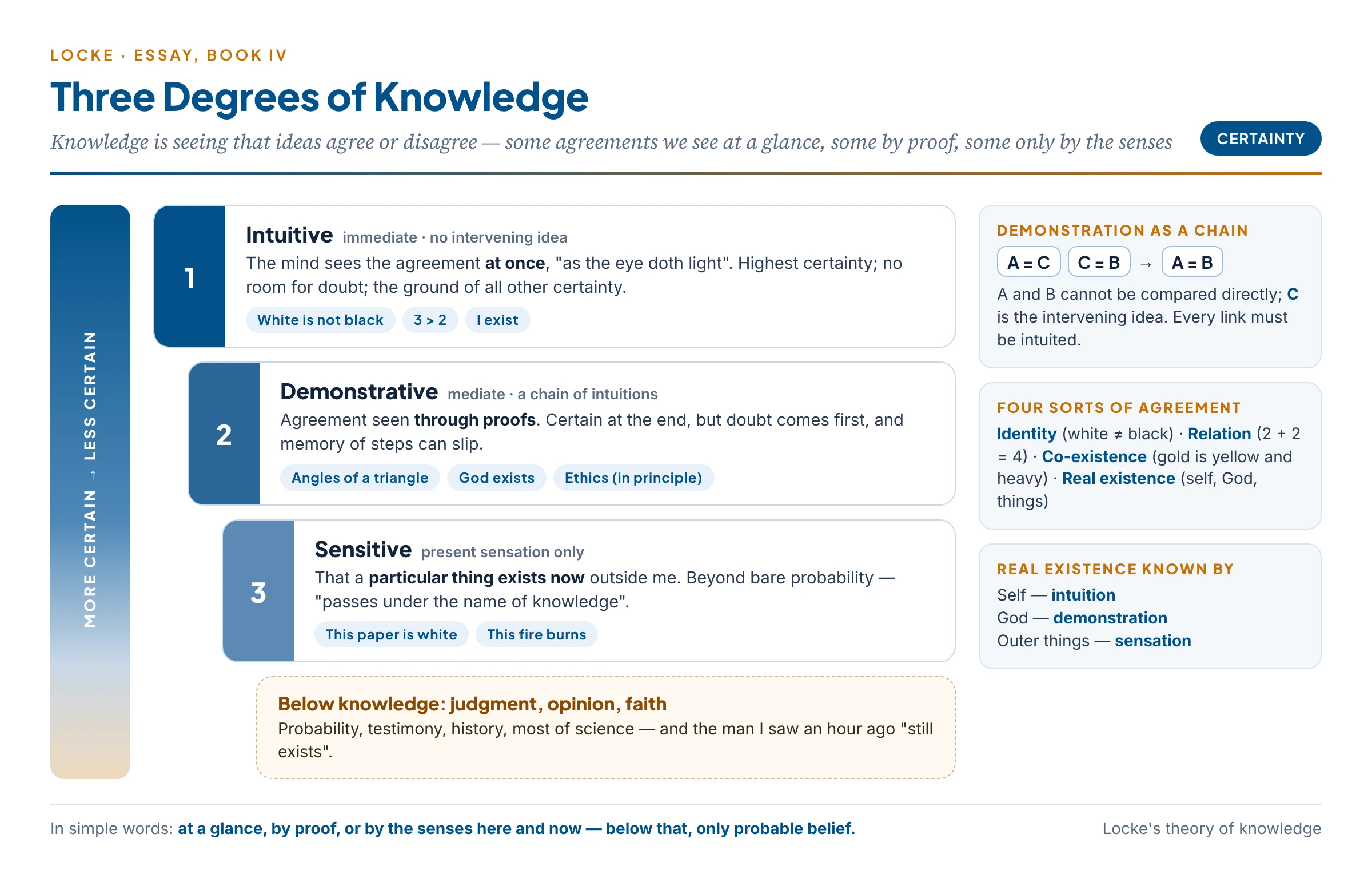
- Identity or diversity — seeing that an idea is itself and not another: “white is not black,” “a circle is not a square.” This is the most basic act of the mind, and immediate.
- Relation — perceiving relations between abstract ideas: equality, proportion, cause and effect, moral relations. Mathematics, logic and ethics belong here: “2 + 2 = 4,” “the three angles of a triangle equal two right angles.”
- Co-existence or necessary connection — whether certain qualities go together in the same substance: “sugar is white and sweet,” “gold is yellow, heavy and malleable.” Our knowledge here is very small, because we do not know the inner constitutions (real essences) of substances. We know that food nourishes us, but we cannot see why it must.
- Real existence — that something actually exists:
- our own existence — known by intuition;
- God’s existence — known by demonstration;
- the existence of external things — known by sensation.
8. Three Degrees of Knowledge
Knowledge also differs in its degree of clearness and certainty. Locke distinguishes three degrees.
(a) Intuitive knowledge — “the mind perceives the agreement or disagreement of two ideas immediately by themselves, without the intervention of any other.”
- We see the agreement “as the eye doth light, only by being directed toward it”: white is not black, a circle is not a triangle, three is more than two, a thing cannot be blue and not-blue at the same time.
- It is immediate, complete and definite — the highest degree of certainty, leaving no room for doubt.
- It is the foundation of all other certainty: every step of a proof must itself be intuited.
- We know our own existence intuitively: the mind is present to itself without any idea standing in between.
(b) Demonstrative knowledge — the mind perceives the agreement or disagreement of two ideas not immediately but through intervening ideas, called proofs.
- A chain of intuitions. If A = C and C = B, then A = B: we cannot compare A and B directly, so we bring in C. Each link must be intuitively seen. That is why it is called “two-tier” or mediated intuition.
- Examples: most of mathematics (the angles of a triangle equal two right angles); the existence of God; and, Locke believed, ethics — which he thought could be made “capable of demonstration” like mathematics, though he never actually worked out such a demonstration.
- Certain, but less clear than intuition. It is indirect; doubt precedes the demonstration; it needs effort, quickness and steady attention; and it relies on memory of earlier steps — and memory can slip. In long proofs, error creeps in.
(c) Sensitive knowledge — our knowledge of the particular existence of finite things outside us, here and now, through the senses: this tree, this table, this sheet of paper.
- It goes beyond mere probability, yet does not reach the certainty of intuition or demonstration — but it still “passes under the name of knowledge.”
- It reaches only as far as present sensation. Locke saw a man a minute ago; now he is alone — he can no longer be certain the man still exists, only that it is highly probable.
- The knowledge of the natural sciences largely belongs here, so science gives probable judgment more than strict knowledge.
- It differs from dreams, illusions and hallucinations — Locke gives reasons (see the next section).
Intuitive vs demonstrative knowledge:
| Point | Intuitive knowledge | Demonstrative knowledge |
|---|---|---|
| How the agreement is seen | Immediately, by comparing the two ideas themselves | Mediately, through one or more intervening ideas (proofs) |
| Structure | A single act of perception | A chain of intuitions, each step intuitive |
| Certainty | Highest; irresistible; no doubt at any stage | Certain at the end, but doubt precedes the proof |
| Clearness | Perfectly clear | Less clear — “like a face reflected through several mirrors” |
| Dependence | Needs nothing else | Needs memory, attention and sagacity; errors possible |
| Examples | White is not black; 3 > 2; I exist | Triangle’s angles = two right angles; God exists; (in principle) ethics |
| Relation | The ground of all certainty | Depends on intuition at every step |
In simple words
Intuition is like seeing at a glance that two pencils are of different colours. Demonstration is like finding out whether two pencils in different rooms are the same length: you cannot put them side by side, so you measure each with a ruler (the intervening idea). The result is certain — if you measured each step correctly.
Common confusion
Is sensitive knowledge “only probable” for Locke? And is “every event has a cause” his example of intuition? Many notes say Locke treats sensitive knowledge as “neither certain nor universal but only probable,” and give “every event has a cause” as an intuitive truth. Both need correcting. Locke says sensitive knowledge is less certain than intuition and demonstration but goes “beyond bare probability” and so “deserves the name of knowledge” — it is the third degree of knowledge, not mere opinion. What is only probable is our belief in things not now perceived (that the man I saw yesterday still lives). And Locke’s own examples of intuition are “white is not black,” “a circle is not a triangle,” “three is more than two” — and his own existence. “Every event has a cause” is not one of them; Hume later showed that it is neither intuitively nor demonstratively certain.
9. Why Trust the Senses? Locke’s Defence of Sensitive Knowledge
If we know only our own ideas, how do we know that anything outside causes them? “The having the idea of anything in our mind no more proves the existence of that thing than the picture of a man evidences his being in the world.” Locke gives the assurance of the senses themselves, confirmed by four concurrent reasons:
- Ideas need the sense organs. Those who lack an organ never have the ideas belonging to it — a man born blind has no ideas of colour. The organs themselves do not make the ideas, or “the eyes of a man in the dark would produce colours, and his nose smell roses in the winter.” So the ideas come from outside causes acting through the organs.
- Some ideas force themselves on us. I can call up the memory of the sun or lay it aside at will. But “if I turn my eyes at noon towards the sun, I cannot avoid the ideas which the light or sun then produces in me.” Ideas I cannot avoid must have an outside cause.
- Actual sensation brings pleasure and pain; memory does not. The pain of a burn, or of hunger, was very troublesome when felt; remembered, it gives no disturbance. The difference shows that something real acted on the body.
- The senses confirm each other and let us predict. “He that sees a fire may, if he doubt whether it be anything more than a bare fancy, feel it too; and be convinced, by putting his hand in it.” When I write, I can predict what marks will appear on the paper, and another person reading them will make the very sounds I intended.
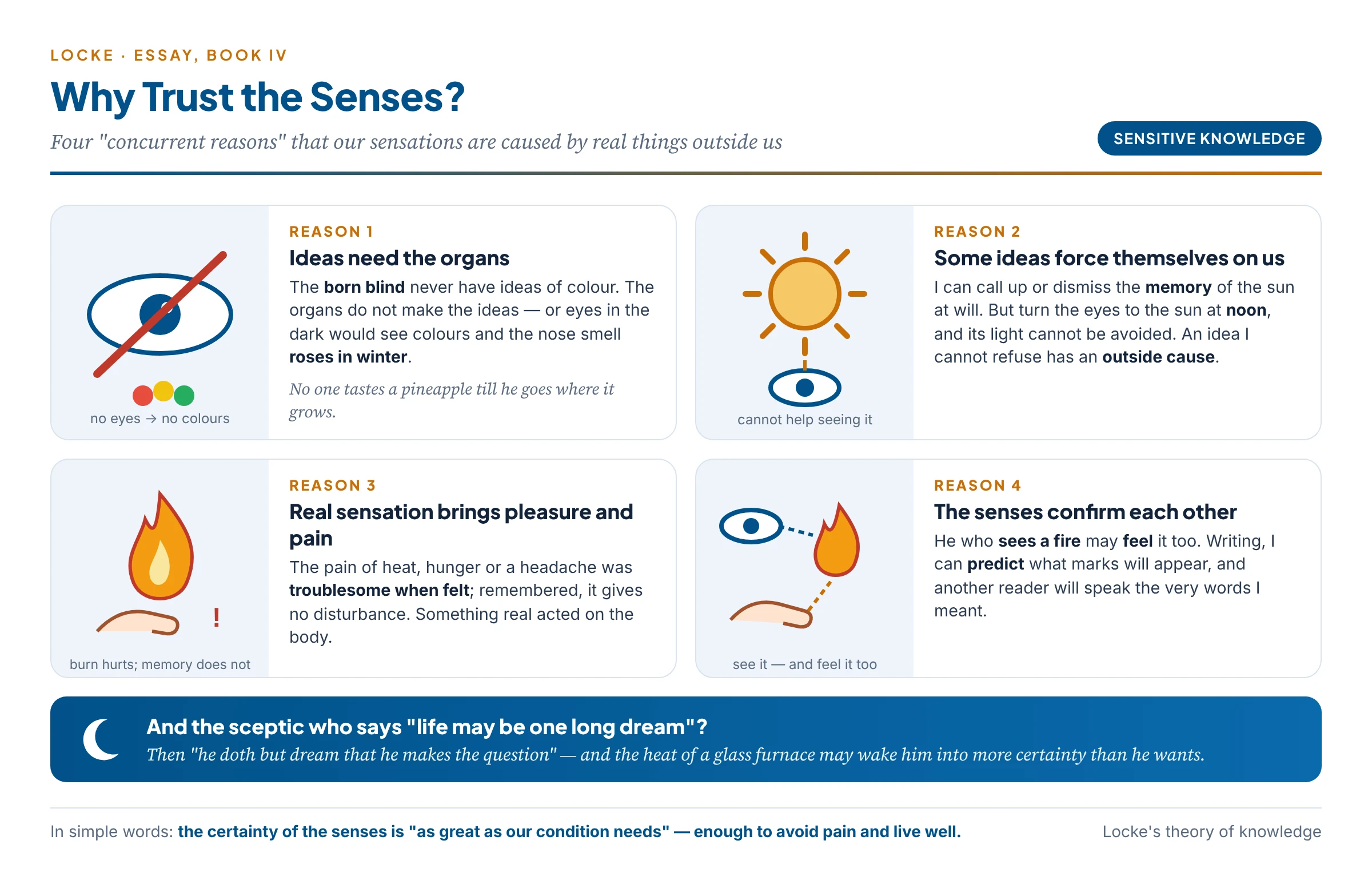
Answer to the dream-sceptic. If someone says that all of life may be one long dream, Locke replies that then “he doth but dream that he makes the question,” so it hardly matters whether a waking man answers him. And if the dreamer tests the glowing heat of a glass furnace with his hand, he may be “wakened into a certainty greater than he could wish.”
- “As great as our condition needs.” Our faculties are suited not to perfect knowledge of everything but “to the preservation of us” and “the use of life.” The assurance of the senses is as certain as our pleasure and pain — our happiness and misery — “beyond which we have no concernment, either of knowing or being.”
- Folly to demand demonstration everywhere. A man who would act only on demonstration “would be sure of nothing in this world, but of perishing quickly” — he could not even trust that his food is wholesome.
10. Beyond Knowledge: Judgment, Probability and Faith
Most of life runs outside knowledge in Locke’s strict sense.
- Judgment is the faculty by which the mind takes ideas to agree or disagree without perceiving it, on the basis of probability. Where knowledge is lacking, God has given us judgment to guide us in “the twilight of probability.”
- Grounds of probability: (a) agreement with our own experience; (b) the testimony of others — weighed by their number, honesty, skill and consistency.
- Opinion governs most practical affairs — history, much of morality in practice, and natural science, where certainty is not available.
- Faith is assent to a proposition on the authority of revelation. It may go above reason (that the dead will rise) but must never go against it. Reason must judge whether something really is a revelation; otherwise the door opens to “enthusiasm” — fanatical certainty without evidence.
11. The Extent and Limits of Knowledge
Locke’s main conclusion is sobering: “the extent of our knowledge comes not only short of the reality of things, but even of the extent of our own ideas.”
Why our knowledge is so limited:
- Knowledge reaches no further than our ideas. Where we have no idea, we can have no knowledge. And all ideas come from experience, so knowledge cannot pass beyond experience.
- It is narrower even than our ideas. Knowledge needs perception of agreement between ideas; often we have the ideas but cannot see how they connect.
- Ignorance of real essences. We know substances only by their observable qualities, not by the hidden structure (the arrangement of tiny particles) that produces them. So we cannot see why gold must be yellow and malleable — knowledge of co-existence is very thin.
- Things too big, too far or too small. Distant planets and the minute particles of matter lie beyond clear observation.
- No visible link between primary and secondary qualities. We cannot see how a certain motion of particles produces the sensation of yellow or of sweetness — still less how bodily motion produces thought.
- Knowledge is confined to ideas, not things. Ideas in the mind represent things; the mind never steps outside its ideas to meet things directly. Yet Locke still accepts the external world they refer to.
- Metaphysical questions about the ultimate nature of substance, of the soul or of the universe lie beyond certain knowledge; here reason must give way to judgment or belief.
Implications of “No man’s knowledge can go beyond his experience”:
- Against innate ideas and pure-reason metaphysics — no principle may be accepted on the claim that it is inborn or self-evident to reason alone.
- A test of meaning and of rights to belief. Every idea must be traced to experience — the seed of Hume’s rule “from what impression is that idea derived?” and, much later, of the logical positivists’ verification principle.
- Natural science becomes probable. Since we lack insight into real essences, physics yields probable opinion, not demonstration — an anticipation of Hume’s problem of induction.
- Epistemic humility and tolerance. Since our knowledge is limited, we should hold opinions with modesty and not persecute others for theirs — a link between Locke’s epistemology and his Letter Concerning Toleration.
- A tension. Locke himself claims demonstrative knowledge of God and of the existence of material substance, both of which go beyond experience. Berkeley and Hume would press this tension until it broke.
“The candle that is set up in us shines bright enough for all our purposes.” — John Locke
Epistemic humility. “Our business here is not to know all things, but those which concern our conduct.” Locke’s image: it is very useful for a sailor to know the length of his sounding-line, though he cannot reach every depth of the ocean with it; it is enough that it touches bottom at the places he must know to steer his voyage safely. Locke’s empiricism ends not in despair but in anti-dogmatism: know what you can, judge carefully what you cannot, and do not pretend to more.
In simple words
Our knowledge is like a torch in a large dark hall. It lights the area near our feet clearly (our own existence, mathematics), lights the walls dimly (the outside world as we touch and see it), and leaves the ceiling in the dark (the inner nature of matter, soul and the universe). Locke’s advice: walk by the torch, and do not claim to see the ceiling.
Critical Evaluation
Did Locke Really Refute Innate Ideas?
Objections to the refutation:
- Descartes’ dispositional reply. Descartes had already said that by “innate” he meant a disposition, as gout or generosity is “innate” in certain families — not something actually present in a baby. Locke’s main target (ideas actually present from birth) may be a straw man.
- Leibniz’s veined marble. In his New Essays Leibniz replied that the mind is like a block of marble with veins that already mark out the figure of Hercules. Work (experience) is needed to bring it out, but the shape is not imposed from outside. To the maxim “nothing is in the intellect that was not first in the senses” he added: “except the intellect itself” (nisi ipse intellectus).
- Locke’s own concession. Locke admits innate powers — to perceive, compare, abstract. If the mind is born with such powers, it is not truly a blank paper; Leibniz pressed exactly this point.
- The unconscious. Locke assumed that whatever is in the mind must be conscious. Modern psychology recognises unconscious and subconscious states — memories, drives, skills — that are present without being noticed.
- Necessary truths. Experience shows what is, never what must be. How can experience give the necessity of “2 + 2 = 4”? Leibniz and later Kant argued that the source of necessity must lie in the mind itself.
- Modern nativism. Noam Chomsky argued that children acquire grammar too fast, from too little data, unless an inborn language faculty guides them. Cognitive science finds early expectations about objects and number in infants.
Defence of Locke:
- His real targets were ready-made propositions used to put doctrines beyond question. Against those, his arguments work.
- “Innate capacities” are something Locke accepts; the debate then shrinks to how rich those capacities are — a question for science, not authority.
- His insistence that universality can be explained by experience remains strong: common experience produces common ideas.
Is Locke a Consistent Empiricist?
Locke began as an empiricist, but at several points he goes beyond what experience can justify.
- Abstract ideas. His account of abstract general ideas and of mathematics resembles the rationalists; strict empiricism cannot easily make room for them.
- Intuitive and demonstrative knowledge ranked above sensitive. An empiricist should hold that sense experience is the best ground of knowledge. Locke instead calls intuition and demonstration certain and the senses less certain — a rationalist ranking.
- God more certain than the world. Locke claims demonstrative certainty of God but only sensitive knowledge of the world we see — an odd result for an empiricist.
- Substance as “something, I know not what.” He admits material and spiritual substance, which is never experienced, because thinking demands a support — a supposition of reason, not a datum of sense.
- Correspondence cannot be checked. If we know only ideas, we can never compare an idea with the thing to see whether it is a true copy.
- Causation. He treats causal connection as real power and necessary connection, without an impression of it — Hume would ask where that idea comes from.
Verdict. One historian of philosophy summed up the “remarkable spectacle” of a philosopher who admits no source of ideas except perception, yet proves God beyond experience, treats natural science as mere opinion, and gives eternal validity to the relations of ideas in mathematics and ethics. Locke has been called less “an inconsistent empiricist” than “a Cartesian influenced by Bacon.” Russell saw the bright side: “the most fruitful philosophies have contained glaring inconsistencies, but for that very reason have been partially true.” Locke’s inconsistencies became the agenda of Berkeley, Hume and Kant.
Problems in the Theory of Ideas
- Passive mind, one idea at a time. Locke says the mind is passive in receiving simple ideas and receives them one by one, in a line. Psychology shows that perception needs active attention, and we first experience wholes (an apple, a face) which we later analyse into parts. Even Locke admits we see at once that black is not white — so the mind is comparing while it receives.
- Atomic ideas cannot unite themselves. If simple ideas are separate atoms, what binds them into the unity of an object or a judgment? Locke gives no principle of synthesis. Kant answered with the a priori forms of intuition and categories of the understanding.
- “The whole is more than its parts.” Locke followed the composition theory of his age: a complex whole is just a sum of simple parts. But a melody is not a heap of notes, and a part changes when it enters a whole.
- Two meanings of “idea.” Locke uses “idea” both for a state of consciousness and for a representation of something beyond it, without separating them. Much confusion in Berkeley and Hume grows from this.
- Origin is not validity. Locke’s “historical” method tells us how an idea arose, not whether it is true. A lotus grows out of mud, but it is not muddy; a child may learn of God in a crude way, yet the idea of God need not be crude. Confusing psychological origin with logical validity is the weak point of Locke’s method.
- Kant’s balance. “Though all our knowledge begins with experience, it does not follow that it all arises out of experience.” Locke saw the first half; he missed the second.
Critics and Defenders
Criticism — Critics
- Leibniz: the mind is veined marble, not white paper; “nothing in the intellect except the intellect itself.”
- Kant: experience gives only the matter of knowledge; its form (space, time, categories) comes from the mind; necessity cannot come from experience.
- Berkeley: if we know only ideas, “matter” and the copy-relation between ideas and things are idle; Locke’s abstract ideas are impossible.
- Hume: Locke kept substance, causal power and God without the impressions that alone could justify them.
- Modern psychology and Chomsky: unconscious contents and inborn structures exist; perception is active and holistic.
Defence — Defenders and lasting value
- Locke’s reply: he denies innate ideas, not innate powers; what is inborn is the capacity to learn, not knowledge.
- Universality explained: common ideas arise from common experience — no mystery source needed.
- The scientific attitude: trace every idea to evidence; hold beliefs in proportion to it.
- Molyneux’s problem: newly sighted patients (Project Prakash) could not at first match seen and felt shapes — support for learning from experience.
- Founding a discipline: Locke made the theory of knowledge — its origin, extent and limits — the first question of philosophy.
Cross-Tradition Comparison
The Mind at Birth: Descartes, Locke, Leibniz and Kant
| Point | Descartes | Locke | Leibniz | Kant |
|---|---|---|---|---|
| Mind at birth | Innate ideas (God, self, mathematics) | Blank paper, with powers | Veined marble | Empty of content, but with a priori forms |
| Source of necessary truths | Reason | Comparison of ideas from experience | Reason; experience only occasions them | Mind’s a priori forms and categories |
| Role of experience | Occasion; often misleading | Only source of all ideas | Awakens what is virtually there | Supplies the matter; mind supplies the form |
| Image | Seeds of truth | White paper | Marble with veins | Spectacles through which we see |
Locke and Indian Epistemology
| Point | Locke | Nyāya | Cārvāka | Yoga / Indian schools generally |
|---|---|---|---|---|
| Sources of knowledge | Sensation and reflection | Four pramāṇas: perception, inference, comparison, testimony | Perception only (pratyakṣa) | Accept perception, inference, testimony |
| Inner experience | Reflection — the mind perceives its own operations | Mānasa pratyakṣa — inner perception of pleasure, pain, desire and cognition | Perception of bodily states | Citta aware of its modifications (vṛtti) |
| Mind at birth | Blank slate | Carries saṃskāras from past lives | Product of matter; no past lives | Saṃskāras / vāsanās — latent impressions |
| Certainty | Intuition > demonstration > sensation | Valid knowledge (pramā) tested by successful action | Only perception certain | Varies by school |
| Knowledge beyond experience | Limited; God by demonstration | God proved by inference | Rejected | Accepted through scripture or yogic perception |
Indian Connect — Key takeaways
- Reflection and mānasa pratyakṣa. Locke’s “internal sense” closely matches Nyāya’s inner perception by the mind (manas): both hold that we directly perceive our own pleasure, pain and thinking, just as the outer senses perceive colours.
- Tabula rasa vs saṃskāra. Indian schools generally deny that the newborn mind is blank. Nyāya argues from the infant’s first smile, fear and suckling that it carries memory-traces from a past life. These saṃskāras are like Descartes’ dispositions, not like Locke’s white paper.
- Locke and Cārvāka. Cārvāka is the most thorough Indian empiricist — perception alone is valid; inference, God and the soul beyond the body are rejected. Locke is more moderate: he accepts demonstration (inference) and proves God, so he stands closer to Nyāya than to Cārvāka. The Cārvāka is to Locke what Hume is to Locke — the consistent empiricist who refuses what lies beyond perception.
- Demonstration and anumāna. Locke’s demonstrative knowledge, a chain of steps each seen to be true, parallels Nyāya’s inference built on an invariable relation (vyāpti). Both admit that inference can extend knowledge beyond what is perceived.
Synthesis (Siddhānta)
Locke turned philosophy from the question “What is reality?” to the prior question “What can the human mind know, and how?” His answers form one connected system: no innate ideas; the mind as white paper; sensation and reflection as the only sources; simple ideas as the atoms and complex ideas as the mind’s constructions; knowledge as the perception of agreement among ideas; three degrees of certainty; and firm limits beyond which we have only judgment and faith.
Estimate of Locke’s place:
- Epistemology before metaphysics. He was the first to make “what can we know?” the first question of philosophy, ahead of “what is there?” — and so is called the founder of the problem of knowledge: what knowledge is, how it originates, how far it extends and how it can be validated.
- A middle road. In an intellectual world split between the old Aristotelian schoolmen and the new Cartesian rationalists, Locke cut a third path — a rational, sober empiricism.
- Psychological analysis. He pioneered the study of the mind by observation and gave rise to psychological atomism — the picture of the mind as built from simple units joined together, later developed into the association psychology of Hume and the nineteenth century.
- Not the last word. His epistemology gave empiricism its starting point but did not solve the problem Descartes had set — how ideas inside the mind give knowledge of a world outside it. His immediate successor, Berkeley, exposed the difficulty.
The system had a crack running through it. Knowledge was confined to ideas, yet Locke kept a world of material substance behind them, a soul beneath them and a God above them, none of which an idea could show. Berkeley would take away matter; Hume would take away the soul and the necessity of causes as well; Kant would try to rebuild certainty by showing that the mind contributes the form of experience. Each step was a working-out of Locke’s own principle that our knowledge cannot go beyond our experience.
- Science and evidence. Locke’s rule — proportion belief to evidence, trace every idea to experience — is the working creed of modern science.
- Education. The blank-slate picture made experience and education decisive in forming the person, a view that shaped modern schooling and child psychology.
- Tolerance. Knowing the narrow limits of knowledge supports humility in public life — the epistemic root of Locke’s case for religious toleration.
- Cognitive science. The debate between Locke and Leibniz continues in the dispute between learning-based and innateness-based models of the mind, including in artificial intelligence.
Locke emptied the mind of inborn ideas only to fill it, idea by idea, from experience — and then showed honestly how little of reality that light can reach.
Previous Year Questions
- 2026Explain the distinction between Intuitive knowledge and Demonstrative knowledge as propounded by Locke.
- 2023Discuss Descartes’ theory of innate ideas and the grounds on which Locke refutes it.
- 2022Why and how does John Locke refute the innate ideas? Elucidate the nature and source of knowledge in Locke’s epistemology.
- 2012John Locke said that ‘No man’s knowledge can go beyond his experience’. Discuss critically the implications of this statement.
- 2006Explain the theory of knowledge according to Locke. Short notes.