

Empiricism (Locke, Berkeley, Hume): Theory of Knowledge; Substance and Qualities; Self and God; Scepticism.
Official Syllabus: Paper I, Section A, Unit 3
When we look at an apple we see red, feel smoothness, taste sweetness and notice a round shape of a certain size. Are all these in the apple, or are some of them only in us? And what is the “apple” itself that has these qualities? John Locke answered both questions in the Essay Concerning Human Understanding. Some qualities — solidity, extension, figure, motion or rest, number — are primary: they really belong to bodies, and our ideas of them resemble them. Others — colours, sounds, tastes, smells, heat and cold — are secondary: they are only powers in bodies to cause sensations in us, and our ideas of them resemble nothing in the bodies. Behind all qualities Locke placed substance, the “supposed support” of qualities — a “something, I know not what.” Together these doctrines form his representative realism: a real world exists, but we know it only through ideas that represent it.
In simple words
Think of a television screen. On the screen you see a red rose. Inside the TV there is no red rose — only electronic signals of certain shapes and strengths that cause the red picture. Locke says the world is like the TV’s insides: bodies really have size, shape and motion (primary qualities), and these cause the colours, tastes and sounds we experience. The red is real as a picture in us, caused by something that is not red at all.
Context & Problem
The New Science and an Old Question
- The distinction is older than Locke. Democritus had said that sweet, bitter, hot, cold and colour exist “by convention,” while in reality there are only atoms and the void. Galileo revived the idea: tastes, odours and colours “reside only in the consciousness”; take away the living creature and they vanish. Descartes held that only extension and its modes (figure, motion) are clearly and distinctly perceived and belong to bodies; colours, heat and sounds are confused ideas in the mind.
- Corpuscular philosophy. Locke’s friend, the chemist Robert Boyle, explained nature by tiny particles (corpuscles) of matter that differ only in size, shape, texture and motion. Locke, who called himself an “under-labourer” to scientists like Boyle and Newton, built his account of qualities on this science.
- Locke’s addition. Against Descartes, Locke made solidity, not mere extension, the most basic property of body. Body is what fills space and resists; Descartes’ “matter = extension” left no room for empty space.
- The philosophical problem. If the scientific picture is true, how much of the everyday world of colour, sound and taste is really “out there”? And if we know only ideas, how can we say anything about the things that cause them?
Ideas and Qualities: Locke’s Key Distinction
Before sorting qualities, Locke separates two things that ordinary speech runs together:
- Idea — “whatsoever the mind perceives in itself, or is the immediate object of perception, thought, or understanding.” Ideas are in the mind.
- Quality — “the power to produce any idea in our mind.” Qualities are in the object.
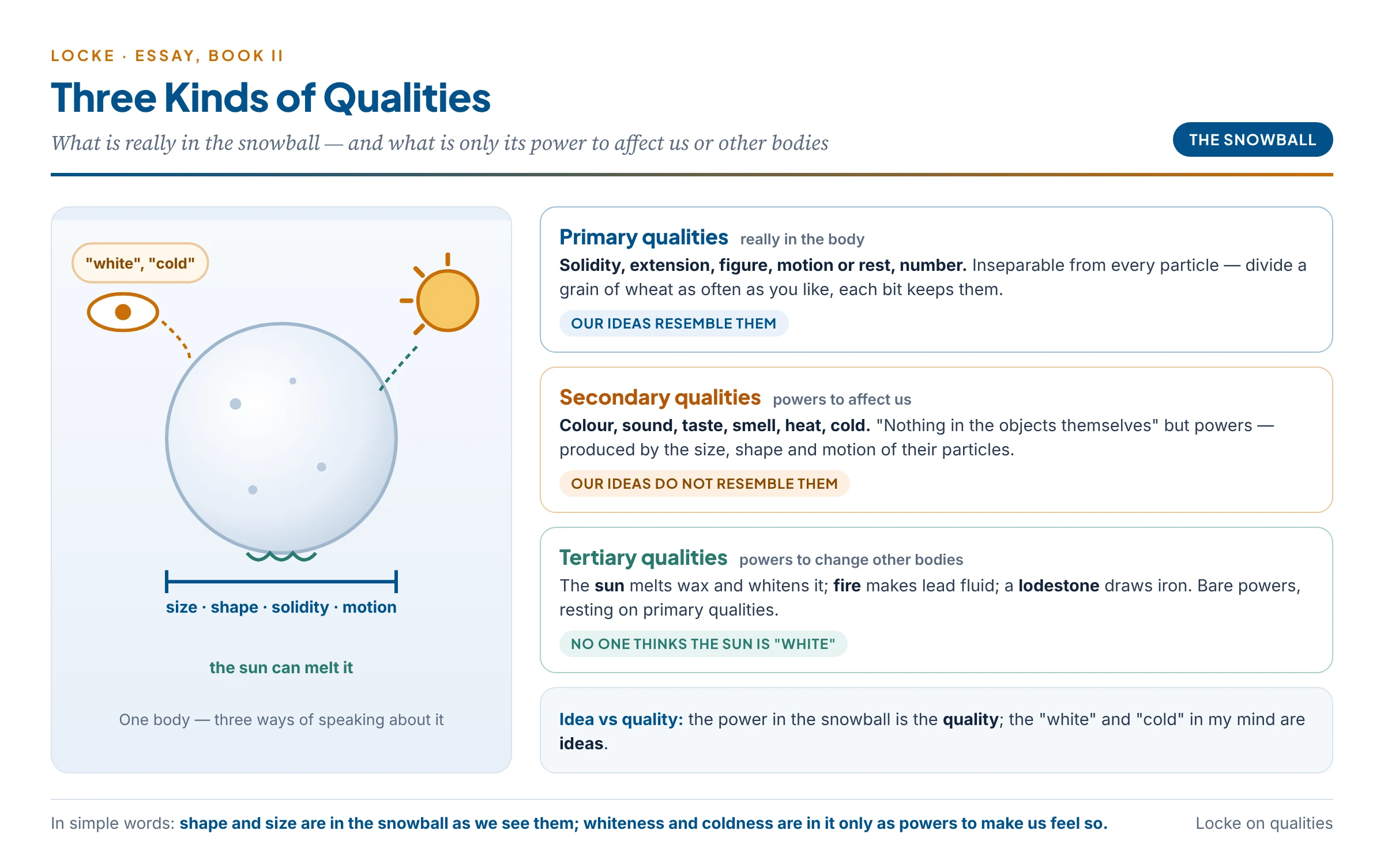
- Locke’s example — a snowball. The snowball has the power to produce in us the ideas of white, cold and round. “The powers to produce those ideas in us, as they are in the snowball, I call qualities; and as they are sensations or perceptions in our understandings, I call them ideas.”
- Why it matters. We easily think our ideas are exact images of something in the object. Locke warns that this is true only for some ideas. So he must answer: (a) which qualities are there in the object, (b) which ideas resemble those qualities.
Common confusion
Are “secondary qualities” in the mind? Many notes say that for Locke secondary qualities “have their locus in the mind” or “exist only in the mind.” Strictly, Locke says the secondary quality is a power in the object — an arrangement of its particles that can produce the sensation of red or sweet. What exists only in the mind is the idea of red or sweet. So both primary and secondary qualities are in the object; the difference lies in the ideas: ideas of primary qualities resemble their causes, ideas of secondary qualities do not. This is exactly why the 2017 question asks about “the idea of primary qualities and primary qualities.”
Core Doctrine
1. Primary Qualities
Primary (original) qualities are those “utterly inseparable from the body, in what state soever it be.”
- The list. Solidity, extension, figure (shape), motion or rest, and number — five items, often counted as six when motion and rest are listed separately. Locke elsewhere sums up the primary qualities of the minute particles as bulk, figure, texture and motion.
- The test of inseparability — the grain of wheat. Divide a grain of wheat into two parts; each part still has solidity, extension, figure and mobility. Divide again and again, even beyond what we can see; every particle keeps these qualities. Division never strips them off. (Notes often use an apple cut into pieces to make the same point.)
- Resemblance. “The ideas of primary qualities of bodies are resemblances of them, and their patterns do really exist in the bodies themselves.” When I see a square table, the table really is square.
- Mind-independent. Primary qualities exist in bodies whether or not anyone perceives them. They are objective, constant and measurable — the qualities that physics describes.
- Perceived by more than one sense. Shape and motion can be both seen and felt — a sign, for Locke, that they belong to the object, not to one sense organ.
- The basis of explanation. The sensation of a square book is explained by a square shape out in the world. Primary qualities explain themselves and everything else.
2. Secondary Qualities
Secondary qualities are “such qualities which in truth are nothing in the objects themselves but powers to produce various sensations in us by their primary qualities” — by the bulk, figure, texture and motion of their insensible parts.
- The list. Colours, sounds, tastes, smells, heat and cold (warmth).
- No resemblance. “There is nothing like our ideas existing in the bodies themselves.” The red I see is not a copy of anything red in the rose; it is the effect of a certain arrangement of particles acting on my eyes.
- Dependent on perceivers. Without eyes there are no colours (as seen); without ears, no sounds; without a tongue, no tastes. Take away the sensation, and what remains in the body is only its particles and their motion.
- Variable and relative. The same object gives different ideas to different people, to the same person at different times, and to different animals. The smell of a fruit may appear different to different people, but there is no such dispute about its solidity or extension.
Locke’s arguments that secondary qualities do not resemble their ideas:
- The porphyry in the dark. The red and white colours of porphyry (a stone) vanish when the light is removed. Yet nothing in the stone itself has changed. So the colour was not a property of the stone like its shape, but a power that acts only in light on an eye.
- The pounded almond. Pound an almond with a pestle: its clear white colour turns dirty, its sweet taste turns oily. What has the pestle done? It has only changed the texture — the arrangement of parts. So colour and taste depend on primary qualities.
- Fire — warmth and pain. At one distance a fire gives the sensation of warmth; nearer, of pain. No one says the pain is in the fire. Why then say the warmth, which is caused in the same way, is in the fire? Similarly, looking at a flame gives an idea of colour; touching it, pain — the colour is no more in the flame than the pain.
- Manna. Manna (a medicinal substance) produces sickness and pain in us. Everyone agrees the sickness is not in the manna. Why then think its whiteness and sweetness — produced by the same kind of action of its particles — are in the manna?
- The hot and cold hands. Warm one hand and chill the other, then put both into the same bowl of lukewarm water. It feels cold to one hand and warm to the other. Water cannot be hot and cold at once, so heat and cold are not in the water as we feel them. But shape does not vary like this: a shape that looks square to one hand does not feel round to the other.
- Explanation needs only primary qualities. To explain why you see blue, we refer to the size, shape and motion of particles and light, never to “blueness out there.” Since primary qualities explain everything we need to explain, there is no reason to put secondary qualities, as we sense them, in the world.
In simple words
A feather tickles your nose. Nobody thinks the tickle is in the feather — the feather has only shape, softness and motion, which cause a tickle in you. Locke says colours and tastes are just like the tickle: real feelings in us, caused by the shape and motion of tiny parts in things.
3. Tertiary Qualities: Powers on Other Bodies
Locke also mentions a third sort: powers in a body to change other bodies, so that they affect us differently.
- The sun has the power to make wax white and to melt it; fire has the power to make lead fluid.
- A lodestone has the power to draw iron (magnetism); wood has the power to burn (flammability).
- These are as much “bare powers” as secondary qualities — no one thinks there is whiteness in the sun or fluidity in the fire. They too rest on primary qualities.
The three kinds compared:
| Point | Primary | Secondary | Tertiary |
|---|---|---|---|
| Examples | Solidity, extension, figure, motion/rest, number | Colour, sound, taste, smell, heat, cold | Sun melting wax; fire melting lead; magnetism |
| What they are in the body | Real, inseparable properties | Powers to produce sensations in us | Powers to change other bodies |
| Do our ideas resemble them? | Yes | No | No (we see only the changed body) |
| Depend on perceivers? | No | Yes, for their ideas | Depend on other bodies |
| Constant or variable? | Constant, measurable | Variable, relative | Depend on circumstances |
| Explained by | Themselves | Primary qualities of particles | Primary qualities of particles |
4. Why Did Locke Need Secondary Qualities?
Why did Locke not simply say that all qualities belong to things as we perceive them? He had several reasons — together they show the logical necessity of the concept.
- To fit the new science. Physics describes bodies only by size, shape, motion and number. If colours and tastes were also in bodies, physics would be incomplete. Secondary qualities let Locke keep the scientific picture and still explain colour and taste.
- To explain perceptual variation without contradiction. The lukewarm water feels hot and cold at once; a fruit smells different to different people. If these were real properties of the object, the object would have contradictory properties. If they are effects in perceivers, the variation is natural.
- To keep realism. Locke did not want to say the world is unreal. By putting the powers in objects and the ideas in us, he keeps both a real world and the subjective character of sense experience.
- Economy of explanation. Everything about colour and taste can be explained by primary qualities of particles. Secondary qualities as powers are just the primary qualities considered in their effects on us.
- Secondary depend on primary. We cannot imagine a colour or taste without some extension or figure, but we can think of the primary qualities without the secondary ones (in the dark, the porphyry keeps its shape). Secondary qualities are thus founded on primary ones.
- To mark the line between objective and subjective knowledge. The distinction tells us what our ideas reveal about bodies (their primary qualities) and what they reveal only about our own sense organs (secondary qualities).
In simple words
A thermometer and your hand both “measure” water. The thermometer gives the same reading whoever holds it; the hand says “cold” or “warm” depending on what it touched before. Locke’s primary qualities are like thermometer readings — the same for everyone. Secondary qualities are like what the hand feels — real feelings, but telling you about your hand as much as about the water.
5. Substance: “Something, I Know Not What”
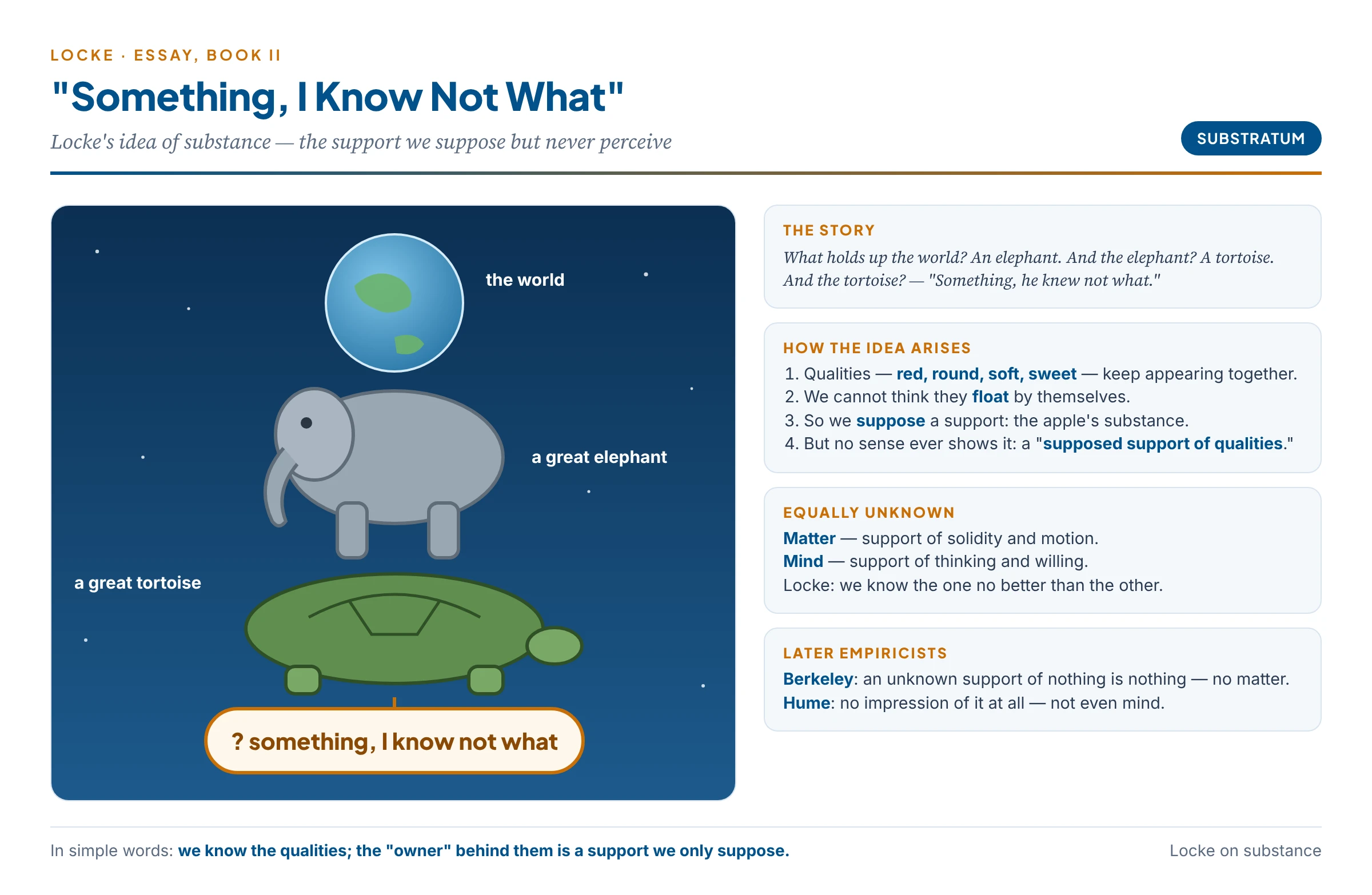
How the idea of substance arises. We notice that a number of simple ideas go constantly together — a certain colour, weight, hardness, fusibility. Since we cannot imagine these qualities existing by themselves in empty space, “we accustom ourselves to suppose some substratum wherein they do subsist, and from which they do result, which therefore we call substance.”
- No simple idea of substance. Sensation gives us colours, shapes and tastes; reflection gives thinking and willing. Neither gives us an idea of a bare “support.” Substance is never experienced.
- Thinking compels it. We cannot think that qualities float without something they belong to. So reason supposes a support. Locke defines substance as the “supposed support of qualities.”
- Unknown in itself. Our idea of “pure substance in general” is “nothing but the supposed, but unknown, support of those qualities we find existing, which we imagine cannot subsist without something to support them.” If asked what it is, we can only say “something, I know not what.”
- The apple. We receive the simple ideas of redness, roundness, softness, sweetness together, and the mind combines them into the complex idea “apple.” What we know are only the qualities; the apple as their substance is “supposed,” never itself perceived.
- Substance in general. What are shoes and spoons made of? Leather and metal. What are leather and metal made of? Matter. What is matter made of, or what gives rise to its properties? Here, Locke admits, we have no clear idea. Our idea of substance will always be somewhat confused.
- Particular sorts of substances. Our ideas of a man, a horse, gold, water are collections of simple ideas “with the confused idea of something to which they belong.” They include powers too — that gold dissolves in aqua regia, that a lodestone draws iron.
- Collective substances. Many individual substances taken together: buildings make a town, soldiers an army, sheep a flock, and the whole world is one collective idea.
Indian Connect — The elephant and the tortoise
Locke illustrated our idea of substance with a story he attributed to “the Indian philosopher“: asked what holds up the world, he said a great elephant; asked what holds up the elephant, he said a great tortoise; pressed to say what holds up the tortoise, he answered — “something, he knew not what.” Our idea of substance, says Locke, is like that last answer: a word for a support we cannot describe. (The image of the world-bearing elephants and tortoise, diggajas and kūrma, comes from Indian cosmology; Locke uses the story to mock the vagueness of the schoolmen’s “substance.”)
6. Three Kinds of Substance, Equally Obscure
Locke admits three kinds of substance: God, finite spirits (minds), and bodies (matter).
- Body: we have clear ideas of its primary qualities — solidity (with the parts cohering) and the power of communicating motion by impulse.
- Spirit (mind): we have equally clear ideas of its primary qualities — thinking and motivity (the power to start motion in the body by will).
- Both substrata are unknown. The “secret and abstract nature of substance in general” is as unknown for body as for mind. We are no better off with matter than with spirit.
- A blow to materialism. People feel more sure of bodies than of spirits because they meet bodies every day. Locke says this customary prejudice has no philosophical basis: we know how a body moves a body no better than how a mind moves a body. Whether God might give matter the power to think, Locke left open — a remark that scandalised his critics.
- God is the one substance whose nature Locke does not call “I know not what”; he holds that God’s existence can be demonstrated (taken up in the article on Self and God).
7. Real Essence and Nominal Essence
Locke’s account of substance shapes his account of classification (Book III).
- Real essence — the hidden inner constitution of a thing, the particular arrangement of its particles, “on which all the sensible qualities depend.” For gold, it is whatever inner structure makes it yellow, heavy, malleable and soluble in aqua regia. We do not know real essences.
- Nominal essence — the complex idea we attach to a name: for “gold,” a body yellow, very heavy, malleable, fusible. We sort things into kinds by nominal essences — by their secondary and tertiary qualities — because the real essences are hidden.
- Consequences. Our kinds are partly made by us; the boundaries of species (is a creature a “man”?) can be uncertain. And natural science of substances can give only probable knowledge, since we cannot see why qualities must go together.
In simple words
You call a metal “gold” because it is yellow, heavy and does not rust — that is its nominal essence, the list on its label. What it is inside that makes it yellow, heavy and rust-free is its real essence, which Locke thought we would never see. Modern chemistry found it: gold is the element with 79 protons in each atom. Locke was right that colour and weight flow from a hidden structure — wrong only in thinking we could never reach it.
8. Matter: Real but Not Fully Known
- Locke affirms matter. Against idealism, he holds that material substances exist independently of mind. We have sensitive certainty that they exist when they act on our senses.
- Corpuscular matter. Bodies are made of minute corpuscles whose size, shape, motion and arrangement give rise to observable qualities.
- Why matter must exist. There must be something that is the source and locus of the qualities which cause our simple ideas of colour, taste and the rest. Matter is that source.
- Partly known, partly unknown. Locke’s views pull in two directions:
- Common-sense view — qualities need something to inhere in; an apple is not a mere sum of qualities.
- Necessity of thought — we cannot conceive qualities existing by themselves.
- Custom — qualities that constantly go together lead us to suppose a substratum (a view close to Hume’s later account).
- Scientific view — substance as what remains permanent amid change: the atoms, whose primary qualities science can describe.
On the first three views, substance is an unknowable “I know not what”; on the fourth, matter is knowable through its primary qualities. So matter is partly known (its primary qualities) and partly unknown (its substratum and real essence).
- Not a sceptic. Locke never doubted that substance is real; he denied only that we know its inner nature. He was not a sceptic but a critic of the common-sense view of substance. Some critics called his position agnosticism about matter.
9. Representative Realism
Locke’s theory of perception is called representative realism (also epistemological dualism or the causal/representative theory of perception).
- Realism — a world of material things exists independently of our minds.
- Representative — we never perceive these things directly. What we perceive are ideas, which represent the things, as a picture represents a person.
- Three terms: mind → idea → object. The object acts on the sense organs; this causes an idea in the mind; the mind perceives the idea and, through it, knows the object.
- Truth as correspondence. An idea is true when it corresponds to its object. Ideas of primary qualities correspond by resemblance; ideas of secondary qualities correspond only as regular effects of their causes.
- Between two extremes. Locke rejects naïve realism (we see things exactly as they are — colours and all) and also idealism (only ideas exist). His middle position fits the science of his day.
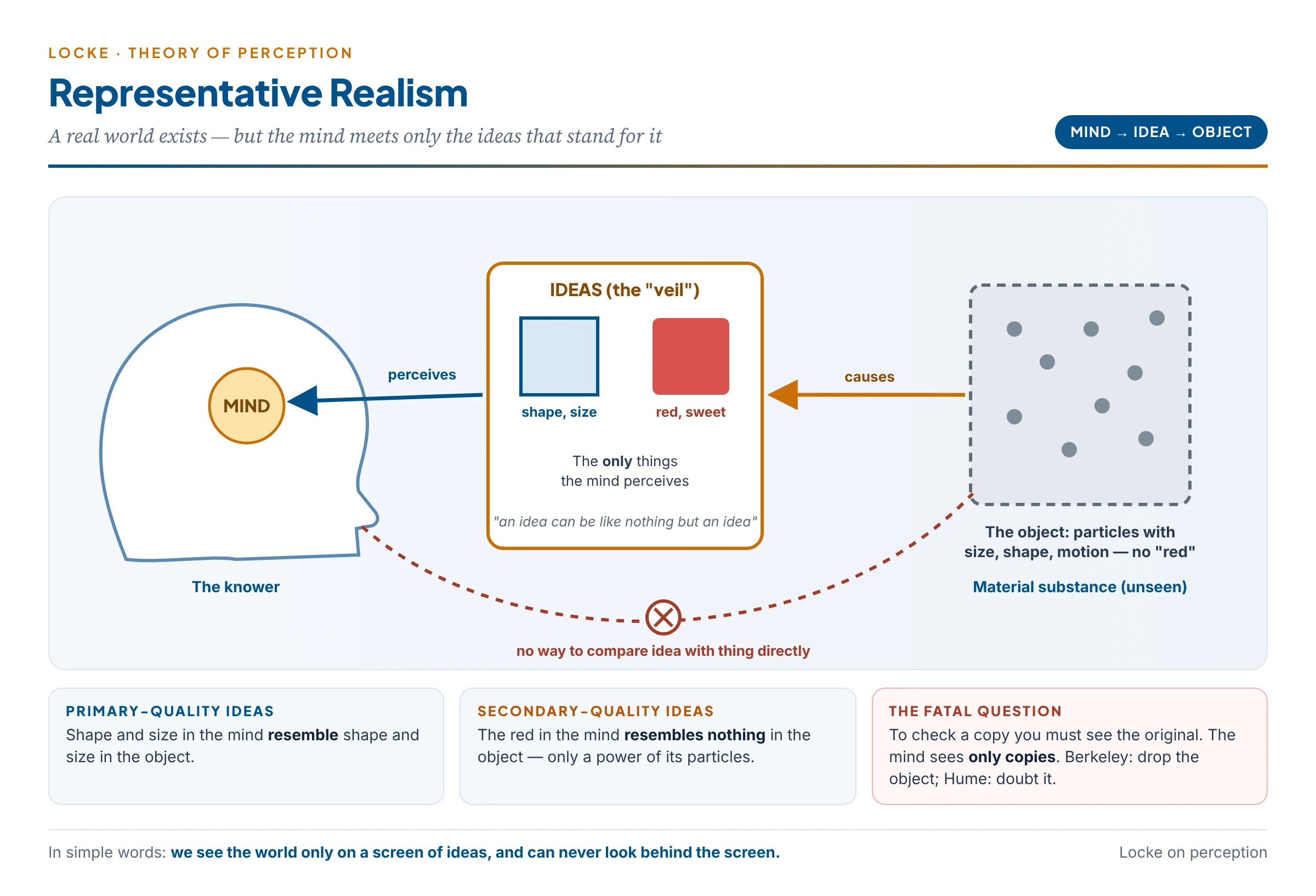
The fatal question. If the mind knows only its ideas, how can it ever check that an idea resembles or corresponds to the object? To compare a photograph with its original, we must see both. But we can never step outside our ideas to see the object “as it is.” This veil of ideas (or “iron curtain” of ideas) is the weak point that Berkeley and Hume attacked.
Critical Evaluation
Berkeley’s Attack on the Primary–Secondary Distinction
George Berkeley accepted Locke’s arguments about secondary qualities — and turned them against primary qualities too.
- Primary qualities are also ideas. Whatever we perceive — shape no less than colour — is an idea, and an idea exists only in a mind. “An idea can be like nothing but an idea.” So an idea cannot “resemble” an unperceived material quality.
- Inseparability. We cannot conceive extension or shape without some colour or tactile quality. Try to imagine a body that has shape but no colour, feel or any sense quality — it cannot be done. If colour is in the mind, the shape that cannot be separated from it is in the mind too. Separating them is vicious abstraction.
- Primary qualities are relative too. Locke made secondary qualities subjective because they vary. But so do primary qualities:
- size — what looks tiny to us is huge to a mite;
- shape — a coin looks round from above, oval from the side;
- motion — a man sitting on a boat is at rest relative to the boat, moving relative to a man on the bank; a motion that seems quick to one mind seems slow to another;
- number — the same length is one yard, three feet or thirty-six inches, depending on the unit the mind chooses.
If variation proves subjectivity, primary qualities are as subjective as secondary ones.
- Primary qualities are known through the senses. We perceive extension only by sight and touch — the same senses that give colours and textures. Berkeley’s New Theory of Vision argued that even seen distance and size depend on learned connections between ideas of sight and touch.
Conclusion (Berkeley): all qualities are mind-dependent; there is no need for a material substance in which primary qualities supposedly reside.
The Attack on Material Substance
- Not perceived. We perceive only qualities, never a substratum. The empiricist’s own principle — no idea without experience — rules it out.
- Not inferred. From ideas, which are mental, we cannot infer something non-mental and unperceivable as their support.
- Not a cause. Locke makes matter the cause of ideas. But matter is supposed to be inert and unthinking; how can it produce ideas in a mind? Only an active being can cause.
- “Something, I know not what” = nothing. An idea of a support that has no describable qualities is the idea of nothing. Berkeley: Locke’s matter is an empty word.
- A rationalist supposition. “Supposed support” is a supposition of thinking, not a datum of experience. In admitting substance, Locke obeys the compulsion of thought, not of experience — he becomes a rationalist at this point.
- Leibniz’s point. A substance apart from all its qualities is an abstraction; it cannot be something definite and determinate. We cannot know such an abstraction through the senses.
- Unperceived entities. Locke also accepts atoms and the inner structure of distant planets, though they cannot be perceived. Berkeley’s dictum “to be is to be perceived” challenges every such admission.
The Problem Locke Left to Later Empiricists
Locke’s distinction was a halfway house. Once the mind is shut up with its ideas, each step of empiricism removes something more:
| Thinker | Primary qualities | Secondary qualities | Material substance | Spiritual substance | Result |
|---|---|---|---|---|---|
| Locke | In objects; ideas resemble them | Powers in objects; ideas do not resemble | Accepted — “I know not what” | Accepted | Representative realism |
| Berkeley | Mind-dependent ideas | Mind-dependent ideas | Rejected | Accepted (finite spirits, God) | Subjective idealism |
| Hume | Bundles of impressions | Bundles of impressions | Rejected | Rejected — “bundle of perceptions” | Scepticism |
- The veil of ideas made the external world unreachable — the seed of Berkeley’s idealism.
- “Something, I know not what” made substance an empty supposition — which Berkeley removed from matter and Hume removed from mind as well.
- “The mind knows only its own ideas” led to Hume’s question: by what impression do we know substance, causal power or a permanent self? The answer “none” ended in scepticism.
- Hence the remark that the seed of scepticism lies in Locke’s philosophy and grows to full size in Hume.
What Can Be Said for Locke
- Science supports a version of the distinction. Physics describes light by wavelength, sound by vibration, heat by molecular motion. Colour as experienced depends on the visual system — colour-blind people and animals see differently. Shape and mass enter physical laws; “redness as seen” does not. Locke’s line between the measurable and the felt is still the line between physics and perception science.
- Dispositional properties. Philosophers today treat colours as dispositions (powers) of surfaces to affect normal perceivers in normal light — close to Locke’s own account.
- Relativity of perception is not relativity of quality. Against Berkeley, a coin looks oval from the side but is round, and we can measure it to find out. Primary qualities can be checked by instruments and agree across senses and observers; secondary qualities cannot be measured as felt.
- Substance as humility. “I know not what” is an honest admission of the limits of knowledge, not a dogma. Locke’s prediction that real essences depend on hidden particle structure proved correct in atomic chemistry.
- Inference to the best explanation. We cannot step behind our ideas, but we can argue that an external world is the best explanation of their order, force and agreement — the line later taken by scientific realists.
Critics and Defenders
Criticism — Critics
- Berkeley: primary qualities are as relative and mind-dependent as secondary ones; “an idea can be like nothing but an idea”; matter is an empty word.
- Hume: there is no impression of substance; the idea is a fiction of the imagination uniting qualities.
- Leibniz: substance stripped of all qualities is an abstraction, not a knowable thing.
- Critics of representative realism: if we know only ideas, resemblance and correspondence can never be checked — the theory leads to scepticism.
- Empiricist consistency: “supposed support” is a supposition of reason, not something given in experience.
Defence — Defenders and lasting value
- Modern physics: shape, mass and motion enter the laws of nature; colour, taste and warmth are explained through them — Locke’s distinction in scientific form.
- Dispositional analysis: secondary qualities as powers of objects is a respected view of colour today.
- Measurability: primary qualities agree across senses, observers and instruments; secondary ones do not.
- Chemistry vindicated “real essence”: the inner structure of substances (atomic number, molecular structure) explains their observable qualities, as Locke said.
- Epistemic honesty: “something, I know not what” admits the limits of knowledge instead of inventing an answer.
Cross-Tradition Comparison
Qualities and Substance: Descartes, Locke and Berkeley
| Point | Descartes | Locke | Berkeley |
|---|---|---|---|
| Essence of body | Extension | Solidity with extension | Body is a collection of ideas |
| Real qualities of body | Extension, figure, motion (clear and distinct) | Solidity, extension, figure, motion/rest, number | None outside minds |
| Colours, tastes, heat | Confused ideas in the mind | Powers in bodies; ideas do not resemble | Ideas in minds — exactly as perceived |
| How known | By intellect (wax argument) | By senses, through ideas | By perception; ideas are the things |
| Material substance | Known clearly by reason | Real but “I know not what” | Does not exist |
| Theory of perception | Representative | Representative realism | Immaterialism (subjective idealism) |
Locke and Indian Theories of Substance and Perception
| Point | Locke | Nyāya–Vaiśeṣika | Sautrāntika Buddhism | Yogācāra Buddhism |
|---|---|---|---|---|
| Substance | Real but unknown support of qualities | Dravya — the substratum (āśraya) of qualities, perceived | No substance beyond momentary qualities (dharmas) | No external substance |
| Qualities | Primary real; secondary are powers | Guṇas (24) — colour, taste, smell, touch, number, size, all real in substances | Momentary point-instants (svalakṣaṇa) | Forms of consciousness |
| How substance and quality relate | Quality “inheres” in an unknown support | Samavāya (inherence), an eternal relation | Mere collection | — |
| Perception of objects | Indirect — through representing ideas | Direct realism — we perceive the pot itself | Indirect — external object inferred from the form (ākāra) in cognition (bāhyānumeya-vāda) | Only cognition and its forms exist (vijñaptimātratā) |
| Western twin | — | Common-sense realism | Locke | Berkeley |
Indian Connect — Key takeaways
- Sautrāntika ≈ Locke. The Sautrāntika holds that we never perceive the external object directly; cognition takes on the form (ākāra) of the object, and from the variety and order of these forms we infer that external objects exist. This is Indian representative realism — and like Locke, it faced the objection that an object never perceived can hardly be inferred.
- Yogācāra ≈ Berkeley. The Yogācāra reply to the Sautrāntika was that the “external object” is superfluous — only consciousness and its forms are real. This mirrors Berkeley’s reply to Locke, as the next articles show.
- Nyāya against Locke. Nyāya–Vaiśeṣika is a direct realist: substance (dravya) is perceived along with its qualities, and colour (rūpa) and taste (rasa) are as real in the object as size (parimāṇa) and number (saṅkhyā). There is no “secondary,” mind-dependent class of qualities; the relation of quality to substance is inherence (samavāya), not an unknown support.
- Buddhism and Hume. Buddhists deny any substance behind qualities: a “pot” is a collection of momentary qualities — the position Hume reached in the West.
Synthesis (Siddhānta)
Locke’s doctrine of qualities and substance is an attempt to hold together two pictures: the everyday world of coloured, tasting, sounding things, and the scientific world of particles in motion. He keeps both by putting primary qualities in bodies, making secondary qualities powers of bodies whose ideas exist only in us, and placing all qualities in an unknown substance. Our knowledge of this world runs through ideas that represent it.
The strength of the doctrine is its fit with science: what physics measures is what Locke called primary; what physics explains away is what he called secondary. Its weakness is its epistemology: if the mind knows only ideas, the resemblance of ideas to bodies, and the very existence of a supporting substance, cannot be checked. Berkeley drew the idealist conclusion; Hume drew the sceptical one; Kant tried to save objectivity by locating space, time and substance in the structure of the knowing mind.
- Physics and perception science still use Locke’s line: measurable properties versus experienced qualities.
- Philosophy of colour debates whether colours are in objects (as dispositions), in brains, or nowhere — Locke’s question in modern form.
- Virtual reality shows how convincingly ideas can be produced without the objects they seem to show — the “veil of ideas” made into technology.
- Intellectual honesty: “something, I know not what” is a model of admitting what we do not know.
Locke kept the world behind a curtain of ideas, trusting that what the curtain shows of shape and motion is true — and his successors asked how anyone could know what lies behind a curtain no one can lift.
Previous Year Questions
- 2017How does Locke draw a distinction between primary and secondary qualities? Does he also draw a distinction between the idea of primary qualities and primary qualities as well as the idea of secondary qualities and secondary qualities? Discuss.
- 2016What is the logical necessity for Locke to introduce the concept of secondary qualities? Give reasons for your answer.
- 2013Examine John Locke’s theory of substance.
- 2012Critically examine John Locke’s categorization of primary and secondary qualities and explain the problem it posed for later empiricists.
- 2011What, according to Empiricists, is the concept of Substance? Discuss.
- 2007State and discuss Locke’s views on Substance.