

Influence of cultural factors in socialization.
Official Syllabus: Paper I · Unit 4 Development of Human Behaviour
“Every function in the child’s cultural development appears twice: first, on the social level, and later, on the individual level; first, between people and then inside the child.”
— Lev Vygotsky (1978), stating the general genetic law of cultural development
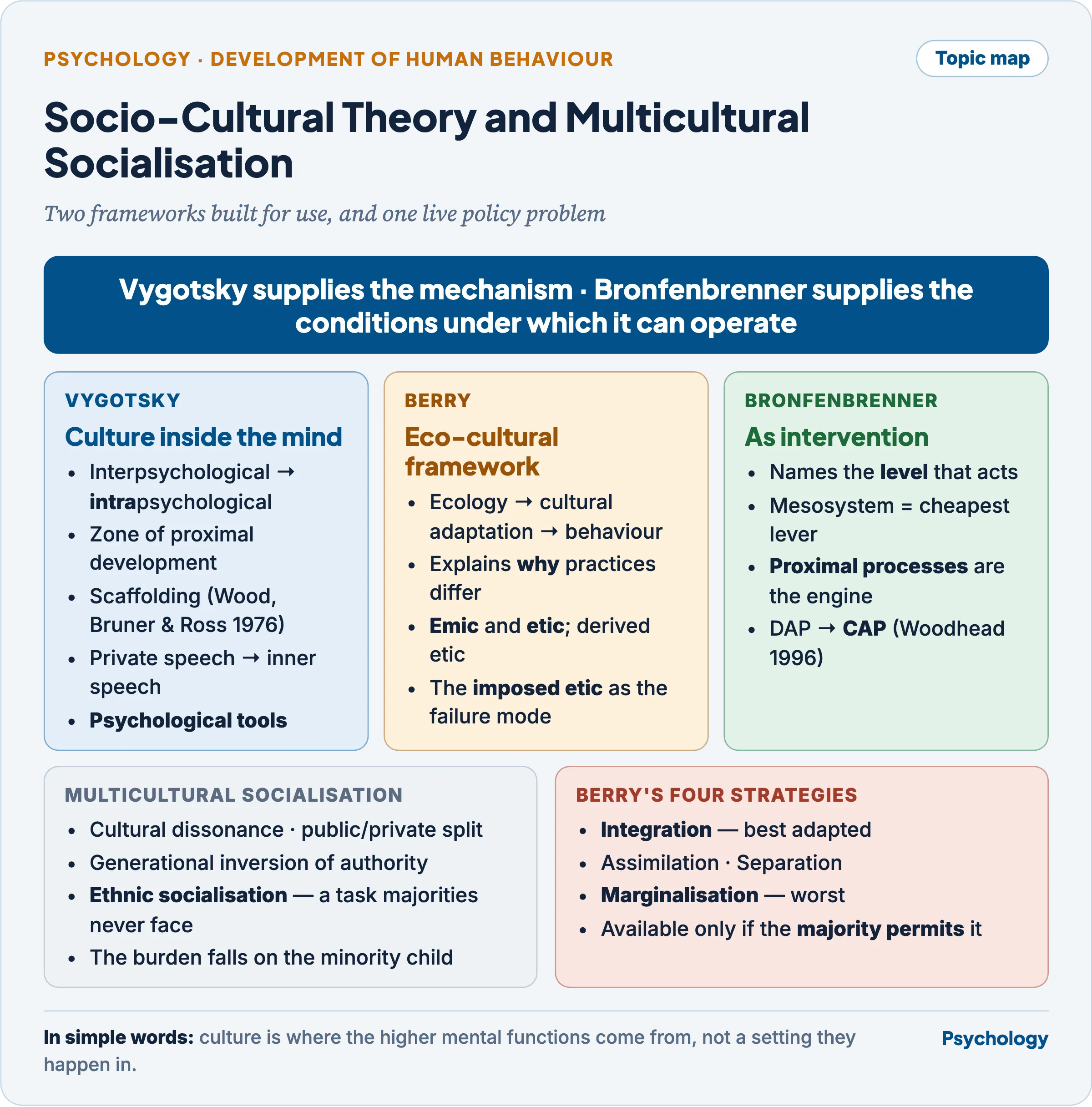
Two theoretical frameworks made culture a cause of development rather than a setting for it, and both were built for use. Vygotsky’s socio-cultural theory locates the origin of mind in social interaction; Bronfenbrenner’s ecological theory locates development in nested systems and identifies which of them an intervention must reach. The third topic here — socialisation in a society of several cultures — is where both frameworks are applied to a live policy problem.
Vygotsky: culture inside the mind
Vygotsky’s theory is the theoretical core of culture in development, because it makes culture the source of the higher mental functions rather than an influence upon functions that would otherwise form anyway.
His general genetic law of cultural development is the proposition quoted above: every function appears first on the social level, between people, and only then on the individual level, inside the child — interpsychological before intrapsychological. He insisted this holds for voluntary attention, logical memory and concept formation alike, because all the higher functions originate as actual relationships between individuals.
Four components carry the claim.
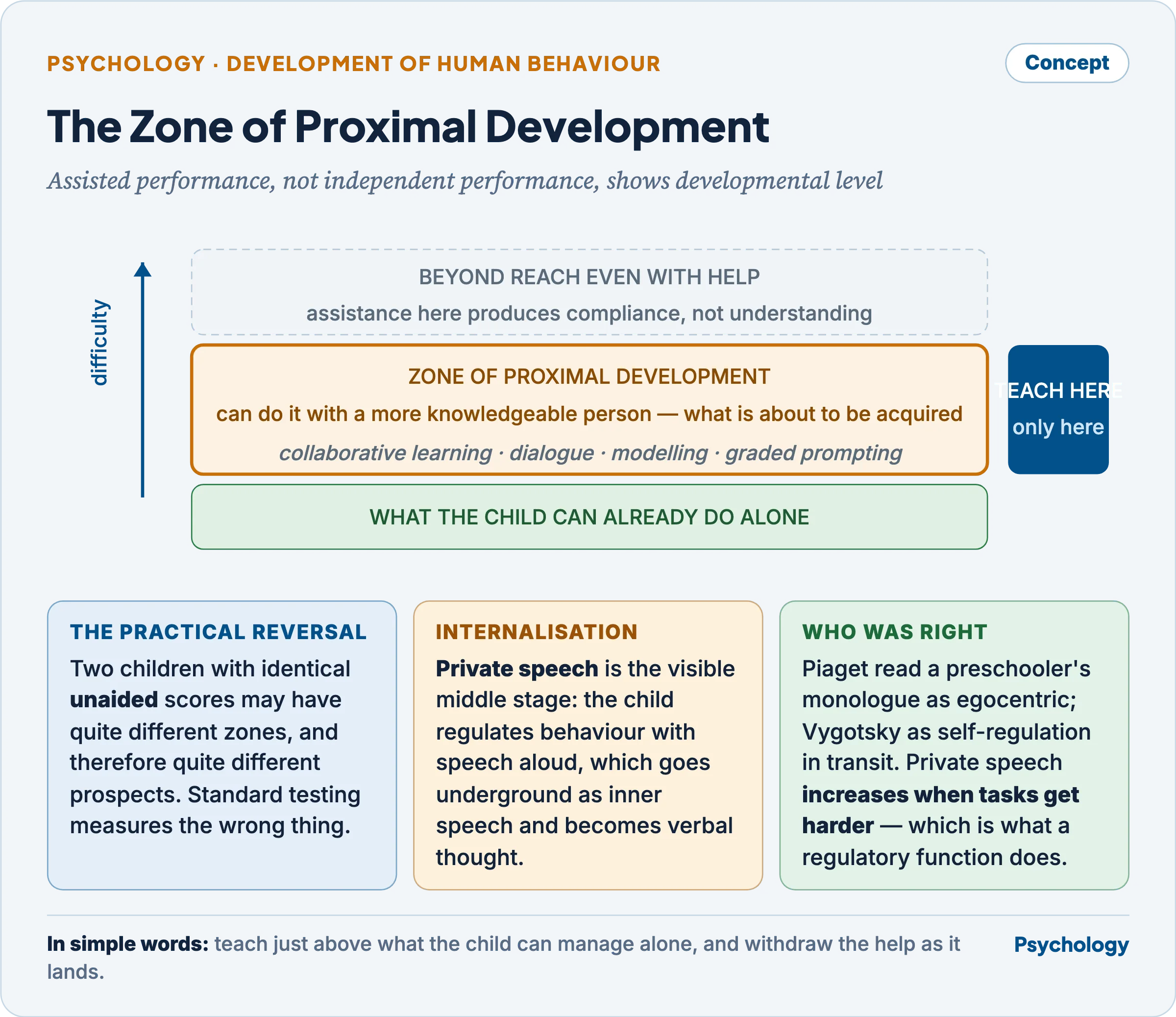
- The zone of proximal development is the distance between what a child can do unaided and what they can do with assistance from a more knowledgeable person. Its practical consequence reverses standard testing practice: assisted performance, not independent performance, indicates developmental level, because it shows what is about to be acquired rather than what has already been consolidated. Two children with identical unaided scores may have quite different zones and therefore quite different prospects.
- Scaffolding is the graded support an adult or more capable peer supplies inside that zone and withdraws as competence grows. The term is not Vygotsky’s own but comes from Wood, Bruner and Ross (1976), and the mechanisms it names — collaborative learning, dialogue, modelling, graded prompting — are what a teacher actually does.
- Internalisation is the process by which an external social operation becomes an internal psychological one. Private speech is the visible intermediate stage: a child first regulates their own behaviour with speech spoken aloud, which then goes underground as inner speech and becomes verbal thought. Where Piaget read a preschooler’s monologue as egocentric and asocial, Vygotsky read it as self-regulation in transit from outside to in — and the evidence favours Vygotsky, because private speech increases when a task becomes difficult, which is what a regulatory function would do and not what egocentrism would predict.
- Psychological tools — language, number systems, writing, mnemonic devices, and now computation — are supplied by the culture and transform the functions that employ them. Memory with a writing system is a different function from memory without one, which makes cognitive development partly a history of the tools a society provides.
Vygotsky set against Piaget
The contrast is the most examinable comparison in developmental psychology, and it is sharper than “one stressed the social”.
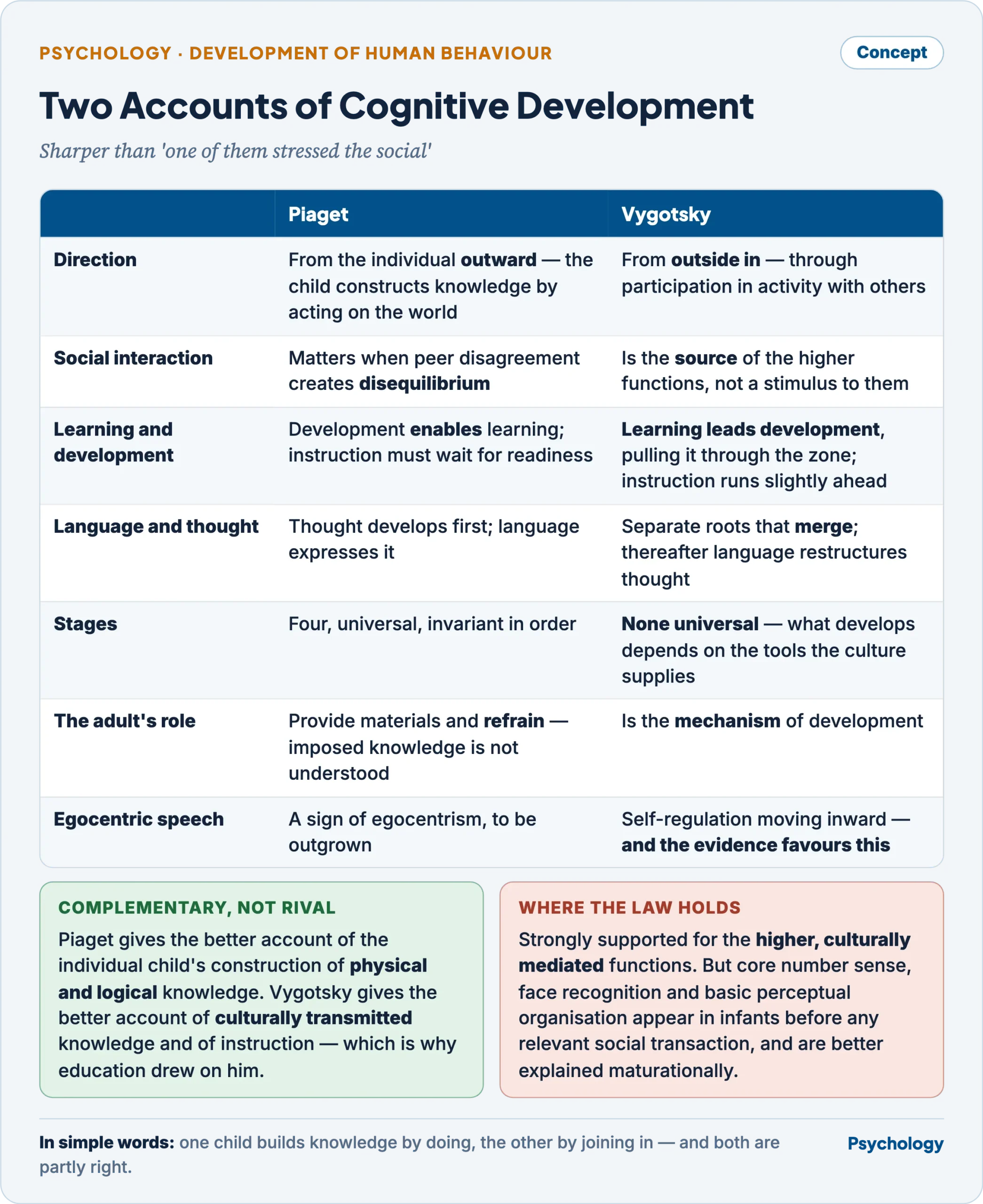
- Direction of development. For Piaget, development proceeds from the individual outward: the child constructs knowledge by acting on the world, and social interaction matters mainly when peer disagreement creates disequilibrium. For Vygotsky it proceeds from outside in, through participation in activity with others.
- Relation of learning to development. Piaget held that development enables learning — a child cannot acquire what the current stage cannot support, so instruction must wait for readiness. Vygotsky held that learning leads development, pulling it forward through the zone of proximal development, so good instruction runs slightly ahead of current capacity.
- Language and thought. For Piaget, thought develops first and language expresses it. For Vygotsky, language and thought have separate roots that merge, after which language restructures thought.
- Stages. Piaget’s four stages are universal and invariant in order. Vygotsky offers no universal stage sequence, since what develops depends on which tools and practices the culture supplies.
- Role of the adult. For Piaget the adult provides materials and refrains from interference, because imposed knowledge is not understood. For Vygotsky the adult is the mechanism of development.
- Egocentric speech, as above, is the one point where the two make directly opposed empirical predictions, and Vygotsky’s is the one that held.
The two are nonetheless complementary rather than exclusive. Piaget gives the better account of the individual child’s construction of physical and logical knowledge; Vygotsky gives the better account of culturally transmitted knowledge and of instruction, which is why education has drawn far more on him.
Where the law holds, and where it does not
The defensible position is that the claim is strongly supported for the higher functions and overstated as a universal.
Joint attention, instructed remembering, categorisation, self-regulation and literacy do demonstrably appear first in interaction and then individually, and the evidence on private speech is good. But some capacities do not fit the pattern: core number sense, face recognition and basic perceptual organisation are present in infants before any relevant social transaction and are better explained maturationally. The correct reading of “every function” is therefore every higher, culturally mediated function — which is precisely what Vygotsky’s own phrase “cultural development” signals. Read that way, the law does not compete with the maturational account of the biological substrate; it explains what is built on top of it.
The eco-cultural framework
John Berry’s eco-cultural framework supplies the explanatory structure that cross-cultural comparison otherwise lacks, by treating culture as an adaptation rather than as an arbitrary given.
Its logic runs in a chain. The ecological context — terrain, climate, subsistence mode — sets the demands a population must meet. Cultural adaptations, including child-rearing practices, develop as solutions to those demands. Socio-political context, including colonial history and contemporary contact, overlays further influences. These transmit to the individual through cultural transmission and socialisation on one side and genetic transmission on the other, producing observable behaviour.
The payoff is that it explains why practices differ instead of only cataloguing that they do. The canonical illustration is subsistence mode: societies dependent on accumulated food stores and herded animals require compliance and care, and their child-rearing emphasises obedience and responsibility; hunting and gathering societies require individual initiative and their child-rearing emphasises self-reliance and assertion. The practices are not accidents of tradition but adaptations, which is also why they change when the subsistence base changes.
Two methodological distinctions belong with it and should be named in any cross-cultural answer.
- Emic descriptions use concepts internal to the culture being studied; etic descriptions use concepts imported for comparison. Pure etic comparison risks imposing a framework that distorts what it measures, while pure emic description makes comparison impossible. The workable procedure is derived etic — begin emically within each culture, then construct comparative categories from what is found, rather than exporting one culture’s categories as universal.
- The imposed etic is the characteristic failure, and it has a documented Indian instance. When the Thomas and Chess temperament dimensions were applied to Indian samples by Malhotra, Malhotra and Randhawa (1983), Indian mothers found the categories difficult to understand — a failure at the level of the question rather than the answer. The triguna-based schedule that Kapur and colleagues (1994, 1997) built from the Samkhya tradition is the emic alternative, measuring dimensions the Western models do not contain.
The ecological perspective as a way of improving outcomes
Treated as an approach to facilitating developmental outcomes rather than describing them, the ecological perspective is a theory of intervention, and its five nested systems are the least of what it offers.
Its first contribution is negative and necessary: it identifies why well-intentioned programmes fail. Universal developmental assumptions have been written into international policy — a World Bank scheme once compressed the first eight years into seven stages described in terms of access to books and puzzles and opportunities for dramatic play. Those descriptions presuppose a particular home, a particular set of material resources and a particular valuation of independence. They also normalise children, leaving no room for individual variation or for differences by sex, maturity or social position. The resulting template bears little resemblance to the lives of most of the world’s children or to the resources actually available to support them.
The constructive proposal is to replace Developmentally Appropriate Practice with Contextually Appropriate Practice (Woodhead, 1996), in which curricula, services and practices are built around the real circumstances of children’s lives, the material and cultural capital available to their families and communities, and the aspirations those families hold. The evidential basis for taking context this seriously includes the Six Cultures Project of Whiting and Whiting (1975), which documented systematic covariation between children’s behaviour and the organisation of daily life across six societies.
The perspective then yields four operational advantages, and these are what make it an approach rather than a description.
- It names the level at which an intervention acts, and therefore explains why single-level interventions underperform. A supplementary nutrition programme working at the microsystem will not succeed while the macrosystem continues to allocate household food by sex.
- It directs attention to the mesosystem, which is the cheapest available lever and the most neglected: parent–teacher contact, a link between an anganwadi and the primary school it feeds, coordination between health and education services. None of these requires new resources, only connection between existing ones.
- Bronfenbrenner’s later bioecological emphasis on proximal processes — the enduring, reciprocal, increasingly complex interactions in the child’s immediate setting — identifies what an intervention must finally change. A programme that does not alter daily interaction will not alter development however well funded it is. This is the single most useful design principle the theory yields, and it explains the common finding that infrastructure spending without change in teaching practice produces no learning gain.
- It treats the child as an active agent in a process of mutual accommodation, so an intervention is judged by whether it enables the child’s own engagement rather than by what is delivered to them.
The two frameworks converge here. Vygotsky identifies the mechanism — assisted performance inside the zone of proximal development — and Bronfenbrenner identifies the conditions under which that assistance is more or less likely to occur. An intervention designed on both grounds works on the quality of adult–child interaction and on the systemic conditions that permit it.
Socialisation in a multicultural society
Whether socialisation is a distinctive problem where several cultures coexist, and what to do about it, are separable questions. The problem is real and should be conceded before it is solved.
Why it is a genuine problem
- Conflicting norms. A child socialised at home into one set of practices and at school into another faces incompatible demands at an age when neither can be evaluated, producing what the literature calls cultural dissonance.
- A split between public and private selves. Research finds people using different acculturation strategies in private and public life — maintaining heritage norms domestically while adapting publicly. This is functional, but it sustains a division that carries a cost in coherence of identity.
- Generational inversion. Children acculturate faster than their parents, which inverts authority where the child becomes the family’s interpreter of the wider society, and undermines the parent’s standing as a model at exactly the age when modelling matters most.
- Prejudice and identity threat. Minority children are socialised not only into their own culture but into the society’s evaluation of it, and must additionally be prepared for discrimination — the task known as ethnic or racial socialisation, which majority families never have to perform.
- Unequal burden. The work of bridging cultures falls on the minority child, who must become competent in two systems while the majority child needs only one. Any mechanism that ignores this asymmetry simply reassigns the problem.
The mechanism, from Berry’s acculturation framework
Berry classified acculturation by two independent questions — whether the heritage culture is to be maintained, and whether relations with the larger society are to be sought — which yields four strategies.
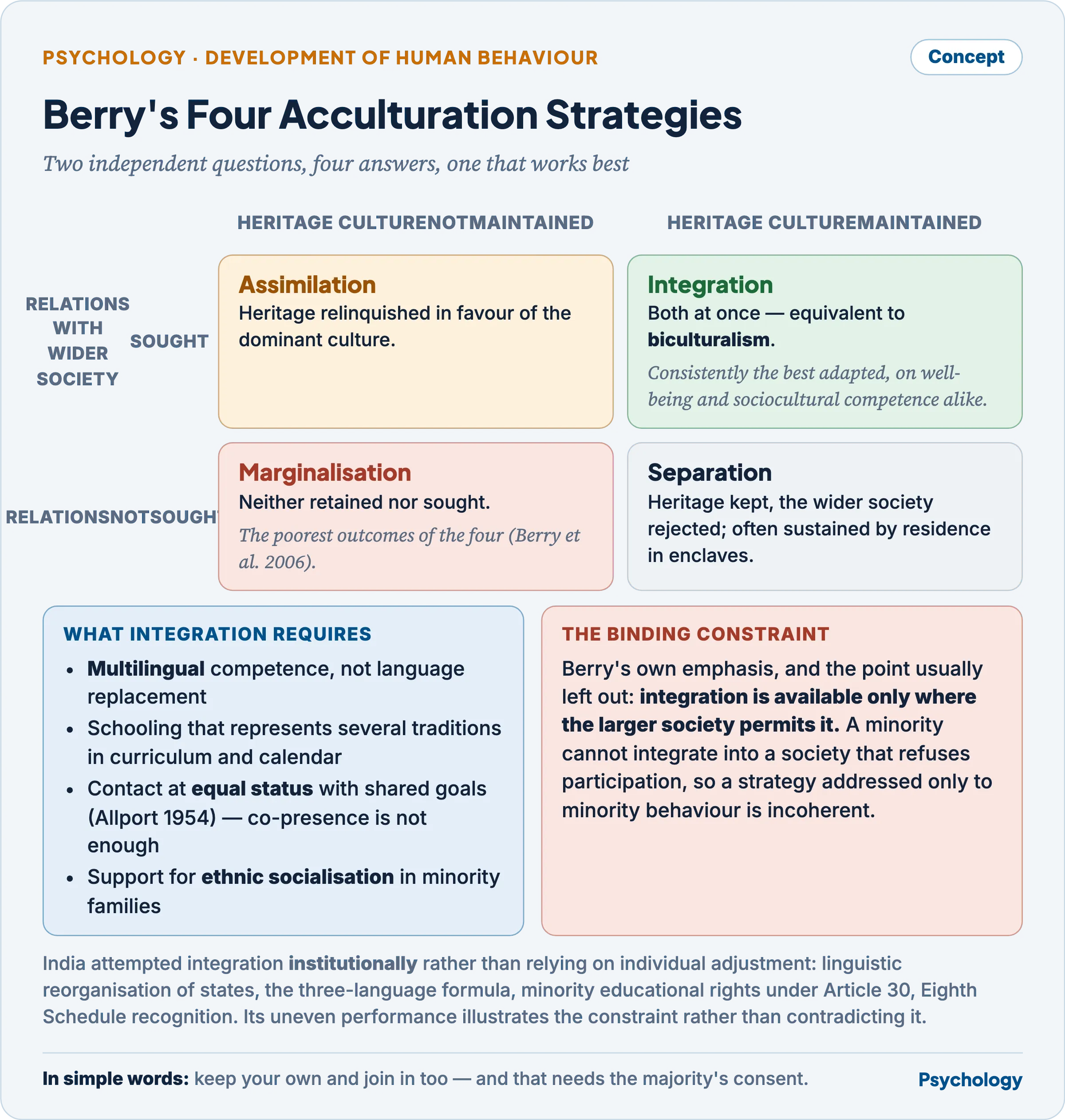
- Integration — heritage maintained and participation in the wider society sought; equivalent to biculturalism.
- Assimilation — heritage relinquished in favour of the dominant culture.
- Separation — heritage retained and the wider society rejected, often sustained by residence in ethnic enclaves.
- Marginalisation — neither heritage retained nor wider participation sought.
The finding that makes this prescriptive rather than merely descriptive is that those who integrate are consistently better adapted than those who assimilate, separate or are marginalised, on both psychological well-being and sociocultural competence, with marginalisation the poorest of the four (Berry and colleagues, 2006).
A socialisation mechanism aimed at integration therefore has specifiable requirements.
- Multilingual competence rather than language replacement, since language is the principal vehicle of heritage transmission and losing it forecloses integration in favour of assimilation.
- Schooling that represents several traditions in curriculum, calendar and staffing, so that no child’s home culture is positioned as the exception requiring explanation.
- Contact under the right conditions — equal status, shared goals, cooperative interdependence and institutional sanction, following Allport’s (1954) contact conditions. Mere co-presence in a classroom does not reduce prejudice and can increase it.
- Explicit support for ethnic socialisation in minority families, since preparing a child for discrimination without instilling hostility is a difficult task that families attempt unaided.
- Majority attitudes as the binding constraint. This is Berry’s own emphasis and the point most often omitted: integration is only available where the larger society permits it. A minority cannot integrate into a society that refuses participation, so a strategy addressed only to minority behaviour is incoherent.
India is a useful case precisely because it attempted the integration strategy institutionally rather than relying on individual adjustment. Linguistic reorganisation of states, the three-language formula, minority educational rights under Article 30, Eighth Schedule recognition of languages and the constitutional protection of cultural practice are all recognisably designed to permit heritage maintenance alongside full participation. Their uneven performance illustrates Berry’s constraint rather than contradicting it: where majority acceptance has held, integration has broadly worked; where it has not, the result has been separation or conflict, not assimilation. The policy lesson is that multicultural socialisation is primarily a task for the majority and for institutions, and only secondarily for minority families.
Criticisms and limitations
- Vygotsky’s theory is underspecified where it matters most. The zone of proximal development has no agreed measurement procedure, so it functions as a metaphor in most empirical work; the mechanism of internalisation is described rather than explained; and his death at 37 left the account without the long empirical programme Piaget’s received.
- It understates the biological and the individual. Maturational constraints, temperament and individual differences in learning have little place in the theory, and it cannot easily explain why children given identical instruction inside their zone progress at very different rates.
- The ecological model is hard to falsify. Its breadth is its appeal and its weakness: with five nested levels almost any finding can be assigned to one after the fact, and the outer systems are rarely measured directly. Bronfenbrenner’s own turn to proximal processes was partly an admission that the nested diagram had become a descriptive container rather than a theory.
- Contextually Appropriate Practice can be used to defend the indefensible. If practice is to follow context, a context of low expectations justifies low provision, and the argument has been used that way. It needs an external standard of children’s interests to constrain it, which the formulation does not itself supply.
- Berry’s four strategies have limited predictive validity. People do not fall neatly into the categories, strategies differ across domains of life for the same person, and situational factors such as language familiarity and whether one migrated with family substantially determine which strategy is even available.
- The acculturation literature is built on voluntary migration to Western host societies, which transfers poorly to India’s situation of long-coexisting indigenous cultural groups with no host-and-migrant structure, and to internal migration between Indian states, where the categories of heritage and dominant culture are not cleanly separable.
- The eco-cultural framework risks functionalism. Explaining a practice by the adaptive pressure it once met can slide into assuming every surviving practice must be adaptive, which neither the historical record nor the persistence of clearly harmful practices supports.
Previous Year Questions
- 2023Do you think that in multicultural society, socialization is a big issue? Give your opinion in this regard and suggest proper socialization mechanism.
- 2014Present an outline of the ecological perspective as an innovative approach to facilitate developmental outcomes.
- 2013“Every function in the child’s development appears twice: first on social level and later, on the individual level.” — Vygotsky. Discuss the above statement and indicate your own position on this proposition.