

Influence of cultural factors in socialization.
Official Syllabus: Paper I · Unit 4 Development of Human Behaviour
“Culture is the man-made part of the environment.”
— Melville Herskovits (1948), a definition that makes culture a condition of development rather than a backdrop to it
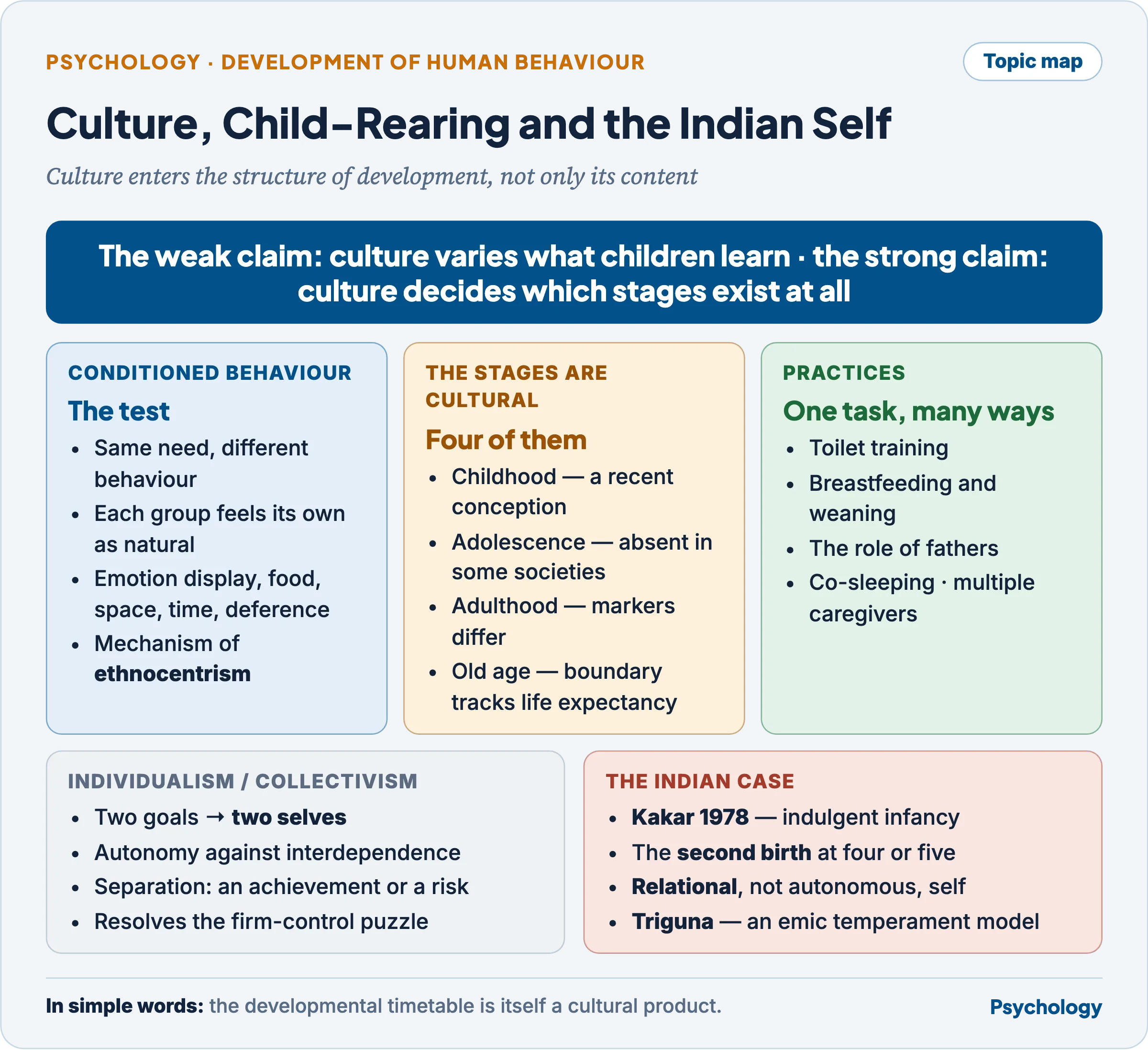
The weak claim about culture is that it varies the content of what children learn. The strong claim, and the one the evidence supports, is that culture enters the structure of development itself — it determines which stages exist, what counts as a developmental task, and which capacities are cultivated and which allowed to lapse. The difference matters because the weak claim leaves a universal developmental sequence intact and merely decorates it, while the strong claim requires the sequence itself to be treated as a cultural product.
Culturally conditioned behaviour
Culturally conditioned behaviour is behaviour whose form, meaning or occurrence is determined by the learned practices of a particular group rather than by biological necessity or individual disposition. The test is substitutability: if the same underlying need is met by visibly different behaviour in another society, and members of each regard their own as natural, the behaviour is culturally conditioned.
The examples worth giving are ones where the behaviour feels biological to those performing it.
- Emotional display. Grief is universal; wailing publicly at a funeral against composed silence is conditioned, and each group experiences its own rule as the natural expression of feeling.
- Eating. Hunger is universal; what counts as food is not. Beef, pork, insects and dog are nutritious and variously unthinkable, and the revulsion is experienced as visceral rather than learned.
- Personal space and touch. The distance at which conversation is comfortable, and whether same-sex friends hold hands in public, differ systematically and are felt as instinctive.
- Modesty. Which parts of the body must be covered varies widely while the sense of shame at exposure is strongly felt in every case.
- Time. Whether punctuality is a moral matter or an approximation, and whether events begin by the clock or when enough people have gathered.
- Deference. Touching an elder’s feet, standing when a senior enters, using honorific pronouns — each is a conditioned enactment of a hierarchy the participants experience as natural respect.
The concept’s importance is diagnostic. Treating conditioned behaviour as natural is the mechanism of ethnocentrism, and in developmental psychology it is the mechanism by which the child-rearing of one society becomes the standard against which all others are scored as deficient.
The life stages themselves are cultural
The most direct evidence against a universal developmental sequence is that the stages are not found everywhere, and this is also the strongest critique available of the life-span notion.
- Childhood. The modern conception of childhood as a protected period with no productive obligation is historically recent and far from universal. In some societies children are treated as economic contributors from the point of physical capability; Kojima (1986) describes a Japanese conception of children as partaking of the divine and therefore free of adult responsibility; the Western post-modern conception treats the child as a separate, rights-bearing individual expected early to be self-determining. Each conception generates a different set of developmental tasks.
- Adolescence. In a number of societies adolescence does not exist as a stage: physical maturity is followed directly by adult roles, sometimes marked by initiation rituals that effect the transition in a matter of days. Where formal education is extended, adolescence lengthens correspondingly, which is why it is now longer in India than it was two generations ago. The familiar characterisation of adolescence as a period of storm and stress, of the drive for autonomy and separation from parents, is supported in some cultures and not others — and the autonomy that is sought is itself culturally specified, being independence in some settings and a renegotiated interdependence in others.
- Adulthood. Starting a family and becoming economically productive are the common markers, but their timing and their order differ, and marriage is no longer the universal threshold of adulthood that it was.
- Old age. Its boundary tracks life expectancy, so the stage begins at very different chronological points. More importantly its meaning differs: where elders are held to possess legitimate authority and accumulated wisdom and are cared for within the family, old age is a position of status, whereas in societies organised around nuclear households and independence it is a period of maintained self-reliance supported by welfare provision.
This yields the substantive critique of the life-span notion. Chronological age is not an adequate reference point for development. A fuller account requires biological age, psychological age, functional age and social age — the last being the role a person’s socio-cultural group expects at a given chronological age. Since social age varies by society and shifts within one society over time, the life-span sequence cannot be read off a calendar. The life-span approach is nonetheless not refuted by this, because its own principle of contextual embeddedness anticipates it; what the critique damages is the universal stage tables, not the framework.
Culture-specific child-rearing practices
Most empirical evidence on child-rearing derives from the care-giving of white middle-class mothers, which Whiting and Edwards (1988) showed to be globally atypical rather than standard. Three practices make the point concretely.
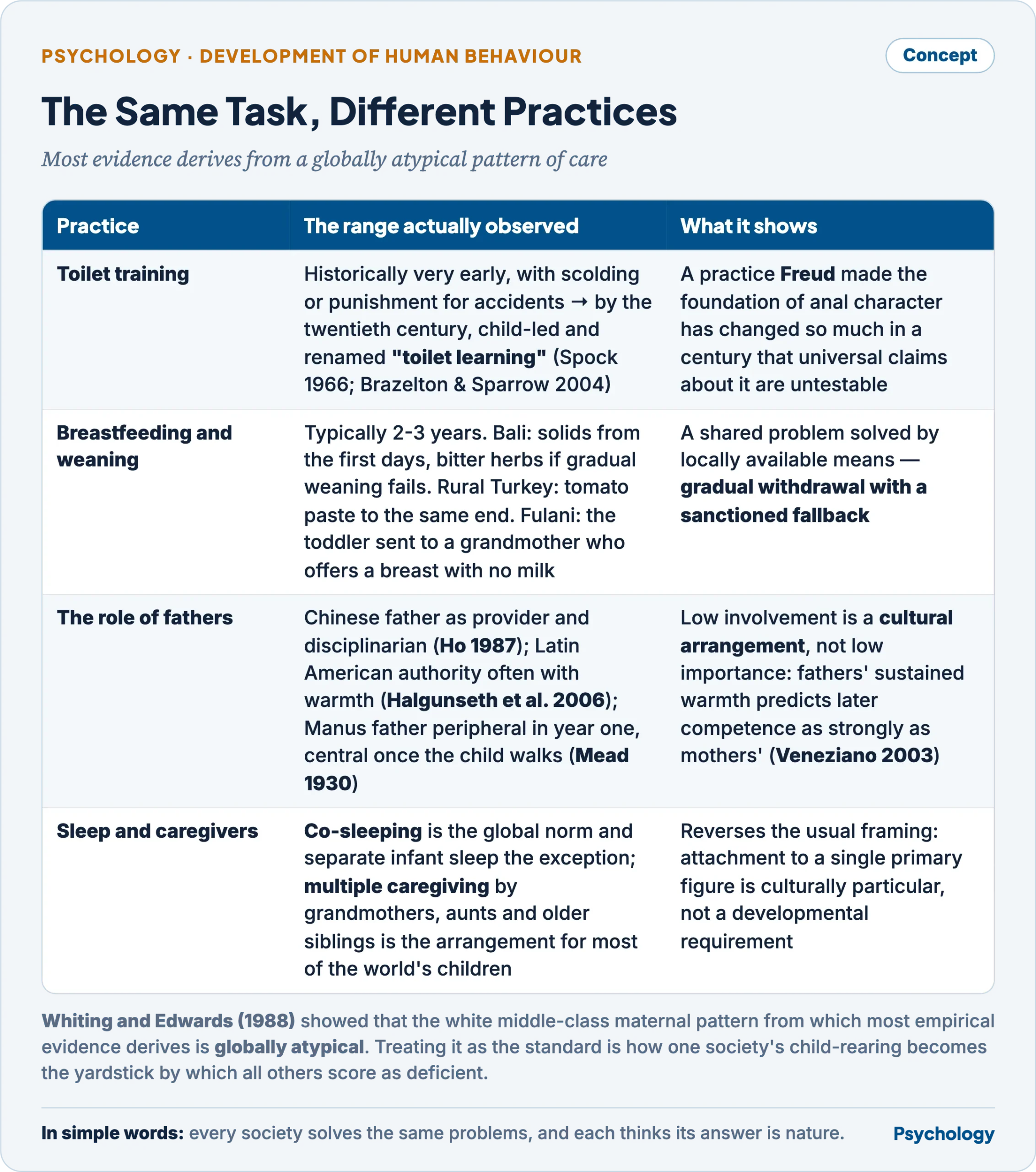
- Toilet training. Historically the emphasis was on training very early, with scolding or physical punishment for accidents, which reflected a belief in the propriety of strong parental authority and placed the parents’ convenience above the child’s readiness. Through the twentieth century, as technology reduced the burden and parenting beliefs shifted, child-care authorities warned against the psychological effects of coercive early training and advised that the child’s readiness set the timing (Spock, 1966; Brazelton and Sparrow, 2004). The change of vocabulary from “toilet training” to “toilet learning” records the shift. Note what has happened: a practice that Freud made the foundation of anal-stage character formation has altered so much within a century that any claim about its universal developmental consequences becomes untestable.
- Breastfeeding and weaning. The historically typical duration is two to three years, against a few months in much of the contemporary industrialised world. Weaning methods are culturally codified and ingenious: gradual introduction of solids from the first days in Bali with weaning around two, bitter herbs applied to the breast if the gradual method fails; tomato paste used to the same end in rural Turkey; and among the Fulani of West Africa, the toddler sent to live with a grandmother who offers her own breast until the child loses interest. The common structure is gradual withdrawal with a culturally sanctioned fallback, which indicates a shared problem solved by locally available means.
- The role of fathers. Across most societies and most of history, fathers have done little routine infant care, with distinct male and female roles and considerable same-sex sociability. Ho (1987) describes the Chinese father as provider and disciplinarian with nurturance left to the mother; Halgunseth and colleagues (2006) find Latin American fathers holding comparable authority but frequently a warm affective bond; Margaret Mead (1930) observed among the Manus of New Guinea a father scarcely involved in the first year who becomes central once the child walks, to the point that children choosing between parents in later childhood often prefer the father. In industrialised societies fathers remain less involved in caregiving and interact more through vigorous physical play. The correction to the inference usually drawn is that Veneziano (2003) found fathers’ sustained affectionate involvement predicting later cognitive, emotional and social competence as strongly as mothers’ warmth, and occasionally more strongly. Low involvement is a cultural arrangement, not an index of low importance.
Two further practices are worth adding for the Indian case. Co-sleeping is the global norm and the Western insistence on separate infant sleep the exception, which reverses the usual framing of dependence as a developmental problem. And multiple caregiving by grandparents, aunts and older siblings is the arrangement for most of the world’s children, so attachment to a single primary figure is a culturally particular pattern rather than a developmental requirement.
Individualism, collectivism and the socialised self
The most productive single dimension for this topic is individualism against collectivism. In individualistic societies people construe themselves as separate entities and are principally concerned with their own needs and goals; in collectivist societies people define themselves as part of a group and subordinate personal to group goals. The consequence for socialisation is that the two produce different selves, not merely different manners.
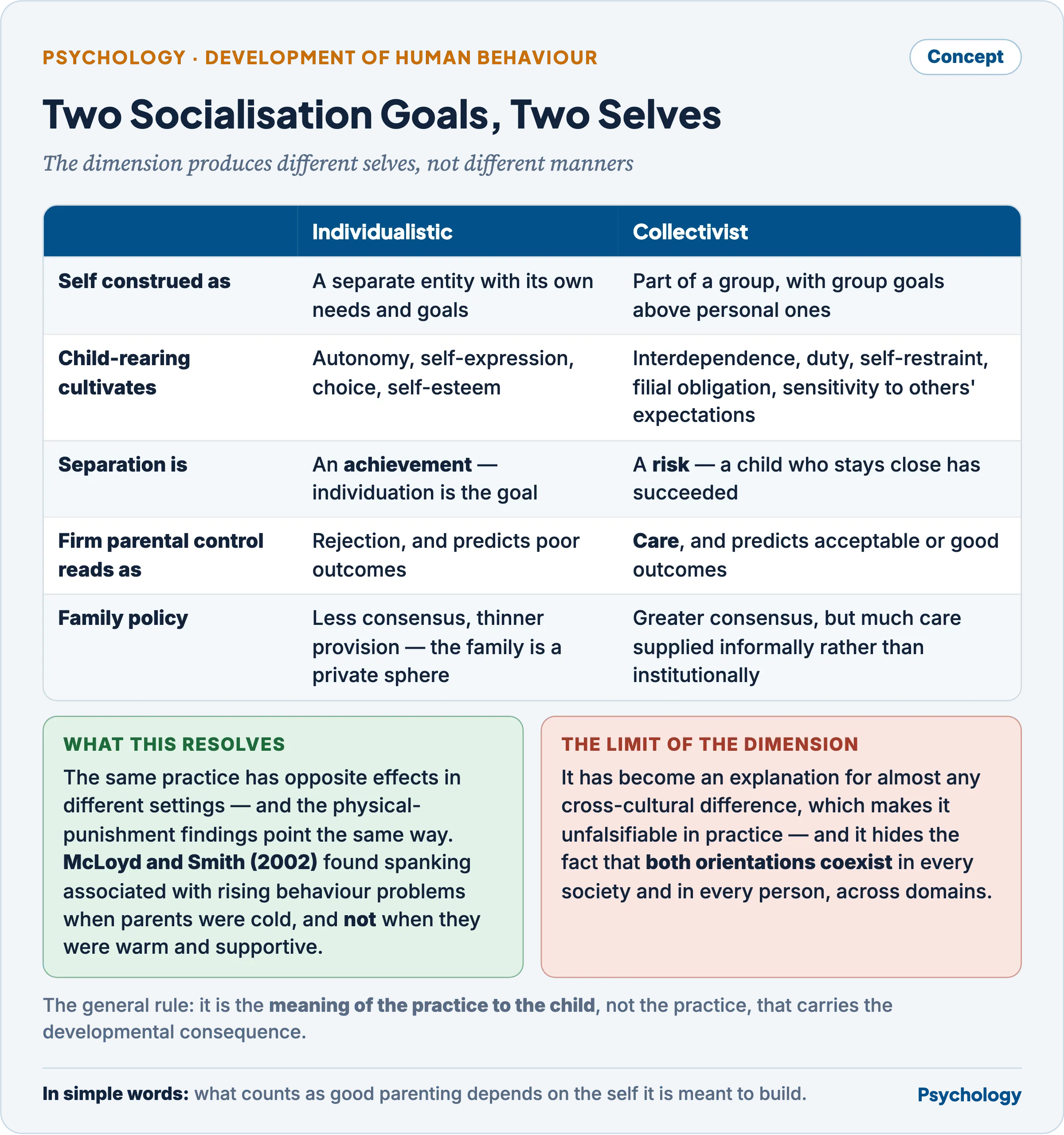
- The socialisation goal differs. Individualistic child-rearing cultivates autonomy, self-expression, choice and self-esteem; collectivist child-rearing cultivates interdependence, duty, self-restraint, filial obligation and sensitivity to others’ expectations.
- The developmental “problem” differs. Separation and individuation are achievements in the first and risks in the second; a child who remains closely bound to the family is a case for concern in one framework and a success in the other.
- Policy consensus differs. Where individualism prevails, agreement on child and family policy is harder to reach and provision correspondingly thinner, because the family is treated as a private sphere.
This also dissolves an apparent conflict in the evidence. Firm, directive parental control predicts poor outcomes in Western samples and acceptable or good outcomes in Chinese, South Asian and African-American samples, because in the latter it is normative, expected and construed by the child as an expression of care rather than of rejection. it is the meaning of the practice to the child, not the practice itself, that carries the developmental consequence — the same conclusion reached by the physical-punishment findings, where harsh discipline damaged children of cold parents and not of warm ones.
The Indian case: child-rearing and the emergence of self-concept
The Indian material is where an answer can be made distinctive, and Sudhir Kakar’s The Inner World (1978) remains its most influential psychological statement.
Kakar’s account turns on a sharp discontinuity. Indian infancy is characterised by prolonged and intense physical indulgence — near-constant bodily contact, the infant carried on the mother’s hip through her working day, co-sleeping that frequently continues for years, feeding on demand, and an absence of the pressure toward early independence that Western practice applies. This produces, on his reading, a securely grounded but relatively undifferentiated early self with permeable boundaries between self and other.
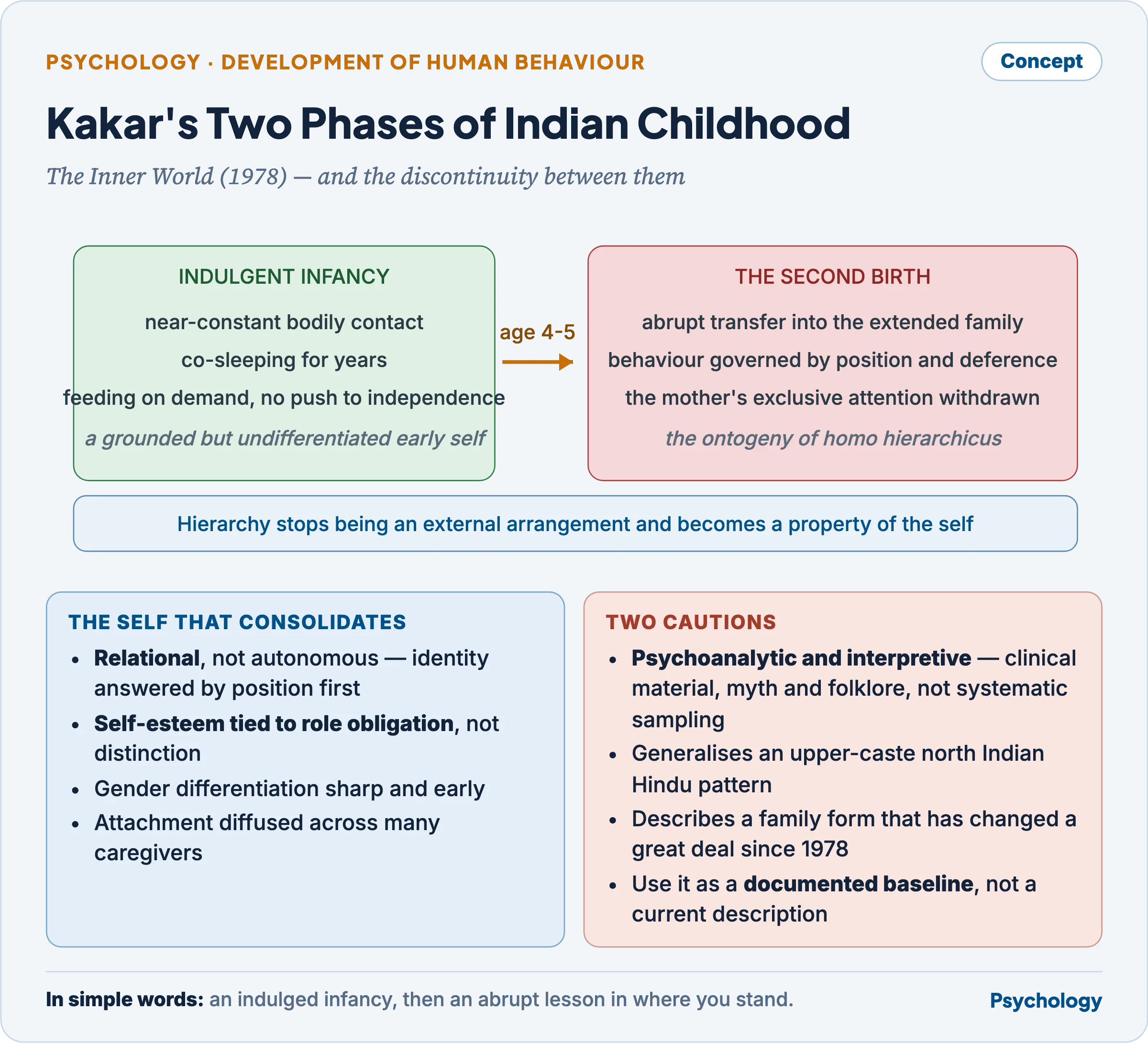
What follows is what he calls the second birth: around the age of four or five the indulged child, particularly the boy, is abruptly transferred into the hierarchical order of the extended family, where behaviour is governed by position, deference and the collective interest, and where the mother’s exclusive attention is withdrawn. Kakar reads this transition as the ontogeny of homo hierarchicus — the point at which hierarchy ceases to be an external arrangement and becomes a property of the self.
The consequences for self-concept in late childhood follow directly.
- The self that consolidates is relational rather than autonomous: identity is answered by position in a web of relationships — family, caste, community, region — before it is answered by individual attributes. Asked who they are, Indian children more often supply relational and social categories where Western children supply traits and preferences.
- Self-esteem is tied to fulfilling role obligations rather than to individual distinction, so the sources of self-worth are duty discharged, family honour upheld and elders satisfied.
- Gender differentiation is sharp and early. Kakar’s account of feminine identity turns on the daughter’s preparation for transfer to her husband’s family, which makes the girl’s socialisation one of anticipated departure and conditional belonging — a structural difference that no amount of parental affection removes.
- The extended family supplies multiple caregivers and multiple models, which diffuses attachment and makes identification less exclusively parental than the nuclear-family literature assumes.
- Child-rearing practices directly implicated include indulgent early feeding and toilet practices, physical closeness and co-sleeping, the use of shaming and the withdrawal of affection rather than explicit rules as disciplinary technique, the invocation of family honour, and a markedly low emphasis on explanation.
Two cautions keep this from becoming a caricature. Kakar’s account is psychoanalytic and interpretive, built on clinical material, mythology and folklore rather than systematic sampling, and it generalises from an upper-caste Hindu north Indian pattern to “the Indian”. And it describes a family form that is changing rapidly: urbanisation, nuclearisation, women’s employment and schooling have altered the practices he described, so his account should be used as a documented baseline against which change is measured rather than as a current description.
A complementary and more empirical Indian contribution is the triguna account of temperament drawn from the Samkhya tradition, in which sattva predisposes to well-being while rajas and tamas contribute to ill health. Kapur and colleagues (1994, 1997) built a Triguna Temperament Schedule from it and validated it on normal and disturbed children, finding that it measured dimensions — manageability, trust, dependence, morality, sociability, aggression — that extend beyond the Western temperament models. Their methodological finding is itself instructive: the Thomas and Chess dimensions, applied to Indian samples by Malhotra, Malhotra and Randhawa (1983), proved difficult for Indian mothers to understand, which is evidence that an imported instrument can fail at the level of the question rather than the answer.
Is national character a valid concept?
The concept asserts that the members of a nation share a distinctive modal personality. It has a long lineage in the culture-and-personality school — Benedict, Mead, Kardiner’s basic personality structure, Linton’s status personality — and it is not valid in the form in which it is usually asserted.
The decisive evidence is Terracciano, McCrae and colleagues (2005), who obtained national character ratings from 3,989 raters in 49 cultures, asking each to describe the typical member of their own culture, and compared these with the aggregated personality scores of culture members from self-reports and observer ratings. The ratings were highly reliable — people within a culture agree strongly about their national character — and did not converge with assessed traits at all. Americans believe the typical American highly assertive and Canadians the typical Canadian submissive, while the two populations score almost identically on assertiveness. Indian respondents characterised themselves as unconventional and open to new experience, while measured openness placed them as more conventional than the world average. England and Northern Ireland showed no resemblance in profile; nor did China and Hong Kong.
The conclusion is precise and worth stating in that form: national character stereotypes are reliable, consensual and unfounded. They are social constructions arising from a culture’s history, customs, myths, economic conditions and values, and they appear to serve the function of maintaining national identity rather than describing a population.
Two qualifications prevent over-correction. Aggregate personality scores do vary systematically across cultures and correlate with other culture-level variables, so cultures genuinely differ on average — the finding is that people’s beliefs about those differences are wrong, not that no differences exist. And culture-level dimensions such as individualism–collectivism remain valid and useful; they describe the organisation of social practice rather than a modal personality, which is why they survive while national character does not.
Socio-cultural factors in well-being across the life span
Culture determines not only how well-being is promoted but what it consists of, and that distinction has to be held stage by stage.
- Infancy and early childhood. Well-being depends on caregiving arrangements that culture supplies — multiple caregivers, co-sleeping, extended breastfeeding, the degree of physical contact. Collectivist arrangements distribute care and so buffer the loss of any one caregiver, while nuclear arrangements concentrate both attention and risk.
- Childhood. Schooling, community and the caste, class or ethnic position the child occupies determine both opportunity and the evaluation the child internalises. Where a child’s group is devalued, well-being requires active ethnic socialisation as a protective measure.
- Adolescence. The length and permissiveness of the stage is culturally set, and so is the amount of conflict generated. Cultures that specify a clear transition and a role to move into generate less identity diffusion; those that extend adolescence without supplying roles generate more. Arranged marriage, early work and extended education each reorganise the tasks of the stage.
- Adulthood. Well-being is tied to the fulfilment of culturally defined obligation — the grihastha stage’s duties in the Indian scheme — and gender roles determine which forms of achievement are available to whom.
- Old age. This is where the cultural determination of well-being is starkest. Where elders hold legitimate authority and are cared for within the family, status and support are secure but autonomy is limited; where independence is the value, autonomy is preserved and isolation is the characteristic risk. The Indian transition from the first arrangement toward the second, without the welfare provision that supports it elsewhere, is the principal current threat to elderly well-being in the country.
The general principle worth stating is that well-being is promoted by goodness of fit between a person’s circumstances and their culture’s expectations, not by any universal provision — which is why imported interventions require adaptation rather than translation.
Criticisms and limitations
- Uneven evidence. Cross-cultural source material ranges from the accounts of travellers and missionaries to professional fieldwork, coverage is thin for many societies on many topics, and the data describe modal practice while saying little about variation within a society.
- Culture treated as a country. National samples are used as cultural units, concealing the regional, caste, class, linguistic and urban–rural variation that within India is larger than much of the variation between nations.
- An overworked dimension. Individualism–collectivism has become an explanation for almost any cross-cultural difference, which makes it unfalsifiable in practice, and it obscures the fact that both orientations coexist in every society and in every individual across domains.
- The interpretive Indian literature is weakly evidenced. Kakar’s account is powerful and widely cited but rests on clinical and mythological material, generalises an upper-caste north Indian Hindu pattern, and describes a family form that has changed substantially since 1978.
- Practices are studied in isolation from their meaning. Comparing toilet training or weaning across societies without establishing what each practice signifies to participants produces catalogues rather than explanations, and the physical-punishment findings show that the meaning is where the developmental consequence lies.
- Cultural relativism has a limit that must be stated. Some practices with full cultural sanction — child marriage, sex-selective neglect, severe corporal punishment — cause demonstrable harm, and the finding that meaning moderates effect does not extend to the claim that meaning neutralises harm. The defensible position distinguishes practices that are merely different from practices that are damaging, and evidence of harm, not the fact of difference, settles which is which.
Previous Year Questions
- 2019Citing research evidences, bring out the role of cultural factors in socialization.
- 2015Discuss the role of socio-cultural factors in promotion of well-being across major stages of life-span.
- 2012Examine the impact of cultural factors on socialization process among children.
- 2006Critically examine the notion of life-span development. Determine the impact of cultural factors on child rearing practices.
- 2001Describe the process of emergence of self-concept during late childhood. Citing suitable illustrations from Indian social milieu explain the impact of child rearing practices on the emergence of self-concept.
- 2000Is national character a valid concept?
- 1995What is culturally conditioned behaviour? Give examples.