

Official syllabusPaper I · Unit 4 · Development of Human Behaviour
Influence of cultural factors in socialization.
Definition
“Students of socialization continue to be concerned with the cluster of processes that lead to adults being able to function adequately within the requirements of the social group or groups among whom they live.”
Eleanor Maccoby (1992)
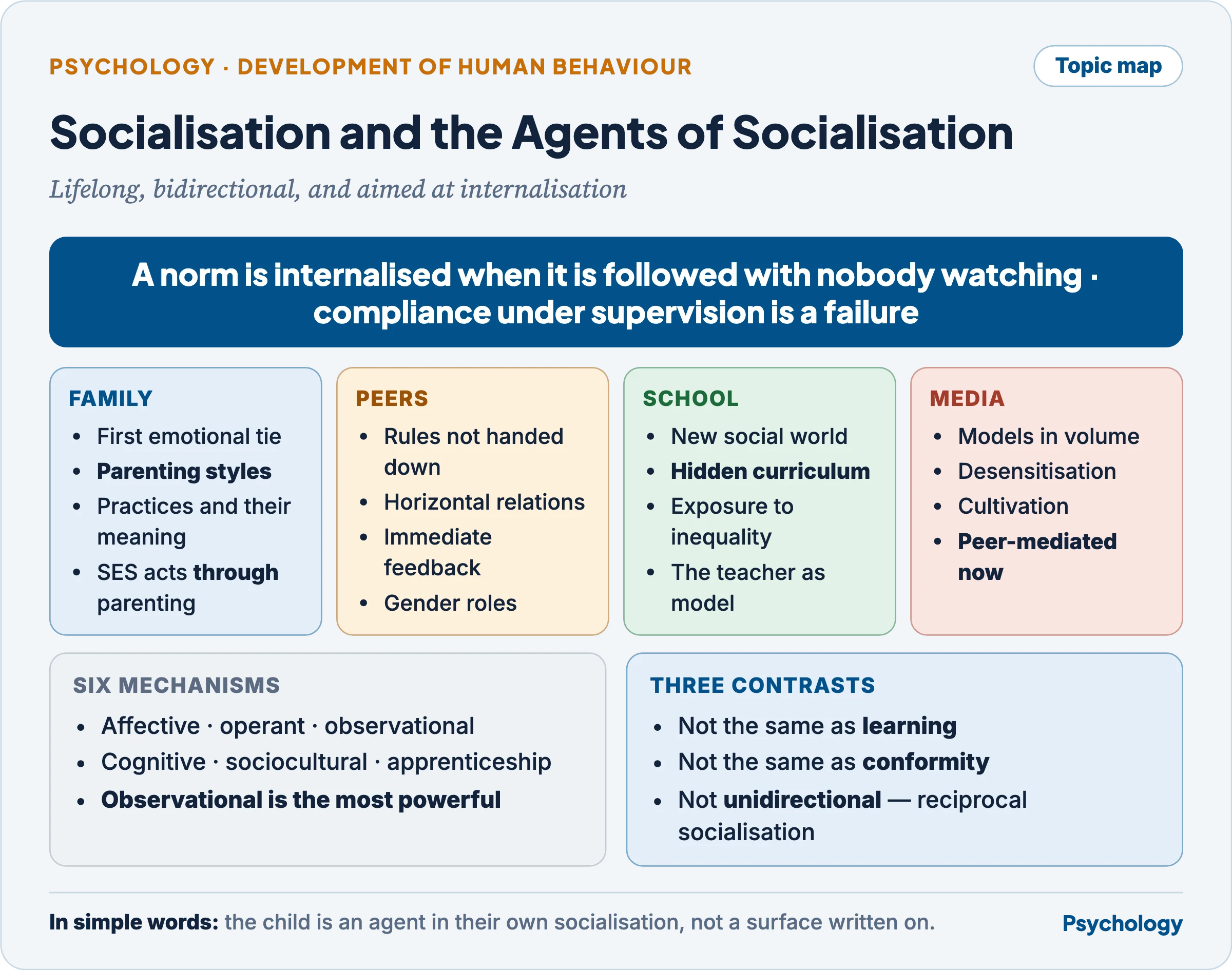
Socialisation is the process by which a person acquires the norms, values, language, skills and behavioural repertoire that make them a competent member of a particular society. Two features of the definition are easy to miss: it is lifelong, not confined to childhood, and it is bidirectional — the child selects, resists and reshapes what the agents of socialisation supply, rather than being a surface on which culture is inscribed.
What socialisation is, and what it is not
Three contrasts fix the concept.
- Socialisation is not the same as learning. Learning to solve a quadratic equation is not socialisation; its content is what makes a person culturally competent — the shared meanings and practices required to act appropriately in a given society.
- Socialisation is not the same as conformity. Its outcome includes the capacity for autonomous moral judgement and for criticising the group’s norms, which requires that the norms have first been internalised.
- Socialisation is not unidirectional. The older model treated the child as the object of adult transmission. The evidence does not support it: a child’s temperament shapes the parenting it receives, and longitudinal studies find adolescent behaviour also predicting later parenting. Hence the modern term reciprocal socialisation.
The concept of internalisation marks the goal. A norm is internalised when it is followed without surveillance or sanction, its violation felt as guilt rather than risk. Socialisation that produces only compliance under supervision has failed, and this is the test for any child-rearing practice.
How socialisation actually works: six mechanisms
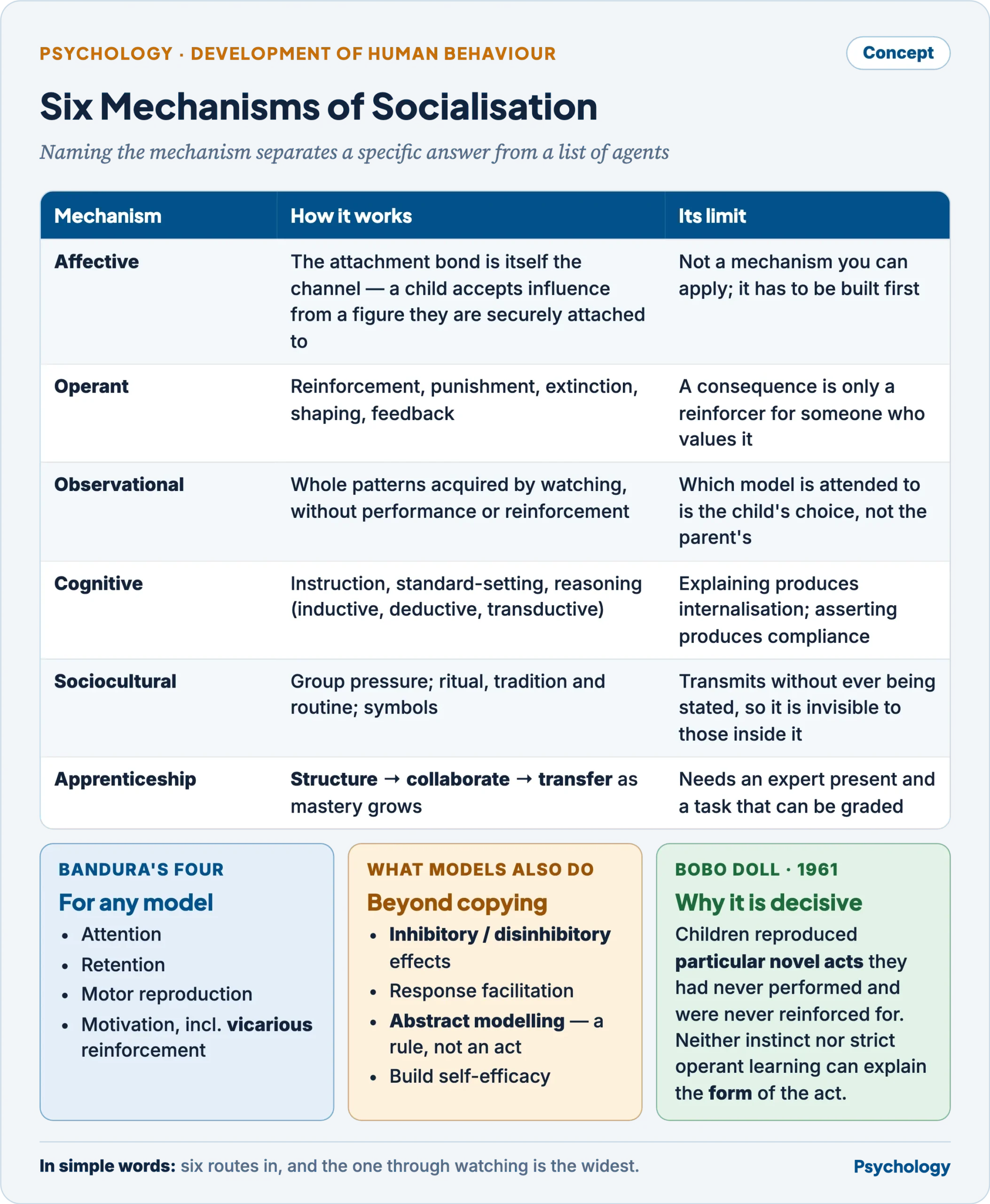
- Affective. The emotional bond with the caregiver is itself a mechanism: a child accepts influence from someone they are securely attached to and resists it from someone they are not. Attachment is the channel of later socialisation, not merely an outcome of early care.
- Operant. Behaviour is shaped by its consequences — positive reinforcement, negative reinforcement, punishment, extinction and shaping by successive approximation, with feedback supplying evaluative information. The limitation is intrinsic: a consequence reinforces only a person who values it.
- Observational. The child acquires whole patterns of behaviour by watching and imitating others, without needing to perform them or be reinforced.
- Cognitive. Socialisation through instruction, standard-setting and reasoning. Parents who explain why a rule exists produce internalisation; parents who merely assert it produce compliance.
- Martin Hoffman (1970) classified discipline into power assertion (force, threats, deprivation), love withdrawal (ignoring, expressed disappointment) and induction (pointing out the act’s consequences for others). Induction is most consistently linked to internalised morality; love withdrawal is at best weakly related to it.
- Sociocultural. Transmission through group pressure, through rituals, traditions and routines that connect a generation to its past, and through symbols that carry shared meaning. A festival or a thread tied at a ceremony encodes values more durably than instruction.
- Apprenticeship. An expert first structures a task to the learner’s capacity, then collaborates while providing assistance, then transfers responsibility once mastery is reached. This is socialisation of skill and role, dominant in occupational and craft learning.
Models and social learning
Albert Bandura’s central demonstration is the Bobo doll work of Bandura, Ross and Ross (1961), in which nursery children who watched an adult attack an inflatable doll reproduced the specific aggressive acts, including novel ones, while control children did not. The children imitated particular forms of behaviour never performed or reinforced, which neither an instinct nor a strict operant account can explain.
Bandura specified four processes that any model must engage.
- Attention — the model must be noticed; this depends on distinctiveness, prestige and similarity to the observer.
- Retention — the observed behaviour must be stored symbolically, in images or in verbal code, so it survives the absence of the model.
- Motor reproduction — the observer must possess the physical and cognitive components to execute it.
- Motivation and reinforcement — including vicarious reinforcement, the observed consequences to the model.
- Bandura (1965) showed children imitating less after seeing the model punished, but reproducing the acts fully once offered an incentive: consequences to the model govern performance, not acquisition.
Models do more than supply behaviours to copy, and the extra functions are what make them socialising agents.
- Inhibitory and disinhibitory effects — a model punished for an act suppresses it in observers; a model who performs it with impunity releases it.
- Response facilitation — an existing behaviour is elicited because others are performing it.
- Abstract modelling — the observer extracts a rule or standard rather than a specific act. This explains how a child acquires moral standards, linguistic rules and styles of judgement from particular instances.
- Self-efficacy — the belief in one’s capacity to execute a behaviour, built largely from mastery experience and from watching similar others succeed. It governs which socially available behaviours a person will actually attempt.
The relation to personality theory follows directly. Dollard and Miller (1941), in Social Learning and Imitation, gave the first social learning theory: imitation is itself learnt when matching a model is reinforced. Social learning theories of personality make personality the organised residue of socialisation rather than an independent structure.
- Bandura’s (1986) reciprocal determinism holds person, behaviour and environment to be mutually determining, so an individual’s dispositions select the environments that then shape them further.
- Rotter (1966) made locus of control — the generalised expectancy that outcomes follow from one’s own action or from external forces — a personality variable learned from a history of socialisation experience.
- Mischel (1968) showed trait measures predicting behaviour across situations only modestly; Mischel and Shoda (1995) resolved the dispute with the cognitive–affective processing system, in which stable if–then contingencies rather than global traits constitute personality.
Social learning theories are therefore theories of socialisation, describing how it produces personality. Their shared limitation is that by locating almost everything in learning history they understate temperament and heritable disposition, which the behaviour-genetic evidence requires.
The family
The family is the first and most consequential agent, supplying the first emotional tie, language, religion, models of adult roles and standards during the period of maximum plasticity.
Parenting styles
Diana Baumrind (1966, 1967) set out three prototypes and then derived them inductively. In the 1967 study she identified groups of preschool children with sharply different behavioural patterns, then worked backwards through home observation, laboratory observation and parent interview to the parenting associated with each. Maccoby and Martin (1983) reorganised her three styles onto two orthogonal dimensions and added a fourth.
- Responsiveness, also called warmth or supportiveness — the extent to which parents are attuned and supportive of the child’s needs and foster individuality and self-assertion.
- Demandingness, also called behavioural control — the claims parents make for mature behaviour, supervision, and willingness to confront disobedience.
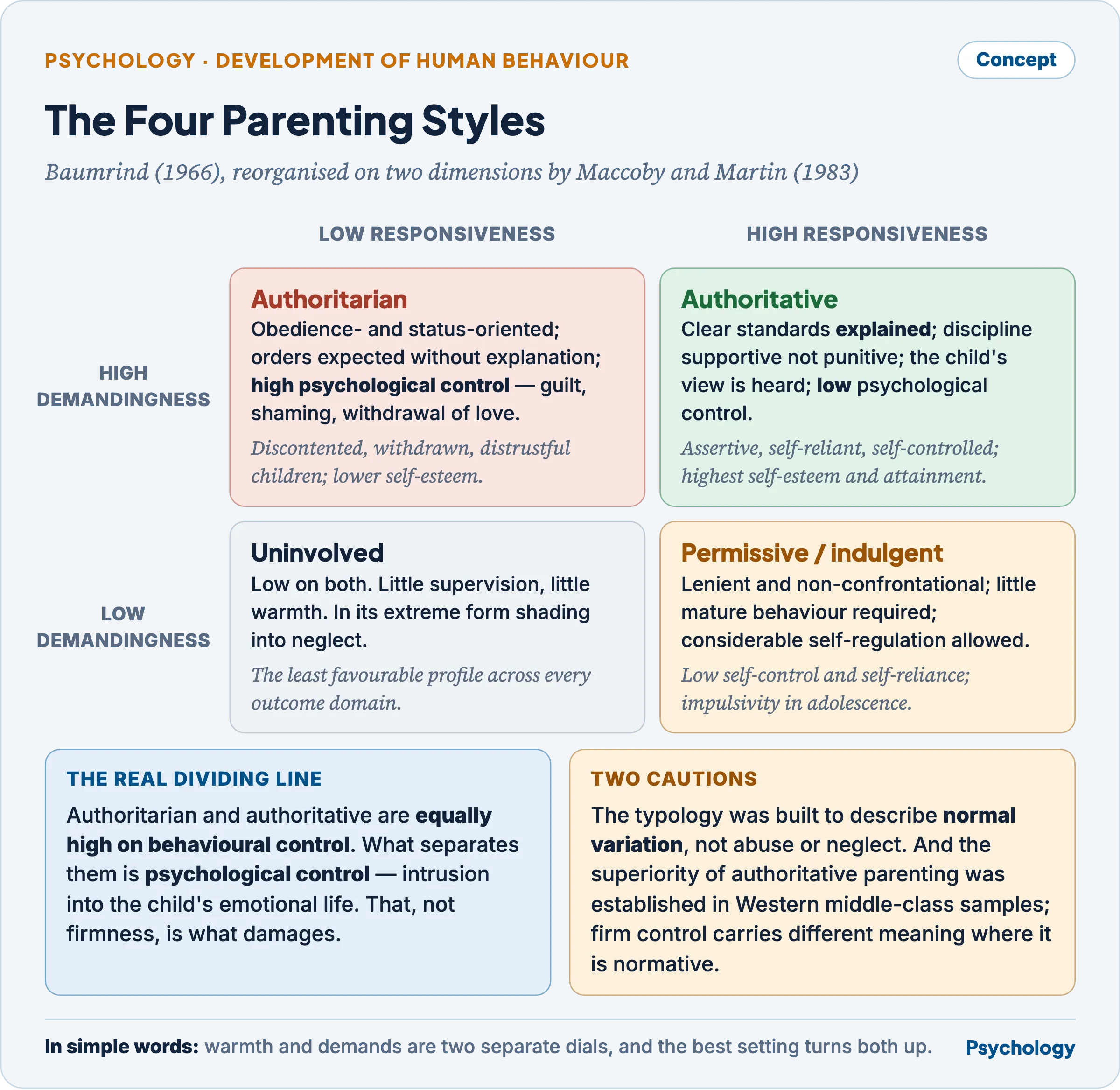
- Authoritative — high responsiveness, high demandingness. Clear standards are set and explained, discipline is supportive rather than punitive, and the child’s view is heard. Outcomes are the most favourable: assertive, self-reliant, self-controlled, socially competent children with higher self-esteem and achievement.
- Authoritarian — low responsiveness, high demandingness. Obedience- and status-oriented, with orders expected to be obeyed without explanation. Associated with discontented, withdrawn and distrustful children, lower self-esteem and either excessive compliance or externalising problems.
- Permissive, or indulgent — high responsiveness, low demandingness. Lenient and non-confrontational, requiring little mature behaviour. Associated with low self-control and low self-reliance, and with impulsivity in adolescence.
- Uninvolved, or neglectful — low on both. The least favourable profile across every outcome domain, and in its extreme form shading into neglect.
Two refinements follow. The first is psychological control, revived as a construct by Barber (1996) — attempts to intrude on the child’s emotional life through guilt induction, shaming or withdrawal of love. Authoritarian and authoritative parents are both high on behavioural control, but the authoritarian parent is typically high and the authoritative parent low on psychological control. The second is that Baumrind’s typology describes normal variation, not abuse or neglect, so applying it to maltreating families stretches it past its design.
Child-rearing practices and their effects
Styles are broad orientations; practices are specific acts, and the effect of a practice depends on the style and the cultural meaning in which it is embedded.
- Physical punishment illustrates this most sharply. McLoyd and Smith (2002), following about 2,000 European American, African American and Hispanic children over six years, found spanking associated with rising behaviour problems when maternal emotional support was low but not when it was high, in all three groups.
- McLoyd, Kaplan, Hardaway and Wood (2007), with 890 African American families, found spanking predicting children’s depressive symptoms chiefly where mothers did not endorse it, such spanking being tied to maternal distress. The practice has no fixed effect; its meaning to the child carries the consequence.
- Marital conflict acts on the child independently of parenting quality. Sustained conflict between parents worsens outcomes even where each parent’s own practices are adequate.
- Negative modelling reproduces itself across generations. Children raised in violent homes disproportionately repeat the pattern as adults, because what has been modelled has been established as normal.
- Fathers have been persistently underweighted; their distinct contribution through play and affectionate involvement is treated in Culture, Child-Rearing and the Indian Self.
- Socioeconomic position operates through parenting rather than around it. Lower-income parents use harsher, more authoritarian discipline with less explanation; higher-income parents use more elaborated vocabulary and more cognitively stimulating activity.
- Three accounts compete: the family stress model (economic hardship degrades parental functioning), the family investment model (financial, social and human capital is invested in the child) and social selection (parental characteristics cause both position and outcome). Conger and Donnellan (2007) argued for an interactionist synthesis running reciprocally across generations.
The peer group
The peer group is the agent that family cannot substitute for, because its structure is different in a way that matters.
- Rules are not handed down. Peers generate their own norms, which gives children their first experience of constructing rather than receiving a social order — the point Piaget (1932) made in arguing that moral autonomy requires the symmetrical relations of peers rather than the unilateral respect owed to adults.
- Relations are horizontal. Status must be negotiated and earned rather than ascribed, which is where skills of assertion, compromise and conflict resolution are acquired.
- Feedback is immediate. Approval and exclusion follow behaviour at once, which makes the peer group a fast and powerful shaper of behaviour.
- It teaches gender roles, since peer groups are substantially sex-segregated in middle childhood and each develops its own interaction style.
- Peer pressure operates in both directions. It is routinely treated as negative — underage drinking, smoking, risk-taking — but the same conformity mechanism sustains academic effort, athletic commitment and prosocial norms where the group’s norms run that way.
The influence is strongest in adolescence and is often misdescribed. Peers do not displace parents wholesale: peers dominate short-term and surface choices — dress, music, speech, immediate risk behaviour — while parents retain influence on long-term values, educational aspiration and moral commitments. The conflict is real but domain-specific.
Judith Rich Harris (1995), in group socialisation theory, went further: socialisation is context-specific and takes place chiefly in childhood and adolescent peer groups, so parents have little lasting effect on personality. Critics reply that parents select the peers and neighbourhoods available.
The school
A child in the Indian system will spend over a decade in school, and the socialising work it does is only partly the curriculum.
- It provides entry into a new social world in which the child must locate their standing among classmates and teachers, a status not given by family position.
- It transmits the hidden curriculum (Jackson, 1968) — punctuality, queueing, deference to impersonal authority, competition, externally imposed schedules — the repertoire of bureaucratic and industrial life, taught by the school’s form rather than its content.
- It sustains or challenges the society’s categories. Schools frequently perpetuate gender-typed play and interaction, and in the Indian context caste, language and class distinctions are both reproduced and, where the school is genuinely mixed, weakened.
- It gives exposure to inequality and to difference, and so the first occasion for socialising across groups, and increases opportunities for exercising control over decisions, which builds competence.
- The Right to Education Act (2009), Section 17: “No child shall be subjected to physical punishment or mental harassment” — a legal shift in schools’ socialising practice.
The teacher is an agent in their own right: model, evaluator and the first significant adult outside the kinship system.
Mass media
Media is the agent that has changed most, and its reach now extends well beyond television.
- Observational learning is the primary route: media supply models, in volume, that a child would never encounter in person, and abstract modelling means the rules and standards they embody are extracted along with the specific behaviours.
- Media violence. Bushman and Huesmann (2006) meta-analysed 431 studies with over 68,000 participants and found modest but significant effects on aggressive behaviour, aggressive cognition, angry affect and arousal, together with reduced helping.
- Their crossover result: short-term effects were larger for adults and long-term effects larger for children — consistent with short-term effects priming already-encoded scripts, which adults have had longer to form, and long-term effects requiring new scripts to be encoded, which children do more readily.
- Huesmann and colleagues (2003), following 557 Chicago children aged 6–10 for 15 years, found childhood exposure predicting adult aggression with initial aggression, intellect, social status and parenting controlled; the reverse path was weaker.
- Desensitisation and cultivation operate alongside imitation. Exposure blunts response to real violence and inflates beliefs about its frequency.
- Social media changes the mechanism, not only the content. Influence is peer-mediated and quantified: the model is a peer, the feedback numerical and public, and exposure continuous and algorithmically selected to existing dispositions — niche-picking at machine speed.
- Caplan (2003) found lonely and depressed individuals preferring online to face-to-face interaction, with poorer outcomes, which identifies the direction of vulnerability.
In the Indian setting, four instances show the mechanisms at work.
- Advertising and body image. Fairness-cream advertising linked skin tone to employability and marriage prospects. The Advertising Standards Council of India’s guidelines (2014) bar showing darker-skinned people as unattractive or unhappy, or linking skin colour to caste, profession or social standing.
- Imitation of filmed stunts. Injuries from adolescents reproducing acts seen in film and on video platforms are observational learning in the Bobo doll sense: a particular sequence is imitated, not a general disposition.
- Aspiration and consumption. The goods, careers and lifestyles adolescents treat as normal now track what is represented rather than what is present locally, so rural expectations have shifted faster than rural opportunity.
- Online challenges. Performance for a quantified peer audience combines modelling with immediate vicarious reinforcement, so it spreads faster than broadcast media could manage.
The moderators matter more than the main effect. Parental co-viewing, mediation and explanation substantially reduce the effect of violent content, and the effect is larger for children already disposed to aggression. Media exposure is a real but modest contributor whose size depends on what family and peers do alongside it.
How the three agents combine in adolescent identity formation
Treated separately, the three agents mislead; what matters is how they interact.
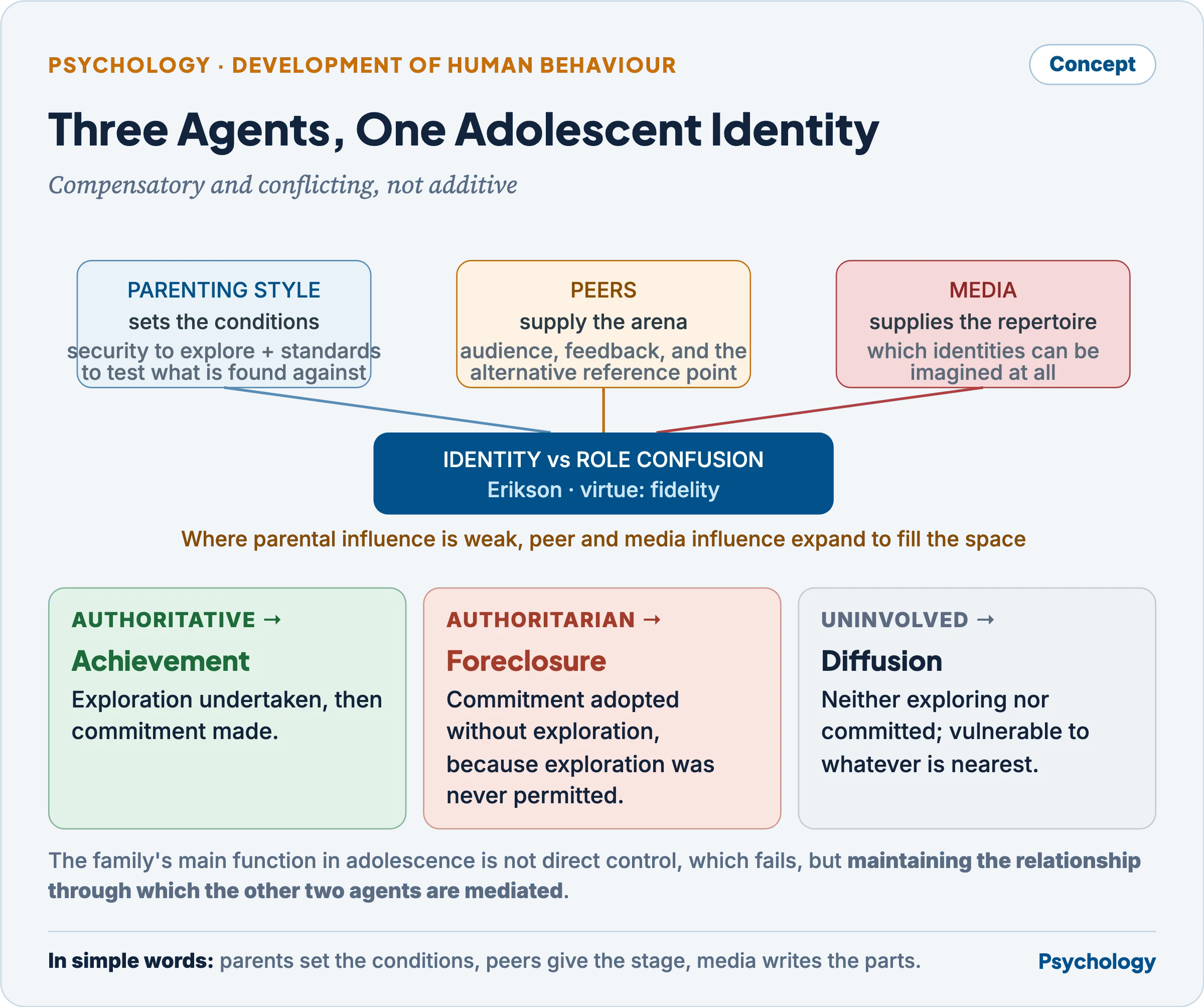
Adolescence is the period Erikson (1968) identified as the crisis of identity against role confusion, and its resolution requires material to build an identity from — available roles, ideologies and models — plus a secure base from which to experiment with them.
- Parenting style sets the conditions. Authoritative parenting supports identity achievement, supplying both the security to explore and standards against which to test what is found. Authoritarian parenting tends to produce foreclosure, in Marcia’s (1966) terms — commitment without exploration. Uninvolved parenting is associated with diffusion.
- Marcia’s fourth status, moratorium (exploring, not yet committed), and the statuses in full are treated in Adolescent Development: Physical, Cognitive, Moral and Social.
- Peers supply the arena. Identity is tried out before peers, who supply audience, feedback and an alternative reference point for separating from parents.
- Media supplies the repertoire. The identities a young person can imagine are set largely by what is represented; this influence has grown most and is least supervised.
The three are not additive but compensatory and conflicting. Where parental influence is weak, peer and media influence expand to fill the space; where peer and parental norms conflict, the adolescent’s prior relationship with each determines which prevails. The family’s most important function in adolescence is therefore not direct control, which fails, but maintaining the relationship through which the other two agents are mediated.
Influence of cultural factors in socialization
Culture decides what each agent transmits and what a practice means. The individualism–collectivism contrast and Indian child-rearing are treated in Culture, Child-Rearing and the Indian Self; Vygotsky’s account of culture as the medium of development, and multicultural socialisation, in Socio-Cultural Theory and Multicultural Socialisation.
Criticisms and limitations
- Contested causal direction. The parenting-style literature is correlational. Authoritative parenting is associated with good outcomes, but competent children are easier to parent authoritatively, and bidirectional studies find child effects on parenting as well as parent effects.
- The styles may not be culturally universal. Ruth Chao (1994) showed Chinese mothers scoring “authoritarian” on Western measures while endorsing training (chiao shun, guan): firm control understood as care and involvement, not domination (see Culture, Child-Rearing and the Indian Self).
- Agent-by-agent treatment misrepresents the process. Family, peers, school and media are presented as separable influences whose effects add, when in practice each selects and moderates the others.
- Media-effects findings remain disputed in magnitude. The effect sizes are small to medium, publication bias and the laboratory measures of aggression have been criticised, and the newer social-media literature is largely cross-sectional and too recent for confident causal claims.
- An unstated default family structure. Most findings derive from the nuclear, mother-as-primary-caregiver family; multiple caregiving by grandparents, aunts and older siblings, the Indian norm, is treated as a deviation (see Attachment and Early Relationships).
Previous Year Questions
- 2021Describe the role of mass media in shaping the behaviour of adolescents. Support it with appropriate examples.
- 2016Describe the parenting styles that are used in raising a normal child.
- 2011Critically evaluate the role of parenting style, peer group and media in identity formation during adolescence.
- 2003Discuss in detail the influence of child-rearing practices on the growth and development of an individual.
- 2000How do models help in the process of socialization?
- 1997Is there any relation between process of socialization and the social learning theories of personality?
