

Official syllabusPaper I · Unit 4 · Development of Human Behaviour
Role of genetic and environmental factors in determining human behaviour.
Definition
“It is a plausible hypothesis that genetic differences affect psychological differences largely indirectly, by influencing the effective environment of the developing child.”
Bouchard, Lykken, McGue, Segal and Tellegen (1990), concluding the Minnesota Study of Twins Reared Apart
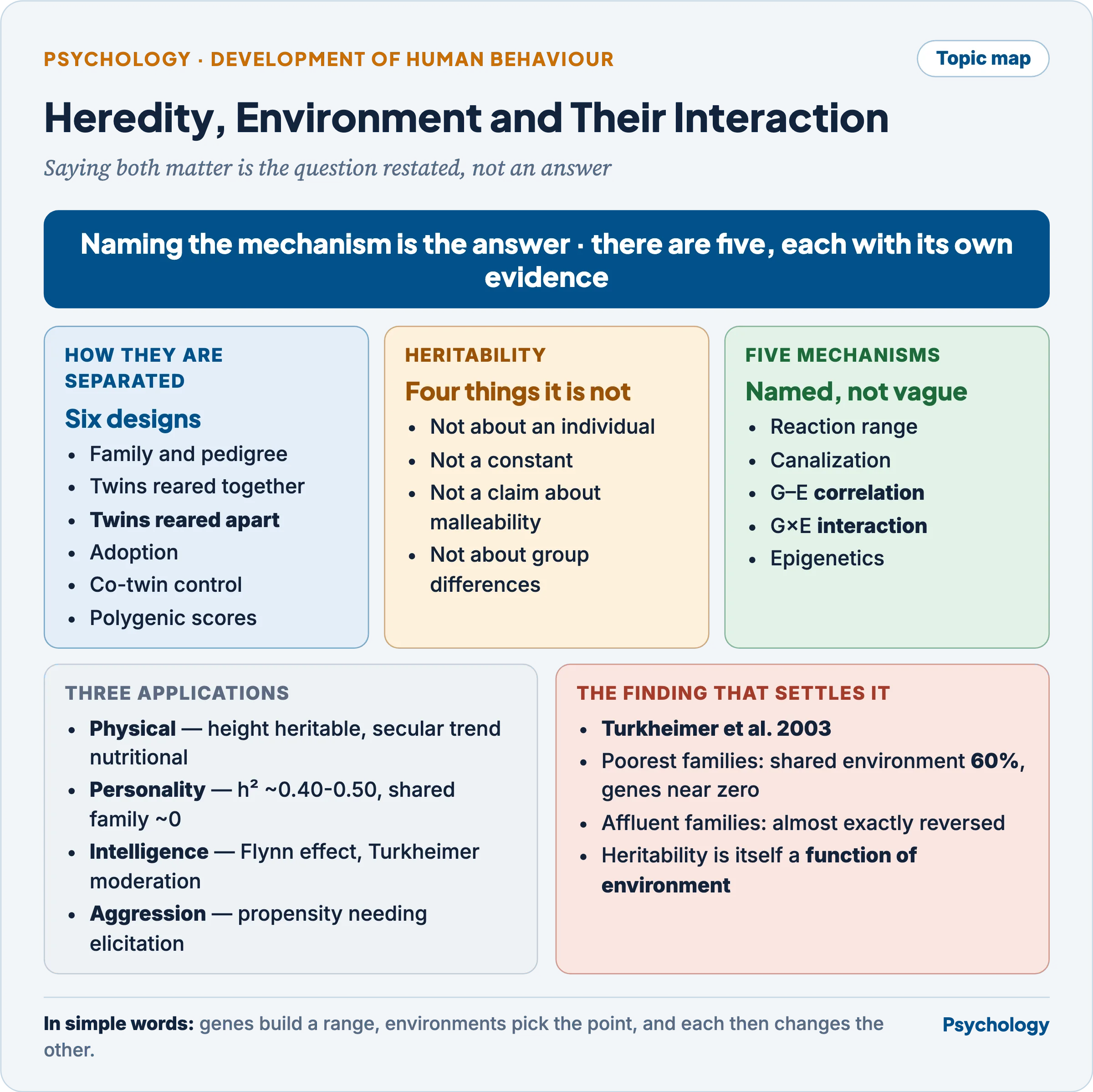
A single sentence contains the defensible modern position: genes build a range, environments select a point inside it, and each then alters the other.
The debate, and why its original form was unanswerable
The terms come from Francis Galton, who set heredity against nurture in the 1870s and read family eminence as evidence for the first. The twentieth century produced two extreme positions, each wrong in an instructive way.
- Hereditarianism. Arnold Gesell (1928) held development to be the unfolding of a genetically specified sequence, with environment supplying only the occasion. His co-twin control studies (Gesell and Thompson, 1929), in which trained and untrained identical twins converged on the same motor milestones, were genuine evidence for maturational control of motor order.
- Environmentalism. John B. Watson (1924; revised 1930) made the opposing claim: give him a dozen healthy infants and freedom to construct the world in which they are reared, and he would guarantee to produce any one of them a doctor, a lawyer, an artist, a beggar or a thief, regardless of talent, tendency or ancestry. His conditioning work did show that environmental arrangement shapes behaviour reliably.
The position the field reached is called interactionism. No phenotype whatever arises without both a genotype and an environment, so asking what proportion of a characteristic is genetic is meaningless as applied to an individual. The question becomes answerable only when reformulated as a question about variance in a population: of the differences among people in this population under these conditions, what proportion is associated with genetic differences among them?
Isolating the two contributions
Designs separate the two influences by holding one of them approximately constant.
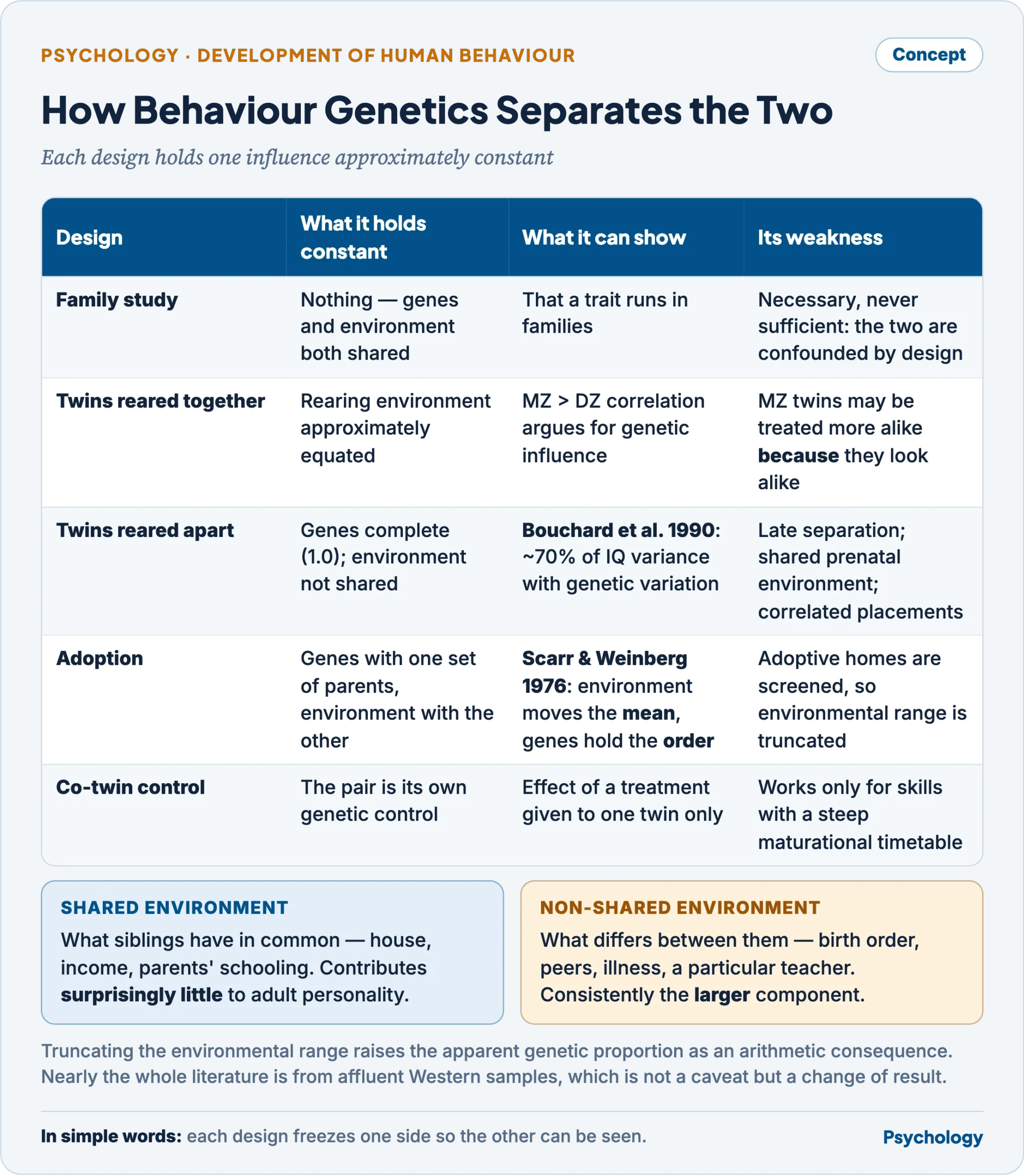
- Family and pedigree studies establish that a characteristic runs in families. This is necessary evidence but never sufficient, because families share environments as well as genes.
- Twin studies compare monozygotic with dizygotic pairs reared together. Genetic sharing differs — effectively 1.0 against 0.5 — while the rearing environment is approximately equated, so a higher correlation in identical than fraternal pairs argues for genetic influence.
- Twins reared apart is the strongest design: genes are fully shared, rearing environment not at all. The Minnesota Study of Twins Reared Apart (Bouchard and colleagues, 1990) gave more than a hundred reared-apart twin and triplet sets about 50 hours of assessment; in the 56 identical sets analysed, about 70 per cent of IQ variance was associated with genetic variation, with identical twins reared apart almost as similar on personality, occupational and leisure interests and social attitudes as identical twins reared together.
- Adoption studies reverse the logic: an adopted child shares genes with biological parents and environment with adoptive ones, so comparing the two sets of correlations partitions the influences. The Minnesota Transracial Adoption Study of Scarr and Weinberg (1976) found adopted children’s IQ raised well above the level predicted by their biological background. In Skodak and Skeels (1949), adopted children averaged about 20 IQ points above their biological mothers yet correlated about 0.4 with them: environment moving the mean, genes holding the order.
- Co-twin control, in which one twin receives a treatment the other does not, uses the pair as its own genetic control.
- Molecular designs now supplement all of these, either testing a named polymorphism or aggregating thousands of small effects into a polygenic score.
Shared environment is what siblings in one family have in common. Non-shared environment is what differs between them: birth order, peer groups, illness, a particular teacher, differential parental treatment. The most surprising finding, set out by Plomin and Daniels (1987), is that for most adult characteristics, the non-shared component is substantially the larger of the two.
What the designs cannot do
- Identical twins reared together may be treated more alike because they look alike, which inflates the estimate by misattributing an environmental similarity to genes.
- Reared-apart twins are frequently separated late rather than at birth, share the prenatal environment in every case, and are often placed in correlated homes by the same agency.
- Adoptive families are screened and therefore unrepresentatively favourable. Screening truncates the environmental range, and a restricted environmental range mechanically raises the apparent genetic proportion.
- Almost the whole literature comes from affluent Western populations, which in US samples changes the result (Turkheimer and colleagues, 2003).
Heritability, and the four things it does not mean
Heritability is the proportion of variance in a characteristic, within a specified population under specified conditions, that is attributable to genetic variation within that population. It is a ratio of two quantities that can each change, and four consequences follow.
- It is about a population, never an individual. A heritability of 0.5 for height does not mean half of any particular person’s height is genetic.
- It is not a constant. Equalise environments and heritability rises, because the environmental term in the denominator shrinks. Diversify them and it falls. A heritability figure is a description of a population at a time, not a property of the trait.
- It says nothing about malleability. Phenylketonuria is a fully penetrant single-gene disorder with an almost complete dietary remedy. High heritability is not an argument against intervention.
- Within-group heritability implies nothing about between-group differences. Two populations may each show high internal heritability while the entire gap between them is environmental — the standard demonstration being genetically identical seed sown in rich and poor soil, where height is highly heritable within each plot and the difference between plots is wholly nutritional.
Socioeconomic status moderates heritability
Turkheimer, Haley, Waldron, D’Onofrio and Gottesman (2003) analysed Wechsler scores for 7-year-old twins from the National Collaborative Perinatal Project, a sample unusual in containing many families at or below the poverty line, and entered socioeconomic status as a continuous moderator rather than a control. The variance components did not merely shift. They reversed. Tucker-Drob and Bates (2016), meta-analysing 14 studies (24,926 twin and sibling pairs), found the moderation in US samples but not in Western European or Australian ones, and proposed that stronger welfare provision buffers deprivation.
In the most impoverished families roughly 60 per cent of IQ variance was attributable to shared environment and the genetic contribution was close to zero; in affluent families the pattern was almost exactly inverted.
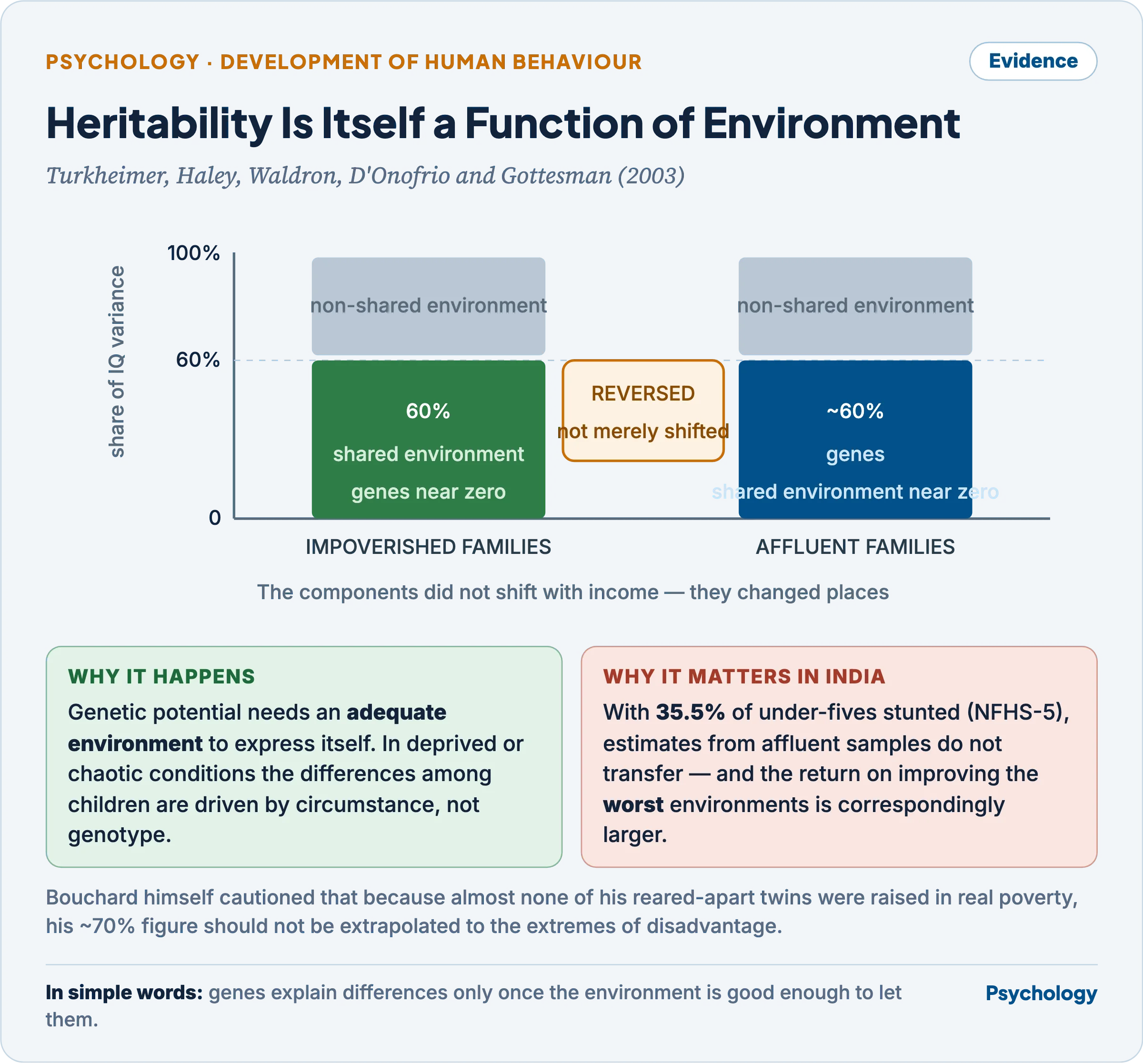
Genetic potential needs an adequate environment to be expressed; in deprived conditions the differences among children are driven by their circumstances, not their genotypes. Bouchard himself cautioned that, because only a few of his reared-apart twins were raised in real poverty or by illiterate parents, his estimate should not be extrapolated to the extremes of disadvantage still found in society.
In a population where a third of children under five are stunted, heritability estimates derived from affluent Western samples do not transfer.
The five ways genes and environments are related
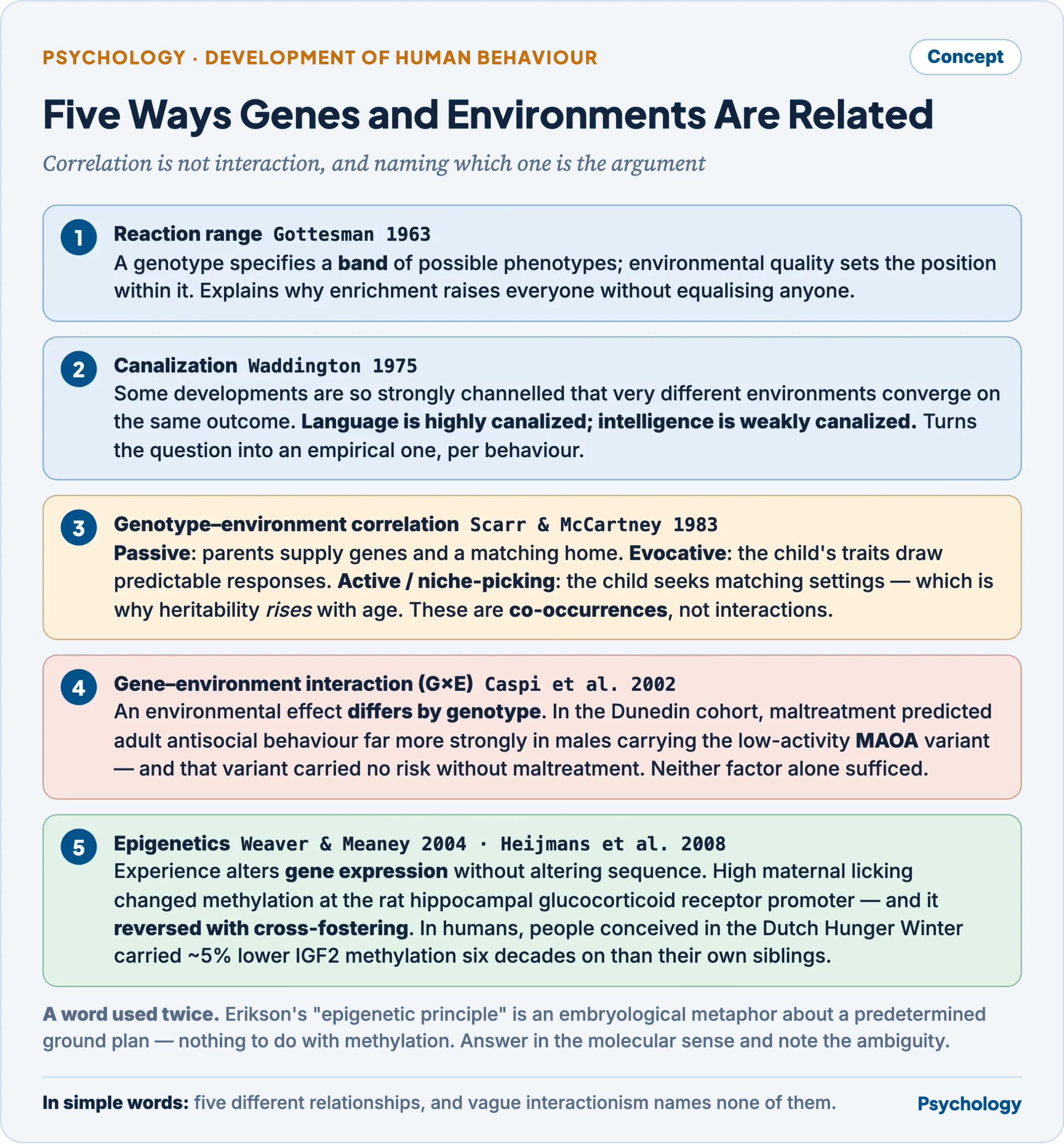
- Reaction range. Gottesman (1963) proposed that a genotype specifies not a value but a band of possible phenotypes, with position inside the band set by environmental quality. The model explains why enrichment raises everyone’s outcome without equalising outcomes.
- Canalization. Waddington (1942) named the opposite case: some developments are so strongly channelled that a wide range of environments converges on the same outcome. Basic language acquisition is highly canalized and occurs across enormous variation in input; measured intelligence is weakly canalized and tracks environmental quality closely.
- Genotype–environment correlation. Scarr and McCartney (1983) showed that genotypes systematically come to occupy particular environments, in three forms. Passive: biological parents supply both the genes and a correlated environment, so a verbally able child typically also receives a book-filled home. Evocative: the child’s genetically influenced characteristics draw predictable responses, so an irritable infant elicits harsher handling and a placid one warmer. Active, or niche-picking: as autonomy grows the child seeks out environments matching their dispositions — which is why heritability rises with age: for general cognitive ability from 41 per cent at 9 to 66 per cent at 17 (Haworth and colleagues, 2010, about 11,000 twin pairs). These are correlations, not interactions: a correlation means genes and environments co-occur, while an interaction means each one’s effect depends on the other’s level.
- Gene–environment interaction, in the strict statistical sense, where an environmental effect differs according to genotype. Caspi and colleagues (2002), working with the Dunedin birth cohort followed from 1972, found that childhood maltreatment predicted adult antisocial behaviour far more strongly in males carrying the low-activity variant of the MAOA gene; maltreated boys with that variant were far more likely to develop conduct disorder and to be convicted of a violent offence by 26, while the same variant carried no elevated risk in the absence of maltreatment. Neither factor alone was sufficient — which is the definition of an interaction. Fergusson and colleagues (2011) replicated the moderation in 398 Christchurch males followed to 30.
- Epigenetics. Experience alters gene expression without altering the DNA sequence, chiefly through DNA methylation and histone modification. Weaver, Meaney and colleagues (2004) found that rat pups receiving high maternal licking, grooming and arched-back nursing showed different methylation at the hippocampal glucocorticoid receptor promoter, producing lifelong differences in stress reactivity. Three features make it strong evidence: the difference reversed with cross-fostering, which establishes maternal behaviour rather than maternal genotype as the cause; it persisted into adulthood; and infusing a histone deacetylase inhibitor abolished it, demonstrating the causal route. In humans, Heijmans and colleagues (2008) found that people conceived during the Dutch Hunger Winter of 1944–45, when official rations fell to about 667 calories a day, carried roughly 5 per cent lower methylation of the imprinted IGF2 gene six decades later than their own unexposed same-sex siblings. The effect was specific to periconceptional exposure and absent in those exposed only late in gestation.
Epigenetics is what finally dissolves the dichotomy rather than balancing it, because a methylation mark is a molecular record of the environment written into the regulation of the genome itself.
From genotype to phenotype through the brain
No gene codes for a psychological characteristic. A gene is transcribed and translated into a protein; proteins make up the enzymes, receptors, transmitters and structural molecules of the nervous system; these build neural architecture, which sets the dispositions with which the child meets its environment.
- Genes are switched on and off at particular developmental times, so one genome has different effects at different ages.
- Probabilistic epigenesis. Gottlieb and Lickliter (2007) modelled development as bidirectional influence within and between four levels — genetic activity, neural activity, behaviour and environment — so outcomes are probable rather than predetermined, and neural activity is the level through which genes and experience reach behaviour.
A terminological warning
The word has a second, unrelated sense. Erikson’s “epigenetic principle” is an embryological metaphor meaning that development unfolds in a predetermined ground plan in which each stage has its own time of ascendancy. It has no connection to methylation or gene expression. The molecular sense is the developmental one.
Four contested applications
Physical development, where the logic is clearest
Within a well-nourished population, height is among the most heritable of human characteristics. Yet mean adult height in many countries rose markedly across the twentieth century, a secular trend far too rapid for genetic change, and driven by nutrition, the control of childhood infection and smaller family size. Genes largely determine who is tall relative to their neighbours, while nutrition determines how tall the whole population becomes.
India supplies the counterpart. With 35.5 per cent of under-fives stunted on NFHS-5 (2019–21) figures, a large part of the observed variation in children’s growth is nutritional rather than genetic, and stunting is a developmental and not merely an anthropometric fact — it is associated with delayed motor milestones and reduced school attainment. Motor development follows the pattern seen earlier: genes fix the order of milestones firmly and the dates only loosely, so handling practices advance or delay them within a genetically specified sequence.
Genetic and environmental factors in personality
A meta-analysis by Vukasović and Bratko (2015) put personality heritability at about 0.40 (twin designs 0.47, family and adoption designs 0.22), and the Minnesota study (Tellegen and colleagues, 1988) found shared family environment contributes very little to adult personality. Half the variance nonetheless remains, and it is largely non-shared environment — the experiences that differ between siblings in one home.
“Personality is all in our genes” is therefore wrong in three distinct ways. It reads a population variance ratio as individual determination. It ignores that about half the variance is environmental. And it presumes a stable cross-situational entity that Mischel (1968) challenged by showing trait measures predict behaviour across situations only modestly, which provoked the person–situation debate and its resolution in interactionism — behaviour as a function of disposition and situation jointly.
- Trait and biological theories accommodate substantial heritability directly. Eysenck grounded extraversion in cortical arousal and neuroticism in limbic reactivity, both explicitly heritable; Cattell’s factors and the five-factor model of Costa and McCrae report consistent moderate heritabilities across cultures.
- Psychoanalytic theory makes personality the outcome of early experience acting on constitutional drives; Freud’s structure is universal but its content biographical.
- Behavioural and social-cognitive theories locate personality wholly in learning history. Skinner treats it as a repertoire of reinforced responses; Bandura’s reciprocal determinism and Rotter’s locus of control make person, behaviour and environment mutually determining, which is itself an interactionist position reached from the environmental side.
- Humanistic theories — Rogers, Maslow — posit an inherent growth tendency, so something is given, but what becomes of it depends on conditions of worth and the satisfaction of needs.
Temperament — activity level, rhythmicity, approach–withdrawal, adaptability, intensity of reaction — is substantially constitutional and observable in the first months, as Thomas and Chess (1977) documented in the New York Longitudinal Study with their easy, difficult and slow-to-warm-up classification. Their own key finding was nonetheless an interactional one: outcome depended not on temperament alone but on goodness of fit between the child’s temperament and the parents’ handling. Personality is temperament elaborated by a life.
Genetic and environmental factors in intelligence
As the adoption studies showed, environment moves the mean level while biological parentage holds the ranking. Schooling has effects separable from age: a meta-analysis of 42 datasets (over 600,000 participants) by Ritchie and Tucker-Drob (2018) estimated 1 to 5 IQ points per additional year of education. At the population level the Flynn effect — a rise of roughly three points a decade (Pietschnig and Voracek, 2015, 271 samples, 31 countries), slowing recently and far too rapid for genetic change — proves environmental potency in the aggregate.
Turkheimer’s moderation sets the boundary condition. Where home environments are poor, family environment accounts for most of the variance; where they are uniformly adequate, it accounts for little. In Indian conditions family and school therefore carry a large share: the Banerjee, Cole, Duflo and Linden (2007) remedial-teaching trials in Mumbai and Vadodara, in which a locally recruited instructor taught basic skills to the weakest children, produced substantial learning gains concentrated precisely among the lowest-scoring pupils.
Genetic and environmental factors in aggression
The innate case rests on three lines. Lorenz treated aggression as an instinctive drive with accumulating action-specific energy requiring periodic discharge; Freud posited a death instinct; and twin studies report moderate heritability of aggressive tendency along with a sex difference in physical aggression found across cultures.
The elicited case rests on two.
- The frustration–aggression hypothesis of Dollard, Doob, Miller, Mowrer and Sears (1939) held that aggression always follows from blocked goal-directed activity. Berkowitz (1989) reformulated it after the original proved too strong: frustration produces an emotional readiness, and aggression follows only when aggressive cues are present and the state is construed as anger.
- Bandura, Ross and Ross (1961) showed children reproducing specific aggressive acts after observing an adult model perform them. Against an instinct account, instinct can explain a quantity of aggression but cannot specify the form of the act, and the children imitated particular novel movements they had never performed.
The MAOA finding is the resolution in miniature. Aggression is best read as a heritable propensity whose expression requires elicitation — which is also why the available policy lever is the eliciting environment and not the propensity.
Criticisms and limitations
- A malformed question. Reformulating nature–nurture as a variance question makes it tractable but also makes the answer population-specific and non-transferable.
- Inflation by sampling. Adoptive and reared-apart twin samples are environmentally restricted by the very processes that create them, and restricting environmental range raises the genetic proportion as an arithmetic consequence.
- Candidate-gene interaction findings have replicated unevenly. The MAOA result has held up better than most, but Border and colleagues (2019), testing 18 much-studied depression candidate genes in samples of up to 443,264, found no support for any, and the field has moved to polygenic methods with correspondingly smaller individual effects.
- Weak translation from animal to human. The Weaver study is experimental; the famine studies are natural experiments in which cold, stress and infection cannot be separated from caloric restriction, and the measured tissue is blood rather than brain.
- The interactionist consensus can function as an evasion. Asserting that the two interact is only an advance if the mode is specified; without naming reaction range, canalization, correlation, strict interaction or epigenetic regulation, it restates the problem in more agreeable words.
- The ethical hazard is historical and real. Heritability claims have repeatedly been used to argue against intervention and to justify selective and eugenic policy. The actual implication of the evidence runs the other way: the environments that most repay improvement are exactly the worst ones, because that is where genetic potential is least able to express itself.
Previous Year Questions
- 2025“Personality is all in our genes.” Evaluate the statement in the context of different personality theories.
- 2021How much nature (genetic factors) and nurture (environmental factors) contribute to a person’s physical, cognitive and socio-emotional development?
- 2021Are we born with personality? Critically evaluate with theoretical interpretation.
- 2020How much do family and school environment contribute to intelligence?
- 2017Whatever we are, it is because of Genes. Discuss.
- 2013How do genes affect development?
- 2012Describe the role of epigenetic model in determining human behaviour.
- 2011How does the brain mediate between the genotype and the phenotype for psychological characteristics?
- 2002Discuss fully the relative roles of genetic and environmental factors in determining human behaviour. Cite findings of related studies in support of your answer.
- 2002Is aggression an innate tendency or an externally elicited behaviour? Answer with suitable examples to substantiate your view.
- 2000How can the contributions of heredity and environment be isolated in the study of human behaviour?
- 1998Analyse the relative contributions of heredity and environment in the development of human behaviour. Illustrate your answer from real life situations.
