

Official syllabusPaper I · Unit 4 · Development of Human Behaviour
Growth and development; principles of development.
Definition
“Life-span developmental psychology involves the study of constancy and change in behaviour throughout the life course (ontogenesis), from conception to death.”
Paul Baltes (1987), defining the life-span approach to development
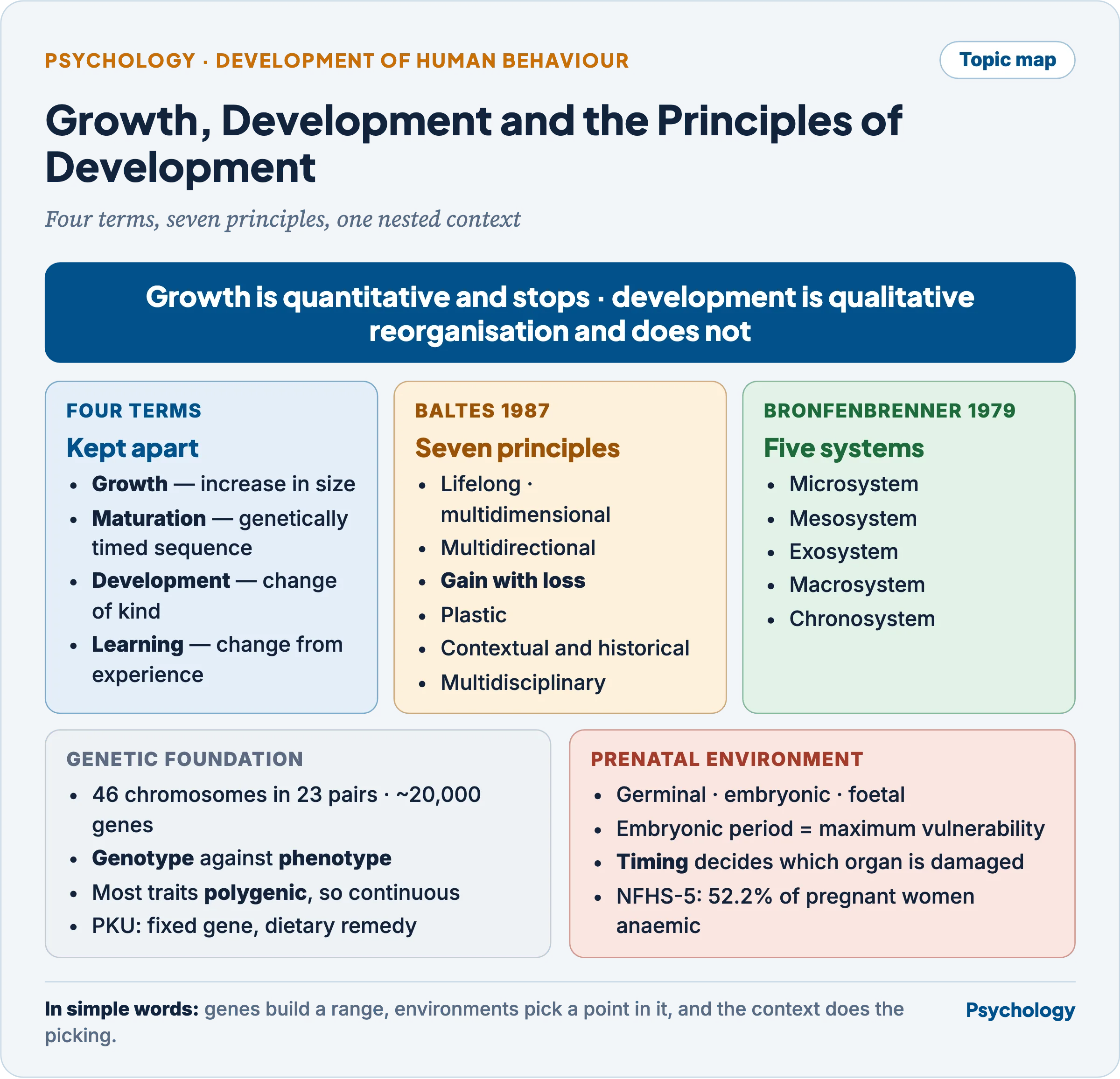
Development is not growth with a longer time-scale. Growth is quantitative and has a terminus; development is qualitative reorganisation and has none. Most later disputes — maturation against learning, decline against gain in old age — turn on which of the two is meant.
Growth, maturation, development and learning
Four terms are routinely used as if interchangeable. They are not, and the differences carry explanatory weight.
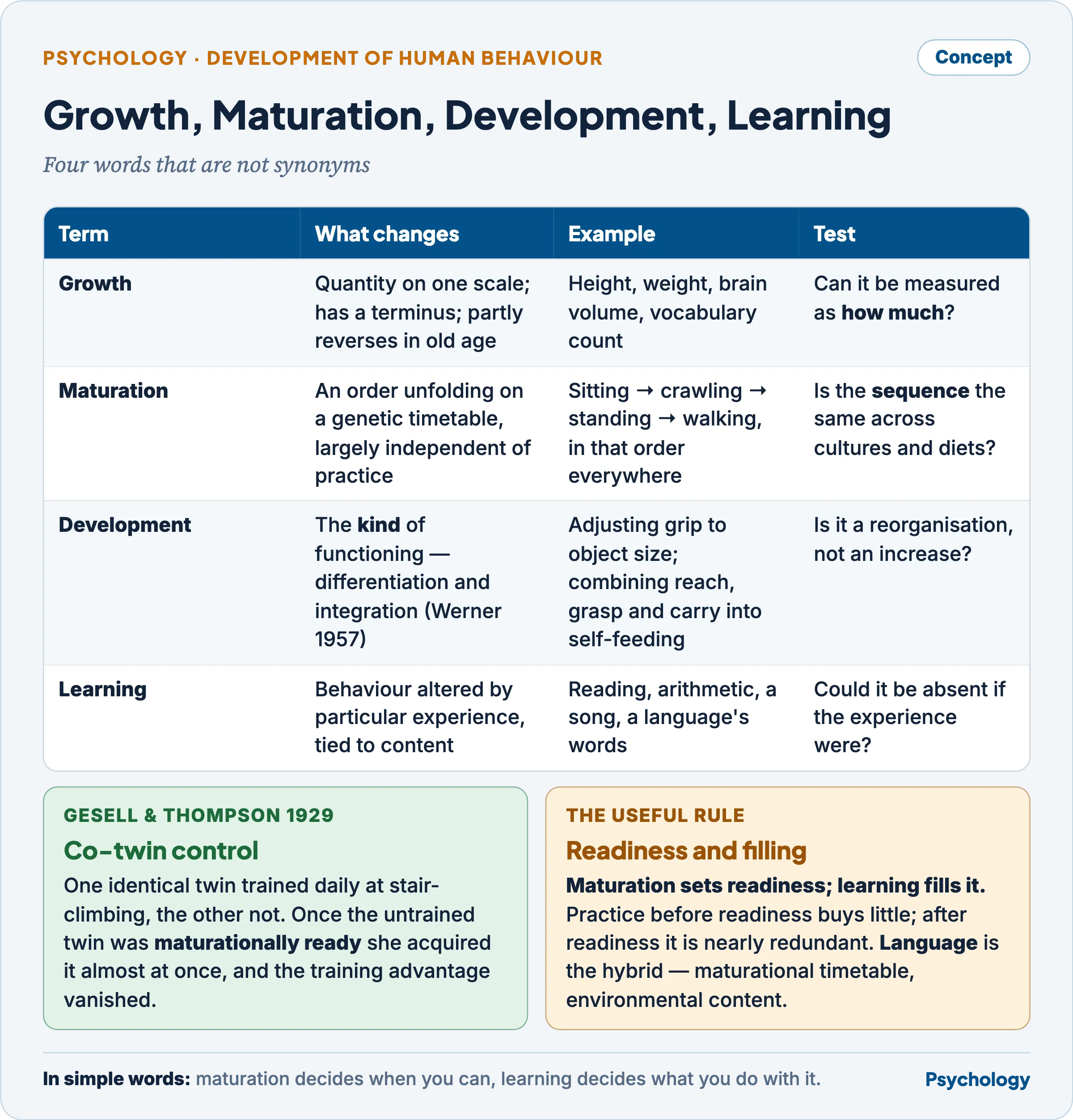
- Growth is quantitative increase in size or mass — height, weight, brain volume, vocabulary count. It is measurable on one scale, it stops, and some of it reverses in old age. Growth answers the question how much.
- Maturation is the unfolding of a genetically governed sequence, largely independent of specific practice. Arnold Gesell (1928) established the usage. The progression from head control to sitting to standing to walking appears in the same order across cultures, diets and child-rearing regimes. Crawling is the exception: some infants, and many in some cultures, skip it.
- Development is qualitative change — a change in the kind of functioning, not its amount. Heinz Werner (1957) named its two processes: differentiation, as when a child adjusts grip aperture to an object’s size, and integration, as when reaching, grasping and transporting combine into self-feeding.
- Werner stated this as the orthogenetic principle: “wherever development occurs it proceeds from a state of relative globality and lack of differentiation to a state of increasing differentiation, articulation, and hierarchic integration.”
- Learning is change arising from particular experience, and unlike the other three it is tied to specifiable content.
How maturation and learning divide the work
The relationship is the substantive point. Maturation sets readiness and learning fills it.
Gesell and Thompson’s (1929) co-twin control design showed this directly. One identical twin received intensive daily practice at stair-climbing and cube manipulation while the co-twin received none. The trained twin improved, but once the untrained twin became maturationally ready she acquired the skill almost immediately, and the training advantage disappeared within weeks. Practice before readiness buys very little; the same practice after readiness is nearly redundant, because the behaviour was emerging anyway.
- Dennis (1940) found that Hopi infants bound to cradleboards did not lag in motor development behind unbound infants: restricted practice did not delay a maturational skill.
- McGraw (1935) gave one twin, Johnny, intensive training in swimming, climbing and roller-skating while Jimmy went untrained. Johnny became precociously skilled, but the twins’ motor differences narrowed as they grew.
Three qualifications keep this from becoming a maturational dogma.
- The argument holds best for universal motor milestones and weakly elsewhere. Reading, arithmetic and musical skill have no maturational timetable of their own and depend almost wholly on instruction.
- Even motor sequences are not immune to environment. Jamaican infants given formal daily handling and massage sit and walk earlier (Hopkins and Westra, 1988); Kenyan infants given sitting practice sit earlier (Super, 1976). Maturation fixes the order far more rigidly than the dates.
- Language is the instructive hybrid. Its timetable is maturational and nearly invariant, yet every word of its content is supplied by the environment — which is exactly why the two processes have to be named separately rather than opposed.
The principles of life-span development
The life-span view displaced an older model in which development meant childhood growth, adulthood meant a plateau and old age meant decline. Baltes (1987) set out the propositions that define the replacement.
- Lifelong. No age period is privileged, and processes genuinely begin at every stage — generativity and the integration of a life history have no infant counterpart at all.
- Multidimensional. Development cannot be captured on one criterion. It runs in distinguishable domains: physical (body size, brain, perceptual and motor capacity, health), cognitive (attention, memory, knowledge, reasoning, problem solving, creativity) and emotional and social (understanding and regulating one’s own feelings, knowledge of others, friendship, intimacy), following Berk (2003).
- Multidirectional. Within a single domain, different capacities move in different directions at the same age. In later adulthood, vocabulary and accumulated knowledge typically rise while speed of processing falls — one domain, two directions.
- Gain and loss together. Every advance carries a cost, and the two are not of equal size. Formal schooling raises knowledge and reasoning while narrowing the range of solutions a child will spontaneously attempt, because rules supplied by others displace idiosyncratic ones. Development is never pure accumulation.
- Plastic. The same person supports different outcomes depending on conditions, and the limits of that plasticity differ by function and by age. An infant who loses one cerebral hemisphere can relocate much of its function; an adult cannot.
- Contextual and historical. The same chronological age means different things in a village and a metropolis, and in 1950 and today.
- Multidisciplinary. No one discipline’s methods reach all the relevant causes, so development is studied jointly with sociology, anthropology, linguistics and biology.
Contextualism and the three sources of influence
Baltes gave the context principle a usable structure by classifying influences into three kinds (Baltes, Reese and Lipsitt, 1980).
- Normative age-graded influences are tied to chronological age and therefore predictable in both timing and content: puberty, school entry, marriage, menopause, retirement.
- Normative history-graded influences are shared by a birth cohort: a famine, a war, a pandemic, an economic liberalisation. They make a cohort resemble itself and differ from cohorts on either side, which is why age differences measured at one moment confound age with cohort.
- Non-normative life events are idiosyncratic, unpredictable and individually powerful: a parent’s death, a disabling accident, a migration, a lottery win. They do not follow a developmental schedule and are a principal reason people of one age differ so much from one another.
Developmental ecology
The context principle acquires its machinery from Urie Bronfenbrenner (1979), who defined the ecology of human development as the scientific study of the progressive mutual accommodation between an active, growing person and the changing settings in which that person lives, as affected by relations among those settings and the larger contexts in which they are embedded.
His central claim is that what acts on development is not the objective setting but the person’s construal of their roles, relations and responsibilities within it. Two children in one classroom inhabit different microsystems if one reads it as safe and the other as hostile. This is what makes the theory psychological rather than sociological.
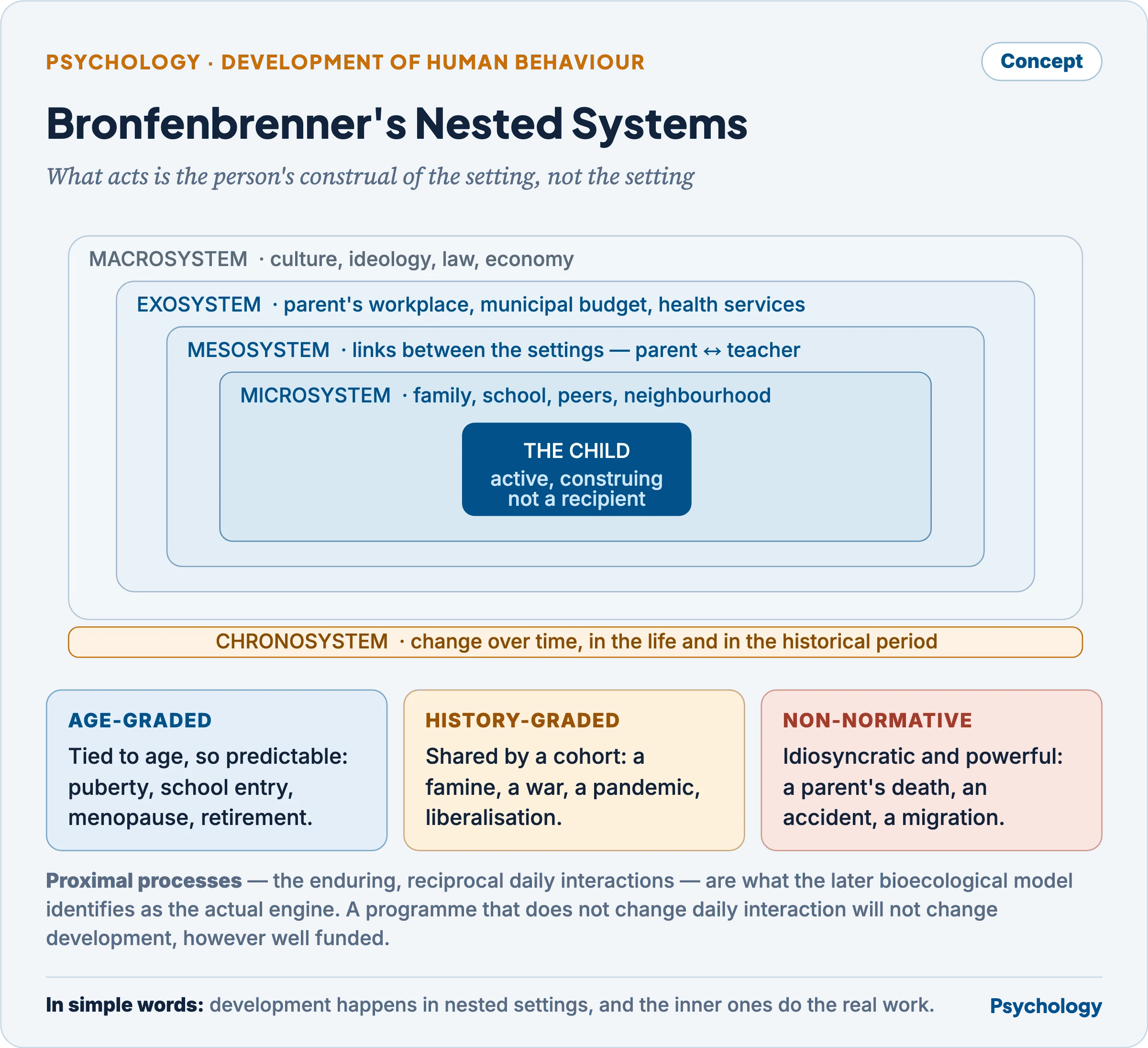
- Microsystem — settings of direct, face-to-face participation: family, school, peer group, neighbourhood.
- Mesosystem — the interconnections among microsystems. A parent who speaks to a teacher creates a mesosystem link; the absence of that link is itself a developmental condition, and much of what schooling achieves depends on it.
- Exosystem — settings that affect the person without their participation: a parent’s workplace and its hours, a municipal budget, the local availability of health services.
- Macrosystem — the culture and subculture, its ideology, law and economic organisation, within which all the inner systems take their particular form.
- Chronosystem (added by Bronfenbrenner, 1986) — change over time, both in the person’s own life transitions and in the historical period through which they pass.
Bronfenbrenner later revised the model into the bioecological form (Bronfenbrenner and Ceci, 1994; Bronfenbrenner and Morris, 1998), the process–person–context–time model, adding proximal processes — the enduring, reciprocal, increasingly complex interactions between the person and their immediate environment, such as sustained parent–child play or shared reading. These he held to be the actual engines of development, with the nested systems being the conditions that make good proximal processes more or less likely. This matters practically: it explains why a well-funded programme can fail if it does not change what happens in daily interaction.
The ecological frame earns its place by naming the level at which an intervention acts, and thereby why interventions fail; its use as an approach to improving outcomes is treated in Socio-Cultural Theory and Multicultural Socialisation.
The genetic foundation of development
The role of genetic factors, and how genes and environments combine, is treated fully in Heredity, Environment and Their Interaction; what follows is the groundwork that development builds on.
Each human somatic cell nucleus carries 46 chromosomes in 23 pairs, one of each pair from each parent, with the 23rd pair determining sex — XX female, XY male. Gametes carry 23, half the complement, so that fusion restores it. Each chromosome is a long molecule of DNA, and a gene is a segment of it coding for a protein. The Human Genome Project settled the count at roughly 20,000 protein-coding genes.
Two terms govern everything that follows. Genotype is the inherited genetic constitution. Phenotype is the observable characteristic — height, blood type, measured intelligence. The distinction matters because the same genotype produces different phenotypes under different conditions, so no inherited factor determines an outcome by itself.
Monozygotic twins arise from one zygote that divides after fertilisation and share effectively all their nuclear DNA. Dizygotic twins arise from two separately fertilised ova and share on average half, as any siblings do. This contrast is the most productive natural experiment in the field.
Mendel’s laws still frame transmission. Alleles do not blend but stay discrete; where a pair differs, a dominant allele is expressed while a recessive one is carried silently and can surface generations later. Sex-linked traits carried on the X chromosome — red-green colour blindness, haemophilia — appear far more often in males, who have a single X and therefore no second copy to mask a defective allele. But most psychologically interesting characteristics are polygenic, depending on very many genes of small individual effect, which is why height and intelligence distribute continuously instead of in Mendelian ratios.
What genetic and chromosomal disorders show
- Down syndrome follows from an extra copy of chromosome 21 — usually free trisomy, giving 47 chromosomes, less often translocation or mosaic forms — with intellectual disability and characteristic physical features. Incidence rises sharply with maternal age.
- Phenylketonuria is a recessive single-gene failure to metabolise phenylalanine, whose intellectual disability an early restricted diet almost entirely prevents.
- Fragile X syndrome arises from expansion of a CGG repeat (over 200 copies) in the FMR1 gene on the X chromosome, which silences the gene, and is the commonest inherited cause of intellectual disability, with high rates of attention difficulty and autistic features; female carriers are typically less affected than males.
- Turner syndrome (a single X) and Klinefelter syndrome (XXY) produce selective rather than global deficits — characteristically spatial in the first, verbal in the second. That selectivity is evidence that chromosomal material maps onto particular cognitive functions, not only onto general ability.
How the brain mediates genotype and phenotype
No gene codes for a psychological characteristic, and the question of how one becomes the other is answered by a chain with the nervous system in the middle.
A gene is transcribed and translated into a protein. Proteins constitute the enzymes, receptors, transmitters, ion channels and structural molecules of the nervous system. These govern neural architecture — cell migration, synapse formation, myelination, pruning, and the availability and reuptake of transmitters. That architecture sets the dispositions with which the organism meets its environment, and behaviour emerges from the meeting. The brain is therefore the organ at which a genotype is converted into a probability distribution over behaviours, never into a behaviour.
Three features of the chain matter.
- Genes are switched on and off at particular developmental times, so one genome has different effects at different ages, and a gene implicated in a disorder of late adolescence may be silent throughout childhood.
- The architecture is partly built by input (Greenough, Black and Wallace, 1987). Development is experience-expectant where the system awaits a reliably present input — the visual cortex needs patterned light — and experience-dependent where it encodes the particular contents an individual happens to encounter.
- The pathway runs both ways. Experience alters gene expression through epigenetic regulation, so the brain is not merely downstream of the genome but also acts upon it; the evidence is set out in Heredity, Environment and Their Interaction.
Prenatal development and its environment
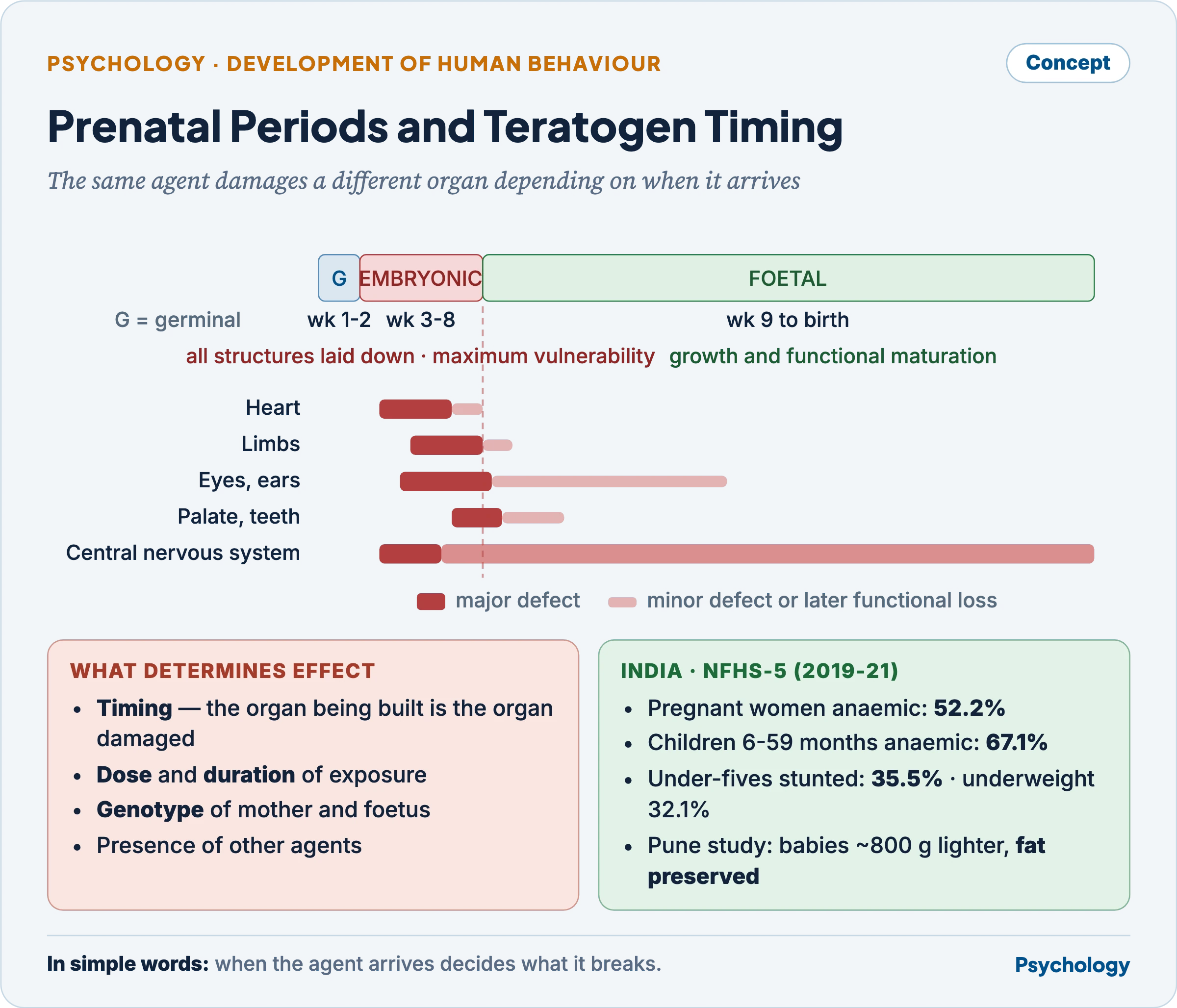
Development from conception to birth takes about 38 weeks in three periods.
- The germinal period, the first two weeks, covers fertilisation, the rapid cell division called cleavage, formation of the blastocyst and implantation in the uterine wall about six days after conception.
- The embryonic period, weeks three to eight, is when cell groups differentiate and every major internal and external structure is laid down. Hence it is the period of maximum vulnerability.
- The foetal period, week nine to birth, is growth and functional maturation of structures already formed. The organism grows from about 3 cm to around 50 cm.
Teratogens are environmental agents that cause prenatal abnormality, and their action follows regularities rather than being arbitrary — the principles codified by Wilson (1959, 1973). Effect depends on dose, on duration of exposure, on the genotype of mother and foetus, on the presence of other agents, and above all on timing: an agent striking during an organ’s formation damages that organ, while the same agent some weeks later may do nothing at all. This is why there is no single list of safe or unsafe periods, only a schedule of organ-specific windows.
The established agents are alcohol, where heavy exposure produces foetal alcohol syndrome (named by Jones and Smith, 1973) with its characteristic facial signs, brain abnormality and cognitive deficit; tobacco, where nicotine constricts blood vessels and carbon monoxide displaces oxygen, giving low birth weight and raised stillbirth risk; narcotics, with neonatal dependence and withdrawal; maternal infection, where the placenta fails to filter pathogens; radiation; lead and methylmercury, both directly neurotoxic and both crossing the placental barrier; and ambient air pollution, associated with preterm birth and intrauterine growth restriction.
Three further influences are less often listed and matter more in the Indian context.
- Maternal nutrition. Iron deficiency produces foetal anaemia, calcium deficiency poor bone formation, protein deficiency restricted growth.
- The Pune Maternal Nutrition Study (Yajnik and colleagues, 2003) compared 631 term babies from six villages near Pune with 338 from Southampton: the Indian babies were about 800 g lighter, smallest in abdominal and mid-arm circumference, while skinfold thickness was best preserved.
- The resulting “thin-fat” composition, low in lean mass but relatively adipose, predicts later insulin resistance and supports the thrifty phenotype account of Hales and Barker (1992), in which a foetus that adapts to scarcity is then mismatched to later abundance.
- Maternal stress and depression. Prenatal maternal cortisol is associated with slower foetal growth, which supplies a physiological route from the mother’s social circumstances to the child’s development, and makes poverty a prenatal and not only a postnatal variable.
- Maternal age. Risk is lowest in the middle of the reproductive range and rises at both ends — preterm labour, low birth weight and birth defects below the late teens, chromosomal anomaly with advancing age.
India’s figures make the point concrete. NFHS-5 (2019–21) records 52.2 per cent of pregnant women aged 15–49 as anaemic and 67.1 per cent of children aged 6–59 months, with 35.5 per cent of under-fives stunted and 32.1 per cent underweight. The policy response works at several ecological levels simultaneously: POSHAN Abhiyaan on household nutrition, Anaemia Mukt Bharat on supplementation, the Pradhan Mantri Matru Vandana Yojana on maternal income during pregnancy, and the Rashtriya Bal Swasthya Karyakram, which screens children for defects at birth, deficiencies, diseases and developmental delay — the point at which a genetic condition like phenylketonuria becomes a treatable one.
Criticisms and limitations
- A distinction cleaner in principle than in data. Almost no human behaviour is purely either, and the co-twin control design works only for skills with a steep maturational timetable, which is a small and unrepresentative set.
- Baltes’s principles are a framework, not a theory. They describe what a developmental account must accommodate and generate no testable predictions of their own, which is why they coexist with mutually incompatible theories rather than adjudicating between them.
- Bronfenbrenner’s model is hard to falsify. Its breadth is its appeal and its weakness: with five nested levels, almost any finding can be assigned to one of them after the fact, and the outer systems are rarely measured directly. Bronfenbrenner’s own turn to proximal processes was partly an admission that the nested diagram had become a descriptive container.
- Teratology evidence is largely correlational in humans. Exposure cannot be assigned, so alcohol, tobacco and pollution exposures travel with poverty, nutrition and stress, and disentangling them relies on statistical control that is rarely complete.
- The universality of developmental norms is overstated. The milestone tables in general use derive from Western samples, and applying them to Indian children risks reading nutritional stunting as developmental delay, or culturally different handling practices as deficit.
Previous Year Questions
- 2026Discuss the role of environmental factors in prenatal development.
- 2024Differentiate between growth and development. Explain the principles of life span development in the context of developmental ecology.
- 2008Bring out the differences in the concepts of growth, maturation and development in human behaviour. Use suitable example in your answers.
- 1996Maturation and learning as determinants of behaviour. Give suitable examples.
