

Official syllabusPaper I · Unit 4 · Development of Human Behaviour
Role of genetic and environmental factors in determining human behaviour; influence of cultural factors in socialization.
Definition
“A cognitive structure, a network of associations that organises and guides an individual’s perception.”
Sandra Bem (1983), defining the schema through which gender is acquired and applied
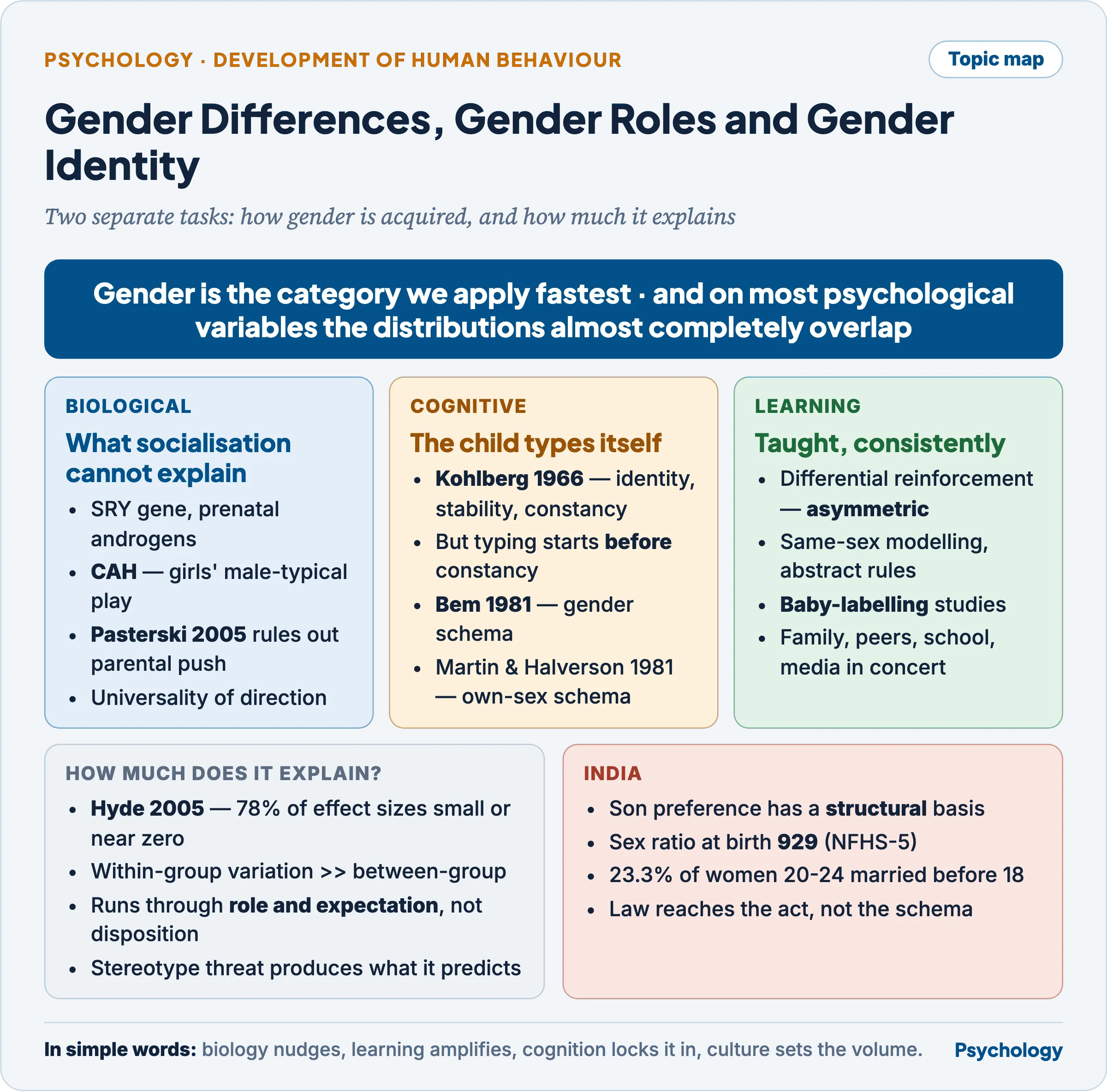
Gender is the category humans apply fastest and most universally, and it invites a false dichotomy: all men treated as alike, all women as alike, and the two as distinct, when the distributions overlap almost completely on most psychological variables. Explaining how a child acquires a gender, and deciding how much that gender explains about behaviour, are separate tasks.
The vocabulary, kept distinct
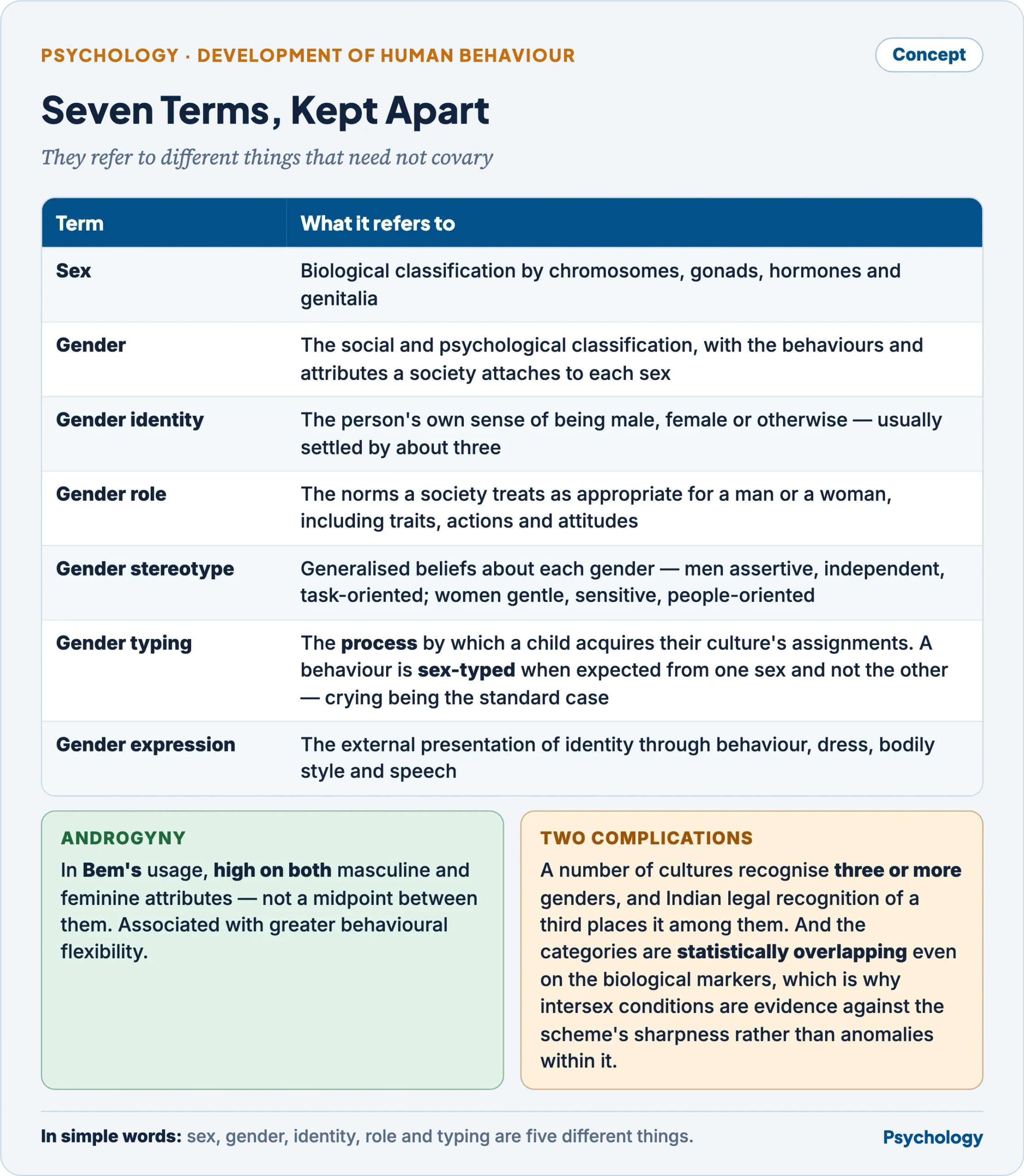
The terms refer to different things that need not covary.
- Sex is the biological classification by chromosomes, gonads, hormones and genitalia.
- Gender is the social and psychological classification, with the behaviours, roles and attributes a society attaches to each sex.
- Gender identity is the person’s own sense of being male, female or otherwise, usually established by about three years of age.
- Gender roles are the social and behavioural norms a particular society treats as appropriate for a man or a woman, including the personality traits, actions and attitudes it associates with each.
- Gender stereotypes are the generalised beliefs about what members of each gender are like — men as assertive, independent, aggressive, task-oriented; women as gentle, dependent, sensitive, emotional, people-oriented.
- Gender typing, or sex-typing, is the process by which a child acquires the roles, preferences, attributes and behaviours their culture assigns to their sex. A behaviour is sex-typed when it is expected and judged appropriate from one sex and unexpected or inappropriate from the other — crying being the standard illustration, comforted in a girl and discouraged in a boy.
- Gender expression is the external presentation of gender identity through behaviour, dress, bodily style and speech.
- Androgyny, in Bem’s (1974) usage, is high standing on both masculine and feminine attributes rather than a midpoint between them. Her Bem Sex Role Inventory measures masculinity and femininity as independent dimensions rather than opposite poles.
Two facts complicate any two-category scheme. Most cultures recognise two genders, but a number recognise three or more, and India joined them through NALSA v Union of India (2014), which recognised a third gender and the right to self-identify, followed by the Transgender Persons (Protection of Rights) Act, 2019. And the categories are statistically overlapping rather than discrete even on the biological markers, which is why intersex conditions are not anomalies within the scheme but evidence against its sharpness.
Biological influences: the role of genetic factors
The biological case does not rest on the existence of sex differences, which could be socialised, but on evidence that cannot be explained by socialisation.
- Chromosomal and gonadal determination. The 23rd chromosome pair sets sex, and the SRY gene on the Y chromosome initiates testicular development, after which the hormonal environment does the work.
- Prenatal androgens are the principal mechanism. During a sensitive period the presence or absence of testosterone organises both genital development and, on the evidence below, aspects of later behaviour.
- Congenital adrenal hyperplasia (CAH) supplies the strongest available natural experiment. The adrenal glands overproduce androgens from before birth, so genetic females are exposed prenatally to atypically high testosterone while being raised as girls.
- Girls with CAH show more male-typical and less female-typical play, toy and playmate preference than unaffected girls, including their own sisters, on questionnaire, interview and observation alike (pooled below).
- Kung, Louie, Spencer and Hines (2024), pooling 20 samples, found large differences between CAH and control females on all seven play outcomes (g = 0.95–1.08). CAH and control males mostly did not differ (g = 0.04–0.27), as a hormonal account predicts, since male foetuses are already androgen-exposed.
- The decisive control comes from Pasterski and colleagues (2005), who measured parental encouragement alongside toy choice. Parents gave their CAH daughters more positive feedback for girl-typical play than parents of unaffected girls gave theirs.
- The male-typical play therefore occurred against the direction of parental socialisation, which rules out differential reinforcement as its explanation.
- The Reimer case (John/Joan). An infant boy whose penis was accidentally destroyed was raised as a girl, and Money (1972) reported the reassignment a success. Diamond and Sigmundson (1997) found he rejected the female identity and lived as male from puberty: rearing alone did not fix gender identity.
- Cross-cultural regularity. Greater male physical aggression and sex-segregated play in middle childhood appear across the societies studied, and regularity of this breadth is difficult to generate from culturally variable socialisation.
- The evolutionary account proposes that differential parental investment selected for different mating and risk strategies. It explains the pattern of findings but is post hoc — it accommodates whatever is found rather than predicting it in advance — which limits how much weight it can carry.
Evidence from typically developing children is mixed. Auyeung and colleagues (2009) found that foetal testosterone measured in amniotic fluid related positively to male-typical play in both boys and girls, while other samples have found no relation. Prenatal androgens clearly matter at atypical concentrations; their role in normal variation is suggestive but unsettled.
Cognitive influences
The cognitive tradition’s distinctive claim is that the child gender-types itself. Once a child has understood which category they belong to, they actively seek out and adopt the behaviours that category prescribes, with no further pressure required.
Kohlberg’s cognitive-developmental theory
Kohlberg (1966) applied a Piagetian stage logic to gender in three stages.
- Gender identity, by about two and a half to three years: the child correctly labels their own sex and that of others, but understanding is tied to surface appearance.
- Gender stability, by about four or five: the child grasps that gender is permanent over time — a boy understands he will not become a mother.
- Gender constancy, by about six or seven: the child understands that gender survives changes in appearance, so a man in a dress and a wig is still a man. This is the gender analogue of conservation, and it arrives at the same point in the Piagetian sequence, which is the theory’s main internal evidence.
Kohlberg’s prediction is that systematic gender-typing should begin only once constancy is achieved, because only then is the category stable enough to organise behaviour around. The evidence contradicts this: children show clear sex-typed toy preferences from around two, long before constancy. This is the theory’s principal empirical failure and the reason the next account replaced it.
Bem’s gender schema theory
Sandra Bem (1981, 1983) retained the cognitive insight and removed the stage requirement. Her objection to Kohlberg was twofold: his theory could not explain why sex rather than race, religion or age becomes the organising principle of a child’s identity, and it made children socialise themselves with no external social force at all.
Her account supplies both. A gender schema is a cognitive structure and network of associations that organises perception — information about “mother” linking to woman, female, nurturer, caretaker. Schemas then do three things: they direct attention toward schema-consistent information, they guide interpretation of what is encountered, and they determine what is encoded and therefore remembered. Children become gender-schematic because their society is gender-polarising — it marks gender everywhere, in clothing, pronouns, toys, spaces and forms of address — so gender is made available as the most salient sorting principle.
The theory’s predictive strength is that schemas distort memory: children shown counter-stereotypical pictures often recall the actor’s sex reversed (Martin and Halverson, 1983). This also explains why stereotypes are so resistant to disconfirming evidence, since the schema filters the evidence before it is stored.
Martin and Halverson (1981) added the useful distinction between an in-group/out-group schema, a simple classification of what each sex does, and an own-sex schema, the detailed knowledge a child accumulates about activities appropriate to their own group — which is why boys and girls end up differently skilled, not merely differently inclined.
Learning influences: cultural factors in socialisation
The learning account holds that gender is taught, by the ordinary mechanisms of socialisation applied with unusual consistency.
- Differential reinforcement. Sex-typed behaviour is rewarded and cross-sex behaviour is ignored or punished, beginning in infancy. The effect is markedly asymmetric: cross-sex behaviour in boys draws much stronger disapproval than in girls, particularly from fathers, which is why the boundaries of boyhood are policed more tightly than those of girlhood.
- Modelling and observational learning. Children attend preferentially to same-sex models and acquire whole repertoires from them. Bandura’s (1977) abstract modelling matters most here, because what is extracted is not a specific act but a rule about what people of one’s sex do.
- Bussey and Bandura (1999) recast the learning account as social-cognitive theory: gender conceptions built from a broad network of social influences work with motivational and self-regulatory mechanisms, and biology permits a range of possibilities rather than dictating a fixed type.
- The baby-labelling studies (Smith and Lloyd, 1978) isolate the adult’s contribution. The same infant, presented as a boy to some adults and a girl to others, is handled differently according to the label: more motor stimulation when labelled male, more gentle nurturance when labelled female.
- Family supplies the first and most powerful instance, beginning before birth with the question of the child’s sex and the choices of colour, clothing, room and toys that follow.
- Peers enforce gender norms harshly and are largely sex-segregated through middle childhood: negotiation, assertion and team play in boys’ groups, dyadic conversation and listening in girls’.
- Schools perpetuate gender-typed play and differentiate expectations by subject; media supplies stereotyped models in volume.
How gender typing actually happens
None of the three accounts is sufficient alone, and their integration is the substantive answer.
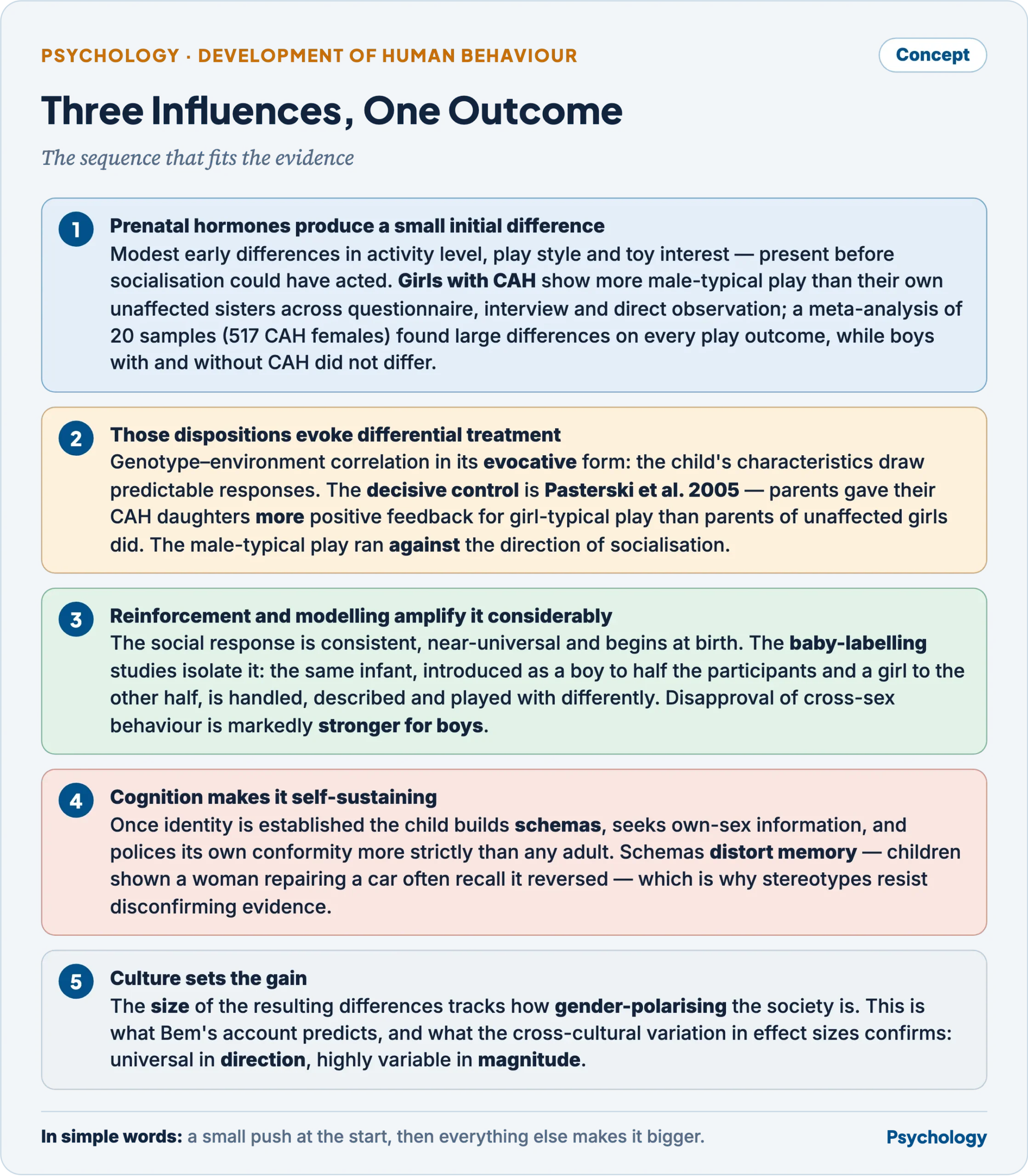
The sequence that fits the evidence runs as follows. Prenatal hormones produce modest initial differences in activity level, play style and toy interest, which are present early and not explicable by socialisation. These dispositions then evoke differential treatment, which is genotype–environment correlation operating in its evocative form. Differential reinforcement and modelling amplify the initial difference, because the social response is consistent and begins at birth. Cognitive development then makes the child an active participant: once gender identity is established the child builds schemas, seeks out own-sex information and polices their own conformity.
The process is also culturally scaled, though the cross-cultural evidence is split. Eagly and Wood (1999), reanalysing Buss’s 37-culture data, found smaller sex differences in some mate preferences where gender equality was greater. But Costa, Terracciano and McCrae (2001), across 26 cultures, found personality differences most pronounced in European and American cultures where traditional sex roles are minimised.
In short, biology supplies a small initial difference, learning amplifies it, cognition makes it self-sustaining, and culture modulates its size, though not always in the direction social-role theory predicts.
Do gender differences account for behaviour?
The evidence gives a largely negative answer, although most writing on the topic assumes otherwise.
Maccoby and Jacklin (1974) reviewed more than 2,000 studies. They dismissed many popular beliefs, such as girls being more social, more suggestible and lower in self-esteem, and found differences well established in only four areas: verbal ability, visual-spatial ability, mathematical ability and aggression.
Janet Hyde’s (2005) gender similarities hypothesis is the decisive evidence. She assembled 46 meta-analyses of psychological sex differences, yielding 124 usable effect sizes across cognitive abilities, verbal and non-verbal communication, social and personality variables, well-being, motor behaviour and moral reasoning. Thirty per cent were close to zero and a further 48 per cent small — 78 per cent in all. The result is the more striking because the meta-analyses addressed precisely those domains where differences were reputed to be reliable: mathematics performance, verbal ability, moral orientation.
Gilligan’s (1982) “different voice” fails on the effect sizes: Jaffee and Hyde (2000) found care orientation d = −0.28 and justice orientation d = 0.19, both small. So does Tannen’s (1990) claim of fundamentally different communication styles.
Zell, Krizan and Teeter (2015) extended the analysis to 106 meta-analyses and 386 effects. The average absolute difference was d = 0.21, with most effects small (46%) or very small (39%).
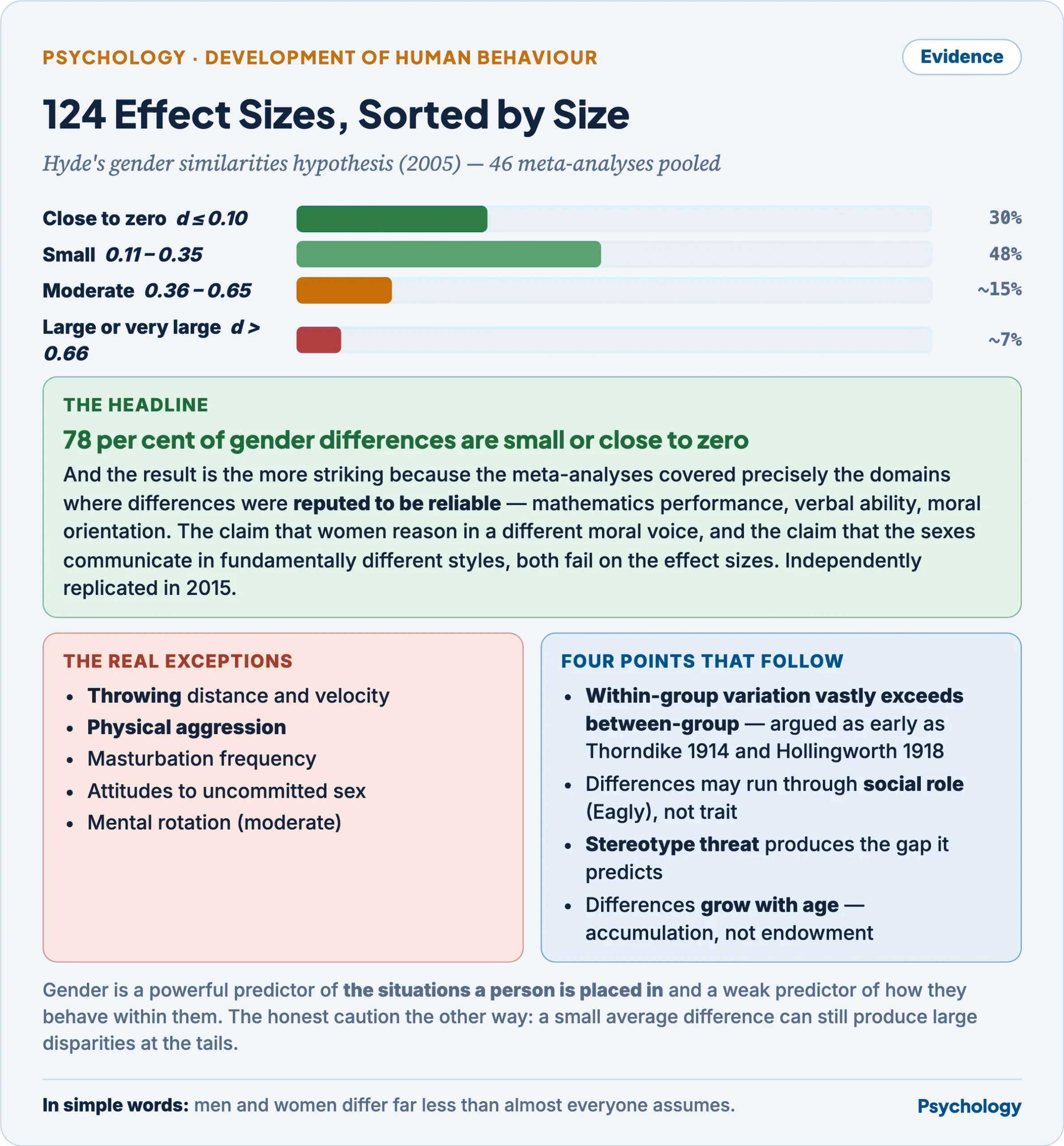
The exceptions are few. The reliably moderate-to-large differences are in throwing distance and velocity, physical aggression, masturbation frequency and attitudes toward uncommitted sex. Mental rotation shows a moderate-to-large difference (d = 0.56 and 0.73 in two meta-analyses). Almost everything else does not.
Several points follow.
- Within-group variation vastly exceeds between-group variation. Thorndike (1914) held the differences too small, against within-gender variation, to matter, and Hollingworth (1918) found little evidence of sex differences in mental traits. A group mean therefore predicts an individual’s standing poorly.
- Social meaning rather than trait. Men and women behave differently partly because they occupy different roles, face different expectations and are differently sanctioned (Eagly’s (1987) social role theory), so the behavioural difference is real while the dispositional one is not.
- Eagly and Crowley (1986), meta-analysing helping, found men helped slightly more overall (d = 0.13), much more under surveillance (d = 0.74) and no more without onlookers (d = −0.02): the difference lies in the role performed.
- Expectation produces the difference it predicts. Stereotype threat research (Spencer, Steele and Quinn, 1999) showed women’s mathematics performance falling when a test was presented as showing gender differences, and the gap vanishing when it was not.
- The effect is now doubted: Flore and Wicherts (2015), meta-analysing studies of schoolgirls, found a small mean effect (d = −0.22) with several signs of publication bias.
- Differences fluctuate with age rather than growing steadily. Complex problem-solving shows no difference in elementary school but a small one in high school, while self-esteem differences shrink in adulthood (Hyde, 2005). Zell and colleagues found magnitudes largely constant across age, culture and generations.
The defensible answer is therefore that gender differences account for far less behaviour than is commonly assumed, and most of what they do account for runs through social role, expectation and self-schema rather than through disposition. Gender is a powerful predictor of the situations a person is placed in and a weak predictor of how they will behave within them.
The Indian context
Gender socialisation in India begins before birth and is enforced at a level that makes it a matter of survival rather than of preference.
- Son preference is the organising fact. Sons carry the family name, inherit, support parents in age and perform the death rites, while daughters are prepared for transfer to another family. This gives the preference a structural basis that exhortation does not reach.
- A measurable demographic consequence. NFHS-5 (2019–21) records the sex ratio at birth for children born in the preceding five years at 929 females per 1,000 males, up from 919 in NFHS-4 but below the biological expectation of about 950.
- The overall sex ratio stood at 1,020 females per 1,000 males, above parity for the first time, which reflects female longevity rather than equal treatment at birth.
- Differential investment follows. Food, healthcare and schooling have historically been allocated unequally within households, which is why anaemia and stunting figures differ by sex.
- Girls’ education has moved substantially. NFHS-5 (2019–21) records 71.8 per cent of females aged six and above as having ever attended school. Gaps remain: 71.5 per cent of women literate against 84.4 per cent of men, and 33.3 per cent of women having ever used the internet against 57.1 per cent of men.
- The digital gap matters because media is now a principal agent of gender socialisation, and access to it is itself gendered.
- Child marriage continues to structure girls’ development, with 23.3 per cent of women aged 20–24 married before 18 (NFHS-5, 2019–21), which truncates education and forecloses the identity exploration adolescence is supposed to permit.
- The policy response works at several levels: the Pre-Conception and Pre-Natal Diagnostic Techniques Act (1994) prohibiting sex determination, Beti Bachao Beti Padhao (2015) on the sex ratio and girls’ schooling, Sukanya Samriddhi Yojana (2015) on the cost of raising a daughter, and the National Education Policy 2020‘s gender-inclusion fund.
- The psychological point is that legal prohibition addresses the act while leaving the schema intact, which is why sex ratios improve slowly and unevenly.
Criticisms and limitations
- Confounded natural experiments. CAH involves prenatal androgens but also genital virilisation, surgery, lifelong medication and parental knowledge of the diagnosis, any of which could influence how the child is treated — though the Pasterski finding on parental encouragement addresses the most obvious of these.
- Kohlberg’s stage requirement is refuted. Sex-typed preferences appear well before gender constancy, so the theory cannot be the main account of gender typing, whatever the sequence’s descriptive value.
- Hard to falsify. Gender schema theory resists it: schemas are inferred from the behaviour they are invoked to explain, and the theory accommodates both stereotype-consistent and stereotype-inconsistent outcomes without specifying in advance which will occur.
- Direction unexplained by learning. Differential reinforcement explains how a difference is amplified but not why every society amplifies it the same way, and the universality of direction remains better explained biologically.
- Contested effect sizes. Hyde’s conclusion depends on treating small effects as unimportant, and a small average difference can produce large disparities at the tails of a distribution, which matters for outcomes determined by extremes such as elite performance.
- Aggregation hides difference. Del Giudice, Booth and Irwing (2012) combined 16PF factors from 10,261 US adults into one multivariate effect size, D = 2.71, an overlap of only 10 per cent, and argued that univariate averaging understates personality differences.
- Binary categories. Almost the entire research literature treats sex and gender as dichotomous, which excludes intersex, transgender and non-binary development and leaves the developmental psychology of those trajectories largely unwritten.
- Cultural narrowness that matters especially here. Findings on gender socialisation derive overwhelmingly from societies where sex does not determine survival or schooling, which makes their transfer to a context of son preference and differential investment doubtful.
Previous Year Questions
- 2025Discuss the role of biological, cognitive and learning influences on gender identity and gender typing by focusing on relevant theories and research studies.
- 2023How does gender differences account for behaviour?
