

Life span development — characteristics.
Official Syllabus: Paper I · Unit 4 Development of Human Behaviour
“Personality develops according to steps predetermined in the human organism’s readiness to be driven toward, to be aware of, and to interact with a widening social radius.”
— Erik Erikson (1963), stating the epigenetic principle
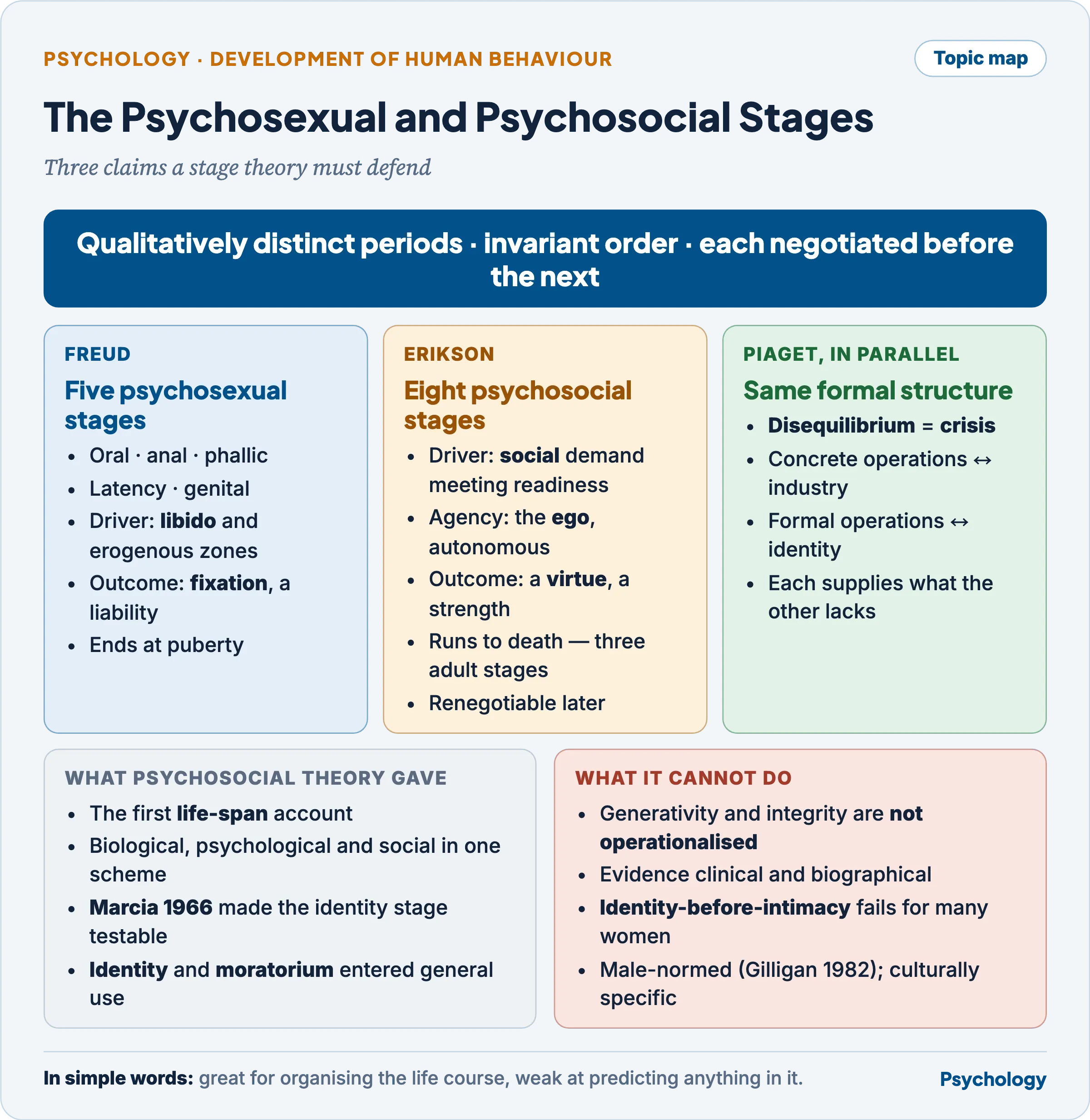
Three claims distinguish a stage theory from a description of change. Development proceeds through qualitatively distinct periods rather than by smooth accumulation; the order is invariant even where the timing is not; and each stage must be negotiated before the next can properly be entered. Both theories below stand or fall on those three, and the critical evaluation tests them one at a time.
Freud’s psychosexual stages
Freud’s theory makes development the history of the libido — a biological sexual energy that successively invests different erogenous zones. Each stage presents a characteristic conflict between the child’s impulse and the demands of caregivers, and the manner of its resolution leaves a permanent mark on personality.
The mechanism that does the explanatory work is fixation: if a stage’s conflict is resolved by either excessive gratification or excessive frustration, libido remains partly invested there, producing an adult character structure organised around that stage’s concerns and a tendency to regress to it under stress.
- Oral stage, birth to about one year. Pleasure centres on the mouth — sucking, biting, swallowing. The conflict concerns feeding and weaning. Fixation yields the oral-receptive character (dependent, gullible, requiring reassurance) or the oral-aggressive (sarcastic, exploitative, verbally hostile).
- Anal stage, roughly one to three years. Pleasure centres on retention and expulsion, and the conflict is toilet training — the child’s first encounter with social demands on bodily function. Fixation yields the anal-retentive character (orderly, parsimonious, obstinate) or the anal-expulsive (disorderly, destructive, careless).
- Phallic stage, about three to six years. Pleasure centres on the genitals and the conflict is the Oedipus complex — the boy’s desire for the mother and rivalry with the father, resolved through castration anxiety leading to identification with the father and the formation of the superego. The female counterpart, which Freud himself called less satisfactory, runs through penis envy to identification with the mother; the term Electra complex is Jung’s, not Freud’s. This stage is the pivot of the theory, because it is where conscience, gender identification and moral authority are all said to originate.
- Latency stage, about six years to puberty. Sexual impulses are repressed and energy is redirected into school, skills and same-sex friendship. It is a period of consolidation rather than of conflict, which is why Freud has least to say about the years when a child is most observable.
- Genital stage, puberty onward. Libido returns to the genitals and is directed toward another person. Mature love and work are possible for those who have reached it without serious fixation.
Erikson’s psychosocial stages
Erikson retained Freud’s architecture and changed three things, each of which is a substantive theoretical move rather than an adjustment. The driver becomes social rather than sexual; the ego becomes an active adaptive agency rather than a servant of the id; and development continues across the whole life span rather than concluding in adolescence.
The organising concept is the epigenetic principle: development unfolds according to a ground plan in which each component has its own time of ascendancy. At each stage a psychosocial crisis arises from the meeting of maturational readiness with a widening social world, and its resolution yields a basic strength or virtue — not the elimination of the negative pole but a favourable ratio between the two, since some mistrust is as necessary as trust.
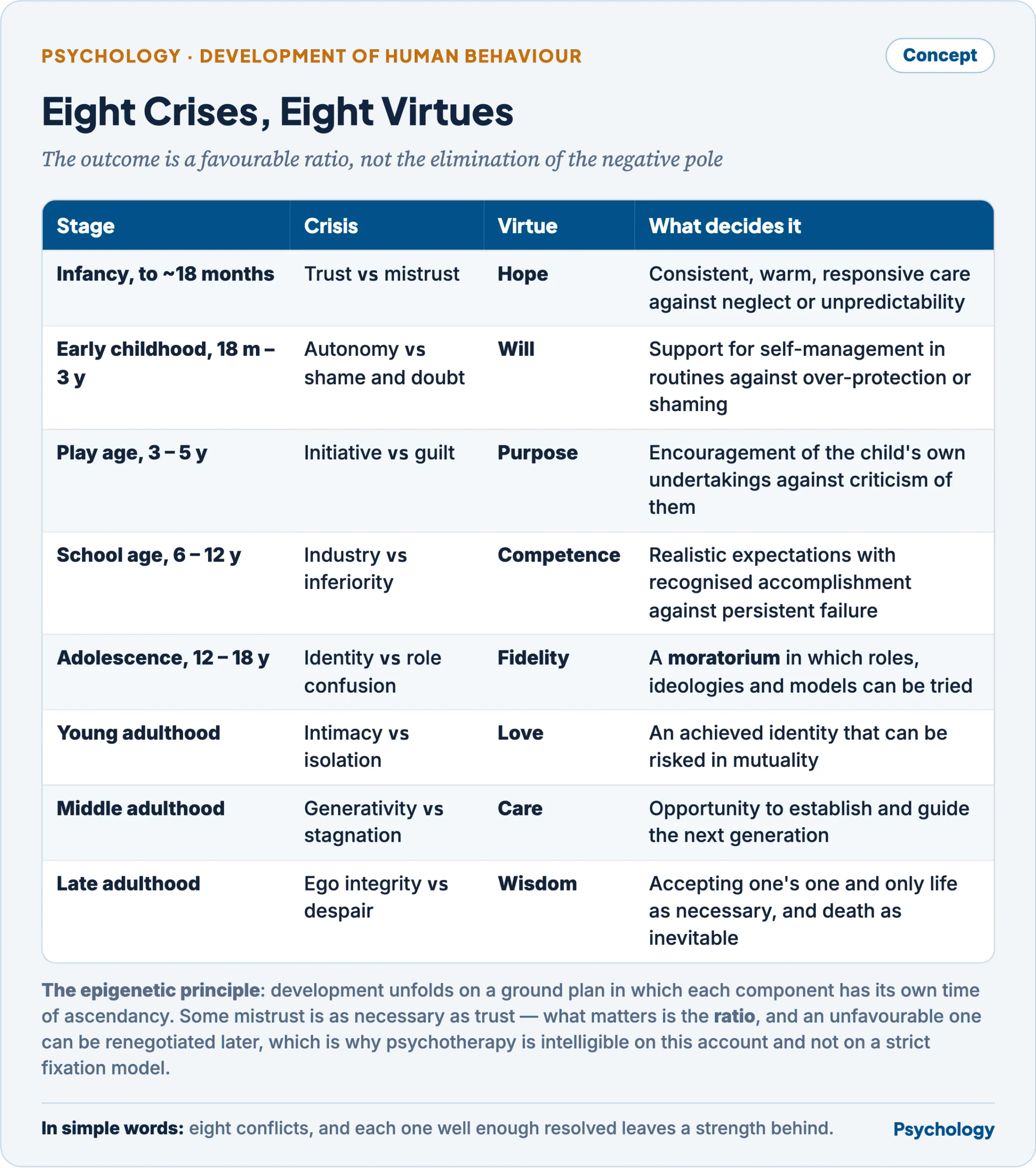
| Stage | Crisis | Virtue |
|---|---|---|
| Infancy, to about 18 months | Trust against mistrust | Hope |
| Early childhood, 18 months to 3 years | Autonomy against shame and doubt | Will |
| Play age, 3 to 5 years | Initiative against guilt | Purpose |
| School age, 6 to 12 years | Industry against inferiority | Competence |
| Adolescence, 12 to 18 years | Identity against role confusion | Fidelity |
| Young adulthood | Intimacy against isolation | Love |
| Middle adulthood | Generativity against stagnation | Care |
| Late adulthood | Ego integrity against despair | Wisdom |
- Trust against mistrust. The infant’s experience of caregiving determines whether the world is construed as dependable. Consistent, warm and responsive care produces confidence that needs will be met; inconsistency or neglect produces a settled expectation that they will not. The virtue is hope — the belief that wishes are attainable.
- Autonomy against shame and doubt. With new motor and language skills the toddler asserts choice. Support for self-management in routine activities — eating, dressing, toileting — produces autonomy; over-protection or shaming produces doubt in one’s own competence. The virtue is will.
- Initiative against guilt. The child now plans, undertakes and tests the reach of their own agency. Encouragement produces a sense of purpose; discouragement and criticism of the child’s initiatives produce guilt about wanting. The virtue is purpose.
- Industry against inferiority. The child enters systematic instruction and is evaluated against standards for the first time. Realistic expectations and recognised accomplishment produce a sense of capability; unrealistic demands or persistent failure produce inferiority. The virtue is competence.
- Identity against role confusion. Rapid physical change and sexual maturation coincide with the question of who one is and will be. The adolescent experiments with roles, ideologies and models; success yields a coherent sense of self, failure a diffusion in which commitment is impossible. The virtue is fidelity — the capacity to sustain loyalty to a chosen commitment. Erikson introduced the idea of the psychosocial moratorium, a socially permitted period of experiment before adult obligations attach.
- Intimacy against isolation. In young adulthood the achieved identity can be risked in genuine mutuality; without one, closeness threatens the self and is avoided. The virtue is love. The sequence matters here: identity before intimacy on this account, which is the theory’s most testable claim about adulthood.
- Generativity against stagnation. Middle adulthood is concerned with establishing and guiding the next generation, through parenting, teaching, mentoring or productive work with a future beyond oneself. Its failure is self-absorption. The virtue is care.
- Ego integrity against despair. The final task is to accept one’s one and only life as having been necessary and sufficient, and with it the inevitability of death. Its failure is despair — the sense that time is short and the life was wrong. The virtue is wisdom.
Freud and Erikson compared
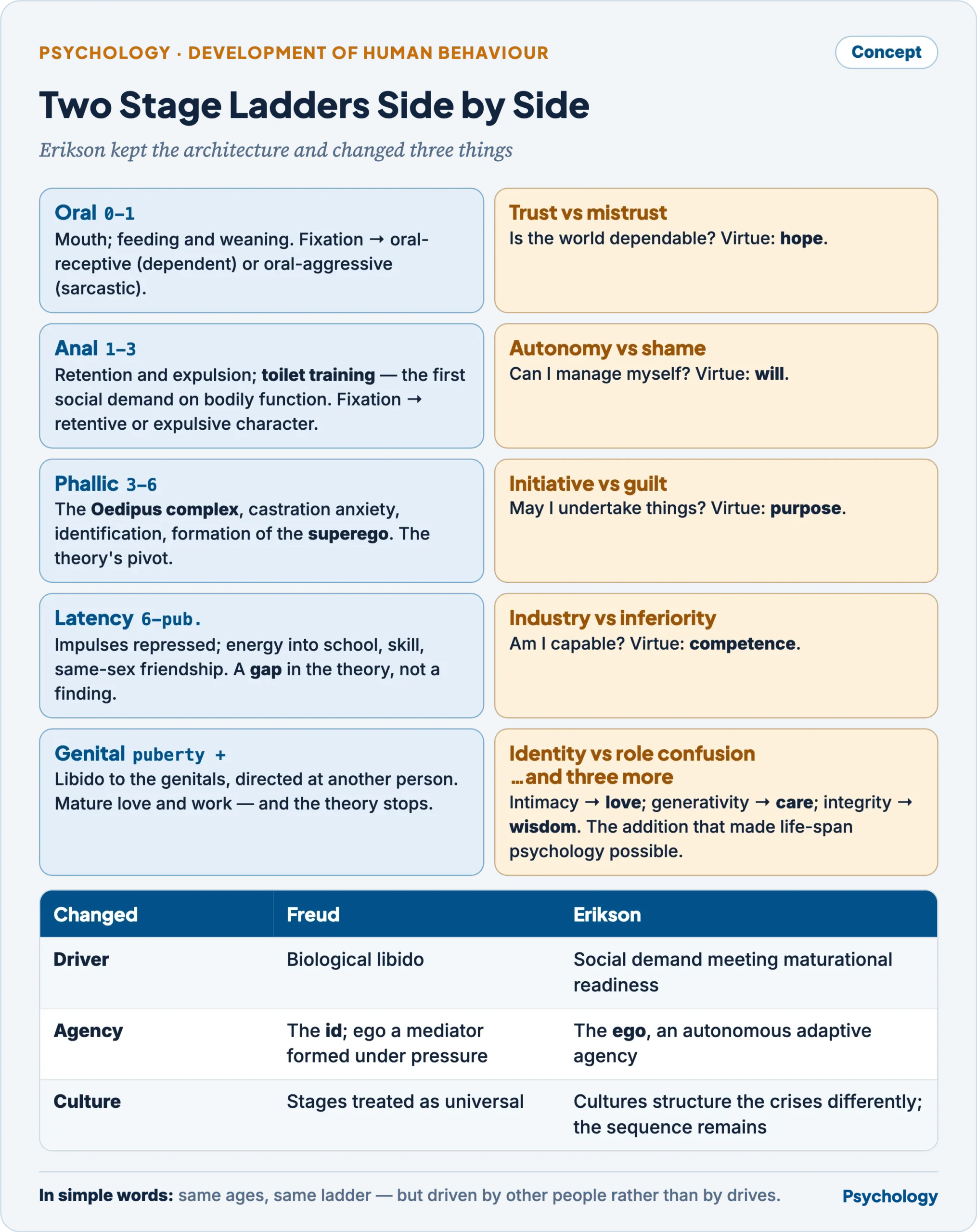
- Motive force. Freud: biological libido and its vicissitudes. Erikson: the social environment’s demands meeting maturational readiness. Erikson’s stages carry the same ages as Freud’s first five, which is the clearest evidence of the derivation.
- Central agency. Freud: the id, with the ego a mediator formed under pressure. Erikson: the ego, an autonomous adaptive agency with its own developmental line.
- Span. Freud: five stages ending at puberty, after which personality is substantially fixed. Erikson: eight stages to death, with three of them in adulthood — the addition that made life-span psychology possible.
- Outcome of a stage. Freud: fixation, a liability. Erikson: a virtue, an acquired strength. Erikson’s scheme is therefore not merely longer but optimistic in structure, because each stage offers a gain rather than only the avoidance of damage.
- Reversibility. Freud: early fixation is largely permanent. Erikson: an unfavourable ratio at one stage can be renegotiated later, which is why psychotherapy is intelligible on his account in a way it is not on a strict fixation model.
- Culture. Freud treated his stages as universal. Erikson, having worked with the Sioux and the Yurok, held that cultures differ in how they structure the crises while the sequence of crises remains — the position that allows cross-cultural comparison without abandoning the theory.
- The sexual. Freud makes infantile sexuality the core and the Oedipus complex the pivot. Erikson retains the developmental architecture while displacing sexuality from the centre, which is why the phallic stage becomes initiative against guilt rather than a drama of desire and castration.
Erikson in parallel with Piaget
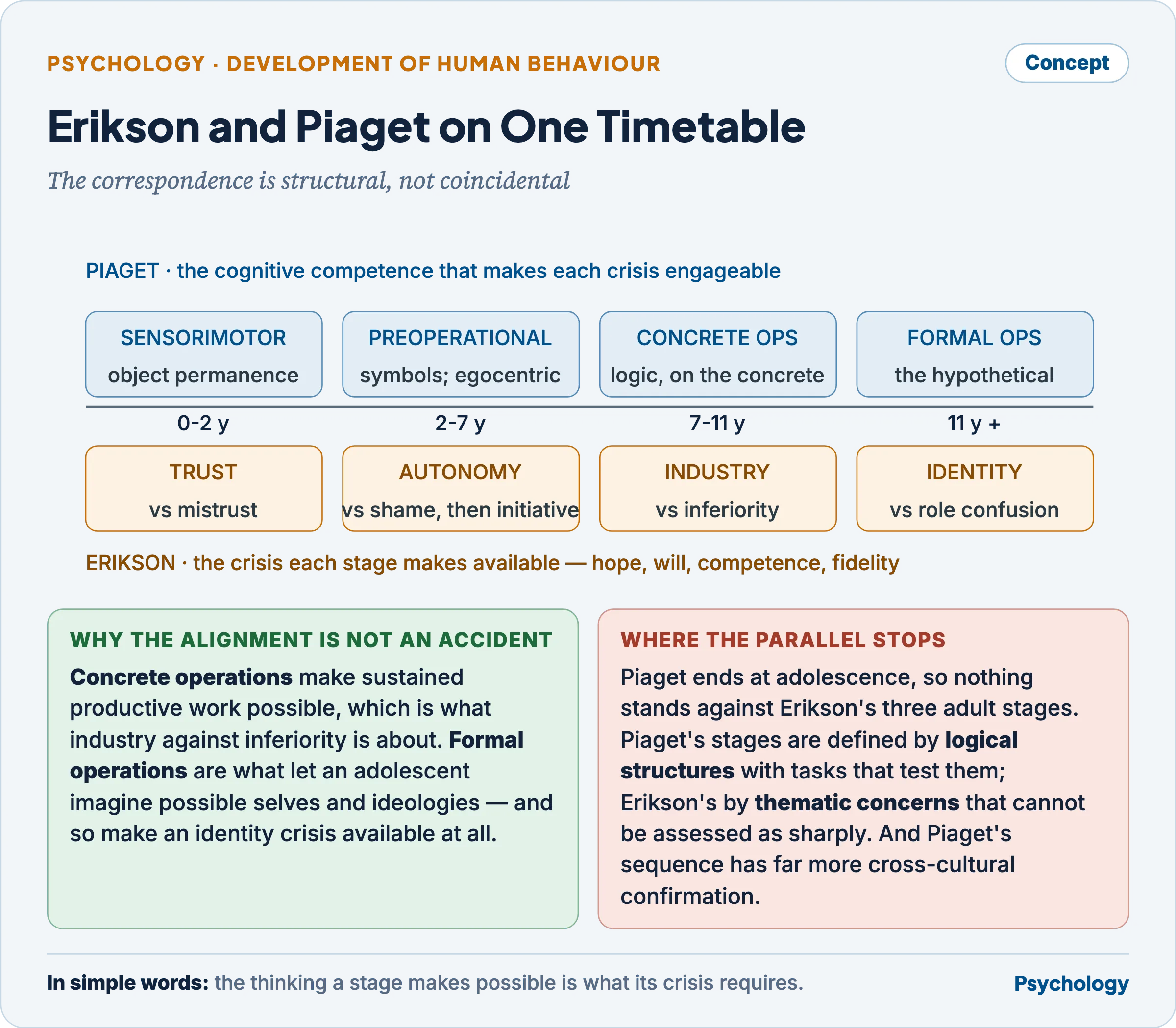
The parallel is real and worth stating precisely, because it is more than a coincidence of ages.
- Shared structure. Both are epigenetic stage theories: qualitatively distinct periods, invariant order, each stage building on and reorganising the last, and timing variable while sequence is not. Both treat the child as active.
- Shared mechanism. Piaget’s disequilibrium and Erikson’s crisis play the same formal role. Development is driven by a mismatch between current capacity and current demand, and is advanced by resolving it — equilibration in one, a favourable ratio in the other.
- Age correspondence. The sensorimotor period coincides with trust against mistrust; preoperational thought with autonomy and initiative; concrete operations with industry against inferiority, which is no accident, since systematic logical thought is what makes sustained productive work possible; and formal operations with identity against role confusion, because the capacity for hypothetical and abstract reasoning is precisely what allows an adolescent to imagine possible selves and ideologies and so to have an identity crisis at all.
- The complementarity. Each theory supplies what the other lacks. Piaget explains the cognitive competence that makes each of Erikson’s crises possible to engage; Erikson explains the affective and social significance of what Piaget’s child is doing. Formal operations without an identity crisis would be a capacity with no content; an identity crisis without formal operations would be a demand the child could not meet.
The limits of the parallel should be stated too. Piaget’s stages end at adolescence, so there is nothing to set against Erikson’s three adult stages. Piaget’s stages are defined by logical structures with clear tasks that test them; Erikson’s are defined by thematic concerns that cannot be assessed so sharply. And Piaget’s sequence has substantial cross-cultural confirmation, while Erikson’s later stages have very little.
Critical evaluation of psychosocial theory
The theory’s strengths are real and should be granted before the criticisms.
- It was the first comprehensive life-span account, and the only major theory of its generation to treat adulthood and old age as developmental rather than as a plateau and a decline.
- It integrates the biological, psychological and social in one scheme without reducing any to another.
- It is clinically and educationally fertile, and Marcia’s (1966) operationalisation of the identity stage into four identity statuses — achievement (exploration then commitment), moratorium (exploration without commitment), foreclosure (commitment without exploration) and diffusion (neither) — produced a large and productive research literature, which is the best evidence that the theory was not merely descriptive.
- Its concept of identity has entered general use, and the psychosocial moratorium names something real about extended education.
The criticisms are the substance of a critical answer.
- No operationalisation. “Generativity” and “ego integrity” have no agreed measurement, which makes most of the adult half of the theory close to untestable. Only the identity stage acquired a research programme, and it did so because Marcia supplied the operationalisation Erikson had not.
- Clinical and biographical evidence. The theory was built from case material, cross-cultural observation and psychobiographies of Luther and Gandhi, not from systematic longitudinal measurement, and psychobiography is notoriously accommodating to the theory being applied.
- A fixed order doubtful in adulthood. The identity-before-intimacy sequence does not hold universally: for many women, and in societies where marriage precedes occupational settlement, intimacy is negotiated before identity or the two together. Erikson’s own later writing conceded this for women, which is an admission that the ground plan is culturally conditioned.
- It is male-normed. Erikson built identity around separation, autonomy and occupational choice. Gilligan (1982) argued that this misdescribes a developmental path organised around relationship and connection, so that women’s development is read as delayed when it is differently structured.
- Cultural specificity under a universalist claim. Autonomy as a toddler achievement, adolescent identity exploration, and the moratorium itself presuppose a society that affords choice of occupation, ideology and spouse. Where roles are ascribed, the identity crisis as Erikson described it does not arise, and its absence is not a failure.
- Dated age bands. A scheme in which intimacy is the task of the early twenties and generativity of the forties describes a mid-twentieth-century life course; extended education, later marriage and longer working lives have moved all of it.
- Causation is not established. The theory asserts that an unfavourable ratio at one stage impairs the next, but the longitudinal evidence for stage-to-stage causal dependency is thin, and the associations that exist are equally consistent with a stable underlying temperament or a continuously adverse environment.
- The resolution is vague. What counts as a favourable ratio is nowhere specified, so almost any outcome can be read as a resolution or a failure after the fact.
A fair verdict is that psychosocial theory is a framework of great heuristic value and modest predictive power: indispensable for organising what has to be explained about the life course, and largely unable to make falsifiable claims about it.
Criticisms and limitations
- Unfalsifiable, on unsound evidence. It was built retrospectively from adult patients’ accounts, it treats contradiction as resistance, and its central claims about infantile sexuality and the Oedipus complex have no satisfactory independent support. Its enduring contributions are the ideas of unconscious motivation, of early experience mattering and of defence — not the stage sequence.
- A weak account of female development, by Freud’s own admission,, resting on penis envy and a less complete resolution of the phallic conflict, and it has no evidential support.
- A gap, not a finding. On the latency years the theory has least to say about the years from six to puberty, which are precisely the years when a child is most observable and most rapidly acquiring competence.
- Over-predicted discontinuity. Measured at short intervals, developmental change usually appears gradual with strategies overlapping, so the stage-like appearance is partly an artefact of measuring at long intervals — as Siegler (1998) demonstrated for children’s arithmetic.
- Both schemes neglect motor development, being organised around the social and the cognitive, which is why dynamic-systems accounts had to be developed separately.
- Age bands that do not survive social change. A scheme in which intimacy is the task of the early twenties and generativity of the forties describes a mid-twentieth-century life course; extended education, later marriage and longer working lives have moved all of it.
Previous Year Questions
- 2020Differentiate between Erikson’s psychosocial and Freudian psychosexual theories. Also explain different virtues attached to each stage of psychosocial theory.
- 2016Critically evaluate Erikson’s stages of Psychosocial development.
- 2010Discuss the stages of psychosexual development according to Freud.
- 2006Critically evaluate the psychosocial theory of personality development.
- 2001Erikson’s theory of psycho-social development parallels Piaget’s theory of cognitive development. Elaborate.