

Life span development — characteristics, development tasks.
Official Syllabus: Paper I · Unit 4 Development of Human Behaviour
“A task which arises at or about a certain period in the life of the individual, successful achievement of which leads to his happiness and to success with later tasks, while failure leads to unhappiness, disapproval by the society, and difficulty with later tasks.”
— Robert Havighurst (1953), defining the developmental task
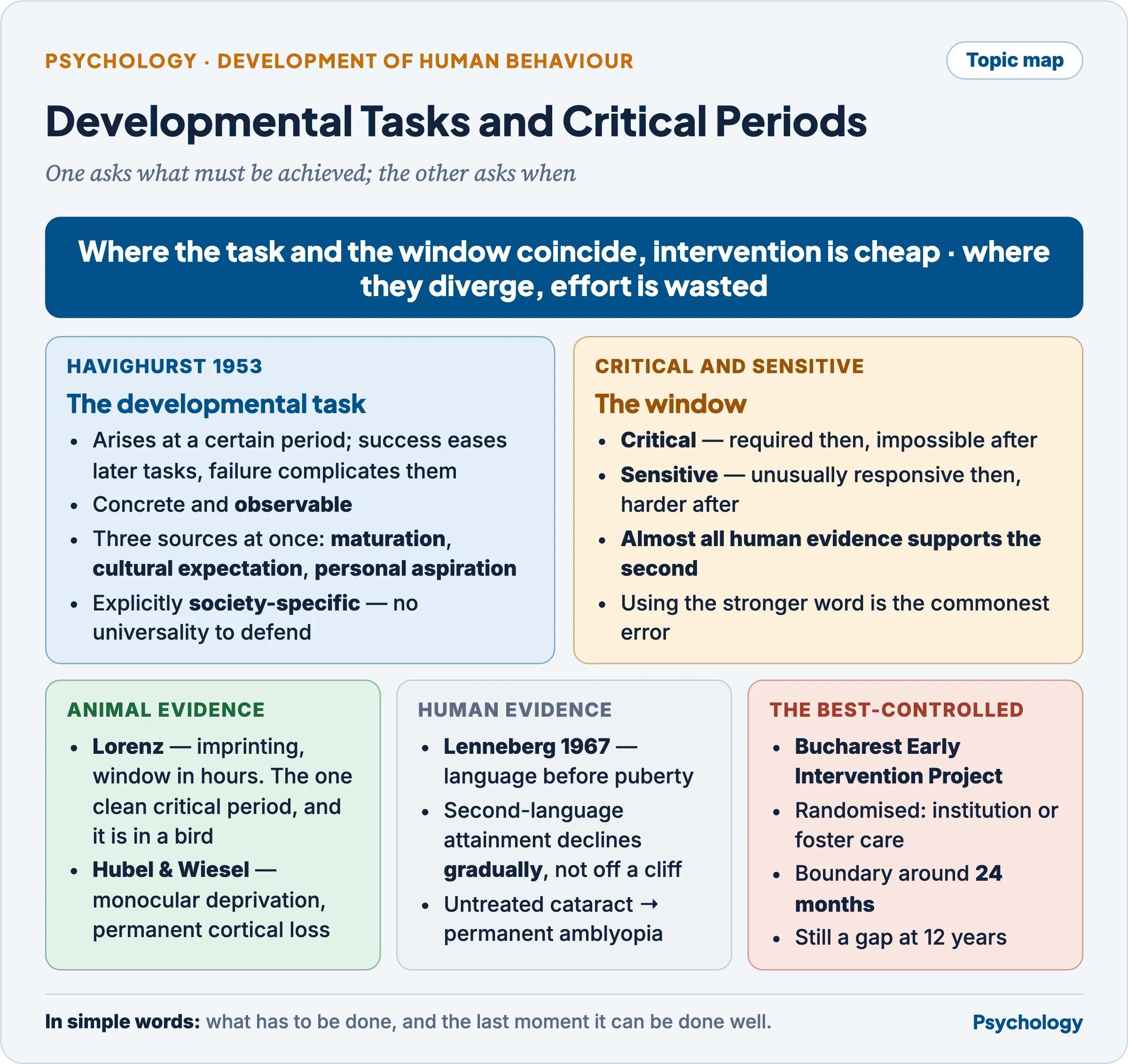
Two ideas organise the life course without requiring a stage theory to be true, and both are more usable than the stage schemes they accompany. The developmental task asks what a person of a given age in a given society is required to accomplish, and is therefore concrete, observable and explicitly culture-bound. The critical or sensitive period asks when an experience must arrive to have its effect, and converts a question about what matters into a question about when — which is what makes it the single most actionable concept in developmental psychology.
Developmental tasks
The developmental task is a distinct and more usable idea than the stage. Robert Havighurst (1953) defined a developmental task as one arising at or about a certain period in life, whose successful achievement leads to happiness and success with later tasks, and whose failure leads to unhappiness, social disapproval and difficulty with later tasks.
Three features make it more tractable than a psychosocial crisis. Tasks are concrete and observable. They arise from three sources jointly — physical maturation, cultural expectation, and the individual’s own aspirations — which builds culture into the concept rather than adding it as a caveat. And they are explicitly society-specific, so no claim of universality has to be defended.
Havighurst’s six periods carry tasks of this kind: in infancy and early childhood, walking, speaking, elimination control and attachment; in middle childhood, physical skills, peer relations, reading and reckoning, conscience and appropriate roles; in adolescence, accepting one’s physique, achieving emotional independence from parents, preparing for an occupation and for family life, and acquiring a value system; in early adulthood, selecting a partner, starting a family, rearing children, beginning an occupation and taking civic responsibility; in middle age, assisting adolescent children to responsible adulthood, achieving civic and social responsibility, maintaining occupational performance and adjusting to physiological change; and in later maturity, adjusting to declining health, to retirement and to the death of a spouse, and establishing affiliation with one’s age group.
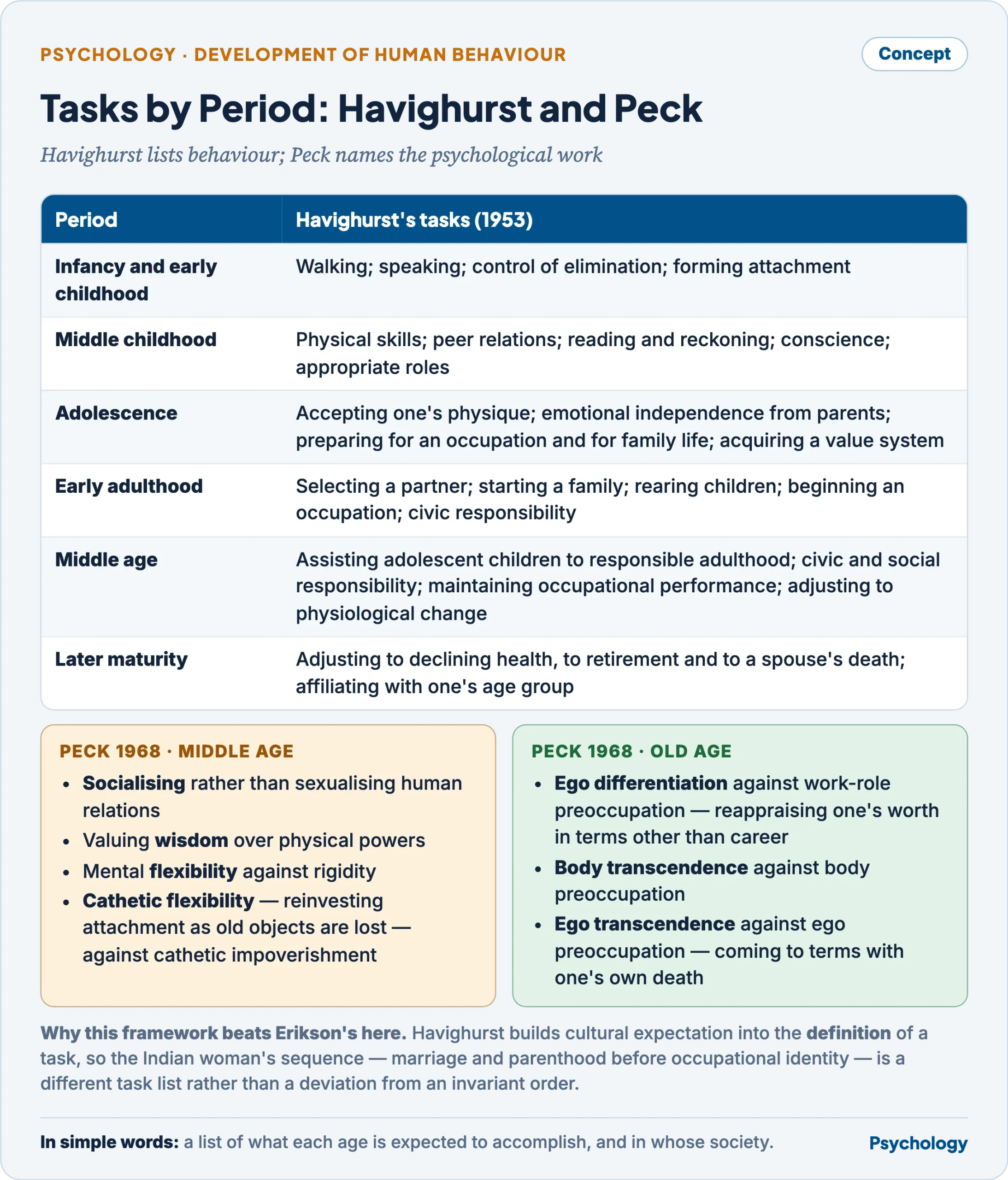
Peck (1968) refined the later periods into paired alternatives that are more psychologically precise than Havighurst’s behavioural list. For middle age: socialising rather than sexualising human relations; valuing wisdom over physical powers; mental flexibility against rigidity; and cathetic flexibility — the capacity to reinvest emotional attachment in new people and activities as old objects are lost — against cathetic impoverishment. For old age: ego differentiation against work-role preoccupation, requiring a reappraisal of worth in terms other than career; body transcendence against body preoccupation, enjoying life despite declining health; and ego transcendence against ego preoccupation, coming to terms with the inevitability of one’s own death and investing in relationships whose significance outlasts it.
Developmental tasks of young men and women in India
The tasks of early adulthood diverge sharply by sex in India, and the divergence is structural rather than attitudinal.
- Timing. The tasks begin at different ages. NFHS-5 (2019-21) records 23.3 per cent of women aged 20-24 as married before 18, against 17.7 per cent of men aged 25-29 married before 21. Marriage and childbearing therefore arrive for many women while occupational preparation is still the task for men of the same cohort, which compresses or eliminates the moratorium for women.
- Sequence. For young men the normative order is education, occupation, marriage, parenthood — identity before intimacy, in Erikson’s terms. For a large proportion of young women it is marriage and parenthood first, with occupational identity afterwards if at all, which inverts the sequence the theory asserts to be fixed.
- Transfer of belonging. Patrilocal marriage makes the young woman’s task the renegotiation of her entire social world — a new household, new authority relations and new kin — while the young man’s household and family position are unchanged. This is a developmental task with no male counterpart, and it falls at the same moment as new marital and reproductive demands.
- Occupational participation. Women’s withdrawal from paid work clusters around marriage and childbirth, so the task of establishing an occupation is for many women not merely delayed but foreclosed. NFHS-5 (2019-21) records a corresponding gap in preparation: 71.5 per cent of women literate against 84.4 per cent of men, and 33.3 per cent of women having ever used the internet against 57.1 per cent of men.
- Autonomy. Decision-making about mobility, healthcare, fertility and expenditure is the young man’s by default and the young woman’s by negotiation, which makes autonomy itself a task for her rather than a presumption.
- Convergence where education extends. Among urban, educated cohorts the two sets of tasks are converging: later marriage, occupational identity before marriage, and a moratorium of comparable length. The divergence tracks schooling and urban residence more closely than it tracks region, which identifies education as the operative variable.
The analytical point is that Havighurst’s framework handles this better, because it builds cultural expectation into the definition of a task, whereas Erikson has to treat the Indian woman’s sequence as a deviation from an invariant order.
Critical and sensitive periods
A critical period is a window during which a particular experience is required for normal development, and outside which the capacity cannot be acquired at all. A sensitive period is a window during which the organism is unusually responsive to a particular input, with acquisition still possible afterwards but harder and less complete. almost all the human evidence supports sensitive rather than strictly critical periods, and using the stronger term where the weaker applies is the commonest error on this topic.
The evidential base runs from strong animal evidence to weaker but convergent human evidence.
- Imprinting. Lorenz’s greylag goslings attached to whatever moving object was present in the hours after hatching, with the window measured in hours. This is the cleanest example of a genuine critical period, and it is in a bird.
- Visual deprivation. Hubel and Wiesel’s work showed that monocular deprivation in kittens during a specific postnatal window produced permanent loss of cortical representation for that eye, with the same deprivation later having little effect. The human analogue is untreated congenital cataract or strabismus, where delayed correction leaves permanent amblyopia — which is why paediatric screening is time-sensitive.
- Language. Lenneberg (1967) proposed a critical period for first-language acquisition ending at puberty. The evidence from extreme deprivation cases is consistent but uncontrolled, since those children suffered every other deprivation simultaneously. Second-language evidence shows a graded decline in attainable native-like competence with age of first exposure rather than a cliff, which again indicates a sensitive rather than a critical period.
- Attachment and institutional deprivation supply the best-controlled human evidence. The Bucharest Early Intervention Project (Nelson, Zeanah, Fox and colleagues, 2007) randomly assigned abandoned children, aged between about 6 and 31 months, from Romanian institutions either to continued institutional care or to foster placement, with never-institutionalised community children as a comparison group. Institutionalised children were markedly below community children in cognitive performance; those randomised to foster care made significant gains, and the gains were largest for the youngest children placed. The language findings are sharper still: placement by 15 months produced scores comparable with typical peers by 30 and 42 months, placement between 15 and 24 months produced dramatic improvement, and placement after 24 months left children with the same severe delays as those who remained in institutions. Follow-up at 12 years found the fostered group still significantly higher in full-scale IQ than those who had remained institutionalised, while both remained below the never-institutionalised group.
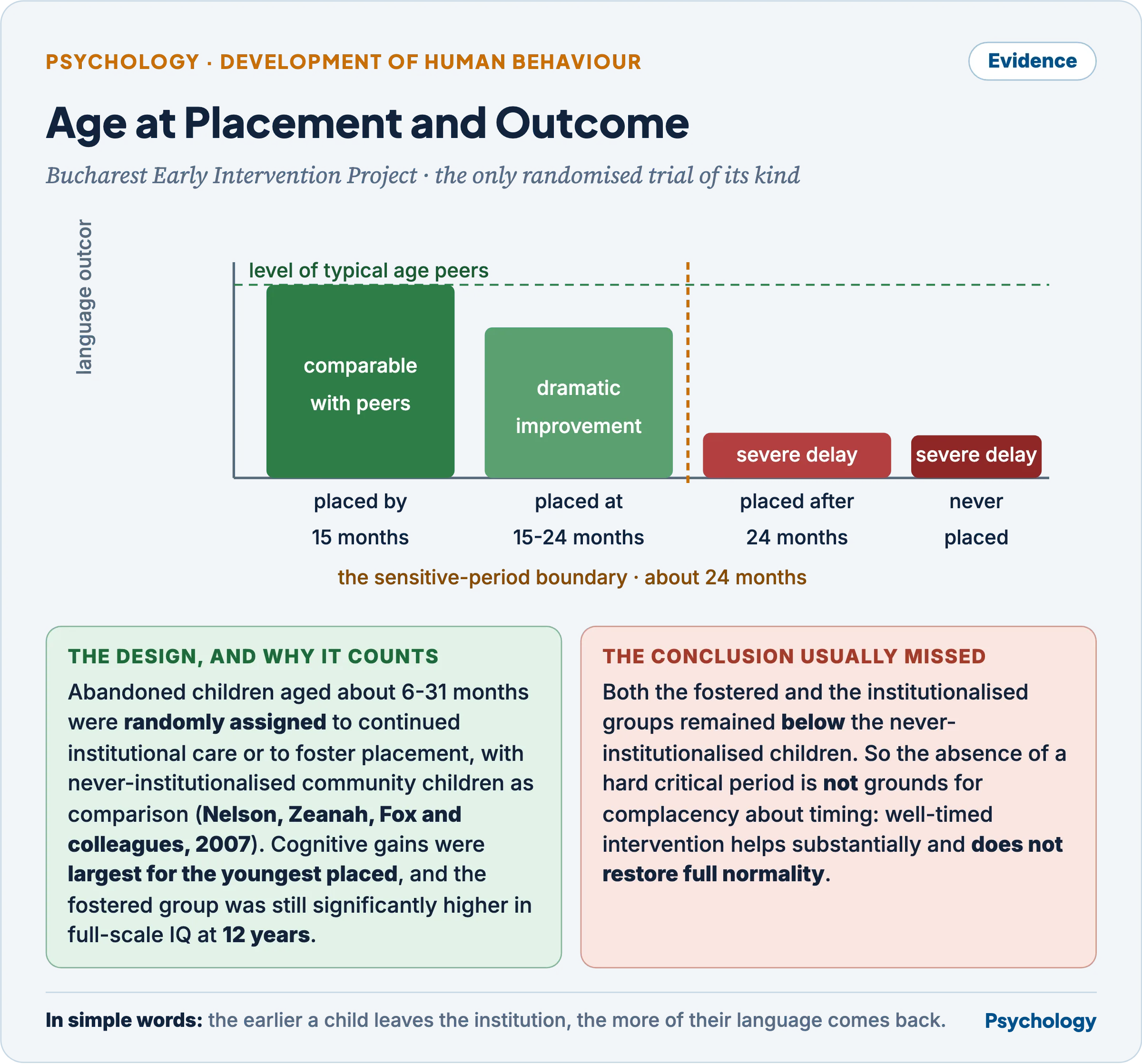
Two conclusions follow, and the second is the one usually missed. There is good evidence for a sensitive period in early cognitive and language development with a boundary in the region of two years. But the never-institutionalised comparison shows that even well-timed intervention does not restore full normality, so the absence of a hard critical period is not grounds for complacency about timing.
Handling critical periods in Indian settings
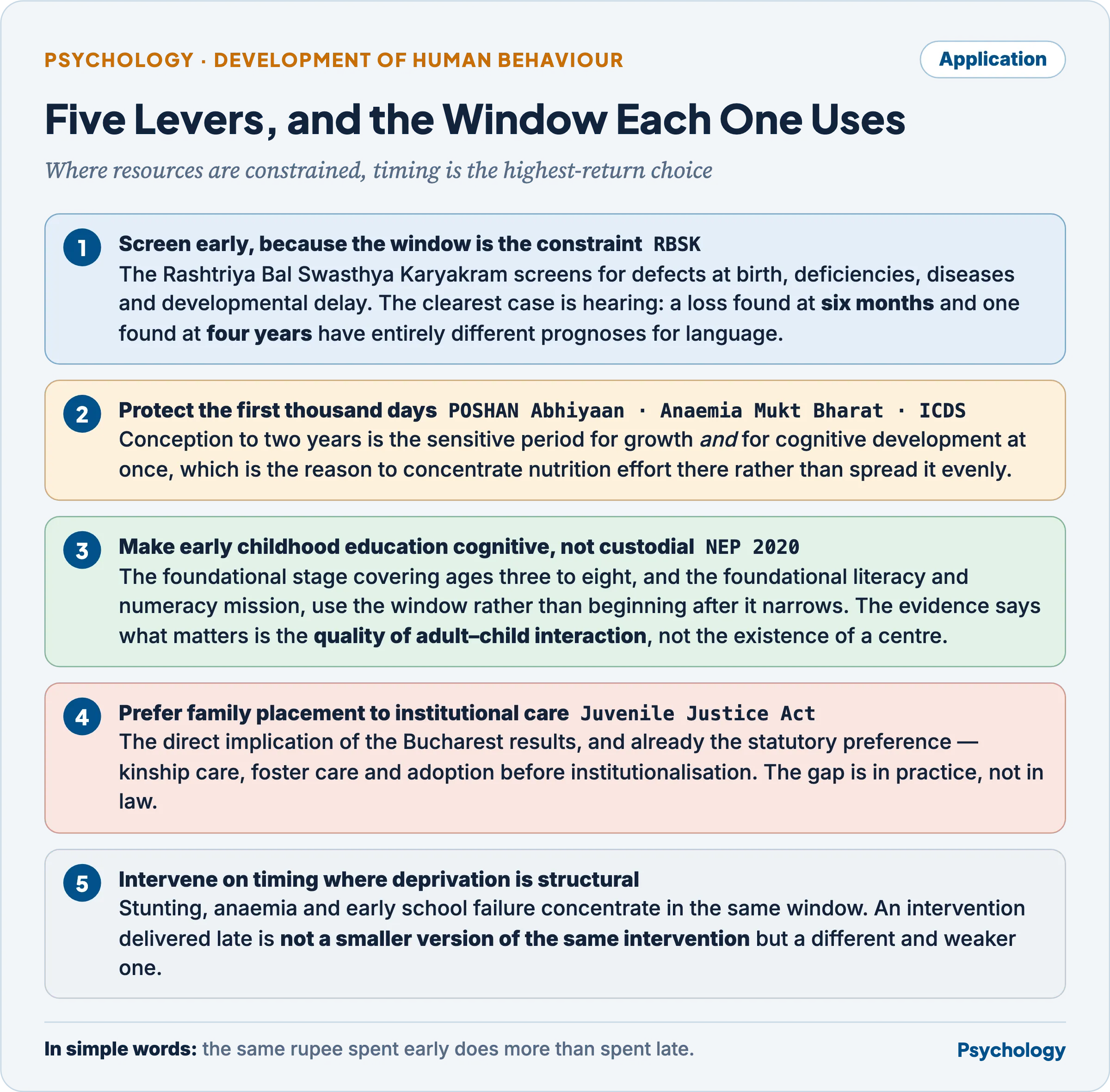
- Screen early. The window is the constraint. The Rashtriya Bal Swasthya Karyakram screens for defects at birth, deficiencies, diseases and developmental delay precisely so that correctable conditions are found inside the window. Universal newborn hearing and vision screening is the clearest case: a hearing loss identified at six months and one identified at four years have entirely different prognoses for language.
- Protect the first thousand days. The period from conception to two years coincides with the sensitive period for both growth and cognitive development, which is the rationale for concentrating nutrition effort there — POSHAN Abhiyaan, Anaemia Mukt Bharat, and the ICDS supplementary nutrition and early-stimulation components delivered through the anganwadi.
- Cognitive, not custodial, early education. The National Education Policy 2020‘s foundational stage, covering ages three to eight, and its foundational literacy and numeracy mission are an explicit attempt to use the window rather than to begin instruction after it has narrowed. The evidence is that what matters is the quality of adult–child interaction, not the existence of a centre.
- Family placement over institutional care. This is the direct implication of the Bucharest results and is the policy embodied in the Juvenile Justice Act’s preference for family-based alternatives — kinship care, foster care and adoption — over institutionalisation, with institutional care as a last resort.
- Timing, where deprivation is structural. Stunting, anaemia and early school failure are concentrated in the same window, so the general lesson is that an intervention delivered late is not a smaller version of the same intervention but a different and weaker one. Where resources are constrained, timing is the highest-return choice available.
Why the two ideas belong together
The task and the period answer complementary questions, and an answer that uses both is stronger than one that uses either.
A developmental task specifies what must be achieved and the society that requires it; a sensitive period specifies when the underlying capacity can most readily be built. Where the two coincide, intervention is cheap and effective — early childhood education arrives while the task of acquiring foundational literacy coincides with the sensitive period for language and for the executive functions that support instruction. Where they diverge, effort is wasted: a remedial literacy programme in late adolescence addresses a real task long after the period of maximum responsiveness, which is why such programmes return so much less per rupee than the same effort applied at six.
The practical rule that follows is that a task should be supported while its substrate is still being built, and that where resources are constrained, moving an intervention earlier usually dominates making it larger.
Criticisms and limitations
- Lists that date quickly. Havighurst’s early-adulthood tasks assume a life course of early marriage, a single lifetime occupation and children in one’s twenties, and each of those has changed. The framework survives the obsolescence of its contents, but the contents must be rewritten for each society and generation.
- Normative tasks, and unjust norms. Defining a task by what a society expects makes social disapproval a criterion of failure, so a task list reproduces the society’s prejudices — which is exactly what the Indian divergence by sex illustrates. The concept describes what is demanded, and cannot by itself say whether the demand is legitimate.
- Unmeasurable alternatives. Cathetic flexibility, body transcendence and ego transcendence are psychologically acute and have no agreed instruments, which leaves them as descriptions rather than findings.
- Routine overstatement. Popular and policy use of “critical” to mean “important” has supported claims about the first three years that the evidence does not carry, and the strong version can be used to justify writing off children past the window — which the Bucharest follow-up at 12 years, showing continued benefit from intervention, directly contradicts.
- No strictly critical human window. The honest formulation is a graded decline in plasticity, not a closing door, and the one clean critical period in the literature — imprinting — is in a bird.
- Unrepeatable, and therefore thin, evidence. The Bucharest project is the only randomised trial of its kind and exists only because an institutional system was already in place; everything else is a natural experiment in which deprivation of every other kind accompanies the one being studied.
- Timing confounded with duration. A child placed early also receives years of better subsequent care, so an apparent sensitive-period effect is partly a duration-of-advantage effect, and the two are hard to separate even in a randomised design.
Previous Year Questions
- 2018Differentiate between various developmental tasks of young men and women in India.
- 2004Discuss in detail the critical periods in human development. Give the suggestions to handle these critical periods effectively in Indian settings.