

Life span development — characteristics, promoting psychological well-being across major stages of the life span.
Official Syllabus: Paper I · Unit 4 Development of Human Behaviour
“The propensity to make strong emotional bonds to particular individuals [is] a basic component of human nature.”
— John Bowlby (1988), on attachment as an organised behavioural system rather than a by-product of feeding
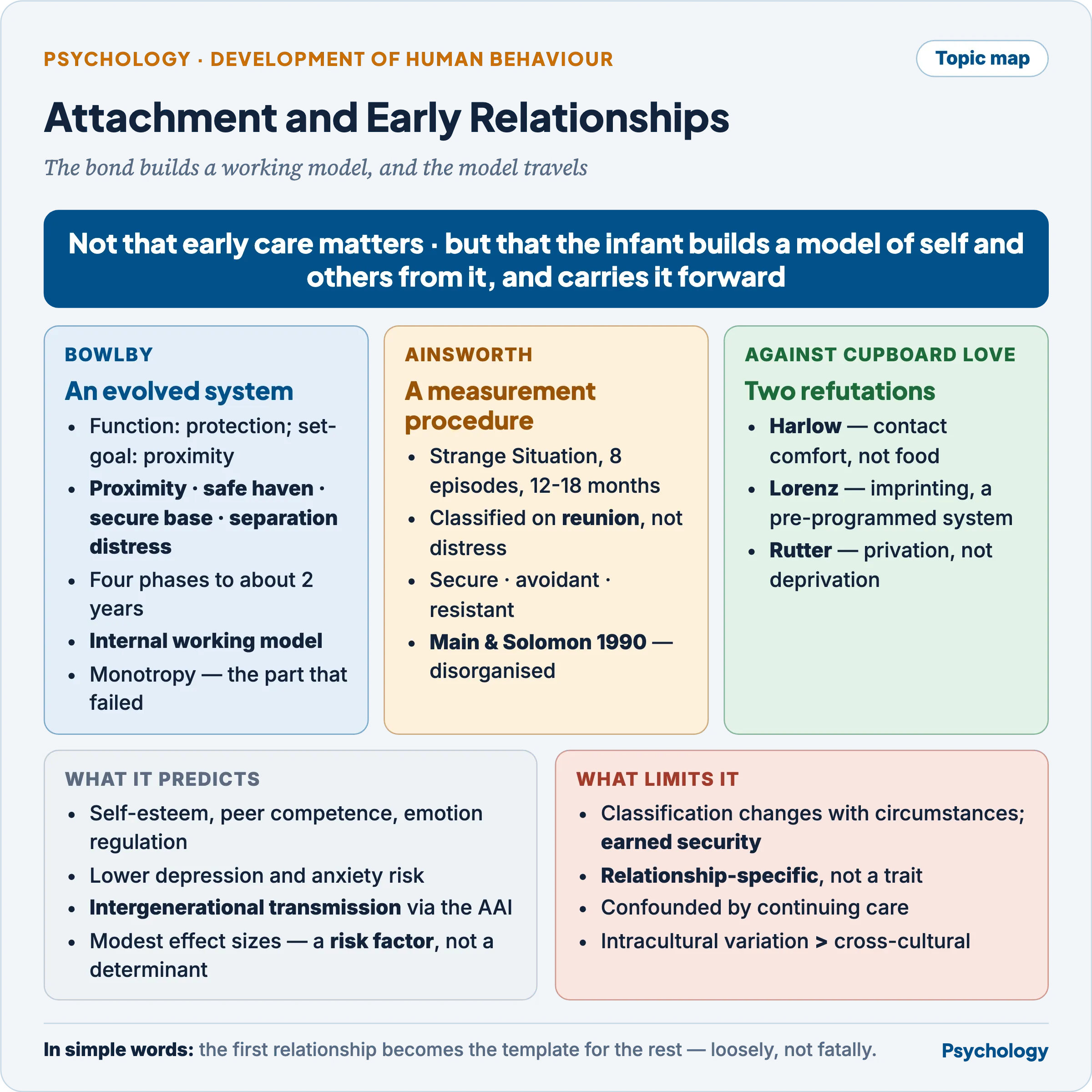
Attachment is the enduring affectional bond between an infant and a particular caregiver, expressed in the infant’s efforts to maintain proximity to that figure and to use them as a base for exploration and a refuge under threat. The theory’s claim is stronger than that early care matters, which nobody disputes. It is that the infant builds an internal working model of relationships from this first bond and carries it forward — which is what makes the first year consequential for the whole of social and emotional development.
Why the bond is not about feeding
The theory’s first achievement was negative: the refutation of what Bowlby called the cupboard love account, in which the infant comes to value the mother through secondary reinforcement because she is associated with food. Both psychoanalytic and learning theory held some version of it, and two lines of evidence overturned it.
- Harlow’s rhesus monkeys, reared with two surrogate mothers, clung to the cloth-covered figure that provided no milk and went to the wire figure only to feed, returning at once to the cloth mother and using her as a base from which to explore a novel object. Contact comfort, not nourishment, produced the bond. The monkeys reared this way were nonetheless socially and sexually abnormal as adults, which indicated that a responsive partner rather than a comforting object is what the system requires.
- Lorenz (1935) on imprinting supplied the evolutionary frame. Precocial birds attach to whatever moving figure is present in a narrow window after hatching, which established that attachment-like behaviour is a pre-programmed system serving proximity and protection, not a learned association.
Bowlby’s synthesis was therefore ethological: attachment is an innate behavioural system shaped by natural selection, whose function is protection from predation and whose set-goal is the maintenance of proximity to a protective adult. The behaviours that serve it — crying, clinging, smiling, following, reaching — are social releasers, built to elicit caregiving.
Bowlby’s theory
Four features define the attachment relationship, and they are the examinable core.
- Proximity maintenance — the wish to be near the attachment figure.
- Safe haven — return to that figure for comfort when frightened or distressed.
- Secure base — use of the figure as the anchor point from which the environment can be explored. This is the feature most often omitted and the most theoretically important, because it explains how attachment serves exploration and learning and not only safety.
- Separation distress — anxiety on the figure’s absence.
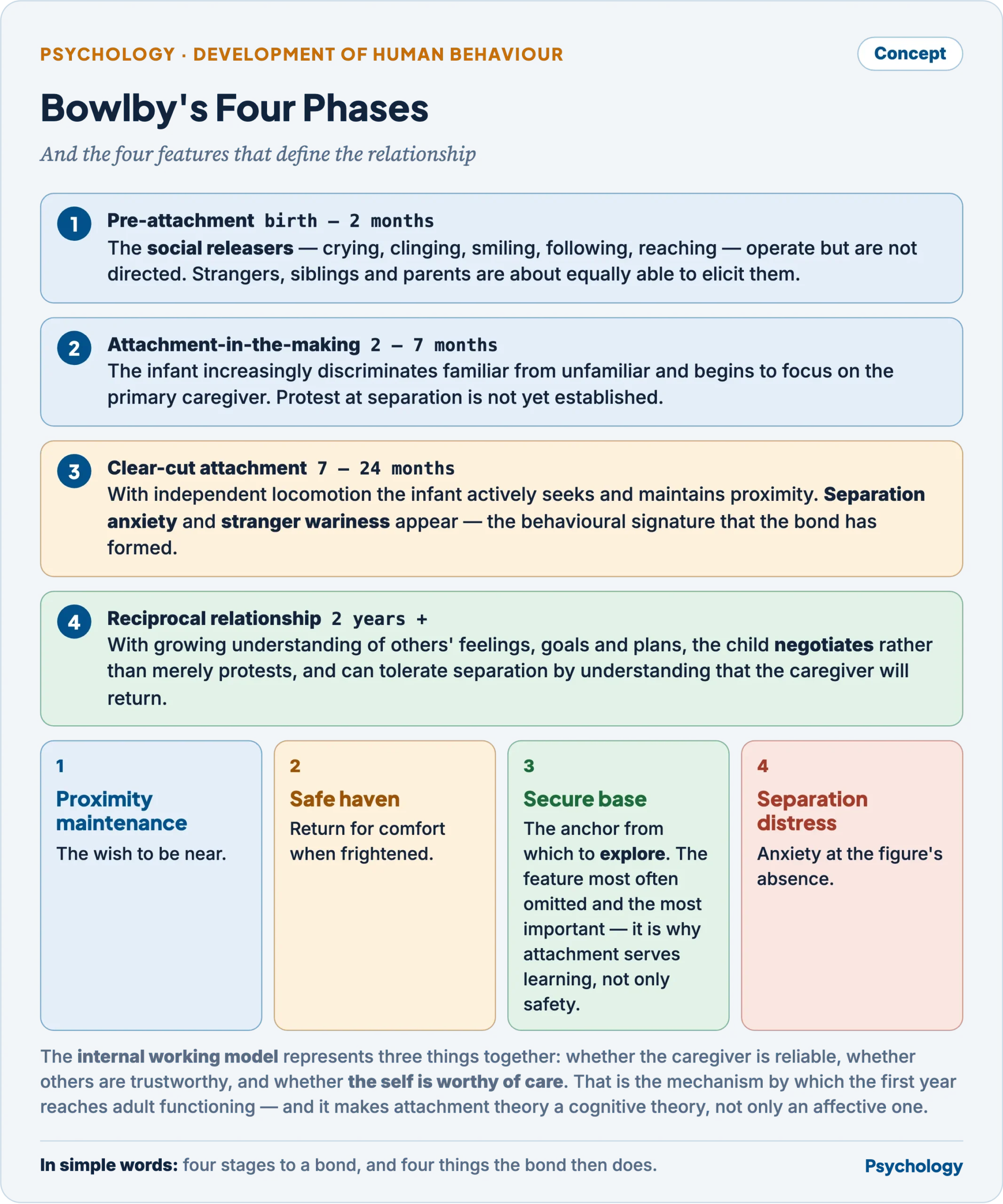
The bond develops in four phases.
- Pre-attachment, birth to about two months. The social releasers operate but are not directed: strangers, siblings and parents are about equally able to elicit crying or smiling.
- Attachment-in-the-making, about two to seven months. The infant increasingly discriminates familiar from unfamiliar and begins to focus on the primary caregiver, though protest at separation is not yet established.
- Clear-cut attachment, about seven to twenty-four months. With independent locomotion the infant actively seeks and maintains proximity to specific figures. Separation anxiety and stranger wariness appear, which is the behavioural signature that the bond has formed.
- Formation of a reciprocal relationship, from about two years. With growing understanding of others’ feelings, goals and plans, the child begins to negotiate rather than merely protest, and can tolerate separation by understanding that the caregiver will return.
Two further concepts carry most of the theory’s weight.
The internal working model is a cognitive-affective representation, built from the accumulated experience of the caregiver’s responsiveness, of three things together: whether the caregiver is reliable, whether others are trustworthy, and whether the self is worthy of care. This model then governs expectations in later relationships, which is the mechanism by which early experience reaches adult functioning. It is also what makes attachment theory a cognitive theory and not only an affective one.
Monotropy was Bowlby’s claim that the infant forms one principal attachment, hierarchically superior to others. This is the part of the theory that has fared worst; infants demonstrably form multiple concurrent attachments, to fathers, grandparents, siblings and professional caregivers, and the hierarchy is less rigid than he proposed.
The maternal deprivation hypothesis followed from monotropy: prolonged disruption of the primary bond in the first years was held to cause lasting cognitive, social and emotional damage. Bowlby’s own evidence was his Forty-Four Juvenile Thieves study, in which delinquents reported more early separations than controls. The study is retrospective, correlational and uncontrolled for the family conditions that produced both the separations and the delinquency, and Rutter’s reanalysis established the decisive correction: it is privation — the failure ever to form a bond — rather than deprivation — the loss of one already formed — that does the lasting damage, and much of the apparent effect was attributable to family discord rather than to separation itself.
Ainsworth’s Strange Situation
Mary Ainsworth converted the theory into a measurement procedure, which is why it generated a research literature where comparable theories did not. The Strange Situation is a twenty-minute laboratory sequence of eight episodes for infants of about twelve to eighteen months, involving two separations from the caregiver and two reunions, with a stranger present for part of it. Classification turns not on the amount of distress at separation but on reunion behaviour, which is the procedure’s key design insight. The three original patterns and their proportions are from Ainsworth, Blehar, Waters and Wall (1978).
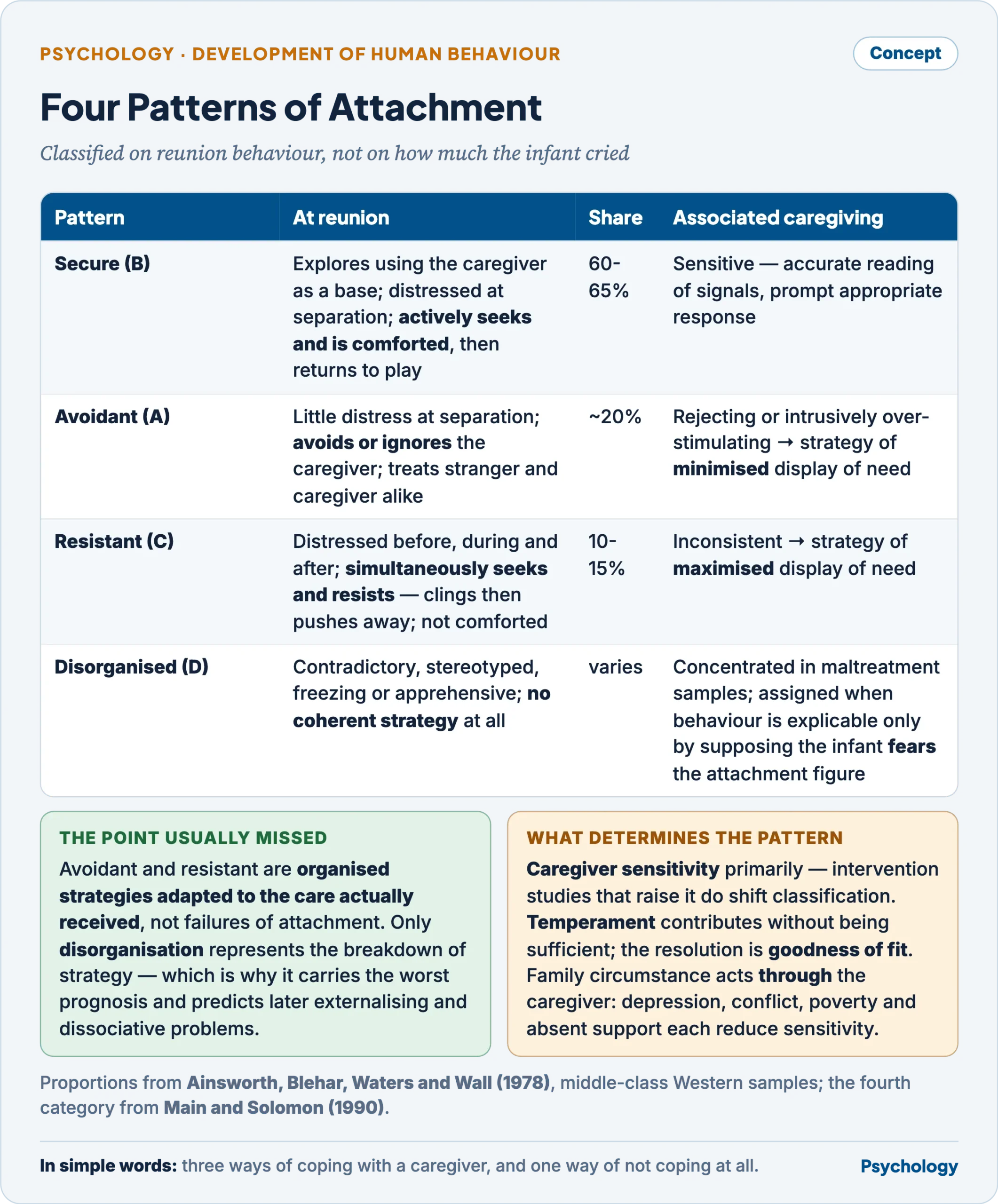
- Secure (Type B) — the infant explores readily using the caregiver as a base, checks back periodically, is distressed on separation, and actively seeks and is comforted by the caregiver on reunion, then returns to play. Roughly 60 to 65 per cent of middle-class Western samples (Ainsworth and colleagues, 1978).
- Insecure-avoidant (Type A) — the infant shows little distress on separation and actively avoids or ignores the caregiver on reunion, treating stranger and caregiver with little differentiation. About 20 per cent (Ainsworth and colleagues, 1978). Associated with caregiving that is rejecting or intrusively over-stimulating, to which the infant’s strategy is minimised display of need.
- Insecure-resistant or ambivalent (Type C) — the infant is distressed before separation, intensely distressed during it, and on reunion simultaneously seeks and resists contact, clinging and then pushing away, and is not comforted. About 10 to 15 per cent (Ainsworth and colleagues, 1978). Associated with inconsistent caregiving, to which the strategy is maximised display of need.
- Disorganised-disoriented (Type D), added by Main and Solomon (1990) from behaviour that the original three categories could not classify. The infant shows contradictory, stereotyped, freezing or apprehensive behaviour and appears to have no coherent strategy at all for managing the reunion. It is assigned when behaviour is inexplicable in context, or explicable only by supposing the infant is frightened of the attachment figure. It is concentrated in maltreatment samples and is the pattern most strongly predictive of later psychopathology.
The analytical point worth making is that avoidant and resistant patterns are organised strategies adapted to the care actually received, not failures of attachment. Disorganisation alone represents the breakdown of strategy, which is why it carries the worst prognosis.
What determines the pattern
- Caregiver sensitivity is the primary determinant on Ainsworth’s own account: the caregiver’s accurate reading of the infant’s signals and prompt, appropriate response. Experimental intervention studies that raise sensitivity do shift attachment classification, which is the strongest evidence that the direction of causation runs this way.
- Infant temperament is the main rival account, and the honest position is that it contributes without being sufficient. An irritable, highly reactive infant is harder to read and to soothe, and sensitivity is harder to sustain with one. The resolution is the goodness of fit between temperament and caregiving rather than either alone: sensitive and well-supported parents produce secure attachment with difficult infants, and difficult temperament predicts insecurity mainly where caregiving support is also poor.
- Family and economic circumstances act through the caregiver. Maternal depression, marital conflict, poverty and the absence of social support each reduce sensitivity, which is how structural disadvantage becomes an infant’s internal working model.
- Multiple caregivers do not in themselves produce insecurity. The quality of each relationship matters more than the number, and an infant may be secure with one figure and insecure with another.
What attachment predicts, and what it does not
This is where the significance question is actually answered, and overstating the evidence is the characteristic error.
The findings that hold up are these. Securely attached infants are, on average, later higher in self-esteem and self-reliance, more socially competent with peers, better at emotion regulation, somewhat higher in school achievement, and at lower risk of depression and anxiety. Early security predicts a stable, typical IQ profile in the Bucharest follow-up, where attachment security emerged as a significant predictor. Disorganised attachment predicts later externalising problems and dissociative symptoms. Attachment representations show continuity into adulthood, measurable by the Adult Attachment Interview, and parents’ own representations predict their infants’ classifications — the intergenerational transmission of attachment, which is the most striking single finding in the field.
The qualifications are equally established and must be stated.
- Effect sizes are modest. Attachment classification predicts later outcomes at correlations that leave most of the variance unexplained. It is a risk factor, not a determinant.
- Continuity is conditional on circumstances. Classification changes when family circumstances change, in either direction, which is exactly what a working-model account should predict since the model is revised by experience. Earned security — a coherent adult representation achieved despite poor early care — is documented, and it is the direct evidence against developmental fixity.
- Attachment is relationship-specific, not a trait. A child’s classification with mother does not determine their classification with father, which means the construct belongs to the dyad rather than to the child.
- The associations are confounded by continuing care. A securely attached infant usually continues to receive sensitive care, so later competence may reflect twelve further years of good environment rather than the first year’s bond. Randomised intervention is the only clean test, and there is little of it.
- Temperament and genetics account for part of the association, since both attachment-relevant caregiving and child outcomes have heritable components.
The defensible statement is therefore that attachment to parents matters substantially for social and emotional well-being, operates through an internal working model of self and others, and is a modifiable risk factor rather than a fixed determinant. That formulation is both supportable and more useful than the stronger claim, because it is the one that licenses intervention.
How the developmental theories account for it
Attachment looks different from each theoretical position, and the comparison is what a question on developmental theories is asking for.
- Psychoanalytic. For Freud the mother is the first love-object and the oral stage’s gratification sets the pattern, but the bond is secondary to drive reduction. For Erikson the same period is trust against mistrust, and the outcome — hope — is essentially what attachment theory calls a positive internal working model. Erikson and Bowlby describe the same phenomenon in different vocabularies, and this correspondence is the most useful single point of integration available.
- Learning theory. Attachment is acquired through association with the reduction of hunger and discomfort and maintained by reinforcement. Harlow’s contact-comfort result is decisive against the strong version, but the learning account retains force in explaining how specific interaction patterns are shaped within the relationship.
- Ethological. Bowlby’s own position: an evolved behavioural system with a set-goal, activated by threat and terminated by proximity, with a sensitive period for its formation.
- Cognitive. The internal working model is a schema, and its operation — directing attention, guiding interpretation, resisting disconfirmation — is schema operation as Bem and others describe it in other domains. This is why attachment expectations are self-confirming.
- Sociocultural. For Vygotsky the caregiver is the mechanism of development, so the secure base is the condition under which scaffolding within the zone of proximal development can occur. An insecurely attached child has a less usable teacher, which is a cognitive consequence of an affective fact.
- Ecological. For Bronfenbrenner attachment is a proximal process in the microsystem, whose quality depends on exosystem conditions — parental employment, hours, support — which is why attachment-focused intervention that ignores family circumstances underperforms.
The cross-cultural evidence
Attachment theory claims universality, and the test of it is the best-known meta-analysis in the field.
van IJzendoorn and Kroonenberg (1988) aggregated nearly 2,000 Strange Situation classifications from 32 samples in 8 countries. Three results matter.
- secure attachment was the most common classification in every culture examined, which supports the universality of the pattern if not of its distribution.
- The distribution of insecure types varied systematically: avoidant classifications were relatively more prevalent in Western European samples, resistant classifications relatively more frequent in Israeli and Japanese ones. Grossmann and colleagues (1981) found about half of a north German Bielefeld sample classified avoidant, and interpreted this as reflecting a cultural ideal of early self-reliance and interpersonal distance rather than insensitive parenting. Takahashi (1986), with 60 Japanese mother–infant pairs in Sapporo, found no avoidant classifications at all and an elevated resistant rate, with infants so unaccustomed to separation that the procedure sometimes had to be stopped.
- The decisive finding: intracultural variation was nearly one and a half times the cross-cultural variation. Samples from one country sometimes resembled samples from another country more than they resembled each other. This undercuts the whole framing of “German attachment” or “Japanese attachment”, and it means culture-level generalisations about attachment are weaker than variation within any culture.
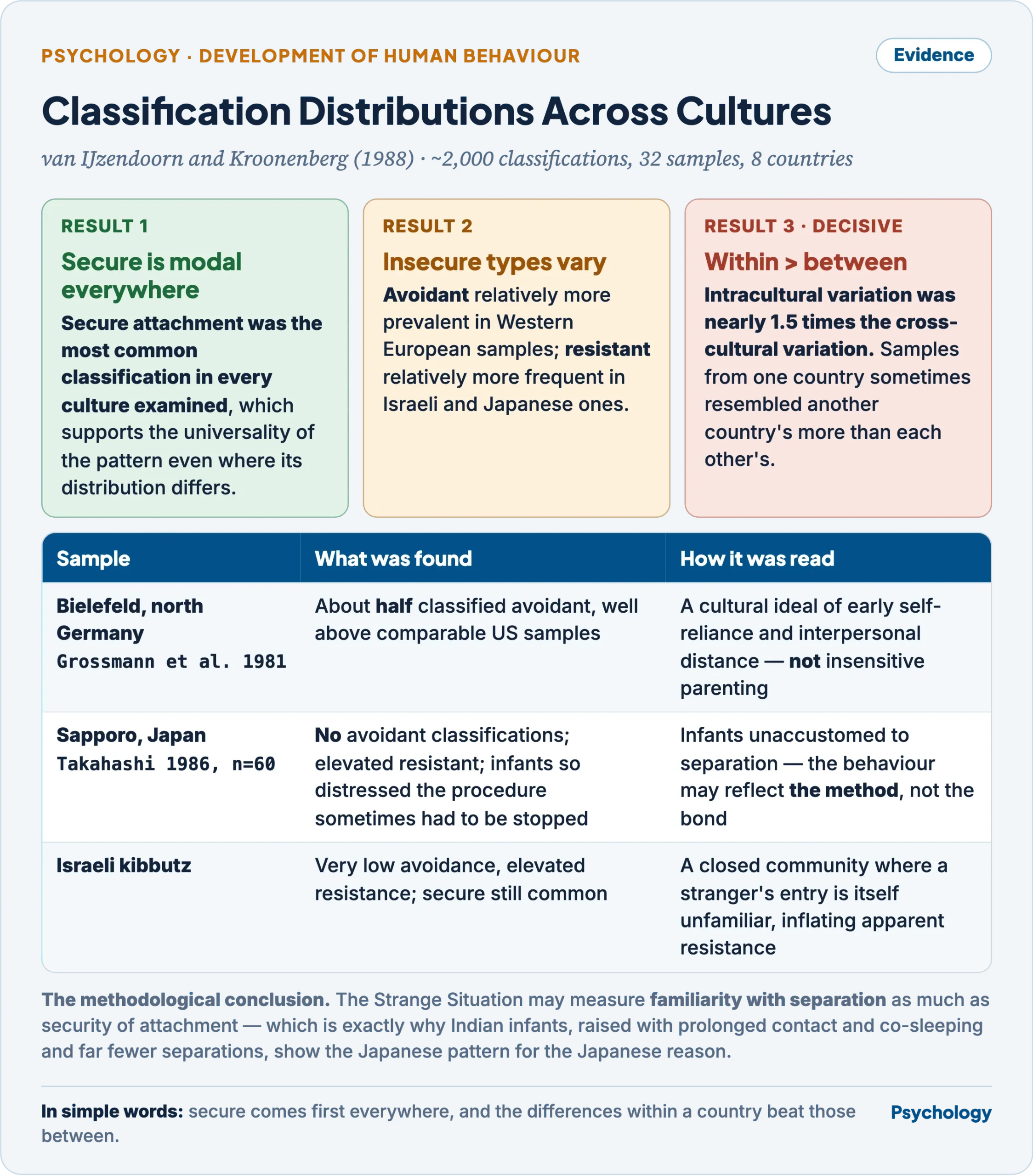
The methodological conclusion is that the Strange Situation may measure familiarity with separation as much as security of attachment, since an infant who has never been left alone will be distressed by the procedure for reasons that have nothing to do with the bond.
The Indian context
- Multiple caregiving is the norm, not a deviation. In joint and extended households an infant is cared for by grandmothers, aunts, older siblings and neighbours as well as the mother, so monotropy is a poor description and the relevant question is the quality of the network rather than of a single dyad.
- Prolonged contact and co-sleeping mean Indian infants experience far fewer separations than the Strange Situation presumes, which makes the procedure’s distress episodes unusually severe and inflates apparent resistance — exactly the Japanese pattern, for the same reason.
- Interdependence is the socialisation goal, so behaviour that a Western coding frame reads as excessive clinging may be the culturally appropriate outcome of successful caregiving. Applying the classification system without this correction produces an artefactual excess of insecurity.
- Maternal employment and migration can separate many infants from mothers for long periods, with care transferred to grandparents — an arrangement that the evidence suggests is protective where the substitute caregiver is stable and responsive, and damaging where care is fragmented.
- Institutional care. The Bucharest results and the Juvenile Justice Act’s statutory preference for family-based alternatives — kinship care, foster care, adoption — over institutionalisation point the same way, and the gap between that preference and practice is the clearest attachment-relevant policy issue in the country.
Criticisms and limitations
- Limited ecological and cross-cultural validity. It is a brief laboratory procedure in an unfamiliar room, it presumes separation is comparably stressful everywhere, and its distress episodes mean different things to infants with different separation histories.
- Monotropy is not supported. Infants form multiple concurrent attachments, and the claim of a single hierarchically dominant figure was both empirically wrong and socially consequential, having been used to argue against maternal employment and child care.
- An overstated hypothesis on weak evidence. The Forty-Four Thieves study is retrospective and confounded, and Rutter’s privation–deprivation distinction is the necessary correction.
- Categories for a continuum. Assigning an infant to one of four types discards information, and dimensional alternatives fit the data at least as well.
- Responsibility placed on mothers. The theory has been used to hold them answerable for outcomes substantially determined by poverty, support and circumstance, by locating causation in maternal sensitivity while treating the conditions that permit sensitivity as background.
- Weak prediction for a prominent theory. The predictive correlations are modest, continuity is conditional, and much of the association with later outcomes is attributable to the continuing environment rather than to the early bond.
- Under-researched fathers and other caregivers. The literature’s default dyad is mother and infant, which leaves the attachment network that most of the world’s children actually inhabit largely unstudied.
Previous Year Questions
- 2019What is the significance of attachment to parents in social and emotional well-being of a child? Illustrate from the perspective of developmental theories.
- 2013Discuss the importance of early relationship for developmental outcomes in the light of researches by Bowlby and Ainsworth.