

Modeling and social learning.
Official Syllabus: Paper I · Unit 6 Learning
“People are self-organizing, proactive, self-reflecting and self-regulating, not just reactive organisms shaped by environmental forces or driven by inner impulses.”
— Albert Bandura (2001), stating the agentic position in one sentence
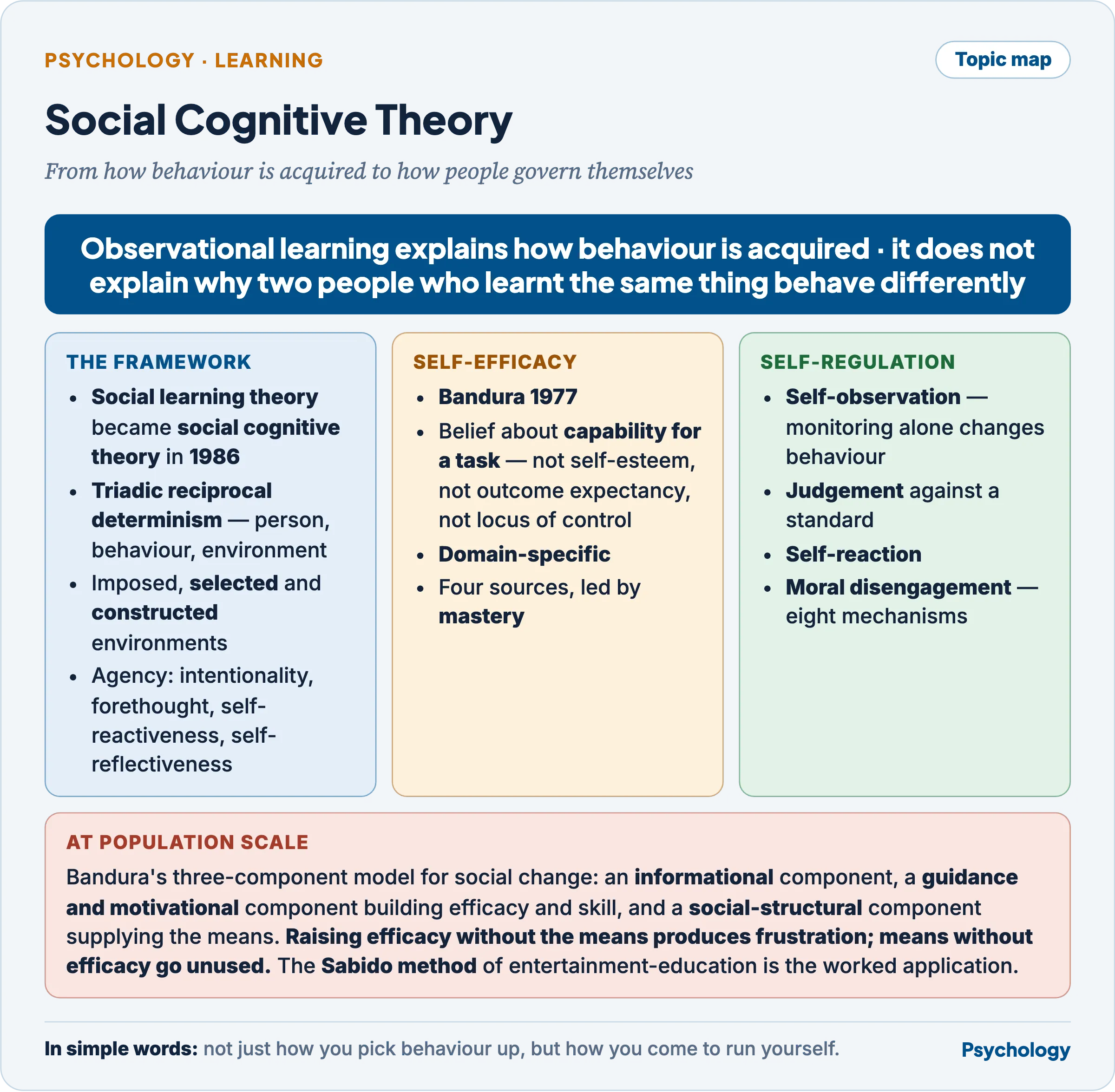
Observational learning explains how behaviour is acquired. It does not explain why two people who have learnt the same thing behave differently, why one persists at a difficult task and the other withdraws, or how people come to regulate themselves in the absence of any external contingency. Bandura’s answer was to rename and enlarge his own theory: social learning theory became social cognitive theory in 1986, with the publication of Social Foundations of Thought and Action, because the subject was no longer learning alone but the self-system through which people exercise control over their own functioning.
Triadic reciprocal determinism
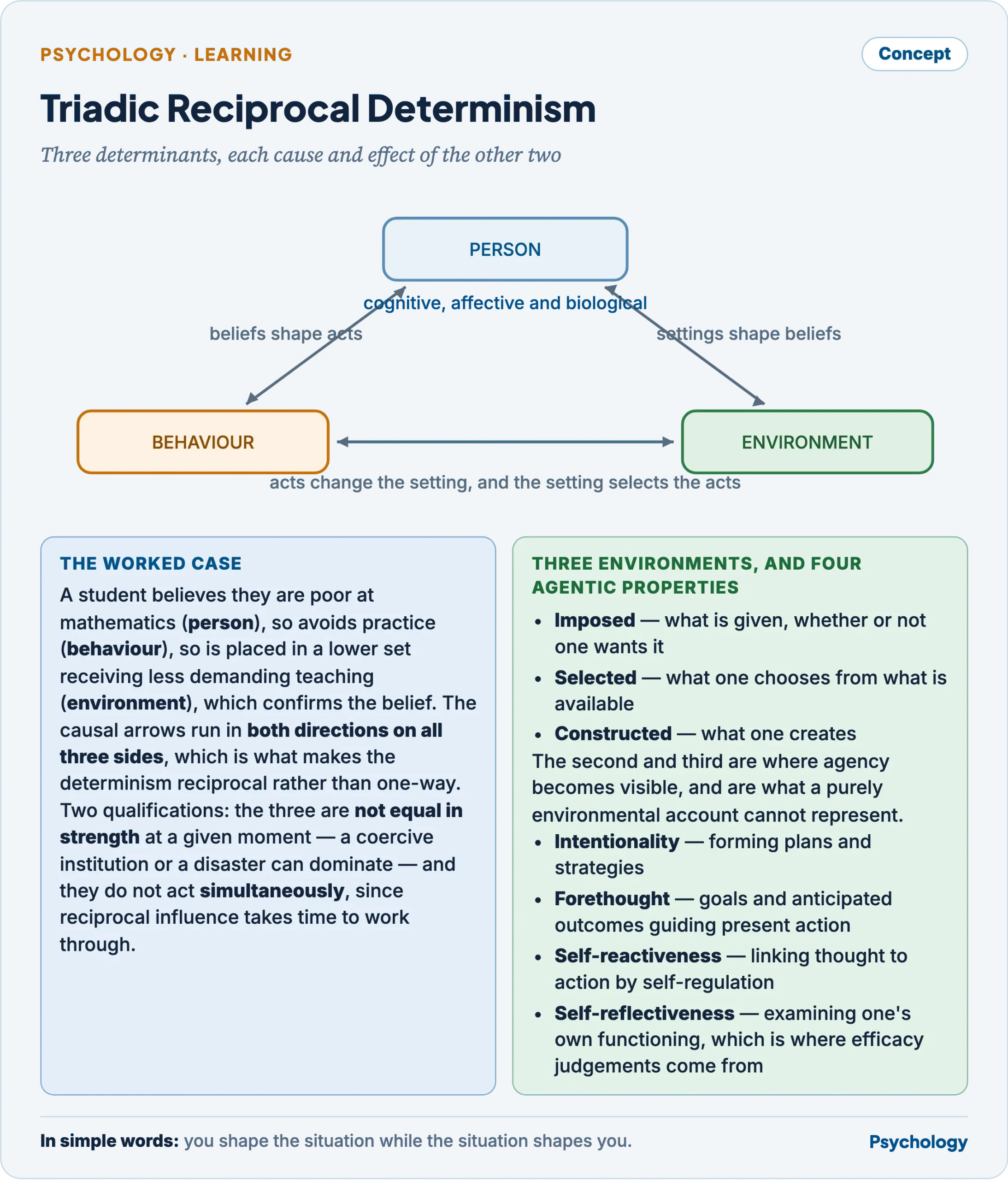
The framework rejects both the behaviourist account, in which the environment determines the person, and the psychodynamic account, in which inner forces do. Three sets of factors operate as interacting determinants of one another.
- Personal factors — cognitive, affective and biological: beliefs, expectations, goals, self-efficacy, temperament.
- Behaviour — what the person actually does.
- Environment — the physical and social setting, including the behaviour of others.
Each influences and is influenced by the other two. A student who believes they are poor at mathematics (person) avoids practice (behaviour), is placed in a lower set and attracts less demanding teaching (environment), which confirms the belief. The causal arrows run in both directions on all three sides, which is why the theory calls the determinism reciprocal.
Two qualifications matter. The three influences are not of equal strength at any given moment — a powerful environment can temporarily dominate, as in a disaster or a coercive institution — and they do not operate simultaneously, since reciprocal influence takes time to work through. Bandura distinguished the imposed environment, which is given; the selected environment, which the person chooses from what is available; and the constructed environment, which the person creates. The second and third are where agency is visible, and they are what a purely environmental account cannot represent.
Human agency is specified by four properties: intentionality, forming plans and action strategies; forethought, setting goals and anticipating outcomes so that the future guides present action; self-reactiveness, linking thought to action through motivation and self-regulation; and self-reflectiveness, examining one’s own functioning and the soundness of one’s own thinking. The fourth is the capacity on which self-efficacy judgements depend.
Self-efficacy
Self-efficacy is the belief in one’s own capability to organise and execute the courses of action required to produce given attainments — introduced by Bandura (1977) in Self-efficacy: toward a unifying theory of behavioral change and developed into the central construct of the theory.
It is routinely confused with three other constructs, and the distinctions are the substance of the topic.
| Construct | What it concerns | Example |
|---|---|---|
| Self-efficacy | Belief about capability for a specific task | “I can solve this class of problem” |
| Self-esteem | Judgement of self-worth | “I am a worthwhile person” |
| Outcome expectancy | Belief about what a behaviour will produce | “Solving them will get me a good grade” |
| Locus of control | Beliefs about what causes outcomes generally | “Grades depend on effort, not luck” |
Self-efficacy is domain-specific, not a global trait: a person may be highly efficacious as a cook and not at all as a public speaker. It is also not a measure of actual skill but of belief about skill, and the gap between the two is where the construct does its work.
Efficacy and outcome judgements, and how they combine
This pairing carries most of the theory’s predictive power.
- An efficacy expectation is the belief that one can perform the behaviour.
- An outcome expectation is the belief about what will follow if one does.
They are independent, and the four combinations predict four quite different states.
| High outcome expectancy | Low outcome expectancy | |
|---|---|---|
| High efficacy | Confident, productive engagement | Protest and activism — “I can do it but the system will not reward it” |
| Low efficacy | Self-devaluation — “it works for others, not for me” | Apathy |
The lower-left cell matters most practically. A person who believes a behaviour works but doubts their own capacity to perform it blames themselves, and the intervention required is a change in efficacy rather than in information. The upper-right cell is the social one: capable people facing an unresponsive environment turn to protest rather than to withdrawal, which is why efficacy beliefs are a variable in collective action and not only in individual achievement.
The experimental evidence for the distinction comes chiefly from Bandura’s treatment studies of snake phobia. Bandura, Adams and Beyer (1977) treated severe phobics by participant modelling, in which the therapist models contact with the snake and the client then performs it with guidance, and compared this with modelling by observation alone and with no treatment. Participant modelling produced the highest efficacy expectations and the most approach behaviour, and the central result was that efficacy expectations predicted which specific tasks a client would subsequently perform more accurately than past performance did — including on tasks never practised in treatment. Bandura and Adams (1977) extended this by raising efficacy through systematic desensitisation and again found approach behaviour tracked the efficacy judgement. Because all clients held the same outcome expectation throughout — everyone agreed that handling the snake would end the phobia — the variance in behaviour had to be carried by the efficacy judgement, which is precisely the separation the two constructs require.
The four sources
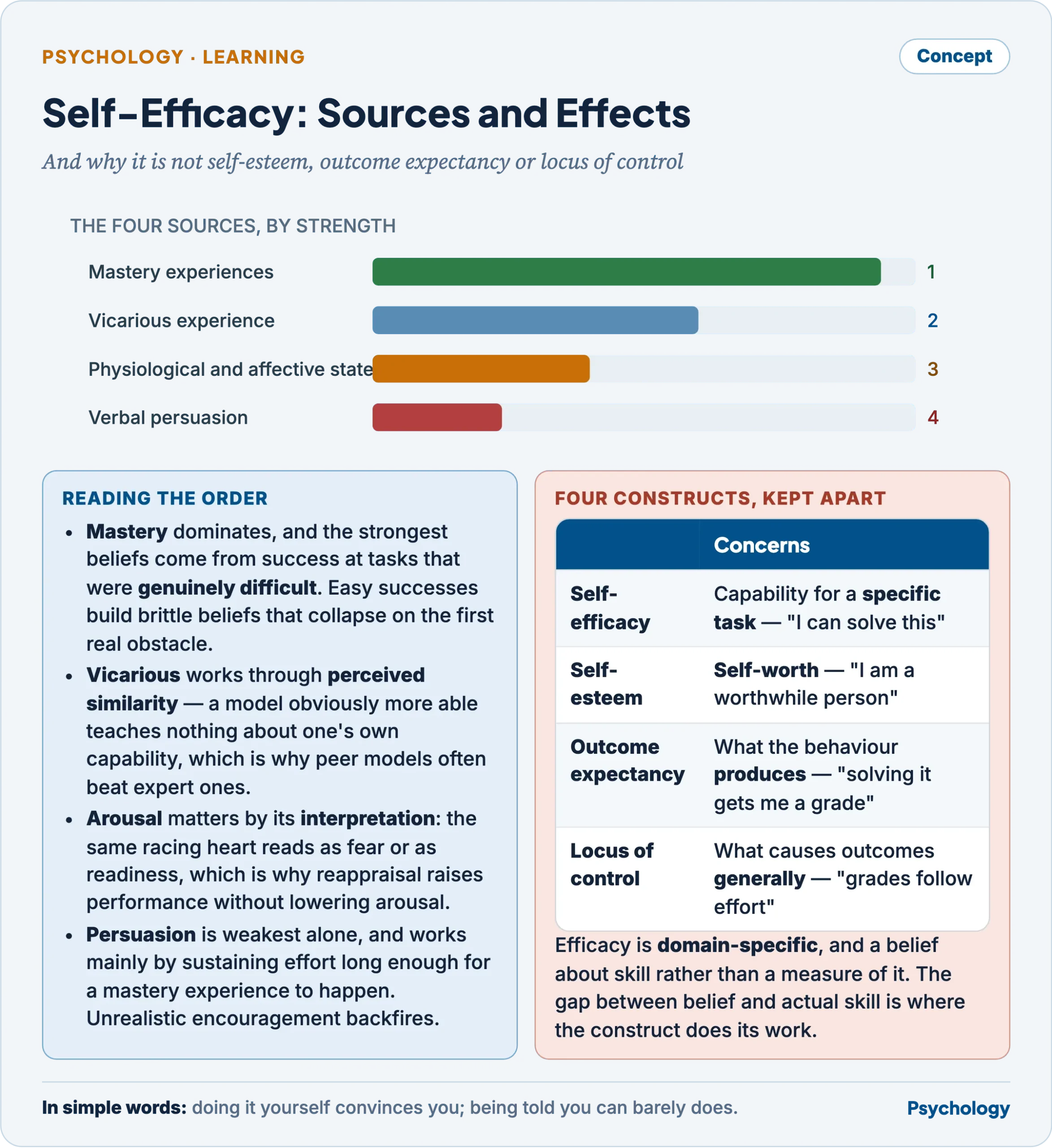
- Mastery experiences — one’s own successes and failures. The most powerful source by a wide margin. Success raises efficacy, failure lowers it, and the strongest beliefs come from success at tasks that were genuinely difficult. Easy successes teach that results should come quickly and produce brittle beliefs that collapse on the first real obstacle.
- Vicarious experience — observing similar others succeed. Its effect depends on perceived similarity: a model clearly more able than the observer teaches nothing about the observer’s own capability, which is why peer models often outperform expert ones for raising efficacy.
- Verbal or social persuasion — being told credibly that one is capable. The weakest of the four on its own, and effective mainly in sustaining effort long enough for a mastery experience to occur. Unrealistic encouragement is counterproductive, because the failure that follows damages both the belief and the persuader’s credibility.
- Physiological and affective states — arousal, fatigue, pain and mood are read as evidence about capability. It is the interpretation, not the arousal, that matters: the same racing heart can be read as fear or as readiness, which is why reappraisal training raises performance without reducing arousal.
What enhanced self-efficacy produces
- Choice. People avoid tasks and settings they believe exceed their capability and seek out those they do not, so efficacy beliefs shape the environments a person ends up in — and therefore what they go on to learn.
- Effort and persistence. Higher efficacy produces greater effort and, crucially, longer persistence under difficulty, which converts into actual attainment and raises efficacy further.
- Resilience after failure. Efficacious people attribute failure to effort or strategy rather than to fixed incapacity, and recover faster.
- Thought patterns and stress. Low efficacy generates intrusive worry and rehearsal of failure, which consumes the attentional capacity the task requires. The anxiety is thus partly a consequence of the efficacy belief, not only a cause of poor performance.
- Goal setting. Efficacious people set higher goals, and commit to them more firmly.
- Health behaviour. Efficacy is among the better predictors of smoking cessation, exercise adherence, dietary change and treatment compliance — which is why health interventions now target confidence in one’s ability to change alongside knowledge of why one should.
- Collective efficacy — a group’s shared belief in its joint capability — predicts what teams, classrooms, organisations and communities attempt and sustain, and is not the simple sum of individual efficacies.
Self-regulation
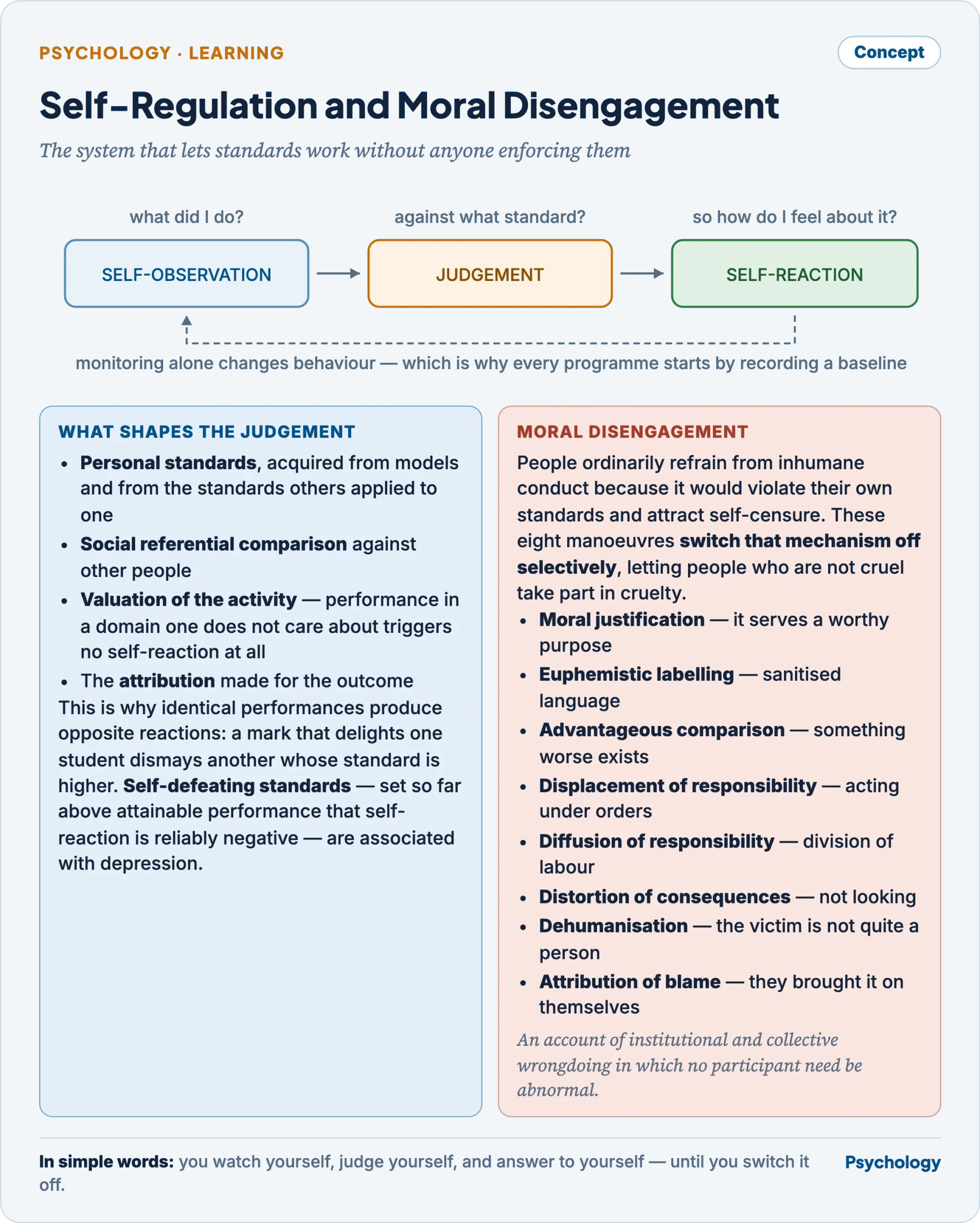
Most human behaviour is not under immediate external control. People work towards distant goals, keep standards no one is enforcing, and feel satisfied or dissatisfied with their own conduct. Self-regulation is the self-system by which this occurs, and it runs through three subfunctions.
- Self-observation. Monitoring one’s own behaviour — its quality, quantity, rate and consequences. Monitoring alone changes behaviour, which is the reason food diaries and step counters work and the reason the first step of almost any behaviour-change programme is to record the baseline.
- Judgemental process. Comparing what was observed against a standard. The judgement is shaped by personal standards, acquired from models and from the standards others have applied to one; social referential comparison against other people; the valuation of the activity, since performance in a domain one does not care about triggers no self-reaction; and the attribution made for the outcome.
- Self-reaction. Responding to one’s own judgement, with tangible or evaluative self-reward, or self-censure. Self-reactive influences are what give standards their motivating force: a standard that produces no self-satisfaction when met and no dissatisfaction when missed regulates nothing.
The system explains why externally identical performances produce opposite reactions: a mark that delights one student dismays another whose personal standard is higher. It also explains self-defeating standards — standards set so far above attainable performance that self-reaction is reliably negative, a pattern associated with depression.
Moral agency and moral disengagement
Bandura extended self-regulation to moral conduct, and the extension is the most socially useful part of the theory. People ordinarily refrain from inhumane conduct because doing it would violate their own standards and attract self-censure. Moral disengagement is the set of manoeuvres by which that self-regulatory mechanism is selectively switched off, allowing people who are not personally cruel to participate in cruelty.
- Moral justification — the conduct serves a worthy purpose.
- Euphemistic labelling — sanitised language that renders the act unrecognisable.
- Advantageous comparison — contrasting it with something worse.
- Displacement of responsibility — acting under orders.
- Diffusion of responsibility — division of labour, so no one acts alone.
- Distortion of consequences — not looking at, or minimising, the harm done.
- Dehumanisation — stripping the victim of human attributes.
- Attribution of blame — the victim brought it on themselves.
This supplies a psychological account of institutional and collective wrongdoing in which no participant need be abnormal, and it is directly usable in analysing bureaucratic harm, corporate misconduct and communal violence.
Self-regulated learning
Zimmerman developed the academic application as a cyclical process: a forethought phase of task analysis, goal setting and strategic planning, driven by efficacy beliefs; a performance phase of self-control and self-observation; and a self-reflection phase of self-judgement and self-reaction, which feeds back into the next cycle’s forethought. Self-regulated learners are distinguished less by ability than by having strategies, monitoring and adaptive attributions — all of which can be taught.
Applying the theory to large-scale social problems
Bandura’s own concern in later life was whether a theory of personal agency could be made to work at population scale, and the answer he developed is a worked model rather than an extrapolation.
- Entertainment-education. The Sabido method builds long-running serial dramas in which characters model a target behaviour and visibly experience its consequences. Its design is drawn directly from the theory: transitional characters who change during the story give the audience a model of the process of changing, not an already-virtuous state; vicarious reinforcement is supplied by showing the consequences; and each episode closes with an epilogue directing viewers to real services, so that raised efficacy meets an available route to act. Serials built this way have been associated with movement in literacy enrolment, family-planning uptake, HIV testing and attitudes to the status of women across several countries, including in Indian broadcasting.
- The three-component model for population change that Bandura set out: an informational component conveying what to do and why; a guidance and motivational component building the self-efficacy and skills to do it; and a social-structural component providing the services and supports that make the behaviour possible. Raising efficacy without the means produces frustration; means without efficacy go unused — the two must move together.
- Collective efficacy for community problems. Where a problem is beyond any individual — sanitation, local safety, environmental degradation — what predicts action is the community’s shared belief in its joint capability. Indian self-help group programmes operate on substantially this logic, and the visible early successes that build collective efficacy are the mechanism, not merely the result.
- Health and environmental behaviour. Efficacy-based interventions outperform information-based ones where the barrier is confidence rather than knowledge, which is the usual case in smoking cessation, exercise, sanitation adoption and water conservation.
- Education and organisations — efficacy-building instruction, peer modelling, teacher collective efficacy, and behaviour modelling training.
Criticisms and limitations
- The scope is wide enough to resist falsification. Triadic reciprocal determinism accommodates nearly any pattern of findings after the fact, and specifies few predictions that could fail.
- Causal direction is contested. Efficacy and performance are reliably correlated; whether efficacy beliefs cause performance, or chiefly reflect past attainment, is not fully settled, and some evidence suggests the effect of past performance is the larger part.
- Measurement is inconsistent. Efficacy is domain-specific by definition, so scales are written anew for each application, which makes findings hard to compare and invites items that are near-paraphrases of the outcome measure.
- Overconfidence is under-treated. The theory holds that slightly optimistic efficacy beliefs are adaptive, but substantially miscalibrated confidence produces poor preparation and real harm, and the theory says little about where the useful margin ends.
- Personal agency can obscure structural constraint. Where opportunity is genuinely absent, attributing outcomes to efficacy beliefs individualises a structural problem — a serious caution in contexts of caste, gender and poverty, and the reason Bandura’s own model insists on the social-structural component.
- Emotion and the unconscious are thin, and the theory’s person is more deliberative and better informed than people usually are.
- Cross-cultural scope. Agency in collectivist settings is often exercised jointly, not individually, and the collective-efficacy construct was a partial response to this; whether the self-system as described transfers intact to interdependent cultures remains an open question.
Previous Year Questions
- 2025Describe social cognitive theory and its applications to solve large scale societal problems.
- 2021What is self-efficacy? Discuss the potential benefits of enhancing self-efficacy.
- 2018According to Bandura, human beings often demonstrate impressive capacity for the self-regulation of their own behaviour. Evaluate.
- 2006Show how self-efficacy and outcome judgments influence the process of social learning. Answer with relevant experimental studies.