

Modeling and social learning.
Official Syllabus: Paper I · Unit 6 Learning
“Learning would be exceedingly laborious, not to mention hazardous, if people had to rely solely on the effects of their own actions to inform them what to do.”
— Albert Bandura (1977), on why conditioning cannot be the whole account
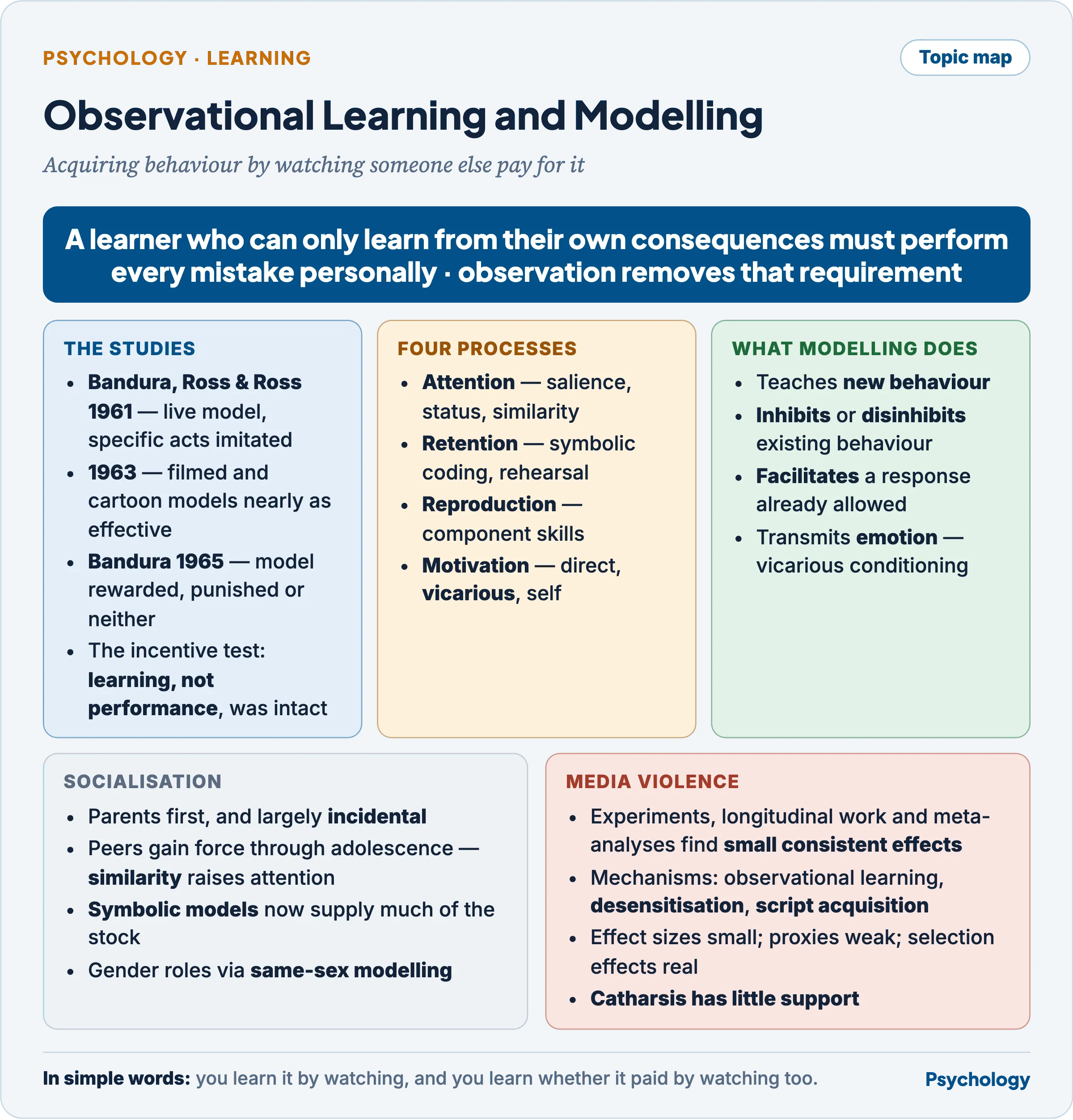
Conditioning requires the learner to perform the behaviour and experience its consequence. A great deal of what people learn is never performed first and never personally reinforced: a child acquires a language, a dialect, table manners, a gendered style of walking and a set of prejudices without being shaped into any of them. Observational learning is the acquisition of behaviour, emotions and expectations by watching others and the consequences they receive, and its demonstration is what ended behaviourism’s claim to be a complete theory of learning.
Observational learning, imitation and conditioning
Three terms are routinely treated as synonyms and are not.
- Imitation is copying an observed act, usually immediately and without regard to its consequences. It is behaviour, and it can occur without anything being learned.
- Observational learning is broader and primarily cognitive. The observer acquires a symbolic representation of the behaviour, with an expectation about what it produces, and may never perform it. It can produce behaviour quite different from the model’s — a child who sees a sibling punished for a prank may learn to be deceptive rather than to repeat the prank.
- Conditioning requires the learner’s own response and its own consequence.
| Conditioning | Social (observational) learning | |
|---|---|---|
| Who performs the behaviour | The learner | The model |
| Who receives the consequence | The learner | The model — the learner receives it vicariously |
| Trials needed | Many, with gradual acquisition | Often one |
| What is acquired | A strengthened connection | A symbolic representation and an expectancy |
| Performance required to learn | Yes | No |
| Role of cognition | Minimised, or denied | Central — attention, memory, expectation |
| New behaviour | Built up by shaping of existing responses | Can appear whole, never previously performed |
| Risk to the learner | Must experience the consequence | None — the cost is borne by the model |
The last row is the evolutionary argument for the mechanism. A species that could only learn which foods are poisonous by eating them would be at a severe disadvantage.
The Bobo doll studies
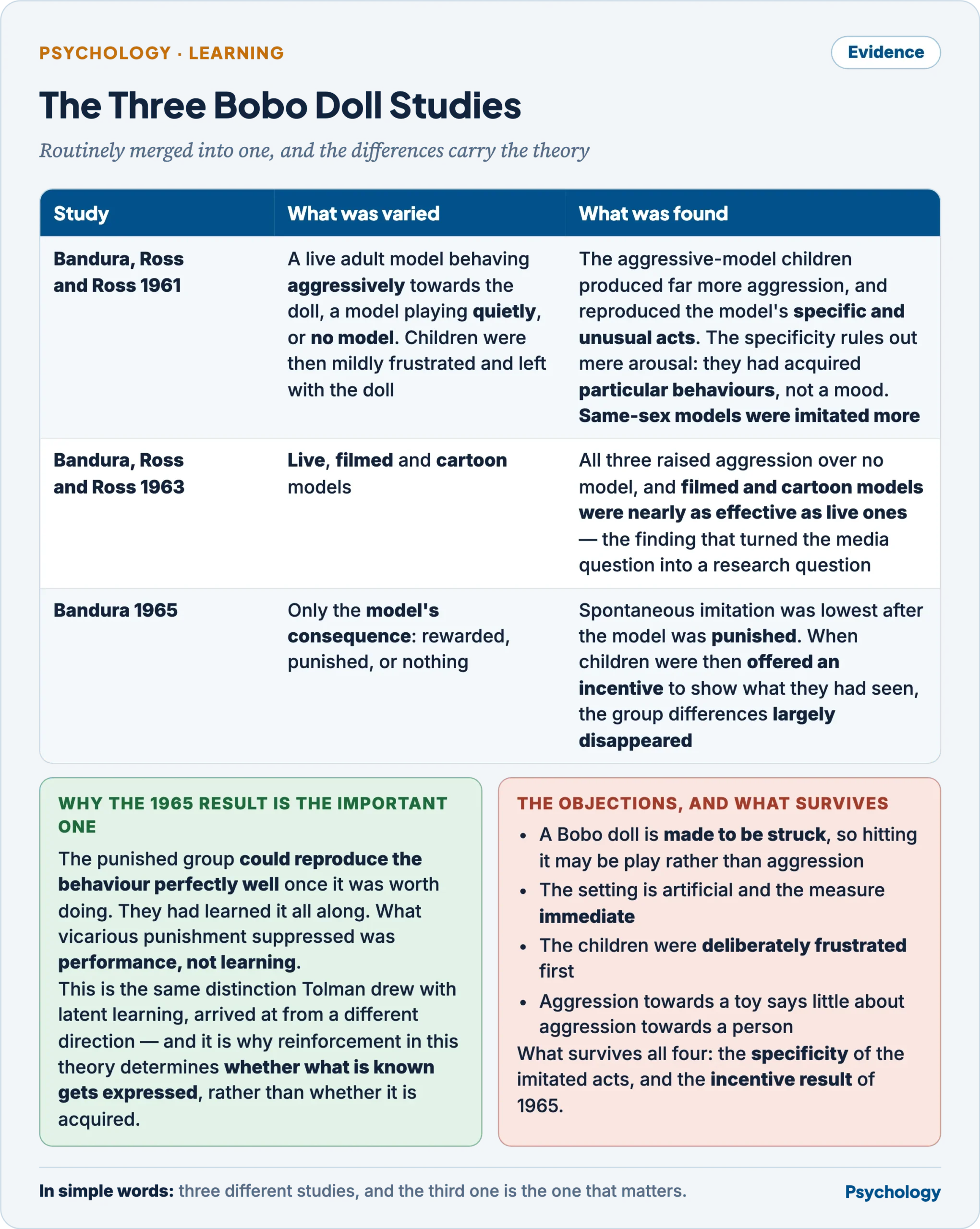
Three separate studies are routinely merged into one, and the differences between them carry the theory.
- Bandura, Ross and Ross (1961). Nursery-school children individually watched an adult either behave aggressively towards an inflatable Bobo doll — striking it with a mallet, kicking it, and using distinctive verbal aggression — or play quietly, with a third group seeing no model. Each child was then mildly frustrated by being shown attractive toys and then denied them, and left in a room containing a Bobo doll.
- Children exposed to the aggressive model produced far more aggression, and reproduced the model’s specific and unusual acts rather than generic aggression. The specificity is what rules out mere arousal: the children were not simply stirred up, they had acquired particular behaviours.
- Same-sex models were imitated more, and the effect was larger for boys, which bears directly on gender-role socialisation.
- Bandura, Ross and Ross (1963) compared live, filmed and cartoon models. All three produced more aggression than no model. Filmed and cartoon models were nearly as effective as live ones, which is the finding that made the media question a research question.
- Bandura (1965) altered only what happened to the model. Children saw the aggressive model rewarded, punished, or receive no consequence.
- Spontaneous imitation was lowest in the model-punished group — the expected vicarious effect.
- The children were then offered an incentive to reproduce what they had seen. The differences between the groups largely disappeared: the model-punished children could reproduce the behaviour just as accurately.
- This is the decisive result. The punished children had learned it all along: vicarious punishment suppressed performance, not learning. The learning–performance distinction is the single most examinable point in the series, and it is exactly the distinction Tolman had drawn for latent learning.
The studies attract real criticism — the Bobo doll is designed to be struck, so hitting it is arguably play rather than aggression; the setting is artificial and the measure immediate; the children were deliberately frustrated first; and aggression against a toy says little about aggression against a person. The specificity of the imitated acts, and the 1965 incentive result, survive these objections.
The four processes
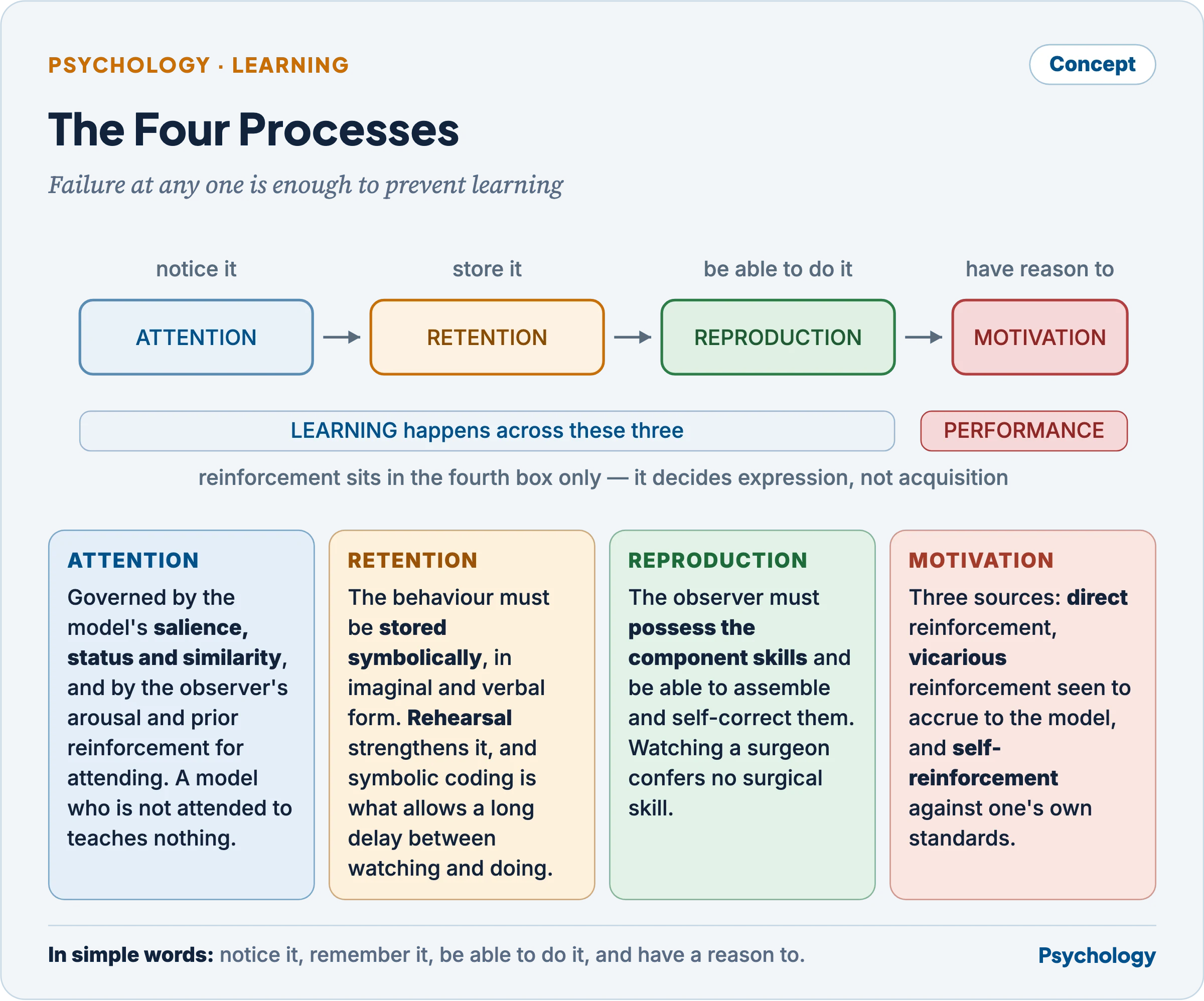
Observation produces learning only if four sub-processes succeed, and failure at any one is sufficient to prevent it.
- Attention. The behaviour must be noticed. Attention is governed by the model’s salience, status and similarity to the observer, and by the observer’s own arousal, sensory capacity and prior reinforcement for attending. A model who is not attended to teaches nothing, which is why high-status and similar models are more effective.
- Retention. The behaviour must be stored symbolically, in imaginal and verbal form, to be available later. Rehearsal — mental or physical — strengthens retention, and the capacity for symbolic coding is what allows a long delay between observation and performance.
- Motor reproduction. The observer must possess the component skills and be able to assemble and self-correct them. A learner may attend perfectly and remember perfectly and still be unable to perform — watching a surgeon does not confer surgical skill. Feedback and practice operate here.
- Motivation. The behaviour is performed only if there is reason to. Motivation comes from three sources: direct reinforcement, vicarious reinforcement observed to accrue to the model, and self-reinforcement according to the observer’s own standards.
Bandura’s departure from behaviourism sits in this last process. Reinforcement is not what stamps in the learning; it determines whether what has already been learned is expressed, and it works by creating an expectation of outcome. Reinforcement therefore moves from being the cause of learning to being one input to a decision.
What modelling does, beyond teaching new behaviour
- Observational learning effect — a genuinely new behaviour is acquired.
- Inhibitory and disinhibitory effects — a behaviour already in the repertoire becomes less or more likely after a model is punished or rewarded. Seeing someone get away with jumping a queue disinhibits; this is how norms loosen.
- Response facilitation — an existing, unprohibited behaviour is simply prompted, as when one person looking up makes a crowd look up.
- Vicarious emotional learning — emotional responses are acquired by observation. A child who watches a parent react with fear to a dog may acquire the fear without any direct aversive experience, and Mineka and Cook’s work with rhesus monkeys showed laboratory-reared monkeys acquiring a durable fear of snakes purely by observing a wild-reared monkey’s fearful reaction. This is vicarious classical conditioning — the model’s emotional display acts as the unconditioned stimulus — and it explains the many phobias whose owners report no frightening encounter of their own.
- Vicarious extinction, the therapeutic use of the same mechanism, in which a fearful observer watches a model interact calmly with the feared object. Participant modelling, where the observer then performs the behaviour alongside the model, is more effective than observation alone and is standard in the treatment of specific phobias.
Modelling in socialisation
Models are the principal route by which a culture transmits itself, because most of what a culture requires is never explicitly taught.
- Parents are the earliest and most imitated models, and the modelling is largely incidental — children acquire conflict styles, emotional expression, food habits, speech patterns and attitudes to work from behaviour the parent never intended to teach. The practical corollary is that modelling overrides instruction where the two conflict, which is why a parent who smokes while forbidding smoking is ineffective.
- Siblings and peers gain influence through adolescence, and peer models are powerful because similarity raises attention and perceived attainability.
- Teachers model far more than content — how to respond to not knowing, how to treat a wrong answer, how to disagree.
- Symbolic models in television, film, advertising and social media now supply a large share of the models a child encounters, and they are selected for salience rather than for suitability.
- Gender roles are acquired substantially through same-sex modelling, as the 1961 study showed in miniature, reinforced by differential treatment of imitation in boys and girls.
Media violence and aggression
The 1963 finding that filmed and cartoon models work nearly as well as live ones made this the most consequential application of the theory, and the most contested.
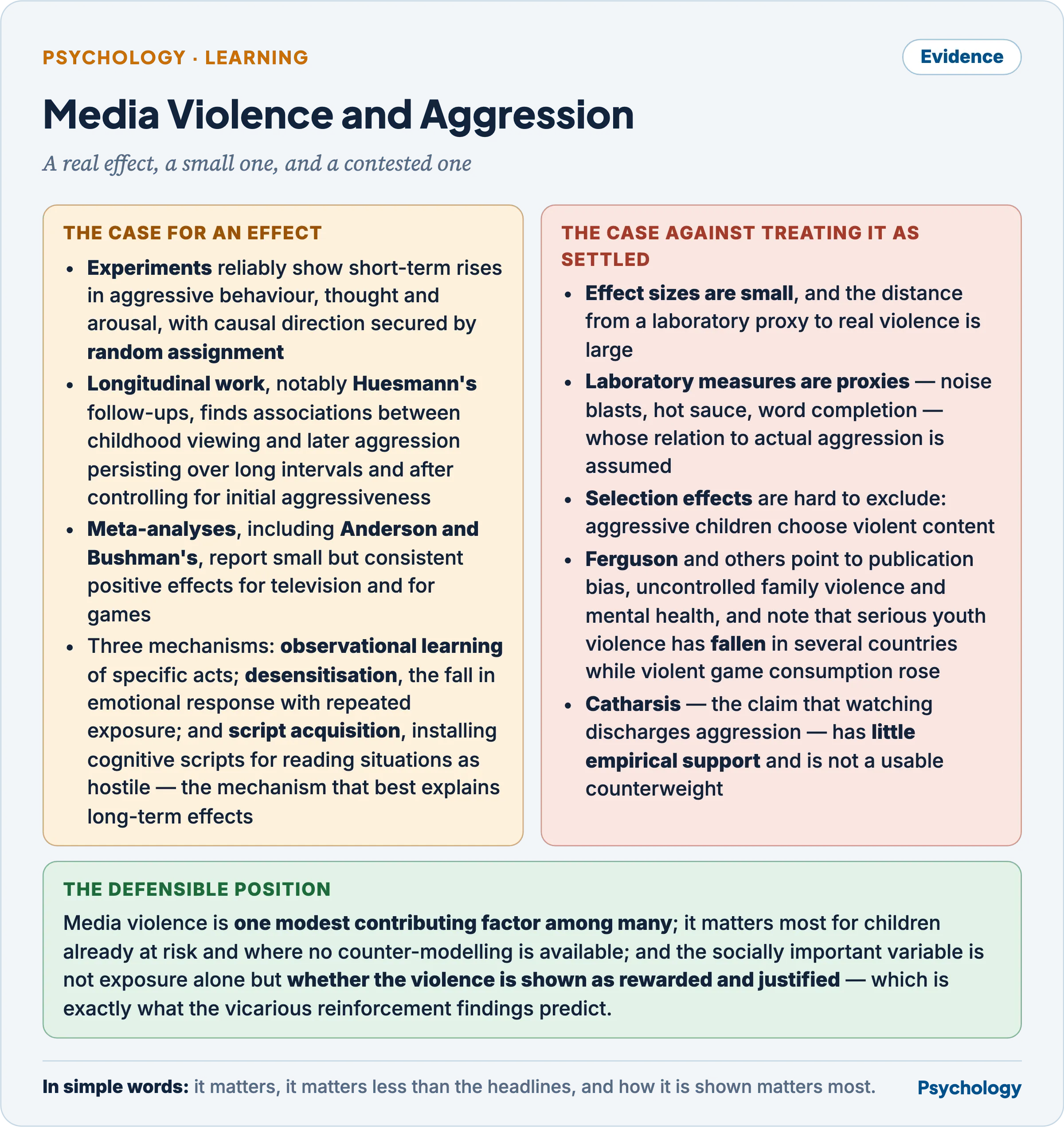
The case that media violence raises aggression.
- Experimental studies reliably show short-term increases in aggressive behaviour, thoughts and arousal after violent content, with the causal direction secured by random assignment.
- Longitudinal studies, notably Huesmann’s follow-ups, report associations between childhood viewing and later aggression persisting over long intervals and after controlling for initial aggressiveness.
- Meta-analyses, including Anderson and Bushman’s work on both television and video games, report small but consistent positive effects.
- Three mechanisms are proposed: observational learning of specific aggressive behaviours; desensitisation, the reduction of emotional response to violence with repeated exposure; and script acquisition, in which repeated exposure installs cognitive scripts for interpreting situations as hostile and responding aggressively — the mechanism that best explains long-term effects.
The case against treating it as settled.
- Effect sizes are small, and the gap between a laboratory increase in a proxy measure and real-world violence is large.
- Laboratory measures are proxies — noise blasts, hot sauce allocation, word completion — and their relation to actual aggression is assumed.
- Selection effects are difficult to exclude: aggressive children choose violent content, so the correlation runs in both directions.
- Ferguson and others argue the literature suffers from publication bias and from failure to control for family violence and mental health, and note that serious youth violence has fallen in several countries across the period when violent game consumption rose sharply.
- Catharsis, the opposite claim that watching violence discharges aggressive impulses, has little empirical support and should not be offered as a counterweight.
The defensible position is that media violence is one modest factor among many, that it matters most for children already at risk and where no counter-modelling is available, and that the socially important variable is not exposure alone but whether the violence is shown as rewarded and justified — which is precisely what the vicarious reinforcement findings predict.
What observational learning offers children, and what it costs them
- In its favour: it is rapid, often needing one exposure; it is safe, since the consequences are borne by the model; it allows complex sequences to be acquired whole; it transmits language, culture and skill faster than shaping could; and it permits positive modelling to be deployed deliberately, in prosocial behaviour, cooperation and emotional regulation.
- Against it: it is indiscriminate — undesirable behaviour is acquired by the same mechanism and as readily; children cannot evaluate the models they meet, or judge whether a behaviour is appropriate; symbolic models are selected for attention value, not suitability; the behaviour may be acquired without understanding, so it transfers where it is harmful; and inhibition is learned as easily as action, so a child who watches a parent’s helplessness may acquire that too.
The implication for adults is that modelling is not optional. A child in the presence of an adult is learning from them continuously, and the only variable under the adult’s control is what is modelled.
Applications
- Behaviour modelling training in organisations — demonstration, guided practice, feedback, transfer planning — is among the best-supported training methods in use.
- Therapy uses participant modelling for phobias, modelling in social-skills training, and video self-modelling, where the learner watches an edited recording of their own successful performance.
- Health and social change at scale. The Sabido method of entertainment-education builds serial dramas whose characters model a target behaviour and visibly experience its consequences, with transitional characters who change during the story so that the audience can identify with the change rather than only the outcome. Series built on this model have been associated with measurable movement in literacy enrolment, family-planning uptake and attitudes to the status of women, including in Indian broadcasting, and the method is Bandura’s own applied programme rather than a later borrowing.
- Classroom practice — worked examples, demonstration, peer modelling, and cognitive modelling in which the teacher thinks aloud through a problem rather than presenting the finished solution.
Criticisms and limitations
- The Bobo doll measure is weak, for the reasons given above, and a disproportionate share of the theory’s popular authority rests on it.
- The four processes describe rather than explain. They specify what must happen without specifying how retention or reproduction work, and the theory does not predict in advance which models will be imitated.
- It handles acquisition better than maintenance. What sustains a modelled behaviour over years is not well handled.
- Biological and temperamental factors are underweighted, and individual differences in imitativeness are left largely unexplained.
- Culture is treated thinly. Who counts as a model worth attending to, and what may be imitated across lines of age, gender and status, varies considerably — a point of real weight in Indian settings, where observational learning in joint families and in traditional craft apprenticeship operates through a different structure of models from the nuclear-family studies on which the theory was built.
- The research uses children, brief exposures, immediate measures, which is the weakest basis for the long-term claims the theory is used to support.
Previous Year Questions
- 2022“Learning occurs not only through conditioning but also from our observations of others.” Discuss this statement from children’s point of view. What are the pros and cons of observational learning for children?
- 2019What is vicarious learning? Discuss its applications in acquisition of emotional responses.
- 2015Review Bandura’s social learning theory and evaluate its impact on understanding aggression as a result of media generated violence.
- 2014Distinguish between ‘social learning’ and ‘conditioning’.
- 2008Explain Bandura’s theory using a suitable social learning task. Extend research support to your answer.
- 2005Citing relevant research study, discuss the significance of modeling in social learning.
- 2002What is observational learning? How does it differ from other forms of learning? Give three examples to explain its nature.
- 2001Discuss the role of vicarious reinforcement in social learning and modelling.
- 2000How do models help in the process of socialization?