

Encoding and remembering.
Official Syllabus: Paper I · Unit 7 Memory
“The key to retrieval is the match between the conditions of encoding and the conditions of retrieval.”
— Endel Tulving and Donald Thomson (1973), stating the encoding specificity principle
Memory is not one thing but a sequence of three operations, and almost every practical question about remembering turns out to be a question about which of the three has failed. Encoding converts an experience into a representation the system can hold; storage maintains it over time; retrieval recovers it when needed. Forgetting that looks like a single phenomenon is usually a failure at a specific stage, and the stages are separable both logically and experimentally.

The three processes, and what failure at each looks like
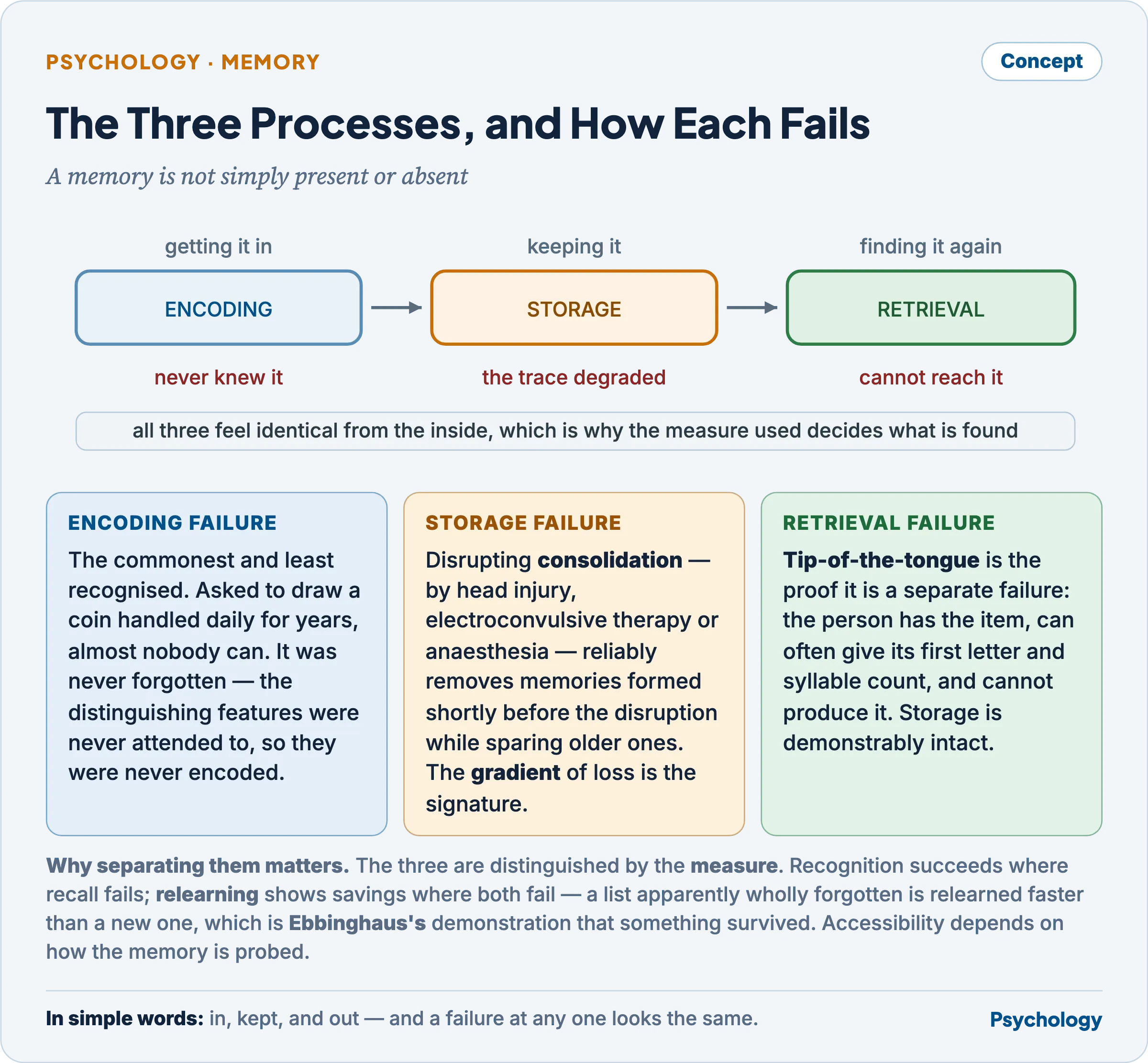
- Encoding — transforming input into a memory representation. It can be visual (what the thing looked like), acoustic (what it sounded like) or semantic (what it meant), and the same material can be encoded in any of these.
- Failure looks like never having known. A person who cannot describe the face of a coin they have handled daily for years did not forget it; they never encoded it, because the features that distinguish coins are not the features attention selects.
- Storage — maintaining the representation. Consolidation is the process by which a labile new trace becomes stable, depends on the hippocampus, and takes hours to years for different aspects of a memory.
- Failure looks like a trace degrading or being lost. Disrupting consolidation — by head injury, electroconvulsive therapy or anaesthesia — reliably removes memories formed shortly before the disruption while sparing older ones.
- Retrieval — recovering the representation. It is cue-driven, and a memory that cannot be reached with one cue may be reached with another.
- Failure is the commonest and the most misread, because it is indistinguishable from the inside from not knowing. The tip-of-the-tongue state is the proof that it is a distinct failure: the person demonstrably has the item, can often report its first letter and number of syllables, and cannot produce it.
Why separating them matters. The three are distinguished by the measure used. Recognition can succeed where recall fails, and relearning can show savings where both fail — a list once learned and apparently wholly forgotten is relearned faster than a new one, which is Ebbinghaus’s demonstration that something survived. A memory is therefore not simply present or absent; its accessibility depends on how it is probed.
What makes encoding effective
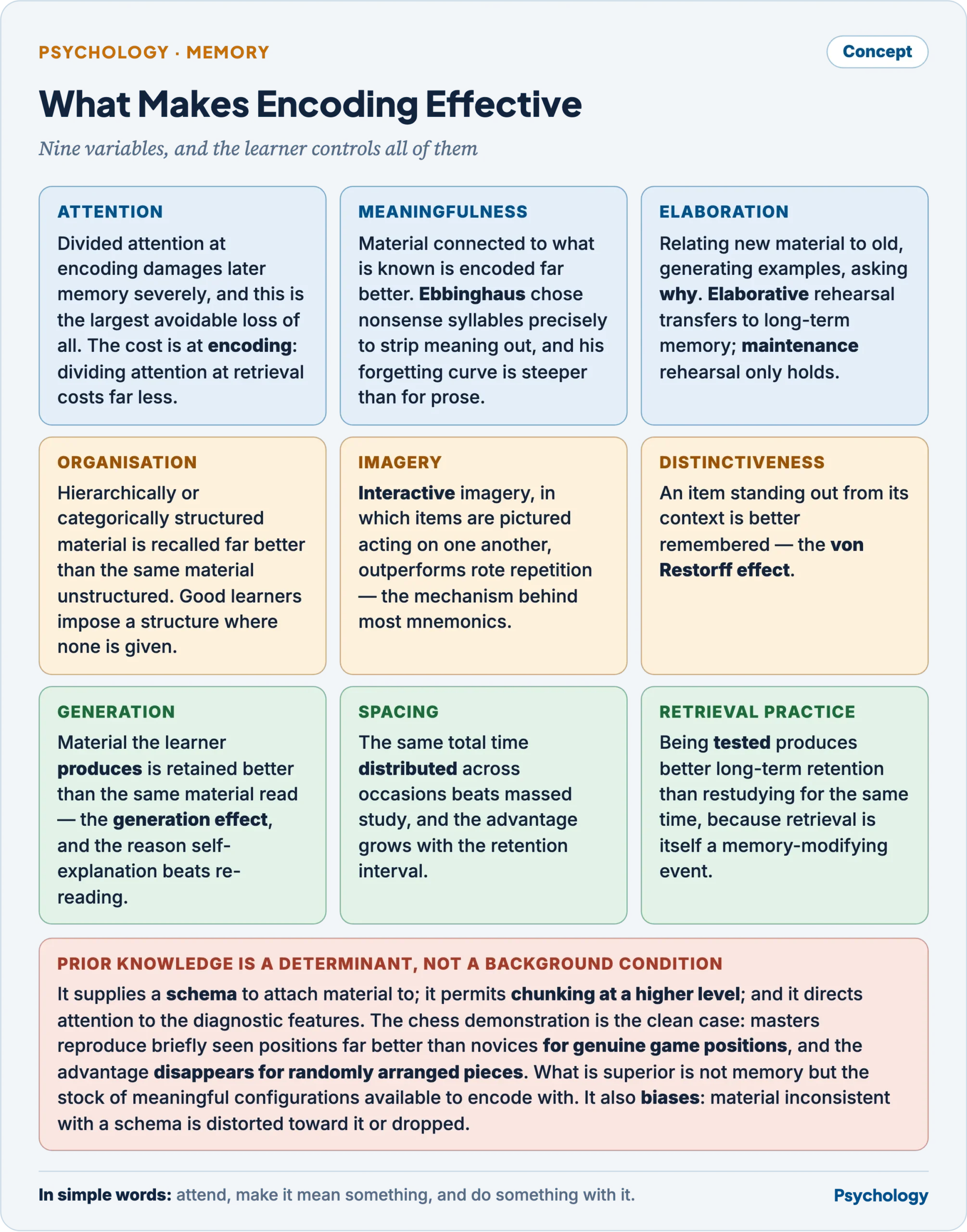
- Attention. Divided attention at encoding damages later memory severely, and this is the single largest avoidable loss. The effect is at encoding rather than retrieval: dividing attention during retrieval costs far less.
- Meaningfulness. Material connected to what is already known is encoded far better. Nonsense syllables were chosen by Ebbinghaus precisely to strip meaning out, and the forgetting curve he obtained is steeper than for meaningful prose.
- Elaboration. Relating new material to existing knowledge, generating examples and asking why a fact is true all improve retention beyond simple repetition. Elaborative rehearsal transfers material to long-term memory; maintenance rehearsal merely holds it.
- Organisation. Material structured hierarchically or categorically is recalled far better than the same material unstructured, and imposing a structure where none is given is what good learners do spontaneously.
- Imagery, especially interactive imagery in which items are pictured acting on one another, outperforms rote repetition — the mechanism behind most mnemonics.
- Distinctiveness. An item that stands out from its context is remembered better, the von Restorff effect.
- Generation. Material a learner produces is better retained than the same material read — the generation effect — which is why self-explanation beats re-reading.
- Spacing. The same total study time distributed across occasions produces substantially better long-term retention than massed study, one of the most robust findings in the field.
- Retrieval practice. Being tested on material produces better long-term retention than restudying it for the same time, because retrieval is itself a memory-modifying event.
Prior knowledge as a determinant of encoding
Prior knowledge is not a background condition on encoding; it is one of its main determinants.
- It supplies a structure to attach to. New information is assimilated to an existing schema, so a learner with relevant knowledge has somewhere to put the material and one without does not. The same passage is encoded very differently by readers who do and do not know its topic.
- It permits chunking at a higher level. The classic demonstration is expertise in chess: masters reproduce briefly seen board positions far better than novices for genuine game positions, and the advantage disappears for randomly arranged pieces. What is superior is not memory but the stock of meaningful configurations available to encode with.
- It directs attention to what matters, so an expert encodes the diagnostic features and a novice encodes surface detail.
- It biases as well as helps. Material inconsistent with a schema is distorted toward the schema or dropped, which is where encoding shades into reconstruction.
Emotional arousal
- Emotional events are generally remembered better than neutral ones, and the effect is mediated by the amygdala acting on hippocampal consolidation, with stress hormones released at the time of the event strengthening the trace afterwards.
- The relationship is not linear. Moderate arousal aids memory; very high arousal impairs it, and does so selectively — Easterbrook’s cue-utilisation hypothesis holds that arousal narrows the range of cues attended to, so central details are sharpened while peripheral ones are lost. Weapon focus, in which a witness recalls the weapon vividly and the face poorly, is the applied case.
- Flashbulb memories — vivid, detailed, confidently held recollections of learning of a shocking public event, described by Brown and Kulik (1977) — show the limit of the arousal benefit. Studies that record accounts immediately and re-test them years later find the accounts change substantially while confidence does not fall. Emotional arousal raises vividness and confidence more reliably than it raises accuracy.
Storage: consolidation and reconsolidation
Storage is the stage most often skipped in an account of memory, and it is where some of the strongest biological evidence sits.
- Consolidation is the conversion of a new, labile trace into a stable one. It operates at two scales: synaptic consolidation over minutes to hours, involving protein synthesis at the synapse, and systems consolidation over months to years, during which the hippocampus progressively hands the representation over to distributed neocortical stores.
- The evidence is the gradient of loss. Disruption shortly after learning — head injury, electroconvulsive therapy, certain drugs — removes recently formed memories and spares older ones. That temporally graded retrograde amnesia is what systems consolidation predicts and a simple storage account does not.
- Sleep supports consolidation. Material learned before sleep is retained better than material learned before an equivalent period of waking, and the hippocampal replay of recent sequences during sleep is the proposed mechanism.
- Reconsolidation. A memory retrieved returns to a labile state and must be stabilised again. This is a genuine amendment to the classical picture: it means the stored trace is not fixed once consolidated, that each retrieval is an opportunity for modification, and that the memory which returns after recall is not quite the one that was recalled. It supplies the storage-level mechanism for the reconstruction findings, and it is the basis of experimental attempts to weaken traumatic memories by disrupting reconsolidation after deliberate retrieval.
Encoding specificity, and why context matters
Tulving and Thomson (1973) stated the encoding specificity principle: a retrieval cue is effective to the extent that it was encoded as part of the original episode. The implication runs against intuition — a strong associate of the target can be a worse cue than a weak one that was present at encoding.
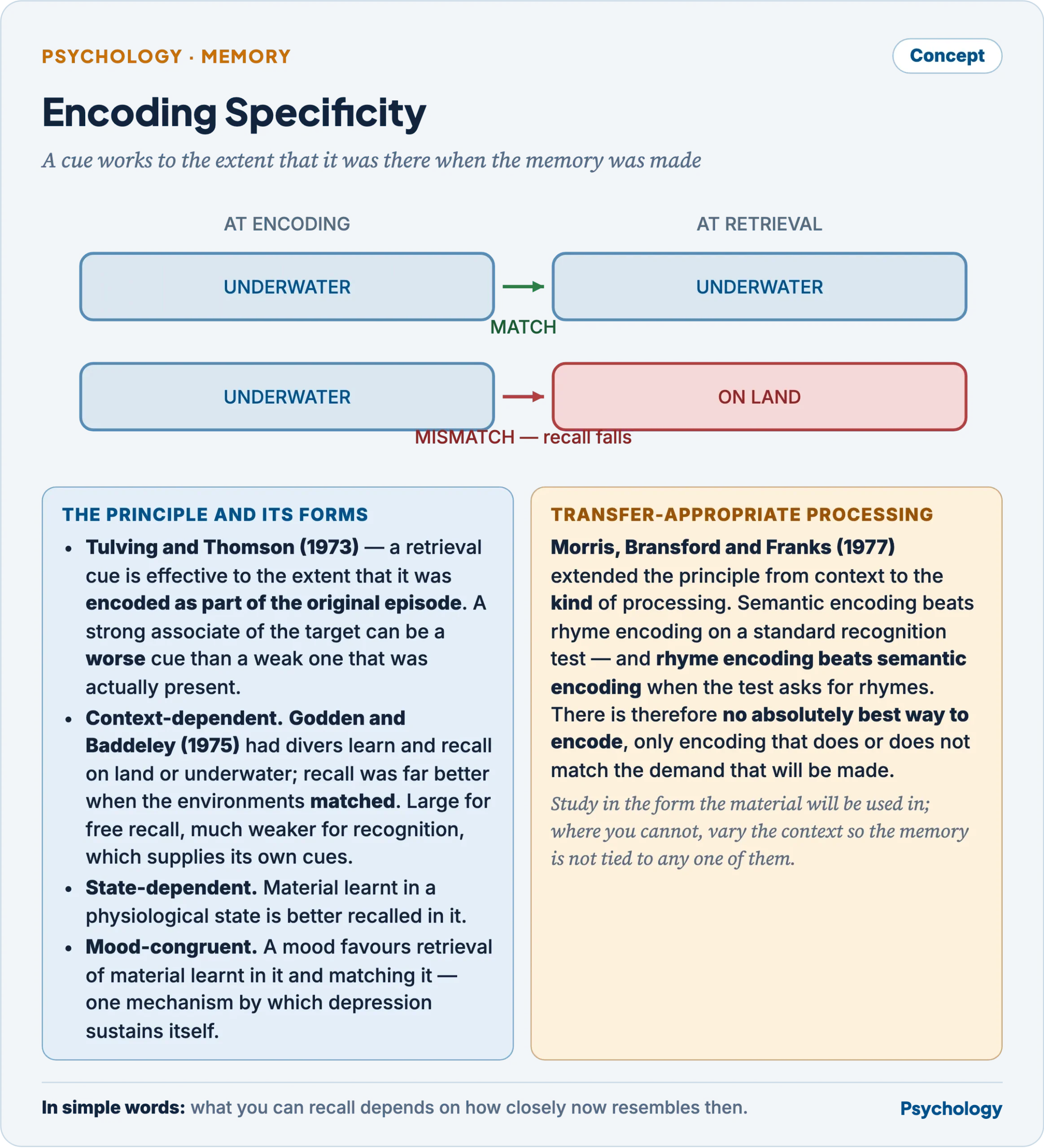
- Context-dependent memory. Godden and Baddeley (1975) had divers learn word lists on land or underwater and recall in the same or the other environment. Recall was substantially better when the environments matched. The effect is large for free recall and much weaker for recognition, which supplies its own cues.
- State-dependent memory. Material learned in a particular physiological state — intoxicated, caffeinated, aroused — is better recalled in that state.
- Mood-congruent and mood-dependent memory. A given mood favours retrieval of material learned in that mood, and of material matching it in tone, which is one mechanism by which depression sustains itself.
- Transfer-appropriate processing. Morris, Bransford and Franks (1977) showed the principle generalises beyond context to the kind of processing: semantic encoding beats rhyme encoding on a standard recognition test, and rhyme encoding beats semantic encoding when the test asks for rhymes. There is therefore no absolutely best way to encode — only encoding that does or does not match the demand that will be made.
The practical consequence is specific: study conditions should resemble the conditions of use, and where they cannot, encoding should be varied across contexts so that the material is not tied to any one of them.
What infant memory shows about adult memory
Infants cannot be asked what they remember, so the methods built to study them measure memory through behaviour alone — and that constraint turned out to be productive.
- Rovee-Collier’s conjugate reinforcement paradigm attaches a ribbon from an infant’s ankle to a mobile, so that kicking moves it. Infants learn the contingency quickly, and when the mobile is presented later without the ribbon, kicking rate measures retention. Infants as young as two to three months show retention over days, and the interval lengthens steadily with age.
- Deferred imitation — reproducing an action seen earlier, after a delay — demonstrates representation held across time without language.
- Both show context dependence far stronger than adults’: changing the cot liner or the room can abolish the infant’s retention entirely, and a brief reminder reinstates it.
What this contributes to the study of adult memory.
- It shows that memory is not created by language, and that an account of adult memory resting on verbal report is studying one output of the system rather than the system.
- It gives converging, non-verbal measures — reinstatement, savings, deferred imitation — that can be applied to adults, to amnesic patients and across species, which is what makes memory comparable at all between populations that cannot be interviewed in the same way.
- It reframes infantile amnesia, the near-absence of adult recall for events before about three. The infant evidence shows the events were encoded and retained at the time, so the adult failure is not a failure to form memories. The better explanation is a retrieval failure: the cues and the self-concept available to the adult do not match those under which the material was encoded, together with the maturation of the hippocampal and frontal systems that support autobiographical memory.
- It supports a continuity view — the same basic processes operating throughout life with changing capacity and strategy — over a view in which adult memory is a different kind of system.
The honest qualification: these are implicit, procedural measures, and inferring the presence of adult-style declarative memory from them overstates what was shown. The novel approaches are methodological rather than a claim that infants remember as adults do.
Criticisms and limitations
- The three-process division is a convenience. The processes are not independent: how material is encoded determines which cues will retrieve it, and retrieval alters the trace it recovers.
- Encoding and retrieval failures are hard to separate in practice, because the evidence for encoding is almost always a retrieval measure.
- Most of the evidence is from word lists studied in laboratories, and generalisation to autobiographical and skill memory is assumed more often than demonstrated.
- Encoding specificity is sometimes stated too strongly. The context effect is robust for free recall and weak or absent for recognition, so advice to reinstate the examination room at study time overstates a real but narrow finding.
- Flashbulb memory illustrates the field’s recurring problem: confidence, vividness and accuracy dissociate, and only the first two are available to introspection.
- Indian research in the area is thin, and the one place where it bears directly on practice — the heavy reliance on rote memorisation in schooling, which produces maintenance rather than elaborative rehearsal and therefore poor retention and poorer transfer — is more often asserted than measured.
Previous Year Questions
- 2017Explain the role of meaningfulness and emotional arousal in encoding. Discuss the implications of encoding specificity principle.
- 2015How far do you agree with the contention that research findings on infant memory can present novel approaches toward analyzing adult memories? Corroborate your answer with examples.
- 2020How does prior knowledge shape encoding in memory?
- 2013What factors contribute to the encoding of information into LTM?
- 2010How would you process information for maintaining it for long-term usage?
- 2003Explain the basic processes involved in remembering and also highlight the phenomenon which may occur when any one of the basic processes fails to operate properly.