

Encoding and remembering.
Official Syllabus: Paper I · Unit 7 Memory
“Remembering is not the re-excitation of innumerable fixed, lifeless and fragmentary traces. It is an imaginative reconstruction.”
— Frederic Bartlett (1932), in Remembering
The intuitive model of memory is a recording: an event is captured, stored intact, and played back more or less faithfully, with forgetting as the loss of parts of the recording. Almost every finding in this area contradicts that model. What is stored is partial and interpreted, what is recovered is assembled from that partial trace together with knowledge, expectation and information acquired since, and the assembly is indistinguishable from the inside from a recording.
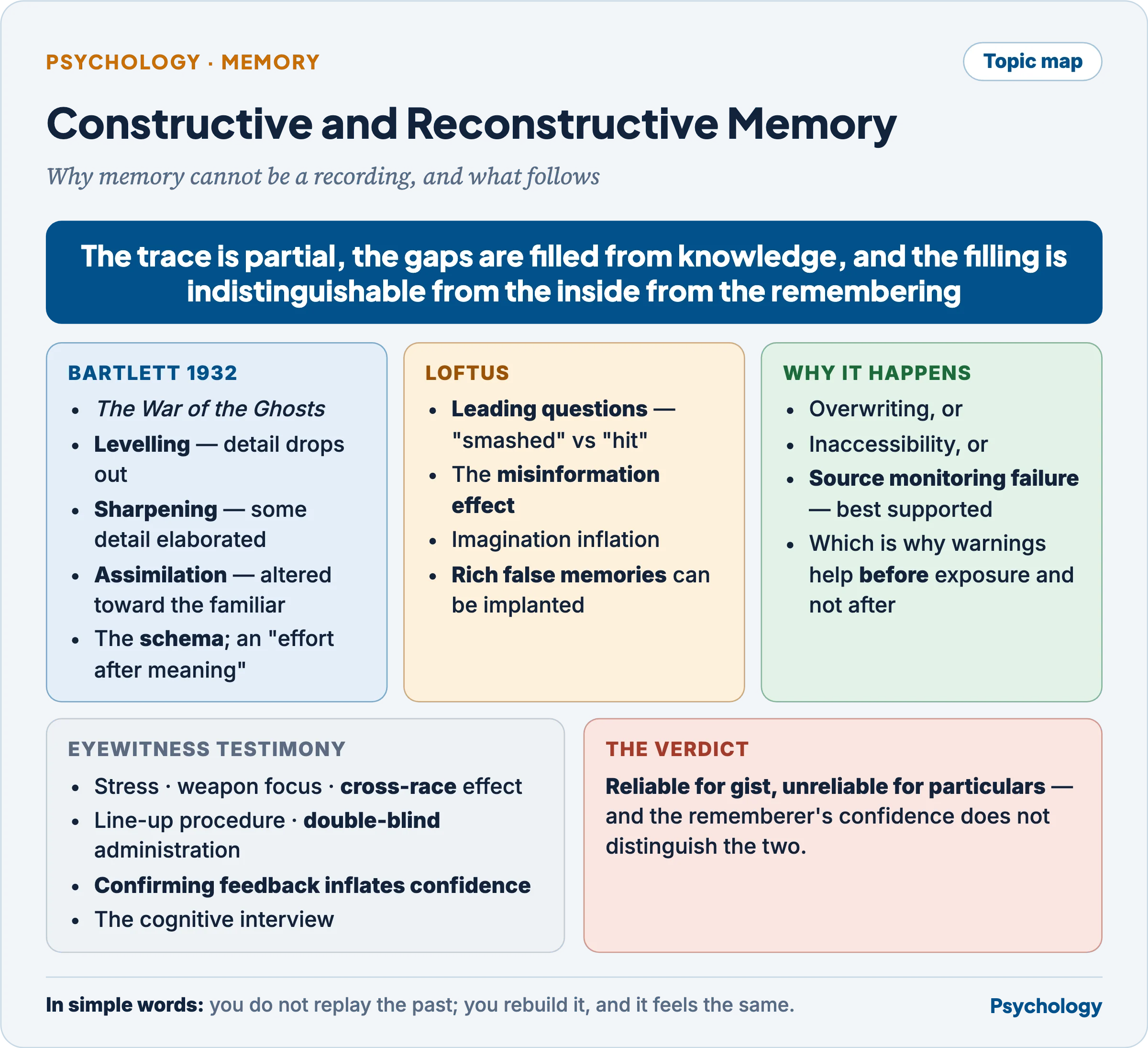
Why memory cannot be a recording
- The trace is incomplete from the start. Attention selects a fraction of any event, and only what was encoded can be stored. A recording device does not choose.
- The gaps are filled rather than left blank. Recollection is normally continuous and coherent, which a partial record could not be unless something supplied the missing material.
- What is supplied comes from general knowledge, so the filled-in content is plausible rather than accurate — and plausibility is precisely what makes the error undetectable.
- The trace is altered by its own retrieval. Recalling a memory returns it to a labile state from which it is reconsolidated, so each recollection can incorporate the conditions of that recollection. A recording is not changed by being played.
- Confidence does not track accuracy. A reconstructed detail feels exactly like a remembered one, because the system has no tag marking which is which.
The slogan that memory is “not a tape recorder” is therefore not a caution about unreliability. It is a claim about mechanism: the system is built to extract and retain meaning, discarding surface detail, because meaning is what is usually needed. The errors are the cost of a design that is otherwise efficient.
Bartlett and the schema
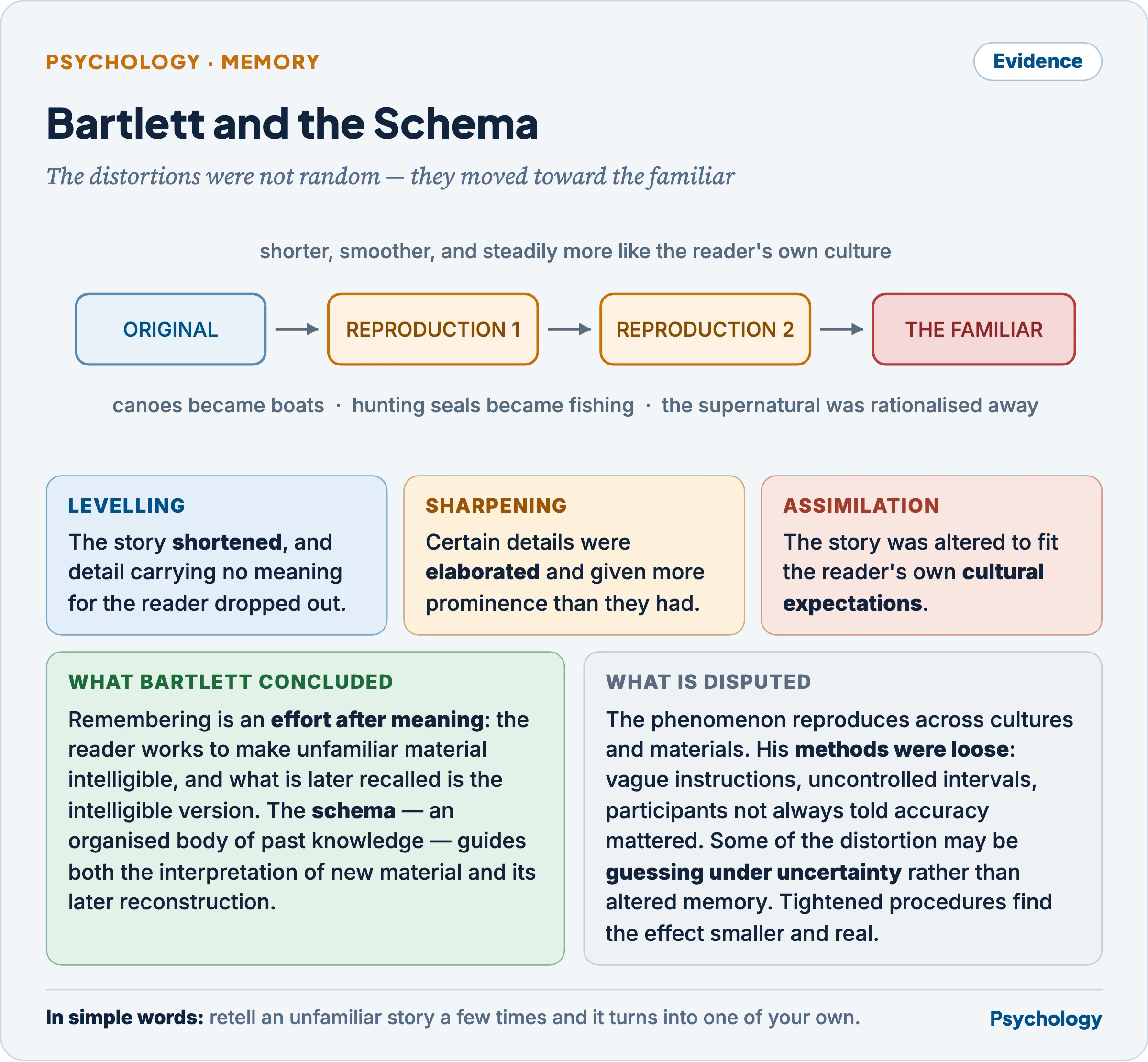
Frederic Bartlett (1932) had English participants read The War of the Ghosts, a Native American folk tale whose narrative conventions and supernatural content were unfamiliar to them, and reproduce it after varying intervals — repeated reproduction by the same participant over time, and serial reproduction passed from person to person.
The reproductions changed in three systematic ways.
- Levelling — the story shortened, and detail that carried no meaning for the reader dropped out.
- Sharpening — certain details were elaborated and given more prominence than they had.
- Assimilation — the story was altered to fit the reader’s own cultural expectations. Canoes became boats, hunting seals became fishing, and the supernatural elements were rationalised or removed.
The distortions were not random: they moved consistently toward the familiar. Bartlett’s explanation was the schema — an organised body of past knowledge that guides both the interpretation of new material and its later reconstruction. Remembering, on his account, is an effort after meaning: the reader works to make the material intelligible, and what is later recalled is the intelligible version.
What Bartlett established, and what is disputed. The phenomenon is robust and has been reproduced across cultures and materials, and the schema concept became central to cognitive psychology. His methods, however, were loose by modern standards: instructions were vague, the intervals between reproductions were not controlled, participants were not always told accuracy mattered, and some of the distortion may be guessing under uncertainty rather than altered memory. Later work tightening the procedure finds the effect smaller but real.
Loftus and the misinformation effect
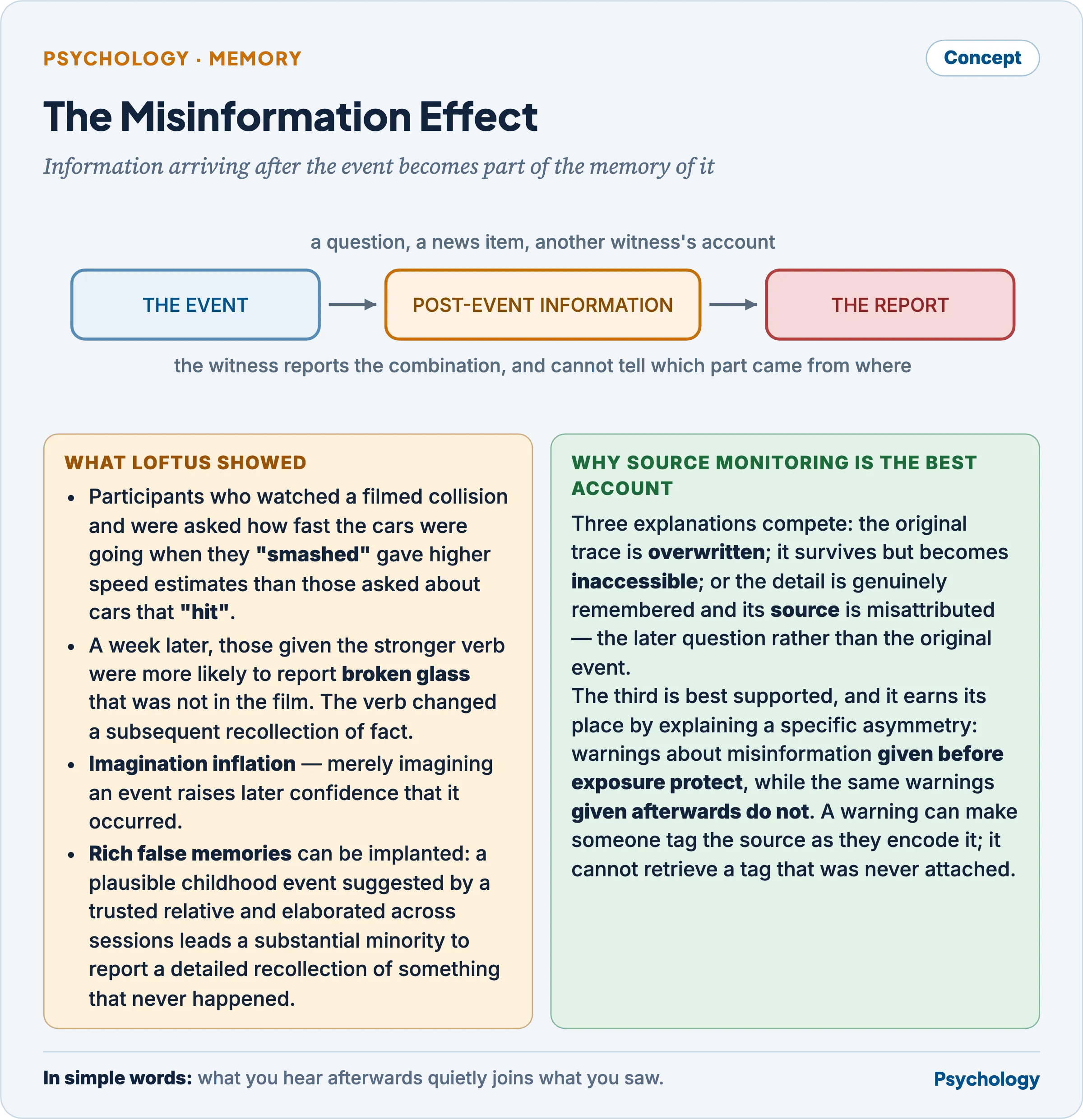
Where Bartlett showed that prior knowledge shapes memory, Elizabeth Loftus showed that information arriving after an event does too.
- Leading questions change the report. Participants who watched a filmed collision and were asked how fast the cars were going when they “smashed” gave higher speed estimates than those asked about cars that “hit” — and a week later, those given the stronger verb were more likely to report broken glass that was not in the film. The verb changed not only the judgement but a subsequent recollection of fact.
- The misinformation effect generalises: a witness exposed to post-event information inconsistent with what they saw — in a question, a news report, or another witness’s account — frequently incorporates it and later reports it as a memory of the original event.
- Imagination inflation. Merely imagining an event that did not occur raises later confidence that it did.
- Rich false memories can be implanted. Procedures in which a plausible childhood event is suggested by a trusted relative and the participant is encouraged to elaborate across sessions lead a substantial minority to report a detailed recollection of something that never happened, often with emotion and confidence.
Why it happens is still argued, and the candidate explanations are worth distinguishing: the original trace may be overwritten, or it may survive but be rendered inaccessible, or the error may be one of source monitoring — the detail is genuinely remembered, but its source, the later question rather than the original event, is misattributed. Source monitoring is the best-supported account and the most useful, because it explains why warnings about misinformation given before exposure protect, while warnings given afterwards do not.
Eyewitness testimony in court
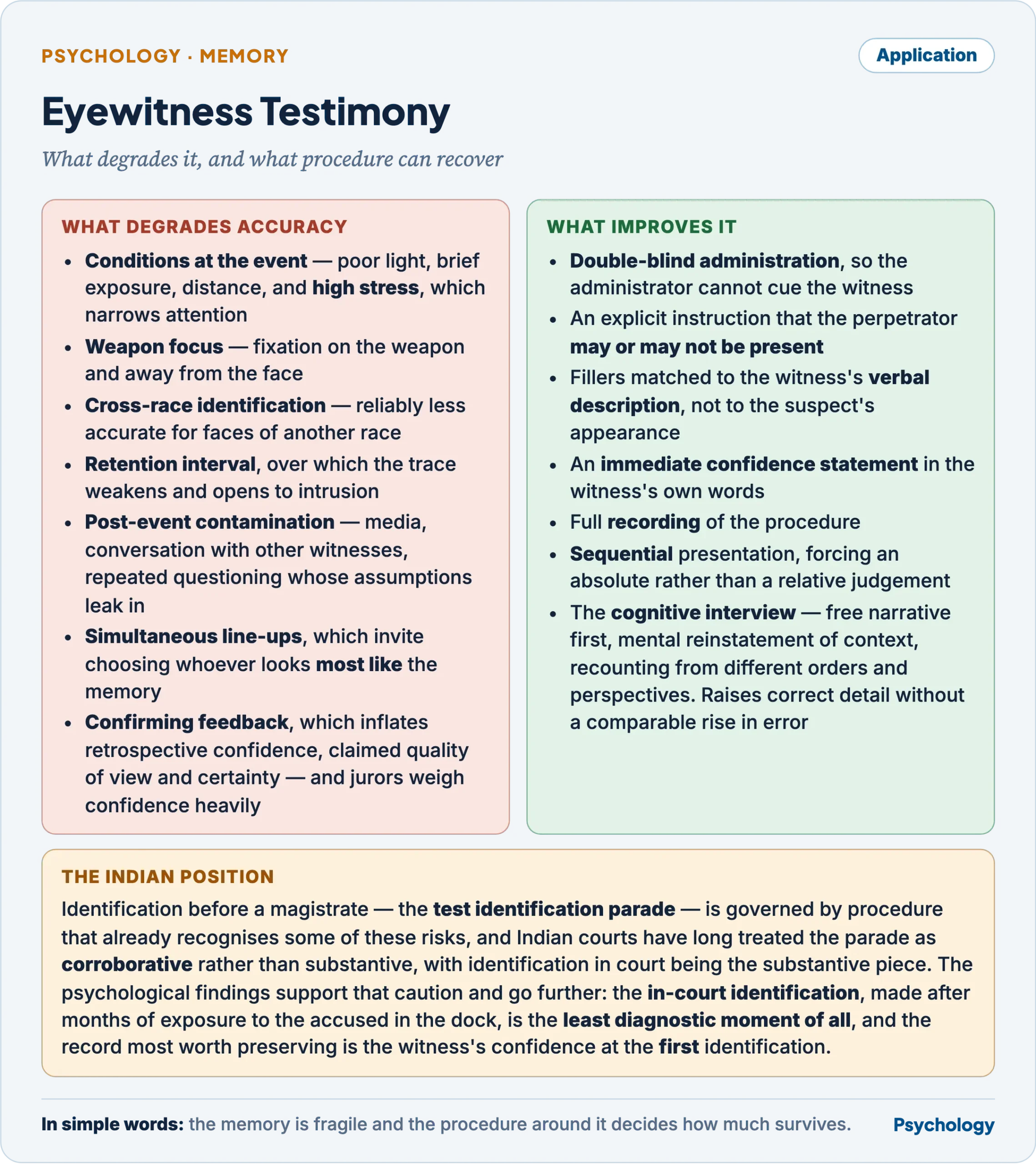
The applied significance is large: eyewitness identification evidence is highly persuasive to juries, and mistaken identification has been the leading contributing factor in convictions later overturned by DNA evidence.
What degrades eyewitness accuracy.
- Conditions at the event — poor light, brief exposure, distance, and high stress, which narrows attention. Weapon focus draws fixation to the weapon and away from the face.
- Cross-race identification. Witnesses are reliably less accurate at identifying faces of a race other than their own.
- Retention interval, over which the trace weakens and becomes more open to intrusion.
- Post-event contamination — media coverage, conversation with other witnesses, repeated questioning in which the questioner’s assumptions leak into the question.
- Procedure at identification. A simultaneous line-up invites a relative judgement — choosing whoever looks most like the memory — where a sequential one forces an absolute judgement against the memory itself. A line-up administered by someone who knows the suspect can cue the witness unintentionally; a double-blind administration cannot.
- Confirming feedback after identification inflates the witness’s retrospective confidence, their claimed view of the event and their certainty of memory — which matters because jurors weigh confidence heavily. Confidence at trial, after months of such influence, carries almost no information; confidence recorded immediately at a clean, unbiased identification is considerably more diagnostic.
What improves it. Double-blind administration; a clear instruction that the perpetrator may or may not be present; fillers chosen to match the witness’s verbal description, not the suspect’s appearance; an immediate confidence statement in the witness’s own words; full recording of the procedure; and the cognitive interview, which elicits free narrative before any specific questioning, reinstates the context mentally, and asks the witness to recount from different perspectives and orders — raising the amount of correct detail without a comparable rise in error.
The Indian position. Identification before a magistrate — the test identification parade — is governed by procedure that already recognises some of these risks, and Indian courts have long treated the parade as corroborative rather than substantive evidence, with the identification in court being the substantive piece. The psychological findings support that caution and go further: they suggest the in-court identification, made after months of exposure to the accused in the dock, is the least diagnostic moment of all, and that the record most worth preserving is the witness’s confidence at the first identification.
Reconstruction outside the courtroom
The forensic case is the vivid one, and the mechanism operates continuously in ordinary life.
- Memory conformity. Witnesses who discuss an event before reporting it converge on a shared account, and each then reports the shared version as their own recollection. Two accounts that agree are therefore not two independent pieces of evidence if the witnesses have spoken — a point that matters wherever corroboration is treated as confirmation.
- Retelling shapes the trace. An account told repeatedly becomes smoother, more coherent and more confidently held, and the version retained is the version last told rather than the event. Anecdotes improve with telling for the same reason.
- Autobiographical memory serves the self. Recollection of one’s own past is reliably biased toward consistency with the present self-concept — past attitudes are recalled as closer to current ones than they were, and one’s own contribution to joint work is recalled as larger.
- The reminiscence bump, the disproportionate recall of events from adolescence and early adulthood, shows that what survives is organised around identity rather than by recency alone.
- Collective and cultural memory runs on the same mechanism at scale: shared accounts of the past are reproduced serially through a culture, levelled, sharpened and assimilated to present concerns exactly as Bartlett’s story was.
Is reconstructed memory accurate?
The question invites a yes or no and deserves neither.
- Accurate for gist, unreliable for detail. The reconstruction is built from a real trace and constrained by it, so the general shape of a remembered event is usually right. Specific details — who said what, in what order, what someone wore, how long it took — are where reconstruction does its work and where error enters.
- Accuracy is highest in the conditions the system was built for: distinctive events, short intervals, no post-event interference, and free narrative recall rather than directed questioning.
- The errors are systematic, which is what makes them predictable and therefore correctable by procedure. They run toward the schema, toward the expected, and toward whatever has been suggested since.
- The design is right for its actual purpose. Retaining meaning and discarding surface detail is the right trade for ordinary life; it is the wrong trade for forensic identification, which is a use the system was never shaped for.
The defensible formulation: memory is a reliable guide to what kind of thing happened and an unreliable guide to the particulars — and the confidence of the rememberer does not distinguish the two.
Criticisms and limitations
- The laboratory work uses films and students, with no personal stake and no consequences, where real witnesses are frightened, involved and testifying under oath. Both over- and under-estimates of real-world error follow, and which dominates is unresolved.
- The misinformation work is read too strongly. Peripheral details are far easier to alter than central ones, and attempts to implant memories of events that are implausible or that contradict a strongly held self-concept usually fail.
- The false-memory debate carried real cost. The same findings that exposed suggestive therapeutic questioning have been used to discredit genuine testimony of abuse, and the honest position is that memory can be both genuinely recovered and genuinely implanted, with no feature of the report itself distinguishing them.
- Bartlett’s control was weak, and some of his distortion is plausibly conventional storytelling rather than memory failure.
- Schema theory describes more than it predicts. It says that material inconsistent with a schema will be distorted toward it, but material that is strikingly inconsistent is often remembered better, and the theory does not specify in advance which will happen.
Previous Year Questions
- 2024Is reconstructed memory accurate? Describe the process of reconstruction, citing research evidence.
- 2021Comment on: With reference to the concept of memory construction evaluate the accuracy of eyewitness testimony in judicial trial.
- 2018“Human memory is not like information stored in a tape recorder or compact disc.” Critically evaluate the statement.
- 2014What is the role of constructive and reconstructive processes in human memory? Explain.