

Official syllabusPaper I · Unit 13 · Language and Communication
Theories of language development – Skinner and Chomsky.
Definition
“Verbal behavior [is] behavior reinforced through the mediation of other persons.”
Skinner (1957)
That sentence carries the whole behaviourist programme. Verbal behaviour is defined not by its form but by how it is reinforced — through another organism trained by the same community — so it requires no principles beyond those already established for operant behaviour. The dispute that followed is over whether that is sufficient, and it is the point at which psychology stopped treating language as one more learned habit.
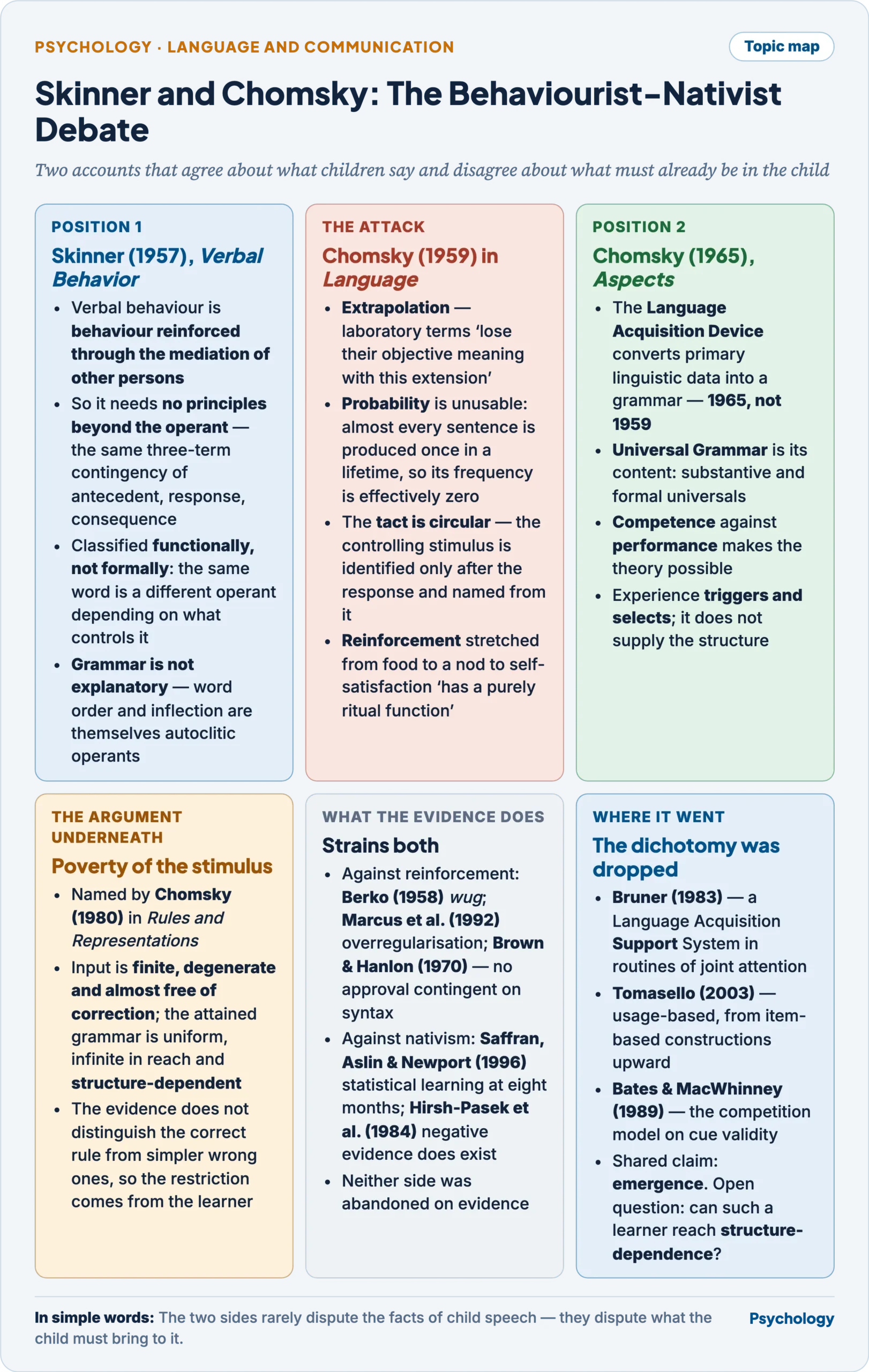
The two accounts rarely disagree about what children say and when; they disagree about what must already be in the child for any of it to be possible.
Skinner’s account of verbal behaviour
- The William James Lectures Skinner gave at Harvard became Verbal Behavior (Skinner, 1957), the fullest book-length behaviourist theory of language ever written.
- Its claim is methodological before it is empirical: verbal behaviour is operant behaviour, explained by the same three-term contingency of antecedent, response and consequence as any other.
- The one feature Skinner treated as distinctive is mediated reinforcement. A thirsty person who reaches a glass is reinforced by the physical environment; a person who says “water” is reinforced only because a listener, trained by the same verbal community, delivers it.
- Verbal behaviour is therefore classified functionally, not formally. The same word belongs to different operants depending on what controls it, and different words can belong to one operant. This is the deep break with linguistics, which classifies by form.
- Grammar is not an explanatory notion on this account. Word order, inflection and sentence structure are themselves products of one further class of operant, not of rules the speaker possesses.
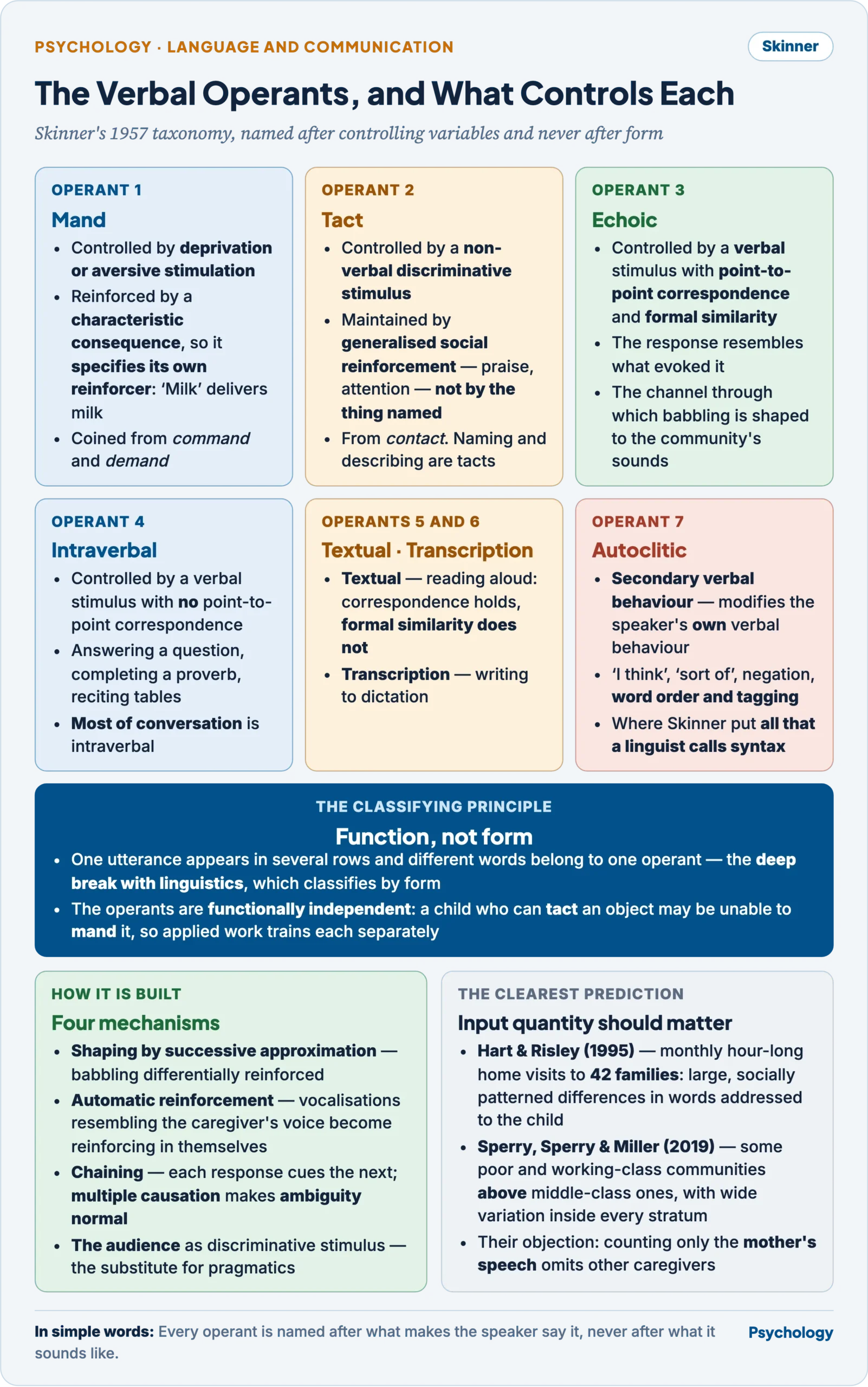
Every operant is named after what controls it and never after what it sounds like, which is why one utterance can appear in several rows.
The verbal operants
- Mand — reinforced by a characteristic consequence, and so under the functional control of deprivation or aversive stimulation. Skinner coined the term from command and demand. A mand specifies its own reinforcer: “Milk” delivers milk.
- Tact — a response “evoked by a particular object or event or property of an object or event” (Skinner, 1957), the term built from contact. Naming and describing are tacts.
- It stands under the control of a non-verbal discriminative stimulus and is maintained by generalised social reinforcement — attention, praise, agreement — not by the thing named.
- Echoic — under the control of a verbal stimulus with point-to-point correspondence and formal similarity, so that the response resembles what evoked it. This is the channel through which babbling is shaped towards the community’s sounds.
- Intraverbal — under the control of a verbal stimulus with no point-to-point correspondence. Answering a question, completing a proverb, reciting tables and most of conversation are intraverbal.
- Textual and transcription — reading aloud, where correspondence holds but formal similarity does not, and writing to dictation.
- Autoclitic — secondary verbal behaviour, dependent on and modifying the speaker’s own other verbal behaviour. “I think”, “sort of”, negation, and the ordering and tagging of words are autoclitics. This is where Skinner placed everything a linguist calls syntax.
How the repertoire is built
- Shaping by successive approximation — babbling is differentially reinforced, approximations nearer the community’s forms drawing attention and remoter ones not.
- Automatic reinforcement — vocalisations resembling the caregiver’s voice acquire reinforcing properties through pairing with her attention, so the infant’s vocal play sustains itself with no adult present on each occasion.
- Chaining and multiple causation — a long utterance is a chain in which each response supplies the stimulus for the next, and most real utterances stand under several controlling variables at once, which is why Skinner expected ambiguity to be normal rather than exceptional.
- The audience operates as a discriminative stimulus, which is the account’s substitute for pragmatics.
- The account’s clearest prediction is that the quantity and quality of input should matter. Hart and Risley (1995) recorded hour-long monthly home visits to 42 families and reported large, socially patterned differences in words addressed to the child, with later vocabulary tracking them.
Chomsky’s 1959 review of Verbal Behavior
- Chomsky (1959) reviewed the book in the journal Language, and the review rather than the book became the standard reference point. Its target, Chomsky later said, was not Skinner’s remarks on language in particular but behaviourist accounts of higher mental processes generally.
- The extrapolation objection — terms with precise meanings in the animal laboratory are carried into the study of speech without the measurement that gave them their meaning, and “the terms borrowed from experimental psychology simply lose their objective meaning with this extension” (Chomsky, 1959).
- Probability of a response — Skinner’s dependent variable is response probability, estimated from rate. Almost every sentence a person produces is produced once in a lifetime, so its frequency is effectively zero; “the term probability has some rather obscure meaning for Skinner in this book”.
- The tact is circular. A stimulus is said to control a response, yet it is identified only after the response has occurred and is named from it.
- Hence “the obscurity of the notion stimulus control makes the concept of the tact rather mystical”, and “the word control here is merely a misleading paraphrase for the traditional denote or refer” (Chomsky, 1959).
- The mand is not identifiable. Deprivation is not independently measured in human speech, so “there is in most cases no way to decide whether a given response is an instance of a particular mand” (Chomsky, 1959).
- “X is under Y-deprivation” is, on this reading, “just an odd paraphrase for ‘X wants Y'”.
- Reinforcement becomes ritual. Once reinforcement stretches from food to a listener’s nod to the speaker’s own satisfaction it excludes nothing, and so “the term reinforcement has a purely ritual function”.
- Reinforcement is not necessary. Children “acquire a good deal of their verbal and nonverbal behavior by casual observation and imitation of adults”, with no contingency arranged by anyone.
- The object of study is misdescribed. What a speaker knows is an unbounded set of well-formed sentences, so no finite repertoire of responses, however reinforced, can be identical with it.
- The positive proposal. Chomsky pointed to “the remarkable capacity of the child to generalize, hypothesize”, held that “human beings are somehow specially designed to do this”, and set the research task as the study of the child’s “data-handling or ‘hypothesis-formulating’ ability”.
Chomsky’s nativist account of language development
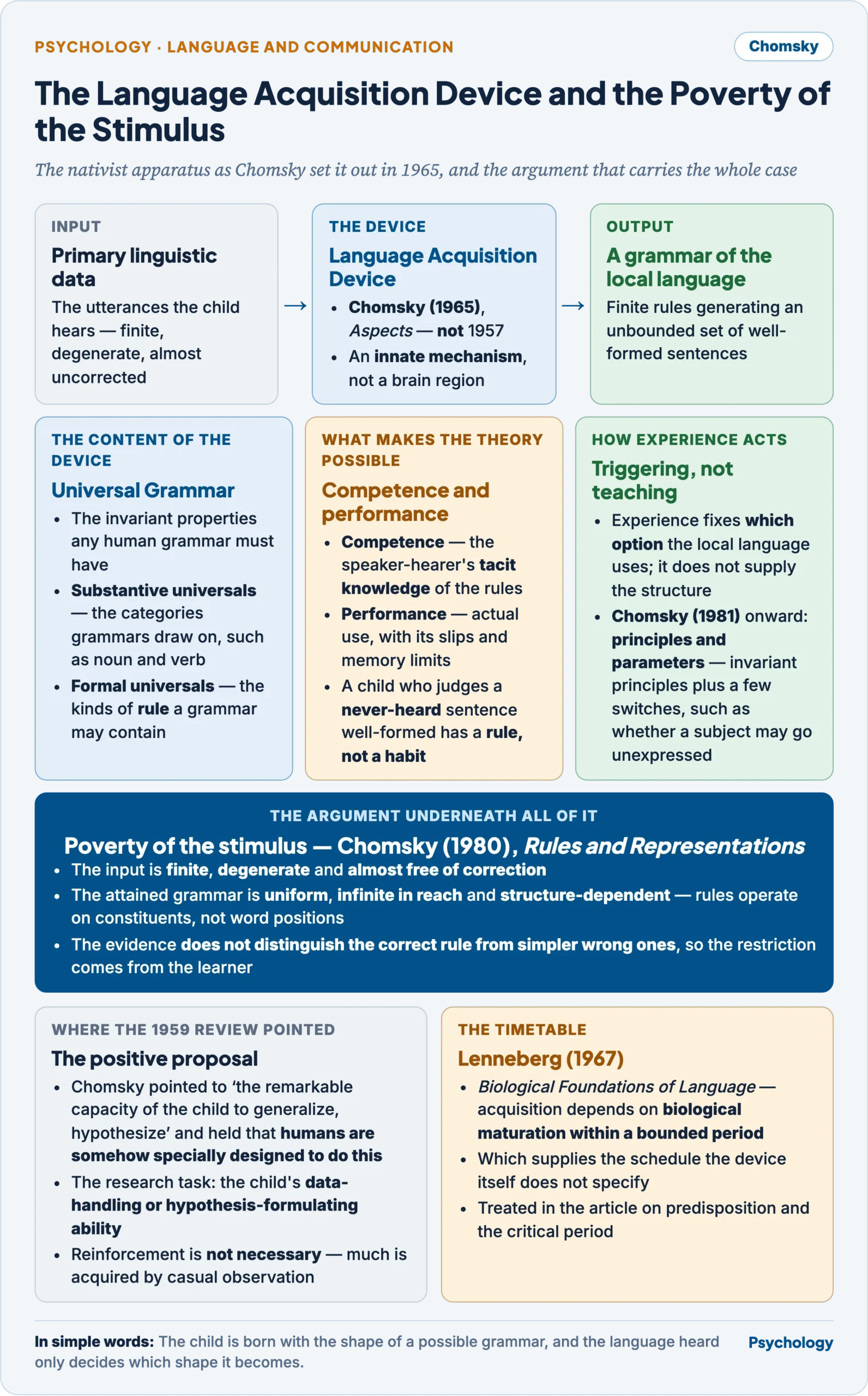
The device converts primary linguistic data into a grammar; experience selects among options it did not create, which is why the same input yields the local language and no other.
- Chomsky (1965), in Aspects of the Theory of Syntax, proposed the Language Acquisition Device — an innate mechanism that takes in primary linguistic data and yields a grammar of the surrounding language. It is a functional construct, not an identified region of brain tissue.
- Universal Grammar is the content of that device: the invariant properties any human grammar must have. Chomsky (1965) separated substantive universals — the categories and features grammars draw on, such as noun and verb — from formal universals, the kinds of rule a grammar may contain.
- The formal machinery itself is set out in the article on transformational generative grammar and its modifications.
- Competence and performance (Chomsky, 1965) make the theory possible. Competence is the speaker-hearer’s tacit knowledge of the rules; performance is actual use, with its slips and memory limits. A child who judges a never-heard sentence well-formed has a rule, not a habit.
- Triggering, not teaching. Experience fixes which of the available options the local language uses; it does not supply the structure.
- From Chomsky (1981) onward this takes the form of principles and parameters — invariant principles plus a small set of switches, such as whether a language lets a subject go unexpressed.
- The poverty of the stimulus is the argument underneath all of this, named by Chomsky (1980) in Rules and Representations.
- The child’s input is finite, degenerate and almost free of correction, yet the attained grammar is uniform, infinite in reach and structure-dependent. The evidence does not distinguish the correct rule from simpler wrong ones, so the restriction must come from the learner.
- Maturation supplies the timetable. Lenneberg (1967), in Biological Foundations of Language, argued that first-language acquisition depends on biological maturation within a bounded period, which is treated in the article on predisposition and the critical period hypothesis.
Behaviourist and nativist accounts compared
| Dimension | Skinner (1957) | Chomsky (1959, 1965) |
|---|---|---|
| Object explained | A repertoire of verbal responses | Tacit knowledge of a rule system (competence) |
| Mechanism | Shaping, differential reinforcement, imitation, chaining | Innate device setting parameters on exposure |
| Role of input | Supplies the contingencies; it is the cause | Triggers and selects; it underdetermines the outcome |
| Status of grammar | A by-product of autoclitic behaviour | The thing to be explained |
| Unit of classification | Function — what controls the response | Form — structural description |
| Novel sentences | Response generalisation and multiple causation | Recursive rules generating an unbounded set |
| Species-specificity | None; the same laws cover all operants | Language-specific and human-specific |
| Individual differences | Traced to reinforcement history | Treated as performance, not competence |
Evidence that bears on the dispute
Findings that strain the reinforcement account
- Berko (1958) gave children a nonsense form, showed one wug and then two, and recorded wugs. Since the plural had never been heard for that word, a rule was applied rather than a stored form retrieved.
- Marcus and colleagues (1992) analysed 11,521 irregular past-tense utterances from the spontaneous speech of 83 children and found overregularisation (goed, bringed) at a low and roughly constant rate over years.
- Adults do not produce these forms, so they cannot be imitations, and they persist without being reinforced.
- Brown and Hanlon (1970) examined parental approval and disapproval and found not “even a shred of evidence that approval and disapproval are contingent on syntactic correctness”; parents respond to whether what the child said is true.
- Goldin-Meadow and Mylander (1998) studied eight deaf children of hearing parents, four in the United States and four in Taiwan, none of whom had usable sign input.
- The children independently invented gesture systems with patterned deletion and patterned ordering of elements, matching the structure of neither English nor Mandarin, so the structure came from the children.
- Senghas and Coppola (2001) traced spatial modulations across successive cohorts of signers in the emerging Nicaraguan Sign Language. Grammatical regularity was introduced by those exposed before about the age of ten, not by their adult models, so young learners created structure absent from their input.
Findings that strain the nativist account
- Hirsh-Pasek, Treiman and Schneiderman (1984) re-examined maternal responses and found them sensitive to ill-formedness, mothers repeating ungrammatical utterances more often than well-formed ones. Negative evidence is therefore available even if explicit correction is rare.
- Saxton (2005) proposed the contrast theory of negative input: corrective force comes from the immediate juxtaposition of the child’s error with the adult form, and measurable effects survived a twelve-week lag.
- Saffran, Aslin and Newport (1996) exposed eight-month-old infants to about two minutes of continuous synthetic syllables carrying no prosodic or acoustic boundary cues, and the infants segmented the stream using transitional probabilities alone.
- A powerful domain-general statistical learner is therefore present in infancy, which weakens the claim that the input is too poor to be exploited.
- Sperry, Sperry and Miller (2019) examined speech to children in five American communities and found some poor and working-class communities above middle-class ones in words heard, with wide variation inside every stratum.
- Their objection to Hart and Risley (1995) is methodological: counting only the mother’s direct speech omits other caregivers and overheard talk.
Criticisms and evaluation
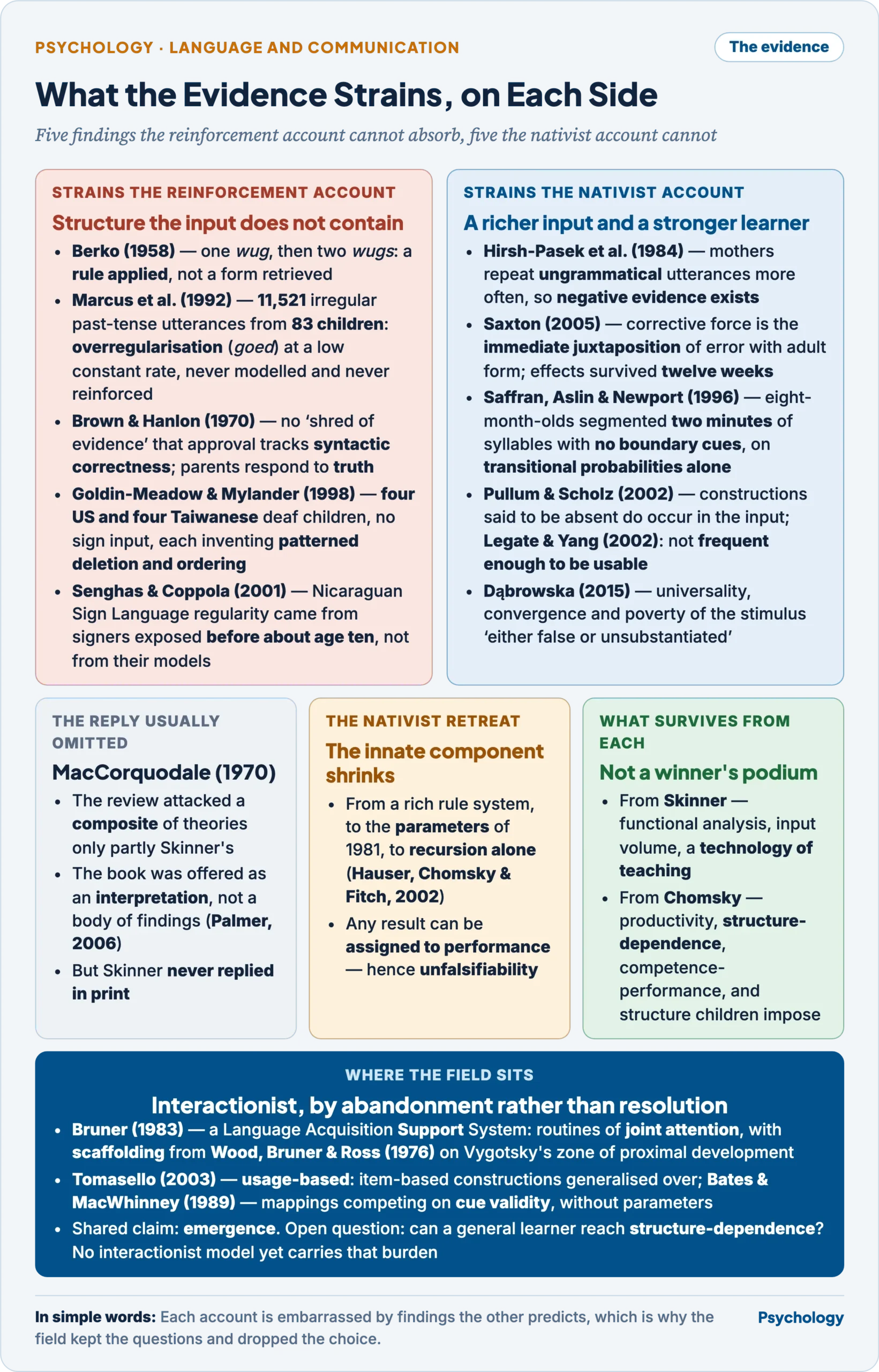
Neither side was abandoned on evidence: Skinner’s account lost the theoretical question and kept the applied one, while nativism won the argument and then had to give ground on what is innate.
- Against Skinner. The account has no mechanism for productivity, since a repertoire cannot be infinite; it cannot explain the uniform order of milestones across languages and rearing conditions; and it predicts errors of imitation where children make errors of overregularisation.
- Because every putative controlling variable is identified after the response it is said to control, the explanations are difficult to falsify.
- The behaviour-analytic reply is substantial and usually omitted. MacCorquodale (1970) argued that the review attacked a composite of mediational and stimulus-response theories only partly Skinner’s.
- He added that Verbal Behavior was offered as an interpretation of language in behavioural terms rather than as a body of findings, which makes much of the review’s demand for proof misdirected.
- Palmer (2006) reviewed the whole exchange and concluded that the standard reading rests on a sustained misunderstanding.
- A fair point against Skinner stands independently: he never replied in print, and the book generated very little experimental work for three decades.
- Against Chomsky. Universal Grammar has never been specified in a form all its proponents accept. Dąbrowska (2015) examined its three standard arguments — universality, convergence and poverty of the stimulus — and judged their premises “either false or unsubstantiated”, proposing instead a language-making capacity of domain-general abilities.
- Evans and Levinson (2009) surveyed structural diversity across languages and argued that very few genuine universals survive inspection, so that the fact needing explanation is diversity rather than a shared template. Commentators replied that psycholinguistics depends less on Universal Grammar than the critique assumes.
- Pullum and Scholz (2002) attacked the empirical premises of poverty-of-the-stimulus arguments, showing that constructions claimed absent from children’s input do occur in it. Legate and Yang (2002) answered that occurrence is not sufficiency: the data must be frequent enough to be usable.
- The theory is insulated from its own evidence. Because competence is separated from performance, a developmental or processing result can always be assigned to performance, which is why the charge of unfalsifiability recurs.
- The innate component has also shrunk steadily: from a rich rule system, to the parameters of Chomsky (1981), to the single recursive operation proposed by Hauser, Chomsky and Fitch (2002) — a retreat critics read as concession.
- The newest line of attack is computational. Piantadosi (2023) argued that large language models acquire grammatical generalisations from input alone and so dissolve the poverty-of-the-stimulus argument.
- Katzir (2023) replied that such models fail on precisely the constraints the argument rests on, and are trained on data orders of magnitude beyond a child’s.
- What survives from each. From Skinner: that verbal behaviour can be analysed functionally, that input volume has measurable effects, and a working technology of language teaching.
- From Chomsky: productivity, structure-dependence, the competence-performance distinction, and the demonstration that children impose structure their input does not contain.
Interactionist positions
- The dichotomy was abandoned rather than resolved. Bruner (1983) proposed a Language Acquisition Support System against Chomsky’s device, locating acquisition in routines and formats of joint attention that adults maintain through child-directed speech. The scaffolding those routines provide is Bruner’s own term, from Wood, Bruner and Ross (1976), and it builds on Vygotsky’s zone of proximal development rather than coming from Vygotsky directly.
- Tomasello (2003) built the usage-based alternative: children begin from concrete item-based constructions, generalise over them, and need only general-purpose capacities for intention-reading and pattern-finding, with no language-specific grammar.
- Bates and MacWhinney (1989) offered the competition model, in which form-function mappings compete on cue validity and reliability, explaining cross-linguistic differences in acquisition order without parameters.
- The shared claim of Bruner (1983), Tomasello (2003) and Bates and MacWhinney (1989) is emergence: structure that looks innate can arise from a general learner meeting structured social input.
- The open question is whether such a learner can reach structure-dependence; no interactionist model yet carries that burden in full.
Applications of the two theories
- Skinner’s analysis became the most heavily applied part of either theory. Sundberg and Michael (2001) set out its use with children with autism, organising instruction around the operants.
- Mand training comes first, because a mand delivers its own reinforcer and so carries its own motivation; echoic, tact and intraverbal repertoires follow.
- Sundberg (2008) derived a criterion-referenced assessment from the same framework, scoring a learner’s operants against developmental milestones so that teaching targets follow from the profile rather than from a fixed curriculum.
- Because the operants are functionally independent, a child who can tact an object may be unable to mand it, which is why the applied work trains each separately — a prediction of Skinner’s taxonomy that has held up.
- Picture-exchange and other augmentative systems operationalise the mand for learners without speech, and programmed instruction and precision teaching apply the same contingency logic to second-language vocabulary and literacy.
- Chomsky’s account changed practice indirectly, and chiefly by supplying rationales.
- Early intervention in congenital deafness follows from a maturational timetable, since timing rather than effort then decides the outcome.
- Specific language impairment is treated as a selective grammatical deficit rather than a general cognitive delay.
- Universal-grammar-based second-language research predicts transfer errors from the parameter settings of the first language.
- Its wider effect was on psychology itself: the review is conventionally treated as one of the triggers of the cognitive revolution, which replaced the study of behaviour with the study of internal representation.
The Indian multilingual setting
- Both theories were framed on monolingual data, and the Indian case shows what that costs. The Census of India (2011) recorded 121 languages — 22 scheduled, 99 not — and 270 mother tongues with ten thousand or more speakers, drawn from 19,569 raw returns.
- A child here commonly acquires two or three codes at once, in a home that mixes them within the sentence. Neither a single reinforcement history nor a single parameter setting describes that input.
- The consequences are taken up in the article on bilingualism, multilingualism and the Indian language context.
- National Education Policy, 2020 (Ministry of Education) — makes the home language or mother tongue the medium of instruction at least to Grade 5, operationalising the claim that early grammatical and literacy learning runs on an already-acquired code rather than a newly taught one.
Previous Year Questions
- 2024How do Skinner and Chomsky differ in their approach to language development? Also, discuss the processes and outcomes of bilingualism and multilingualism in Indian context.
- 2022Discuss language acquisition at different stages of development in the light of the theories of Skinner and Chomsky.
- 2021Give a comparative analysis of the behaviouristic and nativistic perspective to language development.
- 2015How does Chomsky’s Theory differ from that of Skinner in language development? Discuss.
- 2010Compare Chomsky’s innate mechanism view with Skinner’s view of language development.
- 2006The mand and the tact functions of language development proposed by Skinner are not powerful enough to explain why particular utterances are produced at particular times. Discuss in the context of Chomsky’s rebuttal of Skinnerian theory of language development. Also explain Chomsky’s theory of language development.
- 1999Elucidate the main features of Skinner’s and Chomsky’s theory of language development and indicate their application.
- 1996Between brain-maturation and reinforcement, which one offers a more satisfactory explanation of language acquisition?