

Official syllabusPaper I · Unit 13 · Language and Communication
Theories of language development – Skinner and Chomsky.
Definition
“A grammar of a language purports to be a description of the ideal speaker-hearer’s intrinsic competence.”
Chomsky (1965)
A grammar in this sense is not a record of what speakers have said but a finite rule system that generates all and only the well-formed sentences of a language, and assigns each one a structure. The topic settles what such a system must contain. Its interest for psychology is that Chomsky rebuilt it five times in forty years, and the version psychology borrowed is the one he abandoned.
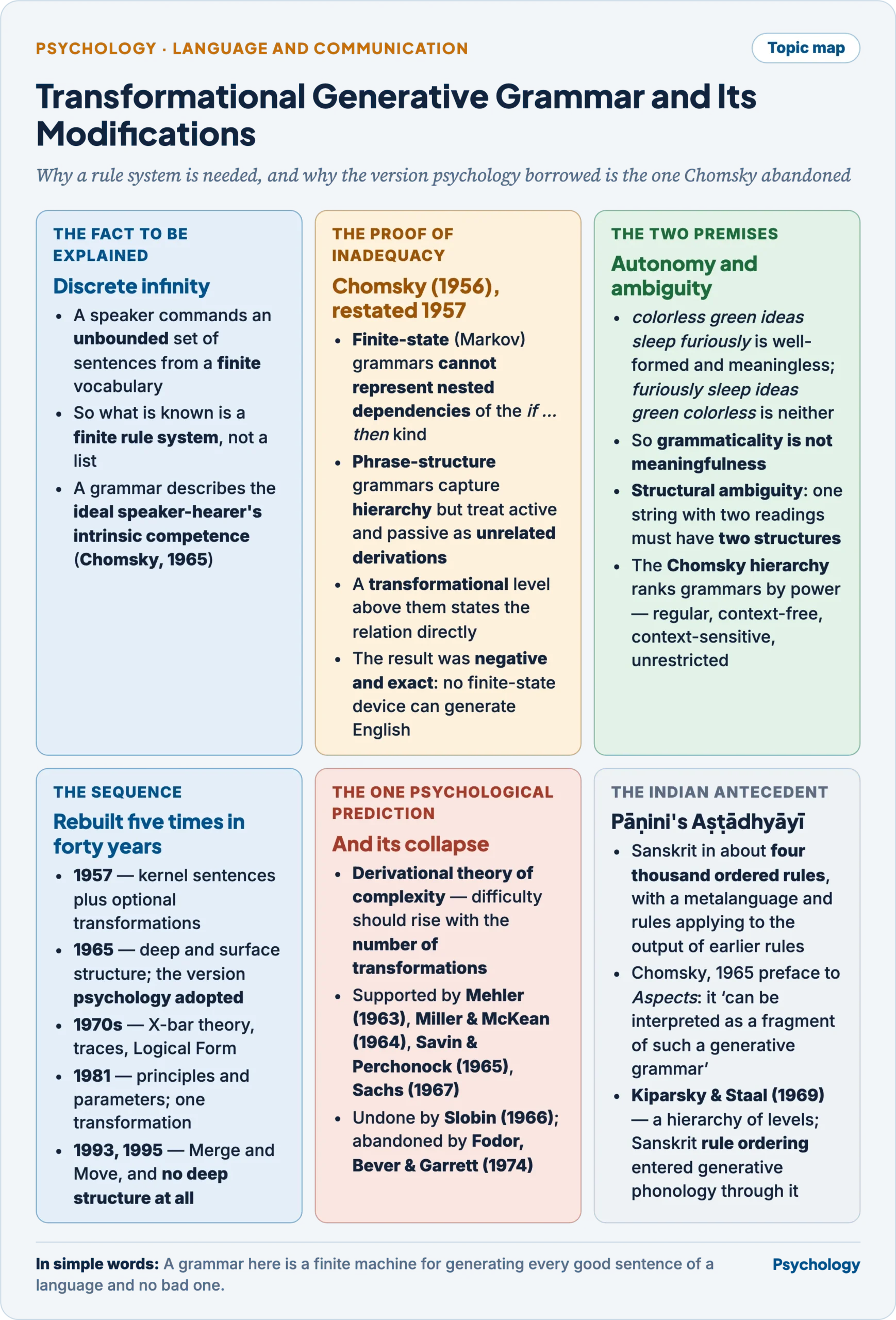
Each stage keeps the goal and discards the machinery of the one before it; the levels of representation are what change.
Why a generative grammar is needed
- Discrete infinity is the fact to be explained. A speaker commands an unbounded set of sentences built from a finite vocabulary, so what is known must be a finite rule system, not a list.
- Chomsky (1956) compared three kinds of grammar for the job and rejected two of them, an argument restated in Syntactic Structures (Chomsky, 1957).
- A finite-state (Markov) grammar generates each word from the preceding state, left to right. It cannot represent nested dependencies of the if … then and either … or kind, where an indefinite amount of material separates two elements that must match.
- A phrase-structure grammar rewrites symbols into strings of symbols and does capture hierarchy, which a finite-state device cannot. But it treats Ram ate the cake and the cake was eaten by Ram as unrelated derivations, and handles discontinuous elements clumsily.
- A transformational level added above phrase structure states the relation between sentence types directly, as an operation on an already-built structure.
- Syntax is autonomous from meaning, which is the premise that makes a purely formal grammar possible. Chomsky (1957) contrasted colorless green ideas sleep furiously with furiously sleep ideas green colorless: the first is well-formed and meaningless, the second neither.
- The sentence dates from his 1955 dissertation and reappears in Chomsky (1956); grammaticality is therefore not the same property as meaningfulness.
- Structural ambiguity settles it. One string with two readings must have two structures, so a grammar that assigns a single description to each string cannot be right.
- The same work set out the hierarchy of formal grammars that bears Chomsky’s name, ranking grammars by generative power and giving the argument its precision (Chomsky, 1956).
- Regular grammars, equivalent to a finite-state machine, are the weakest and are demonstrably too weak for a natural language.
- Context-free grammars are the phrase-structure grammars, strong enough for hierarchy and nesting.
- Context-sensitive and unrestricted grammars are stronger still, and the question for linguistics became where in this hierarchy human languages sit.
- The result that mattered was negative and exact: no finite-state device can generate English, so the inadequacy was proved rather than asserted.
Syntactic Structures (1957): kernel sentences and transformations
- Chomsky (1957) proposed a grammar of three ordered rule levels.
- Phrase-structure rules rewrite symbols into constituents, generating an underlying string with a tree.
- Transformational rules rearrange, add, delete or substitute material in that string.
- Morphophonemic rules convert the result into a sequence of phonemes.
S    -> NP + VP
NP   -> Det + N
VP   -> Aux + V + NP
Aux  -> Tense (+ Modal)
These four rewrite rules alone generate a finite set; the infinity arrives the moment one rule lets NP contain S.
- Kernel sentences are those produced by the phrase-structure rules plus the obligatory transformations alone — simple, active, declarative, affirmative. Every other sentence is derived from one or more kernels by optional transformations.
- Transformations divide two ways.
- Obligatory versus optional — affix hopping, which moves the tense marker onto the verb, must apply; the passive need not.
- Singulary versus generalised — a singulary transformation operates on one string, a generalised transformation combines two kernels into a complex sentence, which is how early transformational grammar produced embedding.
- The standard examples are the passive transformation, subject-auxiliary inversion producing yes-no questions, negation, wh-movement, and the dative alternation.
- The theory’s claim is explanatory economy: a handful of transformations replaces a vast number of separate phrase-structure rules, and the relatedness speakers perceive between sentence types becomes a fact about derivation.
Deep structure and surface structure
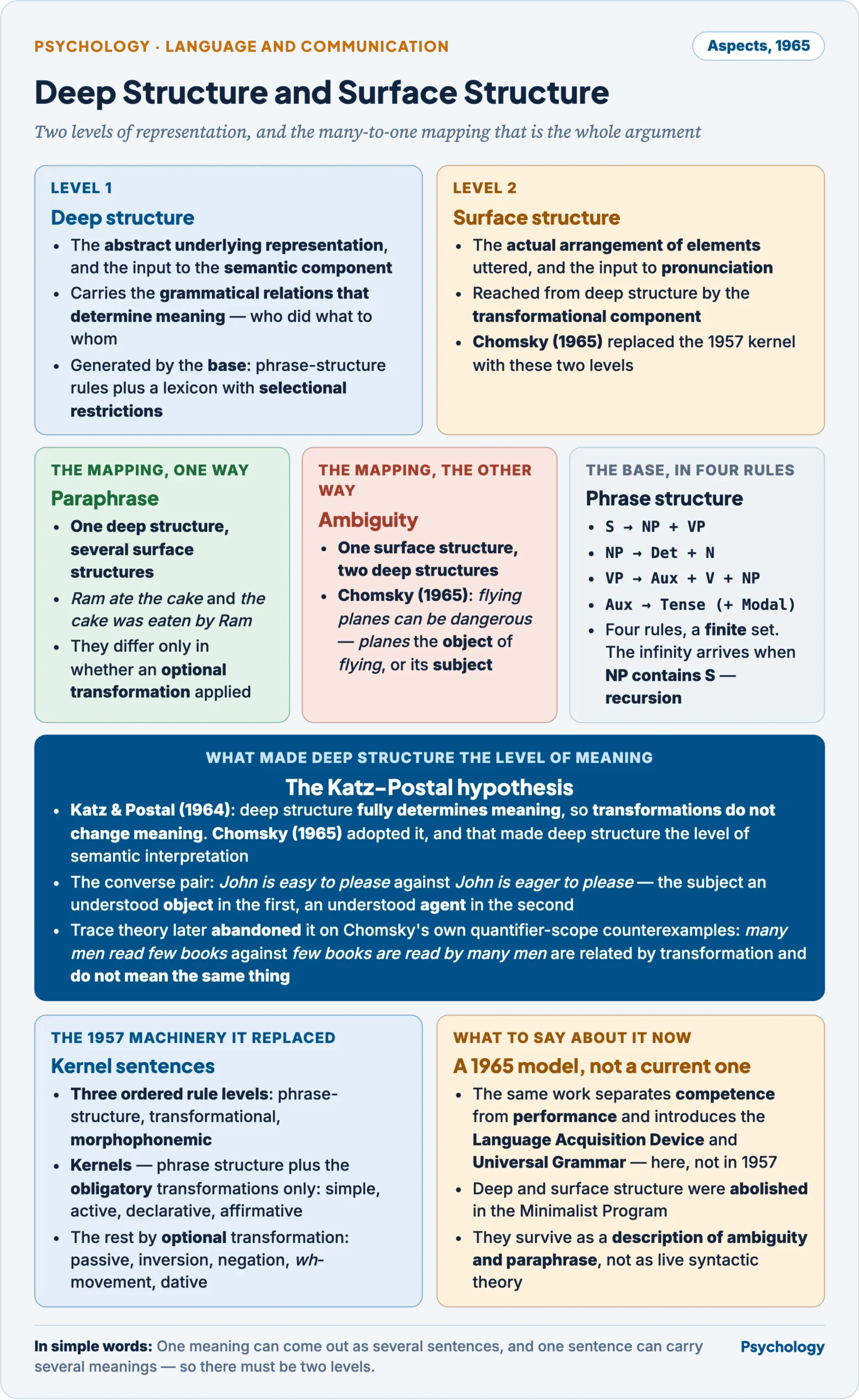
The mapping is many-to-one in both directions, and that is the whole argument: paraphrase runs one way, ambiguity the other.
- Chomsky (1965), in Aspects of the Theory of Syntax, replaced the kernel with two levels of representation and gave the theory the form psychology adopted.
- Deep structure is the abstract underlying representation that carries the grammatical relations determining meaning — who did what to whom.
- Surface structure is the actual arrangement of elements in the uttered sentence, the input to pronunciation.
- The architecture has four components. The base component — phrase-structure rules plus a lexicon with selectional restrictions — generates deep structures; the transformational component maps deep onto surface structure; the semantic component interprets the deep structure; the phonological component interprets the surface structure.
- One deep structure with several surface structures is paraphrase. Ram ate the cake and the cake was eaten by Ram differ only in whether an optional transformation applied.
- One surface structure with two deep structures is ambiguity. Chomsky (1965) used flying planes can be dangerous, where planes is the object of flying on one reading and its subject on the other.
- The same contrast is made by pairs identical on the surface and distinct underneath, as in John is easy to please against John is eager to please, where the subject is the understood object in the first and the understood agent in the second.
- Katz and Postal (1964) had proposed that the deep structure fully determines meaning, so that transformations do not change meaning. Chomsky (1965) adopted this as the Katz-Postal hypothesis, and it is what made deep structure the level of semantic interpretation.
- Competence and performance are separated in the same work, and so is the acquisition claim: the Language Acquisition Device and Universal Grammar are introduced here, not in 1957. The acquisition argument is set out in the article on Skinner and Chomsky and the behaviourist-nativist debate.
- Recursion is what delivers the infinity. A rule letting a noun phrase contain a sentence places no principled bound on sentence length, which is why length limits are treated as performance rather than competence (Chomsky, 1965).
The modifications
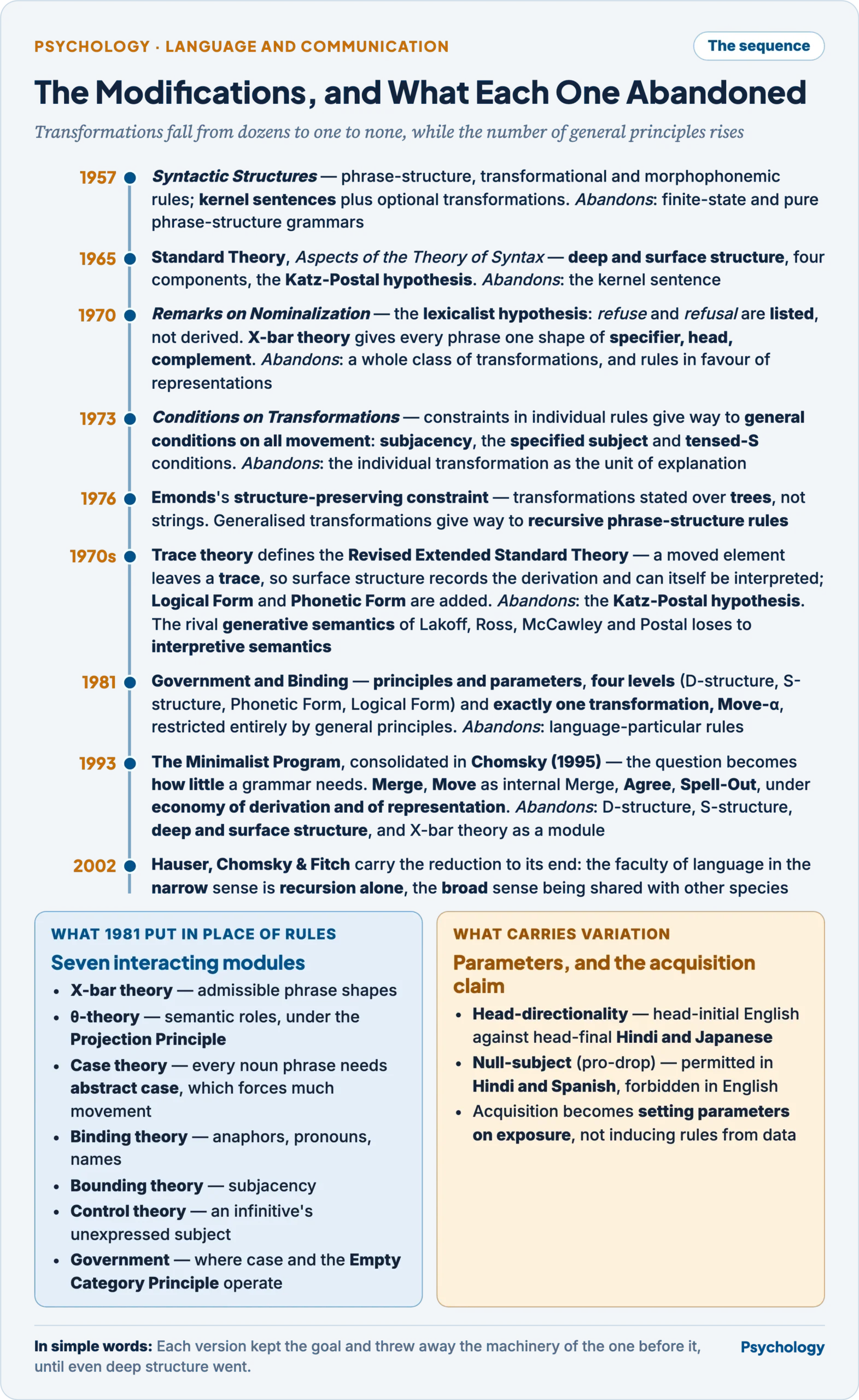
The number of transformations falls from dozens to one to none, while the number of general principles rises; that trade is the history of the theory.
The Extended Standard Theory
- Chomsky (1970), in Remarks on Nominalization, advanced the lexicalist hypothesis: related words such as refuse and refusal are listed in the lexicon rather than derived by transformation, which removes a large class of transformations at a stroke.
- The same paper generalises constituent structure into X-bar theory — a single category-neutral schema of specifier, head and complement in which every phrase, of whatever category, has the same shape. This moved explanatory weight from rules to representations.
- Generalised transformations were dropped in favour of recursive phrase-structure rules, and following the structure-preserving constraint of Emonds (1976) transformations came to be stated over trees rather than strings.
- Chomsky (1973), in Conditions on Transformations, replaced constraints written into individual rules with general conditions on all movement — among them subjacency, the specified subject condition and the tensed-S condition. The individual transformation ceases to be the unit of explanation.
- Trace theory, the move that defines the Revised Extended Standard Theory, holds that a moved element leaves a trace at its original position. The surface structure then records the whole derivation and can itself be semantically interpreted.
- This abandons the Katz-Postal hypothesis, and Chomsky’s own counterexamples were quantifier scope pairs such as many men read few books against few books are read by many men, which are transformationally related and do not mean the same thing.
- Two interpretive levels are added in consequence: Logical Form for meaning and Phonetic Form for sound.
- The rival programme of generative semantics — Lakoff, Ross, McCawley and Postal — pressed the opposite conclusion, that deep structure simply is semantic representation and syntax should be derived from meaning.
- Chomsky’s interpretive semantics prevailed inside the framework, and the dispute pushed its leading figures out of it.
Government and Binding (1981)
- Chomsky (1981), in Lectures on Government and Binding, replaced language-particular rules with principles and parameters: invariant principles common to all languages, plus a small set of binary switches set by experience.
- The grammar now has four levels — D-structure, S-structure, Phonetic Form and Logical Form — and exactly one transformation, Move-α, whose application is restricted entirely by the general principles.
- Those principles are organised into interacting modules, which is the framework’s distinctive design.
- X-bar theory — the admissible shapes of phrases.
- θ-theory — the assignment of semantic roles such as agent and patient, governed by the Projection Principle.
- Case theory — every noun phrase must receive abstract case, which is what forces much movement.
- Binding theory — the distribution of anaphors, pronouns and names, and what each may refer to.
- Bounding theory — subjacency, limiting how far an element may move in one step.
- Control theory — the reference of the unexpressed subject of an infinitive.
- Government — the structural relation under which case and the Empty Category Principle operate.
- Parameters carry cross-linguistic variation. The head-directionality parameter distinguishes head-initial English from head-final Hindi and Japanese; the null-subject or pro-drop parameter permits an unexpressed subject in Hindi and Spanish and forbids it in English.
- The acquisition claim changes shape with it: learning a language is setting parameters on exposure, not inducing rules from data.
The Minimalist Program (1993, 1995)
- Chomsky (1993) opened the programme, consolidated in The Minimalist Program (Chomsky, 1995). Its question is no longer what grammars contain but how little they need to contain — whether language is an optimal solution to the conditions imposed by the systems it interfaces with.
- Two guiding principles do the cutting: economy of derivation, so that no operation applies unless required, and economy of representation, so that no element appears unless it is interpreted.
- The operations reduce to Merge, which takes two syntactic objects and forms a labelled unit from them, and Move, reanalysed as internal Merge, with Agree matching features. Spell-Out hands the derivation to the sound side.
- D-structure and S-structure are abolished, and with them deep and surface structure. Only the interface levels of Phonetic Form and Logical Form survive, and Bare Phrase Structure dispenses with X-bar theory as a separate module.
- Hauser, Chomsky and Fitch (2002) carried the reduction to its conclusion, distinguishing the faculty of language in the broad sense from the faculty of language in the narrow sense.
- They proposed that the narrow faculty consists of recursion alone, everything else being shared with other species.
Psychological tests of the transformational account
- The derivational theory of complexity is the theory’s one direct psychological prediction: if the grammar describes what speakers know, processing difficulty should rise with the number of transformations in a sentence’s derivation.
- Mehler (1963) found kernel sentences recalled better than their transformed counterparts, with errors tending to drop transformations rather than add them.
- Miller and McKean (1964) timed participants converting a sentence from one form to another and reported times rising with the number of transformations separating the two forms.
- Savin and Perchonock (1965) had participants recall a sentence plus as many unrelated words as they could, and the number of words recalled fell as the sentence’s transformational complexity rose — read as transformations consuming storage.
- Fodor and Bever (1965) and Garrett, Bever and Fodor (1966) played a click during a spoken sentence and found it reported as displaced towards the nearest clause boundary.
- Constituents therefore behave as units of perceptual processing, a result that survived the theory it was designed to test.
- Sachs (1967) read passages of connected discourse and then tested recognition of a sentence altered either in meaning or in syntax alone.
- After 80 to 160 syllables of intervening material, detection of semantic changes stayed high while detection of syntactic changes fell to near chance (Sachs, 1967).
- Surface form is therefore held only as long as comprehension requires, which was read as evidence that what is stored is the deep structure.
- The support then came apart on the details. Slobin (1966) found passives no harder than actives when only one reading was plausible, locating the difficulty in reversibility and semantics rather than in transformations.
- Fodor, Bever and Garrett (1974) concluded that the intended isomorphism between grammar and processing was unsustainable, and the derivational theory of complexity was abandoned.
The Indian grammatical antecedent
- The project has a precursor two and a half millennia old. Pāṇini’s Aṣṭādhyāyī describes Sanskrit by roughly four thousand ordered rules, with a metalanguage, abbreviatory conventions, and rules whose application is determined by the output of earlier rules.
- Chomsky, in the 1965 preface to Aspects, acknowledged that “even Pāṇini’s grammar can be interpreted as a fragment of such a ‘generative grammar’, in essentially the contemporary sense of this term”.
- Kiparsky and Staal (1969) analysed the Aṣṭādhyāyī as operating over a hierarchy of levels of representation, and the Sanskrit tradition’s treatment of rule ordering entered generative phonology through that work.
- Whether Pāṇini’s device has the formal power of a transformational grammar or only that of a finite-state transducer remains disputed.
Criticisms and evaluation
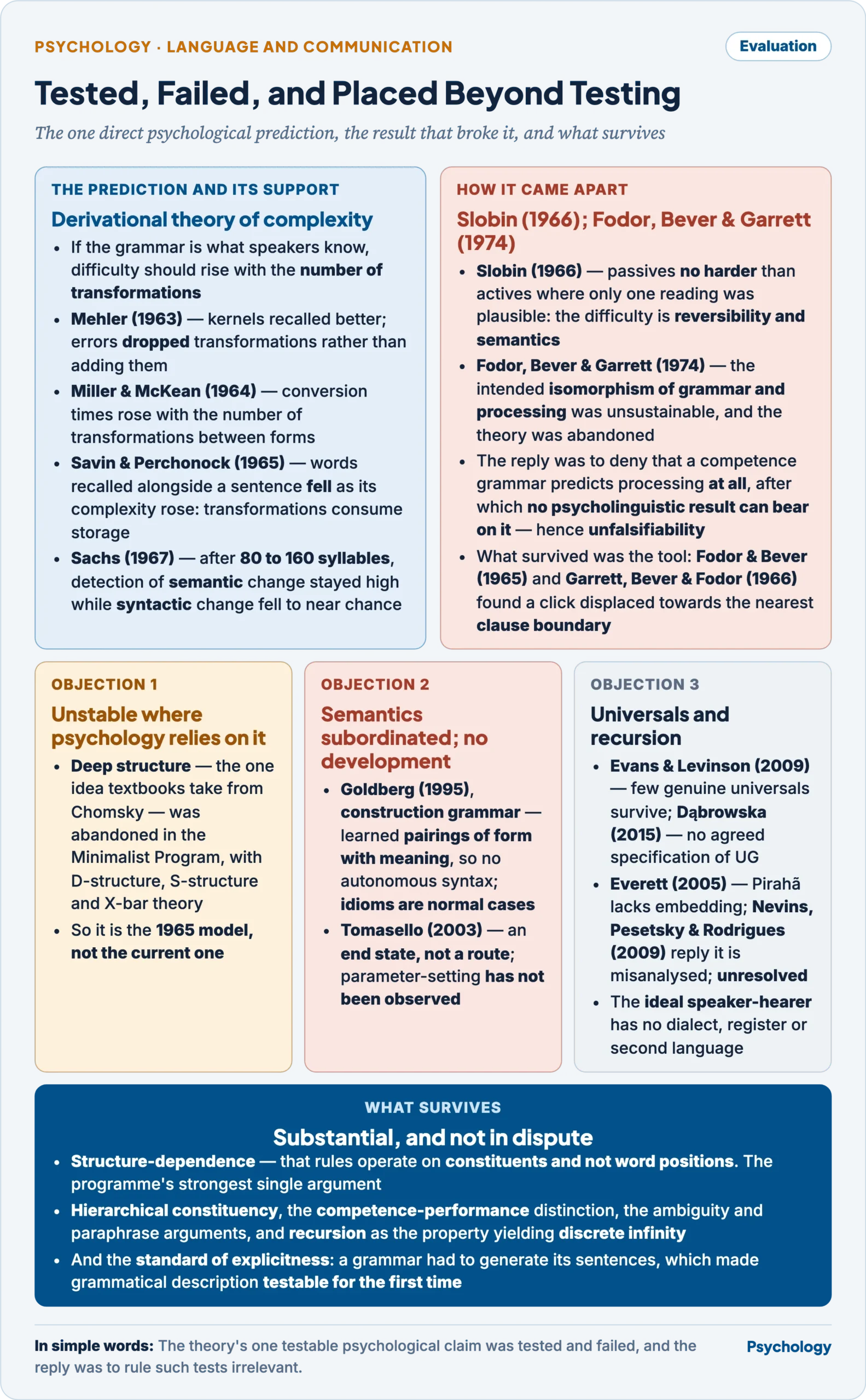
The theory’s central psychological claim was tested, failed, and was then placed outside the reach of testing — which is both its defence and the standing objection to it.
- The derivational theory of complexity failed (Fodor, Bever and Garrett, 1974), and the response was to deny that a competence grammar predicts processing at all.
- Once that separation is accepted, no psycholinguistic result can bear on the grammar, which is the basis of the recurring charge of unfalsifiability.
- The theory is unstable in exactly the place psychology relies on. Deep structure — the single idea textbooks take from Chomsky — was abandoned in the Minimalist Program, along with D-structure, S-structure and X-bar theory.
- Deep and surface structure are therefore the 1965 model, not the current one, and remain useful as a description of ambiguity and paraphrase rather than as live syntactic theory.
- Semantics is subordinated. Goldberg (1995) developed construction grammar, in which the units of a language are learned pairings of form with meaning at every level of generality, so no autonomous syntax is needed; idioms and partially fixed expressions are then normal cases rather than exceptions.
- There is no account of development. Tomasello (2003) objects that the theory describes an end state and not a route to it: a child must identify abstract categories before a parameter can be set, and parameter-setting has not been observed in acquisition data.
- His usage-based alternative has children generalising from concrete item-based constructions instead.
- The universals are contested. Evans and Levinson (2009) surveyed structural diversity and argued that very few genuine universals withstand inspection, so diversity rather than a common template is what needs explaining. Dąbrowska (2015) found no agreed specification of Universal Grammar at all.
- Recursion has a disputed counterexample. Everett (2005) reported that Pirahã lacks clausal embedding and so falsifies the prediction of Hauser, Chomsky and Fitch (2002).
- Nevins, Pesetsky and Rodrigues (2009) replied that the supposed gaps are misanalysed; Everett (2009) answered in turn, and the exchange is unresolved.
- The learnability premise is challenged empirically. Pullum and Scholz (2002) showed that constructions claimed absent from children’s input do occur in it, though Legate and Yang (2002) replied that mere occurrence is not frequency enough to be usable.
- Piantadosi (2023) argued that language models induce grammatical generalisations from input alone; Katzir (2023) answered that they fail on the very constraints at issue and see far more data than any child.
- The idealisation excludes the normal case. An ideal speaker-hearer in a homogeneous speech community has no dialect, no register and no second language, which removes the multilingual repertoire that most of the world’s speakers, and almost all Indian speakers, actually have.
- What survives is substantial. Structure-dependence — that rules operate on constituents and not on word positions — is established and remains the strongest single argument of the programme.
- So do hierarchical constituency, the competence-performance distinction, the ambiguity and paraphrase arguments, and recursion as the formal property yielding discrete infinity.
- So does the standard of explicitness: a grammar had to generate its sentences, which made grammatical description testable for the first time.
Previous Year Questions
- 2026Differentiate between surface and deep structure of language. Describe the hierarchy of language.
- 2017Critically evaluate Noam Chomsky’s theory of transformational grammar.
- 2012Discuss the modifications of Chomsky’s ‘transformational generative grammar’.
- 2009Comment on Chomsky’s theory of transformational Generative grammar and discuss its later modifications.