

Official syllabusPaper I · Unit 13 · Language and Communication
Language acquisition – predisposition, critical period hypothesis.
Definition
“The emergence of language is regulated by maturational processes: there is a critical period for primary language acquisition, beginning in the second year of life and closing at about puberty, after which a first language cannot be acquired with normal facility.”
after Lenneberg (1967)
Two claims are at issue and they are not the same claim. Predisposition says the human infant is biologically prepared for language, so that normal exposure is enough and explicit teaching is not required. The critical period hypothesis adds a timing condition: that the preparation expires, so exposure arriving late cannot be used in the same way. The second is the strong, testable, and much more vulnerable claim, and it is the chief evidence offered for the first.
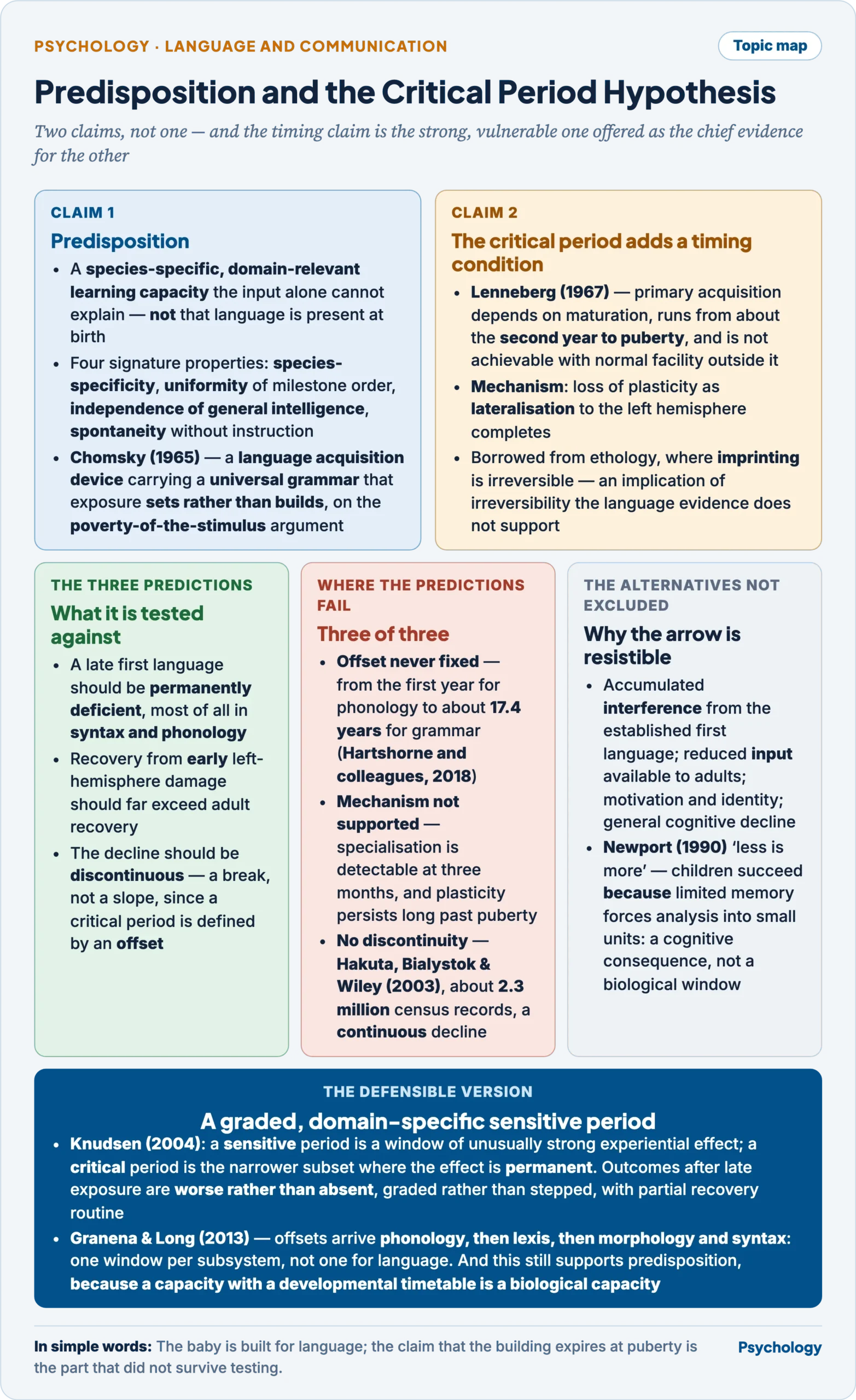
The hypothesis is an inference, not an observation: every box on the left is evidence about outcome after late exposure, and the arrow to maturation is where the argument can be resisted.
What predisposition claims
- The claim is not that language is innate in the sense of being present at birth. It is that the child brings to the task a species-specific, domain-relevant learning capacity which the input alone cannot explain.
- Four properties are standardly offered as its signature, and each is a separate empirical claim.
- Species-specificity — only humans acquire a system with duality of patterning and unbounded productivity. The ape language projects and their contested results are set out in Human Language: Properties, Structure and the Linguistic Hierarchy.
- Uniformity — the same milestone order on roughly the same schedule across unrelated languages and very different child-rearing cultures.
- Independence of general intelligence — language can be impaired while non-verbal cognition is intact, and intact while cognition is impaired.
- Spontaneity — it emerges without instruction, without correction, and in the face of degraded input.
- Chomsky (1965), in Aspects of the Theory of Syntax, stated the mechanism as a language acquisition device: an innate universal grammar specifying the possible form of a human language, which the child’s exposure serves to set rather than to build.
- The supporting argument is the poverty of the stimulus — the child’s input is finite, full of errors and never exhaustive of the grammar, yet every child converges on the same rule system.
- Brown and Hanlon (1970) tested one plank of this directly, finding that parental approval and disapproval bore no relation at all to whether what the child said was grammatical. Whether subtler negative evidence reaches the child through recasts and clarification questions is still disputed.
The evidence for a biological predisposition
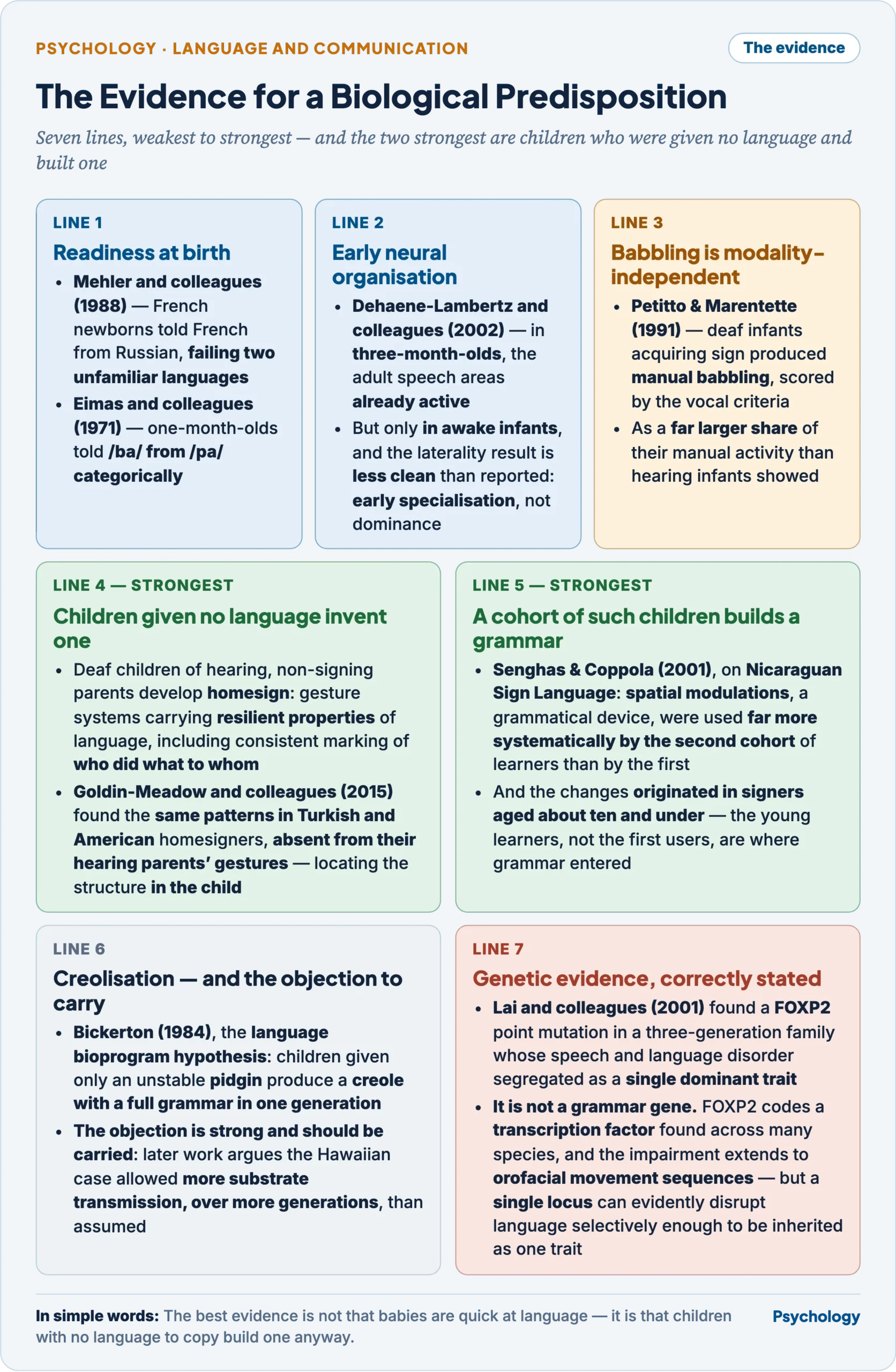
The two strongest lines are the bottom two: a child who is given no language builds one, and a cohort of such children builds a grammar.
- Readiness at birth. Mehler and colleagues (1988) found four-day-old French newborns discriminating French from Russian while failing on two equally unfamiliar languages; Eimas, Siqueland, Jusczyk and Vigorito (1971) showed one-month-olds discriminating /ba/ from /pa/ categorically, across the adult phoneme boundary and not within a category.
- Early neural organisation. Dehaene-Lambertz, Dehaene and Hertz-Pannier (2002) imaged three-month-olds listening to normal and reversed speech and found the temporal areas that serve speech in adults already active, with the forward-versus-reversed difference present in awake infants only.
- The laterality result is less clean than secondary accounts report, and sleep state is a real confound (Dehaene-Lambertz and colleagues, 2002); the defensible conclusion is early anatomical specialisation, not complete left-hemisphere dominance from birth.
- Babbling is modality-independent. Petitto and Marentette (1991) found deaf infants acquiring a sign language producing manual babbling — rhythmically repeated handshape-location-movement units, scored by the criteria used for vocal babbling — as a far larger share of their manual activity than hearing infants did.
- Children given no language invent one. Deaf children of hearing, non-signing parents develop homesign: gesture systems carrying several of the resilient properties of language, including consistent marking of who did what to whom.
- Goldin-Meadow and colleagues (2015) found the same structural patterns in Turkish and American homesigners, patterns largely absent from the gestures their hearing parents produced — which locates the structure in the child, not the input.
- A cohort of such children builds a grammar. Senghas and Coppola (2001) traced the emergence of Nicaraguan Sign Language.
- Spatial modulations, a grammatical device, were used far more systematically by the second cohort of learners than by the first, and the changes originated in signers aged about ten and under (Senghas and Coppola, 2001).
- Creolisation makes the parallel argument for spoken language. Bickerton (1984) proposed a language bioprogram hypothesis: children exposed only to an unstable pidgin produce a creole with a full grammar in a single generation, and creoles of unrelated origins converge on similar structures.
- The objection is strong and should be carried. Later sociohistorical work argues that the Hawaiian case allowed more transmission from substrate languages and over more generations than the bioprogram account assumed.
- Genetic evidence, correctly stated. Lai and colleagues (2001) identified a point mutation in FOXP2 in affected members of a three-generation family whose severe speech and language disorder segregated as a single dominant trait.
- It is not a grammar gene. FOXP2 codes a transcription factor and occurs across many species, and the family’s impairment extends to the coordination of orofacial movement sequences rather than being confined to syntax (Lai and colleagues, 2001).
- What the case does establish is that a single genetic locus can disrupt language development selectively enough to be inherited as one trait.
Lenneberg’s critical period hypothesis
- Lenneberg (1967), in Biological Foundations of Language, set out the hypothesis in its classical form: primary language acquisition depends on biological maturation, runs from roughly the second year to puberty, and is not achievable with normal facility outside that window.
- The proposed mechanism is the loss of cerebral plasticity as lateralisation of language to the left hemisphere completes. Before completion, either hemisphere can take over; after it, reorganisation is no longer available.
- Three predictions follow, and they are what the evidence is tested against.
- A first language acquired after the window closes should be permanently deficient, most of all in syntax and phonology.
- Recovery from early left-hemisphere damage should be far better than recovery from the same damage in an adult.
- The decline should be discontinuous — a break, not a slope — because a critical period is defined by an offset.
- The notion is borrowed from ethology, where imprinting occurs in a narrow window and is irreversible, and that borrowing carries the strong implication of irreversibility which the language evidence does not support.
Case evidence from deprivation
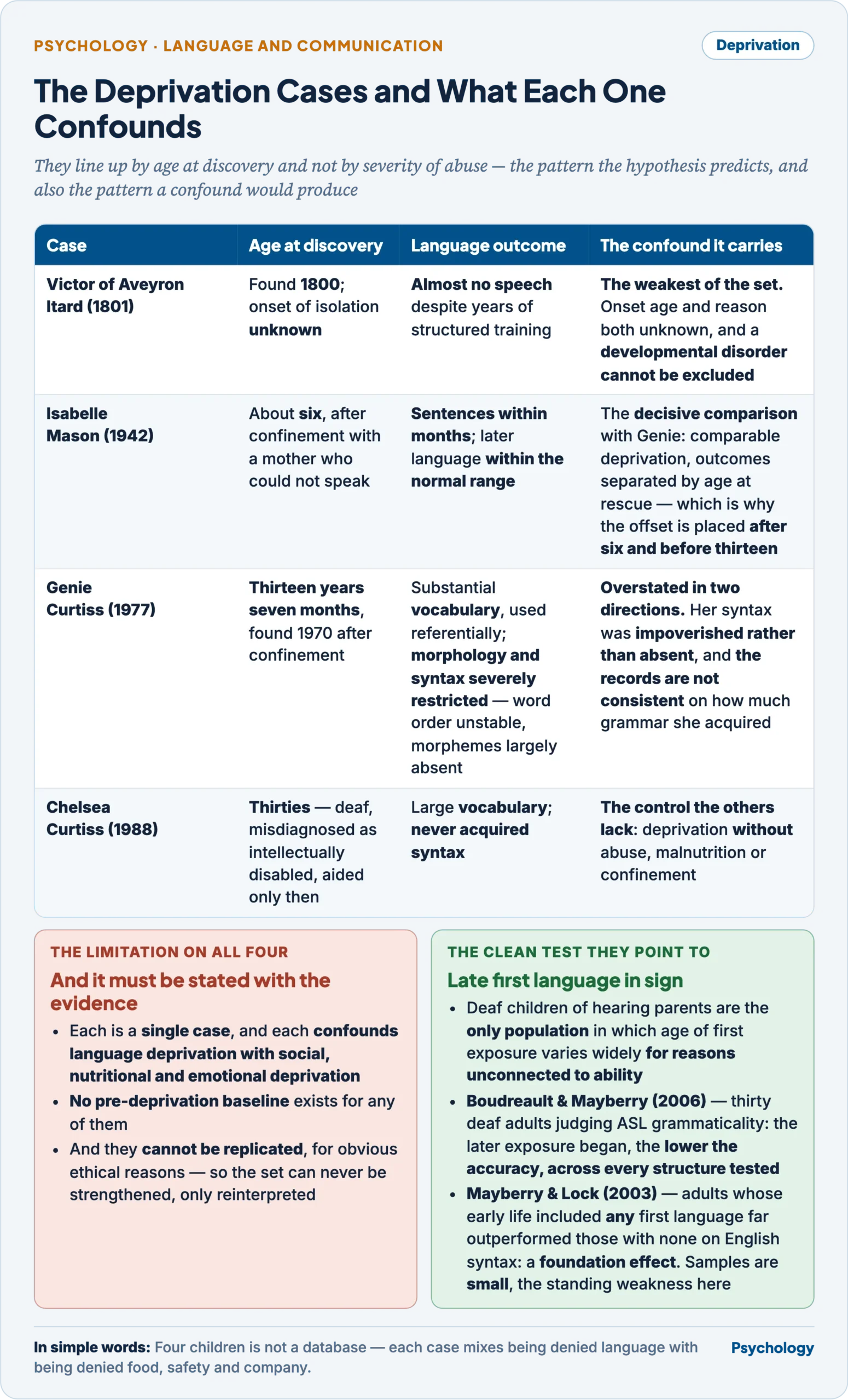
The cases line up by age at discovery and not by severity of abuse, which is the pattern the hypothesis predicts — and also the pattern a confound would produce.
- Victor of Aveyron, found in 1800 and worked with by Itard (1801), acquired almost no speech despite years of structured training.
- The case is the weakest of the set: his age at the onset of isolation is unknown, as is the reason for it, and a developmental disorder cannot be excluded.
- Genie was discovered in 1970 at thirteen years and seven months, after confinement, restraint and near-total absence of speech in the home. Curtiss (1977) documented the outcome over several years.
- She acquired substantial vocabulary and used language referentially; her non-verbal cognition improved markedly.
- Morphology and syntax remained severely restricted — word order unstable, grammatical morphemes largely absent — and phonology stayed non-standard.
- The case is routinely overstated in two directions: her syntax was impoverished rather than absent, and the interpretation has been questioned on the ground that the records are not consistent on how much grammar she acquired.
- Isabelle, reported by Mason (1942), was discovered at about six after confinement with a mother who could not speak, and within months was producing sentences; her later language was within the normal range.
- She is the most informative comparison in the set, and the comparison has to be made carefully. Her deprivation was not equivalent to Genie’s — confinement with a silent mother, rather than confinement with restraint and near-total absence of speech — so age at rescue is confounded with severity, and the contrast narrows the window’s likely offset to somewhere after six and before thirteen without fixing it.
- Chelsea, described by Curtiss (1988), was a deaf woman misdiagnosed as intellectually disabled and fitted with hearing aids only in her thirties. She acquired a large vocabulary and never acquired syntax — deprivation without abuse, malnutrition or confinement, which is exactly the control the other cases lack.
- The limitation that applies to all of them is severe and must be stated with the evidence. Each is a single case, each confounds language deprivation with social, nutritional and emotional deprivation, no pre-deprivation baseline exists, and the studies cannot be replicated for obvious ethical reasons.
Late acquisition of a first language in sign
- Deaf children of hearing parents are the only population in which age of first exposure to a first language varies widely for reasons unconnected to ability, which makes them the strongest available test.
- Boudreault and Mayberry (2006) gave thirty deaf adults a timed grammatical judgement task in American Sign Language and found that the later first-language exposure had begun, the lower the accuracy, across every syntactic structure tested.
- Mayberry and Lock (2003) extended the point to later languages: adults whose early life included a first language, signed or spoken, performed far better on English syntax than adults whose early life included none.
- The implication is a foundation effect — early exposure to any language, in any modality, builds the capacity that later language learning draws on.
- Cochlear implantation supplies a prospective test rather than a retrospective one. Dettman and colleagues (2016) reported, in a cohort of more than four hundred implanted children, better speech perception, language and speech-production accuracy in those implanted before twelve months than in those implanted later.
- The qualification is one of sample size. The sub-twelve-month groups in these cohorts are small, and the margin over implantation at thirteen to twenty-four months is narrower than the margin over later implantation — a gradient, not a threshold.
Second-language evidence and the age-of-arrival function
- Johnson and Newport (1989) tested forty-six native speakers of Korean or Chinese who had arrived in the United States between three and twenty-six years of age, on an auditory grammaticality judgement task in English.
- Performance declined steadily with age of arrival up to about puberty, and among later arrivals bore no systematic relation to arrival age at all (Johnson and Newport, 1989).
- The pattern — slope then floor — is the shape a maturational account requires, which is why the study became the standard citation for a critical period in second-language syntax.
- Hakuta, Bialystok and Wiley (2003) ran the opposite test on a far larger sample: about 2.3 million census records from Spanish- and Chinese-speaking immigrants, relating self-reported English proficiency to age of immigration.
- Proficiency declined with age of immigration continuously, with no discontinuity — and a discontinuity is the defining signature of a critical period.
- Their own caveat is that census data cannot cleanly separate age of immigration from length of residence and educational background.
- Hartshorne, Tenenbaum and Pinker (2018) settled the shape question with 669,498 respondents to an online English grammar test, native and non-native.
- Grammar-learning ability was preserved almost to adulthood and then declined, with the inflection estimated at about 17.4 years — far later than Lenneberg’s puberty.
- Native-like ultimate attainment nevertheless required beginning by about age ten, so a late offset for the learning rate coexists with an early constraint on the final level.
- Snow and Hoefnagel-Höhle (1978) followed English speakers acquiring Dutch naturalistically. Adults and twelve- to fifteen-year-olds progressed fastest early on, eight- to fifteen-year-olds reached the highest proficiency after a year, and three- to five-year-olds scored lowest throughout.
- Younger is therefore not automatically better; the long-run advantage of early starters is an advantage in ultimate attainment, not in rate.
- Granena and Long (2013) found the offsets to be domain-specific, arriving in the order phonology, then lexis and collocation, then morphology and syntax — one window per subsystem rather than one window for language.
Sensitive period rather than critical period
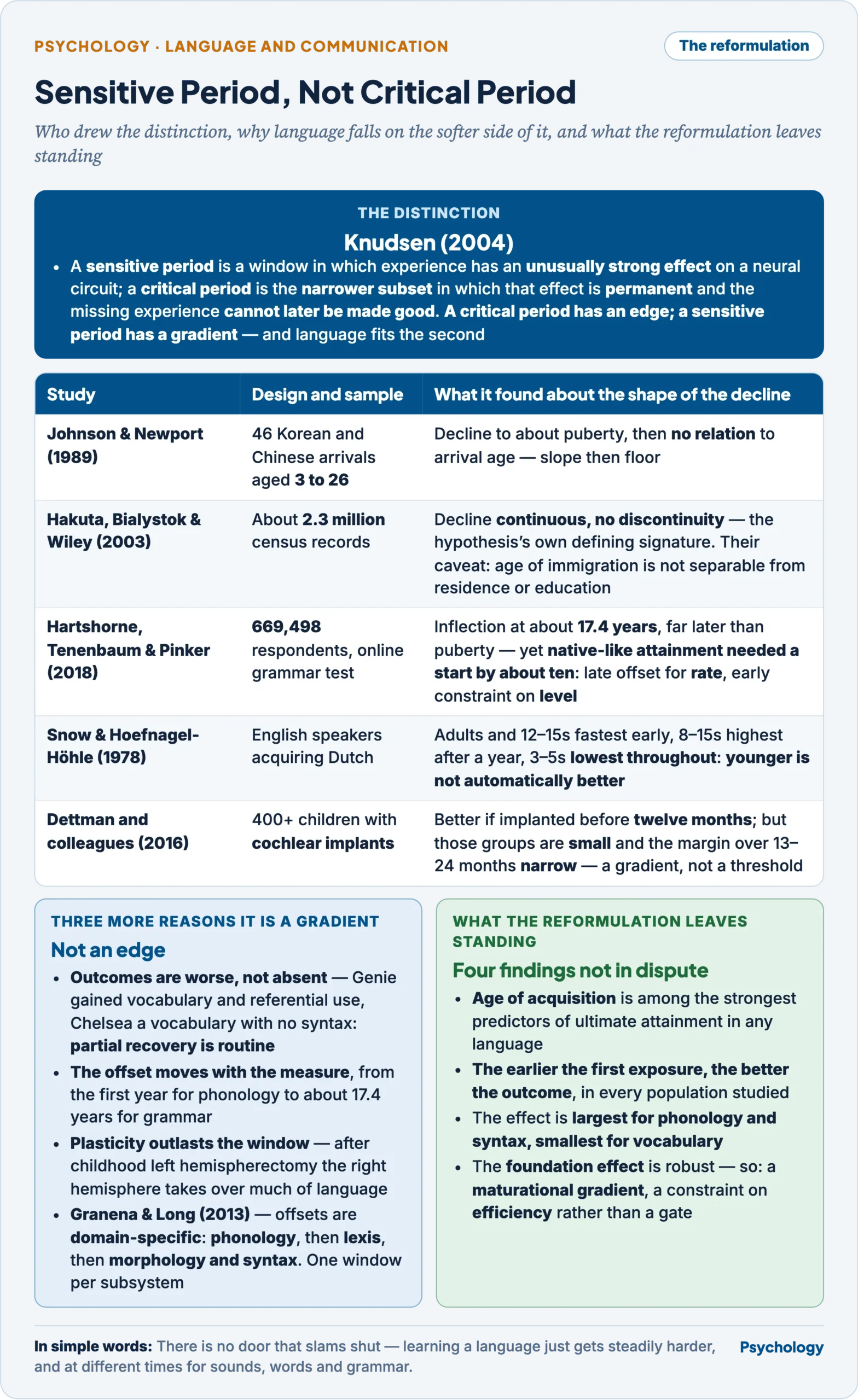
A critical period has an edge; a sensitive period has a gradient. The evidence on language fits the second curve, and the terminology has followed.
- Knudsen (2004) supplies the distinction the field now uses.
- A sensitive period is a window in which experience has an unusually strong effect on a neural circuit. A critical period is the narrower subset in which that effect is permanent and missing experience cannot later be made good.
- On that definition the language evidence is sensitive-period evidence. Outcomes after late exposure are worse rather than absent, the decline is graded rather than stepped, and partial recovery is routine.
- The earliest and sharpest window is phonological, and it closes within the first year. Werker and Tees (1984) found most six- to eight-month-olds from English-speaking homes discriminating a Hindi dental-retroflex contrast and most ten- to twelve-month-olds failing it — perceptual narrowing, well before any critical period for grammar.
- Plasticity outlasts the proposed window. After childhood left hemispherectomy the right hemisphere assumes much of language function, and reviews of these cases report receptive language recovering more fully than expressive, with age at surgery a weaker predictor of outcome than the neurosurgical literature had assumed.
- The useful reformulation is a maturational gradient: the capacity to extract a grammar from exposure declines gradually, differs by subsystem, and is best treated as a constraint on efficiency rather than a gate.
Age of exposure in a multilingual society
- Indian schooling policy makes an age-of-exposure argument of its own. The National Education Policy, 2020 keeps the medium of instruction in the child’s own language into the middle school years, and its provisions are set out in Language Acquisition: Stages and Components.
- What matters here is the reasoning rather than the provision. Its stated psychological ground is that young children grasp non-trivial concepts fastest in the language they already command — a sensitive-period argument applied to the medium of instruction, not to the acquisition of a first language, and the two should not be run together.
- The distinction is worth holding because the evidence for a maturational limit on acquiring a first grammar does not transfer to claims about the best language for teaching arithmetic, where the relevant mechanism is comprehension rather than a closing window.
- The relation between early two-language exposure and cognitive outcomes is a separate literature with its own disputes, taken up in Bilingualism, Multilingualism and the Indian Language Context.
Criticisms and evaluation
- The offset has never been fixed. Puberty was proposed with no independent measurement, and later estimates run from the first year for phonology to about 17.4 years for grammar (Hartshorne, Tenenbaum and Pinker, 2018). A period whose boundary moves with the measure is a weak construct.
- The mechanism has not survived. Completion of lateralisation at puberty is not supported: specialisation is detectable in infancy (Dehaene-Lambertz and colleagues, 2002), and plasticity persists long after puberty.
- No discontinuity. The break is the hypothesis’s own defining criterion, and large samples show a continuous decline in proficiency with age of acquisition instead (Hakuta, Bialystok and Wiley, 2003).
- The deprivation cases are overloaded. Each is a single case confounding language deprivation with abuse, malnutrition and social isolation, with no baseline and no possibility of replication; Victor’s adds an unknown onset age and a possible developmental disorder.
- First and second language are conflated. Most of the evidence concerns a second language learnt by someone who already has a first, which is a different problem from acquiring a first language late. The sign-language studies are the only clean test, and their samples are small.
- Alternative explanations are not excluded. Declining proficiency with later onset is also predicted by accumulated interference from the established first language, by reduced quantity and quality of input available to adults, by motivation and identity, and by the general cognitive decline that is not specific to language.
- “Less is more” cuts the other way. On Newport’s (1990) proposal, young children succeed partly because limited memory and processing force them to analyse language into small units, which makes the advantage a cognitive consequence rather than a biological window.
- What survives is substantial. Four findings are not in dispute.
- Age of acquisition is among the strongest single predictors of ultimate attainment in any language, first or second.
- The earlier the first exposure, the better the outcome, in every population studied.
- The effect is largest for phonology and syntax and smallest for vocabulary.
- The foundation effect — an early first language improving all later ones — is robust.
- The defensible version of the hypothesis is therefore a graded, domain-specific sensitive period. That still supports the predisposition claim, because a capacity with a developmental timetable is a biological capacity. The stage-by-stage course the timetable governs is set out in Language Acquisition: Stages and Components.
Previous Year Questions
- 2026How does the critical period hypothesis support the idea of biological predisposition?
- 2020What are the different rules of language? Critically analyze ‘critical period hypothesis’.
- 2019Evaluate the ‘critical period’ hypothesis in language acquisition.
- 2017Explain the importance of Critical Periods in language development. In what ways are bilingualism and cognitive development related?
- 2008Describe the phase of language acquisition and show how critical period hypothesis explains the process of language acquisition.
- 1996Between brain-maturation and reinforcement, which one offers a more satisfactory explanation of language acquisition?