

Official syllabusPaper I · Unit 13 · Language and Communication
Language acquisition – predisposition, critical period hypothesis.
Definition
“Language acquisition is the child’s construction, out of the speech it happens to hear, of the rule system of its community’s language — a construction whose early course is indexed better by the mean length of the child’s utterances than by its age.”
after Brown (1973)
Every ordinary child arrives at a grammar nobody taught it, in nearly the same order and on nearly the same timetable, from input that is fragmentary and never systematically corrected. Two things therefore have to be described separately: the sequence, which says what appears when, and the components, because sound, vocabulary, grammar and social use are acquired on partly independent schedules rather than as one block.
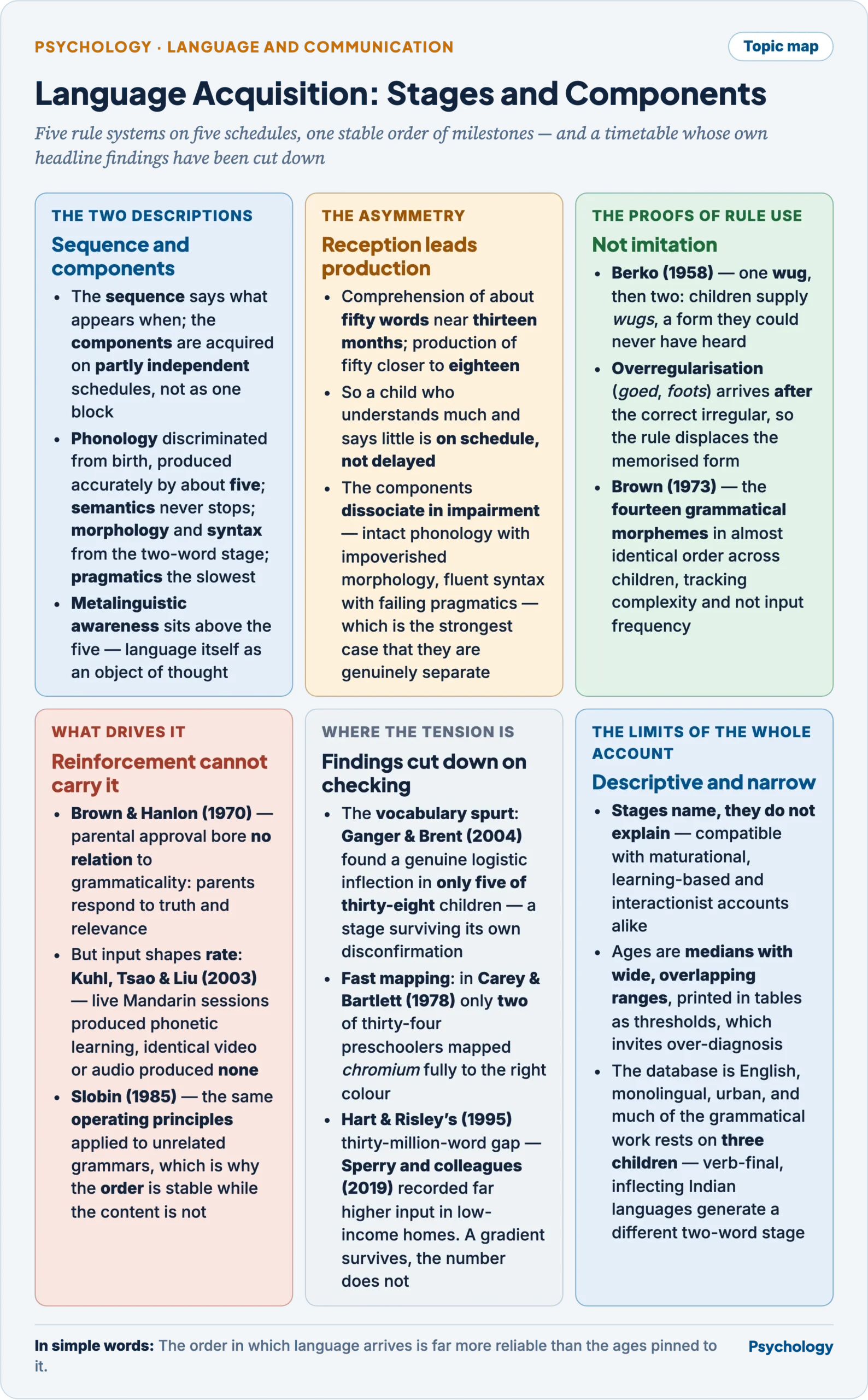
Read across any one age and the child is at a different point in each rule system; the components do not advance in step.
The components of language acquisition
- Language is a rule-governed symbol system, and five rule systems are standardly distinguished. Each is a separate acquisition problem with its own schedule and its own characteristic errors.
- Phonology — the sound system: which phonemes, the smallest sound units that change meaning, the language uses and how they may legally combine. Discriminated from birth, produced accurately by about five.
- Semantics — the meanings of words and sentences; in developmental terms, the growth of the lexicon. The only component that keeps expanding into late adulthood.
- Morphology — the system of morphemes, the smallest units carrying meaning, including the inflections marking tense, number, case and gender.
- Syntax — the rules combining words into acceptable sentences. Begins at the two-word stage and is elaborated throughout childhood.
- Pragmatics — the social rules for using language in context: adjusting to the listener, taking turns, recovering intent from an indirect remark. The slowest to mature.
- A sixth achievement sits above the five. Metalinguistic awareness is the capacity to treat language itself as an object of thought — to define a word, judge a sentence ill-formed, enjoy a pun. It begins in the preschool years and advances sharply in middle childhood.
- Receptive language runs ahead of expressive language at every point. Comprehension of about fifty words is typical near thirteen months, while production of fifty words arrives closer to eighteen, so a child who understands much and says little is on schedule rather than delayed.
- The components dissociate in impairment, which is the strongest argument that they are genuinely separate. A child may have intact phonology with impoverished morphology, or fluent syntax with failing pragmatics.
From non-verbal communication to speech: the prelinguistic phase
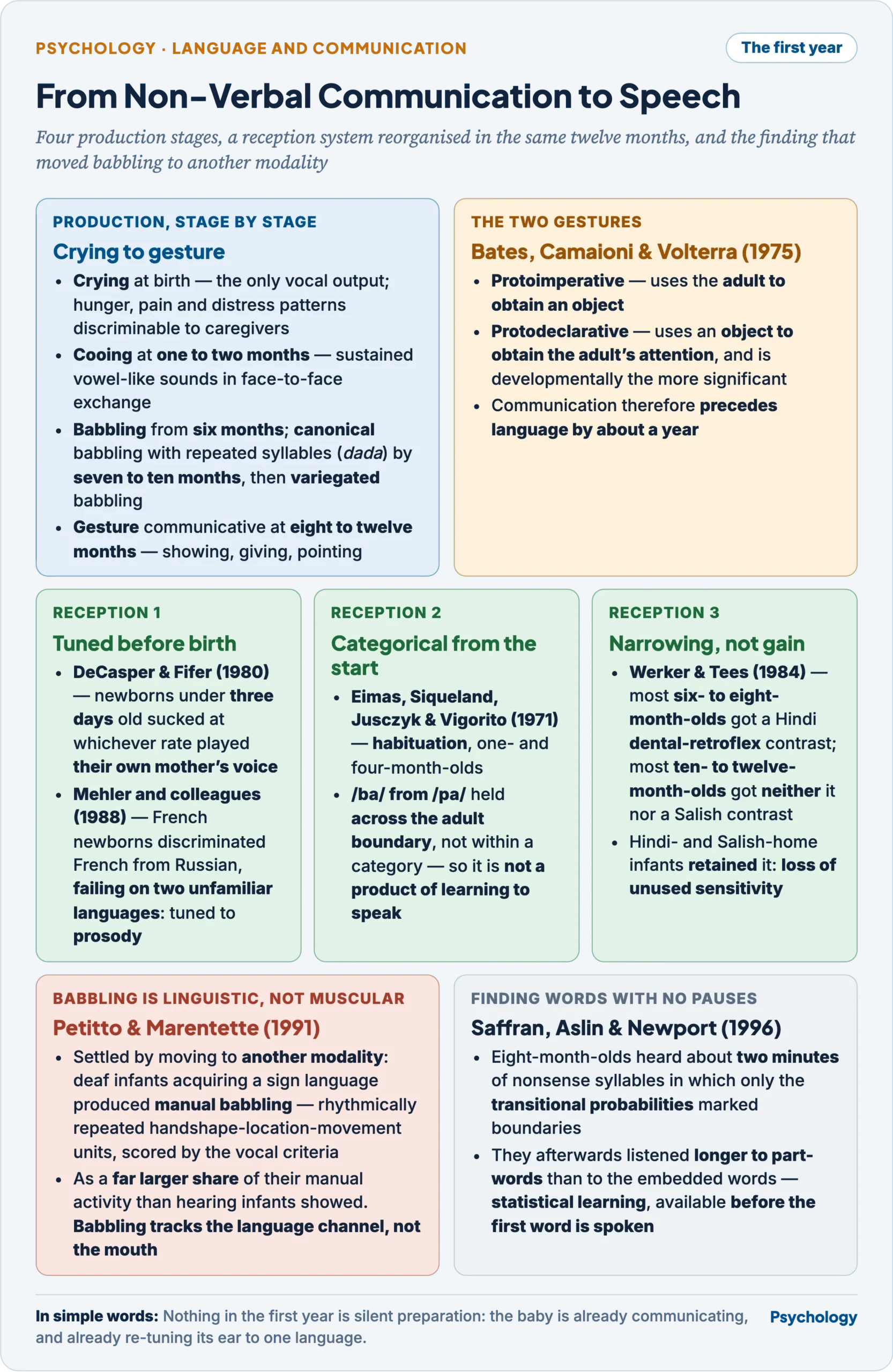
Nothing in the first year is silent preparation: each stage is already communication, and the child’s reception of speech is reorganised before the first word is produced.
- Communication precedes language by about a year, and the earliest evidence is prenatal.
- DeCasper and Fifer (1980) used a sucking-contingent procedure with newborns under three days old: the infants sucked at whichever rate played their own mother’s voice rather than another woman’s, so the voice had been learnt in utero.
- Mehler and colleagues (1988) found four-day-old French newborns discriminating French from Russian while failing on two equally unfamiliar languages. The newborn arrives tuned to the prosody around it.
- Eimas, Siqueland, Jusczyk and Vigorito (1971) established that this reception is already categorical.
- Using a habituation procedure with one- and four-month-olds, discrimination of /ba/ from /pa/ held across the adult phoneme boundary and not within a category (Eimas and colleagues, 1971).
- Categorical perception is therefore not a product of learning to speak; it is in place months before.
- The production sequence runs through four observable stages in the first year.
- Crying is present at birth and is initially the only vocal output; distinct patterns for hunger, pain and distress are discriminable to caregivers.
- Cooing appears at about one to two months — sustained vowel-like sounds, typically during face-to-face exchange.
- Babbling begins around six months: strings combining a consonant and a vowel. By about seven to ten months it becomes canonical babbling, with well-formed repeated syllables (dada, baba), and later variegated babbling, in which syllables differ within a string.
- Gesture becomes communicative at about eight to twelve months — showing, giving and pointing to direct an adult’s attention.
- Bates, Camaioni and Volterra (1975) separated the protoimperative gesture, which uses the adult to obtain an object, from the protodeclarative, which uses an object to obtain the adult’s attention. The second is developmentally the more significant.
- Petitto and Marentette (1991) settled whether babbling is linguistic or merely muscular, by moving to another modality.
- Deaf infants acquiring a sign language produced manual babbling — handshape-location-movement units, repeated rhythmically — scored by the same criteria as vocal babbling.
- Manual babbling made up a far larger share of the deaf infants’ manual activity than of the hearing infants’. Babbling tracks the language channel, not the mouth.
- Werker and Tees (1984) showed that reception is reorganised during the same year.
- Infants from English-speaking homes were tested on a Hindi dental-retroflex contrast and a Nthlakampx (Salish) contrast. Most six- to eight-month-olds discriminated both; most ten- to twelve-month-olds discriminated neither.
- Infants from Hindi- and Salish-speaking homes retained the ability, so perceptual narrowing is the loss of unused sensitivity rather than the gain of a native one.
- Saffran, Aslin and Newport (1996) showed how the child finds words in a signal with no reliable pauses at boundaries.
- Eight-month-olds heard about two minutes of a monotone stream of nonsense syllables in which only the transitional probabilities between syllables marked word boundaries.
- They afterwards listened longer to part-words than to the embedded words, which is statistical learning of distributional regularities — available before the first word is spoken.
First words and the growth of the lexicon
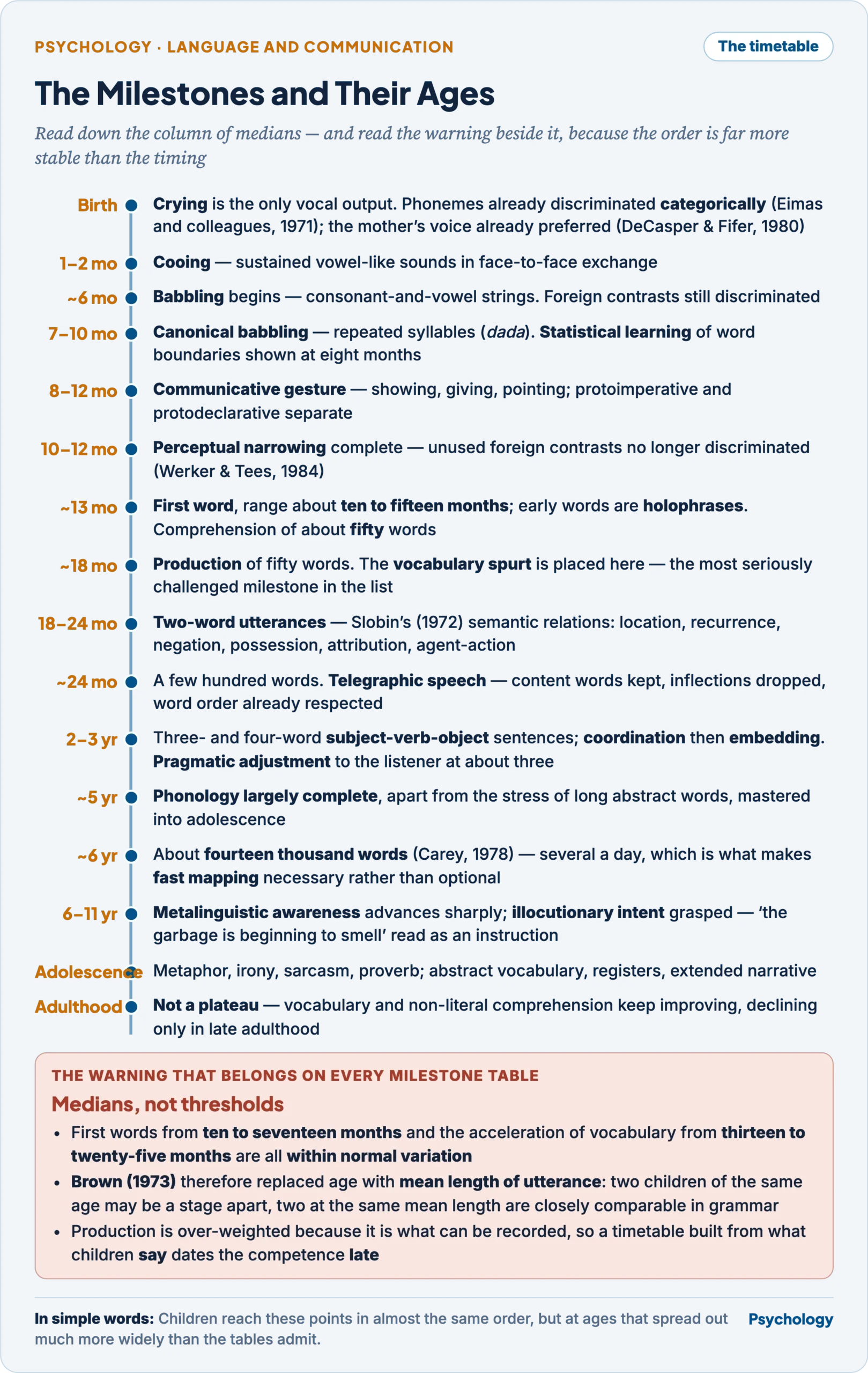
The ages are medians with wide normal ranges, and the ranges overlap; the order of the milestones is far more stable than their timing.
- The first word is usually produced between about ten and fifteen months, with a median near thirteen months. Its form is constrained by what the child can pronounce, so consonant-vowel sequences with repeated syllables dominate.
- Early words are holophrases: one word carrying the force of a whole utterance, so mama may mean “pick me up” on one occasion and “I am hungry” on another, with gesture, intonation and context supplying the rest.
- Nelson (1973) followed eighteen children through their first fifty words.
- Roughly two-thirds were nominals — names of people, animals, food, toys and vehicles — with very few action or function words.
- She separated a referential style, heavy in object labels, from an expressive style richer in social formulae; the referential children reached fifty words earlier.
- Two characteristic meaning errors follow. Overextension applies a word beyond its range (dog for every four-legged animal); underextension restricts it below its range (dog for the family pet alone). Word meaning is being constructed, not copied.
- Growth then accelerates, and the acceleration is traditionally called the vocabulary spurt, placed at about eighteen months — production rising from roughly fifty words then to a few hundred by two years.
- The spurt is the most seriously challenged milestone in the sequence. Ganger and Brent (2004) fitted logistic and quadratic growth curves to longitudinal records of thirty-eight children.
- A better logistic fit, the signature of a genuine inflection, appeared in only five of the thirty-eight (Ganger and Brent, 2004). For most children growth accelerates smoothly, with no spurt to date.
- The mechanism of rapid word learning is fast mapping: a provisional meaning attached to a new word after one or two exposures, with no instruction.
- Carey and Bartlett (1978) introduced thirty-four preschoolers to the invented colour word chromium, for olive green, in one incidental request.
- Most retained it as a colour term and only two mapped it fully to the right colour, so the first mapping is partial and is refined over later encounters (Carey and Bartlett, 1978).
- Carey (1978) estimated a vocabulary of the order of fourteen thousand words by age six, which requires several new words a day across the preschool years — the figure that makes fast mapping necessary rather than optional.
Two-word speech, telegraphic speech and the grammatical morphemes
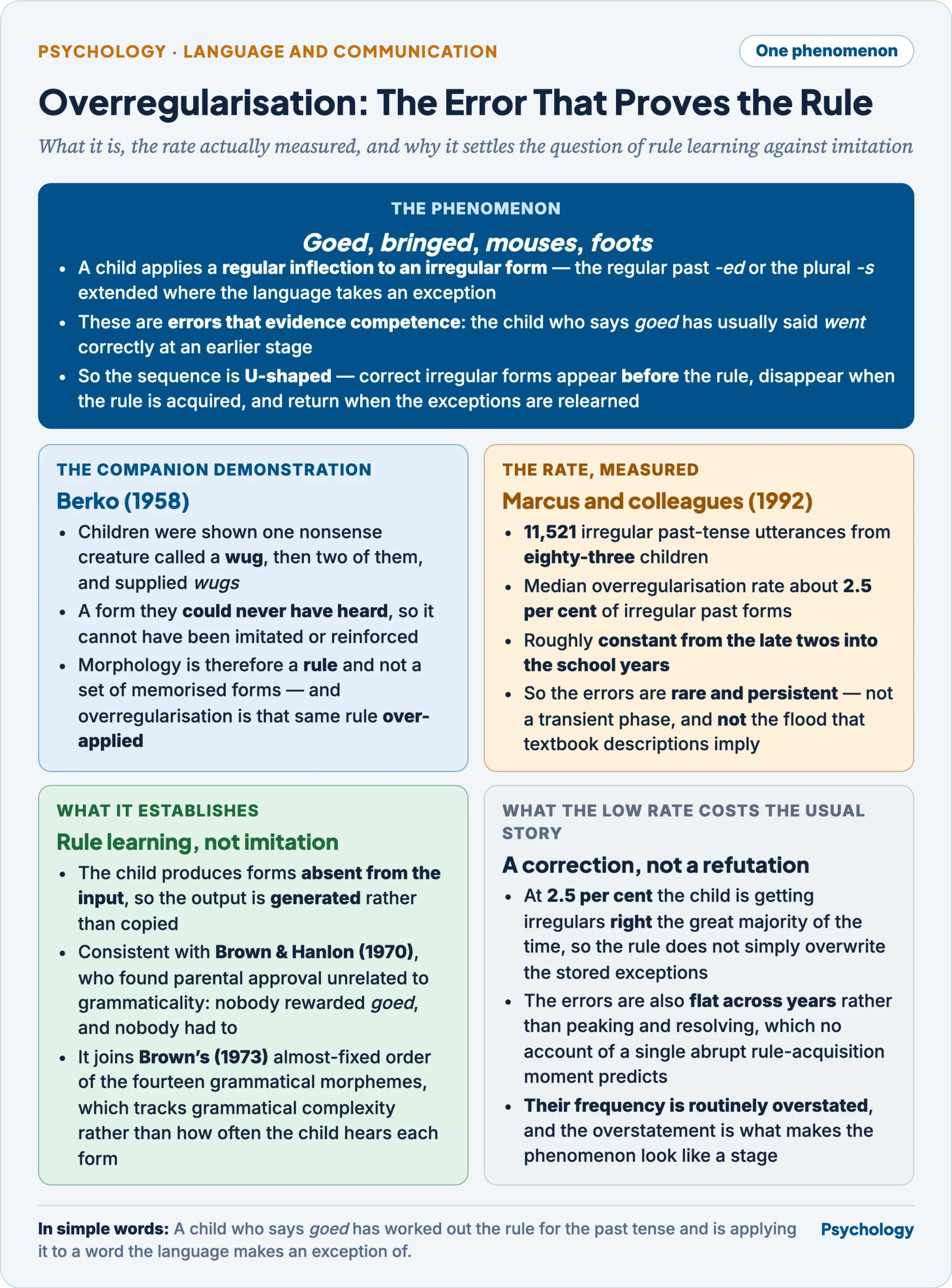
The U-shaped curve is the point: correct irregular forms appear before the rule, disappear when the rule is acquired, and return when the exceptions are relearned.
- Two-word utterances appear at about eighteen to twenty-four months and are not random pairs. Slobin (1972) catalogued the same small set of semantic relations across unrelated languages — identification (see ball), location (book there), recurrence (more milk), negation (not sit), possession (my doggy), attribution (big car), agent-action (mama wave), question (where ball).
- Telegraphic speech follows: short utterances carrying the content words and dropping articles, auxiliaries, prepositions and inflections, as a telegram once did. Word order is already respected, so mummy push and push mummy are not interchangeable.
- Brown (1973) replaced age with mean length of utterance, the average number of morphemes per utterance, and defined five stages by it, Stage I beginning as the measure first rises above 1.0.
- Two children of the same age may be a stage apart; two at the same mean length are closely comparable in grammar.
- Brown’s second finding is the stronger one: the fourteen grammatical morphemes of English are acquired in an almost identical order across children.
- The set includes the present progressive -ing, the plural -s, the possessive -‘s, the regular past -ed, the third-person -s, the articles, and the copula and auxiliary forms.
- The order tracks semantic and grammatical complexity rather than how often the child hears each form, and was confirmed in independent samples by Cazden (1968) and de Villiers and de Villiers (1973).
- Berko (1958) demonstrated that morphology is a rule and not a set of memorised forms. Children shown one nonsense creature called a wug and then two of them supplied wugs — a form they could never have heard.
- The same rule then overregularises: goed, bringed, mouses, foots. These errors evidence competence, because the child who says goed has usually said went correctly at an earlier stage.
- Their frequency is routinely overstated. Marcus and colleagues (1992) analysed 11,521 irregular past-tense utterances from eighty-three children.
- The median overregularisation rate was about 2.5 per cent of irregular past forms, roughly constant from the late twos into the school years (Marcus and colleagues, 1992) — rare and persistent, not a transient phase.
Early childhood: complex syntax, pragmatics and literacy
- Between about two and three years, three- and four-word sentences appear in a consistent subject-verb-object order, and the move from simple to complex sentences — first coordination, then embedding — begins.
- Phonology is largely complete by five, apart from the stress patterns of long and abstract words, still being mastered in adolescence.
- Pragmatic adjustment appears around three: the child varies its speech by listener, simplifying for younger children and using polite forms with adults. That requires representing what the listener knows.
- Referential communication stays weak in preschool laboratory tasks, where children describe an object inadequately for a listener who cannot see it. In familiar settings the same children are far more sensitive to a partner’s needs, so the task overstates the deficit.
- Sénéchal and LeFevre (2002) followed 168 children for five years and separated two home pathways.
- Storybook exposure was related to vocabulary and listening comprehension, which in turn predicted grade-three reading.
- Parent teaching of words was related instead to early literacy skills — so reading to a child and teaching a child to read do different jobs.
Middle childhood to adulthood
- Vocabulary growth continues steeply through the elementary years and is strongly associated with the amount and quality of verbal interaction at home.
- Metalinguistic awareness advances most in middle childhood, visible in language play — riddles, deliberate mislabelling, invented words — and in the ability to define words rather than only use them.
- Illocutionary intent, what a speaker means as distinct from what the utterance literally says, is grasped in this period: an eight-year-old understands that “the garbage is beginning to smell” is an instruction.
- Adolescence brings the figurative layer — metaphor, irony, sarcasm, satire and proverb — alongside abstract vocabulary, registers for different audiences, and extended narrative organisation.
- Adulthood is not a plateau. Vocabulary and the comprehension of subtle non-literal meaning continue to improve with experience, declining only in late adulthood, and then largely through sensory and memory changes rather than loss of linguistic knowledge.
What drives the sequence
- Reinforcement cannot carry the explanation on its own. Brown and Hanlon (1970) tested whether parental approval and disapproval tracked the grammatical correctness of what children said, and found no relation: parents respond to truth and relevance, not to syntax.
- Whether children nevertheless receive usable negative evidence in subtler forms — recasts, clarification questions — remains disputed. The nativist reply, that the child supplies the rule system itself, is set against the behaviourist account of imitation and reinforcement in Skinner and Chomsky: The Behaviourist-Nativist Debate.
- Input nevertheless shapes rate. Kuhl, Tsao and Liu (2003) gave nine-month-olds from English-speaking homes under five hours of Mandarin.
- Live sessions with a human speaker produced phonetic learning; the identical material delivered on video or audio produced none (Kuhl, Tsao and Liu, 2003). Exposure has to be socially contingent to count as input.
- The size of the input gap is contested. Hart and Risley (1995) reported a difference of about thirty million words heard by age three across socio-economic groups, a figure since repeated everywhere.
- Sperry, Sperry and Miller (2019) recorded substantially higher input in low-income families than that work found, with wide variation within groups; critics note their samples included no professional-class comparison group. A real gradient survives, the headline number does not.
- Cross-linguistic work constrains any account. Slobin (1985) assembled acquisition data from unrelated languages and argued that children apply the same operating principles to very different grammars — which is why the order of milestones is stable while their content is not.
The Indian context
- Most Indian children acquire more than one language from the start, so the monolingual milestone norms built on English-speaking samples systematically mis-score them: vocabulary counted in one language alone understates a bilingual child’s total lexicon.
- Indian screening instruments have been built against this problem. Nair and colleagues (2013) developed and validated the Language Evaluation Scale Trivandrum (0-3), a 33-item receptive-and-expressive screen designed for community health workers.
- Against an established reference scale in 643 children, a two-item-delay criterion gave sensitivity of about 67 per cent with specificity of about 95 per cent; a one-item criterion gave about 96 per cent and 78 per cent respectively (Nair and colleagues, 2013).
- The trade-off is the substantive point: a community screen tuned to catch every delayed child also refers large numbers of normally developing multilingual children.
- National Education Policy, 2020 (Ministry of Education) — places the medium of instruction in the home, mother tongue, local or regional language until at least Grade 5 and preferably Grade 8, and retains a three-language formula with at least two Indian languages.
- Its stated psychological ground is that young children grasp non-trivial concepts fastest in the language they already command, which is the comprehension-before-production asymmetry turned into policy. Classroom outcomes are taken up in Bilingualism, Multilingualism and the Indian Language Context.
Criticisms and limitations
- Stages are descriptive, not explanatory. Naming cooing, babbling and telegraphic speech records what is observed and supplies no mechanism for the transition between them; the sequence is compatible with maturational, learning-based and interactionist accounts alike.
- The ages are medians with wide normal ranges, and milestone tables print them as though they were thresholds. The typical band for a first word is ten to fifteen months, but anything out to seventeen months, and an acceleration of vocabulary anywhere from thirteen to twenty-five months, is still within normal variation — so the tables invite over-diagnosis at their own margins.
- The vocabulary spurt may not exist for most children, on the evidence of Ganger and Brent (2004), yet it remains in every standard milestone list — the clearest case of a stage surviving its own disconfirmation.
- The database is narrow. The canonical sequence rests on English, on small longitudinal samples — much of the grammatical work on three children — and on monolingual, literate, urban households.
- Morphologically rich and verb-final Indian languages generate different early utterances, and the two-word stage looks different where inflection is obligatory rather than optional.
- Production is over-weighted because it is what can be recorded. Comprehension leads production by months at every stage, so a timetable built from what children say dates the underlying competence late.
- Pragmatic development is assessed in artificial tasks. Referential communication failures in the laboratory are not reproduced in familiar settings, which means the measure and not the child is sometimes what is being described.
- What survives is substantial. The invariance of milestone order across languages and cultures, the comprehension-before-production asymmetry, perceptual narrowing in the first year, the near-fixed order of the grammatical morphemes, the wug finding and overregularisation as proof of rule use, and fast mapping as the engine of lexical growth are all robust.
- Each of them is also a premise in the argument from uniformity to a biological predisposition, which is set out in Predisposition and the Critical Period Hypothesis.
Previous Year Questions
- 2024How do Skinner and Chomsky differ in their approach to language development? Also, discuss the processes and outcomes of bilingualism and multilingualism in Indian context.
- 2022Discuss language acquisition at different stages of development in the light of the theories of Skinner and Chomsky.
- 2016Discuss the components of language acquisition citing the average age at which these are demonstrated by a child.
- 2011How does language differ from other forms of communication? Referring to relevant studies, document children’s progress from non verbal communication to the use of language.
- 2008Describe the phase of language acquisition and show how critical period hypothesis explains the process of language acquisition.
- 1995Stages in language development.