

Existentialism (Kierkegaard, Sartre, Heidegger): Existence and Essence; Choice, Responsibility and Authentic Existence; Being-in-the-world and Temporality.
Official Syllabus: Paper I, Section A, Unit 10
Jean-Paul Sartre (1905–1980) gave existentialism its ontology — its theory of what there is. In Being and Nothingness (1943), subtitled “An Essay on Phenomenological Ontology“, he describes two radically different regions of being: being-in-itself (l’être-en-soi), the solid, self-identical being of things, and being-for-itself (l’être-pour-soi), the being of consciousness, which is not a thing at all but a nothingness — a gap, a lack, a perpetual going-beyond. Consciousness, Sartre says, “is what it is not and is not what it is“. This strange formula is the root of everything else in his philosophy: of freedom, of anguish, of bad faith, and of the slogan “existence precedes essence“. It answers the question: what must human consciousness be, if human beings are free?
In simple words
A stone is a stone, completely and for ever. It has no gap inside it, no “not yet”, no “used to be”. You are different. You are a student — but not in the way a stone is a stone: you are not yet the officer you hope to become, no longer the child you were, and at any moment you could walk out of the exam hall and stop being a candidate. There is always a little gap between you and whatever you are. Sartre calls this gap nothingness — and says it is exactly what makes you free.
Context & Problem
Sartre’s Path to Phenomenology
- The cocktail glass. In the early 1930s, Sartre’s friend Raymond Aron, back from Germany, told him at a Paris café that with phenomenology one could make philosophy out of the cocktail glass on the table. Simone de Beauvoir records that Sartre “turned pale with emotion“: here at last was a way to philosophise about concrete things as they are lived.
- Berlin. In 1933–34 Sartre studied Husserl and Heidegger in Berlin.
- Early works. The Transcendence of the Ego (1936–37), the novel Nausea (1938), Sketch for a Theory of the Emotions (1939), The Imaginary (1940) — and then the great treatise Being and Nothingness (1943).
What “Phenomenological Ontology” Means
- Ontology is the study of being — what it is to be, and what kinds of being there are.
- Phenomenological means proceeding by careful description of what appears to consciousness — not by building speculative systems.
- Sartre’s method. He analyses concrete human experiences — shame, bad faith, love, desire, anxiety, the look of another, absence, nausea — and through these descriptions uncovers the structures of being.
- From knowledge to existence. Sartre moved phenomenology from a theory of knowledge (Husserl) to an ontology of human existence.
His Debts and His Departures
- From Husserl: intentionality — consciousness is always consciousness of something. Sartre accepted it fully but rejected Husserl’s transcendental ego and his idealism.
- From Heidegger: the focus on existence, facticity and being-in-the-world — given a more individualistic, freedom-centred reading. Where Heidegger speaks of Dasein’s care and temporality, Sartre speaks of personal responsibility and self-creation.
- From Hegel: the very terms “in-itself” and “for-itself“, and the power of negation.
- From Descartes: the starting point in consciousness (the cogito) — but a pre-reflective cogito, not a thinking substance.
- From Kierkegaard: anguish as the awareness of freedom.
Core Doctrine
1. The Monism of the Phenomenon: No Hidden “Thing-in-Itself”
- Against Kant. Kant distinguished phenomena (things as they appear to us) from noumena (things in themselves, unknowable). Sartre rejects this: the noumenon is not hidden or inaccessible — “it simply is not there“.
- Appearance is the only reality. “What appears is what is.” An object is the infinite series of its finite appearances — the front, the back, the side, seen now and seen later. There is nothing “behind” the series.
- Dualisms removed. This eliminates old dualisms: inner and outer (no hidden inside behind the appearing surface), appearance and essence (the essence is just the principle of the series of appearances), potency and act (all is actual).
- But being overflows appearance. The being of the phenomenon is never exhausted by any one appearance: there are always more profiles to see. Being is “transphenomenal” — it is not swallowed up by our knowledge of it.
In simple words
A coin shows you heads; turn it, it shows tails; tilt it, it shows its edge. Kant would say there is also a “coin-in-itself” hidden behind all these views that you can never see. Sartre says: there is nothing hidden behind — the coin is the whole endless series of its appearances. What you see is what there is; you just never see it all at once.
2. Consciousness: Intentional, Empty, Translucent
Intentionality is consciousness:
- “All consciousness is consciousness of something.” Even when consciousness turns on itself in reflection, it is directed to something as to an “other”.
- For Husserl, intentionality is one essential feature of consciousness. For Sartre, intentionality is consciousness: consciousness is nothing but this outward directedness.
- Not a container. Consciousness is not a box filled with ideas or images. In a famous essay on intentionality Sartre said that consciousness “has no inside“: it is a pure bursting out towards the world. If, impossibly, we could “enter” consciousness, we would be thrown outside, among things.
- No bridge problem. Descartes’ certainty of the cogito left him trapped inside his mind, needing a “bridge” to the external world. Intentionality makes this a false problem: consciousness is already in the world, related to objects there.
- Images are not little pictures. An image is not a miniature “in the mind” but a way of intending an absent object — of “derealising” the world. The imagined apple has only the features I give it; unlike a perceived apple, it can teach me nothing new.
Empty and translucent:
- Contentless. Consciousness contains no objects, ideas or ego. All its content is out there.
- Translucent. Consciousness has no blind spots and no hidden depths — no unconscious mind behind it. Everything in it is in principle lit up to itself.
3. Pre-reflective and Reflective Consciousness: The Disappearance of the Ego
In The Transcendence of the Ego Sartre distinguishes two levels of one and the same consciousness.
Pre-reflective (unreflected) consciousness:
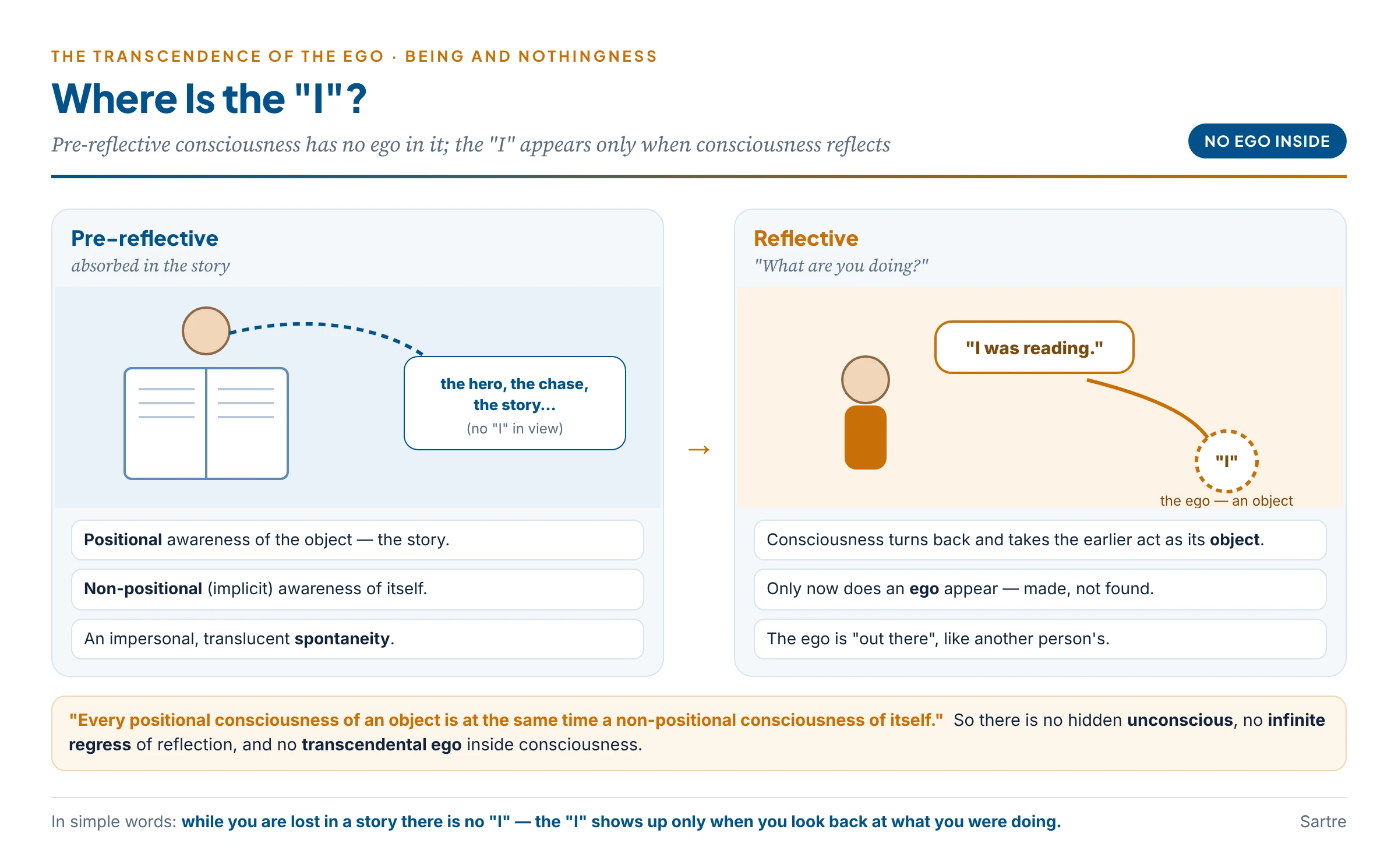
- When I read a novel, my consciousness is absorbed in the story — the hero, his adventures. When I run to catch a bus, my consciousness is of “bus-to-be-caught“. There is no “I” in such consciousness — only its objects.
- Yet it is self-aware. I am not unconscious while reading: if someone asks “What are you doing?”, I can answer at once, “I was reading.” So the pre-reflective consciousness was implicitly aware of itself.
- Positional and non-positional. Consciousness “posits” (explicitly aims at) its object — the story — and is at the same time non-positionally (implicitly) aware of itself. “Every positional consciousness of an object is at the same time a non-positional consciousness of itself.“
- The anaesthetic test. Before an operation a patient is given an anaesthetic precisely to block pre-reflective awareness. Afterwards, asked “What did you feel?”, the answer is “Nothing” — there was no experience to reflect upon. This shows the difference between pre-reflective awareness and genuine unconsciousness.
Reflective consciousness:
- When I reflect — “I was reading” — consciousness turns back upon itself and makes the earlier act its object. Only now does an “I“, an ego, appear.
- The ego is made, not found. The ego is not the inhabitant of consciousness but an object that reflection constitutes — partly discovered, partly created. It is “out there, in the world”, like the ego of another person.
- Consciousness is impersonal. Underneath the ego lies an “impersonal spontaneity“, a “monstrous spontaneity” in which thoughts arise of themselves. Sartre tells of a young bride who dreaded her husband leaving for work because she feared that, once alone, she might sit at the window like a prostitute: she was terrified not of any temptation but of her own freedom to do it. (Kierkegaard’s Adam, learning from the prohibition that he could eat the fruit, felt the same dread.)
Why this matters:
- Against Husserl’s transcendental ego. If consciousness is translucent and outward-directed, there is no room for a “self behind the self” inside it. Such an ego would be “the death of consciousness” — an opaque lump inside what is pure transparency.
- No Freudian unconscious. Because pre-reflective consciousness is always implicitly self-aware, there is no need for an unconscious mind that acts behind our backs and takes away our responsibility. We are “aware of more than we know” — like a dieter who pre-reflectively reaches for a second helping while reflectively saying “I won’t”. Sartre later called this pre-reflective awareness “comprehension“.
- No infinite regress. If self-awareness required a second act reflecting on the first, that would need a third, and so on for ever. Pre-reflective self-awareness stops the regress: every conscious act is already self-aware.
- Self-deception explained. The bifocal structure — pre-reflective awareness and reflective claims that may not match — makes bad faith possible without any unconscious (see the next article).
Common confusion
Did Sartre “reverse” Descartes into “I am, therefore I think”? Some notes say so, but this belongs rather to Kierkegaard (“I must exist in order to think”) and to Heidegger’s priority of existence. Sartre actually kept the cogito as philosophy’s starting point — “there can be no other truth to take off from than this: I think, therefore I am” — but he transformed it. The basic cogito is pre-reflective: a consciousness of the world that is implicitly aware of itself, without any “I” inside it. The thinking “I” of Descartes appears only at the reflective level, as an object.
4. Being-in-Itself (L’Être-en-soi)
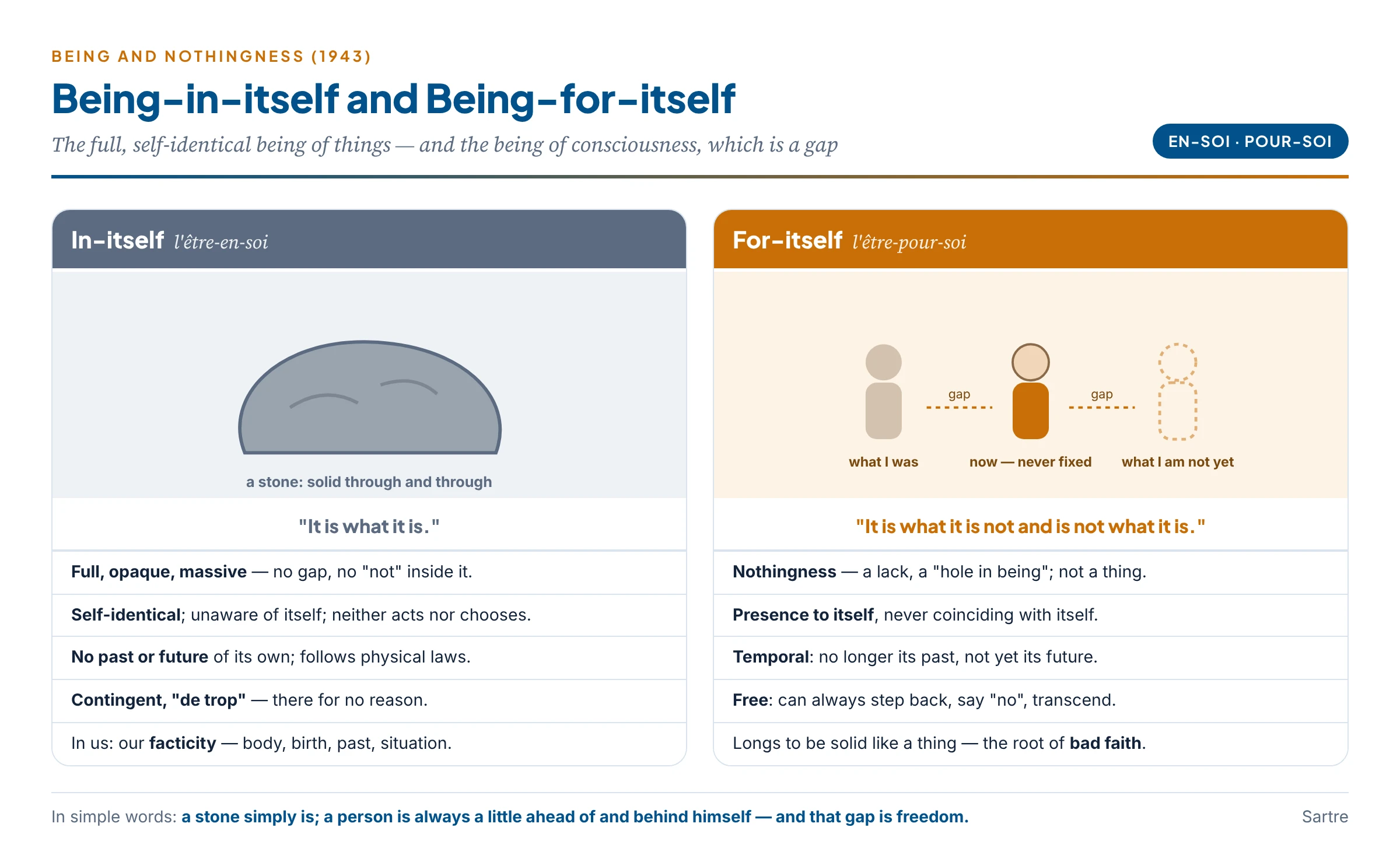
Sartre sums up being-in-itself in three short sentences: “Being is. Being is in-itself. Being is what it is.“
- Things. It is the mode of being of things — stones, tables, trees, the physical world.
- Full and solid. It is massive, opaque, “full of itself“, a plenum — completely filled with being, with no internal gap, no negation, no “not”.
- Self-identical. A stone is simply what it is; it coincides perfectly with itself.
- Neither active nor passive. It does not do anything; it does not relate to itself; it is not even aware of itself.
- No possibilities, no time. It has no future it projects towards, no past it carries as its own; it does not change by choice but merely follows physical laws.
- Uncreated and without reason. Being-in-itself is not created (a creator would only push the problem back) and has no reason for being: it is contingent, “de trop” — superfluous.
- Fixed essence. Its essence is positive and fixed: for things, essence precedes existence.
- In human beings. Our facticity — the body, the past, the place and date of birth, our race, nationality, talents and limits, our previous choices — has the character of the in-itself: it simply is, and cannot be undone.
5. Being-for-Itself (L’Être-pour-soi)
- Consciousness. It is the mode of being of human consciousness.
- Not a thing. Consciousness is not a substance but a dynamic, self-aware activity. It is “a being such that in its being, its being is in question“.
- A nothingness. It is characterised by nothingness (le néant) — not in the sense that it does not exist, but that it contains a gap, a lack, within itself. It is a “hole in being“, a fissure (décalage) introduced into the solid fullness of being-in-itself.
- Never identical with itself. Unlike a stone, a human being is never simply what he is at a given moment. He is presence to himself — and presence implies a tiny distance, a separation by “nothing”.
- Defined by possibilities. The for-itself is defined by possibilities, not by a fixed essence; it is always projecting itself towards a future that it is not yet. It must create itself out of nothingness.
- Free. Because it is never fixed, it can transcend every given state: this transcendence is freedom.
- Examples. A person is not “a teacher” the way a rock is a rock; he can question and transcend this role — become a good or a bad teacher, leave teaching, become a saint or a sinner. “I am not what I was“; “I am not satisfied” — in such thoughts I put a distance between myself and my present condition.
- The tension. Human beings constantly long to be like the in-itself — stable, complete and fixed. This longing is the root of bad faith, in which a person tries to identify himself completely with a social role.
| Point | Being-in-itself (en-soi) | Being-for-itself (pour-soi) |
|---|---|---|
| What | Things: stone, table, tree | Human consciousness |
| Formula | “It is what it is“ | “It is what it is not and is not what it is“ |
| Structure | Full, massive, opaque, no gap | Nothingness, lack, translucent |
| Relation to itself | Self-identical | Presence to itself, never coinciding |
| Essence | Fixed; essence precedes existence | Open; existence precedes essence |
| Time | No past or future of its own | Temporal: projects into the future |
| Activity | Inert; follows physical laws | Spontaneous; negates and transcends |
| Choice | Cannot choose | Always chooses |
| Responsibility | None | Total |
| Freedom | None | Freedom is its very being |
In simple words
Compare your photograph on the admit card with you. The photograph is finished: it is exactly what it is and will never be anything else — that is being-in-itself. You, sitting in the hall, are already thinking about the next question, regretting the last one, imagining the result — always ahead of and behind yourself, never simply “there” like the photo. That restless gap is being-for-itself.
6. “Consciousness Is What It Is Not and Is Not What It Is”
This paradoxical formula sums up the for-itself. It can be unpacked step by step.
“Is not what it is”:
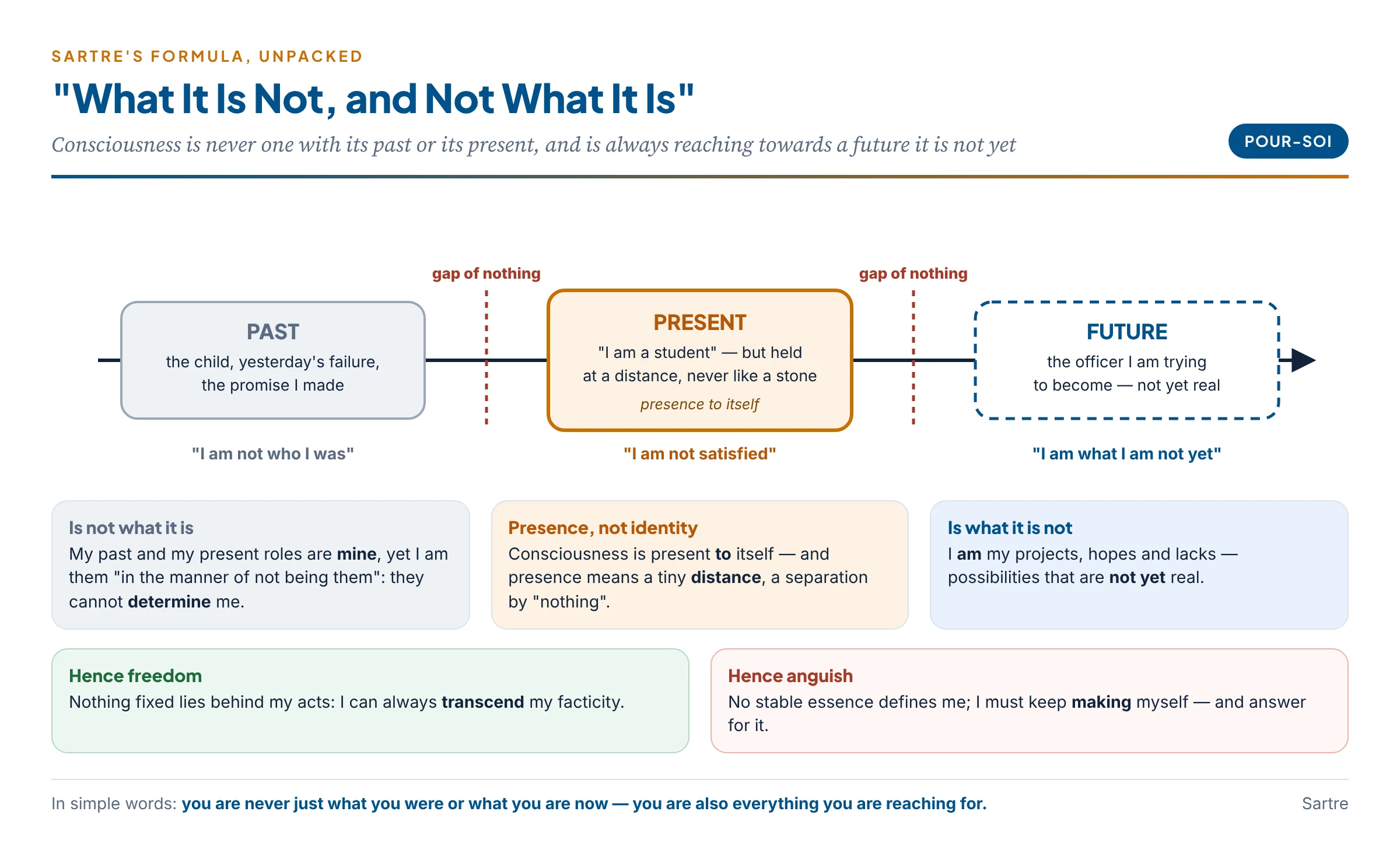
- Whatever I am now — tired, a student, a coward in this moment — I am it in the manner of not being it. I am never stuck in it as a stone is stuck in being a stone.
- My past is mine, but I am no longer it: “I am not who I was.” A nothingness separates me from my past, so that the past cannot determine me.
- Even my present role I hold at a distance: I play at being a waiter, a soldier, a student — I can always step back from it.
“Is what it is not”:
- I am my future possibilities — the person I am trying to become — which I am not yet. “The person I will be is not who I am.” A student is not yet a teacher; a person is not yet what he hopes to become.
- I am also my lack: desire, hope and projects are ways of being what I am not.
- Since my future possibilities are not real at present, I am “what I am not“.
What follows — the chief features of consciousness:
- Intentional — always of something other than itself.
- Translucent — no hidden contents, no unconscious.
- Pre-reflectively self-aware — non-positionally conscious of itself in every act.
- Egoless — the ego is an object for reflection, not an inhabitant of consciousness.
- Negating — it introduces “not” into the world (absence, lack, distance).
- Temporal — stretched between a past it is no longer and a future it is not yet.
- A lack — always desiring, never complete.
- Free — never determined by its past or its situation.
- The source of values and meanings — it gives meaning to its situation by its projects.
- Anguished — because nothing fixed stands behind its choices.
7. Nothingness: How “Not” Enters the World
The question:
- Sartre begins Being and Nothingness with the simple fact that we can ask questions. Every question admits the possibility of a negative answer (“Is there a way out?” — “No”). In questioning, we already reveal non-being in the world.
Pierre is not in the café:
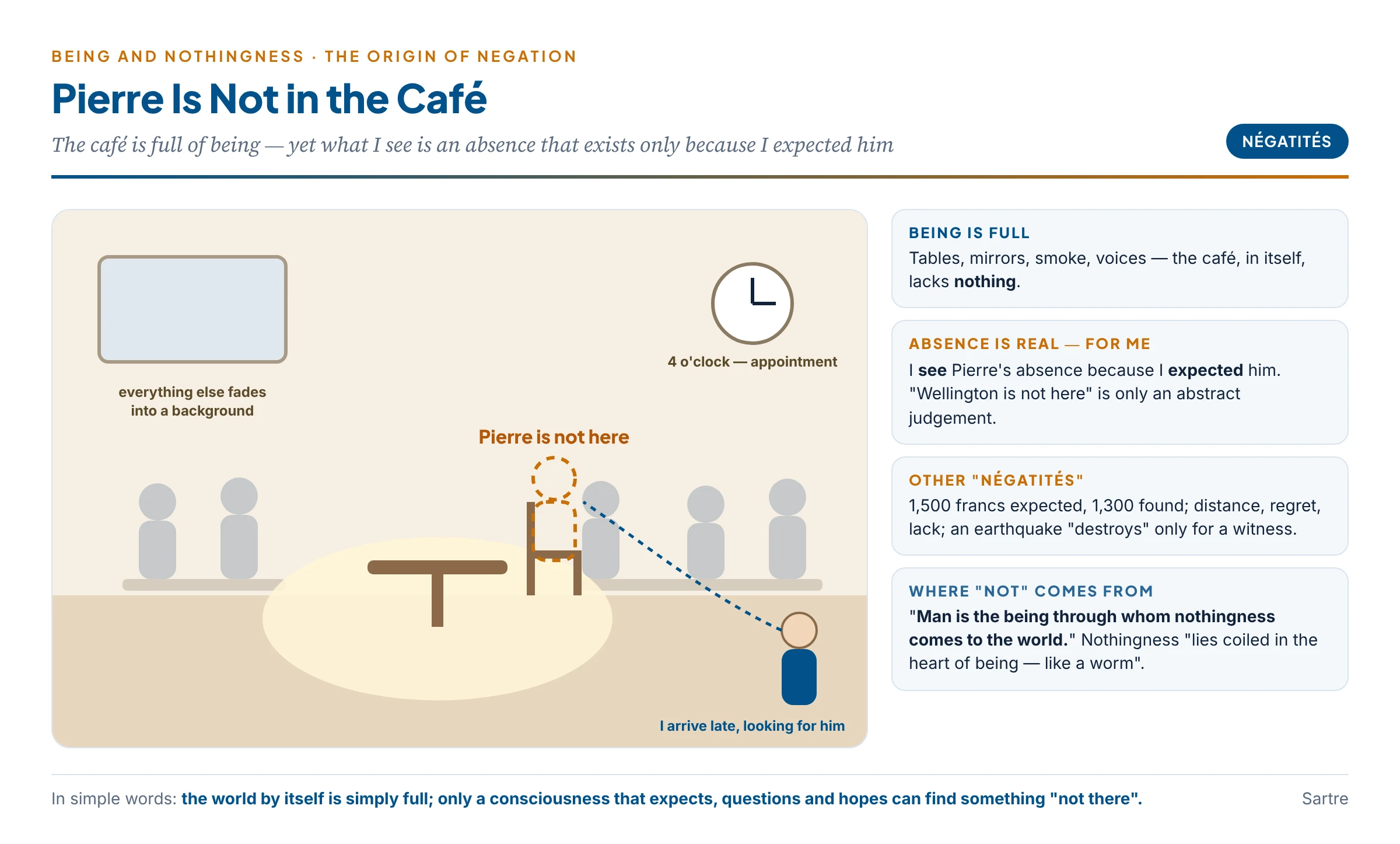
- I have an appointment with my friend Pierre at four o’clock. I arrive late and look round the crowded café. The room is full — tables, mirrors, smoke, people, voices. Yet everything dissolves into a background against which one thing stands out: Pierre’s absence. “Pierre is not here.“
- This absence is real — I see it, I experience it — and yet it is not “in” the café as a thing is. The café is simply full of being. The absence exists only because I expected Pierre: it is introduced by consciousness.
- By contrast, the judgement “Wellington is not in this café” or “Paul Valéry is not here either” is a merely abstract negation: nobody was expecting them.
- Similar “négatités” (negative realities) are everywhere: I look in my wallet expecting to find 1,500 francs and find only 1,300 — the lack is real for me; absence, distance, regret, lack, destruction.
Destruction needs a witness:
- A storm or an earthquake does not “destroy” anything in itself; it only redistributes masses of matter. Destruction exists only for a being who compares what is with what was or might be. “It is man who destroys his cities through the agency of earthquakes.”
Where nothingness comes from:
- Negation is not only a quality of judgements (as some philosophers held); it is a real feature of experience — but it does not come from being-in-itself, which is pure fullness.
- “Nothingness lies coiled in the heart of being — like a worm.” Only a being which is its own nothingness — consciousness — can bring nothingness into the world. “Man is the being through whom nothingness comes to the world.“
- Nihilation. Consciousness is an activity of nihilating (néantisation): it detaches itself from what is given, steps back from it, imagines alternatives, says “no“.
Nothingness and freedom:
- Man is “no thing”. Since man lacks any definite essence apart from what he makes of himself, he is not any particular thing: he is “no-thing” — a blank canvas on which to create his being.
- Beginning from scratch. To defend absolute freedom, man must begin from nothing.
- Foundation of freedom. Because consciousness is not fixed, it can transcend its facticity. I cannot change certain facts — my birth, my past — but I can always reinterpret and respond to them.
- Source of anguish. The same nothingness that frees me also unsettles me: no stable essence defines me, and I am perpetually responsible for creating myself.
In simple words
You open an exam result page expecting to see your roll number in the list — and it is not there. The page is full of other numbers; nothing on the screen “is” an absence. Yet your eyes see nothing but the missing number. That absence exists only because you expected something. Consciousness, Sartre says, is the being that brings such “not” into a world which, by itself, is simply full.
Common confusion
Is Sartre’s “nothingness” the same as Heidegger’s “the Nothing nothings”? No. For Heidegger, the Nothing is revealed in anxiety as the background against which beings as a whole stand out; “the Nothing itself nothings” (das Nichts selbst nichtet). Sartre rejects any independent Nothing: “nothingness does not nihilate itself; nothingness is nihilated.” Nothingness has no being of its own; it exists only as made-to-be by consciousness, which nihilates. Sartre thus ties nothingness firmly to human freedom rather than to Being.
8. Value, Lack and the Desire to Be God
- The for-itself is a lack. Hunger lacks food; desire lacks satisfaction; consciousness as a whole lacks the solid self-coincidence of the in-itself.
- The impossible ideal. What the for-itself ultimately desires is to be both at once — a consciousness (free) that is also a solid, self-founded thing (in-itself). This “in-itself-for-itself” is the traditional idea of God: a being that is its own foundation.
- A useless passion. But the synthesis is impossible: to become solid, consciousness would have to stop being conscious. Hence Sartre’s famous conclusion: “Man is a useless passion.“
- Source of values. This lack is the origin of value: values exist only for a being that lacks and projects. And since there is no God to fix values, “my freedom is anguished at being the foundation of values while being itself without foundation“.
9. Contingency and Nausea
- Roquentin and the chestnut root. In Sartre’s novel Nausea (1938), Antoine Roquentin sits in a public park staring at the root of a chestnut tree. Suddenly all the familiar labels fall away, and he sees it as a “black, knotty, raw, monstrous, naked, obscene lump of existence“. “Never, until these last few days, had I understood the meaning of ‘existence‘.”
- Superfluous. Everything — the trees, the paths, Roquentin himself — appears superfluous (de trop), there for no reason: “I was superfluous for all eternity.”
- Being is absurd. Against the rationalists Spinoza and Leibniz, who sought a sufficient reason for everything, Sartre holds that being has no reason at all: it is not necessary but contingent and absurd.
- A “phenomenon of being”. Nausea is not a cognitive judgement but an emotional disclosure of the brute fact that things are — that we are and need not be. Such experiences are “phenomena of being“.
10. Being-for-Others: The Third Region
- Besides the in-itself and the for-itself, Sartre describes a third dimension: being-for-others (l’être-pour-autrui).
- The look. Under another person’s look, I discover that I have an outside — an object-being I cannot control, which exists for him. In shame I recognise that “I am as the Other sees me“.
- Other minds proved by experience. The famous scene of the voyeur at the keyhole who hears footsteps shows the existence of other minds more directly than any argument from analogy: even if the noise was only the wind, the experience reveals the structure of being-seen.
- Mutual objectification. Each consciousness tries to make the other an object and resists being made one — the root of conflict in human relations. (This is developed in the next article.)
11. Sartre and Husserl on Consciousness
| Point | Husserl | Sartre |
|---|---|---|
| Intentionality | An essential feature of consciousness | Is consciousness itself |
| Contents | Consciousness contains acts, sensory data and the noema | Empty: all content is out in the world |
| Ego | A transcendental ego as the pole of all acts | No ego in consciousness; the ego is an object of reflection |
| Self-awareness | Through reflection | Pre-reflective, non-positional self-awareness |
| Being of consciousness | Absolute being, the residue of the reduction | Nothingness, a lack, a hole in being |
| Bracketing (epoché) | Bracket the world’s existence to study pure consciousness | Existence cannot be bracketed; consciousness is always consciousness of a being it is not |
| Relation to the world | Consciousness constitutes meaning (transcendental idealism) | Consciousness reveals a being independent of it (realism) |
| Gulf | No sharp gulf between world-consciousness and self-consciousness | A wide gulf between the in-itself (world) and the for-itself (consciousness) |
| Aim | Philosophy as a rigorous science | An ontology of freedom and authentic existence |
- The source of the difference. Husserl’s transcendental ego served his project of grounding knowledge. Sartre’s concern was existence — how an individual can find authentic existence — and a constituting ego would turn consciousness back into a thing, destroying freedom.
- Empirical ego. For Sartre, the ego of each person — with states, qualities and character — is an empirical object in the world, built up by reflection; for Husserl, beneath the empirical ego lies the transcendental ego. (Heidegger’s alternative — Dasein as being-in-the-world — is discussed in the article on Heidegger.)
Critical Evaluation
Objections
- Nothingness is a confusion of grammar. Analytic philosophers — A. J. Ayer among them — argued that Sartre treats the word “nothing” as if it named a something, an error of logic. “Pierre is not in the café” is just a negative fact, not an encounter with a mysterious nothingness.
- A new dualism. In-itself and for-itself are as sharply opposed as Descartes’ matter and mind. How could consciousness ever arise from, or act upon, a world of pure in-itself? Sartre gives no account.
- The body is neglected. Merleau-Ponty objected that Sartre’s opposition is too sharp: our existence is embodied and ambiguous, a mixture of activity and passivity, not a pure nothingness facing pure things.
- Too much freedom. If consciousness is never determined, how do we explain habits, inherited talents, a child prodigy, or the weight of social conditions?
- The rejection of the unconscious seems to ignore much of what psychoanalysis has shown about hidden motives.
- Rejecting Kant’s noumenon may be dogmatic: how can Sartre know there is nothing behind appearances?
- Pessimism. “Man is a useless passion” seems to make human life a failure by definition.
Replies and Strengths
- Phenomenological description, not logic. Pierre’s absence is experienced; the description captures something real about how meaning and “lack” belong to lived experience, which a purely logical analysis leaves out.
- A dualism of function. The opposition is not between two substances (as in Descartes) but between spontaneity and inertia — a functional, not substantial, duality.
- Freedom in situation. Sartre never denied facticity; he denied that facticity decides for us. He later recognised social structures more fully (the “practico-inert” of his Critique of Dialectical Reason).
- Pre-reflective “comprehension” lets Sartre keep many psychoanalytic insights without an unconscious that abolishes responsibility.
- Lasting insights. The pre-reflective cogito, the egoless structure of consciousness, the analysis of negation and lack, and the description of the look remain influential in philosophy of mind and phenomenology.
Critics and Defenders
Criticism — Critics
- Grammatical error: “nothing” is treated as a thing (logical analysts).
- Cartesian dualism revived: in-itself versus for-itself, with no bridge.
- Disembodied: neglects the lived body and ambiguity (Merleau-Ponty).
- Overstated freedom: habits, talent and society seem to count for nothing.
- No unconscious: psychoanalytic evidence ignored.
- Pessimism: “man is a useless passion”.
Defence — Defenders and strengths
- Lived negation: absence and lack are real features of experience.
- Functional, not substantial: spontaneity versus inertia, not two substances.
- Pre-reflective cogito: solves the regress of self-awareness.
- No hidden ego: consciousness is transparent and free.
- Responsibility secured: no unconscious to blame.
- Revisable: later works give full weight to social structures.
Cross-Tradition Comparison
Consciousness and Self in Sartre and Indian Thought
| Point | Sartre | Buddhism | Advaita Vedānta | Sāṅkhya |
|---|---|---|---|---|
| Is there an ego inside consciousness? | No — the ego is an object for reflection | No — anattā; the “I” is a construction | The empirical “I” (ahaṃkāra) is superimposed; the true Self is pure witness | Ahaṃkāra belongs to matter (prakṛti) |
| Nature of consciousness | Nothingness, lack, free activity | A stream of momentary, conditioned states | Pure, changeless, self-luminous being-consciousness | Puruṣa: pure, inactive witness |
| Self-awareness | Pre-reflective, non-positional | Self-luminosity (svasaṃvedana) of each moment (Yogācāra) | Self-luminous (svaprakāśa); never an object | Puruṣa illumines but does not act |
| Two regions of being | In-itself and for-itself | Not two substances | One reality (Brahman); the world is appearance | Puruṣa and prakṛti — a dualism |
| Freedom | Absolute, through nihilation | Freedom from craving | Freedom as knowing one’s true Self | Freedom as discriminating puruṣa from prakṛti |
Indian Connect — Key takeaways
- No self inside consciousness. Sartre’s claim that the ego is a construction of reflection, not an inhabitant of consciousness, is strikingly close to the Buddhist anattā — the “I” is put together, not found.
- Self-luminosity. Sartre’s pre-reflective self-awareness resembles the Yogācāra and Advaita teaching that consciousness is self-revealing (svasaṃvedana, svaprakāśa): it does not need a second act to know itself.
- Emptiness is not Sartre’s nothingness. Mādhyamika śūnyatā (emptiness) means that nothing has independent self-nature — including consciousness; Sartre’s nothingness is the specific lack that makes human freedom. And Buddhism seeks to end the craving that Sartre makes the very being of man (“a useless passion”).
- A Sāṅkhya-like dualism, but reversed. Sartre’s two regions recall puruṣa and prakṛti; but Sāṅkhya’s puruṣa is a passive witness while all activity belongs to matter, whereas Sartre’s for-itself is pure activity and freedom and the in-itself is inert.
Synthesis (Siddhānta)
- Two regions of being. Being-in-itself — things — is full, opaque and self-identical: “it is what it is”. Being-for-itself — consciousness — is a nothingness, a lack and a presence-to-self: “it is what it is not and is not what it is”.
- Consciousness. It is intentional, empty, translucent, pre-reflectively self-aware and egoless; the ego is an object constituted by reflection. Against Husserl, there is no transcendental ego and no bracketing of existence.
- Nothingness and freedom. Through questioning, absence (Pierre not in the café), lack and destruction, consciousness introduces “not” into the world. This power of nihilation is freedom itself — and the source of anguish, value and the impossible desire to be God.
- Balance. Critics charge Sartre with a grammatical illusion, a new dualism and a disembodied consciousness. Yet his descriptions of absence, lack, the pre-reflective cogito and the look capture real features of lived experience and give existentialism its rigorous foundation: if we are free, it is because consciousness is not a thing.
“Being is. Being is in-itself. Being is what it is.” — Sartre
“Man is the being through whom nothingness comes to the world.” — Sartre
“Man is a useless passion.” — Sartre
Previous Year Questions
- 2026Describe Sartre’s notion of consciousness as ‘nothing’. How is it different from Husserl’s notion of consciousness? Discuss.
- 2025Explain the difference between being-for-itself and being-in-itself as presented by Sartre.
- 2023“Consciousness is what it is not and is not what it is.” In the light of this statement bring out the chief features of Sartre’s conception of consciousness.
- 2016Discuss Sartre’s notion of ‘Nothingness’.
- 2013Examine Sartre’s distinction between Being-for-itself and Being-in-itself.
- 2010How is the empirical ego in Sartre and Heidegger different from the transcendental ego in Husserl?
- 2008What is the notion of transcendental ego according to Husserl? How is it different from Sartre’s notion of the ego?
- 2000Sartre’s phenomenological ontology.