

Existentialism (Kierkegaard, Sartre, Heidegger): Existence and Essence; Choice, Responsibility and Authentic Existence; Being-in-the-world and Temporality.
Official Syllabus: Paper I, Section A, Unit 10
If consciousness is a nothingness that never coincides with itself, then a human being can never be pushed into action by his nature, his past or his situation as a stone is pushed by a stronger force. Sartre draws the conclusion without flinching: “Man is condemned to be free.” We are wholly responsible for what we make of ourselves — and, in choosing ourselves, for the image of humanity we create. This freedom is felt as anguish, abandonment and despair; it tempts us into the self-deception Sartre calls bad faith; and it collides with the freedom of others in “the look“. This article answers the question: what does it mean, concretely, to be free and responsible — and how do we try to escape it?
In simple words
A student fails a test and says: “My coaching was bad, my parents pressured me, I’m just not a maths person.” Every one of these may be partly true. Sartre’s reply is not that the facts are false, but that they do not decide anything. The same coaching, the same parents and the same weak maths have been turned by other students into a reason to work harder. What you make of your situation is always your choice — and “that’s just how I am” is the most common way of hiding from it.
Context & Problem
The Lecture that Became a Manifesto
- 29 October 1945. In liberated Paris, before an overflowing crowd, Sartre delivered the lecture “Existentialism Is a Humanism” (published 1946). It summarised Being and Nothingness (1943) — a long, difficult book, “more often cited than read” — in plain language.
- The four charges. Sartre set out to answer his critics:
- “A quietism of despair” — a philosophy of inaction that discourages people from committing themselves to anything.
- Pessimism — dwelling on everything ignoble in man. A Catholic critic, Mlle Mercier, accused him of having “forgotten how an infant smiles“; and Being and Nothingness had indeed called man “a useless passion” and described sexual love as doomed to sadism or masochism.
- Ignoring human solidarity — by concentrating on the isolated individual’s choices (a charge made by Marxists and Christians alike).
- Licensing crime — if there are no God-given values, “everyone can do what he likes” and no one can condemn anyone.
- The answer. Sartre’s reply rests on three technical terms — abandonment, anguish and despair — which in his usage have a positive, even optimistic, side that a careless reading misses.
Freedom Tested by History
- Prisoner of war. Sartre was captured by the Germans in 1940 and spent months in a prison camp. Even there, he insisted, he had choices — how to bear captivity, whether to resist, whom to trust.
- Occupation. “We were never so free as under the German Occupation,” he wrote provocatively: precisely because every small act — a word, a silence, a refusal — was a choice with consequences.
- “Cartesian Freedom”. In an essay on Descartes, Sartre argued that, in the absence of God, we must take upon ourselves the absolute freedom that Descartes had reserved for God: the whole “world” — the horizon of meanings in which we live — is our creation, and “we are without excuse“.
Core Doctrine
1. Freedom Is the Very Being of Man
- Not a property but a mode of being. Freedom is not something human beings have, like an ability that could be added or removed. It is what they are. “Man is free; man is freedom.” “To be is to be free.“
- Why. Because consciousness is a nothingness — never identical with its past or its present — nothing in me can mechanically produce my acts. Between my situation and my act there is always the gap of my choice.
- Condemned to be free. “Man is condemned to be free: condemned, because he did not create himself, yet is nevertheless at liberty; and from the moment he is thrown into this world he is responsible for everything he does.”
- No escape. The one thing I cannot choose is not to be free. Even choosing to be guided by others is a free act; even Abraham could obey or disobey. Refusing to choose is itself a choice. In the last resort, there is always an alternative — even if it is only death: if I do not end my life, I have chosen whatever is the alternative.
- Responsible even for emotions. Sartre goes so far as to hold that we choose our emotions: an emotion is a way of transforming a situation “as if by magic” when we cannot change it in fact — a person faints before a danger he cannot face, or literally “jumps for joy” to seize a happy future all at once. To say “I couldn’t help my anger” is, for Sartre, bad faith.
- Freedom comes before values. On the older view, values exist first and freedom merely chooses between them, like a shopper choosing between goods on a shelf. For Sartre, freedom comes first: by choosing, I bestow value on the world. “My freedom is anguished at being the foundation of values while being itself without foundation.”
2. Freedom in a Situation: Facticity and Transcendence
Facticity — the “givens”:
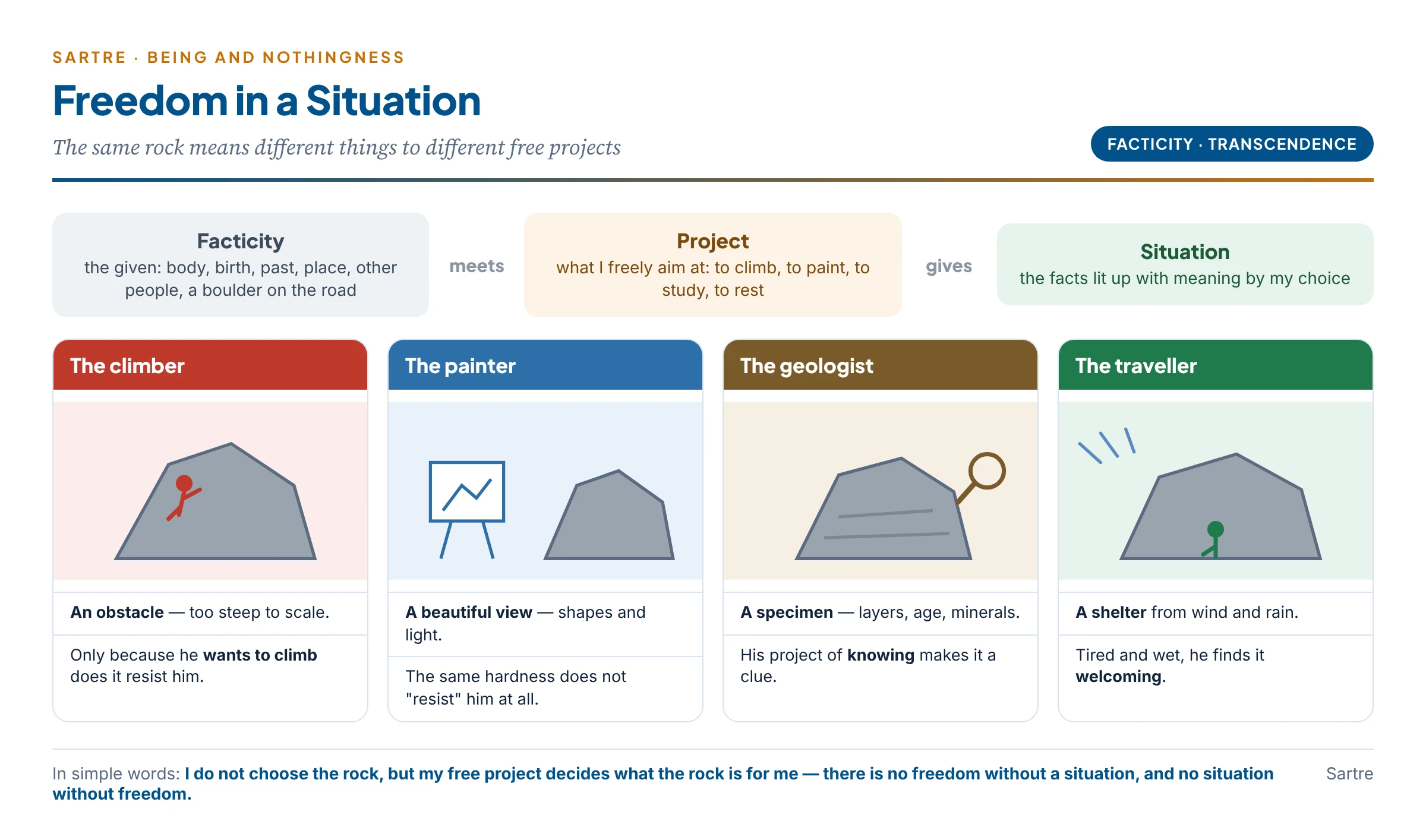
- I did not choose my parents, my family, my birth, my body, my race or nationality, my socio-political conditions, my talents and limitations, the others I meet, my own previous choices — or my death. These are my facticity: they have the solidity of the in-itself; I cannot undo them.
Transcendence — the “takens”:
- Transcendence is the reach of consciousness beyond these givens: how I take them up — with shame or pride, resignation or refusal, hope or despair.
- Situation is the ambiguous mixture of the two: facticity as interpreted by my free projects.
Sartre’s three replies to the objection “facticity limits freedom”:
- A limit is an obstacle only in the light of a choice. A locked room is a “limitation” only for someone who wants to go out. A huge rock across a mountain path is an obstacle to the climber, a beautiful sight to the painter, a specimen to the geologist, a shelter to the tired traveller. The rock is a brute fact; what it means depends on my project.
- Even limited conditions leave options. A prisoner cannot leave his cell, but he can choose his attitude to imprisonment — to despair, to plan escape, to resist, to write.
- Freedom of choice is not freedom of success. Freedom is not unlimited power to obtain whatever I want; it is the freedom to choose, which includes the freedom to fail. Failure does not destroy freedom.
The ambiguity of situation:
- Givens and takens cannot be neatly measured. If I fail to become a surgeon, how much is due to my lack of talent or my poor family (facticity), and how much to my laziness (transcendence)? There is no exact answer. Simone de Beauvoir called existentialism a “philosophy of ambiguity“.
- The same handicap, different lives. One person born with a physical disability builds a full, creative life around it; another allows himself to be crushed by it. The fact is the same; the meaning differs.
In simple words
Two batsmen are given out on a bad umpiring decision. One spends the season complaining about the umpire. The other uses the anger to practise harder and scores a century in the next match. The decision (facticity) is the same for both; what each makes of it (transcendence) is his own. Sartre’s freedom is not the power to change the umpire’s decision — it is the power to decide what that decision will mean in your life.
3. “You Can Always Make Something Out of What You Have Been Made Into”
- The mantra of Sartre’s humanism. Whatever society, family, class or history has made of me, I am never only that: I can always make something out of it. This is the deep, though limited, hope inside existentialist “pessimism”.
- The example of Genet. In Saint Genet (1952), Sartre studied the writer Jean Genet: an abandoned child, raised in foster care, caught stealing and branded “a thief” by society. Genet first chose to become what he had been called — and then, through writing, turned the label into a work of art and a life of his own. He did not escape his conditioning; he took it up and transformed it.
- Later formulation. In old age Sartre defined freedom as “the small movement which makes of a totally conditioned social being someone who does not render back completely what his conditioning has given him“.
- What the statement denies. It denies fatalism: social conditioning is real, but it does not complete the person.
- What it does not deny. It does not claim that everyone can do anything: the “what” one has been made into sets the material — freedom works with it.
- Its moral force. It refuses both the victim’s excuse (“they made me like this”) and the oppressor’s excuse (“they are naturally like that”). It is also the basis of Beauvoir’s “one is not born a woman” and of the existentialist hope that oppression can be undone.
4. Freedom and Determinism
The determinist claim:
- Every event has a cause; every cause necessitates its effect; so no one could ever have acted otherwise. Determinism comes in several forms — physical, biological (genes), psychological (the Freudian unconscious), economic (Marxist), social.
Sartre’s answer:
- Motives do not push; they are weighed. A motive (a reason, a feeling, a desire) has force only within a project that I continue to sustain. Fatigue is a “reason” to stop walking only for someone who has chosen not to make the effort; for another, the same fatigue is a pleasure to be overcome. The project gives the motive its weight — and the project is chosen.
- No inner mechanism. Because consciousness is translucent and egoless, there is no hidden machinery — no unconscious — that could act on me behind my back.
- Determinism as an attitude. “I am determined” is not a neutral discovery but a stance I adopt — usually to relieve myself of anguish. The various determinisms are, for Sartre, theoretical versions of bad faith.
- Freedom without “absolute beginnings”. Sartre does not deny causes in nature, nor the weight of facticity. He denies only that these decide what I do. Facticity is not a limit to freedom but the material through which freedom works: freedom is always situated freedom.
- The later Sartre. In his Critique of Dialectical Reason (1960), Sartre gave much more weight to social structures — the “practico-inert“, the sediment of past human actions that both limits and enables present action, and produces “counter-finality” (deforestation to gain farmland may cause floods that destroy farmland). Freedom remains, but it is freedom inside history.
Common confusion
Does Sartre deny that anything at all influences our choices? No. Sartre fully admits facticity — body, past, class, situation — and, in later work, powerful social structures. What he denies is that any of these determines the choice by itself. A situation exerts influence only through the project in whose light I interpret it. His slogan is not “nothing affects me” but “nothing decides for me“. (Merleau-Ponty put the point more moderately: we are motivated by our situation, not determined by it.)
5. The Fundamental Choice (Project)
- One life, one project. Human reality is not a loose collection of acts but a totality, like a story in the making. Beneath my many particular choices lies a fundamental choice (or “original project”) — a basic way of being in the world that gives my life its unity and its sens (both “meaning” and “direction”).
- Pre-reflective. This choice is not made in a moment of deliberation; I find, when I reflect, that I have already been making it. It is what I am, not just what I do.
- The original project. For Sartre, the deepest human project is the futile attempt to coincide with oneself — to be a free consciousness that is also a solid thing: the ideal of being God. Each person pursues it in a particular style.
- Existential psychoanalysis. Sartre proposed to uncover a person’s fundamental choice by interpreting the pattern of his particular choices — like someone walking on a sandy beach who reads his direction by looking back at his footprints. Unlike Freudian analysis, it appeals to no unconscious, only to pre-reflective comprehension. He applied it in biographies of Baudelaire, Genet and Flaubert.
- Radical conversion. A change of one’s fundamental choice is possible — that is the meaning of freedom — but rare and costly.
6. Responsibility: “Responsible for Myself and for Everyone Else”
- Total responsibility. Since there is no human nature and no excuse, “man is responsible for what he is“. I am the author of my life in the full sense.
- Choosing for all humanity. “When we say that man is responsible for himself, we do not mean that he is responsible only for his own individuality, but that he is responsible for all men.” Why? Because “of all the actions a man may take in order to create himself as he wills to be, there is not one which is not creative, at the same time, of an image of man such as he believes he ought to be“. To choose this rather than that is to affirm that what I choose is good — and nothing can be good for me without being good for all.
- Examples.
- If I join a trade union rather than a Christian party, I commit not only myself but mankind to the view that resignation is not man’s lot.
- If I decide to marry and have children, I commit not only myself but humanity as a whole to the practice of monogamy.
- A legislator for mankind. In choosing, I act “as a legislator deciding for the whole of mankind“. Each person must ask: “Am I really a man who has the right to act in such a manner that humanity regulates itself by what I do?“
- Everyone is watching. “Everything happens to every man as though the whole human race had its eyes fixed upon what he is doing and regulated its conduct accordingly.”
- Responsible even for the war. In Being and Nothingness Sartre says that if I am mobilised in a war, the war is my war: I could have deserted, resisted, or ended my life; by staying, I choose it. “Everyone has the war he deserves.“
- Like Kant, and unlike him. This resembles Kant’s universalisability — act only on a principle you can will for all. But for Kant the universal law is given by reason in advance; for Sartre there is no law in advance: I invent the value, but my invention has universal significance.
- Freedom wills the freedom of others. “I cannot make liberty my aim unless I make that of others equally my aim.” No one is concretely free until all are free.
7. Anguish, Abandonment and Despair
Anguish (angoisse):
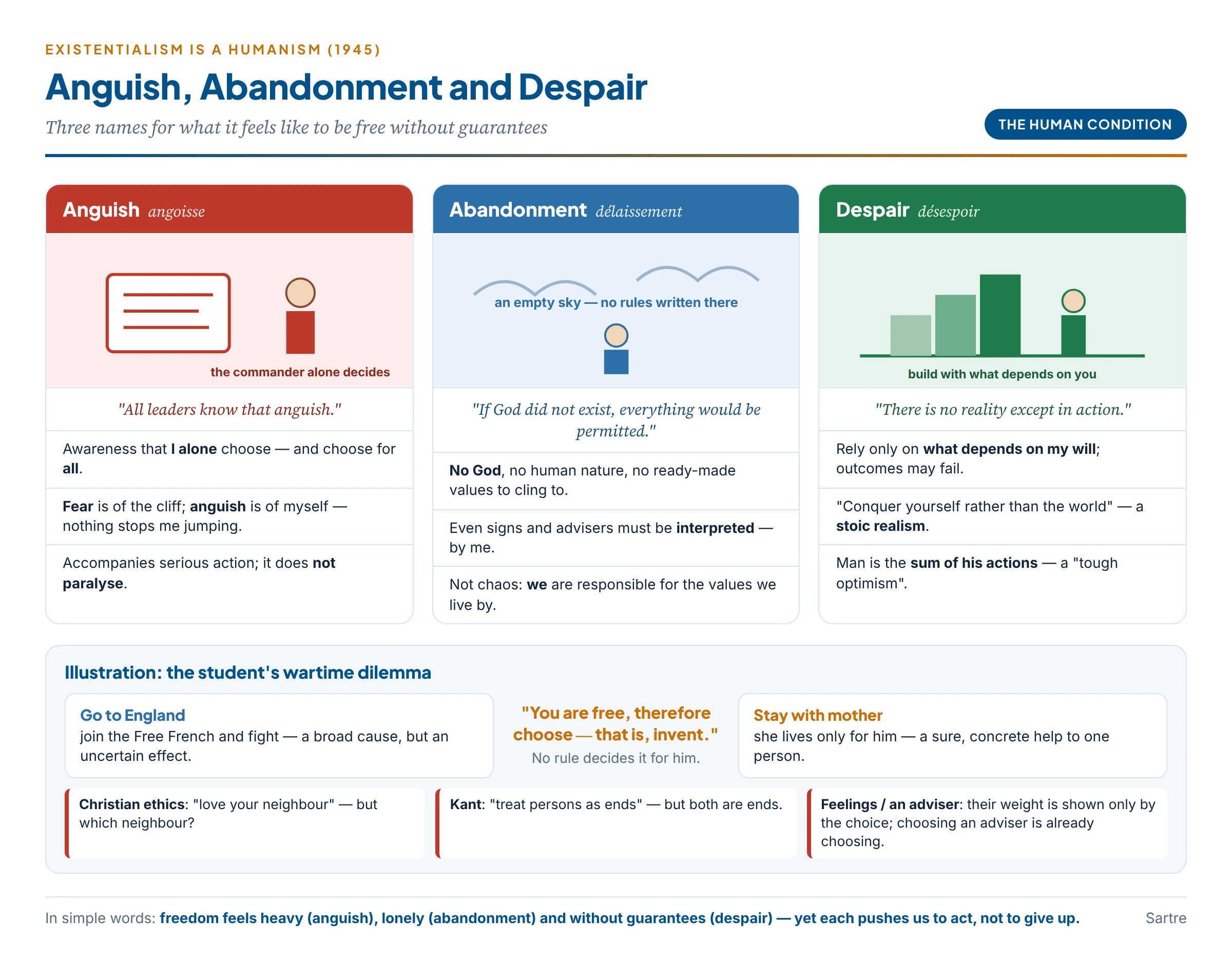
- What it is. The awareness of my freedom and of the weight of my responsibility — that no God, no moral code, no tradition can guarantee that my choice is right.
- The commander. A military leader who decides to send soldiers into an attack, perhaps to their deaths, feels anguish: orders may come from above, but he alone must interpret them, and the lives depend on his decision. “All leaders know that anguish.”
- Abraham and the angel. If a voice speaks to me, it is still I who must decide whether it is the voice of an angel, and whether I am Abraham. “If an angel appears to me, what proof is there that it is an angel?” The interpretation is always mine.
- Anguish and fear. Fear is of something in the world — on a narrow mountain path, I fear the ground may give way. Anguish is before myself — I realise that nothing prevents me from throwing myself over. The recruit going to war may fear death, but more often he is “afraid of being afraid” — anguished before himself.
- The gambler. A man who has sincerely resolved never to gamble again approaches the gaming table and suddenly realises that his resolution of yesterday has no power over him today: he must renew it now, freely. “I await myself in the future” — and anguish is the fear of not finding myself there.
- Not paralysis. Anguish does not prevent action; it accompanies serious action. To feel anguish is to recognise that one’s choices matter.
Abandonment (délaissement):
- Abandoned by God. Abandonment means specifically that there is no God to give us values. Sartre is echoing Nietzsche‘s “God is dead” — not that God once lived and then died, but that belief in God can no longer ground our morality.
- “Everything is permitted.” Sartre cites Dostoevsky: “If God did not exist, everything would be permitted” — and says that this is the starting point of existentialism. Man is “forlorn“, because neither within him nor outside him does he find anything to cling to.
- Against secular moralists. Sartre rejected those atheists who abolished God but kept a secular copy of Christian morality, as if values remained written in heaven without a writer.
- Thrown into the ocean. Man is like someone thrown into the ocean: free to swim or to sink, with no one to rescue him.
- The student’s dilemma. During the war a young student came to Sartre. His brother had been killed in 1940; his father was a collaborator; his mother lived only for him. He had to choose: go to England to join the Free French forces and fight, or stay to care for his mother. Christian doctrine says “love your neighbour” — but which neighbour? Kant says “treat persons as ends” — but both his mother and the fighters are ends. His feelings cannot decide, because their strength is shown only by the choice. Even choosing an adviser is already choosing the answer. Sartre’s only advice: “You are free, therefore choose — that is to say, invent. No rule of general morality can show you what you ought to do; no signs are vouchsafed in this world.” And if a Catholic objects that there are signs — “still, it is I myself, in every case, who have to interpret the signs.”
- Not chaos but responsibility. Abandonment does not mean moral chaos; it means that we are responsible for the values we live by.
Despair (désespoir):
- Meaning. Despair means that we can rely only on what depends on our own will, or on the set of probabilities that make our action feasible. Other people, external events, the course of history may thwart us.
- Act without hope. Sartre quotes Descartes: “Conquer yourself rather than the world” — that is, act without counting on outcomes beyond your control. I may rely on my comrades in a common struggle only so far as I can see their commitment; I cannot count on human goodness in general.
- Not hopelessness but realism. “Despair” here is not a mood of gloom but a stoic realism. It does not lead to inaction: “there is no reality except in action“. “Man is nothing else but the sum of his actions.”
- Answer to quietism. Those who say “I could have been a great writer, if only…” are deceiving themselves: a person is what he does, not what he might have done. This is why existentialism frightens people — it removes their consolations. Sartre calls it a doctrine of action, whose sternness is a “tough optimism“.
8. Bad Faith (Mauvaise Foi)
What it is:
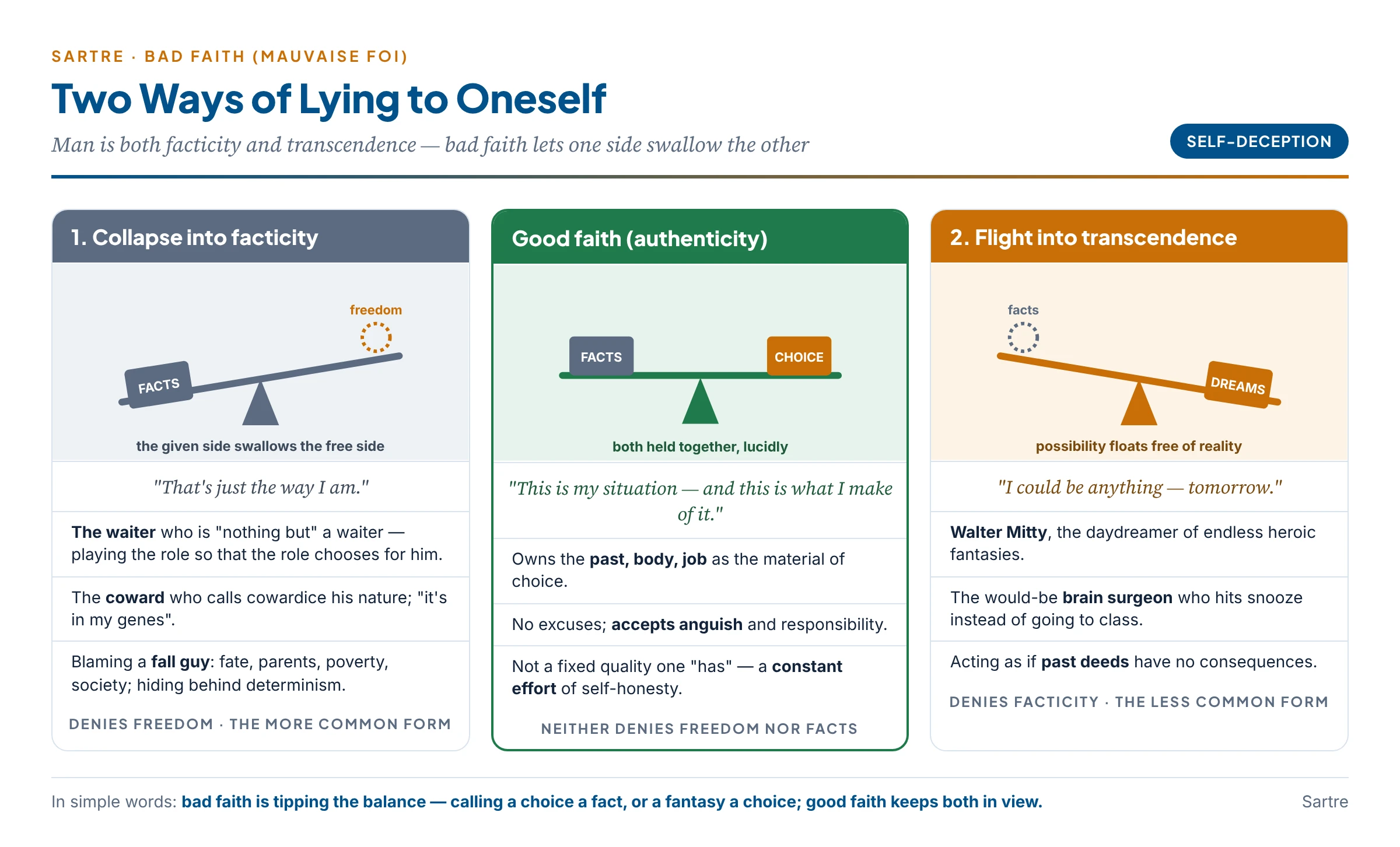
- Self-deception. Bad faith is the attempt to flee the anguish of freedom by lying to oneself — denying either one’s freedom or one’s facticity in order to avoid responsibility.
- Bad faith and lying. An ordinary lie needs two persons: the liar knows the truth and hides it from someone else. In bad faith, the deceiver and the deceived are the same person. It is “knowledge that is ignorant and ignorance that knows better“.
- How is it possible? If I both know and hide the truth, I seem divided into two. Freud explained this by an unconscious “censor”; Sartre rejects this (the censor would itself have to know what it represses). Bad faith is possible because of the bifocal structure of one consciousness: I am pre-reflectively aware of my freedom while reflectively telling myself a different story. And because consciousness is never identical with itself, it can play with this gap.
- The “faith” of bad faith. Bad faith is a kind of belief. Knowledge, for Sartre, is the immediate presence of the thing itself (seeing a proof, catching a spouse in the act); belief relies on evidence that points to something not yet evident (lipstick on a collar). Bad faith is the decision to be satisfied with non-persuasive evidence — like someone who has “fallen in love” and notices only what supports the choice, ignoring what friends point out. “One puts oneself in bad faith as one goes to sleep, and one is in bad faith as one dreams.” Yet because pre-reflective consciousness never blinks, one remains responsible for staying there.
In simple words
Think of a man who keeps the alarm on snooze and says, “I am just not a morning person.” Deep down he knows that he could get up; he has simply chosen not to. By calling it his “nature”, he turns a choice into a fact about himself — and the fact cannot be blamed. That small, comfortable lie to oneself is bad faith.
The waiter in the café:
- Sartre describes a café waiter whose movements are “a little too precise, a little too quick”; he bends forward “a little too eagerly”, his voice and eyes express “an interest a little too solicitous for the order of the customer”; he balances his tray with the recklessness of a tightrope-walker.
- He is playing at being a waiter. Like a stone that is a stone, he tries to be a waiter completely — to make his role his essence, so that his job does his choosing for him.
- Why it is bad faith. He is a waiter only “in the mode of not being” one: at any moment he could take off his apron, walk out, change his life. By hiding this from himself he denies his freedom — he becomes a prisoner of his image, of what others (customers, society) expect him to be. Good faith would mean doing the same job while living the anguish of choosing it afresh each day.
The woman on the date:
- A woman goes out for the first time with a man. She knows very well what he intends, but she does not want to decide — neither to accept nor to refuse. When he takes her hand, to withdraw it would break the charm, to respond would be to commit herself. So she leaves her hand in his, “neither consenting nor resisting — a thing“, while she talks of lofty, intellectual matters.
- Why it is bad faith. She treats her hand — her body — as a mere object (pure facticity), and herself as a pure, disembodied mind (pure transcendence) that is “not there”. She exploits the double nature of the human being to postpone a decision.
Two forms of bad faith:
- Collapsing transcendence into facticity (the more common form) — “That’s just the way I am.” One treats oneself as a thing, determined by nature, past, role or circumstance.
- The waiter who is “nothing but” a waiter.
- The coward who pleads that cowardice is his nature; the person who says “I’m bad-tempered — it’s in my genes”.
- Seeing oneself as a victim of circumstances rather than as someone who made poor decisions.
- Blaming a “fall guy” — God, destiny, the government, society, the “Establishment”, one’s upbringing, one’s parents, one’s poverty (or one’s wealth).
- Using psychological theory to split oneself into a “good I” and a “bad me“, as if a part of me were an “other” that acts on me.
- The theoretical determinisms — economic, psychological, biological — which relieve us of freedom.
- Procrastination — waiting for circumstances to decide.
- Even sincerity can be bad faith, when it demands that a person be what he is “as a table is a table” — the “champion of sincerity” who insists that another simply confess “I am a coward“, as if a free being could be fixed in a label.
- Volatilising facticity into transcendence (less common) — acting as if one were pure possibility, with no past and no actual situation.
- Walter Mitty, the daydreamer of James Thurber’s story, who fantasises endlessly about the hero he could be while his real life stays commonplace.
- The student who declares she will become a brain surgeon but reaches for the snooze button every morning instead of going to her chemistry class. Like Kierkegaard’s captain, she has “chosen not to choose” — pre-reflectively she has chosen not to be a surgeon, without admitting it.
- Refusing to accept responsibility for past actions, as if they had no lasting consequences.
Bad faith and being-for-others:
- A further version lets another person determine the identity to which I conform. Many of our “roles” are images imposed by others’ expectations, which we then adopt as our essence. “In our relationships with others we most often betray ourselves by trying to be whatever the other person expects us to be” — which reveals a lack of faith in ourselves, a lack of courage to be ourselves.
Common confusion
Is the woman on the date denying her freedom (like the waiter) or denying her facticity? Notes disagree, and Sartre’s example is subtle because she does both at once. She treats her hand — her body — as an inert thing (reducing herself to facticity), and at the same moment treats herself as a pure, bodiless mind above the situation (fleeing into transcendence). The essence of bad faith is precisely this playing off of facticity against transcendence, so as never to face the choice. (Similarly, the sentence “I couldn’t help it — that’s just who I am” denies freedom, though some notes list it under “denying facticity”.)
9. Inauthenticity, Bad Faith and Alienation
- Bad faith is inauthenticity. Inauthentic existence consists in fleeing the anguish of freedom — hiding behind labels, roles, excuses and deterministic explanations, acting as though we were objects rather than free agents.
- Why bad faith leads to alienation.
- Alienation from oneself. By identifying with a role or a “nature”, I become a stranger to my own freedom; I live as a thing I am not.
- Alienation into others. By living according to others’ expectations — what “they” want me to be — my being is taken over by others; my centre is outside me.
- Mutual objectification. Since others do the same, social life becomes a network of people treating themselves and each other as objects — an alienated society. Sartre later said that Being and Nothingness was in effect a description of individuals within an alienated society, where bad faith hides the structural injustices that our practices sustain.
- Even good faith can be faked. Claiming to be “in good faith” as a stone is a stone is itself bad faith: we can never possess authenticity as a fixed quality.
10. Authenticity (Good Faith)
- Lucid acceptance. Authenticity is the opposite of bad faith: the lucid recognition of oneself as free and responsible, within one’s facticity. It holds together both dimensions — freedom and situation — without collapsing either.
- No excuses. The authentic person does not say “I had no choice” or “that’s just my nature“; he recognises that even within constraints he chooses how to respond.
- Owning one’s situation. He does not blame his past, body or social position, but owns them as the material of his choices.
- Accepting anguish. Anguish is not weakness but awareness of responsibility. To live authentically is to act knowing that one’s choice expresses an image of humanity.
- Not heroic isolation. Sartre does not romanticise authenticity as heroic solitude; it is a constant effort of self-honesty.
- Never permanent. Since bad faith is always possible, authenticity is never achieved once and for all; it must be renewed in action — the waiter would be authentic if he lived the anguish of continuously renewing his project, knowing he could shed the apron at any moment.
- Sincerity or self-deception. In the end there are only two ways: sincerity — fidelity to oneself, the ability to accept what we are “without exaggeration or excuse” — or self-deception: “to be or not to be“.
- A moral decision. “The choice of authenticity appears to be a moral decision.” Sartre promised an ethics in a footnote to Being and Nothingness; the posthumous Notebooks for an Ethics sketch an ethics of generosity, gift and reciprocity.
- Authenticity has a content. Against the objection that one could be an “authentic Nazi“, Beauvoir argued that freedom wills itself authentically only by willing an open future for others too: to oppress or enslave others is inauthentic.
- Commitment. Authenticity issues in engagement — committed action in the world, including literature that takes sides against oppression.
11. Being-for-Others and “the Look”
The keyhole:
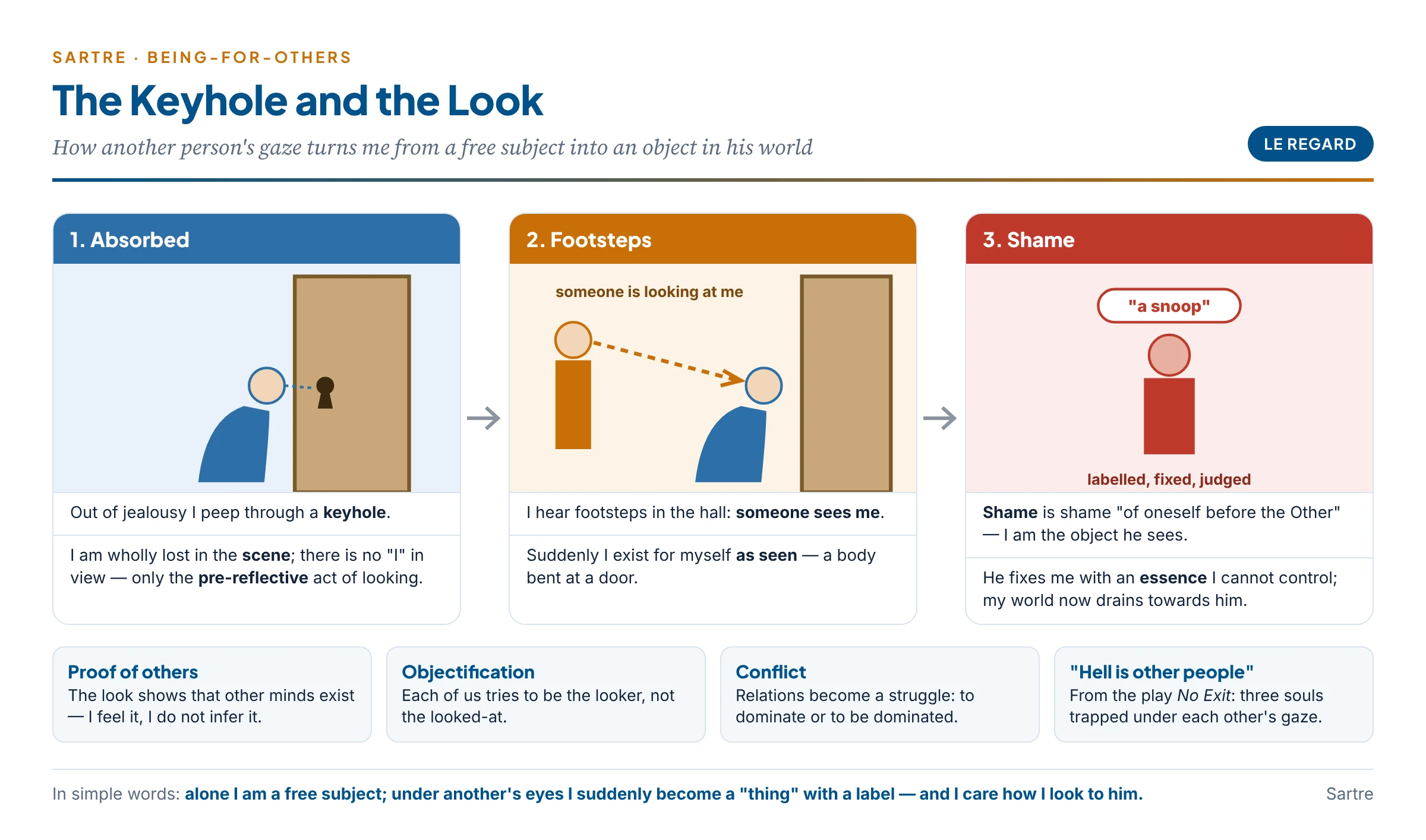
- The scene. Out of jealousy or curiosity, a man is peeping through a keyhole. Wholly absorbed in what he sees, he is a pure consciousness of the scene; there is no “I” in his awareness.
- Footsteps. Suddenly he hears footsteps in the corridor behind him. Someone is looking at him.
- Shame. In one instant he is seen: he becomes, in his own eyes, a voyeur — an object in another’s world. He blushes. In shame “I recognise that I am as the Other sees me.”
- What it proves. The experience reveals both the existence of other minds (far more directly than any argument from analogy) and my body as vulnerable to another’s objectifying gaze. Even if the noise was only the wind in the curtains, the experience shows the structure of being-seen.
What the look does:
- I acquire an “outside”. Under the look, I have a dimension of being — my being-for-others — that I cannot see or control: the other judges, labels and defines me. When someone watches me building a house, he sees me simply as “a house-builder”.
- Loss of freedom. As an object for the other, I am fixed, reduced to what he sees; my world, which was organised around my projects, is stolen and re-centred on him. Sartre speaks of a kind of slavery under the look.
- Mutual objectification. I can recover my freedom only by looking back and making him an object. Like Hegel’s master and slave, but with no reconciling synthesis, each consciousness tries to assert its freedom and resists being objectified.
Love, desire and conflict:
- Two attitudes. Towards the other I can try either to make him an object (indifference, desire, hatred, sadism) or to become an object that captures his freedom (love, language, masochism).
- The trap of love. In love I want to be loved — I want the other’s freedom to choose me freely and yet to be bound to me. I want to possess the other’s freedom as freedom — an impossible demand. Such “love” is often a form of emotional alienation, in which I avoid my own subjectivity by living in the gaze of the other.
- “Conflict is the original meaning of being-for-others.”
- “Hell is other people.” In Sartre’s play No Exit (1944), three dead people are locked together for ever in a drawing-room. There are no torturers: each is tortured by the gaze and judgement of the others. The line “L’enfer, c’est les autres” expresses not a hatred of people but the torment of being fixed by others’ looks.
- Social objectification. The look is the root of large-scale systems of objectification — colonialism, racism, sexism, anti-Semitism — in which the other is seen as a fixed, definable thing, not as a free individual. In Anti-Semite and Jew (1946) Sartre argued that “it is the anti-Semite who makes the Jew”; and since we cannot act directly on another’s freedom, we must change the “bases and structures” of his choice.
- Not only conflict. Being-for-others also makes recognition and mutual acknowledgement possible. In his later Notebooks Sartre described authentic love and friendship in terms of generosity and the “gift-appeal” — the model also of the relation between writer and reader — and dreamed of a “city of ends” with egalitarian, eye-level relations.
In simple words
Imagine you are dancing alone in your room to your favourite song, completely lost in it. Then you notice your younger brother filming you from the doorway. In a flash you see yourself as he sees you — clumsy, ridiculous — and your face burns. Nothing in you changed except that you became an object in someone else’s eyes. That flash is Sartre’s “look“.
12. Sartre and Spinoza on Freedom
| Point | Spinoza | Sartre |
|---|---|---|
| Basic view | Determinism: all follows necessarily from the nature of God (Nature) | Radical freedom: consciousness is never determined |
| Free will | An illusion — we are unaware of the causes of our acts (a falling stone, if conscious, would think itself free) | The very being of man; “condemned to be free” |
| What freedom is | Acting from the necessity of one’s own nature; understanding necessity | Choice — nihilating the given, projecting the future |
| Path to freedom | Reason and intuitive knowledge; freedom from the bondage of passions | Lucidity about one’s freedom; rejecting bad faith |
| Emotions | Passions are bondage; understanding them frees us | Emotions are chosen, “magical” transformations |
| God | God is the one Substance; freedom culminates in the intellectual love of God | No God; abandonment |
| Final state | Blessedness and peace of mind | Anguish, but also dignity and commitment |
| Shared | Both reject excuses and the idea of a self pushed about by external forces; both see freedom as self-determination, not caprice |
13. From the Individual to Society
- A chastened individualism. After the war Sartre increasingly argued that concrete freedom requires changing the social conditions of choice — “in history too, existence precedes essence“. Colonialism, he said, is a system — “the meanness is in the system” — yet the system is kept alive by human acts, so responsibility can still be named.
- Commitment. Literature and philosophy must be committed (engagées) to the freedom of all; merely failing to condemn oppression is not enough.
Critical Evaluation
Objections
- Freedom overstated. Marxists and structuralists argue that individuals are far more conditioned by class, language and social structure than Sartre admits. Merleau-Ponty objected that if freedom is total and the same in every act, it explains nothing; real freedom is graded and embodied.
- The prisoner and the tortured. Is it meaningful to say that a person under torture or extreme poverty is “totally free”? Total responsibility seems to ignore coercion and suffering.
- Responsibility for emotions and war. Holding people responsible for feelings or for a war they did not want seems implausible and even unjust.
- Universal responsibility without universal values. If all values are invented, how can my choice legislate for all humanity? The Kantian language seems borrowed without justification.
- Bad faith is paradoxical. How can one know and not know the same truth at once? Without an unconscious, self-deception seems impossible to explain.
- Why is bad faith wrong? If no values are given, on what ground does Sartre condemn bad faith and praise authenticity? Authenticity seems to be a value his ontology does not license.
- Too conflictual. “Hell is other people” ignores cooperation, empathy, love and solidarity.
- A purely formal ethics. Sartre tells us how to choose (without self-deception), not what to choose.
- The identity of the self. If consciousness is a nothingness, what makes the person who is responsible today the same as the one who acted yesterday?
- Pessimism. Anguish, abandonment, despair and “useless passion” paint a bleak picture, despite the “humanism”.
Replies and Strengths
- Freedom is situated. Sartre never denied facticity; his claim is that facticity has meaning only within a free project. His later work fully integrates social structures.
- Responsibility as a challenge, not blame. Saying that I am responsible for my war or my emotions is a call to own my life rather than to hand it over to circumstances.
- The bifocal consciousness explains self-deception without an unconscious: we are aware of more than we know.
- Authenticity’s content. With Beauvoir, authenticity becomes the willing of freedom for all; oppression is inauthentic by definition.
- Not pessimism but tough optimism. Existentialism places a person’s destiny in his own hands.
- A diagnostic masterpiece. Whatever its gaps, the analysis of bad faith remains the most exact description we have of the ways people contrive not to notice that they are free.
Critics and Defenders
Criticism — Critics
- Overstated freedom: class, language and structure condition us deeply.
- Coercion ignored: the tortured and the starving are not “totally free”.
- Borrowed universality: invented values cannot legislate for all.
- Paradox of bad faith: knowing and not knowing at once.
- Unjustified ethics: why is bad faith a fault if no values are given?
- Conflict only: “hell is other people” forgets love and solidarity.
Defence — Defenders and strengths
- Situated freedom: facticity is the material of freedom, never denied.
- Ownership: responsibility is a call to own one’s life, not a verdict of guilt.
- Bifocal consciousness: self-deception explained without an unconscious.
- Freedom for all: authenticity wills an open future for others (Beauvoir).
- Hope: you can always make something out of what you have been made into.
- Lasting insight: the most exact description of how we hide from freedom.
Cross-Tradition Comparison
Freedom, Responsibility and Self-Deception in Indian Thought
| Point | Sartre | Indian parallel |
|---|---|---|
| Acting without guarantees | Despair: rely only on your own will; act without hope | Bhagavad Gītā: “Your right is to action alone, never to its fruits” (karmaṇy evādhikāras te mā phaleṣu kadācana) |
| No external excuse | “We are without excuse”; no God to blame | Karma in Jainism, Buddhism and Mīmāṃsā: we reap what we sow, without a God who punishes or pardons |
| Excuses rejected | Bad faith: “that’s just how I am” | Krishna rejects Arjuna’s excuses at Kurukṣetra: “Do not yield to unmanliness” (klaibyaṃ mā sma gamaḥ) |
| Self-deception | Bad faith: identifying with a role or with the body as a thing | Advaita: adhyāsa — superimposing “I am the body”, “I am this role” on the true self |
| Made into / make of | “You can always make something out of what you have been made into” | Ambedkar‘s call to the oppressed to “educate, agitate, organise”: birth-based conditioning is not destiny |
| Others’ gaze | The look objectifies; “hell is other people” | Gītā’s sthitaprajña: steady in praise and blame, unshaken by others’ opinions |
Indian Connect — Key takeaways
- Niṣkāma karma and Sartrean despair. Both teach action without dependence on results. But the Gītā grounds action in duty and devotion to a cosmic order (ṛta, dharma, God), while Sartre grounds it in a freedom with no cosmic order.
- Adhyāsa and bad faith. Śaṅkara’s diagnosis — we falsely identify the self with body, roles and qualities — is strikingly close to the waiter’s bad faith. The remedies differ: Advaita seeks the unchanging witness behind all roles; Sartre insists there is no fixed self behind them, only free choice.
- Svadharma versus self-invention. The Gītā’s svadharma (one’s own duty according to one’s nature and station) gives a given essence to action; Sartre denies any such given nature. Yet Krishna, like Sartre, refuses to let Arjuna hide from decision behind confusion and grief.
- Social freedom. Sartre’s and Beauvoir’s insistence that freedom must change the bases and structures of choice meets its Indian echo in the anti-caste struggle: no one is free until the conditions that “make” people into lesser beings are dismantled.
Synthesis (Siddhānta)
- Freedom. Because consciousness is a nothingness, man is freedom — “condemned to be free”. Freedom is situated: facticity (birth, body, past, society) is real, but its meaning depends on my project; a limit becomes an obstacle only in the light of a choice; freedom of choice is not freedom of success. “You can always make something out of what you have been made into.”
- Determinism. Motives do not push; they weigh within a chosen project. Determinism is often a stance of bad faith. Later, Sartre gave social structures their full weight without abandoning freedom.
- Responsibility. I am responsible for myself and, since every choice creates an image of man, for all humanity; refusing to choose is a choice.
- Anguish, abandonment, despair. These are not moods of gloom but the lucid recognition of responsibility, of the absence of God-given values, and of the need to act without guarantees.
- Bad faith and authenticity. Bad faith flees freedom by collapsing into facticity (the waiter, “that’s just how I am”) or fleeing into transcendence (the daydreamer); it leads to alienation from oneself and to a society of mutual objectification. Authenticity is the lucid, ever-renewed acceptance of freedom-in-situation — and, with Beauvoir, the willing of freedom for all.
- The look. Others reveal my object-being; relations tend to conflict — “hell is other people” — but also open the way to recognition and a “city of ends”.
- Balance. Critics are right that Sartre’s early freedom is too absolute and his ethics too formal. But his central insight survives every correction: we are never only what circumstances have made us, and the most common human failing is not wickedness but the quiet, daily refusal to admit that we are free.
“Man is condemned to be free.” — Sartre
“You are free, therefore choose — that is to say, invent.” — Sartre
“Hell is other people.” — Sartre, No Exit
Previous Year Questions
- 2024What do the existentialist thinkers mean by the slogan “existence precedes essence”? How is human existence related to human freedom according to them? Discuss.
- 2021“I can always choose, but I ought to know that if I do not choose, I am still choosing.” Critically discuss Sartre’s conception of choice and responsibility in the light of the above statement.
- 2020“You can always make something out of what you have been made into.” Critically discuss this statement by Sartre with reference to his views on existentialism.
- 2019How does Sartre look at the problem of freedom of choice and determinism? Explain.
- 2018How does Sartre connect inauthenticity with bad faith? Why does Sartre show that inauthenticity and bad faith lead to alienation? Discuss.
- 2015Bring out the relationship between existence and essence in the case of human beings. Explain the issues it gives rise to for human beings according to Sartre.
- 2011“I am responsible for myself and for everyone else.” Discuss this statement in the light of Sartre’s existentialism.
- 2009Compare the views of Spinoza and Sartre on Freedom.
- 2004Discuss Sartre’s conception of freedom.