

Existentialism (Kierkegaard, Sartre, Heidegger): Existence and Essence; Choice, Responsibility and Authentic Existence; Being-in-the-world and Temporality.
Official Syllabus: Paper I, Section A, Unit 10
For Kierkegaard, a human being is not born a self; he must become one, and he becomes one only by choosing. His great works — Either/Or (1843), Fear and Trembling (1843), The Concept of Anxiety (1844), Stages on Life’s Way (1845) and The Sickness unto Death (1849) — trace this journey through three stages or “spheres” of existence: the aesthetic, the ethical and the religious. Each is a whole way of living; none leads automatically to the next; one passes from one to another only by a leap of choice. Along the way the individual meets anxiety — “the dizziness of freedom” — and despair — “the sickness unto death” — and finds release only in the leap of faith, exemplified by Abraham. Together these ideas answer Kierkegaard’s central question: how does one become a self?
In simple words
Picture three young people on a Saturday night. The first is hopping from party to party, phone in hand, afraid of a single dull moment — that is the aesthetic life. The second is at home keeping a promise to an ageing parent, doing what is right whether it is fun or not — the ethical life. The third sits alone in prayer, having staked everything on a relationship with God that no one else can verify — the religious life. Kierkegaard’s point: you do not drift from one to the next as you grow older. You must choose — and each choice changes who you are.
Context & Problem
Why “Stages” and Why Choice?
- The self is a task. Against Hegel, who made the individual a moment of universal spirit, Kierkegaard holds that the self is not given but must be achieved — and achieved only through the individual’s own decision.
- Modes, not ages. The stages are not chronological phases of life (childhood, youth, old age) through which everyone automatically passes. They are qualitatively different modes of existence, different answers to the question “how shall I live?“
- Leaps, not growth. Movement between them is not gradual development or Hegelian “mediation” but a leap — a decisive, risky act of choice. One may remain in a stage indefinitely; Kierkegaard thought most people live their whole lives in the aesthetic sphere.
- Spheres that can coexist. Kierkegaard also calls them “spheres“: they can overlap in one life, and a higher sphere does not simply abolish the lower but re-orders it.
- Told through characters. Each stage is presented by a different pseudonymous author — the young aesthete “A” and Johannes the Seducer, the married Judge William, Johannes de Silentio who writes about Abraham, Frater Taciturnus — so that readers test each way of life from within and reach their own conclusions. Kierkegaard avoided dictating answers.
Frater Taciturnus’ Summary
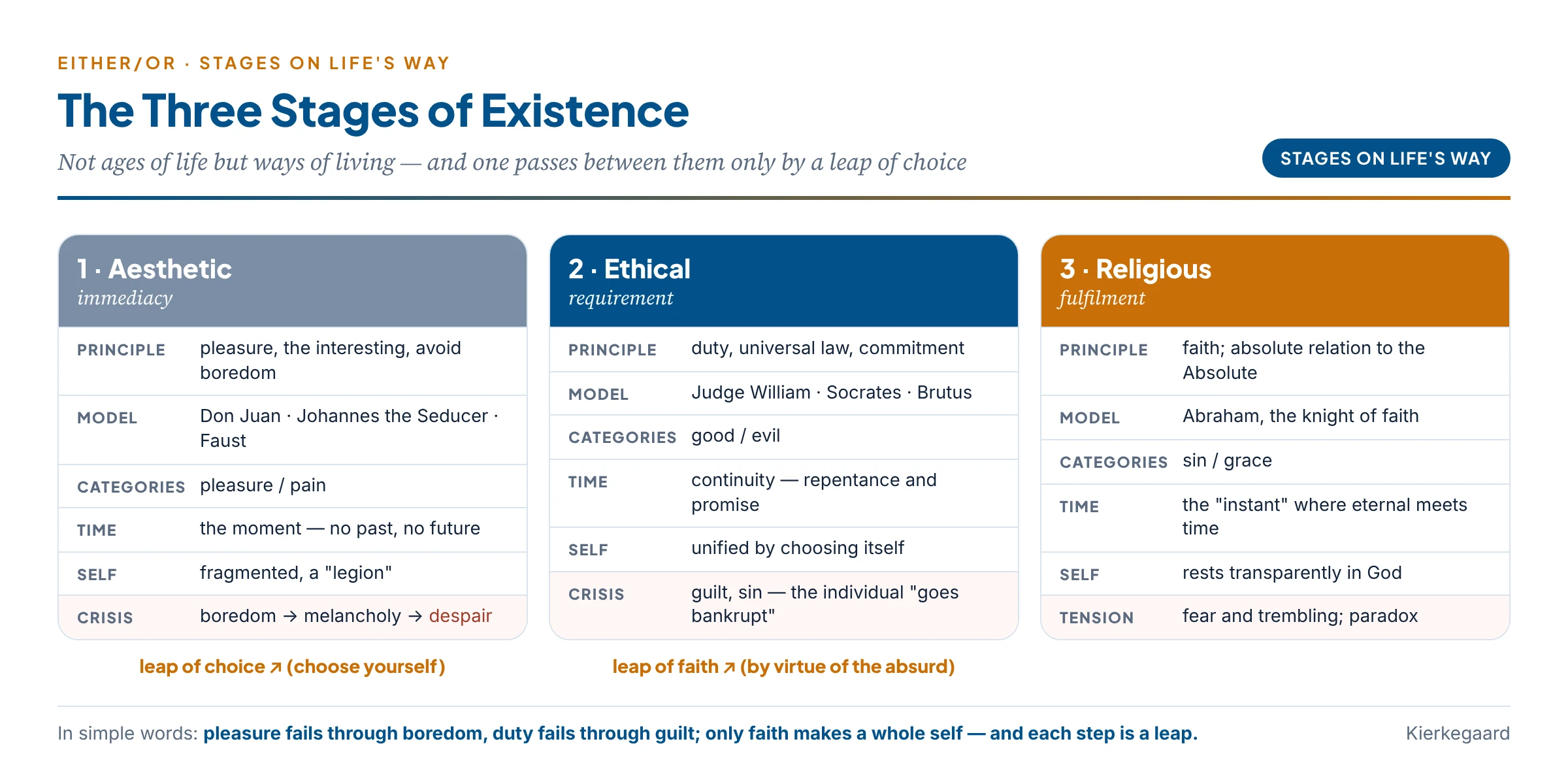
In Stages on Life’s Way, the pseudonym Frater Taciturnus sums up: “There are three existence-spheres: the aesthetic, the ethical, the religious… The aesthetic sphere is the sphere of immediacy, the ethical the sphere of requirement (and this requirement is so infinite that the individual always goes bankrupt), the religious the sphere of fulfilment — but not a fulfilment such as when one fills a sack with gold.” The ethical is only a “transition sphere“, whose highest expression is repentance; and the religious contradiction is “to be out on 70,000 fathoms of water and yet be joyful“.
Core Doctrine
1. Choice: How a Self Is Made
Choice is self-defining:
- Choice, for Kierkegaard, is not merely picking one option over another, like choosing between two dishes. In a real choice I determine the kind of person I become. Choice has existential weight.
- One becomes oneself through acts of commitment. “Choose yourself,” says Judge William to the young aesthete. In choosing, I take responsibility for the whole of my concrete self — my history, my talents, my limits — and make it mine.
- It is through choice that the individual moves from one stage to another.
The danger of not choosing — Judge William’s warnings:
- The ship that keeps moving. “Think of the captain on his ship at the instant when it has to come about. He will perhaps be able to say ‘I can either do this or that’; but if he is not a pretty good navigator, he will be aware at the same time that the ship is all the while making its usual headway… So it is with a man. If he forgets to take account of the headway, there comes at last an instant when there is no longer any question of an either/or, not because he has chosen but because he has neglected to choose, which is equivalent to saying, because others have chosen for him, because he has lost his self.”
- The midnight hour. “Do you not know that there comes a midnight hour when everyone has to throw off his mask?” The aesthete who plays roles may end by being unable to reveal himself at all.
- Becoming a legion. The one who never chooses risks having his personality “resolved into a multiplicity” — becoming “a legion“, like the demon-possessed man of the Gospels — losing “the inmost and holiest thing of all in a man, the unifying power of personality“.
- No self, no love. “He who cannot reveal himself cannot love, and he who cannot love is the most unhappy man of all.” And: “You are incapable of love, because love means self-giving and you have no self to give.”
- The choice is made anyway. “To think that for an instant one can keep one’s personality a blank… is a delusion. The personality is already interested in the choice before one chooses, and when the choice is postponed the personality chooses unconsciously, or the choice is made by obscure powers within it.”
Refusing to choose is itself a choice. One cannot escape responsibility by appealing to external forces, social norms or delay. Sartre later put it bluntly: “to exist is to choose, and to cease to choose is to cease to be”.
Choosing the ethical itself — a choice about criteria:
- Judge William explains: “My either/or does not in the first instance denote the choice between good and evil; it denotes the choice whereby one chooses good and evil, or excludes them.“
- The first and deepest choice is not whether to do this good act or that bad act. It is whether to enter the ethical standpoint at all — to live a life in which the categories “good” and “evil” apply to me. Like deciding to play a game, which commits me to its rules, this choice sets up the criteria by which later choices are judged. It is “criterion-constituting“, not “criterionless”.
In simple words
Before you can play cricket “well” or “badly”, you must first decide to play cricket at all — to accept the rules of runs, wickets and overs. That first decision is not itself a good or bad cricket shot; it is the choice that makes good and bad shots possible. Judge William’s “either/or” is like this: the choice to live ethically at all, which makes good and evil count in your life.
Choice in normative ethics and in meta-ethics:
- Normative ethics asks which acts are right — should I tell the truth here, keep this promise, help this person? A normative choice is made within an accepted moral framework and can be judged by its criteria.
- Meta-ethics asks about the nature and status of moral judgements themselves — what makes anything good or bad at all, and why be moral?
- Kierkegaard’s choice is of the second, deeper kind. The leap from the aesthetic to the ethical is not a choice between moral options but the choice of morality itself — the decision to let the categories of good and evil govern one’s life. No moral rule can justify it in advance, because it is what establishes the rules.
- Parallels. The English moral philosopher R. M. Hare spoke of “decisions of principle” which are not themselves derived from principles but found them; Sartre spoke of a fundamental choice that gives unity and direction to a whole life; William James argued that in a “genuine option” that reason cannot settle, our passional nature must decide.
Can a choice be “correct” or “incorrect”?
- No external criterion for the first choice. Since the basic choice founds the criteria, there is no prior standard by which it could be measured as “correct”. In this sense Kierkegaard’s view comes close to the later existentialist claim that we make a choice right by our follow-through.
- Earnestness matters more than content. Judge William says that what matters is not so much choosing the right as “the energy, the earnestness and the pathos with which one chooses“. Whoever chooses with full earnestness has chosen the ethical — and the ethical will correct him if he has chosen wrongly.
- Yet the stages are not equal. Kierkegaard does not endorse arbitrary subjectivism. The aesthetic life ends in despair; the ethical, though higher, cannot heal guilt; only the religious grounds the self transparently in God. So, from the standpoint of becoming a self, some choices are better than others — the “incorrect” choice is the one that evades selfhood.
- No guarantees. Even Abraham could not be certain that his choice was right; the risk can never be removed. Choice is both burden and privilege: it brings responsibility and the possibility of error, yet it is the very means by which authentic selfhood is formed.
2. The Aesthetic Stage
Character:
- Principle: pleasure, sensuous enjoyment, the interesting, the avoidance of boredom. Life is guided by inclination, not obligation.
- Time: the aesthete lives in the immediate present — the “moment“. He is indifferent to the past (as repentance) and the future (as obligation), except to calculate how to enhance present pleasure.
- Range. It stretches from plain philistinism to the greatest intellectual refinement. It is the most common stage: the person sunk in the crowd is too unreflective to be a self in any meaningful sense.
Two forms:
- Sensual hedonism. Its model is Don Juan — Mozart’s Don Giovanni, the unrepentant seducer whom Kierkegaard loved — living purely for the sensual satisfaction of the moment. Wealth, glory, status and physical beauty may all be pursued in this spirit: when one desire is fulfilled, a new one arises.
- Reflective, intellectual aestheticism. Its models are Johannes the Seducer and the speculative intellectual (Kierkegaard pointed to Goethe’s Faust). The intellectual aesthete loses himself in thought as the hedonist loses himself in the erotic present: he plays the detached observer of history and reality but never participates in his own inner history with passion. Hegel’s speculative philosopher is a refined aesthete.
The Diary of a Seducer:
- The story. In Either/Or, Johannes notices a sixteen-year-old girl, Cordelia, in the street with her aunt. He befriends a young man who loves her, uses him to enter her home, charms the aunt and the girl, then drops the young man. Through letters he wins Cordelia’s engagement — and then manoeuvres her into breaking it off herself, so that she bears the responsibility.
- His creed. “The curse of an engagement is always its ethical side. The ethical is just as tiresome in philosophy as in life.” And: “To poetise oneself into a young girl is an art; to poetise oneself out of her is a masterpiece.“
- Not immoral but non-moral. Johannes is not exactly wicked: he simply does not play the ethical game at all. The rules of right and wrong do not apply in his sphere. He treats others as objects of enjoyment.
Strategies against boredom:
- The “rotation method” (from Either/Or‘s essay “Rotation of Crops”): just as a farmer rotates crops to keep the soil fertile, the aesthete constantly changes his experiences, friends and amusements to avoid monotony — and cultivates arbitrariness and forgetting.
- The comic genealogy of boredom. “The gods were bored, so they created man. Adam was bored because he was alone, so Eve was created… Adam was bored alone; then Adam and Eve were bored together; then Adam and Eve and Cain and Abel were bored en famille; then the population of the world increased, and the peoples were bored en masse.”
- Anticipation and recollection. The pleasure of anticipating an event often exceeds the event itself, so the aesthete learns to draw out anticipation (one playful suggestion: leave your letters unopened for three days). Recollection — remembering childhood festivals, which are often sweeter in memory than in adult reality — is a pleasure best enjoyed alone. Unplanned repetition of a happy experience can be intense; planned repetition, as in marriage, belongs rather to the ethical.
- “In Vino Veritas.” The opening banquet of Stages on Life’s Way, a parody of Plato’s Symposium, celebrates fleeting beauty: the invitations arrive at the last minute and workmen wait to dismantle the hall the moment the feast ends. “To be good, a thing must be all at once.”
Why it fails:
- No self. Because aesthetic pleasure is fleeting, the aesthete has no stable framework for coherent choices; his self remains fragmented and dissipated.
- Boredom, melancholy, despair. Pleasure wears thin; boredom sets in; then melancholy; finally despair. Kierkegaard: “every aesthetic view of life is despair.”
- The turn. In despair the aesthete faces the threat of meaninglessness; diversion no longer satisfies; he turns inward towards genuine selfhood and may choose the ethical.
3. The Ethical Stage
Character:
- Principle: duty, universal moral law, commitment, responsibility. The ethical person lives not for immediate pleasure but for universal principles.
- Model: Judge William — devoted husband, magistrate and citizen.
- Paradigm: marriage. Unlike fleeting romantic passion, marriage means sustained fidelity and responsibility. The excitement of passion may fade, but by consistently acting for the good of one’s spouse, one discovers enjoyments beyond excitement.
- Time: continuity. The ethical person owns his past (through repentance) and binds his future (through obligation and promise). Repentance, obligation and commitment are properly ethical categories.
- A unified self. In choosing ethically, the self becomes integrated: the individual accepts accountability and binds himself to stable norms and long-term purposes. He achieves a unity the aesthete never has.
- Pleasures of its own. The ethical life does not abolish pleasure: an aesthete can never do something solely for another’s good, yet doing so can be deeply joyful.
The universal and the Kantian test:
- Kierkegaard’s ethics, derived from Kant, defines morality by the universal, exceptionless character of its rules. The essence of immorality is to make oneself an exception to a rule one wants everyone else to keep. One can lie only because others do not; if everyone lied, no one would be believed and lying itself would become impossible.
- To make oneself the exception is to treat others as mere instruments — a violation of the intrinsic worth of each individual.
- One can be ethical without knowing the Bible: Socrates, who obeyed the laws of Athens even when they condemned him unjustly, and the Roman consul Brutus, who did not spare his own son from the death penalty for treason, are models. Kierkegaard calls such figures tragic heroes — they give up something personal for the sake of the universal.
Why it fails:
- Infinite requirement. The moral law demands perfection; mortal human beings cannot deliver it. Faced with the absolute demand, the ethical individual “always goes bankrupt” — he discovers guilt and sin.
- Repentance, not cure. The highest the ethical can reach is repentance — a negative act that cannot by itself remove guilt.
- Conflicts of duty. The ethical person meets conflicts within morality (telling a truth that will hurt) and between ethical and religious duty.
- Finite and infinite. He feels the tension of being finite yet infinite — afraid both of dying and of existing for ever — which produces anxiety and moral despair.
- No inward depth. The ethical life, by requiring one to follow socially accepted norms, may divert one from self-exploration, which faith requires; it does little to nurture the spiritual self. Abstract moral rules cannot give final objectivity or security.
4. The Religious Stage
Character:
- Principle: faith — an absolute relation to the Absolute, to God, as a single individual.
- Categories: where the aesthetic speaks of pleasure and pain, and the ethical of good and evil, the religious speaks of sin and grace.
- Time: the “instant” (Øieblikket), in which the eternal touches time — the moment of decision and of faith.
- Model: Abraham, the “knight of faith“.
- Fulfilment. This is the stage of fulfilment, where the individual has an exclusive, personal relationship with God — not the large-scale religion of the Church. The individual is above institutions, moral codes and religious sanctions.
- Rare. Almost no one lives a truly religious life; Kierkegaard’s concern was how to be “a Christian in Christendom” — surrounded by people who are religious in name only.
- The leap. One enters the religious sphere not by reasoning but by the leap of faith.
Two kinds of religiousness:
- Religiousness A — a general, inward religiousness of resignation, suffering and guilt-consciousness, possible in principle for anyone who looks within.
- Religiousness B — specifically Christian, “paradoxical” religiousness: faith in the absolute paradox of God in time (the Incarnation), which cannot be reached by inwardness alone but requires a relation to something outside the self.
Ruled by passion, regulation and faith:
- In the aesthetic life one is ruled by passion; in the ethical by social regulation; in the religious by total faith in God.
| Point | Aesthetic | Ethical | Religious |
|---|---|---|---|
| Principle | Pleasure, the interesting, avoiding boredom | Duty, universal law, commitment | Faith; absolute relation to God |
| Model | Don Juan; Johannes the Seducer; Faust | Judge William; Socrates; Brutus | Abraham, the knight of faith |
| Categories | Pleasure / pain | Good / evil | Sin / grace |
| Time | The moment; no past, no future | Continuity: repentance and promise | The “instant” where eternal meets time |
| Self | Fragmented, dissipated | Unified by choice | Grounded transparently in God |
| Relation to others | Objects of enjoyment | Bound by universal duties | Alone before God, then returned to others |
| Crisis | Boredom, melancholy, despair | Guilt, sin, “bankruptcy” | Anxiety of faith; paradox |
| Exit | Leap of choice | Leap of faith | — |
How are the stages related?
- Leaps, not returns. Once one has chosen the ethical game, one cannot simply go back to innocent aesthetic pleasure; one could resume it only as an immoral person. Likewise the knight of faith cannot backslide without incurring sin.
- “Three great allies.” Yet Judge William also says that if one cannot see “the aesthetical, the ethical and the religious as three great allies“, and conserve the unity of life in all three, then “life is devoid of meaning” — and the aesthete’s pet theory is justified: “Do it or don’t do it — you will regret both.“
- A tension. The language of leaps (stages) and the language of integration (spheres, allies) do not fit perfectly. Kierkegaard’s use of pseudonyms allows these voices to differ; the existentialists prize ambiguity — but they are not irrationalists.
5. Anxiety: “The Dizziness of Freedom”
In The Concept of Anxiety (1844), Kierkegaard analyses anxiety (Angest, often translated “dread”).
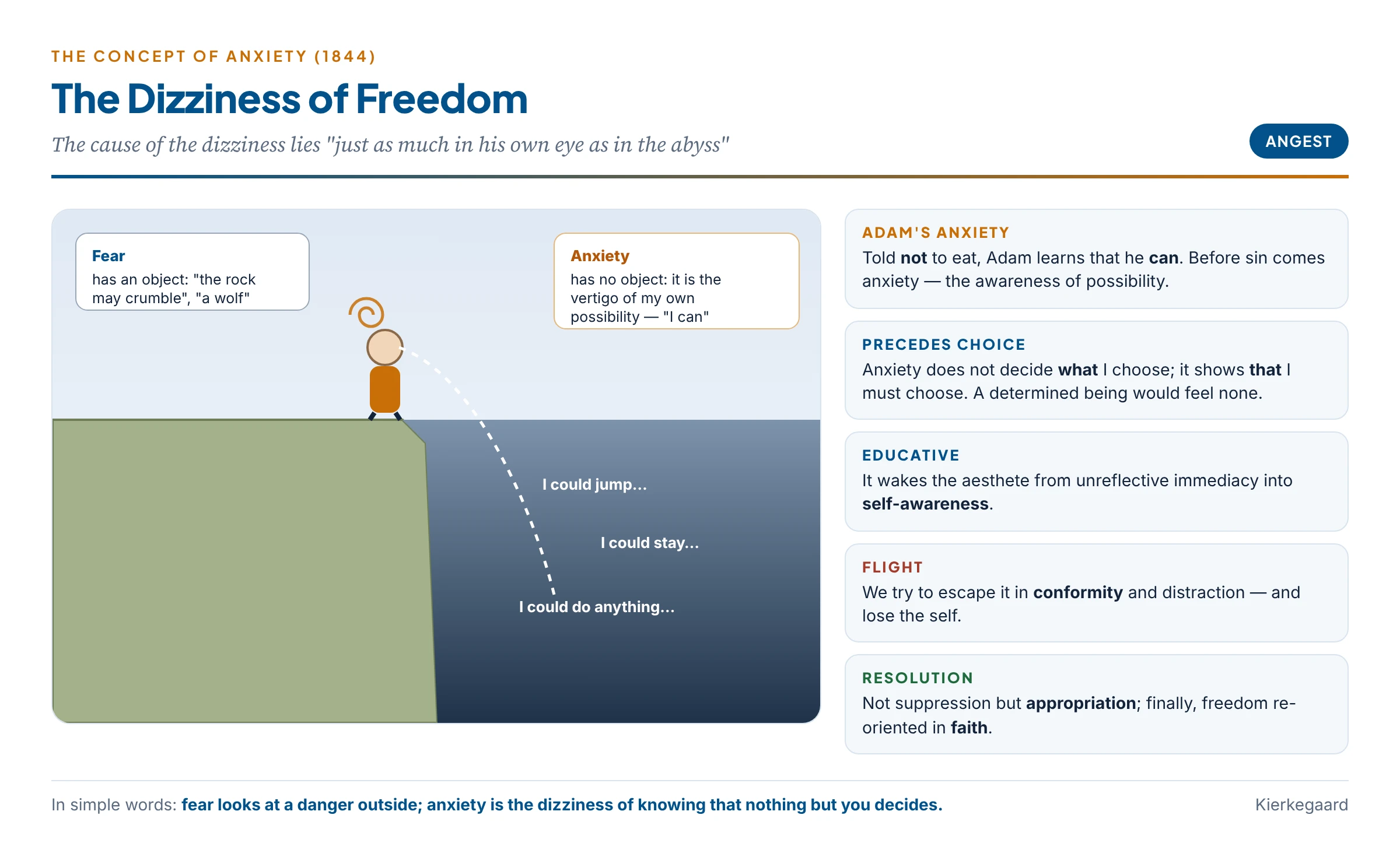
- Fear and anxiety. Fear has a definite object — a wild animal, an exam, a loss. Anxiety has no object: it is directed at nothing, at the open infinity of possibility itself.
- Not just psychology. Anxiety is not a mere psychological disturbance but an ontological condition that reveals the nature of human existence.
- The dizziness of freedom. “Anxiety may be compared with dizziness. He whose eye happens to look down into the yawning abyss becomes dizzy. But what is the reason for this? It is just as much in his own eye as in the abyss… Thus anxiety is the dizziness of freedom.”
- Freedom’s own vertigo. The dizziness comes not from outside compulsion but from realising that one is free — that one could act in many, even contradictory, ways. Only human beings can imagine alternatives and project themselves into different futures; this distinguishes us from animals and objects.
- Adam’s anxiety. When God told Adam not to eat the fruit, Adam learned that he could — that he was free to — and the awareness that “I can” filled him with anxiety. Before sin there is anxiety: the awareness of the possibility of sin.
- Anxiety precedes choice. It does not determine what one will choose, but reveals that one must choose. If human beings were fully determined, anxiety would disappear. Anxiety is the psychological correlate of freedom.
- Double-edged possibility. Possibility includes the good but also wrongdoing and failure.
- Educative. Anxiety is unsettling but educative: it awakens self-awareness, freedom and responsibility, and pulls the individual out of the unreflective immediacy of the aesthetic life.
- Flight or appropriation. One may try to escape anxiety by denying freedom or dissolving oneself in conformity — but this blocks authentic growth. Properly understood, anxiety should not be suppressed but appropriated: it signals the need for decision.
- Towards faith. Anxiety ultimately points to faith: when the individual feels the burden of infinite possibility and the limits of reason, faith reorients freedom towards trust in God — without abolishing it.
In simple words
Stand at the edge of a high cliff. You are not afraid that the rock will crumble — it is solid. Yet you feel dizzy, because you suddenly realise that nothing stops you from jumping. That strange vertigo, which comes from your own freedom rather than from any danger outside you, is what Kierkegaard calls anxiety. Fear looks at the abyss; anxiety looks at yourself looking at it.
6. Despair: “The Sickness unto Death”
The Sickness unto Death (1849) was written under the pseudonym Anti-Climacus, a “Christian of an extraordinary degree”. Its title comes from the story of Lazarus: “This sickness is not unto death.” For the Christian, physical death is not the worst thing; the real “sickness unto death” is despair — a spiritual death that one can carry while physically alive.
What the self is:
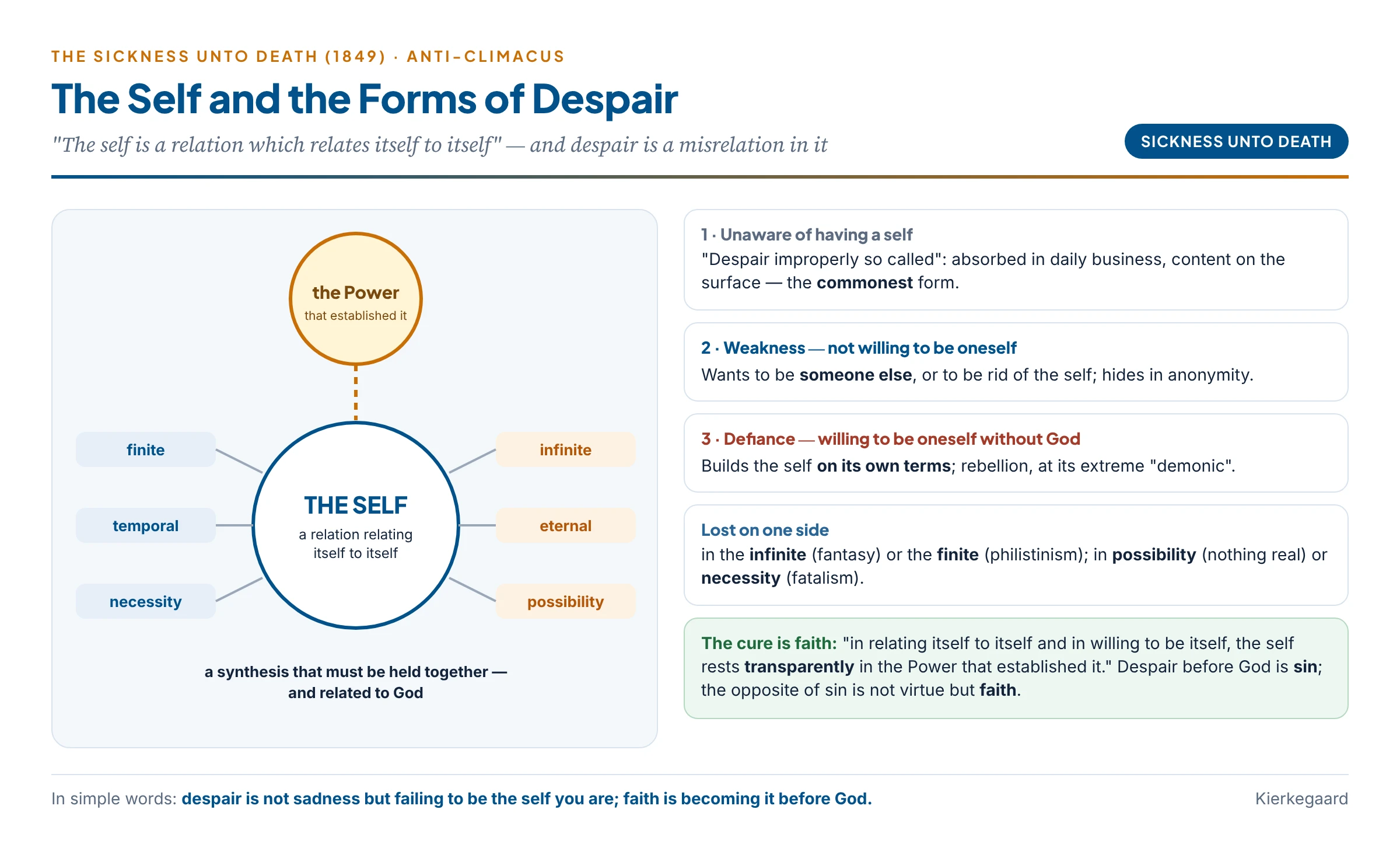
- “Man is spirit. But what is spirit? Spirit is the self. But what is the self? The self is a relation which relates itself to itself.”
- A synthesis of opposites. The human being is a synthesis of the infinite and the finite, the temporal and the eternal, freedom (possibility) and necessity. The self is not one of the two sides but the activity of holding them together — and relating this whole to the Power that established it.
What despair is:
- A misrelation in the self. Despair arises when this synthesis is wrongly related — when one side is overemphasised, or the full structure of the self is refused. It is not an external affliction but an inner disorder in one’s way of being.
- Not depression. Despair is not a mood of sadness; it is a spiritual condition concerning the structure of the self. One may appear content and be in despair.
- Universal. Everyone is in despair to some degree, consciously or not. The tragedy is not to suffer it but to fail to recognise it.
- Despair under finitude and infinitude, possibility and necessity. One may lose oneself in the infinite (dreaming, fantasy, endless possibility with no actuality) or in the finite (becoming a mere number, absorbed in worldly business — “philistinism“); in possibility (nothing ever becomes actual) or in necessity (fatalism: nothing is possible).
Forms of despair:
- Despair that is unaware of having a self — “despair improperly so called”. The person lives immersed in everyday concerns, unaware of any deeper self; he may seem content. This is the most common and, in a sense, the lowest form.
- Despair of weakness — not willing to be oneself. The person is aware of a self but does not want to be it; facing the burden of freedom, he wishes to be someone else, or to be rid of himself, or to dissolve into anonymity.
- Despair of defiance — willing to be oneself (in despair). The person insists on being himself on his own terms, without God, constructing the self he wants and refusing the self he is given. This is the most conscious and willful form — rebellion rather than ignorance — which at its extreme becomes “demonic“.
Despair is sin; faith is its cure:
- Despair before God is sin. To despair is to be estranged from God, because the self finds its proper ground only in a transparent relation to its Creator.
- Sin is a state, not merely an act. Concrete sins — theft, murder — are the results of being in sin, which is first something we are, not something we do.
- Despair over sin deepens it. Despairing over one’s sin, despairing of forgiveness, and finally declaring Christianity untrue, are deeper and deeper sin.
- The opposite of sin is not virtue but faith. The formula of faith: “In relating itself to itself and in willing to be itself, the self rests transparently in the Power that established it.“
- Despair as a gateway. Despair is not wholly negative: it springs from self-awareness, and the recognition of despair can lead to repentance and faith. Despair is “both the deepest problem of existence and the gateway to authentic selfhood“.
Common confusion
Is Kierkegaard’s “despair” the same as depression or ordinary sadness? No. Many notes describe despair as a gloomy feeling. For Kierkegaard, despair is a misrelation in the structure of the self — a failure to be the self one is, before God. A cheerful, successful person can be in despair (indeed, the unconscious form is the most common), and a person in great grief need not be. Despair is diagnosed not by mood but by how one relates to oneself.
7. The Leap of Faith and the Knight of Faith
The leap:
- Not a phrase, but an idea. The exact phrase “leap of faith” rarely appears in Kierkegaard, but the idea is central: a decisive, passionate commitment that cannot be justified by argument or objective proof, marking the passage from the ethical to the religious.
- Supra-rational, not irrational. Faith is not contrary to reason; it is beyond reason. Reason guides ethical deliberation and logical inference but cannot resolve the paradoxes of faith.
- Certainty would destroy faith. If God’s existence could be proved, faith would involve no risk and no inwardness.
- Faith and belief. We believe what we can prove or observe — we believe in gravity, which we feel every moment. It would make no sense to have faith in gravity, because faith requires the possibility of being wrong. We can have faith in God precisely because God is beyond proof.
Abraham on Mount Moriah:
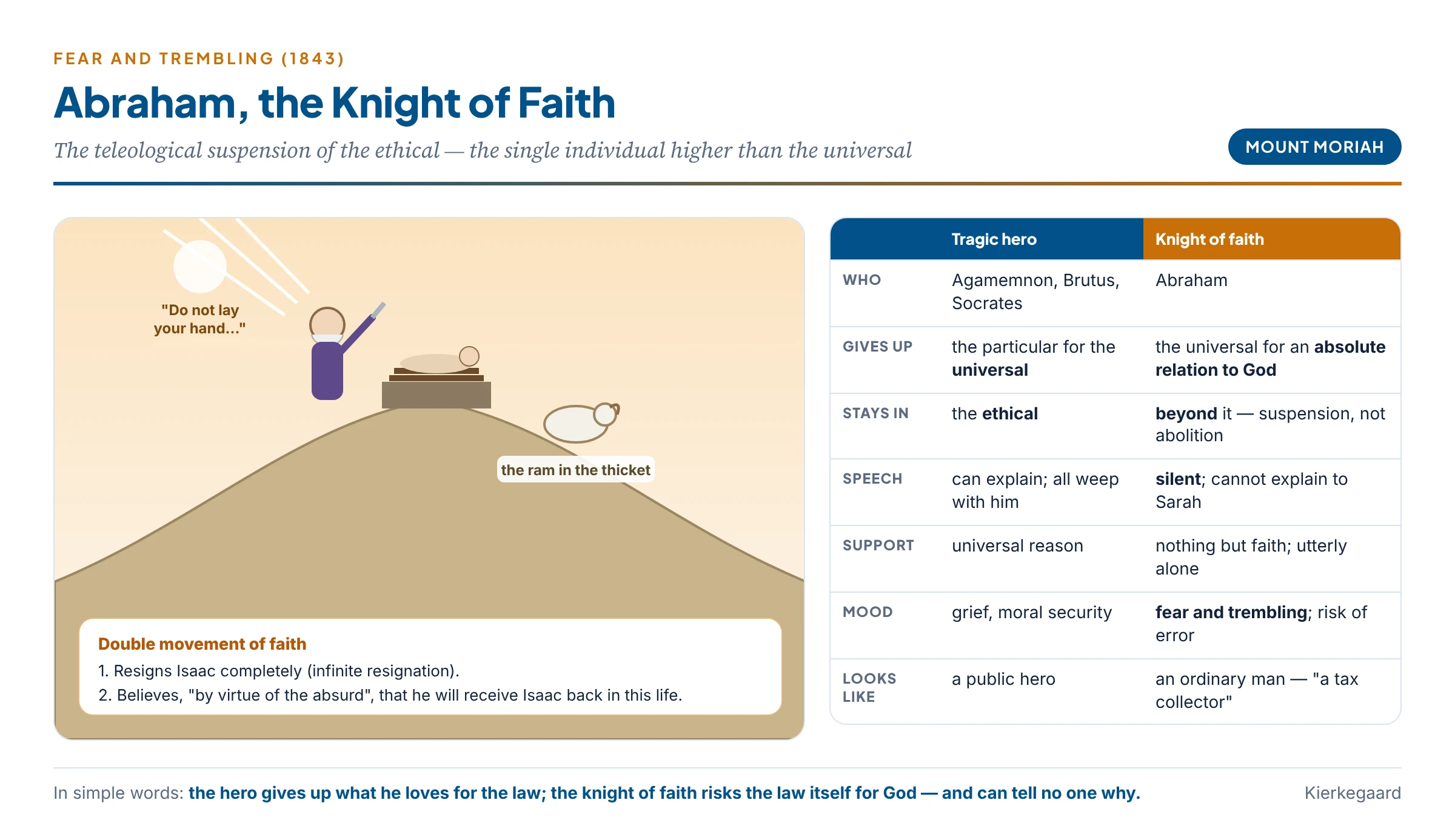
- The story. God promised the aged Abraham that he would be the father of many nations through his son Isaac, born to him in old age. Then God commanded him to sacrifice Isaac on Mount Moriah. Abraham set out, built the altar, raised the knife — and at the last moment an angel stayed his hand and a ram was offered instead.
- Four retellings. Fear and Trembling (by “Johannes de Silentio”) opens with four alternative versions of the story — in one Abraham pretends to Isaac that the sacrifice is his own wish, preferring that Isaac lose faith in his father rather than in God; in another he sacrifices the ram but his faith is broken; in a third he begs forgiveness for having even thought of it; in a fourth he cannot go through with it and Isaac loses his faith. None of these is the Abraham of faith.
- Ethically a murderer, religiously a believer. From the standpoint of universal ethics, Abraham is about to murder his son; a father’s duty is to protect his child. From the standpoint of faith, he is obeying God.
The teleological suspension of the ethical:
- “Teleological” means “with regard to an end” (telos). If I eat in order to stop being hungry, my act is teleological.
- Abraham suspends the ethical — puts it on hold — for the sake of a higher end: his absolute relation to God.
- Suspension, not abolition. The ethical is not abandoned. When Abraham comes down from the mountain, he returns to the ethical — but now knows that it is not exceptionless, and that his obedience to its rules rests on a higher loyalty.
- The single individual is higher than the universal. In faith, the individual stands in an absolute relation to the Absolute and a relative relation to the universal ethical order.
By virtue of the absurd — faith and resignation:
- The knight of infinite resignation gives up what he loves, accepting the loss with dignity, and finds peace in the eternal. That is a great movement — but not faith.
- The knight of faith makes a double movement: he resigns Isaac completely — and at the same time believes, “by virtue of the absurd“, that he will receive Isaac back in this life. He does not act out of resignation (“God must always be obeyed”) but out of faith that God will not finally do what is unethical — while knowing he cannot be sure.
- Obedience versus faith. If Abraham were willing to kill Isaac merely because he was ordered, that would show obedience, not faith. Kierkegaard thus distinguishes the blind obedience a church may demand from the true faith of the individual.
Tragic hero and knight of faith:
| Point | Tragic hero (Agamemnon, Brutus, Socrates) | Knight of faith (Abraham) |
|---|---|---|
| Sacrifices | The particular (his child, his life) for the universal (State, law) | The universal (ethical duty) for an absolute relation to God |
| Stays within | The ethical | Goes beyond the ethical (teleological suspension) |
| Can explain himself? | Yes — everyone understands and weeps with him | No — he cannot speak; he is silent before Sarah and Isaac |
| Support | Universal reason and public sympathy | Nothing but faith; utterly alone |
| Feeling | Grief, but moral security | Fear and trembling, anxiety, risk |
- Silence and loneliness. Abraham has no words to explain his singular act to his wife; he can rely neither on general principles nor on universal reason. He is alone before God — “the consummate individual”. He also bears the anguish that the command might not be divine; the “temptation” for him is to make the ethical absolute and do the “moral” thing.
- Greatness. “He who strove with the world became great by overcoming the world; he who strove with himself became great by overcoming himself; but he who strove with God became greater than all.” Abraham was “great by reason of his power whose strength is impotence, great by reason of his wisdom whose secret is foolishness, great by reason of his hope whose form is madness.”
- Outwardly ordinary. Kierkegaard imagines that if one met a knight of faith, he might look exactly like a tax collector — an ordinary man enjoying ordinary things — for faith is entirely inward.
- The paradox of ethics. Ethical systems are made for the welfare of the many, but sometimes following a rule helps one and harms ten; human beings cannot see the future. Faith, for Kierkegaard, removes this burden of prediction — but only at the price of anxiety, since one cannot know one has passed the test until it is over.
Common confusion
Does “teleological suspension of the ethical” mean that Kierkegaard approves of breaking moral rules whenever one feels God commands it? No. Kierkegaard does not say morality may be abandoned; he says it may be suspended in an absolutely unique relation to God — and he stresses that this is accompanied by fear and trembling, silence and the terrible possibility of being wrong. He presents Abraham not as a model anyone may copy at will, but as a paradox that shows the limits of a purely ethical view of life. Many critics nonetheless find the idea dangerous, as discussed below.
8. Prayer: Changing the One Who Prays
- The saying. Kierkegaard wrote: “The function of prayer is not to influence God, but rather to change the nature of the one who prays.“
- Not bargaining. God is unchangeable; prayer that tries to persuade God, like a petition to a ruler, misunderstands both God and prayer.
- Prayer as inward transformation. In true prayer the person who began by speaking ends by listening; the one who wanted God to do his will comes to will God’s will. Prayer is a form of appropriation — the inward movement of the single individual before God.
- Link to subjectivity. Prayer is the clearest case of “truth is subjectivity“: it changes nothing in the objective world directly, yet it changes how the individual exists — which, for Kierkegaard, is what matters most.
In simple words
A child begs her father for a new phone every day, hoping to wear him down. Years later, she talks to her father not to get things but because she has grown to share his concerns. The father has not changed; she has. That, for Kierkegaard, is what prayer does.
9. Responsibility and Authentic Existence
- Responsibility follows from choice. The individual is accountable for the direction of his life; responsibility becomes most inward in the religious sphere, where one stands directly before God.
- Authenticity is an ongoing task. The self must continually choose itself; authenticity is never inherited or socially guaranteed.
- Faith completes the self. Faith does not abolish anxiety or freedom; it transforms them. The individual accepts finitude while trusting in the eternal: authentic existence combines humility and commitment.
- The road to later existentialism. Kierkegaard’s analysis of choice, anxiety and despair became the template for Heidegger’s anxiety and authenticity and Sartre’s anguish and bad faith — with God removed.
Critical Evaluation
Objections
- The danger of Abraham. If ethics can be suspended for a divine command, what prevents fanaticism — someone killing in the name of God? Kant had already written that Abraham should have replied to the voice: “That I ought not to kill my good son is quite certain; but that you, this apparition, are God — of that I am not certain.” Sartre asked the same question: if an angel appears to me, what proof is there that it is an angel, and that I am Abraham? The interpretation of the sign is always mine.
- Irrationalism and fideism. The leap places faith beyond rational justification and seems to weaken reason’s role in religion.
- The stages are arbitrary. Why three, and why in this order? The division seems more literary than demonstrated, and Kierkegaard himself is inconsistent about leaps versus integration.
- A thin ethics. The ethical stage is identified with Kantian universal duty; other ethical traditions (virtue, care, community) are ignored.
- Pessimism. The constant emphasis on boredom, anxiety, despair, guilt and sin may overstate the existential crisis and undervalue ordinary forms of fulfilment.
- Neglect of the social. The individual’s relation to self and God is everything; society, politics and economics are almost absent.
- Choice without criteria? If the first choice founds its own criteria, it seems arbitrary; how can one choice be better than another?
Replies and Strengths
- Abraham as a limit, not a licence. Kierkegaard’s Abraham is surrounded by fear and trembling; the point is to show that faith is not comfortable morality — not to license crimes. Abraham is not violent towards others for a cause; he is tested in what is dearest to him.
- Supra-rational. Faith does not contradict reason in its own sphere.
- Psychological depth. His analyses of boredom, anxiety and despair anticipate modern psychology and remain illuminating — “despair” as not wanting to be oneself is recognisably human.
- Choice is criterion-founding, not careless. The stages are not equal; earnestness and passion are demanded; the aesthetic and ethical reveal their own inadequacy from within.
- Freedom taken seriously. Kierkegaard shows that a self is made through commitment, not given — the founding insight of existentialism.
Critics and Defenders
Criticism — Critics
- Fanaticism: a “divine command” can justify anything; Kant and Sartre doubt any voice can prove itself divine.
- Fideism: faith beyond reason becomes uncriticisable.
- Arbitrary stages: literary types rather than demonstrated structures.
- Narrow ethics: morality reduced to Kantian universal law.
- Pessimism: boredom, despair and sin dominate the picture.
- Asocial: no account of community, justice or politics.
Defence — Defenders and strengths
- Faith is not comfortable: Abraham’s fear and trembling is a warning, not a licence.
- Choice makes the self: the founding insight of existentialism.
- Deep psychology: anxiety as the dizziness of freedom; despair as not willing to be oneself.
- Not arbitrary: the stages show their own failures from within.
- Honest about guilt: the ethical cannot heal what it condemns.
- Lasting influence: Heidegger, Sartre, Jaspers, modern theology and psychotherapy.
Cross-Tradition Comparison
The Stages and the Indian Aims of Life
| Point | Kierkegaard’s stages | Indian puruṣārthas and āśramas |
|---|---|---|
| Basic aim | Aesthetic: pleasure | Kāma (desire, pleasure) and artha (wealth) |
| Middle aim | Ethical: universal duty, marriage | Dharma: duty; the householder (gṛhastha) stage |
| Highest aim | Religious: faith, relation to God | Mokṣa: liberation; renunciation (saṃnyāsa) |
| Movement | Leaps of choice; no automatic progress | A natural, ordered progression through life stages |
| Relation of levels | Higher may suspend the lower | Dharma regulates kāma and artha; mokṣa transcends all |
| Final state | The single individual before a personal God | Liberation, often dissolving the separate ego |
Indian Connect — Indian Connect: Arjuna and Abraham
- Despair at Kurukṣetra. The Bhagavad Gītā opens with Arjuna’s despair (viṣāda): his ethical duties as kinsman and as warrior collide; he drops his bow, unable to choose. Like Kierkegaard’s ethical man, he discovers that the universal rules conflict and cannot carry him.
- Surrender beyond rules. Krishna’s final teaching — “Abandoning all dharmas, take refuge in Me alone; I shall free you from all sins” (sarva-dharmān parityajya mām ekaṃ śaraṇaṃ vraja) — has often been compared with the teleological suspension of the ethical: a personal surrender to God above the ordinary code.
- Prapatti. Rāmānuja’s tradition of prapatti (total self-surrender to God) resembles the leap of faith — a decisive act of trust, not the conclusion of an argument.
- Differences. Arjuna is instructed and fights within his duty (svadharma) as a warrior, with full explanation; Abraham is silent, alone and cannot explain himself. The Gītā reconciles duty and devotion; Kierkegaard keeps them in paradoxical tension.
- Prayer. Indian bhakti also sees prayer as transforming the devotee rather than changing God; Gandhi called prayer “not asking” but “a longing of the soul“.
Kierkegaard and Later Existentialists on Anxiety and Choice
| Point | Kierkegaard | Heidegger | Sartre |
|---|---|---|---|
| Anxiety reveals | Freedom, possibility of sin | Thrownness, death, the nothing | Freedom as foundation of values |
| Escape from anxiety | Aesthetic distraction, conformity | Falling into “the they” | Bad faith |
| Authentic response | Leap of faith before God | Anticipatory resoluteness towards death | Lucid acceptance of freedom |
| Role of God | Central | Philosophically irrelevant | Absent (“abandonment”) |
Synthesis (Siddhānta)
- Choice makes the self. For Kierkegaard, a self is achieved through choice; the deepest choice is not between good and evil acts but the choice to enter the ethical at all — a criterion-constituting decision that no prior rule can justify. Hence a choice is “correct” not by an external measure but by its earnestness and by whether it lets the person become a self.
- Three stages. The aesthetic life of pleasure ends in boredom and despair; the ethical life of duty unifies the self but “goes bankrupt” before guilt; the religious life of faith grounds the self transparently in God. Each passage is a leap.
- Anxiety and despair. Anxiety is the dizziness of freedom, revealing that we must choose; despair is the misrelation of the self, cured only by faith — the opposite of sin.
- The knight of faith. Abraham’s teleological suspension of the ethical shows that faith is not a higher ethics but a paradoxical, lonely, absolute relation to God, held “by virtue of the absurd”.
- Balance. Critics rightly fear fanaticism and fideism; Kierkegaard’s defenders reply that he made faith harder, not easier. His deeper legacy is philosophical: the self as task, choice as self-making, and anxiety and despair as revelations of what it is to be free — themes Heidegger and Sartre would carry into a world without God.
“Anxiety is the dizziness of freedom.” — Kierkegaard
“The function of prayer is not to influence God, but rather to change the nature of the one who prays.” — Kierkegaard
“In relating itself to itself and in willing to be itself, the self rests transparently in the Power that established it.” — Kierkegaard
Previous Year Questions
- 2022How does Søren Kierkegaard define the notion of ‘subjectivity’? Explain it with reference to three stages of existence as propounded by him.
- 2014Explain Kierkegaard’s concept of choice. How does the concept of choice in meta-ethics differ from normative ethics? Explain.
- 2013Analyse Kierkegaard’s concept of choice. Can there be, in his view, correct or incorrect choice? Discuss.
- 2012Søren Kierkegaard clarified that “The function of prayer is not to influence God but rather to change the nature of the one who prays.” Comment on this statement.