

Existentialism (Kierkegaard, Sartre, Heidegger): Existence and Essence; Choice, Responsibility and Authentic Existence; Being-in-the-world and Temporality.
Official Syllabus: Paper I, Section A, Unit 10
Søren Kierkegaard (1813–1855), the Danish thinker called the father of existentialism, built his philosophy on one protest: the great systems of philosophy, above all Hegel‘s, explain everything except what it means to exist as a living, choosing, suffering individual. Against the System he set the single individual (den Enkelte); against objective, impersonal knowledge he set his famous principle “truth is subjectivity” — the highest truths must be lived, appropriated and staked upon, not merely known; and against the anonymous crowd of modern society he declared that “the crowd is untruth“. These ideas answer the problem of how a human being can find a truth for which he can live and die.
In simple words
Two students both know the sentence “honesty is the best policy“. One recites it in an exam and copies in the next. The other, alone and unobserved, returns a wallet full of cash. Both “know” the same objective truth. Only the second is in the truth, because he has made it his own by living it. For Kierkegaard, the truths that matter most are like this: not something you have, but something you are.
Context & Problem
The Man and His Copenhagen
- Life. Kierkegaard was born, lived and died in Copenhagen. He studied theology and the then-dominant Hegelian philosophy at the university. He broke off his engagement to Regine Olsen, apparently because he did not want to burden her with his lonely religious vocation, and stayed unmarried all his life. He died in 1855, at forty-two.
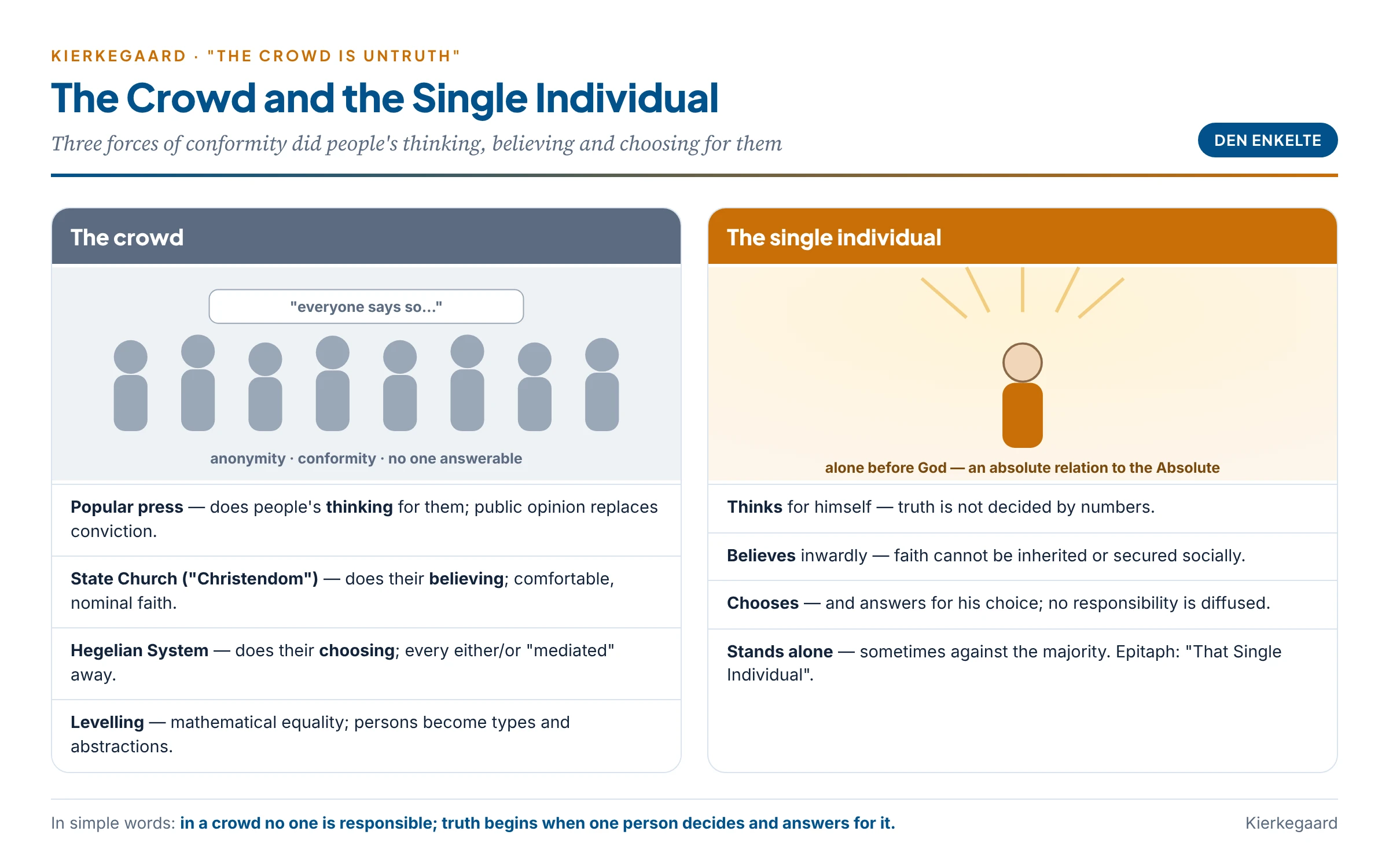
- A lonely polemicist. He attacked the three most powerful forces of conformity in the Copenhagen of his day:
- the popular press, which did people’s thinking for them;
- the State Church, which did their believing for them;
- Hegelian philosophy, which did their choosing for them, by “mediating” every either/or into a comfortable both-and.
- The price he paid. A satirical weekly, The Corsair, caricatured him until he became the laughing-stock of the city and hesitated even to take his beloved walks through its streets.
- His epitaph. He wished his tombstone to read simply: “That Single Individual“.
- His method. Most of his books were published under pseudonyms — Johannes Climacus, Johannes de Silentio, Victor Eremita, Frater Taciturnus, Anti-Climacus — each speaking from a different point of view. This “indirect communication” was deliberate: it does not dictate answers but forces readers, like Socrates’ questions, to decide for themselves.
The Philosophical Situation: Hegel’s System
- Hegel’s claim. Reality is the self-unfolding of the Absolute Spirit. Through dialectic — thesis, antithesis, synthesis — every opposition is “mediated” into a higher unity. History, the State, art, religion and philosophy are all moments of one rational whole. “The rational is the real, and the real is the rational.“
- The individual’s place. In this System the individual is only a passing moment; he finds his fulfilment in the ethical life of the State; and true freedom is the acceptance of necessity.
- Christianity rationalised. Hegel presented Christian doctrine as the picture-language of truths that philosophy grasps conceptually. Faith becomes a lower stage of knowledge.
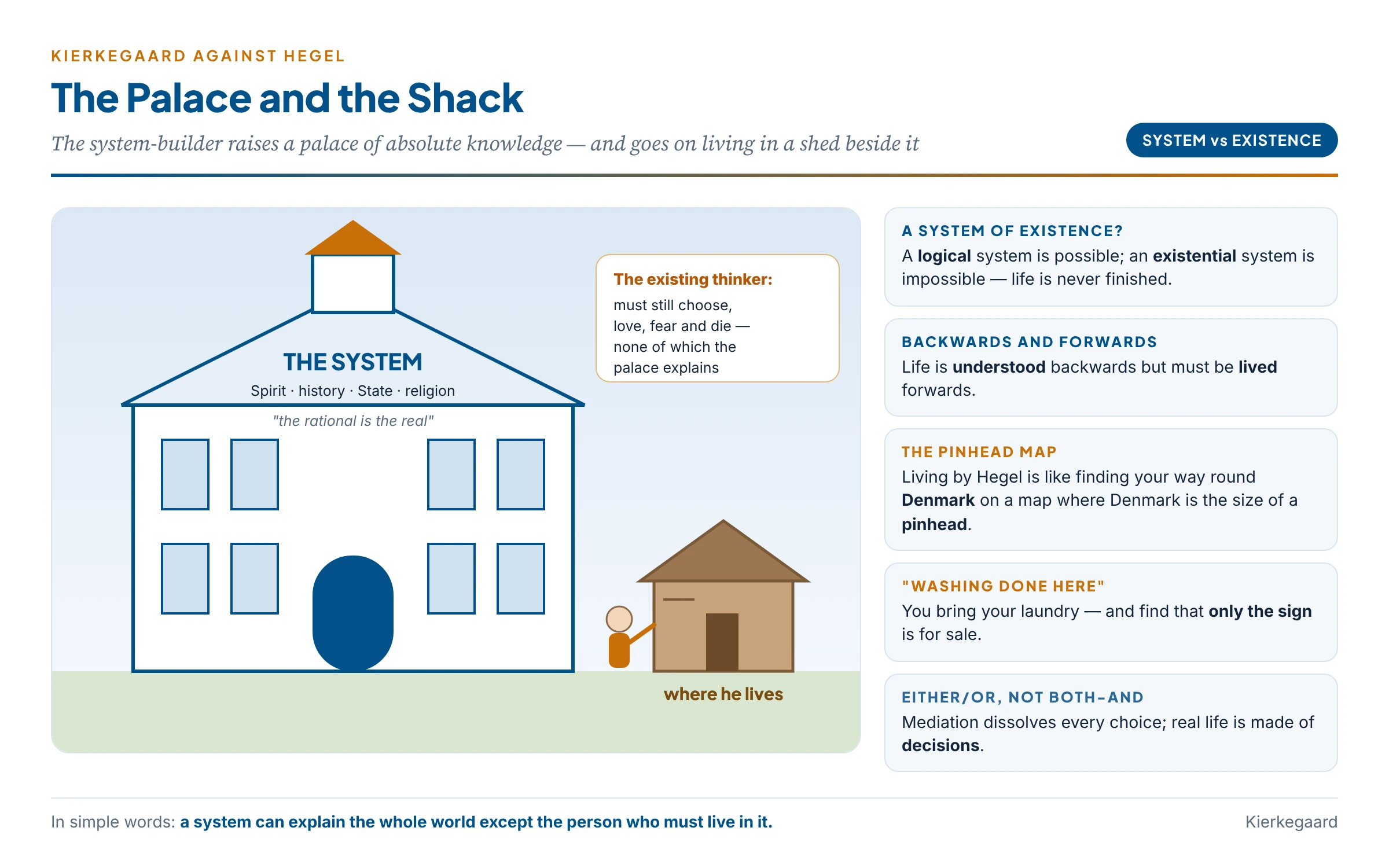
- Kierkegaard’s question. Such a System may explain everything objectively — but does it help me to know how to live, what to choose, how to die? His answer was no: it forgets the one who is doing the philosophising — the existing individual.
In simple words
Hegel’s System is like a world atlas that shows every country, river and mountain in perfect order. Kierkegaard’s complaint is that you cannot use it to find your way home through your own city lanes at night. As he put it: trying to live by Hegel’s philosophy is like trying to find your way around Denmark with a map of the world on which Denmark is the size of a pinhead.
Core Doctrine
1. The Revolt against Hegel
(a) A system of existence is impossible:
- Logic can be systematic; life cannot. “A logical system is possible; an existential system is impossible.” Logic can be completed because it deals with abstract concepts. Existence is incomplete, always on the way, lived forward into an unknown future.
- Life backwards and forwards. “It is perfectly true, as philosophers say, that life must be understood backwards. But they forget the other proposition, that it must be lived forwards.” A system can explain events after they happen; it is powerless before the choices I must make now.
- The palace and the shack. Kierkegaard pictured the system-builder as a man who builds an enormous palace — a grand system of absolute knowledge — but himself lives in a shed beside it. The thinker has forgotten what it means to exist as a mortal, anxious, choosing person.
- The laundry sign. Living by abstract philosophy is like taking your laundry to a shop with the sign “Washing Done Here” — only to discover that only the sign is for sale.
(b) Mediation destroys the “either/or”:
- Hegel’s logic. Hegel’s dialectic overturns the old laws of logic — identity, non-contradiction and the excluded middle — because in the dialectic everything passes into its opposite and is then reconciled in a synthesis.
- Kierkegaard’s mockery. In Either/Or (1843) he writes an “ecstatic lecture”: “If you marry, you will regret it; if you do not marry, you will also regret it; marry or do not marry, you will regret both… Hang yourself, you will regret it; do not hang yourself, you will also regret that… This, gentlemen, is the sum and substance of all philosophy.” The point: where every opposition is swallowed up, nothing is ever really decided, and apathy results.
- Life demands either/or. Real existence is made of qualitative choices that no synthesis can dissolve: to marry or not, to believe or not, to commit or to drift. The very title Either/Or is an attack on Hegel’s both-and.
(c) The individual is not a moment of the universal:
- Universal spirit is an abstraction. Philosophers abstract a “universal spirit” from many individual selves, just as we abstract “horseness” from many horses. But such an abstraction has only logical status; it does not exist. Only particulars exist.
- The individual stands before God. For Hegel the individual finds himself in the ethical life of the community and the State. For Kierkegaard the individual stands alone before God, sometimes even against the universal ethical order — as Abraham did (see the next article).
- The individual is higher than the universal. Hence the paradox Kierkegaard defends in Fear and Trembling: in faith, “the single individual is higher than the universal“.
(d) Christianity cannot be turned into philosophy:
- Faith is not a lower form of knowledge. Faith is paradox and risk, not speculative insight.
- The absolute paradox. The central Christian claim — that the eternal God became a finite, historical man (the Incarnation) — is an offence to reason. It cannot be “mediated”; it can only be believed or rejected.
- Objectivity kills faith. If God’s existence could be proved, faith would no longer involve risk and inward commitment — and so would no longer be faith.
(e) Existence cannot be thought:
- Thought abstracts. Every word — “the brown dog obeys its master” — names a general concept. Thought, being language-bound, always abstracts from the particular.
- The surd of existence. “To think is one thing, to exist is another.” I can say many things about myself — “I am a teacher, an Indian, in love, I prefer tea to coffee” — but when I am done, one thing remains that cannot be thought: that I exist, which I must live.
- Against “the rational is the real”. Hegel identified thought and being. Kierkegaard inverts him: existence is precisely what escapes thought. Beneath rationality lies a lived reality of decision, passion and anxiety.
(f) The overall charge:
- Hegel’s optimistic idealism ignores the human predicament — guilt, anxiety, death, the need to choose — and tries to make everything rational. Kierkegaard’s critique is therefore not a rejection of thinking but a turning of philosophy from the outward-looking spectator to the inward-looking existing person. Some have called this a “Copernican revolution” in the theory of truth: the criterion of the highest truth is no longer objectivity but subjectivity.
Common confusion
Did Kierkegaard simply reject Hegel and reason altogether? No. Kierkegaard was steeped in Hegel and even borrowed his love of dialectic — his “stages of life” form a dialectical sequence. What he rejected was Hegel’s claim that a system could include the existing individual, and that faith could be absorbed into reason. He never denied objective truth in mathematics, science or history; he denied that such truths can tell me how to live. He was not against reason, but against reason’s overreach.
2. Against Descartes: “I Must Exist in Order to Think”
- The reversal. Descartes argued “I think, therefore I am”. Kierkegaard replies that the order is upside down: I must exist in order to think. In the order of being (ontology), existence comes before thought, even if in the order of knowing thought may seem to come first.
- A tautology. “I think” already contains “I am”; so “I think, therefore I am” adds nothing — it is a tautology that repeats its premise in its conclusion.
- The self is not an object. Descartes tried to know the self as an object. But the self is the knower, never the known; the knower is always prior to anything known and can never become an object of knowledge. All attempts to know the self objectively fail.
- The self is beyond doubt. All doubting originates in the self; so the self is not one more thing to be doubted.
- Ontology before epistemology. This is a basic belief of all existentialists: the question “what is it to be?” is prior to and deeper than the question “how do we know?”
Indian Connect — Indian Connect: the knower that is never known
- Śaṅkara‘s Advaita makes exactly this point: the self (ātman, the witness, sākṣin) is the knower and can never become an object of knowledge. “You cannot see the seer of seeing,” says the Bṛhadāraṇyaka Upaniṣad.
- Self-evident. Like Kierkegaard’s self that is “beyond doubt”, Śaṅkara’s self is self-established (svataḥ-siddha): whoever doubts it, presupposes it.
- The difference. Kierkegaard’s self is a finite, anxious existing individual before God; Śaṅkara’s self is the infinite consciousness identical with Brahman. Both, however, reject the idea that the self is a thing to be known like other things.
3. The Single Individual and “the Crowd”
- The primacy of the single individual. Truth is not realised in the unfolding of universal spirit or historical totality, but in the inward life of the existing person. One cannot exist “in general“; every act of choice, every anxiety, every movement towards faith happens in a unique, inward perspective.
- “The crowd is untruth.” The crowd represents anonymity, conformity and irresponsibility. In a crowd no one feels fully accountable, because responsibility is diffused among all.
- Comfort at a price. The crowd gives comfort — at the cost of authenticity. It substitutes public opinion for personal conviction.
- Numbers do not make truth. Truth cannot be decided by numerical consensus; majority agreement does not establish existential validity. As Kierkegaard’s critique of the press shows, public opinion is formed by those who do not wish to risk being excluded by thinking for themselves.
- Levelling. The modern age levels everyone to a kind of mathematical equality; people are pressed to conform to types and become abstractions rather than individuals. Mass production, mass media and theories of objectivity all diminish the individual.
- A false belonging. A purely collective identity is always somehow false: in order to belong and fit in, we must betray some part of ourselves and stop living our own lives.
- The present age. Kierkegaard contrasted the passionate age of revolution with “the present age” — “essentially a sensible, reflecting age, devoid of passion, flaring up in superficial, short-lived enthusiasm and prudently relaxing in indolence”. It is an “age of publicity“: nothing really happens, but there is instant publicity about everything.
- Christendom versus Christianity. Kierkegaard’s last battle was to reintroduce New Testament Christianity into “Christendom” — a cultural, state-run Christianity of complacency, comfort and tokenism towards the poor. The State, he said, employed a thousand officials (the clergy) who, while professing Christianity, in fact prevented people from knowing what it truly is. His question was how to be a Christian in Christendom.
- Faith cannot be inherited. Faith is a personal task: it cannot be inherited culturally, secured socially or mediated by institutions. The single individual stands in an absolute relation to the Absolute — and no system, institution or collective identity can do this for him.
- Authentic existence requires standing alone. The individual must have the courage to stand alone — sometimes against the majority — and relate to truth personally.
In simple words
On social media, a post with ten lakh likes feels “true” simply because so many agree. Kierkegaard would say that the number of likes tells you nothing about whether you have thought it through and are ready to live by it. The crowd is comfortable precisely because no one in it has to answer for anything.
4. “Truth Is Subjectivity”
Kierkegaard’s principle, developed mainly in the Concluding Unscientific Postscript (1846), is one of the most famous — and most misunderstood — ideas in philosophy.
Two ways of reflecting:
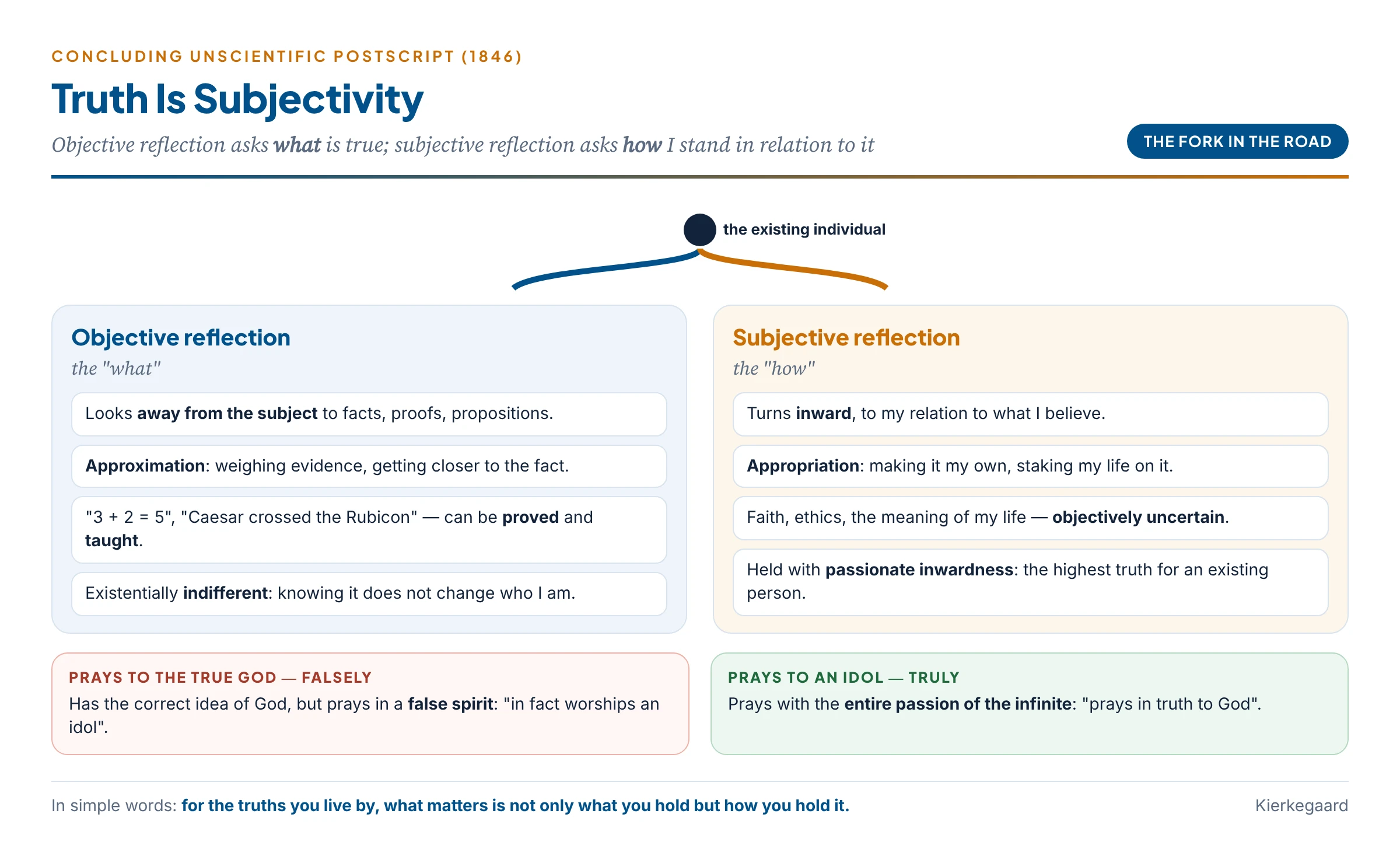
- Objective reflection. It asks what is true. It turns away from the subject and towards the object — facts, propositions, proofs. “The way of objective reflection makes the subject accidental, and thereby transforms existence into something indifferent, something vanishing… it leads to abstract thought, to mathematics, to historical knowledge of different kinds; and always it leads away from the subject, whose existence or non-existence becomes infinitely indifferent.”
- Subjective reflection. It asks how the individual is related to what he believes. It turns inward, to the existing person’s relation to truth.
Objective truths are existentially indifferent:
- “3 + 2 = 5“, “force equals mass times acceleration“, “Caesar crossed the Rubicon in 49 BCE” — such truths have objective criteria; they can be proved and taught in class. But if I found one of them false I would be surprised, not changed. They have no essential relation to how I live.
- Even the historical evidence for Christianity, or philosophical proofs of God, belong to objective inquiry. And even if Christianity could be proved objectively, this would not make anyone a Christian.
Kierkegaard’s definition:
“An objective uncertainty, held fast in an appropriation-process of the most passionate inwardness, is the truth, the highest truth attainable for an existing individual.” — Kierkegaard
Unpacked:
- Objective uncertainty. The matter cannot be proved — God, immortality, the meaning of my life.
- Held fast. I do not merely entertain it; I commit to it.
- Appropriation. I make it my own — not “approximation” (weighing evidence, getting closer and closer to a fact) but appropriation (taking it into my life).
- Passionate inwardness. With the whole intensity of the self — will, feeling and thought together.
- The highest truth for an existing person. Not the only kind of truth, but the highest kind available to a finite, existing being.
The famous example — the true God and the idol:
- “If one who lives in the midst of Christendom goes up to the house of God, the house of the true God, with the true conception of God in his knowledge, and prays, but prays in a false spirit; and one who lives in an idolatrous community prays with the entire passion of the infinite, although his eyes rest upon the image of an idol: where is there most truth? The one prays in truth to God though he worships an idol; the other prays falsely to the true God, and hence worships in fact an idol.”
- The lesson. “When the question of truth is raised subjectively, reflection is directed to the nature of the individual’s relationship; if only the mode of this relationship is in the truth, the individual is in the truth, even if he should happen to be thus related to what is not true.”
Socrates as the model:
- Socrates, facing execution, did not possess an objective proof of immortality. He said the soul might be immortal — and then staked his life on that possibility, drinking the poison calmly. For Kierkegaard, Socrates’ “if” held with his whole existence contains more truth than a hundred proofs held indifferently.
Features of subjective truth:
- It needs no proof and cannot be proved.
- It cannot be taught in a classroom like a theorem; it can only be realised.
- It requires a personal decision.
- It concerns values, ethics and faith, not empirical facts — “it is immoral to cause needless misery”, “God is love“.
- It is like friendship: friendship is not an objective fact about two people but a subjective relation that exists only as it is lived.
- “Only the truth which edifies is truth for you,” says the closing word of Either/Or: a truth that does not build up my life remains, for me, merely information.
In simple words
A doctor knows, as an objective fact, that smoking causes cancer, and can quote the statistics perfectly. Yet he goes on smoking. The day he throws away the packet — not because the numbers changed, but because he took the truth into his own life — he passes from knowing the truth to being in it. That passage is what Kierkegaard calls appropriation.
Inwardness and passion:
- Inwardness means self-reflection, self-commitment and the readiness to stake one’s life on a conviction, facing doubt and anxiety without external guarantees.
- Passion is not mere emotion but existential intensity — wholehearted engagement. A passionless acceptance of truth is spiritually hollow.
- The greater the uncertainty, the greater the inwardness. Faith lives precisely in the tension between passionate commitment and objective uncertainty.
- Truth to be, not only to know. Kierkegaard shifts philosophy from speculative system-building to existential decision: truth becomes not only something to know but something to be.
“A truth for which I can live and die”:
- At twenty-two, Kierkegaard wrote in his journal: “The thing is to find a truth which is true for me, to find the idea for which I can live and die.” And: “What I really lack is to be clear in my mind what I am to do, not what I am to know, except in so far as a certain understanding must precede every action.”
Common confusion
Does “truth is subjectivity” mean that whatever I sincerely believe is true — that truth is relative? No. Kierkegaard did not deny objective truth in science, mathematics or history, and he was not a relativist about what is true. His target was the lukewarm, nominal believer who holds correct doctrines with indifference. He was saying that in matters of existence — faith, ethics, the meaning of one’s life — the decisive question is how a person stands in relation to the truth: whether he has appropriated it with passion and risk. His own commitment was to a definite Christian faith, not to “anything goes”.
5. The Paradox, and Why Subjective Truth Cannot Become Objective
- Paradox arises when subjective truth is treated objectively. When a truth of faith is turned into an object of proof, it collapses into contradiction. The central case is the Incarnation: objectively, that the eternal should become temporal, the infinite a finite man, is a contradiction — the “absolute paradox“.
- God cannot be an object. God, as truth, cannot be found “outside” as an objective fact; God is met only in subjective relation. Trying to know God objectively turns God into one more object among objects.
- Faith, not proof. Hence Kierkegaard’s notion of the leap of faith: a decision grounded in personal choice, not in evidence.
- Knowledge and life. Objective truths of science and mathematics help us, but they cannot regulate our life or show us our goals. It is the values we select by personal choice that give our lives direction.
Common confusion
Is the paradox Kierkegaard speaks of the paradox of the Trinity — “how can the Son be his own Father”? Some notes give this example, but it misplaces Kierkegaard’s emphasis. The “absolute paradox” for Kierkegaard is the Incarnation: that the eternal God entered time as an individual human being. It is a paradox not because of a puzzle about persons in God, but because the infinite and the finite, the eternal and the historical, meet in one existing individual — something reason can never mediate and faith alone can accept.
6. Authentic Existence: Becoming a Self
- The self is a task. The self is not a fixed substance but a dynamic synthesis of opposites — finite and infinite, temporal and eternal, necessity and possibility — which must be held together rightly. One must become oneself.
- Inauthentic existence is evasion. The aesthete evades commitment; even the conventionally ethical person may simply conform to social norms without inward appropriation. Outward religious practice without inward existence is not religious existence.
- The single individual, again. Authenticity requires standing as a single individual against the levelling of the crowd, relating to truth personally.
- An ongoing task. Authenticity is not a static achievement: the self must continually choose itself, through repeated acts of decision and self-examination. It cannot be inherited or guaranteed socially.
- Fulfilled in faith. The fullest authenticity is reached in the religious stage, where the self rests transparently in the power that established it — God (see the next article).
7. Why Kierkegaard Is the “Father of Existentialism”
- He made existence — concrete, individual, choosing — the central category of philosophy.
- He made subjectivity, passion, decision, anxiety and despair philosophical themes.
- He introduced the contrast between authentic individual existence and the inauthentic crowd — the ancestor of Heidegger’s “they” (das Man) and Sartre’s bad faith.
- He showed that life must be lived forwards, anticipating the existentialist emphasis on temporality and the future.
- He combined philosophy and literature (pseudonyms, stories, parables) — a style later taken up by Nietzsche, Sartre, Camus and Beauvoir.
- He remained a theist: for Kierkegaard the self finds itself only in relation to God. Later existentialists kept his structure but often removed God.
Critical Evaluation
Objections
- Subjectivism and relativism. If the “how” matters more than the “what”, the passionate fanatic may seem as “much in the truth” as the saint. How do we tell faith from delusion?
- Irrationalism and fideism. By placing faith beyond reason and celebrating paradox, Kierkegaard seems to weaken reason’s role in religion and open the door to uncritical belief.
- Undervaluing objective truth. Science and universal ethics cannot be relegated to “objective indifference”; they matter enormously to how we live.
- No refutation possible. Kierkegaard often does not argue logically; one cannot refute him, only agree or disagree.
- Extreme individualism. He offers little analysis of social structures, institutions or economic conditions. In the year of European revolutions (1848) — one took place outside his study window — he was more concerned with inner conversion than social injustice; he even wrote a chapter on “Mercifulness” in Works of Love (1847) as a reply to communism. Critics call him elitist, apolitical and conservative.
- Unfair to Hegel. Hegel too spoke of subjectivity, freedom and the “seriousness” of the negative; Kierkegaard sometimes attacks a caricature.
- Theism questioned. Atheistic existentialists like Sartre hold that existentialism is not compatible with theism, and dropped the God-relation.
- Obscurity. The pseudonyms make it hard to know which views are Kierkegaard’s own.
Replies and Strengths
- Not relativism. Kierkegaard attacks indifference, not objective truth; he also insists that passion must be directed to the truth — he was a committed Christian, not a sceptic.
- Supra-rational, not anti-rational. Faith is above reason, not against it; reason has its full role in ethics, logic and science.
- A corrective. His one-sidedness is deliberate: he saw himself as a corrective to an age that had forgotten the individual. A corrective must press hard on one side.
- Social insight after all. His analysis of the crowd, levelling, the press and the “age of publicity” is a penetrating piece of social psychology, strikingly relevant to mass media and social media today.
- Enormous influence. He shaped Heidegger, Jaspers, Sartre, Camus, and modern theology (Barth, Bultmann, Tillich), as well as existential psychology.
Critics and Defenders
Criticism — Critics
- Fanaticism risk: passion without objective criteria cannot tell a saint from a zealot.
- Fideism: faith placed beyond reason weakens rational religion.
- Indifference to objective truth: science and universal ethics belittled.
- Individualism: silent on class, State and social injustice; conservative.
- Caricature of Hegel: Hegel’s system was not so lifeless.
- Obscurity: pseudonyms and paradoxes hide his own position.
Defence — Defenders and strengths
- Against indifference, not truth: what he attacks is lukewarm, borrowed belief.
- Supra-rational: faith goes beyond reason without denying it.
- Rescues the individual: reclaims the person from philosophical, theological and political abstraction.
- Prophetic social critique: crowd, levelling, press, “age of publicity”.
- Honest about existence: life is lived forwards, in risk and decision.
- Seminal: the root of existentialism, modern theology and existential psychology.
Cross-Tradition Comparison
Kierkegaard and Hegel
| Point | Hegel | Kierkegaard |
|---|---|---|
| Starting point | The Absolute Spirit; the whole | The existing individual |
| Truth | Objective; the rational whole (“the true is the whole”) | Subjectivity; inward appropriation |
| Logic | Dialectic mediates opposites (both-and) | Existence demands either/or |
| Individual | A moment of the universal; fulfilled in the State | Higher than the universal; alone before God |
| Faith | A lower, pictorial form of philosophical knowledge | Paradox, risk, leap; beyond reason |
| Freedom | Acceptance of rational necessity | Choice under anxiety |
| Philosophy as | A completed system | Fragments; indirect communication |
| History | Rational; understood backwards | Life must be lived forwards |
Kierkegaard and Socrates
- Shared. Both are midwives: they do not hand over truths but make others give birth to their own. Both lived their philosophy and were ridiculed by their city.
- Difference. For Socrates, truth is recollected — already within us; the teacher is only an occasion. For Kierkegaard (in his Philosophical Fragments), the highest truth must be given by God in time — the learner lacks it and must receive it; hence the moment of decision has eternal weight.
Indian Parallels
| Point | Kierkegaard | Indian parallel |
|---|---|---|
| Truth must be lived | Truth is subjectivity; appropriation | Upaniṣadic knowledge is realisation (anubhava), not information; Advaita’s “direct, immediate knowledge” (aparokṣa-anubhūti) |
| The crowd is untruth | Do not take truth from the majority | The Buddha’s advice to the Kālāmas: do not accept a teaching because of tradition, hearsay or many people — test it in your own life |
| Against Christendom | Faith smothered by State Church and ritual | Kabīr and the bhakti saints against ritualism and priestly religion; God met in the heart |
| The self as knower | “I must exist in order to think”; self not an object | Śaṅkara: the witness-self can never be an object |
| Faith beyond proof | Leap of faith; paradox | Śraddhā (faith) as a condition of spiritual knowledge; bhakti as personal surrender |
Indian Connect — Key takeaways
- Lived, not learned. Indian thought, like Kierkegaard, distinguishes knowing about the truth from becoming it. The Muṇḍaka Upaniṣad calls all scriptural learning “lower knowledge” (aparā vidyā) compared with the “higher knowledge” (parā vidyā) by which the Imperishable is realised.
- Against borrowed religion. Kabīr’s mocking of empty ritual — rosaries turned without a turned heart — is very close to Kierkegaard’s attack on Christendom.
- Test it yourself. The Kālāma advice parallels “the crowd is untruth“: a truth that matters must be verified in one’s own life, not accepted on the authority of numbers.
- Difference. Indian traditions usually seek a truth that dissolves the separate ego (Advaita, Buddhism); Kierkegaard’s truth intensifies the single individual before a personal God.
Synthesis (Siddhānta)
- The revolt. Kierkegaard turned philosophy from Hegel’s System to the existing individual: a logical system is possible, an existential system is not; life is understood backwards but lived forwards; existence demands either/or.
- The principle. “Truth is subjectivity“: for the truths that matter most — ethical and religious — what counts is how one stands in relation to them, with passionate inwardness and appropriation in the face of objective uncertainty. This is not relativism but a protest against indifference.
- The individual and the crowd. The single individual stands in an absolute relation to the Absolute; “the crowd is untruth” because it dissolves responsibility, levels persons and replaces conviction with publicity.
- The balance. Critics rightly warn of fanaticism, fideism and individualism. Yet Kierkegaard’s work is best read as a deliberate corrective: it reminds every age — and especially ours, of mass media and “trending” opinions — that truth which is not lived is only information, and that no crowd can decide for me how I am to exist.
“The thing is to find a truth which is true for me, to find the idea for which I can live and die.” — Kierkegaard
“The crowd is untruth.” — Kierkegaard
“Life must be understood backwards. But it must be lived forwards.” — Kierkegaard
Previous Year Questions
- 2024How does Kierkegaard define truth in terms of subjectivity? Critically discuss.
- 2023How does Kierkegaard argue against Hegel’s idea of universal spirit in favour of the individual as the essence of spirit? Critically discuss.
- 2022How does Søren Kierkegaard define the notion of ‘subjectivity’? Explain it with reference to three stages of existence as propounded by him.
- 2020What does Kierkegaard mean by saying “Subjectivity is the truth” in the context of the problem of ‘the single individual’?