

Salient features and value premises; Constitutionalism; Political culture; Bureaucracy and democracy; Bureaucracy and development.
This article: Salient features and value premises of the Constitution and what they mean for administration: the Preamble and its ideals (sovereign, socialist, secular, democratic, republic; justice, liberty, equality, fraternity; Berubari, Kesavananda, the 42nd Amendment; ideals on paper and in practice); sources of the Constitution (the Government of India Act, 1935 as the structural source; the philosophical sources; the “bag of borrowings” critique); salient features (written and detailed, rigid-flexible, federal with a unitary bias, symmetric and asymmetric federalism, parliamentary system and real versus nominal executive, independent judiciary, judicial review and basic structure, single citizenship, universal adult franchise, emergency provisions, independent constitutional bodies); Fundamental Rights (including vertical and horizontal application), Directive Principles and Fundamental Duties and their administrative implications; reservation in public services and the special officer and commissions for SCs and STs; gender equality provisions and judicial interventions; socialism and economic reforms; the Constitution as the fundamental law of administration.
Official Syllabus: Paper II · Unit 2-02 Philosophical and Constitutional Framework of Government
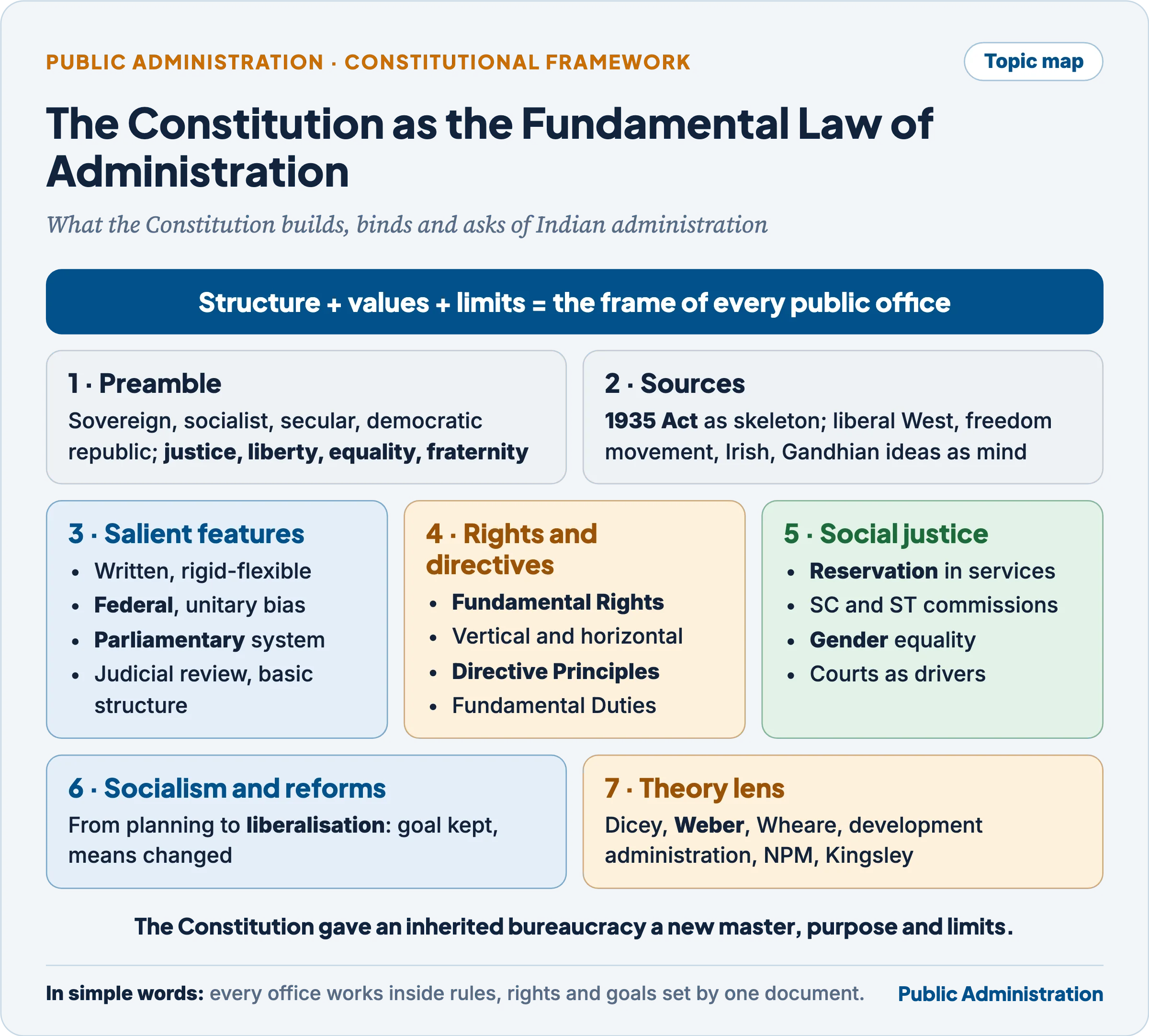
The Constitution of India is the single most powerful influence on the structure, purpose and behaviour of Indian administration. It creates the offices (President, Council of Ministers, Governor, Collector’s superiors, Public Service Commissions, CAG, Election Commission), divides work between the Union and the States, lays down the rights that administration must respect and the directives it must pursue, and fixes the values (justice, liberty, equality, fraternity, secularism, socialism) by which its performance is judged. Independent India inherited a colonial bureaucracy built for order and revenue; the Constitution gave that bureaucracy a new master (the people), a new purpose (welfare and social transformation) and new limits (rights and judicial review).
In simple words
Think of a new company that takes over an old factory. The machines (offices, files, officers) are old, but the company writes a new charter: who owns the factory, what it must produce, what workers may never be made to do, and how profits must be shared. The Constitution is that charter for Indian administration.
1. The Constitution as the Fundamental Law of Administration
In simple words
Every government office in India, from the Cabinet Secretariat to a block office, works under rules that trace back to the Constitution. It tells officials what powers they have, whom they answer to, and what they must never do to a citizen.
1.1 Two kinds of influence
The Constitution shapes administration in two broad ways:
- Formal or structural influence. It prescribes the configuration of the administrative system:
- the executive at the Union (Articles 52–78) and in the States (Articles 153–167), with executive power vested in the President and Governor but exercised on ministerial advice;
- the division of work between the Union and the States through the Seventh Schedule;
- the services (Part XIV, Articles 308–323), including the All India Services (Article 312) and the Public Service Commissions (Articles 315–323);
- financial control through the Consolidated Fund, the budget (Article 112), the CAG (Articles 148–151) and the Finance Commission (Article 280);
- local government through Parts IX and IX-A (73rd and 74th Amendments, 1992).
- Informal or normative influence. It determines the role, responsibility and responsiveness of administrators through the Preamble, the Fundamental Rights, the Directive Principles and the Fundamental Duties. These shape the character of governance and the behaviour of officials: an official who refuses a ration card because of caste breaks Article 15; one who ignores a hungry family breaks the spirit of Articles 39 and 47.
1.2 Why the framers wrote administrative detail into the Constitution
The Indian Constitution contains matters that most constitutions leave to ordinary law: the services, Public Service Commissions, audit, elections, official language and Union–State administrative relations.
- Dr B.R. Ambedkar, Chairman of the Drafting Committee, defended this in the Constituent Assembly on 4 November 1948. He argued that the form of administration must be in harmony with the form of the Constitution, and that a legislature could pervert the Constitution without changing its form simply by changing the form of administration. Since constitutional morality (respect for constitutional forms and restraint in the use of power) was not yet natural to Indians, it was safer to fix the essentials of administration in the Constitution itself.
- Effect. Administration in India is constitutionalised: the merit system, the independence of the CAG and the Election Commission, and safeguards for civil servants (Article 311) cannot be removed by a simple law.
1.3 Articles that build the administrative state
The table below lists the provisions that directly create or bind the administrative machinery.
| Area | Article(s) | What it does for administration |
|---|---|---|
| Definition of the State | 12 | Brings government, legislatures, local and “other authorities” (including many public corporations) under Fundamental Rights |
| Judicial review | 13, 32, 226 | Laws and executive acts that violate rights are void; writs enforce rights |
| Executive power | 53, 73, 154, 162 | Executive power of the Union and States, and its extent |
| Ministerial advice | 74, 163 | President and Governor act on the advice of the Council of Ministers |
| Conduct of business | 77, 166 | Orders in the name of the President or Governor; Rules of Business and allocation of work among ministries |
| Union–State administrative relations | 256, 257 | States must comply with Union laws; Union can give directions |
| Contracts and suits | 299, 300 | Government contracts and the State’s liability to be sued |
| Services | 309, 310, 311 | Recruitment rules; doctrine of pleasure; safeguards against arbitrary dismissal |
| All India Services | 312 | IAS, IPS, IFoS; new services by Rajya Sabha resolution |
| Public Service Commissions | 315–323 | Independent recruitment and advice on service matters |
| Audit | 148–151 | Independent audit of Union and State accounts by the CAG |
| Finance Commission | 280, 281 | Sharing of taxes and grants between the Union and States |
| Elections | 324–329 | Independent Election Commission; universal adult franchise (326) |
| Tribunals | 323A, 323B | Administrative and other tribunals (42nd Amendment, 1976) |
| Local government | 243–243ZG | Panchayats and municipalities as institutions of self-government |
| Special officers and commissions | 338, 338A, 338B, 350B | Watchdogs for SCs, STs, backward classes and linguistic minorities |
The table shows that the Constitution does not merely set up political organs; it also creates the permanent machinery (services, commissions, audit) and binds it with rights and remedies. This is why the Constitution is called the fundamental law of administration: every administrative act must trace its authority to it, directly or through a law made under it.
1.4 Does the institutional package “lack teeth”?
A recurring criticism is that many constitutional institutions are advisory or recommendatory rather than coercive.
- Arguments that it lacks teeth:
- UPSC’s advice under Article 320 is not binding; the government may depart from it after informing Parliament (Article 323).
- CAG reports have no force of their own; they depend on the Public Accounts Committee and on executive follow-up.
- The National Commissions for SCs, STs and backward classes investigate and recommend; they cannot enforce.
- Directive Principles are non-justiciable (Article 37), so welfare promises cannot be enforced in court.
- Article 311 protects officials from arbitrary dismissal, but critics argue it also shields inefficient or corrupt officials.
- No constitutional ombudsman exists; the Lokpal is statutory (2013).
- Arguments that the teeth are real:
- Judicial review (Articles 13, 32, 226) lets any citizen challenge administrative action; courts have converted many directives into enforceable rights by reading them into Article 21.
- Independent tenure for judges, the CAG, Election Commissioners and PSC members (removal only by special procedure) protects watchdogs from the executive.
- Constitutional status gives commissions moral authority; the National Commission for Scheduled Castes has the powers of a civil court while investigating (Article 338(8)).
- Balance. The Constitution deliberately relies on deliberation, publicity and accountability to Parliament rather than coercion; its strength depends on how political leaders and officials use it. This matches Ambedkar’s warning on 25 November 1949 that a good Constitution can turn out bad if those who work it are bad, and a bad one can turn out good if they are good.
2. The Preamble: Ideals and Value Premises
In simple words
The Preamble is the opening paragraph of the Constitution. In about eighty words it says who made the Constitution (the people), what kind of country India is (sovereign, socialist, secular, democratic, republic) and what the State must achieve for every citizen (justice, liberty, equality and fraternity).
2.1 Text and structure
The Preamble, as amended in 1976, reads in substance: “We, the people of India, having solemnly resolved to constitute India into a Sovereign Socialist Secular Democratic Republic and to secure to all its citizens: Justice, social, economic and political; Liberty of thought, expression, belief, faith and worship; Equality of status and of opportunity; and to promote among them all Fraternity assuring the dignity of the individual and the unity and integrity of the Nation; in our Constituent Assembly this twenty-sixth day of November, 1949, do hereby adopt, enact and give to ourselves this Constitution.”
It has four components:
| Component | Words | Meaning |
|---|---|---|
| Source of authority | “We, the people of India” | Sovereignty lies with the people, not with a monarch or the British Parliament |
| Nature of the State | Sovereign, socialist, secular, democratic, republic | The character of the Indian polity |
| Objectives | Justice, liberty, equality, fraternity | The goals the State and its administration must pursue |
| Date of adoption | 26 November 1949 | The day the Constituent Assembly adopted the Constitution |
The Preamble draws on the Objectives Resolution moved by Jawaharlal Nehru on 13 December 1946 and adopted on 22 January 1947. The phrase “We, the people” echoes the United States Constitution; the triad liberty, equality, fraternity comes from the French Revolution; and the threefold justice, social, economic and political reflects the influence of the Russian Revolution and socialist thought.
2.2 Legal status of the Preamble
The question whether the Preamble is part of the Constitution was settled in stages.
- In re Berubari Union (1960). In a Presidential Reference under Article 143, the Supreme Court held that the Preamble is not part of the Constitution and is not a source of power, though it is, in the words of the American jurist Joseph Story, “a key to open the mind of the makers”.
- Kesavananda Bharati v. State of Kerala (1973). A 13-judge bench held that the Preamble is part of the Constitution, that it can be amended under Article 368, but that its basic features cannot be destroyed. The Preamble became the main guide for identifying the basic structure.
- LIC of India v. Consumer Education and Research Centre (1995). The Court reaffirmed that the Preamble is an integral part of the Constitution.
- 42nd Amendment Act, 1976. Added “socialist”, “secular” and “integrity” (the only amendment of the Preamble so far).
- Dr Balram Singh v. Union of India (25 November 2024). A bench of CJI Sanjiv Khanna and Justice Sanjay Kumar dismissed petitions challenging the 1976 insertions. It held that Parliament’s power under Article 368 extends to the Preamble, that the date of adoption (1949) does not limit later amendment, and that “socialist” denotes a welfare State committed to equality of opportunity, not a fixed economic model, while “secular” means the State neither supports nor penalises any religion.
Common confusion
Is the Preamble enforceable in court, and was Berubari overruled? The Preamble is part of the Constitution (Kesavananda, 1973), but it is neither a source of power nor a limit on power by itself, and no one can sue only for breach of the Preamble. Courts use it to interpret ambiguous provisions and to identify the basic structure. So Kesavananda corrected Berubari on the question of “part or not part”, but agreed with it that the Preamble does not confer powers.
2.3 The nature of the Indian State and what it asks of administration
The five words that describe the State each carry an administrative mandate.
| Term | Meaning | What it asks of administration |
|---|---|---|
| Sovereign | India is independent internally and externally; no outside authority can dictate its laws | Administration answers only to Indian law and Indian people; foreign agreements are made by Indian authority |
| Socialist | A commitment to reduce inequality of income, status and opportunity through a mixed economy and welfare, not total State ownership | Welfare delivery, redistribution, protection of workers and the poor, regulation of private economic power |
| Secular | The State has no official religion, treats all religions equally and does not penalise any faith (Articles 25–28) | Religious neutrality in recruitment, service delivery, law and order, and use of public funds |
| Democratic | Government by elected representatives, accountable to the people, with rights protected | Responsiveness, transparency, accountability to the legislature and citizens |
| Republic | The head of State is elected (the President), not hereditary; every public office is open to all citizens | No hereditary privilege in public office; equality of access to all posts |
- Indian secularism differs from the Western idea of a wall of separation. The Indian model, described as sarva dharma sambhava (equal respect for all religions), lets the State regulate secular activities connected with religion (Article 25(2)) and reform social practices (such as temple entry). In S.R. Bommai v. Union of India (1994), a nine-judge bench held secularism to be part of the basic structure.
- The “socialist” ideal read with Article 39(b) helped courts uphold nationalisation (for example in Excel Wear v. Union of India, 1978), and read with Articles 14 and 16 helped courts derive the principle of equal pay for equal work. It has, however, never required total State ownership (Section 9 below).
2.4 The four objectives and their administrative mandate
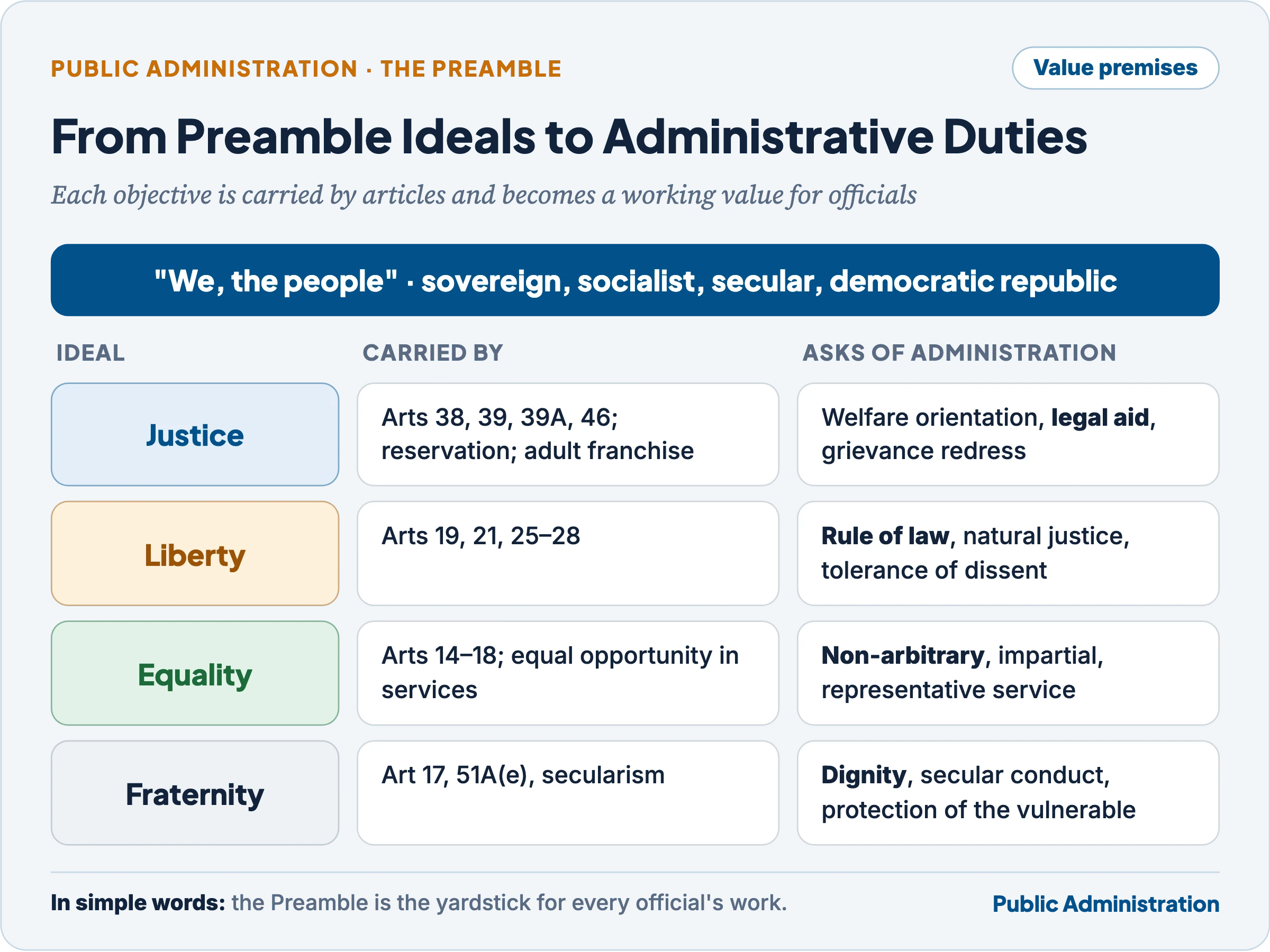
- Justice: social, economic and political.
- Social justice means ending discrimination by caste, religion, sex or birth; it is carried by Articles 15–17 and 46 and by reservation.
- Economic justice means a fair share of wealth and livelihood; it is carried by Articles 38 and 39, land reforms, minimum wages and welfare schemes.
- Political justice means equal political rights: universal adult franchise (Article 326) and equal access to office.
- Article 38 directs the State to secure a social order in which justice, social, economic and political, shall inform all the institutions of national life.
- Liberty of thought, expression, belief, faith and worship. Carried by Article 19(1)(a) and Articles 25–28. For administration it means tolerance of dissent, protection of peaceful protest, and restraint in the use of police powers.
- Equality of status and of opportunity.
- Status: Article 14 (equality before law, equal protection), Article 17 (untouchability abolished) and Article 18 (titles abolished, removing artificial inequality of birth).
- Opportunity: Article 16 (equal opportunity in public employment), with reservation for backward classes as a corrective.
- Administration must avoid arbitrariness (Article 14 has been read since E.P. Royappa v. State of Tamil Nadu, 1974 as a guarantee against arbitrary State action).
- Fraternity assuring the dignity of the individual and the unity and integrity of the nation.
- Fraternity is a moral ideal rather than a legal rule: no law can make people feel brotherly. It was drawn from the motto of the French Revolution and has special meaning for a multi-religious, multi-lingual, caste-divided society.
- It is carried by Article 51A(e) (duty to promote harmony and renounce practices derogatory to women), Article 17 and secularism.
- Dr Ambedkar regarded fraternity as the hardest of the three to achieve and warned that political democracy cannot last unless it rests on social democracy, in which liberty, equality and fraternity are recognised together.
2.5 How the Preamble has been described
| Description | By whom | Point |
|---|---|---|
| “Political horoscope” of the Republic | K.M. Munshi, Constituent Assembly member | Foretells the character of the new State |
| “Key-note” to the Constitution | Ernest Barker, British political scientist | Sets the tone and spirit |
| “Soul” of the Constitution | Pandit Thakur Das Bhargava, Constituent Assembly member | Gives life to the text |
| “Identity card” of the Constitution | N.A. Palkhivala, jurist | Tells who the Constitution belongs to and what it stands for |
| “A key to open the mind of the makers” | Joseph Story, quoted in Berubari (1960) | An aid to interpretation |
2.6 Values of Indian administration rooted in the Preamble
The Preamble provides a framework of ideals and values for Indian administration because the responsibility of enforcing the Constitution lies with the government, and the administrative system is an integral part of the executive.
- Laws and policies must reflect liberty, equality, justice, socialism and secularism.
- Administrative behaviour must manifest them too: the attitudes of officials, their treatment of citizens, and their own internal practices (fair recruitment, no harassment of subordinates, protection of their own employees’ rights).
- The yardstick of performance. In an ideal situation, the administrative system would be judged against the values of the Preamble; a realistic appraisal must also account for a complex and volatile environment (poverty, social hierarchy, low capacity).
- Translating the Preamble into administrative values:
- Justice → a pro-poor, welfare orientation; legal aid (Article 39A); grievance redress.
- Liberty → rule of law, procedural fairness, natural justice in administrative decisions.
- Equality → impartiality, non-arbitrariness, representative bureaucracy, equal access to services.
- Fraternity → secular and humane conduct, protection of minorities and vulnerable groups, respect for dignity at the counter and in the police station.
- Democracy → responsiveness, transparency (the RTI Act, 2005), participation (Gram Sabhas, social audit).
- Sovereignty of the people → officials are servants, not rulers; citizen-centric administration, as the 2nd Administrative Reforms Commission (12th Report, Citizen Centric Administration, 2009) urged.
2.7 Ideals on paper and in practice
Whether the Preamble’s ideals remain “only on paper” is an old debate. The record is mixed: the political and libertarian ideals have advanced further than the egalitarian ones.
| Ideal | Progress | Gaps that keep it partly “on paper” |
|---|---|---|
| Sovereign, democratic republic | Regular, peaceful elections and transfers of power since 1952; universal franchise; no military rule | Money and muscle power in elections; weak internal party democracy |
| Political justice | One person, one vote; reserved seats for SCs and STs; one-third seats for women in panchayats and municipalities | Women were only about 14 per cent of Lok Sabha members after 2024; the 106th Amendment’s quota is yet to operate |
| Liberty | Expansion of Article 21 by the courts; RTI; free press | Preventive detention, sedition-type cases, internet shutdowns, custodial violence |
| Equality of opportunity | Reservation has created a middle class among SCs, STs and OBCs; free and compulsory education (Article 21A) | Unequal schools; benefits concentrated among better-off groups within reserved categories (hence sub-classification) |
| Economic justice | Large fall in multidimensional poverty; food security (2013); rural employment guarantee | Inequality of income and wealth has widened since 1991; informal work without protection |
| Fraternity | Constitutional ban on untouchability; secular law | Caste atrocities, communal violence, honour crimes |
- The libertarian ideal gained the upper hand. Courts and administration have been quicker to protect civil and political liberties (which need restraint) than to deliver economic and social equality (which needs resources, capacity and political will). The right to property itself was moved out of Part III by the 44th Amendment (1978) to remove obstacles to land reform.
- Ambedkar’s “life of contradictions”. On 25 November 1949 Ambedkar warned that from 26 January 1950 India would have equality in politics (one person, one vote) but inequality in social and economic life, and that this contradiction must be removed quickly or those who suffer from inequality would “blow up” the structure of political democracy.
- Administrative reasons for the gap: a colonial, order-oriented bureaucracy; formalism (laws passed but not enforced); weak local government; corruption and leakages; and capture of programmes by local elites.
- Why the ideals are not merely on paper: they have been converted into justiciable rights (education, food, legal aid, dignity) by courts, into statutory entitlements (RTI, MGNREGA and now the VB–G RAM G Act, food security), and into institutions (panchayats, commissions). They act as a standing yardstick that citizens, courts and media use to judge government.
3. Sources of the Constitution
In simple words
The framers did not invent everything. They took the skeleton (offices, lists of subjects, the federal court, emergency powers) from the British-made Government of India Act, 1935, and added a new heart and mind (rights, directive principles, adult franchise, parliamentary responsibility) from India’s freedom struggle and from the world’s best constitutions.
3.1 The Constituent Assembly
- Formation. Set up under the Cabinet Mission Plan (1946), the Assembly was indirectly elected by the provincial legislatures (themselves elected on a limited franchise of 1946), with nominees of the princely states. After Partition, its strength was reduced to 299.
- Key dates. First met on 9 December 1946 (Dr Sachchidananda Sinha as interim chairman; Dr Rajendra Prasad elected President on 11 December); Objectives Resolution moved on 13 December 1946; Drafting Committee appointed on 29 August 1947 with Dr B.R. Ambedkar as Chairman; Constitution adopted on 26 November 1949; came fully into force on 26 January 1950 (provisions on citizenship, elections and provisional Parliament came into force on 26 November 1949).
- Adviser. Sir B.N. Rau, the Constitutional Adviser, prepared the first draft after studying constitutions abroad.
- Method. The Assembly worked by consensus and accommodation rather than bare majority, through committees such as the Union Powers Committee, the Union Constitution Committee (both chaired by Nehru), the Provincial Constitution Committee (Sardar Patel) and the Advisory Committee on Fundamental Rights, Minorities and Tribal Areas (Patel).
- Critique of legitimacy. Critics said the Assembly was not directly elected, sat on a narrow franchise, and the Constitution was never ratified by a referendum, so “We, the people” was a claim rather than a fact. The answers: the Assembly was broadly representative (all major groups, many shades of opinion), the Indian Independence Act, 1947 gave it full legal authority, and the people have since ratified it in practice through regular elections under it.
3.2 The Government of India Act, 1935: the structural source
The Government of India Act, 1935 (321 sections and 10 schedules) is the most important single source of the structural or institutional part of the Constitution. About 250 provisions of the Constitution are drawn, wholly or with changes, from it. The Constituent Assembly itself directed the Drafting Committee to follow the 1935 Act on certain matters.
| Feature of the 1935 Act | What the Constitution took from it |
|---|---|
| All-India Federation of provinces and princely states | A federal structure (renamed a “Union of States”) |
| Three lists (Federal, Provincial, Concurrent) | The Seventh Schedule (Union, State, Concurrent Lists) |
| Provincial autonomy with ministries responsible to legislatures | Responsible government in the States |
| Governor and his discretionary and emergency powers (Section 93) | The office of Governor; Article 356 (failure of constitutional machinery) |
| Federal Court (1937) | The Supreme Court with original jurisdiction in Union–State disputes |
| Federal and Provincial Public Service Commissions | Articles 315–323 |
| Emergency powers of the Governor-General | Articles 352–360 |
| Bicameral legislatures, Auditor-General, administrative details | Parliament, State legislatures, the CAG and much administrative machinery |
- Why the Assembly took it as the base.
- It was a tested and detailed framework, already familiar to Indian politicians and officials who had worked provincial autonomy from 1937.
- It provided a strong Centre, which Partition (1947), the integration of princely states and communal violence made essential.
- It saved time, letting the Assembly concentrate on the new philosophical parts.
- Critique.
- It was a colonial statute designed to keep power with the Governor-General and Governors; by borrowing its frame, the Constitution also borrowed its centralism (emergency powers, Governor’s discretion, Article 356).
- Critics said the Constitution was “the 1935 Act with adult franchise”; Ambedkar replied that there was nothing to be ashamed of in borrowing the administrative details, which are common to all constitutions, and that the spirit (responsibility to the people, rights, adult franchise) was wholly new.
- Why dyarchy and provincial autonomy did not deliver real self-government.
- Dyarchy under the Government of India Act, 1919 divided provincial subjects into reserved (with the Governor and his executive council) and transferred (with ministers responsible to the legislature). Ministers had responsibility without power: finance and police remained reserved, and the ICS officers serving them answered to the Governor. The arrangement was widely seen as a façade of self-government.
- Provincial autonomy under the 1935 Act ended dyarchy in the provinces, but the Governor’s special responsibilities and discretionary powers, the Governor-General’s overriding powers, and a restricted franchise meant neither full parliamentary democracy nor real federalism. The All-India Federation never came into being because the princes did not join, and dyarchy at the Centre never operated.
- These lessons shaped the Constitution: full responsibility of ministers to elected legislatures, a nominal head acting on advice, and adult franchise. For the detailed history, see the article on Legacy of British Rule.
3.3 The philosophical sources
If the 1935 Act supplied the skeleton, the philosophical part (Preamble, Fundamental Rights, Directive Principles, adult franchise, secularism, social justice) came from many other sources.
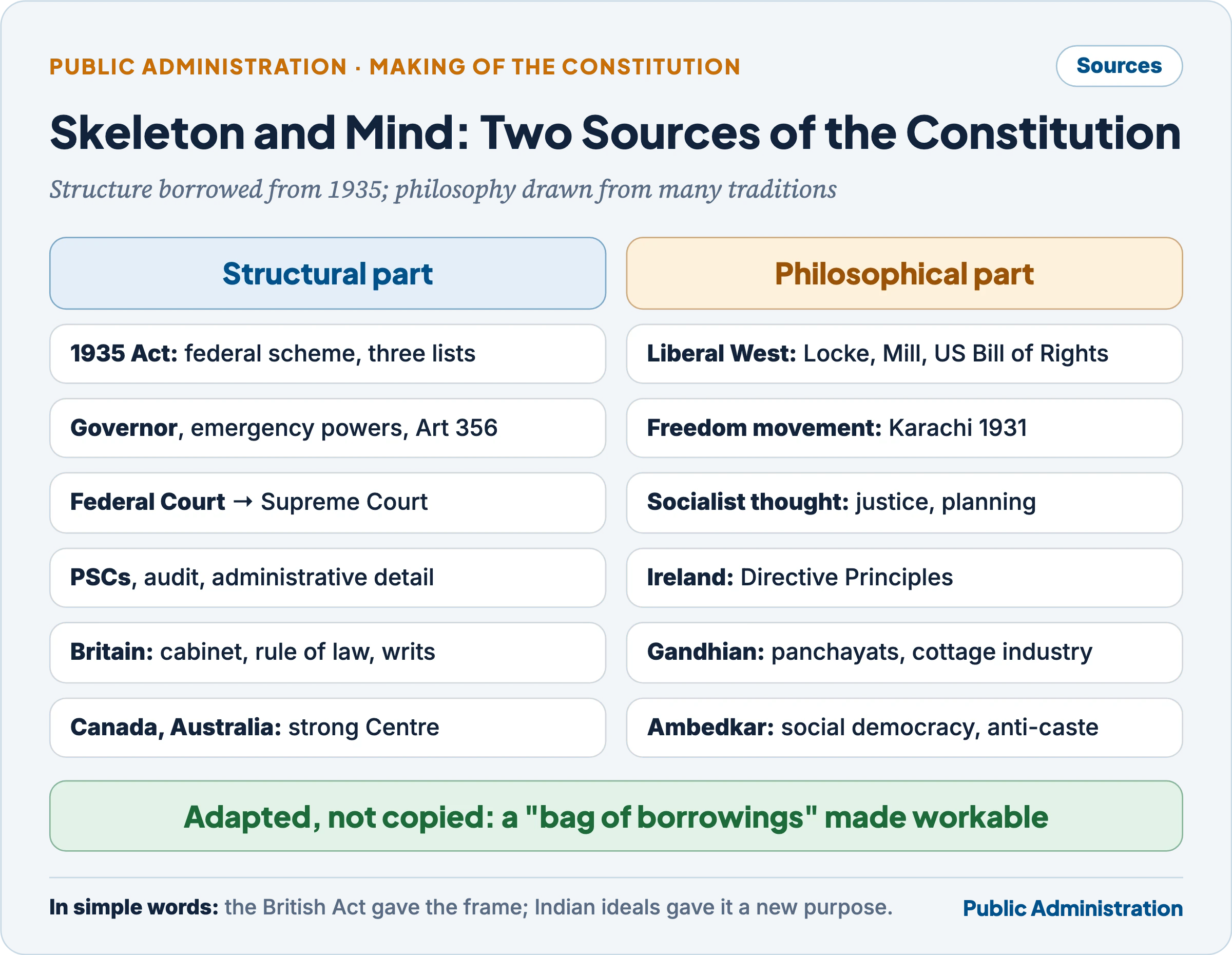
- The liberal-democratic ideology of the West.
- John Locke (natural rights to life, liberty and property; government by consent), Montesquieu (separation of powers), J.S. Mill (liberty of thought and expression), A.V. Dicey (rule of law) and the British tradition of parliamentary, responsible government.
- The American Bill of Rights (first ten amendments, 1791) and judicial review; the French Declaration of the Rights of Man (1789) and the ideals of liberty, equality and fraternity.
- The Universal Declaration of Human Rights (adopted by the UN on 10 December 1948, while the Assembly was debating the draft) reinforced the rights chapter.
- Most framers (Nehru, Ambedkar, Munshi, Alladi Krishnaswami Ayyar, B.N. Rau) were trained in Western liberal and legal thought, which explains the emphasis on individual rights, the rule of law, an independent judiciary and representative government.
- But not wholly liberal. Liberalism was modified by group rights (minorities’ cultural and educational rights, Articles 29–30), compensatory discrimination (reservation), and a welfare and socialist commitment. Individual rights were balanced by reasonable restrictions.
- Socialist and Fabian thought. Nehru’s Fabian socialism (influenced by the British Labour tradition and Harold Laski) and the planned economy of the Soviet Union inspired the commitment to economic justice, planning and a large public sector. The Soviet constitution is also cited as the inspiration for social, economic and political justice and for Fundamental Duties.
- The Irish Constitution (1937). Its Directive Principles of Social Policy gave the model for Part IV. (The Irish idea itself drew on the Spanish Constitution of 1931.)
- The Indian national movement. The Constitution’s rights and welfare goals were demanded long before 1947:
- the Constitution of India Bill, 1895 (a call for rights such as free speech and equality);
- the Commonwealth of India Bill, 1925, prepared under Annie Besant‘s leadership;
- the Nehru Report (1928) by a committee chaired by Motilal Nehru, which proposed a list of fundamental rights, responsible government and a federal structure;
- the Karachi Resolution (1931) of the Indian National Congress, presided over by Sardar Vallabhbhai Patel, on Fundamental Rights and Economic Programme, which linked political freedom to economic freedom (State control of key industries, labour rights, free primary education);
- the Sapru Committee Report (1945), which suggested dividing rights into justiciable and non-justiciable ones;
- the Objectives Resolution (1946–47).
- Gandhian ideas. Directive Principles on village panchayats (Article 40), cottage industries (Article 43), promotion of the interests of weaker sections (Article 46), prohibition (Article 47) and protection of cattle (Article 48), and the abolition of untouchability (Article 17). Gandhian ideas of a decentralised village republic were, however, largely set aside: Ambedkar called the Indian village a “sink of localism, a den of ignorance, narrow-mindedness and communalism” (4 November 1948), and the Constitution made the individual, not the village, its unit. Panchayats received constitutional status only in 1992.
- Ambedkar’s social-democratic vision. The emphasis on social justice, protection of the depressed classes, abolition of untouchability, reservation and equal citizenship owes much to Ambedkar and the anti-caste movements.
3.4 What was borrowed from which constitution
| Source | Features borrowed |
|---|---|
| Government of India Act, 1935 | Federal scheme, Governor’s office, judiciary, Public Service Commissions, emergency provisions, administrative details |
| Britain | Parliamentary government, rule of law, cabinet system, single citizenship, legislative procedure, prerogative writs, bicameralism |
| United States | Fundamental Rights, judicial review, independence of the judiciary, impeachment of the President, removal of judges, Vice-President as chair of the upper house |
| Ireland | Directive Principles, nomination of members to Rajya Sabha, method of election of the President |
| Canada | Federation with a strong Centre, residuary powers with the Centre, appointment of Governors by the Centre, advisory jurisdiction of the Supreme Court |
| Australia | Concurrent List, freedom of trade and commerce, joint sitting of both Houses |
| Weimar Germany | Suspension of Fundamental Rights during an emergency |
| Soviet Union | Fundamental Duties, ideal of social, economic and political justice |
| France | Republic; ideals of liberty, equality, fraternity |
| South Africa | Procedure for amendment; election of Rajya Sabha members |
| Japan | “Procedure established by law” (Article 21) |
3.5 Is the Constitution a “bag of borrowings”?
- The criticism. Because so much came from the 1935 Act and foreign constitutions, critics (for example, some members in the Assembly and later commentators) called the Constitution a “bag of borrowings”, a “paste-and-scissors” job, or a slavish copy of the 1935 Act, with nothing original and an alien Western character unsuited to Indian conditions.
- The defence.
- Borrowing is universal. A constitution framed in the mid-twentieth century could hardly ignore what had worked elsewhere; Ambedkar argued that the fundamentals of a constitution are generally recognised, and that what mattered was adaptation.
- Adapted, not copied. The framers modified what they borrowed: parliamentary government without parliamentary sovereignty (because of judicial review and a written Constitution); federation with a strong Centre and single citizenship; rights with reasonable restrictions; directive principles alongside rights.
- Original elements. Adult franchise in a poor, largely non-literate society at one stroke; reservation as compensatory justice; abolition of untouchability; minorities’ educational rights; a blend of rigidity and flexibility; Fifth and Sixth Schedules for tribal areas.
- The test is workability. The aim was not an original Constitution but a good and workable one. Its survival through wars, emergencies, coalitions and economic transformation, without being replaced, is the best proof.
4. Salient Features of the Constitution
In simple words
Salient features are the big design choices that make the Indian Constitution what it is: a long written text, a Union of States with a strong Centre, a cabinet answerable to Parliament, courts that can strike down laws, one citizenship, one vote for every adult, emergency powers, and a set of independent watchdogs.
4.1 Written, lengthy and detailed
- Written and enacted. Unlike the British constitution (largely unwritten, resting on conventions), India’s Constitution was enacted at a fixed moment by a body specially created for the purpose. Conventions still matter (for example, the President inviting the leader of the majority to form a government), but only within the written text.
- Why written. A federal polity needs a written document because powers are divided between the Union and the States and must be precise. The rulers were also new to democracy; ambiguity would have created conflict.
- The lengthiest constitution in the world. It began with 395 articles in 22 parts and 8 schedules; it now has about 470 articles (numbering still ends at 395, with lettered insertions such as 21A, 243ZG, 330A), 25 parts and 12 schedules.
- Why so long:
- it contains the constitutions of the Union and the States together (except Jammu and Kashmir until 2019);
- it includes administrative details borrowed from the 1935 Act (services, PSCs, audit, elections, official language);
- special provisions for regions and groups (Articles 371–371J; Fifth and Sixth Schedules; SCs, STs, Anglo-Indians, linguistic minorities);
- both justiciable rights (with their exceptions spelt out) and non-justiciable directives;
- the framers’ anxiety, after Partition and with little experience of democracy, to leave nothing to chance: had details been left unwritten, Union–State disputes would have gone to the courts and enlarged judicial power, as in the United States, whose constitution is brief.
- Critique. Ivor Jennings, the British constitutional scholar, criticised it as too long and complex, with borrowings not always well chosen; other critics called it a “lawyers’ paradise” because its detail invites litigation. The detail has also required frequent amendment.
4.2 A blend of rigidity and flexibility
A rigid constitution needs a special procedure to amend; a flexible one can be changed like an ordinary law. India’s is a synthesis: less rigid than the American (amended only 27 times since 1789) and more rigid than the British (where Parliament can change anything by ordinary law).
| Method | Majority required | Examples |
|---|---|---|
| Simple majority (outside Article 368) | Ordinary majority of Parliament | New states and boundaries (Articles 2, 3, 4), creation or abolition of Legislative Councils (169), Fifth and Sixth Schedules, citizenship, quorum |
| Special majority (Article 368(2)) | Majority of the total membership of each House and two-thirds of those present and voting | Fundamental Rights, Directive Principles, most other provisions |
| Special majority plus ratification by half the States (proviso to 368(2)) | As above, plus resolutions of at least half the State legislatures | Election of the President, extent of Union and State executive power, Supreme Court and High Courts, Seventh Schedule, representation of States in Parliament, GST Council (Article 279A), Article 368 itself |
- Record. The 106th Amendment (2023), on reservation of seats for women, is the latest enacted amendment; in July 2026 the Union Law Minister told Parliament that eight amendments (99th to 106th) had been enacted in the previous twelve years. The Constitution (131st Amendment) Bill, 2026, to expand the Lok Sabha and delink women’s reservation from the next census, failed to win the special majority in the Lok Sabha on 17 April 2026 (298 for, 230 against, when 352 were needed), showing that the special majority is a real check.
- Nehru’s view. In the Assembly Nehru argued that while the Constitution should be as solid and permanent as possible, there is no permanence in constitutions; too much rigidity would stop the growth of a living nation.
- The limit. Parliament’s amending power is not unlimited: it cannot destroy the basic structure (4.4).
4.3 Supremacy of the Constitution, independent judiciary and judicial review
- Constitutional supremacy, not parliamentary sovereignty. No organ (legislature, executive or judiciary) is supreme; all work within limits set by the Constitution. This is the key departure from Britain, where, in A.V. Dicey‘s classic statement, Parliament can make or unmake any law and no court can set it aside.
- Independent judiciary.
- Judges of the Supreme Court and High Courts are appointed under Articles 124 and 217; since the Second Judges case (1993) and the Third Judges case (1998), appointments follow the recommendation of a collegium of senior judges. The National Judicial Appointments Commission (99th Amendment, 2014) was struck down in Supreme Court Advocates-on-Record Association v. Union of India (2015).
- Security of tenure (removal only by Parliament for proved misbehaviour or incapacity, Article 124(4)), salaries charged on the Consolidated Fund, and a bar on discussing judges’ conduct in the legislature.
- Article 50 directs the separation of the judiciary from the executive in the public services of the State; this ended the colonial practice of the Collector-Magistrate trying cases (completed through the Code of Criminal Procedure, 1973, now the Bharatiya Nagarik Suraksha Sanhita, 2023, in force from 1 July 2024).
- An integrated judiciary. Unlike the dual courts of the United States, India has a single hierarchy (Supreme Court, High Courts, subordinate courts) enforcing both Union and State laws.
- Judicial review. Courts can declare laws and executive acts void if they violate the Constitution (Articles 13, 32, 131–136, 226, 227). For administration this means every order, rule and notification is subject to review for legality, reasonableness and procedural fairness. See the article on Administrative Law and Dicey.
4.4 The basic structure doctrine
The basic structure doctrine holds that Parliament can amend any part of the Constitution but cannot destroy its essential identity.
| Case | Year | Holding |
|---|---|---|
| Shankari Prasad v. Union of India | 1951 | Parliament can amend Fundamental Rights; an amendment is not “law” under Article 13 |
| Sajjan Singh v. State of Rajasthan | 1965 | Followed Shankari Prasad (with doubts expressed by two judges) |
| I.C. Golaknath v. State of Punjab | 1967 | 11-judge bench: Parliament cannot amend Fundamental Rights |
| 24th Amendment | 1971 | Restored Parliament’s power to amend any part, including Part III |
| Kesavananda Bharati v. State of Kerala | 1973 | 13-judge bench (7:6): Parliament can amend any part but not the basic structure |
| Indira Nehru Gandhi v. Raj Narain | 1975 | Free and fair elections part of the basic structure; struck down clause 4 of the 39th Amendment |
| Minerva Mills v. Union of India | 1980 | Limited amending power and harmony between Fundamental Rights and Directive Principles are themselves basic features |
| Waman Rao v. Union of India | 1981 | Laws placed in the Ninth Schedule after 24 April 1973 are open to basic-structure review |
| S.R. Bommai v. Union of India | 1994 | Federalism and secularism are basic features |
| I.R. Coelho v. State of Tamil Nadu | 2007 | Ninth Schedule laws after 1973 can be tested against the basic structure |
- Elements recognised so far (the list is open): supremacy of the Constitution; republican and democratic government; secularism; federalism; separation of powers; judicial review; independence of the judiciary; rule of law; free and fair elections; sovereignty, unity and integrity; harmony of rights and directives; parliamentary system; the welfare State; limited amending power; and the essence of equality and dignity.
- Significance for administration. The doctrine protects the framework within which administration works (rule of law, independent courts, federal balance) from being dismantled by temporary majorities. It is the strongest institutional expression of constitutionalism, the idea of limited government (see the article on Constitutionalism and Political Culture).
4.5 The parliamentary system
Indian Connect — Why the framers chose a parliamentary system
- Familiarity. Indians had worked responsible government in the provinces under the Acts of 1919 and 1935; the national movement (Nehru Report, 1928) had always demanded it.
- Responsibility over stability. Ambedkar explained (4 November 1948) that a democratic executive must be both stable and responsible, and no system could give both fully. The presidential system gives more stability; the parliamentary system gives more responsibility, because it is assessed daily (questions, motions, debates) as well as periodically (elections). The Drafting Committee preferred more responsibility to more stability.
- Avoiding deadlock. A separately elected President and legislature could clash, as in the United States; for a new nation facing Partition, refugees and integration of princely states, harmony between executive and legislature was vital.
- Accommodating diversity. A collective cabinet can include ministers from many regions, communities and groups, which a single-person presidential executive cannot.
- Rejecting a strong single executive. The memory of the Viceroy’s autocracy made many members wary of concentrating power in one elected individual. A few members (for example K.T. Shah) argued for a presidential system, but the Assembly preferred the parliamentary model.
- Features of the Indian parliamentary system:
- Nominal and real executive. The President (and in States, the Governor) is the nominal or constitutional head; the Council of Ministers headed by the Prime Minister (Chief Minister in States) is the real executive (Articles 74, 75, 163, 164).
- Binding advice. The 42nd Amendment (1976) made ministerial advice binding on the President; the 44th Amendment (1978) allowed the President to return advice once for reconsideration.
- Majority party rule and collective responsibility to the Lok Sabha (Article 75(3)); ministers “swim or sink together”.
- Individual responsibility of ministers, who hold office during the President’s pleasure (in practice, the Prime Minister’s).
- Membership of the legislature. Ministers must be members of Parliament (or become so within six months).
- Leadership of the Prime Minister, cabinet secrecy (oath of secrecy), and dissolution of the Lok Sabha on the Prime Minister’s advice.
- Government by criticism. The opposition, questions, committees and media keep government under constant scrutiny; the executive’s life depends on the confidence of the lower House.
- The real executive in the States. The claim that parliamentary democracy makes the elected head the real executive holds for the States as well. In Shamsher Singh v. State of Punjab (1974), a seven-judge bench held that the President and Governor exercise their formal powers only on ministerial advice, save in a few exceptional situations. In Nabam Rebia v. Deputy Speaker (2016), the Court held that the Governor’s discretion under Article 163 is narrow and cannot be used to override an elected government on matters within its domain. The Presidential Reference opinion of 20 November 2025 confirmed that Governors cannot sit indefinitely on State Bills (“prolonged and evasive inaction” may attract a limited direction to decide), while holding that courts cannot impose fixed timelines or “deemed assent”.
- Why the nominal head matters at all. The President or Governor ensures continuity, appoints the Prime Minister when no party has a majority, can seek information (Article 78), and serves as a symbol of national unity. The Governor’s dual role (head of the State and agent of the Centre) and discretion under Articles 163, 200 and 356 have made the office a frequent source of Union–State friction.
| Point | Britain | India |
|---|---|---|
| Head of State | Hereditary monarch | Indirectly elected President (republic) |
| Constitution | Largely unwritten | Written |
| Sovereignty | Parliament is sovereign | Constitution is supreme; laws subject to judicial review |
| Structure | Unitary (with devolution) | Federal |
| Rights | No entrenched bill of rights (Human Rights Act, 1998 is ordinary law) | Fundamental Rights enforceable against legislature and executive |
| Prime Minister | Must be from the Commons by convention | May be from either House |
| Legal responsibility of ministers | Countersignature makes ministers legally responsible | No legal responsibility; courts cannot inquire into advice given (Article 74(2)) |
The table shows that India adopted the Westminster form but grafted it onto a written, federal, rights-based Constitution with judicial review. Whether the Westminster philosophy (homogeneous society, two-party system, strong conventions, neutral civil service) fits India’s political culture is discussed in the article on Constitutionalism and Political Culture.
4.6 Federal system with a unitary bias
Article 1 declares that “India, that is Bharat, shall be a Union of States”. The word “federation” is not used anywhere in the Constitution.
- Why “Union” and not “federation”. Ambedkar explained that the Drafting Committee chose “Union” to make clear that the Indian federation was not the result of an agreement among states (unlike the United States), and that, not being the result of an agreement, no state has the right to secede. The federation is a Union because it is indestructible.
- From a loose to a strong federation. Before Partition, the Objectives Resolution (1946) envisaged autonomous units holding residuary powers, a loose federation to keep the Muslim League in. After the Partition plan of 3 June 1947, the Union Powers Committee opted for a strong Centre with residuary powers.
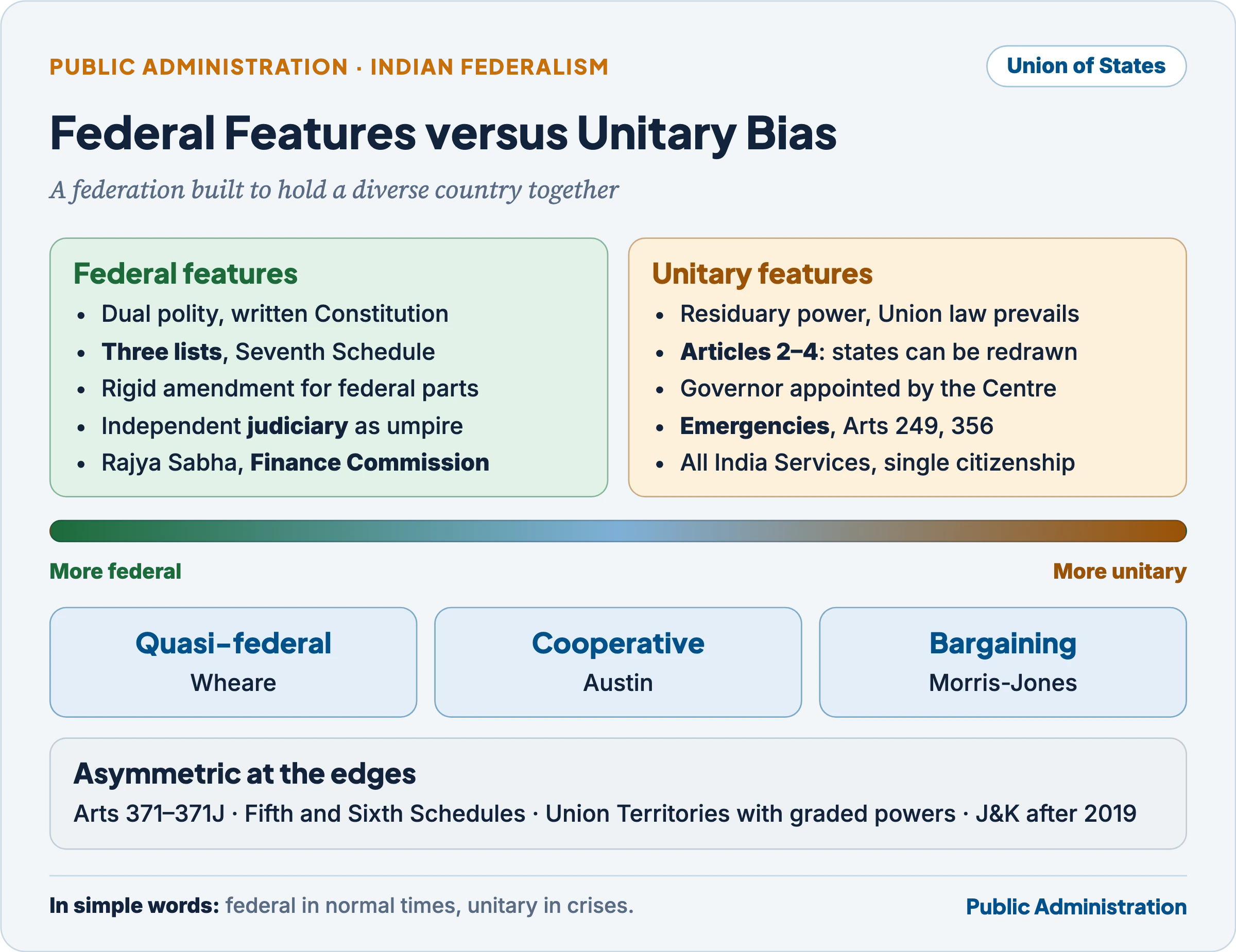
Federal features:
- Dual polity: a Union government and State governments, each with its own legislature and executive.
- Written and supreme Constitution, binding both levels; Ambedkar described it as the frame from which neither can get out.
- Division of powers through three lists in the Seventh Schedule (originally 97 Union, 66 State and 47 Concurrent entries); the 42nd Amendment moved subjects such as education, forests, weights and measures and protection of wild animals and birds to the Concurrent List.
- Rigid amendment for federal provisions (ratification by half the States).
- Independent judiciary as umpire of Union–State disputes (Article 131).
- Bicameralism: the Rajya Sabha represents the States.
- Constitutional fiscal transfers through the Finance Commission (Article 280).
Unitary features (the “unitary bias”):
- Strong Centre: the Union List has the most important subjects; Union law prevails in conflicts on Concurrent subjects (Article 254); residuary powers lie with the Union (Article 248).
- Parliament can alter state boundaries and names by simple law (Articles 2–4); states are “destructible”.
- Single Constitution and single citizenship (unlike the United States, where states have their own constitutions).
- Parliament can legislate on State subjects: in the national interest after a Rajya Sabha resolution by two-thirds (Article 249, valid for a year at a time); during a National Emergency (Article 250); on the request of two or more States (Article 252); and to implement treaties (Article 253).
- Governors are appointed by the President and hold office during the President’s pleasure (Articles 155, 156); they can reserve State Bills for the President (Article 201).
- Emergency provisions (Articles 352, 356, 360) can turn the system into an almost unitary one.
- All India Services (Article 312) under the ultimate control of the Union serve the States.
- Integrated judiciary, single election machinery (Election Commission) and single audit (CAG).
- Union directions to States (Articles 256, 257) and fiscal dependence of States on Union transfers.
- Rajya Sabha representation is by population, not equal for each State.
- Reasons for the mix: the history of a unitary British administration; the size and diversity of the country; the trauma of Partition and fear of disintegration; the need to integrate princely states; and the goal of planned economic development for which the Centre needed resources and control.
- How scholars describe it:
- K.C. Wheare, the Australian-born Oxford scholar of federalism (Federal Government, 1946), called India quasi-federal: in his widely quoted phrase, rather a unitary state with subsidiary federal features than a federal state with subsidiary unitary features.
- Granville Austin, the American historian of the Indian Constitution (The Indian Constitution: Cornerstone of a Nation, 1966), called it cooperative federalism, in which the Union and States depend on each other.
- Ivor Jennings called it a federation with a strong centralising tendency.
- W.H. Morris-Jones, the British political scientist, described bargaining federalism, where outcomes are negotiated between the levels.
- Ambedkar said the Constitution could be both unitary and federal according to the requirements of time and circumstances: federal in normal times, unitary in war or emergency.
- What the courts say.
- In State of West Bengal v. Union of India (1962), the Supreme Court held the Constitution was not a traditional federation and the States were not sovereign.
- In S.R. Bommai (1994), it held federalism to be a basic feature, and restricted the arbitrary use of Article 356 (the floor of the House, not the Governor’s opinion, decides majority; the proclamation is open to judicial review).
Common confusion
Is India “federal in form but unitary in spirit”? The phrase is half true. The form has strong unitary elements too (single citizenship, Centre-appointed Governors, Article 3), and the spirit has become more federal over time: coalition governments from 1989 to 2014, regional parties, the Bommai judgment, the 73rd and 74th Amendments, a rising share of central taxes for States (41 per cent since 2021–22) and the GST Council as a shared body. Indian federalism is better described as flexible: centralised when the Centre is politically strong or in crises, more cooperative when power is shared.
- The “purist” critique. Purists who measure India against the American model say India is not a true federation (states can be redrawn, Centre controls Governors and emergencies) and is unduly rigid in parts. The reply is that federalism is a means to good government, not an end in itself; India chose a federalism suited to its needs, holding together a diverse country rather than bringing together sovereign states.
- Changing phases of Indian federalism:
- 1950–1967: centralised, one-party federalism; Planning Commission and Congress dominance.
- 1967–1989: confrontational; non-Congress State governments, misuse of Article 356, demands for autonomy (Anandpur Sahib, Rajamannar Committee in Tamil Nadu, 1969–71), and the Sarkaria Commission (1983–88).
- 1989–2014: coalition and cooperative; regional parties in Union cabinets, Bommai (1994), the Inter-State Council (1990, under Article 263) and the Punchhi Commission (2007–10).
- 2014 onwards: cooperative and competitive federalism; the NITI Aayog replaced the Planning Commission (1 January 2015); higher tax devolution; the GST Council (101st Amendment, 2016); but also concerns about centralisation, cesses outside the divisible pool, and Governor–State conflicts.
Multiple channels of Union–State transfers
The 16th Finance Commission (2026–31, chaired by Arvind Panagariya) identifies three channels through which resources flow from the Union to the States: tax devolution under Article 270, grants-in-aid under Article 275 (both on Finance Commission advice), and discretionary grants under Article 282, mainly through Centrally Sponsored Schemes.
- Why multiple channels compound federal problems:
- Before 2015 the Planning Commission (a non-constitutional body) also gave plan grants, so transfers were split between a constitutional, formula-based body and an executive body with discretion.
- Article 282 grants and Centrally Sponsored Schemes carry central conditions, reduce States’ freedom to set priorities, and often require matching State shares.
- Funds once went directly to district agencies, bypassing State budgets and weakening State accountability.
- Cesses and surcharges are outside the divisible pool, so a larger part of central revenue escapes sharing.
- Recent changes: abolition of the Planning Commission; a sub-group of Chief Ministers (2015) that rationalised Centrally Sponsored Schemes into core and optional schemes; a jump in devolution from 32 to 42 per cent (14th FC), held at 41 per cent by the 15th and 16th Finance Commissions (accepted in the Union Budget of 1 February 2026). For details, see the article on Union–State Relations and the Finance Commission.
4.7 Symmetric and asymmetric federalism
- Symmetric federalism means all units have the same powers and status. India’s federation is largely symmetric: all States have the same legislative lists, the same institutions and the same relationship with the Union.
- Asymmetric federalism means some units receive special status or arrangements because of history, ethnicity, geography or security. India has many such features.
| Provision | Unit | Nature of the asymmetry |
|---|---|---|
| Article 371 | Maharashtra, Gujarat | Development boards for backward regions (Vidarbha, Marathwada, Saurashtra, Kutch) |
| Article 371A | Nagaland | Acts of Parliament on Naga religious and social practices, customary law and ownership of land apply only if the State Assembly agrees |
| Article 371B, 371C | Assam, Manipur | Committees of the Assembly for tribal and hill areas |
| Article 371D, 371E | Andhra Pradesh (and Telangana) | Equitable opportunities in public employment and education; central university |
| Article 371F | Sikkim | Special arrangements on its 1975 merger; protection of existing laws |
| Article 371G | Mizoram | Protection of Mizo religious and social practices, customary law and land |
| Article 371H | Arunachal Pradesh | Governor’s special responsibility for law and order |
| Article 371I | Goa | Minimum size of the Assembly |
| Article 371J | Karnataka | Special provisions for the Hyderabad-Karnataka (Kalyana-Karnataka) region (98th Amendment, 2012) |
| Fifth Schedule | Scheduled Areas in ten States | Governor’s special powers; Tribes Advisory Councils |
| Sixth Schedule | Tribal areas of Assam, Meghalaya, Tripura, Mizoram | Autonomous District Councils with legislative, judicial and financial powers |
| Union Territories (Articles 239–241) | Delhi (239AA), Puducherry (239A), Jammu and Kashmir (with legislature), and others | Administered by the President through an Administrator or Lieutenant Governor; graded legislative powers |
- Jammu and Kashmir. Article 370 gave the State special status. It was rendered inoperative in August 2019, and the State was reorganised into two Union Territories (J&K with a legislature, Ladakh without). In In re Article 370 (11 December 2023), a five-judge bench upheld the abrogation and directed restoration of statehood “at the earliest” and elections (held in 2024).
- Delhi. Article 239AA (69th Amendment, 1991) gives Delhi an elected Assembly with limits (police, public order and land are with the Union). In Government of NCT of Delhi v. Union of India (May 2023) the Court held that the elected government controls services other than those three subjects; Parliament then passed the GNCTD (Amendment) Act, 2023, placing services under a statutory authority in which the Lieutenant Governor has the final say. The episode shows how graded asymmetry among Union Territories is a site of conflict.
- Weighted and differentiated equality.
- Equality among States is the federal norm: every State has the same constitutional status, lists and institutions.
- Weighted equality means representation and resources are weighted by need or population rather than equal: Rajya Sabha seats are by population (Uttar Pradesh 31, several north-eastern States 1 each), and Finance Commission formulas weight population, area, income distance, forest cover and demographic performance.
- Differentiated equality means treating unequal units unequally to achieve real equality: special provisions under Articles 371A–371J, the Fifth and Sixth Schedules, and (until 2015) special category status for hill and border States in plan assistance.
- Union Territories sit lower on this scale: they are administered by the Union, with or without legislatures, and have no separate share in tax devolution.
- Assessment. Asymmetry has accommodated diversity and helped end insurgencies (the Mizo Accord of 1986 led to Article 371G). Critics fear it creates resentment among other units, demands for similar status (Ladakh’s demand for Sixth Schedule protection is a current example), and weakens uniform citizenship. On balance, India’s federalism is symmetric in its core and asymmetric at its edges.
4.8 Other salient features
- Single citizenship. All Indians are citizens of India only (Articles 5–11; Citizenship Act, 1955), unlike the dual citizenship of the United States. It promotes national unity and equal rights across States, though some States protect local residents through domicile rules or special provisions (for example Article 371D on local cadres).
- Universal adult franchise. Every adult citizen may vote (Article 326), without property, education or sex qualifications. The voting age was lowered from 21 to 18 by the 61st Amendment (1988). Introducing it at one stroke in a largely poor and non-literate country was a bold act of faith in ordinary citizens; it made political equality real and gave weaker sections bargaining power.
- Emergency provisions (Part XVIII):
- National Emergency (Article 352) on grounds of war, external aggression or armed rebellion (the 44th Amendment replaced “internal disturbance” with “armed rebellion”); proclaimed in 1962, 1971 and 1975.
- President’s Rule (Article 356) on failure of constitutional machinery in a State; used over a hundred times, often for partisan ends before Bommai (1994).
- Financial Emergency (Article 360); never proclaimed.
- Administrative effect: during a National Emergency the Union can direct States on any matter, Parliament can legislate on State subjects, and Fundamental Rights under Article 19 are suspended (Article 358); the 44th Amendment ensured that Articles 20 and 21 can never be suspended.
- Independent constitutional bodies. The Constitution sets up bodies that work outside ministerial control to check the executive and to perform neutral functions:
| Body | Article | Role |
|---|---|---|
| Election Commission | 324 | Superintendence of elections to Parliament, State legislatures, President and Vice-President |
| Union and State Public Service Commissions | 315–323 | Merit recruitment and advice on service matters |
| Comptroller and Auditor General | 148–151 | Audit of Union and State accounts |
| Finance Commission | 280 | Sharing of taxes and grants |
| National Commission for Scheduled Castes | 338 | Investigate and monitor safeguards for SCs |
| National Commission for Scheduled Tribes | 338A | Same for STs |
| National Commission for Backward Classes | 338B | Same for socially and educationally backward classes (102nd Amendment, 2018) |
| Special Officer for Linguistic Minorities | 350B | Safeguards for linguistic minorities |
| GST Council | 279A | Joint Union–State body on the Goods and Services Tax |
| Attorney General | 76 | Chief legal adviser to the Union |
- Secular State. No State religion; equal respect for all religions; freedom of conscience; no religious instruction in wholly State-funded institutions (Article 28).
- Three-tier government. The 73rd and 74th Amendments (1992) added constitutionally mandated panchayats and municipalities, making India a multi-level federation (see the articles on Panchayati Raj and Urban Local Government).
- Fundamental Rights, Directive Principles and Fundamental Duties. Discussed in Sections 5 and 6 because of their direct implications for administration.
5. Fundamental Rights and the Administration
In simple words
Fundamental Rights are promises the Constitution makes to every person that the government can be taken to court for breaking. A police officer, a municipal clerk or a ministry that treats people unequally, gags them without legal reason or detains them unfairly can be ordered by a court to stop.
5.1 Why rights, and why in the Constitution
A democracy aims at the fullest development of each individual’s personality, which depends on liberty. Most democracies protect liberty by listing fundamental rights in the constitution, making them inviolable by ordinary executive and legislative action, and giving an independent judiciary the power to protect them. Part III (Articles 12–35) is the Indian version; Ambedkar called Article 32 (the right to constitutional remedies) the “heart and soul” of the Constitution.
5.2 The six groups of rights
| Group | Articles | Core content | What it means for administration |
|---|---|---|---|
| Right to equality | 14–18 | Equality before law; no discrimination by religion, race, caste, sex, place of birth; equal opportunity in public employment; untouchability abolished; titles abolished | Non-arbitrary decisions, equal service delivery, fair recruitment with reservation as a permitted exception |
| Right to freedom | 19–22 | Six freedoms (speech, assembly, association, movement, residence, profession); protection in conviction; life and personal liberty; safeguards against arbitrary arrest | Restraint in policing and licensing; reasons and procedure for every restriction; rights of arrested persons |
| Right against exploitation | 23–24 | No trafficking, begar or forced labour; no child labour in factories, mines and hazardous work | Labour inspection, bonded labour rescue, child labour enforcement |
| Right to freedom of religion | 25–28 | Conscience and free profession, practice and propagation; management of religious affairs; no tax for any one religion; no religious instruction in State-funded institutions | Religious neutrality; regulation of secular aspects of religion only by law |
| Cultural and educational rights | 29–30 | Protection of language, script and culture; minorities’ right to set up and run educational institutions | Non-discrimination in aid and admission; protection of minority institutions |
| Right to constitutional remedies | 32 (and 226 in High Courts) | Writs: habeas corpus, mandamus, prohibition, certiorari, quo warranto | Every administrative act is open to judicial correction |
- Citizens and persons. Some rights belong to all persons (Articles 14, 20, 21, 25), others to citizens only (Articles 15, 16, 19, 29, 30).
- The right to property (Article 31 and 19(1)(f)) was removed from Part III by the 44th Amendment (1978) and is now a constitutional right under Article 300A.
- Right to education. Article 21A (86th Amendment, 2002; in force from 2010 with the Right of Children to Free and Compulsory Education Act, 2009) makes free and compulsory education for children aged 6–14 a Fundamental Right.
- Limits on rights. Rights are not absolute: Article 19 rights face reasonable restrictions (sovereignty and integrity, security of the State, public order, decency, morality and others); Article 19 is suspended during a National Emergency (Article 358); preventive detention is allowed under Article 22 (with advisory boards); and Parliament can amend rights subject to the basic structure.
- The five writs, in brief:
- Habeas corpus (“produce the body”): to free a person unlawfully detained.
- Mandamus (“we command”): to compel a public authority to perform a public duty.
- Prohibition: to stop a lower court or tribunal from exceeding its jurisdiction.
- Certiorari: to quash an order of a lower court or tribunal (and, today, of administrative authorities acting without jurisdiction or in breach of natural justice).
- Quo warranto (“by what authority”): to remove a person from a public office he has no right to hold.
5.3 Who is “the State”?
Article 12 defines “the State” to include the Union and State governments, Parliament and State legislatures, and all local and other authorities within India or under the control of the Government of India.
- Through cases such as R.D. Shetty v. International Airport Authority (1979) and Ajay Hasia v. Khalid Mujib (1981), the courts brought public corporations, government companies and societies that are instrumentalities or agencies of the State within Article 12.
- Administrative significance. As the State has spread into business and services through public sector undertakings, Article 12 ensures that constitutional discipline follows public power into these bodies. Privatisation raises the question of whether rights reach private providers of public services, which leads to the debate on horizontal application.
5.4 Vertical and horizontal application
- Vertical application means rights are enforced against the State (citizen versus government). This is the general rule in India: most rights in Part III restrain the State only.
- Horizontal application means rights are enforced against private persons (citizen versus citizen or company).
- Rights that the Constitution itself makes horizontal:
- Article 15(2): no citizen can be denied access to shops, restaurants, hotels, places of entertainment, wells, tanks, bathing ghats, roads and places of public resort on grounds of religion, race, caste, sex or place of birth (aimed at private discrimination).
- Article 17: abolishes untouchability “in any form”, whoever practises it; enforced through the Protection of Civil Rights Act, 1955 and the SC and ST (Prevention of Atrocities) Act, 1989.
- Article 23: prohibits trafficking, begar and forced labour by anyone; enforced through the Bonded Labour System (Abolition) Act, 1976.
- Article 24: prohibits child labour in factories, mines and hazardous employment, which binds private employers.
- Vishaka v. State of Rajasthan (1997). After the gang rape of Bhanwari Devi, a social worker in Rajasthan who tried to stop a child marriage, the Supreme Court held that sexual harassment at the workplace violates Articles 14, 15, 19(1)(g) and 21. In the absence of a law, it drew on CEDAW (the UN Convention on the Elimination of All Forms of Discrimination against Women) and laid down binding guidelines for all employers, public and private, including complaint committees. The guidelines operated as law until the Sexual Harassment of Women at Workplace (Prevention, Prohibition and Redressal) Act, 2013. Vishaka is the leading example of horizontal effect: a fundamental right was given force against private employers through judicial guidelines.
- Other steps towards horizontality:
- People’s Union for Democratic Rights v. Union of India (1982) (the Asiad workers’ case): Articles 23 and 24 enforced against private contractors; payment below minimum wage treated as forced labour.
- Kaushal Kishor v. State of Uttar Pradesh (3 January 2023): a five-judge bench held by majority (4:1) that rights under Articles 19 and 21 can be enforced even against persons other than the State, and that the State has an affirmative duty to protect a person’s Article 21 rights against threats from private actors. Justice B.V. Nagarathna dissented on this point, holding that such rights operate horizontally mainly through common law and statutes.
Common confusion
Does Vishaka mean all Fundamental Rights now bind private persons? No. The general rule remains vertical. Horizontal force comes in three ways: rights that the text itself directs at everyone (Articles 15(2), 17, 23, 24); statutes that give effect to rights against private parties (the POSH Act, the Atrocities Act); and judgments such as Vishaka and Kaushal Kishor that extend certain rights in defined situations. A writ under Article 32 still lies mainly against the State, though courts can direct the State to protect people from private violations.
5.5 How courts expanded rights, and what it means for administration
- Maneka Gandhi v. Union of India (1978) held that the “procedure established by law” under Article 21 must be just, fair and reasonable, and that Articles 14, 19 and 21 are linked (the “golden triangle”). This imported due process and natural justice into all administrative action affecting liberty.
- Article 21 now includes the right to livelihood (Olga Tellis, 1985), clean environment, health, speedy trial, legal aid, shelter, dignity, education (before 21A), privacy (K.S. Puttaswamy, 2017), and the right against custodial violence (D.K. Basu, 1997).
- Public interest litigation from the late 1970s let anyone approach the courts for those unable to do so, turning directives into rights and making courts monitors of administration (bonded labour, prison conditions, food, pollution).
- Administrative implications:
- Legal responsibility: the administration is entrusted with both the legal and moral responsibility of protecting and promoting the rights of the people, who are its clientele and its ultimate masters.
- Procedure: decisions must follow natural justice (notice, hearing, reasons, no bias); discretion must be exercised reasonably and for proper purposes.
- Equality in practice: institutions must not only treat people as equal before law but demonstrate equality and justice convincingly in daily dealings.
- Internal rights: departments must protect the rights of their own employees (equal pay, non-discrimination, freedom from harassment).
- Cost of non-compliance: courts award compensation for violations (Rudul Sah, 1983; Nilabati Behera, 1993), making officials and departments answerable in money as well as law.
5.6 Fundamental Rights: an appraisal
- Criticism:
- “Given with one hand and taken back with the other”: so many exceptions, provisos and restrictions attach to rights that critics call them mere apologies of themselves.
- Preventive detention in peacetime and suspension during emergencies (especially 1975–77) make the right to freedom hollow.
- Reservation makes equality of opportunity unequal for those outside it (a criticism the courts reject because they treat reservation as a facet of equality, N.M. Thomas, 1976; Indra Sawhney, 1992).
- No social and economic rights such as the right to work, which sit in the non-justiciable Part IV.
- Amendability: after the 24th Amendment (1971), Parliament can amend rights, subject only to the basic structure.
- The legal language is hard for ordinary people, and access to courts is costly.
- Defence:
- Restrictions are needed in a society facing stresses of security, communal tension and poverty; liberty without order cannot survive.
- The judiciary has expanded rights far beyond the text.
- The 44th Amendment restored safeguards after the Emergency (Articles 20 and 21 cannot be suspended; “armed rebellion” in place of “internal disturbance”).
- Balance sheet. The record of protection by the politico-administrative system is mixed: awareness has grown among people and officials, but the bureaucracy needs constant cultivation of empathy, equity, secularism, rule orientation and respect for law. Training helps, but administrative values cannot run ahead of social values; the reward and punishment system within administration must therefore encourage a culture of rights.
6. Directive Principles and Fundamental Duties
In simple words
Directive Principles are a to-do list for every government: reduce inequality, provide work, education, health and legal aid, protect the environment, organise panchayats. No one can sue the government for not finishing the list, but every government is judged by how much of it it completes. Fundamental Duties are a matching to-do list for citizens.
6.1 Nature of the Directive Principles
- Part IV (Articles 36–51) lists principles that are “fundamental in the governance of the country” and that the State must apply in making laws (Article 37), but that are not enforceable by any court.
- Instrument of Instructions. Ambedkar compared them to the Instruments of Instructions issued to the Governor-General and Governors under the 1935 Act; the difference is that these instructions are issued to the legislature and executive by the people, and the electorate is their sanction.
- A code for administrators. They are addressed to governments, legislators and administrators alike and set the standard by which public policy and administrative performance are judged.
- Granville Austin described the Fundamental Rights and Directive Principles together as the “conscience of the Constitution”.
6.2 Content: socialistic, Gandhian and liberal-intellectual principles
| Group | Articles | Examples |
|---|---|---|
| Socialistic (economic and social justice) | 38, 39, 39A, 41, 42, 43, 43A, 47 | Minimise inequalities of income, status and opportunity (38(2), added 1978); adequate livelihood for men and women; distribution of material resources for the common good (39(b)); prevent concentration of wealth (39(c)); equal pay for equal work (39(d)); protection of children (39(f)); free legal aid (39A); right to work, education and public assistance (41); just and humane conditions of work and maternity relief (42); living wage (43); workers’ participation in management (43A) |
| Gandhian | 40, 43, 43B, 46, 47, 48 | Village panchayats (40); cottage industries (43); cooperative societies (43B, 97th Amendment, 2011); educational and economic interests of SCs, STs and weaker sections (46); prohibition of intoxicating drinks (47); cattle protection (48) |
| Liberal-intellectual | 44, 45, 48, 48A, 49, 50, 51 | Uniform civil code (44); early childhood care and education (45, as amended in 2002); modern agriculture and animal husbandry (48); environment, forests and wildlife (48A, 1976); monuments (49); separation of judiciary from executive (50); international peace (51) |
- Are the Directive Principles socialistic? Largely yes in direction and content: Articles 38 and 39 aim at a welfare State with reduced inequality, social control of material resources and prevention of concentrated wealth, and the 42nd Amendment strengthened this. But they are not Marxist: they do not call for abolition of private property or class rule. They reflect democratic socialism combined with Gandhian and liberal strands, to be achieved by democratic and legal means. The Supreme Court in Property Owners Association (2024) read them as endorsing economic democracy rather than any fixed economic ideology.
6.3 Rights versus directives: from conflict to harmony
| Stage | Case or amendment | Position |
|---|---|---|
| Rights prevail | State of Madras v. Champakam Dorairajan (1951) | Directives cannot override rights; communal G.O. struck down (led to the 1st Amendment, adding Article 15(4)) |
| Parliament’s response | 25th Amendment (1971) | Article 31C: laws giving effect to 39(b) and (c) protected from challenge under Articles 14 and 19 |
| Partial acceptance | Kesavananda Bharati (1973) | Upheld the first part of 31C; struck down the clause barring judicial review |
| Directives above rights | 42nd Amendment (1976) | Extended 31C protection to all directives |
| Harmony restored | Minerva Mills (1980) | Struck down the 42nd Amendment’s extension; balance between Parts III and IV is a basic feature |
| Clarification | Property Owners Association v. State of Maharashtra (5 November 2024) | Nine-judge bench: Article 31C (in its 1971 form) survives; by 7:2 majority, not all private property is a “material resource of the community” under 39(b) |
- Integration through interpretation. Courts now read directives into rights: Article 21 has absorbed livelihood, health, environment, legal aid and education; Article 14 with 39(d) gives equal pay for equal work; directives also justify reasonable restrictions on rights (for example, prohibition laws upheld under Article 47).
6.4 Implementation record and implications for administration
- Principles largely implemented: land reforms and abolition of zamindari; panchayats (73rd Amendment, 1992, gave Article 40 constitutional force); free legal aid (Legal Services Authorities Act, 1987); separation of judiciary from executive; compulsory education (Article 21A); environmental protection (Environment Protection Act, 1986); rural employment (MGNREGA, 2005, replaced from 1 July 2026 by the Viksit Bharat – Guarantee for Rozgar and Ajeevika Mission (Gramin) Act, 2025, which guarantees 125 days of wage work a year); food security (2013); equal remuneration and maternity benefit laws; cooperatives (97th Amendment).
- Principles left largely untouched: a nationwide uniform civil code (Article 44) because of its sensitivity; Goa has long had a common civil code, and Uttarakhand became the first State in independent India to bring one into force (27 January 2025); prohibition (only a few States); workers’ participation in management (mostly advisory).
- Implications for administration:
- The administrative system is expected to play a proactive, activist role in converting “voluntary” principles into practical programmes; this explains the growth of development administration after 1950: planning, community development, welfare ministries, public sector enterprises.
- Directives supply the policy agenda (health, nutrition, education, employment, weaker sections) and the criteria for evaluating schemes.
- They shape the motivation of the bureaucracy: from a regulatory, order-keeping ethos to a welfare and change-oriented one.
- Because they are non-justiciable, delivery depends on political will, resources and administrative capacity; the gap between promise and performance is a measure of administrative weakness.
6.5 Fundamental Duties
- Origin. Added as Article 51A (Part IV-A) by the 42nd Amendment (1976) on the recommendation of the Swaran Singh Committee (1976); the idea is often traced to the constitution of the former Soviet Union.
- Content. Ten duties originally, with an eleventh added by the 86th Amendment (2002): to abide by the Constitution and respect its ideals and institutions, the National Flag and Anthem; cherish the ideals of the freedom struggle; uphold sovereignty, unity and integrity; defend the country; promote harmony and renounce practices derogatory to the dignity of women; preserve composite culture; protect the environment; develop scientific temper, humanism and reform; safeguard public property and abjure violence; strive towards excellence; and (for parents and guardians) provide education to children aged 6–14.
- Legal status. Non-justiciable: there is no direct penalty for breach, though courts use them to interpret laws and to uphold reasonable restrictions. The Justice J.S. Verma Committee (1999) on operationalising the duties identified existing laws that already enforce several of them (for example the Prevention of Insults to National Honour Act, 1971, and environmental laws).
- Implications for administration and appraisal.
- Duties reinforce constructive citizenship: a democracy needs citizens who obey laws, protect public property and respect others’ rights, not only governments that deliver.
- Their impact on national life has been minimal; many citizens are unaware of them, and visible public apathy towards national and social obligations does not augur well for constructive citizenship.
- Families, schools, media and frontline officials carry the responsibility of spreading awareness; administrators themselves are expected to model the duties (scientific temper, harmony, dignity of women) in their conduct.
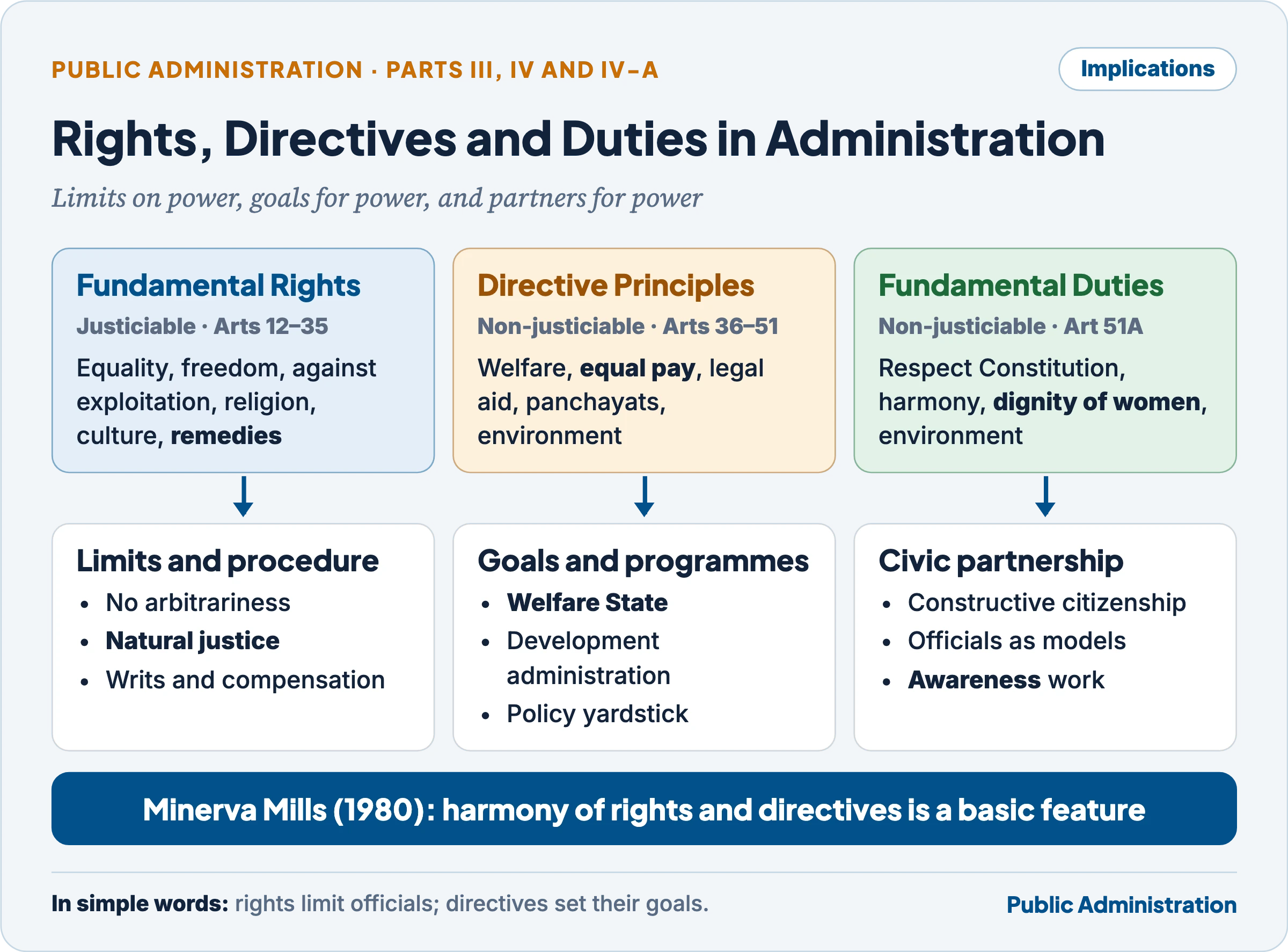
7. Social Justice: Reservation in Public Services
In simple words
For centuries some castes and tribes were kept out of schools and government jobs. Reservation keeps a share of seats and posts for them so that the State itself reflects all of its people. The courts keep checking that it stays fair: not too large, based on data, and reaching those who need it most.
7.1 Constitutional provisions
| Provision | Content |
|---|---|
| Article 15(4) (1st Amendment, 1951) | Special provisions for the advancement of socially and educationally backward classes, SCs and STs |
| Article 15(5) (93rd Amendment, 2005) | Reservation in admissions, including private unaided institutions (minority institutions excluded) |
| Article 15(6), 16(6) (103rd Amendment, 2019) | Up to 10 per cent for economically weaker sections (EWS) not covered by other reservations |
| Article 16(4) | Reservation of appointments or posts for any backward class not adequately represented in State services |
| Article 16(4A) (77th Amendment, 1995; amended by 85th, 2001) | Reservation in promotion for SCs and STs, with consequential seniority |
| Article 16(4B) (81st Amendment, 2000) | Unfilled reserved vacancies carried forward as a separate class, outside the 50 per cent ceiling for that year |
| Article 46 | Promote educational and economic interests of weaker sections, especially SCs and STs |
| Article 335 (proviso added by 82nd Amendment, 2000) | Claims of SCs and STs to be considered consistently with efficiency of administration; relaxation of qualifying marks permitted |
| Articles 330, 332 | Reserved seats in the Lok Sabha and State Assemblies for SCs and STs (extended till 2030 by the 104th Amendment) |
| Articles 243D, 243T | Reservation in panchayats and municipalities, including one-third for women |
| Articles 338, 338A, 338B | National Commissions for SCs, STs and backward classes |
| Article 340 | Commission to investigate conditions of backward classes |
| Articles 341, 342, 342A | Lists of SCs, STs and socially and educationally backward classes |
- Current central quotas in direct recruitment: SC 15 per cent, ST 7.5 per cent, OBC 27 per cent and EWS 10 per cent.
7.2 The judicial journey
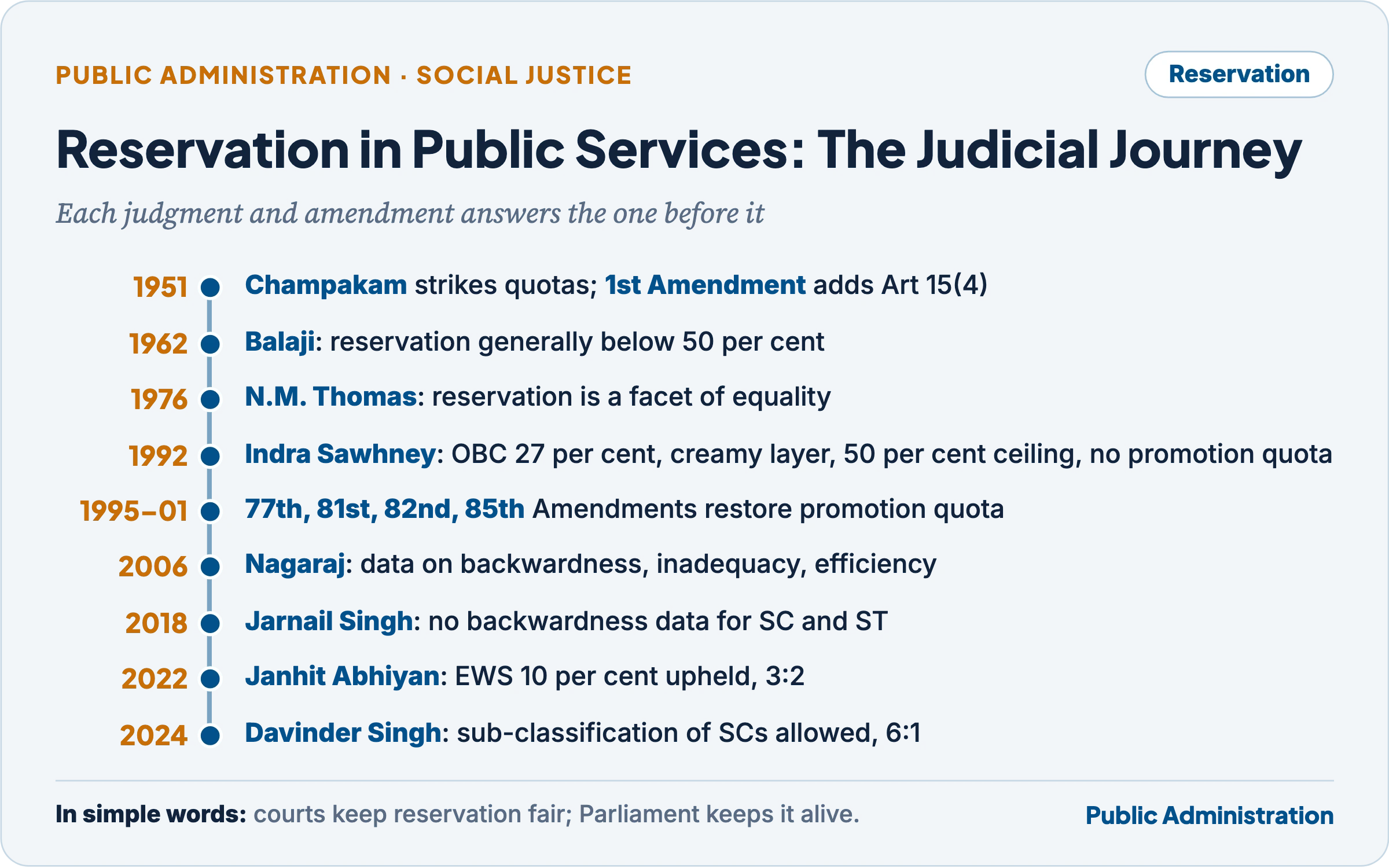
- State of Madras v. Champakam Dorairajan (1951): caste-based quotas in admissions struck down; Parliament responded with Article 15(4).
- M.R. Balaji v. State of Mysore (1962): reservation should generally stay below 50 per cent; caste can be a factor but not the sole test of backwardness.
- State of Kerala v. N.M. Thomas (1976): Article 16(4) is not an exception to 16(1) but a facet of equality of opportunity itself (substantive equality).
- Indra Sawhney v. Union of India (16 November 1992), the Mandal case, nine-judge bench:
- upheld 27 per cent OBC reservation recommended by the Mandal Commission (B.P. Mandal, report 1980; implemented by an office memorandum of August 1990);
- caste can identify a backward class; the creamy layer (advanced persons among OBCs) must be excluded;
- total reservation should not normally exceed 50 per cent, except in extraordinary situations;
- no reservation in promotions under Article 16(4) (operative after five years);
- reservation based only on economic criteria was invalid (a position later revisited for EWS).
- Parliament’s response: the 77th (1995), 81st and 82nd (2000) and 85th (2001) Amendments restored reservation in promotion with consequential seniority, carry-forward and relaxation of standards.
- M. Nagaraj v. Union of India (2006): upheld these amendments, but required the State to show backwardness, inadequacy of representation and overall efficiency (Article 335) with quantifiable data before reserving in promotion; the creamy layer and the 50 per cent ceiling apply.
- Jarnail Singh v. Lachhmi Narain Gupta (2018): a five-judge bench held that the State need not collect data on the backwardness of SCs and STs (they are presumed backward), but upheld the need for data on inadequacy and efficiency, and applied the creamy layer to SCs and STs in promotions. A three-judge bench in 2022 declined to lay down a yardstick for “inadequacy”, leaving it to governments to assess cadre by cadre.
- Janhit Abhiyan v. Union of India (7 November 2022): a five-judge bench, 3:2, upheld the 103rd Amendment (EWS reservation): economic criteria alone may ground reservation, the exclusion of SCs, STs and OBCs from EWS is valid, and the 50 per cent ceiling is not inflexible for this purpose. The minority (including Chief Justice U.U. Lalit) held the exclusion violated equality.
- State of Punjab v. Davinder Singh (1 August 2024): a seven-judge bench, 6:1, held that States may sub-classify Scheduled Castes to give more help to the most disadvantaged among them, overruling E.V. Chinnaiah (2004). Sub-classification must rest on empirical data on inadequate representation due to backwardness, and no sub-group can take 100 per cent of the quota. Four judges, led by Justice B.R. Gavai, urged a creamy layer for SCs and STs too; the Union Cabinet stated soon after that it would not apply a creamy layer to SCs and STs. Justice Bela Trivedi dissented.
- Other important rulings: R.K. Sabharwal (1995) (reservation is post-based, operated through a roster); Mukesh Kumar v. State of Uttarakhand (2020) (no fundamental right to reservation in promotion; Articles 16(4) and 16(4A) are enabling provisions); B.K. Pavitra (2019) (efficiency under Article 335 must be read inclusively, not as a bar).
- Enabling, not obligatory. Articles 15(4) and 16(4) permit the State to reserve but do not oblige it to; no individual can claim reservation as a fundamental right (Mukesh Kumar, 2020). Reservation is nevertheless a constitutional value rooted in equality and Article 46, and once the State chooses to reserve, it must implement the policy fairly and with data.
7.3 Backward classes commissions
- First Backward Classes Commission (Kaka Kalelkar, 1953–55): identified backward classes largely by caste; its report was not accepted by the Union government.
- Second Backward Classes Commission (B.P. Mandal, 1979–80): recommended 27 per cent reservation for OBCs.
- Commission to examine sub-categorisation of OBCs (Justice G. Rohini, constituted 2017; report submitted 2023): examined the uneven spread of OBC benefits among the castes in the central list.
- National Commission for Backward Classes: statutory from 1993, constitutional from 2018 (102nd Amendment, Article 338B); the 105th Amendment (2021) restored the States’ power to prepare their own lists of backward classes.
7.4 The special officer for SCs and STs and the commissions
- The original Article 338. The Constitution provided for a Special Officer for SCs and STs, appointed by the President (designated the Commissioner for Scheduled Castes and Scheduled Tribes). His duty was to investigate all matters relating to the safeguards provided for SCs and STs and to report to the President, whose reports were laid before Parliament.
- Why “more investigative than executive”.
- The officer had no executive powers: he could not implement, order or punish; implementation stayed with Union and State departments.
- His work was monitoring and reporting, and its effect depended on Parliament and governments acting on the reports.
- A single officer with a small field staff could not cover the whole country; States often ignored his findings.
- This design reflects a deliberate choice: implementation belongs to the line departments, while an independent constitutional authority watches and reports.
- From officer to commissions:
- 1978: a multi-member non-statutory Commission for SCs and STs was set up by government resolution alongside the Commissioner.
- 65th Amendment (1990): replaced the Special Officer with a constitutional, multi-member National Commission for Scheduled Castes and Scheduled Tribes.
- 89th Amendment (2003): split it into the National Commission for Scheduled Castes (Article 338) and the National Commission for Scheduled Tribes (Article 338A), from 2004.
- Powers today. The commissions investigate and monitor safeguards, inquire into specific complaints, advise on planning for SC and ST development, and report to the President. While investigating, they have the powers of a civil court (summoning, documents, evidence). The Union and States must consult them on major policy matters affecting these groups (Article 338(9)).
- Assessment. The commissions remain recommendatory: their reports are often tabled late, and action-taken reports are thin. Their strength lies in visibility, inquiry and pressure, not enforcement; real change depends on line departments, police (for atrocities) and courts.
7.5 Has reservation promoted social justice?
- Positive impact:
- Created a first generation of SC, ST and OBC officers, teachers, doctors and legislators; a middle class and leadership among historically excluded groups.
- Made the bureaucracy more representative of society, increasing its legitimacy and sensitivity in dealing with weaker sections (the logic of representative bureaucracy).
- Political reservation gave SCs and STs a guaranteed voice in legislatures and local bodies.
- Broke the monopoly of a few castes over public office.
- Limits (“positive but meagre in absolute terms”):
- Benefits have been concentrated among better-off sections and a few castes within each category (hence the creamy layer and sub-classification debates).
- Large backlog vacancies and under-representation at senior levels, partly because of weak schooling and partly because of non-implementation.
- Shrinking public sector employment after 1991, contractualisation and outsourcing reduce the jobs where reservation applies.
- Social discrimination persists despite legal equality; atrocities continue.
- Critics argue reservation has entrenched caste identities and raised questions of efficiency; supporters reply that efficiency must be read inclusively (Pavitra, Davinder Singh) and that the real problem is unequal schooling.
- New directions: data-based policy (the 2027 Census will, for the first time since independence, enumerate caste, a decision of the Cabinet Committee on Political Affairs of 30 April 2025); sub-classification; and the Supreme Court’s own adoption of a formal 200-point reservation roster for its staff (circular of 24 June 2025).
8. Gender Equality: Constitutional Provisions and Judicial Interventions
In simple words
The Constitution promises women equal rights and also allows the State to give them extra help, because equal treatment of people who start unequal does not make them equal. Courts have used this promise to strike down unfair rules in government jobs, families and workplaces.
8.1 Constitutional provisions
| Provision | Content |
|---|---|
| Preamble | Equality of status and of opportunity; dignity of the individual |
| Article 14 | Equality before law and equal protection of laws |
| Article 15(1), 15(3) | No discrimination on grounds of sex; special provisions for women and children permitted |
| Article 16(1), 16(2) | Equal opportunity in public employment; no discrimination on grounds of sex |
| Article 21 | Life with dignity, privacy, bodily autonomy |
| Article 23 | Prohibits trafficking in human beings |
| Article 39(a), 39(d), 39(e) | Equal right to livelihood; equal pay for equal work; health of women workers not abused |
| Article 42 | Maternity relief |
| Article 51A(e) | Duty to renounce practices derogatory to the dignity of women |
| Articles 243D, 243T | At least one-third seats and chairperson posts for women in panchayats and municipalities (many States have raised this to 50 per cent) |
| Articles 330A, 332A, 334A, 239AA (106th Amendment, 2023) | One-third seats for women in the Lok Sabha, State Assemblies and the Delhi Assembly, for fifteen years; brought into force on 16 April 2026 but operative only after delimitation following the first census after commencement |
8.2 Judicial interventions
| Case | Year | Contribution |
|---|---|---|
| C.B. Muthamma v. Union of India | 1979 | Struck down Indian Foreign Service rules that required women officers to seek permission to marry and allowed their removal after marriage; Justice Krishna Iyer condemned sex discrimination in public service |
| Air India v. Nergesh Meerza | 1981 | Struck down the rule ending air hostesses’ service on first pregnancy as arbitrary |
| Vishaka v. State of Rajasthan | 1997 | Guidelines against sexual harassment at the workplace, using CEDAW |
| Githa Hariharan v. RBI | 1999 | Mother can be the natural guardian of a minor during the father’s lifetime |
| Anuj Garg v. Hotel Association of India | 2007 | Struck down a ban on women working in bars; protective laws must not become paternalistic |
| Shayara Bano v. Union of India | 2017 | Instant triple talaq held unconstitutional |
| Joseph Shine v. Union of India | 2018 | Struck down the adultery offence as treating women as husbands’ property |
| Indian Young Lawyers Association v. State of Kerala (Sabarimala) | 2018 | Exclusion of women of menstruating age held discriminatory (wider questions referred to a larger bench in 2019) |
| Secretary, Ministry of Defence v. Babita Puniya | 2020 | Permanent commission for women officers in the Army |
| Vineeta Sharma v. Rakesh Sharma | 2020 | Daughters have coparcenary rights by birth in Hindu joint family property |
| Lt. Col. Nitisha v. Union of India | 2021 | Recognised indirect and systemic discrimination in evaluation criteria for women officers |
- Implications for administration.
- Workplace: every office must have an Internal Committee under the POSH Act; service rules must be gender-neutral; maternity and child-care leave are entitlements.
- Representation: women’s reservation in local bodies has brought over a million women into elected office; the “sarpanch-pati” problem (husbands acting for elected women) shows that formal quotas need capacity building and administrative support.
- Gender budgeting (a Gender Budget Statement in the Union Budget since 2005–06) and gender audits aim to make allocation decisions gender-sensitive.
- Policing and justice: women’s help desks, one-stop centres, and sensitive handling of complaints are tests of whether constitutional equality reaches women in practice.
- Gaps. Low female labour force participation, low representation in senior civil service and the higher judiciary, violence against women, and the delay in implementing legislative reservation show the distance between formal equality and substantive equality.
9. Socialism, Economic Reforms and the Basic Values
In simple words
In 1976 India wrote “socialist” into its Preamble. In 1991 it opened its economy to private and foreign business. People ask whether the second broke the promise of the first. The answer depends on what socialism means: a fixed economic model (state ownership) or a goal (a fair society with welfare for all).
9.1 What “socialist” means in the Indian Constitution
- Roots before 1976. The Karachi Resolution (1931) tied political freedom to economic freedom; the Congress adopted the goal of a “socialistic pattern of society” at its Avadi session (1955); the Industrial Policy Resolution, 1956 gave the public sector the commanding heights; and the Directive Principles (Articles 38, 39) already carried socialist content. Nehru‘s Fabian socialism and admiration for Soviet planning shaped the mixed economy, while Gandhian ideas added village industry and trusteeship.
- The 42nd Amendment (1976) made the commitment explicit, in the context of bank nationalisation (1969), abolition of privy purses (26th Amendment, 1971) and the “Garibi Hatao” politics of the period.
- Democratic socialism, not Marxist socialism. Indian socialism aims at reducing inequality and ending exploitation through democratic and constitutional means, with private property and private enterprise recognised (Article 19(1)(g), Article 300A). It is a blend of Marxian and Gandhian socialism, leaning towards Gandhian socialism.
- What the courts have said:
- Excel Wear v. Union of India (1978): the word “socialist” lets courts lean in favour of nationalisation and State ownership, but private ownership remains part of the economic structure.
- D.S. Nakara v. Union of India (1982): the principal aim of a socialist State is to eliminate inequality in income, status and standards of life, and to give a decent standard of life to working people (pensioners’ case).
- Property Owners Association v. State of Maharashtra (2024): the Constitution endorses economic democracy and leaves the choice of economic model to elected governments; not all private property is a “material resource of the community”.
- Dr Balram Singh v. Union of India (2024): “socialist” denotes a welfare State and equality of opportunity; it does not restrict the economic policies of an elected government or private entrepreneurship; India has moved from dominance of public investment to coexistence of public and private investment.
- Does “socialist” need to be defined? The Constitution never defines it. The 44th Amendment Bill (1978) proposed defining “socialist” as a republic committed to freedom from all forms of exploitation, social, political and economic, but the Rajya Sabha did not accept that part. Leaving it undefined has allowed flexibility (successive governments have pursued different economic policies under the same Preamble), but critics argue it has also made the word symbolic and easy to ignore.
9.2 Socialism, planning and centralisation
- Planning drove centralism. Much of the centralisation of Indian federalism in the first four decades came less from the constitutional text than from the socialist goal of planned development: the Planning Commission (1950, created by executive resolution), plan grants under Article 282, central control of industry through licensing, and the dominance of one party at the Centre and in most States.
- Evidence: when planning weakened after 1991 and coalition politics arrived, the same Constitution operated in a more federal way (States competing for investment, more devolution, Bommai’s limits on Article 356). This suggests the centralism was political and economic as much as institutional.
- The counter-view: the institutional framework itself (Union List, residuary power, emergencies, Governors, All India Services) gives the Centre capacity for centralisation whenever political conditions allow.
9.3 Economic reforms since 1991
- The shift. The balance of payments crisis of 1991 led to the New Industrial Policy (24 July 1991): end of most industrial licensing, a reduced list of industries reserved for the public sector, opening to foreign investment, disinvestment of public enterprises, trade liberalisation and, later, regulatory bodies. This is the move from the Nehruvian to the liberalisation (LPG) model of development.
- Reinventing government. The shift required a new role for the State: from producer and controller to facilitator, regulator and enabler, as in David Osborne and Ted Gaebler‘s Reinventing Government (1992) (“steering rather than rowing”). In India this meant regulators (SEBI, TRAI, electricity commissions), public–private partnerships, e-governance, citizen’s charters, outcome budgeting and direct benefit transfer. See the article on New Public Management and After.
- Judicial stance on reforms. Courts have treated economic policy as the domain of the elected government: in Delhi Science Forum v. Union of India (1996) (telecom opening) and BALCO Employees’ Union v. Union of India (2001) (disinvestment), the Supreme Court held that it would not review the wisdom of economic policy unless it was unconstitutional or illegal.
Criticism — Have economic reforms infringed the basic values of the Constitution?
- Retreat of the welfare State: disinvestment, cuts in public employment and the shift to contract work reduce the space for reservation and job security.
- Widening inequality: growth has been uneven between regions, sectors and classes; concentration of wealth sits uneasily with Article 39(c).
- Commercialisation of services: user charges and private provision in health and education can exclude the poor, weakening Articles 21, 41 and 47.
- Weakened labour protection and informal work contradict Articles 39, 42 and 43.
- Regional imbalance: competition among States for investment favours already developed States, threatening the federal goal of balanced development.
- Thus, even if the basic structure is intact, the realisation of social and economic justice has been compromised in practice.
Defence — The reforms serve the same values by other means
- Socialism is an end, not a means. The Preamble does not prescribe State ownership; growth has funded welfare at a scale never seen before (food security, employment guarantee, health insurance, housing, direct benefit transfers).
- Courts agree. No reform has been struck down for violating the basic structure; Balram Singh (2024) and Property Owners (2024) confirm that the Constitution leaves economic choices to elected governments.
- Poverty has fallen sharply since 1991, and resources saved from loss-making enterprises have been diverted to welfare.
- The State’s role in equitable development has not shrunk; only the nature of the mixed economy has changed, from public dominance to public–private coexistence.
- Rights have expanded in the same period: education (Article 21A), information (RTI), food, rural work, and more.
- Assessment. The reforms have not infringed the basic structure: the Constitution’s value premises are framed as goals, not as a particular economic system. But they have shifted the burden of realising social and economic justice onto regulation, targeted welfare and administrative capacity. Where administration is weak (health, school quality, labour inspection), the ideals of social and economic justice remain partly unrealised. “Socialist” is therefore not redundant: it works as a standing reminder that growth must be judged by its distribution.
10. The Value Premises in a Changing World
In simple words
The Constitution was written in 1949, but the world has changed: global trade, international human rights law, digital technology and markets. The core values stay, but courts and governments keep reading them in new ways.
10.1 Global constitutionalism and the value premises
Global constitutionalism refers to the spread of shared constitutional ideas across countries: human rights, the rule of law, judicial review, proportionality and independent institutions.
- International norms enter Indian law. Courts use international conventions to read rights more widely where Indian law is silent (CEDAW in Vishaka, 1997; human rights instruments in Puttaswamy, 2017 on privacy; Navtej Singh Johar, 2018 on sexual orientation; NALSA, 2014 on transgender persons).
- New tests of State action. The proportionality test (adopted clearly in Modern Dental College, 2016, and Puttaswamy) now measures whether administrative and legislative restrictions are necessary and the least restrictive option, borrowing from German and Canadian practice.
- Globalisation and sovereignty. Commitments to the WTO (1995) and global finance limit economic policy choices, but the State strengthens its internal sovereignty and legitimacy by creating local democratic structures (the 73rd and 74th Amendments) and accommodating civil society.
- Globalisation and federalism. Deregulation has had a skewed regional impact: developed States attract investment while backward States lag. To pursue equity and balanced development, the Centre may need corrective, centrally managed interventions; at the same time, local government and voluntary organisations push towards decentralisation. Indian federalism thus faces pressure in both directions.
- Conclusion on the value premises. Liberty, equality and justice have been broadened (privacy, dignity, information, environment) by global ideas, while socialism has been reinterpreted as welfare and equal opportunity. The value premises have proved adaptable rather than obsolete.
Theory lens: reading the Constitution through administrative theory
- Dicey’s rule of law. A.V. Dicey, in Introduction to the Study of the Law of the Constitution (1885), defined the rule of law as the supremacy of regular law, equality before the law and rights flowing from court decisions. India adopts the rule of law (Articles 14, 21, judicial review) but rejects his parliamentary sovereignty: the Constitution, not Parliament, is supreme. The vast growth of administrative law in India (natural justice, writs, tribunals) shows that Dicey’s fear of administrative discretion has been answered by controlling discretion rather than denying it. See the article on Administrative Law and Dicey.
- Weber’s legal-rational authority. Max Weber, in Economy and Society (1922), argued that modern authority rests on impersonal rules and a professional bureaucracy. The Constitution is the ultimate source of legal-rational authority in India: every official’s power must trace back to it, and Part XIV builds a merit-based career service. But the Constitution also adds substantive values (justice, equality) that a purely rule-following Weberian bureaucracy may neglect. See the article on Weber and Bureaucracy.
- Wheare’s quasi-federalism. K.C. Wheare‘s federal principle (general and regional governments each coordinate and independent within a sphere) makes India quasi-federal: the administrative consequences include All India Services, Union directions under Articles 256–257, and the Governor as a link, all of which give the Centre administrative reach into the States.
- Welfare State and development administration. The Directive Principles mandate a welfare State and require an administration that changes society, not merely keeps order. This is the core idea of development administration (the term is credited to U.L. Goswami, 1955, and popularised by Edward Weidner and Fred Riggs). See the article on Development Administration.
- Riggs and formalism. Fred Riggs (Administration in Developing Countries, 1964) described formalism, the gap between what laws prescribe and what actually happens, as typical of prismatic societies. The distance between the Preamble’s ideals and their realisation (untouchability persisting despite Article 17, directives unimplemented) is a classic case. See the article on Riggsian Models.
- NPM and LPG versus the socialist ideal. New Public Management (Christopher Hood’s 1991 formulation) and reinventing government brought market tools into the State after 1991. The tension with the socialist value premise is resolved in the Indian constitutional reading by treating socialism as a goal (welfare, equal opportunity) rather than a means (State ownership). See the articles on LPG and Good Governance and on New Public Management and After.
- Representative bureaucracy. J. Donald Kingsley, in Representative Bureaucracy (1944), argued that a bureaucracy is democratic only if it reflects the social composition of those it serves. Reservation under Articles 16(4), 16(4A) and 335 is India’s constitutional answer, combining passive representation (social composition) with the hope of active representation (sensitivity to weaker sections). See the article on Recruitment, Training and Career.
Key Terms
| Term | Meaning in simple words |
|---|---|
| Preamble | The opening statement of the Constitution: its source (the people), the nature of the State, and its goals |
| Value premises | The basic values (justice, liberty, equality, fraternity, secularism, socialism, democracy) on which the Constitution rests |
| Basic structure | Core features of the Constitution that Parliament cannot destroy by amendment (Kesavananda, 1973) |
| Judicial review | The power of courts to declare laws and executive actions void if they violate the Constitution |
| Quasi-federal | Federal in structure but with a strong Centre and unitary features (Wheare’s description of India) |
| Cooperative federalism | Union and States working together and depending on each other rather than in watertight compartments |
| Asymmetric federalism | Special status or arrangements for some units (Articles 371–371J, Fifth and Sixth Schedules, UTs) |
| Residuary powers | Subjects not listed in any of the three lists; vested in the Union (Article 248) |
| Nominal executive | The formal head (President, Governor) in whose name government acts |
| Real executive | The Council of Ministers headed by the Prime Minister or Chief Minister, which actually governs |
| Collective responsibility | The whole Council of Ministers stands or falls together before the Lok Sabha (Article 75(3)) |
| Vertical application | Fundamental Rights enforced against the State |
| Horizontal application | Fundamental Rights enforced against private persons |
| Directive Principles | Non-justiciable guidelines for governance in Part IV |
| Fundamental Duties | Civic obligations of citizens in Article 51A |
| Creamy layer | The better-off members of a backward class excluded from reservation benefits |
| Sub-classification | Dividing a reserved category (such as SCs) into groups to direct more benefit to the most backward |
| EWS reservation | Up to 10 per cent reservation for economically weaker sections outside other reserved groups (103rd Amendment) |
| Representative bureaucracy | A civil service that mirrors the social composition of the population |
| Democratic socialism | Pursuing equality and welfare through democratic, legal means within a mixed economy |
| Universal adult franchise | The right of every adult citizen to vote, without property or education conditions |
| Constitutional morality | Respect for constitutional forms and restraint in the use of power (Ambedkar’s phrase, borrowed from George Grote) |
| Global constitutionalism | The spread of shared constitutional ideas such as human rights, rule of law and proportionality across countries |
Commissions, Committees and Judgments
The table lists the reports, committees and judgments that shaped the salient features and value premises, in order of time.
| Body or case | Year | Key point |
|---|---|---|
| Nehru Report (Motilal Nehru) | 1928 | Fundamental rights, responsible government, federal scheme |
| Karachi Resolution (Congress session presided over by Vallabhbhai Patel) | 1931 | Fundamental Rights and Economic Programme; political and economic freedom linked |
| Sapru Committee (Tej Bahadur Sapru) | 1945 | Rights divided into justiciable and non-justiciable |
| Objectives Resolution (moved by Nehru) | 1946–47 | Basis of the Preamble |
| Drafting Committee (B.R. Ambedkar) | 1947–49 | Prepared the Draft Constitution |
| State of Madras v. Champakam Dorairajan | 1951 | Rights prevail over directives; led to Article 15(4) |
| Backward Classes Commission (Kaka Kalelkar) | 1953–55 | First national inquiry into backward classes |
| In re Berubari Union | 1960 | Preamble not part of the Constitution; key to the makers’ mind |
| Golaknath v. State of Punjab | 1967 | Parliament cannot amend Fundamental Rights (reversed by 24th Amendment) |
| Kesavananda Bharati v. State of Kerala | 1973 | Basic structure; Preamble part of the Constitution |
| Shamsher Singh v. State of Punjab | 1974 | President and Governor act on ministerial advice |
| Swaran Singh Committee | 1976 | Recommended Fundamental Duties |
| Maneka Gandhi v. Union of India | 1978 | Fair, just and reasonable procedure under Article 21 |
| C.B. Muthamma v. Union of India | 1979 | Sex discrimination in service rules struck down |
| Mandal Commission (B.P. Mandal) | 1980 | 27 per cent reservation for OBCs |
| Minerva Mills v. Union of India | 1980 | Harmony of rights and directives is a basic feature |
| Sarkaria Commission (R.S. Sarkaria) | 1983–88 | Centre–State relations; restraint in Article 356; Inter-State Council |
| Indra Sawhney v. Union of India | 1992 | OBC reservation upheld; creamy layer; 50 per cent ceiling |
| S.R. Bommai v. Union of India | 1994 | Federalism and secularism basic features; limits on Article 356 |
| Vishaka v. State of Rajasthan | 1997 | Workplace sexual harassment guidelines; horizontal effect |
| Committee on Fundamental Duties (J.S. Verma) | 1999 | Laws that enforce duties; awareness |
| BALCO Employees’ Union v. Union of India | 2001 | Courts do not review the wisdom of economic policy |
| National Commission to Review the Working of the Constitution (M.N. Venkatachaliah) | 2000–02 | Review of the Constitution’s working after fifty years |
| M. Nagaraj v. Union of India | 2006 | Promotion reservation valid subject to data on backwardness, inadequacy, efficiency |
| Punchhi Commission (M.M. Punchhi) | 2007–10 | Centre–State relations after Sarkaria |
| Jarnail Singh v. Lachhmi Narain Gupta | 2018 | No data on SC/ST backwardness needed; creamy layer in promotion |
| Janhit Abhiyan v. Union of India | 2022 | EWS reservation upheld 3:2 |
| Kaushal Kishor v. State of Uttar Pradesh | 2023 | Articles 19 and 21 enforceable against private persons (4:1) |
| Rohini Commission (G. Rohini) | 2017–23 | Sub-categorisation of OBCs |
| In re Article 370 | 2023 | Abrogation of J&K’s special status upheld |
| State of Punjab v. Davinder Singh | 2024 | Sub-classification of SCs permitted (6:1) |
| Property Owners Association v. State of Maharashtra | 2024 | Not all private property is a community resource under 39(b) |
| Dr Balram Singh v. Union of India | 2024 | “Socialist” and “secular” in the Preamble upheld |
| Sixteenth Finance Commission (Arvind Panagariya) | 2025 | Vertical devolution held at 41 per cent for 2026–31 |
| Presidential Reference No. 1 of 2025 | 2025 | No judicial timelines or “deemed assent” for Governors and President; no indefinite inaction |
Contemporary Developments
- Women’s reservation law in force, enabling amendment defeated (April 2026). The 106th Amendment (2023) was brought into force on 16 April 2026, but its seat quota still waits for delimitation after the next census. The Constitution (131st Amendment) Bill, 2026, to expand the Lok Sabha to up to 850 seats and delink the quota from the new census, failed to get the special majority on 17 April 2026, a reminder that Article 368’s special majority is a real check on the executive.
- Caste enumeration in Census 2027 (30 April and 4 June 2025). The Cabinet Committee on Political Affairs decided to include caste enumeration in the census for the first time since independence; the reference date is 1 March 2027 (1 October 2026 for Ladakh and snow-bound areas). The data will shape reservation, sub-classification and delimitation debates.
- Presidential Reference opinion (20 November 2025). A five-judge bench held that courts cannot impose fixed timelines or “deemed assent” on Governors and the President for State Bills, though prolonged and evasive inaction can attract a limited direction. It refined the Tamil Nadu Governor judgment of 8 April 2025 and reshaped the federal balance on Article 200.
- Sixteenth Finance Commission (report 17 November 2025; tabled 1 February 2026). The Commission, chaired by Arvind Panagariya, retained the States’ share of the divisible pool at 41 per cent for 2026–31; the Union accepted it in the Budget of 1 February 2026.
- The Preamble’s “socialist” and “secular” upheld (25 November 2024). In Dr Balram Singh v. Union of India, the Supreme Court dismissed challenges to the 42nd Amendment’s insertions, reading “socialist” as a welfare-State commitment that does not bind governments to any economic model; it followed the nine-judge Property Owners Association ruling of 5 November 2024.
- Sub-classification of SCs permitted (1 August 2024). State of Punjab v. Davinder Singh allowed States to sub-classify Scheduled Castes on the basis of data, overruling E.V. Chinnaiah (2004); several States have since begun data exercises for sub-classification.
- Right to work: VB–G RAM G Act in force (1 July 2026). The Viksit Bharat – Guarantee for Rozgar and Ajeevika Mission (Gramin) Act, 2025 replaced MGNREGA, raising the statutory employment guarantee from 100 to 125 days, a fresh statutory expression of Article 41.
- Uniform civil code at State level (27 January 2025). Uttarakhand brought its Uniform Civil Code into force, the first State to act on Article 44 after independence (Scheduled Tribes are excluded), reviving debate on uniformity versus diversity.
Revision Grid
| Thinker or body | Work or report (year) | Key idea |
|---|---|---|
| Jawaharlal Nehru | Objectives Resolution (1946) | Sovereign republic; justice, liberty, equality; basis of the Preamble |
| B.R. Ambedkar | Speeches in the Constituent Assembly (4 November 1948; 25 November 1949) | Responsibility over stability; “Union” not “federation”; social democracy; working of the Constitution matters most |
| K.M. Munshi | Constituent Assembly debates (1946–49) | Preamble as the “political horoscope” |
| Motilal Nehru | Nehru Report (1928) | Early charter of fundamental rights |
| A.V. Dicey | Introduction to the Study of the Law of the Constitution (1885) | Rule of law; parliamentary sovereignty (rejected by India) |
| Max Weber | Economy and Society (1922) | Legal-rational authority and bureaucracy |
| K.C. Wheare | Federal Government (1946) | Federal principle; India as quasi-federal |
| Granville Austin | The Indian Constitution: Cornerstone of a Nation (1966) | Cooperative federalism; rights and directives as the conscience of the Constitution |
| W.H. Morris-Jones | The Government and Politics of India (1964) | Bargaining federalism |
| Ivor Jennings | Critique of the Indian Constitution (1950s) | Too long and complex; strong centralising tendency |
| J. Donald Kingsley | Representative Bureaucracy (1944) | Bureaucracy should mirror society |
| Fred Riggs | Administration in Developing Countries (1964) | Formalism: gap between norms and practice |
| Osborne and Gaebler | Reinventing Government (1992) | Steering rather than rowing; entrepreneurial government |
| Mandal Commission | Report (1980) | 27 per cent OBC reservation |
| Swaran Singh Committee | Report (1976) | Fundamental Duties |
| Sarkaria Commission | Report (1988) | Cooperative Centre–State relations; limits on Article 356 |
Previous Year Questions
- 2026Under the Indian Constitution fundamental rights are usually enforced only vertically, whereas Vishaka case represents the horizontal application. Comment.
- 2025Highlight the constitutional provisions and judicial interventions to promote gender equality in India.
- 2023“Parliamentary democracy in India envisages elected head as the real executive of a State.” Discuss.
- 2022“The Government of India Act, 1935 is the most important source of Indian constitution”. Identify its features.
- 2022“The Indian federal structure is largely symmetric albeit with some asymmetric features”. Examine the status of States and Union Territories through the principle of weighted and differentiated equality in India.
- 2021The Preamble to the Constitution of India provides a foundational framework of ideals and values for the Indian administration. Discuss.
- 2020The structural part of the Constitution of India is to a large extent derived from the Government of India Act, 1935, whereas its philosophical part has many other sources. Discuss the sources of the philosophical part.
- 2019The economic reforms have significantly infringed the basic values and spirit of the Indian Constitution. Examine.
- 2017“The market reforms have not infringed the basic structure of the Constitution of India, but have largely compromised the realisation of the ideals of social and economic justice.” Comment.
- 2016Do you think that some of the ideals enshrined in the Preamble of the Constitution remain only on paper even today? Critically evaluate.
- 2015Do you think that some of the ideals enshrined in the Preamble of the Constitution remain only on paper even today? Critically evaluate.
- 2013“The liberal-democratic ideology of the West influenced the shaping of value premises of the Indian Constitution.” Discuss.
- 2013“There is a tendency of centralism in Indian federalism, but it is not because of its institutional framework but because of its socialist goals and centrally devised plan development.” Explain the statement in the context of Union-State relationship.
- 2010The prevalence of multiple channels for transfer of resources from the Centre to the States is stated to have compounded the problems of federal arrangements. Discuss.
- 2009“Values of Indian administration must be rooted in the Preamble of the Indian Constitution.” Discuss.
- 2008‘The shift from the Nehruvian to the liberalisation model of development has necessitated reinventing government.’ Comment.
- 2006“The basic values of the Constitution of India enshrine social, political and economic philosophy symbolising sovereignty of the people, rule of law and basic characteristics of a socialist, secular, democratic, republic.” Comment.
- 2002“Indian federalism is described as federal in form but unitary in spirit.” Comment.
- 2002“The value premises of our Constitution in the era of global constitutionalism.” Comment.
- 2001“The use of the word ‘Socialist’ in the Indian Constitution has become redundant in the context of the liberalization of economy.” Comment.
- 2000“Reservation policy and its implementation has had some positive impact in relation to terms on the socio-economic development of the SCs and STs but it is very meagre in absolute terms.” Comment.
- 1998“Indian Constitution considerably influences the nature, role and structure of Indian administration.” Elucidate.
- 1997“The Directive Principles of State Policy are socialistic in their direction and content.” Comment.
- 1997“The Preamble to the Constitution is a key to open the mind of the markers.” Comment.
- 1997Examine the motives and intentions of the framers of the Indian Constitution as they opted for the system of parliamentary democracy in India.
- 1996“The constitutional provisions for the appointment of a special officer for the Scheduled Castes & Scheduled Tribes are more investigative than executive in orientation.” Comment.
- 1996“The first Article of the Draft Constitution of India provided that India shall be a federation.” Comment.
- 1995“The Indian Constitution is a bag to borrowed materials.” Comment.
- 1995“The purists have criticized the Indian Constitution as not conforming to the conception of a federation and so being unduly rigid.” Examine the statement.
- 1994“The word ‘socialist’ in the Preamble to our Constitution requires to be defined.” Comment.
- 1994“In framing a Federal Constitution the Constituent Assembly had many models to draw upon, but it wisely decided to take the Government of India Act, 1935 as the basis on which the new Constitution was to be framed.” Critically examine this statement.
- 1992‘Reservation Policy in Public Services as a mandate from the Constitution has been conducive to the promotion of Social Justice.’ Discuss and illustrate.
- 1991‘The fine art of deception which the British Practised in the name of “Dyarchy” was too crude for it to pass the test of self- government. It hastened “Provincial Autonomy” but this too did not promote parliamentary democracy of federalism.” Comment.
- 1991‘As the Fundamental Law of Administration of the land, the Indian Constitution lacks teeth in its institutional package in the Constitution.’ Comment.
- 1990‘The Preamble to the Constitution of India contains the ideals to be achieved by the administration; the progress in regard to their realisation has however been halting and patchy, the libertarian ideal on the whole gaining an upper hand over the egalitarian.’ Comment.
- 1992‘Rule of law is the base of India’s constitutional life, and administrative law seeks to ensure that this basic premise remains upheld and protected.’ Comment.