

Kautilya’s Arthashastra; Mughal administration; Legacy of British rule in politics and administration – Indianization of public services, revenue administration, district administration, local self-government.
This article: Kautilya’s Arthashastra — the text, its meaning and its authorship and dating debate; the origin of the state and the saptanga theory; the king and rajadharma; mantrins, mantriparishad and amatyas; the superintendents (adhyakshas) and the departmental machinery; principles of administration; personnel administration (recruitment, upadha tests, pay, transfer, discipline); corruption and its control, including the forty ways of embezzlement; revenue, treasury, budgeting, accounts and audit; justice and the four sources of law (dharma, vyavahara, charitra, rajasasana) and codification; espionage; local and village administration; mandala theory, the six-fold policy (sadgunya) and diplomacy; ethics, welfare and political realism; comparison with Weber and Machiavelli; Ashoka as a brief bridge; relevance to contemporary governance and international relations.
Official Syllabus: Paper II · Unit 2-01 Evolution of Indian Administration
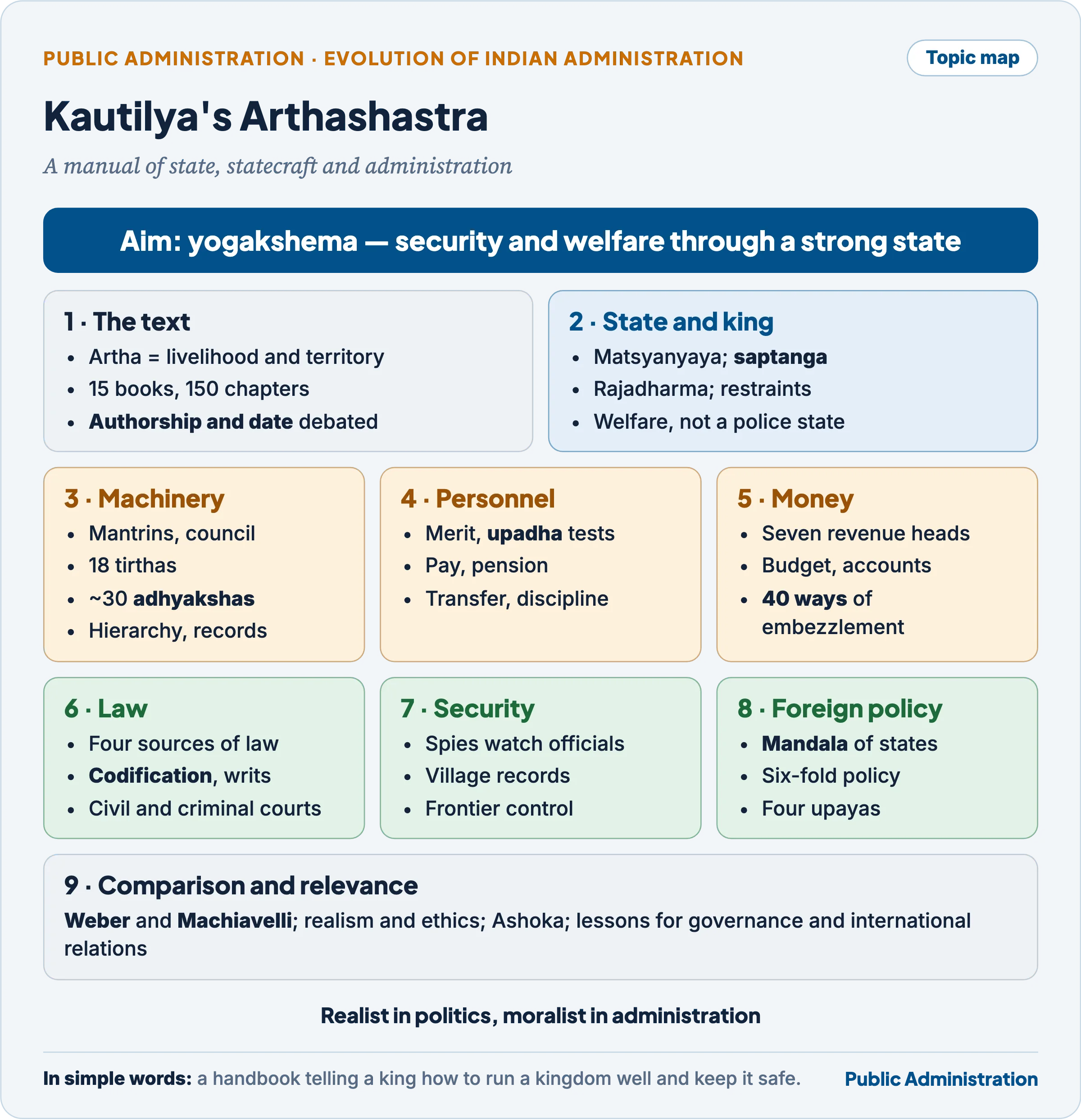
The Arthashastra is the oldest surviving Indian treatise that treats government as a subject of systematic study. It discusses how a ruler should be trained, how ministers should be chosen and tested, how departments should be organised, how revenue should be raised and accounted for, how courts should decide cases, how spies should watch officials, and how a state should deal with its neighbours. For Indian administration it matters for three reasons: it shows that ideas such as hierarchy, merit, audit and anti-corruption control have deep Indian roots; it supplies a vocabulary (yogakshema, rajadharma, danda, mandala) still used in Indian public life; and it raises a question every state still faces, namely how far power and morality can be combined.
In simple words
Imagine a very detailed handbook written for the head of a large company. It tells him how to choose managers, how to check that they are honest, how to keep the accounts, how to settle disputes between staff, how to deal with rival companies, and why his own success depends on keeping customers happy. The Arthashastra is such a handbook, written for a king and his kingdom.
1. The Text: Meaning, Structure, Authorship and Date
In simple words
Before studying what the Arthashastra says, it helps to know what kind of book it is: a practical manual on running a state, put together in fifteen books, whose author and date are still debated by scholars.
1.1 What “Arthashastra” means
- Artha as livelihood and wealth. The last book of the text defines its own subject: the subsistence of human beings is artha; the earth inhabited by human beings is also artha; and the science that teaches how to acquire and maintain the earth is the Arthashastra. The word therefore means more than “economics”. It is the science of livelihood, wealth and the territory that sustains them, which is why it is often translated as the science of polity or political economy.
- Two aims: palana and labha. The text has a twofold purpose. Palana (also rakshana) is the protection and administration of the existing state; labha is the acquisition of new territory and resources. The first is internal administration; the second is foreign policy and war.
- Primacy of wealth. In Book I Kautilya states that among the three goals of life (dharma, artha, kama) artha is the chief, because righteousness and pleasure both depend on material means. This does not reject dharma; it says that a poor and insecure state cannot sustain a moral social order.
- Wealth of the people, not only of the king. The treasury, the army and royal power all rest on varta (agriculture, cattle-rearing and trade). A ruler who wants a full treasury must first make the subjects productive and secure. This is why the text spends so much space on irrigation, mines, trade routes, weights and measures and the settlement of new villages.
1.2 The four sciences and the place of dandaniti
Kautilya lists four branches of knowledge a ruler must master.
| Science | Meaning | Role in governance |
|---|---|---|
| Anvikshiki | Philosophy and logic (reasoning, enquiry) | Trains the mind to judge right and wrong, strength and weakness |
| Trayi | The three Vedas | Lays down social and religious duties |
| Varta | Economics: agriculture, cattle-breeding, trade | Produces grain, cattle, gold, forest produce and labour, and so the treasury and army |
| Dandaniti | The science of government (literally “the policy of the rod”) | Enforces order so that the other three can flourish |
- Dandaniti defined. The sceptre (danda) on which the progress of the other three sciences depends is called danda, and the science that treats of it is dandaniti. It is a means to acquire, secure, improve and distribute wealth. Dandaniti is the oldest name for the science that Kautilya calls Arthashastra.
- Knowledge as a qualification to govern. The king, the crown prince, the high priest and the ministers must all be trained in the science of government. Kautilya says that a minister who is not learned in the sciences is unfit even to hear council deliberations, and that a king who acts against the science ruins himself and his kingdom by maladministration. Administration, in short, is both a science to be learned and an art to be practised; practice without science blunders, and science without practice is useless.
1.3 Structure of the text
The Arthashastra is a prose text in short aphoristic sentences (sutras) with some verses.
- Size. It has 15 books (adhikaranas), 150 chapters (adhyayas) and 180 topics (prakaranas). The text itself claims 6,000 shlokas; the modern critical edition counts about 5,300–5,400 numbered sentences, of which about 380 are verses.
- Balance of themes. Books I to V carry most of the material on internal administration; Books VI to XIV, on foreign policy, war and secret means, form roughly half the text.
- Method. Book XV explains the 32 devices of exposition (tantrayuktis) the author uses, which shows that the work was composed as a systematic scientific treatise, not a loose collection of maxims.
| Book | Theme | Administrative content |
|---|---|---|
| I | Concerning discipline | Training of the king, ministers, upadha tests, spies, council, envoys, daily routine |
| II | Duties of government superintendents | Settlement, forts, samahartri, accounts office, embezzlement, writs, about thirty departments, towns |
| III | Concerning law | Four sources of law, civil courts, contracts, marriage, inheritance, labour |
| IV | Removal of thorns | Criminal justice, protection of artisans and consumers, misconduct of officials |
| V | Conduct of courtiers | Salaries, emergency taxation, conduct of officers |
| VI–VII | Sources of sovereignty; six-fold policy | Saptanga, mandala, sadgunya |
| VIII–XIV | Calamities, war, alliances, secret means | Military and covert operations |
| XV | Plan of the treatise | Method of exposition |
1.4 Rediscovery and editions
- Lost and found. The work was widely cited until about the eighth century CE (the poet Dandin knew it), then fell out of use. In 1905 a manuscript reached R. Shamasastry, librarian of the Mysore Government Oriental Library. He published the Sanskrit text in 1909 and a full English translation in 1915.
- Later scholarship. T. Ganapati Sastri published a commentary (1924). R.P. Kangle produced the critical edition in three parts (text 1960, translation 1963, study 1965), which remains the standard reference. L.N. Rangarajan published a rearranged English translation (1992), and Patrick Olivelle a new annotated translation, King, Governance, and Law in Ancient India (2013).
- Effect on Indian thought. The rediscovery corrected the colonial claim that ancient Indians cared only for the other world and had no political science. Within decades a body of Indian scholarship on ancient polity grew up, and the nationalist movement read the text as proof of a strong indigenous tradition of statecraft.
1.5 Authorship and dating debate
Common confusion
Does the Arthashastra describe how the Mauryan empire was actually governed? Not with certainty. The text is prescriptive: it describes what a well-run kingdom ought to look like, not a record of a particular administration. Its date and single authorship are disputed, and several details (for example the city administration) differ from what the Greek envoy Megasthenes reported of Chandragupta’s capital. It is best read as a manual of ideal practice drawn from long experience, which may reflect Mauryan practice in part, rather than as an administrative report of the Mauryan state.
- The traditional view. Indian tradition identifies Kautilya with Chanakya (also called Vishnugupta), the Brahmin teacher who helped Chandragupta Maurya overthrow the Nandas and found the Mauryan empire around 321 BCE, and who served as his chief minister. On this view the text dates to the late fourth century BCE. The concluding verse names Vishnugupta as the author. Shamasastry, Kangle and many Indian scholars accepted this dating.
- The case for a later, composite text.
- Thomas Trautmann, in Kautilya and the Arthasastra: A Statistical Investigation of the Authorship and Evolution of the Text (1971), compared the frequency of common Sanskrit particles across the books and concluded that Books II, III and VII were written by different authors, so the text is a compilation.
- Patrick Olivelle (2013) proposes three layers: an early treatise on statecraft (around the mid-first century BCE), a “Kautilya recension” (about 50–125 CE) that combined earlier expert texts into a single vision, and a later “Shastric recension” (about 175–300 CE), which is the text we have.
- Others point to references (such as certain terms, coins and institutions) that seem anachronistic for the fourth century BCE, and some argue that Chanakya and Kautilya were different people.
- What remains agreed. Whatever its date, the text draws on earlier schools of statecraft (it cites the views of Bharadvaja, Vishalaksha, Parashara, Pishuna, Kaunapadanta, Vatavyadhi and others and then gives “Kautilya’s” own view), and it shows a mastery of administrative detail that could only come from practical experience of government.
- Megasthenes and the Arthashastra. Megasthenes, ambassador of the Greek ruler Seleucus Nikator at Chandragupta’s court, wrote an account (Indica, surviving only in quotations by later Greek writers). Some details match the Arthashastra (a large, centralised bureaucracy, state control of mines and forests, an elaborate system of informers); others do not (Megasthenes describes boards of five members running the capital, which the Arthashastra does not). The match is close enough to suggest a shared tradition, not close enough to prove that the text is a description of Mauryan reality.
1.6 A practical, not merely theoretical, work
- Debate with predecessors. Almost every important question is settled by stating what “my teacher” or a named school says and then giving Kautilya’s reasoned answer. On how to choose ministers, for example, seven earlier opinions are rejected before Kautilya concludes that a man’s ability is to be judged by his capacity shown in work. This is the method of an empirical policy analyst, not of a utopian philosopher.
- Theory present but not abstract. There is a theory of the state (origin, elements, aims), a theory of law (four sources), a theory of inter-state relations (mandala) and a theory of administration (principles of hierarchy, division of work, control). But the theory is always tied to what to do and how. It is therefore fair to call the text a treatise of applied political science: theoretical in its framework, practical in its prescriptions.
- Not an ideal state. Unlike Plato’s Republic, the Arthashastra does not imagine a perfect society with common property or the abolition of the family. It takes human selfishness, rival states and scarce resources as given and asks how to govern well in spite of them.
2. The State: Origin, Saptanga and the Aims of Government
In simple words
Kautilya explains why people need a state (without it the strong would eat the weak), what a state is made of (seven parts that depend on each other), and what the state is for (keeping people safe and helping them prosper).
2.1 Origin of the state: from matsyanyaya to monarchy
- The law of the fish. In the absence of a ruler, society falls into matsyanyaya, the “law of the fishes”, in which the bigger fish swallows the smaller. Kautilya says that where punishment is not enforced the strong devour the weak, but under the protection of the ruler the weak can resist the strong.
- A quasi-contract. Oppressed by this anarchy, people chose Manu as their king and agreed to give him one-sixth of their grain and one-tenth of their merchandise and gold. In return the king guaranteed their security and prosperity. Taxation is thus the price of protection.
- Not a full social contract. Unlike Hobbes in Leviathan (1651), Kautilya does not develop the contract into a theory that makes the ruler all-powerful, nor like Locke into a theory of limited government and a right of rebellion. The story is a justification of taxation and kingship, mentioned briefly; the text’s real interest is in how the king governs.
- Divine aura, practical basis. The text attaches a divine element to kingship (the king grants favours like Indra and punishes like Yama; disrespect to kings invites divine punishment). But the actual basis of royal authority is practical: protection, welfare and the contentment of the subjects.
- Forms of rule. Monarchy is assumed to be the normal form. Kautilya mentions dvairajya (joint rule by members of one family) and vairajya (rule by a foreign conqueror) and rejects the latter, because a foreign ruler has no real interest in the welfare of the land and will drain it of men and wealth.
2.2 The saptanga theory: seven limbs of the state
The best known part of Kautilya’s political theory is the saptanga (“seven-limbed”) theory. The state has seven prakritis (constituent elements or “limbs”). Each must be healthy for the state to survive.
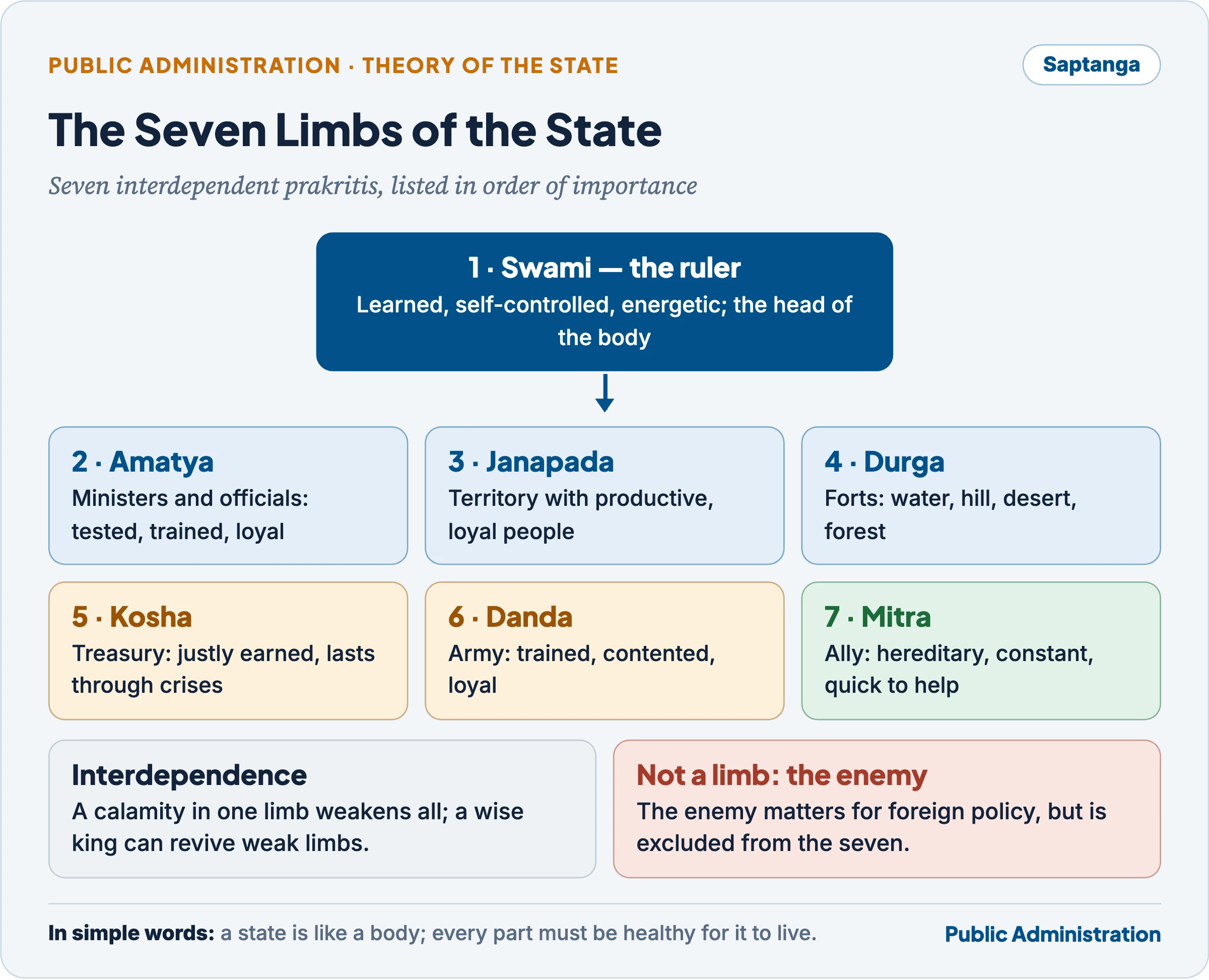
| Limb | Meaning | Ideal qualities in the text | Modern analogue |
|---|---|---|---|
| Swami | The ruler | Noble birth, learning, energy, self-control, truthfulness, foresight, a good council | Head of government |
| Amatya | Ministers and high officials | Native, well-born, trained, honest, tested, loyal | Council of ministers and civil service |
| Janapada | Territory with its people | Fertile, rich in mines, forests and water, defensible, with loyal and hard-working people able to pay taxes | Territory and population |
| Durga | Fortified capital and forts | Strong forts of four types: water, hill, desert and forest | Defence infrastructure |
| Kosha | Treasury | Justly acquired, rich in gold and silver, able to last through long calamities | Public finance |
| Danda | Army (coercive power) | Hereditary, loyal, well-trained, contented | Armed forces and police |
| Mitra | Ally | Hereditary, constant, able to mobilise quickly, unlikely to break away | Strategic partners |
- An organic view. The seven are compared to the limbs of a body. They are interdependent: a defect in one weakens all. Book VIII discusses the calamities (vyasanas) of each limb and asks which calamity is graver, for instance whether a calamity of the ministers is worse than one of the king.
- Order of importance. The list is in descending order of importance, with the king first. Kautilya holds that a wise king can make even weak elements prosperous, while a wicked king destroys even the most prosperous and loyal ones. Yet he also says that sovereignty is possible only with assistance: “a single wheel can never move”, so the king must employ ministers.
- The people are inside the janapada. The text does not list the citizens separately; they are part of the janapada. Its ideal population is loyal, productive and able to bear taxation, which shows that the subjects are seen mainly as the base of the state’s strength.
- The ally is a limb, the enemy is not. The mitra belongs to another state, but it is counted because no state can survive alone. The enemy is discussed alongside the prakritis in Book VI, but the text expressly excludes it from the seven limbs.
- Comparison with modern theory. Modern political science names four elements of the state (population, territory, government, sovereignty). Kautilya’s list is more concrete and administrative: it adds the treasury, the army, forts and allies, recognising that finance, force and foreign support are what turn a legal state into a functioning one.
Common confusion
Is the enemy the eighth element of the state in the Arthashastra? No. Some notes list eight elements including the enemy. The text names seven prakritis (swami, amatya, janapada, durga, kosha, danda, mitra) and, after describing the worst kind of enemy, says that the seven, excepting the enemy, are the limb-like elements of sovereignty. The enemy matters for foreign policy (the mandala), not as a constituent of the state.
2.3 The aims of the state: yogakshema, protection and welfare
- Rakshana and yogakshema. The king’s first duty is rakshana or palana, the protection of the subjects and their property against both natural calamities and anti-social elements. Beyond protection lies yogakshema: yoga is the successful acquisition of what one does not have, and kshema the secure enjoyment of what one has. Together they mean welfare, prosperity and security.
- The welfare duties in Book II. The king must:
- maintain orphans, the aged, the infirm, the afflicted and the helpless, and provide for helpless pregnant women and their newborn children;
- protect agriculture from oppressive fines, forced labour and taxes, and help cultivators with seed, cattle and money;
- build reservoirs, roads, trade routes and market towns, and help people who build reservoirs of their own accord;
- relieve famine by distributing seed and provisions, starting public works and, if needed, drawing on the stores of the rich or of allies;
- make relatives who neglect dependants pay fines, and make village elders guard the property of minors.
- An economic state. The state runs mines, forests, manufactories, shipping, salt and liquor as state enterprises, regulates prices, weights and measures, and protects consumers against cheating merchants and artisans and labourers against breach of contract. This is a regulatory and entrepreneurial state, not a minimal one.
- “Neither a police state nor merely a tax-gathering state.” The phrase sums up this mix. The Kautilyan state certainly uses danda (coercion) and certainly collects revenue intensively, but both are means. The ends are security, prosperity and the maintenance of social order. A ruler who neglects welfare, Kautilya warns, will fall victim to the fury of his own subjects (prakritikopa) or to his enemies.
- The limits of this welfare state. The welfare is paternal and hierarchical. The king protects the varna and ashrama order (the social order of castes and stages of life), and the text accepts slavery (while regulating it) and inequality between castes. The subjects are beneficiaries, not citizens with rights. It is a welfare state of a benevolent monarchy, not of a democracy.
Indian Connect — Welfare goals in the Constitution
Several Directive Principles of State Policy read like a modern restatement of yogakshema: Article 38 (a social order securing justice and welfare), Article 39 (adequate livelihood, distribution of resources for the common good), Article 41 (public assistance in old age, sickness and disablement), Article 42 (maternity relief) and Article 47 (nutrition and public health). The difference is that the Constitution places these duties in a democratic, rights-based framework where the state answers to elected representatives and courts, not to the conscience of a king.
3. The King and Rajadharma
In simple words
The king in the Arthashastra holds great power, but he is expected to work very hard, control his own desires, listen to advisers, be easy to reach, and treat the happiness of his people as his own happiness.
3.1 Training and qualities of the ruler
- Discipline of the senses. The king must conquer the six enemies of the self: lust, anger, greed, vanity, haughtiness and overjoy (kama, krodha, lobha, mana, mada, harsha). Kings who gave way to them, the text says, perished with their kingdoms.
- The sage-king. A king who controls his senses, keeps company with the learned, sees through his spies, is ever active and does good to the people is a rajarshi (royal sage). Unlike Plato’s philosopher-king, he is not an ascetic: he may enjoy the three goals of life in balance, provided he does not violate righteousness and economy.
- Training. The prince studies philosophy and the Vedas under teachers, economics under the superintendents of departments, and dandaniti under theoretical and practical politicians. Learning, for Kautilya, produces discipline (vinaya), and discipline is the foundation of good rule.
- Qualities listed in Book VI. Noble birth, valour, truthfulness, gratitude, high aims, enthusiasm, freedom from procrastination, a council of good ministers, love of discipline, sharp intellect, memory, foresight, ability to reward and punish fairly, and freedom from passion, anger, greed, fickleness and back-biting.
3.2 Rajadharma: the duties of the king
Rajadharma means the duty of the ruler. Book I gives its most quoted statement:
“In the happiness of his subjects lies his happiness; in their welfare his welfare; whatever pleases himself he shall not consider as good, but whatever pleases his subjects he shall consider as good.” — Kautilya, Arthashastra I.19 (Shamasastry translation)
- The king as the first servant. Of a king, the text says, the religious vow is readiness to act, the sacrifice is the satisfactory discharge of duties, and the sacrificial fee is equal attention to all. Royal duty is redefined as public service.
- Energy as a virtue. “If a king is energetic, his subjects will be equally energetic”; if he is reckless, they will be reckless too and eat into his works. The root of wealth is activity, the root of evil its reverse.
- The first manual of time management. The king’s day and night are each divided into eight parts. The day’s parts are assigned to accounts of receipts and expenditure, the affairs of citizens and country people, study, revenue and appointment of superintendents, correspondence with the council and reports of spies, rest, inspection of the army, and military planning; the night’s parts to secret agents, sleep, reflection on the sciences and the next day’s work, and consultations. The schedule may be adapted to the king’s capacity.
- Accessibility. The king must never keep petitioners waiting at the door. A ruler who makes himself inaccessible and leaves work to his immediate officers causes confusion in business and public disaffection. He must personally hear matters concerning temples, learned men, cattle, sacred places, minors, the aged, the afflicted, the helpless and women, and must attend to urgent matters at once, because postponed problems become impossible to solve.
- Justice and protection. The king is the fountain of justice (dharmapravartaka). A king who does not protect his people wields the sceptre in vain. If stolen property of citizens cannot be recovered, the king must make it good from his own treasury; if he punishes an innocent man, he must offer thirty times the fine as an expiation.
3.3 Was the Kautilyan king absolute?
The text gives the king the last word in appointments, policy, justice and war. But it also hedges royal power with many indirect restraints.
- Moral and educational restraints: the king’s training, the requirement to follow the science, and the duty of the purohita (high priest) and teachers to warn him of careless conduct.
- Institutional restraints: the expectation that every major measure is preceded by deliberation in a council; in an emergency the king must do what the majority of the council advises.
- Fixed emoluments: the highest salary (48,000 panas) is fixed by the text for the senior-most figures around the throne, which implies that the royal establishment is a charge on revenue under rules, not the king’s private property.
- Political restraint: the constant fear of prakritikopa (anger of the subjects). An oppressive, greedy or lazy king, Kautilya warns repeatedly, will be overthrown by his own people or conquered by enemies.
- Some interpreters therefore describe the Kautilyan king as almost a “constitutional slave” of his duties. Others note that none of these restraints is enforceable: there is no assembly that can remove him, no ministerial responsibility to a legislature, no independent judiciary and no fundamental rights.
| Point | Kautilyan ruler | Modern democratic ruler in India |
|---|---|---|
| Source of authority | Heredity, divine aura and protection of subjects | Elected majority; the Constitution |
| Tenure | For life; removal only by revolt or conquest | Fixed term; can lose a no-confidence motion or an election |
| Accountability | Moral, to dharma and the subjects’ contentment | Legal and political: to Parliament, courts, CAG, media, voters |
| Ministers | Chosen and dismissed by the king; responsible to him | Collectively responsible to the Lok Sabha (Article 75(3)) |
| Rights of the people | Benefits granted by a benevolent king | Enforceable fundamental rights |
| Welfare | Paternal duty | Constitutional directive and statutory entitlement |
| Information | Spies and personal hearings | RTI, grievance portals, audit, free press |
The table shows that the ethic of the Kautilyan ruler (the people’s welfare as the ruler’s own) is close to modern ideals of public service, but the institutions that enforce it are absent. Modern democratic rulers face far more formal checks; yet many of them fall short of the personal discipline, accessibility and constant activity that Kautilya demanded of a king.
4. Ministers, Council and the Machinery of Government
In simple words
No king can do everything alone. Kautilya describes a small group of close advisers, a larger council, about eighteen top officials, and around thirty heads of departments, all arranged in a clear chain of command.
4.1 Amatya, mantrin and the mantriparishad
- Terms. The text uses amatya, sachiva and mantrin in overlapping ways. Broadly, amatya denotes all high officers of the state, whether counsellors or executive heads of departments; mantrin denotes the inner counsellors whose main function is to give advice (mantra). The mantrins need higher qualifications than ordinary amatyas.
- The inner body: three or four mantrins. Kautilya rejects the view (of Bharadvaja) that the king should deliberate alone, and the view that he should consult endlessly. He advises three or four counsellors: one alone acts wilfully and cannot reach a balanced conclusion on complex issues; two may combine against the king or quarrel; with more than four, decisions become slow and secrecy is hard to keep. Depending on the matter, the king may still consult one or two, or decide alone.
- The five elements of deliberation. Every proposal is examined under five heads: the means of starting the work; the men and material required; the place and time; remedies against failure; and final success.
- Secrecy of counsel. Deliberations must be so secret that “even birds cannot see them”. Carelessness, intoxication, talking in sleep and love are listed as causes of leaks, and anyone who discloses counsel is severely punished.
- The mantriparishad (council of ministers). Below the mantrins is a larger council. Earlier schools fixed its size at 12 (Manu), 16 (Brihaspati) or 20 (Ushanas); Kautilya says it should have as many members as the needs of the dominion require. Its functions are:
- to start work not yet begun;
- to complete what has been begun;
- to improve what has been accomplished;
- to enforce strict obedience to orders.
- Majority rule in emergencies. The god Indra, the text says, has a council of a thousand sages who are his “eyes”, which is why he is called thousand-eyed. In an emergency the king must call both the mantrins and the mantriparishad and act on what the majority advises or on whatever course promises success. Distant members are consulted by writs.
- Not a cabinet. Some writers compare the mantrins to a modern cabinet and the mantriparishad to the wider council of ministers, but the analogy is weak. The ministers were appointed and removed by the king, held office at his pleasure, could be consulted individually or not at all, and had no collective responsibility to any elected body. Their role was advisory and executive, not constitutional.
4.2 The eighteen tirthas: high officers of state
Kautilya places the senior officials in eighteen tirthas (high offices). The list below gives the main ones and their modern equivalents.
| Office | Role | Rough modern parallel |
|---|---|---|
| Mantrin | Chief counsellor | Prime Minister or senior cabinet minister |
| Purohita | High priest and moral adviser | Moral and ceremonial guide; no modern parallel |
| Senapati | Head of the army | Defence Minister or service chief |
| Yuvaraja | Crown prince | Heir; may lead armies |
| Dauvarika | Chief of palace attendants | Head of the royal household |
| Antarvamshika | Chief of the king’s guards | Head of personal security |
| Prashastri | Head of the secretariat and records; magistrate | Cabinet or Chief Secretary |
| Samahartri | Collector-general of revenue | Finance and Revenue Minister; also home administration of the countryside |
| Sannidhatri | Treasurer-general and keeper of stores | Treasury and stores |
| Pradeshtri | Commissioner; criminal justice and inspection | Divisional Commissioner or magistrate |
| Nayaka | City constable or military chief | Police commissioner |
| Paura (nagaraka) | Governor of the capital | Municipal commissioner |
| Vyavaharika | Chief judge or superintendent of transactions | Chief Justice of civil courts |
| Karmantika | Superintendent of factories and mines | Industries |
| Mantriparishadadhyaksha | President of the council | Cabinet coordinator |
| Dandapala | Officer of the army department | Military logistics |
| Durgapala | Guardian of forts | Internal defence |
| Antapala | Warden of the frontiers | Border management |
| Atavika | Officer in charge of forest tribes | Forest and tribal administration |
The list shows a government organised around functions (finance, justice, security, economy), with the king at the top of every line.
4.3 Samahartri and sannidhatri: the twin pillars of finance and field administration
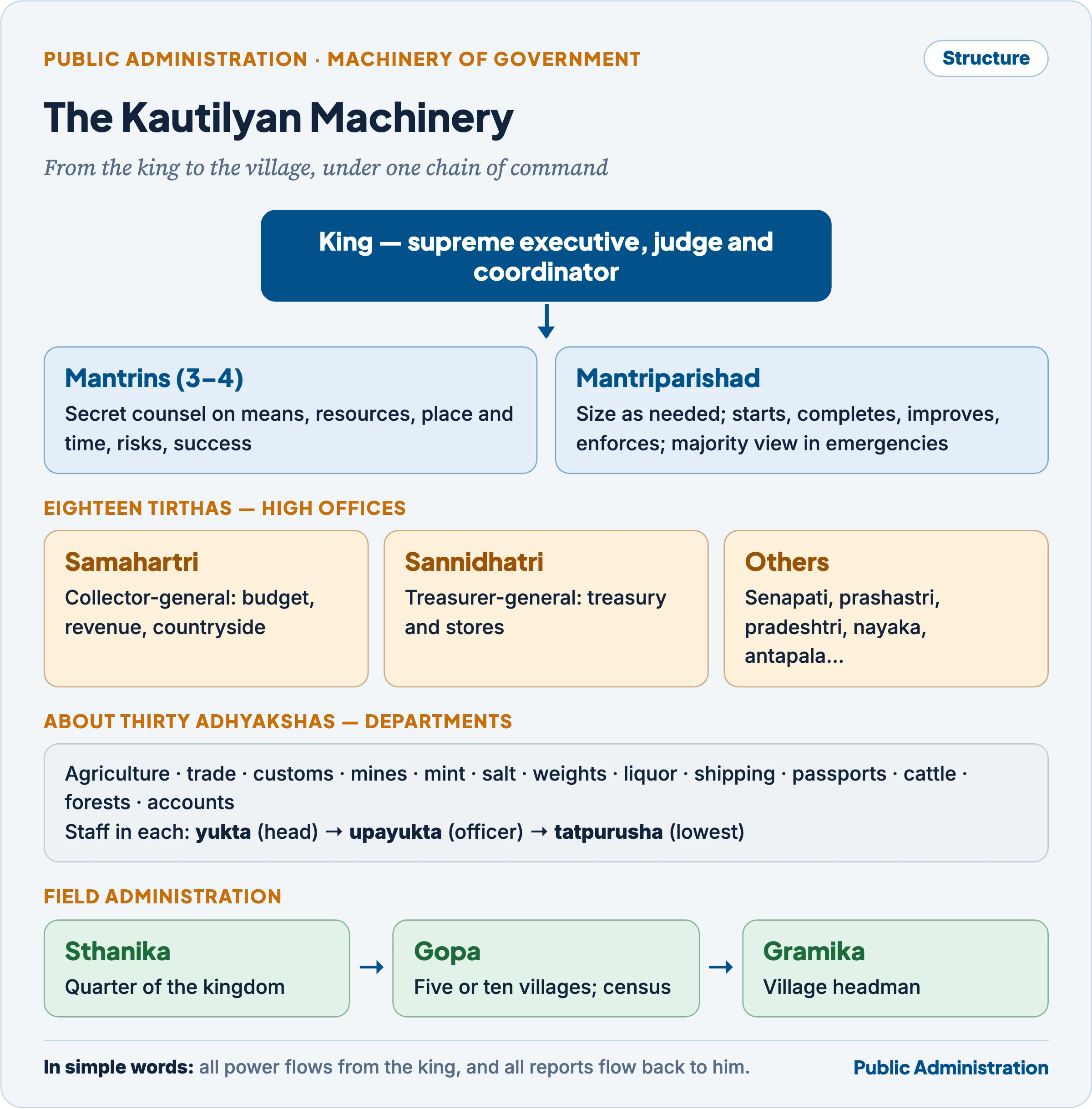
- The samahartri (collector-general). He prepares the annual budget, fixes the revenue expected under each of the seven heads of income, keeps the accounts and tries to correct any excess of expenditure over income. He is also the administrative head of the countryside (everything except the fortified capital), with the sthanikas and gopas under him and the pradeshtris to suppress crime. He is therefore part finance minister and part home minister.
- The sannidhatri (treasurer-general). He is in charge of stores: the treasury, warehouses of grain, forest produce, the armoury and even the prison. He maintains the secret reserve built up for emergencies.
- Dual control. The superintendents of revenue-earning departments are under the samahartri for revenue and personnel, and under the sannidhatri for the supply of goods, with the king’s control over both. This is an early form of the separation of collection, custody and accounting of public money, a basic principle of financial control today.
4.4 The adhyakshas: superintendents and departments
Book II describes the duties of about thirty superintendents (adhyakshas), each the head of a department.
- Kinds of departments. The superintendents fall into four broad groups:
- in charge of state goods and stores (treasury, storehouse, armoury, forest produce);
- in charge of state establishments (accounts office, mint, weaving, slaughterhouses, prisons);
- in charge of mining and industry (mines, metals, gold, salt);
- regulating trade and economic life (commerce, tolls and customs, weights and measures, liquor, shipping, passports, pastures).
- Examples. The sitadhyaksha (agriculture on crown lands), panyadhyaksha (trade and prices), shulkadhyaksha (tolls and customs), akaradhyaksha (mines), lakshanadhyaksha (mint), lavanadhyaksha (salt), pautavadhyaksha (weights and measures), suradhyaksha (liquor), navadhyaksha (shipping and ports), mudradhyaksha (passports), godhyaksha (cattle), kupyadhyaksha (forest produce) and akshapataladhyaksha (accounts and records).
- Expert help and joint working. Superintendents work with accountants, writers, coin-testers, treasurers and supervisory officers, and are assisted by technical experts. A department is to be run by several temporary heads, which prevents any one officer from building a private empire.
- Departments by function. Departments are arranged according to the services needed by the people and provided by the government, mostly horizontally by subject; the revenue department under the samahartri, with its commissioners, district officers and village officers, is a vertical, territorial arrangement.
4.5 Principles of administration in the Arthashastra
The machinery rests on principles that modern administrative theory would recognise. They can be grouped into two sets.
- Principles of authority and obligation
- Authority, obedience and discipline: the king’s danda keeps people to their duties; without it matsyanyaya returns.
- Duty and interest: obedience is secured not only by fear but by duty (the injunctions of the Vedas) and interest (pay, promotion, permanence, land, help in illness and at funerals).
- Responsibility: each officer answers for his work and is liable to make good losses caused by negligence.
- Principles of organisation
- Division of labour: “sovereignty is possible only with assistance”; work is divided among ministers and departments, and the workload of departments such as agriculture is described in detail.
- Coordination: the natural corollary of division of work; the king, with his council, is the chief coordinator.
- Hierarchy: three grades of amatyas (highest, middle, lowest); in each department the yukta (head), upayukta (subordinate officer) and tatpurusha (lowest servants); a scale of more than seven rungs by salary.
- Unity of command: all officers derive authority from the king and answer to him; orders flow through royal writs.
- Specialisation and job classification: special qualifications for special posts; the more responsible the office, the more numerous and higher the qualities required.
- Uniformity: the same practices and standards (of weights, accounts, writs) across the kingdom.
- The written word and records. Writs, registers, sealed account books and statistics on land, households and livestock show a records-based administration. Kautilya even specifies the design of the accounts office (door facing north or east, separate seats for clerks, shelves for account books), an early attention to office layout.
- Gaps. As modern commentators note, the links between parts of the machinery are not always clear: the relationship of superintendents to ministers, the exact chain from district to village, and the place of justice in the hierarchy are left vague. The text gives principles and detail, but not a single organisation chart.
Indian Connect — Kautilyan principles in today’s machinery
The Government of India (Allocation of Business) Rules, 1961 and (Transaction of Business) Rules, 1961, framed under Article 77(3), divide work among ministries and fix who may decide what: a modern form of Kautilya’s division of labour and coordination. The Cabinet Secretariat and Cabinet committees coordinate as the mantriparishad was meant to; the Central Secretariat Manual of Office Procedure prescribes the written trail of files and orders that Kautilya’s writs and registers anticipated.
5. Personnel Administration
In simple words
Kautilya cared a great deal about who works for the state. He wanted officials chosen for ability, tested for honesty, paid well enough to resist temptation, rewarded for good work, moved around to stop corruption, and punished when they failed.
5.1 Qualifications and recruitment
- Merit proved in work. In Book I Kautilya reviews seven views on whom to appoint as ministers: classmates, those who share the king’s secrets, those who proved loyal in danger, those who raised revenue, sons of former ministers, new men learned in theory, or men of good family with practical wisdom. He concludes that appointments must depend on qualifications, and that ability is inferred from capacity shown in work. Theory without experience, he says through one of the schools, leads to serious blunders in practice.
- The qualities sought. A minister should be a native of the country, of good family, trained in the arts and sciences, intelligent, of good memory, eloquent, bold, upright, friendly, firm in loyalty, healthy, energetic and free from vices. The key general qualities are sattva (energy and courage), prajna (intelligence) and vakyashakti (power of expression).
- How qualities are checked. Origin and family are checked through trusted persons; learning through experts; intelligence, perseverance and dexterity through performance in work; eloquence and presence of mind through conversation; endurance through behaviour in troubles; integrity and loyalty through associates and the upadha tests.
- Who appoints. Officers drawing 1,000 panas and above are appointed by the king with the advice of the high priest and the chief minister. Superintendents of groups of a hundred or a thousand may regulate the pay, appointment and transfer of the staff under them, an early form of delegation of personnel powers.
- Persons to avoid. The king should not entrust money to the mulahara (one who has squandered his inheritance), the tadatvika (one who spends all he earns) or the kadarya (the miser who hoards at the cost of his own family).
5.2 The upadha tests of integrity
Ministers appointed to ordinary departments are tested secretly, through trusted spies, by four kinds of allurement (upadha). The result decides where each officer is posted.
| Test | How it was applied | Officer who passes it is posted to |
|---|---|---|
| Dharmopadha (religious allurement) | A dismissed priest invites him to join a plot to replace an “unrighteous” king | Civil and criminal courts |
| Arthopadha (monetary allurement) | A dismissed commander offers great wealth for joining a plot | Revenue collection and the treasury |
| Kamopadha (allurement of desire) | A woman agent claims the queen desires him and promises wealth | Pleasure grounds and the palace precincts |
| Bhayopadha (allurement under fear) | Officers are arrested on a pretext and then incited to rebel | Immediate personal service of the king |
| Passes all four | Mantrin (chief counsellor) | |
| Fails | Mines, forests and factories, away from sensitive work |
- The idea. Integrity is not one quality but several; a man who resists money may yield to fear. Matching the kind of integrity to the kind of post is a remarkably modern idea, close to today’s sensitive-post and vigilance-clearance practices.
- Kautilya’s own caution. He rejects the view that the king or queen should be used as bait, because a pure mind once tempted may not recover its original state, “like water vitiated with poison”. The tests should therefore use an external object as the bait. This shows awareness that testing itself can corrupt.
- Critique. The method rests on entrapment and deception by the state. Modern law treats entrapment of honest officers with suspicion, and the tests reveal more about the king’s fear of conspiracy than about competence. Their underlying idea, verifying integrity before entrusting power, survives in police verification, character certificates and integrity checks.
5.3 Training
- The prince’s training is elaborate, but there is little on training of officials after appointment, apart from the daily drill of the army at sunrise, which the king himself should watch. Kautilya seems to assume that officials enter service already learned and already tested, and learn on the job under supervision.
5.4 Pay, allowances and pension
- A cap on the wage bill. The king should keep the cost of maintaining his servants within one-fourth of the total revenue. This is an early fiscal rule on establishment expenditure.
- Liberal pay to prevent temptation. Salaries are fixed on a generous scale so that officers will “scarcely yield to temptation and hardly be discontented”. The scale is given in Book V:
| Rank (examples) | Annual pay in panas |
|---|---|
| Sacrificial priest, teacher, chief minister, purohita, commander of the army, crown prince, king’s mother, queen | 48,000 |
| Doorkeeper, chief of the harem guards, prashastri, samahartri, sannidhatri | 24,000 |
| Princes, city constable, governor of the town, judge, superintendent of factories, members of the council, wardens of country and frontiers | 12,000 |
| Chiefs of military corporations and of army wings, commissioners | 8,000 |
| Superintendents of infantry, cavalry, chariots, elephants; guards of forests | 4,000 |
| All superintendents of departments; astrologers, story-tellers | 1,000 |
| Trained soldiers, accountants and writers | 500 |
| Artisans and carpenters | 120 |
| Attendants, labourers, bodyguards | 60 |
- Payment in kind. When money is short, pay may be given partly in forest produce, cattle or fields, but the king should not grant whole villages, which would create a hereditary landed class outside his control.
- Social security. The wives and sons of servants who die on duty receive their subsistence and wages; infants, the aged and sick relatives of deceased servants are also helped; the king gives presents on funerals, sickness and childbirth. This is an early form of family pension and welfare measures, though no pension after retirement is mentioned.
- Pay rises for learning and work. The king should increase subsistence and wages in consideration of learning and work: pay linked to qualification and performance.
- The spread of pay. The highest annual pay is 48,000 panas and the lowest 60 panas, a ratio of 800 to 1; the purohita is in the top grade. (Figures of 4,800 panas for the top salary, found in some accounts, are a slip.)
5.5 Promotion, permanence and transfer
- Performance-based reward. Superintendents who bring in as much as or more than the fixed revenue are to be honoured with promotion and rewards; those who increase revenue and are loyal are to be made permanent. There are no fixed rules of promotion by seniority.
- Transfer as an anti-corruption tool. Officials are to be transferred from one work to another so that they can neither misappropriate money nor “vomit what they have eaten”. The exception: officers guarding royal buildings, forts and country parts are not to be transferred; they should be many and permanent, because security posts need continuity.
- No leave and personal liability. No leave is provided. If an employee absents himself, his sureties or dependants must make good the loss. Every official is liable to punishment if found corrupt, slack or oppressive to the people.
5.6 Supervision and conduct of officials
- Daily examination. Superintendents are to be examined daily “for men are naturally fickle-minded and like horses at work exhibit constant change in their temper”. The agency, tools, place, time, form of work, outlay and results are always to be checked.
- Neither collusion nor discord. Officers must work “without dissension and without any concert among themselves”: “when in concert they eat up the revenue; when in disunion they mar the work”. This captures a permanent dilemma of control: coordination can turn into collusion.
- No unauthorised action. Officers must undertake nothing without the king’s knowledge, except remedial measures against imminent danger. A fine of twice the daily pay is fixed for negligence.
- Conduct of courtiers. Book V advises officers to behave with dignity, avoid arrogance and flattery, and read signs of the king’s displeasure. It shows that service was at the king’s pleasure, with no tenure protection of the kind Article 311 now gives civil servants.
Indian Connect — Kautilyan ideas in Indian personnel administration
Merit-based entry through the UPSC (Article 315), probation before confirmation, vigilance clearance before empanelment and promotion, identification of sensitive posts with rotational transfer, the Conduct Rules (All India Services (Conduct) Rules, 1968; Central Civil Services (Conduct) Rules, 1964), family pension to dependants, and pay revision by Central Pay Commissions all echo Kautilyan concerns. The capacity-building agenda of Mission Karmayogi (launched September 2020) adds what Kautilya largely left out: structured training after recruitment.
6. Corruption and Its Control
In simple words
Kautilya assumed that anyone handling public money would be tempted to take some of it, and that such theft is very hard to see. So he listed the ways officials cheat, and built many checks: spies, audits, rewards for informers, compensation for victims, transfers and heavy fines.
6.1 Realism about corruption
Kautilya’s starting point is a frank view of human nature in office. Three similes in Book II make the point:
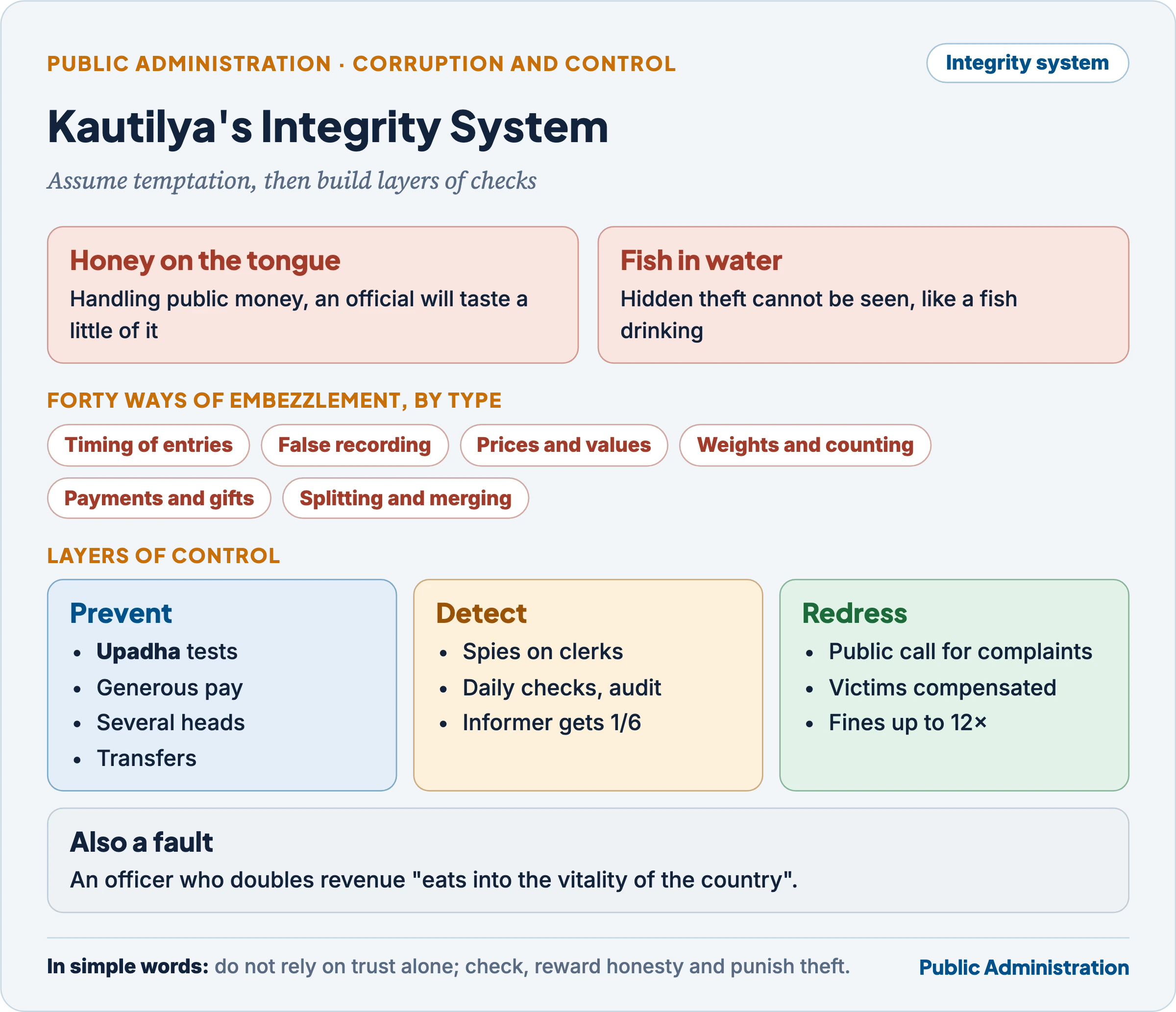
- Honey on the tongue. Just as it is impossible not to taste honey or poison placed on the tip of the tongue, it is impossible for a government servant not to eat up at least a bit of the king’s revenue.
- Fish in water. Just as fish moving under water cannot be seen drinking or not drinking, officials employed in government work cannot be found out while taking money.
- Birds in the sky. It is possible to mark the flight of birds high in the sky, but not the movements of officials of hidden purpose.
The lesson is that corruption is structural, not exceptional: it arises from opportunity and information advantage, and so must be met by systems rather than trust alone.
6.2 What depletes the treasury
The chapter on embezzlement opens with “All undertakings depend upon finance; hence foremost attention shall be paid to the treasury”. It lists eight causes that deplete the treasury, each with its fine.
| Fault | Meaning | Penalty in the text |
|---|---|---|
| Pratibandha (obstruction) | Failing to start work, realise its results or credit profits | Ten times the amount |
| Prayoga (loan) | Lending treasury money on interest | Twice the profit |
| Vyavahara (trading) | Trading with government money | Twice the profit |
| Avastara (fabrication) | Falsifying the time of revenue collection | Ten times the amount |
| Parihapana (causing loss) | Reducing fixed income or inflating expenditure | Four times the loss |
| Upabhoga (self-enjoyment) | Using the king’s property for oneself or others | Death for gems; lesser fines for other goods |
| Parivartana (barter) | Exchanging government articles for one’s own | As for self-enjoyment |
| Apahara (defalcation) | Not crediting collections, not spending as ordered, misreporting net revenue | Twelve times the amount |
6.3 The forty ways of embezzlement
Kautilya then lists about forty ways of embezzlement. They can be grouped into a few types, each still recognisable in audit reports today.
- Timing frauds: entering early receipts late and late receipts early; paying too early or too late; not collecting what is due; showing hard-to-collect revenue as collected.
- Recording frauds: showing collected sums as uncollected and uncollected sums as collected; entering part payments as full and full payments as part; entering one source or one item in place of another; entering a false donee.
- Valuation and quantity frauds: exchanging costly goods for cheap ones and the reverse; raising or lowering prices; false weights and measures; false counting; misstating the fineness of gold and silver.
- Payment frauds: paying what is not payable and not paying what is; inflating small gifts into large ones and reducing large ones; entering unpaid raw materials and omitting paid ones.
- Aggregation and calendar frauds: splitting a lump sum into scattered items or merging scattered items; adding or removing days in wage records; months not matching the year or days the month.
6.4 The toolkit of control
Kautilya does not stop at listing frauds. He builds a layered system of prevention, detection and punishment.
- Prevention
- Integrity tests before appointment and matching of posts to tested qualities.
- Liberal pay to reduce need and resentment.
- Several temporary heads for each department and joint working with accountants and treasurers, so that no single officer controls a transaction.
- Rotation by transfer, except in security posts.
- Detection
- Spies placed among accountants and clerks; Kautilya holds, against his teacher, that “cases of embezzlement can be ascertained through spies alone“, not merely by comparing income and expenditure.
- Daily examination of work and annual audit in the accounts office.
- Separate examination of everyone in the chain of a transaction (treasurer, prescriber, receiver, payer, the person who caused payment, the officer’s assistants); anyone who lies is punished like the chief offender.
- Rewards to informers: an informant who proves an embezzlement gets one-sixth of the amount (one-twelfth if he is himself a government servant); a part proof earns a proportionate share. A false accuser is punished, which guards against malicious complaints.
- Redress and punishment
- Public proclamation inviting anyone harmed by the offending officer to come forward, and compensation equal to their loss: an early grievance-redressal and restitution mechanism.
- Confiscation of ill-gotten hoards and fines of up to twelve times the amount.
- An officer proved guilty of part of a large embezzlement is answerable for the whole.
- Special punishments for judges and officials who abuse their power (Book IV).
6.5 Over-zealous officers are also a danger
Kautilya warns against the opposite fault too.
- Whoever doubles the revenue “eats into the vitality of the country”: an officer who squeezes the people to impress the king is to be warned and, if the offence is grave, punished.
- Whoever spends without results “eats up the labour of workmen”.
- The test of a good officer is therefore honest and sustainable revenue, not the largest possible collection. This anticipates the modern distinction between efficiency and effectiveness, and the idea that over-extraction destroys the tax base.
Indian Connect — The Kautilyan toolkit and India’s anti-corruption framework
India’s framework reproduces many Kautilyan devices in legal form. The Prevention of Corruption Act, 1988 (amended in 2018 to make bribe-giving an offence and to add Section 17A, requiring prior approval to investigate decisions taken in official duties) mirrors the twin aims of punishing the corrupt and protecting the honest from harassment. The Central Vigilance Commission (statutory since 2003), the Lokpal and Lokayuktas Act, 2013, the Public Interest Disclosure and Protection of Informers Resolution, 2004 (whistle-blowing), rotational transfers from sensitive posts, and the CAG‘s audit perform the functions of Kautilya’s spies, informers and accounts office. On 13 January 2026 the Supreme Court delivered a split verdict on the validity of Section 17A, and the question was placed before a larger bench.
7. Revenue, Treasury, Budgeting and Audit
In simple words
For Kautilya the treasury was the backbone of the state, because the army, the officials and welfare all need money. He described where revenue should come from, how it should be collected without hurting the people, how it should be spent, and how every account should be written and checked.
7.1 The primacy of the treasury
- Kosha before danda. The army depends on the treasury: without money, soldiers cannot be raised or kept loyal. Kautilya therefore treats finance as the base of all state activity: “all undertakings depend upon finance”.
- A public, not private, treasury. The kosha must be justly acquired, rich enough to withstand long calamities, and is not the king’s personal property; even gifts to the king were to be entered in a record book.
7.2 Sources of revenue: the ayasharira
The samahartri collects revenue under seven heads, together called the ayasharira (“body of income”).
| Head | What it covers |
|---|---|
| Durga (forts and towns) | Tolls, fines, weights and measures, mint, passports, liquor, slaughterhouses, goldsmiths, gambling, artisans’ guilds |
| Rashtra (countryside) | Produce of crown lands (sita), the king’s share of produce (bhaga), religious taxes (bali), money taxes (kara), ferries, road cess |
| Khani (mines) | Gold, silver, gems, pearls, metals, salt |
| Setu (irrigated works and gardens) | Flower, fruit and vegetable gardens, wet fields, sugarcane |
| Vana (forests) | Game, timber and elephant forests |
| Vraja (herds) | Cows, buffaloes, goats, sheep, horses, camels |
| Vanikpatha (trade routes) | Land and water routes |
- Forms of revenue (ayamukha). Revenue comes as capital, share of produce, premia, fixed taxes, premia on coins and fixed fines.
- Land revenue. The customary share of the produce is one-sixth (shadbhaga). Crown lands are cultivated directly through the superintendent of agriculture.
- State enterprise as revenue. Mines, salt, forests, manufactories, liquor and state trade are run for profit. The state is the largest producer and trader.
- Canons of taxation. Kautilya’s maxims anticipate later canons:
- The ripe-fruit rule. Just as fruit is gathered from a garden when it is ripe, revenue should be collected when it is ripe; collecting unripe revenue injures the source and causes great trouble.
- Remissions that swell the treasury. The king should grant only such favours and remissions as will increase revenue in the long run; new settlements receive tax holidays in their early years.
- Emergency revenue. In a financial crisis the king may make special demands (pranaya), but only once and never twice, and may invite voluntary contributions.
- Do not oppress cultivators with fines, forced labour and taxes; a king with a depleted treasury, Kautilya warns, will eat into the vitality of citizens and country people.
7.3 Expenditure: the vyayasharira
- The vyayasharira (“body of expenditure”) lists the heads of spending: worship and gifts, the palace and kitchen, messengers, storehouses, the armoury, warehouses, factories, labour, the four wings of the army, cattle herds, and stores of firewood and fodder.
- Wage bill limit: within one-fourth of revenue.
- Profitable works are protected: the king “will have to suffer in the end if he curtails the fixed amount of expenditure on profitable works”, an early recognition of the value of capital and productive expenditure.
7.4 Budget, accounts and audit
- The budget. The samahartri fixes the revenue expected under each head and plans expenditure, and tries to correct any excess of expenditure over revenue. This is an early annual budget with a concern for balance.
- The accounting year. A working year is 354 days; accounts close at the end of the month of Ashadha (around mid-July), when officers present themselves with their sealed account books, commodities and net revenue. The intercalary month is calculated separately.
- The akshapatala (records and accounts office). It maintains registers of each department: the work and results of factories, profit and loss, delayed earnings, wages, labour used, prices and weights of goods, the customs and transactions of regions and corporations, grants and remissions, and even treaties and tributes. From these registers the superintendent of accounts prepares statements of works in hand, works accomplished, partly finished works, receipts, expenditure, net balance and works to be undertaken.
- Audit procedure. Accounts are examined by department and in aggregate; discrepancies attract fines; accountants who fail to present themselves on time, or to produce their books with the net revenue, are fined ten times the amount due. The king is to hear the accounts in a council meeting and personally attend to receipts and expenditure each morning.
- A limitation. Accounts and audit are kept in the same office under the superintendent of accounts, so there is no strict separation of audit from accounts, although a separate audit procedure is laid down. The independence that Article 148 later gave the CAG has no Kautilyan counterpart.
7.5 Planning and the role of the state in the economy
- Control rather than development planning. The Arthashastra’s “planning” is budgetary and regulatory: fixing expected revenue from each activity and controlling its collection. Modern planning sets multi-year development priorities and allocates resources to them; the Kautilyan emphasis is on control, the modern one on development.
- Regulation of markets. The superintendent of commerce fixes fair prices and allows a profit of five per cent on local goods and ten per cent on foreign goods, prevents hoarding and adulteration, and protects buyers; weights and measures are standardised and stamped; artisans who breach contracts and weavers who short-change customers are fined. This is early consumer protection and market regulation.
- Public goods. Roads, irrigation, forts, market towns and the settlement of new villages are state responsibilities: the state creates the infrastructure for private prosperity.
Indian Connect — From the akshapatala to the CAG
The Kautilyan scheme of budget, registers and audit has its constitutional counterparts in the Annual Financial Statement (Article 112), Appropriation Acts (Article 114), the Comptroller and Auditor General (Articles 148–151), whose current incumbent is K. Sanjay Murthy (since November 2024), and Parliament’s Public Accounts Committee. Kautilya’s cap on the wage bill and his warning against over-extraction have modern echoes in the Fiscal Responsibility and Budget Management Act, 2003 and in Finance Commission norms. The big difference is independence: Kautilya’s accountant served the king, while the CAG audits the executive on behalf of Parliament.
8. Justice, Law and Codification
In simple words
Kautilya believed that punishment, applied fairly, keeps society in order. He set out four sources of law, said that the king’s written orders could override older custom when needed, and described courts for civil disputes and for crimes.
8.1 Danda: punishment as the instrument of order
- Proportionate punishment. Kautilya rejects his teacher’s advice that the king should always keep the rod raised. A ruler who punishes severely becomes hateful; one who punishes mildly is despised; one who punishes as deserved is respected. Punishment awarded with due consideration makes people devoted to righteousness and to productive work; punishment awarded from greed, anger or ignorance angers even forest hermits.
- Impartiality. Power, exercised impartially and in proportion to guilt, whether against the king’s son or his enemy, sustains this world and the next.
8.2 The four sources (legs) of law
Book III names four “legs” of law, each with a different basis.
| Source | Meaning | Basis |
|---|---|---|
| Dharma | Sacred law; eternal truth | Scriptures (dharmashastras) |
| Vyavahara | Evidence and transactions | Witnesses and documents in a dispute |
| Charitra | Custom and usage | The tradition of the people, castes, guilds, regions |
| Rajasasana | Royal edict | The king’s written order |
- The later prevails over the earlier. Of the four, each later one is superior to the one before. The king’s edict therefore overrides custom, custom overrides evidence, and so on. In practice this gives positive law made by the state priority over religious tradition.
- Reason over scripture. Where sacred law conflicts with rational law (the king’s law based on justice), reason prevails, because the original text on which the sacred law rests may be lost.
- Secular tendency. This ordering places politics above religion in matters of governance. Religion remains a source of values, but the state decides.
8.3 Why Kautilya favoured codification and written orders
The text opens its chapter on royal writs by noting that kings depend on edicts, and that treaties and war have their roots in writs. Several reasons for Kautilya’s preference for written, codified law can be drawn from the text.
- Uniformity and predictability: a written rule applies the same way across a large kingdom, to every officer and subject; Kautilya insists on uniform administrative practice.
- Control of discretion: written orders and registers bind officials and leave a trail that can be checked; without them, officials could act on whim and conceal misconduct.
- Accountability within the hierarchy: authority flows from the king, and the writ proves who ordered what.
- Administration at a distance: a large empire cannot be run by oral command; distant ministers are consulted and instructed by writs.
- Diplomacy: treaties, ultimatums and alliances depend on precise written terms.
- Overriding outdated custom: the rajasasana allows the state to reform custom where needed.
- The craft of drafting. The lekhaka (writer) must have ministerial qualifications, know customs, compose well and write legibly. A writ needs orderly arrangement, relevance, completeness, sweetness, dignity and lucidity; its faults are clumsiness, contradiction, repetition, bad grammar and misarrangement. The text lists thirteen purposes of writs (such as command, prohibition, inquiry, persuasion and threat) and kinds of writs (of information, command, gift, remission, licence, guidance, reply and general proclamation).
Common confusion
Does Kautilya’s support for written law amount to the modern rule of law? Only partly. Codified rules and written orders give predictability and limit officials’ discretion, which is one element of the rule of law. But in the Arthashastra the king’s edict is the highest law, the king is not bound by the courts, and there are no rights enforceable against the state. The modern rule of law, in Dicey’s sense and under the Indian Constitution, places the government itself under the law; Kautilya places the law under the king, though he expects the king to obey dharma and reason.
8.4 Courts and procedure
- Two kinds of courts.
- Dharmasthiya courts (civil): presided over by three judges learned in sacred law (dharmasthas) and three ministers (amatyas), they decide disputes on contracts, debts, deposits, marriage, inheritance, property, labour and partnership.
- Kantakashodhana courts (“removal of thorns”): presided over by three commissioners (pradeshtris) or three ministers, they deal with crime and threats to public order, including fraud by artisans and merchants, misconduct of officials, and the investigation of suspects.
- Location. Courts sit in the sangrahana (centre of ten villages), dronamukha (centre of four hundred), sthaniya (centre of eight hundred) and at places where districts meet, with the king’s court at the top.
- Procedure. The year, month, date, place, amount and the names, residence, caste and occupation of the parties are registered first; statements are recorded in order and scrutinised. Shifting one’s case, contradicting oneself or conferring secretly with witnesses is the offence of parokta, punished with fines. Witness costs are paid by the losing party; the defendant gets three to seven nights to prepare a defence.
- Validity of agreements. Agreements made in secret, at night, in forests or by fraud are void, except where the circumstances make them natural (for instance traders who work at night, or forest dwellers). Agreements by minors, the very old, the intoxicated, the insane or dependants without authority are invalid. Many of these rules resemble modern contract law.
- Judges under the executive. Judges are appointed by the king and can be removed by the samahartri for injustice, slackness or corruption; ministers sit with jurists on the bench. There is no separation of the judiciary from the executive, a sharp contrast with Article 50 of the Constitution.
- Limits on coercion. The text allows torture of suspects whose guilt appears probable, which no modern system accepts, but it exempts pregnant women and women within a month of childbirth, halves the standard for women, bars the arrest of a suspect three days after a crime without strong evidence, and insists on conclusive evidence, warning that innocent people have confessed under fear of torture.
8.5 The range of law
The Arthashastra’s law covers contracts, debts, deposits and pledges, sale and purchase, partnership, labour and wages, marriage, divorce in some circumstances, women’s property (stridhana), inheritance and partition, boundaries and property, defamation, assault, theft, robbery and sexual offences, as well as consumer protection and the regulation of professions. This breadth makes it one of the earliest comprehensive civil and criminal codes in the world.
Indian Connect — Codification in modern India
India’s own history of codification runs from colonial codes to their replacement. The Bharatiya Nyaya Sanhita, Bharatiya Nagarik Suraksha Sanhita and Bharatiya Sakshya Adhiniyam (enacted 2023, in force from 1 July 2024) replaced the Indian Penal Code, the Code of Criminal Procedure and the Indian Evidence Act. The Jan Vishwas (Amendment of Provisions) Act, 2026 (assent 7 April 2026), which amended 784 provisions of 79 central Acts and decriminalised 717 of them, applies a Kautilyan idea in modern form: punishment proportionate to the wrong, neither too harsh nor too mild.
9. Espionage and Internal Security
In simple words
Kautilya treated spies as the king’s eyes and ears. They watched not only enemies but also the king’s own ministers and officials, and reported what ordinary people were saying.
9.1 Why espionage was central
- Information as power. A king who rules a large territory cannot see everything himself. Spies give him information about officials, public opinion and enemies. The text holds that embezzlement can be detected only through spies.
- Nobody is exempt. The ministers, the purohita, the commander, the crown prince, the treasurer, the collector-general, the judges, the council and the heads of departments are all to be watched. Integrity tests themselves are administered by spies.
9.2 Types of spies
Kautilya divides spies into two groups.
| Group | Type | Cover and task |
|---|---|---|
| Samstha (stationary, working from “institutes of espionage”) | Kapatika | Fraudulent disciple; reads others’ minds |
| Udasthita | Recluse who runs farms and maintains a network of ascetics | |
| Grihapatika | Former cultivator living as a householder | |
| Vaidehaka | Former trader running a business | |
| Tapasa | Ascetic with shaven head or matted hair, consulted by the public | |
| Sanchara (wandering) | Satri | Orphans trained in palmistry, omens and lore; carry information |
| Tikshna | Fearless “fire-brand” agents; can act as bodyguards or assassins | |
| Rasada | Poisoners placed as cooks, barbers and attendants | |
| Parivrajika / bhikshuki | Women ascetics with access to ministers’ homes |
- Cross-checking. Information is believed only when three independent spies agree; a spy repeatedly found wrong is removed. This is an early method of verifying intelligence.
- Spies among the public. Spies in the guise of ascetics or traders gather what people say about the king and his officers, and identify the contented and the discontented, so that grievances can be addressed or disaffection controlled.
- Spies among officials. Honest attendants of military officers watch accountants and clerks; householder spies verify the gopa’s village accounts.
- Spies abroad. Envoys, merchants and ascetics gather intelligence in enemy states; covert agents sow dissension and, in extreme cases, carry out “silent war”.
9.3 Evaluation
- Strength: the system gives the ruler feedback on administration and opinion, catches corruption and protects against conspiracy. In a monarchy without elections, press or courts independent of the king, it was the main channel of accountability information.
- Weakness: it builds a surveillance state in which officials and subjects are watched constantly, encourages deception, and can be abused to settle scores. Modern constitutional democracies must reconcile intelligence with privacy and due process; the Supreme Court in K.S. Puttaswamy v. Union of India (2017) held privacy to be a fundamental right, so state surveillance must satisfy legality, necessity and proportionality.
- Modern parallels: intelligence agencies for internal and external security, vigilance wings in departments, audit and inspection, and, in democratic form, RTI, social audit and grievance portals, which give citizens themselves the information that Kautilya’s king gathered through spies.
10. Local and Village Administration
In simple words
Kautilya divided the kingdom into a ladder of units: four large divisions, groups of villages, and single villages. A village accountant kept detailed records of land, people and animals, and passed them up the ladder.
10.1 The territorial hierarchy
- Settlement of villages. Villages are to contain 100 to 500 families of cultivators, with clear boundaries (rivers, hills, forests, trees, embankments), and should be able to protect one another. New villages may be settled with immigrants or with surplus population from crowded areas, and receive tax concessions in their early years.
- Administrative centres. A sthaniya (fortified town) is set up in the centre of 800 villages, a dronamukha for 400, a kharvatika for 200, and a sangrahana for 10. These centres house courts, stores and officials.
- Officers. The janapada is divided into four divisions, each under a sthanika; under him, each gopa handles the accounts of five or ten villages. Pradeshtris (commissioners), sent by the samahartri, inspect the work of gopas and sthanikas and suppress crime. At the bottom is the gramika (village headman), a state servant.
- Frontier and forest administration. Antapalas man forts at the frontiers and control entry of men and goods through passes; trappers, hunters and forest tribes watch the interior wilds.
10.2 The gopa and the record of rights
- The gopa numbers and registers every plot (cultivated or not, wet or dry, gardens, forests, temples, irrigation works, cremation grounds, pastures, roads), and records gifts, sales and remissions.
- He numbers every house as tax-paying or not, and records the number of people of each caste and occupation (cultivators, herders, traders, artisans, labourers, slaves), the number of animals, and the income and expenditure of each household.
- Householder spies then verify his figures. This is the earliest Indian description of a land-records and household-census system, the ancestor of the patwari’s records and of modern statistical administration. Kautilya is often credited as among the first thinkers to see the value of statistics in administration.
10.3 The village and the town
- Village elders (gramavriddhas) look after the property of minors and of temples and help settle boundary disputes. Whether they formed a panchayat with real powers cannot be said from the text.
- Restrictions on village life. Outside ascetics, foreign guilds and entertainers are kept out of villages so that villagers stay at their work: the village is seen as a unit of production, not of self-government.
- Towns. The nagaraka (governor of the city) administers the capital through gopas (in charge of groups of households) and sthanikas (in charge of quarters), and is responsible for fire precautions, sanitation, night patrols, the register of travellers and the control of crime.
10.4 Evaluation: deconcentration, not devolution
- Highly centralised. Power in the countryside is centred in the samahartri and his officials; the village has little initiative. In modern terms this is deconcentration (spreading the centre’s agents into the field), not devolution (transferring power to elected local bodies).
- Yet administratively sophisticated. The tiered structure, the record of rights, the use of statistics and the combination of revenue, police and judicial functions in field officers anticipate the later district administration, in which the Collector and the patwari carry out similar tasks.
- Contrast with Gandhian and constitutional ideals. The 73rd Amendment (1992) made the panchayat a constitutional unit of self-government; Kautilya’s village was a unit of revenue and control.
11. Mandala Theory, the Six-fold Policy and Diplomacy
In simple words
Kautilya saw neighbouring kingdoms as a circle. Your next-door neighbour is likely to be your rival, and your rival’s neighbour is likely to be your friend. A wise king chooses among six policies, from peace to war, depending on whether he is stronger or weaker than the others.
11.1 The mandala: the circle of states
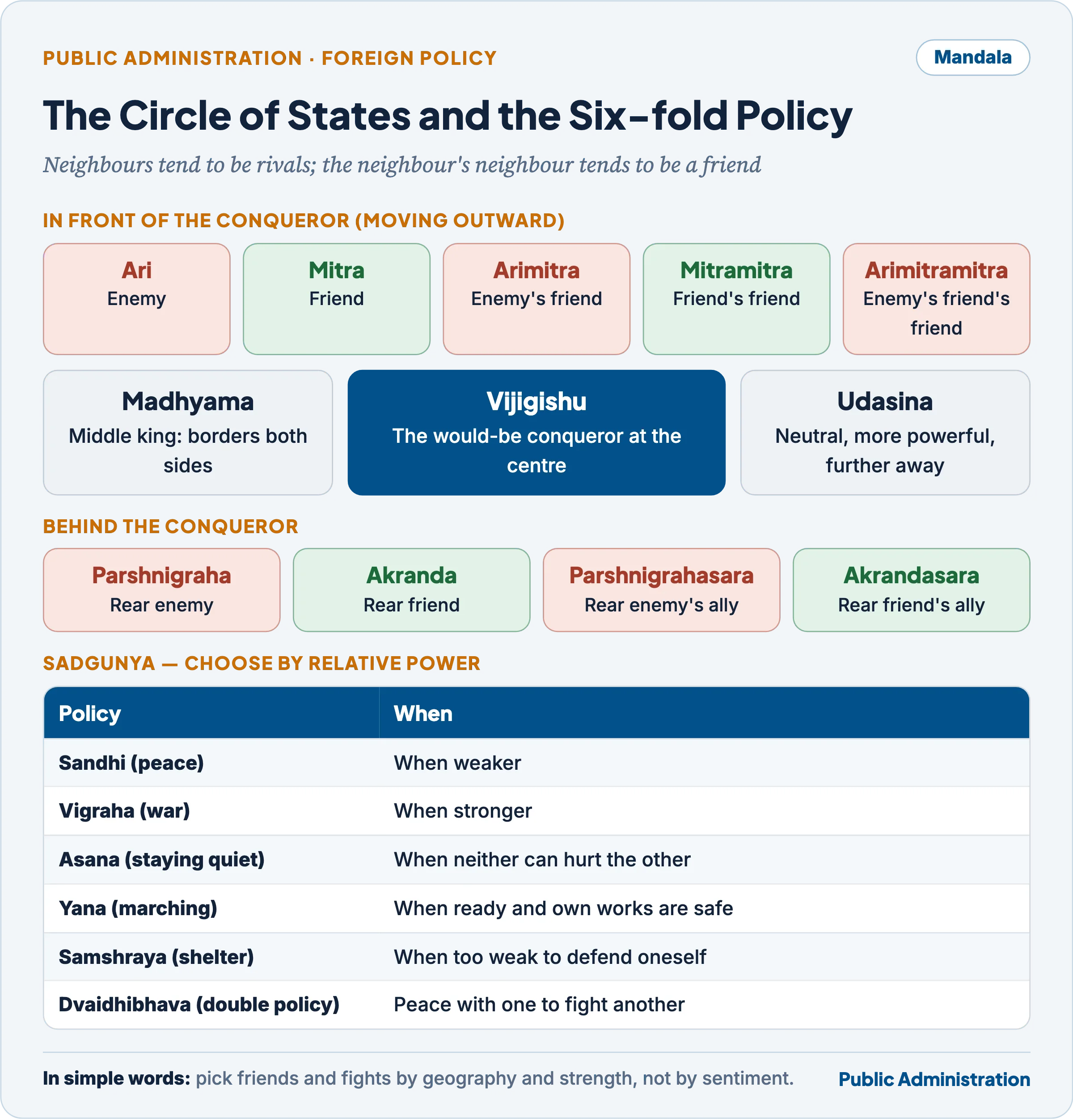
- The vijigishu at the centre. The theory is built around the vijigishu (“one who desires to conquer”), the king who is ambitious and well endowed with the elements of sovereignty.
- Geography shapes alignments. The state immediately bordering the vijigishu is his natural enemy (ari); the state beyond the enemy is his natural friend (mitra); beyond that comes the enemy’s friend (arimitra), then the friend’s friend (mitramitra), then the enemy’s friend’s friend (arimitramitra). Behind the vijigishu are the rear enemy (parshnigraha), the rear friend (akranda), and their allies (parshnigrahasara, akrandasara).
- Two outside powers. The madhyama (middle king) borders both the vijigishu and his enemy and can help or resist either; the udasina (neutral king), more powerful and further away, can help or resist all of them.
- Twelve kings, four circles. These make up the twelve primary kings. The text also counts four primary circles (centred on the vijigishu, the enemy, the madhyama and the udasina), and seventy-two elements in all once each king’s elements of sovereignty are added.
- Natural and acquired relations. A natural enemy is a neighbour of equal birth; a factitious enemy is one who becomes hostile for reasons of his own. A natural friend is a hereditary ally; an acquired friend is one courted for self-interest.
- The goal. The vijigishu should make himself the nave of the wheel and the other kings its spokes. Each king seeks to increase his power (deliberation, treasury and army, and martial energy) and his happiness; superiority, equality and inferiority in power decide policy.
11.2 Sadgunya: the six-fold policy
Kautilya rejects the view (of Vatavyadhi) that there are only two policies, peace and war, and lists six, each suited to a particular balance of power.
| Policy | Meaning | When to adopt it |
|---|---|---|
| Sandhi | Peace by treaty | When one is weaker than the other king |
| Vigraha | War or hostility | When one is stronger |
| Asana | Staying quiet; neutrality | When neither side can hurt the other |
| Yana | Marching; preparing to attack | When one has the means and has secured one’s own works |
| Samshraya | Seeking protection of a stronger king | When one is too weak to defend oneself |
| Dvaidhibhava | Double policy: peace with one, war with another | When help is needed from one to act against another |
- The test of a policy. The right policy is the one that lets the king build forts, roads, plantations, mines and villages while harming the similar works of his enemy. The aim is to move from deterioration to stagnation to progress. Foreign policy is thus judged by its effect on the economic strength of the state: war and peace are means of development, not ends.
- Prudence over glory. A weak king attacked by a strong one should neither surrender abjectly nor fight to the death, but seek protection or hold out in a fort. Peace is preferred when gains from peace and war are equal, because war brings losses, expense and absence from home.
11.3 The four upayas and diplomacy
- Four means. In dealing with other kings the ruler uses sama (conciliation), dana (gifts or concessions), bheda (sowing dissension) and danda (force), generally in that order, with force as the last resort.
- Envoys. Kautilya distinguishes the nisrishtartha (envoy with full powers), the parimitartha (envoy with a limited mission) and the shasanahara (bearer of royal messages). An envoy must convey his message exactly as entrusted, even at the risk of his life, study the enemy’s forts, army and officials, and watch the reception he receives for signs of the enemy’s intentions. Envoys are not to be killed, since they merely speak for their masters.
- Kinds of war. The text names open war (prakasha-yuddha), treacherous or concealed war (kuta-yuddha) and silent war (tushnim-yuddha, eliminating an enemy through secret agents without open hostility).
- Kinds of conquerors. A just conqueror (dharmavijayi) is satisfied with submission; a greedy conqueror (lobhavijayi) with land or money; a demon-like conqueror (asuravijayi) wants everything, including lives. A weak king should seek the protection of the just one.
- Governing the conquered. After conquest the king should cover the enemy’s vices with his own virtues, keep his promises, remit taxes, honour local leaders, and adopt the dress, language and customs of the people and respect their festivals and faith, because “whoever acts against the will of the people becomes unreliable”. Realism in war is joined to conciliation in rule.
11.4 Relevance to international relations
Kautilya is widely called the first great political realist, and many of his ideas reappear in modern realism.
- Self-interest of states: states act to increase their power and security; alliances follow interest, not sentiment. This is the core of realism from Thucydides to Morgenthau.
- Geopolitics: neighbours tend to be rivals and the neighbour’s neighbour a natural partner; the mandala anticipates balance-of-power reasoning.
- Hedging: dvaidhibhava (peace with one, hostility with another) and samshraya resemble modern hedging and multi-alignment.
- Economic foundations of power: foreign policy is judged by its effect on productive capacity, close to modern ideas of comprehensive national power and economic statecraft.
- Intelligence and grey-zone conflict: silent war and covert action anticipate hybrid and grey-zone warfare.
- Indian practice. Indian strategic discourse often reads policies such as Neighbourhood First, Act East, partnerships with distant powers and the pursuit of strategic autonomy through multiple alignments in Kautilyan terms. The Indian Army’s Project Udbhav (launched October 2023 with the United Service Institution of India) set out to build an indigenous strategic vocabulary from texts including the Arthashastra.
- Limits. The mandala assumes small, contiguous monarchies in constant rivalry. It does not account for international law, multilateral institutions, nuclear deterrence, economic interdependence or non-state actors, and its acceptance of assassination and deceit conflicts with modern norms.
Indian Connect — Relevance in international relations versus economic affairs
The claim that the Arthashastra is more relevant to international relations than to economic affairs has some basis: its strategic logic of interest, alliances and power translates easily to today’s world of states, while its economic model of state monopolies, price control and royal enterprise belongs to a pre-industrial monarchy. But its economic principles endure: a sound treasury, taxation that does not destroy the source, investment in infrastructure, regulation of markets, consumer protection and a check on official extraction. The Ministry of Finance and the Institute of Economic Growth have convened the Kautilya Economic Conclave since 2022 (its fourth edition was held on 3–5 October 2025) precisely to link economic policy with strategic thinking. The fairer view is that Kautilya’s strategic concepts are more directly usable, while his economic institutions need translation into a market economy.
12. Ethics, Welfare and Political Realism
In simple words
Kautilya wanted honest officials and a king devoted to the people, which is ethical. But he also allowed lies, spying and even killing when the safety of the state required it, which is realist. Understanding him means seeing how both ideas fit together.
12.1 Ethics in public service in the Arthashastra
Ethics in the Arthashastra is not preached in the abstract. It is built into administration. Its main elements are:
- Ethics of the ruler: control of the six inner enemies; the happiness of the subjects as the king’s happiness; accessibility; constant activity; impartial justice; personal liability for theft he cannot prevent.
- Ethics of selection: appointment by merit and tested character, and placement according to which temptations an officer can resist.
- Ethics of reward: fair and adequate pay, family support, and reward for honest performance, which reduces the pressure to be corrupt.
- Ethics of control: a detailed list of frauds, layered checks, informer rewards, compensation to victims and graded punishment.
- Ethics towards the people: protection of cultivators, artisans, consumers, women, minors, the aged and the helpless; prohibition of over-extraction of revenue.
- Ethics of the conquered: respect for the customs and faith of a conquered people.
These elements justify the view that ethics in public services is a central concern of the text. Yet that view must be qualified.
- Ethics as instrumental. Honesty is valued largely because corruption weakens the treasury and the state. The welfare of the subjects matters because contented subjects make a strong state. Kautilyan ethics is the ethics of raison d’etat (reason of state), in which the good of the state is the final test.
- A double standard. The same text that demands honesty from officials prescribes deception, entrapment, secret killing and the use of religion to manipulate when the state’s interest requires it, especially against enemies and traitors.
- Hierarchical morality. Duties differ by varna, and the moral order the king protects is unequal.
12.2 Political realism
Political realism is the view that politics is governed by power and interest, that the statesman must deal with the world as it is rather than as it ought to be, and that public morality differs from private morality.
- Evidence of realism in the Arthashastra
- Human nature is taken as self-interested: officials will steal; neighbours will be rivals.
- Power (of counsel, of treasury and army, of energy) is the measure of states; policy depends on relative power.
- Means include deceit, espionage, bribery, dissension and assassination; treaties may be broken when interest requires.
- Religion may be used to boost one’s troops and frighten the enemy’s.
- The test of policy is its result for the state.
- But a bounded realism
- The ends that justify extreme means are specific: the security of the state, the punishment of the wicked and the protection of the good, and the welfare of the people. The text is not a manual for a tyrant’s personal enjoyment of power.
- Harsh measures are mainly reserved for enemies, traitors and emergencies; ordinary administration is governed by rules, proportionate punishment and welfare.
- The ruler himself is bound by discipline, and an unrighteous ruler is warned that he will fall.
- Historical reception. Within India the text was not universally admired: the seventh-century poet Banabhatta, in Kadambari, condemned the science of Kautilya as merciless in its precepts. The playwright Vishakhadatta’s Mudrarakshasa portrays Chanakya as a master of intrigue in the service of a just cause. The tension between admiration and unease is as old as the text.
12.3 Was Kautilya a preacher of moral values?
- Yes, in the sense that he demands of the king and officials self-control, truthfulness, learning, diligence, justice and care for the weak, and treats these as the foundation of good government.
- No, in the sense that he subordinates morality to the preservation and growth of the state, and openly accepts immoral means in statecraft.
- The synthesis. Kautilya separates individual morality from public morality. He is a moralist in administration and a realist in politics: within the state he seeks an honest, welfare-oriented government; in dealing with threats to the state he accepts whatever works. This is why some scholars praise his timeless wisdom and others condemn his ruthlessness, and why his ideas are, as one modern summary puts it, often publicly criticised and privately practised.
Criticism — The case against Kautilyan statecraft as a model
- Ends justify means: espionage, entrapment, assassination and broken treaties are acceptable whenever the state benefits, which no constitutional democracy can accept.
- Surveillance state: officials and subjects are watched by a vast secret network; privacy and trust are casualties.
- Absolute authority: the king’s edict is the highest law; there is no legislature, independent judiciary or enforceable right.
- Unequal order: the state upholds the varna hierarchy and accepts slavery.
- Instrumental ethics: honesty and welfare are valued because they strengthen the state, not because people have rights.
- Uncertain history: the text may not describe any real administration, so its “practice” is partly ideal.
Defence — The case for Kautilyan statecraft as a model
- Welfare as the end: yogakshema, protection of the weak and the ruler’s happiness in the subjects’ happiness make the state an instrument of welfare, not of personal power.
- Bounded realism: harsh means are reserved mainly for enemies, traitors and emergencies; ordinary rule is by law and proportionate punishment.
- Institutional integrity: merit, tests, adequate pay, audit, informer rewards, transfer and compensation form a coherent anti-corruption system still relevant today.
- Honest about power: it states openly what states actually do, which helps in designing controls against abuse.
- Discipline of the ruler: the king is bound by training, counsel and fear of the people’s anger.
- Administrative science: division of work, hierarchy, records, statistics and budgeting make it a pioneering text of public administration.
13. Kautilya, Weber and Machiavelli
In simple words
Kautilya is often compared with two European thinkers: Max Weber, who described modern bureaucracy, and Niccolo Machiavelli, who wrote frankly about power. Kautilya shares Weber’s interest in an orderly, rule-bound officialdom and Machiavelli’s frankness about power, but differs from both in important ways.
13.1 Kautilya and Weber
Max Weber, the German sociologist, described the ideal type of bureaucracy in Economy and Society (published 1922), as the administrative staff of legal-rational authority (see the article on Weber and Bureaucracy). Kautilya’s administrative maxims show striking similarities with it, despite a gap of two thousand years and very different settings.
| Feature | Kautilya | Weber |
|---|---|---|
| Hierarchy | Three grades of amatyas; yukta, upayukta, tatpurusha; pay scale of several rungs | Clear hierarchy of offices |
| Defined competence | Each superintendent has a defined department and duties | Fixed jurisdictional areas |
| Selection by merit | Qualifications, performance, upadha tests | Technical qualifications, examinations |
| Salaried officials | Fixed cash salaries, within a quarter of revenue | Fixed salaries, usually with pension |
| Written records | Writs, registers, sealed account books | Administration based on files |
| Career and promotion | Permanence and promotion for good work; no fixed rules | Career with promotion by seniority or achievement |
| Discipline and control | Daily examination, spies, fines, transfer | Strict and systematic discipline |
| Separation of office and person | Treasury not the king’s property; gifts recorded | Official does not own the means of administration |
| Basis of obedience | Control: fear, interest and duty, backed by danda | Legitimate authority: belief in the legality of rules |
| Nature of authority | Traditional / patrimonial: officials serve the king personally, at his pleasure | Legal-rational: officials serve impersonal rules |
| Method | Prescriptive and normative manual | Ideal-type construct for analysis |
- The key difference: authority versus control. Weber’s bureaucracy rests on authority, the willingness to obey because rules are seen as legitimate; Kautilya’s rests on control, obedience secured by sanctions, surveillance and incentives. In Weberian terms, Kautilya’s system is closer to power than to legitimate authority.
- Patrimonial, not legal-rational. Kautilya’s officials are the king’s servants, appointed and removed at his pleasure; Weber’s are servants of impersonal law with security of tenure. Kautilya’s administration thus combines rational techniques with a patrimonial structure, which Weber himself would classify as a form of traditional rule.
- Ethics. Weber expects officials to internalise professional ethics; Kautilya assumes they will steal and relies on external checks. Both, however, want a clean administration and see control of corruption as central.
- Weber on Kautilya. In his lecture “Politics as a Vocation” (1919) Weber remarked that truly radical “Machiavellianism” is classically expressed in Kautilya’s Arthashastra, compared with which Machiavelli’s The Prince is harmless. Weber knew the text and saw it chiefly as a work of ruthless realism.
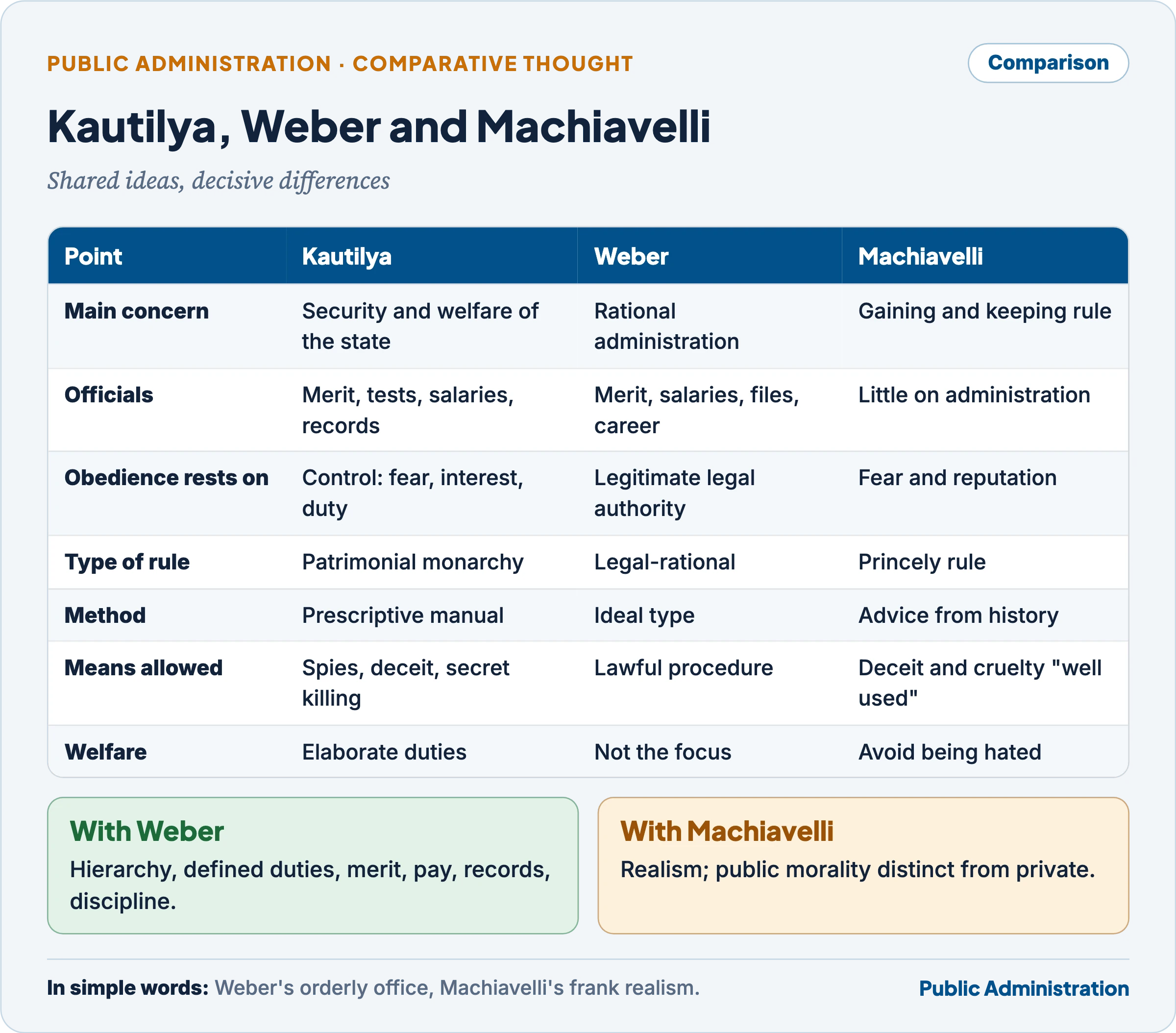
13.2 Kautilya and Machiavelli
Niccolo Machiavelli, the Florentine diplomat, wrote The Prince in 1513 (published 1532), advising a ruler how to gain and keep power in the turbulent Italy of his time.
| Point | Kautilya | Machiavelli |
|---|---|---|
| Context | Founding and running a large empire | Divided Italian city-states; call for a unifying prince |
| Aim of the work | Yogakshema and rakshana: security and welfare of the subjects through a strong state | How a prince may acquire and maintain his rule |
| Scope | Comprehensive: administration, economy, law, personnel, foreign policy, war | Mainly political conduct of the prince (with Discourses on republics) |
| Means | Openly includes espionage, assassination, deceit, poison | Deceit and cruelty “well used”; less on espionage and assassination |
| Morality | Public morality distinct from private; ruler bound by discipline | Politics autonomous from Christian morality |
| Administration | Detailed machinery of departments, revenue and audit | Little on administration |
| Welfare | Elaborate welfare duties | Little on welfare; the prince should avoid being hated |
| Reception | Admired in ancient India, criticised by some | Denounced for centuries in Europe |
- Similarities: both are realists who separate politics from conventional morality, accept that ends can justify means in statecraft, value strength and prudence, and write from experience of politics.
- Differences: Machiavelli’s prince seeks to perpetuate his rule; Kautilya’s king seeks the security and welfare of the state and its people, and the Arthashastra is a treatise on administration and economy that Machiavelli never attempted. As Weber noted, Kautilya is also more radical in the means he accepts.
- Plato and Aristotle. Compared with the Greeks, Kautilya shifted attention from political philosophy (the ideal state, justice) to political science and administration (how a real state is run). Plato’s idealism contrasts with Kautilya’s practical realism, though both favour rule by the trained few.
14. Ashoka: The Arthashastra Tradition in Practice?
In simple words
Ashoka, Chandragupta’s grandson, ran the same empire but turned away from war after the conquest of Kalinga. His edicts show a ruler who kept many Kautilyan administrative habits while trying to rule by moral persuasion.
- Ashoka ruled the Mauryan empire from about 268 to 232 BCE. After the bloody conquest of Kalinga, he turned to dhamma (a moral code of tolerance, compassion and right conduct) and to conquest by dhamma instead of by arms.
- Kautilyan continuities.
- Constant availability: in his sixth major rock edict Ashoka orders that reporters should inform him of the people’s business at all times and in all places, whether he is eating, in the inner apartments or in the garden: a direct echo of the Arthashastra’s demand that the king never keep petitioners waiting.
- Special officers: he created dhamma-mahamattas (officers of righteousness) to look after the welfare of different communities, and gave rajukas (rural officers) authority in justice and welfare.
- Public works and welfare: wells, rest houses, shade trees along roads, and medical care for people and animals.
- A large, centralised bureaucracy with regular inspection tours.
- Departures. Ashoka rejected the expansionist mandala in favour of dhammavijaya and stressed moral persuasion over coercion. Whether he was directly guided by the Arthashastra cannot be proved; the similarities suggest a shared Mauryan tradition of governance in which Ashoka gave Kautilya’s welfare ideal a moral and Buddhist turn.
15. Relevance to Contemporary Governance
In simple words
Many of Kautilya’s ideas, such as choosing honest officials, keeping careful accounts, rewarding people who report fraud and being easy for citizens to reach, are still good advice. Others, such as an all-powerful king and constant spying, cannot fit a democracy.
15.1 Learnings for governance today
| Kautilyan idea | What it means today | Indian example |
|---|---|---|
| Yogakshema; the ruler’s happiness in the people’s | Citizen-centric, welfare-oriented governance | DPSPs; welfare schemes; citizen’s charters |
| Accessibility of the ruler | Open, responsive government | CPGRAMS grievance portal; Jan Sunwai; PRAGATI reviews |
| Merit and tested integrity | Merit recruitment, vigilance clearance | UPSC; probation; vigilance clearance |
| Adequate pay, reward for performance | Pay commissions, performance-linked incentives | Central Pay Commissions; APAR |
| Forty ways of embezzlement; layered checks | Systems-based anti-corruption | PC Act 1988; CVC; Lokpal; e-procurement |
| Informer rewards; compensation to victims | Whistle-blower protection; restitution | PIDPI Resolution 2004; consumer forums |
| Transfer from sensitive posts | Rotation to prevent entrenchment | Rotational transfer policies |
| Budget, registers, audit | Fiscal discipline and audit | Article 112; CAG; FRBM Act 2003 |
| Ripe-fruit taxation; no over-extraction | Taxation that protects the base | GST rate rationalisation; taxpayers’ charter |
| Proportionate danda | Proportionate regulation | Jan Vishwas Acts 2023 and 2026 |
| Written, uniform law | Codification and legal certainty | BNS, BNSS, BSA (2024) |
| Statistics and records | Data-driven administration | Census; digital land records |
| Mandala and six-fold policy | Strategic, interest-based foreign policy | Neighbourhood First; strategic autonomy |
15.2 Governing, accountability and justice
- Governing. Kautilya’s insistence that all undertakings depend upon finance, that policy should be decided after structured deliberation (the five elements of counsel), and that the ruler be active and accessible is a template for effective executive leadership.
- Accountability. His system is upward accountability (officials to the king) enforced by surveillance, audit and sanction. Modern democracy adds downward and horizontal accountability: to citizens, legislatures, courts and independent bodies. Kautilya’s public proclamation inviting complaints against an erring officer is a rare early instance of accountability to the people affected.
- Justice. Proportionate punishment, registration of cases, rules on evidence and witnesses, and protection of the weak remain sound. The missing elements are judicial independence and rights against the state, which the Constitution supplies.
15.3 Limits of relevance
- Monarchy versus democracy: the Kautilyan state has subjects, not citizens; legitimacy comes from protection, not consent.
- Surveillance versus privacy: the espionage system conflicts with constitutional rights.
- Hierarchy versus equality: varna-based duties cannot be reconciled with Articles 14–17.
- State monopoly versus market economy: the entrepreneurial monarchy differs from a liberalised economy with independent regulators.
- Means versus ends: constitutional morality does not permit the deceit and violence that Kautilya allowed.
The useful legacy is therefore the administrative and ethical technique, not the political form.
Theory lens: Kautilya through Paper I ideas
- Weber’s ideal-type bureaucracy. Kautilya anticipates Weber’s hierarchy, defined competence, merit, salaries, records and discipline, but within a patrimonial order where obedience rests on control rather than legitimate authority (see the article on Weber and Bureaucracy). India’s civil service today is formally Weberian; its informal workings often recall the patrimonial side.
- Riggs’s fused and prismatic societies. Fred Riggs, in Administration in Developing Countries (1964), described fused societies in which one structure performs many functions. The Kautilyan state, where the king’s household, treasury, courts and army overlap and the samahartri is at once revenue, police and magistrate, is close to the fused type with some diffracted techniques. The often-quoted description of Indian administration as “Weberian structures, Kautilyan practice and Gandhian rhetoric” is a prismatic picture: Weberian forms on paper, Kautilyan power-centred and surveillance-based practice beneath, and Gandhian ideals in public speech, which is Riggs’s formalism (see the article on Riggsian Models).
- Principal–agent theory. Kautilya’s honey and fish similes describe exactly the problem of information asymmetry between a principal (the king) and agents (officials) who have hidden actions and hidden purposes. His remedies (monitoring by spies, audits, bonding through sureties, incentive pay, rewards for informers, rotation) are the standard agency solutions of monitoring, bonding and incentive alignment.
- Public choice. The assumption that officials will “eat” the revenue unless checked, and that over-zealous officers maximise collection to impress their master, parallels public choice theory’s self-interested bureaucrat (see the article on New Public Administration and Public Choice).
- Accountability theory. Kautilya relies on hierarchical and legal accountability in Romzek and Dubnick’s terms: close supervision and sanctions. Professional and political accountability are thin. His public proclamation for complaints is a primitive form of diagonal accountability (see the article on Accountability and Control).
- Good governance. The World Bank’s Governance and Development (1992) stressed public sector management, accountability, a legal framework and transparency. Kautilya’s sound finance, accountable officials, codified law and information systems match the first three; transparency to citizens is the missing element (see the article on LPG and Good Governance).
- Administrative ethics. The upadha tests and placement by tested integrity anticipate modern integrity management, and the separation of public and private morality is the old form of the debate on ethics of public office (see the article on Administrative Ethics).
- Development administration. The Kautilyan state that settles villages, builds irrigation and runs enterprises is an early positive, developmental state, a reminder that the administration of development did not begin with post-war theory (see the article on Development Administration).
Key Terms
| Term | Meaning in simple words |
|---|---|
| Arthashastra | The science of acquiring and maintaining the earth (livelihood and territory); science of polity |
| Artha | Wealth, livelihood, and the territory that supports them |
| Anvikshiki | Philosophy and logic |
| Varta | Economics: agriculture, cattle-breeding and trade |
| Dandaniti | Science of government; the policy of the rod |
| Danda | Coercive power, punishment; also the army |
| Matsyanyaya | Law of the fish: the strong swallow the weak in anarchy |
| Saptanga / prakritis | Seven limbs of the state |
| Yogakshema | Acquisition and secure enjoyment of welfare |
| Rakshana / palana | Protection and administration of the state |
| Rajadharma | The duties of the ruler |
| Rajarshi | A royal sage: a self-disciplined, learned king |
| Mantrin | Inner counsellor |
| Mantriparishad | Council of ministers |
| Amatya | High official; minister or head of department |
| Tirthas | The eighteen high offices of state |
| Adhyaksha | Superintendent; head of a department |
| Samahartri | Collector-general of revenue and head of rural administration |
| Sannidhatri | Treasurer-general and keeper of stores |
| Akshapatala | Records and accounts office |
| Ayasharira / vyayasharira | Body of income / body of expenditure |
| Upadha | Secret test of integrity by allurement |
| Yukta, upayukta, tatpurusha | Head, subordinate officer and lowest staff of a department |
| Lekhaka | Writer who drafts royal writs |
| Rajasasana | Royal edict; the highest of the four sources of law |
| Charitra | Custom and usage of the people |
| Dharmasthiya / kantakashodhana | Civil courts / courts for crime and public order |
| Gopa / sthanika | Officer of five to ten villages / officer of a quarter of the kingdom |
| Samstha / sanchara | Stationary spies / wandering spies |
| Vijigishu | The would-be conqueror at the centre of the mandala |
| Mandala | Circle of states |
| Sadgunya | Six-fold foreign policy |
| Madhyama / udasina | Middle king / neutral king |
| Prakritikopa | Anger or revolt of the subjects |
Commissions, Committees and Judgments
The Arthashastra predates modern commissions and courts, but the bodies and judgments below carry its central administrative concerns (integrity, audit, codification, surveillance) into the Indian state today.
| Body / case | Year | Key point |
|---|---|---|
| Committee on Prevention of Corruption (chair K. Santhanam) | 1964 | Led to the Central Vigilance Commission (1964) and a systematic anti-corruption framework |
| Prevention of Corruption Act | 1988 (amended 2018) | Criminal liability of public servants; 2018 amendment made bribe-giving an offence and added Section 17A (prior approval) |
| Vineet Narain v. Union of India | 1997 | Supreme Court struck down the “Single Directive”, gave the CVC supervisory role over the CBI, and laid down safeguards for independent investigation |
| Public Interest Disclosure and Protection of Informers Resolution | 2004 | Designated the CVC to receive and protect whistle-blower complaints |
| 2nd ARC, 4th Report, “Ethics in Governance” (chair M. Veerappa Moily) | 2007 | Recommended a code of ethics for ministers and civil servants, a strengthened anti-corruption framework and protection of whistle-blowers |
| Lokpal and Lokayuktas Act | 2013 | Statutory ombudsman for corruption complaints against public servants |
| Subramanian Swamy v. Director, CBI | 2014 | Struck down Section 6A of the DSPE Act (prior approval to investigate senior officers) as violating Article 14 |
| K.S. Puttaswamy v. Union of India | 2017 | Privacy is a fundamental right; state surveillance must meet legality, necessity and proportionality |
| Bharatiya Nyaya Sanhita, Nagarik Suraksha Sanhita, Sakshya Adhiniyam | 2023 (in force 1 July 2024) | Replaced the IPC, CrPC and Evidence Act; a fresh codification of criminal law |
| Centre for Public Interest Litigation v. Union of India | 2026 (13 January) | Split verdict on Section 17A of the PC Act; one judge held it unconstitutional, the other valid if screening is done by the Lokpal or Lokayukta; referred to a larger bench |
| Jan Vishwas (Amendment of Provisions) Act | 2026 (assent 7 April) | Amended 784 provisions of 79 central Acts and decriminalised 717, for proportionate, trust-based regulation |
The pattern in the table is a move from Kautilya’s king-centred, surveillance-based control to rule-based, independent and rights-respecting control: statutory vigilance bodies, independent investigation, an ombudsman, protection of privacy and proportionate penalties.
Contemporary Developments
- Kautilya Economic Conclave (October 2025). The fourth edition, held on 3–5 October 2025 in New Delhi on the theme “Seeking Prosperity in Turbulent Times”, was convened by the Institute of Economic Growth with the Ministry of Finance, which have organised the conclave annually since 2022.
- Chanakya Defence Dialogue (November 2025). The Indian Army and the Centre for Land Warfare Studies held the dialogue on 27–28 November 2025 on the theme “Reform to Transform”, showing the continued use of Kautilyan identity in India’s strategic discourse.
- Project Udbhav (2023–2024). Launched by the Defence Minister on 21 October 2023 with the United Service Institution of India to study ancient Indian strategic texts, including the Arthashastra, and develop an indigenous strategic vocabulary; its first phase closed with a panel on ancient military ethics on 21 May 2024.
- Split verdict on prior approval for corruption probes (January 2026). On 13 January 2026 the Supreme Court split on Section 17A of the Prevention of Corruption Act, reviving the Kautilyan dilemma of how to catch the corrupt without harassing the honest.
- Jan Vishwas (Amendment of Provisions) Act, 2026 (April 2026). Passed by Parliament on 2 April 2026 after a Select Committee review, it decriminalised 717 provisions across central Acts, a modern application of proportionate danda.
- New criminal codes in force (July 2024). The BNS, BNSS and BSA came into force on 1 July 2024, replacing colonial codes with a new codification of criminal law.
- Karmayogi Saptah (October 2024). The Prime Minister launched the first National Learning Week for civil servants on 19 October 2024 under Mission Karmayogi, adding structured capacity building to merit-based recruitment.
- New CAG (November 2024). K. Sanjay Murthy took office as Comptroller and Auditor General in November 2024, heading the independent audit institution that has replaced the king’s accounts office of the Arthashastra.
Revision Grid
| Thinker / body | Work or report (year) | Key idea |
|---|---|---|
| Kautilya (Chanakya, Vishnugupta) | Arthashastra (traditionally c. 4th century BCE) | Science of polity; saptanga; yogakshema; machinery of administration; mandala |
| R. Shamasastry | Text (1909), translation (1915) | Rediscovered and first published the text |
| R.P. Kangle | Critical edition (1960–65) | Standard text, translation and study |
| Thomas Trautmann | Kautilya and the Arthasastra (1971) | Statistical analysis: multiple authors |
| Patrick Olivelle | King, Governance, and Law in Ancient India (2013) | Three-layer composition, c. 50 BCE to 300 CE |
| Megasthenes | Indica (c. 300 BCE, fragments) | Greek account of Chandragupta’s administration |
| Max Weber | “Politics as a Vocation” (1919); Economy and Society (1922) | Called Kautilya more radical than Machiavelli; ideal-type bureaucracy |
| Niccolo Machiavelli | The Prince (1513) | Realist advice on gaining and keeping power |
| Roger Boesche | The First Great Political Realist (2002) | Kautilya as the founder of political realism |
| Fred Riggs | Administration in Developing Countries (1964) | Fused–prismatic–diffracted; formalism |
| Banabhatta | Kadambari (7th century CE) | Criticised Kautilya’s science as merciless |
| Ashoka | Rock and pillar edicts (c. 268–232 BCE) | Dhamma, constant availability, dhamma-mahamattas |
| Santhanam Committee | Report (1964) | Anti-corruption framework; CVC |
| 2nd ARC | 4th Report, Ethics in Governance (2007) | Codes of ethics; anti-corruption reforms |
Previous Year Questions
- 2026Learnings from Arthasastra could make governance effective even today. Explore the potential.
- 2025Arthashastra of Kautilya means the science of economics of livelihood of the people. Comment.
- 2024“Ethics in Public services has been the main concern of Kautilya’s Arthashastra.” Examine the statement.
- 2023“Kautilya’s Arthashastra is a theoretical work on the state and Statecraft.” Comment.
- 2021Kautilya envisages protection, welfare and prosperity of the State and its people as the utmost concern of a ruler. In this context, discuss the significance of Kautilya’s emphasis on governing, accountability and justice in contemporary India.
- 2019In the text of Arthashastra, ‘the state is neither a police State nor merely a tax gathering State’. Comment.
- 2016“In contemporary times, Kautilya’s Arthashastra is relevant more in the field of international relations than in economic affairs.” Analyse the statement.
- 2014“Ethics in public services has been the central concern of Kautilya’s Arthashatra.” Critically examine the statement.
- 2014“Indian administration is said to be characterised by its three features viz. Weberian structures. Kautilyan practice and Gandhian rhetoric.” Examine the statement.
- 2012‘The Arthashatra is a book of political realism.’ Elaborate.
- 2010“The rule of kings depends primarily on written orders ………” Why did Kautilya favour Codification of Laws?
- 2009Comment on the view that despite different contexts, administrative maxims of Kautilya’s Arthashastra bear considerable similarity with features of Weber’s ideal bureaucratic model.
- 2007“Kautilya was not only the foremost politico-administrative thinker of ancient India but he was an advocate and preacher of moral values too.” Comment.
- 2006“In the happiness of his subjects lies the king’s happiness; in their welfare his welfare.” Comment on Kautilyan state administration. In what respects is modern democratic rulers’ behaviour different from Kautilyan rulers?
- 2003“The Arthashastra is India’s oldest complete text on public administration.” Comment.
- 2001“The machinery of government designed in Kautilya’s Arthashastra does not exactly resemble our modern-day polity, but it does contain some principles which could be said to be the part of today’s science of public administration.” Comment.
- 1998“Kautilya’s Arthashastra has significant relevance to the contemporary Indian administration.” Comment.
- 1990‘The principles in Arthashastra do not command as much of our attention as the delineation of the machinery of administration in it…. It reveals the authors mastery of detail, which could have developed only as a result of his actual experience of administration.’ Comment.
- 1987‘It is not possible to maintain that the administrative system, described in Arthashastra was in actual existence during the Mouryan period’. Comment.