

Salient features and value premises; Constitutionalism; Political culture; Bureaucracy and democracy; Bureaucracy and development.
This article: Constitutionalism: meaning and definitions (McIlwain, Friedrich, Wheare, Loewenstein, Andrews, Fellman), constitution versus constitutionalism, entrenchment and conventions, evolution, liberal, Marxist and Third World views, global constitutionalism and its critics; the elements (rule of law, separation of powers, checks and balances, judicial review, fundamental rights, independent institutions, free elections, diffusion of power); constitutionalism in India (basic structure from Kesavananda to Coelho, the Emergency, ADM Jabalpur and its overruling, the 44th Amendment, rule of law and social justice, constitutional morality, Ambedkar’s warnings, how far limited government is real, the “lacks teeth” critique, constitutionalism as the base of administration and the values bureaucracy cannot violate, recent tests from electoral bonds to Governors’ assent and tribunals); political culture (Almond and Verba, civic culture, Pye, socialisation, Lijphart, critiques, UK and US); Indian political culture (evolution, modernity of tradition, elite and mass cultures, Congress system, caste, religion, populism, regionalism, personality cult, dynasty, criminalisation); the Westminster model in Indian soil; the interface of political and administrative culture; culturally sanctioned values and symbols in administration.
Official Syllabus: Paper II · Unit 2-02 Philosophical and Constitutional Framework of Government
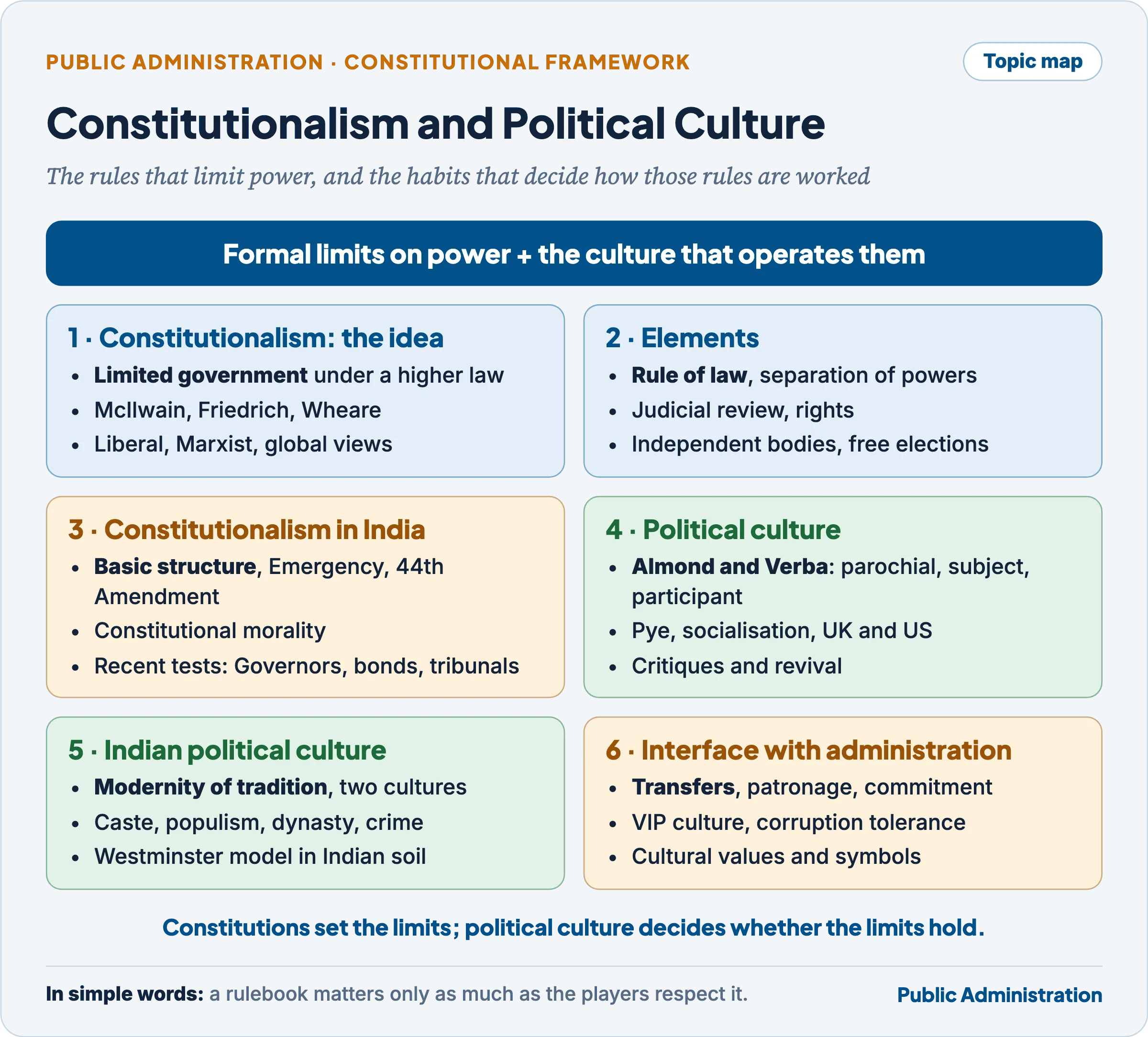
Every democracy has two layers. The first is formal: a constitution that creates offices, divides power, lists rights and sets limits. The second is cultural: the beliefs, habits and expectations with which politicians, officials and citizens actually work those offices. Constitutionalism is the idea that power must stay within the limits of a higher law; political culture is the set of attitudes that decides whether those limits are respected in practice. Indian administration lives where the two meet. The Constitution tells a District Magistrate that every citizen is equal before the law; political culture decides whether a powerful caller still gets a quicker hearing.
In simple words
Think of a cricket match. The rulebook (the constitution) says what a no-ball is and gives the umpire the final word. But the game is fair only if players accept the umpire’s decision and do not bully him (the culture). A good rulebook with players who ignore it gives a bad match; average rules with sporting players can still give a good one.
1. Constitutionalism: Meaning and Ideas
In simple words
Constitutionalism means that rulers cannot do whatever they like. Their power comes from a set of basic rules and stays inside those rules. Even a ruler elected by a huge majority must obey them.
1.1 Constitution and constitutionalism
- A constitution is a body of fundamental rules, usually collected in one written document, that creates the organs of government, gives them powers and sets out their relations with each other and with citizens. It is the means.
- Constitutionalism is an ideology and a practice: the belief that government derives its authority from those rules and is legitimate only while it obeys them. It is the goal a constitution is meant to serve.
- Scope. Constitutionalism is the wider idea; the written constitution is only its most important component, alongside conventions, judicial decisions, statutes and political habits.
- Constitutionalism without a written constitution. The United Kingdom has no single written constitution, yet its government is limited by the rule of law, by conventions such as collective responsibility, by the courts and by a political culture of restraint. Its constitutionalism is a product of slow growth, not of a founding moment.
- A constitution without constitutionalism. Nazi Germany kept the Weimar Constitution (1919) formally in force, but the Enabling Act of 1933 let the executive make laws without the Reichstag, so the document limited nothing. Many military regimes and one-party states today also have elaborate written constitutions that do not restrain rulers.
- The test is therefore not “Is there a document?” but “Does the document actually bind those who hold power?“
Common confusion
Does having a written constitution make a state constitutional? No. A constitution is a document; constitutionalism is the practice of limited government under that document. Britain has constitutionalism without a single written constitution, while several authoritarian states have long written constitutions with no real limits on rulers. India has both a written Constitution and, for the most part, a working constitutionalism, but the two can come apart, as they did during the Emergency of 1975–77.
1.2 Classic definitions
The idea has been stated in many ways. Each definition below stresses a different side of it.
| Thinker | Work (year) | Core idea |
|---|---|---|
| C.H. McIlwain | Constitutionalism: Ancient and Modern (1940) | A legal limitation on government; the antithesis of arbitrary rule; its opposite is despotic government, the government of will instead of law |
| Carl J. Friedrich | Constitutional Government and Democracy (1941) | By dividing power, constitutionalism provides a system of effective restraints on government; a body of rules ensuring fair play and making government responsible |
| K.C. Wheare | Modern Constitutions (1951) | Constitutional government means more than government according to a constitution: it means government according to rule, as opposed to arbitrary government |
| Karl Loewenstein | Political Power and the Governmental Process (1957) | Constitutionalism distributes power among several power holders and makes them control one another |
| William G. Andrews | Constitutions and Constitutionalism (1961) | Constitutionalism rests on consensus: on the structure of government, the rule of law, broad goals and policy |
| David Fellman | American constitutional scholar | The touchstone of constitutionalism is limited government under a higher law; officials are not free to do anything they please in any manner they choose |
- McIlwain, the American historian of political thought, traced the idea from Roman law through medieval England. His point is the core of every later definition: constitutionalism is about law limiting will.
- Friedrich, the German-American political scientist, made division of power the heart of it. For him constitutionalism could exist in a monarchy or a republic, an aristocracy or a democracy, so long as power was divided. He also stressed that it is not static: the methods of restraint change with conditions.
- Wheare, the Australian-born Oxford scholar of federalism, added that a government that follows its constitution’s text but uses it to do arbitrary things is not “constitutional” in the full sense.
- Jean Blondel, the French-British comparativist, warned against dividing states into “constitutional” and “unconstitutional”. Constitutionalism is a dimension: real regimes lie along a continuum from very strong restraints to very weak ones. Friedrich made the same point: complete restraint and no restraint are both unreal poles.
1.3 The essential elements, as scholars list them
Loewenstein’s list of what a constitution must contain to be constitutionalist:
- Differentiation of state functions and their assignment to different organs, to disperse power.
- A planned mechanism of cooperation among power holders, such as checks and balances.
- A mechanism for avoiding deadlocks between power holders.
- A method of peaceful amendment, so that the constitution adapts to change without illegality, violence or revolution.
- Explicit recognition of fundamental liberties and the means of protecting them.
Andrews’ four consensuses (the political side of constitutionalism):
- On the structure and processes of government: most citizens must accept how government is organised; without that support no constitution survives.
- On the rule of law: a firm belief that the system works according to law, not arbitrarily.
- On broad goals: agreement on what the society is trying to become; without it, government and society pull against each other.
- On policy: deep, unbridgeable disagreement on policy makes restraint hard to sustain.
Other commonly listed features are (a) a basic and foundational constitution that sets up the three organs, (b) control of power through clear division and limitation, (c) the constitution’s ability to absorb future change without becoming a hurdle, and (d) organisation of power both vertically (federal and local levels) and horizontally (between organs).
1.4 Minimal and rich senses; entrenchment and conventions
- Minimal sense. Every state has rules saying who makes, executes and adjudicates law. An absolute monarch whose only rule is “the king’s word is law” has a constitution in this sense, but no constitutionalism.
- Rich sense. Constitutionalism exists only where these rules limit power: by rights (free speech, equality, due process), by jurisdiction (a federal division of subjects), and by procedure (the form and manner of law-making).
- Hobbes and Austin versus Locke. Thomas Hobbes (Leviathan, 1651) and John Austin, the English legal positivist, thought sovereignty cannot be legally limited: a sovereign cannot command itself. John Locke (Two Treatises of Government, 1689) held that power is held on trust from the people and is limited by the terms of that trust. Modern constitutionalism follows Locke; Austin’s way out (the “people” are the unlimited sovereign, while organs are limited) leads to the paradox, noted by H.L.A. Hart, of commanders commanding themselves.
- Entrenchment. Limits must be protected from easy change by those they limit. Most written constitutions require special majorities to amend. In India, Article 368 prescribes special majorities and state ratification for federal provisions, and the basic structure doctrine puts the core beyond amendment altogether.
- Writtenness is helpful but not essential. Britain shows that limits can live in statutes (Magna Carta 1215, Petition of Right 1628, Bill of Rights 1689), common law and conventions.
- Conventions. A.V. Dicey, in Introduction to the Study of the Law of the Constitution (1885), separated the law of the constitution (rules enforced by courts) from the conventions of the constitution (customs and practices not enforced by courts, which he called “constitutional morality” or political ethics). Conventions limit power where law is silent: the British monarch’s assent to Bills, or the convention that a Prime Minister who loses the confidence of the Commons resigns.
- Constitutional questions versus questions of constitutionalism. The historian Christian Fritz distinguished questions that can be settled by reading the text and cases (how power is divided) from deeper questions that cannot (who the sovereign people are and how they monitor their government). The second kind belongs to political culture, the subject of the later sections.
1.5 Evolution of the idea
- Ancient. Plato’s Laws described a “second-best” state ruled by law; Aristotle praised a mixed constitution with a strong middle class. Rome gave the idea that the emperor’s authority ultimately came from the people.
- Medieval. Germanic custom held that the king was under the law of the folk. The Church subordinated rulers to religious law. Magna Carta (1215) bound the English king to respect the barons’ liberties and due process.
- Early modern. Machiavelli (The Prince, 1513) and Jean Bodin (Six Books of the Commonwealth, 1576) secularised politics and strengthened the sovereign state; the struggle then turned to limiting that sovereign.
- Revolutionary age. England’s Glorious Revolution (1688) and Bill of Rights (1689), the American Declaration of Independence (1776) and Constitution (1787), and the French Declaration of the Rights of Man (1789) turned constitutionalism into democratic government. The US set the model of a written, rigid, federal constitution with judicial review; Switzerland (1848), Canada (1867) and Germany (1871) followed with written constitutions.
- Twentieth century. Britain democratised through the Reform Acts of 1832, 1867 and 1884 and the Parliament Act, 1911. The Soviet constitutions (1918, 1924) added socialism to the vocabulary. After the Second World War, constitutions added internationalism: Japan’s Constitution (in force 1947), in Article 9, renounces war as an instrument of national policy, and India’s Article 51 asks the state to promote international peace and respect international law.
- The direction of change. Constitutionalism moved from a theological to a secular basis, from an aristocratic to a democratic one, and from an individualistic to a social-welfare one. It is a dynamic idea that keeps adjusting to new problems.
1.6 Liberal, Marxist and Third World views
| View | Purpose of the constitution | Limits on government | Rights | Example |
|---|---|---|---|---|
| Liberal | To limit government and protect individual liberty | Separation of powers, rule of law, judicial review, free press, pluralism | Civil and political rights first | USA, UK |
| Marxist | To build socialism under the dictatorship of the proletariat | Few: power is concentrated in the Communist Party | Rights serve the socialist order; “enemies of socialism” get none | USSR, China |
| Third World (mixed) | Liberal democratic forms plus state-led social and economic justice | Liberal limits, but a strong developmental state | Civil rights plus directive social goals | India, South Africa |
- The liberal view treats the constitution as both an end (to be respected) and a means (to security and liberty). It values peaceful change, the rule of law, a free press as the “fourth estate”, a plural society and, increasingly, nationalism, secularism, democracy, internationalism and social welfare.
- The Marxist view sees liberal constitutionalism as a cover for class rule. A socialist constitution exists not to limit power but to make it vast enough to build a classless society; the party becomes the state.
- Developing countries borrowed liberal forms from their colonisers but were also drawn to socialist goals of social and economic justice. India’s Constitution, with justiciable Fundamental Rights in Part III and non-justiciable Directive Principles in Part IV, is the classic mix.
- Threats to constitutionalism in the twentieth century: the rise of totalitarianism (Fascism, Nazism, Stalinism), war conditions that justify emergency rule, and socio-economic distress, which tempts governments to sweep aside restraints for the sake of radical reform. The American Supreme Court’s invalidation of the National Industrial Recovery Act (1935) during Roosevelt’s New Deal showed how judicial limits can collide with welfare goals.
1.7 Global constitutionalism
Global constitutionalism is the spread of constitutional ideas beyond the nation-state and across borders.
- Diffusion of constitutional forms. After 1945 and again after 1989, almost every new state adopted a written constitution with a bill of rights and a constitutional court. Judicial review became the global norm rather than an American peculiarity.
- International human rights law (the Universal Declaration of 1948, the two Covenants of 1966, CEDAW 1979) works as a common higher law that domestic courts borrow from.
- Constitutionalisation of international bodies. The EU’s treaties, the WTO’s dispute settlement and regional human rights courts create rule-bound limits on states themselves.
- New values. Newer constitutions add environmental protection, sustainable development, gender equality, the rights of indigenous peoples and international cooperation. The Russian Constitution of 1993 and the South African Constitution of 1996 carry such provisions; South Africa requires its courts to consider international law when interpreting rights.
- Judicial borrowing. Courts read each other’s judgments. The idea of proportionality, developed in German and Canadian law, is now a global test of whether a restriction on rights is justified.
Indian Connect — Global constitutionalism in Indian courts
- Vishaka v State of Rajasthan (1997) read CEDAW into Articles 14, 15, 19 and 21 to frame guidelines against sexual harassment at work, filling a legislative gap until the 2013 Act.
- K.S. Puttaswamy v Union of India (2017) drew on American, European and other courts to recognise privacy as a fundamental right.
- Modern Dental College v State of Madhya Pradesh (2016) and the Puttaswamy (Aadhaar) case (2018) adopted the four-part proportionality test for limits on rights.
- Navtej Singh Johar v Union of India (2018) relied on comparative and international human rights law to read down Section 377 of the IPC.
- Critics warn that global norms can be borrowed selectively, that they come mostly from Western experience, and that they shift power from elected legislatures to judges.
1.8 The critique of constitutionalism
- Parchment barriers. James Madison, in Federalist No. 48 (1788), warned that written limits are mere “parchment barriers” unless each branch has the motive and means to resist the others. Rules do not enforce themselves.
- The libertarian critique. Murray Rothbard, the American libertarian economist, argued that no constitution can interpret or enforce itself; when the government’s own court interprets it, the court tends to approve ever wider powers for that government.
- The counter-majoritarian difficulty. Alexander Bickel, in The Least Dangerous Branch (1962), asked why unelected judges should overrule elected majorities. Jeremy Waldron later argued that rights disagreements should be settled by legislatures, not courts.
- The Marxist critique. Formal equality before the law hides real inequality of power and property; constitutionalism protects the propertied.
- Rhetorical use. “Constitutionalism” is often used as a slogan by whichever side claims the constitution supports its view, so it can dress up raw politics in legal language.
- The answer to these critiques is not to abandon limits but to remember that constitutionalism depends on a supporting political culture: elites willing to lose, citizens who expect restraint, and institutions with the will to say no.
2. The Elements of Constitutionalism
In simple words
Limited government is built from several parts that work together. Power is split between organs, every organ obeys the law, courts can strike down what breaks the rules, citizens have rights that cannot be taken away, and independent bodies run elections and check accounts.
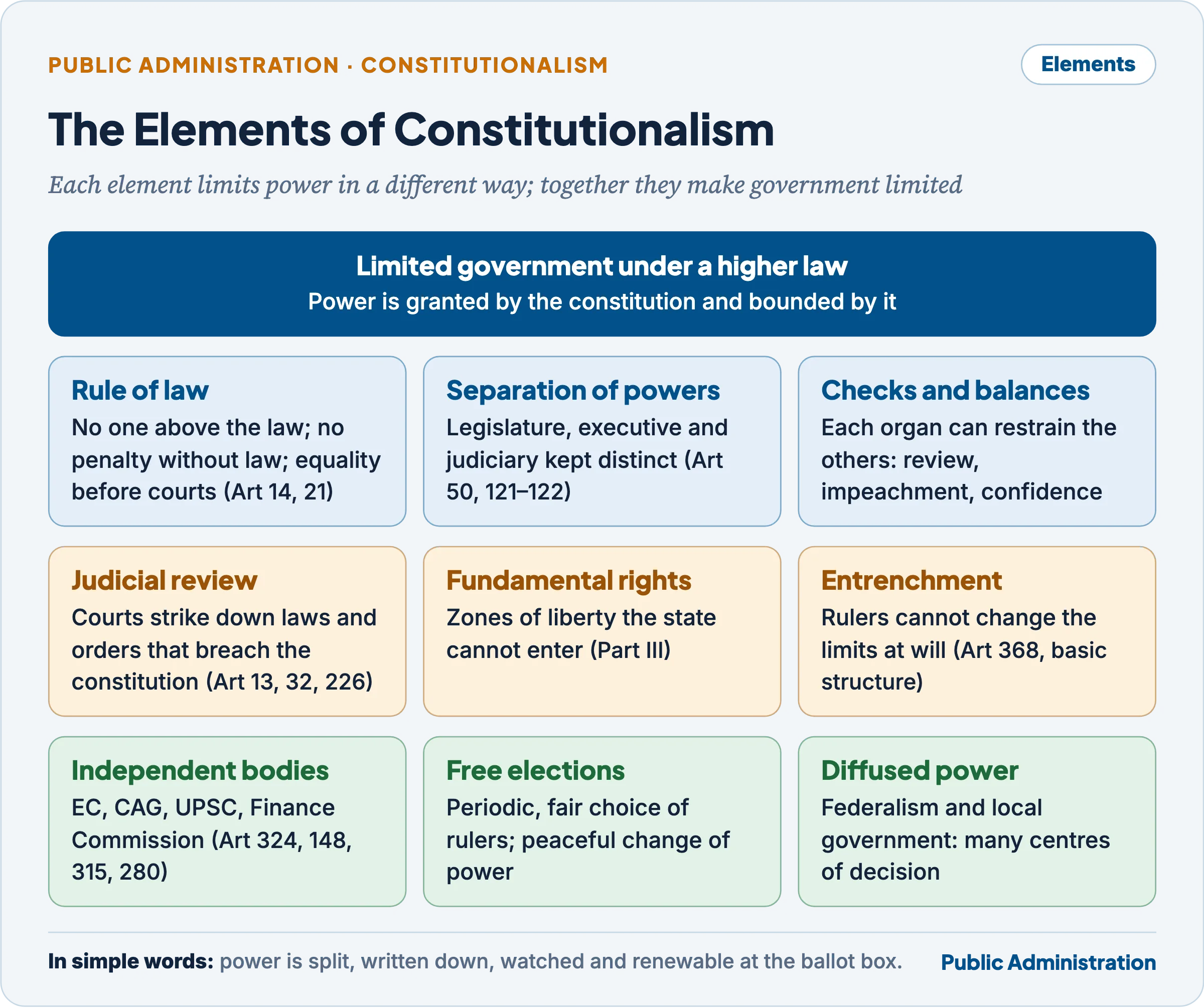
2.1 Rule of law
- Dicey’s three meanings (Law of the Constitution, 1885):
- Supremacy of regular law over arbitrary power: no one can be punished except for a distinct breach of law established before the ordinary courts.
- Equality before the law: every person, whatever his rank, including officials, is subject to the ordinary law and ordinary courts.
- Rights flow from court judgments: in Britain, liberties were the result of judicial decisions in particular cases, not of a written bill of rights.
- In India the first two meanings live in Article 14 (equality before law and equal protection of laws) and Article 21 (no deprivation of life or liberty except by procedure established by law). The third does not apply: Indian rights are written into Part III and enforced through Articles 32 and 226.
- From formal to substantive rule of law. E.P. Royappa v State of Tamil Nadu (1974) held that arbitrariness is the antithesis of equality, and Maneka Gandhi v Union of India (1978) required that the “procedure established by law” be fair, just and reasonable. Indian rule of law thus demands not only legality but non-arbitrariness.
- Limits of Dicey. He overlooked the growth of administrative law and wrongly treated French droit administratif as a system of official privilege; this debate is covered in the article on Administrative Law and Dicey.
2.2 Separation of powers and checks and balances
- Montesquieu, in The Spirit of the Laws (1748), argued that liberty dies when the legislative, executive and judicial powers are united in one person or body.
- Madison turned this into checks and balances: “ambition must be made to counteract ambition”.
- India has a functional, not a rigid, separation. The Supreme Court in Ram Jawaya Kapur v State of Punjab (1955) held that the Constitution does not adopt separation of powers in its absolute rigidity, but recognises the differentiation of functions. Indira Gandhi v Raj Narain (1975) listed separation of powers among the basic features.
- Constitutional anchors: Article 50 (separation of the judiciary from the executive in public services), Articles 121 and 211 (legislatures may not discuss judges’ conduct in the discharge of duties), Articles 122 and 212 (courts may not inquire into legislative proceedings), Article 361 (immunity of the President and Governors).
- Checks in practice. The judiciary reviews laws; Parliament can impeach judges and the President; the executive is collectively responsible to the Lok Sabha (Article 75(3)); the President can return a Bill once (Article 111).
2.3 Judicial review
- Meaning: the power of courts to test laws and executive action against the constitution and to declare them void if they breach it.
- Origin: Marbury v Madison (1803) in the US.
- Indian basis: Article 13 (laws inconsistent with Fundamental Rights are void), Articles 32 and 226 (writ jurisdiction), Article 131 (Union–state disputes), Article 136 (special leave), Article 142 (complete justice).
- Judicial review is itself part of the basic structure (L. Chandra Kumar v Union of India, 1997), so it cannot be removed by amendment.
2.4 Fundamental rights
- Part III (Articles 12–35) lists rights to equality, freedom, against exploitation, religion, cultural and educational rights and constitutional remedies; the right to free and compulsory education (Article 21A) was added by the 86th Amendment and came into force on 1 April 2010.
- Rights bind the “State” as defined in Article 12, which covers government departments, legislatures, local authorities and other authorities, including many public corporations. This is what makes the bureaucracy directly answerable to Part III.
- Writing rights down is not enough. The French Constitution of 1791 carried strong guarantees of press freedom, yet they were set aside at the height of the Revolution. What made Indian rights work was the independent judiciary behind them.
2.5 Independent institutions, free elections and diffused power
- Independent bodies watch the government: the Election Commission (Article 324), the Comptroller and Auditor General (Article 148), the Union and State Public Service Commissions (Article 315), the Finance Commission (Article 280), and statutory bodies such as the Lokpal, the Central Vigilance Commission, the National Human Rights Commission and the information commissions. Their security of tenure, fixed salaries and removal only by special procedure keep them independent.
- Free and fair elections allow peaceful change of rulers. The Supreme Court held in Indira Gandhi v Raj Narain (1975) that free and fair elections are part of the basic structure.
- Diffusion of power through federalism (Seventh Schedule) and local self-government (Parts IX and IXA, added by the 73rd and 74th Amendments, 1992) creates many centres of decision-making, so that no single centre can dominate.
- Free press and civil society are not written institutions but act as the “fourth estate”, feeding information to voters and courts.
- Amendment by a defined procedure (Article 368) lets the constitution change peacefully while the basic structure keeps the core fixed.
3. Constitutionalism in India
In simple words
India gave itself a written Constitution in 1950 with rights, independent courts and many checks. Courts later ruled that Parliament can change the Constitution but cannot destroy its core. The real test is whether those in power respect the limits when the limits get in their way.
3.1 The founding vision
- The Constituent Assembly (1946–49) drew on the Government of India Act, 1935 for structure and on world constitutions and the national movement for values (covered in the article on Salient Features and Value Premises).
- Granville Austin, the American historian, called the Constitution “first and foremost a social document“, and saw in it a “seamless web” of three strands: national unity and integrity, democracy, and a social revolution (Working a Democratic Constitution, 1999).
- Ambedkar on constitutional morality (4 November 1948). Quoting the Greek historian George Grote, B.R. Ambedkar said that constitutional morality means a paramount reverence for the forms of the constitution, and that it “is not a natural sentiment. It has to be cultivated.” He warned that democracy in India was “only a top-dressing on an Indian soil, which is essentially undemocratic”. This is why he put administrative detail into the Constitution itself: he did not trust convention alone to restrain those in power.
- Ambedkar’s choice of the parliamentary system (same speech): the Draft Constitution, in recommending the parliamentary executive, “has preferred more responsibility to more stability“.
- Rajendra Prasad’s caution (26 November 1949): whatever the Constitution provides, the welfare of the country will depend on the way it is administered and on the men who administer it; if those elected are capable and of character, they can make the best even of a defective Constitution.
Articles that make India a constitutional state
The provisions below turn each element of constitutionalism from section 2 into binding law.
| Element | Main provisions |
|---|---|
| Supremacy of the Constitution | Art 13, 245–246, 368 |
| Rule of law and equality | Art 14, 21 |
| Fundamental Rights and remedies | Part III; Art 32, 226 |
| Separation of powers | Art 50, 121–122, 211–212 |
| Independent judiciary | Art 124(4) removal only by Parliament’s special majority; Art 125 salaries; Art 217–218 |
| Responsible executive | Art 74–75, 163–164 |
| Independent institutions | Art 148 (CAG), 280 (Finance Commission), 315 (PSCs), 324 (Election Commission) |
| Federal and local diffusion | Seventh Schedule; Parts IX, IXA |
| Emergency safeguards | Art 352(3) written Cabinet advice; Art 359 (Art 20 and 21 not suspendable) |
| Civil service safeguards | Art 309–311 |
The table shows that Indian constitutionalism is written and detailed: limits that Britain leaves to convention are spelt out as Articles. This reflects the framers’ distrust of convention in a new democracy, and it gives courts firm ground to enforce limits.
3.2 The basic structure doctrine
The central question of Indian constitutionalism after 1950 was whether Parliament’s amending power had any limit. The courts answered it over two decades.
- Shankari Prasad (1951) and Sajjan Singh (1965): Parliament could amend any part, including Fundamental Rights; an amendment is not “law” under Article 13.
- Golaknath v State of Punjab (1967): an eleven-judge bench held, by six to five, that Parliament cannot amend Fundamental Rights at all.
- 24th Amendment (1971) restored Parliament’s power and declared that Article 13 does not apply to amendments.
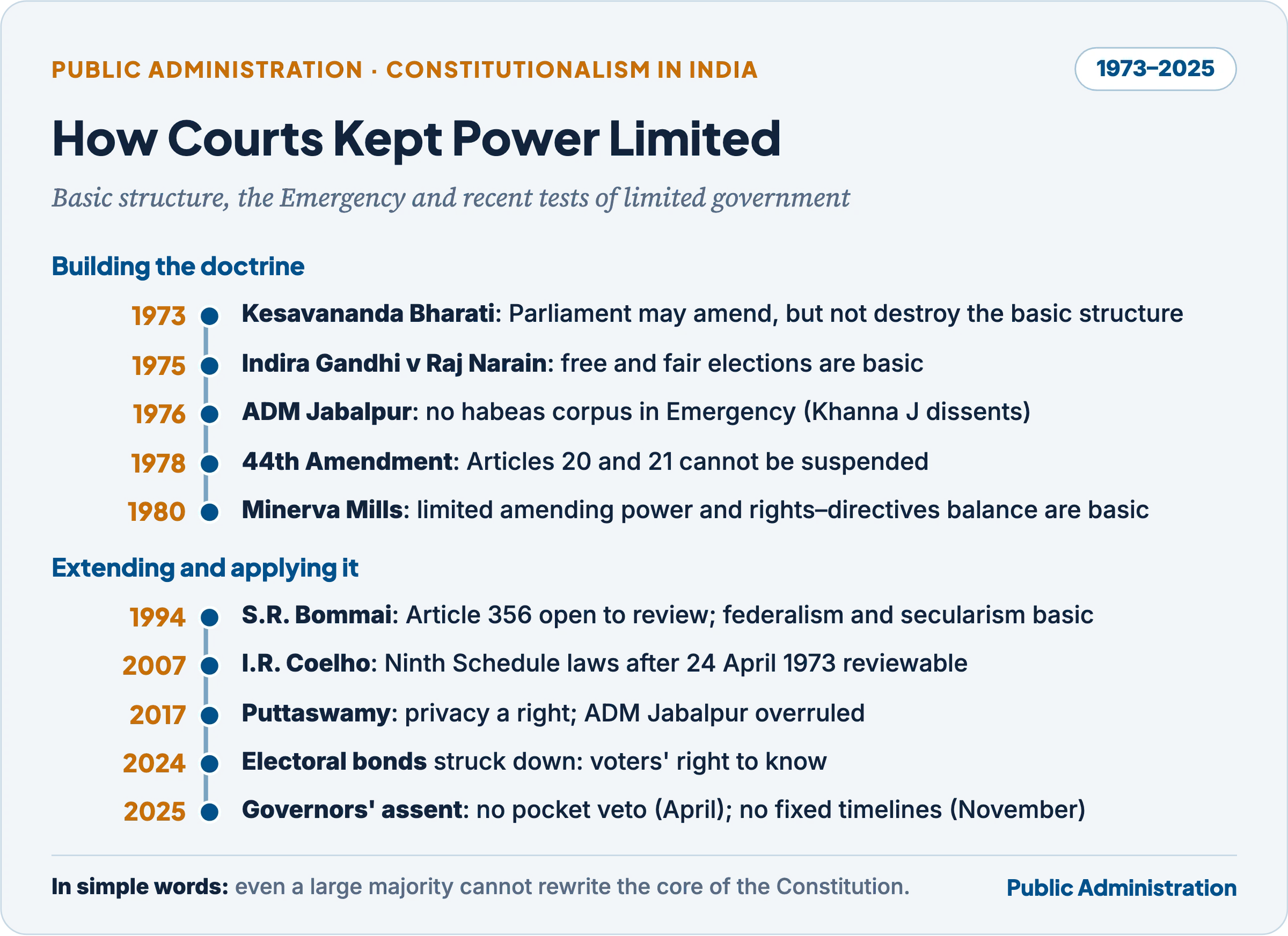
- Kesavananda Bharati v State of Kerala (24 April 1973): a thirteen-judge bench, by seven to six, upheld the 24th Amendment but held that Parliament cannot alter the basic structure or framework of the Constitution. This is the cornerstone of Indian constitutionalism: even a two-thirds majority is a limited power.
- Indira Gandhi v Raj Narain (7 November 1975): struck down clause (4) of Article 329A (inserted by the 39th Amendment), which had placed the Prime Minister’s election beyond judicial scrutiny; free and fair elections, rule of law and judicial review are basic.
- Minerva Mills v Union of India (1980): struck down Sections 4 and 55 of the 42nd Amendment. Limited amending power is itself a basic feature, and the harmony and balance between Fundamental Rights and Directive Principles is part of the basic structure; giving all Directive Principles primacy over Articles 14 and 19 would destroy it.
- Waman Rao v Union of India (1981): laws placed in the Ninth Schedule after 24 April 1973 can be tested against the basic structure.
- S.R. Bommai v Union of India (1994): federalism, secularism and democracy are basic features; a proclamation under Article 356 is open to judicial review, and the floor of the House is the place to test a majority.
- L. Chandra Kumar (1997): judicial review by the High Courts and the Supreme Court is basic; tribunals cannot replace it.
- I.R. Coelho v State of Tamil Nadu (11 January 2007): a nine-judge bench held that every law put in the Ninth Schedule after 24 April 1973 is open to challenge if it damages or destroys the basic structure, tested through the rights in Articles 14, 19 and 21. (Some notes cite a 1999 report of this case; that was only the reference order. The nine-judge judgment came in 2007.)
- Supreme Court Advocates-on-Record Association v Union of India (16 October 2015): struck down the 99th Amendment and the National Judicial Appointments Commission Act, holding that independence of the judiciary, including primacy in appointments, is basic.
- What counts as basic is not listed in one place. Judgments have named, among others: supremacy of the Constitution, republican and democratic government, secularism, federalism, separation of powers, judicial review, rule of law, free and fair elections, parliamentary system, limited amending power, harmony of rights and directives, independence of the judiciary, dignity and freedom of the individual, welfare state and equality.
- Criticism. The doctrine has no text in the Constitution; it gives unelected judges a veto over the elected amending body; its content is uncertain. Defence: without it, a passing majority could, by amendment, abolish elections or rights, as the 39th and 42nd Amendments tried to do.
3.3 The Emergency, ADM Jabalpur and the 44th Amendment
The Emergency of 1975–77 was the greatest test of Indian constitutionalism, because it showed how formal legality can be used to destroy limited government.
- What happened. An internal Emergency was proclaimed on 25 June 1975 under Article 352 on the ground of “internal disturbance”. Fundamental Rights were suspended, thousands were detained under preventive detention laws, the press was censored, and the 38th, 39th and 42nd Amendments curbed judicial review and extended the life of the Lok Sabha.
- ADM Jabalpur v Shivkant Shukla (28 April 1976). A five-judge bench held, four to one, that during the Emergency no one could move a court for habeas corpus to challenge illegal detention, since the right to enforce Article 21 had been suspended. Justice H.R. Khanna dissented: the right to life and liberty does not depend on Article 21 alone, and the rule of law requires that no one be deprived of liberty without the authority of law. The judgment is remembered as the lowest point of judicial constitutionalism in India.
- The administrative side. The Shah Commission (1977–78), chaired by Justice J.C. Shah, found that many officials had carried out illegal and oral orders without question during the Emergency, showing how a “committed” bureaucracy can become the instrument of unconstitutional rule.
- The 44th Amendment (1978) rebuilt the guard rails:
- “Internal disturbance” was replaced by “armed rebellion” as a ground for a national emergency.
- An emergency may be proclaimed only on the written advice of the Union Cabinet (Article 352(3)).
- The rights under Articles 20 and 21 cannot be suspended even during an emergency (Article 359).
- Parliament’s approval and periodic renewal of a proclamation became stricter, and the Lok Sabha may disapprove it.
- The right to property was removed from Part III and made a legal right under Article 300A.
- Puttaswamy (24 August 2017). A nine-judge bench held privacy to be a fundamental right. The plurality opinion, written by Justice D.Y. Chandrachud, declared the majority judgments in ADM Jabalpur “seriously flawed” and expressly overruled them, adopting Khanna J’s dissent. Life and personal liberty are inalienable; they are not gifts of the state that can be withdrawn.
Common confusion
Was ADM Jabalpur overruled by the 44th Amendment? Not exactly. The 44th Amendment (1978) removed the effect of the judgment for the future by making Articles 20 and 21 non-suspendable during an emergency. But the judgment itself stood as a precedent until the Supreme Court expressly overruled it in K.S. Puttaswamy v Union of India (2017). The amendment changed the law; Puttaswamy repudiated the reasoning.
3.4 Constitutionalism, rule of law and social justice
The Indian Constitution does not see the rule of law and social justice as rivals. It asks the state to deliver justice, social, economic and political (Preamble) through lawful, limited means.
- Rule of law protects the weak. Equality before law (Article 14), the bar on untouchability (Article 17), protection against forced labour (Article 23) and child labour (Article 24), and free legal aid (Article 39A) turn formal legality into protection for those who most need it.
- Social justice through law. Articles 15(4), 16(4) and 46 permit special provisions and reservations for disadvantaged groups. Indra Sawhney v Union of India (1992) upheld reservation for backward classes, capped it at 50 per cent as a rule and excluded the creamy layer. Janhit Abhiyan v Union of India (7 November 2022) upheld, by three to two, the 103rd Amendment creating a 10 per cent quota for economically weaker sections.
- Judicial expansion of Article 21. Through PIL, courts read the rights to livelihood (Olga Tellis, 1985), release from bonded labour (Bandhua Mukti Morcha, 1984), food, shelter, health, clean environment and education into the right to life, so that the poor could use the rule of law to claim social justice.
- Transformative constitutionalism. A phrase introduced by the American legal scholar Karl Klare (1998) for the South African Constitution and used by the Indian Supreme Court in Navtej Singh Johar and Joseph Shine (2018): the Constitution is meant to transform an unequal society, not merely to preserve the existing order.
- The tension. Courts have sometimes struck down redistributive laws (bank nationalisation in R.C. Cooper, 1970; privy purses in Madhav Rao Scindia, 1970) in the name of rights, and governments have answered with amendments. Minerva Mills settled that rights and directives must be held in balance.
Market reforms, the basic structure and social justice
- The legal position. Economic policy choices, including disinvestment and privatisation, are for the elected government. In BALCO Employees’ Union v Union of India (2001) the Supreme Court refused to strike down the sale of a public sector company, holding that courts do not review the wisdom of economic policy unless it is illegal or arbitrary.
- “Socialist” after liberalisation. In Dr Balram Singh v Union of India (25 November 2024), the Supreme Court dismissed challenges to the words “socialist” and “secular” added to the Preamble by the 42nd Amendment. It said that “socialist” in India means a welfare state committed to equality of opportunity, and does not tie an elected government to any particular economic model; India has consistently followed a mixed economy.
- So the basic structure has not been breached by market reforms. The harder question is whether reforms have slowed the realisation of social and economic justice: rising inequality, informal and contract labour, weakened public provision in health and education, and regional imbalance. Defenders reply that growth since 1991 financed the largest anti-poverty programmes in Indian history, from rural employment to food security and direct benefit transfers. This debate is taken up fully in the article on Salient Features and Value Premises.
3.5 Constitutional morality
- Ambedkar’s meaning (1948). Constitutional morality is a reverence for the forms of the constitution: obedience to authority acting under it, combined with freedom to criticise; the habit of self-restraint among those who hold power.
- Judicial revival. Indian courts turned the phrase into a working test:
- Naz Foundation v Government of NCT of Delhi (Delhi High Court, 2 July 2009) contrasted constitutional morality with popular or public morality, holding that criminalising consensual same-sex relations could not be justified by majority disapproval.
- Manoj Narula v Union of India (2014) said that constitutional morality requires the Prime Minister and Chief Ministers to avoid appointing ministers with serious criminal charges, though the choice remained theirs.
- State (Government of NCT of Delhi) v Union of India (4 July 2018): a Constitution Bench held that the Lieutenant Governor must ordinarily act on the advice of the elected government, describing constitutional morality as adherence to the norms of the Constitution and a spirit of cooperation among high functionaries.
- Navtej Singh Johar v Union of India (6 September 2018): read down Section 377 of the IPC; constitutional morality must prevail over social morality.
- Indian Young Lawyers Association v State of Kerala (Sabarimala, 28 September 2018): the majority held the exclusion of women of menstruating age unconstitutional, using constitutional morality against custom. Justice Indu Malhotra, dissenting, warned that constitutional morality must also respect religious freedom and pluralism. Review petitions were referred to a larger bench in November 2019.
- Critique. The phrase is open-ended; it can let judges substitute their own values for the legislature’s, and it can be invoked selectively. Its defenders reply that constitutional morality is not personal morality but the values written into the text: dignity, equality, liberty, fraternity.
Common confusion
Is constitutional morality the same as public or social morality? No. Social or public morality is what the majority of society believes at a given time, and it can be prejudiced. Constitutional morality is fidelity to the values and processes of the Constitution (equality, dignity, liberty, due process, self-restraint by office holders). In Naz Foundation (2009) and Navtej Singh Johar (2018), courts held that where the two conflict, constitutional morality prevails.
3.6 Ambedkar’s warning: the Constitution depends on how it is worked
- The speech of 25 November 1949. Ambedkar told the Constituent Assembly that however good a Constitution may be, it will turn out bad if those called to work it are a bad lot; and however bad, it may turn out good if they are a good lot. The Constitution can provide only the organs of state (legislature, executive, judiciary); the factors on which their working depends are the people and the political parties they set up as instruments of their wishes.
- His three warnings in the same speech:
- Abandon unconstitutional methods (civil disobedience, satyagraha) once constitutional methods are available.
- Do not lay liberties at the feet of a great man: in religion bhakti may be a road to salvation, but in politics hero-worship is a sure road to degradation and to eventual dictatorship.
- Make political democracy a social democracy: India was entering a “life of contradictions”, with equality in politics (one person, one vote) and inequality in social and economic life.
- What it means for administration. The same Constitution produced the honest elections of 1952 and the Emergency of 1975. The difference lay in political parties, leaders, officials and citizens: in political culture. Hence the two halves of this article cannot be studied apart.
3.7 How far is “limited government” a functional reality?
The honest answer is: largely, but unevenly. India passes the big tests of constitutionalism (regular elections, peaceful transfers of power, an independent Supreme Court that strikes down laws), while failing many everyday ones.
| Where limits hold | Where limits are strained |
|---|---|
| Seventeen general elections with peaceful transfers of power, including defeats of ruling parties at the Centre (1977, 1989, 1996, 2004, 2014) | Ordinances used to bypass Parliament; Krishna Kumar Singh v State of Bihar (2017) called repeated re-promulgation a fraud on the Constitution |
| Basic structure has blocked attempts to place power beyond review (1975, 1980, 2015) | Article 356 was used over a hundred times before Bommai (1994), often against opposition governments |
| Courts strike down laws and schemes (NJAC 2015, electoral bonds 2024, tribunal provisions 2025) | Governors delaying assent to state Bills for years, until the courts stepped in (2025) |
| Independent bodies (EC, CAG, UPSC) have mostly kept credibility | Anti-defection law weakened by Speakers sitting on petitions; Keisham Meghachandra Singh (2020) suggested a three-month limit |
| RTI (2005), PIL, social audit and a free press widen scrutiny | Preventive detention, broad security laws and internet shutdowns (Anuradha Bhasin, 2020, required them to be necessary and proportionate) |
| 44th Amendment made a repeat of 1975 legally harder | Criminalisation of politics: 46 per cent of Lok Sabha members elected in 2024 declared criminal cases |
| Judicial delay, executive influence over appointments to regulators and tribunals, and bypassing of parliamentary committees |
- Riggs’ formalism describes the gap well: Fred Riggs, the American comparativist, in Administration in Developing Countries (1964), called the distance between formal norms and actual practice in “prismatic” societies formalism. India’s Constitution is highly developed on paper; its practice is uneven because the formal limits sit on a political culture of patronage and personal power. See the article on Riggsian Models.
- The judiciary as the main guardian. Through PIL and activism, courts have done much of the work that parliamentary oversight and political self-restraint should have done. This raises its own constitutional worry: an unaccountable “imperium of the judiciary”, judicial overreach into policy, and the courts’ own backlog and opacity in appointments.
Criticism — The case that Indian constitutionalism is largely formal
- Executive dominance: ordinances, money Bill routes, weak parliamentary scrutiny and centralised decision-making leave few real checks between elections.
- Federal limits bent: Article 356 in the past, and Governors’ discretion and central agencies today, are used against opposition-ruled states.
- Institutions captured or pressured: appointment processes for election commissioners, regulators and tribunals give the executive a decisive hand.
- Rights unequally enjoyed: the poor, minorities and dissenters face preventive detention, custodial violence and slow courts, so equality before law is often nominal.
- The Constitution “lacks teeth”: Directive Principles are non-justiciable, Finance Commission and many commission recommendations are advisory, conventions on Governors and Speakers are unenforceable, and the Election Commission cannot deregister parties or bar candidates facing serious charges.
Defence — The case that Indian constitutionalism is a working reality
- Peaceful alternation of power for seven decades in a poor, diverse country is the strongest proof that limits hold.
- Courts have repeatedly said no: from Kesavananda to NJAC, electoral bonds and the Governors’ cases, unconstitutional exercises of power have been undone.
- Self-correction after crises: the Emergency produced the 44th Amendment, Bommai ended routine misuse of Article 356, and Puttaswamy repudiated ADM Jabalpur.
- Teeth exist where they matter: Fundamental Rights are directly enforceable, judicial review is unamendable, and the CAG, EC and UPSC have constitutional security of tenure.
- New accountability tools (RTI, social audit, Lokpal, digital transparency) and an active civil society keep extending the reach of limited government.
3.8 Constitutionalism as the foundation of the administrative edifice
Indian administration is constitutional administration: almost every major institution of the administrative system is created, shaped or limited by the Constitution.
| Administrative element | Constitutional basis |
|---|---|
| Executive power of Union and states | Art 53, 73; 154, 162 |
| Conduct of government business | Art 77, 166 (rules of business, Allocation and Transaction of Business Rules) |
| Council of Ministers and collective responsibility | Art 74–75, 163–164 |
| Civil services and their safeguards | Art 308–314; Art 309 (recruitment rules), Art 310 (pleasure doctrine), Art 311 (protection against arbitrary dismissal) |
| All India Services | Art 312 |
| Public Service Commissions | Art 315–323 |
| Financial administration and audit | Art 112–117, 202–207 (budget); Art 148–151 (CAG); Art 280 (Finance Commission) |
| Union–state administrative relations | Art 256–257 (directions), Art 258 (delegation), Art 262–263 (water disputes, Inter-State Council) |
| Local administration | Part IX (Panchayats), Part IXA (Municipalities) |
| Special administration | Fifth and Sixth Schedules (Scheduled and tribal areas) |
| Tribunals | Art 323A–323B |
| Accountability of the administration | Art 12 (definition of State), Art 32, 226 (writs), Art 299–300 (contracts and suits) |
- Three things follow. First, administrative power is derived power: an official’s authority must trace back to the Constitution or a law made under it, or it is void (ultra vires). Second, administration is bound by Part III: every order can be tested for arbitrariness, discrimination or breach of natural justice. Third, the structure of administration (All India Services, public service commissions, CAG, Finance Commission, local bodies) is entrenched, so that it cannot be dismantled by an executive order.
- The values premise. The Preamble, Part III and Part IV give administration not only its limits but also its purpose: justice, liberty, equality, fraternity and the welfare state. Administration is the means through which these become real (see the article on Salient Features and Value Premises).
3.9 Values of constitutionalism that the bureaucracy cannot violate
- Rule of law and legality. No action without legal authority; every order must be traceable to law and made by the competent authority. Oral orders, as the Shah Commission found, are an invitation to abuse.
- Non-arbitrariness and equality (Article 14). Decisions must be reasoned, consistent and free from favouritism; like cases treated alike.
- Non-discrimination and equal opportunity (Articles 15–16). No discrimination by religion, race, caste, sex or place of birth; reservations and special provisions applied faithfully.
- Fundamental Rights, especially life and personal liberty (Article 21): no custodial torture, illegal detention or demolition without due process. In In Re: Directions in the matter of demolition of structures (13 November 2024), the Supreme Court held that the executive cannot act as judge and punish an accused person by demolishing his home; officials who do so must be held personally accountable.
- Natural justice: the right to be heard (audi alteram partem) and the rule against bias (nemo judex in causa sua).
- Secularism: equal treatment of all religions in policing, relief, licensing and employment.
- Federalism and democratic control: officials serve the elected government of the day, whether at the Centre or in the states, and must not act as agents of one against the other.
- Political neutrality and integrity: the All India Services (Conduct) Rules, 1968 and the Central Civil Services (Conduct) Rules, 1964 require civil servants to be politically neutral and impartial.
- Social justice and the welfare purpose: Article 46 and the Directive Principles require special care for weaker sections.
- Accountability and transparency: to Parliament through ministers, to courts, to the CAG and, through the Right to Information Act, 2005, to citizens.
- Constitutional morality: refusing illegal orders even when they come from political superiors. The Supreme Court in T.S.R. Subramanian v Union of India (31 October 2013) directed that civil servants should act on written instructions, have minimum fixed tenure, and be transferred through Civil Services Boards, precisely to protect this value.
3.10 Recent tests of constitutionalism (2023–2026)
- Electoral bonds (15 February 2024). In Association for Democratic Reforms v Union of India, a five-judge bench unanimously struck down the Electoral Bond Scheme and related amendments. Anonymous political funding violated the voters’ right to information under Article 19(1)(a), and unlimited corporate donations were manifestly arbitrary under Article 14. The State Bank of India was ordered to disclose the bond data.
- Election Commission appointments. In Anoop Baranwal v Union of India (2 March 2023) the Court directed that the Chief Election Commissioner and Election Commissioners be appointed on the advice of a committee of the Prime Minister, Leader of the Opposition and Chief Justice of India until Parliament made a law. Parliament’s Chief Election Commissioner and Other Election Commissioners Act, 2023 replaced the Chief Justice with a Union Cabinet minister nominated by the Prime Minister, reviving the debate on the independence of watchdog bodies.
- Governors and state Bills (8 April 2025). In State of Tamil Nadu v Governor of Tamil Nadu, a bench of Justices J.B. Pardiwala and R. Mahadevan held that the Governor’s withholding of assent to ten re-passed Bills, and his later reservation of them for the President, was illegal. It ruled out an absolute or pocket veto, set timelines (one to three months) for decisions under Article 200, and, using Article 142, declared the ten Bills deemed to have received assent.
- The Presidential reference (20 November 2025). On a reference made under Article 143 on 13 May 2025, a five-judge Constitution Bench led by Chief Justice B.R. Gavai advised that courts cannot impose fixed timelines on the Governor or the President, and that the concept of “deemed assent” is not available under the Constitution. But the Governor cannot sit on Bills indefinitely; a prolonged, unexplained and indefinite delay is open to limited judicial scrutiny, and the court may direct a decision without deciding its merits. Constitutionalism here required the Court to limit both the Governor and itself.
- Tribunals (19 November 2025 and August 2026). In Madras Bar Association v Union of India, a bench of Chief Justice B.R. Gavai and Justice K. Vinod Chandran struck down key provisions of the Tribunals Reforms Act, 2021 as a re-enactment of provisions already invalidated in 2021, holding that Parliament cannot simply override a judgment by repackaging the same measure. It ordered a National Tribunals Commission within four months. Parliament then passed the Tribunals Reforms Act, 2026 (assent 13 August 2026), which repeals the 2021 Act and creates a National Tribunals Commission to run selections and oversee tribunals; critics note that all its members are still appointed by the Union government.
- Bulldozer demolitions (13 November 2024). The guidelines described in 3.9 (prior notice, hearing, video recording, personal liability of officials) applied the rule of law directly to the conduct of administration.
- Removal of jailed ministers. The Constitution (130th Amendment) Bill, 2025, introduced in August 2025, would remove a Prime Minister, Chief Minister or minister detained for thirty consecutive days on charges punishable with five or more years. It is before a Joint Parliamentary Committee, whose reporting deadline was extended in July 2026 to the Winter Session; the committee has discussed suspension instead of removal. Supporters see it as a curb on criminalisation; critics see a threat to the presumption of innocence and a tool against opposition governments.
4. Political Culture: Concept and Theory
In simple words
Political culture is what people in a country feel and believe about politics: whether they trust the government, whether they think they can change it, whether they see officials as servants or as masters. Two countries with the same constitution can behave very differently because of it.
4.1 Meaning and definitions
- Origin of the term. Gabriel Almond, the American political scientist, introduced it in his article “Comparative Political Systems” in the Journal of Politics (1956). (Some notes name a “Journal of Political System”; the correct journal is the Journal of Politics.) Samuel Beer, Adam Ulam, Sidney Verba, Lucian Pye and Dennis Kavanagh developed it.
- Almond and Powell (Comparative Politics: A Developmental Approach, 1966): political culture is the pattern of individual attitudes and orientations towards politics among the members of a political system.
- Lucian Pye: the set of attitudes, beliefs and sentiments that give order and meaning to the political process and provide the underlying assumptions and rules that govern behaviour; it covers both the political ideals and the operating norms of a polity. It is the subjective side of politics in aggregate form.
- Sidney Verba: the system of empirical beliefs, expressive symbols and values that defines the situation in which political action takes place.
- Dennis Kavanagh, the British political scientist: a shorthand for the set of values within which the political system operates.
- Daniel Elazar, in American Federalism: A View from the States (1966): the particular pattern of orientation to political action in which each political system is embedded.
- Political culture and ideology are different. People can disagree on ideology (what government should do) and still share a political culture (how government should be carried out, what is legitimate, how one loses an election).
Orientations and objects
Almond and Verba broke political culture into orientations towards political objects.
| Orientation | Meaning | Example |
|---|---|---|
| Cognitive | Knowledge and beliefs about the system | Knowing that the Collector, not the MLA, issues caste certificates |
| Affective | Feelings of attachment, involvement or rejection | Pride in elections; anger at the police |
| Evaluative | Judgements combining values with information | “This scheme works; that office is corrupt” |
These orientations are directed at four objects: the system as a whole, the input side (parties, interest groups, media, elections), the output side (bureaucracy, courts, police) and the self as a political actor (one’s own ability to influence politics, or political efficacy).
4.2 Almond and Verba: The Civic Culture
Gabriel Almond and Sidney Verba, in The Civic Culture: Political Attitudes and Democracy in Five Nations (1963), surveyed about five thousand citizens in the United States, United Kingdom, West Germany, Italy and Mexico to ask what kind of culture sustains a stable democracy.
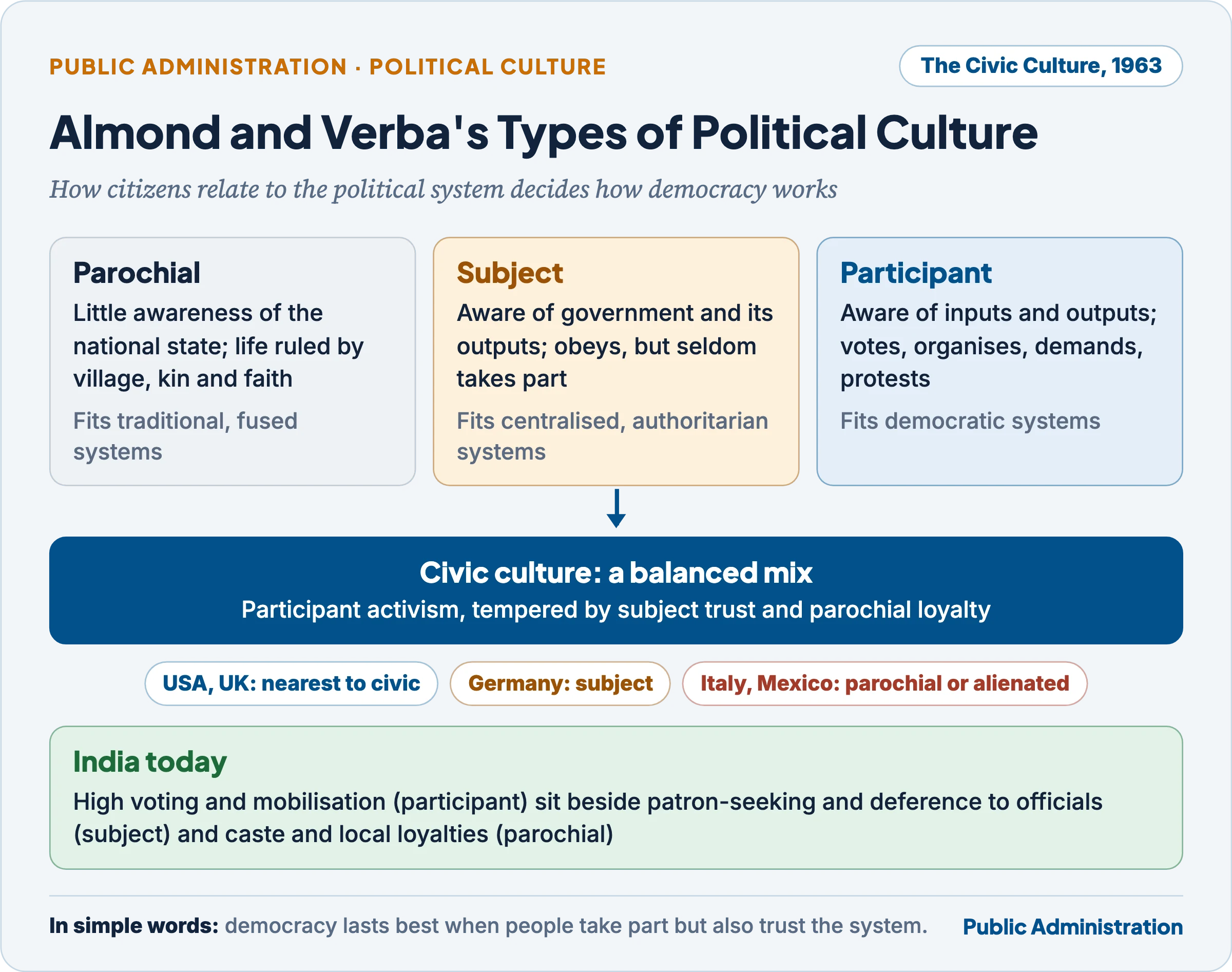
| Type | Orientation to system and outputs | Orientation to inputs and self | Congruent structure |
|---|---|---|---|
| Parochial | Little or none; central government is remote | None; politics is not one’s business | Traditional, fused (tribal, village-based) |
| Subject | High: aware of government and its outputs | Low: passive, obeys, little scope for dissent | Centralised, authoritarian |
| Participant | High | High: active in inputs, sees self as able to influence | Democratic |
- Civic culture is not pure participation. It is a mixed culture in which participant orientations are balanced by subject attitudes (trust, deference, acceptance of decisions) and parochial ties (family, community). Citizens are active enough to keep elites accountable but not so active that the system is overloaded. This balance, Almond and Verba argued, explains stable democracy.
- Findings. Britain and the United States came closest to the civic culture (Britain more deferential, the US more participant). West Germany was largely a subject culture, competent in dealing with administration but detached from politics. Italy showed alienation and parochialism, and Mexico a mix of parochial life with aspirations to participate.
- Mixed cultures. Real societies combine types: parochial-subject (people moving from tribal to state authority), subject-participant (as in much of post-war Europe), parochial-participant (many new states, where mass mobilisation sits on parochial loyalties).
- Congruence. Democracy is stable when culture and structure fit. A democratic constitution placed on a subject or parochial culture produces strain, which is exactly the problem of the Westminster model in post-colonial states (section 5.5).
4.3 Lucian Pye and political development
- Lucian Pye, the American scholar of Asian politics, co-edited with Verba Political Culture and Political Development (1965), which applied the concept to ten countries, including Myron Weiner’s chapter on India.
- Pye’s four dimensions of political culture:
- Trust versus distrust of others and of authority.
- Hierarchy versus equality in relations with authority.
- Liberty versus coercion as the expected way of getting things done.
- Level of identification: loyalty to the parochial group (caste, tribe, region) versus the nation.
- Crises of political development. In Aspects of Political Development (1966), Pye listed six crises every developing state must pass through: identity, legitimacy, penetration, participation, integration and distribution. India has faced all six at once: linguistic and regional identity, the legitimacy of the post-colonial state, the reach of administration into villages, the surge of new groups into politics, national integration, and redistribution through planning and welfare.
- Pye’s point for administration: in transitional societies, formal institutions are imported, but attitudes towards authority are older. Officials behave as patrons, citizens as supplicants, and the rule-bound office becomes a site of personal bargaining.
4.4 Political socialisation
Political socialisation is the process by which people acquire their political orientations; it is how political culture is transmitted and changed across generations.
- Agents: the family (party loyalty, attitudes to authority), the school (civic education, national symbols), peer groups, religious and caste institutions, political parties, the mass media and now social media, and direct contact with government (the police station, the ration shop, the tahsil office).
- Latent and manifest. Some socialisation is deliberate (civics textbooks, national anthem, Republic Day), much of it is unintended (what a child learns from watching a parent bribe a clerk).
- For administration: officials are socialised before they enter service, in family, caste and region, and then re-socialised by training and by the informal culture of the office. This is why a training academy can teach neutrality while a district posting teaches the opposite.
4.5 Other typologies and the critique of the concept
- Arend Lijphart, the Dutch-American political scientist, and Gerhard Lehmbruch challenged Almond’s claim that only an Anglo-American civic culture sustains democracy. Studying the Netherlands, Switzerland and Austria, they showed that deeply divided societies can be stable if elites cooperate.
Lijphart’s typology of democracies (1968) combined social structure with elite behaviour:
| Homogeneous society | Plural (divided) society | |
|---|---|---|
| Coalescent elites | Depoliticised democracy | Consociational democracy (Netherlands, Belgium, Switzerland, Austria) |
| Adversarial elites | Centripetal democracy (Britain, Scandinavia) | Centrifugal democracy (France’s Fourth Republic, Weimar, Italy) |
- Reading the table. Stability depends less on mass culture than on elite behaviour: a plural society can be stable if its leaders bargain and share power (consociational), and even a homogeneous one is unstable if elites fight (centrifugal). Some notes place Scandinavia among the consociational cases and call the first cell “idealised democracy”; in Lijphart’s scheme the Scandinavian states are centripetal and the cell is “depoliticised”.
- India. Lijphart later argued, in “The Puzzle of Indian Democracy: A Consociational Interpretation” (1996), that India’s grand coalition under the Congress system, minority rights, linguistic federalism and group autonomy made it broadly consociational; critics reply that India’s majoritarian electoral system and strong Centre do not fit the model.
- Elazar’s three American subcultures: moralistic (government as a means to the common good), individualistic (government as a marketplace serving private interests) and traditionalistic (government to preserve the existing social order, led by elites).
- William Stewart’s eight political cultures: anarchism, oligarchy, tory corporatism, fascist corporatism, classical liberalism, radical liberalism, democratic socialism and Leninist socialism, distinguished by whether the basic unit is the individual or the group, whether society is cooperative or competitive, hierarchical or egalitarian, and justified by tradition or reason.
- Robert Dahl used political culture to explain patterns of opposition, through orientations to problem-solving, collective action, the political system and other people.
Critiques of the political culture approach
- Ethnocentrism: the civic culture was modelled on Anglo-American democracy and presented it as the end point for everyone.
- Static and conservative: it explained stability better than change, and could blame a people’s “culture” for failures caused by poverty or institutions.
- Causality problem: Brian Barry (Sociologists, Economists and Democracy, 1970) and others argued that attitudes may be the result of how institutions work, not their cause. Distrust of the police may follow bad policing.
- Elite bias: Carole Pateman, in The Civic Culture Revisited (1980), criticised the idea that low participation and deference are healthy for democracy.
- Methodology: survey data aggregated individual attitudes and treated the nation as one culture, missing class, regional and group sub-cultures.
Revival. Robert Putnam‘s Making Democracy Work (1993), on Italian regions, linked effective government to social capital (networks of trust and civic engagement). Ronald Inglehart‘s work on post-materialist values (The Silent Revolution, 1977) and the World Values Survey showed that culture shifts with economic security. Samuel Huntington extended cultural arguments to world politics.
Long roots of the idea. Montesquieu linked forms of law to climate and customs; Rousseau spoke of a civil religion binding citizens; Max Weber defined legitimacy as belief in the rightness of authority, which shifts the study of power to its reception in society; and the “culture and personality” school of Margaret Mead and Ruth Benedict connected national character with politics. Almond and Verba gave these ideas a behavioural, survey-based form.
4.6 British and American political cultures compared
| Feature | United Kingdom | United States |
|---|---|---|
| Basic character | Deferential civic culture; “traditionally modern” (Richard Rose, 1965) | Participant, individualist civic culture |
| Attitude to authority | Deference to the governing class and institutions (Walter Bagehot called England a “deferential nation” in The English Constitution, 1867), now much weaker | Suspicion of government; liberty against the state |
| Consensus | Post-war consensus on the welfare state, mixed economy and monarchy | Consensus on the liberal creed: liberty, equality, democracy, rule of law, civic duty (Louis Hartz, The Liberal Tradition in America, 1955) |
| Homogeneity | Historically high; now challenged by Scottish and Welsh nationalism (devolution 1998, Scottish referendum 2014) and Brexit (2016) | Diverse immigrant society held together by a civic creed |
| Constitution | Unwritten; parliamentary sovereignty, conventions | Written; separation of powers, judicial review, federalism |
| Formative factors | Island geography, gradual evolution rather than revolution, Christian tradition, class, empire | Revolution of 1776, frontier, Tocqueville’s associational life (Democracy in America, 1835–40) |
| Current trend | Declining deference and trust, territorial strains | Polarisation, bitterly fought close elections |
- The lesson for India. India borrowed Britain’s parliamentary institutions without Britain’s deferential, homogeneous, convention-bound culture, and borrowed America’s written constitution and judicial review without its associational individualism. The result is a distinct Indian mix.
5. Political Culture of India
In simple words
Indian politics mixes the very old and the very new. People vote in huge numbers and expect the state to deliver, but they often vote along caste and community lines and approach officials through patrons. Big leaders become objects of devotion, and families pass party leadership down the generations.
5.1 Evolution
- Pre-colonial: largely parochial. Kingdoms rose and fell over villages that governed themselves through caste and village councils; the ordinary peasant’s political world was local.
- Colonial: a subject culture. The British unified India under one administration, but citizens were subjects of a distant, alien state reached through the Collector and the police.
- The national movement: political awareness spread from small elites to the masses. Gandhi’s mass campaigns, the Congress organisation and provincial elections under the 1935 Act created a participant layer.
- After 1947: universal adult franchise (21 years at first, 18 years since the 61st Amendment, 1988/89) and the first general election of 1951–52 made a participant culture formally universal.
| Phase | Dominant pattern | Effect on administration |
|---|---|---|
| 1947–1967: Congress system | One-party dominance, elite-led nation-building, consensus | High prestige of the civil service; planning through the bureaucracy |
| 1967–1989: populism and centralisation | Non-Congress state governments (1967), split of 1969, “Garibi Hatao” (1971), Emergency (1975–77) | Committed bureaucracy, personalisation of power, transfers as control |
| 1989–2014: coalitions and mobilisation | Mandal and Mandir politics, regional parties, coalition governments, economic reform | Federal bargaining; 73rd and 74th Amendments; rights-based laws (RTI 2005, MGNREGA 2005) |
| 2014 onwards: return of dominant parties | Single-party majorities (2014, 2019), coalition-dependent majority (2024), strong central leadership, digital campaigning | Centralised monitoring, direct benefit transfer, “minimum government, maximum governance”; concerns about institutional autonomy |
5.2 Interpreting Indian political culture
- The modernity of tradition. Lloyd and Susanne Rudolph, in The Modernity of Tradition: Political Development in India (1967), rejected the idea that tradition and modernity are opposites. Caste associations (they had shown this in an article of 1960) became vehicles of democratic participation, education and mobility; traditional structures were adapted to modern politics rather than destroyed.
- Two political cultures. Myron Weiner, in “India: Two Political Cultures” (in Pye and Verba, 1965), distinguished an elite political culture in New Delhi (English-educated, national, secular, planning-minded, sharing the language of the bureaucracy) from a mass political culture in the districts (vernacular, local, caste-based, oriented to patronage and immediate benefits). Much of the conflict between administration and politics in India is the clash of these two cultures: the officer speaks the language of rules and plans, the local politician the language of claims and favours.
- Three idioms. W.H. Morris-Jones, in The Government and Politics of India (1964), identified three languages of Indian politics: the modern idiom (constitution, law, policy, parties), the traditional idiom (caste, community, kinship) and the saintly idiom (Gandhian moral appeal, renunciation, as in Vinoba Bhave’s movement).
- The Congress system. Rajni Kothari (“The Congress ‘System’ in India”, Asian Survey, 1964; Politics in India, 1970) described one-party dominance as a party of consensus surrounded by parties of pressure. Dissent operated through factions inside the Congress, and opposition parties influenced policy by pressing factions within it. In Caste in Indian Politics (1970), Kothari argued that democracy politicised caste and, in doing so, also loosened its ritual hold.
- Vote banks and dominant castes. M.N. Srinivas, the sociologist, popularised the terms vote bank and dominant caste: numerically and economically strong castes controlling rural politics.
- Patronage democracy. Kanchan Chandra (Why Ethnic Parties Succeed, 2004) described India as a patronage democracy, in which the state is the main source of jobs and services and officials have discretion over their distribution, so voters choose parties by ethnic headcounts to secure access.
- The second democratic upsurge. Yogendra Yadav used this phrase for the surge of lower castes, Dalits, tribals and women into electoral participation from the 1990s, which shifted Indian democracy’s social base downwards.
- Ashis Nandy, the political psychologist, observed that the nation-state became the hegemonic actor in public life, that the middle class grew impatient with democratic process, and that politics moved from Parliament to the media; to the masses democracy still offers hope, to sections of the elite it looks like an obstacle.
- Factional politics. Paul Brass showed that factional contests for party posts, though bitter and full of charges of “bogus enrolment”, kept the Congress organisation alive in the districts and forced leaders to build local support.
5.3 Features of Indian political culture
- Heterogeneity and fragmentation. Many languages, religions, castes, regions and classes produce many sub-cultures rather than one national culture. Unity rests on accommodation: linguistic states (1956), minority rights, reservations.
- Traditional and modern side by side. Electronic voting machines and caste panchayats, televised debates and astrologers fixing swearing-in times coexist. Riggs called such societies prismatic.
- Caste. The influence of caste in social relations has weakened, but its role in political mobilisation has grown: in candidate selection, ministry formation, vote appeals and demands for reservation (Jat, Maratha, Patidar agitations).
- Religion. Secularism is a constitutional principle, but religious identity remains a powerful mobiliser, and communal violence repeatedly tests the neutrality of the police and district administration.
- Populism. From “Garibi Hatao” (1971) to loan waivers and pre-election cash transfers, parties compete through direct promises to voters. The debate over “freebies” versus welfare reached the Supreme Court in 2022. Populism favours visible, quick, individual benefits over slower public goods.
- Regionalism. Regional parties have governed most states and shaped coalitions at the Centre since 1989, making federal bargaining part of the political culture.
- Personality cult and charismatic leadership. Indian politics revolves around leaders more than programmes: Nehru, Indira Gandhi, regional leaders and, more recently, highly personalised national campaigns. Ambedkar’s warning against bhakti in politics (3.6) applies directly.
- Dynastic politics. Family succession runs through national and regional parties. Kanchan Chandra and her co-authors (Democratic Dynasties, 2016) found a large share of MPs with family ties to politicians, linked to weak internal party organisation.
- Criminalisation of politics. The Vohra Committee (1993), chaired by Home Secretary N.N. Vohra, described a nexus of criminals, politicians and bureaucrats. According to the Association for Democratic Reforms, 251 of the 543 members (46 per cent) elected to the Lok Sabha in 2024 declared criminal cases, and 170 (31 per cent) declared serious cases, up from 30 per cent and 14 per cent in 2009. The Supreme Court has required candidates and parties to publish criminal antecedents (Public Interest Foundation, 2018; Rambabu Singh Thakur, 2020).
- Participant in voting, subject towards officials. Turnout is high, and the poor vote more than the rich, but many citizens approach the state as supplicants: through a patron, a broker or an MLA’s letter. The “mai-baap sarkar” expectation (the state as parent) coexists with deep distrust of officials.
- Agitational politics. Bandhs, road blockades and hunger strikes are standard tools; no group, as one source puts it, is prepared to budge from its stated position, and confrontation crowds out deliberation.
- Resilience. Despite all this, Indian political culture has absorbed defeat with grace at the polls, accepted court verdicts on elections, and expanded participation to groups excluded for centuries.
5.4 Indian political culture through Almond and Verba’s lens
- India is best described as a mixed parochial-subject-participant culture. Its participant layer is strong in elections and movements; its subject layer shows in deference to officials and dependence on the state; its parochial layer survives in caste, kin and village loyalties that shape political choices.
- Congruence problem. The democratic structure of the Constitution is more participant than much of the culture. This incongruence explains the gap between constitutional norms and administrative behaviour that the Riggsian idea of formalism captures.
5.5 The Westminster model and Indian political culture
The Westminster model is the British system of parliamentary government: a cabinet drawn from and responsible to the elected house, a neutral head of state, two disciplined parties, a neutral Speaker, a permanent, neutral and anonymous civil service, and heavy reliance on conventions and self-restraint.
| Westminster assumption | Indian reality |
|---|---|
| Homogeneous society with class-based parties | Deeply plural society; parties built on caste, region, religion and leaders |
| Two-party system with a strong, recognised opposition | Multi-party system; dominant-party phases and long coalition eras; an official Leader of the Opposition was absent in the Lok Sabha from 2014 to 2024 |
| Conventions obeyed voluntarily | Conventions often broken (Governors’ discretion, Speakers on defection, use of ordinances), and then codified by courts (Bommai, Kihoto Hollohan, the 2025 Governors’ cases) |
| Neutral Speaker who leaves party politics | Speakers remain party members; decisions under the Tenth Schedule (1985) are often delayed or partisan |
| Collective cabinet led by a first among equals | Strongly Prime Minister-centred and Chief Minister-centred government |
| Neutral, anonymous civil service | Politicised transfers, demands for commitment, caste and regional lobbies |
| Parliamentary sovereignty | Constitutional supremacy, federalism, judicial review |
| Deferential, consensual culture | Agitational, competitive culture with low trust between government and opposition |
- The case that they are at odds. The model assumes a political culture of restraint, where the majority does not use every power it has and the opposition is a “government in waiting”. In India, conventions are treated as optional when power is at stake, legislatures sit for fewer days, Bills pass with little debate, and the first-past-the-post system can convert a minority of votes into large majorities. The anti-defection law itself is evidence that the culture could not sustain party loyalty by convention.
- The case that India has adapted it. India never adopted pure Westminster. Ambedkar chose it for responsibility over stability, and the framers deliberately added a written constitution, Fundamental Rights, federalism and judicial review, precisely because they did not expect British-style conventions to hold. Over seven decades, Indian parliamentary government has survived coalitions, hung houses and changes of government, and courts have turned broken conventions into binding rules. The result is an “Indianised Westminster”, rule-bound where Britain is convention-bound.
- For administration, the clash shows most in the civil service. The Westminster ideal of a neutral, anonymous official serving any minister impartially sits uneasily with a political culture that rewards personal loyalty. Section 6 takes this up.
6. Political Culture and Administrative Culture
In simple words
Officials are not machines. They come from society and work under politicians, so they pick up the habits around them. If politics rewards loyalty and favours, many officials learn to give loyalty and favours. If politics respects rules, officials find it easier to stay honest.
6.1 Administrative culture
- Meaning. Administrative or bureaucratic culture is the set of values, beliefs, attitudes and behaviour patterns shared by administrators: how they see their role, their superiors, their political masters and the public. It is a sub-culture of the wider political culture, shaped also by the service’s own history and training.
- Features of Indian administrative culture, largely inherited from the colonial service and reinforced by social structure:
- Hierarchy and status-consciousness: authority flows downwards; juniors rarely contradict seniors.
- Rule-mindedness and proceduralism: following the file is safer than achieving the result; Merton’s displacement of goals.
- Elitism and distance from citizens: the “sahib” culture of the district officer.
- Secrecy: the Official Secrets Act, 1923, and the habit of treating information as the government’s property, only partly undone by RTI.
- Generalism: the all-rounder administrator over the specialist.
- Paternalism: the citizen as a ward to be looked after, not a rights-holder.
- Risk aversion: vigilance fear and audit objections discourage initiative.
- Studies of the cultural roots of behaviour:
- Richard Taub, Bureaucrats under Stress (1969), on Odisha’s administrators: tendencies to split into groups on particularistic ties, reluctance to delegate, hierarchical thinking drawn from caste, and deference to authority.
- Stanley Heginbotham, Cultures in Conflict (1975), on Tamil Nadu: the clash between the Weberian-British model of administration and traditional Hindu (dharmic) and Gandhian ideas of duty, and the urban, educated official facing a rural, hierarchical society.
- V. Subramaniam, the Indian scholar of administration, argued that certain traditional attitudes (reluctance to choose between exclusive alternatives, a gap between precept and practice, indifference to small differences) work against rational decision-making, and that the familiar complaint “policies are good, implementation is bad” reflects a cultural distance between decision and execution.
- David Apter, the American political scientist (The Politics of Modernization, 1965), distinguished instrumental values (which support change) from consummatory values (ends in themselves, which resist it); David McClelland (The Achieving Society, 1961) tied economic development to the achievement motive, and some writers saw a fatalistic reading of karma as weakening it.
- Authority in a feudal culture is treated as sacred; personal loyalty to the boss outranks organisational goals, communication flows only downwards, and benevolent paternalism works better than participative leadership.
- Social background or service culture? V. Subramaniam‘s Social Background of India’s Administrators (1971) found the higher civil service drawn overwhelmingly from the urban, educated middle class. Later intake has widened through reservations and regional recruitment, yet observers find that officers from very different backgrounds come to behave alike within a few years. Research on Indian bureaucracy therefore tends to give the service’s own culture (training, peer norms, the incentives set by political masters) more weight than social origin in shaping integrity: an honest recruit placed in a corrupt office, with transfers as the price of resistance, is socialised into its ways, while a strong institutional culture can hold officers of any background to high standards.
- These generalisations have been criticised as cultural stereotyping: the same “culture” produced efficient institutions like the Election Commission, ISRO and the Delhi Metro. Culture conditions behaviour; it does not fix it.
6.2 How political culture shapes bureaucratic behaviour, integrity and conduct
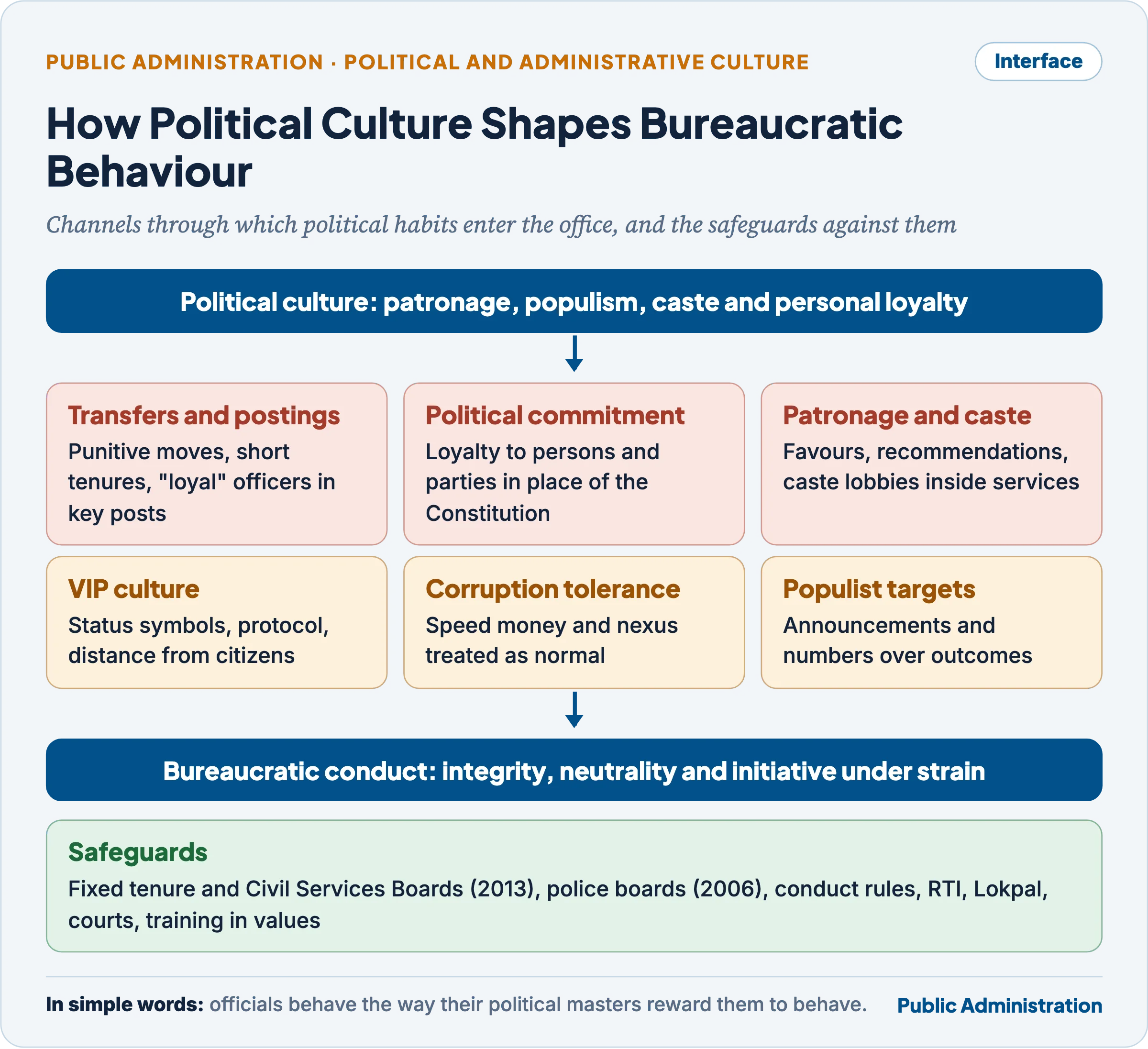
- Transfers and postings. The single strongest channel. Politicians use transfers to reward loyalty and punish independence, so that officers learn that compliance is safer than integrity. Short tenures in districts and departments destroy continuity, accountability and local knowledge. Officers who cancel illegal land deals or act against powerful mining or sand interests have repeatedly been transferred or suspended within days, a pattern so common that “transfer industry” became a standard phrase.
- Committed bureaucracy. After the Congress split of 1969, leaders around Indira Gandhi demanded a bureaucracy committed to the government’s socialist programme rather than a “neutral” one. Defended as commitment to constitutional goals, it slid into commitment to the ruling party and its leaders, which the Shah Commission documented for the Emergency. Neutrality, as the Constitution understands it, means commitment to the Constitution and the law, not to persons.
- Patronage and caste. In a patronage democracy, the MLA’s letter, the minister’s phone call and caste networks shape who gets the posting, the contract, the licence or the benefit. Caste and regional associations form informal groups within services, weakening their unity and impartiality.
- VIP culture. A political culture of deference and display produces red beacons, protocol, convoys and privileged access. The Union Cabinet banned red beacons on official vehicles (except emergency services) from 1 May 2017, but the culture of special treatment persists in airport lounges, temple queues and hospital wards.
- Corruption tolerance. Where society treats paying “speed money” as normal and politics depends on large, unaccounted funds, petty and grand corruption become routine rather than deviant. The Santhanam Committee (1964) already noted public belief in ministerial corruption; the Vohra Committee (1993) described a politician-bureaucrat-criminal nexus. India scored 39 out of 100 and ranked 91st of 182 in Transparency International’s Corruption Perceptions Index 2025 (released February 2026).
- Populism and target-chasing. Pressure for quick announcements and visible numbers (toilets built, accounts opened, beneficiaries enrolled) can push officials to report outputs over outcomes, and sometimes to inflate them.
- Centralisation and personalisation. Personalised leadership concentrates decisions in the PMO and Chief Ministers’ offices; officials close to leaders gain influence beyond their rank, and line departments lose initiative.
- Criminalisation and law and order. Where criminal records do not end political careers, police officers face pressure to go slow on cases against the powerful, which damages the credibility of policing.
- Positive influences. Political culture also pushes administration forward: competitive elections force delivery; coalition and federal bargaining made governments consult; social movements produced RTI (2005), the Lokpal Act (2013) and the Whistle Blowers Protection Act (2014); rising aspirations of the poor demand responsive service. The Election Commission’s enforcement of the Model Code of Conduct shows officials applying the rules impartially even against ruling parties.
6.3 The reverse flow: administrative culture shaping political culture
- Continuity of the “steel frame”. A permanent, all-India service gave new politicians a ready machine and a habit of rule-bound governance, which helped Indian democracy survive its early decades.
- Subject attitudes reinforced. Distant, discourteous and slow offices teach citizens that the state is a master, not a servant, deepening patron-seeking and distrust.
- Officials as political brokers. In districts, officers mediate between groups and allocate benefits, so citizens experience “politics” largely through the bureaucracy.
- Reform from inside. Officer-led innovations (single-window services, grievance portals, e-governance) have changed citizens’ expectations and fed back into political demands for service guarantee laws (Madhya Pradesh 2010, followed by most states).
6.4 Correctives and reforms
- Judicial: Prakash Singh v Union of India (22 September 2006) ordered State Security Commissions, Police Establishment Boards and fixed tenure for police chiefs; T.S.R. Subramanian (2013) ordered Civil Services Boards, fixed tenure and written orders; Vineet Narain (1997) insulated the CBI’s director and gave the CVC statutory oversight.
- Commissions: the Second Administrative Reforms Commission (chaired first by M. Veerappa Moily) recommended in its 4th report, Ethics in Governance (2007), codes of ethics for ministers and civil servants, state funding and reform of political finance, and a Lokpal; its 10th report, Refurbishing of Personnel Administration (2008), recommended a Civil Services Law stating public service values, stable tenure and a Central Civil Services Authority. The National Commission to Review the Working of the Constitution (chaired by Justice M.N. Venkatachaliah, 2002) proposed similar insulation of civil servants from political pressure.
- Statutory: RTI Act (2005), Lokpal and Lokayuktas Act (2013), Whistle Blowers Protection Act (2014), amendments to the Prevention of Corruption Act (2018) penalising bribe-givers as well as takers.
- Capacity and values: Mission Karmayogi (National Programme for Civil Services Capacity Building, launched September 2020) and the Capacity Building Commission seek to shift the bureaucracy from rule-based to role-based functioning and to build citizen-centric values.
- Political: internal democracy in parties, transparent political funding, disqualification of candidates facing serious charges, and voluntary self-restraint by ministers in matters of transfers. These depend on political culture itself, which is why they move slowest.
6.5 Culturally sanctioned values and symbols in administration
Culture does not only obstruct administration; it also supplies values and symbols that give administration legitimacy and help it mobilise people. Riggs observed that every culture offers both supports and obstacles to change.
Positive values drawn from tradition and the freedom struggle
- Dharma and rajdharma: the ruler’s duty to protect and serve all subjects impartially; the phrase is still invoked to remind governments of their duty in times of communal crisis. Kautilya’s ideal of the king’s happiness lying in the happiness of his subjects is often cited in training.
- Seva (service) and nishkama karma (duty without attachment to reward), from the Bhagavad Gita: the ideal of the selfless public servant.
- Gandhian values: truth, non-violence, trusteeship, simplicity, and Gandhi’s talisman (recall the face of the poorest person and ask whether the step will help him), widely used to frame pro-poor administration.
- Antyodaya (the welfare of the last person), a value now built into scheme names and targeting.
- Character over cleverness: the motto of the Lal Bahadur Shastri National Academy of Administration is “Sheelam Param Bhushanam” (character is the highest virtue).
Symbols that carry these values
- The State Emblem with “Satyameva Jayate” (truth alone triumphs), whose use is regulated by the State Emblem of India (Prohibition of Improper Use) Act, 2005.
- Institutional mottos: the Supreme Court’s “Yato Dharmastato Jayah” (where there is dharma, there is victory). In June 2025 the Lokpal replaced its Sanskrit motto, “Ma Gridhah Kasyasvid Dhanam” (do not covet anyone’s wealth), with “Empower Citizens, Expose Corruption“, a shift from a classical to a citizen-facing symbol.
- Renaming to signal service rather than rule: Rajpath became Kartavya Path (September 2022); in November 2025 the Union Home Ministry asked Raj Bhavans to become Lok Bhavans; the new PMO complex was named Seva Teerth (February 2026).
- Mass campaigns using cultural symbols: the Swachh Bharat Mission (2014) used Gandhi’s spectacles as its logo; immunisation and sanitation drives enlist religious leaders, festivals and village rituals to reach people the formal state cannot.
Negative values and symbols that obstruct
- Hierarchy and deference drawn from caste and feudal tradition: subordinates hesitate to speak up; citizens bow before officers.
- Status symbols: beacons, large bungalows, orderlies, the officer’s chair with a white towel, which display distance from citizens.
- Particularism: duty to kin, caste and village above impartial rules, which can turn favouritism into a moral obligation.
- Gift and reciprocity norms, which blur the line between courtesy and bribery.
- Fatalism and ritualism: accepting delay and suffering as fate; ceremonies (foundation stones, inaugurations) valued over follow-through.
What this means. Culturally sanctioned values are a resource: when administration speaks in the idiom of seva, dharma and Gandhian service, it gains legitimacy and reach that rules alone cannot buy. But the same culture also sanctions hierarchy and particularism, which the Constitution’s values of equality and impartiality must correct. Good administration uses the first and resists the second.
Theory lens: reading constitutionalism and political culture through Paper I ideas
- Dicey’s rule of law. A.V. Dicey (Law of the Constitution, 1885) gives Indian constitutionalism its first two principles (supremacy of law and equality before it) in Articles 14 and 21; Indian courts went beyond him by adding non-arbitrariness (Royappa, Maneka Gandhi) and by building an administrative law he distrusted. See the article on Administrative Law and Dicey.
- Weber’s types of legitimacy. Max Weber (Economy and Society, 1922) separated traditional, charismatic and legal-rational authority. The Constitution embodies legal-rational legitimacy; Indian political culture keeps strong strands of charisma (personality cults, the bhakti Ambedkar warned against) and tradition (dynasty, caste leadership). The bureaucracy is the main carrier of legal-rational authority in a society where the other two remain powerful. See the article on Weber and Bureaucracy.
- Riggs’ prismatic model and formalism. Fred Riggs (Administration in Developing Countries, 1964) explains why a highly developed Constitution coexists with patronage and arbitrariness: in a prismatic society, modern structures overlap with traditional behaviour, and formalism (the gap between norm and practice) is the rule. Transfer rules, police neutrality and anti-defection law that are honoured on paper but bent in practice are textbook cases. See the article on Riggsian Models.
- The ecological approach. John Gaus (Reflections on Public Administration, 1947) and Riggs (The Ecology of Public Administration, 1961) argued that administration must be studied in its environment of people, place, technology, ideas and culture. Political culture is a central part of that environment; Indian administrative behaviour cannot be understood from the rulebook alone. See the article on Comparative Public Administration.
- Accountability and control theory. The Friedrich–Finer debate (1940–41) sets the choice: Carl Friedrich relied on the official’s inner professional responsibility, Herman Finer on external control by elected bodies. Indian experience suggests both are needed: external controls (courts, Parliament, CAG, RTI) because political culture often fails to support inner restraint, and inner responsibility because controls cannot reach every decision. See the article on Accountability and Control.
- Public choice. James Buchanan and Gordon Tullock (The Calculus of Consent, 1962) and William Niskanen (Bureaucracy and Representative Government, 1971) treat politicians and bureaucrats as self-interested actors: politicians maximise votes, bureaucrats budgets and security. Anne Krueger‘s 1974 paper on the rent-seeking society drew partly on India’s licence regime. Transfers as currency, populist spending before elections and the politician-bureaucrat nexus fit this lens; constitutional limits are, in public choice terms, rules that constrain self-interested rulers. See the article on New Public Administration and Public Choice.
- Principal–agent theory. Voters (principals) delegate to politicians, who delegate to bureaucrats; every link carries information asymmetry. Constitutional devices (written orders, fixed tenure, audit, RTI) reduce the agency problem; a patronage culture enlarges it by aligning agents with the wrong principal.
Key Terms
| Term | Meaning in simple words |
|---|---|
| Constitutionalism | The idea and practice of government limited by a higher law |
| Limited government | Government whose powers are defined and restrained by the constitution |
| Rule of law | No one above the law; action only under law; equality before courts |
| Entrenchment | Protecting constitutional limits from easy change by those they limit |
| Constitutional conventions | Unwritten rules of political practice not enforced by courts |
| Separation of powers | Keeping legislative, executive and judicial functions in different hands |
| Checks and balances | Each organ able to restrain the others |
| Judicial review | Courts’ power to strike down laws and actions that breach the constitution |
| Basic structure | The core features of the Constitution that even an amendment cannot destroy |
| Constitutional morality | Fidelity to the constitution’s values and processes; self-restraint by office holders |
| Transformative constitutionalism | Reading the constitution as a tool to change an unequal society |
| Global constitutionalism | Spread of constitutional limits and rights norms across and beyond states |
| Deemed assent | Treating a Bill as assented to without the Governor’s or President’s actual assent |
| Political culture | Shared attitudes, beliefs and feelings about politics in a society |
| Parochial culture | Little awareness of or interest in the national political system |
| Subject culture | Awareness of government’s outputs, but passive and obedient |
| Participant culture | Active involvement in politics; belief that one can influence it |
| Civic culture | A balanced mix of participant, subject and parochial attitudes |
| Political socialisation | The process of learning political attitudes from family, school, media and experience |
| Political efficacy | A person’s belief that his or her action can influence politics |
| Consociational democracy | Democracy in a divided society kept stable by cooperating elites |
| Modernity of tradition | Traditional structures such as caste adapting to and serving modern politics |
| Congress system | One-party dominance with internal factions and pressure from outside parties |
| Vote bank | A group voting as a bloc, usually on caste or community lines |
| Patronage democracy | Democracy in which the state is the main source of jobs and benefits distributed with discretion |
| Westminster model | British-style parliamentary government with conventions and a neutral civil service |
| Administrative culture | Shared values, beliefs and behaviour patterns of administrators |
| Committed bureaucracy | A bureaucracy loyal to the government’s programme (or, in its degraded form, to the ruling party) rather than neutral |
| Formalism | Riggs’ term for the gap between formal rules and actual behaviour |
Commissions, Committees and Judgments
The table lists the judgments, commissions and Acts that define constitutionalism in India and the reform of the political-administrative interface, in order.
| Body or case | Year | Key point |
|---|---|---|
| Ram Jawaya Kapur v State of Punjab | 1955 | No rigid separation of powers; functions differentiated |
| Santhanam Committee (K. Santhanam) | 1964 | Corruption and public belief in ministerial corruption; led to the CVC |
| Golaknath v State of Punjab | 1967 | Parliament cannot amend Fundamental Rights (later overtaken) |
| Kesavananda Bharati v State of Kerala | 1973 | Thirteen judges, 7:6: amending power cannot destroy the basic structure |
| E.P. Royappa v State of Tamil Nadu | 1974 | Arbitrariness is the antithesis of equality under Article 14 |
| Indira Gandhi v Raj Narain | 1975 | Art 329A(4) struck down; free and fair elections and rule of law basic |
| ADM Jabalpur v Shivkant Shukla | 1976 | 4:1, no habeas corpus during Emergency; Khanna J dissents |
| Shah Commission (Justice J.C. Shah) | 1977–78 | Emergency excesses; officials obeyed illegal oral orders |
| 44th Amendment Act | 1978 | “Armed rebellion”; written Cabinet advice; Art 20, 21 not suspendable |
| Maneka Gandhi v Union of India | 1978 | Procedure under Art 21 must be fair, just and reasonable |
| Minerva Mills v Union of India | 1980 | Limited amending power and rights–directives balance are basic |
| Kihoto Hollohan v Zachillhu | 1992 | Tenth Schedule valid; Speaker’s decisions open to judicial review |
| Indra Sawhney v Union of India | 1992 | OBC reservation upheld; 50 per cent ceiling; creamy layer excluded |
| Vohra Committee (N.N. Vohra) | 1993 | Nexus of criminals, politicians and bureaucrats |
| S.R. Bommai v Union of India | 1994 | Art 356 reviewable; federalism and secularism basic |
| L. Chandra Kumar v Union of India | 1997 | Judicial review by HCs and SC is basic structure |
| Vishaka v State of Rajasthan | 1997 | International conventions read into Fundamental Rights |
| NCRWC (Justice M.N. Venkatachaliah) | 2002 | Review of the Constitution’s working; insulation of civil service |
| Prakash Singh v Union of India | 2006 | Police boards, security commissions, fixed tenure |
| 2nd ARC, Ethics in Governance (M. Veerappa Moily) | 2007 | Codes of ethics, Lokpal, political finance reform |
| I.R. Coelho v State of Tamil Nadu | 2007 | Nine judges: post-1973 Ninth Schedule laws open to basic structure review |
| 2nd ARC, Refurbishing of Personnel Administration | 2008 | Civil Services Law, public service values, stable tenure |
| Naz Foundation v Govt of NCT of Delhi (Delhi HC) | 2009 | Constitutional morality over public morality |
| T.S.R. Subramanian v Union of India | 2013 | Civil Services Boards, fixed tenure, written orders |
| Manoj Narula v Union of India | 2014 | Constitutional morality in choosing ministers |
| SC Advocates-on-Record Association v Union of India (NJAC) | 2015 | 99th Amendment struck down; judicial independence basic |
| K.S. Puttaswamy v Union of India | 2017 | Privacy a fundamental right; ADM Jabalpur overruled |
| Krishna Kumar Singh v State of Bihar | 2017 | Re-promulgation of ordinances a fraud on the Constitution |
| State (NCT of Delhi) v Union of India | 2018 | LG bound by aid and advice; constitutional morality and cooperation |
| Navtej Singh Johar v Union of India | 2018 | Constitutional morality prevails over social morality |
| Indian Young Lawyers Association (Sabarimala) | 2018 | Exclusion of women struck down; review referred to larger bench (2019) |
| Anoop Baranwal v Union of India | 2023 | Selection committee for Election Commissioners pending a law |
| ADR v Union of India (electoral bonds) | 2024 | Scheme struck down; voters’ right to information |
| Demolition of structures (bulldozer case) | 2024 | Executive cannot act as judge; due process and official liability |
| Dr Balram Singh v Union of India | 2024 | “Socialist” and “secular” in Preamble valid; no fixed economic model |
| State of Tamil Nadu v Governor of Tamil Nadu | 2025 | No pocket veto; timelines; ten Bills deemed assented under Art 142 |
| Madras Bar Association v Union of India | 2025 | Tribunals Reforms Act 2021 provisions struck down; National Tribunals Commission ordered |
| Presidential Reference No. 1 of 2025 | 2025 | No judicial timelines or deemed assent; limited review of indefinite delay |
| Tribunals Reforms Act | 2026 | Repeals 2021 Act; creates National Tribunals Commission |
Contemporary Developments
- Electoral bonds struck down (15 February 2024). A five-judge bench in Association for Democratic Reforms v Union of India held anonymous political funding unconstitutional, reinforcing the voter’s right to know as a pillar of democratic constitutionalism.
- Lok Sabha 2024 and criminalisation (June 2024). ADR’s analysis found 251 of 543 members (46 per cent) with declared criminal cases and 170 (31 per cent) with serious cases, the highest so far.
- “Socialist” and “secular” upheld (25 November 2024). Dr Balram Singh v Union of India held that the words added in 1976 do not bind elected governments to any economic model, closing the debate over whether liberalisation conflicts with the Preamble.
- Governors and state Bills (8 April and 20 November 2025). The two-judge ruling in State of Tamil Nadu v Governor ended the pocket veto and declared ten Bills deemed assented; the Constitution Bench opinion on the Presidential reference then held that courts cannot fix timelines or deem assent, but can review indefinite, unexplained delay.
- Tribunal independence (19 November 2025 to 13 August 2026). The Supreme Court struck down provisions of the Tribunals Reforms Act, 2021; Parliament responded with the Tribunals Reforms Act, 2026 creating a National Tribunals Commission.
- Corruption perceptions (10 February 2026). India scored 39/100 and ranked 91st of 182 in the CPI 2025, up from 38 and 96th a year earlier.
- 130th Amendment Bill (2025–2026). The Bill to remove ministers detained for 30 days is with a Joint Parliamentary Committee, whose deadline was extended in July 2026; the panel has discussed suspension instead of removal.
- Service-oriented symbols (2025–2026). Raj Bhavans renamed Lok Bhavans (November 2025) and the new PMO named Seva Teerth (February 2026); the Lokpal adopted the motto “Empower Citizens, Expose Corruption” (June 2025).
Revision Grid
| Thinker or body | Work or report (year) | Key idea |
|---|---|---|
| C.H. McIlwain | Constitutionalism: Ancient and Modern (1940) | Legal limitation on government; antithesis of arbitrary rule |
| Carl J. Friedrich | Constitutional Government and Democracy (1941) | Division of power as effective restraint; constitutionalism as dynamic |
| K.C. Wheare | Modern Constitutions (1951) | Government according to rule, not merely according to a constitution |
| Karl Loewenstein | Political Power and the Governmental Process (1957) | Power distributed among controlled power holders |
| William G. Andrews | Constitutions and Constitutionalism (1961) | Constitutionalism rests on four consensuses |
| A.V. Dicey | Law of the Constitution (1885) | Rule of law; law versus conventions of the constitution |
| Montesquieu | The Spirit of the Laws (1748) | Separation of powers protects liberty |
| B.R. Ambedkar | Constituent Assembly speeches (1948, 1949) | Constitutional morality must be cultivated; working depends on people and parties |
| Granville Austin | Working a Democratic Constitution (1999) | Seamless web of unity, democracy and social revolution |
| Gabriel Almond and Sidney Verba | The Civic Culture (1963) | Parochial, subject, participant; civic culture |
| Lucian Pye and Sidney Verba | Political Culture and Political Development (1965) | Political culture in developing nations; trust, hierarchy, liberty, identity |
| Arend Lijphart | Typologies of democratic systems (1968) | Consociational democracy through elite cooperation |
| Lloyd and Susanne Rudolph | The Modernity of Tradition (1967) | Caste associations as vehicles of modern politics |
| Myron Weiner | “India: Two Political Cultures” (1965) | Elite versus mass political culture |
| W.H. Morris-Jones | The Government and Politics of India (1964) | Modern, traditional and saintly idioms |
| Rajni Kothari | “The Congress ‘System’ in India” (1964) | Party of consensus, parties of pressure |
| Fred Riggs | Administration in Developing Countries (1964) | Prismatic society and formalism |
| Richard Taub | Bureaucrats under Stress (1969) | Cultural roots of Indian bureaucratic behaviour |
| Robert Putnam | Making Democracy Work (1993) | Social capital and government performance |
Previous Year Questions
- 2026Constitutionalism in India paves the way for rule of law and social justice. Elaborate.
- 2026The political culture in India shapes bureaucratic behaviour, professional integrity and civil service conduct. Explain with suitable examples.
- 2025While the Constitution offers a strong framework for decentralized and accountable governance, the real test lies in how institutions, civil society and citizens uphold constitutional values in practice. Examine.
- 2021Examine the extent to which the ideal of Constitutionalism as ‘government by limited powers has been a functional reality in India.
- 2018The philosophy of the Westminster model is at odds with the political culture of India.” Critically analyse.
- 2017“Constitutionalism is the foundation of the administrative edifice in India.” Discuss
- 2017“The market reforms have not infringed the basic structure of the Constitution of India, but have largely compromised the realisation of the ideals of social and economic justice.” Comment.
- 2015To what extent has political culture influenced the administrative culture of India? Explain.
- 2015As Dr. B.R. Ambedkar observed, “the text of the Constitution can provide the organs of the State, but the final outcome of the governance process depends on how it has operationalized by the political parties and people”. Elucidate the statement.
- 2014Discuss the valuable premise of constitutionalism in India which the bureaucracy cannot violate.
- 2011Explain with appropriate illustrations the interface between political culture and bureaucratic culture in contemporary India.
- 2002“Culturally sanctioned values and symbols have acted as important influencing catalyst in administration.” – Elaborate.
- 2002“The value premises of our Constitution in the era of global constitutionalism.” Comment.
- 1995“Between social background and administrative culture, it is the latter that has a dominating influence on integrity in administration in the Indian situation.” Review the statement in the light of research findings in this area.
- 1992‘The Indian Constitution provides a mere environmental setting for our politics and administration but the state of conflict arises from the mass base and the elitist orientations of the two respectively.’ Comment.
- 1991‘As the Fundamental Law of Administration of the land, the Indian Constitution lacks teeth in its institutional package in the Constitution.’ Comment.
- 1993How dose public administration differ in the developed and developing societies? How far can it modernise the traditional political culture of developing countries?
- 1992‘Rule of law is the base of India’s constitutional life, and administrative law seeks to ensure that this basic premise remains upheld and protected.’ Comment.