

Comparative Public Administration: Historical and sociological factors affecting administrative systems; Administration and politics in different countries; Current status of Comparative Public Administration; Ecology and administration; Riggsian models and their critique.
This article: Riggsian models and their critique (with Riggs’s ecological approach, his theory of development and the Riggs–Weber and Riggs–Heady comparisons)
Official Syllabus: Paper I · Unit 1-07 Comparative Public Administration
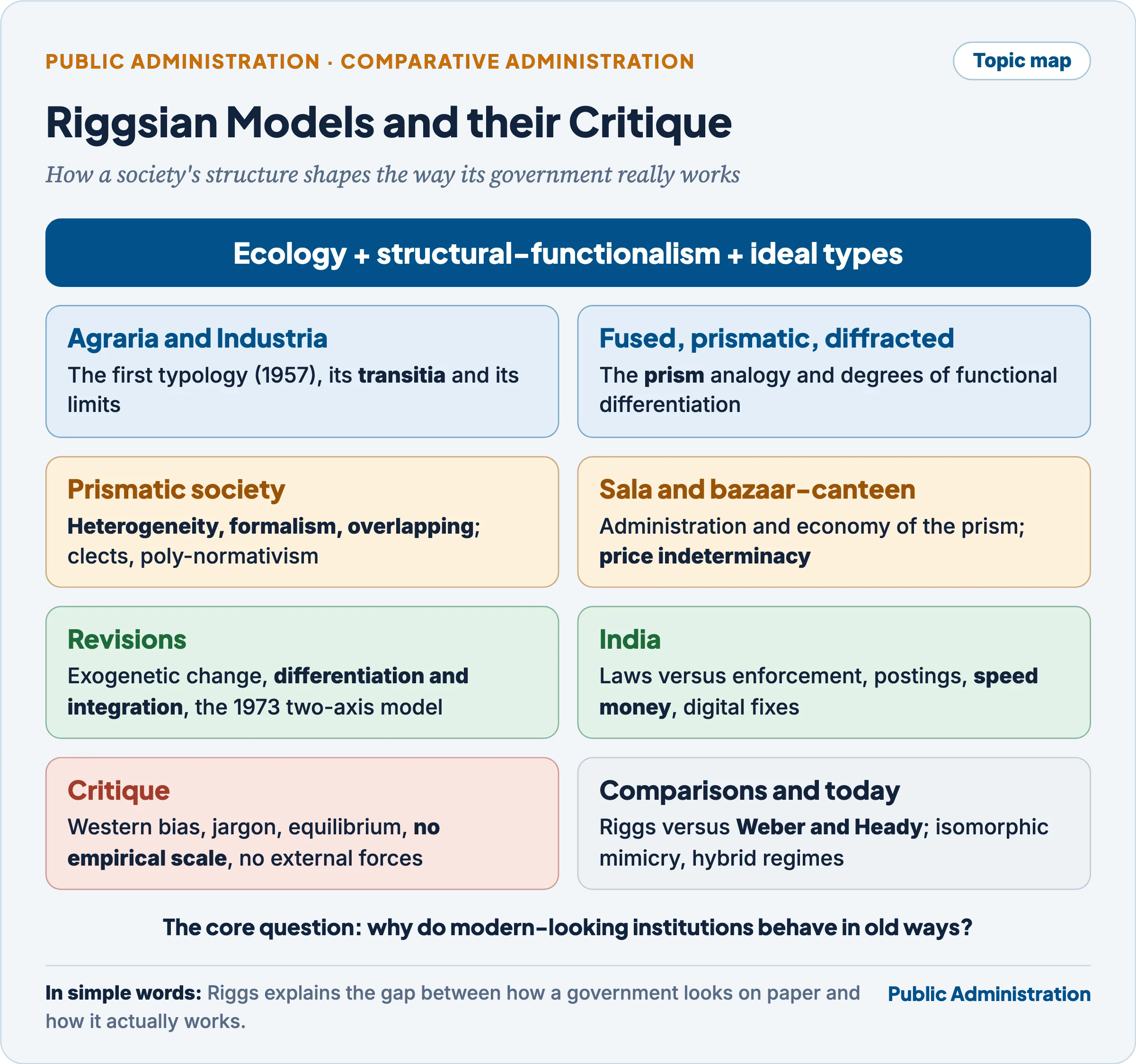
Fred W. Riggs gave Comparative Public Administration its best-known vocabulary: fused, prismatic, diffracted, sala, clects, bazaar-canteen and, above all, formalism. His models try to answer one question that every new state of the 1950s and 1960s faced: why do modern-looking institutions, copied from the West, behave in old ways? The answer, for Riggs, lay not inside the office but in the society around it. That is why his work sits at the meeting point of the ecological approach and development administration.
In simple words
A district office in a developing country may have a computer, a citizen’s charter on the wall and a rule book on the shelf. Yet a file may still move faster for a relative of the clerk, or for someone who pays “speed money”. The building is new; the habits are old. Riggs called this mixed condition prismatic, and his models are a way of describing it.
1. Fred W. Riggs: the Scholar and his Works
In simple words
Riggs was an American political scientist who grew up in China and spent his career studying Asian administration. He built “models” of whole societies to explain why the same office behaves differently in different countries.
- Who he was. Fred Warren Riggs (1917–2008) was born in Kuling, China, studied at the University of Illinois and took his PhD from Columbia University (1948).
- He taught at Indiana University (1956–1967) and the University of Hawaii (1967–1987, then emeritus).
- He was the founding chairman of the Comparative Administration Group (CAG) of the American Society for Public Administration (formed 1960) and led it through the 1960s, the body that drove Comparative Public Administration in its classical phase.
- His field studies were mainly of Thailand and the Philippines; he also lectured in India, Korea and Indonesia.
- He received ASPA’s Dwight Waldo Award for lifetime contribution (1991).
- Why he matters. Ferrel Heady, the leading comparativist of the next generation, called Administration in Developing Countries probably the most notable single contribution to the field.
Major works
A short list of his works shows how the models grew in stages; each later book corrects an earlier one.
| Work | Year | What it contributed |
|---|---|---|
| “Agraria and Industria: Toward a Typology of Comparative Administration”, in W.J. Siffin (ed.), Toward the Comparative Study of Public Administration | 1957 | First typology: two polar societies and, soon after, transitia |
| “Trends in the Comparative Study of Public Administration”, International Review of Administrative Sciences | 1962 | The three trends: normative to empirical, idiographic to nomothetic, non-ecological to ecological |
| The Ecology of Public Administration | 1961 | The ecological approach; fused–prismatic–diffracted societies; the first statement of heterogeneity, formalism and overlapping |
| Administration in Developing Countries: The Theory of Prismatic Society | 1964 | Full theory of the prismatic society, the sala model and the bazaar-canteen economy |
| Thailand: The Modernization of a Bureaucratic Polity | 1966 | The bureaucratic polity: a state in which officials, not parties or legislatures, dominate politics |
| Frontiers of Development Administration (editor) | 1970 | Development administration as a field; Riggs’s idea of development as rising autonomy and differentiation |
| Prismatic Society Revisited | 1973 | The two-dimensional model: differentiation plus integration |
- The 1961 book was first published in Bombay (Asia Publishing House), one reason Riggs’s terms entered Indian scholarship early; the Indian Institute of Public Administration brought out a fiftieth-anniversary edition in 2011.
- After 1973 Riggs debated his critics, notably Daya Krishna, in the Indian journal Administrative Change (1974–1976), refining his idea of development.
- In later life he turned to the fragility of presidential systems and to the design of precise social-science terminology.
2. The Ecological Approach and Riggs’s Three Analytical Tools
In simple words
Ecology in biology studies how a plant or animal and its surroundings shape each other. Riggs applied the same idea to government: an administration shapes its society, and the society shapes the administration.
What “ecology of administration” means
- Definition. The ecology of administration is the two-way interaction between the administrative system and its environment: political, economic, social, cultural, symbolic and communication systems.
- Administration is one sub-system of the larger social system; it is affected by the other sub-systems and in turn modifies them.
- Riggs’s own line, often quoted, is that the significance of each administrative pattern lies in its setting.
- Predecessors. John M. Gaus (Reflections on Public Administration, 1947) first listed ecological factors: people, place, physical technology, social technology, wishes and ideas, catastrophe and personality. Robert Dahl (“The Science of Public Administration: Three Problems”, 1947) argued that generalisations from one nation cannot be applied to all. Riggs turned these hints into a systematic theory of whole societies. (The wider history of the ecological approach is in the companion article on CPA’s nature, factors and ecology.)
- Riggs’s distinctive move. Gaus asked how environment explains American administration. Riggs asked how environment explains why borrowed Western administration does not work as designed in new states.
The three trends Riggs saw in comparative study
In his 1962 article Riggs said that three trends could be discerned in the comparative study of administration. They describe both what CPA was becoming and what Riggs wanted it to become.
| From | To | Meaning |
|---|---|---|
| Normative | Empirical | From what ought to be (ideal structures, “best practice”) to what actually is |
| Idiographic | Nomothetic | From unique, one-country case studies to generalisations, hypotheses and laws that hold across countries |
| Non-ecological | Ecological | From administration studied in isolation to administration studied in its social setting |
- For Riggs, truly comparative studies are those that are empirical, nomothetic and ecological at once.
- He treated these as degrees of emphasis, not watertight pairs: much literature sat between idiographic and nomothetic, and development administration itself mixed normative and empirical aims.
- The trends explain his famous jibe that not to be comparative is to be naively parochial: an administrative theory tested in one country cannot claim to be a science of administration.
The three analytical tools
- Ecological approach. Administration studied in interaction with its environment (above).
- Structural-functional approach. Borrowed from sociology (Talcott Parsons, The Social System, 1951; Robert Merton; Marion Levy) and political science (Gabriel Almond and James Coleman, The Politics of the Developing Areas, 1960).
- Every society must perform certain functions; structures are the patterned arrangements (family, temple, market, ministry) that perform them.
- Riggs named five functions found in every society: economic, social, communication, symbolic and political. The same functional requisites apply to the administrative sub-system.
- The key variable is functional differentiation: how far each function has its own specialised structure.
- Ideal models. Like Weber’s ideal types, Riggs’s models are one-sided accentuations of logically related traits. They are not descriptions of any real country but heuristic devices: yardsticks against which real societies can be placed and compared.
Common confusion
Are fused, prismatic and diffracted descriptions of real countries? No. Riggs said repeatedly that they are ideal types not found in any actual society. Real societies only lie nearer one pole or another. He placed traditional Siam near the fused end, modern Thailand and the Philippines in the prismatic middle and the United States towards the diffracted end, and called even these “speculative guesses”, not measurements.
3. The Agraria–Industria Typology and its Limits
In simple words
Riggs first sorted societies into two kinds: farming societies and industrial societies. It was a useful start, but most real countries are a mixture, so he later added a middle type and then replaced the whole scheme.
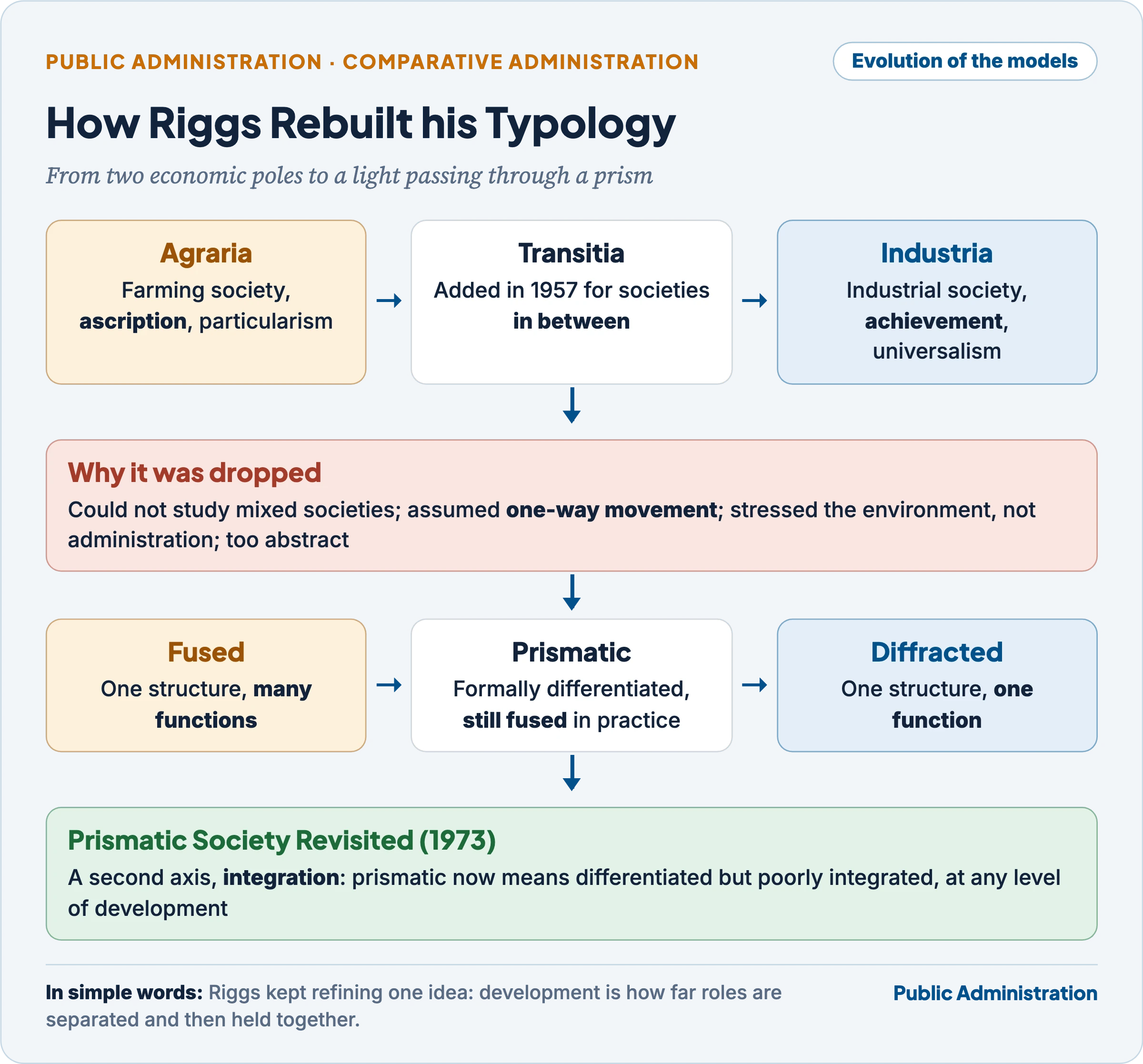
- The typology (1957). Riggs contrasted Agraria, a society dominated by agricultural institutions (model: Imperial China), with Industria, a society dominated by industrial institutions (model: contemporary United States).
- Traits. The two poles reuse Parsons’s pattern variables:
| Agraria | Industria |
|---|---|
| Ascription: status by birth | Achievement: status by performance |
| Particularism: rules vary by who you are | Universalism: the same rule for all |
| Functional diffuseness: one role, many tasks | Functional specificity: one role, one task |
| Stable local groups, little spatial and social mobility | High mobility |
| Simple, stable occupational differences | Developed occupational system cut off from other structures |
| Differential (hierarchical) stratification | Egalitarian class system based on achievement |
| Many voluntary associations, functionally specific and non-ascriptive |
- Transitia. In the same year Riggs added transitia, an intermediate type carrying features of both poles, to represent societies moving from one to the other.
- The Agraria–Transitia–Industria scheme and Weber. Agraria and Industria resemble Weber’s traditional and legal-rational authority systems respectively.
Why Riggs abandoned it
- Weak for transitional societies. The typology was built from the two poles; it said little about the societies in between, which were exactly the new states Riggs wanted to study.
- Cannot handle mixed societies. Modern industrial societies always keep some agrarian features; a two-box scheme cannot capture the mixture.
- Unidirectional. It assumed every society moves one way, from Agraria to Industria, an evolutionist assumption that history did not bear out.
- Environment over administration. It stressed the environment of administration rather than the administrative system itself.
- Too abstract. Critics such as F.J. Tickner (1959) and R.S. Milne (“Comparisons and Models in Public Administration”, 1962) found it general and remote from concrete reality.
Riggs answered these points by moving from an economic basis (farm versus factory) to a structural-functional basis (degree of differentiation), which gave the fused–prismatic–diffracted model.
Indian Connect — Agraria and Industria in India
India in 1950 fitted the Agraria–Industria scheme badly. It had an industrial and urban enclave (Bombay, Calcutta, the railways, a modern civil service) alongside a vast agrarian society governed by caste and custom. A model with only two poles, or a transitia that is merely “halfway”, could not explain why the modern enclave itself behaved in agrarian ways, for example caste shaping recruitment to modern jobs. This is the gap the prismatic model was designed to fill.
4. The Fused–Prismatic–Diffracted Model
In simple words
Shine white light into a glass prism and a rainbow comes out the other side. Inside the prism the light is half-split: no longer white, not yet a clean rainbow. Riggs said developing societies are like the light inside the prism.
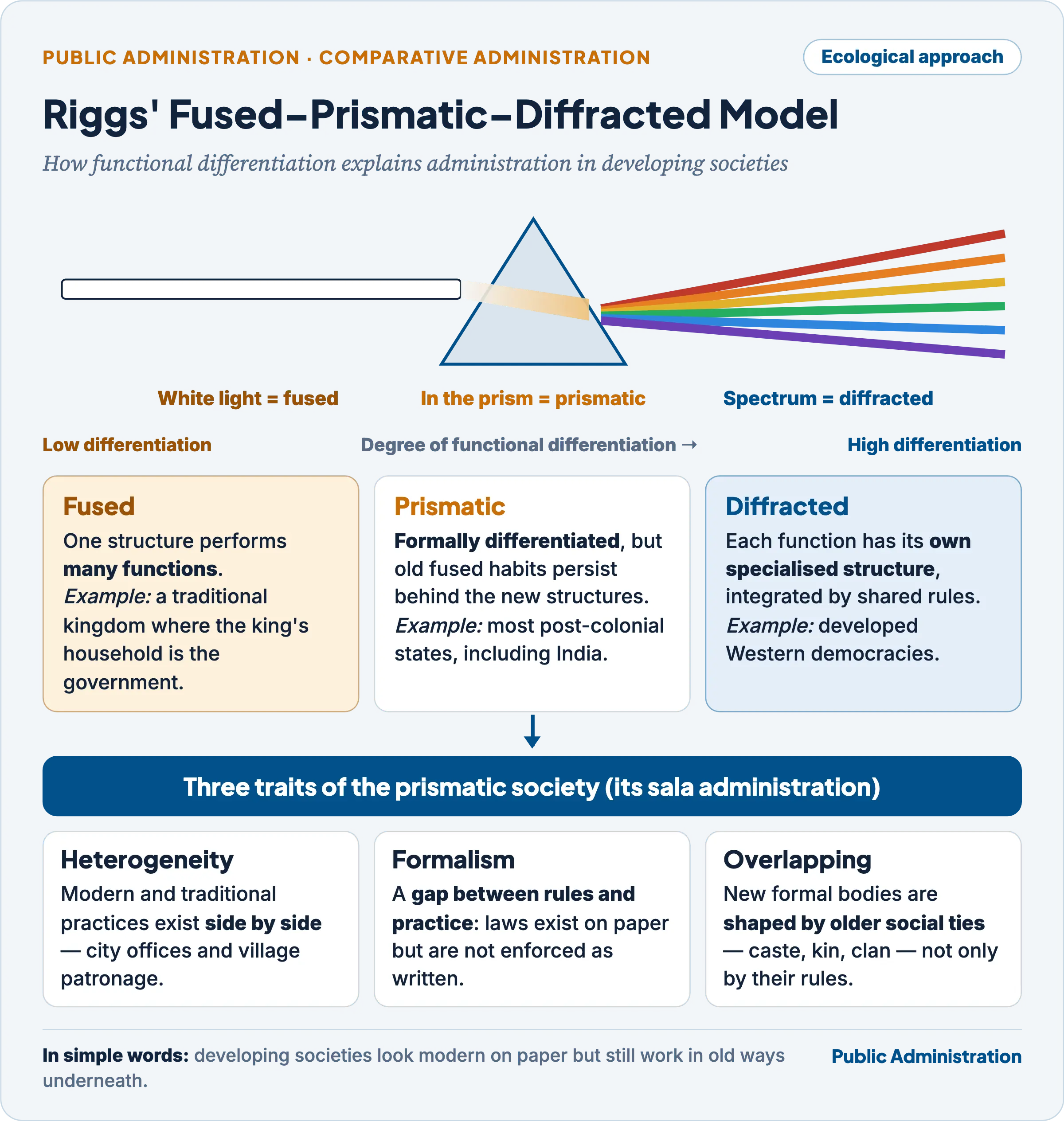
The prism analogy
- Fused. White light before it enters the prism: all colours mixed. A fused society has functionally diffuse structures: one structure (the royal household, the family, the temple) performs economic, political, religious and administrative functions together.
- Prismatic. Light inside the prism: partly separated, colours overlapping. A prismatic society has created specialised structures on paper, but old fused patterns still operate inside them.
- Diffracted. The rainbow after the prism: each colour distinct. A diffracted society has functionally specific structures: legislatures legislate, courts adjudicate, markets allocate, ministries administer, and shared rules integrate them.
- Key variable. The model is built on one dimension: the degree of functional differentiation. This is why a 2012 question could say the classification is built around differentiation.
- Riggs’s own words. Traditional agricultural and folk societies approximate the fused model, modern industrial societies the diffracted (or “refracted”) model; the intermediate model is called prismatic after the prism through which fused light passes to become refracted.
Attributes of the three types
Riggs placed the prismatic society between Parsons’s paired pattern variables and coined three middle terms for it. This is the trio asked about in 2009.
| Dimension | Fused | Prismatic | Diffracted |
|---|---|---|---|
| Application of norms | Particularism | Selectivism | Universalism |
| Basis of status and recruitment | Ascription | Attainment | Achievement |
| Structure–function relation | Functional diffuseness | Poly-functionalism | Functional specificity |
| Economy | Redistributive, traditional exchange | Bazaar-canteen | Market |
| Administrative office | Chamber (royal household) | Sala | Bureau (office) |
| Fit between rule and practice | Realism (custom is the rule) | Formalism | Realism (rule is practised) |
- Selectivism: universal rules exist but are applied selectively, for some people and not others.
- Attainment: formal qualifications (a degree, an examination) matter, but family and community still decide who gets the job; it is a mix of achievement and ascription.
- Poly-functionalism: structures are formally specialised but in practice still carry many functions.
- A striking point: both fused and diffracted societies are “realistic”. In a fused society custom is the rule; in a diffracted society the written rule is practised. Only the prismatic society suffers a gap between the two.
The fused and diffracted ideal types in brief
- Fused society (Riggs’s examples: Imperial China, pre-modern Siam).
- Agrarian, with a redistributive economy: goods flow to the king as tribute and back as favours.
- The king and his household are the government; no separate structures for economy, justice or administration.
- Government is not accountable to the people; subjects owe deference without expecting service.
- No line between formal and informal, public and private.
- Diffracted society (nearest real case: the United States as Riggs saw it).
- Universalistic norms, achievement-based roles, open classes and many voluntary associations.
- A market economy that shapes other spheres (“marketised society”).
- Responsive government, protected rights, broad consensus on basic norms.
Indian Connect — Is India prismatic?
Most Indian scholars of the 1960s and 1970s treated India as a textbook prismatic society: a modern Constitution, Parliament, an examination-based civil service and courts, side by side with caste, kinship and patronage that still shape what those institutions do. The 2001 question asks how far Indian administration shows these traits; Sections 6 and 9 answer it in detail.
5. The Prismatic Society: Heterogeneity, Formalism, Overlapping
In simple words
A prismatic society has three tell-tale signs. Very different ways of life sit side by side (heterogeneity). Laws say one thing and practice does another (formalism). New offices are steered by old loyalties (overlapping).
Riggs’s central interest was the prismatic society; the fused and diffracted models were tools to throw light on it. In answer to the 1996 question, its three features are:
Heterogeneity
- Meaning. The simultaneous presence, side by side, of quite different kinds of systems, practices and viewpoints.
- Examples. Sophisticated urban intellectuals, skyscrapers and Western-style offices in the capital; villages where the elder combines political, judicial, economic and religious roles. Modern hospitals beside traditional healers; Western-style schools beside traditional ones.
- In the administration. The sala itself is heterogeneous: it combines the chamber of the fused society and the bureau of the diffracted one.
- Consequences.
- Social change is incomplete and uneven; generalisation about “the” society becomes difficult.
- Government jobs carry great prestige and income; those who fail to get them form pressure groups and agitations, so elected governments struggle to control the people.
- Heterogeneity in a poly-communal society pulls in many directions, so lack of integration is the basic problem.
Formalism
- Riggs’s definition. The extent to which a discrepancy exists between the prescriptive and the descriptive, between formal and effective power, between the impression given by constitutions, laws, organisation charts and statistics and the actual practices of government and society.
- Degree, not presence. The greater the gap between the formal and the actual, the greater the formalism. Fused and diffracted societies show realism; the prismatic society shows high formalism.
- Causes Riggs named.
- Lack of pressure on government to achieve programme objectives.
- Weak social power over bureaucratic performance.
- Great permissiveness for arbitrary administration.
- How it shows.
- Officials sometimes follow rules strictly and sometimes ignore them; behaviour is unpredictable and depends on the situation.
- Formalism opens the door to corruption: when the rule is not the real rule, its enforcement can be bought.
- Reforms that change only formal rules have a superficial impact; Riggs therefore stressed changing attitudes and building “realism”.
- Constitutional formalism. The gap between constitutional principle and practice, for example when the formal power to choose a Chief Minister rests with the legislature party but the real choice is made by a central party leadership, or when legislators spend little time on law-making and leave it to the bureaucracy.
Overlapping
- Definition. The extent to which formally differentiated structures of a diffracted society coexist with undifferentiated structures of a fused society.
- In the sala, what is described as administrative behaviour is actually determined by non-administrative criteria: political, economic, social, religious or family considerations.
- New norms receive lip service; old values decide.
- Overlapping does not arise in a fused society (whatever is formal is also effective there); it is a product of partial differentiation.
- Five dimensions of overlapping, each with its own Riggsian term, are set out in the next section.
Common confusion
Is formalism the same as red tape or excessive rule-following? No. In ordinary speech “formalism” means rigid attachment to procedure. Riggs’s formalism means the gap between the rule and the practice. A formalistic office may be very rigid with one applicant and ignore the same rule for another. Weber’s “red tape” problem (goal displacement, rules becoming ends in themselves) is a disease of bureaucracy that actually follows rules; Riggs’s formalism is a disease of an administration that does not.
6. Five Dimensions of Overlapping and the Sala Model
In simple words
Overlapping has five faces: jobs going to relatives, groups that look like clubs but act like castes, two moral codes at once, real power lying outside official power, and prices that depend on who you are.
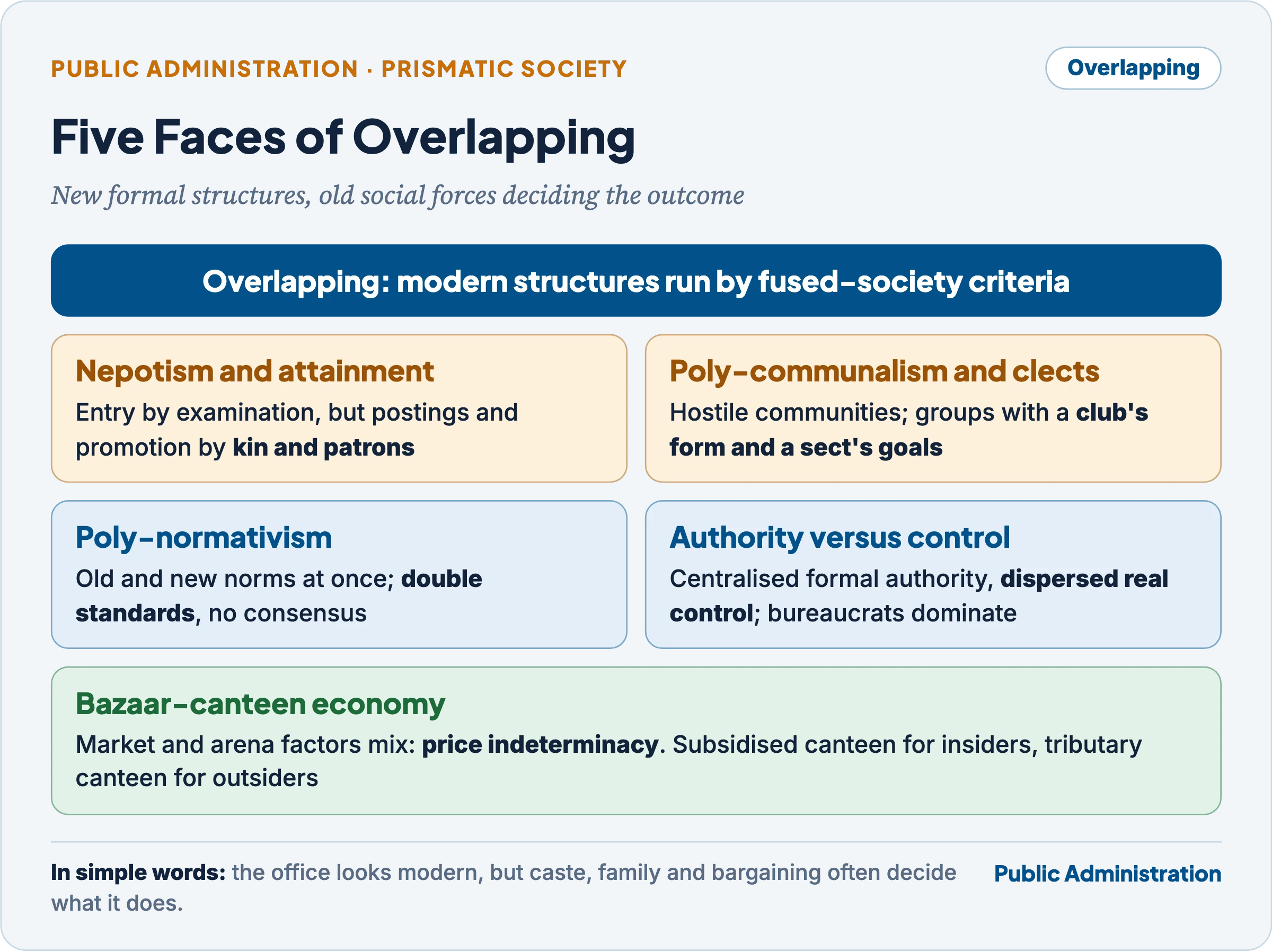
The sala: administration in the prism
- The word. Sala is Spanish for a room, hall or office used for many purposes (Riggs knew it from the Philippines and Thailand, where the word is also used). The Sanskrit shala (pathshala, dharmashala) carries a similar sense.
- Place in the model. Fused society: chamber; prismatic society: sala; diffracted society: bureau.
- Character. The sala has some bureau features (offices, files, rules, examinations) but they do not capture its basic character; its behaviour reflects the heterogeneous values of the society. The administrative rationality of the bureau is largely absent.
(a) Nepotism, attainment and ascription
- In a diffracted society kinship is kept out of official behaviour; in a fused society the polity is patrimonial, so family is openly decisive.
- In the prismatic society patrimonialism is officially condemned but widely practised: universal laws are superimposed on family and kinship and then disregarded.
- Recruitment is by attainment: officials enter through educational qualifications and competitive examinations, but postings, promotions and career advancement depend on ascriptive ties, seniority and the favour of seniors.
- The sala official puts personal aggrandisement before welfare; a few gain from programmes while many are left out.
(b) Poly-communalism and clects
- Poly-communalism: several ethnic, religious, linguistic or caste communities living together in hostile interaction, mobilised for politics without being assimilated into a common national elite.
- Officials, in theory impartial, feel greater loyalty to their own community than to the government.
- A dominant community may capture a large share of posts; quotas or reservation may be introduced for proportional representation, but Riggs warned that compartmentalisation can itself breed rivalry between agencies staffed by rival communities.
- Riggs noted that this is not unique to new states; he cited white–black relations in the American South.
- Clects (a blend of club and sect): typical prismatic groups that use modern, associational methods of organisation (offices, membership, press conferences, lobbying) but pursue diffuse, particularistic goals of a traditional kind.
- A clect serves its own members and ignores others; a sala agency may develop close links with a clect, or behave like a clect itself, so policy meant to be universal is applied selectively.
(c) Poly-normativism and lack of consensus
- Poly-normativism: traditional and modern norms coexist without either prevailing, so there is no consensus on norms of conduct.
- Double standards: the sala official publicly professes modern, rational norms but privately treats them as not binding. He insists on strict literal enforcement at one moment and winks at open violation the next.
- Citizens are poly-normative too: they demand strictly legal-rational conduct from officials in general but seek exemptions for themselves.
- Three kinds of people result: traditionalists, modernists and “transitional” individuals attracted to both codes.
(d) Authority versus control
- Riggs described the prismatic power structure as a highly centralised and concentrated authority structure overlapping a control system that is highly localised and dispersed.
- Authority is officially sanctioned, legitimate power (de jure).
- Control is real but unofficial power (de facto), held by landlords, clects, community leaders and patrons.
- In practice de jure authority often yields to de facto control.
- Unbalanced polity. Political institutions (legislatures, parties, interest groups, public opinion) are weak, so bureaucrats dominate the politico-administrative system. Riggs argued that strengthening the bureaucracy in such a polity may impede political development.
- Inverse power–output hypothesis. Riggs proposed that the more powerful the bureaucrats, the less effective they are as administrators: powerful officials spend effort on protecting their position, while weak politicians cannot reward good work or punish bad.
- Sala summary. Nepotism in recruitment, institutionalised corruption, inefficiency in enforcing laws and a drive to gain power to protect its own interests.
(e) The bazaar-canteen economy
- Arena and market. In a fused society economic exchange is governed by arena factors (religion, status, family), so price hardly arises; in a diffracted society by market factors (supply and demand). In the prismatic society both operate at once.
- Price indeterminacy. The result is that no common price can be fixed for a good or a public service. The price depends on the relationship between buyer and seller: kinship, community, bargaining power, political pull.
- Canteen sides.
- A subsidised canteen for insiders: members of the dominant community, the right clect or the politically influential get services cheap or free.
- A tributary canteen for outsiders: minorities, the poor and the unconnected pay more, often through bribes.
- Bazaar side. A bazaar atmosphere of bargaining spreads into taxes, fees, rebates, licences and bribes; revenue collection suffers; official salaries stay low; low-paid officials make up the gap illegitimately. Some officials are paid without working at all.
- Pariah entrepreneurs. Riggs also noted that in prismatic economies trade is often left to foreign or migrant minorities who lack political standing and must buy protection from officials, which ties economic power to official extortion rather than to production.
- Feedback loop. The economy affects official conduct, and official conduct shapes the economy: inflation, black-marketing and hoarding follow.
Indian Connect — The bazaar-canteen in Indian public services
The Santhanam Committee on Prevention of Corruption (1964) already described “speed money”, payments made to get a file moved, as a routine feature of Indian administration. The Second Administrative Reforms Commission, in its fourth report, Ethics in Governance (2007), and its twelfth, Citizen Centric Administration (2009), pointed to discretion, opaque procedures and the absence of time-bound delivery as the openings for such payments. Riggs’s vocabulary fits: the same certificate, connection or sanction has no fixed “price” in practice; the connected get it through the subsidised canteen, the poor through the tributary one. Right to Services Acts in many states (Madhya Pradesh’s in 2010 was the first), which fix time limits and penalties for listed services, are in effect attempts to make the price of a public service determinate.
7. Change in a Prismatic Society: Exogenetic and Endogenetic Diffraction
In simple words
If a society changes because its own people push for change, new habits come first and new laws follow, so laws fit practice. If change is pushed from outside, new laws come first and habits lag behind, so the gap between law and practice grows.
- Sources of change. Riggs distinguished pressures for change by their origin:
- Exogenetic (exogenous) change: pressure mainly external, such as colonial rule, foreign aid, technical assistance or imitation of foreign models.
- Endogenetic (endogenous) change: pressure mainly internal, from the society’s own groups and reformers.
- Equigenetic change: external and internal pressures of roughly equal strength.
- The hypothesis (examined in 2022). The more exogenetic the process of diffraction, the more formalistic and heterogeneous its prismatic phase; the more endogenetic, the less formalistic and heterogeneous.
- Why. In endogenetic change, effective behaviour precedes the creation of new formal institutions: people already act in new ways, and laws codify them. In exogenetic change the sequence is reversed: formal institutions arrive first, and behaviour is expected to catch up, so a gap opens.
- Western contrast. Western states diffracted slowly over centuries, largely from within, so they faced less formalism, heterogeneity and overlapping. New states, trying to absorb externally induced change in the shortest possible time, face more formalism and what Riggs called severe “evolutionary tensions”.
- Exo-prismatic and endo-prismatic. Societies whose prismatic phase is driven from outside Riggs called exo-prismatic; those driven from within, endo-prismatic.
Testing the hypothesis
- Supporting evidence.
- Colonial and post-colonial states that imported constitutions, civil services and legal codes wholesale often show large gaps between law and practice.
- Externally designed reform packages (structural adjustment, imported “best practice”) have repeatedly produced laws on paper with little change in behaviour, the pattern later called isomorphic mimicry (Section 11).
- In India, social legislation passed ahead of social opinion, such as the Dowry Prohibition Act, 1961, shows high formalism; reforms that grew from strong internal demand, such as the Right to Information Act, 2005 (preceded by grassroots campaigns like the Mazdoor Kisan Shakti Sangathan’s in Rajasthan), took firmer root.
- Limits.
- “External” and “internal” are hard to separate: Indian constitutionalism was borrowed but also owned by a national movement.
- Japan after the Meiji Restoration and South Korea after 1960 adopted foreign models quickly yet built effective states; leadership and state capacity mattered as much as the origin of change.
- The hypothesis can become fatalistic for late developers, who have no choice but to borrow.
Indian Connect — Exogenetic change and Indian institutions
Much of India’s administrative frame was exogenetic: the all-India services, district administration, the Police Act of 1861 and the codes of procedure were colonial imports. Where institutions were transplanted without social roots, formalism has been persistent: the Supreme Court’s seven directions on police reform in Prakash Singh v. Union of India (2006) were met in many states by laws or orders that complied in form while retaining political control over postings and transfers, a point the Court and expert reviews have noted repeatedly since. By contrast, Panchayati Raj had indigenous roots in the national movement, but after the 73rd Amendment (1992) its practice still shows overlapping: the “sarpanch pati”, a husband exercising power in the name of an elected woman, led the Ministry of Panchayati Raj, on the Supreme Court’s advice, to set up an advisory committee under Sushil Kumar in October 2023; its report (February 2025) proposed exemplary penalties for proxy functioning.
8. Revisions: Prismatic Society Revisited (1973) and Riggs’s Theory of Development
In simple words
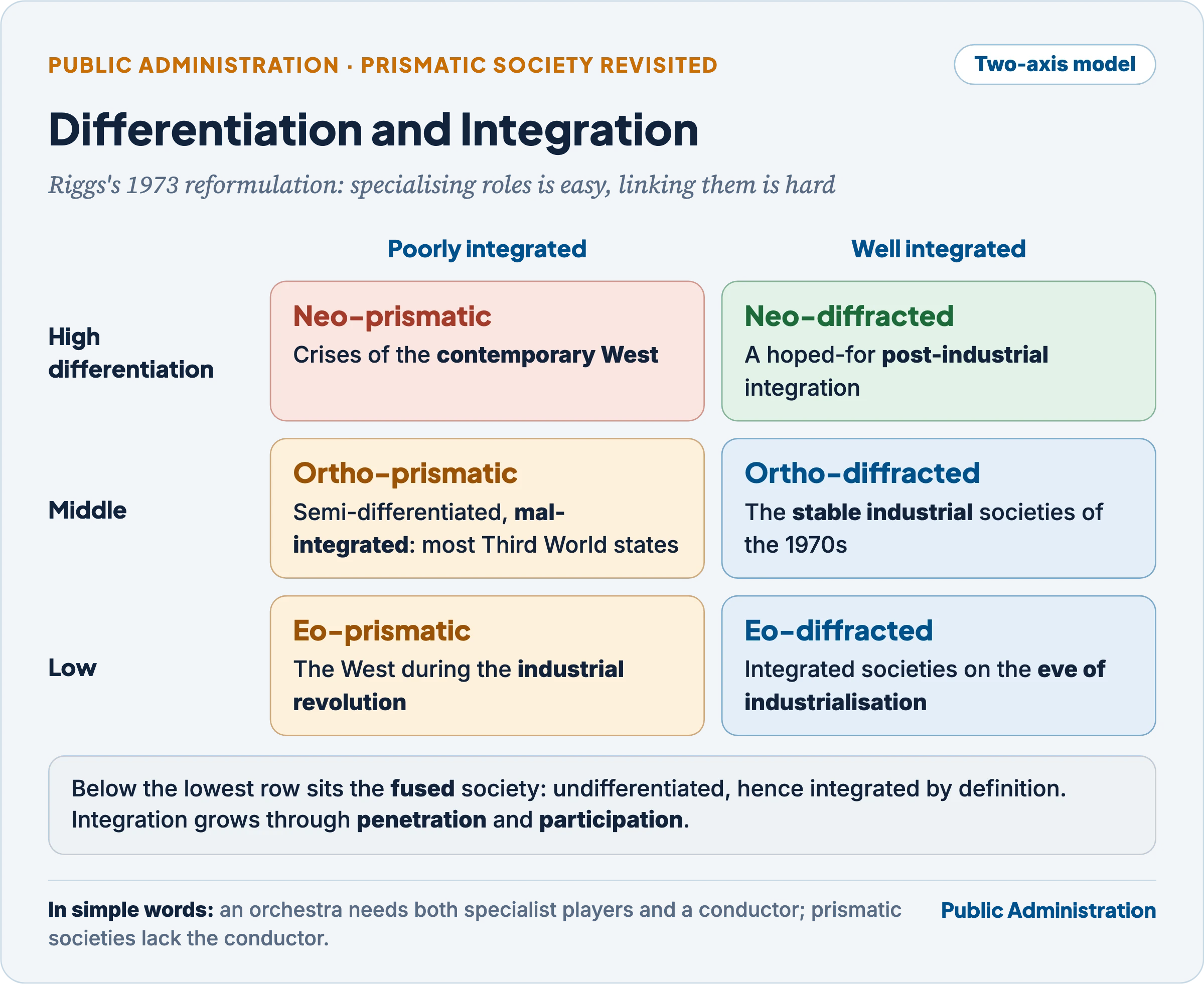
Riggs later admitted that measuring only “how specialised” a society is was not enough. A society can have many specialist offices and still fail because nobody makes them work together. So he added a second yardstick: integration.
From one dimension to two
- Self-criticism. In Prismatic Society Revisited (1973) Riggs called his earlier scheme a mistaken one-dimensional approach (differentiation only).
- Second dimension: integration. The new scheme adds the degree of integration among the differentiated structures, that is, how far they are linked, coordinated and made to mesh.
- A fused society is undifferentiated and therefore integrated by definition.
- Diffracted now means differentiated and integrated.
- Prismatic now means differentiated but mal-integrated.
- Finer types. Both types are subdivided by the level of differentiation, with prefixes marking early, middle and advanced stages:
- Eo-diffracted, ortho-diffracted, neo-diffracted.
- Eo-prismatic, ortho-prismatic, neo-prismatic.
- Riggs’s own illustrations: eo-prismatic for the mal-integrated West of the industrial revolution (the conditions Marx described); ortho-prismatic for most Third World countries; neo-prismatic for the new crises of the contemporary West. On the diffracted side, eo-diffracted for differentiated and integrated societies on the eve of industrialisation; ortho-diffracted for the most stable industrial societies of his day; neo-diffracted for a post-industrial society that might one day solve its neo-prismatic crises.
- He also combined these with the source of change: the prismatic society he actually analysed was, in his phrase, the exo-ortho-prismatic model.
- The transitional societies of the Third World are now classed as ortho-prismatic: semi-differentiated and mal-integrated.
- The orchestra image. Riggs compared a differentiated society to a symphony orchestra. While it is tuning up, every specialist is present but the result is noise; under the conductor’s baton the same specialists make music. Differentiation is the same in both moments; only integration differs. He added that malintegration can occur at any level of differentiation, and the more differentiated a system, the more catastrophic its breakdown.
- Developed countries can be prismatic. The big gain of the revision: prismatic conditions need not be confined to less developed countries. Riggs pointed to signs of mal-integration in the United States in the late 1960s: urban crises, race riots, student uprisings, apathy and the turmoil of the Vietnam War. This answers the 2010 question: in the revised model, the prismatic condition can apply to developed as well as developing societies.
Development as differentiation plus integration
- Riggs’s definition. Development is a process of increasing autonomy (discretion) of social systems, made possible by rising levels of diffraction. Discretion is the ability to choose among alternatives; diffraction is the combined level of differentiation and integration.
- Ecological version. Development is the increasing ability of a society to make and carry out collective decisions affecting its environment.
- Rules of the scheme.
- The higher both differentiation and integration, the greater the development.
- A mismatch (much differentiation, little integration) yields prismatic conditions at that level.
- A society that keeps differentiating without matching integration slides towards confusion; Riggs’s line was that it is much easier to train people for specialised roles than to integrate those roles.
- What drives each axis.
- Differentiation depends on technological and non-technological factors: the more technology, the more differentiation.
- Integration depends on penetration (the government’s ability to make and carry out decisions throughout its territory) and participation (the willingness and ability of people to accept laws and help carry them out).
Administrative development and administration of development
- Riggs distinguished two sides of development administration:
- Administration of development: using the administrative system to carry out development programmes (the system as an instrument).
- Administrative development: building the capacity, skills and structures of the administration itself (the system as a target).
- Chicken-and-egg relationship. Riggs argued that the two depend on each other: a weak administration cannot deliver development, but administrative capacity itself grows only as society develops (more educated recruits, more resources, more political pressure for performance). Neither can wait for the other; they must advance together.
- Why prismatic conditions hurt both. In a prismatic society formalism and overlapping weaken administrative development (merit, discipline, coordination), which then hampers the administration of development (programme delivery). This is the argument behind the 1987 and 1988 questions.
- Contrast with Weidner. Edward Weidner, who edited Development Administration in Asia (1970), defined development administration as goal-oriented, action-oriented administration aimed at progressive political, economic and social objectives, and urged that development goals be the dependent variable of research. Riggs’s ecological view treated the administration itself as shaped by its environment. The 2011 criticism of both is that Weidner’s definition was normative and vague about process, while Riggs’s model was static and descriptive, explaining why administration fails better than how it develops. (Development administration as a field is covered in the Development Dynamics articles.)
Did Riggs keep changing his theory?
The 2016 question invites a judgement on Riggs’s revisions. The table shows the sequence.
| Stage | Key idea | What it corrected |
|---|---|---|
| Agraria–Industria (1957) | Two economic poles | — |
| Transitia (1957) | A middle type | Neglect of transitional societies |
| Fused–prismatic–diffracted (1959–1964) | One axis: differentiation; the prism | Economic basis, one-way evolution, abstractness |
| Sala and bazaar-canteen (1962–1964) | Administration and economy of the prism | Neglect of the administrative system itself |
| Revisited (1973) | Two axes: differentiation and integration | Western bias; developing-country-only scope |
| Development debates (1970s) | Development as rising discretion; penetration and participation | The charge of a static model |
- Reading 1: endless tinkering. Critics saw a moving target: each criticism produced new terms, and the model never settled into testable form.
- Reading 2: scientific self-correction. Riggs treated models as heuristic tools to be improved as evidence and criticism came in; revising them is what Popperian science demands. The core idea (differentiation and the gap between form and practice) stayed constant; the revisions sharpened it.
9. Riggs and India: Formalism, Sala and Bazaar-Canteen Today
In simple words
Riggs’s ideas are useful for India because they name problems that everyone sees: good laws that are not enforced, postings that depend on connections, and services whose real cost depends on who you know. They are less useful if they make us forget how much Indian institutions have changed.
Formalism: laws versus enforcement
- Social legislation ahead of practice.
- The Dowry Prohibition Act, 1961 has been on the statute book for over six decades; the National Crime Records Bureau continues to record thousands of dowry deaths every year.
- The Prohibition of Employment as Manual Scavengers and their Rehabilitation Act, 2013 replaced a 1993 law, yet deaths in sewer and septic-tank cleaning continue to be reported; in Dr. Balram Singh v. Union of India (2023) the Supreme Court directed compensation of Rs 30 lakh for each sewer death.
- Anti-child-labour and environmental laws show similar gaps between standard and enforcement.
- Decentralisation in form. The 73rd and 74th Amendments (1992) listed 29 and 18 subjects for devolution, but states have devolved funds, functions and functionaries unevenly; the Ministry of Panchayati Raj’s devolution index reports show wide variation across states.
- Constitutional formalism. Practices such as the choice of Chief Ministers by party high commands, or Governors’ discretion used in politically contested ways, show a gap between constitutional text and convention.
- “Weberian structures, Kautilyan practice, Gandhian rhetoric”. This often-repeated description of Indian administration is a Riggsian diagnosis in other words: a formally Weberian civil service, power exercised in the manner of a calculating ruler, and welfare rhetoric not matched by delivery.
Sala features: caste and kin in postings
- Attainment. Entry to the higher civil services is by an open competitive examination conducted by the UPSC (Article 315 onwards), one of the most meritocratic recruitment systems anywhere. This is the “achievement” side.
- Overlapping after entry. Transfers and postings are the opening for non-administrative criteria.
- The Supreme Court in T.S.R. Subramanian v. Union of India (2013) found frequent transfers and political interference serious enough to direct Civil Services Boards for postings and a minimum tenure, and said officials should act on written, not oral, instructions.
- The Hota Committee (2004) and the 2nd ARC’s tenth report, Refurbishing of Personnel Administration (2008), recommended fixed tenure and insulation of postings.
- Clects within government. Caste-based and community associations of employees, and pressure for posting officers of particular communities to particular districts, fit Riggs’s clect pattern. These must be described soberly: reservation itself is a constitutional instrument of equality (Articles 16(4), 16(4A)), not overlapping; overlapping lies in informal favouritism, not in lawful representation.
- Authority versus control. At the district level, formal authority lies with the Collector and the police, but real control may lie with local power-holders, a theme of studies of the “dominant caste” since M.N. Srinivas.
Bazaar-canteen in public services
- Bribes for land records, birth certificates, building sanctions and connections: the classic tributary canteen.
- The subsidised canteen: VIP quotas, discretionary allotments of land and housing, and the “VIP culture” that the Union government targeted in 2017 by banning red beacons on official vehicles.
- Transparency International’s Corruption Perceptions Index 2025 (released in February 2026) ranked India 91st of 182 countries with a score of 39 out of 100, a reminder that perceived corruption remains high.
Technology and rules as “de-prismatising” tools
Since the 2010s, several reforms have tried to narrow formalism by removing discretion and personal contact, which is where overlapping operates.
| Riggsian problem | Reform | How it works |
|---|---|---|
| Price indeterminacy, leakage | Direct Benefit Transfer with Aadhaar and bank accounts (JAM) | Money goes straight to the beneficiary; fewer intermediaries to bargain with |
| Bargaining in tax assessment | Faceless Assessment Scheme (income tax, 2020) | No face-to-face contact between assessing officer and taxpayer |
| Delay as a lever for bribes | Right to Services Acts; online single-window systems | Time limits and penalties make the “price” of a service fixed |
| Formalism in project delivery | PRAGATI review platform (2015) | Top-level, real-time monitoring of stalled projects across departments |
| Discretion in procurement | Government e-Marketplace (GeM), 2016 | Open, rule-based online purchasing |
- Limits. Technology can create new gatekeepers (cyber cafes, middlemen, data-entry operators), exclude those who fail biometric authentication, and shift discretion rather than abolish it. Formalism can reappear as “dashboard formalism”: targets met on screen but not on the ground.
Indian Connect — The 2nd ARC as an anti-formalism agenda
The Second Administrative Reforms Commission (2005–2009, chaired first by M. Veerappa Moily) did not use Riggs’s terms, but several of its themes read as a reply to him: citizen-centric administration and enforceable service standards (twelfth report) against formalism; ethics, a strong Lokpal and confiscation of illegally acquired property (fourth report) against the bazaar-canteen; tenure and performance management (tenth report) against overlapping in postings; and capacity-building for local government (sixth report) against mal-integration between levels of government.
10. The Critique of Riggsian Models
In simple words
Riggs was criticised for making developing countries look hopeless, for judging them by an American yardstick, for inventing too many words, and for models that could not be measured or tested. Some critics also pointed out that the “prismatic” problems exist in rich countries too.
Western and ethnocentric bias; a negative image
- Michael Monroe argued that Riggs examined developing countries while taking America as the standard society; the diffracted model is an idealised West.
- Negative portrait. The prismatic society is described almost wholly through pathologies (formalism, nepotism, corruption, clects). Its positive features, such as social solidarity, flexibility, and community networks that substitute for weak state services, receive little attention.
- “Overly gloomy”. The 2024 question’s phrase: Riggs’s models offered diagnosis without hope, and could not explain the rapid transformation of South Korea, Taiwan or Singapore, or the post-1991 changes in India.
Positive formalism and positive overlapping
- E.W. Valson, “Positive Formalism: A Desideratum for Development” (Philippine Journal of Public Administration, 1968), argued that some gap between law and practice can be functional: laws may set aspirational standards ahead of society, and flexible enforcement can let administration move faster.
- Riggs’s assumption that formalism is dysfunctional in all circumstances is itself, critics said, a non-ecological view.
- Ramesh K. Arora, Comparative Public Administration: An Ecological Perspective (1972), argued that overlapping exists equally in diffracted societies, though for different reasons, and that Riggs looked only at its negative side; overlapping can generate healthy competition between sub-systems.
Jargon and neologisms
- Riggs coined new words (clects, sala, poly-normativism, selectivism, attainment, eo-/ortho-/neo-) and gave new meanings to old ones (formalism, diffraction), many borrowed from physics and optics.
- Sisson quipped that one must read Riggs three times: once for the language, once for the concepts, and once to see whether there is anything to learn.
- Richard A. Chapman (“Prismatic Theory in Public Administration”, Public Administration, 1966) suggested Riggs should have published his own dictionary. Borrowing physical-science terms does not make administration a science.
- Tilman criticised the choice of an analytical tool from physical science for social systems.
Ideal types without measurement
- No scale. Chapman and others noted there is no measuring scale to identify how prismatic a society is; readers start seeing prismatic traits everywhere.
- Daya Krishna (“Shall We Be Diffracted?”, Administrative Change, 1974) argued that if fused and diffracted societies are imaginary, all real societies are prismatic, and “low”, “middle” and “high” prismatism mean nothing without measurement. If America can become prismatic and a poor country be diffracted, the scheme loses its link with development.
- Untested assumptions. Conclusions such as “formalism concentrates power in the bureaucracy, which causes inefficiency” were drawn, critics said, without systematic empirical evidence.
Equilibrium bias and a static model
- Hahn-Been Lee (“From Ecology to Time”, International Review of Administrative Sciences, 1967) called Riggs’s models equilibrium models: good at describing a system’s balance, poor at explaining change. Where the purpose of administration is to change society, such models are of limited use. Lee proposed adding time as a variable.
- Daya Krishna added that the diffracted society, as a state of equilibrium and stability, is neither realistic nor desirable when change is constant.
- Administration as an agent of change ignored. Riggs treated administration largely as a dependent variable shaped by society; critics argued administration also shapes society, as in planned development.
Neglect of ideology, history and the international system
- External forces. Daya Krishna faulted Riggs for ignoring the international context: a powerful developed state may exploit a weaker one, and the condition of new states owes much to colonialism and the world economy. This is the critique made more fully by dependency theorists (Andre Gunder Frank’s “development of underdevelopment”), for whom underdevelopment is produced by the world system, not by internal social structure.
- Ideology and politics. Riggs said little about class conflict, ideology, the role of leadership or the choice of development strategy. Marxist critics saw the model as a liberal modernisation theory of the Cold War, funded through the same networks (the Ford Foundation and US aid) as the CAG.
- Penetration and participation questioned. Daya Krishna noted that participation can be high in dictatorships, so it is a weak measure of integration; and differentiation is driven by social, not only technological, factors.
- Internal dynamics. Riggs analysed the environment of administration more than administration itself: its internal organisation, decision-making and leadership.
Prismatic features in the West
- Formalism, overlapping and clect-like behaviour appear in developed countries: lobbying and regulatory capture, patronage appointments, the “spoils” side of US politics, racially selective policing, and campaign finance that sells access. Riggs himself conceded this in 1973.
- If prismatic traits are universal, the model loses its value as a typology of developing societies, but may gain value as a set of diagnostic concepts usable anywhere.
Critics at a glance
| Critic | Main objection |
|---|---|
| Daya Krishna | All real societies prismatic; no measurement; diffracted state neither real nor desirable; ignores external forces; weak link between participation and integration |
| Hahn-Been Lee | Equilibrium model; cannot explain change; time missing |
| Richard A. Chapman | Jargon; no scale; implications for administration not worked out; yet useful as a diagnostic tool |
| Michael Monroe | America taken as the standard society |
| Ramesh K. Arora | Overlapping exists in diffracted societies too; only negative aspects examined |
| E.W. Valson | Formalism can be positive |
| Sisson; Tilman | Unreadable terminology; physical-science tools misapplied |
| R.S. Milne; F.J. Tickner | Early typologies too general and remote from reality |
| Ferrel Heady | Admired the ambition, but preferred bureaucracy-centred middle-range comparison as more workable |
Common confusion
Who made the criticism of “refraction” or “diffraction” that UPSC attributes (in a 2000 question) to “Raj Krishna”? The well-known critique is by the Indian philosopher Daya Krishna, in “Shall We Be Diffracted? A Critical Comment on F.W. Riggs’ Prismatic Societies and Public Administration” (Administrative Change, 1974), and a follow-up in 1976. Its “valid content” is the points above: the models cannot be measured, the diffracted ideal is neither real nor obviously desirable, and the international setting is ignored. The question keeps the paper’s wording.
Defence and lasting value
- Chapman’s verdict. Despite their limits, Riggs’s models deepen insight into the problems of transitional societies. Like Simon’s “proverbs” of administration, they may not be universal truths, yet they are useful criteria for describing and diagnosing administrative situations. This is the “sophisticated tools” of the 1992 question.
- They alerted researchers that Weber is not predictive everywhere (1995): the same formal bureaucracy behaves differently where society is prismatic.
- They set the research agenda: empirical, nomothetic, ecological study; the study of corruption as a systemic, not merely moral, problem; and the idea that institutional transfer needs social roots.
Criticism — Criticism of Riggs’s models
- Ethnocentric: the diffracted West is the hidden ideal, and developing societies are seen through their defects.
- Untestable: ideal types without a measuring scale; every society ends up “prismatic”.
- Static and gloomy: an equilibrium model that cannot explain success stories like South Korea or Singapore.
- Blind to the outside world: colonialism, dependency and global markets barely appear.
- Opaque: a forest of neologisms that hides more than it reveals.
Defence — Defence of Riggs’s models
- Riggs himself said the types are heuristic, not descriptions, and revised them in 1973 to include mal-integration in developed societies.
- Formalism remains the most precise name for the implementation gap that governance indicators measure today.
- The models explain why institutional transplants fail, the core insight behind modern ideas such as isomorphic mimicry.
- The ecological method made administration a cross-cultural social science rather than an American craft.
- New words were needed for conditions the old vocabulary of “efficiency” and “bureaucracy” could not describe.
11. Riggs Compared: Weber and Heady
In simple words
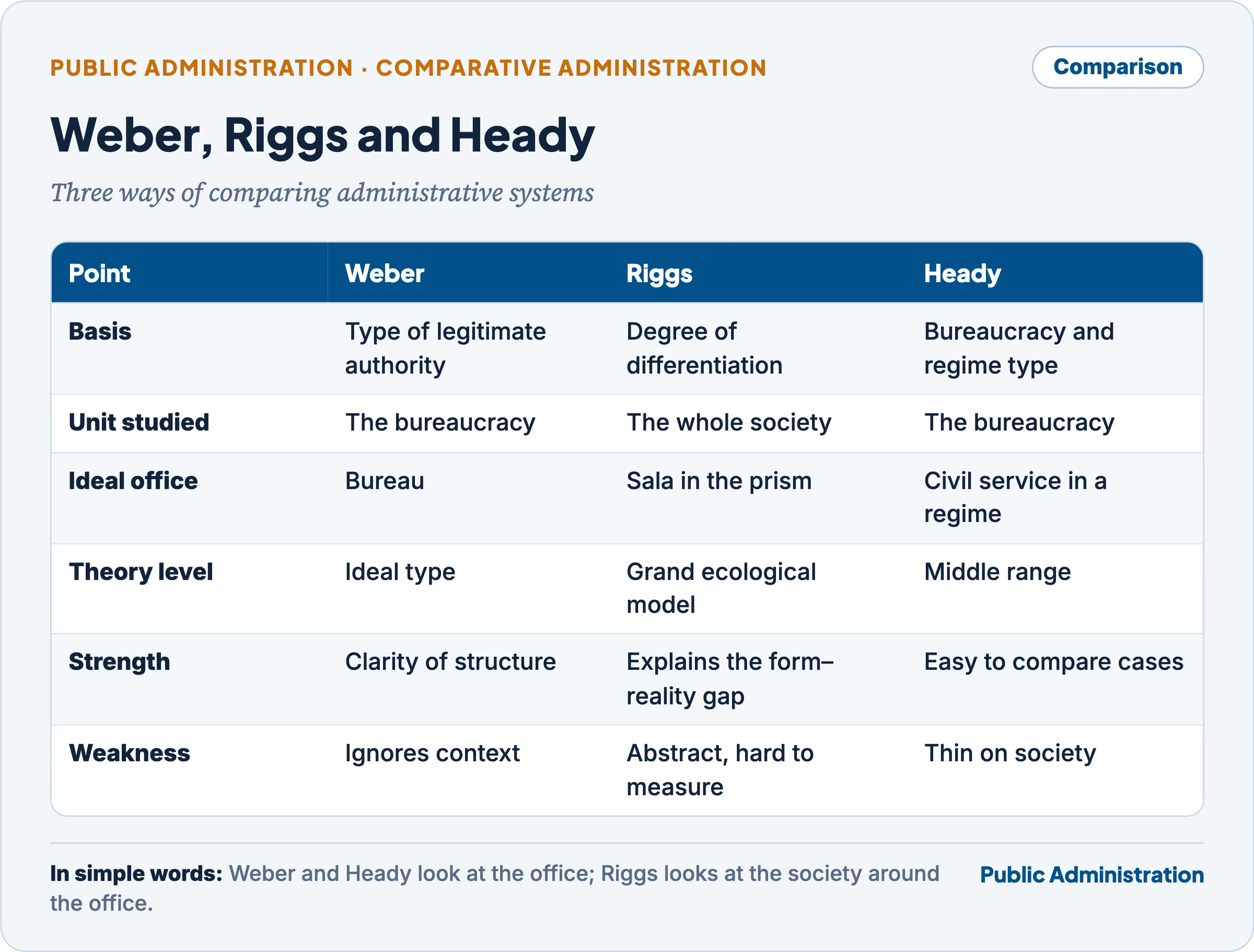
Weber built a model of the ideal office. Riggs built a model of the whole society around the office. Heady chose a middle path: compare the bureaucracies themselves, but classify them by the political system they serve.
Riggs and Weber
The 2017 question asks whether Riggs’s three models were inspired by Weber’s three types of authority. The resemblance is real, but so are the differences.
- Similarities.
- Both build three ideal types.
- Weber’s traditional authority resembles Riggs’s fused society (simple role differentiation, patrimonial administration); legal-rational authority resembles the diffracted society (autonomous, specialised structures, rule-bound administration).
- Both pay close attention to the link between the political system and its administrative staff.
- Both focus on one kind of society and use the others for contrast: Weber on legal-rational bureaucracy, Riggs on the prismatic sala.
- Differences.
- Basis. Weber classifies by the type of legitimacy of authority; Riggs by the degree of structural differentiation.
- Charisma. Riggs has no counterpart of charismatic authority; he dealt with contemporary systems, though charismatic leaders appeared in prismatic states such as India and Iran.
- Ecology. Weber’s account of the economic and social environment of administration is sketchy; Riggs, drawing on structural-functionalism, made it central.
- Development. Neither typology explains development well: Weber wrote before the Third World emerged; Riggs, writing amid the birth of new states, kept development mostly outside the ecological models (and treated it separately).
| Weber’s bureaucracy | Riggs’s sala |
|---|---|
| Hierarchy of offices | Heterogeneity: chamber and bureau mixed |
| Defined sphere of competence for each office | Overlapping: offices steered by non-administrative criteria |
| Selection by achievement (qualifications, examinations) | Attainment as the basis of recruitment; nepotism |
| Administration by rule | Formalism: rules prescribed but not practised |
| Universalism and impersonal operation | Personalised norms; selectivism |
| Officials subject to authority only in their official capacity | Officials embedded in clect and kin obligations |
| Separation of public funds from private | Widespread official corruption; price indeterminacy |
- The sala is a composite type, so not every Weberian trait has a neat opposite.
- Verdict. Riggs was clearly influenced by Weber’s method of ideal types and by the traditional–legal-rational contrast, but his basis of classification was Parsonian structural-functionalism, not legitimacy. “Inspired by” is fair for method; “derived from” would be too strong.
Riggs and Heady: structures versus ecology (the 2026 question)
- Ferrel Heady, the American comparativist and Riggs’s CAG colleague, in Public Administration: A Comparative Perspective (first edition 1966; sixth edition 2001), took bureaucracy as the common unit for comparison because every modern state has one.
- Heady identified four approaches in CPA: modified traditional, development-oriented, general system model-building, and middle-range theory formulation. He placed Riggs in general system model-building and preferred the middle-range, bureaucracy-centred route.
- He classified political regimes in developing countries, in his earlier editions, as traditional-autocratic, bureaucratic elite (civil and military), polyarchal competitive, dominant-party semi-competitive, dominant-party mobilisation and communist totalitarian systems; later editions refined these (for example, ortho-traditional and neo-traditional regimes, personalist and collegial bureaucratic elites).
- He listed common features of administration in developing nations: an imitative rather than indigenous pattern; shortage of skilled manpower for development; emphasis on goals other than production (status, personal expediency); widespread discrepancy between form and reality; and a generous measure of operational autonomy for the bureaucracy.
- Heady borrows from Riggs. His “discrepancy between form and reality” is Riggs’s formalism, and his “operational autonomy” echoes Riggs’s unbalanced polity.
| Point | Heady | Riggs |
|---|---|---|
| Focus | Administrative structures: the bureaucracy | Ecology: the whole society around administration |
| Level of theory | Middle range | Grand, general-system model |
| Classification | By political regime and bureaucracy’s role | By differentiation (and later integration) |
| Method | Comparable, observable variables; case material | Ideal types, deduction, neologisms |
| Strength | Workable, testable, easy to apply across countries | Explains why the same structure behaves differently |
| Weakness | Thin on culture and society; Weber-centric | Abstract, hard to measure, negative image |
| View of developing states | Varied: many regime types | One broad prismatic type |
- Which tool is more effective for developing nations?
- Heady’s framework is more operational: one can compare civil services, regimes and bureaucratic power with observable evidence, and it recognises variety among developing states (a military bureaucratic regime differs from a competitive democracy like India).
- Riggs’s framework is more explanatory of the core puzzle: why formally similar institutions behave differently. It catches informal practice that structure-centred comparison misses.
- The most useful practice combines them: Heady’s structures as the unit, Riggs’s ecology as the explanation. Heady himself adopted Riggsian concepts in describing developing-country bureaucracies.
- Did Riggs think a powerful bureaucracy helps development? No, rather the reverse. Riggs warned that in an “unbalanced polity”, where political institutions are weak, strengthening the bureaucracy can impede political development, and he hypothesised that the more powerful officials are, the less effective they are as administrators. This differs from views that saw a strong, autonomous bureaucracy as the engine of development (as later argued for East Asia’s “developmental states”); the contrast is a debate, not a settled finding.
12. Riggs Today: Old Terms, New Forms
In simple words
Riggs’s words have mostly fallen out of use, but the problems they named are now studied under new labels: “implementation gap”, “informal institutions”, “neo-patrimonialism”, “hybrid regimes” and “isomorphic mimicry”.
Riggsian terms reborn (the 2021 question)
| Riggsian term | Newer form | Where it appears |
|---|---|---|
| Formalism | Implementation gap; isomorphic mimicry: adopting the forms of successful institutions without their functions | Matt Andrews, Lant Pritchett and Michael Woolcock, “Escaping Capability Traps through Problem-Driven Iterative Adaptation” (World Development, 2013); Building State Capability (2017) |
| Overlapping | Informal institutions shaping formal ones | Gretchen Helmke and Steven Levitsky, “Informal Institutions and Comparative Politics” (Perspectives on Politics, 2004) |
| Sala, nepotism | Neo-patrimonialism: patrimonial rule inside a legal-rational shell | Studies of African and Asian states from the 1980s onward |
| Bazaar-canteen, price indeterminacy | Rent-seeking, crony capitalism, state capture | Public choice and political economy; anti-corruption research |
| Clects | Identity-based interest groups; ethnic and caste mobilisation using modern media and litigation | Studies of identity politics |
| Prismatic society | Hybrid regimes; limited access orders | Levitsky and Way, Competitive Authoritarianism (2010); North, Wallis and Weingast, Violence and Social Orders (2009) |
| Mal-integration | Coordination failure; need for whole-of-government and joined-up working | NPM-era fragmentation and its correction |
| Sala in India | The “flailing state”: a capable head (elite services) not reliably connected to its limbs (field delivery) | Lant Pritchett, “Is India a Flailing State?” (2009) |
- Governance indicators measure formalism directly. The World Justice Project Rule of Law Index, for instance, scores the gap between laws on the books and their enforcement; the World Bank’s Worldwide Governance Indicators track government effectiveness and control of corruption.
- The prismatic as a permanent condition. Many scholars now treat hybridity not as a passing stage on the way to the diffracted West but as a stable equilibrium; Riggs’s 1973 admission that prismatic conditions occur at any level of development anticipated this.
Industria and post-modern public administration (the 2025 question)
- Riggs’s industria (and later diffracted society) was an interdependent economy: highly specialised roles, markets linking them, many voluntary associations, and government as one specialised structure among many.
- Several features of later and post-modern public administration grow from this picture:
- Pluralism of actors: governance through networks of state, market and civil society (New Public Governance) presupposes the differentiated, associational society of industria.
- Market mechanisms in government (NPM) assume the market-ordered exchange of industria.
- Fragmentation and coordination: post-modern public administration, as in Charles Fox and Hugh Miller’s Postmodern Public Administration (1995), stresses fragmented authority and discourse among many players; Riggs’s integration problem is the same puzzle in older words.
- Interdependence across borders: globalisation extends industria’s interdependence to the world, linking CPA with international public administration.
- The limit: post-modernism rejects grand narratives and universal models, while Riggs built a grand model. The link is in the features he described, not his method.
Differentiation after globalisation (the 2014 question)
- Further differentiation. Globalisation multiplied specialised structures: independent regulators (SEBI, TRAI, CCI), autonomous agencies, special-purpose vehicles, public–private partnerships and global bodies. India’s differentiation has risen sharply.
- New integration problems. More bodies mean more coordination failures: overlapping regulators, Centre–state friction, and agencies working at cross-purposes. In Riggs’s 1973 terms, rising differentiation without matching integration produces neo-prismatic conditions even in advanced economies.
- De-differentiation. Some trends reverse differentiation: whole-of-government reforms, merged ministries, single-window clearance and platform governance reintegrate functions. India’s PM Gati Shakti National Master Plan (2021) for integrated infrastructure planning is an example of conscious integration.
- Hybrid structures. Networks, PPPs and public–private hybrids blur the line between state and market, which Riggs’s diffracted model assumed to be clear.
Key Terms
| Term | Meaning in simple words |
|---|---|
| Ecology of administration | Two-way interaction between administration and its social, political, economic and cultural environment |
| Structural-functional approach | Studying which structures perform which functions in a society |
| Functional differentiation | How far each function has its own specialised structure |
| Agraria / Industria | Riggs’s first polar types: agricultural and industrial societies |
| Transitia | The in-between type added in 1957 |
| Fused society | One structure performs many functions; functionally diffuse |
| Diffracted society | Separate, specialised structures for each function, integrated by shared rules |
| Prismatic society | Formally differentiated but still fused in practice; later, differentiated but poorly integrated |
| Heterogeneity | Very different systems and practices existing side by side |
| Formalism | Gap between what laws and rules prescribe and what is actually done |
| Overlapping | Modern formal structures governed by traditional, non-administrative criteria |
| Sala | The administrative sub-system of the prismatic society, between the chamber and the bureau |
| Chamber / Bureau | The office of the fused and diffracted societies respectively |
| Attainment | Recruitment by qualification on paper, but by family and community in effect |
| Selectivism | Universal rules applied only to some |
| Poly-functionalism | Formally specialised structures still doing many jobs |
| Poly-communalism | Several hostile communities living together without assimilation |
| Clect | A group with a club’s modern methods and a sect’s narrow goals |
| Poly-normativism | Coexisting old and new norms, with no consensus; double standards |
| Authority vs control | Formal legitimate power versus real unofficial power |
| Unbalanced polity | Bureaucracy dominating weak political institutions |
| Bazaar-canteen | The prismatic economy, mixing market and arena factors |
| Price indeterminacy | No common price for a good or service; price depends on who you are |
| Subsidised / tributary canteen | Cheap access for insiders; extra charges for outsiders |
| Exogenetic / endogenetic / equigenetic | Change driven from outside, from inside, or equally from both |
| Eo-, ortho-, neo- | Prefixes in the 1973 model marking early, middle and advanced differentiation |
| Penetration | Government’s capacity to make and enforce decisions everywhere |
| Participation | People’s willingness and ability to accept and help carry out laws |
| Isomorphic mimicry | Copying institutional forms without their functions |
Contemporary Developments
- Public Examinations (Prevention of Unfair Means) Act, 2024 (enacted 12 February, in force from 21 June 2024; imprisonment up to 10 years and fines up to Rs 1 crore): a Union law with stiff penalties for paper leaks and impersonation in public recruitment examinations, a response to the “bazaar” pressures on the attainment stage of recruitment that Riggs described.
- August 2024: the Union government asked the UPSC to cancel its advertisement for 45 lateral-entry posts after objections that reservation norms were not applied, showing how recruitment design in a poly-communal society is judged against representation as well as merit.
- 13 November 2024: the Supreme Court (Justices B.R. Gavai and K.V. Viswanathan), in In Re: Directions in the Matter of Demolition of Structures, held that demolishing an accused person’s property without due process violates the rule of law and, under Article 142, required at least 15 days’ notice, a personal hearing and a reasoned order, a judicial attack on a gap between due-process law and executive practice.
- 10 February 2026: Transparency International’s Corruption Perceptions Index 2025 placed India 91st of 182 countries with a score of 39 (up from 38 and 96th in the 2024 index). The small gain leaves India well below the global top tier, so perceived bazaar-canteen practices persist.
- February 2025: the Ministry of Panchayati Raj’s advisory committee on proxy participation (chair Sushil Kumar, constituted October 2023) reported on the “sarpanch pati” problem and proposed measures against men exercising the powers of elected women representatives, a live case of overlapping.
- April 2026: the Jan Vishwas (Amendment of Provisions) Act, 2026 received assent on 7 April 2026 after Parliament passed it on 1–2 April. It replaced the 2025 Bill (introduced 18 August 2025 and examined by a Select Committee chaired by Tejasvi Surya, which reported on 13 March 2026) and amends 80 central Acts to decriminalise or rationalise offences, adding warnings for first offences and civil penalties in place of jail terms. Building on the 2023 Act, it trims the mass of rarely enforced penal provisions that feed formalism and give inspectors room to bargain.
- Mission Karmayogi (launched 2020) and the Capacity Building Commission continue to push competency-based training for civil servants, an “administrative development” agenda in Riggs’s sense.
Revision Grid
| Thinker / body | Work or report (year) | Key idea |
|---|---|---|
| Fred W. Riggs | “Agraria and Industria” (1957) | First typology; transitia |
| Fred W. Riggs | The Ecology of Public Administration (1961) | Ecological approach; fused–prismatic–diffracted |
| Fred W. Riggs | “Trends in the Comparative Study of Public Administration” (1962) | Normative to empirical, idiographic to nomothetic, non-ecological to ecological |
| Fred W. Riggs | Administration in Developing Countries (1964) | Prismatic society, sala, bazaar-canteen |
| Fred W. Riggs | Thailand: The Modernization of a Bureaucratic Polity (1966) | Bureaucratic polity |
| Fred W. Riggs (ed.) | Frontiers of Development Administration (1970) | Development as rising discretion and diffraction |
| Fred W. Riggs | Prismatic Society Revisited (1973) | Differentiation plus integration; eo-, ortho-, neo- types |
| John M. Gaus | Reflections on Public Administration (1947) | Ecological factors of administration |
| Talcott Parsons | The Social System (1951) | Pattern variables; structural-functionalism |
| Ferrel Heady | Public Administration: A Comparative Perspective (1966) | Bureaucracy-centred, middle-range comparison; regime types |
| Hahn-Been Lee | “From Ecology to Time” (1967) | Riggs’s models are equilibrium models |
| Richard A. Chapman | “Prismatic Theory in Public Administration” (1966) | Jargon and measurement problems; useful diagnostic tool |
| E.W. Valson | “Positive Formalism” (1968) | Formalism can be functional |
| Ramesh K. Arora | Comparative Public Administration: An Ecological Perspective (1972) | Overlapping exists in diffracted societies too |
| Daya Krishna | “Shall We Be Diffracted?” (1974) | No measurement; diffracted ideal undesirable; external forces ignored |
| Andrews, Pritchett, Woolcock | “Escaping Capability Traps” (2013) | Isomorphic mimicry: form without function |
| Lant Pritchett | “Is India a Flailing State?” (2009) | Capable head, weak limbs |
| 2nd ARC | Reports 4, 10, 12 (2007–2009) | Ethics, personnel reform and citizen-centric administration against formalism |
Previous Year Questions
- 2026Critically analyse the differences between Ferrel Heady’s focus on administrative structures and Fred Riggs’s ecological ‘Prismatic’ model. Which one of these frameworks provides a more effective tool for the study of developing nations? Examine.
- 2025F. W. Riggs’s ‘industria’-interdependent economy is a precursor for some features of post-modern Public Administration. Analyse.
- 2024Riggs’ Prismatic Model has been criticised as overly gloomy and technical complex, but it remains as a useful starting point for Comparative Public Administration research. Analyse.
- 2022‘The more exogenetic the process of diffraction, the more formalistic and heterogenous its prismatic phase; the more endogenetic the less formalistic and heterogenous.’ Examine this hypothesis of Riggs.
- 2021In modern context, Riggsian terms have not altogether disappeared, but have emerged in different forms with newer meanings. Discuss.
- 2017“The Riggsian Models of Fused-Prismatic-Diffracted Societies and their administrative systems have been inspired by Max Weber’s typology of Traditional Charismatic Legal-Rational Authorities.” Analyse.
- 2017“Development Administration and Administrative Development have a chicken and egg kind of relationship”. -(Riggs). Elaborate
- 2016“Riggs observed that three ‘trends’ could be discerned in the comparative study of Public Administration.” Discuss.
- 2016“Fred Riggs continuously changed his theory in order to create the perfect model.” Comment.
- 2014Critically examine the Riggsian concept of differentiation in context of post-globalisation era.
- 2012‘Rigg’s classification of societies into fused, prismatic, and diffracted is built around the concept of differentiation.’ Analyze.
- 2011Neither Edward Weidner nor Fred Riggs was able to describe the process of development administration adequately. Explain the drawbacks and weaknesses in their theoretical analyses.
- 2010“The Prismatic model of Riggs is equally applicable to developing as well as developed society.” Comment.
- 2009Which of the model (s) in development admini-stration is/are characterised by ‘Selectivism’, ‘Attainment’ and ‘Poly- functionalism’? Describe the corresponding theoretical roots & attributes.
- 2007“Not to be comparative is to be naively parochial” (Riggs). Comment.
- 2002How did F.W. Riggs conceptualise the inter-actions between administrative systems and their environment?
- 2001Critically comment on Riggsian Prismatic Sala model of administration of developing societies. To what extent Indian Administrative system exhibits prismatic characteristics?
- 2000Critically examine the approach and methodology adopted by Fred W. Riggs in his study of prismatic and sala societies. What is valid-content of Raj Krishna’s criticism of refraction?
- 2000“Political environment conditions administrative system.” – (F. W. Riggs) Comment.
- 1996What, according to Riggs, are the three important characteristic features of the prismatic society?
- 1995Rigg’s key concepts have alerted the researcher that Weberian bureaucracy might not be entirely predictive of behaviour in most Third World countries. Comment.
- 1993How dose public administration differ in the developed and developing societies? How far can it modernise the traditional political culture of developing countries?
- 1992‘Rigg’s approach and models may be considered as more sophisticated tools for describing and diagnosing administrative situations.’ Discuss.
- 1990Explain how the concept of ‘clects’ and ‘bazaar-canteen’ model explain the working of the administrative system in a developing society. In this context compare the working of the administrative system in a developed & in a developing society.
- 1989The prismatic sala model “enables us to cope with many problems of transitional societies….” (Riggs). What are these problems and how can this model enables us to cope with them.
- 1988“The nature of Prismatic Society adversely tells upon the phenomenon of administrative development which in-turn hinders the working of development administration.” Comment.
- 1987Distinguish between administrative development and administration of development. In what way is the former supplementary to the latter in a Prismatic Society?
- 2014“Indian administration is said to be characterised by its three features viz. Weberian structures. Kautilyan practice and Gandhian rhetoric.” Examine the statement.
- 1999“Only a systematic-ecological approach to the study of corruption in India can help us understand its causes and dimensions.” Comment.