

Importance of human resource development; Recruitment, training, career advancement, position classification, discipline, performance appraisal, promotion, pay and service conditions; employer-employee relations, grievance redressal mechanism; Code of conduct; Administrative ethics.
This article: Code of conduct (CCS Conduct Rules 1964, AIS Conduct Rules 1968); discipline (meaning, informal and formal action, Article 311, CCS (CCA) Rules 1965, minor and major penalties, procedure, suspension, natural justice, Tulsiram Patel); performance appraisal (purposes, methods, errors, appraisal versus performance management, ACR to APAR, multi-source feedback, 2nd ARC 10th Report); employer–employee relations (staff associations, right to strike, Whitleyism, Joint Consultative Machinery); grievance redressal for employees (internal machinery, CPGRAMS, the tribunal route).
Official Syllabus: Paper I · Unit 1-09 Personnel Administration
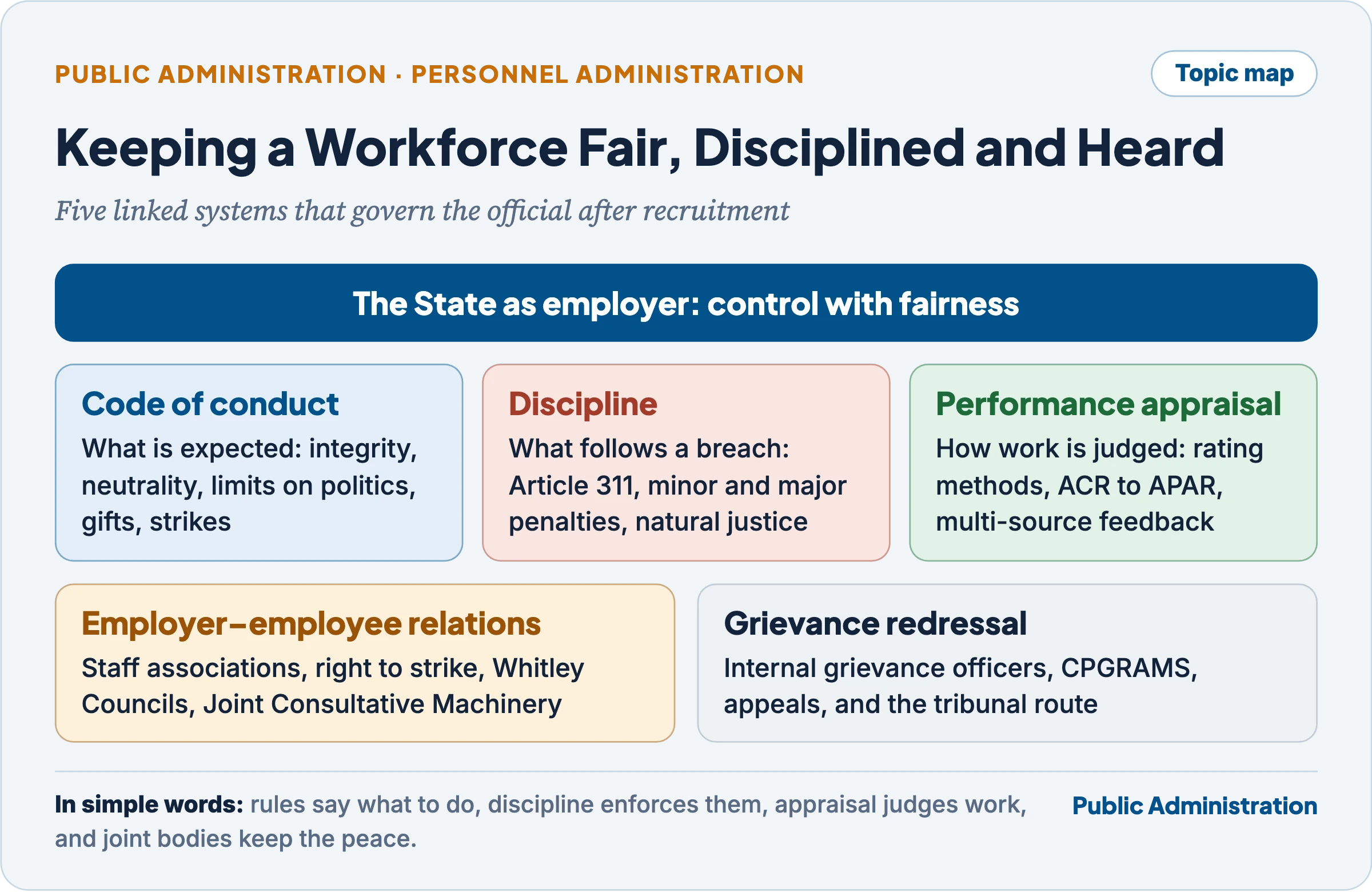
Recruitment and training bring a person into the public service and equip them; the systems in this article govern the official for the next thirty-odd years. The State must be able to say what conduct it expects, punish breaches, judge performance, deal with its employees as an organised body and hear their complaints. Each of these is a balance between control (the State as employer and guardian of the public interest) and fairness (the civil servant as a citizen with rights). Where the balance tips too far towards control, the service becomes fearful and politicised; where it tips too far towards protection, it becomes unaccountable.
In simple words
Think of a cricket team. There is a code (no sledging, no ball tampering), a match referee who fines players after hearing them, a selection committee that reviews form, a players’ association that talks to the board about pay, and a way for a player to complain if he feels wronged. Take away any one of these and the team either becomes lawless or miserable.
- The recruitment, training, classification, promotion and pay side of the unit is covered in the companion article on HRD, recruitment and career systems; administrative ethics (values, Nolan principles, ethical codes) is covered in the article on administrative ethics. This article stays with the rules, procedures and machinery that sit between them.
1. Code of Conduct: What the State Expects of Its Servants
In simple words
A code of conduct is the rulebook of behaviour for a job. It tells an official, in advance, what is forbidden: taking costly gifts, joining a party, speaking against government policy in public, going on strike. Knowing the rules in advance is what makes later punishment fair.
1.1 Meaning and purpose
- A code of conduct is a set of written norms that lays down the responsibilities and proper practices of members of an organisation. An internationally used working definition (from the accounting profession’s 2007 guidance on codes) describes it as the principles, values, standards or rules of behaviour that guide decisions in a way that serves stakeholders and respects the rights of those affected.
- Conduct rules and discipline are two halves of one system. The conduct rules define misconduct; the discipline rules define what happens when misconduct occurs. In India this split was made deliberate after Independence: the Santhanam Committee on Prevention of Corruption (1964) recommended that rules of conduct, especially on integrity, be uniform across services and separated from the classification, control and appeal rules.
- Why public employees need a special code:
- They exercise public power and discretion, so conflicts of interest harm citizens, not only the employer.
- They must stay politically neutral so that they can serve any elected government.
- The appearance of integrity matters as much as integrity itself; public trust is the capital of a government.
- Some rules reach beyond the office into private and domestic life (habitual indebtedness, dowry, treatment of women, intoxication in public).
- Codes versus values. A code of conduct lists prohibited acts and is enforceable through penalties; a code of ethics states values to aspire to and is enforced mainly through culture. The 2nd ARC (4th Report, Ethics in Governance, 2007) asked India to add a values statement to the rule-based codes; the ethics article develops this.
Common confusion
Do codes and standards replace rules and regulations? No. Rules fix the minimum below which an official may not fall and attach a penalty; standards and values describe the conduct expected above that minimum and guide judgement where no rule exists. A gift rule fixes a money limit; a standard of integrity tells the official to refuse a gift below the limit if it comes from a party with business before him. The two complement each other: rules give certainty, standards give direction.
1.2 The two main codes in India
The Central Civil Services (Conduct) Rules govern most Union employees; the All India Services (Conduct) Rules govern IAS, IPS and IFoS officers serving both the Union and the States. Their content is largely parallel.
| Feature | CCS (Conduct) Rules, 1964 | AIS (Conduct) Rules, 1968 |
|---|---|---|
| Legal basis | Article 309 proviso (rules made by the President) | All India Services Act, 1951 |
| Covers | Civil servants of the Union (Groups A to D/C) | IAS, IPS, Indian Forest Service |
| Who enforces | Ministry or department controlling the post | State Government or Union, depending on where the officer serves |
| Values clause | General duty of integrity, devotion to duty, conduct becoming a government servant (Rule 3) | Rule 3, with sub-rule (1A) added in 2014 listing values |
- The 2014 values clause. The All India Services (Conduct) Amendment Rules, 2014 inserted Rule 3(1A), requiring officers to maintain, among other things, high ethical standards, integrity and honesty; political neutrality; merit, fairness and impartiality; accountability and transparency; responsiveness to the public, particularly the weaker sections; and courtesy. Parallel amendments to the CCS (Conduct) Rules followed in November 2014. This is the closest India has come to turning a values code into an enforceable rule.
1.3 What the conduct rules cover
The rules are long; their main heads can be grouped as follows.
- General integrity (Rule 3 in both codes): absolute integrity, devotion to duty, nothing unbecoming of a government servant. The phrase “unbecoming” is an omnibus clause that covers private and domestic conduct not listed anywhere else; courts read it narrowly to avoid arbitrary use.
- Politics (CCS Rule 5): no membership of a political party or organisation taking part in politics; no canvassing or election work; the only political act permitted is to vote, and that secretly. Government can declare which organisations are “political” for this rule (see 1.4).
- Associations (Rule 6): no membership of an association whose objects are prejudicial to sovereignty, integrity, public order or morality.
- Demonstrations and strikes (Rule 7): no demonstration that is prejudicial to the security of the State, public order, decency or morality, and no strike or incitement to strike in connection with service matters.
- Speech and the media (Rules 8 and 9): no unsanctioned connection with the press; no public criticism of government policy; literary, artistic and scientific writing allowed if it does not embarrass the government.
- Gifts (Rule 13), private trade and employment (Rule 15), investment, lending and borrowing (Rule 16), insolvency (Rule 17), and property (Rule 18): limits on gifts, prior sanction for outside work, no speculative investment, avoidance of habitual debt, and declaration of movable and immovable property.
- Other heads: no use of influence for family employment, no dowry, no sexual harassment at the workplace (added after the Vishaka guidelines of 1997), no intoxication in public, no bigamy, no approach to political superiors to further one’s service interests.
1.4 Conduct rules and fundamental rights
The conduct rules restrict freedoms every other citizen enjoys. The Constitution permits this only within limits.
- Article 33 lets Parliament restrict fundamental rights of the armed forces, police and intelligence personnel; it does not cover ordinary civil servants.
- For civil servants, restrictions must pass the test of reasonable restrictions under Article 19(2)–(6). The Supreme Court made this clear in Kameshwar Prasad v. State of Bihar (1962): a Bihar rule banning “any form of demonstration” was struck down as violating Articles 19(1)(a) and (b), because government servants do not lose fundamental rights merely by entering service; the same rule, so far as it banned strikes, was upheld because there is no fundamental right to strike.
- The 2024 change on the RSS. Office memoranda of 1966, 1970 and 1980 had named the Rashtriya Swayamsevak Sangh (and the Jamaat-e-Islami) as organisations whose activities attracted Rule 5. A DoPT memorandum of 9 July 2024 removed the mention of the RSS, while the Jamaat-e-Islami stayed on the list. The Madhya Pradesh High Court, disposing of a petition on the point, observed that such restrictions on voluntary membership should come through the conduct rules themselves, backed by evidence, not through executive instructions.
Indian Connect — Conduct rules in practice
- A civil servant writing a newspaper column on monsoon birds needs no permission; writing one attacking the farm policy of the government does.
- A district officer who accepts an expensive gift from a contractor during a festival breaches the gift rule even if no favour is shown, because the rule targets conflict of interest, not proven corruption.
- Retired officers joining private firms connected to their former work must observe a cooling-off period under pension rules; the 2nd ARC had recommended a firm rule on post-retirement employment.
1.5 Critique of the conduct rules
- Too wide and vague. “Unbecoming of a government servant” gives disciplinary authorities room for selective use.
- Freedom of expression. Rules on media and criticism sit uneasily with an era of social media, RTI and whistle-blowing; officials who expose wrongdoing can be charged for “embarrassing the government”.
- Neutrality versus political rights. Allowing only the vote keeps the service neutral, but critics argue that lower-level employees with no policy role (a postal clerk, a railway gangman) need not be denied wider political rights. Britain, for instance, grades restrictions by the level of the post, leaving most junior staff politically free. The neutrality debate itself is taken up in the ethics article.
- Rules without values. A rule-based code tells officials what not to do but does little to build positive integrity; this is why the 2nd ARC pressed for a code of ethics alongside the conduct rules.
2. Discipline: Meaning, Types and Purposes
In simple words
Discipline is what keeps a group working by common rules. Most of the time it is invisible: people follow the rules because they agree with them. Punishment is the fallback for the few who do not, and it must be fair, or it destroys the willing discipline of everyone else.
2.1 Meaning
- Discipline in any group has two parts: accepted norms that members generally follow, and sanctions applied when the norms are broken. A family reprimands a child; a caste council once expelled members. What makes discipline in government different is that both the norms and the sanctions are laid down authoritatively by the State and carry its legal force.
- O. Glenn Stahl, the American personnel scholar (Public Personnel Administration), made the classic point that no organisation is so perfect and no personnel system so good that correction and punishment can be avoided altogether. Positive motivation comes first, but a residue of misconduct always remains.
- Positive and negative discipline.
- Positive (self-) discipline comes from good leadership, clear rules, fair treatment and motivation; people conform because they accept the rules.
- Negative (enforced) discipline relies on penalties. Modern personnel thinking treats it as the last resort, used to protect the positive discipline of the majority.
2.2 Informal and formal disciplinary action
UPSC has asked about this distinction directly.
| Type | Form | When used | Example |
|---|---|---|---|
| Informal action | Oral warning, counselling, a word of advice, transfer of work | Minor lapses; first offences; where guilt is hard to prove | A supervisor counsels a clerk who is often late |
| Formal action | Written charge, recorded finding, a penalty that enters the service record | Breach of conduct rules; repeated or serious misconduct | Censure, withholding of increments, dismissal |
- Informal action is not a penalty in law. A warning or “displeasure” letter is not one of the penalties listed in the rules, so it needs no inquiry; but it must not be placed on the record in a way that works as a hidden penalty.
- Formal action has to be in writing, follow the prescribed procedure and rest on evidence. It is subject to the constitutional and statutory safeguards discussed in Section 3.
2.3 Causes and purposes of disciplinary action
- Common causes: corruption and lack of integrity; negligence and inefficiency; insubordination; unauthorised absence; misuse of position; misbehaviour with the public or colleagues; breach of political-activity or media rules; criminal conviction.
- Purposes of punishment:
- Reformative: teaches the employee not to repeat the mistake.
- Deterrent: warns others; in government this is usually the main purpose, especially in removal and dismissal.
- Retributive or restitutive: recovers loss caused to the public exchequer through negligence or breach of orders.
- Principles of good discipline (drawn from personnel literature): rules known in advance, consistency, promptness (delay weakens deterrence and punishes the innocent), proportionality, a fair hearing, reasons for the decision, and a right of appeal. Douglas McGregor’s “hot stove rule” summarises it: the stove warns, burns immediately, burns everyone who touches it, and burns impersonally.
3. Article 311 and the CCS (CCA) Rules, 1965
In simple words
In India a government job carries a constitutional shield. Before the government can sack a permanent employee or demote him, it must hold an inquiry, tell him what he is accused of and hear his side. Only the authority that appointed him (or a higher one) can sack him.
3.1 The doctrine of pleasure and its limits
- Article 310 states the doctrine of pleasure: members of the civil services of the Union hold office during the pleasure of the President, and those of a State during the pleasure of the Governor. The doctrine is borrowed from the English rule that Crown servants serve at the Crown’s pleasure.
- Article 309 allows Parliament and the State legislatures to regulate recruitment and conditions of service, and allows the President or Governor to make rules until such laws are made. Almost all service rules, including the CCS (CCA) Rules, 1965 and the CCS (Conduct) Rules, 1964, are made under this proviso.
- Article 311 qualifies the pleasure doctrine with two safeguards:
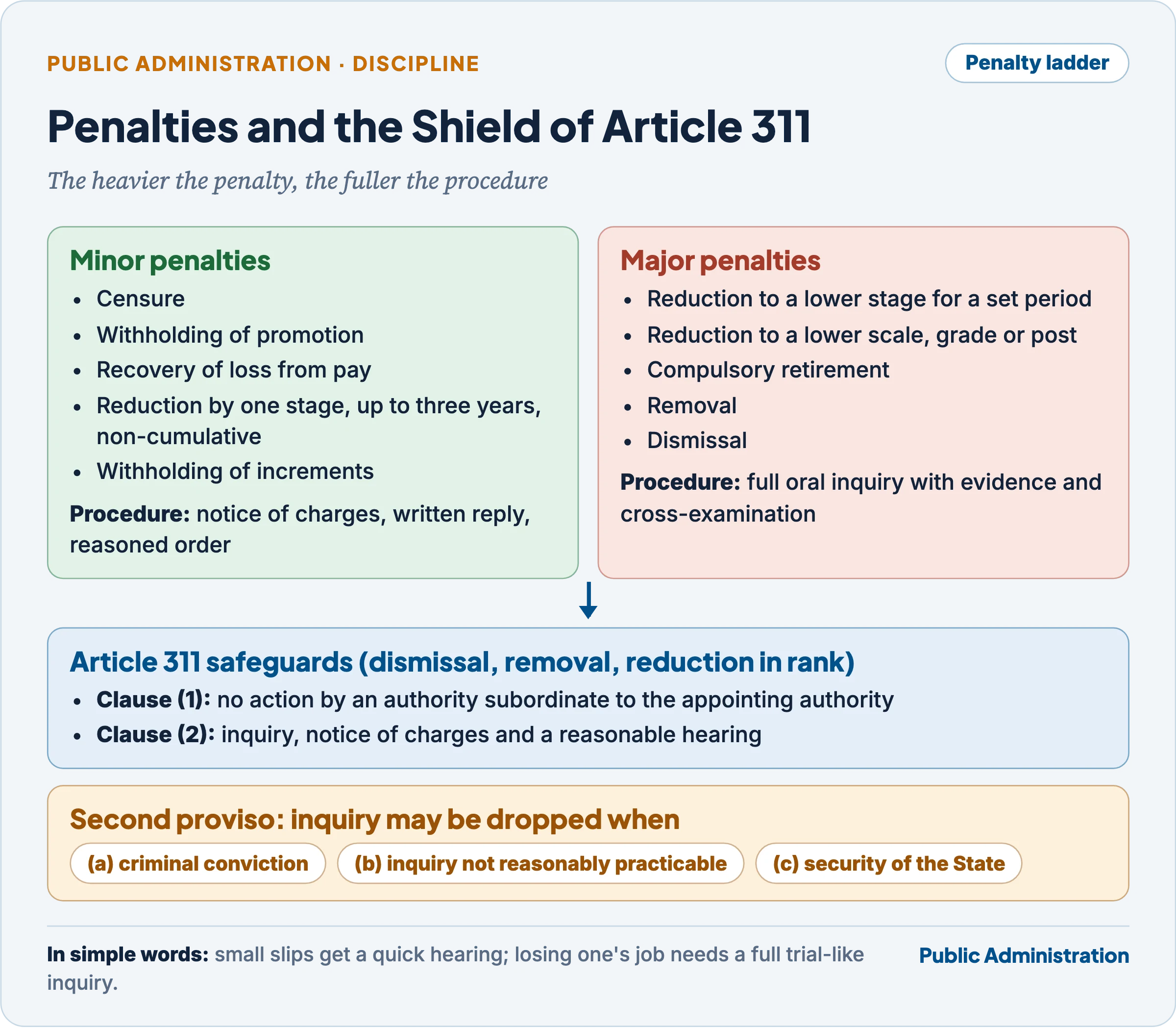
- Clause (1): no person shall be dismissed or removed by an authority subordinate to the one that appointed him.
- Clause (2): no person shall be dismissed, removed or reduced in rank except after an inquiry in which he has been informed of the charges and given a reasonable opportunity of being heard.
- History. Section 96B of the Government of India Act, 1919 first made Crown service “subject to” rules, which led to the Civil Services (Classification, Control and Appeal) Rules, 1930; Section 240 of the Government of India Act, 1935 framed safeguards that Articles 309–311 largely reproduce.
3.2 The 42nd Amendment and the second proviso
- Before 1976, a government servant was entitled to two opportunities: one to answer the charges at the inquiry, and a second show-cause notice against the proposed penalty.
- The 42nd Amendment (1976) removed the second show-cause stage: once the inquiry is complete, the penalty may be imposed on the evidence adduced, without a fresh hearing on the penalty.
- The second proviso to Article 311(2) allows the inquiry itself to be dispensed with in three cases:
- (a) where the person is dismissed, removed or reduced in rank on the ground of conduct that has led to conviction on a criminal charge;
- (b) where the disciplinary authority is satisfied, for reasons recorded in writing, that it is not reasonably practicable to hold the inquiry (for instance, where witnesses are being intimidated or there is a violent agitation);
- (c) where the President or Governor is satisfied that holding the inquiry is not expedient in the interest of the security of the State.
- Article 311(3) makes the authority’s decision on clause (b) final, though courts can still review it for mala fides and irrelevance.
3.3 Union of India v. Tulsiram Patel (1985)
The leading case on the second proviso was decided by a Constitution Bench on 11 July 1985 (judgment by Justice D.P. Madon).
- Facts. Several government servants had been dismissed without any inquiry under the second proviso and similar service rules (including Rule 19 of the CCS (CCA) Rules). An earlier decision, Challappan (1976), had suggested that a hearing on the penalty was still needed.
- Holding.
- The second proviso is valid; when one of its clauses applies, the inquiry can be dispensed with entirely, including any notice on the penalty.
- The proviso is a constitutional exclusion of natural justice; Article 14 cannot be used to bring back what the Constitution has expressly taken out.
- “Not reasonably practicable” is judged by what a reasonable authority would think in the situation; it need not be impossible to hold the inquiry.
- The exclusion is not a licence for arbitrariness: the reasons must be recorded, the action is open to departmental appeal, and courts can strike it down if the grounds are irrelevant or mala fide.
- Significance. Tulsiram Patel overruled Challappan on this point, restored the employer’s ability to act quickly in exceptional situations, and at the same time set the outer limits of the State’s power over its servants.
Common confusion
Does Article 311 protect against every penalty? No. Article 311(2) protects only against the three gravest penalties: dismissal, removal and reduction in rank. Other penalties (censure, withholding of increments, recovery) are protected by the service rules and by natural justice, not by Article 311. Article 311 also does not cover members of the defence services or holders of posts outside the civil services, and it does not stop compulsory retirement in the public interest under FR 56(j), which courts treat as not a penalty.
3.4 Penalties under Rule 11 of the CCS (CCA) Rules
The CCS (Classification, Control and Appeal) Rules, 1965 classify services, name disciplinary and appellate authorities, and list nine penalties in Rule 11, arranged in rising severity.
| Minor penalties | Major penalties |
|---|---|
| (i) Censure | (v) Reduction to a lower stage in the time-scale for a specified period, with directions on increments |
| (ii) Withholding of promotion | (vi) Reduction to a lower time-scale, grade, post or service for a specified period |
| (iii) Recovery from pay of loss caused to Government by negligence or breach of orders | (vii) Compulsory retirement |
| (iii a) Reduction by one stage in the time-scale for up to three years, without cumulative effect and without affecting pension | (viii) Removal from service, not a bar to future government employment |
| (iv) Withholding of increments | (ix) Dismissal from service, ordinarily a bar to future government employment |
- Removal versus dismissal. Both end service; dismissal ordinarily bars future government employment, removal does not.
- Compulsory retirement as a penalty versus FR 56(j). As a penalty under Rule 11 it follows an inquiry and carries a stigma; under Fundamental Rule 56(j) it is a non-punitive review of officers (after 50/55 years of age or 30 years’ service, depending on the category) “in the public interest”. The Santhanam Committee had recommended such a power; the 2nd ARC wanted it used more systematically.
- What is not a penalty. The rules list actions that are not penalties: non-promotion after due consideration, reversion of an officiating employee, retirement on superannuation, termination of a probationer, and so on.
3.5 Procedure for imposing penalties
The procedure grows heavier as the penalty grows heavier.
- Minor penalty (Rule 16). The employee is told in writing of the proposal and the imputations, and given an opportunity to make a representation; the disciplinary authority considers it (with UPSC advice where needed) and passes a reasoned order. An oral inquiry is held only if the authority thinks it necessary, or where withholding of increments would affect pension or run beyond three years.
- Major penalty (Rule 14). A full inquiry is required.
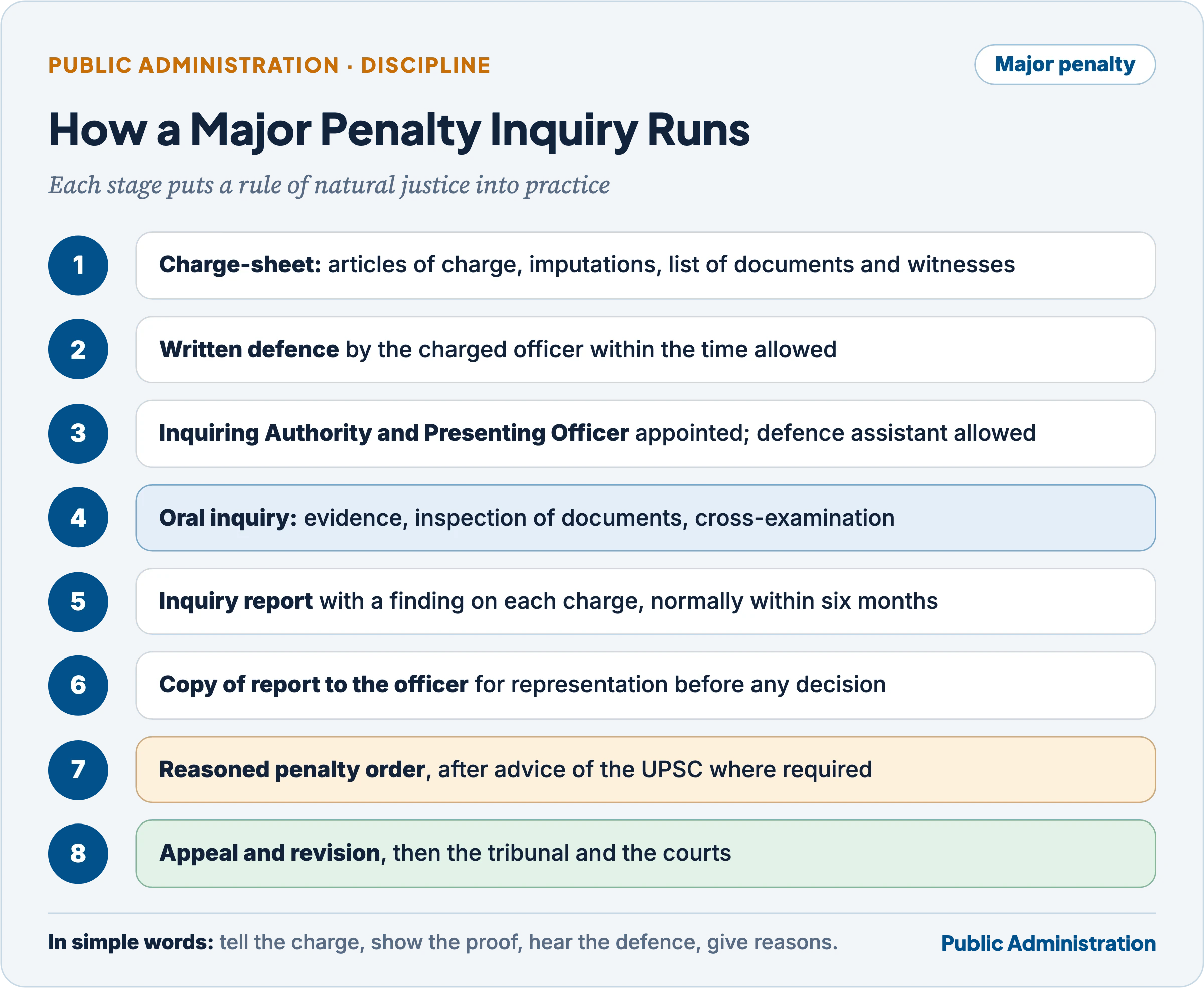
- The major penalty inquiry step by step:
- Charge-sheet: articles of charge, a statement of imputations, and lists of documents and witnesses.
- Written statement of defence: normally within 15 days, extendable up to 45 days.
- Appointment of the Inquiring Authority and a Presenting Officer; the charged officer may take a defence assistant (another government servant, or a lawyer if the Presenting Officer is one).
- The oral inquiry: inspection of documents, evidence of witnesses, cross-examination by both sides, and the officer’s own defence evidence.
- The inquiry report, with a finding on each charge; since a 2017 amendment (notified 2 June 2017) the Inquiring Authority must normally finish within six months, extendable for recorded reasons.
- Copy of the report to the officer for a representation before the disciplinary authority decides (required by the Supreme Court in ECIL v. B. Karunakar, 1993).
- Consultation with the Central Vigilance Commission (in vigilance cases) and the UPSC (for gazetted officers, under Article 320(3)(c)), with the UPSC’s advice supplied to the officer.
- Final reasoned order by the disciplinary authority.
- Appeal, revision and review. An appeal lies to the appellate authority named in the rules (except against an order of the President); revision and review are also provided. After exhausting these, the employee can go to the Central Administrative Tribunal (see Section 7).
3.6 Suspension
- Suspension (Rule 10) is not a penalty; it keeps the employee away from duty while an inquiry or criminal case is pending, so that evidence is not tampered with.
- Deemed suspension follows detention in custody for more than 48 hours, or conviction with imprisonment beyond 48 hours.
- Subsistence allowance (initially half pay plus allowances, revisable) is paid.
- The Supreme Court in Ajay Kumar Choudhary v. Union of India (2015) held that suspension should not extend beyond three months unless a charge-sheet is served within that period, to stop suspension being used as punishment by delay.
3.7 Natural justice in disciplinary proceedings
- Natural justice has two core rules:
- Nemo judex in causa sua (no one should be judge in his own cause): the inquiring authority must not be biased or a witness in the case.
- Audi alteram partem (hear the other side): notice of charges, access to evidence, a chance to rebut, and a reasoned decision.
- The CCS (CCA) procedure is in effect a codification of these rules: the charge-sheet gives notice, the inquiry gives the hearing, the copy of the report and the reasoned order prevent hidden decisions.
- Limits. Natural justice is flexible: its content depends on the stakes. It can be excluded by the Constitution itself (as in the second proviso), and courts ask whether the employee suffered real prejudice before setting aside an order for a procedural lapse (Karunakar). The full theory of natural justice is in the administrative tribunals article.
Indian Connect — Discipline and vigilance in Indian administration
- Departmental proceedings run alongside the vigilance system: the Central Vigilance Commission (statutory since the CVC Act, 2003) gives “first stage” and “second stage” advice in cases with a vigilance angle, and Chief Vigilance Officers sit in every ministry and PSU.
- Section 17A of the Prevention of Corruption Act (inserted in 2018) requires prior approval before police can inquire into a public servant’s recommendation or decision taken in official functions, a shield for honest decisions that also slows action against the dishonest.
- FR 56(j) reviews have been used actively since 2014–15 to retire officers judged to lack integrity or efficiency, a route that avoids the full Article 311 inquiry because it is not a penalty.
3.8 Problems in the disciplinary system and reform proposals
- Delay. Inquiries drag on for years; the officer is in limbo, the honest are harassed and the guilty retire with benefits.
- Lack of independence. Inquiry, decision and first appeal are all handled within the same department, so employees see the system as weighted against them.
- Technicality and legalism. The heavy jurisprudence around Article 311 turns inquiries into mini-trials; small procedural slips void penalties.
- Weak use of minor penalties and of counselling, so that the system is either inactive or punitive.
- 2nd ARC proposals.
- The 4th Report, Ethics in Governance (2007), observed that the protections of Article 311 had in practice shielded the guilty, and recommended that Article 311 be repealed, with a law under Article 309 giving civil servants protection against arbitrary action.
- The 10th Report, Refurbishing of Personnel Administration: Scaling New Heights (2008), built on this: replace court-style inquiries with a summary disciplinary procedure with a hearing; dismissal only by an authority at least three levels above the post; consult the CVC only once and the UPSC only for likely dismissals; and repeal the CCS (CCA) Rules in favour of a Civil Services Law with minimum safeguards.
- These recommendations have not been adopted; Article 311 and the 1965 Rules remain in force, but procedural time limits (2017) and online case tracking have been added.
4. Performance Appraisal: Purposes and Methods
In simple words
Performance appraisal is the yearly report card of an employee. A good report card tells the employee what he did well and what to improve, helps the organisation decide who to promote or train, and gives the boss a reason to talk to the people under him. A bad one is just a form filled in by habit.
4.1 Meaning and purposes
- Performance appraisal is the systematic, periodic evaluation of an employee’s job performance (quality, quantity, timeliness, cost) and potential, against standards set for the job.
- Purposes (personnel literature lists them roughly as below):
- Administrative: promotion, confirmation, increments, empanelment, retention or exit.
- Developmental: identifying strengths, weaknesses and training needs; career planning.
- Motivational: feedback and recognition improve effort, as expectancy and goal-setting theories predict.
- Communicative: a structured dialogue between superior and subordinate.
- Organisational diagnosis: aggregate appraisal data reveal weak units, skill gaps and the validity of recruitment tests.
- Documentation: a record that justifies rewards and penalties against charges of favouritism.
- “Beyond vertical promotion.” In a closed career service, appraisal tends to collapse into a single question: is the officer fit for the next grade? The other purposes, development, placement in the right job, feedback, are lost. A broader view uses appraisal to match officers to roles, plan training, build domain expertise and reward excellence without promotion (for example, through awards or better postings).
4.2 Methods of performance appraisal
Methods fall into trait-based, behaviour-based, results-based and multi-rater families. Older methods appear in UPSC questions on “sources and procedures for measuring performance”.
| Method | How it works | Strength | Weakness |
|---|---|---|---|
| Graphic rating scale | Rater scores traits (accuracy, initiative, judgement) on a 5-point scale | Simple, cheap, comparable | Vague traits, halo and leniency |
| Ranking and paired comparison | Employees ranked best to worst, or each compared with each | Forces differentiation | Unworkable in large groups; no feedback value |
| Forced distribution | Fixed share of staff in each grade (e.g. only 10% outstanding) | Curbs grade inflation | Penalises good teams; breeds rivalry |
| Checklist | Rater ticks statements describing behaviour (the Probst system, 1927, listed about a hundred) | Reduces rater judgement | Weighting hidden and arbitrary |
| Critical incident | Supervisor records specific good and bad incidents through the year | Concrete, good for feedback | Time-consuming; recent incidents dominate |
| BARS (behaviourally anchored rating scale) | Each point on the scale is anchored to a described behaviour | Clear, job-specific, less bias | Costly to design for every job |
| MBO (management by objectives) | Superior and subordinate agree measurable goals; result judged against them | Focus on results; participation | Neglects how results were achieved; hard where outputs are intangible |
| 360° / multi-source feedback | Ratings from superiors, peers, subordinates, clients and self | Fuller picture; reduces single-boss bias | Complex; gaming, anonymity problems, popularity contest |
- Trait-based systems are the oldest. The graphic scale used in Washington in the 1920s rated around fifteen traits; Britain’s civil service report, introduced on the recommendation of the National Whitley Council in 1921 and revised in 1938, rated ten qualities on a five-point scale and required that adverse reports be shown to the officer. Personnel research later warned against trait ratings: personality traits cannot be changed by feedback, and vague traits let office politics into the rating.
- BARS was developed by Patricia Smith and Lorne Kendall (1963) to anchor each grade in concrete behaviour (for a police constable, “calms a quarrelling crowd without force” might anchor a high score).
- MBO was popularised by Peter Drucker in The Practice of Management (1954) and adapted to appraisal by George Odiorne and Douglas McGregor, who in “An Uneasy Look at Performance Appraisal” (1957) argued that the boss should act as a coach helping the subordinate set and review his own goals, not as a judge “playing God”.
- 360° appraisal spread in large firms in the 1990s and entered governments as multi-source feedback.
4.3 Errors in appraisal
Every method is used by human raters, and the same errors recur.
- Halo effect: one strong trait colours the whole rating.
- Leniency or strictness: some raters grade everyone high (to avoid conflict) or low.
- Central tendency: everyone rated “average” to avoid justifying extremes.
- Recency: only the last few months are remembered.
- Similarity and personal bias: officers like the rater get higher marks; caste, gender or regional bias.
- “Ditto” reporting: a reporting officer copies his predecessor’s assessment instead of judging afresh.
- Grade inflation: in Indian practice most officers are graded “outstanding” or “very good”, so the grading stops distinguishing between them.
4.4 Subjectivity and objectivity
- The limits of objectivity. Elaborate rating systems in the early United States, which converted traits into decimal scores, produced absurd results: promotions turned on fractions of a mark. Subjectivity re-enters at two stages in any system: in choosing which qualities matter for a post and in weighting them into a final verdict. Human merit does not lend itself fully to mechanical measurement.
- Acknowledging subjectivity. A sounder system therefore uses judgement openly but disciplines it: several raters, higher review, standard instructions, written reasons for extreme grades, disclosure to the officer and a chance to respond. The report then aids, rather than replaces, the judgement of the promoting authority. Over-reliance on “objective” numbers in public work (files cleared, targets met) also invites goal displacement: officials chase what is counted rather than what matters.
Common confusion
Is a 360° appraisal simply a more objective version of the annual report? No. Multi-source feedback adds more perspectives, not more objectivity. Peers may collude or settle scores, subordinates may fear retaliation, and outsiders may judge visible but unimportant behaviour. It works when respondents are chosen transparently, ratings are behaviour-based, feedback is used mainly for development, and the officer sees the aggregated result. Used secretly as a gatekeeper for promotion, it becomes “complex and inauthentic”, as one UPSC question put it.
4.5 Making 360° appraisal more reliable
Drawing the lessons together, multi-source feedback becomes more credible when:
- Respondents are selected by a known rule (a mix of seniors, peers, juniors and external stakeholders), not hand-picked;
- Questions are behavioural (“shares information with other departments”) rather than global (“good officer”);
- Anonymity is protected but patterns, not single scores, drive conclusions;
- Results are disclosed to the officer with a chance to respond, as with APAR;
- It is combined with the APAR, vigilance record and work record, never used alone;
- It is piloted for development first, building trust before it decides careers.
5. Performance Appraisal in India: ACR to APAR and Beyond
In simple words
For over a century Indian officers were judged by a secret report they never saw unless it was bad. Since 2009 the report is shared in full, the officer can respond, and senior officers are also judged by what colleagues and juniors say about them.
5.1 The Annual Confidential Report
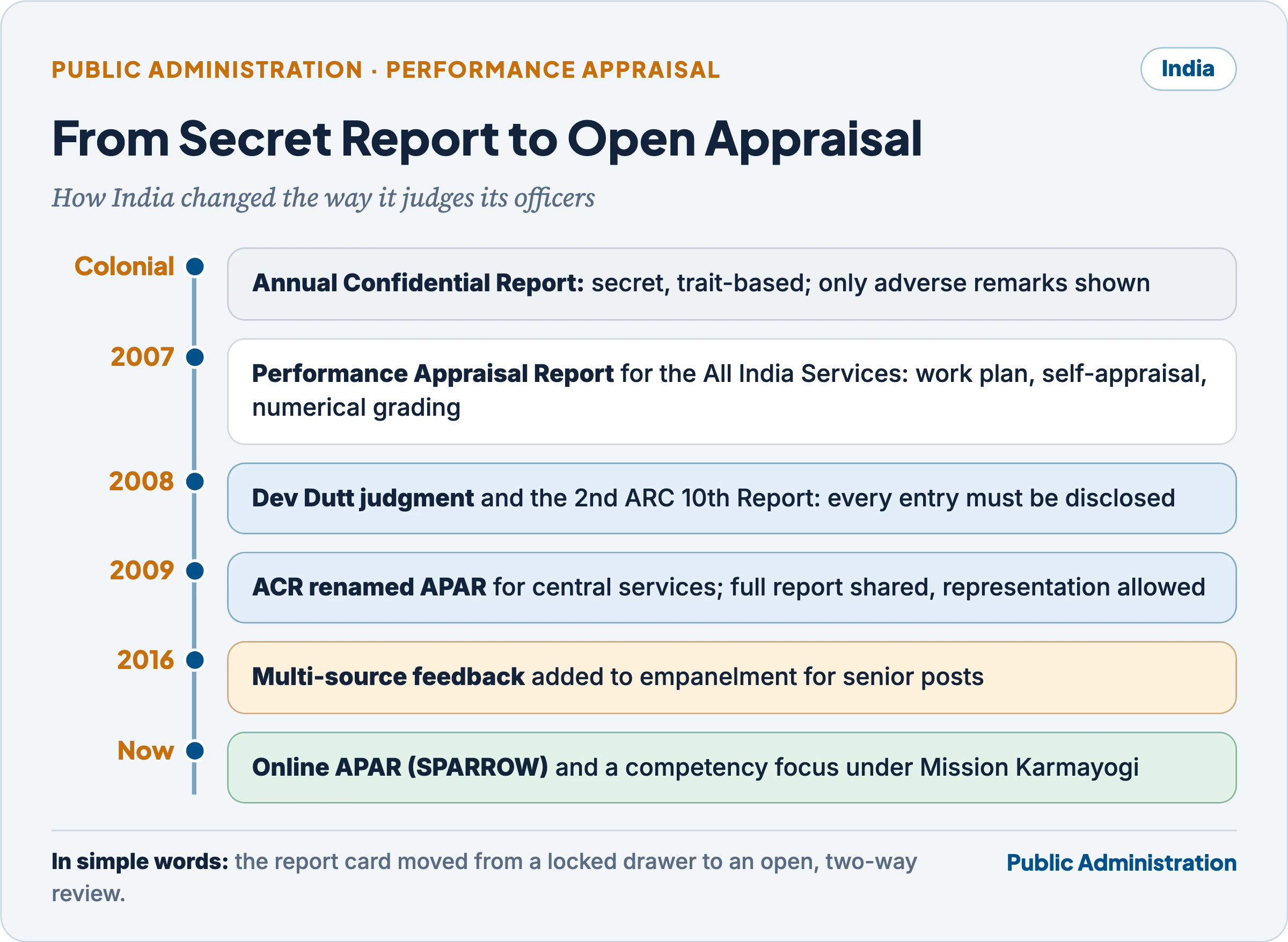
- The ACR, inherited from colonial practice, was a secret, trait-based report written by the reporting officer and reviewed by a higher officer. Only adverse remarks were communicated.
- Problems: subjectivity, lack of feedback, no link to work targets, grade inflation, use as an instrument of control, and long delays in writing reports.
- The 1st ARC (1966–70) suggested calling it a “performance record” and having officers submit an account of their own work; the 5th Central Pay Commission (1997) suggested a numerical rating scale.
5.2 The move to APAR
- AIS (Performance Appraisal Report) Rules, 2007. For IAS, IPS and IFoS officers, the ACR was replaced by a Performance Appraisal Report with a work plan, self-appraisal, numerical grading on a 1–10 scale and assessment of integrity.
- Dev Dutt v. Union of India (12 May 2008). The Supreme Court held that every entry in the report, not only adverse ones, must be communicated, because an uncommunicated “good” grade can block promotion where the benchmark is “very good”; non-communication violates fairness under Article 14.
- 2nd ARC 10th Report (2008) recommended that appraisal for all services be made consultative and transparent on the AIS pattern.
- DoPT Office Memorandum of 14 May 2009 renamed the ACR the Annual Performance Assessment Report (APAR) for central services and required the full report, including overall grade and integrity, to be disclosed, with a representation within 15 days, from the reporting year 2008–09.
- Online APAR. The SPARROW (Smart Performance Appraisal Report Recording Online Window) system, built by NIC, moved the APAR online for the All India Services and, from 2018–19, the Central Secretariat Service and others, tracking delays and pendency.
5.3 Multi-source feedback for empanelment
- The problem. Empanelment for Joint Secretary, Additional Secretary and Secretary posts used to rest almost wholly on APARs, which were inflated and did not capture integrity or capability.
- The response. Revised empanelment guidelines of April 2016 added multi-source feedback (MSF), drawing confidential views from seniors, juniors, peers and external stakeholders, alongside service record and vigilance status. DoPT told a parliamentary committee that this “360-degree review” was the same as MSF.
- The controversy. Officers who were not empanelled challenged the opacity of the process; members of Parliament and the parliamentary committee on personnel asked for transparency. In October 2023, DoPT told the Central Administrative Tribunal that there was no formal 360-degree appraisal system for empanelment, describing MSF as one input among several. The episode shows the tension between confidential feedback and the disclosure norm established in Dev Dutt.
Indian Connect — Appraisal reform in India: three lessons
- Disclosure changed behaviour. Once officers could see their grades, reporting officers began writing more careful remarks and representations became common.
- Grade inflation survived disclosure. With most officers rated 9 or 10, APARs stopped separating the good from the excellent, which pushed the government towards MSF and other inputs.
- Competency, not traits. Mission Karmayogi’s Framework of Roles, Activities and Competencies (FRAC) aims to link appraisal to the competencies a post needs, shifting from “rule-based” to “role-based” management.
5.4 Appraisal versus performance management
UPSC treats these as distinct activities, and the 2nd ARC built its 10th Report on the distinction.
| Feature | Performance appraisal | Performance management |
|---|---|---|
| Scope | One individual | Organisation, team and individual together |
| Timing | Once a year, backward-looking | Continuous cycle: plan, monitor, review, reward |
| Main purpose | Rating for promotion and rewards | Improving results and building capability |
| Link to goals | Weak | Individual targets cascade from organisational goals |
| Tools | ACR/APAR, rating scales | Strategic plans, performance agreements, dashboards, APAR as one input |
- Performance management framework. A good framework gives a clear line of sight from the government’s goals to a department’s plan, to a unit’s targets, to an officer’s work plan, and back through measurement and review. Each officer can see how his work contributes to outcomes.
- 2nd ARC 10th Report recommendations:
- Job-specific appraisal forms; a work plan with a mid-year review; clearer rules for numerical grading.
- Performance agreements between ministers and Secretaries with verifiable targets, assessed by a third party and reported to the legislature through outcome budgets.
- Two in-depth reviews in every career: at 14 years (developmental) and 20 years (fitness to continue), with exit for the unfit.
- Performance-related incentives, and domain assignment of senior officers.
- Indian experiments. The Performance Monitoring and Evaluation System (PMES), approved in September 2009, required each department to prepare an annual Results Framework Document (RFD) with weighted targets, monitored by a Performance Management Division in the Cabinet Secretariat. It was later discontinued in favour of PMO-led reviews, outcome budgets, PRAGATI and dashboard monitoring of flagship schemes.
- Limits of performance management. Public outcomes are shaped by many agencies and by factors no officer controls; targets can be gamed; and an over-tight “line of sight” may suppress discretion and innovation. Training alone rarely fixes poor performance either: performance problems often come from unclear goals, poor systems, lack of resources, wrong placement or weak motivation, so appraisal, job design, incentives and leadership must work together with training.
Criticism — The case against appraisal as practised in government
- Ritual, not management: reports are written late, by habit, and almost everyone is “outstanding”.
- Subjective and political: grades reflect loyalty to superiors and political masters as much as work.
- Promotion-obsessed: the developmental purpose is lost.
- Unmeasurable outputs: much public work (policy advice, coordination, order) resists quantification, so “objective” targets distort behaviour.
- Opaque gatekeeping: confidential feedback for empanelment brings back the secrecy that disclosure was meant to end.
Defence — The case for reformed appraisal
- Disclosure and representation have made the APAR fairer and more accountable than the ACR.
- Work plans and self-appraisal link the report to actual tasks.
- Multiple sources reduce dependence on one superior’s bias when used openly.
- Performance management connects individual effort to organisational results, as the 2nd ARC proposed.
- Online systems have cut delays, and competency frameworks under Mission Karmayogi link appraisal to training.
6. Employer–Employee Relations
In simple words
The government is the country’s biggest employer, but it is an unusual one: it makes the laws, sets the budget and cannot be shut down like a factory. So its employees cannot bargain and strike like factory workers, yet they still need a way to be heard. Joint councils, where officers and staff representatives sit together, are the answer most democracies found.
6.1 Why employer–employee relations in government are special
- The employer is the State, an impersonal entity represented by senior officers who are themselves employees and cannot settle pay without the approval of ministers, the Finance Ministry and Parliament. A long chain of authority separates the bulk of employees from the real decision-maker.
- No profit-and-loss yardstick. In private industry, wages can be linked to profits; in government there is no such automatic measure.
- Sovereign and essential functions. A strike in the police, power supply, hospitals or railways hurts the whole community, not just the employer.
- Constitutional dimension. Articles 309–311, Article 19 (association, expression) and Article 33 frame the relationship.
- Political dimension. Employee unions are often linked to political parties; pay commissions and pensions are electoral issues.
- Operational dimension. Day-to-day relations depend on supervisory style, grievance handling, welfare and consultation.
- Hence the need for machinery. Dissatisfaction that has no outlet smoulders into disputes and strikes. The aim is to bring disputes into the open early and settle them by discussion.
6.2 Staff associations and the right to association
- Article 19(1)(c) guarantees the right to form associations or unions; government servants share it, subject to reasonable restrictions.
- Recognition is not a fundamental right. Courts have held that the right to form an association does not include a right to have it recognised by the employer. Recognition, which gives a union the right to negotiate and to sit on joint councils, is governed by rules: the CCS (Recognition of Service Associations) Rules (originally 1959, revised in 1993) require a minimum membership share, a restriction of membership to one category of employees, no political affiliation, and no strike.
- Functions of staff associations: representing members on pay and service conditions; welfare and mutual help; discussing improvement of work; giving employees a sense of belonging and a collective voice; providing members for joint councils.
- Restrictions: members of the armed forces, police and intelligence (under Article 33 and laws such as the Police-Forces (Restriction of Rights) Act, 1966) may not form ordinary unions.
- Industrial workers in railways, defence production, posts and similar departments are often covered by the Industrial Disputes Act, 1947 and trade union law, alongside separate negotiating machinery (the Permanent Negotiating Machinery in Railways, 1952).
6.3 The right to strike
- No fundamental right. In Kameshwar Prasad v. State of Bihar (1962) the Supreme Court held that while a ban on all demonstrations was unconstitutional, the ban on strikes was valid, because there is no fundamental right to strike (following All India Bank Employees’ Association, 1962). Radhey Shyam Sharma v. Post Master General (1964) upheld the penalties imposed on postal employees under the Essential Services Maintenance Ordinance, 1960, after the July 1960 strike.
- T.K. Rangarajan v. Government of Tamil Nadu (6 August 2003). After Tamil Nadu dismissed a very large number of striking employees under the Tamil Nadu Essential Services Maintenance Act, the Supreme Court held that government employees have no fundamental, statutory, moral or equitable right to strike, that a strike in public services hurts society, and that employees should seek redress through the machinery provided (it nonetheless left room for the reinstatement of most employees).
- The statutory position. CCS (Conduct) Rule 7 forbids strikes; the Essential Services Maintenance Act (1968 and later versions) allows the government to prohibit strikes in notified services; recognition rules require associations to abjure strikes.
- Debate. Supporters of a limited right argue that a total ban weakens employees’ bargaining power and drives protest into informal channels; the ILO distinguishes essential services, where strikes may be restricted, from others. Defenders reply that government employees already enjoy security, pay commissions, joint councils and arbitration as a quid pro quo for giving up strikes.
- Is the right to strike the same as the right to form a union? No. Article 19(1)(c) protects forming an association; it does not protect any particular activity of that association. Striking, collective bargaining and recognition are not fundamental rights; they depend on statutes and rules. That is why a ban on strikes is valid while a ban on joining associations generally would not be.
6.4 Whitleyism: the British model
- Origin. In 1916 a sub-committee of the British Reconstruction Committee was set up under J.H. Whitley, a Liberal MP (later Speaker of the House of Commons), to consider relations between employers and employed. Its reports of 1917–18 recommended joint industrial councils at national, district and works levels with equal representation of employers and workers.
- Application to the civil service. After further committees, the Civil Service National Whitley Council met for the first time on 23 July 1919. It had an official side (representatives of the government as employer, led by the Treasury) and a staff side (representatives of staff associations), each of 27 members, with its scope covering “all matters which affect the conditions of service of the staff”. Departmental Whitley Councils and local committees mirrored it.
- Principles of Whitleyism:
- Joint consultation instead of confrontation: the two sides meet as partners, not adversaries.
- Equality of sides and decisions by agreement, reported to the Cabinet.
- Arbitration for unresolved pay disputes (the Civil Service Arbitration Tribunal from 1936).
- Recognition of staff associations as legitimate representatives.
- Wide scope: pay, hours, leave, promotion principles, training, welfare and efficiency, but not individual cases.
- “A typical British response to trade unionism.” Whitleyism was a way of absorbing the rising unionism of civil servants after the First World War into a structured, cooperative channel, avoiding both the denial of unions and American-style adversarial bargaining. It reflected the British preference for consensus, gradualism and informal agreement.
- Later history. The full National Council rarely met after the 1920s; business moved to committees and direct negotiations between the staff side and the Treasury. In 1980 the staff side was reconstituted as the Council of Civil Service Unions, and from the 1980s delegation of pay to departments and agencies under Thatcherite reforms weakened the national Whitley structure.
6.5 The Joint Consultative Machinery in India
- Early attempts. Employee organisations sought Whitley-type machinery from the 1920s. The First Pay Commission (1947) recommended joint councils on Whitley lines; staff committees were set up in ministries in 1954 and renamed staff councils in 1957. They were advisory, nominated by officials, dealt with trivial matters (water coolers, canteens, uniforms) and were dismissed by unions as “eyewash”. The Second Pay Commission (1959) called for machinery that followed the Whitley model “fully in spirit and largely in form”.
- The JCM Scheme (1966). The Scheme for Joint Consultative Machinery and Compulsory Arbitration for Central Government Employees was introduced in 1966 after consultation with employee leaders. It covers over 95% of regular civil employees of the Union, including industrial employees of the railways and defence workshops.
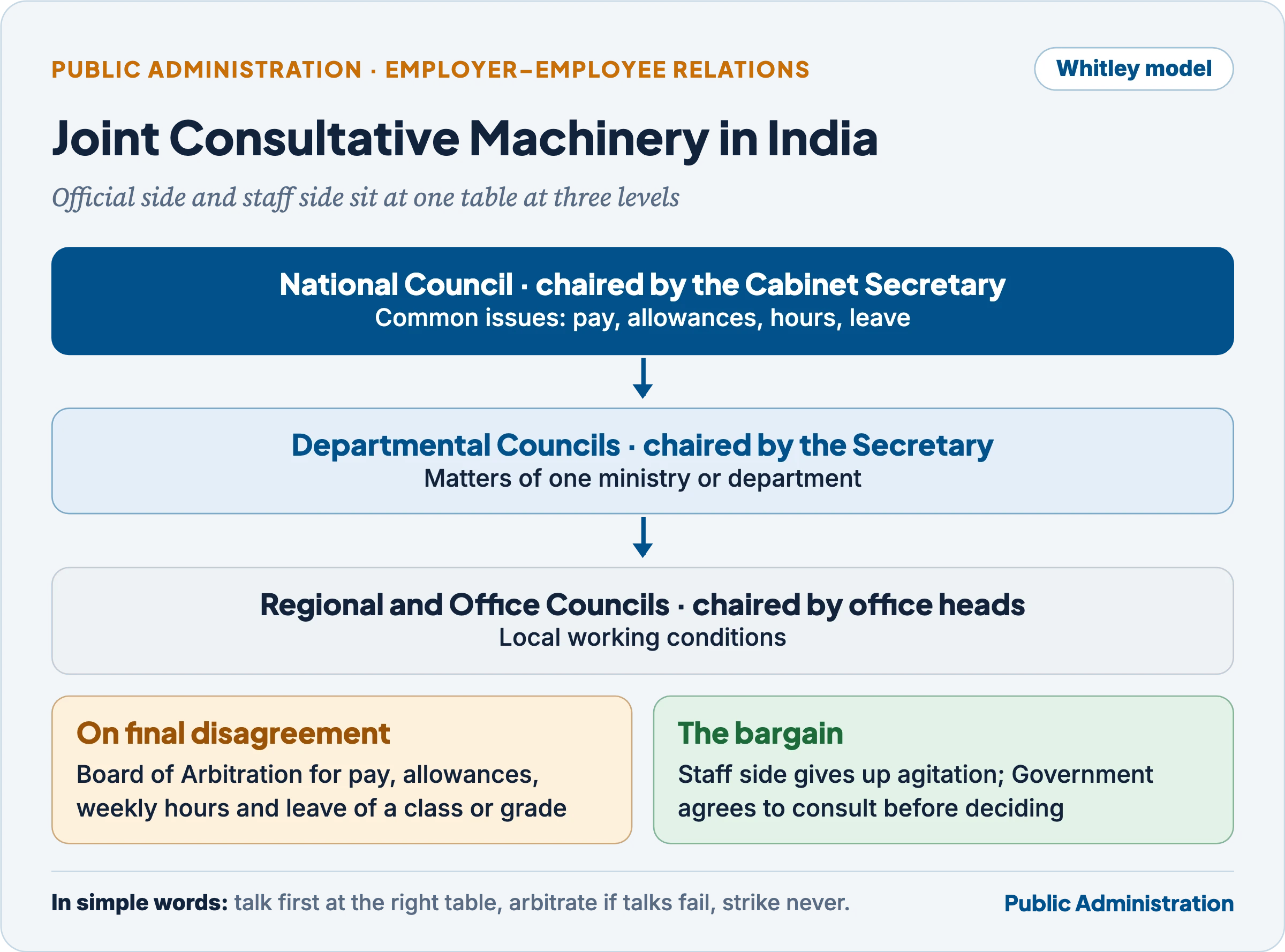
- Structure:
- National Council: chaired by the Cabinet Secretary; official side nominated by government; staff side nominated by recognised federations. It deals with matters affecting Central Government employees generally: minimum remuneration, dearness allowance, pay of common categories, hours and leave.
- Departmental Councils: one for each ministry or department, chaired by its Secretary, for matters of that department.
- Regional and Office Councils: chaired by the head of a region or office, for local matters such as duty hours, distribution of work and amenities.
- Scope. Conditions of service and work, welfare, efficiency and standards of work; on recruitment, promotion and discipline only general principles, never individual cases.
- Compulsory arbitration. On final disagreement in the National or a Departmental Council, matters of pay and allowances, weekly hours of work and leave of a class or grade can be referred to a Board of Arbitration (under the Ministry of Labour). The Government accepts awards subject to Parliament’s power to modify or reject them on grounds of national economy or social justice.
- Declaration of Joint Intent. Participation is voluntary; both sides sign a declaration under which staff associations abjure agitational methods such as strikes in return for consultation and arbitration. This is the Indian version of the Whitley bargain: mutual reliance in place of conflict.
Indian Connect — JCM at work
- The National Council’s staff side is the main negotiating voice of Central Government employees before Pay Commissions: it submitted memoranda to the 7th Central Pay Commission and is doing so for the 8th Central Pay Commission, constituted by Gazette notification of 3 November 2025 under Justice Ranjana Prakash Desai, after the Cabinet approved its Terms of Reference on 28 October 2025.
- Employee federations through the JCM pressed for reform of the New Pension System, which led to the Unified Pension Scheme, effective from 1 April 2025, as an option within the NPS.
- The 1968 token strike showed the limits: after it, several associations were derecognised and the National Council met without full strength for some years.
6.6 Assessment of JCM and the relevance of Whitleyism today
- Achievements: a standing forum at three levels; a channel for pay commission follow-up and dearness allowance; a reduction in strikes compared with the pre-1966 period; arbitration as a safety valve.
- Weaknesses:
- Irregular meetings: the National Council has often gone years without meeting; Departmental and Office Councils exist on paper in many places.
- Unequal partners: the official side sets the agenda and implementation; the Finance Ministry’s veto makes the councils consultative in practice.
- Arbitration awards are delayed and sometimes not implemented.
- Fragmentation and politicisation of unions, and multiple rival federations.
- Exclusion of Group A officers and of contractual and outsourced staff, who are a growing share of the public workforce.
- Relevance of Whitleyism today.
- Still relevant: the core idea of consultation and partnership fits modern human resource thinking (participative management, Likert’s System 4, employee engagement) and New Public Service values better than command-and-control.
- Under pressure: NPM reforms decentralised pay, introduced contracts and performance pay, and weakened centralised bargaining; the casualisation of public employment leaves many workers outside the machinery.
- Way forward: regular meetings with time-bound follow-up, an independent arbitration board with enforceable timelines, inclusion of contractual workers through suitable forums, use of consultation on reforms such as Mission Karmayogi, digital grievance and consultation platforms, and a shared commitment to productivity.
- Mutual reliance. The employer relies on employees for delivery and morale; employees rely on the employer for security, fair pay and voice. When both sides see it this way, disputes become problems to solve together, which is exactly what the Whitley tradition intended.
7. Grievance Redressal for Employees
In simple words
A grievance is any feeling of unfairness about the job: a delayed promotion, a wrong pay fixation, an unfair transfer. If it is not heard, the employee either stops caring or takes it to court or the media. A good system hears it early, inside the office, and settles it quickly.
7.1 Meaning and sources of grievances
- An employee grievance is a complaint, real or imagined, about conditions of service or treatment at work: pay fixation, seniority, promotion, transfer, leave, APAR remarks, disciplinary action, pension, harassment, or working conditions.
- Collective grievances (pay scales, allowances) go to the JCM; individual grievances need separate machinery, since the JCM excludes individual cases.
- Consequences of neglect: low morale, absenteeism, litigation, leaks to the media, union agitation, and loss of productivity. The 2017 Paper II question on civil servants airing grievances in the media turns precisely on this: the conduct rules forbid going to the press, which is fair only if internal channels actually work.
7.2 Machinery available to Central Government employees
- Within the organisation:
- Grievance officers / Staff Grievance Officers designated in every ministry and department (an officer of Deputy Secretary rank or above), with “open days” for staff.
- Representation to the controlling and higher authorities, with time limits.
- Statutory remedies within the service rules: appeal, revision and review under the CCS (CCA) Rules; representations against APAR entries.
- Internal Complaints Committees under the Sexual Harassment of Women at Workplace Act, 2013.
- Welfare officers and the JCM for collective issues.
- CPGRAMS. The Centralised Public Grievance Redress and Monitoring System, run by the Department of Administrative Reforms and Public Grievances (DARPG), is an online platform for grievances against any ministry; serving employees and pensioners also use it for service and pension matters (pension grievances have a parallel portal, CPENGRAMS, of the Department of Pension and Pensioners’ Welfare).
- Comprehensive Guidelines (August 2024) reduced the redressal timeline from 30 days to 21 days, required dedicated grievance cells, root-cause analysis and action on citizen feedback, and strengthened appeals.
- In 2025, the average disposal time for Central Ministries and Departments was 15 days, and 82.1% of grievances were disposed of within 21 days; 22.78 lakh grievances were received in 2025 (PIB, March 2026).
- Critique: a centralised portal is good at tracking but weak at local issues, which depend on field offices and State nodal officers; quality of disposal (closing cases without solving them) is a recurring complaint.
- Outside the organisation (the tribunal route): service disputes go to the Central Administrative Tribunal (CAT), set up in 1985 under the Administrative Tribunals Act, 1985 and Article 323A, with State Administrative Tribunals where established. Since L. Chandra Kumar v. Union of India (1997), CAT decisions are subject to the writ jurisdiction of High Courts. The structure and working of tribunals are discussed in the article on administrative tribunals.
Indian Connect — Why grievance redressal is called the weakest link
- Internal grievance officers are often busy line officers with no authority over the decision complained of.
- Departments that cause the grievance also decide it, so employees go to the CAT, where service cases form a large backlog.
- The 2nd ARC’s 12th Report (Citizen Centric Administration, 2009) proposed process re-engineering and analysis of grievance patterns so that the cause, not just the complaint, is removed; the August 2024 CPGRAMS guidelines adopt the same logic of root-cause analysis.
7.3 Improving grievance redressal
- Prevent grievances: clear rules, timely promotions and pay fixation, transparent transfers and APARs (process re-engineering removes the reason to complain).
- Empower internal grievance officers with authority, timelines and a duty to give reasons.
- Make digital systems local: integrate CPGRAMS with State and field-office systems; track quality of disposal, not only speed.
- Mediation before litigation: in-house mediation and Lok Adalat-type settlement for service disputes to reduce the tribunal backlog.
- Feedback loops: use grievance data in performance reviews of supervisors.
Key Terms
The terms below recur across the article.
| Term | Meaning in simple words |
|---|---|
| Code of conduct | Written list of what an official must and must not do |
| Doctrine of pleasure | Civil servants hold office at the pleasure of the President or Governor (Article 310) |
| Article 311 | Constitutional safeguards before dismissal, removal or reduction in rank |
| Reduction in rank | Demotion to a lower post or grade as a penalty |
| Minor penalty | Censure, withholding of promotion or increments, recovery, one-stage reduction |
| Major penalty | Larger reduction, compulsory retirement, removal, dismissal |
| Removal and dismissal | Both end service; dismissal ordinarily bars future government jobs |
| Suspension | Keeping an employee off duty during an inquiry; not a penalty |
| FR 56(j) | Rule allowing premature retirement in the public interest; not a penalty |
| Natural justice | Fair procedure: no bias, and a hearing for the accused |
| Charge-sheet | Written statement of the charges and the evidence relied upon |
| Inquiring Authority | Officer who holds the departmental inquiry |
| Performance appraisal | Periodic evaluation of an employee’s work and potential |
| Performance management | Year-round system linking individual targets to organisational goals |
| APAR | Annual Performance Assessment Report, the open successor to the ACR |
| Multi-source feedback | Ratings from seniors, peers, juniors and outsiders (360°) |
| BARS | Rating scale whose points are tied to described behaviours |
| MBO | Appraisal against goals agreed in advance by superior and subordinate |
| Halo effect | One quality colouring the whole rating |
| Staff association | Union of government employees |
| Recognition | Employer’s acceptance of a union as a representative for negotiation |
| Whitleyism | British system of joint councils of official and staff sides |
| JCM | Joint Consultative Machinery, India’s Whitley-type councils (1966) |
| Compulsory arbitration | Reference of pay, hours and leave disputes to a Board of Arbitration |
| CPGRAMS | Online grievance portal run by DARPG |
Commissions, Committees and Judgments
The main bodies and cases are gathered here.
| Body / case | Year | Key point |
|---|---|---|
| Whitley Committee (J.H. Whitley) | 1916–18 | Joint councils of employers and employed |
| Civil Service National Whitley Council (UK) | 1919 | Official side and staff side; joint consultation |
| First Central Pay Commission | 1947 | Recommended Whitley-type joint councils |
| Second Central Pay Commission | 1959 | Recommended joint consultation and arbitration, leading to JCM |
| Kameshwar Prasad v. State of Bihar | 1962 | Ban on all demonstrations struck down; no fundamental right to strike |
| Santhanam Committee | 1964 | Uniform conduct rules; CVC; basis of FR 56(j) |
| Radhey Shyam Sharma v. PMG | 1964 | Penalties under the essential services ordinance upheld |
| JCM Scheme | 1966 | Three-tier councils and compulsory arbitration |
| 42nd Amendment | 1976 | Second show-cause notice on penalty removed |
| Union of India v. Tulsiram Patel | 1985 | Second proviso to Article 311(2) valid; inquiry can be dispensed with |
| ECIL v. B. Karunakar | 1993 | Inquiry report to be given to the employee before decision |
| L. Chandra Kumar v. Union of India | 1997 | Tribunal decisions subject to High Court review |
| T.K. Rangarajan v. Government of Tamil Nadu | 2003 | No fundamental, statutory or moral right to strike |
| 2nd ARC, 4th Report (Ethics in Governance) | 2007 | Repeal Article 311 with a protective law under Article 309 |
| Dev Dutt v. Union of India | 2008 | All appraisal entries must be communicated |
| 2nd ARC, 10th Report (Refurbishing of Personnel Administration) | 2008 | Performance management, 14- and 20-year reviews, summary discipline |
| Ajay Kumar Choudhary v. Union of India | 2015 | Suspension beyond three months needs a charge-sheet |
| 8th Central Pay Commission (Justice Ranjana Prakash Desai) | 2025 | Pay, pensions and service conditions of Central employees |
Contemporary Developments
- 9 July 2024: DoPT removed the mention of the RSS from the 1966, 1970 and 1980 memoranda listing organisations whose activities attract Rule 5 of the CCS (Conduct) Rules.
- August 2024: DARPG’s Comprehensive Guidelines for Effective Redressal of Public Grievances cut the CPGRAMS timeline from 30 to 21 days and required grievance cells and root-cause analysis.
- February 2025: a Review Meeting Module was added to CPGRAMS for senior-level review of grievances.
- 1 April 2025: the Unified Pension Scheme came into effect as an option for Central Government employees under the NPS, after prolonged employee demands.
- 28 October and 3 November 2025: the Cabinet approved the Terms of Reference of the 8th Central Pay Commission, which was constituted under Justice Ranjana Prakash Desai with 18 months to report.
- 2025 data (PIB, March 2026): 22.78 lakh grievances received on CPGRAMS; average disposal time 15 days; 82.1% disposed of within 21 days.
- October 2023: DoPT told the Central Administrative Tribunal that there was no formal 360-degree appraisal system for empanelment, reopening the debate on transparency in multi-source feedback.
Revision Grid
| Thinker / body | Work or report (year) | Key idea |
|---|---|---|
| O. Glenn Stahl | Public Personnel Administration | Punishment can never be wholly avoided; positive discipline first |
| Douglas McGregor | “An Uneasy Look at Performance Appraisal” (1957) | Superior as coach, not judge; goal-based appraisal |
| Peter Drucker | The Practice of Management (1954) | Management by objectives |
| Smith and Kendall | BARS (1963) | Rating anchored to concrete behaviour |
| J.B. Probst | Checklist rating (1927) | Ticking listed traits to limit rater judgement |
| J.H. Whitley | Whitley Committee reports (1917–18) | Joint councils of employers and employed |
| Santhanam Committee | Report (1964) | Uniform conduct rules; vigilance machinery |
| Second Pay Commission | Report (1959) | Joint consultation and arbitration for Central employees |
| 2nd ARC | 4th Report (2007) | Repeal Article 311; code of ethics |
| 2nd ARC | 10th Report (2008) | Performance management; career reviews; summary discipline |
| Supreme Court | Tulsiram Patel (1985) | Limits of Article 311 protection |
| Supreme Court | Rangarajan (2003) | No right to strike for government employees |
| Supreme Court | Dev Dutt (2008) | Open appraisal |
Previous Year Questions
- 2024Performance Management and Performance Appraisal are two distinct activities in Public Personnel Administration. Discuss.
- 2024Civil Servants should be allowed only to cast vote or to participate in the electoral process of the country. Examine.
- 2023“Instead of conflicting, the employer-employee relationship should be one of mutual reliance.” Explain.
- 2022Performance problems are rarely caused simply by lack of training and rarely can performance be improved by training alone. Critically analyse the statement.
- 2022Standards are the foundation which do not replace regulations but complement them. Comment.
- 2021Performance appraisal needs to be seen beyond the mere suitability of the official for vertical promotion. Explain.
- 2020“Performance Management Framework enables a clear line of sight between planning, measuring and monitoring performance.” Critically analyse.
- 2019A more effective system of performance appraisal should acknowledge the subjective elements in it and be less obsessed with the objective criteria. Elucidate.
- 2017“360° performance appraisal system is a rational idea, but it involves complex and inauthentic procedures.” How can it be made foolproof?
- 2016“A central reason for utilization of Performance Appraisal is performance improvement of the employees.” In the light of the statement, analyze the needs of Performance Appraisal in an Organization.
- 2016“Disciplinary action may be informal and formal.” Explain and point out the provisions made in the Constitution or Statute to check the misuse of power to take disciplinary action.
- 2015Analyse the relevance of Whitleyism in contemporary employer – employee relationship.
- 2005Why do public organisations evaluate employees’ performance/ How can performance evaluation systems affect employees’ behaviour? How can administration effectively evaluate employees?
- 2002Analyse the constitutional, political and operational dimensions of employer – employee relations. What are your suggestions to bring about a satisfactory relationship between them?
- 2001What techniques the Government of India have employed to evaluate (appraise) the performance of senior level employees, i.e., Class I and Class II? Are you satisfied with these techniques?
- 1996Public Agencies have used a number of sources and procedures for measuring Performance. Comment.
- 1990‘Public interest demands the maintenance of political impartiality in the civil services.’ Comment.
- 1987‘Whitleyism represents a typical British response to Trade Unionism by public servants.’ Comment.
- 2025Centralized Public Grievance Redress and Monitoring System (CPGRAMS) does not effectively address local level issues. Give your opinion.
- 2018“Effective public grievance redressal requires administrative commitment. But process reengineering can help prevent some grievances.” Discuss.
- 2017“Civil servants should avoid airing grievances in the media.” In this context, discuss the grievance redressal mechanism available to the Civil Servants in India.
- 2015Discuss the major highlights of the reforms introduced from time-to-time in Central Civil Services Conduct Rules and add your own Comments.
- 2014Elaborate the features of the grievance redressal mechanism of the civil services in India. Does this mechanism satisfy the objectives of its creation?
- 2011‘Performance Appraisal Systems’ with special reference to the Performance Management and Evaluation System (PMES) are expected to transform the bureaucratic culture of Indian administration. Do you agree? Give reasons.
- 2011“Grievance redressal system is perhaps the weakest link in India’s civil service management.” Comment.
- 2009“The weakest aspect of Indian administration is the grievance redressal machinery.” Discuss.
- 2000Do you think that our administration is sensitive to public grievances? Discuss the existing grievances redressal mechanism and give suggestions for enhancing its capabilities.